

- Industry Size (2026)
- USD 413.3 Mn
- Forecast (2036)
- USD 969.5 Mn
- CAGR (2026 to 2036)
- 8.9%
Non-Biocidal Slime Control Agents for Cooling Systems Market Forecast and Outlook 2026 to 2036
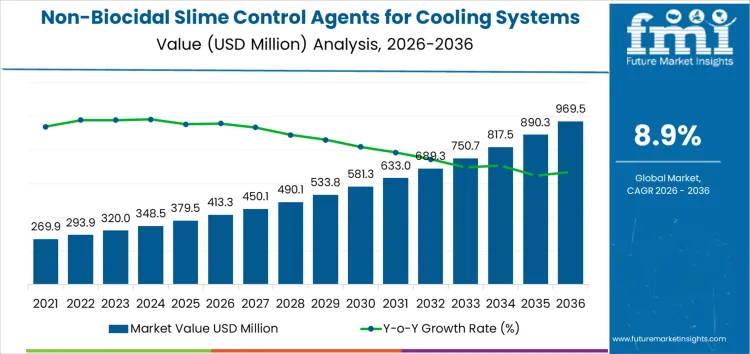
The non-biocidal slime control agents for cooling systems market is valued at USD 413.3 million in 2026 and is projected to reach USD 969.5 million by 2036, with a compound annual growth rate (CAGR) of 8.9%. Growth in this market is driven by a high concentration of applications within key sectors such as industrial cooling, HVAC systems, and power generation. These industries heavily depend on effective slime control to maintain operational efficiency, leading to stable, repeat demand. Volume stability is crucial, as these systems require ongoing maintenance with predictable chemical usage rates.
End-use dependency plays a significant role in determining growth quality, with specific industries maintaining long-term relationships with suppliers to ensure reliability. While the market is poised for steady expansion, growth will be constrained by the challenges of offering non-biocidal alternatives that meet regulatory standards and performance expectations. As a result, suppliers must focus on both innovation and consistency to secure their position in the competitive landscape.
Quick Stats of the Non-Biocidal Slime Control Agents for Cooling Systems Market
- Non-Biocidal Slime Control Agents for Cooling Systems Market Value (2026): USD 413.3 million
- Non-Biocidal Slime Control Agents for Cooling Systems Market Forecast Value (2036): USD 969.5 million
- Non-Biocidal Slime Control Agents for Cooling Systems Market Global Forecast CAGR (2026 to 2036): 8.9%
- Non-Biocidal Slime Control Agents for Cooling Systems Market Leading Segment: Cooling System Type (Open Recirculating Cooling Towers) 38%
- Key Growth Regions in Non-Biocidal Slime Control Agents for Cooling Systems Market: India
- Top Players in Non-Biocidal Slime Control Agents for Cooling Systems Market: Ecolab, Solenis, Nalco Water (Ecolab), Kemira, Kurita Water Industries
What is the Growth Forecast for the Non-Biocidal Slime Control Agents for Cooling Systems Market through 2036?
The long-term value accumulation curve for the non-biocidal slime control agents for cooling systems market demonstrates consistent growth over the forecast period, with significant increases in market value, particularly in the first half of the decade. Starting at USD 413.3 million in 2026, the market will steadily increase to USD 647.5 million in 2031. This initial growth reflects the growing adoption of non-biocidal agents as industries shift toward more sustainable solutions in response to rising environmental concerns and regulatory pressures.
The second phase of growth, from 2031 to 2036, will see continued expansion, though at a slightly slower pace, as the market matures. From USD 647.5 million in 2031, the market will reach USD 969.5 million by 2036, accumulating USD 323.2 million over the next five years. This steady increase reflects ongoing market adoption, technological improvements, and the integration of non-biocidal solutions into standard cooling system maintenance practices. The long-term value accumulation curve indicates a stable but strong growth trajectory, driven by the continued demand for environmentally friendly alternatives and the increasing focus on sustainability in industrial operations.
Non-Biocidal Slime Control Agents for Cooling Systems Market Key Takeaways
| Metric | Value |
|---|---|
| Industry Sales Value (2026) | USD 413.3 million |
| Industry Forecast Value (2036) | USD 969.5 million |
| Industry Forecast CAGR (2026 to 2036) | 8.9% |
What Is Driving the Demand for the Non-Biocidal Slime Control Agents for Cooling Systems Market Globally?
The global demand for non-biocidal slime control agents for cooling systems is driven by increasing regulatory restrictions on traditional biocides, heightened focus on environmental safety, and operational needs in industrial and commercial sectors. Cooling systems in power plants, manufacturing facilities, and large building complexes are vulnerable to slime and biofilm formation, which can reduce heat transfer efficiency, increase energy use, and accelerate corrosion.
Conventional biocidal treatments control microbial growth but pose risks to downstream ecosystems through toxic discharges and regulatory limitations on hazardous chemical use in many regions including Europe, North America, and Asia. In response, facility operators and water treatment professionals are adopting non-biocidal alternatives that inhibit slime formation through physical and chemical mechanisms without releasing toxic substances. These agents help maintain system cleanliness, reduce maintenance frequency, and align with corporate sustainability commitments aimed at lowering environmental impact. Increased industry awareness of water reuse, discharge quality standards, and lifecycle operating costs has reinforced the value of safer treatment options that support reliable cooling performance without compromising compliance.
Future demand for non-biocidal slime control agents for cooling systems is expected to grow as industries prioritise sustainable water management and cost-effective operations. Advances in formulation technologies are improving the ability of non-biocidal agents to prevent both organic and microbial fouling across diverse water chemistries, temperatures, and flow conditions. Integration with real-time water monitoring and control systems enables more precise dosing and early detection of fouling, helping operators optimise performance and reduce unnecessary chemical use.
Regulatory frameworks that emphasise reduced toxic load in industrial effluents and promote water conservation will continue to shape how treatment strategies are selected worldwide. Expansion of cooling system applications in data centers, petrochemical facilities, and district energy networks will sustain demand for effective slime control solutions that support system efficiency and longevity. As facility managers seek to balance compliance, environmental stewardship, and operational costs, non-biocidal slime control agents that deliver measurable benefits without toxic byproducts are poised to see continued global market growth.
What are the Leading Segments in the Global Non-Biocidal Slime Control Agents for Cooling Systems Market?
The global non-biocidal slime control agents for cooling systems market is segmented by agent type and cooling system type. Among agent types, polymer-based slime control agents lead the market, capturing 30% of the share, followed by enzymatic & bio-based anti-slime agents, surfactant-based dispersants, chelating & fouling prevention agents, and other non-biocidal slime control additives. Polymer-based agents are preferred for their effectiveness in controlling microbial growth and preventing slime formation without introducing biocides. On the cooling system type side, open recirculating cooling towers dominate the market, holding 38% of the share, followed by closed loop cooling systems, once-through cooling systems, hybrid & advanced cooling systems, and decentralized/modular cooling units. Open recirculating cooling towers are the most common type in industries that require large-scale cooling systems, driving the demand for non-biocidal slime control agents.
What Drives the Growth of Polymer-Based Slime Control Agents in the Non-Biocidal Slime Control Agents for Cooling Systems Market?
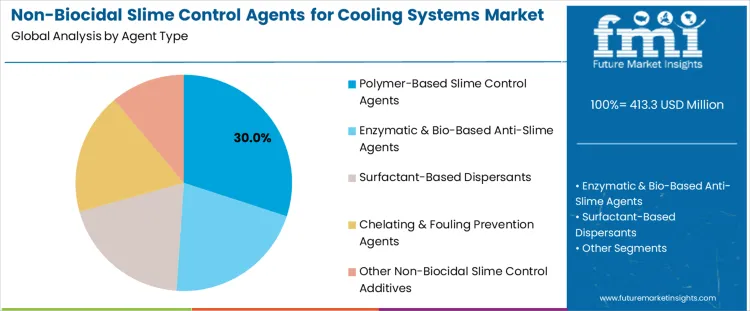
Polymer-based slime control agents are the leading agent type in the non-biocidal slime control agents for cooling systems market, holding 30% of the share. These agents are highly effective at controlling the growth of microorganisms and the formation of biofilm or slime, which can lead to blockages, reduced heat transfer efficiency, and maintenance issues in cooling systems. Polymer-based agents work by disrupting the cell structure of microorganisms, preventing their growth and accumulation in the system. Their effectiveness, combined with their ability to function without biocides, makes them an attractive solution for industries seeking environmentally friendly, non-toxic alternatives. As regulations on chemical use in cooling systems tighten and companies prioritize sustainability, the demand for polymer-based slime control agents is expected to increase. The ability of these agents to perform well in various cooling systems, particularly in large-scale open recirculating cooling towers, further drives their adoption, ensuring their dominance in the market.
What is Driving the Demand for Open Recirculating Cooling Towers in the Non-Biocidal Slime Control Agents for Cooling Systems Market?
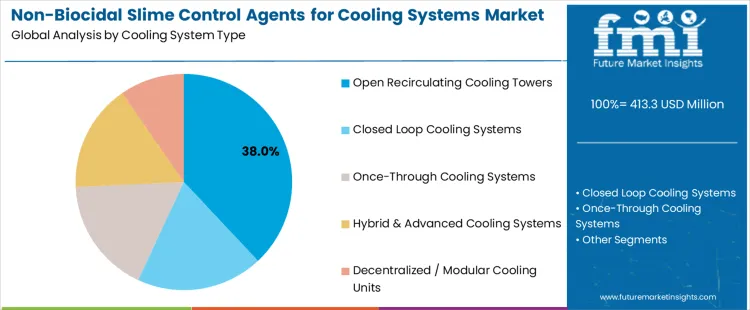
Open recirculating cooling towers are the leading cooling system type in the non-biocidal slime control agents for cooling systems market, capturing 38% of the share. These cooling towers are commonly used in industries such as power generation, chemical processing, and manufacturing, where large amounts of water are needed to dissipate heat from industrial processes. The recirculating nature of these cooling towers makes them susceptible to biofouling, including slime formation, which can significantly reduce their efficiency and increase operational costs. Non-biocidal slime control agents, particularly polymer-based and enzymatic agents, are crucial in preventing microbial growth and maintaining the optimal performance of these systems. As industries increasingly adopt non-toxic, environmentally friendly solutions for slime control, the demand for non-biocidal additives in open recirculating cooling towers continues to grow. The widespread use of these systems in high-demand sectors ensures their dominance as a key application area for slime control agents.
What are the Key Dynamics in the Global Non-Biocidal Slime Control Agents for Cooling Systems Market?
The global non-biocidal slime control agents for cooling systems market is expanding as industrial, commercial and power generation facilities adopt safer methods to manage biofilm, slime and microbial deposits without relying on traditional biocides. These control agents help reduce accumulation of organic and microbial films on heat exchange surfaces, improving thermal efficiency, reducing corrosion risk and lowering maintenance needs. Market growth is influenced by stricter environmental regulations on chemical discharge, rising demand for sustainable water treatment solutions, and increased focus on operational uptime and equipment longevity in cooling towers, HVAC systems and industrial water loops.
What are the Key Drivers for the Non-Biocidal Slime Control Agents for Cooling Systems Market?
Regulatory pressure to reduce reliance on toxic biocidal chemicals is a major driver, as wastewater discharge limits tighten across regions and industries. Facility managers seek alternatives that control microbial fouling while minimizing environmental impact and worker exposure. Continued emphasis on energy efficiency in cooling operations motivates use of additives that keep heat transfer surfaces clean and performant without frequent shutdowns for cleaning. Advances in polymeric dispersants, anti-adhesion surface modifiers and environmentally friendly surfactants support broader use of non-biocidal strategies. Growth in sectors such as manufacturing, data centers and commercial buildings also supports adoption where reliable cooling performance is critical.
What are the Restraints for the Non-Biocidal Slime Control Agents for Cooling Systems Market?
One restraint is variability in field effectiveness across diverse water qualities, temperatures and microbial communities, which can require site-specific optimization and pilot testing. Some facilities may be cautious about switching from conventional biocides until non-biocidal agents demonstrate reliable control under local operating conditions. Perceived higher initial cost for advanced control chemistries compared with generic biocides may affect uptake in budget-constrained operations. Integration with existing water treatment programs and control systems requires expertise, as balancing dispersants, anti-adhesion agents and feed strategies influences outcome. Limited long-term performance data in certain applications can also slow adoption where operational risk tolerance is low.
What are the Key Trends in the Non-Biocidal Slime Control Agents for Cooling Systems Market?
A key trend is development of tailored, low-toxicity control chemistries that combine anti-adhesion, dispersant and scale management functions, reducing the need for multiple separate additives. Supplier focus on formulations that minimize foaming, corrosion and environmental footprint aligns with sustainability goals and green building standards. Integration of real-time monitoring, digital dosing and automated control systems helps facilities optimize additive use, reduce waste and track performance metrics. Collaboration between chemical specialists, equipment OEMs and water treatment professionals is increasing to refine best practices and support broader adoption of non-biocidal approaches that maintain system efficiency and regulatory compliance.
What is the Country-Wise Analysis of the Non-Biocidal Slime Control Agents for Cooling Systems Market?
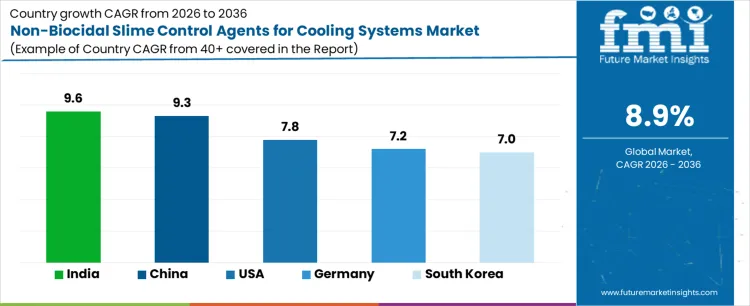
The non-biocidal slime control agents for cooling systems market is projected to grow steadily, driven by increasing demand for eco-friendly and sustainable solutions to control microbial growth and biofouling in cooling systems. These agents are used to prevent the formation of slime and other microorganisms in industrial cooling systems without the use of biocides, offering a safer and more environmentally friendly alternative to traditional treatments. High-growth markets like India and China are witnessing strong demand due to their expanding industrial sectors and growing awareness about environmental impact. Developed markets such as the United States, Germany, and South Korea are also experiencing steady growth, supported by stringent environmental regulations, technological advancements in water treatment, and the shift toward sustainable industrial practices.
| Country | CAGR (%) |
|---|---|
| India | 9.6 |
| China | 9.3 |
| USA | 7.8 |
| Germany | 7.2 |
| South Korea | 7.0 |
What is the Growth Outlook for the Non-Biocidal Slime Control Agents for Cooling Systems Market in India?
The non-biocidal slime control agents for cooling systems market in India is expected to grow at the highest rate, with a projected CAGR of 9.6%. India’s rapidly growing industrial and manufacturing sectors are driving the demand for cooling systems, particularly in sectors like power generation, chemicals, and HVAC (heating, ventilation, and air conditioning). With increasing concerns about the environmental impact of biocidal treatments, industries in India are increasingly adopting non-biocidal alternatives to prevent microbial growth and slime formation in cooling systems. The government’s push for sustainable industrial practices, combined with rising awareness of water management and pollution control, is expected to accelerate the adoption of non-biocidal slime control agents in India’s industrial operations.
What is the Market Outlook for the Non-Biocidal Slime Control Agents for Cooling Systems Market in China?
The non-biocidal slime control agents for cooling systems market in China is projected to grow steadily, with a projected CAGR of 9.3%. China’s rapid industrialization, particularly in sectors such as power generation, manufacturing, and chemical processing, has led to an increased demand for cooling systems. With stringent environmental regulations and growing concerns about the impact of biocides on water quality and ecosystem health, there is rising demand for non-biocidal solutions. The Chinese government’s commitment to sustainable industrial practices and water conservation is driving the market for non-biocidal slime control agents. As China continues to focus on environmental sustainability, the demand for eco-friendly water treatment solutions will continue to grow, further expanding the market.
What is the Growth Forecast for the Non-Biocidal Slime Control Agents for Cooling Systems Market in the United States?
The non-biocidal slime control agents for cooling systems market in the United States is expected to grow steadily, with a projected CAGR of 7.8%. The USA market is driven by the growing demand for more sustainable and environmentally friendly water treatment solutions in industries such as power generation, HVAC, and chemical processing. With increasingly stringent environmental regulations, industries are shifting away from biocidal treatments and adopting non-biocidal alternatives to control microbial growth in cooling systems. The USA government’s focus on reducing water pollution and improving sustainability practices in industrial operations is further encouraging the adoption of non-biocidal slime control agents. As sustainability becomes a priority, the market for these solutions is expected to grow steadily in the USA.
What is the Market Outlook for the Non-Biocidal Slime Control Agents for Cooling Systems Market in Germany?
The non-biocidal slime control agents for cooling systems market in Germany is projected to grow steadily, with a projected CAGR of 7.2%. Germany’s strict environmental regulations, combined with its commitment to sustainability, are key drivers of the market. As industries in Germany work to comply with environmental standards and reduce the environmental impact of cooling systems, the demand for non-biocidal slime control agents is increasing. The German government’s support for sustainable technologies and eco-friendly water management solutions is further encouraging the adoption of non-biocidal solutions in cooling systems. As the market for green technologies continues to expand, Germany’s non-biocidal slime control agents market is set for steady growth.
What are the Growth Prospects for the Non-Biocidal Slime Control Agents for Cooling Systems Market in South Korea?
The non-biocidal slime control agents for cooling systems market in South Korea is expected to grow steadily, with a projected CAGR of 7%. South Korea’s industrial sectors, including power generation, manufacturing, and petrochemicals, are major consumers of cooling systems. As the country works to improve its sustainability practices and reduce environmental impact, there is a growing demand for non-biocidal alternatives to traditional water treatment chemicals. The South Korean government’s increasing focus on environmental protection and eco-friendly technologies is encouraging industries to adopt non-biocidal solutions to control microbial growth and slime formation in cooling systems. As the market for green and sustainable industrial solutions expands, South Korea’s market for non-biocidal slime control agents is expected to grow steadily.
What is the Competitive Landscape for the Non-Biocidal Slime Control Agents for Cooling Systems Market?
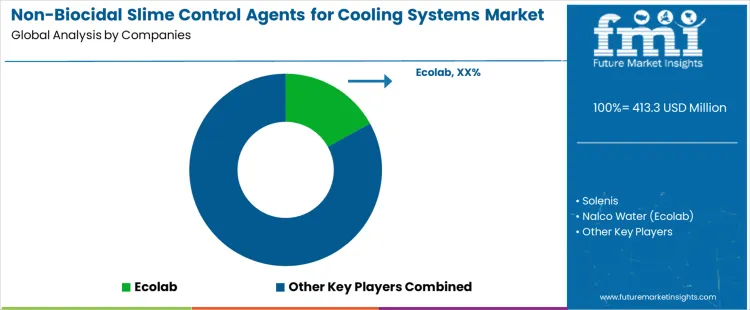
The non-biocidal slime control agents for cooling systems market is expanding as industries increasingly seek environmentally friendly alternatives to traditional chemical treatments for managing microbial growth in cooling water systems. Ecolab leads the market with its advanced non-biocidal slime control agents, offering innovative solutions that effectively manage biofouling and microbial growth without the use of biocides. Their focus on sustainability, performance, and regulatory compliance has positioned them as a dominant player in the market. Solenis, Nalco Water (Ecolab), and Kemira are significant competitors, each providing specialized slime control solutions designed to enhance cooling system performance and reduce environmental impact. Solenis offers eco-friendly products that help maintain cooling efficiency, while Nalco Water (Ecolab) focuses on providing comprehensive water treatment solutions with an emphasis on slime control. Kemira delivers high-quality, non-biocidal solutions that improve system performance and meet sustainability goals.
Kurita Water Industries further contributes to the competitive landscape by offering non-biocidal slime control agents designed to optimize cooling system operations. Kurita specializes in providing chemical solutions that prevent the formation of biofilms and slime, ensuring efficient water management. These companies compete by focusing on product innovation, sustainability, and their ability to provide cost-effective, eco-friendly solutions for cooling system maintenance. As industries face increasing regulatory pressures and demand for sustainable solutions grows, the market for non-biocidal slime control agents is expected to continue expanding, fostering further innovation and competition.
Key Players of the Non-Biocidal Slime Control Agents for Cooling Systems Market
- Ecolab
- Solenis
- Nalco Water (Ecolab)
- Kemira
- Kurita Water Industries
Scope of the Report
| Items | Values |
|---|---|
| Quantitative Units (2026) | USD Million |
| Agent Type | Polymer-Based Slime Control Agents, Enzymatic & Bio-Based Anti-Slime Agents, Surfactant-Based Dispersants, Chelating & Fouling Prevention Agents, Other Non-Biocidal Slime Control Additives |
| Cooling System Type | Open Recirculating Cooling Towers, Closed Loop Cooling Systems, Once-Through Cooling Systems, Hybrid & Advanced Cooling Systems, Decentralized / Modular Cooling Units |
| End-Use Industry | Power Generation & Utilities, Petrochemical & Refining, Manufacturing & Process Industries, HVAC & Commercial Buildings, Data Centers & Industrial Cooling |
| Companies | Ecolab, Solenis, Nalco Water (Ecolab), Kemira, Kurita Water Industries |
| Regions Covered | North America, Latin America, Western Europe, Eastern Europe, South Asia and Pacific, East Asia, Middle East & Africa |
| Countries Covered | United States, Canada, Mexico, Brazil, Argentina, Germany, France, United Kingdom, Italy, Spain, Netherlands, China, India, Japan, South Korea, ANZ, GCC Countries, South Africa |
| Additional Attributes | Dollar by sales by agent type, cooling system type, end-use industry, and region. Includes market trends in non-biocidal slime control agents, performance in various cooling system applications, cost-effectiveness, sustainability practices, regulatory compliance, market share and competitive positioning of key companies, and the role of slime control agents in reducing maintenance costs, enhancing cooling efficiency, and improving system performance across industries. |
Non-Biocidal Slime Control Agents for Cooling Systems Market Segmentation
Agent Type
- Polymer-Based Slime Control Agents
- Enzymatic & Bio-Based Anti-Slime Agents
- Surfactant-Based Dispersants
- Chelating & Fouling Prevention Agents
- Other Non-Biocidal Slime Control Additives
Cooling System Type
- Open Recirculating Cooling Towers
- Closed Loop Cooling Systems
- Once-Through Cooling Systems
- Hybrid & Advanced Cooling Systems
- Decentralized / Modular Cooling Units
End-Use Industry
- Power Generation & Utilities
- Petrochemical & Refining
- Manufacturing & Process Industries
- HVAC & Commercial Buildings
- Data Centers & Industrial Cooling
Region
- Asia Pacific
- China
- Japan
- South Korea
- India
- Australia & New Zealand
- ASEAN
- Rest of Asia Pacific
- Europe
- Germany
- United Kingdom
- France
- Italy
- Spain
- Nordic
- BENELUX
- Rest of Europe
- North America
- United States
- Canada
- Mexico
- Latin America
- Brazil
- Chile
- Rest of Latin America
- Middle East & Africa
- Kingdom of Saudi Arabia
- Other GCC Countries
- Turkey
- South Africa
- Other African Union
- Rest of Middle East & Africa
Frequently Asked Questions
How big is the non-biocidal slime control agents for cooling systems market in 2026?
The global non-biocidal slime control agents for cooling systems market is estimated to be valued at USD 413.3 million in 2026.
What will be the size of non-biocidal slime control agents for cooling systems market in 2036?
The market size for the non-biocidal slime control agents for cooling systems market is projected to reach USD 969.5 million by 2036.
How much will be the non-biocidal slime control agents for cooling systems market growth between 2026 and 2036?
The non-biocidal slime control agents for cooling systems market is expected to grow at a 8.9% CAGR between 2026 and 2036.
What are the key product types in the non-biocidal slime control agents for cooling systems market?
The key product types in non-biocidal slime control agents for cooling systems market are polymer-based slime control agents, enzymatic & bio-based anti-slime agents, surfactant-based dispersants, chelating & fouling prEVention agents and other non-biocidal slime control additives.
Which cooling system type segment to contribute significant share in the non-biocidal slime control agents for cooling systems market in 2026?
In terms of cooling system type, open recirculating cooling towers segment to command 38.0% share in the non-biocidal slime control agents for cooling systems market in 2026.
Preview the report firsthand - request a free sample
Get SampleGet the brochure for pricing and purchase details.
Get PDFTable of Content
- Executive Summary
- Global Market Outlook
- Demand-side Trends
- Supply-side Trends
- Technology Roadmap Analysis
- Analysis and Recommendations
- Market Overview
- Market Coverage / Taxonomy
- Market Definition / Scope / Limitations
- Market Background
- Market Dynamics
- Drivers
- Restraints
- Opportunity
- Trends
- Scenario Forecast
- Demand in Optimistic Scenario
- Demand in Likely Scenario
- Demand in Conservative Scenario
- Opportunity Map Analysis
- Product Life Cycle Analysis
- Supply Chain Analysis
- Investment Feasibility Matrix
- Value Chain Analysis
- PESTLE and Porter’s Analysis
- Regulatory Landscape
- Regional Parent Market Outlook
- Production and Consumption Statistics
- Import and Export Statistics
- Market Dynamics
- Global Market Analysis 2021 to 2025 and Forecast, 2026 to 2036
- Historical Market Size Value (USD Million) Analysis, 2021 to 2025
- Current and Future Market Size Value (USD Million) Projections, 2026 to 2036
- Y-o-Y Growth Trend Analysis
- Absolute $ Opportunity Analysis
- Global Market Pricing Analysis 2021 to 2025 and Forecast 2026 to 2036
- Global Market Analysis 2021 to 2025 and Forecast 2026 to 2036, By Agent Type
- Introduction / Key Findings
- Historical Market Size Value (USD Million) Analysis By Agent Type , 2021 to 2025
- Current and Future Market Size Value (USD Million) Analysis and Forecast By Agent Type , 2026 to 2036
- Polymer-Based Slime Control Agents
- Enzymatic & Bio-Based Anti-Slime Agents
- Surfactant-Based Dispersants
- Chelating & Fouling Prevention Agents
- Other Non-Biocidal Slime Control Additives
- Polymer-Based Slime Control Agents
- Y-o-Y Growth Trend Analysis By Agent Type , 2021 to 2025
- Absolute $ Opportunity Analysis By Agent Type , 2026 to 2036
- Global Market Analysis 2021 to 2025 and Forecast 2026 to 2036, By Cooling System Type
- Introduction / Key Findings
- Historical Market Size Value (USD Million) Analysis By Cooling System Type, 2021 to 2025
- Current and Future Market Size Value (USD Million) Analysis and Forecast By Cooling System Type, 2026 to 2036
- Open Recirculating Cooling Towers
- Closed Loop Cooling Systems
- Once-Through Cooling Systems
- Hybrid & Advanced Cooling Systems
- Decentralized / Modular Cooling Value (USD Million)s
- Open Recirculating Cooling Towers
- Y-o-Y Growth Trend Analysis By Cooling System Type, 2021 to 2025
- Absolute $ Opportunity Analysis By Cooling System Type, 2026 to 2036
- Global Market Analysis 2021 to 2025 and Forecast 2026 to 2036, By End-Use Industry
- Introduction / Key Findings
- Historical Market Size Value (USD Million) Analysis By End-Use Industry, 2021 to 2025
- Current and Future Market Size Value (USD Million) Analysis and Forecast By End-Use Industry, 2026 to 2036
- Power Generation & Utilities
- Petrochemical & Refining
- Manufacturing & Process Industries
- HVAC & Commercial Buildings
- Data Centers & Industrial Cooling
- Power Generation & Utilities
- Y-o-Y Growth Trend Analysis By End-Use Industry, 2021 to 2025
- Absolute $ Opportunity Analysis By End-Use Industry, 2026 to 2036
- Global Market Analysis 2021 to 2025 and Forecast 2026 to 2036, By Region
- Introduction
- Historical Market Size Value (USD Million) Analysis By Region, 2021 to 2025
- Current Market Size Value (USD Million) Analysis and Forecast By Region, 2026 to 2036
- North America
- Latin America
- Western Europe
- Eastern Europe
- East Asia
- South Asia and Pacific
- Middle East & Africa
- Market Attractiveness Analysis By Region
- North America Market Analysis 2021 to 2025 and Forecast 2026 to 2036, By Country
- Historical Market Size Value (USD Million) Trend Analysis By Market Taxonomy, 2021 to 2025
- Market Size Value (USD Million) Forecast By Market Taxonomy, 2026 to 2036
- By Country
- USA
- Canada
- Mexico
- By Agent Type
- By Cooling System Type
- By End-Use Industry
- By Country
- Market Attractiveness Analysis
- By Country
- By Agent Type
- By Cooling System Type
- By End-Use Industry
- Key Takeaways
- Latin America Market Analysis 2021 to 2025 and Forecast 2026 to 2036, By Country
- Historical Market Size Value (USD Million) Trend Analysis By Market Taxonomy, 2021 to 2025
- Market Size Value (USD Million) Forecast By Market Taxonomy, 2026 to 2036
- By Country
- Brazil
- Chile
- Rest of Latin America
- By Agent Type
- By Cooling System Type
- By End-Use Industry
- By Country
- Market Attractiveness Analysis
- By Country
- By Agent Type
- By Cooling System Type
- By End-Use Industry
- Key Takeaways
- Western Europe Market Analysis 2021 to 2025 and Forecast 2026 to 2036, By Country
- Historical Market Size Value (USD Million) Trend Analysis By Market Taxonomy, 2021 to 2025
- Market Size Value (USD Million) Forecast By Market Taxonomy, 2026 to 2036
- By Country
- Germany
- UK
- Italy
- Spain
- France
- Nordic
- BENELUX
- Rest of Western Europe
- By Agent Type
- By Cooling System Type
- By End-Use Industry
- By Country
- Market Attractiveness Analysis
- By Country
- By Agent Type
- By Cooling System Type
- By End-Use Industry
- Key Takeaways
- Eastern Europe Market Analysis 2021 to 2025 and Forecast 2026 to 2036, By Country
- Historical Market Size Value (USD Million) Trend Analysis By Market Taxonomy, 2021 to 2025
- Market Size Value (USD Million) Forecast By Market Taxonomy, 2026 to 2036
- By Country
- Russia
- Poland
- Hungary
- Balkan & Baltic
- Rest of Eastern Europe
- By Agent Type
- By Cooling System Type
- By End-Use Industry
- By Country
- Market Attractiveness Analysis
- By Country
- By Agent Type
- By Cooling System Type
- By End-Use Industry
- Key Takeaways
- East Asia Market Analysis 2021 to 2025 and Forecast 2026 to 2036, By Country
- Historical Market Size Value (USD Million) Trend Analysis By Market Taxonomy, 2021 to 2025
- Market Size Value (USD Million) Forecast By Market Taxonomy, 2026 to 2036
- By Country
- China
- Japan
- South Korea
- By Agent Type
- By Cooling System Type
- By End-Use Industry
- By Country
- Market Attractiveness Analysis
- By Country
- By Agent Type
- By Cooling System Type
- By End-Use Industry
- Key Takeaways
- South Asia and Pacific Market Analysis 2021 to 2025 and Forecast 2026 to 2036, By Country
- Historical Market Size Value (USD Million) Trend Analysis By Market Taxonomy, 2021 to 2025
- Market Size Value (USD Million) Forecast By Market Taxonomy, 2026 to 2036
- By Country
- India
- ASEAN
- Australia & New Zealand
- Rest of South Asia and Pacific
- By Agent Type
- By Cooling System Type
- By End-Use Industry
- By Country
- Market Attractiveness Analysis
- By Country
- By Agent Type
- By Cooling System Type
- By End-Use Industry
- Key Takeaways
- Middle East & Africa Market Analysis 2021 to 2025 and Forecast 2026 to 2036, By Country
- Historical Market Size Value (USD Million) Trend Analysis By Market Taxonomy, 2021 to 2025
- Market Size Value (USD Million) Forecast By Market Taxonomy, 2026 to 2036
- By Country
- Kingdom of Saudi Arabia
- Other GCC Countries
- Turkiye
- South Africa
- Other African Union
- Rest of Middle East & Africa
- By Agent Type
- By Cooling System Type
- By End-Use Industry
- By Country
- Market Attractiveness Analysis
- By Country
- By Agent Type
- By Cooling System Type
- By End-Use Industry
- Key Takeaways
- Key Countries Market Analysis
- USA
- Pricing Analysis
- Market Share Analysis, 2025
- By Agent Type
- By Cooling System Type
- By End-Use Industry
- Canada
- Pricing Analysis
- Market Share Analysis, 2025
- By Agent Type
- By Cooling System Type
- By End-Use Industry
- Mexico
- Pricing Analysis
- Market Share Analysis, 2025
- By Agent Type
- By Cooling System Type
- By End-Use Industry
- Brazil
- Pricing Analysis
- Market Share Analysis, 2025
- By Agent Type
- By Cooling System Type
- By End-Use Industry
- Chile
- Pricing Analysis
- Market Share Analysis, 2025
- By Agent Type
- By Cooling System Type
- By End-Use Industry
- Germany
- Pricing Analysis
- Market Share Analysis, 2025
- By Agent Type
- By Cooling System Type
- By End-Use Industry
- UK
- Pricing Analysis
- Market Share Analysis, 2025
- By Agent Type
- By Cooling System Type
- By End-Use Industry
- Italy
- Pricing Analysis
- Market Share Analysis, 2025
- By Agent Type
- By Cooling System Type
- By End-Use Industry
- Spain
- Pricing Analysis
- Market Share Analysis, 2025
- By Agent Type
- By Cooling System Type
- By End-Use Industry
- France
- Pricing Analysis
- Market Share Analysis, 2025
- By Agent Type
- By Cooling System Type
- By End-Use Industry
- India
- Pricing Analysis
- Market Share Analysis, 2025
- By Agent Type
- By Cooling System Type
- By End-Use Industry
- ASEAN
- Pricing Analysis
- Market Share Analysis, 2025
- By Agent Type
- By Cooling System Type
- By End-Use Industry
- Australia & New Zealand
- Pricing Analysis
- Market Share Analysis, 2025
- By Agent Type
- By Cooling System Type
- By End-Use Industry
- China
- Pricing Analysis
- Market Share Analysis, 2025
- By Agent Type
- By Cooling System Type
- By End-Use Industry
- Japan
- Pricing Analysis
- Market Share Analysis, 2025
- By Agent Type
- By Cooling System Type
- By End-Use Industry
- South Korea
- Pricing Analysis
- Market Share Analysis, 2025
- By Agent Type
- By Cooling System Type
- By End-Use Industry
- Russia
- Pricing Analysis
- Market Share Analysis, 2025
- By Agent Type
- By Cooling System Type
- By End-Use Industry
- Poland
- Pricing Analysis
- Market Share Analysis, 2025
- By Agent Type
- By Cooling System Type
- By End-Use Industry
- Hungary
- Pricing Analysis
- Market Share Analysis, 2025
- By Agent Type
- By Cooling System Type
- By End-Use Industry
- Kingdom of Saudi Arabia
- Pricing Analysis
- Market Share Analysis, 2025
- By Agent Type
- By Cooling System Type
- By End-Use Industry
- Turkiye
- Pricing Analysis
- Market Share Analysis, 2025
- By Agent Type
- By Cooling System Type
- By End-Use Industry
- South Africa
- Pricing Analysis
- Market Share Analysis, 2025
- By Agent Type
- By Cooling System Type
- By End-Use Industry
- USA
- Market Structure Analysis
- Competition Dashboard
- Competition Benchmarking
- Market Share Analysis of Top Players
- By Regional
- By Agent Type
- By Cooling System Type
- By End-Use Industry
- Competition Analysis
- Competition Deep Dive
- Ecolab
- Overview
- Product Portfolio
- Profitability by Market Segments (Product/Age /Sales Channel/Region)
- Sales Footprint
- Strategy Overview
- Marketing Strategy
- Product Strategy
- Channel Strategy
- Solenis
- Nalco Water (Ecolab)
- Kemira
- Kurita Water Industries
- Ecolab
- Competition Deep Dive
- Assumptions & Acronyms Used
- Research Methodology


