

- Market Size (2026)
- USD 0.7 Bn
- Forecast (2036)
- USD 1.2 Bn
- CAGR (2026 to 2036)
- 5.4%
Electronic Rotary Controller Systems for Infotainment Market Size, Market Forecast and Outlook By FMI
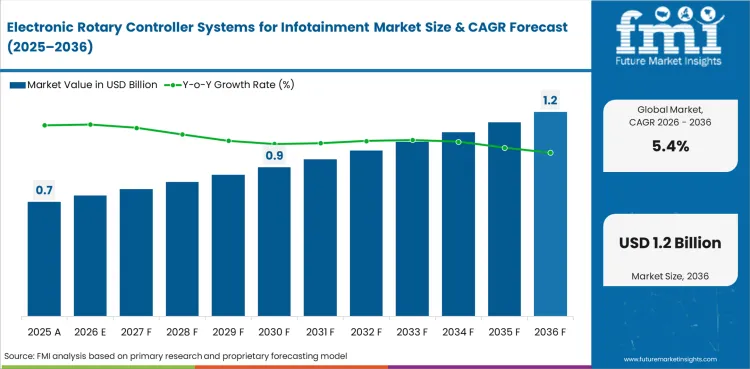
Electronic rotary controller systems for infotainment market was valued USD 0.6 billion in 2025. Industry is estimated to reach USD 0.7 billion in 2026 and to reach USD 1.2 billion by 2036 at a 5.4% CAGR. OEM supply is expected to represent 86% of demand in 2026, while passenger cars are projected to account for 67% of vehicle type demand.
Summary of the Electronic Rotary Controller Systems for Infotainment Market
- Demand and Growth Drivers
- Expanding digital cockpit layouts with larger infotainment displays are driving adoption of rotary controllers as a secondary tactile input for safer browsing and confirmation tasks.
- Rising electric vehicle production and higher cabin electronic content are increasing the fitment of mixed touch‑and‑tactile infotainment control hardware across passenger vehicle programs.
- OEM-led integration during early infotainment system design supports strong sales volumes, as rotary controllers are validated and installed at the factory level rather than added post-sale.
- Product and Segment View
- OEM channels are estimated to account for 86% share in 2026, as infotainment rotary hardware is designed into cockpit modules before vehicle launch.
- Passenger Cars are estimated to hold 67% share in 2026, supported by premium trims and larger display layouts across global nameplates.
- Product scope covers electronic rotary input hardware used for infotainment browsing, menu confirmation, audio control, and integrated tactile navigation tasks.
- Geography and Competitive Outlook
- China and India carry the strongest volume-led outlook due to higher vehicle production and faster cockpit content expansion across local and global brands.
- Japan and Germany support stable demand through mature supplier bases and deeper use of integrated cabin electronics in passenger vehicle programs.
- Alps Alpine, Panasonic Automotive Systems, Hyundai Mobis, Continental, Marelli, Visteon, and Bosch Mobility hold established positions across infotainment and cockpit control hardware.
- Analyst Opinion
- Nikhil Kaitwade, Principal Analyst in the Automotive domain at FMI says, “Industry is shifting toward cockpit designs that balance large displays with dependable tactile input. Suppliers with proven automotive validation and strong integration support are well placed for new programs. Rotary controllers are being refined through capacitive surfaces, haptic feedback, and tighter controller linkage for lower visual diversion.”
- Electronic Rotary Controller Systems for Infotainment Market Value Analysis
- Electronic rotary controller systems have moved from premium-only cabin hardware into a broader infotainment input layer across mid-range passenger vehicle programs.
- Adoption is supported by larger display ecosystems requiring a secondary physical input for browsing and confirmation functions.
- Safety guidance and driver distraction concerns support demand for tactile control formats beside touch-heavy interface layouts.
- Value expansion also propelled by connected cockpit rollouts and higher electrical content in electric passenger vehicles.
Key Takeaways
- Electronic rotary controller systems for infotainment are estimated at USD 0.6 billion in 2025.
- Industry is projected to reach USD 1.2 billion by 2036 as infotainment hardware content rises across digital cockpit programs.
- FMI estimates the market will expand at a CAGR of 5.4% from 2026 to 2036.
- Incremental opportunity across the forecast window is estimated at USD 0.6 billion as more vehicles retain tactile cabin inputs.
- OEM channels are expected to represent 86% share in 2026, reflecting direct integration into production vehicle infotainment architecture.
- China leads the country outlook with an expected 7.4% CAGR through 2036 on the back of vehicle output scale and cockpit electronics depth.
Electronic Rotary Controller Systems for Infotainment Market Definition
Electronic rotary controller systems for infotainment include electronically actuated rotary knobs, dial modules, and haptic rotary interfaces used to manage in-vehicle entertainment and related screen functions. Scope covers embedded control hardware sold into passenger vehicle and selected commercial vehicle infotainment systems through factory installation or qualified retrofit programs.
Electronic Rotary Controller Systems for Infotainment Market Inclusions
Market scope includes capacitive, mechanical, and haptic rotary controller systems used for menu scrolling, media selection, navigation input, volume adjustment, and confirmation actions. Counted revenue includes OEM-installed units, approved infotainment control modules, and electronic rotary interface assemblies supplied within cockpit and head unit platforms.
Electronic Rotary Controller Systems for Infotainment Market Exclusions
Scope excludes analog-only knobs without electronic signal architecture, HVAC-only rotary controls sold outside infotainment functions, and broad touchscreen modules sold without dedicated rotary input hardware. Standalone steering controls and voice-only cabin control software also stay outside the defined market boundary.
Electronic Rotary Controller Systems for Infotainment Market Research Methodology
- Primary Research: FMI assessed supplier positioning through product portfolios, cockpit integration activity, and cabin interface offerings across leading automotive electronics manufacturers.
- Desk Research: Secondary review used OICA production data, IEA electric vehicle updates, Euro NCAP control guidance, and country automotive association releases.
- Market Sizing and Forecasting: Sizing combines vehicle production, infotainment fitment assumptions, rotary controller penetration, and estimated hardware pricing by vehicle class.
- Data Validation: Model outputs were checked against digital cockpit adoption signals, supplier presence, and the relative scale of adjacent HMI hardware programs.
Why is the Electronic Rotary Controller Systems for Infotainment Market Growing?
- Larger screens deepen menu structures and increase demand for secondary tactile inputs to reduce repeated touch interaction.
- Rising cabin software complexity across connected vehicles supports hardware inputs for simpler menu access and confirmation tasks.
- Safety evaluation frameworks now assign direct value to physical identification of core controls during the driving task.
Digital cockpit programs are expanding in passenger vehicles with growing display counts and greater feature density. Electric car sales exceeded 17 million units in 2024, and first-quarter 2025 sales topped 4 million worldwide. Wider display layouts and deeper menu structures support tactile inputs for browsing and menu confirmation.
Regulatory and rating pressure supports continued use of tactile cabin controls inside infotainment layouts. Euro NCAP's 2026 safe-driving protocol assigns points to general vehicle controls and defines direct physical input as controls discoverable by tactility with minimal off-road gaze. That framework strengthens the case for rotary inputs in mixed-control cabins.
Market Segmentation Analysis
- Passenger Cars are estimated to represent 67% share in 2026, supported by infotainment-rich sedans and utility vehicles across mainstream and premium launches.
- OEM supply is estimated at 86% share in 2026, reflecting strict design validation and close integration with cockpit electronics platforms.
- Center Stack placement is estimated at 48% share in 2026, supported by ergonomic placement near the primary infotainment screen.
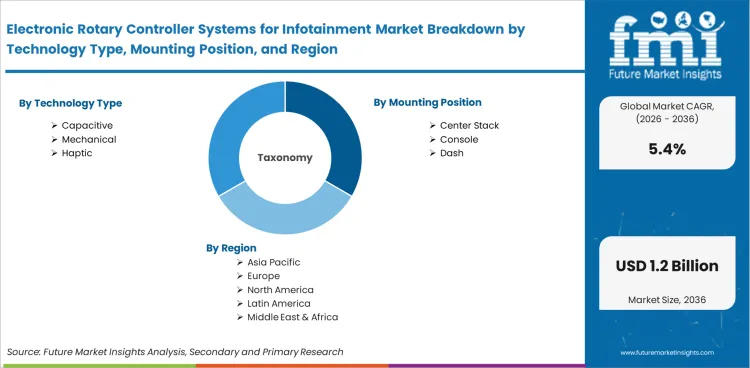
The market is segmented by technology type, mounting position, vehicle type, interface mode, sales channel, and region. By technology, capacitive, mechanical, and haptic rotary controllers address varying requirements for tactile feedback, cost, and software integration across infotainment systems. By vehicle type and sales channel, passenger cars and OEM installations dominate demand due to higher infotainment penetration and early-stage cockpit integration. By mounting position and interface mode, center stack placement and push‑rotate formats lead adoption, supported by ergonomic design preferences and safer browse‑and‑confirm interaction within expanding digital cockpit layouts. Electronic Rotary Controller Systems for Infotainment Market Analysis By Technology Type
Insights into the Capacitive Technology Segment
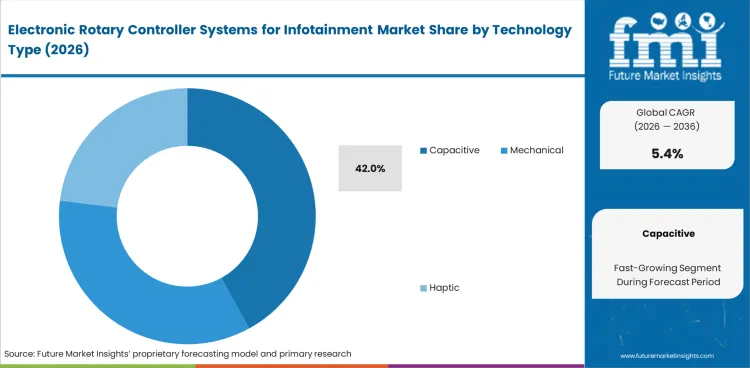
- Capacitive technology is expected to account for 42% share in 2026, supported by smooth surface design and closer software alignment in newer infotainment programs.
- Automakers use this format across digital cockpit layouts requiring tactile input without reverting to bulkier mechanical controller assemblies.
Insights into the Haptic Technology Segment
- Haptic technology is projected to expand faster within technology type demand because premium cabins seek tactile feedback with a more refined controller appearance.
- Feedback-enabled rotary modules support stronger menu confirmation across larger displays and improve control confidence during routine infotainment use.
Electronic Rotary Controller Systems for Infotainment Market Analysis By Mounting Position
Insights into the Center Stack Mounting Segment
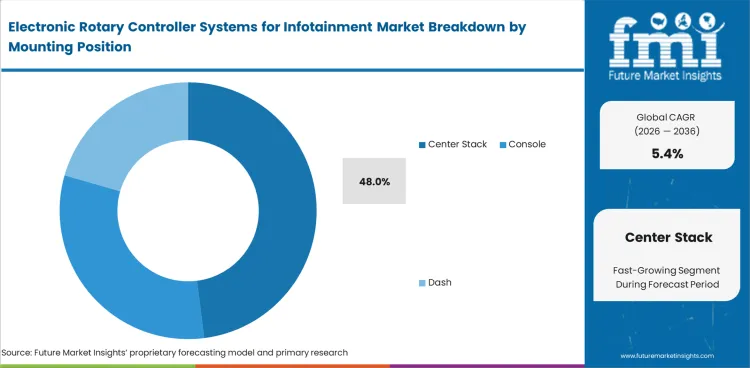
- Center stack mounting is projected to contribute 48% share in 2026, as this position keeps the controller close to the primary infotainment display.
- Easy hand reach and direct screen proximity support broader use across passenger vehicle programs with richer media and navigation functions.
Insights into the Console Mounting Segment
- Console mounting is projected to expand at a rapid pace owing to mounting position demand because premium interiors favor lower control placement and cleaner dashboard execution.
- This layout supports a more organized upper cabin surface and preserves tactile infotainment access near the natural hand position.
Electronic Rotary Controller Systems for Infotainment Market Analysis By Vehicle Type
Insights into the Passenger Cars Segment
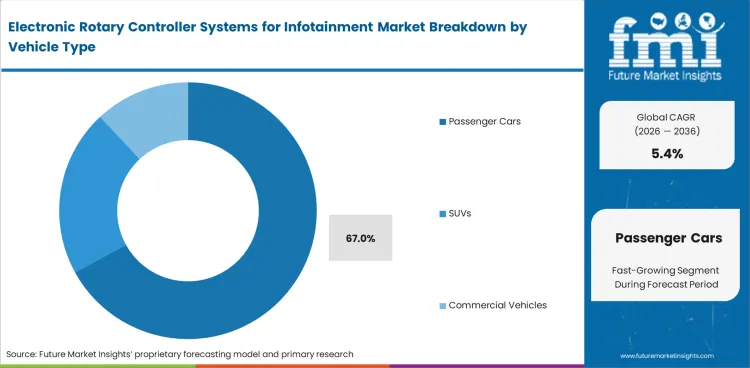
- Passenger cars are expected to account for 67% share in 2026, supported by broader infotainment fitment across mainstream and premium vehicle programs.
- Larger production volumes and deeper trim ladders support stronger controller demand across passenger vehicle cabins with wider screen usage.
Insights into the SUVs Segment
- SUVs are projected to expand faster within vehicle type demand because larger cabins carry more feature-loaded infotainment packages.
- Higher screen size and stronger consumer preference for convenience controls support wider use of rotary infotainment inputs across this segment.
- Electronic Rotary Controller Systems for Infotainment Market Analysis By Interface Mode
Insights into the Push Rotate Interface Mode Segment
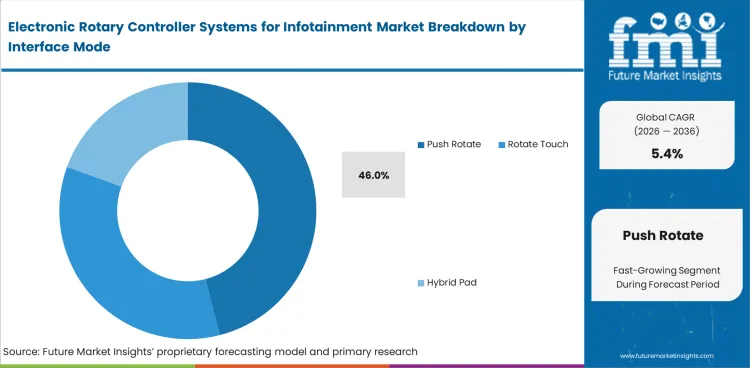
- Push rotate is estimated to represent a 46% share in 2026, supported by infotainment systems integrating scrolling and command confirmation within a single control unit.
- This format supports easier command input during routine media use and reduces repeated touchscreen interaction across deeper menu structures.
Insights into the Rotate Touch Interface Mode Segment
- Rotate touch is projected to expand among interface modes because automakers pursue advanced control surfaces with premium visual treatment.
- Combined rotary movement and touch-sensitive response support infotainment layouts with a refined appearance and direct tactile interaction.
- Electronic Rotary Controller Systems for Infotainment Market Analysis By Sales Channel
Insights into the OEM Sales Channel Segment
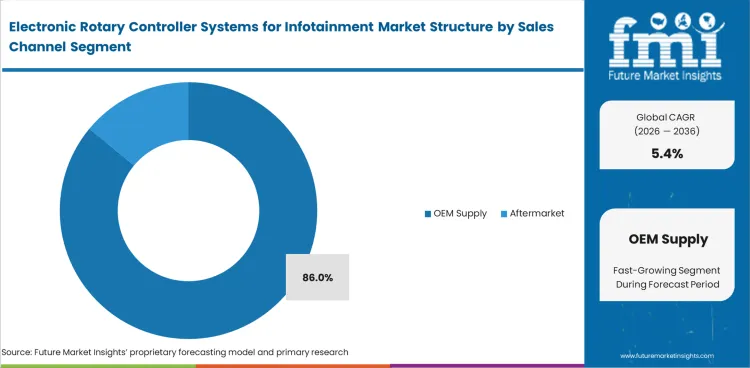
- OEM supply is set to represent 86% share in 2026, as controller hardware enters vehicle programs during early infotainment design validation.
- Factory integration supports software compatibility and installation consistency across large production runs built around shared cockpit architectures.
Insights into the Aftermarket Sales Channel Segment
- Aftermarket sales segment is likely to record the faster pace within channel demand as replacement needs rise across aging infotainment hardware installations.
- Upgrade activity also supports selective opportunity in vehicles needing controller replacement with matching fitment and approved software behavior.
Electronic Rotary Controller Systems for Infotainment Market Analysis by Technology and Interface Integration
Insights into the Hybrid Pad Segment
- Hybrid Pad is estimated to account for 12% share in 2026, supported by premium cabins seeking fewer physical controls with broader command flexibility.
- Combined gesture support and rotary interaction help suppliers address infotainment modules built around consolidated input architecture.
Insights into the Mechanical Technology Segment
- Mechanical technology holds value in programs requiring familiar tactile feel and lower system complexity across selected infotainment controller applications.
- Cost discipline and durable control behavior support ongoing use in vehicle platforms carrying simpler digital cockpit specifications.
Electronic Rotary Controller Systems for Infotainment Market Drivers, Restraints, and Opportunities
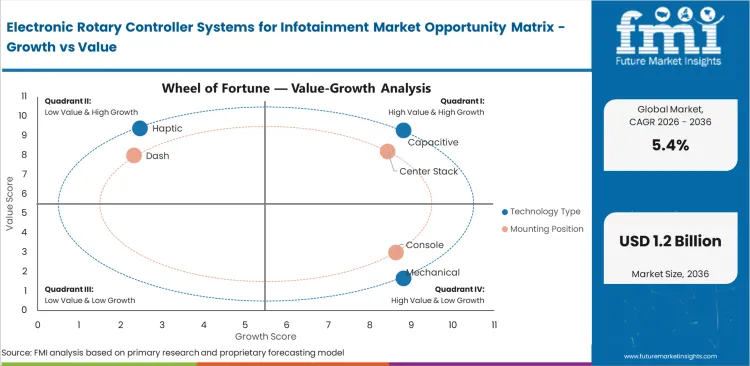
- Display expansion and deeper menu structures support steady use of tactile infotainment inputs in higher-content cabin programs.
- Entry trims face limited fitment due to cost pressure and software-led minimalism centered on touch-only architectures.
- Premium cabin upgrades create room for haptic rotary formats with stronger tactile feedback and cleaner surface execution.
Rising Digital Cockpit Complexity Supports Rotary Infotainment Controls
Cockpit systems now combine media and navigation inside shared display environments. Phone functions and vehicle settings are also integrated within these displays. A single touch layer can handle these tasks, although repeated tap sequences raise driver distraction risk and slow command access. Browse-and-confirm interaction from rotary controllers addresses this problem in a manner familiar to drivers inside moving vehicles. Expanding demand for automotive display and connected car programs supports this use case across mid-range and premium cabins.
Touch-Only Dashboard Design Limits Rotary Controller Adoption
Entry vehicles and some electric platforms pursue lower hardware count and flatter dashboard layouts. This direction can reduce rotary controller penetration in lowcost cabins, particularly with simplified menu structures driven by software teams. Hardware suppliers face a tighter value case in price-sensitive launches. Vehicles integrating tactile controls alongside automotive connectivity and in vehicle apps requiring frequent user interaction carry a more stable outlook.
Haptic Rotary Systems Create Premium Upgrade Opportunity
Suppliers are refining rotary inputs through surface sensing and force feedback. Integration with software‑defined cockpit systems continues to deepen. This opens an upgrade lane inside premium trims and branded cabin packages. Hardware content can hence rise even if unit penetration does not jump sharply. Adjacent demand across automotive HUD, automotive infotainment SOCs supports richer cockpit architectures. Automotive connectivity and in‑vehicle apps reinforce the shift toward more deliberate user control methods.
Regional Market Analysis
.webp "Top Country Growth Comparison Electronic Rotary Controller Systems For Infotainment Market Cagr (2026 2036)")
| Country | CAGR (2026 to 2036) |
|---|---|
| China | 7.4% |
| India | 7.1% |
| South Korea | 6.8% |
| Germany | 6.3% |
| United States | 5.4% |
| Japan | 5.8% |
| United Kingdom | 5.4% |
Source: Future Market Insights, 2026.
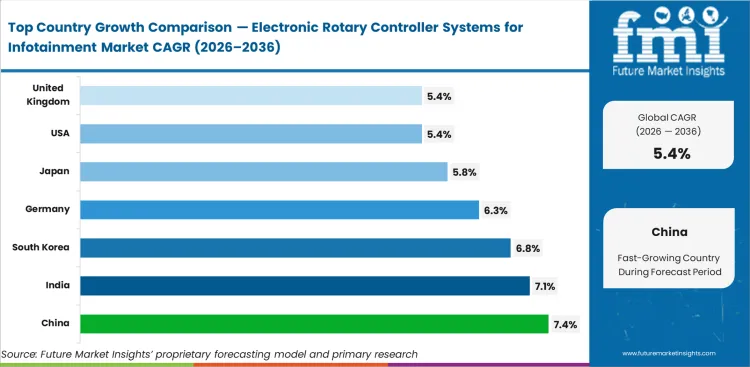
Electronic Rotary Controller Systems for Infotainment Market Analysis by Country
- China is in first place with an expected 7.4% CAGR, supported by the world’s largest vehicle production base and rapid rollout of digital cockpit and infotainment electronics across domestic brands. Strong output scale and deeper cabin electronics integration are anticipated to keep China well above the global growth average.
- India is expected to follow with a 7.1% CAGR, driven by record passenger vehicle sales, expanding utility‑led model launches, and rising infotainment content across mid‑priced segments. Growth is anticipated as larger display layouts and feature‑rich cabins increase the need for tactile input hardware.
- South Korea (6.8% CAGR) and Japan (5.8% CAGR) are anticipated to maintain steady growth, supported by strong supplier ecosystems, mature electronics capability, and higher adoption of advanced cockpit technologies. Both markets benefit from export‑oriented passenger vehicle programs with richer infotainment and cabin electronics content.
The global market for electronic rotary controller systems for infotainment is projected to grow steadily from 2026 to 2036, supported by expanding digital cockpit architectures, larger display ecosystems, and ongoing regulatory emphasis on physical controls that reduce driver distraction. The study covers multiple regions and leading automotive manufacturing countries, with Asia anticipated to remain the fastest‑growing contributor. Country Outlooks
Demand Outlook in China
An estimated 7.4% CAGR reflects both production size and faster cockpit content addition. Local brands are pushing harder into digital cockpit design and larger infotainment displays across domestic passenger programs. This supports stable adoption for rotary infotainment controllers, especially in passenger vehicles with richer screen-based functions.
- Vehicle output scale supports stronger controller volumes across many infotainment-equipped programs.
- Domestic brand expansion helps broader adoption of mixed tactile and display cabin layouts.
- China produced 31.28 million vehicles in 2024, which keeps it far ahead of every other manufacturing base worldwide.
Future Outlook in India
India is estimated to expand at 7.1% CAGR during the forecast years. Utility-led model growth supports richer cabin content at mid-price points. Electronic rotary controllers benefit from this shift as vehicles add bigger displays and more feature layers.
- India recorded its highest-ever passenger vehicle sales at 4.3 million units in FY 2024-25, which signals a larger addressable base for factory-fitted infotainment controls.
- Passenger vehicle sales growth supports stronger infotainment hardware demand across higher trims.
- Utility vehicle mix improves controller fitment potential in screen-centered cabin layouts.
Opportunity Analysis in the United States
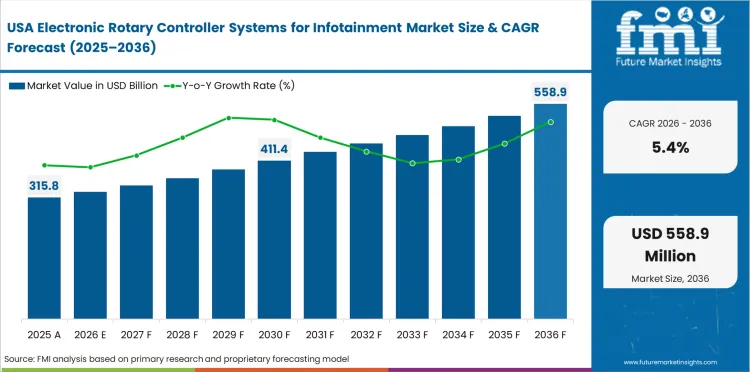
The United States industry is projected to grow at 5.4% CAGR from 2026 to 2036. Larger vehicle cabins and infotainment-rich truck programs support continued use of physical input hardware. Systems blending touch screens with tactile browse functions continue to rely on rotary controllers.
- Larger cabin formats support tactile infotainment controls beside wide touchscreen displays.
- Consumer spending strength supports higher-content trims with richer cockpit hardware.
- United States vehicle production reached 10.56 million units in 2024, supporting a large base for factory-fitted infotainment hardware.
Sales Outlook in Germany
Demand in Germany is projected to advance at 6.3% CAGR across the forecast period. Premium cockpit design often supports tactile backup inputs in vehicles carrying deeper digital feature stacks. Electronic rotary controllers retain better stability here than in lower-cost vehicle markets.
- Premium vehicle concentration supports durable demand for tactile infotainment control hardware.
- Supplier depth improves design continuity across established cockpit electronics programs.
- Germany produced over 4 million passenger cars in 2024 and retains a strong premium vehicle base.
Outlook in South Korea
South Korea is expected to grow at 6.8% CAGR during the forecast period. Local integration depth supports quicker movement toward advanced haptic and capacitive rotary formats. Demand stays healthy in export-oriented passenger vehicle programs with richer cabin electronics.
- Supplier concentration supports faster rollout of upgraded rotary control hardware.
- South Korea built 4.13 million vehicles in 2024 and hosts major cockpit electronics suppliers with strong infotainment capability.
- Export vehicle programs support controller demand in digital-heavy cabin architectures.
Competitive Landscape and Strategic Positioning
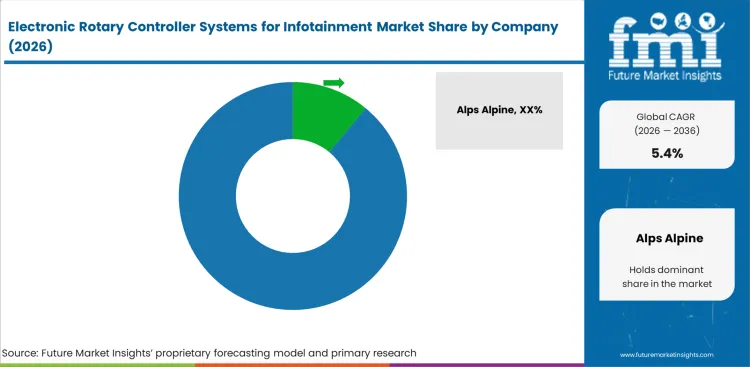
- Competitive positioning depends on integration capability and rigorous design validation across supplier offerings. Software architecture alignment within cockpit systems further influences outcomes.
- Supplier strength improves with proven infotainment hardware programs and long-standing automaker relationships.
- Market concentration is moderate since a limited set of automotive electronics firms hold visible program depth.
Alps Alpine retains a strong profile through rotary switch heritage and broader digital cabin solutions. Panasonic Automotive Systems brings infotainment program depth and recent cockpit platform visibility across current automotive programs.
Companies such as Hyundai Mobis and Visteon operate from a broader cockpit integration position rather than a pure control hardware focus. Their strength comes from integrating infotainment systems with display platforms inside validated cockpit architectures. This positioning supports rotary controller content in larger and more complex cockpit programs.
Marelli and Bosch Mobility add competitive pressure through cockpit electronics scale and interface innovation. They remain relevant in programs moving to cleaner surface design and deeper software control paths. That positioning reflects broader cockpit electronics capability rather than a narrow focus on controller hardware.
Key Companies
- Alps Alpine, Panasonic Automotive Systems, and Hyundai Mobis combine infotainment hardware experience with visible digital cockpit participation across current automotive programs.
- Continental, Visteon, and Bosch Mobility hold strong positions in integrated cockpit electronics, which can support infotainment controller demand inside broader cabin platforms.
- Marelli is an active competitor through in-cabin electronics development and cockpit innovation tied to software-defined vehicle programs.
Competitive Benchmarking
| Company | Infotainment Integration | Rotary Control Depth | Cockpit Platform Reach | Geographic Presence |
|---|---|---|---|---|
| Alps Alpine | High | High | Medium | Global |
| Panasonic Automotive Systems | High | Medium | High | Global |
| Hyundai Mobis | High | Medium | High | Global |
| Continental | High | Medium | High | Global |
| Marelli | Medium | Medium | High | Global |
| Visteon | High | Low | High | Global |
| Bosch Mobility | Medium | Medium | High | Global |
Source: Future Market Insights, 2026.
Key Developments
- In November 2024, Alps Alpine began mass production of a haptic reactor for steering wheels and air-conditioning control units.
- In June 2024, Hyundai Mobis unveiled M.VICS 5.0, its latest integrated driver's system built around a panoramic digital cockpit.
- In April 2025, Visteon and Qualcomm expanded collaboration around high-performance cockpit platforms for intelligent cabin systems.
- In April 2026, Marelli presented in-cabin innovations at Auto China 2026 and highlighted a unified software-defined cockpit experience.
Key Players
Major Global Players
- Alps Alpine
- Panasonic Automotive Systems
- Hyundai Mobis
- Continental
- Marelli
Other Active Participants
- Visteon
- Bosch Mobility
Report Scope and Coverage
| Parameter | Details |
|---|---|
| Quantitative Units | USD 0.7 billion in 2026 to USD 1.2 billion in 2036 at a CAGR of 5.4% |
| Market Definition | Electronic rotary infotainment input hardware used in factory-installed and approved retrofit vehicle systems |
| Technology Scope | Capacitive, mechanical, and haptic rotary controller systems |
| Vehicle Scope | Passenger cars, SUVs, and selected commercial vehicles |
| Regions Covered | North America, Europe, East Asia, South Asia and Pacific |
| Countries Covered | China, India, South Korea, Germany, United States, Japan, United Kingdom |
| Key Companies Profiled | Alps Alpine, Panasonic Automotive Systems, Hyundai Mobis, Continental, Marelli, Visteon, Bosch Mobility |
| Forecast Period | 2026 to 2036 |
Market by Segments
By Technology Type:
- Capacitive
- Mechanical
- Haptic
By Mounting Position:
- Center Stack
- Console
- Dash
By Vehicle Type:
- Passenger Cars
- SUVs
- Commercial Vehicles
By Interface Mode:
- Push Rotate
- Rotate Touch
- Hybrid Pad
By Sales Channel:
- OEM
- Aftermarket
By Region:
- North America
- USA
- Canada
- Mexico
- Latin America
- Brazil
- Chile
- Rest of Latin America
- Europe
- Germany
- UK
- Italy
- Spain
- France
- Rest of Europe
- East Asia
- China
- Japan
- South Korea
- South Asia and Pacific
- India
- ASEAN
- Australia & New Zealand
- Rest of South Asia and Pacific
- Middle East and Africa
- Saudi Arabia
- Other GCC Countries
- South Africa
- Rest of Middle East and Africa
Research Sources and Bibliography
- International Energy Agency. (2025, May 14). Global EV Outlook 2025.
- International Organization of Motor Vehicle Manufacturers. (2024). 2024 Production Statistics.
- European Automobile Manufacturers’ Association. (2025). Passenger car registrations: 2024 full-year figures.
- Euro NCAP. (2025). Euro NCAP’s 2026 Safe Driving Car Assisted Driving Assessment Protocol.
- Society of Indian Automobile Manufacturers. (2025, January 21). SIAM announces 2024-25 annual performance.
- Society of Motor Manufacturers and Traders. (2026, February 27). UK car production rises in January as industry readies new models.
- Alps Alpine Co., Ltd. (2025, January 16). Alps Alpine launched compact Haptic Reactor “U-Type”.
- Hyundai Mobis. (2024, June 11). Hyundai Mobis unveils future of in-vehicle display with ‘Moving Panoramic Screens’.
- Visteon Corporation. (2025, April 24). Visteon and Qualcomm redefine next-generation AI-based intelligent cockpit experience.
- Marelli. (2026, April 9). Marelli highlights next-generation in-cabin innovations for the software-defined vehicle at Auto China 2026.
This bibliography is provided for reader reference.
This Report Answers
- What is the estimated global size of the Electronic Rotary Controller Systems for Infotainment Market in 2026 and 2036?
- Which factors are supporting adoption of tactile rotary infotainment controls across digital cockpit vehicle programs?
- Which sales channel is expected to account for the highest share of demand in 2026?
- Which vehicle type is expected to contribute the largest share of controller demand through 2026?
- Why does China carry the strongest country outlook for infotainment rotary controller demand through 2036?
- How do safety guidance and driver distraction concerns support continued use of tactile cabin inputs?
- Which companies hold the strongest current presence across infotainment controller hardware and broader cockpit systems?
Frequently Asked Questions
What is the global market demand for Electronic Rotary Controller Systems for Infotainment in 2026?
Global demand for electronic rotary controller systems for infotainment is estimated at USD 0.7 billion in 2026.
How big is the Electronic Rotary Controller Systems for Infotainment Market expected to be by 2036?
FMI estimates the market will reach USD 1.2 billion by 2036 as cockpit electronics content and mixed-control cabin layouts expand.
What is the forecast CAGR for the market from 2026 to 2036?
FMI estimates a 5.4% CAGR from 2026 to 2036 based on vehicle output, infotainment fitment, and tactile control adoption trends.
Which sales channel leads the market in 2026?
OEM channels lead the market in 2026 with an estimated 86% share, supported by direct integration into validated cockpit electronics programs.
Which vehicle type accounts for the highest share of demand in 2026?
Passenger Cars hold the largest share in 2026 at an estimated 67%, reflecting richer infotainment content and broader trim depth.
Preview the report firsthand - request a free sample
Get SampleGet the brochure for pricing and purchase details.
Get PDFTable of Content
- Executive Summary
- Global Market Outlook
- Demand-side Trends
- Supply-side Trends
- Technology Roadmap Analysis
- Analysis and Recommendations
- Market Overview
- Market Coverage / Taxonomy
- Market Definition / Scope / Limitations
- Research Methodology
- Chapter Orientation
- Analytical Lens and Working Hypotheses
- Market Structure, Signals, and Trend Drivers
- Benchmarking and Cross-market Comparability
- Market Sizing, Forecasting, and Opportunity Mapping
- Research Design and Evidence Framework
- Desk Research Programme (Secondary Evidence)
- Company Annual and Sustainability Reports
- Peer-reviewed Journals and Academic Literature
- Corporate Websites, Product Literature, and Technical Notes
- Earnings Decks and Investor Briefings
- Statutory Filings and Regulatory Disclosures
- Technical White Papers and Standards Notes
- Trade Journals, Industry Magazines, and Analyst Briefs
- Conference Proceedings, Webinars, and Seminar Materials
- Government Statistics Portals and Public Data Releases
- Press Releases and Reputable Media Coverage
- Specialist Newsletters and Curated Briefings
- Sector Databases and Reference Repositories
- FMI Internal Proprietary Databases and Historical Market Datasets
- Subscription Datasets and Paid Sources
- Social Channels, Communities, and Digital Listening Inputs
- Additional Desk Sources
- Expert Input and Fieldwork (Primary Evidence)
- Primary Modes
- Qualitative Interviews and Expert Elicitation
- Quantitative Surveys and Structured Data Capture
- Blended Approach
- Why Primary Evidence is Used
- Field Techniques
- Interviews
- Surveys
- Focus Groups
- Observational and In-context Research
- Social and Community Interactions
- Stakeholder Universe Engaged
- C-suite Leaders
- Board Members
- Presidents and Vice Presidents
- R&D and Innovation Heads
- Technical Specialists
- Domain Subject-matter Experts
- Scientists
- Physicians and Other Healthcare Professionals
- Governance, Ethics, and Data Stewardship
- Research Ethics
- Data Integrity and Handling
- Primary Modes
- Tooling, Models, and Reference Databases
- Desk Research Programme (Secondary Evidence)
- Data Engineering and Model Build
- Data Acquisition and Ingestion
- Cleaning, Normalisation, and Verification
- Synthesis, Triangulation, and Analysis
- Quality Assurance and Audit Trail
- Market Background
- Market Dynamics
- Drivers
- Restraints
- Opportunity
- Trends
- Scenario Forecast
- Demand in Optimistic Scenario
- Demand in Likely Scenario
- Demand in Conservative Scenario
- Opportunity Map Analysis
- Product Life Cycle Analysis
- Supply Chain Analysis
- Investment Feasibility Matrix
- Value Chain Analysis
- PESTLE and Porter’s Analysis
- Regulatory Landscape
- Regional Parent Market Outlook
- Production and Consumption Statistics
- Import and Export Statistics
- Market Dynamics
- Global Market Analysis 2021 to 2025 and Forecast, 2026 to 2036
- Historical Market Size Value (USD Million) Analysis, 2021 to 2025
- Current and Future Market Size Value (USD Million) Projections, 2026 to 2036
- Y-o-Y Growth Trend Analysis
- Absolute $ Opportunity Analysis
- Global Market Pricing Analysis 2021 to 2025 and Forecast 2026 to 2036
- Global Market Analysis 2021 to 2025 and Forecast 2026 to 2036, By Technology Type
- Introduction / Key Findings
- Historical Market Size Value (USD Million) Analysis By Technology Type , 2021 to 2025
- Current and Future Market Size Value (USD Million) Analysis and Forecast By Technology Type , 2026 to 2036
- Capacitive
- Mechanical
- Haptic
- Capacitive
- Y-o-Y Growth Trend Analysis By Technology Type , 2021 to 2025
- Absolute $ Opportunity Analysis By Technology Type , 2026 to 2036
- Global Market Analysis 2021 to 2025 and Forecast 2026 to 2036, By Mounting Position
- Introduction / Key Findings
- Historical Market Size Value (USD Million) Analysis By Mounting Position, 2021 to 2025
- Current and Future Market Size Value (USD Million) Analysis and Forecast By Mounting Position, 2026 to 2036
- Center Stack
- Console
- Dash
- Center Stack
- Y-o-Y Growth Trend Analysis By Mounting Position, 2021 to 2025
- Absolute $ Opportunity Analysis By Mounting Position, 2026 to 2036
- Global Market Analysis 2021 to 2025 and Forecast 2026 to 2036, By Vehicle Type
- Introduction / Key Findings
- Historical Market Size Value (USD Million) Analysis By Vehicle Type, 2021 to 2025
- Current and Future Market Size Value (USD Million) Analysis and Forecast By Vehicle Type, 2026 to 2036
- Passenger Cars
- SUVs
- Commercial Vehicles
- Passenger Cars
- Y-o-Y Growth Trend Analysis By Vehicle Type, 2021 to 2025
- Absolute $ Opportunity Analysis By Vehicle Type, 2026 to 2036
- Global Market Analysis 2021 to 2025 and Forecast 2026 to 2036, By Interface Mode
- Introduction / Key Findings
- Historical Market Size Value (USD Million) Analysis By Interface Mode, 2021 to 2025
- Current and Future Market Size Value (USD Million) Analysis and Forecast By Interface Mode, 2026 to 2036
- Push Rotate
- Rotate Touch
- Hybrid Pad
- Push Rotate
- Y-o-Y Growth Trend Analysis By Interface Mode, 2021 to 2025
- Absolute $ Opportunity Analysis By Interface Mode, 2026 to 2036
- Global Market Analysis 2021 to 2025 and Forecast 2026 to 2036, By Sales Channel
- Introduction / Key Findings
- Historical Market Size Value (USD Million) Analysis By Sales Channel, 2021 to 2025
- Current and Future Market Size Value (USD Million) Analysis and Forecast By Sales Channel, 2026 to 2036
- OEM Supply
- Aftermarket
- OEM Supply
- Y-o-Y Growth Trend Analysis By Sales Channel, 2021 to 2025
- Absolute $ Opportunity Analysis By Sales Channel, 2026 to 2036
- Global Market Analysis 2021 to 2025 and Forecast 2026 to 2036, By Region
- Introduction
- Historical Market Size Value (USD Million) Analysis By Region, 2021 to 2025
- Current Market Size Value (USD Million) Analysis and Forecast By Region, 2026 to 2036
- North America
- Latin America
- Western Europe
- Eastern Europe
- East Asia
- South Asia and Pacific
- Middle East & Africa
- Market Attractiveness Analysis By Region
- North America Market Analysis 2021 to 2025 and Forecast 2026 to 2036, By Country
- Historical Market Size Value (USD Million) Trend Analysis By Market Taxonomy, 2021 to 2025
- Market Size Value (USD Million) Forecast By Market Taxonomy, 2026 to 2036
- By Country
- USA
- Canada
- Mexico
- By Technology Type
- By Mounting Position
- By Vehicle Type
- By Interface Mode
- By Sales Channel
- By Country
- Market Attractiveness Analysis
- By Country
- By Technology Type
- By Mounting Position
- By Vehicle Type
- By Interface Mode
- By Sales Channel
- Key Takeaways
- Latin America Market Analysis 2021 to 2025 and Forecast 2026 to 2036, By Country
- Historical Market Size Value (USD Million) Trend Analysis By Market Taxonomy, 2021 to 2025
- Market Size Value (USD Million) Forecast By Market Taxonomy, 2026 to 2036
- By Country
- Brazil
- Chile
- Rest of Latin America
- By Technology Type
- By Mounting Position
- By Vehicle Type
- By Interface Mode
- By Sales Channel
- By Country
- Market Attractiveness Analysis
- By Country
- By Technology Type
- By Mounting Position
- By Vehicle Type
- By Interface Mode
- By Sales Channel
- Key Takeaways
- Western Europe Market Analysis 2021 to 2025 and Forecast 2026 to 2036, By Country
- Historical Market Size Value (USD Million) Trend Analysis By Market Taxonomy, 2021 to 2025
- Market Size Value (USD Million) Forecast By Market Taxonomy, 2026 to 2036
- By Country
- Germany
- UK
- Italy
- Spain
- France
- Nordic
- BENELUX
- Rest of Western Europe
- By Technology Type
- By Mounting Position
- By Vehicle Type
- By Interface Mode
- By Sales Channel
- By Country
- Market Attractiveness Analysis
- By Country
- By Technology Type
- By Mounting Position
- By Vehicle Type
- By Interface Mode
- By Sales Channel
- Key Takeaways
- Eastern Europe Market Analysis 2021 to 2025 and Forecast 2026 to 2036, By Country
- Historical Market Size Value (USD Million) Trend Analysis By Market Taxonomy, 2021 to 2025
- Market Size Value (USD Million) Forecast By Market Taxonomy, 2026 to 2036
- By Country
- Russia
- Poland
- Hungary
- Balkan & Baltic
- Rest of Eastern Europe
- By Technology Type
- By Mounting Position
- By Vehicle Type
- By Interface Mode
- By Sales Channel
- By Country
- Market Attractiveness Analysis
- By Country
- By Technology Type
- By Mounting Position
- By Vehicle Type
- By Interface Mode
- By Sales Channel
- Key Takeaways
- East Asia Market Analysis 2021 to 2025 and Forecast 2026 to 2036, By Country
- Historical Market Size Value (USD Million) Trend Analysis By Market Taxonomy, 2021 to 2025
- Market Size Value (USD Million) Forecast By Market Taxonomy, 2026 to 2036
- By Country
- China
- Japan
- South Korea
- By Technology Type
- By Mounting Position
- By Vehicle Type
- By Interface Mode
- By Sales Channel
- By Country
- Market Attractiveness Analysis
- By Country
- By Technology Type
- By Mounting Position
- By Vehicle Type
- By Interface Mode
- By Sales Channel
- Key Takeaways
- South Asia and Pacific Market Analysis 2021 to 2025 and Forecast 2026 to 2036, By Country
- Historical Market Size Value (USD Million) Trend Analysis By Market Taxonomy, 2021 to 2025
- Market Size Value (USD Million) Forecast By Market Taxonomy, 2026 to 2036
- By Country
- India
- ASEAN
- Australia & New Zealand
- Rest of South Asia and Pacific
- By Technology Type
- By Mounting Position
- By Vehicle Type
- By Interface Mode
- By Sales Channel
- By Country
- Market Attractiveness Analysis
- By Country
- By Technology Type
- By Mounting Position
- By Vehicle Type
- By Interface Mode
- By Sales Channel
- Key Takeaways
- Middle East & Africa Market Analysis 2021 to 2025 and Forecast 2026 to 2036, By Country
- Historical Market Size Value (USD Million) Trend Analysis By Market Taxonomy, 2021 to 2025
- Market Size Value (USD Million) Forecast By Market Taxonomy, 2026 to 2036
- By Country
- Kingdom of Saudi Arabia
- Other GCC Countries
- Turkiye
- South Africa
- Other African Union
- Rest of Middle East & Africa
- By Technology Type
- By Mounting Position
- By Vehicle Type
- By Interface Mode
- By Sales Channel
- By Country
- Market Attractiveness Analysis
- By Country
- By Technology Type
- By Mounting Position
- By Vehicle Type
- By Interface Mode
- By Sales Channel
- Key Takeaways
- Key Countries Market Analysis
- USA
- Pricing Analysis
- Market Share Analysis, 2025
- By Technology Type
- By Mounting Position
- By Vehicle Type
- By Interface Mode
- By Sales Channel
- Canada
- Pricing Analysis
- Market Share Analysis, 2025
- By Technology Type
- By Mounting Position
- By Vehicle Type
- By Interface Mode
- By Sales Channel
- Mexico
- Pricing Analysis
- Market Share Analysis, 2025
- By Technology Type
- By Mounting Position
- By Vehicle Type
- By Interface Mode
- By Sales Channel
- Brazil
- Pricing Analysis
- Market Share Analysis, 2025
- By Technology Type
- By Mounting Position
- By Vehicle Type
- By Interface Mode
- By Sales Channel
- Chile
- Pricing Analysis
- Market Share Analysis, 2025
- By Technology Type
- By Mounting Position
- By Vehicle Type
- By Interface Mode
- By Sales Channel
- Germany
- Pricing Analysis
- Market Share Analysis, 2025
- By Technology Type
- By Mounting Position
- By Vehicle Type
- By Interface Mode
- By Sales Channel
- UK
- Pricing Analysis
- Market Share Analysis, 2025
- By Technology Type
- By Mounting Position
- By Vehicle Type
- By Interface Mode
- By Sales Channel
- Italy
- Pricing Analysis
- Market Share Analysis, 2025
- By Technology Type
- By Mounting Position
- By Vehicle Type
- By Interface Mode
- By Sales Channel
- Spain
- Pricing Analysis
- Market Share Analysis, 2025
- By Technology Type
- By Mounting Position
- By Vehicle Type
- By Interface Mode
- By Sales Channel
- France
- Pricing Analysis
- Market Share Analysis, 2025
- By Technology Type
- By Mounting Position
- By Vehicle Type
- By Interface Mode
- By Sales Channel
- India
- Pricing Analysis
- Market Share Analysis, 2025
- By Technology Type
- By Mounting Position
- By Vehicle Type
- By Interface Mode
- By Sales Channel
- ASEAN
- Pricing Analysis
- Market Share Analysis, 2025
- By Technology Type
- By Mounting Position
- By Vehicle Type
- By Interface Mode
- By Sales Channel
- Australia & New Zealand
- Pricing Analysis
- Market Share Analysis, 2025
- By Technology Type
- By Mounting Position
- By Vehicle Type
- By Interface Mode
- By Sales Channel
- China
- Pricing Analysis
- Market Share Analysis, 2025
- By Technology Type
- By Mounting Position
- By Vehicle Type
- By Interface Mode
- By Sales Channel
- Japan
- Pricing Analysis
- Market Share Analysis, 2025
- By Technology Type
- By Mounting Position
- By Vehicle Type
- By Interface Mode
- By Sales Channel
- South Korea
- Pricing Analysis
- Market Share Analysis, 2025
- By Technology Type
- By Mounting Position
- By Vehicle Type
- By Interface Mode
- By Sales Channel
- Russia
- Pricing Analysis
- Market Share Analysis, 2025
- By Technology Type
- By Mounting Position
- By Vehicle Type
- By Interface Mode
- By Sales Channel
- Poland
- Pricing Analysis
- Market Share Analysis, 2025
- By Technology Type
- By Mounting Position
- By Vehicle Type
- By Interface Mode
- By Sales Channel
- Hungary
- Pricing Analysis
- Market Share Analysis, 2025
- By Technology Type
- By Mounting Position
- By Vehicle Type
- By Interface Mode
- By Sales Channel
- Kingdom of Saudi Arabia
- Pricing Analysis
- Market Share Analysis, 2025
- By Technology Type
- By Mounting Position
- By Vehicle Type
- By Interface Mode
- By Sales Channel
- Turkiye
- Pricing Analysis
- Market Share Analysis, 2025
- By Technology Type
- By Mounting Position
- By Vehicle Type
- By Interface Mode
- By Sales Channel
- South Africa
- Pricing Analysis
- Market Share Analysis, 2025
- By Technology Type
- By Mounting Position
- By Vehicle Type
- By Interface Mode
- By Sales Channel
- USA
- Market Structure Analysis
- Competition Dashboard
- Competition Benchmarking
- Market Share Analysis of Top Players
- By Regional
- By Technology Type
- By Mounting Position
- By Vehicle Type
- By Interface Mode
- By Sales Channel
- Competition Analysis
- Competition Deep Dive
- Alps Alpine
- Overview
- Product Portfolio
- Profitability by Market Segments (Product/Age /Sales Channel/Region)
- Sales Footprint
- Strategy Overview
- Marketing Strategy
- Product Strategy
- Channel Strategy
- Panasonic Automotive Systems
- Hyundai Mobis
- Continental
- Marelli
- Visteon
- Alps Alpine
- Competition Deep Dive
- Assumptions & Acronyms Used


