

- Industry Size (2026)
- USD 2.1 Bn
- Forecast (2036)
- USD 4.1 Bn
- CAGR (2026 to 2036)
- 6.9%
Electronic Differential Control Module Market Size, Market Forecast and Outlook By FMI
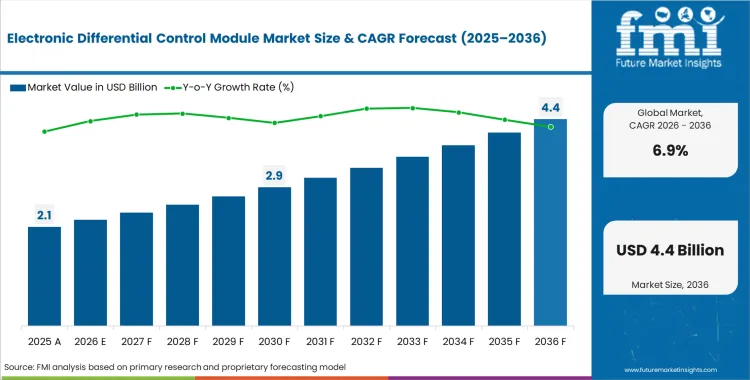
The electronic differential control module market was estimated at USD 2.0 billion in 2025. Persistently increasing sales are projecting the value to surpass USD 2.1 billion in 2026 at a CAGR of 6.9% during the forecast period. Rapid expansion of the industry propels total growth to USD 4.1 billion through 2036 as vehicle dynamic controllers merge lateral and longitudinal slip management into centralized architectures.
Summary of Electronic Differential Control Module Market
- Market Snapshot
- Global demand for the electronic differential control module market is valued at USD 2.0 billion in 2025 and is projected to hit USD 4.1 billion by the close of 2036.
- Revenue expansion tracks a steady 6.9% CAGR over the coming decade, opening up an incremental opportunity worth USD 2.0 billion beyond the 2026 base year.
- Success in this software-heavy electronics space requires suppliers to master fast response speeds, seamless chassis integration, and flawless functional safety while supporting both torque-vectoring and all-wheel-drive systems.
- Hardware isolation is already disappearing from product designs. Consolidating these modules into a central chassis computer accounts for 58% of current demand, signaling a permanent move toward unified motion-control setups.
- Demand and Growth Drivers
- Carmakers are rapidly installing these electronic traction systems as they build more software-managed and battery-powered vehicle platforms.
- Using active electronics rather than old mechanical parts to stabilize a vehicle under heavy steering drives the popularity of eLSD control, a category likely set to capture 54% of the market in 2026.
- Centralizing vehicle computers drastically cuts the number of required hardware boxes. Tech companies promote this domain control approach because it helps engineers pack more software-defined features into the main chassis network.
- Asian markets are scaling these electrified programs faster than older replacement-led economies. India is likely to record the highest compound growth at 8.1%, followed by China at a 7.0% CAGR, the USA at a 6.2% CAGR, South Korea at a 6.0% CAGR, Germany at a 5.3% CAGR, France at a 5.0% CAGR, and Japan at a 4.7% CAGR.
- Tight cost control and strict weight limits force automakers to rethink putting a standalone controller on every axle, pushing engineers to blend differential logic directly into larger motion-management domains.
- Product and Segment View
- Industry tracking covers the physical controllers, torque-vectoring logic, embedded software, and power interfaces that manage left-to-right power distribution in everyday cars and light trucks.
- Traction management must happen instantly across all modern vehicle types. Engineers specify these specialized computing units for everything from heavy battery-electric platforms to premium hybrid SUVs where cornering stability matters.
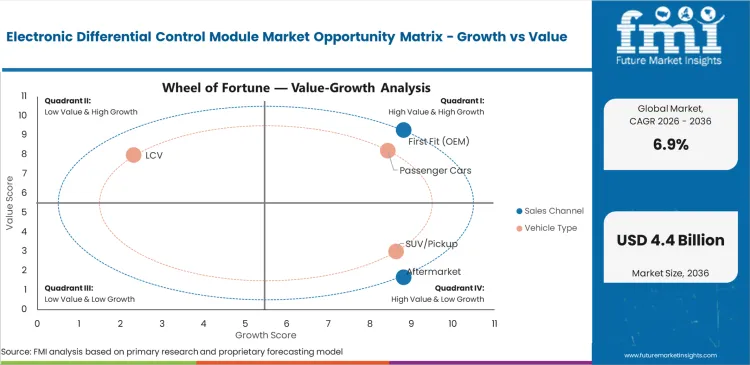
- Factory installation completely dominates the sales channel with an anticipated 93% position, since automakers lock down vehicle dynamics testing and safety certification long before a car reaches the dealership.
- High production volumes ensure Passenger Cars is likely to account for 62% of demand in 2026, even though heavy pickups and luxury sport utility vehicles frequently utilize advanced torque-vectoring features.
- Avoiding expensive axle redesigns makes eLSD Control the preferred upgrade path. This setup is expectedly poised to secure 54% of the market in 2026 as brands add active handling programs to their electrified and premium lineups.
- Complex power blending between gas engines and electric motors keeps the ICE/HEV segment in the lead with a predicted 63% share in 2026. Legacy hybrid architectures still rely heavily on dedicated electronic differential behavior compared to simpler pure-electric drive units.
- Removing excess wiring and saving weight pushes the industry toward consolidated hardware, leaving the Integrated in Chassis ECU category estimated to represent 58% of the market in 2026.
- The analysis evaluates embedded software, actuator-driving electronics, and chassis-domain integration logic. Simple mechanical differentials, pure hydraulic transfer cases, and basic brake computers that lack active differential intelligence sit entirely outside this scope.
- Geography and Competitive Outlook
- Rapid industrial shifts make India, China, and the USA the fastest-expanding environments for this hardware. Engineering hubs like Germany and Japan maintain stable volumes driven primarily by premium platform upgrades and mature factory programs.
- Hardware suppliers, driveline specialists, and software companies now fight for the same dashboard real estate. Magna pushes rear driveline modules for torque control, BorgWarner markets cross-axle systems, and Bosch Engineering highlights advanced axle-split capabilities.
- The supply-chain demand outlook splits between companies that build the physical driveline hardware and technology firms that provide the central processing platforms. Continental, Bosch, ZF, Hitachi Astemo, and Magna lead this specific integration work.
- Continental operates as the leading supplier with a ruling market position. The rest of the sector is divided among global competitors who win contracts based on how well their calibration software talks to the main vehicle computer.
Car designers face tight physical space limits that force them to combine their vehicle electronics immediately. Putting a separate differential control computer on each automotive axle simply ruins the weight limits of modern vehicle designs. Purchasing teams now must find suppliers who can build systems that talk to the entire car, rather than just handling basic tire-slip programming. This change means engineers must compare centralized electronic AWD coupling modules against older, scattered hardware setups. Car companies that wait to make this switch face severe penalties in their mandatory safety test scores.
Vehicle engineers speed up this transition the moment they combine all the steering and acceleration controls into one main vehicle control unit. Using software defined vehicle chassis control helps engineering teams cut out duplicate wheel speed calculations. Once they make this structural change, the car's ability to react to sudden slip events drops to under ten milliseconds.
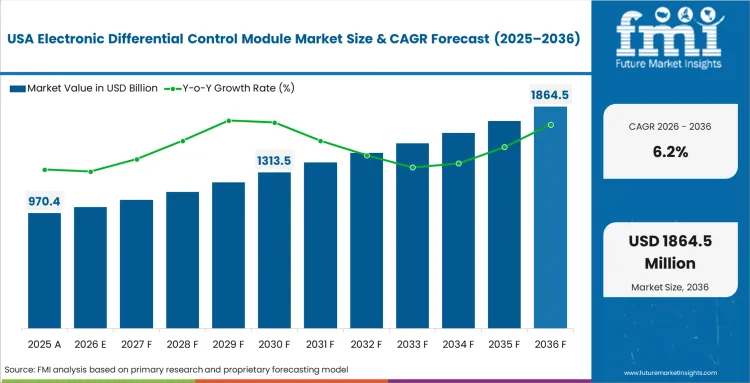
In the USA, the shift toward electric heavy-duty pickup trucks pushes demand to an anticipated growth of 6.2%. South Korea is expected to rise at 6.0%, while Germany is likely to expand at 5.3% to meet the strict handling requirements of premium European brands. India is anticipated to lead the market at 8.1% as local car makers upgrade their basic traction systems. China follows closely at an expected 7.0%, driven by a massive push to build automotive electric drivetrain components locally. France likely to experience a predicted inclination to 5.0% expansion, and Japan steadily advances at an estimated 4.7%. A clear divide now separates markets that just need basic power routing from those that demand fast-acting automotive differential control modules for advanced electric cars.
Segmental Analysis
Electronic Differential Control Module Market Analysis by Sales Channel
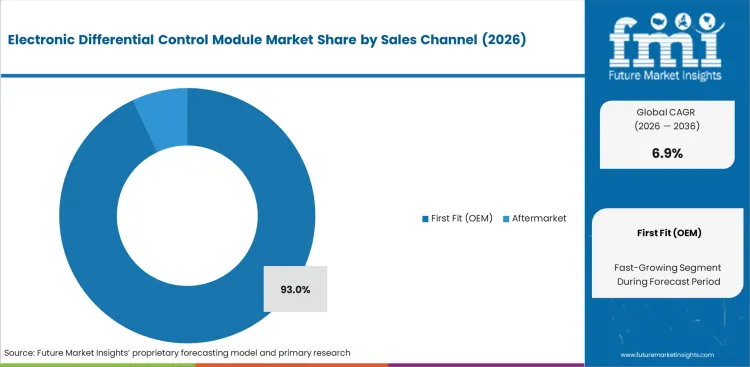
Modern safety protocols run on closed-loop software that actively blocks unauthorized third-party parts from modifying core chassis dynamics. With factory integration engineers controlling these encrypted networks, First Fit (OEM) is anticipated to capture 93% of the market in 2026, leaving almost no room for outside modifications. Dealership technicians cannot install aftermarket slip controllers because doing so immediately triggers cybersecurity alarms and voids factory warranties. Production analysts note that the tiny remaining aftermarket volume relies entirely on specialized off-road retrofits that bypass the main computer. Off-road tuning shops face an expiring business model as newer driveline control systems and devices permanently reject outside hardware nodes.
- Initial Installation Dominance: Factory integration engineers define network security protocols that lock differential hardware to specific central processors. Dealership technicians avoid unapproved modules to prevent immediate warranty voiding.
- Diagnostic Access Restriction: Encrypted communication layers prevent independent service centers from calibrating new differential software. Maintenance supervisors must purchase factory-authorized replacement units from approved electronic differential control module OEM suppliers.
- Off-Road Exception Shrinkage: Specialized performance tuners successfully bypass legacy mechanical systems for rock crawling applications. Next-generation electric platforms eliminate this physical workaround entirely.
Electronic Differential Control Module Market Analysis by Vehicle Type
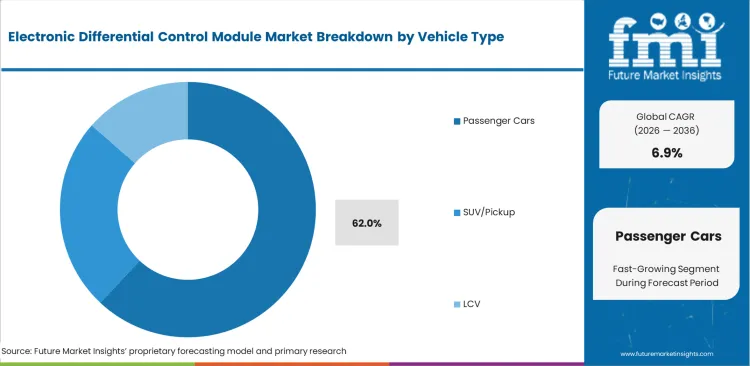
Factory managers building mass-market vehicles standardize active safety hardware across all trim levels to avoid the nightmare of managing dozens of different wiring harnesses. Chassis engineering directors specify passenger car differential control electronics as basic equipment to pass strict collision avoidance tests without having to redesign cheap and expensive models separately. Stripping these electronic controls from base models actually costs the manufacturer more money because it breaks the standardized assembly process. Driven by this need for high-volume manufacturing simplicity, the Passenger Cars category is likely to account for 62% share in 2026, giving parts makers the scale they need to cover their heavy software development bills. SUV and pickup builders who delay using these centralized systems now face heavy penalties in high-speed evasion testing.
- Harness Standardization Savings: Wiring architects eliminate multiple physical sensors by routing differential data through central safety buses. Production line managers achieve faster assembly times with unified active safety suites.
- Stability Test Compliance: Electronic slip control drastically improves performance during mandatory high-speed evasion maneuvers. Safety certification leads require these modules to achieve maximum consumer ratings.
- Payload Compensation Limits: Heavy pickup trucks demand specialized cooling algorithms that standard passenger car modules cannot survive. Fleet operators require dedicated heavy-duty validation.
Electronic Differential Control Module Market Analysis by Differential Type
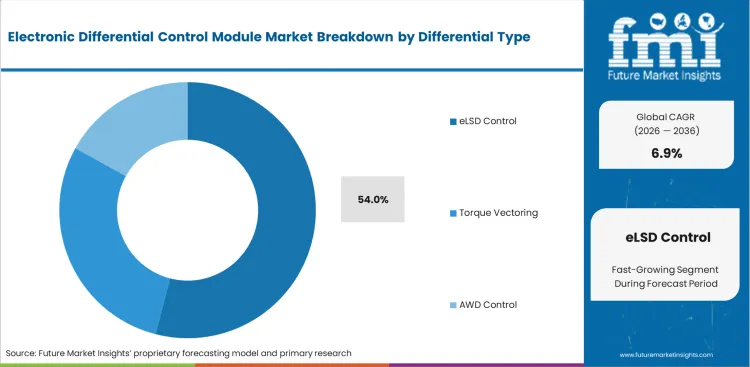
Upgrading old mechanical axles with smart electronic actuators allows car makers to improve vehicle handling without paying for expensive underbody redesigns. The market is expected to see eLSD Control account for 54% share in 2026 because drivetrain engineers strongly prefer this simple bolt-on upgrade over installing heavy, complex twin-clutch systems. This high adoption rate hides a massive capability gap between simple brake-based eLSD and true active torque transfer. Purchasing directors frequently buy this basic eLSD control module hardware just so the marketing department can print advanced dynamics on the brochure, even if the system only reacts after the tires start slipping. Brands that rely on this cheap reactive logic quickly lose buyers in the premium performance space to competitors using a dedicated torque vectoring control module.
- Casting Reuse Advantage: Axle packaging engineers avoid expensive underbody redesigns by bolting electronic actuators to standard limited-slip housings. Financial controllers approve these minor upgrades over full torque vectoring redesigns.
- Thermal Degradation Risk: Reactive braking logic generates massive heat during sustained track or off-road use. Warranty managers monitor high failure rates in vehicles pushed beyond basic street driving.
- Pre-Emptive Transition Requirement: Premium vehicle dynamics directors require AWD coupling system hardware capable of shifting torque before a tire loses grip. Performance division heads abandon basic eLSD for fully active twin-clutch hardware.
Electronic Differential Control Module Market Analysis by Powertrain
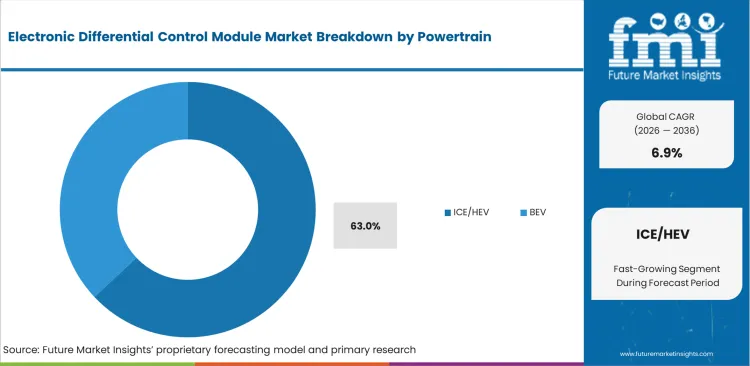
Hybrid vehicles force computers to constantly juggle power between older gas engines and instant electric motors without the driver feeling a clunky shift. Powertrain engineers use dedicated ICE HEV differential control systems specifically to mask these rough mechanical transitions. As legacy automakers struggle to separate slip control from their old engine management software, ICE/HEV is projected to secure 63% share in 2026, keeping older platform architectures functional. The frustrating reality for engineering teams is that writing this bridging software for a hybrid axle cost almost twice as much as programming a pure electric drive unit. Calibration teams working on these hybrid setups face severe budget cuts as major car companies move all their funding to electric platforms that require a specialized BEV torque distribution controller.
- Torque Blending Complexity: Hybrid calibration engineers must write software that smoothly transitions between instant electric torque and delayed combustion response. Quality directors reject systems that allow noticeable driveline shudder.
- Legacy Architecture Maintenance: Software architects struggle to integrate modern slip logic into outdated combustion engine control units. Project managers approve standalone differential modules to avoid rewriting core engine software.
- Electric Transition Acceleration: Pure battery platforms eliminate the physical differential entirely by using dual electric motors. e-axle input and output couplings replace traditional gearsets.
Electronic Differential Control Module Market Analysis by Integration
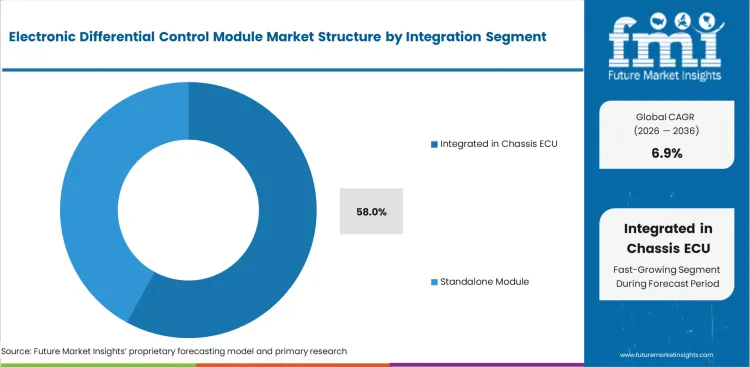
Car makers are running out of physical room to run wiring, forcing electrical design directors to combine multiple small computers into one central brain. Moving sensitive microcontrollers off the hot, vibrating axle and into the main vehicle body immediately cuts down on heat-related hardware failures. Evaluating an integrated chassis ECU vs standalone module setup reveals that this consolidation solves the space problem but traps the automaker in a bad software supply chain. When purchasing managers buy a combined automotive electric drivetrain components package, they are usually forced to use the exact driving algorithms written by the hardware maker. Despite this risk of supplier lock-in, the Integrated in Chassis ECU segment is estimated to represent 58% of the market in 2026 as the physical need to cut weight overrides software independence. Car companies that fail to write their own code quickly become entirely dependent on giant parts suppliers.
- Vibration Exposure Elimination: Packaging engineers remove sensitive microcontrollers from the axle casting to improve long-term reliability. Warranty analysts see immediate reductions in heat-related computing failures.
- Algorithm Lockout Risk: Sourcing an integrated chassis computer often forces procurement directors to accept generic slip-control software. Vehicle dynamics teams lose the ability to fine-tune unique brand driving characteristics.
- In-House Software Pivots: Advanced technology directors at premium brands demand uncompiled control units to write their own differential logic. Software engineering leads treat internal slip algorithms as core corporate intellectual property.
Electronic Differential Control Module Market Drivers, Restraints, and Opportunities
Building electric vehicles leaves almost no physical space for extra parts. Car designers must combine their electronic systems to save room. Putting a separate computer on each axle ruins tight weight limits and creates a mess of wiring. Sourcing teams now only buy from suppliers who build computers capable of managing the whole chassis. Car companies that wait to upgrade face poor scores in mandatory safety tests. Adding electric motors forces engineering teams to use faster computing modules to handle instant power delivery. Software code takes over the exact job that heavy physical gears used to do.
Testing new software delays the shift to central chassis computers. Combining steering and traction controls into one vehicle control unit (VCU) forces engineers to run millions of test miles. Safety regulators require hard proof that a simple radio glitch cannot crash the differential control module functional safety network. Proving this safety separation costs massive amounts of time. Many car makers keep using older, separate hardware modules just to avoid this long approval process.
- Centralized Operating Systems: Software teams have to build programs that safely divide tasks inside an electronic control unit in automotive systems. Big parts suppliers lock in long-term deals when they provide a single computer that runs both the brakes and the axles.
- Smart Cooling Software: Engineers working on high-performance cars need a way to stop differential parts from overheating before damage occurs. Independent software creators win direct contracts when they write code that limits power based on predicted temperature spikes.
- Electric Motor Programming: Teams building electric drivetrains struggle to make two separate motors behave like a traditional mechanical axle. Tech companies that write torque allocation software in electric vehicles to fix this driving feel problem secure highly profitable licensing agreements.
Regional Analysis
Based on regional analysis, electronic differential control module market is segmented into North America, Europe, and Asia Pacific across 40 plus countries.
.webp "Top Country Growth Comparison Electronic Differential Control Module Market Cagr (2026 2036)")
| Country | CAGR (2026 to 2036) |
|---|---|
| India | 8.1% |
| China | 7.0% |
| USA | 6.2% |
| South Korea | 6.0% |
| Germany | 5.3% |
| France | 5.0% |
| Japan | 4.7% |
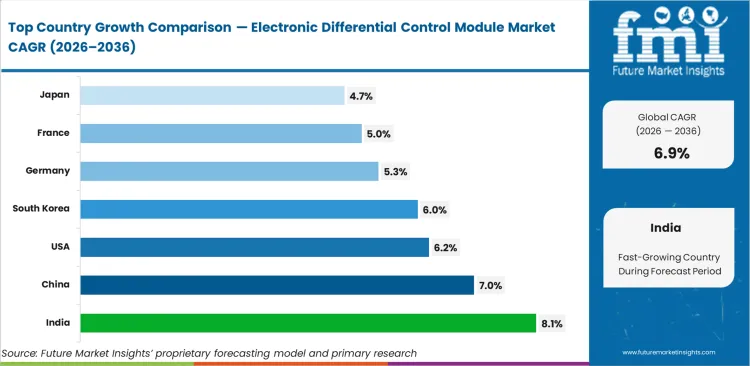
Source: Future Market Insights (FMI) analysis, based on proprietary forecasting model and primary research
North America Electronic Differential Control Module Market Analysis
Electric pickup trucks completely change how engineers handle cooling for chassis electronics in North America. Fleet owners need differential controllers that can handle massive towing loads for hours without overheating. Domestic automotive ECU makers are building bigger heat sinks just to survive these extreme conditions, which regular passenger cars never face. This heavy payload reality forces a clear split between basic car modules and heavy-duty truck hardware.
- United States: USA truck platforms operate under sustained towing loads that push AWD coupling systems beyond standard passenger-vehicle requirements. Fleet buyers screen out conventional modules early because thermal buildup under load shortens service life and raises warranty risk. Demand for these systems in the United States is expected to rise at a CAGR of 6.2% through 2036, reflecting steady requirements from pickups and utility vehicles built for work-intensive use. Suppliers that pair robust hardware with intelligent cooling control are better placed to secure long-term platform awards.
The North American shift toward electrified utility vehicles ensures that thermal management remains the biggest engineering hurdle. Hardware suppliers who ignore these extreme towing standards will quickly lose their footing in this specific commercial vehicle space.
Europe Electronic Differential Control Module Market Analysis
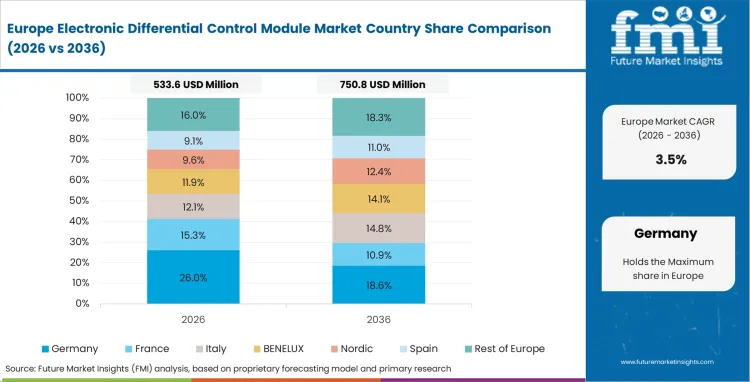
Strict crash-test rules dictate how fast European car brands adopt new safety hardware. Government regulators now use severe high-speed swerve tests that old mechanical axles fail miserably. Engineering bosses at luxury brands make active slip control a standard feature on every car just to keep their five-star safety scores. This baseline legal push guarantees a steady rollout of automotive domain control module hardware regardless of what individual drivers actually want to buy.
- Germany: Driving on fast autobahns requires instant communication between the steering wheel and the wheels. Luxury car engineers demand reaction times under ten milliseconds to keep drivers safe at high speeds. Tracking electronic differential control module integration in Germany shows the country is expectedly poised to expand at a CAGR of 5.3% through 2036 as these highway safety standards become tighter. Local technology companies heavily dominate the software licensing side of this high-performance space.
- France: Building everyday hatchbacks involves strict budget limits when moving from old mechanical parts to active safety systems. Electronic differential controller adoption in France is expected to move ahead at a CAGR of 5.0% from 2026 to 2036, driven largely by these cost-conscious design changes. Purchasing managers push for simple electronic designs that fit right onto older mechanical axles to save money. This tight focus on spending effectively blocks the use of expensive, full torque vectoring systems in everyday commuter cars.
FMI assesses, European demand relies on mandatory safety ratings rather than raw performance appeal. Car companies must install advanced chassis electronics simply to remain legally competitive on the showroom floor.
Asia Pacific Electronic Differential Control Module Market Analysis
Asian automakers are abandoning old mechanical axles rapidly to build locally designed electric vehicles. Design teams skip hybrid setups entirely and go straight for static stability control sensors built for dual-motor electric cars. Local car brands move incredibly fast because they do not have to rewrite decades of old gas-engine software. Starting fresh lets them plug differential controls right into the main vehicle computer much quicker than older, established brands can manage.
- India: India’s passenger vehicle developers are moving beyond basic traction control and specifying dedicated electronic differential control more often in newer platforms. Safety and vehicle dynamics teams are under pressure to improve stability performance as local testing and regulatory expectations tighten. Demand for differential control modules in India is projected to rise at a CAGR of 8.1% from 2026 to 2036, making the country one of the stronger growth pockets for suppliers targeting volume programs. This shift is opening room for cost-effective eLSD hardware that can meet compliance needs without pushing vehicle prices too far upward.
- China: Chinese automakers increasingly use cornering response and vehicle control software as visible product differentiators in the domestic EV market. Electronic differential control module adoption in China is forecast to expand at a CAGR of 7.0% through 2036 as brands compete on handling refinement, software behavior, and feature depth. Many OEMs now develop core driving logic internally to fine-tune vehicle feel and reduce reliance on external calibration partners. That approach is changing supplier relationships, with hardware vendors facing closer scrutiny on software compatibility, response speed, and integration support.
- South Korea: South Korean automakers are aligning chassis electronics across global vehicle programs to reduce engineering variation and simplify export execution. The market for electronic differential control modules in South Korea is expected to grow at a CAGR of 6.0% during the assessment period, supported by this push toward platform standardization. A common hardware architecture helps manufacturers manage regulatory differences across destinations without redesigning core systems for each region. It also lowers assembly complexity by reducing regional wiring and configuration changes at the plant level.
- Japan: Japanese automakers continue to devote substantial engineering effort to hybrid drivability, especially in managing transitions between engine and electric power without compromising vehicle refinement. That development focus shapes demand patterns for electronic differential control modules, even as the Japan market is expected to post a CAGR of 4.7% through 2036. Hybrid-heavy product strategies still absorb calibration resources that could otherwise accelerate migration toward cleaner EV-native control architectures. Suppliers serving Japan need to support this preference for smooth transitional control rather than assume a rapid shift in system design priorities.
FMI reports, the Asia Pacific region moves at two different speeds, with China and India rushing toward new hardware while Japan carefully refines legacy hybrid software. This clean-sheet approach to electric vehicle design makes the region the fastest-changing environment for chassis electronics globally.
Competitive Aligners for Market Players
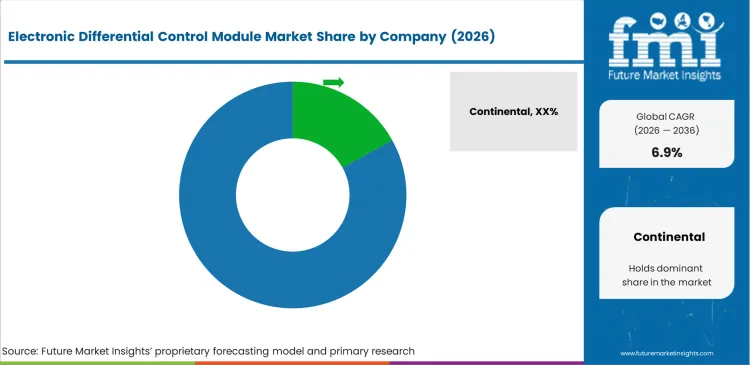
Supply contracts in chassis electronics are increasingly decided by software behavior inside centralized vehicle computers. Procurement teams test fault isolation, code stability, and functional coexistence alongside the mechanical durability of the differential hardware. Bosch, and other established electronic differential control module suppliers strengthen their position by proving that a fault in ABS or ESC does not disable the wider vehicle control network. That standard leaves little room for new hardware entrants unless they work with software specialists that already understand automotive safety architecture.
Established suppliers also benefit from validation histories that are difficult to reproduce within a normal program timeline. Their control strategies have been refined through years of recorded tire-slip incidents, recovery events, and vehicle-level testing across large driving populations. Automakers specifying automotive active roll control systems often prefer these vendors because proven code can be adapted into new platforms with less validation risk. New entrants face a slower path to approval since equivalent credibility still has to be built through extensive mileage, edge-case testing, and repeated safety signoff.
Vehicle engineering teams are also trying to avoid long-term dependence on a single software source. OEMs push back when closed systems prevent in-house calibration teams from adjusting steering response, torque distribution, and overall vehicle feel. That pressure is encouraging suppliers to separate hardware supply from the higher-layer control stack. It creates room for independent developers to sell custom torque vectoring software that can run on standardized computing hardware.
Key Players in Electronic Differential Control Module Market
- Continental
- Bosch
- ZF
- Hitachi Astemo
- Magna
- BorgWarner
Scope of the Report
| Metric | Value |
|---|---|
| Quantitative Units | USD 2.1 billion to USD 4.1 billion, at a CAGR of 6.9% |
| Market Definition | Electronic differential control modules serve as the dedicated computing hardware managing predictive torque distribution across axles. This equipment replaces passive mechanical slip reaction with active, software-driven dynamic control. |
| Segmentation | Sales Channel, Vehicle Type, Differential Type, Powertrain, Integration, and Region |
| Regions Covered | North America, Latin America, Europe, East Asia, South Asia & Pacific, Middle East & Africa (MEA) |
| Countries Covered | USA, China, India, Germany, Japan, South Korea, France |
| Key Companies Profiled | Continental, Bosch, ZF, Hitachi Astemo, Magna, BorgWarner |
| Forecast Period | 2026 to 2036 |
| Approach | Global light vehicle production volumes cross-referenced with active differential fitment rates |
Source: Future Market Insights (FMI) analysis, based on proprietary forecasting model and primary research
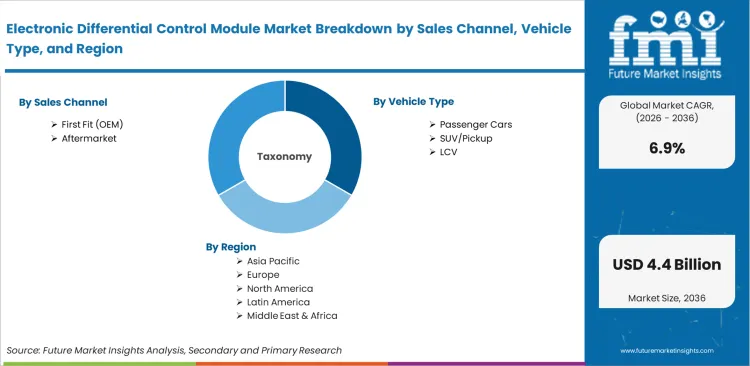
Segments
Sales Channel
- First Fit (OEM)
- Aftermarket
Vehicle Type
- Passenger Cars
- SUV/Pickup
- LCV
Differential Type
- eLSD Control
- Torque Vectoring
- AWD Control
Powertrain
- ICE/HEV
- BEV
Integration
- Integrated in Chassis ECU
- Standalone Module
Regions:
- Asia Pacific
- India
- China
- Japan
- South Korea
- Indonesia
- Australia & New Zealand
- ASEAN
- Rest of Asia Pacific
- Europe
- Germany
- Italy
- France
- United Kingdom
- Spain
- Benelux
- Nordics
- Central & Eastern Europe
- Rest of Europe
- North America
- United States
- Canada
- Mexico
- Latin America
- Brazil
- Argentina
- Chile
- Rest of Latin America
- Middle East & Africa
- Kingdom of Saudi Arabia
- United Arab Emirates
- South Africa
- Turkey
- Rest of Middle East & Africa
Bibliography
- Asperti, M., Vignati, M., & Sabbioni, E. (2024). On torque vectoring control: Review and comparison of state-of-the-art approaches. Machines, 12(3), 160.
- Liu, H. (2025). Electronic differential control based on speed and optimum slip ratio estimation for all-electric vehicles with in-wheel motors. PLOS ONE, 20(6), e0325125.
- Asperti, M., Vignati, M., & Sabbioni, E. (2024). Subjective-objective assessment of different torque vectoring control strategies. In G. Mastinu, F. Braghin, F. Cheli, M. Corno, & S. M. Savaresi (Eds.), 16th International Symposium on Advanced Vehicle Control (AVEC 2024) (pp. 517-524). Springer.
- United Nations Economic Commission for Europe. (2024). Uniform provisions concerning the approval of passenger cars with regard to electronic stability control (ESC) systems (UN Regulation No. 140, Supplement 6).
This bibliography is provided for reader reference. The full FMI report contains the complete reference list with primary source documentation.
This Report Addresses
- Vehicle platform constraints driving the consolidation of electronic differential controllers into central computing domains.
- Structural factors protecting first fit OEM installations from independent aftermarket interference.
- High-speed evasion testing requirements forcing mass passenger car adoption of active slip hardware.
- Software validation bottlenecks complicating the transition from basic eLSD to full torque vectoring.
- Legacy hybrid torque blending challenges delaying pure electric vehicle development timelines.
- Predictive thermal management necessities for heavy pickup truck applications in the USA.
- Software safety isolation requirements determining Tier-1 chassis electronics contract awards.
- Premium automaker strategies for preventing complete supplier lock-in regarding vehicle dynamics logic.
Frequently Asked Questions
What is an electronic differential control module?
Electronic differential control modules operate as centralized hardware units that utilize wheel speed and steering angle data to distribute vehicle torque dynamically.
How does an eLSD control module work in modern vehicles?
An eLSD control module applies targeted brake pressure or adjusts electronic actuator limits to mitigate wheel slip before a traction loss occurs.
What is the difference between eLSD and torque vectoring?
Basic eLSD systems rely primarily on reactive braking logic to limit slip, whereas torque vectoring physically distributes engine power side-to-side through active clutches.
Why are OEMs integrating differential control into chassis ECUs?
Automakers consolidate differential processing into central chassis ECUs to reduce overall wiring complexity and eliminate heavy standalone modules.
Compare eLSD control and torque vectoring in modern vehicles.
Engineers prefer eLSD for upgrading traditional axle castings cost-effectively, while reserving complex torque vectoring systems for premium electric architectures demanding proactive cornering performance.
Which countries are growing fastest for electronic differential control modules?
India leads volume expansion with an 8.1% CAGR as safety regulations tighten, while China follows closely at a 7.0% CAGR driven by electric vehicle platform scaling.
Is standalone differential control hardware losing share to integrated chassis ECUs?
Standalone differential nodes are rapidly losing market share as electrical architects mandate cross-domain safety controllers that handle braking and traction simultaneously.
What drives demand for passenger car differential control electronics?
Standardized active collision avoidance tests compel manufacturers to install electronic slip control across all passenger car trim levels to secure top safety ratings.
Who are the top torque vectoring ECU vendors?
Incumbent Tier-1 manufacturers like Continental, Bosch, and ZF currently dominate supply chains because their extensive pre-validated software libraries guarantee network safety.
How do ICE HEV differential control systems differ from BEV variants?
Hybrid differential platforms require highly complex software algorithms to smooth the jarring transition between combustion and electric power, unlike pure BEV systems that simply manage dual motor distribution.
Preview the report firsthand - request a free sample
Get SampleGet the brochure for pricing and purchase details.
Get PDFTable of Content
- Executive Summary
- Global Market Outlook
- Demand-side Trends
- Supply-side Trends
- Technology Roadmap Analysis
- Analysis and Recommendations
- Market Overview
- Market Coverage / Taxonomy
- Market Definition / Scope / Limitations
- Research Methodology
- Chapter Orientation
- Analytical Lens and Working Hypotheses
- Market Structure, Signals, and Trend Drivers
- Benchmarking and Cross-market Comparability
- Market Sizing, Forecasting, and Opportunity Mapping
- Research Design and Evidence Framework
- Desk Research Programme (Secondary Evidence)
- Company Annual and Sustainability Reports
- Peer-reviewed Journals and Academic Literature
- Corporate Websites, Product Literature, and Technical Notes
- Earnings Decks and Investor Briefings
- Statutory Filings and Regulatory Disclosures
- Technical White Papers and Standards Notes
- Trade Journals, Industry Magazines, and Analyst Briefs
- Conference Proceedings, Webinars, and Seminar Materials
- Government Statistics Portals and Public Data Releases
- Press Releases and Reputable Media Coverage
- Specialist Newsletters and Curated Briefings
- Sector Databases and Reference Repositories
- FMI Internal Proprietary Databases and Historical Market Datasets
- Subscription Datasets and Paid Sources
- Social Channels, Communities, and Digital Listening Inputs
- Additional Desk Sources
- Expert Input and Fieldwork (Primary Evidence)
- Primary Modes
- Qualitative Interviews and Expert Elicitation
- Quantitative Surveys and Structured Data Capture
- Blended Approach
- Why Primary Evidence is Used
- Field Techniques
- Interviews
- Surveys
- Focus Groups
- Observational and In-context Research
- Social and Community Interactions
- Stakeholder Universe Engaged
- C-suite Leaders
- Board Members
- Presidents and Vice Presidents
- R&D and Innovation Heads
- Technical Specialists
- Domain Subject-matter Experts
- Scientists
- Physicians and Other Healthcare Professionals
- Governance, Ethics, and Data Stewardship
- Research Ethics
- Data Integrity and Handling
- Primary Modes
- Tooling, Models, and Reference Databases
- Desk Research Programme (Secondary Evidence)
- Data Engineering and Model Build
- Data Acquisition and Ingestion
- Cleaning, Normalisation, and Verification
- Synthesis, Triangulation, and Analysis
- Quality Assurance and Audit Trail
- Market Background
- Market Dynamics
- Drivers
- Restraints
- Opportunity
- Trends
- Scenario Forecast
- Demand in Optimistic Scenario
- Demand in Likely Scenario
- Demand in Conservative Scenario
- Opportunity Map Analysis
- Product Life Cycle Analysis
- Supply Chain Analysis
- Investment Feasibility Matrix
- Value Chain Analysis
- PESTLE and Porter’s Analysis
- Regulatory Landscape
- Regional Parent Market Outlook
- Production and Consumption Statistics
- Import and Export Statistics
- Market Dynamics
- Global Market Analysis 2021 to 2025 and Forecast, 2026 to 2036
- Historical Market Size Value (USD Million) Analysis, 2021 to 2025
- Current and Future Market Size Value (USD Million) Projections, 2026 to 2036
- Y-o-Y Growth Trend Analysis
- Absolute $ Opportunity Analysis
- Global Market Pricing Analysis 2021 to 2025 and Forecast 2026 to 2036
- Global Market Analysis 2021 to 2025 and Forecast 2026 to 2036, By Sales Channel
- Introduction / Key Findings
- Historical Market Size Value (USD Million) Analysis By Sales Channel , 2021 to 2025
- Current and Future Market Size Value (USD Million) Analysis and Forecast By Sales Channel , 2026 to 2036
- First Fit (OEM)
- Aftermarket
- First Fit (OEM)
- Y-o-Y Growth Trend Analysis By Sales Channel , 2021 to 2025
- Absolute $ Opportunity Analysis By Sales Channel , 2026 to 2036
- Global Market Analysis 2021 to 2025 and Forecast 2026 to 2036, By Vehicle Type
- Introduction / Key Findings
- Historical Market Size Value (USD Million) Analysis By Vehicle Type, 2021 to 2025
- Current and Future Market Size Value (USD Million) Analysis and Forecast By Vehicle Type, 2026 to 2036
- Passenger Cars
- SUV/Pickup
- LCV
- Passenger Cars
- Y-o-Y Growth Trend Analysis By Vehicle Type, 2021 to 2025
- Absolute $ Opportunity Analysis By Vehicle Type, 2026 to 2036
- Global Market Analysis 2021 to 2025 and Forecast 2026 to 2036, By Differential Type
- Introduction / Key Findings
- Historical Market Size Value (USD Million) Analysis By Differential Type, 2021 to 2025
- Current and Future Market Size Value (USD Million) Analysis and Forecast By Differential Type, 2026 to 2036
- eLSD Control
- Torque Vectoring
- AWD Control
- eLSD Control
- Y-o-Y Growth Trend Analysis By Differential Type, 2021 to 2025
- Absolute $ Opportunity Analysis By Differential Type, 2026 to 2036
- Global Market Analysis 2021 to 2025 and Forecast 2026 to 2036, By Powertrain
- Introduction / Key Findings
- Historical Market Size Value (USD Million) Analysis By Powertrain, 2021 to 2025
- Current and Future Market Size Value (USD Million) Analysis and Forecast By Powertrain, 2026 to 2036
- ICE/HEV
- BEV
- ICE/HEV
- Y-o-Y Growth Trend Analysis By Powertrain, 2021 to 2025
- Absolute $ Opportunity Analysis By Powertrain, 2026 to 2036
- Global Market Analysis 2021 to 2025 and Forecast 2026 to 2036, By Integration
- Introduction / Key Findings
- Historical Market Size Value (USD Million) Analysis By Integration, 2021 to 2025
- Current and Future Market Size Value (USD Million) Analysis and Forecast By Integration, 2026 to 2036
- Integrated in Chassis ECU
- Standalone Module
- Integrated in Chassis ECU
- Y-o-Y Growth Trend Analysis By Integration, 2021 to 2025
- Absolute $ Opportunity Analysis By Integration, 2026 to 2036
- Global Market Analysis 2021 to 2025 and Forecast 2026 to 2036, By Region
- Introduction
- Historical Market Size Value (USD Million) Analysis By Region, 2021 to 2025
- Current Market Size Value (USD Million) Analysis and Forecast By Region, 2026 to 2036
- North America
- Latin America
- Western Europe
- Eastern Europe
- East Asia
- South Asia and Pacific
- Middle East & Africa
- Market Attractiveness Analysis By Region
- North America Market Analysis 2021 to 2025 and Forecast 2026 to 2036, By Country
- Historical Market Size Value (USD Million) Trend Analysis By Market Taxonomy, 2021 to 2025
- Market Size Value (USD Million) Forecast By Market Taxonomy, 2026 to 2036
- By Country
- USA
- Canada
- Mexico
- By Sales Channel
- By Vehicle Type
- By Differential Type
- By Powertrain
- By Integration
- By Country
- Market Attractiveness Analysis
- By Country
- By Sales Channel
- By Vehicle Type
- By Differential Type
- By Powertrain
- By Integration
- Key Takeaways
- Latin America Market Analysis 2021 to 2025 and Forecast 2026 to 2036, By Country
- Historical Market Size Value (USD Million) Trend Analysis By Market Taxonomy, 2021 to 2025
- Market Size Value (USD Million) Forecast By Market Taxonomy, 2026 to 2036
- By Country
- Brazil
- Chile
- Rest of Latin America
- By Sales Channel
- By Vehicle Type
- By Differential Type
- By Powertrain
- By Integration
- By Country
- Market Attractiveness Analysis
- By Country
- By Sales Channel
- By Vehicle Type
- By Differential Type
- By Powertrain
- By Integration
- Key Takeaways
- Western Europe Market Analysis 2021 to 2025 and Forecast 2026 to 2036, By Country
- Historical Market Size Value (USD Million) Trend Analysis By Market Taxonomy, 2021 to 2025
- Market Size Value (USD Million) Forecast By Market Taxonomy, 2026 to 2036
- By Country
- Germany
- UK
- Italy
- Spain
- France
- Nordic
- BENELUX
- Rest of Western Europe
- By Sales Channel
- By Vehicle Type
- By Differential Type
- By Powertrain
- By Integration
- By Country
- Market Attractiveness Analysis
- By Country
- By Sales Channel
- By Vehicle Type
- By Differential Type
- By Powertrain
- By Integration
- Key Takeaways
- Eastern Europe Market Analysis 2021 to 2025 and Forecast 2026 to 2036, By Country
- Historical Market Size Value (USD Million) Trend Analysis By Market Taxonomy, 2021 to 2025
- Market Size Value (USD Million) Forecast By Market Taxonomy, 2026 to 2036
- By Country
- Russia
- Poland
- Hungary
- Balkan & Baltic
- Rest of Eastern Europe
- By Sales Channel
- By Vehicle Type
- By Differential Type
- By Powertrain
- By Integration
- By Country
- Market Attractiveness Analysis
- By Country
- By Sales Channel
- By Vehicle Type
- By Differential Type
- By Powertrain
- By Integration
- Key Takeaways
- East Asia Market Analysis 2021 to 2025 and Forecast 2026 to 2036, By Country
- Historical Market Size Value (USD Million) Trend Analysis By Market Taxonomy, 2021 to 2025
- Market Size Value (USD Million) Forecast By Market Taxonomy, 2026 to 2036
- By Country
- China
- Japan
- South Korea
- By Sales Channel
- By Vehicle Type
- By Differential Type
- By Powertrain
- By Integration
- By Country
- Market Attractiveness Analysis
- By Country
- By Sales Channel
- By Vehicle Type
- By Differential Type
- By Powertrain
- By Integration
- Key Takeaways
- South Asia and Pacific Market Analysis 2021 to 2025 and Forecast 2026 to 2036, By Country
- Historical Market Size Value (USD Million) Trend Analysis By Market Taxonomy, 2021 to 2025
- Market Size Value (USD Million) Forecast By Market Taxonomy, 2026 to 2036
- By Country
- India
- ASEAN
- Australia & New Zealand
- Rest of South Asia and Pacific
- By Sales Channel
- By Vehicle Type
- By Differential Type
- By Powertrain
- By Integration
- By Country
- Market Attractiveness Analysis
- By Country
- By Sales Channel
- By Vehicle Type
- By Differential Type
- By Powertrain
- By Integration
- Key Takeaways
- Middle East & Africa Market Analysis 2021 to 2025 and Forecast 2026 to 2036, By Country
- Historical Market Size Value (USD Million) Trend Analysis By Market Taxonomy, 2021 to 2025
- Market Size Value (USD Million) Forecast By Market Taxonomy, 2026 to 2036
- By Country
- Kingdom of Saudi Arabia
- Other GCC Countries
- Turkiye
- South Africa
- Other African Union
- Rest of Middle East & Africa
- By Sales Channel
- By Vehicle Type
- By Differential Type
- By Powertrain
- By Integration
- By Country
- Market Attractiveness Analysis
- By Country
- By Sales Channel
- By Vehicle Type
- By Differential Type
- By Powertrain
- By Integration
- Key Takeaways
- Key Countries Market Analysis
- USA
- Pricing Analysis
- Market Share Analysis, 2025
- By Sales Channel
- By Vehicle Type
- By Differential Type
- By Powertrain
- By Integration
- Canada
- Pricing Analysis
- Market Share Analysis, 2025
- By Sales Channel
- By Vehicle Type
- By Differential Type
- By Powertrain
- By Integration
- Mexico
- Pricing Analysis
- Market Share Analysis, 2025
- By Sales Channel
- By Vehicle Type
- By Differential Type
- By Powertrain
- By Integration
- Brazil
- Pricing Analysis
- Market Share Analysis, 2025
- By Sales Channel
- By Vehicle Type
- By Differential Type
- By Powertrain
- By Integration
- Chile
- Pricing Analysis
- Market Share Analysis, 2025
- By Sales Channel
- By Vehicle Type
- By Differential Type
- By Powertrain
- By Integration
- Germany
- Pricing Analysis
- Market Share Analysis, 2025
- By Sales Channel
- By Vehicle Type
- By Differential Type
- By Powertrain
- By Integration
- UK
- Pricing Analysis
- Market Share Analysis, 2025
- By Sales Channel
- By Vehicle Type
- By Differential Type
- By Powertrain
- By Integration
- Italy
- Pricing Analysis
- Market Share Analysis, 2025
- By Sales Channel
- By Vehicle Type
- By Differential Type
- By Powertrain
- By Integration
- Spain
- Pricing Analysis
- Market Share Analysis, 2025
- By Sales Channel
- By Vehicle Type
- By Differential Type
- By Powertrain
- By Integration
- France
- Pricing Analysis
- Market Share Analysis, 2025
- By Sales Channel
- By Vehicle Type
- By Differential Type
- By Powertrain
- By Integration
- India
- Pricing Analysis
- Market Share Analysis, 2025
- By Sales Channel
- By Vehicle Type
- By Differential Type
- By Powertrain
- By Integration
- ASEAN
- Pricing Analysis
- Market Share Analysis, 2025
- By Sales Channel
- By Vehicle Type
- By Differential Type
- By Powertrain
- By Integration
- Australia & New Zealand
- Pricing Analysis
- Market Share Analysis, 2025
- By Sales Channel
- By Vehicle Type
- By Differential Type
- By Powertrain
- By Integration
- China
- Pricing Analysis
- Market Share Analysis, 2025
- By Sales Channel
- By Vehicle Type
- By Differential Type
- By Powertrain
- By Integration
- Japan
- Pricing Analysis
- Market Share Analysis, 2025
- By Sales Channel
- By Vehicle Type
- By Differential Type
- By Powertrain
- By Integration
- South Korea
- Pricing Analysis
- Market Share Analysis, 2025
- By Sales Channel
- By Vehicle Type
- By Differential Type
- By Powertrain
- By Integration
- Russia
- Pricing Analysis
- Market Share Analysis, 2025
- By Sales Channel
- By Vehicle Type
- By Differential Type
- By Powertrain
- By Integration
- Poland
- Pricing Analysis
- Market Share Analysis, 2025
- By Sales Channel
- By Vehicle Type
- By Differential Type
- By Powertrain
- By Integration
- Hungary
- Pricing Analysis
- Market Share Analysis, 2025
- By Sales Channel
- By Vehicle Type
- By Differential Type
- By Powertrain
- By Integration
- Kingdom of Saudi Arabia
- Pricing Analysis
- Market Share Analysis, 2025
- By Sales Channel
- By Vehicle Type
- By Differential Type
- By Powertrain
- By Integration
- Turkiye
- Pricing Analysis
- Market Share Analysis, 2025
- By Sales Channel
- By Vehicle Type
- By Differential Type
- By Powertrain
- By Integration
- South Africa
- Pricing Analysis
- Market Share Analysis, 2025
- By Sales Channel
- By Vehicle Type
- By Differential Type
- By Powertrain
- By Integration
- USA
- Market Structure Analysis
- Competition Dashboard
- Competition Benchmarking
- Market Share Analysis of Top Players
- By Regional
- By Sales Channel
- By Vehicle Type
- By Differential Type
- By Powertrain
- By Integration
- Competition Analysis
- Competition Deep Dive
- Continental
- Overview
- Product Portfolio
- Profitability by Market Segments (Product/Age /Sales Channel/Region)
- Sales Footprint
- Strategy Overview
- Marketing Strategy
- Product Strategy
- Channel Strategy
- Bosch
- ZF
- Hitachi Astemo
- Magna
- BorgWarner
- Continental
- Competition Deep Dive
- Assumptions & Acronyms Used


