

- Market Size (2026)
- USD 0.86 Bn
- Forecast (2036)
- USD 2.56 Bn
- CAGR (2026 to 2036)
- 11.5%
Cybersecure Electronic Fuel Delivery Control Units Market Size, Market Forecast and Outlook By FMI
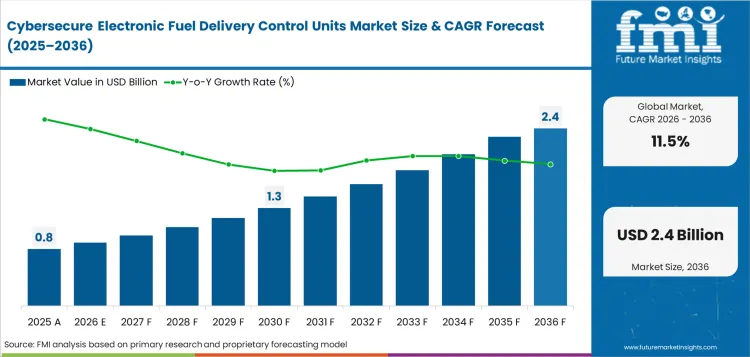
The cybersecure electronic fuel delivery control units market was valued at USD 0.77 billion in 2025 and is projected to reach USD 0.86 billion in 2026. It is forecast to reach USD 2.56 billion by 2036 at 11.5% CAGR. Fuel pump controllers are projected to lead control type with 45.0% share in 2026. OEM fitment is expected to hold 82.0% share of sales channel in 2026.
Summary of the Cybersecure Electronic Fuel Delivery Control Units Market
- Demand and Growth Drivers
- Electronic fuel systems need safer control as fuel injection system content rises in gasoline and hybrid platforms.
- Connected diagnostics are increasing demand for protected calibration files and controlled memory access.
- Flex fuel platforms are expanding software needs because injection maps must handle different fuel blends.
- OTA update growth is making authenticated fuel map changes more important for powertrain suppliers.
- Product and Segment View
- Control unit suppliers are tying fuel modules with automotive ECU designs that support safety and software audits.
- Secure boot is projected to hold 41.0% share of security layer demand in 2026.
- Gasoline ICE platforms are expected to account for 40.0% share of powertrain demand in 2026.
- Geography and Competitive Outlook
- China is expected to expand at 12.7% CAGR because local vehicle scale and software rule alignment support adoption.
- India is forecast to grow at 13.2% CAGR as electronic fuel injection widens across cars and two-wheelers.
- Companies such Bosch and DENSO define control software depth in the industry. Continental and Hitachi Astemo influence fuel system integration.
- Analyst Opinion
- Nikhil Kaitwade, Principal Consultant at FMI says, “Cybersecure fuel delivery control now acts as a compliance filter beyond a small added feature. Suppliers with the clearest advantage will combine fuel pressure control with verified secure development. OEM sourcing is anticipated to favor companies that can document threat analysis and safe software updates.”
- Cybersecure Electronic Fuel Delivery Control Units Market Value Analysis
- The market is shifting from standalone fuel control modules into secure powertrain control nodes.
- Secure injector control raises value because software protection now sits beside timing accuracy and emissions calibration.
- Dedicated engine ECUs increase value as injector control remains central to powertrain safety.
- Hardware security modules support pricing gains by protecting keys and update routes.
- OEM fitment lifts revenue quality because cyber validation is handled before production release.
Key Takeaways
- The cybersecure electronic fuel delivery control units market was valued at USD 0.77 billion in 2025.
- By 2036, the market is expected to be worth USD 2.56 billion.
- From 2026 to 2036, the market is projected to expand at 11.5% CAGR.
- The market is projected to create an incremental opportunity of USD 1.70 billion between 2026 and 2036.
- Fuel pump controllers are projected to account for 45.0% share of control type demand in 2026.
- OEM fitment is expected to account for 82.0% share of sales channel demand in 2026.
- India at 13.2% CAGR and China at 12.7% CAGR are the lucrative growth potential markets.
Cybersecure electronic fuel delivery control units are not treated as simple pumps or injector controllers. In modern vehicles and diagnostic signals are transmitted through connected ECU networks, meaning that any compromised signal can directly affect drivability and emissions performance. Regulatory frameworks are reinforcing this shift. In May 2024, the UK Vehicle Certification Agency confirmed that UN Regulation No. 155 governs vehicle cybersecurity and cybersecurity management systems, while UN Regulation No. 156 addresses secure software updates and their role in vehicle safety. At the component level, semiconductor and ECU suppliers are aligning with these requirements. For example, in March 2025, Infineon achieved ISO/SAE 21434 certification for its AURIX TC4Dx microcontroller, supporting compliance with automotive cybersecurity standards such as UN R155.
Cybersecure Electronic Fuel Delivery Control Units Market Definition
The cybersecure electronic fuel delivery control units market covers electronic modules that regulate fuel pump pressure and injector driver timing with built-in cybersecurity controls. Scope includes secure boot and message authentication for automotive fuel delivery system programs. Protected update support is included if fuel delivery commands are part of the module. Revenue covers control hardware and embedded software for gasoline fuel delivery. Diesel and hybrid fuel delivery programs are included if a secure controller is sold. The market excludes simple mechanical fuel parts and non-secure replacement modules without verified software protection.
Cybersecure Electronic Fuel Delivery Control Units Market Inclusions
Market scope includes pump controllers and injector drivers if they include cybersecurity features. Rail pressure controllers are included if secure command control is built in. Included products may communicate with engine control modules and vehicle gateways. The study covers OEM fitment and service replacement if the module carries secure calibration handling. Scope includes passenger cars and commercial vehicles using electronic fuel injection. Two-wheelers are included if secure control units are specified. Adjacent automotive fuel injector hardware is included only if the control electronics are separately identified.
Cybersecure Electronic Fuel Delivery Control Units Market Exclusions
Scope does not include mechanical pumps, passive fuel rails or conventional connectors. Battery electric vehicles without a fuel delivery circuit are excluded from revenue sizing. General cybersecurity software is excluded unless sold with fuel delivery control hardware. Telematics gateways are excluded unless they secure fuel control commands directly. Replacement parts without secure software handling are not counted in the cybersecure segment.
Cybersecure Electronic Fuel Delivery Control Units Market Research Methodology
- Primary Research: FMI analysts reviewed fuel system suppliers and control module engineers. FMI analysts reviewed aftermarket channel views and cybersecurity certification needs across major automotive countries.
- Desk Research: The study used public data from vehicle regulators and industry bodies. Desk research used standards agency material and company technical releases.
- Market sizing and forecasting: Market size was estimated using a parent market share method with control unit volumes and secure content assumptions. The estimate was checked against fuel injection system values and ECU growth.
- Data validation: Forecast checks compared fuel delivery control unit growth and cybersecurity regulation timing. Hybrid vehicle exposure and supplier announcements were used as further checks.
Why is the Cybersecure Electronic Fuel Delivery Control Units Market Growing?
- Fuel control modules now carry security relevance as connected vehicles expose more powertrain command paths.
- Regulatory pressure makes cybersecurity evidence part of ECU supplier shortlisting across export vehicle programs.
- Secure update handling is expanding as fuel maps and calibration files move through controlled software channels.
Automakers treat fuel delivery control as a guarded powertrain function as vehicle networks open further. Vehicle networks now expose more ECUs to diagnostics and gateway traffic. In May 2024, Keysight’s Riscure Security Solutions received RDW approval to conduct type approval evaluations under UN R155 and UN R156. Keysight said these cybersecurity and software update rules became a requirement for all new vehicles produced for UNECE countries from July 2024. This affects fuel delivery modules because pump pressure and diagnostic access must be protected before approval work begins. Cybersecurity evidence now sits beside pressure control performance in OEM sourcing.
Fuel efficiency pressure adds another reason to protect calibration paths. In February 2026, the EPA reported that model year 2024 new vehicles reached a record 27.2 mpg in real world fuel economy. The same report said fuel economy would have been 1.7 mpg lower without BEVs and PHEVs. Gasoline and hybrid programs still need protected fuel delivery software because pump commands and adaptive calibration affect economy results. The link with over the air engine control module updates makes cybersecurity part of long-term vehicle service. Suppliers with secure update workflows can support calibration changes after launch.
Market Segmentation Analysis
- Fuel pump controllers are projected to reach 45.0% share in 2026 as pressure regulation stays central to electronic fuel delivery.
- Secure boot is expected to represent 41.0% share in 2026 as OEMs want start-up protection before network access.
- Passenger cars are forecast to account for 49.0% share in 2026 as platforms carry higher electronic content.
- Gasoline ICE platforms are projected to capture 40.0% share in 2026 as direct injection remains widely used.
- OEM fitment is estimated to account for 82.0% share in 2026 because cybersecurity evidence is fixed before production approval.
The market is divided into five segment groups based on control type and security layer. Vehicle type, powertrain and sales channel are assessed as separate dimensions. Control type covers fuel pump controllers and injector drivers. Rail pressure controllers form the third control group. Security layer covers secure boot and encrypted CAN. OTA hardening is assessed as the third security layer. Vehicle type separates passenger cars and commercial vehicles. Two-wheelers are assessed as a distinct high-volume group. The sales channel split explains why factory fitment dominates over service replacement. Channel separation connects two-wheeler fuel injection growth with secure low-cost controller demand.
Insights into the Fuel Pump Controllers Control Type Segment
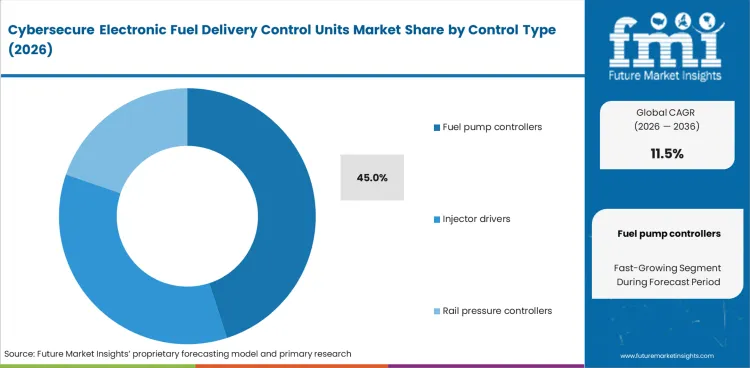
- Fuel pump controllers are projected to account for 45.0% share of control type in 2026. Fuel pump controller modules operate close to the fuel pressure command loop and therefore need secure command validation.
- Pump control has a clear aftermarket reference point because many replacement programs track module fitment by part number.
Insights into the Secure Boot Security Layer Segment
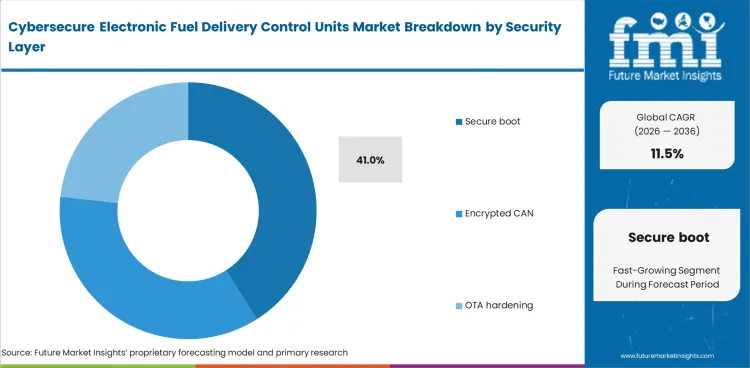
- Secure boot is expected to represent 41.0% share of security layer segment in 2026. Secure boot checks trusted software before the controller allows normal operation.
- Secure boot is usually easier to specify across many fuel ECU variants. Suppliers with standard secure boot stacks can lower validation work for OEM powertrain teams.
Insights into the Passenger Cars Vehicle Type Segment
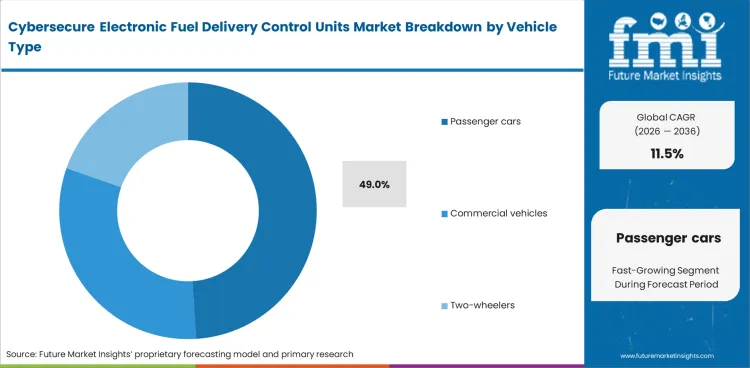
- Passenger cars are forecast to account for 49.0% share in 2026. The segment carries the broadest pool of electronic fuel control placements across gasoline and hybrid platforms.
- Automakers connect these modules with broader cabin and control architectures as automotive connectivity control unit content increases. Passenger car programs face type approval pressure in Europe and Japan. Secure fuel control becomes a planned design item before late validation.
Insights into the Gasoline ICE Powertrain Segment
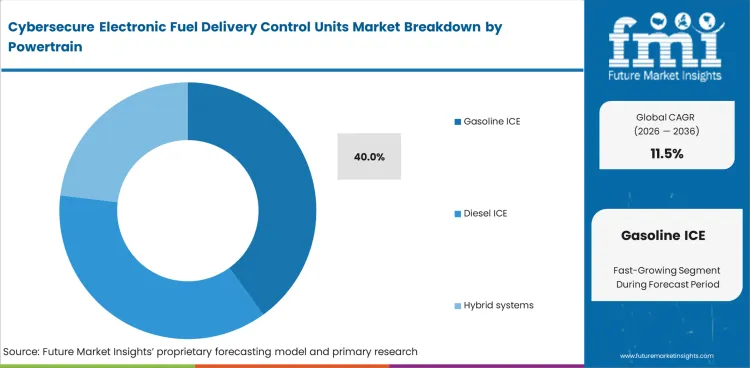
- Gasoline ICE platforms are projected to account for 40.0% share in 2026. Gasoline direct injection needs careful pump and injector control to balance performance with emissions.
- Diesel platforms retain relevance in commercial vehicles and off-road segments. Gasoline systems lead because passenger car volumes and direct injection penetration keep the order pool broad.
Insights into the OEM Fitment Sales Channel Segment
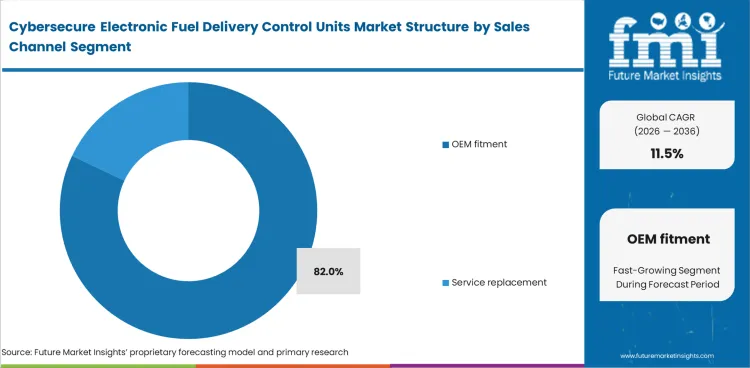
- OEM fitment is estimated to account for 82.0% share of sales channel demand in 2026. Cybersecurity requirements must be documented before vehicle approval and production release.
- Factory supply dominates because secure keys and software versions are tied to the vehicle program. Aftermarket suppliers need clearer traceability to compete in secure module replacement.
Cybersecure Electronic Fuel Delivery Control Units Market Drivers Restraints and Opportunities
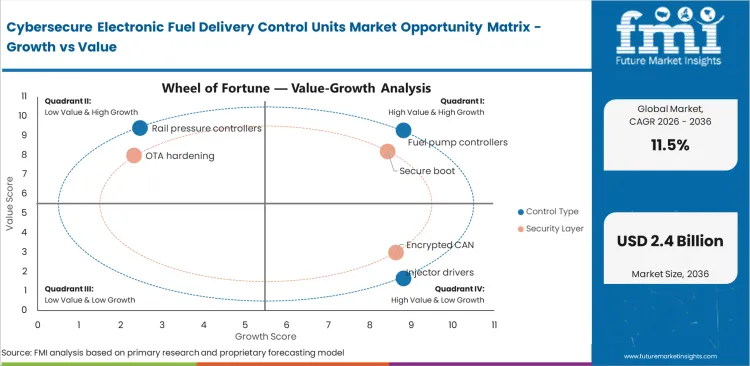
- Secure calibration handling is raising the value of fuel control modules in connected vehicle programs.
- Cost and validation time slow adoption in low-margin vehicle platforms with simpler fuel electronics.
- Zonal gateway links create opportunity as fuel ECUs need safer communication with vehicle networks.
One of the prominent growth drivers in the market is the shift from isolated fuel electronics to connected control paths. Vehicle Certification Agency guidance states that UN Regulation No. 156 covers software update management systems. UN Regulation No. 156 affects fuel control because calibration and diagnostics move through more often protected service channels. Suppliers that link fuel controllers with automotive zonal gateway ECU security gain a clearer route into software-defined vehicle platforms. Embedded software depth gives vendors an advantage over simple controller assembly.
Validation Cost Is Slowing Low-End Adoption
Validation cost is a primary restraint across many vehicle variants. Secure boot and software update testing raise engineering time before launch. Smaller vehicle programs may delay full security packages when local rules do not force strict proof. Adoption remains uneven across regions and vehicle classes. Suppliers that reuse approved software stacks can reduce this cost barrier and defend margins.
Secure Update Workflows Create Module Value
A lucrative opportunity lies in fuel modules that can support protected field updates. Engine maps and pump commands can change if emissions fixes or fuel quality issues appear after launch. The SCR dosing control modules category shows the same service value in emissions hardware. Fuel delivery suppliers can build similar value by joining secure diagnostics with update proof. Protected update support creates a higher priced lane for controllers that reduce recall and service risk.
Analysis of Cybersecure Electronic Fuel Delivery Control Units Market by Key Countries
.webp "Top Country Growth Comparison Cybersecure Electronic Fuel Delivery Control Units Market Cagr (2026 2036)")
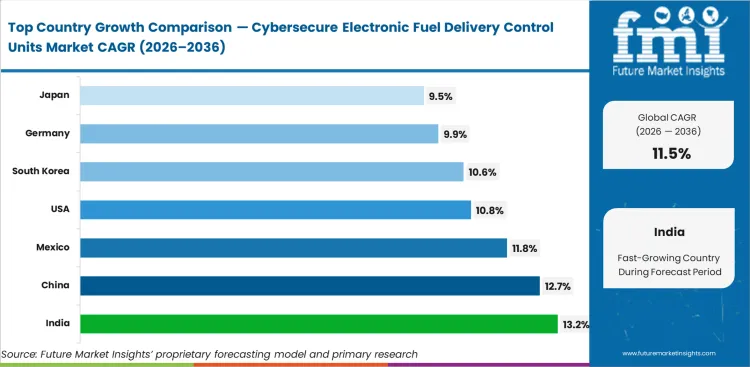
| Country | CAGR |
|---|---|
| United States | 10.8% |
| China | 12.7% |
| India | 13.2% |
| Germany | 9.9% |
| Japan | 9.5% |
| South Korea | 10.6% |
| Mexico | 11.8% |
Source: Future Market Insights, 2026.
Cybersecure Electronic Fuel Delivery Control Units Market CAGR Analysis by Country
- India is forecast to grow at 13.2% CAGR by 2036 as electronic fuel injection spreads across cars and two-wheelers.
- China is projected to record 12.7% CAGR by 2036 as vehicle scale and connected software rules lift secure module demand.
- Mexico is expected to expand at 11.8% CAGR by 2036 as export vehicle plants need secure fuel electronics.
- The United States is expected to advance at 10.8% CAGR by 2036 because emissions pressure and hybrid platform upgrades support demand.
- Germany and Japan are forecast below the global CAGR because electrification reduces long-term ICE module volume.
Country-level analysis covers major vehicle production markets with fuel control and cybersecurity regulation exposure. Export platform needs are considered separately. Growth varies by vehicle mix and the speed at which connected powertrain electronics enter mass platforms.
Demand Outlook for Cybersecure Electronic Fuel Delivery Control Units in the United States
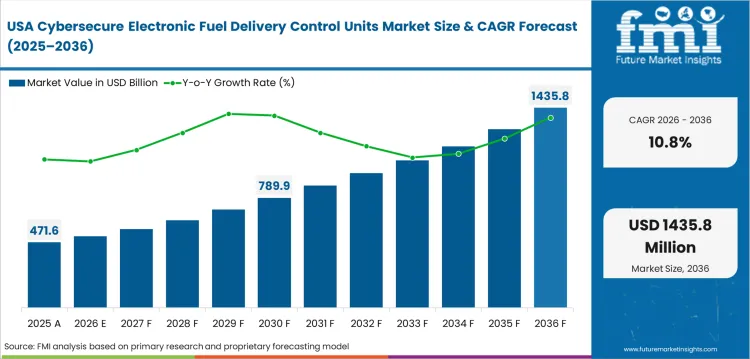
The United States is projected to record a 10.8% CAGR through 2036 as hybrid programs keep fuel electronics relevant. The United States Environmental Protection Agency reported 27.2 miles per gallon for model year 2024 new vehicles. Efficiency pressure raises the value of accurate fuel command and secure calibration.
- Michigan powertrain programs need secure pump control for gasoline and hybrid vehicle lines.
- Ohio assembly plants support demand for controller validation tied to emissions and durability checks.
- California software rules raise interest in protected update handling for connected vehicle service.
Sales Analysis of Cybersecure Electronic Fuel Delivery Control Units in China
China is expected to expand at 12.7% CAGR through 2036 as local vehicle scale supports faster secure ECU adoption. The International Energy Agency reported that electric car sales in China exceeded 11 million in 2024. China’s EV sales signal shows how fast local vehicle electronics can shift once policy and supply align. Fuel delivery control remains relevant in hybrids and range-extender vehicles. Suppliers in Shanghai and Chongqing need secure controllers that match local software rules.
- Shanghai OEM programs create demand for controllers that can pass connected vehicle security reviews.
- Chongqing powertrain clusters support gasoline and hybrid fuel control module sourcing.
- Guangzhou suppliers need lower-cost security stacks for domestic and export platforms.
Demand Outlook for Cybersecure Electronic Fuel Delivery Control Units in India
India is forecast to grow at 13.2% CAGR through 2036 as electronic fuel injection expands across vehicles. The Society of Indian Automobile Manufacturers reported FY 2025 to 2026 passenger vehicle sales of 46.43 lakh units and two-wheeler sales of 2.17 crore units. India’s production mix creates a large pool for low-cost secure controllers. BS VI compliance keeps fuel metering accuracy in focus. Pune and Chennai are expected to remain early supplier hubs for secure fuel control programs.
- Pune suppliers can combine engine electronics with secure calibration services for local OEMs.
- Chennai plants support passenger car and two-wheeler controller programs with export exposure.
- Gurugram engineering centers can test secure software handling for high-volume fuel controllers.
Opportunity Analysis of Cybersecure Electronic Fuel Delivery Control Units in Germany
Germany is expected to advance at 9.9% CAGR through 2036 as secure fuel control shifts toward premium and export platforms. While the share of electric vehicles is increasing, evidenced by 1.67 million electric passenger cars produced in 2025, this shift is gradually reducing the long-term demand for internal combustion engine (ICE) fuel control systems. However, secure fuel delivery control units remain relevant in hybrid and high-performance gasoline platforms, particularly in export markets where ICE and hybrid vehicles continue to dominate.
- Stuttgart powertrain programs need secure controllers for hybrid and performance gasoline platforms.
- Wolfsburg sourcing teams evaluate fuel electronics beside zonal and software update requirements.
- Bavarian premium programs give suppliers room to price validated cybersecurity functions.
Future Outlook for Cybersecure Electronic Fuel Delivery Control Units in Japan
Japan is forecast at 9.5% CAGR through 2036 as hybrid expertise sustains secure fuel control demand. Japan Automobile Manufacturers Association material shows automotive shipments reached 71.6 trillion yen in 2023. Japan’s industrial scale supports continued fuel system development across domestic and export platforms. Suppliers must show secure processes because Japanese safety rules reference cybersecurity practices.
- Aichi engineering teams need secure fuel control for high-volume hybrid powertrain programs.
- Tokyo software suppliers can support threat analysis and secure update evidence for ECU projects.
- Kyushu production sites create demand for controller testing tied to export vehicle platforms.
Sales Analysis of Cybersecure Electronic Fuel Delivery Control Units in South Korea
South Korea is projected to grow at a CAGR of 10.6% through 2036, supported by strong export-oriented vehicle programs that require secure powertrain electronics. The country has a well-established automotive manufacturing base with a deep network of component suppliers, which supports the development and validation of secure ECUs for gasoline and hybrid vehicles.
- Ulsan vehicle production keeps OEM fitment demand active for secure fuel control units.
- Gyeonggi electronics suppliers can support cryptographic hardware and ECU software validation.
- Seoul engineering teams can link fuel control security with connected vehicle service systems.
Future Outlook for Cybersecure Electronic Fuel Delivery Control Units in Mexico
Mexico is expected to post 11.8% CAGR through 2036 as export assembly keeps secure fuel electronics in scope. The United States International Trade Administration reported that Mexico ranked fifth globally in light vehicle manufacturing and exports in 2024. The same source noted overseas vehicle shipments near USD 104.8 billion. Mexico’s export exposure raises pressure to meet cybersecurity rules from destination markets. Bajio and northern border plants are expected to remain main sourcing points.
- Bajio plants need secure fuel modules that match North American and European vehicle rules.
- Monterrey suppliers can support electronics assembly and harness integration for control modules.
- Puebla and Saltillo programs create demand for export-ready fuel control validation packages.
Competitive Landscape and Strategic Positioning
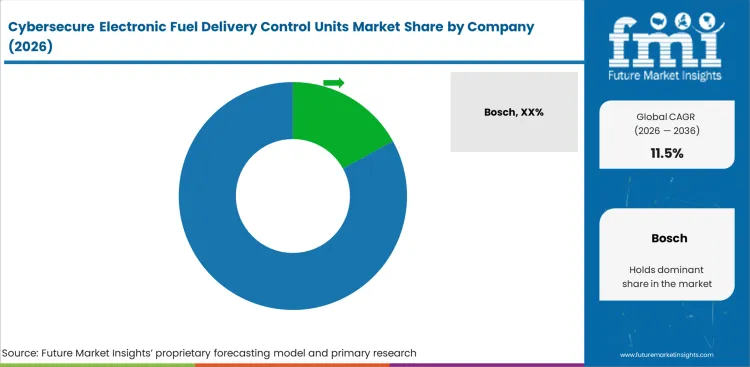
- The market is concentrated around powertrain control software and secure development evidence.
- Bosch and DENSO hold established positions through engine control depth and global OEM relationships.
- Continental and Hitachi Astemo compete on fuel system integration and regional powertrain support.
- Entry barriers center on secure boot validation and key handling. Calibration traceability and ECU life-cycle documentation add further approval pressure.
Competitive advantage is shifting from fuel pressure accuracy alone to secure command handling across the powertrain. Bosch presented a customer-neutral engine control module at ACT Expo 2026. That signal is relevant because secure fuel control is often bought as part of wider engine electronics. DENSO gained ISO/SAE 21434 process certification in January 2024 through TÜV SÜD. This gives the company a stronger proof point for secure controller development across vehicle components.
Semiconductor suppliers further boost the competitive intensity in the sector. NXP introduced the S32K5 automotive microcontroller family in March 2025 with security acceleration and post-quantum capability. Renesas launched the RH850 U2C in March 2026 with ISO/SAE 21434 support and cryptographic acceleration. Chip-level moves affect fuel controller suppliers because secure boot and message authentication depend on embedded hardware support. Controller makers can shorten validation cycles by pairing fuel expertise with secure MCUs.
Key Companies in the Cybersecure Electronic Fuel Delivery Control Units Market
Competition is best read by role because fuel control hardware, secure software and powertrain integration are not the same capability.
- Powertrain Control Leaders: Bosch and DENSO hold established positions through engine control software and global OEM approval. Bosch carries an estimated 18.0% share of cybersecure fuel control unit value in 2026. DENSO gains strength from secure process certification and Japanese hybrid program depth.
- Fuel System Integrators: Continental and Hitachi Astemo compete through pump control and injector driver depth. Schaeffler through Vitesco adds powertrain module integration. Fuel system integrators are more exposed to OEM fitment than general electronics suppliers.
- Control Electronics Specialists: Marelli and Aptiv support secure ECU architecture and controller integration. Their strength is clearest at fuel-control and vehicle-network link points.
Competitive Benchmarking: Cybersecure Electronic Fuel Delivery Control Units Market
| Company | Secure Fuel Control Depth | ECU Cybersecurity Proof | OEM Program Reach | Geographic Footprint |
|---|---|---|---|---|
| Bosch | High | Strong | Strong | Global with Germany and North America powertrain depth |
| DENSO | High | Strong | Strong | Global with Japan hybrid platform depth |
| Continental | Medium | Strong | Strong | Europe centered with aftermarket fuel system expansion |
| Hitachi Astemo | Medium | Medium | Strong | Japan centered with global powertrain and motorcycle systems |
| Schaeffler Vitesco | Medium | Medium | Strong | Europe centered with gasoline and hybrid powertrain programs |
| Marelli | Medium | Medium | Medium | Japan and Europe centered with engine management capability |
| Aptiv | Low | Strong | Medium | Global with vehicle architecture and network integration strength |
Source: Future Market Insights competitive analysis 2026. Ratings reflect relative positioning based on secure fuel control depth and cybersecurity proof. OEM program reach was reviewed as a separate commercial filter.
Key Developments in Cybersecure Electronic Fuel Delivery Control Units Market
- In March 2025, NXP introduced the S32K5 automotive MCU family with security acceleration and faster MRAM programming for updates.
- In March 2026, Renesas expanded its RH850 portfolio with a 28 nm U2C MCU for vehicle control and automotive safety applications.
In February 2026, STMicroelectronics introduced Stellar P3E for X-in-1 electronic control units with real-time edge intelligence.
Scope of the Report
| Item | Value |
|---|---|
| Quantitative Units | USD billion and CAGR |
| Market Definition | Cybersecure Control Units, Used for Electronic Fuel Delivery Command and Protection |
| Control Type | Fuel Pump Controllers, Injector Drivers, Rail Pressure Controllers |
| Security Layer | Secure Boot, Encrypted CAN, OTA Hardening |
| Vehicle Type | Passenger Cars, Commercial Vehicles, Two-Wheelers |
| Powertrain | Gasoline ICE, Diesel ICE, Hybrid Systems |
| Sales Channel | OEM Fitment, Service Replacement |
| Regions Covered | North America and Latin America. Europe and East Asia. South Asia and Pacific plus Middle East and Africa. |
| Countries Covered | United States and China. India and Germany. Japan and South Korea. Mexico. |
| Key Companies Profiled | Bosch and DENSO. Continental and Hitachi Astemo. Schaeffler Vitesco and Marelli. Aptiv. |
| Forecast Period | 2026 to 2036 |
| Approach | Hybrid top-down and bottom-up model using fuel control unit demand, secure ECU adoption and supplier validation |
Market Analysis by Segments
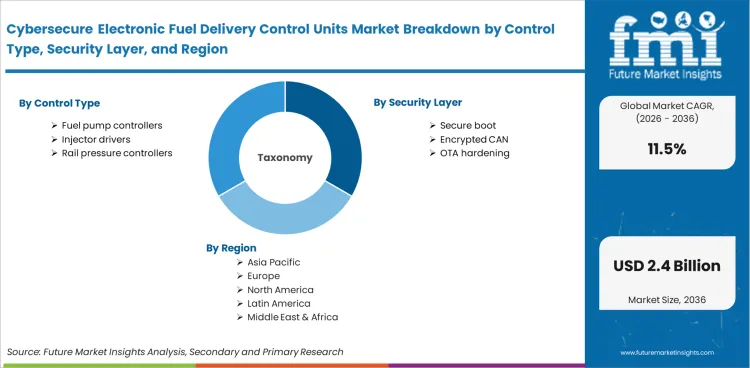
By Control Type:
- Fuel pump controllers
- Injector drivers
- Rail pressure controllers
By Security Layer:
- Secure boot
- Encrypted CAN
- OTA hardening
By Vehicle Type:
- Passenger cars
- Commercial vehicles
- Two-wheelers
By Powertrain:
- Gasoline ICE
- Diesel ICE
- Hybrid systems
By Sales Channel:
- OEM fitment
- Service replacement
By Region:
- North America
- Latin America
- Europe
- East Asia
- South Asia and Pacific
- Middle East and Africa
Research Sources and Bibliography
- Vehicle Certification Agency. (2024, May 14). Cyber security and software updating.
- Vehicle Certification Agency. (2025, November 13). New GB type approval legislation: Cyber security and software updates introduced.
- USA Environmental Protection Agency. (2026, February 19). Highlights of the Automotive Trends Report.
- International Energy Agency. (2025, May 14). Global EV Outlook 2025.
- Society of Indian Automobile Manufacturers. (2026, April 14). Auto industry performance of Q4 (Jan–March 2026) & FY 2025-26.
- Continental AG. (2024, September 10). Continental launches major product range expansion.
- Robert Bosch LLC. (2026, April 30). Bosch showcases next-generation powertrain solutions and compute systems at ACT Expo 2026.
- TÜV SÜD. (2024, January 29). TÜV SÜD issues ISO/SAE 21434 certification for automotive cybersecurity to DENSO.
- NXP Semiconductors. (2025, March 11). New S32K5 microcontroller family advances zonal SDV architectures and extends the NXP CoreRide platform.
- Renesas Electronics Corporation. (2026, March 4). Renesas expands auto MCU portfolio with 28nm RH850/U2C. h
- German Association of the Automotive Industry. (2026, February 3). Production and market in January 2026.
- United States Department of Commerce International Trade Administration. (2026, February 11). Mexico automotive industry.
- Japan Automobile Manufacturers Association. (2025, September). The motor industry of Japan 2025.
This Report Answers
- What is the current and future size of the cybersecure electronic fuel delivery control units market?
- How fast is the cybersecure electronic fuel delivery control units market expected to expand between 2026 and 2036?
- Which control type is expected to account for the leading cybersecure electronic fuel delivery control units share in 2026?
- Which security layer is projected to account for the leading cybersecure electronic fuel delivery control units share in 2026?
- Why do secure boot features support cybersecure electronic fuel delivery control units demand?
- How does OEM fitment support cybersecure electronic fuel delivery control units adoption?
- Which countries are projected to record faster expansion during the forecast period?
- Who are the main companies active in cybersecure electronic fuel delivery control units supply?
- How does FMI define the cybersecure electronic fuel delivery control units market scope?
- How does FMI estimate and validate the cybersecure electronic fuel delivery control units forecast?
Frequently Asked Questions
What is the cybersecure electronic fuel delivery control units market size in 2026?
The cybersecure electronic fuel delivery control units market is projected at USD 0.86 billion in 2026 under FMI’s current sizing view.
What is the cybersecure electronic fuel delivery control units market outlook for 2036?
The market is forecast to reach USD 2.56 billion by 2036 as secure fuel control becomes standard in connected powertrains.
Which segment leads the cybersecure electronic fuel delivery control units market by control type?
Fuel pump controllers are projected to lead control type demand with 45.0% share in 2026 because fuel pressure command needs remain central.
Which sales channel leads the cybersecure electronic fuel delivery control units market?
OEM fitment is expected to hold 82.0% share in 2026 because cybersecurity proof is set before vehicle production approval.
Which countries grow faster in the cybersecure electronic fuel delivery control units market?
India and China are expected to grow faster because vehicle scale, electronic fuel injection spread and software rule alignment support adoption.
Preview the report firsthand - request a free sample
Get SampleGet the brochure for pricing and purchase details.
Get PDFTable of Content
- Executive Summary
- Global Market Outlook
- Demand-side Trends
- Supply-side Trends
- Technology Roadmap Analysis
- Analysis and Recommendations
- Market Overview
- Market Coverage / Taxonomy
- Market Definition / Scope / Limitations
- Research Methodology
- Chapter Orientation
- Analytical Lens and Working Hypotheses
- Market Structure, Signals, and Trend Drivers
- Benchmarking and Cross-market Comparability
- Market Sizing, Forecasting, and Opportunity Mapping
- Research Design and Evidence Framework
- Desk Research Programme (Secondary Evidence)
- Company Annual and Sustainability Reports
- Peer-reviewed Journals and Academic Literature
- Corporate Websites, Product Literature, and Technical Notes
- Earnings Decks and Investor Briefings
- Statutory Filings and Regulatory Disclosures
- Technical White Papers and Standards Notes
- Trade Journals, Industry Magazines, and Analyst Briefs
- Conference Proceedings, Webinars, and Seminar Materials
- Government Statistics Portals and Public Data Releases
- Press Releases and Reputable Media Coverage
- Specialist Newsletters and Curated Briefings
- Sector Databases and Reference Repositories
- FMI Internal Proprietary Databases and Historical Market Datasets
- Subscription Datasets and Paid Sources
- Social Channels, Communities, and Digital Listening Inputs
- Additional Desk Sources
- Expert Input and Fieldwork (Primary Evidence)
- Primary Modes
- Qualitative Interviews and Expert Elicitation
- Quantitative Surveys and Structured Data Capture
- Blended Approach
- Why Primary Evidence is Used
- Field Techniques
- Interviews
- Surveys
- Focus Groups
- Observational and In-context Research
- Social and Community Interactions
- Stakeholder Universe Engaged
- C-suite Leaders
- Board Members
- Presidents and Vice Presidents
- R&D and Innovation Heads
- Technical Specialists
- Domain Subject-matter Experts
- Scientists
- Physicians and Other Healthcare Professionals
- Governance, Ethics, and Data Stewardship
- Research Ethics
- Data Integrity and Handling
- Primary Modes
- Tooling, Models, and Reference Databases
- Desk Research Programme (Secondary Evidence)
- Data Engineering and Model Build
- Data Acquisition and Ingestion
- Cleaning, Normalisation, and Verification
- Synthesis, Triangulation, and Analysis
- Quality Assurance and Audit Trail
- Market Background
- Market Dynamics
- Drivers
- Restraints
- Opportunity
- Trends
- Scenario Forecast
- Demand in Optimistic Scenario
- Demand in Likely Scenario
- Demand in Conservative Scenario
- Opportunity Map Analysis
- Product Life Cycle Analysis
- Supply Chain Analysis
- Investment Feasibility Matrix
- Value Chain Analysis
- PESTLE and Porter’s Analysis
- Regulatory Landscape
- Regional Parent Market Outlook
- Production and Consumption Statistics
- Import and Export Statistics
- Market Dynamics
- Global Market Analysis 2021 to 2025 and Forecast, 2026 to 2036
- Historical Market Size Value (USD Million) Analysis, 2021 to 2025
- Current and Future Market Size Value (USD Million) Projections, 2026 to 2036
- Y-o-Y Growth Trend Analysis
- Absolute $ Opportunity Analysis
- Global Market Pricing Analysis 2021 to 2025 and Forecast 2026 to 2036
- Global Market Analysis 2021 to 2025 and Forecast 2026 to 2036, By Control Type
- Introduction / Key Findings
- Historical Market Size Value (USD Million) Analysis By Control Type , 2021 to 2025
- Current and Future Market Size Value (USD Million) Analysis and Forecast By Control Type , 2026 to 2036
- Fuel pump controllers
- Injector drivers
- Rail pressure controllers
- Fuel pump controllers
- Y-o-Y Growth Trend Analysis By Control Type , 2021 to 2025
- Absolute $ Opportunity Analysis By Control Type , 2026 to 2036
- Global Market Analysis 2021 to 2025 and Forecast 2026 to 2036, By Security Layer
- Introduction / Key Findings
- Historical Market Size Value (USD Million) Analysis By Security Layer, 2021 to 2025
- Current and Future Market Size Value (USD Million) Analysis and Forecast By Security Layer, 2026 to 2036
- Secure boot
- Encrypted CAN
- OTA hardening
- Secure boot
- Y-o-Y Growth Trend Analysis By Security Layer, 2021 to 2025
- Absolute $ Opportunity Analysis By Security Layer, 2026 to 2036
- Global Market Analysis 2021 to 2025 and Forecast 2026 to 2036, By Vehicle Type
- Introduction / Key Findings
- Historical Market Size Value (USD Million) Analysis By Vehicle Type, 2021 to 2025
- Current and Future Market Size Value (USD Million) Analysis and Forecast By Vehicle Type, 2026 to 2036
- Passenger cars
- Commercial vehicles
- Two-wheelers
- Passenger cars
- Y-o-Y Growth Trend Analysis By Vehicle Type, 2021 to 2025
- Absolute $ Opportunity Analysis By Vehicle Type, 2026 to 2036
- Global Market Analysis 2021 to 2025 and Forecast 2026 to 2036, By Powertrain
- Introduction / Key Findings
- Historical Market Size Value (USD Million) Analysis By Powertrain, 2021 to 2025
- Current and Future Market Size Value (USD Million) Analysis and Forecast By Powertrain, 2026 to 2036
- Gasoline ICE
- Diesel ICE
- Hybrid systems
- Gasoline ICE
- Y-o-Y Growth Trend Analysis By Powertrain, 2021 to 2025
- Absolute $ Opportunity Analysis By Powertrain, 2026 to 2036
- Global Market Analysis 2021 to 2025 and Forecast 2026 to 2036, By Sales Channel
- Introduction / Key Findings
- Historical Market Size Value (USD Million) Analysis By Sales Channel, 2021 to 2025
- Current and Future Market Size Value (USD Million) Analysis and Forecast By Sales Channel, 2026 to 2036
- OEM fitment
- Service replacement
- OEM fitment
- Y-o-Y Growth Trend Analysis By Sales Channel, 2021 to 2025
- Absolute $ Opportunity Analysis By Sales Channel, 2026 to 2036
- Global Market Analysis 2021 to 2025 and Forecast 2026 to 2036, By Region
- Introduction
- Historical Market Size Value (USD Million) Analysis By Region, 2021 to 2025
- Current Market Size Value (USD Million) Analysis and Forecast By Region, 2026 to 2036
- North America
- Latin America
- Western Europe
- Eastern Europe
- East Asia
- South Asia and Pacific
- Middle East & Africa
- Market Attractiveness Analysis By Region
- North America Market Analysis 2021 to 2025 and Forecast 2026 to 2036, By Country
- Historical Market Size Value (USD Million) Trend Analysis By Market Taxonomy, 2021 to 2025
- Market Size Value (USD Million) Forecast By Market Taxonomy, 2026 to 2036
- By Country
- USA
- Canada
- Mexico
- By Control Type
- By Security Layer
- By Vehicle Type
- By Powertrain
- By Sales Channel
- By Country
- Market Attractiveness Analysis
- By Country
- By Control Type
- By Security Layer
- By Vehicle Type
- By Powertrain
- By Sales Channel
- Key Takeaways
- Latin America Market Analysis 2021 to 2025 and Forecast 2026 to 2036, By Country
- Historical Market Size Value (USD Million) Trend Analysis By Market Taxonomy, 2021 to 2025
- Market Size Value (USD Million) Forecast By Market Taxonomy, 2026 to 2036
- By Country
- Brazil
- Chile
- Rest of Latin America
- By Control Type
- By Security Layer
- By Vehicle Type
- By Powertrain
- By Sales Channel
- By Country
- Market Attractiveness Analysis
- By Country
- By Control Type
- By Security Layer
- By Vehicle Type
- By Powertrain
- By Sales Channel
- Key Takeaways
- Western Europe Market Analysis 2021 to 2025 and Forecast 2026 to 2036, By Country
- Historical Market Size Value (USD Million) Trend Analysis By Market Taxonomy, 2021 to 2025
- Market Size Value (USD Million) Forecast By Market Taxonomy, 2026 to 2036
- By Country
- Germany
- UK
- Italy
- Spain
- France
- Nordic
- BENELUX
- Rest of Western Europe
- By Control Type
- By Security Layer
- By Vehicle Type
- By Powertrain
- By Sales Channel
- By Country
- Market Attractiveness Analysis
- By Country
- By Control Type
- By Security Layer
- By Vehicle Type
- By Powertrain
- By Sales Channel
- Key Takeaways
- Eastern Europe Market Analysis 2021 to 2025 and Forecast 2026 to 2036, By Country
- Historical Market Size Value (USD Million) Trend Analysis By Market Taxonomy, 2021 to 2025
- Market Size Value (USD Million) Forecast By Market Taxonomy, 2026 to 2036
- By Country
- Russia
- Poland
- Hungary
- Balkan & Baltic
- Rest of Eastern Europe
- By Control Type
- By Security Layer
- By Vehicle Type
- By Powertrain
- By Sales Channel
- By Country
- Market Attractiveness Analysis
- By Country
- By Control Type
- By Security Layer
- By Vehicle Type
- By Powertrain
- By Sales Channel
- Key Takeaways
- East Asia Market Analysis 2021 to 2025 and Forecast 2026 to 2036, By Country
- Historical Market Size Value (USD Million) Trend Analysis By Market Taxonomy, 2021 to 2025
- Market Size Value (USD Million) Forecast By Market Taxonomy, 2026 to 2036
- By Country
- China
- Japan
- South Korea
- By Control Type
- By Security Layer
- By Vehicle Type
- By Powertrain
- By Sales Channel
- By Country
- Market Attractiveness Analysis
- By Country
- By Control Type
- By Security Layer
- By Vehicle Type
- By Powertrain
- By Sales Channel
- Key Takeaways
- South Asia and Pacific Market Analysis 2021 to 2025 and Forecast 2026 to 2036, By Country
- Historical Market Size Value (USD Million) Trend Analysis By Market Taxonomy, 2021 to 2025
- Market Size Value (USD Million) Forecast By Market Taxonomy, 2026 to 2036
- By Country
- India
- ASEAN
- Australia & New Zealand
- Rest of South Asia and Pacific
- By Control Type
- By Security Layer
- By Vehicle Type
- By Powertrain
- By Sales Channel
- By Country
- Market Attractiveness Analysis
- By Country
- By Control Type
- By Security Layer
- By Vehicle Type
- By Powertrain
- By Sales Channel
- Key Takeaways
- Middle East & Africa Market Analysis 2021 to 2025 and Forecast 2026 to 2036, By Country
- Historical Market Size Value (USD Million) Trend Analysis By Market Taxonomy, 2021 to 2025
- Market Size Value (USD Million) Forecast By Market Taxonomy, 2026 to 2036
- By Country
- Kingdom of Saudi Arabia
- Other GCC Countries
- Turkiye
- South Africa
- Other African Union
- Rest of Middle East & Africa
- By Control Type
- By Security Layer
- By Vehicle Type
- By Powertrain
- By Sales Channel
- By Country
- Market Attractiveness Analysis
- By Country
- By Control Type
- By Security Layer
- By Vehicle Type
- By Powertrain
- By Sales Channel
- Key Takeaways
- Key Countries Market Analysis
- USA
- Pricing Analysis
- Market Share Analysis, 2025
- By Control Type
- By Security Layer
- By Vehicle Type
- By Powertrain
- By Sales Channel
- Canada
- Pricing Analysis
- Market Share Analysis, 2025
- By Control Type
- By Security Layer
- By Vehicle Type
- By Powertrain
- By Sales Channel
- Mexico
- Pricing Analysis
- Market Share Analysis, 2025
- By Control Type
- By Security Layer
- By Vehicle Type
- By Powertrain
- By Sales Channel
- Brazil
- Pricing Analysis
- Market Share Analysis, 2025
- By Control Type
- By Security Layer
- By Vehicle Type
- By Powertrain
- By Sales Channel
- Chile
- Pricing Analysis
- Market Share Analysis, 2025
- By Control Type
- By Security Layer
- By Vehicle Type
- By Powertrain
- By Sales Channel
- Germany
- Pricing Analysis
- Market Share Analysis, 2025
- By Control Type
- By Security Layer
- By Vehicle Type
- By Powertrain
- By Sales Channel
- UK
- Pricing Analysis
- Market Share Analysis, 2025
- By Control Type
- By Security Layer
- By Vehicle Type
- By Powertrain
- By Sales Channel
- Italy
- Pricing Analysis
- Market Share Analysis, 2025
- By Control Type
- By Security Layer
- By Vehicle Type
- By Powertrain
- By Sales Channel
- Spain
- Pricing Analysis
- Market Share Analysis, 2025
- By Control Type
- By Security Layer
- By Vehicle Type
- By Powertrain
- By Sales Channel
- France
- Pricing Analysis
- Market Share Analysis, 2025
- By Control Type
- By Security Layer
- By Vehicle Type
- By Powertrain
- By Sales Channel
- India
- Pricing Analysis
- Market Share Analysis, 2025
- By Control Type
- By Security Layer
- By Vehicle Type
- By Powertrain
- By Sales Channel
- ASEAN
- Pricing Analysis
- Market Share Analysis, 2025
- By Control Type
- By Security Layer
- By Vehicle Type
- By Powertrain
- By Sales Channel
- Australia & New Zealand
- Pricing Analysis
- Market Share Analysis, 2025
- By Control Type
- By Security Layer
- By Vehicle Type
- By Powertrain
- By Sales Channel
- China
- Pricing Analysis
- Market Share Analysis, 2025
- By Control Type
- By Security Layer
- By Vehicle Type
- By Powertrain
- By Sales Channel
- Japan
- Pricing Analysis
- Market Share Analysis, 2025
- By Control Type
- By Security Layer
- By Vehicle Type
- By Powertrain
- By Sales Channel
- South Korea
- Pricing Analysis
- Market Share Analysis, 2025
- By Control Type
- By Security Layer
- By Vehicle Type
- By Powertrain
- By Sales Channel
- Russia
- Pricing Analysis
- Market Share Analysis, 2025
- By Control Type
- By Security Layer
- By Vehicle Type
- By Powertrain
- By Sales Channel
- Poland
- Pricing Analysis
- Market Share Analysis, 2025
- By Control Type
- By Security Layer
- By Vehicle Type
- By Powertrain
- By Sales Channel
- Hungary
- Pricing Analysis
- Market Share Analysis, 2025
- By Control Type
- By Security Layer
- By Vehicle Type
- By Powertrain
- By Sales Channel
- Kingdom of Saudi Arabia
- Pricing Analysis
- Market Share Analysis, 2025
- By Control Type
- By Security Layer
- By Vehicle Type
- By Powertrain
- By Sales Channel
- Turkiye
- Pricing Analysis
- Market Share Analysis, 2025
- By Control Type
- By Security Layer
- By Vehicle Type
- By Powertrain
- By Sales Channel
- South Africa
- Pricing Analysis
- Market Share Analysis, 2025
- By Control Type
- By Security Layer
- By Vehicle Type
- By Powertrain
- By Sales Channel
- USA
- Market Structure Analysis
- Competition Dashboard
- Competition Benchmarking
- Market Share Analysis of Top Players
- By Regional
- By Control Type
- By Security Layer
- By Vehicle Type
- By Powertrain
- By Sales Channel
- Competition Analysis
- Competition Deep Dive
- Bosch
- Overview
- Product Portfolio
- Profitability by Market Segments (Product/Age /Sales Channel/Region)
- Sales Footprint
- Strategy Overview
- Marketing Strategy
- Product Strategy
- Channel Strategy
- DENSO
- Continental
- Hitachi Astemo
- Schaeffler Vitesco
- Marelli
- Aptiv
- Bosch
- Competition Deep Dive
- Assumptions & Acronyms Used


