

- Industry Size (2026)
- USD 2.9 Bn
- Forecast (2036)
- USD 6.1 Bn
- CAGR
- 7.7%(2026 to 2036)
SCR Dosing Control Modules Market Size, Market Forecast and Outlook By FMI
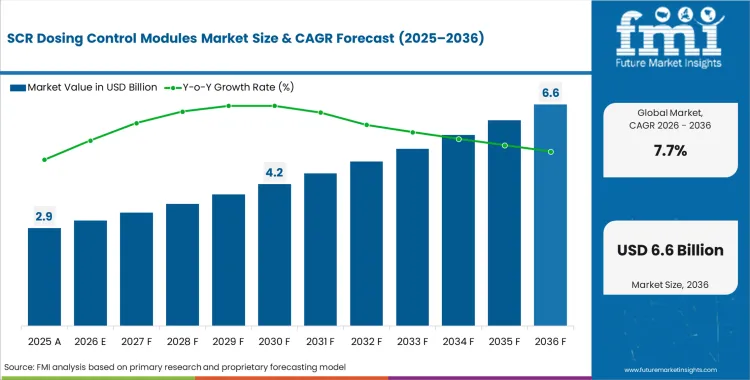
In 2025, the SCR dosing control modules market crossed a valuation of USD 2.7 billion, with a consistent increase in sales, it is expected to cross USD 2.9 billion in 2026 at a CAGR of 7.7% during the forecast period. Revenue expansion lifts total market valuation to USD 6.1 billion through 2036 as sustained procurement of integrated aftertreatment architectures becomes mandatory to satisfy strict phase-in requirements of Euro VII and EPA Phase 3 mandates.
Logistics directors face a major financial risk tied to their automotive exhaust systems. Buying individual, mismatched parts creates massive blind spots, if the computer cannot trigger a cleaning cycle in time, the system clogs. Transport companies that wait to upgrade to fully integrated, tested systems risk causing chain-reaction breakdowns that destroy expensive diesel particulate filter units. Engineering teams now realize that buying the right software is far more important than saving money on the physical hardware.
Summary of SCR Dosing Control Modules Market
- Market Snapshot
- Global sales for SCR dosing control modules market sit at USD 2.7 billion in 2025 and are set to reach USD 4.1 billion by 2036.
- A steady 3.9% CAGR through the next decade will add roughly USD 1.3 billion in new revenue to the sector.
- Strict pollution rules force manufacturers to buy these specific hardware setups, making heat resistance and precise fluid control the main reasons buyers choose one brand over another.
- Heavy diesel and hybrid trucks drive almost all of these purchases since fleet owners only buy these parts when regulations require them.
- Demand and Growth Drivers
- New clean air laws in the United States push truck builders to install better pollution-blocking hardware on every fresh engine rolling off the assembly line.
- The upcoming Euro 7 regulations force European automakers to buy highly accurate exhaust parts to ensure their commercial vehicles pass strict new roadside tests.
- Engineers are switching to water-cooled setups with built-in computers because heavy trucks need parts that will not freeze in winter or fail under massive engine loads.
- Looking at country-level expansion, India grows fastest at a 5.3% CAGR, while China hits 4.7%, Brazil sees 4.1%, the United States tracks at 3.6%, South Korea records 3.5%, Germany reaches 3.1%, and Japan posts 2.8%.
- Sales would climb even faster if these durable parts broke down more often, but long lifespans and the slow rise of fully electric trucks naturally cap the total number of units sold.
- Product and Segment View
- This equipment includes the specific pumps, computer chips, and heating elements needed to inject liquid cleaners directly into a truck's hot exhaust stream.
- Builders install these assemblies primarily in large freight haulers, city buses, construction diggers, and heavy off-road machinery.
- Massive highway transport trucks capture a 48% share of all purchases because their huge diesel engines face the toughest pollution checks.
- Liquid cooling systems hold a 57% share since pulling heat away from sensitive electronics is mandatory for vehicles working long shifts.
- Factory-direct installations account for an 82% share because automakers design and test these parts alongside the engine years before a truck ever hits the road.
- Combining the fluid pump and the computer brain into one box takes a 54% share, as this combined design reacts instantly to engine changes and saves wiring space.
- Standard highway vehicles make up a 71% share simply because there are far more regulated trucks and buses on paved roads than tractors in dirt fields.
- While the numbers track the actual fluid pumps and their attached computers, they completely ignore the large storage tanks and massive exhaust pipes sold separately.
- Geography and Competitive Outlook
- Developing regions like India, China, and Brazil buy new parts at the fastest rates, even as the United States and Germany spend the most money on premium, high-tech systems.
- Winning large contracts requires suppliers like Bosch, Cummins Inc., PHINIA, and DENSO CORPORATION to write flawless software that perfectly syncs their physical pumps with a truck's main engine computer.
- No single company controls this space, because truck brands prefer buying from a wide mix of local and global specialists.
A massive truck manufacturer when adopts one specific, closed software system across all its heavy vehicles, the entire supply chain shifts. Top-tier suppliers use these huge contracts to pressure smaller, regional truck brands into buying the exact same selective catalytic reduction dosing modules. Once enough companies adopt the same design, suppliers can finally justify building these precision parts locally, which causes prices to drop significantly.
Demand in the U.S. is expected to expand at a 5.0% CAGR through 2036, supported by incoming EPA Phase 3 greenhouse gas requirements. South Korea is projected to grow at 4.7%, with demand linked to component requirements tied to its maritime export base. The market in Germany is anticipated to rise at a 4.6% CAGR through 2036, reflecting continued upgrades across premium commercial vehicle platforms. India is set to record 7.2% CAGR during the forecast period, as scrappage policies accelerate fleet replacement rather than gradual engine retrofitting. China is likely to advance at 6.3% CAGR through 2036, driven by stricter China VI enforcement in municipal heavy-duty vehicle segments. Demand across Brazil is poised to grow at 5.4% CAGR over the assessment period, supported by logistics modernization in the agricultural sector. Japan is forecast to register 3.9% CAGR through 2036, with growth shaped by hybrid-diesel standardization in municipal transit fleets. Variation across these country markets reflects differences in regulatory pressure, replacement cycles, and policy support for newer vehicle platforms.
Segmental Analysis
SCR Dosing Control Modules Market Analysis by Sales Channel
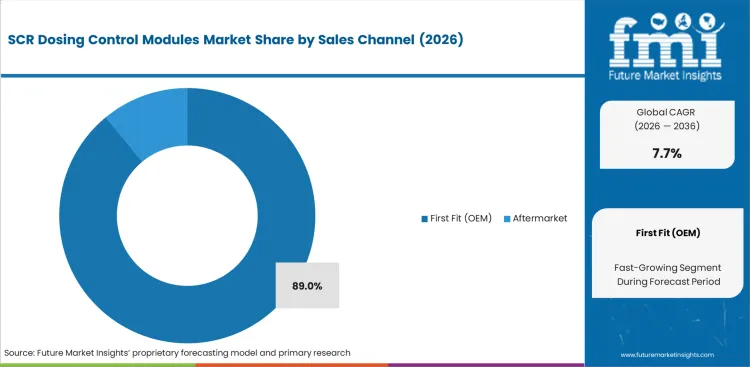
First Fit (OEM) channels are estimated to account for 89.0% share in 2026, as operators remain cautious about invalidating multi-year powertrain warranties by installing unverified third-party SCR doser modules. FMI estimates suggest that independent service centers face tight limitations in accessing the proprietary diagnostic software needed to calibrate replacement units accurately. Aftermarket demand is shaped less by internal module failure and more by collision-related damage to exposed chassis components that require fast replacement. Grey-market sourcing can increase the risk of downstream issues affecting DEF storage and dosing systems. Component-level sourcing is becoming less viable under stricter compliance requirements, while delays in OEM-grade procurement can raise downtime exposure for transport operators.
- Initial Specification Trigger: Powertrain calibration teams demand guaranteed component lifespan metrics. First-fit suppliers secure contracts by proving their metering valves survive aggressive thermal cycling without calibration drift.
- Validation Parameter Constraint: Procurement directors review accelerated wear data during vendor selection. Modules failing to maintain precise spray geometry under high-pressure conditions face immediate disqualification.
- Renewal Volume Expansion: Fleet maintenance operators extend original equipment contracts based on diagnostic integration. Seamless software handshakes between engine controllers and dosing modules guarantee repeat bulk purchasing.
SCR Dosing Control Modules Market Analysis by Vehicle Type
FMI's analysis indicates heavy transport platforms operate under sustained high-load conditions demanding continuous precise fluid injection to prevent catastrophic catalyst poisoning. Heavy commercial vehicle operators prioritize absolute reliability over initial capital expenditure. The factor that production figures hide is that HCVs dominate not due to pure chassis volume, but because their intense thermal duty cycles increasingly require twin-dosing redundancy per vehicle. Payload optimization targets constantly conflict with heavy thermal management equipment required for compliance. HCV architectures resolve this tension by embedding robust aftertreatment systems, helping this segment secure 49.0% share. Transport firms delaying adoption of a heavy-duty SCR dosing module within these commercial vehicle urea tank networks face massive non-compliance fines.
- Procurement Saving Origin: Logistics purchasing managers negotiate bulk pricing on standardized architectures. Standardizing dosing control interfaces across mixed fleets reduces necessary spare parts inventory significantly.
- Hidden Operational Penalty: Fleet service technicians discover latent expenses when deploying underspecified modules. Frequent crystallization blockages force unscheduled maintenance stops that destroy tight freight delivery margins.
- Lifecycle Cost Revelation: Financial controllers calculating total ownership expenses uncover severe discrepancies. Premium metering valves justify their high upfront cost by eliminating expensive downstream particulate filter replacements entirely.
SCR Dosing Control Modules Market Analysis by Module Type
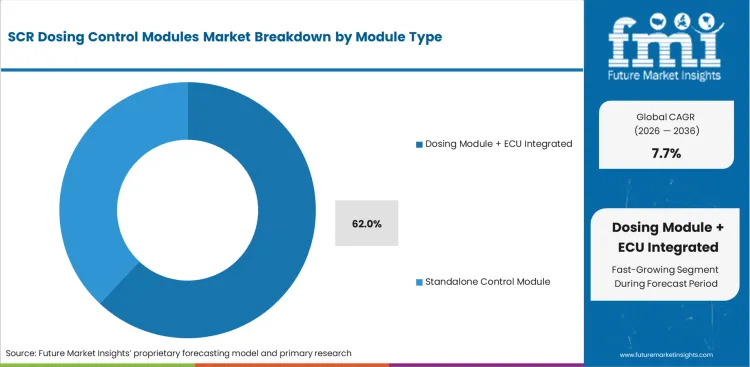
Vehicle electrical architectures are rapidly consolidating distributed processing nodes into central mechatronic hubs. Dosing Module + ECU Integrated configurations represent 62.0% share due to this aggressive simplification of commercial vehicle wiring harnesses. Powertrain design engineers eliminate multiple potential failure points by housing both fluid handling and logic processing within one sealed enclosure. Integrated automotive exhaust systems reduce critical millisecond communication latency between emission sensors and physical injection valves. Integrated modules win because they reduce overall wiring harness weight, a critical metric in payload-optimized heavy freight architectures. Equipment manufacturers choosing standalone components suffer severe competitive disadvantages regarding total dry weight limits.
- Thermal Degradation Prevention: Integrated assemblies protect sensitive control logic from extreme exhaust heat. Packaging engineers shield critical circuitry behind circulating fluid pathways to guarantee continuous operation.
- Connector Corrosion Risk: Standalone control modules remain vulnerable to environmental moisture ingress. Service managers constantly replace external wiring harnesses damaged by road salt and high-pressure washing.
- Full Benefit Realization: Calibration specialists must tune integrated processors specific to unique engine maps. Proper software configuration ensures maximum nitrogen oxide reduction without risking expensive excess ammonia slip.
SCR Dosing Control Modules Market Analysis by Emission Standard
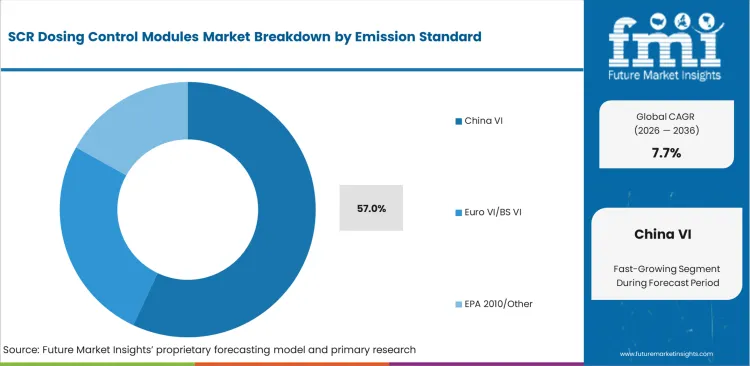
Legacy mechanical injection approaches fail entirely under precise monitoring requirements of modern regulatory regimes. In FMI's view, compliance officers at major truck brands cannot self-certify platforms without demonstrating hardware capable of surviving mandatory in-service conformity testing. Euro VI/BS VI platforms are being artificially extended through software updates to delay massive capital expenditures required for Euro 7 hardware redesigns. Euro VI/BS VI platforms account for 57.0% share because they force continuous closed-loop verification of actual tailpipe outputs. Manufacturers attempting to modify older global emission control catalyst platforms to meet these strict targets face insurmountable calibration challenges.
- Primary Production Control: Tier-1 automotive suppliers dominate component availability through extensive patent portfolios. Competitors cannot legally replicate specific fluid metering geometries required for highest compliance tiers.
- Component Constraint Planning: Assembly plant managers must forecast specialized sensor demand months ahead. Shortages in critical semi-conductor elements routinely threaten to halt entire heavy truck production lines.
- Future Regulatory Readiness: Research directors design current hardware with massive excess processing capacity. Anticipating stricter future limits allows seamless over-the-air compliance upgrades without physical component swapping.
SCR Dosing Control Modules Market Analysis by Engine Type
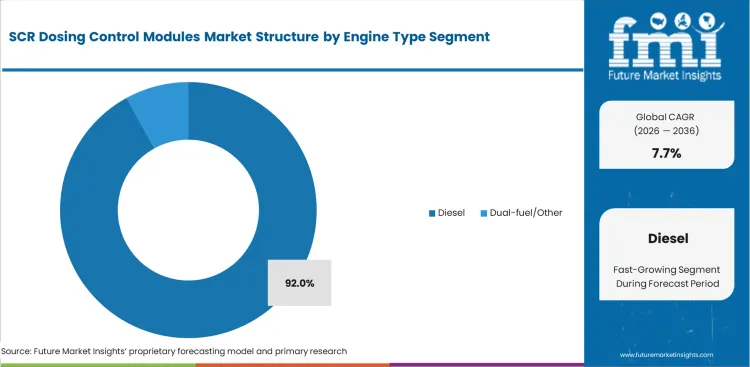
Long-haul freight infrastructure dictates entrenched positioning of specific powertrain technologies. Diesel applications hold 92.0% share because alternative heavy-duty propulsion networks remain critically underdeveloped across primary transport corridors. As per FMI's projection, logistics network planners cannot risk deploying zero-emission platforms on routes lacking guaranteed refueling certainty. Diesel's massive share masks a silent pivot where engineers configure an identical SCR dosing module for diesel engines to support upcoming hydrogen combustion architectures. Fleet operators ignoring advanced automotive catalytic converter integration on legacy diesel assets suffer rapid depreciation as urban zones introduce severe emission-based access charges.
- Baseline Expectation Surplus: Modern injection systems over-deliver on steady-state highway emission targets. Fleet operators routinely record compliance margins significantly better than mandated legal maximum thresholds.
- Edge Condition Vulnerability: Extreme cold weather operations expose severe component limitations. Maintenance supervisors deploy supplemental heating elements when freezing temperatures threaten to crystallize primary fluid reservoirs.
- Qualification Standard Gating: Environmental protection agencies enforce brutal durability testing protocols. Powertrain engineering teams must prove components survive thousands of hours before securing approval to commence vehicle sales.
SCR Dosing Control Modules Market Drivers, Restraints, and Opportunities
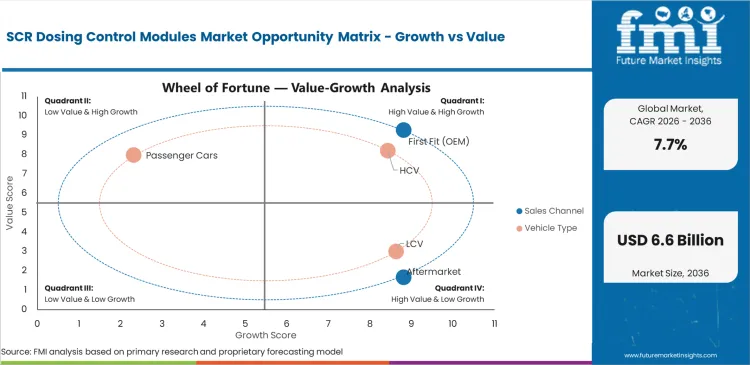
Strict new temperature-testing rules are forcing trucking companies to upgrade to double-injection systems right away. Operators know that older, single-injection systems simply cannot handle the cold-weather demands of the upcoming Euro 7 laws without leaking harmful chemicals. Transport businesses that wait too long to buy these updated AdBlue dosing modules face massive fines and risk losing the right to drive in major cities. Truck engineers are rushing to fit these complex liquid systems into their vehicles before new deadlines make their current models illegal to sell. This sudden rush is pushing purchasing teams to quickly sign long-term deals with top-tier parts suppliers so they do not run out of equipment.
Truck manufacturers are putting strict digital locks on their emission parts, which stops independent mechanics from doing basic repairs. When a truck's exhaust filter stops working, the vehicle sits broken down because everyday mechanics do not have the digital passwords needed to install a new dosing unit. This setup forces fleet owners to take their trucks only to expensive official dealerships, heavily driving up the total cost of owning the vehicle. New right-to-repair laws are trying to fix this problem and open up access to these systems. However, original equipment makers keep changing their software locks much faster than independent tool companies can figure them out.
- Hydrogen Combustion Adaptation: Powertrain engineering teams reconfigure existing precision metering valves to inject water into hydrogen engine intakes. This prevents pre-ignition knocking while extending commercial lifespans of legacy hardware designs.
- Predictive Maintenance Monetization: Telematics platform developers integrate real-time dosing performance data into subscription dashboards. Fleet managers gladly pay premium fees to detect impending NOX sensor failures before vehicles enter limp-mode mid-route.
- Solid-State Reagent Vaporization: Advanced material scientists develop heated substrates capable of processing solid ammonium carbamate. R&D directors targeting payload-critical applications eliminate heavy liquid storage tanks entirely.
Regional Analysis
Global demand for emission control parts is driven by a mix of strict new regulations in established regions and sudden fleet modernization programs in developing nations. Local government policies on vehicle upgrades dictate where the most immediate purchasing happens.
.webp "Top Country Growth Comparison Scr Dosing Control Modules Market Cagr (2026 2036)")
| Country | CAGR (2026 to 2036) |
|---|---|
| India | 7.2% |
| China | 6.3% |
| Brazil | 5.4% |
| USA | 5.0% |
| South Korea | 4.7% |
| Germany | 4.6% |
| Japan | 3.9% |
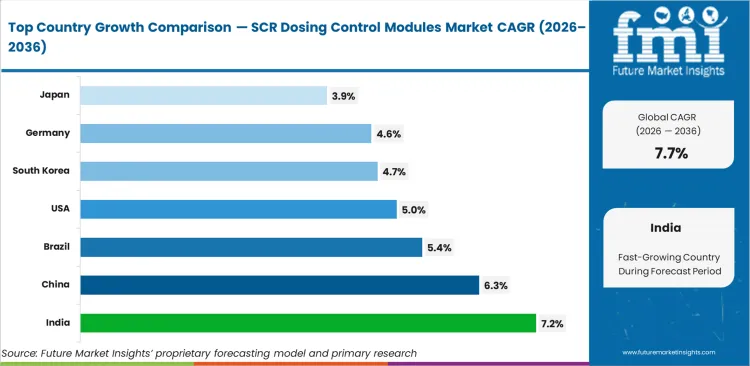
Source: Future Market Insights (FMI) analysis, based on proprietary forecasting model and primary research
North America and Latin America SCR Dosing Control Modules Market Analysis
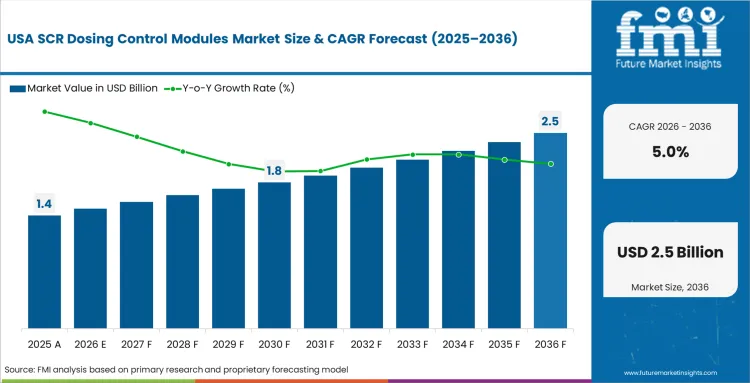
Across the Americas, buyers focus heavily on hardware durability and meeting new clean-air rules above all else. Transport companies choose reliable systems to avoid expensive breakdowns on long highway routes or rugged farming paths. Operation managers want parts that can handle constant heavy loads without failing unexpectedly. Replacing broken equipment out on the road costs far more than buying a premium part in the first place. This practical approach to buying ensures that high-quality fluid injection systems remain the top choice for major delivery networks.
- U.S.: Trucking companies are actively updating older vehicles to meet strict new federal clean air rules. Demand for emission control parts in the U.S. is anticipated to rise at a CAGR of 5.0% through 2036, pushing delivery firms to lock in long-term deals for these items. Businesses simply cannot afford the massive fines from failing random roadside checks, so they choose to buy reliable equipment straight from trusted brands rather than risking cheaper copies.
- Brazil: Fueled by a booming agricultural industry, farming transport relies heavily on massive trucks that can handle rough dirt roads and poor-quality fuel. Fleet managers here strongly prefer simple, tough parts that local mechanics can easily fix without needing expensive computer tools. Brazil is set to progress at a CAGR of 5.4% in this sector during the assessment period, highlighting this steady demand from the rural logistics sector.
This shared priority across both continents makes physical toughness just as important to buyers as the actual software running the module itself. Truck owners in these countries simply refuse to gamble their delivery schedules on unproven parts. Equipment must survive everything from freezing northern winters to intense tropical heat without skipping a beat. Manufacturers who understand these extreme weather and road conditions easily beat competitors selling standard factory designs.
Asia-Pacific SCR Dosing Control Modules Market Analysis
The Asia-Pacific region mixes high-volume government modernization drives with highly specialized engineering needs. Rapidly growing cities desperately need cleaner air, so local authorities are forcing transport companies to upgrade their fleets. Local parts makers are building these items domestically to beat the high prices of imported hardware and capture this expanding buyer base. Domestic factories are learning how to copy the best global designs while keeping their production costs very low. This aggressive local manufacturing makes it much harder for outside brands to maintain their early sales leads.
- China: Strict enforcement of clean air rules for city buses is pushing rapid hardware upgrades across major urban centers. The adoption of emission control modules in China is expected to move ahead at a CAGR of 6.3% through 2036. Local truck builders are dropping their own part designs and buying trusted systems from major brands to ensure their vehicles pass local city tests.
- Japan: Sales in Japan are poised to expand at a CAGR of 3.9% during the assessment period as manufacturers move toward compact, lightweight systems specifically for hybrid engines. Finding room for bulky emission parts is a major challenge for designers working on small city delivery trucks. This specific need for smaller parts pushes suppliers to invent completely new space-saving designs.
- India: Government rules forcing the removal of aging trucks are causing a massive wave of new vehicle purchases. India is projected to witness 7.2% CAGR in this market through 2036, as fleet owners rush to finance cleaner replacements. Getting these new vehicles quickly is the only way these businesses can avoid losing their long-term delivery contracts.
- South Korea: Buyers in this area need tough, high-capacity systems that can survive harsh saltwater exposure without breaking down. Heavy demand from the shipbuilding industry drives continuous orders for these rugged, weather-resistant parts. South Korea is forecasted to record a steady pace at a CAGR of 4.7% through 2036, driven directly by these unique maritime needs.
Rapid urban growth and strict vehicle scrap policies ensure this region remains a hotspot for both basic replacements and highly customized emission parts. Governments are no longer accepting slow, voluntary improvements from local transport businesses. This creates a massive, guaranteed wave of buyers who must purchase new hardware right now. Suppliers who can deliver large volumes of reliable parts quickly are capturing most of this new spending.
Europe SCR Dosing Control Modules Market Analysis
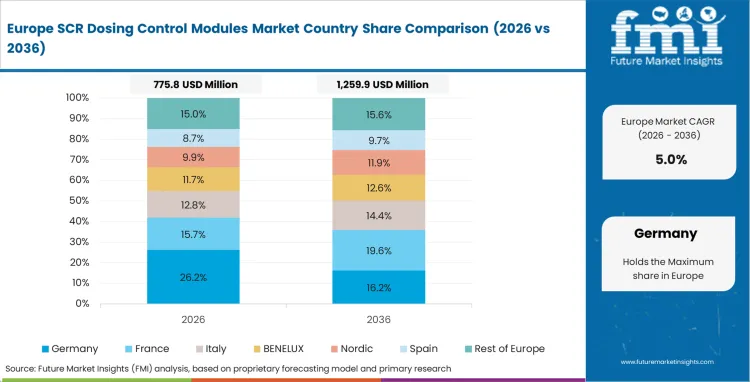
European growth is defined by adding more advanced parts to the same number of vehicles rather than building more trucks. Automakers engineer exceptionally complex exhaust setups to squeeze the last bit of value out of diesel engines before electric vehicles take over completely. Fleet buyers are willing to pay extra for systems that guarantee their trucks can still enter strict city zones. Designers are focusing entirely on making sure these parts work perfectly the second the engine starts on a freezing morning. This intense focus on premium quality pushes the average price of emission hardware much higher here than anywhere else.
- Germany: Major truck brands are installing double-injection systems to handle freezing winter temperatures and pass new emission checks. Germany is anticipated to see demand grow at a CAGR of 4.6% over the forecast period as premium manufacturers prioritize flawless cold-start engine performance. Total truck production numbers might look flat, but the actual money spent on parts inside each vehicle is doubling because of these mandatory cold-weather upgrades.
FMI reports, the changing laws across the continent are shortening the remaining lifespan of traditional gas and diesel engines. Truck designers refuse to risk their brand's reputation on unproven parts during this tricky transitional phase. Reliable fluid injection hardware remains the main defense against losing the right to drive in major cities.
Competitive Aligners for Market Players
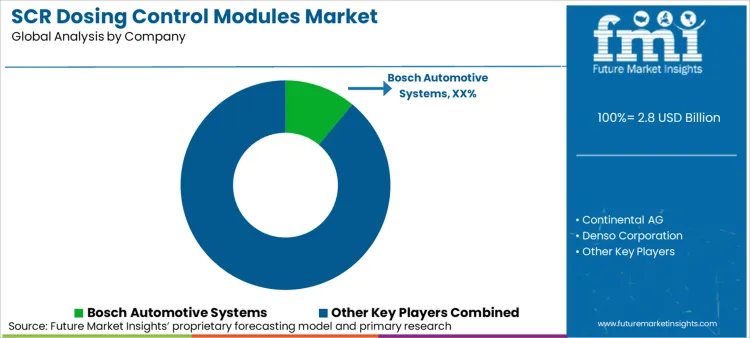
Commercial vehicle operators actively resist being tied to closed repair networks. Maintenance directors refuse to buy trucks that force them to pay expensive monthly software fees just to reset a basic part. They demand systems that can easily talk to equipment from any brand. This pushback forces truck makers to directly challenge the dominant SCR doser OEM suppliers. True market shifts happen when heavy vehicle makers successfully demand open access to testing tools, breaking the total control original developers hold over who is allowed to fix the trucks.
Historical driving records protect the market lead of established companies. They have collected heat and wear data from billions of miles on the road. Newer competitors like Weichai Power Co., Ltd. or Eberspächer Gruppe GmbH & Co. KG struggle to copy this deep well of information. This tracking data tells engineers exactly when a specific part might get blocked during extreme weather or on bad roads. DEF dosing module manufacturers use this history to build parts that last exactly through their required guarantee times without spending extra on premium materials.
Pre-packaged compliance programs win large contracts much faster than physical hardware improvements. Major suppliers like Bosch and Continental AG secure large orders because their systems come with software that works right out of the box to pass strict pollution tests. Purchasing directors at truck brands judge automotive electronics based on one main factor: how many hours of expensive engine testing the vendor can save them. The physical hardware is essentially just a delivery tool for these valuable computer programs.
Key Players in SCR Dosing Control Modules Market
- Bosch
- Continental AG
- Denso Corporation
- Cummins Inc.
- BorgWarner Inc.
- Eberspächer Gruppe GmbH & Co. KG
- FORVIA (Faurecia)
- Hitachi Astemo Ltd.
- Delphi Technologies
- Weichai Power Co., Ltd.
Scope of the Report
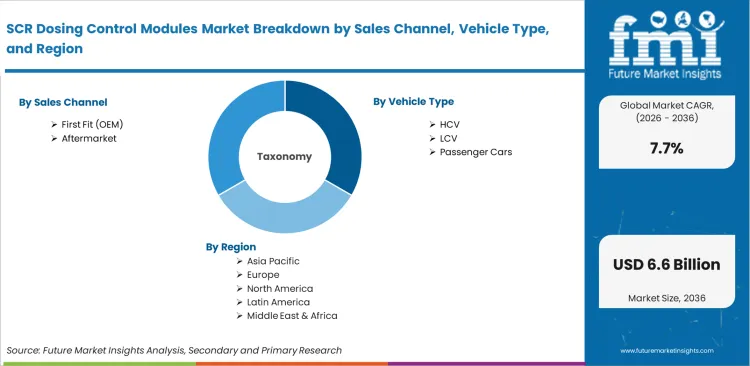
| Metric | Value |
|---|---|
| Quantitative Units | USD 2.9 billion to USD 6.1 billion, at a CAGR of 7.7% |
| Market Definition | Precision fluid metering systems determine exact volume and timing of urea-water solution injected into exhaust streams to neutralize nitrogen oxides. These assemblies physically execute commands generated by engine management software, ensuring continuous catalytic conversion across varying thermal duty cycles. Hardware configurations range from standalone dispensing pumps to fully integrated mechatronic blocks containing both hydraulic delivery mechanisms and dedicated processing units. |
| Segmentation | Sales Channel, Vehicle Type, Module Type, Emission Standard, Engine Type, Region |
| Regions Covered | North America, Latin America, Europe, East Asia, South Asia & Pacific, Middle East & Africa |
| Countries Covered | U.S., China, India, Germany, Japan, South Korea, Brazil |
| Key Companies Profiled | Bosch, Continental AG, Denso Corporation, Cummins Inc., BorgWarner Inc., Eberspächer Gruppe GmbH & Co. KG, FORVIA (Faurecia), Hitachi Astemo Ltd., Delphi Technologies, Weichai Power Co., Ltd. |
| Forecast Period | 2026 to 2036 |
| Approach | Global commercial vehicle production volumes anchor baseline module demand calculations. |
Source: Future Market Insights (FMI) analysis, based on proprietary forecasting model and primary research
Segments
Sales Channel
- First Fit (OEM)
- Aftermarket
Vehicle Type
- HCV
- LCV
- Passenger Cars
Module Type
- Dosing Module + ECU Integrated
- Standalone Control Module
Emission Standard
- Euro VI/BS VI
- China VI
- EPA 2010/Other
Engine Type
- Diesel
- Dual-fuel/Other
Region
- Asia Pacific
- India
- China
- Japan
- South Korea
- Indonesia
- Australia & New Zealand
- ASEAN
- Rest of Asia Pacific
- Europe
- Germany
- Italy
- France
- United Kingdom
- Spain
- Benelux
- Nordics
- Central & Eastern Europe
- Rest of Europe
- North America
- United States
- Canada
- Mexico
- Latin America
- Brazil
- Argentina
- Chile
- Rest of Latin America
- Middle East & Africa
- Kingdom of Saudi Arabia
- United Arab Emirates
- South Africa
- Turkey
- Rest of Middle East & Africa
Bibliography
- European Union. (2024, May 8). Regulation (EU) 2024/1257 of the European Parliament and of the Council of 24 April 2024 on type-approval of motor vehicles and engines and of systems, components and separate technical units intended for such vehicles, with respect to their emissions and battery durability (Euro 7), amending Regulation (EU) 2018/858 of the European Parliament and of the Council and repealing Regulations (EC) No 715/2007 and (EC) No 595/2009 of the European Parliament and of the Council, Commission Regulation (EU) No 582/2011, Commission Regulation (EU) 2017/1151, Commission Regulation (EU) 2017/2400 and Commission Implementing Regulation (EU) 2022/1362. EUR-Lex.
- U.S. Environmental Protection Agency. (2024, March). Regulations for smog, soot, and other air pollution from commercial trucks & buses.
- Dornoff, J., & Rodríguez, F. (2024, March). Euro 7: The new emission standard for light- and heavy-duty vehicles in the European Union. International Council on Clean Transportation.
- Lang, J., Chen, K., Su, G., Jia, H., Tian, W., Bai, S., & Sun, K. (2024). A simulation study on urea maldistribution and implications for NOx reduction with a multi-channel modelling approach. Applied Sciences, 14(23), 11105.
- Wang, Y., Wang, G., Yang, L., Chen, G., & He, S. (2024). Intelligent optimization of diesel engine selective catalytic reduction urea injection based on multi-model state estimation to reduce NH3 slip and NOx emission. Fuel, 365, 131188.
This bibliography is provided for reader reference. The full FMI report contains the complete reference list with primary source documentation.
This Report Addresses
- Warranty consolidation strategies driving First Fit OEM procurement channels.
- Thermal management necessities inflating dual-dosing component requirements inside HCV platforms.
- Payload-optimized wiring harness reductions favoring Integrated ECU module configurations.
- Software lifecycle extensions temporarily preserving Euro VI/BS VI hardware dominance.
- Impending thermal stability testing mandates forcing immediate twin-dosing architecture integration.
- Cryptographic software locks restricting independent maintenance diagnostic capabilities.
- Rapid scrappage policy implementation accelerating heavy vehicle fleet turnover across India.
- Telematics platform developers monetizing predictive dosing performance data successfully.
Frequently Asked Questions
What is an SCR dosing control module?What does a DEF dosing module do during extreme cold?
A selective catalytic reduction dosing module physically executes commands generated by engine management software to meter urea into the exhaust stream accurately.
How does an SCR dosing module work?
Precision metering valves utilize hydraulic pressure and electronic solenoids to atomize fluid directly into the high-temperature catalytic converter pathway.
Why are SCR dosing modules important in heavy-duty vehicles?
These specific components represent the only reliable hardware capable of neutralizing massive nitrogen oxide outputs generated under severe commercial freight loads.
Which countries are growing fastest in this sector?
India registers the fastest expansion at a CAGR of 7.2%, followed rapidly by China at 6.3% and Brazil at 5.4%.
Who are the leading SCR dosing module suppliers?
Dominant Tier-1 integrators including Bosch, Continental AG, Cummins Inc., and Denso Corporation command the supply chain through extensive software calibration capabilities.
What is the difference between an SCR dosing module and a urea injector?
While an injector merely sprays fluid physically, a complete dosing module incorporates the pump, logic controller, and heating elements into one synchronized assembly.
How do EPA 2027 rules affect SCR dosing module demand?
Strict federal phase-in requirements force interstate freight operators to procure advanced closed-loop hardware to avoid catastrophic weigh-station emission fines.
How does Euro 7 influence SCR aftertreatment hardware?
Mandatory cold-start thermal stability testing compels European powertrain engineers to specify redundant twin-dosing architectures immediately.
Which vehicle types account for the largest demand?
Heavy commercial vehicles lead procurement definitively because their intense thermal duty cycles increasingly require sophisticated dual-stage injection redundancy.
Are OEM or aftermarket channels larger for SCR dosing modules?
First Fit OEM channels dominate heavily at 89.0% share because fleet operators refuse to risk invalidating multi-year powertrain warranties with unverified components.
What does a DEF dosing module do during extreme cold?
Integrated heating elements prevent the primary fluid reservoir from crystallizing, ensuring continuous nitrogen oxide reduction despite freezing ambient temperatures.
Can an SCR dosing module be replaced independently?
Cryptographic software locks restrict unprogrammed replacements, forcing technicians to utilize proprietary diagnostic handshakes to calibrate new units successfully.
How does an integrated ECU compare to a standalone SCR controller?
Housing both fluid handling and logic processing within one sealed enclosure reduces critical communication latency and sheds significant wiring harness weight.
Why do fleet managers evaluate the SCR dosing module replacement cost carefully?
Unplanned component failures destroy tight freight delivery margins and expose operators to cascading warranty claims on expensive downstream particulate filters.
What drives the high SCR dosing module CAGR through 2036?
Sustained revenue expansion results from global regulators penalizing legacy emissions while heavily subsidizing the adoption of advanced twin-dosing architectures.
How does water-cooled dosing architecture differ from air-cooled designs?
Water-cooled configurations circulate engine coolant directly around the metering valve to prevent extreme exhaust heat from degrading sensitive internal electronics.
Why do buyers compare OEM and aftermarket SCR dosing modules constantly?
Purchasing directors must balance the high initial capital expenditure of factory-fitted units against the severe downtime risks associated with grey-market alternatives.
What specific factors dictate an SCR dosing module RFQ evaluation?
Technical evaluation teams prioritize software calibration capability and accelerated wear data over basic hardware unit costs during vendor selection.
Why is the commercial vehicle SCR dosing module essential for buses?
Public transit authorities mandate internally heated metering valves to ensure city bus fleets pass random municipal tailpipe compliance tests reliably.
How does agricultural logistics impact the SCR dosing module for off-highway equipment?
High-torque engine platforms require specialized high-flow components capable of surviving intense vibration loads across unpaved transport corridors.
What drives demand for a urea dosing system supplier in South Korea?
Maritime component export requirements push domestic suppliers to scale production of ruggedized high-capacity injection systems that resist saline degradation.
How do diagnostic capabilities influence the SCR dosing module price?
Premium metering valves justify their high upfront cost by eliminating expensive downstream filter replacements and offering predictive maintenance telematics.
What role does predictive maintenance play in SCR dosing module diagnostics?
Telematics platform developers integrate real-time performance data into subscription dashboards so fleet managers can detect impending failures before limp-mode engages.
Preview the report firsthand - request a free sample
Get SampleGet the brochure for pricing and purchase details.
Get PDFTable of Content
- Executive Summary
- Global Market Outlook
- Demand-side Trends
- Supply-side Trends
- Technology Roadmap Analysis
- Analysis and Recommendations
- Market Overview
- Market Coverage / Taxonomy
- Market Definition / Scope / Limitations
- Research Methodology
- Chapter Orientation
- Analytical Lens and Working Hypotheses
- Market Structure, Signals, and Trend Drivers
- Benchmarking and Cross-market Comparability
- Market Sizing, Forecasting, and Opportunity Mapping
- Research Design and Evidence Framework
- Desk Research Programme (Secondary Evidence)
- Company Annual and Sustainability Reports
- Peer-reviewed Journals and Academic Literature
- Corporate Websites, Product Literature, and Technical Notes
- Earnings Decks and Investor Briefings
- Statutory Filings and Regulatory Disclosures
- Technical White Papers and Standards Notes
- Trade Journals, Industry Magazines, and Analyst Briefs
- Conference Proceedings, Webinars, and Seminar Materials
- Government Statistics Portals and Public Data Releases
- Press Releases and Reputable Media Coverage
- Specialist Newsletters and Curated Briefings
- Sector Databases and Reference Repositories
- FMI Internal Proprietary Databases and Historical Market Datasets
- Subscription Datasets and Paid Sources
- Social Channels, Communities, and Digital Listening Inputs
- Additional Desk Sources
- Expert Input and Fieldwork (Primary Evidence)
- Primary Modes
- Qualitative Interviews and Expert Elicitation
- Quantitative Surveys and Structured Data Capture
- Blended Approach
- Why Primary Evidence is Used
- Field Techniques
- Interviews
- Surveys
- Focus Groups
- Observational and In-context Research
- Social and Community Interactions
- Stakeholder Universe Engaged
- C-suite Leaders
- Board Members
- Presidents and Vice Presidents
- R&D and Innovation Heads
- Technical Specialists
- Domain Subject-matter Experts
- Scientists
- Physicians and Other Healthcare Professionals
- Governance, Ethics, and Data Stewardship
- Research Ethics
- Data Integrity and Handling
- Primary Modes
- Tooling, Models, and Reference Databases
- Desk Research Programme (Secondary Evidence)
- Data Engineering and Model Build
- Data Acquisition and Ingestion
- Cleaning, Normalisation, and Verification
- Synthesis, Triangulation, and Analysis
- Quality Assurance and Audit Trail
- Market Background
- Market Dynamics
- Drivers
- Restraints
- Opportunity
- Trends
- Scenario Forecast
- Demand in Optimistic Scenario
- Demand in Likely Scenario
- Demand in Conservative Scenario
- Opportunity Map Analysis
- Product Life Cycle Analysis
- Supply Chain Analysis
- Investment Feasibility Matrix
- Value Chain Analysis
- PESTLE and Porter’s Analysis
- Regulatory Landscape
- Regional Parent Market Outlook
- Production and Consumption Statistics
- Import and Export Statistics
- Market Dynamics
- Global Market Analysis 2021 to 2025 and Forecast, 2026 to 2036
- Historical Market Size Value (USD Million) Analysis, 2021 to 2025
- Current and Future Market Size Value (USD Million) Projections, 2026 to 2036
- Y-o-Y Growth Trend Analysis
- Absolute $ Opportunity Analysis
- Global Market Pricing Analysis 2021 to 2025 and Forecast 2026 to 2036
- Global Market Analysis 2021 to 2025 and Forecast 2026 to 2036, By Sales Channel
- Introduction / Key Findings
- Historical Market Size Value (USD Million) Analysis By Sales Channel , 2021 to 2025
- Current and Future Market Size Value (USD Million) Analysis and Forecast By Sales Channel , 2026 to 2036
- First Fit (OEM)
- Aftermarket
- First Fit (OEM)
- Y-o-Y Growth Trend Analysis By Sales Channel , 2021 to 2025
- Absolute $ Opportunity Analysis By Sales Channel , 2026 to 2036
- Global Market Analysis 2021 to 2025 and Forecast 2026 to 2036, By Vehicle Type
- Introduction / Key Findings
- Historical Market Size Value (USD Million) Analysis By Vehicle Type, 2021 to 2025
- Current and Future Market Size Value (USD Million) Analysis and Forecast By Vehicle Type, 2026 to 2036
- HCV
- LCV
- Passenger Cars
- HCV
- Y-o-Y Growth Trend Analysis By Vehicle Type, 2021 to 2025
- Absolute $ Opportunity Analysis By Vehicle Type, 2026 to 2036
- Global Market Analysis 2021 to 2025 and Forecast 2026 to 2036, By Module Type
- Introduction / Key Findings
- Historical Market Size Value (USD Million) Analysis By Module Type, 2021 to 2025
- Current and Future Market Size Value (USD Million) Analysis and Forecast By Module Type, 2026 to 2036
- Dosing Module + ECU Integrated
- Standalone Control Module
- Dosing Module + ECU Integrated
- Y-o-Y Growth Trend Analysis By Module Type, 2021 to 2025
- Absolute $ Opportunity Analysis By Module Type, 2026 to 2036
- Global Market Analysis 2021 to 2025 and Forecast 2026 to 2036, By Emission Standard
- Introduction / Key Findings
- Historical Market Size Value (USD Million) Analysis By Emission Standard, 2021 to 2025
- Current and Future Market Size Value (USD Million) Analysis and Forecast By Emission Standard, 2026 to 2036
- China VI
- Euro VI/BS VI
- EPA 2010/Other
- China VI
- Y-o-Y Growth Trend Analysis By Emission Standard, 2021 to 2025
- Absolute $ Opportunity Analysis By Emission Standard, 2026 to 2036
- Global Market Analysis 2021 to 2025 and Forecast 2026 to 2036, By Engine Type
- Introduction / Key Findings
- Historical Market Size Value (USD Million) Analysis By Engine Type, 2021 to 2025
- Current and Future Market Size Value (USD Million) Analysis and Forecast By Engine Type, 2026 to 2036
- Diesel
- Dual-fuel/Other
- Diesel
- Y-o-Y Growth Trend Analysis By Engine Type, 2021 to 2025
- Absolute $ Opportunity Analysis By Engine Type, 2026 to 2036
- Global Market Analysis 2021 to 2025 and Forecast 2026 to 2036, By Region
- Introduction
- Historical Market Size Value (USD Million) Analysis By Region, 2021 to 2025
- Current Market Size Value (USD Million) Analysis and Forecast By Region, 2026 to 2036
- North America
- Latin America
- Western Europe
- Eastern Europe
- East Asia
- South Asia and Pacific
- Middle East & Africa
- Market Attractiveness Analysis By Region
- North America Market Analysis 2021 to 2025 and Forecast 2026 to 2036, By Country
- Historical Market Size Value (USD Million) Trend Analysis By Market Taxonomy, 2021 to 2025
- Market Size Value (USD Million) Forecast By Market Taxonomy, 2026 to 2036
- By Country
- USA
- Canada
- Mexico
- By Sales Channel
- By Vehicle Type
- By Module Type
- By Emission Standard
- By Engine Type
- By Country
- Market Attractiveness Analysis
- By Country
- By Sales Channel
- By Vehicle Type
- By Module Type
- By Emission Standard
- By Engine Type
- Key Takeaways
- Latin America Market Analysis 2021 to 2025 and Forecast 2026 to 2036, By Country
- Historical Market Size Value (USD Million) Trend Analysis By Market Taxonomy, 2021 to 2025
- Market Size Value (USD Million) Forecast By Market Taxonomy, 2026 to 2036
- By Country
- Brazil
- Chile
- Rest of Latin America
- By Sales Channel
- By Vehicle Type
- By Module Type
- By Emission Standard
- By Engine Type
- By Country
- Market Attractiveness Analysis
- By Country
- By Sales Channel
- By Vehicle Type
- By Module Type
- By Emission Standard
- By Engine Type
- Key Takeaways
- Western Europe Market Analysis 2021 to 2025 and Forecast 2026 to 2036, By Country
- Historical Market Size Value (USD Million) Trend Analysis By Market Taxonomy, 2021 to 2025
- Market Size Value (USD Million) Forecast By Market Taxonomy, 2026 to 2036
- By Country
- Germany
- UK
- Italy
- Spain
- France
- Nordic
- BENELUX
- Rest of Western Europe
- By Sales Channel
- By Vehicle Type
- By Module Type
- By Emission Standard
- By Engine Type
- By Country
- Market Attractiveness Analysis
- By Country
- By Sales Channel
- By Vehicle Type
- By Module Type
- By Emission Standard
- By Engine Type
- Key Takeaways
- Eastern Europe Market Analysis 2021 to 2025 and Forecast 2026 to 2036, By Country
- Historical Market Size Value (USD Million) Trend Analysis By Market Taxonomy, 2021 to 2025
- Market Size Value (USD Million) Forecast By Market Taxonomy, 2026 to 2036
- By Country
- Russia
- Poland
- Hungary
- Balkan & Baltic
- Rest of Eastern Europe
- By Sales Channel
- By Vehicle Type
- By Module Type
- By Emission Standard
- By Engine Type
- By Country
- Market Attractiveness Analysis
- By Country
- By Sales Channel
- By Vehicle Type
- By Module Type
- By Emission Standard
- By Engine Type
- Key Takeaways
- East Asia Market Analysis 2021 to 2025 and Forecast 2026 to 2036, By Country
- Historical Market Size Value (USD Million) Trend Analysis By Market Taxonomy, 2021 to 2025
- Market Size Value (USD Million) Forecast By Market Taxonomy, 2026 to 2036
- By Country
- China
- Japan
- South Korea
- By Sales Channel
- By Vehicle Type
- By Module Type
- By Emission Standard
- By Engine Type
- By Country
- Market Attractiveness Analysis
- By Country
- By Sales Channel
- By Vehicle Type
- By Module Type
- By Emission Standard
- By Engine Type
- Key Takeaways
- South Asia and Pacific Market Analysis 2021 to 2025 and Forecast 2026 to 2036, By Country
- Historical Market Size Value (USD Million) Trend Analysis By Market Taxonomy, 2021 to 2025
- Market Size Value (USD Million) Forecast By Market Taxonomy, 2026 to 2036
- By Country
- India
- ASEAN
- Australia & New Zealand
- Rest of South Asia and Pacific
- By Sales Channel
- By Vehicle Type
- By Module Type
- By Emission Standard
- By Engine Type
- By Country
- Market Attractiveness Analysis
- By Country
- By Sales Channel
- By Vehicle Type
- By Module Type
- By Emission Standard
- By Engine Type
- Key Takeaways
- Middle East & Africa Market Analysis 2021 to 2025 and Forecast 2026 to 2036, By Country
- Historical Market Size Value (USD Million) Trend Analysis By Market Taxonomy, 2021 to 2025
- Market Size Value (USD Million) Forecast By Market Taxonomy, 2026 to 2036
- By Country
- Kingdom of Saudi Arabia
- Other GCC Countries
- Turkiye
- South Africa
- Other African Union
- Rest of Middle East & Africa
- By Sales Channel
- By Vehicle Type
- By Module Type
- By Emission Standard
- By Engine Type
- By Country
- Market Attractiveness Analysis
- By Country
- By Sales Channel
- By Vehicle Type
- By Module Type
- By Emission Standard
- By Engine Type
- Key Takeaways
- Key Countries Market Analysis
- USA
- Pricing Analysis
- Market Share Analysis, 2025
- By Sales Channel
- By Vehicle Type
- By Module Type
- By Emission Standard
- By Engine Type
- Canada
- Pricing Analysis
- Market Share Analysis, 2025
- By Sales Channel
- By Vehicle Type
- By Module Type
- By Emission Standard
- By Engine Type
- Mexico
- Pricing Analysis
- Market Share Analysis, 2025
- By Sales Channel
- By Vehicle Type
- By Module Type
- By Emission Standard
- By Engine Type
- Brazil
- Pricing Analysis
- Market Share Analysis, 2025
- By Sales Channel
- By Vehicle Type
- By Module Type
- By Emission Standard
- By Engine Type
- Chile
- Pricing Analysis
- Market Share Analysis, 2025
- By Sales Channel
- By Vehicle Type
- By Module Type
- By Emission Standard
- By Engine Type
- Germany
- Pricing Analysis
- Market Share Analysis, 2025
- By Sales Channel
- By Vehicle Type
- By Module Type
- By Emission Standard
- By Engine Type
- UK
- Pricing Analysis
- Market Share Analysis, 2025
- By Sales Channel
- By Vehicle Type
- By Module Type
- By Emission Standard
- By Engine Type
- Italy
- Pricing Analysis
- Market Share Analysis, 2025
- By Sales Channel
- By Vehicle Type
- By Module Type
- By Emission Standard
- By Engine Type
- Spain
- Pricing Analysis
- Market Share Analysis, 2025
- By Sales Channel
- By Vehicle Type
- By Module Type
- By Emission Standard
- By Engine Type
- France
- Pricing Analysis
- Market Share Analysis, 2025
- By Sales Channel
- By Vehicle Type
- By Module Type
- By Emission Standard
- By Engine Type
- India
- Pricing Analysis
- Market Share Analysis, 2025
- By Sales Channel
- By Vehicle Type
- By Module Type
- By Emission Standard
- By Engine Type
- ASEAN
- Pricing Analysis
- Market Share Analysis, 2025
- By Sales Channel
- By Vehicle Type
- By Module Type
- By Emission Standard
- By Engine Type
- Australia & New Zealand
- Pricing Analysis
- Market Share Analysis, 2025
- By Sales Channel
- By Vehicle Type
- By Module Type
- By Emission Standard
- By Engine Type
- China
- Pricing Analysis
- Market Share Analysis, 2025
- By Sales Channel
- By Vehicle Type
- By Module Type
- By Emission Standard
- By Engine Type
- Japan
- Pricing Analysis
- Market Share Analysis, 2025
- By Sales Channel
- By Vehicle Type
- By Module Type
- By Emission Standard
- By Engine Type
- South Korea
- Pricing Analysis
- Market Share Analysis, 2025
- By Sales Channel
- By Vehicle Type
- By Module Type
- By Emission Standard
- By Engine Type
- Russia
- Pricing Analysis
- Market Share Analysis, 2025
- By Sales Channel
- By Vehicle Type
- By Module Type
- By Emission Standard
- By Engine Type
- Poland
- Pricing Analysis
- Market Share Analysis, 2025
- By Sales Channel
- By Vehicle Type
- By Module Type
- By Emission Standard
- By Engine Type
- Hungary
- Pricing Analysis
- Market Share Analysis, 2025
- By Sales Channel
- By Vehicle Type
- By Module Type
- By Emission Standard
- By Engine Type
- Kingdom of Saudi Arabia
- Pricing Analysis
- Market Share Analysis, 2025
- By Sales Channel
- By Vehicle Type
- By Module Type
- By Emission Standard
- By Engine Type
- Turkiye
- Pricing Analysis
- Market Share Analysis, 2025
- By Sales Channel
- By Vehicle Type
- By Module Type
- By Emission Standard
- By Engine Type
- South Africa
- Pricing Analysis
- Market Share Analysis, 2025
- By Sales Channel
- By Vehicle Type
- By Module Type
- By Emission Standard
- By Engine Type
- USA
- Market Structure Analysis
- Competition Dashboard
- Competition Benchmarking
- Market Share Analysis of Top Players
- By Regional
- By Sales Channel
- By Vehicle Type
- By Module Type
- By Emission Standard
- By Engine Type
- Competition Analysis
- Competition Deep Dive
- Bosch
- Overview
- Product Portfolio
- Profitability by Market Segments (Product/Age /Sales Channel/Region)
- Sales Footprint
- Strategy Overview
- Marketing Strategy
- Product Strategy
- Channel Strategy
- Continental AG
- Denso Corporation
- Cummins Inc.
- BorgWarner Inc.
- Eberspächer Gruppe GmbH & Co. KG
- FORVIA (Faurecia)
- Hitachi Astemo Ltd.
- Delphi Technologies
- Weichai Power Co., Ltd.
- Bosch
- Competition Deep Dive
- Assumptions & Acronyms Used


