

- Industry Size (2026)
- USD 799.2 Mn
- Forecast (2036)
- USD 2269.3 Mn
- CAGR (2026 to 2036)
- 11.0%
Micro-Zone Climate Control Modules Market Forecast and Outlook 2026 to 2036
The micro-zone climate control modules market is valued at USD 799.2 million in 2026 and forecasted to reach USD 2,269.3 million by 2036 at a CAGR of 11.0%. Value behavior reflects increasing allocation toward localized thermal regulation architectures rather than expansion of centralized HVAC capacity. Investment concentrates on modular components embedded at platform design stage to manage occupant comfort and energy load at zone level. Cost structures favor solutions that leverage existing ducting and control frameworks while adding sensors, actuators, and software layers. OEM spending is weighted toward line-fit integration supporting differentiated comfort delivery without proportional increases in system power draw. Revenue growth aligns with electrified vehicle programs and smart building deployments where energy efficiency metrics directly influence platform acceptance and operating cost models.
Scalability remains conditioned by integration complexity and component density. Micro-zone modules increase calibration effort, validation timelines, and interface coordination across HVAC, electronics, and software domains. Value realization depends on accurate sensing, airflow modulation, and control logic stability under variable load conditions. Pricing sensitivity persists in volume platforms where added hardware challenges cost targets. Supply exposure to miniaturized actuators, smart valves, and embedded controllers influences delivery cadence. Adoption favors applications with clear efficiency tradeoffs, such as electric mobility and high-density interior environments, rather than broad retrofit scenarios. Long-term value concentration reflects platform-level decisions prioritizing targeted thermal delivery, software-defined climate control, and energy optimization under constrained power budgets.
Quick Stats for Micro-Zone Climate Control Modules Market
- Micro-Zone Climate Control Modules Market Value (2026): USD 799.2 million
- Micro-Zone Climate Control Modules Market Forecast Value (2036): USD 2,269.3 million
- Micro-Zone Climate Control Modules Market Forecast CAGR 2026 to 2036: 11.0%
- Leading Module Type in Global Demand: Micro-Zone HVAC Duct Modules
- Fastest-Growing Countries: China, Brazil, USA, South Korea, Germany
- Top Players in Global Demand: Hanon Systems, Valeo, Denso, MAHLE, Gentherm, Hyundai Mobis, Marelli, Bosch, Eberspächer, Sanden
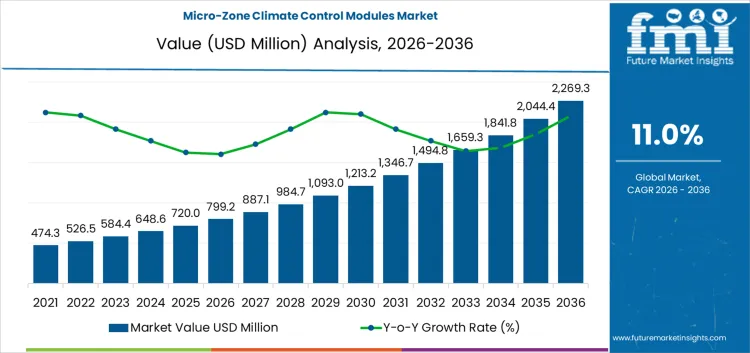
Micro-Zone Climate Control Modules Market Key Takeaways
| Metric | Value |
|---|---|
| Market Value (2026) | USD 799.2 million |
| Market Forecast Value (2036) | USD 2,269.3 million |
| Forecast CAGR 2026 to 2036 | 11.0% |
Why is the Demand for Micro-Zone Climate Control Modules Growing?
Demand for micro-zone climate control modules is increasing as vehicle designers require precise environmental regulation within specific cabin zones. Vehicle OEMs and mobility platform designers specify micro-zone modules to regulate temperature and airflow across specific cabin seating zones and compartments. Manufacturers of advanced vehicles integrate micro-zone systems to support individualized comfort settings for passengers across seating zones. Engineers assess performance criteria including response accuracy, control interface compatibility, and energy efficiency when selecting components for diverse applications. System integrators focus on modules that provide real-time feedback and maintain stable conditions under variable loads while supporting diagnostics and maintenance planning.
Growth in smart building and smart vehicle deployments is reinforcing uptake of micro-zone climate control modules that align with digital control networks. Technology providers offer modular solutions that interface with building management systems and vehicle electronics to deliver configurable control strategies. End users value systems that help optimize operational costs and support regulatory standards for comfort and indoor air quality. Coordination between designers, installers, and product specialists enhances system compatibility and performance verification in live environments. These dynamics support sustained adoption of micro-zone climate control modules in complex control scenarios.
How Are the Segments Classified in the Micro-Zone Climate Control Modules Market?
Demand for micro-zone climate control modules is shaped by occupant comfort personalization, energy efficiency requirements, and localized thermal management strategies. Adoption increases as vehicle platforms integrate targeted airflow and temperature control to reduce overall HVAC load. System design prioritizes fast response, compact packaging, and precise zone-level regulation. Integration aligns with electric vehicle architectures and advanced cabin comfort expectations. Segment classification reflects differentiation by module configuration, zone targeting strategy, and control technology. Structure highlights how hardware form, seating focus, and actuation method influence deployment intensity, system complexity, and functional value across modern vehicle cabin environments.
Which Module Type Represents the Largest Share of Demand?
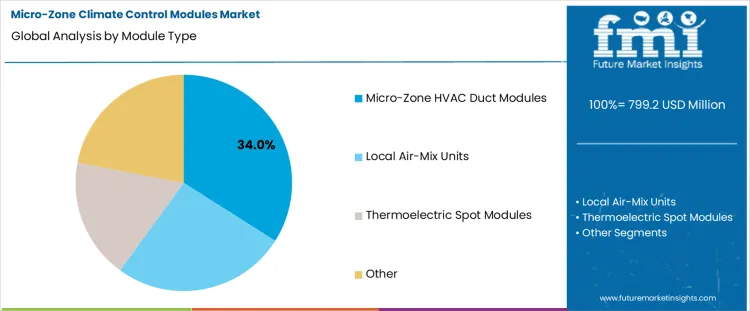
Micro-zone HVAC duct modules hold 34.0%, representing the largest share among module types due to compatibility with existing HVAC architectures. These modules enable localized airflow distribution without requiring independent thermal generation units. Integration supports modular expansion of zonal control using established ducting layouts. Packaging efficiency and predictable airflow behavior support consistent performance across vehicle platforms. Local air-mix units and thermoelectric spot modules address finer temperature adjustments and seat-level targeting with higher component density. Other module types support niche configurations. Module type segmentation reflects preference for scalable solutions balancing control precision and system integration efficiency.
Key Points:
- Duct-based modules integrate efficiently with existing HVAC layouts.
- Modular design supports scalable zone-level expansion.
- Other module types address localized or seat-specific control needs.
Which Zone Target Accounts for the Highest Share of Demand?
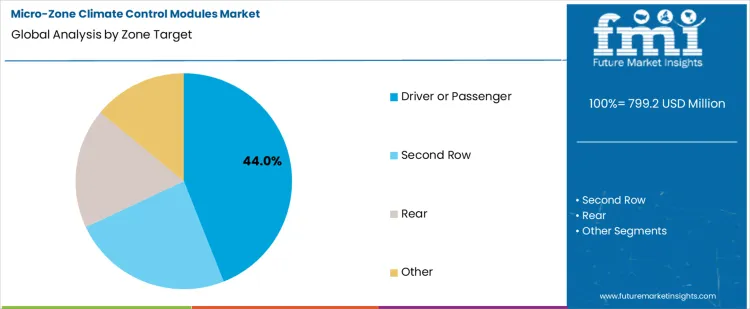
Driver or passenger targeting holds 44.0%, representing the largest share among zone targets due to direct impact on occupant comfort perception. Primary seating positions receive priority for thermal regulation to support alertness and comfort. Control accuracy in these zones influences overall cabin satisfaction and energy optimization. System calibration emphasizes fast response and fine adjustment for front-row occupants. Second row and rear targeting address multi-occupant comfort with varied duty cycles. Other targets support specialized layouts. Zone target segmentation reflects prioritization of primary occupants where comfort sensitivity and usage frequency remain highest.
Key Points:
- Front-row targeting directly affects perceived cabin comfort.
- Fast response improves occupant satisfaction and control accuracy.
- Other zones support secondary comfort requirements.
Which Control Technology Drives the Largest Share of Demand?
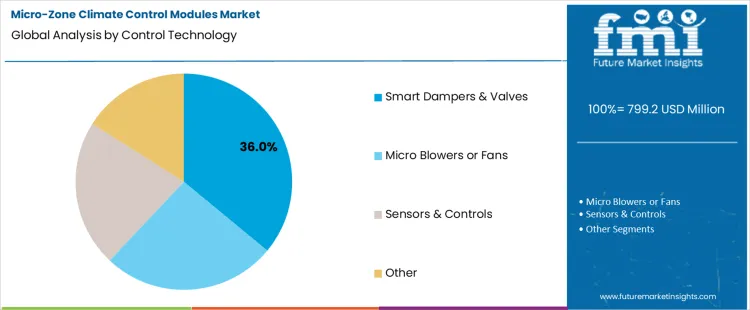
Smart dampers and valves hold 36.0%, representing the largest share among control technologies due to precise airflow modulation capability. These components enable real-time adjustment of air distribution across micro-zones. Integration supports coordinated response with sensors and central HVAC controllers. Reliability and low power consumption align with vehicle efficiency objectives. Micro blowers and fans provide localized airflow generation where duct routing is constrained. Sensors and control units support monitoring and feedback functions. Control technology segmentation reflects emphasis on mechanical regulation solutions delivering accuracy, durability, and seamless integration within cabin climate control systems.
Key Points:
- Smart dampers enable precise airflow regulation.
- Low power operation supports efficiency objectives.
- Other technologies complement sensing and localized airflow needs.
What are the Key Dynamics in the Micro-Zone Climate Control Modules Market?
Demand for micro-zone climate control modules reflects requirement for precise, localized thermal management within confined occupant or equipment spaces. Adoption is concentrated in automotive cabins and commercial vehicles, with limited application in adjacent mobility platforms. Global scope aligns with energy efficiency mandates, comfort differentiation, and thermal load optimization. Usage centers on compact modules combining sensors, actuators, and controls enabling independent temperature regulation at sub-cabin or component level.
How do precision thermal management needs and energy optimization shape adoption?
Micro-zone climate control addresses inefficiencies associated with conditioning unused or low-priority spaces. Demand increases where platforms require individualized comfort settings for occupants or sensitive components with differing thermal tolerances. Automotive and mobility applications adopt modules to reduce overall HVAC load and energy draw. Electronics and medical systems rely on micro-zoning to maintain stable operating temperatures without affecting surrounding environments. Integration with intelligent control software enables real-time adjustment based on occupancy, usage patterns, or heat generation. Compact design supports placement in space-constrained architectures. Adoption reflects operational focus on targeted thermal delivery rather than uniform climate conditioning.
How do system integration complexity and cost sensitivity influence market scalability?
Micro-zone modules add hardware, software, and calibration requirements, increasing system integration effort. Demand sensitivity rises where added cost challenges platform pricing targets. Compatibility issues emerge across diverse architectures lacking standardized interfaces. Performance depends on accurate sensing and airflow control, where misalignment reduces effectiveness. Maintenance complexity increases due to higher component count. Reliability concerns arise in harsh vibration or temperature environments. Regulatory requirements for thermal safety and efficiency testing add validation burden. Supply chain dependence on miniaturized components constrains scalability across high-volume production programs.
How Is Demand for Micro-Zone Climate Control Modules Evolving Globally?
Demand for micro-zone climate control modules is expanding globally as mobility and building platforms adopt localized thermal management to improve energy efficiency and occupant comfort. Adoption reflects shift toward software-defined HVAC architectures enabling independent control of seats, zones, or compartments. Electrification and tighter efficiency targets increase relevance of targeted conditioning over whole-cabin approaches. Integration with sensors and control algorithms supports precise load management. Growth rates in China at 13.0%, Brazil at 12.8%, USA at 10.4%, South Korea at 10.2%, and Germany at 10.1% indicate sustained expansion driven by platform redesign, climate exposure, and efficiency-focused system engineering.
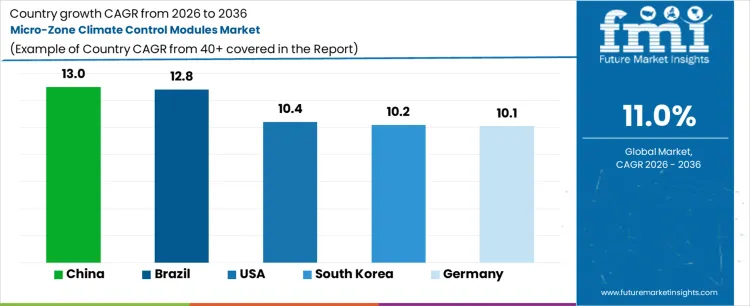
| Country | CAGR (%) |
|---|---|
| China | 13.0% |
| Brazil | 12.8% |
| USA | 10.4% |
| South Korea | 10.2% |
| Germany | 10.1% |
What Is Driving Accelerated Growth of Micro-Zone Climate Control Modules in China?
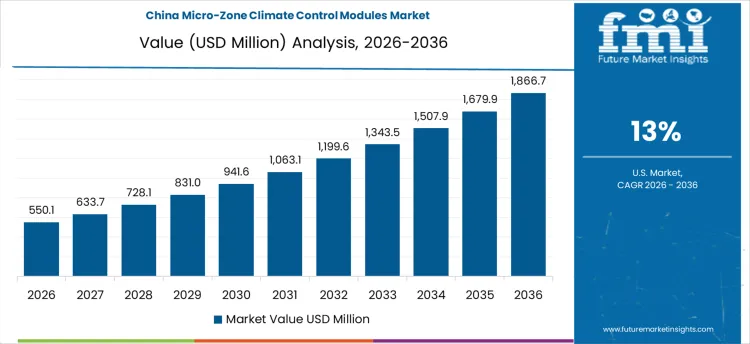
Production scale and platform standardization are accelerating micro-zone climate control module demand in China, expanding at a CAGR of 13.0%. High-volume electric vehicle programs integrate localized modules to reduce overall HVAC energy draw. Urban usage patterns favor rapid comfort delivery to occupied zones rather than full-cabin conditioning. Public transport electrification extends adoption into buses and rail cabins with variable occupancy. OEM software ecosystems enable sensor-driven control tied to seat occupancy and user profiles. Domestic supplier depth supports fast iteration and deployment across multiple vehicle platforms.
- High-volume EV platform integration
- Urban driving favoring occupied-zone conditioning
- Public transport electrification with variable occupancy
- Strong domestic module and control software supply
Why Is Brazil Experiencing Rapid Uptake of Micro-Zone Climate Control Modules?
Thermal load management under hot operating conditions is driving micro-zone climate control module demand in Brazil, growing at a CAGR of 12.8%. High ambient temperatures elevate cooling energy consumption at vehicle startup. Localized modules enable targeted cooling without conditioning unused zones. Electric buses and commercial fleets adopt micro-zoning to control operating costs across long duty cycles. Depot-based charging and predictable routes support scheduled thermal strategies. Demand growth reflects operational efficiency priorities across fleet electrification programs rather than discretionary comfort features.
- High ambient temperatures increasing cooling loads
- Fleet electrification across buses and commercial vehicles
- Targeted cooling to reduce energy consumption
- Depot operations enabling scheduled thermal strategies
How Is the USA Supporting Expansion of Micro-Zone Climate Control Modules?
Platform-level energy optimization is supporting micro-zone climate control module demand growth in the USA at a CAGR of 10.4%. OEMs deploy localized modules to improve range consistency across diverse climates. Consumer usage emphasizes personalized comfort settings controlled through vehicle software interfaces. Commercial fleets value micro-zoning to balance comfort and efficiency during multi-stop operations. High connectivity penetration enables sensor-based and user-profile-driven control. Adoption extends across passenger vehicles, delivery fleets, and specialty mobility platforms as HVAC architectures evolve toward modular designs.
- Platform optimization for range consistency
- Personalized comfort control through software interfaces
- Fleet use cases with variable occupancy patterns
- High connectivity enabling sensor-driven control
What Factors Are Sustaining Growth of Micro-Zone Climate Control Modules in South Korea?
Engineering-led integration sustains micro-zone climate control module demand in South Korea, expanding at a CAGR of 10.2%. Domestic OEMs emphasize coordinated thermal management across cabin, battery, and power electronics. Micro-zoning improves heating efficiency during winter operation and balances cooling during summer peaks. Export-oriented platforms require adaptable HVAC configurations for different regional climates. Supplier innovation supports compact modules with fast response times. Growth reflects technology differentiation within globally deployed vehicle architectures.
- Integrated thermal management across vehicle systems
- Seasonal efficiency improvements in heating and cooling
- Export platform requirements across climate regions
- Supplier innovation in compact, fast-response modules
Why Is Germany Showing Consistent Growth in Micro-Zone Climate Control Modules?
Efficiency-focused vehicle engineering is driving micro-zone climate control module demand in Germany, growing at a CAGR of 10.1%. OEMs prioritize localized conditioning to reduce overall HVAC energy consumption. Micro-zoning supports premium comfort differentiation through precise temperature control. Regulatory efficiency targets reinforce adoption within next-generation platforms. Integration with heat pump systems enhances performance during cold conditions. Demand growth is linked to platform redesign cycles rather than retrofit activity, sustaining steady integration across new vehicle programs.
- Energy efficiency priorities in vehicle engineering
- Premium comfort enabled by precise zone control
- Regulatory pressure on thermal efficiency
- Integration with heat pump HVAC architectures
What is the competitive landscape of demand for micro-zone climate control modules globally?
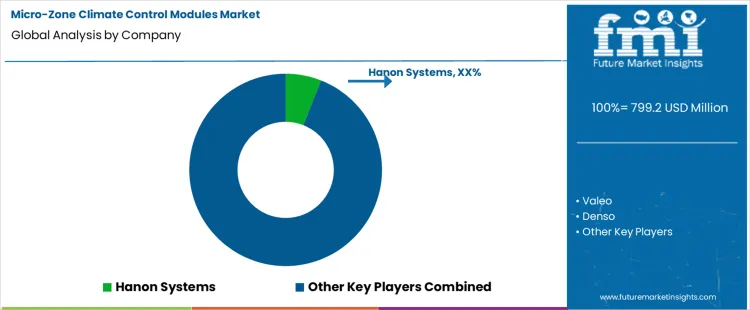
Demand for micro-zone climate control modules is driven by passenger comfort expectations, especially in premium and electric vehicles where individualized thermal zones enhance user experience and energy efficiency. These modules enable localized temperature control at seat, footwell, headliner, and rear seat positions, reducing reliance on full-cabin HVAC for faster comfort response. Buyers evaluate module responsiveness, energy consumption, integration with seat and HVAC systems, and control logic that supports adaptive and personalized settings. Procurement teams prioritize suppliers with modular architectures, automotive OEM certifications, and global application engineering support. Trend in the global market reflects growth of personalized comfort features, electrification of climate systems, and integration with connected vehicle interfaces.
Hanon Systems holds strong positioning through advanced micro-zone thermal modules integrated into multi-zone HVAC platforms designed for energy-efficient performance. Valeo supports demand with modular and scalable climate control components that enhance localized comfort in electrified and conventional vehicles. Denso participates with thermal management technologies and micro-zone solutions aligned with OEM comfort and energy-use targets. MAHLE contributes climate and thermal control modules that integrate precise temperature regulation with compact packaging. Gentherm supplies seat-integrated thermal comfort systems and micro-zone modules improving localized heating and cooling performance. Competitive differentiation depends on responsiveness to thermal setpoints, energy efficiency, integration flexibility, and ability to support diverse vehicle architectures and user interface demands.
Key Players in the Micro-Zone Climate Control Modules Market
- Hanon Systems
- Valeo
- Denso
- MAHLE
- Gentherm
- Hyundai Mobis
- Marelli
- Bosch
- Eberspächer
- Sanden
Scope of the Report
| Items | Values |
|---|---|
| Quantitative Units | USD million |
| Module Type | Micro-Zone HVAC Duct Modules; Local Air-Mix Units; Thermoelectric Spot Modules; Other |
| Zone Target | Driver or Passenger; Second Row; Rear; Other |
| Control Technology | Smart Dampers & Valves; Micro Blowers or Fans; Sensors & Controls; Other |
| Sales Channel | OEM Line-Fit; Tier-1 Modules; Limited Aftermarket; Other |
| Regions Covered | Asia Pacific, Europe, North America, Latin America, Middle East & Africa |
| Countries Covered | China, Brazil, USA, South Korea, Germany, and 40+ countries |
| Key Companies Profiled | Hanon Systems; Valeo; Denso; MAHLE; Gentherm; Hyundai Mobis; Marelli; Bosch; Eberspächer; Sanden |
| Additional Attributes | Dollar sales by module type and sales channel; adoption trends for occupant-focused micro-zone thermal control in EV and premium vehicle architectures; airflow precision, response time, and noise-vibration performance metrics; integration with zonal HVAC, seat comfort, and vehicle energy management systems; software calibration, sensor accuracy, and diagnostics considerations; compliance with OEM thermal comfort targets, efficiency requirements, and interior noise standards. |
Micro-Zone Climate Control Modules Market by Segment
By Module Type:
- Micro-Zone HVAC Duct Modules
- Local Air-Mix Units
- Thermoelectric Spot Modules
- Other
By Zone Target:
- Driver or Passenger
- Second Row
- Rear
- Other
By Control Technology:
- Smart Dampers & Valves
- Micro Blowers or Fans
- Sensors & Controls
- Other
By Sales Channel:
- OEM Line-Fit
- Tier-1 Modules
- Aftermarket
- Other
By Region:
- Asia Pacific
- China
- Japan
- South Korea
- India
- Australia & New Zealand
- ASEAN
- Rest of Asia Pacific
- Europe
- Germany
- United Kingdom
- France
- Italy
- Spain
- Nordic
- BENELUX
- Rest of Europe
- North America
- United States
- Canada
- Mexico
- Latin America
- Brazil
- Chile
- Rest of Latin America
- Middle East & Africa
- Kingdom of Saudi Arabia
- Other GCC Countries
- Turkey
- South Africa
- Other African Union
- Rest of Middle East & Africa
Bibliography
- International Energy Agency. (2024). Advanced thermal management and zonal climate control strategies for electrified mobility and buildings. IEA Energy Efficiency Reports.
- Society of Automotive Engineers International. (2023). Micro-zonal HVAC architectures and localized climate control modules for vehicle cabins. SAE Technical Papers.
- European Commission Joint Research Centre. (2024). Localized climate control, energy efficiency, and occupant comfort in transport and building systems. JRC Science for Policy Reports.
- International Organization for Standardization. (2023). Energy performance and control requirements for localized heating and cooling systems. ISO Technical Standards.
Frequently Asked Questions
How big is the micro-zone climate control modules market in 2026?
The global micro-zone climate control modules market is estimated to be valued at USD 799.2 million in 2026.
What will be the size of micro-zone climate control modules market in 2036?
The market size for the micro-zone climate control modules market is projected to reach USD 2,269.3 million by 2036.
How much will be the micro-zone climate control modules market growth between 2026 and 2036?
The micro-zone climate control modules market is expected to grow at a 11.0% CAGR between 2026 and 2036.
What are the key product types in the micro-zone climate control modules market?
The key product types in micro-zone climate control modules market are micro-zone hvac duct modules, local air-mix units, thermoelectric spot modules and other.
Which zone target segment to contribute significant share in the micro-zone climate control modules market in 2026?
In terms of zone target, driver or passenger segment to command 44.0% share in the micro-zone climate control modules market in 2026.
Preview the report firsthand - request a free sample
Get SampleGet the brochure for pricing and purchase details.
Get PDFTable of Content
- Executive Summary
- Global Market Outlook
- Demand-side Trends
- Supply-side Trends
- Technology Roadmap Analysis
- Analysis and Recommendations
- Market Overview
- Market Coverage / Taxonomy
- Market Definition / Scope / Limitations
- Market Background
- Market Dynamics
- Drivers
- Restraints
- Opportunity
- Trends
- Scenario Forecast
- Demand in Optimistic Scenario
- Demand in Likely Scenario
- Demand in Conservative Scenario
- Opportunity Map Analysis
- Product Life Cycle Analysis
- Supply Chain Analysis
- Investment Feasibility Matrix
- Value Chain Analysis
- PESTLE and Porter’s Analysis
- Regulatory Landscape
- Regional Parent Market Outlook
- Production and Consumption Statistics
- Import and Export Statistics
- Market Dynamics
- Global Market Analysis 2021 to 2025 and Forecast, 2026 to 2036
- Historical Market Size Value (USD Million) Analysis, 2021 to 2025
- Current and Future Market Size Value (USD Million) Projections, 2026 to 2036
- Y-o-Y Growth Trend Analysis
- Absolute $ Opportunity Analysis
- Global Market Pricing Analysis 2021 to 2025 and Forecast 2026 to 2036
- Global Market Analysis 2021 to 2025 and Forecast 2026 to 2036, By Module Type
- Introduction / Key Findings
- Historical Market Size Value (USD Million) Analysis By Module Type , 2021 to 2025
- Current and Future Market Size Value (USD Million) Analysis and Forecast By Module Type , 2026 to 2036
- Micro-Zone HVAC Duct Modules
- Local Air-Mix Value (USD Million)s
- Thermoelectric Spot Modules
- Other
- Micro-Zone HVAC Duct Modules
- Y-o-Y Growth Trend Analysis By Module Type , 2021 to 2025
- Absolute $ Opportunity Analysis By Module Type , 2026 to 2036
- Global Market Analysis 2021 to 2025 and Forecast 2026 to 2036, By Zone Target
- Introduction / Key Findings
- Historical Market Size Value (USD Million) Analysis By Zone Target, 2021 to 2025
- Current and Future Market Size Value (USD Million) Analysis and Forecast By Zone Target, 2026 to 2036
- Driver or Passenger
- Second Row
- Rear
- Other
- Driver or Passenger
- Y-o-Y Growth Trend Analysis By Zone Target, 2021 to 2025
- Absolute $ Opportunity Analysis By Zone Target, 2026 to 2036
- Global Market Analysis 2021 to 2025 and Forecast 2026 to 2036, By Control Technology
- Introduction / Key Findings
- Historical Market Size Value (USD Million) Analysis By Control Technology, 2021 to 2025
- Current and Future Market Size Value (USD Million) Analysis and Forecast By Control Technology, 2026 to 2036
- Smart Dampers & Valves
- Micro Blowers or Fans
- Sensors & Controls
- Other
- Smart Dampers & Valves
- Y-o-Y Growth Trend Analysis By Control Technology, 2021 to 2025
- Absolute $ Opportunity Analysis By Control Technology, 2026 to 2036
- Global Market Analysis 2021 to 2025 and Forecast 2026 to 2036, By Sales Channel
- Introduction / Key Findings
- Historical Market Size Value (USD Million) Analysis By Sales Channel, 2021 to 2025
- Current and Future Market Size Value (USD Million) Analysis and Forecast By Sales Channel, 2026 to 2036
- OEM Line-Fit
- Tier-1 Modules
- Aftermarket
- Other
- OEM Line-Fit
- Y-o-Y Growth Trend Analysis By Sales Channel, 2021 to 2025
- Absolute $ Opportunity Analysis By Sales Channel, 2026 to 2036
- Global Market Analysis 2021 to 2025 and Forecast 2026 to 2036, By Region
- Introduction
- Historical Market Size Value (USD Million) Analysis By Region, 2021 to 2025
- Current Market Size Value (USD Million) Analysis and Forecast By Region, 2026 to 2036
- North America
- Latin America
- Western Europe
- Eastern Europe
- East Asia
- South Asia and Pacific
- Middle East & Africa
- Market Attractiveness Analysis By Region
- North America Market Analysis 2021 to 2025 and Forecast 2026 to 2036, By Country
- Historical Market Size Value (USD Million) Trend Analysis By Market Taxonomy, 2021 to 2025
- Market Size Value (USD Million) Forecast By Market Taxonomy, 2026 to 2036
- By Country
- USA
- Canada
- Mexico
- By Module Type
- By Zone Target
- By Control Technology
- By Sales Channel
- By Country
- Market Attractiveness Analysis
- By Country
- By Module Type
- By Zone Target
- By Control Technology
- By Sales Channel
- Key Takeaways
- Latin America Market Analysis 2021 to 2025 and Forecast 2026 to 2036, By Country
- Historical Market Size Value (USD Million) Trend Analysis By Market Taxonomy, 2021 to 2025
- Market Size Value (USD Million) Forecast By Market Taxonomy, 2026 to 2036
- By Country
- Brazil
- Chile
- Rest of Latin America
- By Module Type
- By Zone Target
- By Control Technology
- By Sales Channel
- By Country
- Market Attractiveness Analysis
- By Country
- By Module Type
- By Zone Target
- By Control Technology
- By Sales Channel
- Key Takeaways
- Western Europe Market Analysis 2021 to 2025 and Forecast 2026 to 2036, By Country
- Historical Market Size Value (USD Million) Trend Analysis By Market Taxonomy, 2021 to 2025
- Market Size Value (USD Million) Forecast By Market Taxonomy, 2026 to 2036
- By Country
- Germany
- UK
- Italy
- Spain
- France
- Nordic
- BENELUX
- Rest of Western Europe
- By Module Type
- By Zone Target
- By Control Technology
- By Sales Channel
- By Country
- Market Attractiveness Analysis
- By Country
- By Module Type
- By Zone Target
- By Control Technology
- By Sales Channel
- Key Takeaways
- Eastern Europe Market Analysis 2021 to 2025 and Forecast 2026 to 2036, By Country
- Historical Market Size Value (USD Million) Trend Analysis By Market Taxonomy, 2021 to 2025
- Market Size Value (USD Million) Forecast By Market Taxonomy, 2026 to 2036
- By Country
- Russia
- Poland
- Hungary
- Balkan & Baltic
- Rest of Eastern Europe
- By Module Type
- By Zone Target
- By Control Technology
- By Sales Channel
- By Country
- Market Attractiveness Analysis
- By Country
- By Module Type
- By Zone Target
- By Control Technology
- By Sales Channel
- Key Takeaways
- East Asia Market Analysis 2021 to 2025 and Forecast 2026 to 2036, By Country
- Historical Market Size Value (USD Million) Trend Analysis By Market Taxonomy, 2021 to 2025
- Market Size Value (USD Million) Forecast By Market Taxonomy, 2026 to 2036
- By Country
- China
- Japan
- South Korea
- By Module Type
- By Zone Target
- By Control Technology
- By Sales Channel
- By Country
- Market Attractiveness Analysis
- By Country
- By Module Type
- By Zone Target
- By Control Technology
- By Sales Channel
- Key Takeaways
- South Asia and Pacific Market Analysis 2021 to 2025 and Forecast 2026 to 2036, By Country
- Historical Market Size Value (USD Million) Trend Analysis By Market Taxonomy, 2021 to 2025
- Market Size Value (USD Million) Forecast By Market Taxonomy, 2026 to 2036
- By Country
- India
- ASEAN
- Australia & New Zealand
- Rest of South Asia and Pacific
- By Module Type
- By Zone Target
- By Control Technology
- By Sales Channel
- By Country
- Market Attractiveness Analysis
- By Country
- By Module Type
- By Zone Target
- By Control Technology
- By Sales Channel
- Key Takeaways
- Middle East & Africa Market Analysis 2021 to 2025 and Forecast 2026 to 2036, By Country
- Historical Market Size Value (USD Million) Trend Analysis By Market Taxonomy, 2021 to 2025
- Market Size Value (USD Million) Forecast By Market Taxonomy, 2026 to 2036
- By Country
- Kingdom of Saudi Arabia
- Other GCC Countries
- Turkiye
- South Africa
- Other African Union
- Rest of Middle East & Africa
- By Module Type
- By Zone Target
- By Control Technology
- By Sales Channel
- By Country
- Market Attractiveness Analysis
- By Country
- By Module Type
- By Zone Target
- By Control Technology
- By Sales Channel
- Key Takeaways
- Key Countries Market Analysis
- USA
- Pricing Analysis
- Market Share Analysis, 2025
- By Module Type
- By Zone Target
- By Control Technology
- By Sales Channel
- Canada
- Pricing Analysis
- Market Share Analysis, 2025
- By Module Type
- By Zone Target
- By Control Technology
- By Sales Channel
- Mexico
- Pricing Analysis
- Market Share Analysis, 2025
- By Module Type
- By Zone Target
- By Control Technology
- By Sales Channel
- Brazil
- Pricing Analysis
- Market Share Analysis, 2025
- By Module Type
- By Zone Target
- By Control Technology
- By Sales Channel
- Chile
- Pricing Analysis
- Market Share Analysis, 2025
- By Module Type
- By Zone Target
- By Control Technology
- By Sales Channel
- Germany
- Pricing Analysis
- Market Share Analysis, 2025
- By Module Type
- By Zone Target
- By Control Technology
- By Sales Channel
- UK
- Pricing Analysis
- Market Share Analysis, 2025
- By Module Type
- By Zone Target
- By Control Technology
- By Sales Channel
- Italy
- Pricing Analysis
- Market Share Analysis, 2025
- By Module Type
- By Zone Target
- By Control Technology
- By Sales Channel
- Spain
- Pricing Analysis
- Market Share Analysis, 2025
- By Module Type
- By Zone Target
- By Control Technology
- By Sales Channel
- France
- Pricing Analysis
- Market Share Analysis, 2025
- By Module Type
- By Zone Target
- By Control Technology
- By Sales Channel
- India
- Pricing Analysis
- Market Share Analysis, 2025
- By Module Type
- By Zone Target
- By Control Technology
- By Sales Channel
- ASEAN
- Pricing Analysis
- Market Share Analysis, 2025
- By Module Type
- By Zone Target
- By Control Technology
- By Sales Channel
- Australia & New Zealand
- Pricing Analysis
- Market Share Analysis, 2025
- By Module Type
- By Zone Target
- By Control Technology
- By Sales Channel
- China
- Pricing Analysis
- Market Share Analysis, 2025
- By Module Type
- By Zone Target
- By Control Technology
- By Sales Channel
- Japan
- Pricing Analysis
- Market Share Analysis, 2025
- By Module Type
- By Zone Target
- By Control Technology
- By Sales Channel
- South Korea
- Pricing Analysis
- Market Share Analysis, 2025
- By Module Type
- By Zone Target
- By Control Technology
- By Sales Channel
- Russia
- Pricing Analysis
- Market Share Analysis, 2025
- By Module Type
- By Zone Target
- By Control Technology
- By Sales Channel
- Poland
- Pricing Analysis
- Market Share Analysis, 2025
- By Module Type
- By Zone Target
- By Control Technology
- By Sales Channel
- Hungary
- Pricing Analysis
- Market Share Analysis, 2025
- By Module Type
- By Zone Target
- By Control Technology
- By Sales Channel
- Kingdom of Saudi Arabia
- Pricing Analysis
- Market Share Analysis, 2025
- By Module Type
- By Zone Target
- By Control Technology
- By Sales Channel
- Turkiye
- Pricing Analysis
- Market Share Analysis, 2025
- By Module Type
- By Zone Target
- By Control Technology
- By Sales Channel
- South Africa
- Pricing Analysis
- Market Share Analysis, 2025
- By Module Type
- By Zone Target
- By Control Technology
- By Sales Channel
- USA
- Market Structure Analysis
- Competition Dashboard
- Competition Benchmarking
- Market Share Analysis of Top Players
- By Regional
- By Module Type
- By Zone Target
- By Control Technology
- By Sales Channel
- Competition Analysis
- Competition Deep Dive
- Hanon Systems
- Overview
- Product Portfolio
- Profitability by Market Segments (Product/Age /Sales Channel/Region)
- Sales Footprint
- Strategy Overview
- Marketing Strategy
- Product Strategy
- Channel Strategy
- Valeo
- Denso
- MAHLE
- Gentherm
- Hyundai Mobis
- Marelli
- Bosch
- Eberspächer
- Sanden
- Hanon Systems
- Competition Deep Dive
- Assumptions & Acronyms Used
- Research Methodology


