

- Market Size (2026)
- USD 2.2 Bn
- Forecast (2036)
- USD 4.5 Bn
- CAGR (2026 to 2036)
- 7.5%
Screw Press Dewatering Machine Market Size, Market Forecast and Outlook By FMI
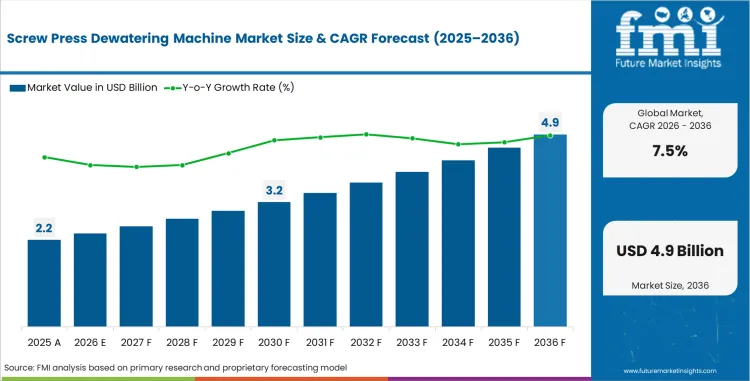
The screw press dewatering machine market was valued at USD 2.0 billion in 2025. The sector is expected to reach USD 2.2 billion in 2026 at a CAGR of 7.5% during the forecast period. Sustained replacement of older sludge dewatering lines, paired with steady expansion of wastewater treatment capacity, carries the valuation to USD 4.5 billion through 2036 as buyers continue shifting toward enclosed, lower-energy dewatering platforms that trim hauling volumes and reduce operator attention in day-to-day plant use.
Summary of Screw Press Dewatering Machine Market
- Market Snapshot
- The screw press dewatering machine market was valued at USD 2.0 billion in 2025 and is projected to reach USD 4.5 billion by 2036.
- The industry is expected to reach 7.5% CAGR from 2026 to 2036, creating an incremental opportunity of USD 2.2 billion over the period from the 2026 base of USD 2.1 billion.
- This category remains a specification-led wastewater and sludge-handling equipment space where throughput stability, power draw, polymer demand, and maintenance simplicity shape vendor selection.
- Demand remains tied to municipal sewage treatment, industrial solids reduction, and disposal-cost control where dewatering efficiency influences hauling, storage, and downstream handling economics.
- Demand and Growth Drivers
- Demand is increasing as wastewater plants and industrial facilities aim to reduce sludge volume, lower transport costs, and meet stricter treatment and disposal requirements.
- Multi-disc screw press systems are gaining adoption because they operate in enclosed conditions, require less manual handling, and handle variable sludge loads with more consistent performance than older equipment.
- Expansion in wastewater treatment capacity across developing economies continues to support demand, as new plants and system upgrades add dewatering equipment.
- India is projected to expand at 8.1% CAGR in the screw press systems market from 2026 to 2036, followed by China at 7.2% CAGR. The United States is expected to record 6.4% CAGR, while Brazil posts 6.0% CAGR, Germany 5.7% CAGR, France 5.4% CAGR, and Japan 5.0% CAGR over the same period.
- Market expansion is moderated by competition from belt presses and centrifuges, along with slower budgeting cycles in established treatment networks where equipment replacement occurs less frequently.
- Product and Segment View
- The industry is estimated to include screw-based sludge dewatering systems used in municipal treatment, industrial wastewater, food processing, and pulp and paper operations.
- These systems are applied across utilities, industrial facilities, and contract-operated plants where solids reduction, enclosed handling, and lower operator involvement are required in daily operations.
- Municipal sludge is projected to account for 37.0% share of the application segment in 2026, as continuous sludge generation requires stable and reliable dewatering performance.
- Multi-disc screw press systems are expected to hold 44.0% share of the machine type segment in 2026, supported by self-cleaning operation, compact footprint, and adaptability to variable feed conditions.
- The 10-50 m³/hr capacity range is anticipated to represent 48.0% share of the capacity segment in 2026, reflecting common throughput needs across municipal and mid-scale industrial installations.
- New system installations are projected to capture 58.0% share of the sales segment in 2026, as capacity additions and modernization projects continue alongside replacement demand.
- Industrial plants are expected to account for 42.0% share of the end-user segment in 2026, driven by onsite wastewater treatment and compliance requirements across process industries.
- The scope is estimated to include standalone screw press units and integrated sludge thickening and dewatering systems, while excluding non-screw technologies that do not follow this machine architecture.
- Geography and Competitive Outlook
- India, China, and the USA are the faster-growing national markets, while Germany and Japan remain more stable technical demand bases with mature installed equipment fleets.
- Competition is shaped by operating stability, power consumption, washwater management, polymer support, engineering response, and the ability to integrate dewatering with upstream and downstream solids handling.
- ANDRITZ, HUBER, Mitsubishi Kakoki, Fournier, Voith, IHI, Veolia, SUEZ, Aqseptence, and Sakurai remain among the visible supplier names across this market set.
Key Takeaways, Market Size, and Forecast
- Screw Press Dewatering Machine Market is projected to grow from USD 2.2 billion in 2026 to USD 4.5 billion by 2036, at a CAGR of 7.5%.
- The Screw Press Dewatering Machine Market was valued at USD 2.0 billion in 2025.
- By 2036, the Screw Press Dewatering Machine Market is expected to be worth USD 4.5 billion.
- From 2026 to 2036, the market is projected to expand at a CAGR of 7.5%.
- The market is projected to create an incremental opportunity of USD 2.2 billion between 2026 and 2036.
- In 2026, Municipal Sludge is expected to account for 37.0% of the application segment.
- India (8.1% CAGR) and China (7.2% CAGR) are two of the fastest growing markets.
Screw Press Dewatering Machine Market Key Takeaways
| Metric | Details |
|---|---|
| Industry Size (2026) | USD 2.2 billion |
| Industry Value (2036) | USD 4.5 billion |
| CAGR (2026-2036) | 7.5% |
Source: Future Market Insights (FMI) analysis, based on proprietary forecasting model and primary research
Decision-making in utilities and industrial treatment plants now extends beyond basic sludge dewatering. Teams assess whether equipment can operate under tighter labor limits, energy constraints, odor control requirements, and rising disposal costs without increasing maintenance effort. Screw press systems are gaining attention because they balance performance with lower operational complexity compared to more maintenance-heavy alternatives. Evaluation often includes related treatment and filtration equipment, as buyers compare lifecycle performance rather than only throughput. Many upgrades are delayed not due to uncertainty in dewatering results, but because plants need assurance that systems can handle variable sludge conditions without creating additional operational issues.
Adoption improves when screw press systems are treated as a repeatable upgrade rather than a one-time engineering change. This shift occurs when reference installations, service support, polymer optimization, and solids handling integration are already established within the organization. Once these factors are in place, replacement decisions move faster and equipment is evaluated based on operating reliability rather than initial unfamiliarity.
India is expected to expand at 8.1% CAGR in the screw press systems market from 2026 to 2036, supported by wastewater capacity expansion and sanitation investment. China follows at 7.2% CAGR, driven by ongoing municipal and industrial treatment development. The United States is projected at 6.4% CAGR, Brazil at 6.0% CAGR, Germany at 5.7% CAGR, France at 5.4% CAGR, and Japan at 5.0% CAGR. Differences across countries reflect how quickly treatment requirements translate into equipment investment, retrofit activity, and project execution.
Segmental Analysis
Screw Press Dewatering Machine Market Analysis by Application
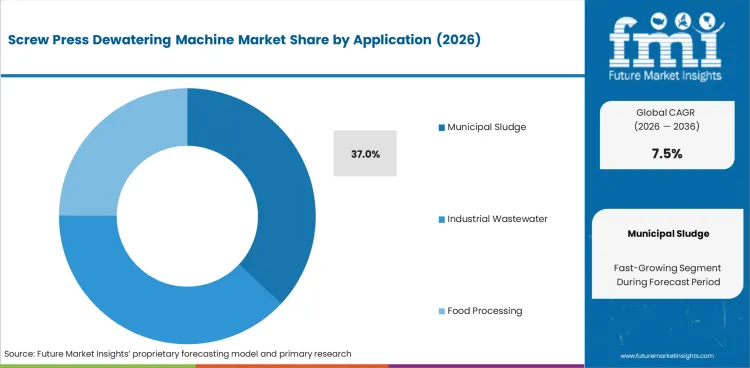
Steady sludge generation at municipal plants keeps dewatering performance under constant review, as daily operation depends on stable solids handling rather than peak throughput. Municipal sludge is expected to account for 37.0% share of the application segment in 2026, since treatment facilities must maintain consistent performance to meet compliance and control transport costs. Equipment selection is often compared across broader sludge handling and water treatment options when decisions are tied to operational risk rather than a single equipment change. Industrial wastewater remains important, as sludge handling directly affects production continuity, but municipal use continues to anchor demand due to continuous processing needs and limited labor availability. Food processing and pulp and paper applications also contribute, though they typically require more specific sludge analysis before final equipment selection.
- Continuity: Municipal operators value equipment that keeps solids moving every day because disposal delays quickly turn into storage pressure and hauling cost.
- Variability: Feed quality swings matter less when the press can hold stable operation without constant manual correction.
- Consequence: Buyers who under-specify for public sludge duty usually face cake inconsistency, higher polymer use, and avoidable operator workload.
Screw Press Dewatering Machine Market Analysis by Machine Type
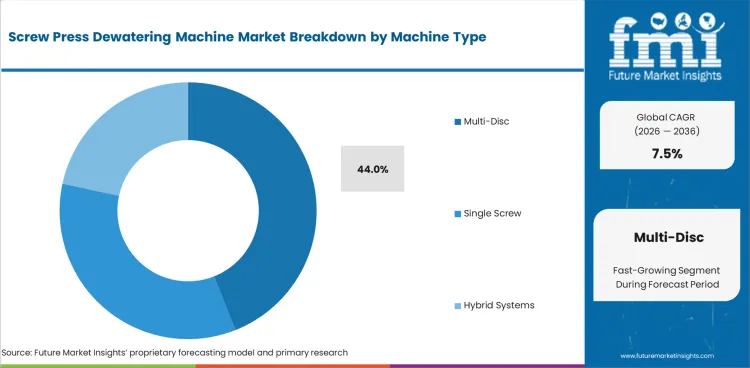
Compact footprints and easier wash management have become stronger buying arguments in this category as dewatering rooms rarely get more space when plants modernize. Multi-disc screw press systems are anticipated to represent 44.0% of the market in 2026, reflecting how often utilities and industrial treatment teams prioritize self-cleaning behavior, enclosed processing, and stable cake discharge over raw mechanical familiarity. FMI analysis points buyers toward adjacent references such as filter press, automatic presses, and membrane presses when they evaluate where screw press design actually reduces operator burden. Single screw presses retain a workable role where sludge conditions stay more predictable or cost discipline dominates the project brief. Hybrid systems remain useful in plants that need more tailored treatment trains, though they usually demand stronger site-specific engineering justification before procurement closes.
- Cleaning logic: Multi-disc configurations reduce manual cleaning burden, which matters in plants running with lean operator teams.
- Control response: Stable behavior under variable sludge quality gives buyers more confidence in daily operation and fewer surprises during commissioning.
- Selection risk: Plants that choose a familiar machine type without matching it to feed behavior often inherit avoidable downtime and washwater complications.
Screw Press Dewatering Machine Market Analysis by Capacity
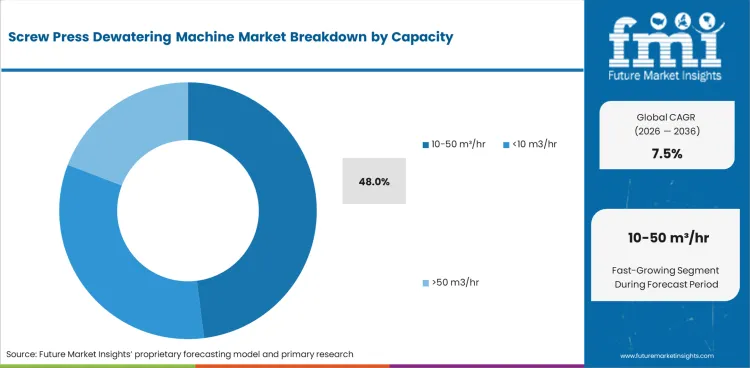
Capacity requirements often guide this decision before supplier choice. Many facilities need sufficient dewatering capability to prevent sludge buildup without moving into larger, more complex systems. The 10-50 m³/hr range is expected to account for 48.0% share of the capacity segment in 2026, as it fits a broad base of municipal and industrial installations with moderate solids loads. Mid-range systems align with routine processing needs without adding unnecessary engineering burden. Equipment sizing is also compared with other treatment and filtration systems when defining overall solids handling design. Smaller units remain suitable for compact and decentralized setups, while higher-capacity systems are used where sludge volumes are heavier but require longer approval and engineering cycles.
- Throughput fit: Mid-capacity presses work for many plants because they balance operational coverage with manageable footprint and capex.
- Budget discipline: Oversized equipment weakens project economics when average sludge loads do not justify the added engineering package.
- Scaling effect: Plants that size too close to current demand can run back into backlog risk once treatment volumes rise or sludge characteristics change.
Screw Press Dewatering Machine Market Analysis by Sales Mix
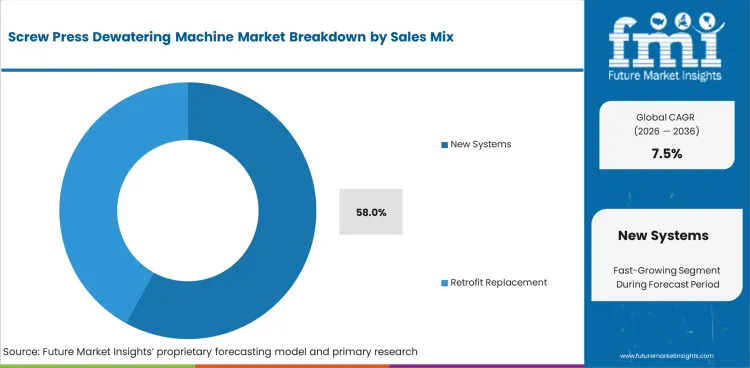
Fresh installations still command more attention than retrofit jobs because many buyers are expanding or rebuilding solids-handling lines rather than making only incremental corrections to legacy layouts. New systems are forecast to account for 58.0% share in 2026, reflecting ongoing wastewater capacity additions and the fact that line redesign often works better than patching older dewatering arrangements into new treatment targets. Supplier comparisons increasingly stretch into aerators, advanced flocculants and broader treatment chemicals discussions because dewatering decisions are now folded into whole-plant solids strategy. Retrofit and replacement projects remain steady, especially in mature utility networks, but they can be slowed by layout constraints, integration work, and uncertainty over how much performance gain an older line can realistically capture without deeper process changes.
- Installation scope: New-build projects let engineering teams optimize feed, polymer, conveying, and discharge points together rather than accepting inherited layout limits.
- Retrofit burden: Replacement work often looks smaller on paper, yet hidden interface issues can stretch commissioning and dilute expected gains.
- Capital timing: Sites that wait too long to replace worn dewatering units usually shift from planned capex into reactive maintenance and disposal-cost pressure.
Screw Press Dewatering Machine Market Analysis by End User
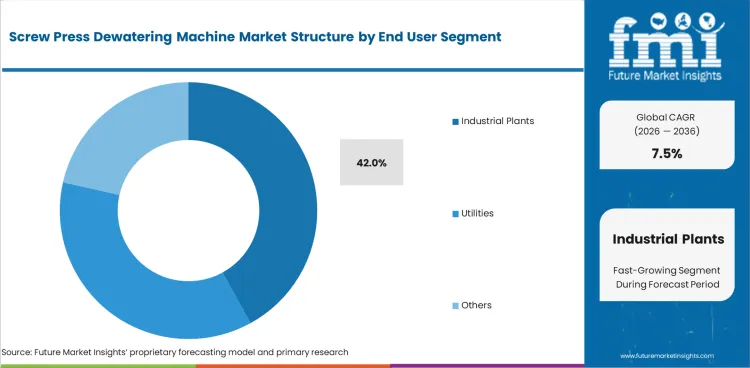
Industrial facilities account for a large share of demand because sludge generation is directly linked to production uptime, treatment requirements, and cost control. Industrial plants are expected to account for 42.0% share of the end-user segment in 2026, as many manufacturers invest in onsite systems to manage discharge quality and solids handling more effectively. Utility demand remains important, especially where municipal upgrades are underway, but industrial sites often act faster when dewatering issues affect production flow. Equipment selection is also influenced by how sludge is handled after dewatering, with links to effluent treatment, chemical dosing, and conveying systems. Contract operators play a role in shaping replacement timing and performance standards in facilities managed through outsourced operations.
- Uptime linkage: Industrial buyers connect dewatering directly to plant continuity, which makes response time and operating stability central vendor criteria.
- Handling chain: A screw press purchase is rarely isolated because discharge, conveying, storage, and hauling all influence the real cost outcome.
- Service exposure: End users who overlook aftermarket support can face longer stoppages when polymer tuning, wear parts, or feed changes disrupt routine performance.
Screw Press Dewatering Machine Market Drivers, Restraints, and Opportunities
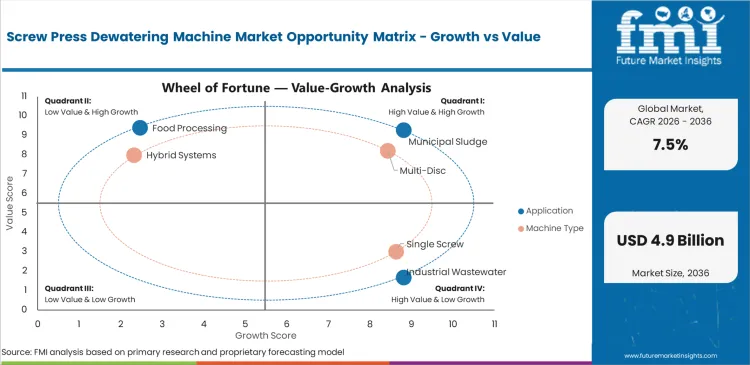
Disposal costs are pushing plants to treat sludge reduction as a core operating decision rather than a secondary task. Utilities and industrial facilities need to lower wet volume before transport, storage, and final handling costs increase. Screw press systems are gaining adoption because they offer enclosed dewatering, moderate energy use, and manageable daily operation. Buyers often evaluate them alongside broader treatment solutions when reviewing full solids handling strategy rather than a single equipment upgrade. Delays in adoption increase operating burden, as rising hauling, chemical use, odor control, and storage demands become harder to manage.
Project complexity remains the main constraint on implementation. Even when the need for improved dewatering is clear, progress depends on engineering validation, sludge characterization, layout compatibility, and service planning. Retrofit installations add further challenges, as existing piping, feed systems, and conveying setups may limit performance if not adjusted properly. Suppliers can reduce hesitation by providing pilot data, integration guidance, and structured commissioning support. Adoption still moves cautiously in plants where sludge properties change across seasons or production conditions.
Opportunities in the Screw Press Dewatering Machine Market
- Municipal upgrades: Capacity expansion and aging solids lines create room for new installations where buyers want quieter, enclosed dewatering that fits tighter staffing models.
- Industrial retrofit bundles: Plants that pair dewatering upgrades with polymer optimization, conveying changes, and sludge-handling redesign can unlock stronger project economics than stand-alone machine swaps.
- Reference selling: Suppliers who anchor proposals against nearby categories such as AFP systems and liquid filtration can help buyers frame screw press projects inside a wider solids-separation investment case.
Regional Analysis
Based on the regional analysis, the Screw Press Dewatering Machine Market is segmented into North America, Latin America, Western Europe, Eastern Europe, East Asia, South Asia & Pacific, and the Middle East & Africa across 40 plus countries.
.webp "Top Country Growth Comparison Screw Press Dewatering Machine Market Cagr (2026 2036)")
| Country | CAGR (2026 to 2036) |
|---|---|
| India | 8.1% |
| China | 7.2% |
| USA | 6.4% |
| Brazil | 6.0% |
| Germany | 5.7% |
| France | 5.4% |
| Japan | 5.0% |
Source: Future Market Insights (FMI) analysis, based on proprietary forecasting model and primary research
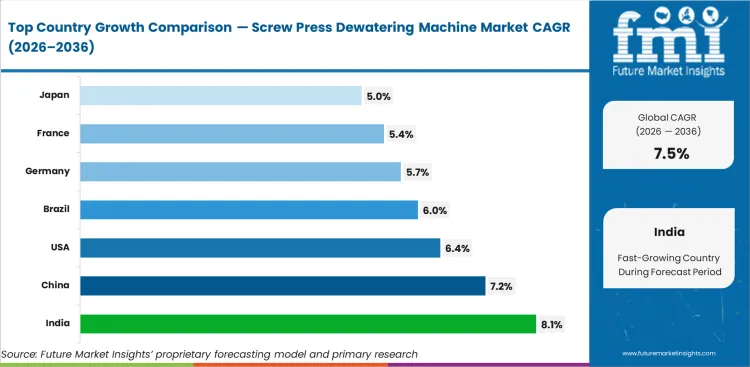
Asia Pacific Screw Press Dewatering Machine Market Analysis
Wastewater capacity expansion changes the buying rhythm across Asia Pacific. Many projects are not simple replacements; they are first-time or step-up investments where plant teams are building dewatering into broader treatment architecture from the start. That favors equipment suppliers that can support commissioning, sludge characterization, and long-run operating stability rather than only ship hardware. FMI analysis reads this region alongside industrial treatment, water treatment, and advanced flocculants because solids reduction decisions are often made together with chemical dosing and process-upgrade budgets. Scale alone does not explain the region. Project execution speed, service reach, and local confidence in operating simplicity matter just as much when utilities and industrial sites select dewatering equipment.
- India: Sanitation expansion, municipal treatment buildout, and growing industrial wastewater enforcement keep India at the top of the growth range. Demand for screw press dewatering machines in India is expected to rise at a CAGR of 8.1% through 2036. Plant operators often favor equipment that can manage variable feed conditions without constant intervention because staffing depth and site consistency still vary across projects. Buyers who postpone dewatering upgrades risk pushing sludge storage and hauling costs into already tight operating budgets.
- China: Treatment capacity keeps widening in China, and that enlarges the replacement and new-installation base for dewatering systems at the same time. The market for screw press dewatering machines in China is forecast to register a CAGR of 7.2% over the assessment period. Local execution speed and the need to fit equipment into large municipal and industrial treatment programs give an edge to suppliers that can combine engineering support with dependable after-sales coverage. Procurement teams that overlook service backing often inherit slower stabilization after startup.
- Japan: Mature wastewater infrastructure keeps Japan in a steadier growth lane, yet operators still value equipment that lowers intervention and fits within compact plant layouts. The industry is anticipated to reach 5.0% CAGR in Japan through 2036. Replacement logic carries more weight here than greenfield expansion, so vendors need to prove lifecycle performance, not just machine availability. Plants that stay with aging dewatering assets too long usually absorb the penalty through maintenance hours and lower operating flexibility.
FMI coverage for this region also extends across South Korea, Southeast Asia, and Australia. Additional country patterns point to one consistent feature: sites that can translate treatment expansion into disciplined commissioning and service support move from pilot interest to repeated purchase much faster than sites treating dewatering as a narrow equipment add-on.
Europe Screw Press Dewatering Machine Market Analysis
Compliance maturity shapes Europe more than raw installation count. Buyers here usually know the dewatering problem well; the harder question is which equipment configuration can reduce solids-handling cost without adding maintenance complexity or upsetting established treatment routines. That creates room for careful comparison with treatment chemicals, filter press and plate frame references when solids-management upgrades are scoped. Procurement cycles can be deliberate, especially in municipal systems, yet once a project moves forward the technical brief is usually clear. Vendors win less on broad claims and more on predictable cake dryness, footprint fit, washwater control, and service responsiveness under real sludge conditions.
- Germany: Germany holds near 5.7% CAGR through 2026 to 2036, but the path to purchase is often longer. Buyers test assumptions early. They want to understand how the machine behaves over time, not just during initial runs. If operating cost projections feel uncertain, projects tend to pause. Equipment that demonstrates stable performance under real sludge conditions usually moves forward. The focus stays on predictability rather than speed of adoption.
- France: Treatment modernization in France continues to support dewatering demand, particularly where sludge handling is tied to tighter site economics and public-service continuity. Screw press dewatering machine sales in France are likely to increase at a CAGR of 5.4% by 2036. Municipal buyers often need evidence that a new press can reduce routine operator burden without creating a new cleaning or tuning problem. Equipment that fails to prove that point can lose ground even when purchase cost looks competitive.
FMI work in Europe also includes the UK, Italy, Spain, the Nordics, and Central European treatment markets. A common regional pattern stands out: once installed fleets become mature, buyers stop rewarding novelty and start rewarding operating certainty, service depth, and integration discipline.
Americas Screw Press Dewatering Machine Market Analysis
Installed base economics shape the Americas differently from Asia Pacific. Much of the decision flow here turns on whether plants should extend older dewatering lines, replace them outright, or fold the change into a larger solids-handling redesign. That makes supplier positioning in municipal sludge, sludge handling, treatment systems and even screw conveyors relevant to how buyers frame value. Capital is available in many cases, but project timing can be slowed by budgeting cycles, procurement processes, and the need to justify operating savings in practical terms. Buyers often respond best when vendors can connect dewatering performance to disposal reduction, staffing ease, and the downstream handling chain.
- USA: A large installed treatment base keeps the USA central to demand even though growth is slower than in the fastest-developing countries. The USA screw press dewatering machine sector is poised to expand at a CAGR of 6.4% during the assessment period. Replacement and modernization both matter, particularly where plants want lower-energy dewatering with simpler day-to-day oversight. Utilities that defer replacement too long can watch reactive maintenance erode the savings they hoped to preserve.
- Brazil: Sanitation catch-up and industrial treatment needs keep Brazil above the pace of several mature markets. Through 2036, screw press dewatering machine demand in Brazil is expected to reach a CAGR of 6.0%. Projects here benefit when suppliers align equipment choice with site-level support and realistic commissioning plans rather than overloading the business case with idealized performance assumptions. Execution gaps can turn a technically sound specification into a slower commercial rollout.
FMI analysis for the Americas also spans Canada, Mexico, Argentina, and selected Andean markets. Regional variance comes down to one practical issue: plants that can convert treatment pressure into financeable upgrade programs pull ahead, while sites trapped between deferred maintenance and limited project readiness move more slowly.
Competitive Aligners for Market Players
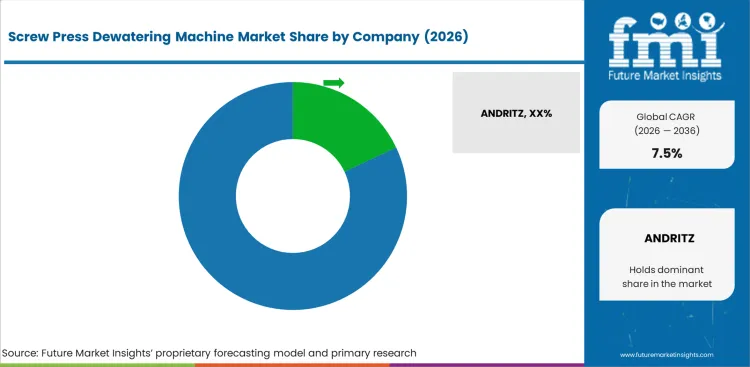
Moderate fragmentation defines this category because the equipment itself is specialized, yet buyer decisions are still influenced heavily by application fit, service coverage, and credibility in plant operation rather than by a single dominant intellectual-property barrier. ANDRITZ, HUBER, Veolia, SUEZ, Voith, Mitsubishi Kakoki, IHI, Aqseptence, Fournier, and Sakurai compete in or around the space through different combinations of treatment expertise, installed base access, and solids-handling familiarity. Buyers usually distinguish credible suppliers on engineering response, maintenance practicality, commissioning support, and how well the press fits into broader municipal sludge, treatment equipment or industrial treatment workflows. A machine can look competitive on paper and still lose if plant teams doubt how it will behave once sludge conditions drift from the design case.
Incumbents hold an advantage when they can connect dewatering hardware to a wider treatment relationship. That may come through installed water infrastructure, service technicians already active in the region, or a better grasp of how polymer handling, sludge conveying, and discharge arrangements affect real performance. Challengers can still win, though they usually need a sharper operating proposition and faster problem-solving response to do it. Competitive pressure increasingly runs through adjacent categories such as filtration equipment, automatic presses, membrane presses and liquid filtration because buyers often compare dewatering options inside a larger separation and solids-management budget. Vendors that cannot translate technical claims into plant-level operating confidence struggle to move beyond first project consideration.
Large buyers resist lock-in by qualifying multiple equipment routes, testing service capability early, and separating machine purchase from long-term consumables or maintenance dependence where possible. That behavior should keep the category from collapsing into a highly concentrated structure by 2036, even if the leading names remain visible. Competitive advantage is likely to sit with suppliers that can make screw press systems easier to specify, easier to start up, and easier to maintain under changing sludge conditions. Vendors leaning only on catalog strength risk losing ground to firms that close the gap between quoted performance and routine plant use.
Key Players in Screw Press Dewatering Machine Market
- ANDRITZ
- Voith
- Mitsubishi Kakoki
- HUBER
- Fournier
- SUEZ
- Veolia
- Aqseptence
- Sakurai
- IHI
Scope of the Report
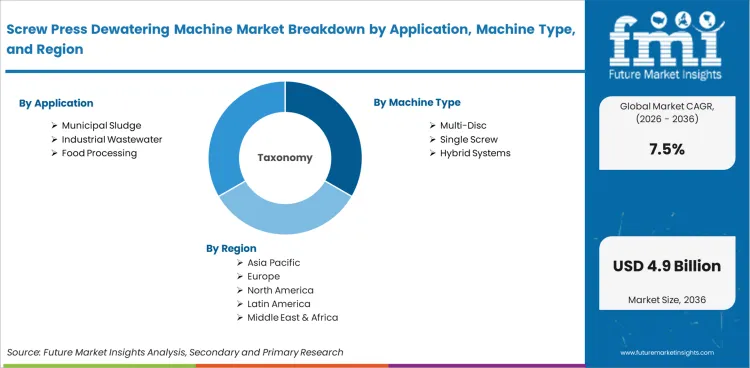
| Metric | Value |
|---|---|
| Quantitative Units | USD 2.2 billion to USD 4.5 billion, at a CAGR of 7.5% |
| Market Definition | Covers screw press dewatering machines used to reduce water content in sludge and comparable solids-bearing streams generated by municipal and industrial treatment processes. |
| Application Segmentation | Municipal Sludge, Industrial Wastewater, Food Processing, Pulp & Paper |
| Machine Type Segmentation | Multi-disc Screw Press, Single Screw Press, Hybrid Systems |
| Capacity Segmentation | <10 m3/hr, 10-50 m3/hr, >50 m3/hr |
| Sales Mix Segmentation | New Systems, Retrofit Replacement |
| End User Segmentation | Utilities, Industrial Plants, Contract Operators |
| Regions Covered | North America, Latin America, Western Europe, Eastern Europe, East Asia, South Asia & Pacific, Middle East & Africa |
| Countries Covered | India, China, USA, Brazil, Germany, France, Japan, and 40 plus countries |
| Key Companies Profiled | ANDRITZ; Voith; Mitsubishi Kakoki; HUBER; Fournier; SUEZ; Veolia; Aqseptence; Sakurai; IHI |
| Approach | FMI combined direct market inputs, application-level equipment logic, company participation review, and country-level treatment expansion patterns. Buyer behavior was interpreted through operating realities around sludge volume reduction, maintenance load, and solids-handling integration. Forecasts were checked against segment structure, installed-base maturity, and the pace of project conversion across core countries. |
Source: Future Market Insights (FMI) analysis, based on proprietary forecasting model and primary research
Screw Press Dewatering Machine Market Analysis by Segments
Application:
- Municipal Sludge
- Industrial Wastewater
- Food Processing
- Pulp & Paper
Machine Type:
- Multi-disc Screw Press
- Single Screw Press
- Hybrid Systems
Capacity:
- <10 m3/hr
- 10-50 m3/hr
- >50 m3/hr
Sales Mix:
- New Systems
- Retrofit Replacement
End User:
- Utilities
- Industrial Plants
- Contract Operators
Region:
- North America
- United States
- Canada
- Europe
- Germany
- United Kingdom
- France
- Italy
- Spain
- Asia Pacific
- China
- Japan
- South Korea
- Taiwan
- Singapore
- Latin America
- Brazil
- Mexico
- Argentina
- Middle East & Africa
- GCC Countries
- South Africa
- Israel
Bibliography
- European Parliament and Council of the European Union. (2024). Directive (EU) 2024/3019 of the European Parliament and of the Council of 27 November 2024 concerning urban wastewater treatment (recast). EUR-Lex.
- Water Environment Federation. (2024, June 18). Residuals and Biosolids Conference 2024 Program. WEF.
- International Water Association. (2024). IWA Conference on Sustainable Sludge Management. IWA.
- ANDRITZ AG. (2025). Annual Report 2024. ANDRITZ.
- IHI Corporation. (2024, June 26). IHI Integrated Report 2024. IHI.
This bibliography is provided for reader reference. The full FMI report contains the complete reference list with primary source documentation.
This Report Addresses
- Market intelligence to support strategic decision making across screw press dewatering systems, sludge-handling lines, solids-reduction workflows, and plant-level wastewater equipment selection.
- Market size estimation and 10-year revenue forecasts from 2026 to 2036, supported by application-led forecasting, installed-base logic, and country-level treatment expansion interpretation.
- Growth opportunity mapping across application, machine type, capacity, sales mix, and end-user segments with emphasis on when dewatering upgrades become easier to justify and execute.
- Segment and regional forecast coverage spanning municipal sludge, industrial wastewater, food processing, and pulp and paper use across utilities, industrial plants, and contract-operated treatment assets.
- Competition strategy assessment including engineering support, service response, operating stability, solids-handling integration, and lifecycle practicality as the main vendor-selection variables.
- Technology tracking covering multi-disc screw press systems, single screw presses, hybrid configurations, polymer-linked dewatering workflows, and downstream conveying requirements.
- Market access analysis covering retrofit constraints, replacement cycles, commissioning readiness, buyer approval patterns, and country-level treatment investment differences discussed in this article.
- Report delivery for executive strategy, capital planning, product positioning, and operational benchmarking across wastewater and sludge-processing equipment decisions.
Frequently Asked Questions
How large is the Screw Press Dewatering Machine Market in 2026?
FMI estimates the market at USD 2.2 billion in 2026. That starting point reflects a category that is already established in sludge dewatering, yet still has room to expand through replacement and capacity-building work.
What will the market be valued at by 2036?
Projected value reaches USD 4.5 billion by 2036. Growth at that scale suggests screw press systems are moving from selective adoption into a more regular place within wastewater and solids-handling capex plans.
What CAGR is projected for the market?
The market is forecast to expand at 7.5% CAGR from 2026 to 2036. Rate strength comes from a practical equipment need rather than from short-lived novelty.
Which application segment leads the market?
Municipal sludge leads with 37.0% share in 2026. Public wastewater plants generate a steady solids load, so dewatering equipment that reduces handling burden without unstable day-to-day operation keeps winning priority.
Which machine type leads the market?
Multi-disc screw press systems lead with 44.0% share in 2026. Buyers favor them where self-cleaning behavior, enclosed operation, and easier response to variable sludge quality matter more than mechanical familiarity alone.
Which capacity band leads the market?
The 10-50 m3/hr range leads with 48.0% share in 2026. Mid-range throughput suits a broad set of municipal and industrial installations without pushing projects into oversized engineering packages.
What drives rapid growth in this market?
Sludge hauling, storage, and disposal costs keep dewatering near the center of plant economics. Buyers also want lower-energy equipment that fits leaner operating teams and avoids constant intervention.
What holds adoption back even when the need is clear?
Project complexity slows adoption more than simple lack of interest. Engineering review, sludge testing, retrofit fit, and confidence in long-run maintenance often determine whether a proposal converts into a purchase order.
Which country grows fastest and why does it outpace the next one?
India leads at 8.1% CAGR, ahead of China at 7.2%. India benefits from stronger catch-up in sanitation and treatment buildout, while China combines new demand with a larger mature base that moderates the rate slightly.
Why do industrial plants hold the largest end-user share?
Industrial plants reach 42.0% share in 2026 because dewatering connects directly to site uptime, discharge performance, and waste-handling cost. A sludge bottleneck in an industrial setting can affect broader plant continuity much faster than buyers want to accept.
Why do new systems outsell retrofit projects?
New systems account for 58.0% share because many projects involve fresh capacity or broader line redesign rather than a simple machine swap. Buyers often find it easier to justify a full dewatering package when old layouts already constrain performance.
Why does municipal sludge remain the anchor application?
Public treatment sites cannot let solids handling drift into a weak point. Continuous sludge generation, disposal discipline, and operator workload keep municipal plants focused on dependable dewatering above all.
How does screw press dewatering differ from centrifuge-led projects?
Screw press proposals often win where buyers want enclosed operation, lower energy use, and less mechanical intensity in daily maintenance. Centrifuges remain relevant, but they are not always the easiest fit for plants prioritizing calm routine operation.
Where does replacement demand matter most?
Replacement matters most in mature treatment markets such as Japan, Germany, France, and the U.S. Installed base age and maintenance pressure make lifecycle economics central in those countries.
What do buyers really compare when they shortlist vendors?
Vendor choice usually turns on engineering response, service reach, startup support, sludge-fit confidence, and how the machine works inside the full solids-handling chain. Price matters, though it rarely closes the decision on its own.
Does this market behave like a highly concentrated equipment category?
No. Structure remains moderately fragmented because buyers can still weigh multiple machine routes and service models, and no single supplier controls the operating logic of the category.
How important is after-sales support in this market?
After-sales support is central because dewatering performance depends on feed behavior, wear parts, tuning, and operator confidence after commissioning. A technically sound machine can disappoint if service response is weak.
What makes the Asia Pacific outlook stronger than Europe?
Asia Pacific benefits more from capacity expansion and first-time or step-up treatment investment. Europe remains important, though many projects there run through more deliberate replacement and optimization cycles.
Why is the U.S. still important if it does not lead growth?
Scale and installed base keep the U.S. commercially important. Even at 6.4% CAGR, replacement and modernization volume can make it one of the more valuable national markets in the category.
What usually triggers a screw press project to move from interest to action?
Projects move faster when buyers can see proven reference installations, reliable service access, and a commissioning path that does not overload plant staff. Standardization lowers perceived risk and helps budgets convert.
What does the market look like by 2036?
By 2036, screw press dewatering should sit more firmly inside standardized treatment planning rather than being treated as a special-case upgrade. Buyers are likely to expect stronger operating proof, simpler integration, and steadier service support as standard parts of the offer.
How should suppliers position themselves in this category?
Suppliers need to translate machine design into operating certainty. Proposals that connect dewatering performance to disposal reduction, maintenance ease, and solids-handling fit are usually more credible than catalog-led selling.
Preview the report firsthand - request a free sample
Get SampleGet the brochure for pricing and purchase details.
Get PDFTable of Content
- Executive Summary
- Global Market Outlook
- Demand-side Trends
- Supply-side Trends
- Technology Roadmap Analysis
- Analysis and Recommendations
- Market Overview
- Market Coverage / Taxonomy
- Market Definition / Scope / Limitations
- Research Methodology
- Chapter Orientation
- Analytical Lens and Working Hypotheses
- Market Structure, Signals, and Trend Drivers
- Benchmarking and Cross-market Comparability
- Market Sizing, Forecasting, and Opportunity Mapping
- Research Design and Evidence Framework
- Desk Research Programme (Secondary Evidence)
- Company Annual and Sustainability Reports
- Peer-reviewed Journals and Academic Literature
- Corporate Websites, Product Literature, and Technical Notes
- Earnings Decks and Investor Briefings
- Statutory Filings and Regulatory Disclosures
- Technical White Papers and Standards Notes
- Trade Journals, Industry Magazines, and Analyst Briefs
- Conference Proceedings, Webinars, and Seminar Materials
- Government Statistics Portals and Public Data Releases
- Press Releases and Reputable Media Coverage
- Specialist Newsletters and Curated Briefings
- Sector Databases and Reference Repositories
- FMI Internal Proprietary Databases and Historical Market Datasets
- Subscription Datasets and Paid Sources
- Social Channels, Communities, and Digital Listening Inputs
- Additional Desk Sources
- Expert Input and Fieldwork (Primary Evidence)
- Primary Modes
- Qualitative Interviews and Expert Elicitation
- Quantitative Surveys and Structured Data Capture
- Blended Approach
- Why Primary Evidence is Used
- Field Techniques
- Interviews
- Surveys
- Focus Groups
- Observational and In-context Research
- Social and Community Interactions
- Stakeholder Universe Engaged
- C-suite Leaders
- Board Members
- Presidents and Vice Presidents
- R&D and Innovation Heads
- Technical Specialists
- Domain Subject-matter Experts
- Scientists
- Physicians and Other Healthcare Professionals
- Governance, Ethics, and Data Stewardship
- Research Ethics
- Data Integrity and Handling
- Primary Modes
- Tooling, Models, and Reference Databases
- Desk Research Programme (Secondary Evidence)
- Data Engineering and Model Build
- Data Acquisition and Ingestion
- Cleaning, Normalisation, and Verification
- Synthesis, Triangulation, and Analysis
- Quality Assurance and Audit Trail
- Market Background
- Market Dynamics
- Drivers
- Restraints
- Opportunity
- Trends
- Scenario Forecast
- Demand in Optimistic Scenario
- Demand in Likely Scenario
- Demand in Conservative Scenario
- Opportunity Map Analysis
- Product Life Cycle Analysis
- Supply Chain Analysis
- Investment Feasibility Matrix
- Value Chain Analysis
- PESTLE and Porter’s Analysis
- Regulatory Landscape
- Regional Parent Market Outlook
- Production and Consumption Statistics
- Import and Export Statistics
- Market Dynamics
- Global Market Analysis 2021 to 2025 and Forecast, 2026 to 2036
- Historical Market Size Value (USD Million) Analysis, 2021 to 2025
- Current and Future Market Size Value (USD Million) Projections, 2026 to 2036
- Y-o-Y Growth Trend Analysis
- Absolute $ Opportunity Analysis
- Global Market Pricing Analysis 2021 to 2025 and Forecast 2026 to 2036
- Global Market Analysis 2021 to 2025 and Forecast 2026 to 2036, By Application
- Introduction / Key Findings
- Historical Market Size Value (USD Million) Analysis By Application , 2021 to 2025
- Current and Future Market Size Value (USD Million) Analysis and Forecast By Application , 2026 to 2036
- Municipal Sludge
- Industrial Wastewater
- Food Processing
- Municipal Sludge
- Y-o-Y Growth Trend Analysis By Application , 2021 to 2025
- Absolute $ Opportunity Analysis By Application , 2026 to 2036
- Global Market Analysis 2021 to 2025 and Forecast 2026 to 2036, By Machine Type
- Introduction / Key Findings
- Historical Market Size Value (USD Million) Analysis By Machine Type, 2021 to 2025
- Current and Future Market Size Value (USD Million) Analysis and Forecast By Machine Type, 2026 to 2036
- Multi-Disc
- Single Screw
- Hybrid Systems
- Multi-Disc
- Y-o-Y Growth Trend Analysis By Machine Type, 2021 to 2025
- Absolute $ Opportunity Analysis By Machine Type, 2026 to 2036
- Global Market Analysis 2021 to 2025 and Forecast 2026 to 2036, By Capacity
- Introduction / Key Findings
- Historical Market Size Value (USD Million) Analysis By Capacity, 2021 to 2025
- Current and Future Market Size Value (USD Million) Analysis and Forecast By Capacity, 2026 to 2036
- 10-50 m³/hr
- <10 m3/hr
- >50 m3/hr
- 10-50 m³/hr
- Y-o-Y Growth Trend Analysis By Capacity, 2021 to 2025
- Absolute $ Opportunity Analysis By Capacity, 2026 to 2036
- Global Market Analysis 2021 to 2025 and Forecast 2026 to 2036, By Sales Mix
- Introduction / Key Findings
- Historical Market Size Value (USD Million) Analysis By Sales Mix, 2021 to 2025
- Current and Future Market Size Value (USD Million) Analysis and Forecast By Sales Mix, 2026 to 2036
- New Systems
- Retrofit Replacement
- New Systems
- Y-o-Y Growth Trend Analysis By Sales Mix, 2021 to 2025
- Absolute $ Opportunity Analysis By Sales Mix, 2026 to 2036
- Global Market Analysis 2021 to 2025 and Forecast 2026 to 2036, By End User
- Introduction / Key Findings
- Historical Market Size Value (USD Million) Analysis By End User, 2021 to 2025
- Current and Future Market Size Value (USD Million) Analysis and Forecast By End User, 2026 to 2036
- Industrial Plants
- Utilities
- Others
- Industrial Plants
- Y-o-Y Growth Trend Analysis By End User, 2021 to 2025
- Absolute $ Opportunity Analysis By End User, 2026 to 2036
- Global Market Analysis 2021 to 2025 and Forecast 2026 to 2036, By Region
- Introduction
- Historical Market Size Value (USD Million) Analysis By Region, 2021 to 2025
- Current Market Size Value (USD Million) Analysis and Forecast By Region, 2026 to 2036
- North America
- Latin America
- Western Europe
- Eastern Europe
- East Asia
- South Asia and Pacific
- Middle East & Africa
- Market Attractiveness Analysis By Region
- North America Market Analysis 2021 to 2025 and Forecast 2026 to 2036, By Country
- Historical Market Size Value (USD Million) Trend Analysis By Market Taxonomy, 2021 to 2025
- Market Size Value (USD Million) Forecast By Market Taxonomy, 2026 to 2036
- By Country
- USA
- Canada
- Mexico
- By Application
- By Machine Type
- By Capacity
- By Sales Mix
- By End User
- By Country
- Market Attractiveness Analysis
- By Country
- By Application
- By Machine Type
- By Capacity
- By Sales Mix
- By End User
- Key Takeaways
- Latin America Market Analysis 2021 to 2025 and Forecast 2026 to 2036, By Country
- Historical Market Size Value (USD Million) Trend Analysis By Market Taxonomy, 2021 to 2025
- Market Size Value (USD Million) Forecast By Market Taxonomy, 2026 to 2036
- By Country
- Brazil
- Chile
- Rest of Latin America
- By Application
- By Machine Type
- By Capacity
- By Sales Mix
- By End User
- By Country
- Market Attractiveness Analysis
- By Country
- By Application
- By Machine Type
- By Capacity
- By Sales Mix
- By End User
- Key Takeaways
- Western Europe Market Analysis 2021 to 2025 and Forecast 2026 to 2036, By Country
- Historical Market Size Value (USD Million) Trend Analysis By Market Taxonomy, 2021 to 2025
- Market Size Value (USD Million) Forecast By Market Taxonomy, 2026 to 2036
- By Country
- Germany
- UK
- Italy
- Spain
- France
- Nordic
- BENELUX
- Rest of Western Europe
- By Application
- By Machine Type
- By Capacity
- By Sales Mix
- By End User
- By Country
- Market Attractiveness Analysis
- By Country
- By Application
- By Machine Type
- By Capacity
- By Sales Mix
- By End User
- Key Takeaways
- Eastern Europe Market Analysis 2021 to 2025 and Forecast 2026 to 2036, By Country
- Historical Market Size Value (USD Million) Trend Analysis By Market Taxonomy, 2021 to 2025
- Market Size Value (USD Million) Forecast By Market Taxonomy, 2026 to 2036
- By Country
- Russia
- Poland
- Hungary
- Balkan & Baltic
- Rest of Eastern Europe
- By Application
- By Machine Type
- By Capacity
- By Sales Mix
- By End User
- By Country
- Market Attractiveness Analysis
- By Country
- By Application
- By Machine Type
- By Capacity
- By Sales Mix
- By End User
- Key Takeaways
- East Asia Market Analysis 2021 to 2025 and Forecast 2026 to 2036, By Country
- Historical Market Size Value (USD Million) Trend Analysis By Market Taxonomy, 2021 to 2025
- Market Size Value (USD Million) Forecast By Market Taxonomy, 2026 to 2036
- By Country
- China
- Japan
- South Korea
- By Application
- By Machine Type
- By Capacity
- By Sales Mix
- By End User
- By Country
- Market Attractiveness Analysis
- By Country
- By Application
- By Machine Type
- By Capacity
- By Sales Mix
- By End User
- Key Takeaways
- South Asia and Pacific Market Analysis 2021 to 2025 and Forecast 2026 to 2036, By Country
- Historical Market Size Value (USD Million) Trend Analysis By Market Taxonomy, 2021 to 2025
- Market Size Value (USD Million) Forecast By Market Taxonomy, 2026 to 2036
- By Country
- India
- ASEAN
- Australia & New Zealand
- Rest of South Asia and Pacific
- By Application
- By Machine Type
- By Capacity
- By Sales Mix
- By End User
- By Country
- Market Attractiveness Analysis
- By Country
- By Application
- By Machine Type
- By Capacity
- By Sales Mix
- By End User
- Key Takeaways
- Middle East & Africa Market Analysis 2021 to 2025 and Forecast 2026 to 2036, By Country
- Historical Market Size Value (USD Million) Trend Analysis By Market Taxonomy, 2021 to 2025
- Market Size Value (USD Million) Forecast By Market Taxonomy, 2026 to 2036
- By Country
- Kingdom of Saudi Arabia
- Other GCC Countries
- Turkiye
- South Africa
- Other African Union
- Rest of Middle East & Africa
- By Application
- By Machine Type
- By Capacity
- By Sales Mix
- By End User
- By Country
- Market Attractiveness Analysis
- By Country
- By Application
- By Machine Type
- By Capacity
- By Sales Mix
- By End User
- Key Takeaways
- Key Countries Market Analysis
- USA
- Pricing Analysis
- Market Share Analysis, 2025
- By Application
- By Machine Type
- By Capacity
- By Sales Mix
- By End User
- Canada
- Pricing Analysis
- Market Share Analysis, 2025
- By Application
- By Machine Type
- By Capacity
- By Sales Mix
- By End User
- Mexico
- Pricing Analysis
- Market Share Analysis, 2025
- By Application
- By Machine Type
- By Capacity
- By Sales Mix
- By End User
- Brazil
- Pricing Analysis
- Market Share Analysis, 2025
- By Application
- By Machine Type
- By Capacity
- By Sales Mix
- By End User
- Chile
- Pricing Analysis
- Market Share Analysis, 2025
- By Application
- By Machine Type
- By Capacity
- By Sales Mix
- By End User
- Germany
- Pricing Analysis
- Market Share Analysis, 2025
- By Application
- By Machine Type
- By Capacity
- By Sales Mix
- By End User
- UK
- Pricing Analysis
- Market Share Analysis, 2025
- By Application
- By Machine Type
- By Capacity
- By Sales Mix
- By End User
- Italy
- Pricing Analysis
- Market Share Analysis, 2025
- By Application
- By Machine Type
- By Capacity
- By Sales Mix
- By End User
- Spain
- Pricing Analysis
- Market Share Analysis, 2025
- By Application
- By Machine Type
- By Capacity
- By Sales Mix
- By End User
- France
- Pricing Analysis
- Market Share Analysis, 2025
- By Application
- By Machine Type
- By Capacity
- By Sales Mix
- By End User
- India
- Pricing Analysis
- Market Share Analysis, 2025
- By Application
- By Machine Type
- By Capacity
- By Sales Mix
- By End User
- ASEAN
- Pricing Analysis
- Market Share Analysis, 2025
- By Application
- By Machine Type
- By Capacity
- By Sales Mix
- By End User
- Australia & New Zealand
- Pricing Analysis
- Market Share Analysis, 2025
- By Application
- By Machine Type
- By Capacity
- By Sales Mix
- By End User
- China
- Pricing Analysis
- Market Share Analysis, 2025
- By Application
- By Machine Type
- By Capacity
- By Sales Mix
- By End User
- Japan
- Pricing Analysis
- Market Share Analysis, 2025
- By Application
- By Machine Type
- By Capacity
- By Sales Mix
- By End User
- South Korea
- Pricing Analysis
- Market Share Analysis, 2025
- By Application
- By Machine Type
- By Capacity
- By Sales Mix
- By End User
- Russia
- Pricing Analysis
- Market Share Analysis, 2025
- By Application
- By Machine Type
- By Capacity
- By Sales Mix
- By End User
- Poland
- Pricing Analysis
- Market Share Analysis, 2025
- By Application
- By Machine Type
- By Capacity
- By Sales Mix
- By End User
- Hungary
- Pricing Analysis
- Market Share Analysis, 2025
- By Application
- By Machine Type
- By Capacity
- By Sales Mix
- By End User
- Kingdom of Saudi Arabia
- Pricing Analysis
- Market Share Analysis, 2025
- By Application
- By Machine Type
- By Capacity
- By Sales Mix
- By End User
- Turkiye
- Pricing Analysis
- Market Share Analysis, 2025
- By Application
- By Machine Type
- By Capacity
- By Sales Mix
- By End User
- South Africa
- Pricing Analysis
- Market Share Analysis, 2025
- By Application
- By Machine Type
- By Capacity
- By Sales Mix
- By End User
- USA
- Market Structure Analysis
- Competition Dashboard
- Competition Benchmarking
- Market Share Analysis of Top Players
- By Regional
- By Application
- By Machine Type
- By Capacity
- By Sales Mix
- By End User
- Competition Analysis
- Competition Deep Dive
- ANDRITZ
- Overview
- Product Portfolio
- Profitability by Market Segments (Product/Age /Sales Channel/Region)
- Sales Footprint
- Strategy Overview
- Marketing Strategy
- Product Strategy
- Channel Strategy
- Voith
- Mitsubishi Kakoki
- HUBER
- Fournier
- SUEZ
- ANDRITZ
- Competition Deep Dive
- Assumptions & Acronyms Used


