

- Industry Size (2026)
- USD 42.15 Bn
- Forecast (2036)
- USD 66.10 Bn
- CAGR (2026 to 2036)
- 4.60%
Water and Waste Water Treatment Chemical Market Size, Market Forecast and Outlook By FMI
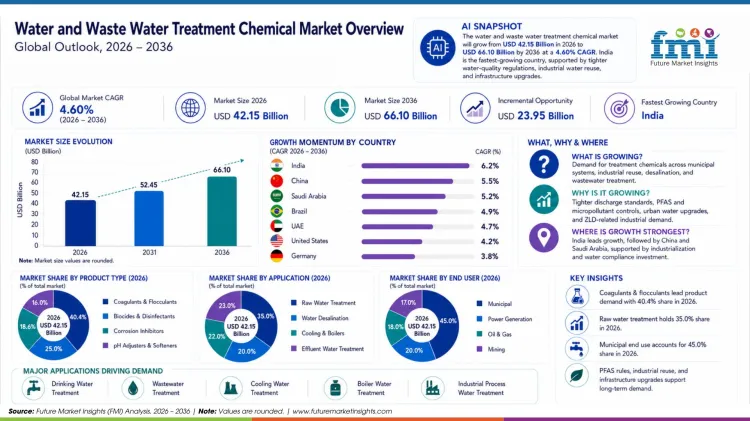
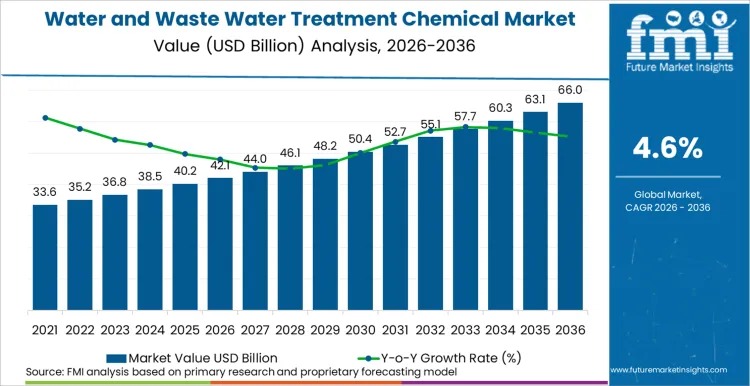
Water and waste water treatment chemical market is expected to expand from USD 42.15 billion in 2026 to USD 66.10 billion by 2036. The market is anticipated to register a 4.60% CAGR during the forecast period. Coagulants and flocculants are likely to lead with a 40.4% share, while municipal end use is projected to account for 45.0% of total demand in 2026.
Key Takeaways, Market Size, and Forecast
- Water and waste water treatment chemical demand is valued at USD 42.15 billion in 2026.
- By 2036, the market is forecast to attain USD 66.10 billion.
- FMI places growth at 4.60% CAGR during 2026 to 2036.
- Coagulants and flocculants are likely to lead product demand with 40.4% share.
- Raw water treatment is projected to hold 35.0% of application demand.
- Municipal end use is likely to account for 45.0% share in 2026.
- India records the fastest listed growth at 6.2% CAGR through 2036.
- China follows with 5.5% CAGR, supported by industrial water compliance needs.
Summary of the Water and Waste Water Treatment Chemical Market
- Demand and Growth Drivers
- Tight water quality rules are raising demand for advanced treatment chemicals.
- PFAS and micropollutant controls are shifting demand toward specialty formulations.
- Urban water infrastructure upgrades are expanding chemical use across utilities.
- Industrial reuse and ZLD programs are increasing demand for membrane protection chemicals.
- Product and Segment View
- Coagulants and flocculants lead due to their core role in solid-liquid separation.
- Raw water treatment remains central as source water quality becomes less predictable.
- Biocides and disinfectants retain steady use across municipal safety standards.
- Corrosion inhibitors gain relevance in cooling systems and boiler water treatment.
- Geography and Competitive Outlook
- Asia Pacific leads volume growth due to urbanization and industrial expansion.
- North America is moving toward premium chemicals for PFAS and compliance upgrades.
- Europe favors bio-based and circular water economy aligned formulations.
- Competition centers on localized production and low-carbon manufacturing footprints.
- Analyst Opinion
- Nikhil Kaitwade, Principal Consultant at FMI, opines, “Water and waste water treatment chemical demand is becoming more compliance-focused as utilities and industrial plants deal with tighter discharge rules. Suppliers with specialty formulations, local production strength, and reliable technical service should hold a stronger position in long-term contracts.”
- Water and Waste Water Treatment Chemical Market Value Analysis
- Water treatment chemical demand is moving from basic volume use toward compliance-linked specialty products.
- Value stays concentrated in coagulants and flocculants due to daily treatment needs.
- Municipal utilities provide the largest recurring demand base across potable water and sewage systems.
- PFAS rules and micropollutant control are creating higher-value formulation opportunities.
- Localized production in Asia Pacific improves cost control and supply reliability.
A shift toward sustainable sourcing is reshaping procurement strategies, as noted by Joachim Schmidt-Leithoff, Vice President of Business Management Amines at BASF: "As one of the world's largest amines producers, BASF is taking a step towards sustainability by converting to 100% renewable electricity for the amines produced at BASF's Nanjing site. This move enhances competitiveness for both BASF and our customers in the region by reducing carbon emissions, positioning us closer to becoming their preferred partner for sustainable intermediates," [2]. Manufacturers that align production footprints with low-carbon energy sources are securing preferential status with multinational buyers who must report Scope 3 emissions reductions.
Expansion tracks a divergence in regional momentum, with India (6.2%), China (5.5%), and Saudi Arabia (5.2%) leading volume growth through industrialization, while Brazil (4.9%), UAE (4.7%), USA (4.2%), and Germany (3.8%) prioritize efficiency and compliance retrofits.
Water and Waste Water Treatment Chemical Market Definition
The industry encompasses the formulation, production, and distribution of specialty chemicals used to remove contaminants, neutralize acidity, and prevent scaling in aqueous systems. Core categories include coagulants, flocculants, biocides, and pH adjusters essential for ensuring water quality in municipal grids and industrial processes. These agents facilitate the physical-chemical separation of suspended solids and the elimination of biological pathogens to meet safety standards.
Water and Waste Water Treatment Chemical Market Inclusions
Included within the scope are chemicals specifically engineered for raw water intake, boiler feed conditioning, cooling tower maintenance, and effluent discharge compliance. The market covers both commodity-grade inorganic salts and high-value organic polymers used in water treatment system applications across power generation, mining, and oil & gas sectors. Value-added services such as on-site monitoring and inventory management provided by chemical suppliers are also considered part of the market ecosystem.
Water and Waste Water Treatment Chemical Market Exclusions
The report excludes physical filtration hardware, pumps, valves, and membranes themselves, focusing strictly on the chemical consumables. General-purpose bulk chemicals not specifically marketed or formulated for water treatment applications are omitted from the market valuation. Consumer-grade household water filters and small-scale point-of-use additives are also outside the industrial and municipal scope of this analysis.
Water and Waste Water Treatment Chemical Market Research Methodology
- Primary Research: Interviews with chemical engineers, plant managers, regulatory consultants, and procurement heads across municipal and industrial sectors.
- Desk Research: Analysis of corporate annual reports, EPA funding allocations, patent filings for novel formulations, and import/export trade data.
- Market-Sizing and Forecasting: Bottom-up modeling based on daily active capacity of treatment plants and top-down validation using chemical consumption coefficients per cubic meter of water treated.
- Data Validation and Update Cycle: Cross-referencing production volumes with feedstock availability and verifying capex announcements against actual plant commissioning dates.
Segmental Analysis
Water and Waste Water Treatment Chemical Market Analysis by Product Type
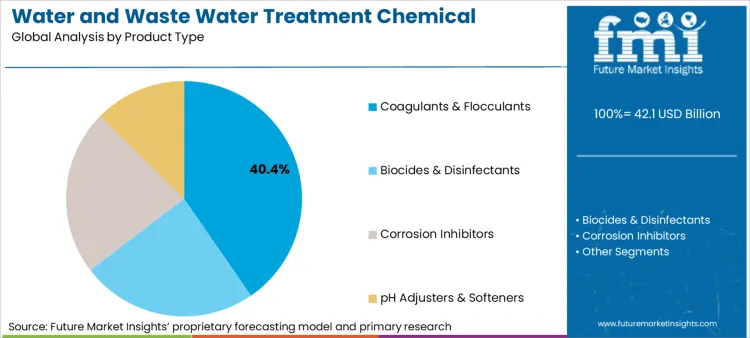
Coagulants & Flocculants command 40.4% of the market in 2026, serving as the primary mechanism for solid-liquid separation in high-volume municipal facilities. This dominance is reinforced by the universal need to remove suspended solids before advanced filtration stages, making these chemicals indispensable for both basic sanitation and complex industrial reuse loops.
- Efficiency trigger: Demand is reinforced by the need to optimize sludge dewatering rates, which reduces disposal volume and associated transport costs for utility operators. Advanced polymer adoption accelerates where plants face capacity constraints, as seen in Kemira's strategic investments to expand local coagulant capacity in Spain and Norway to support municipal efficiency drives [3].
- Compliance push: FMI analysts opine that procurement shifts because stricter discharge limits on phosphorus and suspended solids require higher dosing precision and novel chemical blends. Uptake of aluminum-based coagulants increases as regulators enforce nutrient removal standards, evidenced by the patenting of specific aluminum-polysaccharide formulations to clarify water while precipitating phosphorus [4].
- Cost physics: Adoption accelerates where operational expenditure is scrutinized, as higher-performance flocculants lower total cost of ownership by extending filter run times. Growth is anchored in the ability of new flocculant and coagulant chemistries to function effectively at lower dosages, a critical factor for facilities managing the 56% of global domestic wastewater that currently undergoes safe treatment [5].
Water and Waste Water Treatment Chemical Market Analysis by Application
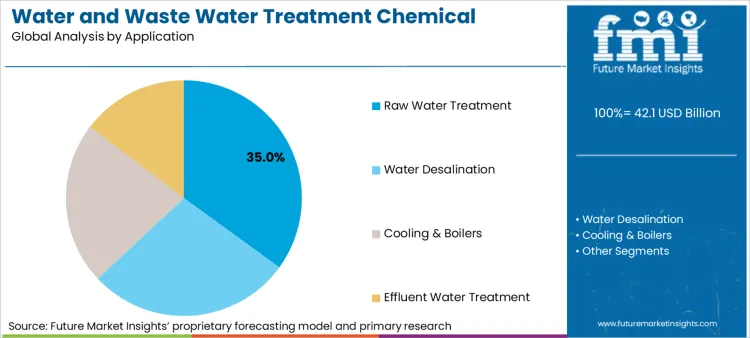
Raw Water Treatment represents the leading application segment at 35.0% share, driven by the degradation of freshwater sources and the subsequent need for more intensive chemical conditioning. Utilities are forced to treat increasingly turbid and contaminated intake water, necessitating robust pretreatment regimes to protect downstream infrastructure.
- Scarcity driver: Demand for water desalination equipment chemicals is poised to surge as freshwater deficits force coastal cities to rely on sea and brackish water processing. Expansion is linked to the deployment of antiscalants and biocides in mega-projects, with companies like Kemira now treating 21 billion cubic meters of water annually, equivalent to the consumption of 370 million people [6].
- Thermal load: According to FMI's estimates, growth in Cooling & Boilers applications tracks the rising energy intensity of data centers and power plants that require massive heat rejection capacities. This trajectory is supported by commercial developments such as Ecolab's record 2024 performance, driven by high-tech manufacturing and data center water needs [7].
- Circular loop: The shift toward wastewater treatment chemicals for reuse is reshaping the Effluent Water Treatment segment as industries strive for closed-loop operations. Uptake is catalyzed by funding for advanced reclamation, such as the $50 million investment in India's Membrane Group to scale Zero Liquid Discharge (ZLD) solutions for semiconductor manufacturing [8].
Water and Waste Water Treatment Chemical Market Analysis by End User
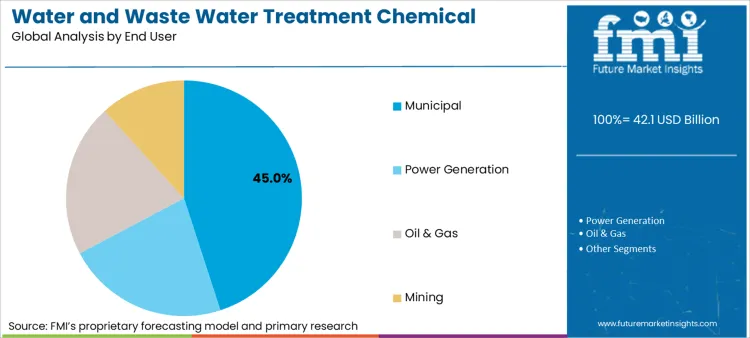
Municipal entities account for 45.0% of total demand, underpinning the market with stable, long-term volume requirements for potable water and sewage treatment. Public health mandates and population growth ensure a continuous baseline consumption of disinfection and clarification agents across urban centers.
- Funding unlock: Demand is driven by federal infrastructure grants that enable local governments to upgrade aging sanitary systems and expand service coverage. Deployment accelerates as capital becomes available, illustrated by the USA EPA funding over 1,986 wastewater projects in 2024 through State Revolving Funds [9].
- Decentralization shift: FMI analysts opine that procurement is evolving as remote and peri-urban areas adopt decentralized treatment models to bypass expensive pipe network extensions. Adoption of sludge treatment chemicals increases where local regulations incentivize small-scale units, such as Ladakh's 2025 scheme subsidizing Sewage Treatment Plants (STP) for hotels [10].
- Industrial compliance: Growth in Power Generation and Mining segments is anchored in strict liability for effluent quality and the operational risk of scaling events. This demand shift is reflected in the enforcement of discharge norms, where violations in parameters like COD and BOD drive immediate chemical remediation, as seen in India's CPCB monitoring actions [11].
Water and Waste Water Treatment Chemical Market Drivers, Restraints, and Opportunities
Stringent regulatory frameworks targeting emerging contaminants are fundamentally altering chemical procurement. The USA EPA's introduction of national drinking water standards for PFAS limits in 2024 has created an immediate, legally binding requirement for utilities to implement advanced removal technologies. This policy shift forces a transition from generic treatment to high-performance specialty regimes capable of eliminating "forever chemicals" to protect public health. The scale of this driver is underscored by the EPA's allocation of nearly USD 1 billion in grant funding specifically for PFAS testing and remediation in small and disadvantaged communities [1].
The immense capital cost required to upgrade aging infrastructure acts as a significant bottleneck for chemical adoption. While advanced chemicals exist, their effectiveness is often limited by the antiquated physical plants available in many municipalities, leading to sub-optimal dosing and performance. Utilities struggle to secure the necessary financing for these capital-intensive retrofits, creating a lag between regulatory mandates and actual implementation. This gap is highlighted by the Clean Watersheds Needs Survey, which identifies a funding deficit of at least USD 630 billion needed over the next two decades for USA water infrastructure compliance [1].
Opportunities
- PFAS Destruction: Manufacturers can capture high-margin revenue by developing catalytic destruction technologies that permanently eliminate per-and polyfluoroalkyl substances rather than merely sequestering them. This opportunity is validated by Oxyle securing USD 16 million in seed funding to commercialize technology that destroys PFAS in wastewater [12].
- Desalination Brine Management: Suppliers have a strategic opening to provide chemical solutions that mineralize CO2 within desalination brine, turning a waste liability into a carbon-negative asset. This potential is exemplified by Capture6 raising USD 27.5 million to deploy systems that recover freshwater while mineralizing carbon using waste brine [13].
- Renewable-Powered Production: Chemical producers can differentiate their portfolios and secure contracts with sustainability-focused buyers by transitioning manufacturing to renewable energy. This shift is demonstrated by BASF converting its entire amine portfolio at the Nanjing site to 100 percent renewable electricity, reducing annual CO2 emissions by approximately 9,800 tons [2].
Regional Analysis
Based on the regional analysis, the Water and Waste Water Treatment Chemical Market is segmented into North America, Latin America, Europe, East Asia, South Asia, Oceania and Middle East & Africa across 40+ countries. The full report also offers market attractiveness analysis based on regional trends.
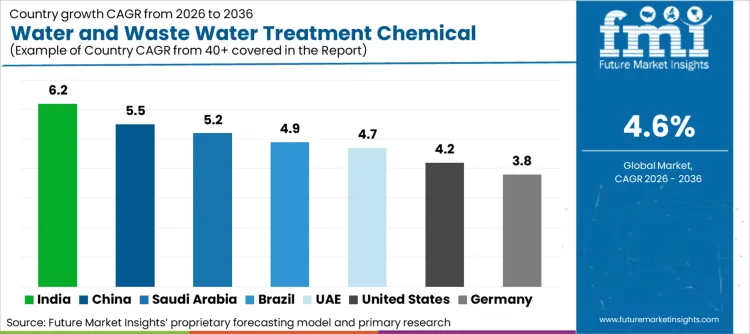
| Country | CAGR (2026 to 2036) |
|---|---|
| India | 6.2% |
| China | 5.5% |
| Saudi Arabia | 5.2% |
| Brazil | 4.9% |
| UAE | 4.7% |
| United States | 4.2% |
| Germany | 3.8% |
Source: Future Market Insights (FMI) analysis, based on proprietary forecasting model and primary research
North America Water and Waste Water Treatment Chemical Market Analysis
North America remains a value-driven market where growth is dictated by the modernization of legacy infrastructure and the enforcement of the world's strictest drinking water standards. The region is characterized by a rapid pivot toward disinfection byproduct control chemicals in drinking water and PFAS remediation agents, spurred by federal oversight. Development is further catalyzed by heavy investment in detection and treatment grants, ensuring that even smaller municipalities enter the buying cycle for advanced chemical solutions.
- United States: Growth tracks a CAGR of 4.2% as the EPA’s 2024 PFAS mandates force a nationwide upgrade of filtration and chemical treatment protocols. This trajectory is supported by the release of nearly USD 1 billion in emerging contaminant grants, which directly subsidizes the procurement of testing and treatment chemistries for 100 million people [1].
FMI’s report includes a detailed growth analysis for Canada and Mexico, identifying them as key secondary markets. The analysis points to Canada's focus on mining effluent standards and Mexico's industrial reuse initiatives as critical areas for supplier expansion. Suppliers in these markets should monitor cross-border regulatory alignment, particularly regarding the export of treated wastewater technologies [1].
Asia Pacific Water and Waste Water Treatment Chemical Market Analysis
Asia Pacific serves as the global volume engine, leveraging massive industrial expansion and urbanization to drive demand for basic and specialty water chemicals. The region is witnessing a structural shift toward localized production to secure supply chains, with major players aggressively expanding capacity for amines and dispersions. Regulatory pressure for Zero Liquid Discharge (ZLD) in water-stressed zones is creating a burgeoning market for high-efficiency boiler water treatment chemicals and membrane protectants.
- China: China water treatment sector is poised to expand at 5.5% CAGR during 2026 to 2036 because stringent industrial discharge targets are compelling chemical plants to adopt renewable-powered treatment cycles. This demand shift is reflected in BASF's 2025 expansion of its Nanjing site, where DMAPA capacity was doubled to support regional environmental compliance [2].
- India: In India, the water chemicals market is forecast to advance at 6.2% CAGR through 2036, with growth anchored in the "Make in India" initiative that encourages domestic manufacturing of critical dispersions. This outlook is underpinned by BASF’s February 2026 launch of a new production line in Mangalore, directly addressing the country’s construction and coating chemical needs [14].
FMI’s report includes a comprehensive assessment of opportunities in Japan, South Korea, and ASEAN nations. These markets are characterized by a high demand for ultrapure water in electronics manufacturing, a trend that buyers should watch closely. The region offers significant potential for membrane chemicals as semiconductor fabrication facilities expand their footprint [8].
Europe Water and Waste Water Treatment Chemical Market Analysis
Europe acts as the global leader in circular water economy practices, prioritizing resource recovery and energy-neutral treatment processes. The market value is driven by the replacement of conventional chemistries with bio-based and biodegradable alternatives that align with the EU Green Deal. Municipalities and industries focus heavily on efficiency, seeking chemicals that minimize sludge generation and facilitate phosphorus recovery.
- Germany: Germany is likely to see water chemical revenues increase at 3.8% CAGR during 2026 to 2036, given heavy investments in circular economy infrastructure and high-efficiency water technologies. This expansion is supported by Veolia’s Water Technologies division reporting solid revenue growth, driven by the region's appetite for premium products and services [15].
FMI’s report includes an evaluation of the United Kingdom and France as pivotal markets for activated carbon and micropollutant removal. The closing of loop systems in these countries presents a clear opportunity for suppliers of advanced sludge treatment chemicals. Strategic buyers are increasingly focusing on lifecycle costs and carbon footprint when selecting chemical vendors [3].
Latin America Water and Waste Water Treatment Chemical Market Analysis
Latin America is emerging as a critical growth node, balancing the need for basic sanitation coverage with industrial water efficiency in the mining and agricultural sectors. The region faces water scarcity challenges that drive the adoption of reuse technologies and robust chemical treatment for raw water sources. Multinational players are integrating their portfolios to offer diversified hygiene and treatment solutions to capture the middle-market demand.
- Brazil: The outlook for water chemicals in Brazil indicates a 4.9% CAGR from 2026 to 2036 as industrial and municipal operators seek integrated solutions to manage water variability. This demand is reinforced by strong sales volumes in the Industry & Water segments of global players like Kemira, which reported continued growth in such regions during 2024 [16].
FMI’s report includes Chile and Argentina as key markets driven by resource extraction industries. These countries offer substantial opportunities for flocculant and coagulant suppliers catering to the mining sector's water recovery needs. Buyers in these markets should watch for evolving regulations on mine tailing discharge and water rights [17].
Middle East & Africa Water and Waste Water Treatment Chemical Market Analysis
The Middle East & Africa region is defined by its reliance on desalination and the urgent need for water conservation in arid climates. Market activity is concentrated on high-performance antiscalants and corrosion inhibitors essential for maintaining thermal and membrane desalination plants. Governments are increasingly subsidizing decentralized treatment to protect fragile ecosystems and support tourism.
- Saudi Arabia: Saudi Arabia is expected to see water chemical adoption rise at 5.2% CAGR from 2026 to 2036 as the Kingdom expands its desalination capacity to meet Vision 2030 goals. This growth is anchored in the robust performance of technology providers like Veolia Water Technologies & Solutions, whose water technology revenues grew by 2.0% in early 2025 due to project milestones in water-scarce regions [15].
- UAE: UAE's water treatment landscape is forecast to expand at 4.7% CAGR through 2036, as the focus shifts toward energy-efficient desalination and brine management. This trajectory is supported by innovations in brine mineralization, such as those commercialized by Capture6, which address the environmental impact of intensive desalination [13].
FMI’s report includes South Africa and Turkey as growing markets for industrial water treatment. These nations present opportunities for decentralized systems and chlorine disinfectant suppliers. Stakeholders should monitor policy shifts regarding industrial effluent recycling in water-stressed urban hubs [13].
Competitive Aligners for Market Players
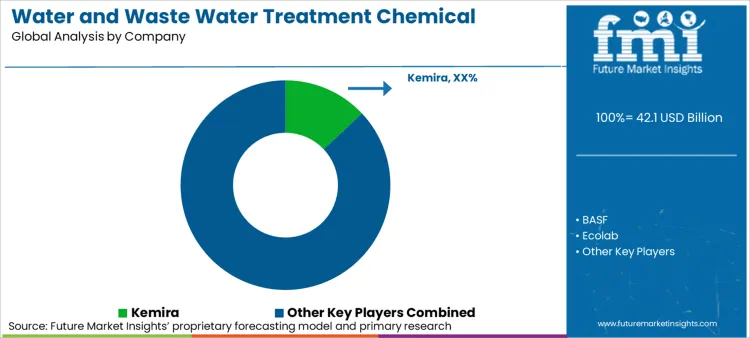
The competitive landscape is rapidly consolidating as major players seek to integrate high-tech specialty capabilities with broad commodity portfolios. Veolia’s strategic acquisition of CDPQ’s minority stake in its Water Technologies division for USD 1.75 billion signals a decisive move to fully internalize its highest-margin, technology-driven assets [18]. This consolidation allows market leaders to offer end-to-end solutions, squeezing out mid-sized competitors who lack the balance sheet to support extensive R&D or global service networks.
According to FMI's estimates, competition is shifting from price-based volume battles to value-based service contracts, particularly in the middle market. Solenis's move to acquire NCH Corporation in June 2025 exemplifies this trend, creating a diversified platform that combines global reach with specialized hygiene and water solutions [17]. By merging distinct customer bases, these entities can cross-sell coagulants and digital monitoring services, increasing switching costs for buyers.
Regional capacity optimization has become a critical differentiator for ensuring supply security and reducing logistics carbon footprints. BASF’s aggressive expansion of amine capacity in China and dispersion lines in India demonstrates a strategy of localization to serve high-growth Asian industrial hubs directly [2]. Players that fail to localize production risk losing share to competitors who can offer shorter lead times and lower Scope 3 emission profiles to sustainability-conscious multinational clients.
Recent Developments
The report includes full coverage of key trends from competitive benchmarking. Some of the recent developments covered in the reports:
- In June 2025, Solenis signed a definitive agreement to acquire 100% of NCH Corporation, merging portfolios to create a diversified global leader in industrial water and hygiene solutions [17].
- In July 2025, BASF doubled its DMAPA production capacity and increased PEA capacity by 25% at its Nanjing site to meet rising demand for high-performance amines in the Asia Pacific region [2].
Key Players in Water and Waste Water Treatment Chemical Market
- Kemira
- BASF
- Ecolab
- Solenis
- Veolia Water Technologies & Solutions
Scope of the Report
| Metric | Value |
|---|---|
| Quantitative Units | USD 42.15 billion (2026) to USD 66.10 billion (2036), at a CAGR of 4.60% |
| Market Definition | The industry encompasses the formulation, production, and distribution of specialty chemicals used to remove contaminants, neutralize acidity, and prevent scaling in aqueous systems. |
| Product Type Segmentation | Coagulants & Flocculants, Biocides & Disinfectants, Corrosion Inhibitors, pH Adjusters & Softeners |
| Application Segmentation | Raw Water Treatment, Water Desalination, Cooling & Boilers, Effluent Water Treatment |
| End User Coverage | Municipal, Industrial, Power Generation, Oil & Gas, Mining |
| Regions Covered | North America, Latin America, Europe, East Asia, South Asia, Oceania, Middle East & Africa |
| Countries Covered | United States, Canada, Mexico, Brazil, Argentina, Chile, Germany, France, United Kingdom, Italy, Spain, China, India, Japan, South Korea, Indonesia, Saudi Arabia, UAE, South Africa, Turkey |
| Key Companies Profiled | Kemira, BASF, Ecolab, Solenis, Veolia Water Technologies & Solutions |
| Forecast Period | 2026 to 2036 |
| Approach | Hybrid top-down and bottom-up modeling validated through primary interviews with chemical engineers and plant managers, supported by trade data benchmarking and plant-level capacity verification. |
Water and Waste Water Treatment Chemical Market Analysis by Segments
Product Type
- Coagulants & Flocculants
- Biocides & Disinfectants
- Corrosion Inhibitors
- pH Adjusters & Softeners
Application
- Raw Water Treatment
- Water Desalination
- Cooling & Boilers
- Effluent Water Treatment
End User
- Municipal
- Power Generation
- Oil & Gas
- Mining
Region
- Asia Pacific
- India
- China
- Japan
- South Korea
- Indonesia
- Australia & New Zealand
- ASEAN
- Rest of Asia Pacific
- Europe
- Germany
- Italy
- France
- United Kingdom
- Spain
- Benelux
- Nordics
- Central & Eastern Europe
- Rest of Europe
- North America
- United States
- Canada
- Mexico
- Latin America
- Brazil
- Argentina
- Chile
- Rest of Latin America
- Middle East & Africa
- Kingdom of Saudi Arabia
- United Arab Emirates
- South Africa
- Turkey
- Rest of Middle East & Africa
Bibliography
- [1] USA Environmental Protection Agency (EPA). (2024). FY 2024 Annual Performance Report and Clean Watersheds Needs Survey data regarding $630 billion infrastructure need and PFAS grants.
- [2] BASF SE. (2025). Press Release: BASF converts amines production at Nanjing site to 100% renewable electricity and expands capacity. October 2025.
- [3] Kemira. (2024). Annual Report 2024: Strategic investments in Spain and Norway coagulant capacity.
- [5] UN-Water. (2024). SDG 6 Data: Indicator 6.3.1 on safely treated domestic wastewater.
- [6] Kemira. (2024). Annual Report 2024: Impact scale of 21 billion cubic meters of water treated annually.
- [7] Ecolab. (2025). Earnings Call Transcript: Q4 2024 Performance driven by data center and high-tech water demand. February 2025.
- [8] Economic Times. (2024). Membrane Group secures $50 million investment from GEF Capital Partners for ZLD solutions.
- [9] USA Environmental Protection Agency (EPA). (2024). FY 2024 Annual Performance Report: 1,986 wastewater projects funded.
- [10] Government of UT Ladakh. (2025). The Sewage Treatment Plant (STP) Incentive Scheme, 2025.
- [11] Central Pollution Control Board (CPCB). (2024). Monitoring analysis of ETP outlet violations in India.
- [12] Oxyle. (2024). Company Announcement: Oxyle raises $16M to lead the fight against forever chemicals.
- [13] Capture6. (2025). Press Release: Capture6 completes $27.5 million Series A funding for brine mineralization.
- [14] Indian Chemical News. (2026). BASF boosts India production with new Mangalore dispersions line. February 2026.
- [15] Veolia Water Technologies & Solutions. (2025). Press Release: 9M 2025 Financial Results and Water Technologies revenue growth.
- [16] Kemira. (2024). Interim Report: January-September 2024 organic revenue growth in Industry & Water segment.
- [17] Solenis. (2025). Press Release: Solenis and NCH Corporation to join forces. June 2025.
- [18] Veolia Water Technologies & Solutions. (2025). Press Release: Veolia acquires CDPQ's 30% minority stake in Water Technologies and Solutions.
This bibliography is provided for reader reference and is not exhaustive. The full report contains the complete reference list and detailed citations.
Frequently Asked Questions
How large is the demand for Water and Waste Water Treatment Chemical in the global market in 2026?
Demand for Water and Waste Water Treatment Chemical in the global market is estimated to be valued at USD 42.15 billion in 2026.
What will be the market size of Water and Waste Water Treatment Chemical in the global market by 2036?
Market size for Water and Waste Water Treatment Chemical is projected to reach USD 66.10 billion by 2036.
What is the expected demand growth for Water and Waste Water Treatment Chemical in the global market between 2026 and 2036?
Demand for Water and Waste Water Treatment Chemical in the global market is expected to grow at a CAGR of 4.60% between 2026 and 2036.
Which Product Type is poised to lead global sales by 2026?
Coagulants & Flocculants are expected to lead with approximately 40.4% market share, driven by their essential role in solid-liquid separation.
How significant is the role of Municipal End Use in driving Water and Waste Water Treatment Chemical adoption in 2026?
Municipal represents a critical segment, projected to hold a substantial 45.0% share of the total market in 2026 due to continuous public sanitation requirements.
What is driving demand in India?
Demand is driven by the "Make in India" initiative and strict enforcement of ETP discharge norms by the CPCB.
What compliance standards or regulations are referenced for the United States?
The EPA TSCA and National Primary Drinking Water Regulations for PFAS are referenced as key compliance benchmarks.
What is the United States growth outlook in this report?
The United States is projected to grow at a CAGR of 4.2% during 2026 to 2036.
Why is Asia Pacific described as a priority region in this report?
Growth is fueled by rapid industrialization, urbanization, and a shift toward localized production of critical chemicals.
What type of demand dominates in Europe?
Replacement driven demand for premium bio-based and circular economy-compliant resins dominates regional consumption.
What is China growth outlook in this report?
China is projected to expand at a CAGR of 5.5% during 2026 to 2036.
Does the report cover Saudi Arabia in its regional analysis?
Yes, Saudi Arabia is included within the Middle East & Africa under the regional scope of analysis.
What are the sources referred to for analyzing the market in Saudi Arabia?
Corporate financial reports from major players like Veolia and regional desalination capacity data are used.
What is the main demand theme linked to Saudi Arabia in its region coverage?
Demand is associated with the expansion of desalination capacity and brine management solutions.
Does the report cover Brazil in its regional analysis?
Yes, Brazil is included within Latin America under the regional coverage framework.
What is the main Brazil related demand theme in its region coverage?
Industrial water efficiency and integrated solutions for mining and agriculture are emphasized.
Which product formats or configurations are strategically important for Asia Pacific supply chains?
Localized production of amines and dispersions is prioritized to reduce logistics costs and secure supply.
What is Water and Waste Water Treatment Chemical and what is it mainly used for?
It refers to specialty agents used to purify water, remove contaminants, and prevent scaling in municipal and industrial systems.
What does Water and Waste Water Treatment Chemical Market mean in this report?
The market refers to the global production, trade, and industrial consumption of chemical formulations for water treatment.
What is included in the scope of this Water and Waste Water Treatment Chemical report?
Scope covers coagulants, flocculants, biocides, and pH adjusters for municipal, power, and industrial applications.
What is excluded from the scope of this report?
Physical filtration hardware, membranes, and consumer-grade point-of-use additives are excluded.
What does market forecast mean on this page?
Market forecast represents a model based projection built on defined assumptions for strategic planning purposes.
How does FMI build and validate the Water and Waste Water Treatment Chemical forecast?
Forecast is developed using hybrid top down and bottom up modeling validated through trade data, capacity checks, and industry review.
What does zero reliance on speculative third party market research mean here?
Primary interviews and verifiable public datasets are used instead of unverified syndicated market estimates.
Preview the report firsthand - request a free sample
Get SampleGet the brochure for pricing and purchase details.
Get PDFTable of Content
- Executive Summary
- Global Market Outlook
- Demand-side Trends
- Supply-side Trends
- Technology Roadmap Analysis
- Analysis and Recommendations
- Market Overview
- Market Coverage / Taxonomy
- Market Definition / Scope / Limitations
- Research Methodology
- Chapter Orientation
- Analytical Lens and Working Hypotheses
- Market Structure, Signals, and Trend Drivers
- Benchmarking and Cross-market Comparability
- Market Sizing, Forecasting, and Opportunity Mapping
- Research Design and Evidence Framework
- Desk Research Programme (Secondary Evidence)
- Company Annual and Sustainability Reports
- Peer-reviewed Journals and Academic Literature
- Corporate Websites, Product Literature, and Technical Notes
- Earnings Decks and Investor Briefings
- Statutory Filings and Regulatory Disclosures
- Technical White Papers and Standards Notes
- Trade Journals, Industry Magazines, and Analyst Briefs
- Conference Proceedings, Webinars, and Seminar Materials
- Government Statistics Portals and Public Data Releases
- Press Releases and Reputable Media Coverage
- Specialist Newsletters and Curated Briefings
- Sector Databases and Reference Repositories
- FMI Internal Proprietary Databases and Historical Market Datasets
- Subscription Datasets and Paid Sources
- Social Channels, Communities, and Digital Listening Inputs
- Additional Desk Sources
- Expert Input and Fieldwork (Primary Evidence)
- Primary Modes
- Qualitative Interviews and Expert Elicitation
- Quantitative Surveys and Structured Data Capture
- Blended Approach
- Why Primary Evidence is Used
- Field Techniques
- Interviews
- Surveys
- Focus Groups
- Observational and In-context Research
- Social and Community Interactions
- Stakeholder Universe Engaged
- C-suite Leaders
- Board Members
- Presidents and Vice Presidents
- R&D and Innovation Heads
- Technical Specialists
- Domain Subject-matter Experts
- Scientists
- Physicians and Other Healthcare Professionals
- Governance, Ethics, and Data Stewardship
- Research Ethics
- Data Integrity and Handling
- Primary Modes
- Tooling, Models, and Reference Databases
- Desk Research Programme (Secondary Evidence)
- Data Engineering and Model Build
- Data Acquisition and Ingestion
- Cleaning, Normalisation, and Verification
- Synthesis, Triangulation, and Analysis
- Quality Assurance and Audit Trail
- Market Background
- Market Dynamics
- Drivers
- Restraints
- Opportunity
- Trends
- Scenario Forecast
- Demand in Optimistic Scenario
- Demand in Likely Scenario
- Demand in Conservative Scenario
- Opportunity Map Analysis
- Product Life Cycle Analysis
- Supply Chain Analysis
- Investment Feasibility Matrix
- Value Chain Analysis
- PESTLE and Porter’s Analysis
- Regulatory Landscape
- Regional Parent Market Outlook
- Production and Consumption Statistics
- Import and Export Statistics
- Market Dynamics
- Global Market Analysis 2021 to 2025 and Forecast, 2026 to 2036
- Historical Market Size Value (USD Billion) Analysis, 2021 to 2025
- Current and Future Market Size Value (USD Billion) Projections, 2026 to 2036
- Y-o-Y Growth Trend Analysis
- Absolute $ Opportunity Analysis
- Global Market Pricing Analysis 2021 to 2025 and Forecast 2026 to 2036
- Global Market Analysis 2021 to 2025 and Forecast 2026 to 2036, By Product Type
- Introduction / Key Findings
- Historical Market Size Value (USD Billion) Analysis By Product Type , 2021 to 2025
- Current and Future Market Size Value (USD Billion) Analysis and Forecast By Product Type , 2026 to 2036
- Coagulants & Flocculants
- Biocides & Disinfectants
- Corrosion Inhibitors
- pH Adjusters & Softeners
- Coagulants & Flocculants
- Y-o-Y Growth Trend Analysis By Product Type , 2021 to 2025
- Absolute $ Opportunity Analysis By Product Type , 2026 to 2036
- Global Market Analysis 2021 to 2025 and Forecast 2026 to 2036, By Application
- Introduction / Key Findings
- Historical Market Size Value (USD Billion) Analysis By Application, 2021 to 2025
- Current and Future Market Size Value (USD Billion) Analysis and Forecast By Application, 2026 to 2036
- Raw Water Treatment
- Water Desalination
- Cooling & Boilers
- Effluent Water Treatment
- Raw Water Treatment
- Y-o-Y Growth Trend Analysis By Application, 2021 to 2025
- Absolute $ Opportunity Analysis By Application, 2026 to 2036
- Global Market Analysis 2021 to 2025 and Forecast 2026 to 2036, By End User
- Introduction / Key Findings
- Historical Market Size Value (USD Billion) Analysis By End User, 2021 to 2025
- Current and Future Market Size Value (USD Billion) Analysis and Forecast By End User, 2026 to 2036
- Municipal
- Power Generation
- Oil & Gas
- Mining
- Municipal
- Y-o-Y Growth Trend Analysis By End User, 2021 to 2025
- Absolute $ Opportunity Analysis By End User, 2026 to 2036
- Global Market Analysis 2021 to 2025 and Forecast 2026 to 2036, By Region
- Introduction
- Historical Market Size Value (USD Billion) Analysis By Region, 2021 to 2025
- Current Market Size Value (USD Billion) Analysis and Forecast By Region, 2026 to 2036
- North America
- Latin America
- Western Europe
- Eastern Europe
- East Asia
- South Asia and Pacific
- Middle East & Africa
- Market Attractiveness Analysis By Region
- North America Market Analysis 2021 to 2025 and Forecast 2026 to 2036, By Country
- Historical Market Size Value (USD Billion) Trend Analysis By Market Taxonomy, 2021 to 2025
- Market Size Value (USD Billion) Forecast By Market Taxonomy, 2026 to 2036
- By Country
- USA
- Canada
- Mexico
- By Product Type
- By Application
- By End User
- By Country
- Market Attractiveness Analysis
- By Country
- By Product Type
- By Application
- By End User
- Key Takeaways
- Latin America Market Analysis 2021 to 2025 and Forecast 2026 to 2036, By Country
- Historical Market Size Value (USD Billion) Trend Analysis By Market Taxonomy, 2021 to 2025
- Market Size Value (USD Billion) Forecast By Market Taxonomy, 2026 to 2036
- By Country
- Brazil
- Chile
- Rest of Latin America
- By Product Type
- By Application
- By End User
- By Country
- Market Attractiveness Analysis
- By Country
- By Product Type
- By Application
- By End User
- Key Takeaways
- Western Europe Market Analysis 2021 to 2025 and Forecast 2026 to 2036, By Country
- Historical Market Size Value (USD Billion) Trend Analysis By Market Taxonomy, 2021 to 2025
- Market Size Value (USD Billion) Forecast By Market Taxonomy, 2026 to 2036
- By Country
- Germany
- UK
- Italy
- Spain
- France
- Nordic
- BENELUX
- Rest of Western Europe
- By Product Type
- By Application
- By End User
- By Country
- Market Attractiveness Analysis
- By Country
- By Product Type
- By Application
- By End User
- Key Takeaways
- Eastern Europe Market Analysis 2021 to 2025 and Forecast 2026 to 2036, By Country
- Historical Market Size Value (USD Billion) Trend Analysis By Market Taxonomy, 2021 to 2025
- Market Size Value (USD Billion) Forecast By Market Taxonomy, 2026 to 2036
- By Country
- Russia
- Poland
- Hungary
- Balkan & Baltic
- Rest of Eastern Europe
- By Product Type
- By Application
- By End User
- By Country
- Market Attractiveness Analysis
- By Country
- By Product Type
- By Application
- By End User
- Key Takeaways
- East Asia Market Analysis 2021 to 2025 and Forecast 2026 to 2036, By Country
- Historical Market Size Value (USD Billion) Trend Analysis By Market Taxonomy, 2021 to 2025
- Market Size Value (USD Billion) Forecast By Market Taxonomy, 2026 to 2036
- By Country
- China
- Japan
- South Korea
- By Product Type
- By Application
- By End User
- By Country
- Market Attractiveness Analysis
- By Country
- By Product Type
- By Application
- By End User
- Key Takeaways
- South Asia and Pacific Market Analysis 2021 to 2025 and Forecast 2026 to 2036, By Country
- Historical Market Size Value (USD Billion) Trend Analysis By Market Taxonomy, 2021 to 2025
- Market Size Value (USD Billion) Forecast By Market Taxonomy, 2026 to 2036
- By Country
- India
- ASEAN
- Australia & New Zealand
- Rest of South Asia and Pacific
- By Product Type
- By Application
- By End User
- By Country
- Market Attractiveness Analysis
- By Country
- By Product Type
- By Application
- By End User
- Key Takeaways
- Middle East & Africa Market Analysis 2021 to 2025 and Forecast 2026 to 2036, By Country
- Historical Market Size Value (USD Billion) Trend Analysis By Market Taxonomy, 2021 to 2025
- Market Size Value (USD Billion) Forecast By Market Taxonomy, 2026 to 2036
- By Country
- Kingdom of Saudi Arabia
- Other GCC Countries
- Turkiye
- South Africa
- Other African Union
- Rest of Middle East & Africa
- By Product Type
- By Application
- By End User
- By Country
- Market Attractiveness Analysis
- By Country
- By Product Type
- By Application
- By End User
- Key Takeaways
- Key Countries Market Analysis
- USA
- Pricing Analysis
- Market Share Analysis, 2025
- By Product Type
- By Application
- By End User
- Canada
- Pricing Analysis
- Market Share Analysis, 2025
- By Product Type
- By Application
- By End User
- Mexico
- Pricing Analysis
- Market Share Analysis, 2025
- By Product Type
- By Application
- By End User
- Brazil
- Pricing Analysis
- Market Share Analysis, 2025
- By Product Type
- By Application
- By End User
- Chile
- Pricing Analysis
- Market Share Analysis, 2025
- By Product Type
- By Application
- By End User
- Germany
- Pricing Analysis
- Market Share Analysis, 2025
- By Product Type
- By Application
- By End User
- UK
- Pricing Analysis
- Market Share Analysis, 2025
- By Product Type
- By Application
- By End User
- Italy
- Pricing Analysis
- Market Share Analysis, 2025
- By Product Type
- By Application
- By End User
- Spain
- Pricing Analysis
- Market Share Analysis, 2025
- By Product Type
- By Application
- By End User
- France
- Pricing Analysis
- Market Share Analysis, 2025
- By Product Type
- By Application
- By End User
- India
- Pricing Analysis
- Market Share Analysis, 2025
- By Product Type
- By Application
- By End User
- ASEAN
- Pricing Analysis
- Market Share Analysis, 2025
- By Product Type
- By Application
- By End User
- Australia & New Zealand
- Pricing Analysis
- Market Share Analysis, 2025
- By Product Type
- By Application
- By End User
- China
- Pricing Analysis
- Market Share Analysis, 2025
- By Product Type
- By Application
- By End User
- Japan
- Pricing Analysis
- Market Share Analysis, 2025
- By Product Type
- By Application
- By End User
- South Korea
- Pricing Analysis
- Market Share Analysis, 2025
- By Product Type
- By Application
- By End User
- Russia
- Pricing Analysis
- Market Share Analysis, 2025
- By Product Type
- By Application
- By End User
- Poland
- Pricing Analysis
- Market Share Analysis, 2025
- By Product Type
- By Application
- By End User
- Hungary
- Pricing Analysis
- Market Share Analysis, 2025
- By Product Type
- By Application
- By End User
- Kingdom of Saudi Arabia
- Pricing Analysis
- Market Share Analysis, 2025
- By Product Type
- By Application
- By End User
- Turkiye
- Pricing Analysis
- Market Share Analysis, 2025
- By Product Type
- By Application
- By End User
- South Africa
- Pricing Analysis
- Market Share Analysis, 2025
- By Product Type
- By Application
- By End User
- USA
- Market Structure Analysis
- Competition Dashboard
- Competition Benchmarking
- Market Share Analysis of Top Players
- By Regional
- By Product Type
- By Application
- By End User
- Competition Analysis
- Competition Deep Dive
- Kemira
- Overview
- Product Portfolio
- Profitability by Market Segments (Product Type / Application / End User / Region)
- Sales Footprint
- Strategy Overview
- Marketing Strategy
- Product Strategy
- Channel Strategy
- BASF
- Ecolab
- Solenis
- Veolia Water Technologies & Solutions
- Kemira
- Competition Deep Dive
- Assumptions & Acronyms Used


