

- Industry Size (2026)
- USD 782.6 Mn
- Forecast (2036)
- USD 1802.3 Mn
- CAGR (2026 to 2036)
- 8.7%
Advanced Flocculants for Wastewater Treatment Market Forecast and Outlook 2026 to 2036
The advanced flocculants for wastewater treatment market is valued at USD 782.6 million in 2026 and is forecasted to reach USD 1,802.3 million by 2036, expanding at a CAGR of 8.7%. Growth is driven by tightening discharge regulations, rising wastewater volumes from urbanization, and increasing focus on treatment efficiency and sludge reduction. Municipal authorities and industrial operators prioritize advanced flocculation solutions to improve solid-liquid separation, reduce chemical consumption, and enhance overall treatment plant performance under variable influent conditions.
Synthetic polymer flocculants represent leading flocculant-type demand due to high efficiency at low dosages and adaptability across a wide range of wastewater characteristics. These polymers enable rapid aggregation of suspended solids, organic matter, and fine particulates, improving clarification and dewatering performance. Preference for synthetic polymers reflects predictable behavior, ease of automation, and compatibility with modern high-rate clarification and membrane-based treatment systems. Segment structure highlights continued shift toward high-performance formulations that reduce operational costs and downstream sludge handling requirements.
Quick Stats for Advanced Flocculants for Wastewater Treatment Market
- Advanced Flocculants for Wastewater Treatment Market Value (2026): USD 782.6 million
- Advanced Flocculants for Wastewater Treatment Market Forecast Value (2036): USD 1,802.3 million
- Advanced Flocculants for Wastewater Treatment Market Forecast CAGR (2026-2036): 8.7%
- Leading Flocculant Type in Global Demand: Synthetic Polymer Flocculants
- Fastest-Growing Countries: China, India, USA, Germany, Brazil
- Top Players in Global Demand: Kemira, SNF Floerger, BASF SE, Solenis, Ecolab
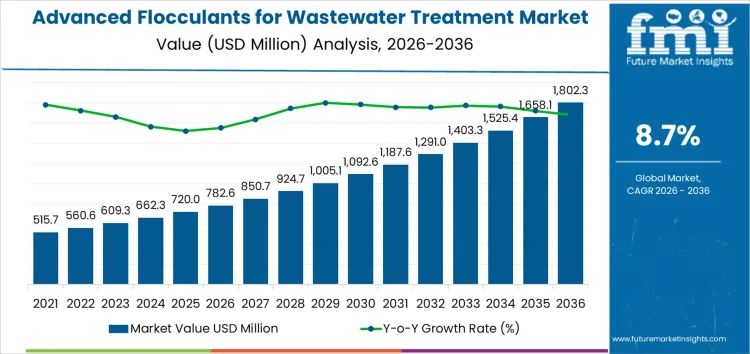
Municipal wastewater treatment represents leading end-use demand, reflecting scale of urban treatment infrastructure and regulatory oversight. China, India, USA, Germany, and Brazil emerge as fastest-growing countries, supported by infrastructure investment and capacity expansion. Competitive landscape includes Kemira, SNF Floerger, BASF SE, Solenis, and Ecolab, focusing on high-molecular-weight polymers, application-specific blends, and optimized dosing solutions.
Advanced Flocculants for Wastewater Treatment Market Key Takeaways
| Metric | Value |
|---|---|
| Market Value (2026) | USD 782.6 million |
| Market Forecast Value (2036) | USD 1,802.3 million |
| Forecast CAGR (2026-2036) | 8.7% |
Why is the Demand for Advanced Flocculants for Wastewater Treatment Market Growing?
Demand for advanced flocculants for wastewater treatment is growing globally due to increasing regulatory requirements for effluent quality and rising complexity of industrial and municipal wastewater streams. Wastewater treatment facilities adopt engineered flocculants to enhance removal of suspended solids, turbidity, organic matter, and trace contaminants prior to discharge or reuse. Stringent discharge standards imposed by environmental authorities across regions motivate utilities to implement flocculation agents that deliver high removal efficiency under diverse pH, temperature, and load conditions.
Growth in industrial sectors such as food processing, chemical manufacturing, mining, and textiles increases wastewater variability, which necessitates tailored flocculants capable of addressing specific colloidal and particulate profiles. Advanced polymeric and bio-based flocculants improve settling rates, sludge dewatering characteristics, and overall treatment performance, reducing operational costs and energy use. Expansion of potable water reuse and resource recovery programs reinforces adoption of high performance flocculants within multi barrier treatment trains. Research and innovation focus on improving flocculant selectivity, biodegradability, and reduced residuals to support sustainable treatment practices. Utilities and industrial operators prioritize solutions that integrate with automation and monitoring systems to maintain consistent treatment outcomes across variable influent conditions.
How Are the Segments Classified in the Advanced Flocculants for Wastewater Treatment Market?
Demand for advanced flocculants for wastewater treatment globally is shaped by tightening discharge norms, higher suspended solids loading, and efficiency requirements across municipal and industrial systems. Operators evaluate floc strength, settling speed, sludge volume reduction, and compatibility with diverse effluent chemistries. Adoption patterns reflect movement toward higher-performance formulations supporting stable clarification, dewatering efficiency, and downstream treatment reliability.
Which Flocculant Type Represents the Largest Share of Global Demand?
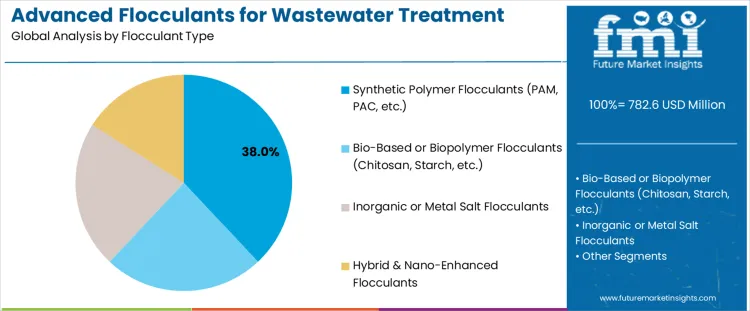
Synthetic polymer flocculants hold 38.0%, representing the largest share of global demand. These materials provide strong particle aggregation, consistent performance across variable water chemistries, and suitability for large-scale treatment systems. Bio-based or biopolymer flocculants account for 24.0%, supporting biodegradability and reduced environmental impact in regulated applications. Inorganic or metal salt flocculants hold 22.0%, relying on charge neutralization and precipitation mechanisms. Hybrid and nano-enhanced flocculants account for 16.0%, enabling improved efficiency at lower dosages. Flocculant-type distribution reflects preference for proven polymer-based performance with growing interest in sustainable alternatives.
Key Points
- Synthetic polymers lead due to strong aggregation efficiency.
- Bio-based flocculants support environmental compliance goals.
- Hybrid systems enhance performance at reduced dosage levels.
Which End-Use Industry Accounts for the Highest Share of Global Adoption?
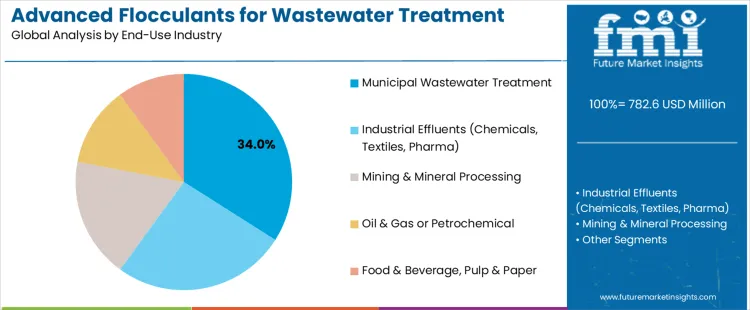
Municipal wastewater treatment holds 34.0%, accounting for the highest share of global adoption. These facilities require reliable clarification and sludge handling to meet discharge standards. Industrial effluents hold 26.0%, addressing complex wastewater from chemicals, textiles, and pharmaceuticals. Mining and mineral processing account for 18.0%, supporting solid-liquid separation under high solids loading. Oil and gas or petrochemical applications hold 12.0%, managing produced water and process streams. Food and beverage, pulp, and paper hold 10.0%. End-use distribution reflects concentration of high-volume flocculant consumption in public and industrial treatment infrastructure.
Key Points
- Municipal systems dominate due to continuous high-volume treatment.
- Industrial effluents require tailored flocculation performance.
- Mining applications handle extreme solids concentrations.
Which Treatment Stage Holds the Largest Share of Global Demand?
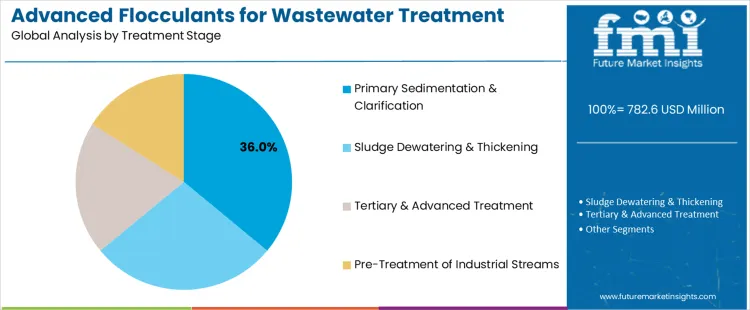
Primary sedimentation and clarification hold 36.0%, representing the largest share of global demand. This stage relies on flocculants to accelerate settling and reduce suspended solids early in treatment. Sludge dewatering and thickening account for 28.0%, focusing on water removal and volume reduction. Tertiary and advanced treatment hold 20.0%, supporting polishing and regulatory compliance. Pre-treatment of industrial streams accounts for 16.0%, preparing effluents for downstream processing. Treatment-stage distribution reflects priority on front-end clarification and solids management efficiency.
Key Points
- Primary clarification drives highest flocculant consumption.
- Dewatering applications focus on sludge volume reduction.
- Advanced treatment supports final effluent quality control.
What are the Key Dynamics in the Advanced Flocculants for Wastewater Treatment Market?
Global demand rises as municipal and industrial wastewater treatment facilities adopt advanced flocculants to improve solid-liquid separation, reduce turbidity, and enhance sludge dewaterability. Advanced polymeric flocculants and tailored coagulant aids support nutrient removal, color reduction, and microcontaminant capture in complex effluent matrices. Adoption aligns with tightening discharge standards, increased wastewater volumes from urbanization and industrial growth, and investment in sustainable treatment infrastructure across regions. Usage spans municipal utilities, mining, food processing, pulp and paper, and chemical sectors requiring robust separation performance.
How do regulatory limits and effluent quality expectations shape global demand?
Governments and environmental agencies globally tighten limits on suspended solids, biochemical oxygen demand, and nutrient indicators to protect receiving water quality. Treatment plants integrate advanced flocculants within primary and tertiary processes to achieve compliance benchmarks and reduce downstream load on biological systems. Industrial operations with high solid loads, such as mineral processing and food production, employ engineered flocculants to improve clarity and reduce operational cost tied to extended settling times. Urban wastewater utilities invest in flocculant optimization to manage peak influent variability and support reuse initiatives. Public health and ecosystem protection priorities reinforce investment in effective chemical aids that enable reliable solid capture and clearer discharge.
How do cost considerations, source water variability, and integration complexity influence market scalability?
Advanced flocculants often carry higher per-unit cost compared with basic polymers, prompting careful cost-benefit analysis linked to treatment goals and system configurations. Performance depends on source water characteristics such as pH, organic load, particulate composition, and ionic strength, requiring tailored chemistry selection and dosing strategy. Integration with existing mechanical and biological treatment trains demands process monitoring and adjustment to avoid issues such as overdosing, poor floc structure, or increased sludge volume. Supply chain variability for raw monomers and polymer precursors influences pricing and delivery timelines across regions. Regulatory divergence in acceptable treatment endpoints affects urgency and degree of flocculant adoption. Global growth depends on development of cost-effective, robust flocculant formulations and digital dosing/monitoring systems that deliver consistent performance across diverse wastewater treatment contexts worldwide.
How Is Demand for Advanced Flocculants for Wastewater Treatment Evolving?
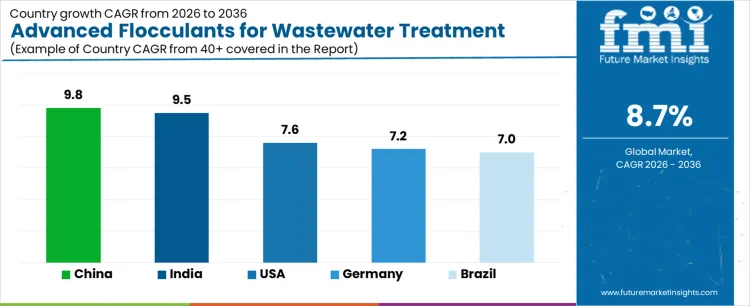
Demand for advanced flocculants for wastewater treatment is increasing globally due to stricter effluent standards, water reuse expansion, and higher suspended solids loads. China leads with a 9.8% CAGR, supported by municipal capacity expansion and industrial discharge regulation. India follows at 9.5%, driven by sewage infrastructure growth and industrial wastewater treatment upgrades. USA records a 7.6% CAGR, reflecting optimization of existing treatment systems and compliance requirements. Germany posts 7.2%, shaped by precautionary regulation and efficiency-focused treatment practices. Brazil records 7.0%, supported by urban wastewater expansion and industrial compliance needs. Growth reflects sustained emphasis on improved solid-liquid separation worldwide.
| Country | CAGR (%) |
|---|---|
| China | 9.8% |
| India | 9.5% |
| USA | 7.6% |
| Germany | 7.2% |
| Brazil | 7.0% |
What factors are driving strong demand growth for advanced flocculants in China?
China demand is driven by expansion of municipal wastewater treatment plants and tightening industrial effluent standards. CAGR of 9.8% reflects increased use of high-performance polymeric flocculants to manage higher solids loading and variable influent quality. Industrial sectors adopt advanced formulations to improve clarification efficiency and reduce sludge volume. Centralized planning enables standardized procurement and dosing optimization. Water reuse targets increase demand for consistent effluent quality. Continuous monitoring requirements support steady chemical consumption. Growth remains scale-driven and regulation-aligned, supported by national water quality improvement initiatives.
- Expansion of municipal wastewater treatment capacity
- Industrial effluent compliance requirements
- Standardized procurement and dosing practices
- Water reuse-driven effluent quality targets
How is India sustaining high growth in advanced flocculants usage?
India demand reflects expansion of sewage treatment infrastructure and increasing industrial wastewater regulation. CAGR of 9.5% is supported by adoption of high-efficiency flocculants to improve clarification in municipal and industrial plants. River and lake restoration programs require enhanced solids removal. Industrial clusters integrate advanced flocculants to meet discharge norms. Regulatory oversight strengthens performance expectations. Growth remains infrastructure-led and compliance-focused, aligned with improving surface water quality and treatment reliability.
- Expansion of sewage treatment plants
- River and lake restoration initiatives
- Industrial wastewater compliance needs
- Strengthening of regulatory oversight
What operational drivers shape advanced flocculants demand growth in the USA?
USA demand is shaped by optimization of existing wastewater treatment facilities and compliance with discharge permits. CAGR of 7.6% reflects use of advanced flocculants to enhance performance without major capital upgrades. Utilities apply tailored polymer formulations to manage variable influent conditions. Industrial facilities adopt advanced flocculants to improve sludge dewatering efficiency. Emphasis remains on cost control, performance consistency, and regulatory compliance. Growth remains operations-driven, aligned with lifecycle optimization and permit adherence.
- Optimization of existing treatment infrastructure
- Variable influent management requirements
- Sludge dewatering efficiency improvement
- Permit-driven compliance focus
Why does Germany show steady but controlled growth in advanced flocculants?
Germany demand reflects precautionary environmental regulation and emphasis on treatment efficiency. CAGR of 7.2% is supported by targeted use of advanced flocculants within optimized treatment frameworks. Utilities prioritize precise dosing, reduced chemical consumption, and minimal secondary impacts. Strong source control reduces excessive solids loading. Documentation and validation requirements guide chemical selection. Growth remains efficiency-led and stability-focused, aligned with established wastewater management practices.
- Precautionary environmental regulation
- Emphasis on dosing precision and efficiency
- Strong source control policies
- Documentation and validation requirements
What supports gradual demand expansion for advanced flocculants in Brazil?
Brazil demand is driven by urban wastewater treatment expansion and industrial effluent management. CAGR of 7.0% reflects increased use of flocculants to improve clarification and solids removal. Rapid urbanization increases treatment demand in metropolitan regions. Industrial activity contributes to complex wastewater streams requiring advanced treatment. Public investment supports capacity expansion. Growth remains application-driven and infrastructure-aligned, supported by improving water quality standards and environmental compliance initiatives.
- Urban wastewater treatment expansion
- Management of complex industrial effluents
- Increased public investment in treatment
- Alignment with water quality improvement goals
What is the competitive landscape of demand for advanced flocculants for wastewater treatment?
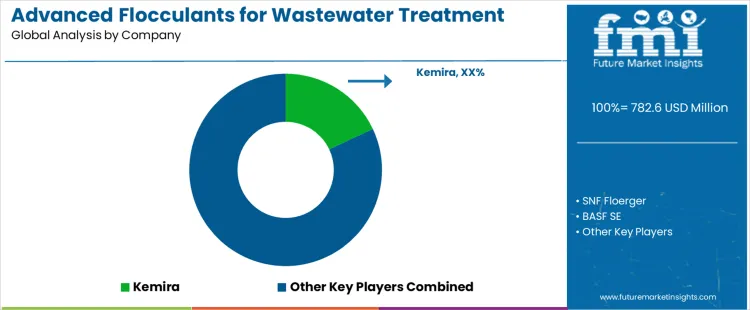
Demand for advanced flocculants for wastewater treatment is driven by stricter discharge limits, water reuse adoption, and rising complexity of industrial effluents. Applications span municipal wastewater, mining, pulp and paper, oil and gas, food processing, and chemical manufacturing. Buyers evaluate flocculation efficiency, settling speed, sludge dewaterability, tolerance to variable pH and salinity, and compatibility with existing treatment processes. Procurement teams prioritize consistent polymer quality, dosage efficiency, reduction of sludge volume, and support for process optimization. Trend in the global market reflects higher solids loading, increased use of membrane systems requiring upstream solids control, and growing emphasis on operational cost reduction and treatment reliability.
Kemira maintains strong positioning through a broad portfolio of advanced polymer flocculants optimized for municipal and industrial wastewater applications worldwide. SNF Floerger operates extensive global production capacity supplying high-molecular-weight flocculants used across large-scale treatment plants. BASF SE supports demand with specialty polymers designed to enhance clarification and sludge handling performance. Solenis provides tailored flocculants programs integrated with overall water treatment strategies for industrial operators. Ecolab contributes advanced flocculants supported by digital monitoring and service-led optimization models. Competitive differentiation depends on polymer performance consistency, adaptability to complex wastewater matrices, technical service depth, and ability to support regulatory compliance and reuse objectives.
Key Players in the Advanced Flocculants for Wastewater Treatment Market
- Kemira
- SNF Floerger
- BASF SE
- Solenis
- Ecolab
Scope of the Report
| Items | Values |
|---|---|
| Quantitative Units | USD million |
| Flocculant Type | Synthetic Polymer Flocculants (PAM, PAC, etc.); Bio-Based or Biopolymer Flocculants (Chitosan, Starch, etc.); Inorganic or Metal Salt Flocculants; Hybrid & Nano-Enhanced Flocculants |
| End-Use Industry | Municipal Wastewater Treatment; Industrial Effluents (Chemicals, Textiles, Pharma); Mining & Mineral Processing; Oil & Gas or Petrochemical; Food & Beverage, Pulp & Paper |
| Treatment Stage | Primary Sedimentation & Clarification; Sludge Dewatering & Thickening; Tertiary & Advanced Treatment; Pre-Treatment of Industrial Streams |
| Regions Covered | Asia Pacific, Europe, North America, Latin America, Middle East & Africa |
| Countries Covered | China, India, USA, Germany, Brazil, and 40+ countries |
| Key Companies Profiled | Kemira; SNF Floerger; BASF SE; Solenis; Ecolab |
| Additional Attributes | Dollar sales by flocculant type and treatment stage; adoption trends for high-efficiency and low-dosage polymer systems; performance benchmarks for turbidity removal, sludge volume reduction, and dewatering efficiency; compatibility with municipal and industrial wastewater processes; impact of bio-based and hybrid formulations on chemical consumption and residuals management; regulatory and discharge standards influencing advanced flocculants selection. |
Advanced Flocculants for Wastewater Treatment Market by Segment
Flocculant Type:
- Synthetic Polymer Flocculants (PAM, PAC, etc.)
- Bio-Based or Biopolymer Flocculants (Chitosan, Starch, etc.)
- Inorganic or Metal Salt Flocculants
- Hybrid & Nano-Enhanced Flocculants
End-Use Industry:
- Municipal Wastewater Treatment
- Industrial Effluents (Chemicals, Textiles, Pharma)
- Mining & Mineral Processing
- Oil & Gas or Petrochemical
- Food & Beverage, Pulp & Paper
Treatment Stage:
- Primary Sedimentation & Clarification
- Sludge Dewatering & Thickening
- Tertiary & Advanced Treatment
- Pre-Treatment of Industrial Streams
Region:
- Asia Pacific
- China
- Japan
- South Korea
- India
- Australia & New Zealand
- ASEAN
- Rest of Asia Pacific
- Europe
- Germany
- United Kingdom
- France
- Italy
- Spain
- Nordic
- BENELUX
- Rest of Europe
- North America
- United States
- Canada
- Mexico
- Latin America
- Brazil
- Chile
- Rest of Latin America
- Middle East & Africa
- Kingdom of Saudi Arabia
- Other GCC Countries
- Turkey
- South Africa
- Other African Union
- Rest of Middle East & Africa
Bibliography
- USA Environmental Protection Agency. (2023). Wastewater technology fact sheet: Coagulation and flocculation in municipal and industrial treatment systems. USA Environmental Protection Agency.
- European Commission. (2023). Urban wastewater treatment directive revision and implications for advanced solid-liquid separation technologies. European Commission.
- Organization for Economic Co-operation and Development. (2023). Water quality management policies and advanced chemical treatment solutions. OECD Publishing.
- Kemira Oyj. (2024). Advanced polymer flocculants for municipal and industrial wastewater clarification and sludge dewatering. Kemira Oyj.
Frequently Asked Questions
How big is the advanced flocculants for wastewater treatment market in 2026?
The global advanced flocculants for wastewater treatment market is estimated to be valued at USD 782.6 million in 2026.
What will be the size of advanced flocculants for wastewater treatment market in 2036?
The market size for the advanced flocculants for wastewater treatment market is projected to reach USD 1,802.3 million by 2036.
How much will be the advanced flocculants for wastewater treatment market growth between 2026 and 2036?
The advanced flocculants for wastewater treatment market is expected to grow at a 8.7% CAGR between 2026 and 2036.
What are the key flocculant types in the advanced flocculants for wastewater treatment market?
The key flocculant types in advanced flocculants for wastewater treatment market are synthetic polymer flocculants (PAM, PAC, etc.), bio-based or biopolymer flocculants (chitosan, starch, etc.), inorganic or metal salt flocculants and hybrid & nano-enhanced flocculants.
Which end-use industry segment to contribute significant share in the advanced flocculants for wastewater treatment market in 2026?
In terms of end-use industry, municipal wastewater treatment segment to command 34.0% share in the advanced flocculants for wastewater treatment market in 2026.
Preview the report firsthand - request a free sample
Get SampleGet the brochure for pricing and purchase details.
Get PDFTable of Content
- Executive Summary
- Global Market Outlook
- Demand-side Trends
- Supply-side Trends
- Technology Roadmap Analysis
- Analysis and Recommendations
- Market Overview
- Market Coverage / Taxonomy
- Market Definition / Scope / Limitations
- Market Background
- Market Dynamics
- Drivers
- Restraints
- Opportunity
- Trends
- Scenario Forecast
- Demand in Optimistic Scenario
- Demand in Likely Scenario
- Demand in Conservative Scenario
- Opportunity Map Analysis
- Product Life Cycle Analysis
- Supply Chain Analysis
- Investment Feasibility Matrix
- Value Chain Analysis
- PESTLE and Porter’s Analysis
- Regulatory Landscape
- Regional Parent Market Outlook
- Production and Consumption Statistics
- Import and Export Statistics
- Market Dynamics
- Global Market Analysis 2021 to 2025 and Forecast, 2026 to 2036
- Historical Market Size Value (USD Million) Analysis, 2021 to 2025
- Current and Future Market Size Value (USD Million) Projections, 2026 to 2036
- Y-o-Y Growth Trend Analysis
- Absolute $ Opportunity Analysis
- Global Market Pricing Analysis 2021 to 2025 and Forecast 2026 to 2036
- Global Market Analysis 2021 to 2025 and Forecast 2026 to 2036, By Flocculant Type
- Introduction / Key Findings
- Historical Market Size Value (USD Million) Analysis By Flocculant Type , 2021 to 2025
- Current and Future Market Size Value (USD Million) Analysis and Forecast By Flocculant Type , 2026 to 2036
- Synthetic Polymer Flocculants (PAM, PAC, etc.)
- Bio-Based or Biopolymer Flocculants (Chitosan, Starch, etc.)
- Inorganic or Metal Salt Flocculants
- Hybrid & Nano-Enhanced Flocculants
- Synthetic Polymer Flocculants (PAM, PAC, etc.)
- Y-o-Y Growth Trend Analysis By Flocculant Type , 2021 to 2025
- Absolute $ Opportunity Analysis By Flocculant Type , 2026 to 2036
- Global Market Analysis 2021 to 2025 and Forecast 2026 to 2036, By End-Use Industry
- Introduction / Key Findings
- Historical Market Size Value (USD Million) Analysis By End-Use Industry, 2021 to 2025
- Current and Future Market Size Value (USD Million) Analysis and Forecast By End-Use Industry, 2026 to 2036
- Municipal Wastewater Treatment
- Industrial Effluents (Chemicals, Textiles, Pharma)
- Mining & Mineral Processing
- Oil & Gas or Petrochemical
- Food & Beverage, Pulp & Paper
- Municipal Wastewater Treatment
- Y-o-Y Growth Trend Analysis By End-Use Industry, 2021 to 2025
- Absolute $ Opportunity Analysis By End-Use Industry, 2026 to 2036
- Global Market Analysis 2021 to 2025 and Forecast 2026 to 2036, By Treatment Stage
- Introduction / Key Findings
- Historical Market Size Value (USD Million) Analysis By Treatment Stage, 2021 to 2025
- Current and Future Market Size Value (USD Million) Analysis and Forecast By Treatment Stage, 2026 to 2036
- Primary Sedimentation & Clarification
- Sludge Dewatering & Thickening
- Tertiary & Advanced Treatment
- Pre-Treatment of Industrial Streams
- Primary Sedimentation & Clarification
- Y-o-Y Growth Trend Analysis By Treatment Stage, 2021 to 2025
- Absolute $ Opportunity Analysis By Treatment Stage, 2026 to 2036
- Global Market Analysis 2021 to 2025 and Forecast 2026 to 2036, By Region
- Introduction
- Historical Market Size Value (USD Million) Analysis By Region, 2021 to 2025
- Current Market Size Value (USD Million) Analysis and Forecast By Region, 2026 to 2036
- North America
- Latin America
- Western Europe
- Eastern Europe
- East Asia
- South Asia and Pacific
- Middle East & Africa
- Market Attractiveness Analysis By Region
- North America Market Analysis 2021 to 2025 and Forecast 2026 to 2036, By Country
- Historical Market Size Value (USD Million) Trend Analysis By Market Taxonomy, 2021 to 2025
- Market Size Value (USD Million) Forecast By Market Taxonomy, 2026 to 2036
- By Country
- USA
- Canada
- Mexico
- By Flocculant Type
- By End-Use Industry
- By Treatment Stage
- By Country
- Market Attractiveness Analysis
- By Country
- By Flocculant Type
- By End-Use Industry
- By Treatment Stage
- Key Takeaways
- Latin America Market Analysis 2021 to 2025 and Forecast 2026 to 2036, By Country
- Historical Market Size Value (USD Million) Trend Analysis By Market Taxonomy, 2021 to 2025
- Market Size Value (USD Million) Forecast By Market Taxonomy, 2026 to 2036
- By Country
- Brazil
- Chile
- Rest of Latin America
- By Flocculant Type
- By End-Use Industry
- By Treatment Stage
- By Country
- Market Attractiveness Analysis
- By Country
- By Flocculant Type
- By End-Use Industry
- By Treatment Stage
- Key Takeaways
- Western Europe Market Analysis 2021 to 2025 and Forecast 2026 to 2036, By Country
- Historical Market Size Value (USD Million) Trend Analysis By Market Taxonomy, 2021 to 2025
- Market Size Value (USD Million) Forecast By Market Taxonomy, 2026 to 2036
- By Country
- Germany
- UK
- Italy
- Spain
- France
- Nordic
- BENELUX
- Rest of Western Europe
- By Flocculant Type
- By End-Use Industry
- By Treatment Stage
- By Country
- Market Attractiveness Analysis
- By Country
- By Flocculant Type
- By End-Use Industry
- By Treatment Stage
- Key Takeaways
- Eastern Europe Market Analysis 2021 to 2025 and Forecast 2026 to 2036, By Country
- Historical Market Size Value (USD Million) Trend Analysis By Market Taxonomy, 2021 to 2025
- Market Size Value (USD Million) Forecast By Market Taxonomy, 2026 to 2036
- By Country
- Russia
- Poland
- Hungary
- Balkan & Baltic
- Rest of Eastern Europe
- By Flocculant Type
- By End-Use Industry
- By Treatment Stage
- By Country
- Market Attractiveness Analysis
- By Country
- By Flocculant Type
- By End-Use Industry
- By Treatment Stage
- Key Takeaways
- East Asia Market Analysis 2021 to 2025 and Forecast 2026 to 2036, By Country
- Historical Market Size Value (USD Million) Trend Analysis By Market Taxonomy, 2021 to 2025
- Market Size Value (USD Million) Forecast By Market Taxonomy, 2026 to 2036
- By Country
- China
- Japan
- South Korea
- By Flocculant Type
- By End-Use Industry
- By Treatment Stage
- By Country
- Market Attractiveness Analysis
- By Country
- By Flocculant Type
- By End-Use Industry
- By Treatment Stage
- Key Takeaways
- South Asia and Pacific Market Analysis 2021 to 2025 and Forecast 2026 to 2036, By Country
- Historical Market Size Value (USD Million) Trend Analysis By Market Taxonomy, 2021 to 2025
- Market Size Value (USD Million) Forecast By Market Taxonomy, 2026 to 2036
- By Country
- India
- ASEAN
- Australia & New Zealand
- Rest of South Asia and Pacific
- By Flocculant Type
- By End-Use Industry
- By Treatment Stage
- By Country
- Market Attractiveness Analysis
- By Country
- By Flocculant Type
- By End-Use Industry
- By Treatment Stage
- Key Takeaways
- Middle East & Africa Market Analysis 2021 to 2025 and Forecast 2026 to 2036, By Country
- Historical Market Size Value (USD Million) Trend Analysis By Market Taxonomy, 2021 to 2025
- Market Size Value (USD Million) Forecast By Market Taxonomy, 2026 to 2036
- By Country
- Kingdom of Saudi Arabia
- Other GCC Countries
- Turkiye
- South Africa
- Other African Union
- Rest of Middle East & Africa
- By Flocculant Type
- By End-Use Industry
- By Treatment Stage
- By Country
- Market Attractiveness Analysis
- By Country
- By Flocculant Type
- By End-Use Industry
- By Treatment Stage
- Key Takeaways
- Key Countries Market Analysis
- USA
- Pricing Analysis
- Market Share Analysis, 2025
- By Flocculant Type
- By End-Use Industry
- By Treatment Stage
- Canada
- Pricing Analysis
- Market Share Analysis, 2025
- By Flocculant Type
- By End-Use Industry
- By Treatment Stage
- Mexico
- Pricing Analysis
- Market Share Analysis, 2025
- By Flocculant Type
- By End-Use Industry
- By Treatment Stage
- Brazil
- Pricing Analysis
- Market Share Analysis, 2025
- By Flocculant Type
- By End-Use Industry
- By Treatment Stage
- Chile
- Pricing Analysis
- Market Share Analysis, 2025
- By Flocculant Type
- By End-Use Industry
- By Treatment Stage
- Germany
- Pricing Analysis
- Market Share Analysis, 2025
- By Flocculant Type
- By End-Use Industry
- By Treatment Stage
- UK
- Pricing Analysis
- Market Share Analysis, 2025
- By Flocculant Type
- By End-Use Industry
- By Treatment Stage
- Italy
- Pricing Analysis
- Market Share Analysis, 2025
- By Flocculant Type
- By End-Use Industry
- By Treatment Stage
- Spain
- Pricing Analysis
- Market Share Analysis, 2025
- By Flocculant Type
- By End-Use Industry
- By Treatment Stage
- France
- Pricing Analysis
- Market Share Analysis, 2025
- By Flocculant Type
- By End-Use Industry
- By Treatment Stage
- India
- Pricing Analysis
- Market Share Analysis, 2025
- By Flocculant Type
- By End-Use Industry
- By Treatment Stage
- ASEAN
- Pricing Analysis
- Market Share Analysis, 2025
- By Flocculant Type
- By End-Use Industry
- By Treatment Stage
- Australia & New Zealand
- Pricing Analysis
- Market Share Analysis, 2025
- By Flocculant Type
- By End-Use Industry
- By Treatment Stage
- China
- Pricing Analysis
- Market Share Analysis, 2025
- By Flocculant Type
- By End-Use Industry
- By Treatment Stage
- Japan
- Pricing Analysis
- Market Share Analysis, 2025
- By Flocculant Type
- By End-Use Industry
- By Treatment Stage
- South Korea
- Pricing Analysis
- Market Share Analysis, 2025
- By Flocculant Type
- By End-Use Industry
- By Treatment Stage
- Russia
- Pricing Analysis
- Market Share Analysis, 2025
- By Flocculant Type
- By End-Use Industry
- By Treatment Stage
- Poland
- Pricing Analysis
- Market Share Analysis, 2025
- By Flocculant Type
- By End-Use Industry
- By Treatment Stage
- Hungary
- Pricing Analysis
- Market Share Analysis, 2025
- By Flocculant Type
- By End-Use Industry
- By Treatment Stage
- Kingdom of Saudi Arabia
- Pricing Analysis
- Market Share Analysis, 2025
- By Flocculant Type
- By End-Use Industry
- By Treatment Stage
- Turkiye
- Pricing Analysis
- Market Share Analysis, 2025
- By Flocculant Type
- By End-Use Industry
- By Treatment Stage
- South Africa
- Pricing Analysis
- Market Share Analysis, 2025
- By Flocculant Type
- By End-Use Industry
- By Treatment Stage
- USA
- Market Structure Analysis
- Competition Dashboard
- Competition Benchmarking
- Market Share Analysis of Top Players
- By Regional
- By Flocculant Type
- By End-Use Industry
- By Treatment Stage
- Competition Analysis
- Competition Deep Dive
- Kemira
- Overview
- Product Portfolio
- Profitability by Market Segments (Product/Age /Sales Channel/Region)
- Sales Footprint
- Strategy Overview
- Marketing Strategy
- Product Strategy
- Channel Strategy
- SNF Floerger
- BASF SE
- Solenis
- Ecolab
- Kemira
- Competition Deep Dive
- Assumptions & Acronyms Used
- Research Methodology


