

- Industry Size (2026)
- USD 1650.0 Mn
- Forecast (2036)
- USD 2538.0 Mn
- CAGR (2026 to 2036)
- 4.40%
Plate and Frame Filter Press Market Forecast and Outlook 2026 to 2036
The plate and frame filter press market is projected to increase from USD 1,650.0 million in 2026 to USD 2,538.0 million by 2036, expanding at a CAGR of 4.40%. Value creation in this market is shaped less by shipment volume and more by control over cost structure and lifecycle economics. Margin concentration tends to favor manufacturers that command engineering depth, proprietary plate designs, and automation ready platforms rather than low cost fabricators. While steel frames and basic plates are increasingly commoditized, pricing control is retained in hydraulic systems, membrane plates, automation modules, and application specific customization. Aftermarket components such as filter cloths, membranes, service contracts, and system upgrades account for a disproportionate share of long term profitability, particularly in mining and wastewater installations with continuous duty cycles. Buyers often accept higher upfront pricing in exchange for predictable cake dryness, reduced downtime, and lower operating cost per ton processed, reinforcing value capture by technically differentiated suppliers. Smaller manufacturers compete on price but face margin pressure from raw material volatility and limited service reach.
Quick Stats for Plate and Frame Filter Press Market
- Plate and Frame Filter Press Market Value (2026): USD 1,650.0 Million
- Plate and Frame Filter Press Market Forecast Value (2036): USD 2,538.0 Million
- Plate and Frame Filter Press Market Forecast CAGR 2026 to 2036: 4.40%
- Leading End Use in Plate and Frame Filter Press Market: Mining & Minerals (30% share)
- Key Growth Regions in Plate and Frame Filter Press Market: Asia Pacific, Europe, North America, Latin America, Middle East & Africa
- Top Key Players in Plate and Frame Filter Press Market: ANDRITZ, Metso, FLSmidth, Micronics Engineered Filtration, Evoqua (Xylem), MSE Filterpressen, Diemme Filtration, Jingjin Equipment, Ishigaki Company
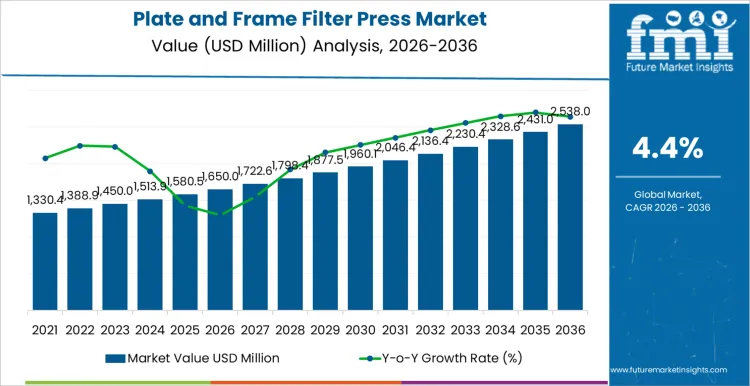
Plate and Frame Filter Press Market Key Takeaways
| Metric | Value |
|---|---|
| Plate and Frame Filter Press Market Value (2026) | USD 1,650.0 Million |
| Plate and Frame Filter Press Market Forecast Value (2036) | USD 2,538.0 Million |
| Plate and Frame Filter Press Market Forecast CAGR 2026 to 2036 | 4.40% |
How are Sludge Management Needs and Process Optimization Driving the Plate and Frame Filter Press Market?
The plate and frame filter press market is driven by industries seeking efficient solid-liquid separation under tightening environmental and operational constraints. Municipal wastewater treatment plants, mining operations, chemicals, food processing, and pharmaceuticals rely on filter presses to achieve high solids capture and low moisture content in filter cakes. Municipal buyers also benchmark capex and OPEX against the broader municipal sludge dewatering equipment set before selecting press configurations. For equipment manufacturers, demand is increasingly linked to applications where disposal cost reduction, regulatory compliance, and process consistency are critical decision factors.
Procurement behavior is shifting toward performance reliability and automation readiness. End users are prioritizing filter presses that deliver higher filtration pressure, uniform cake formation, and reduced cycle times. Automation features such as automatic plate shifting, cloth washing systems, and integrated control panels are becoming standard requirements, particularly for large-scale installations. This preference is accelerating adoption of automatic filter presses where labor reduction and cycle consistency are contractual KPIs. Suppliers that can offer application-specific plate materials, cloth designs, and scalable configurations are gaining preference in competitive tenders. Many EPCs now procure bundled filter press solutions that include media, controls, and commissioning support to reduce integration risk.
Replacement demand and capacity expansion are further sustaining market growth. Aging filtration infrastructure in wastewater and industrial plants is being upgraded to handle higher sludge volumes and stricter discharge norms. Upgrades are often scoped alongside sludge handling equipment modernization so dewatering, conveyance, and disposal steps stay balanced. In emerging economies, new industrial and municipal projects are driving fresh installations. For manufacturers and system integrators, competitive advantage increasingly depends on customization capability, service support, and the ability to optimize filtration performance over the full equipment lifecycle positioning plate and frame filter presses as a steady, process-critical solution across diverse industries.
How Is The Plate And Frame Filter Press Market Structured By End Use And Plate Size?
The plate and frame filter press market is segmented by end use and plate size, reflecting how slurry characteristics, solids load, and throughput requirements determine equipment configuration. By end use, mining and minerals processing leads demand, as filtration is critical for tailings dewatering, concentrate recovery, and water reuse. Other end uses include municipal and industrial wastewater treatment, chemicals, food and beverage processing, and pharmaceutical manufacturing, each requiring different filtration precision and hygiene standards. By plate size, systems up to 800 mm represent the leading category, while mid-range (800-1500 mm) and large-format plates address higher-capacity and continuous operation needs in large-scale plants.
Why Does Mining And Minerals Processing Lead End-Use Demand In The Plate And Frame Filter Press Market?
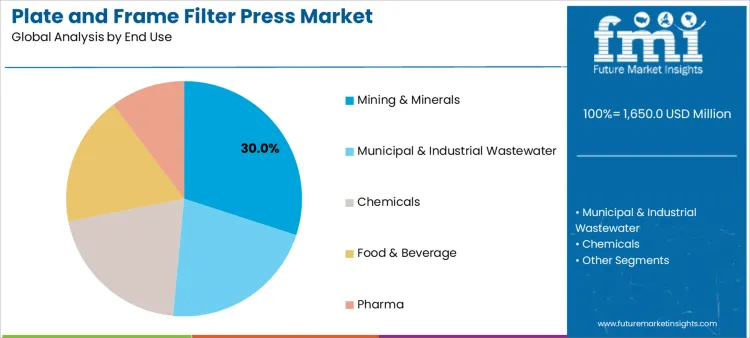
Mining and minerals account for 30% share of the plate and frame filter press market because solid-liquid separation is a core operation across mineral beneficiation and tailings management. Filter presses are widely used to dewater concentrates, recover process water, and reduce slurry volume before disposal or transport. High solids loading and abrasive materials favor robust plate and frame designs with high-pressure capability. Mining operators prioritize filtration systems that improve water recovery and reduce downstream handling costs. Large project sizes and long equipment lifecycles drive sustained demand. These operational intensity and volume-driven requirements explain why mining and minerals remain the dominant end-use segment.
Why Do Plate Sizes Up To 800 mm Dominate Market Adoption?
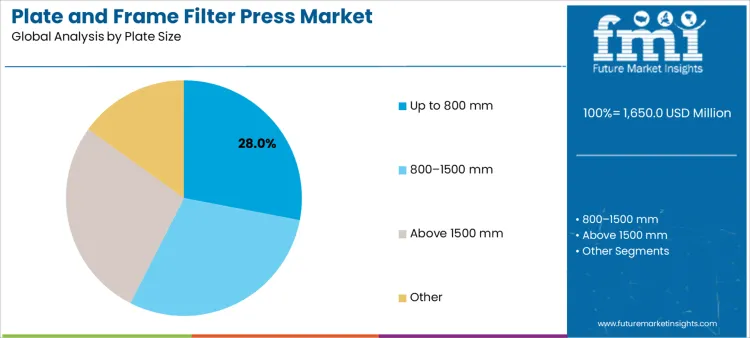
Filter presses with plate sizes up to 800 mm hold 28% share of the plate and frame filter press market because they align with the most common filtration capacities across industrial applications. These systems offer a balance between footprint, throughput, and capital cost, making them suitable for small to mid-sized mining operations, wastewater plants, and chemical facilities. Smaller plate sizes enable easier installation, faster cycle times, and lower maintenance complexity. OEMs favor this range for standardized designs and modular scalability. For manufacturers, this segment supports higher unit volumes and repeat orders. These practicality and cost-efficiency factors explain dominance of up to 800 mm plate sizes.
What Are The Key Dynamics Of The Plate And Frame Filter Press Market?
The plate and frame filter press market is driven by demand for reliable solid-liquid separation in industries such as mining, chemical processing, wastewater treatment, food and beverage, pharmaceuticals, and industrial manufacturing. Press selection is often justified within the broader liquid filtration spend category to compare lifecycle economics across competing separation steps. Plate and frame filter presses deliver high dewatering efficiency, customizable filtration area, and operation across a broad range of viscosities and solids loads. For OEMs, integrators, and component suppliers, filtration performance (cake dryness), frame durability, ease of chamber accessibility, and automation capabilities are central differentiators that influence buyer decisions. Adoption is supported by increasingly stringent effluent discharge standards and the need to reduce disposal costs and improve resource recovery. Projects that target reuse often pair presses with upgrades in industrial water treatment so recovered filtrate meets internal recycle specifications.
How Are Technology And Automation Trends Shaping This Market?
Technology and automation trends are shaping the plate and frame filter press market through smart controls, sensor integration, and automated cycle management that improve throughput and reduce manual intervention. Real-time monitoring of pressure differentials, flow rates, and cake formation enables operators to optimize filtration cycles and identify maintenance triggers before they impact performance. Automated plate shifters, interleaved wash systems, and variable feed control loops enhance efficiency and reduce downtime. Integration with plant supervisory systems (SCADA/DCS) supports centralized monitoring and process analytics. For suppliers, providing modular solutions that can be retrofitted with digital control packages enhances value for both new and installed equipment bases.
Why Do Operational, Cost, And Feedstock Variability Challenges Restrain Market Growth?
Operational, cost, and feedstock variability challenges restrain growth in the plate and frame filter press market by increasing implementation complexity and total cost of ownership. High initial capital investment and installation costs especially for large filtration surface areas can deter price-sensitive buyers. Operational complexity in handling variable slurry characteristics (changing solids concentration, particle size distribution, and rheology) requires skilled operators to optimize membrane squeeze cycles and clean-out procedures. Sites handling high variability increasingly compare upgrades against membrane filter press machines to improve final cake dryness during squeeze cycles. Unplanned maintenance from membrane wear or cloth clogging further raises operating expenses. Inconsistent feedstock streams in industries such as mining and wastewater can reduce filter press effectiveness; this variability increases cycle times and reduces predictable throughput. To stabilize cycle times, plants increasingly optimize conditioning with advanced flocculants for wastewater treatment before filtration.
What is The Country-Wise Growth Outlook for the Plate and Frame Filter Press Market?
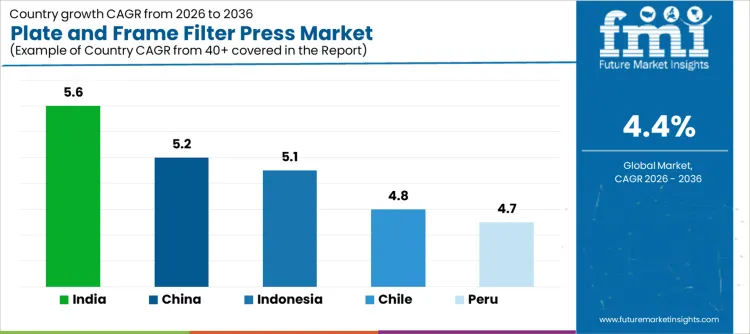
The plate and frame filter press market is expanding steadily as industries increase focus on efficient solid-liquid separation, sludge dewatering, and water recovery across mining, chemicals, food processing, and wastewater treatment. Demand is driven by industrial expansion, tightening discharge requirements, and modernization of existing processing facilities. Growth patterns vary by country depending on mining activity, industrial investment cycles, and infrastructure development. Mature mining markets show replacement-led demand and efficiency upgrades, while emerging economies are supported by Greenfield projects and capacity additions.
| Country | CAGR (%) |
|---|---|
| India | 5.6 |
| China | 5.2 |
| Indonesia | 5.1 |
| Chile | 4.8 |
| Peru | 4.7 |
Why Is India Emerging As A Steady-Growth Market For Plate And Frame Filter Presses?
Demand for plate and frame filter press is growing at a CAGR of 5.6% during 2026-2036, supported by expanding activity across mining, chemicals, pharmaceuticals, food processing, and wastewater treatment sectors. Increasing emphasis on solid-liquid separation efficiency in industrial processes is driving adoption of filter presses for sludge dewatering, mineral processing, and product recovery. Buyers prioritize filtration efficiency, ease of maintenance, and adaptability to varied slurry characteristics. Demand is strong in both new industrial projects and upgrades of existing processing plants seeking improved throughput and reduced downtime. Cost sensitivity influences procurement decisions, but operational reliability and plate durability remain critical selection criteria. Local manufacturing and assembly capabilities support competitive pricing and faster delivery. Market value is driven by industrial expansion, infrastructure development, and rising treatment capacity requirements. India represents a practical growth market where supplier success depends on cost-effective designs, strong service support, and ability to serve diverse end-use industries.
How Is China Sustaining Consistent Demand For Plate And Frame Filter Press Systems?
Sale for plate and frame filter press in China is expanding at a CAGR of 5.2% during 2026-2036, driven by large-scale industrial processing and continued investment in mining, chemicals, and environmental treatment facilities. Filter presses are widely used for mineral concentrates, chemical intermediates, and industrial sludge handling. Buyers emphasize high throughput, automation compatibility, and long service life under continuous operation. Local manufacturing dominance supports cost efficiency and broad availability. Procurement decisions favor suppliers with proven engineering capability, standardized designs, and ability to deliver at scale. Replacement demand remains significant as older filtration systems are modernized. Market value is driven by industrial volume, plant standardization, and maintenance cycles. China represents a volume-driven market where competitiveness depends on manufacturing scale, performance consistency, and ability to support large industrial installations reliably.
What Is Driving Gradual Growth Of Plate And Frame Filter Presses In Indonesia?
Demand for plate and frame filter press in Indonesia is growing at a CAGR of 5.1% during 2026-2036, supported by steady activity across mining, palm oil processing, chemicals, and wastewater treatment sectors. Demand is linked to a mix of Greenfield industrial projects and incremental capacity upgrades at existing facilities. Filter presses are adopted to improve solid-liquid separation efficiency, sludge dewatering performance, and water recovery in challenging operating environments. Buyers prioritize mechanical robustness, corrosion-resistant materials, and ease of operation due to high humidity, variable feed characteristics, and continuous-duty requirements. Imported equipment plays a significant role, often specified by EPC contractors managing project execution. Procurement decisions favor suppliers that can provide reliable local service support, spare parts availability, and commissioning assistance. Market value is driven by gradual industrial expansion, tightening discharge norms, and ongoing investment in waste handling infrastructure. Indonesia represents a balanced market where success depends on equipment durability, responsive service networks, and adaptability to diverse process conditions.
Why Is Chile Maintaining Stable Demand For Plate And Frame Filter Presses?
Demand for plate and frame filter press in Chile is expanding at a CAGR of 4.8% during 2026-2036, shaped primarily by the country’s well-established mining and mineral processing industry. Filter presses are essential for tailings dewatering, concentrate filtration, and water reuse in copper and mineral extraction operations. Buyers emphasize filtration efficiency, structural integrity, and reliable performance under high-pressure and abrasive conditions. Procurement decisions are typically project-based and closely aligned with mine expansions, debottlenecking initiatives, or modernization programs aimed at improving operational efficiency. Demand is largely replacement-driven, as operators upgrade older filtration systems to improve uptime and reduce operating costs. Market value is supported by continuous mine operation requirements and efficiency optimization rather than rapid capacity additions. Chile represents a mature, mining-focused market where growth is steady and supplier success depends on proven engineering reliability, sector experience, and long-term operational support capabilities.
How Is Peru Supporting Controlled Growth In Plate And Frame Filter Press Adoption?
Peru’s plate and frame filter press market is growing at a CAGR of 4.7% during the forecast period, supported by sustained mining investments and selective industrial development. Filter presses are widely used in mineral beneficiation, tailings management, and water recovery applications across copper, gold, and polymetallic mining operations. Buyers prioritize rugged construction, high-pressure performance, and ease of maintenance due to remote operating locations and demanding process conditions. Procurement decisions are cautious and often influenced by project economics, commodity price cycles, and capital allocation discipline. Demand is primarily driven by mine upgrades, life-extension projects, and compliance with environmental discharge requirements rather than large-scale new installations. Market value is shaped by replacement demand and efficiency improvements within existing operations. Peru represents a controlled-growth market where supplier success depends on equipment durability, dependable technical support, and strong long-term relationships with mining operators and EPC partners.
How Are Manufacturers Competing in the Plate and Frame Filter Press Market?
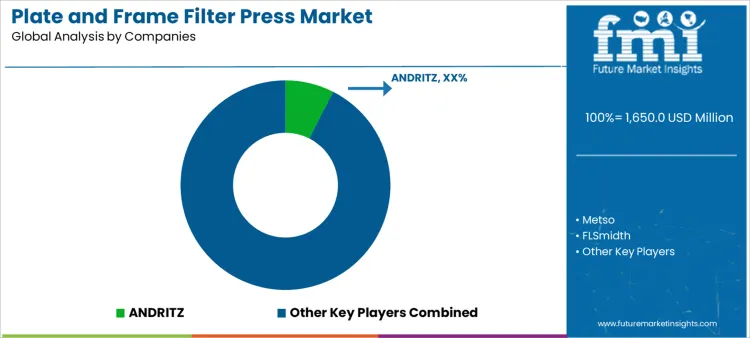
Competition in the plate and frame filter press market is driven by dewatering efficiency, mechanical robustness, and adaptability to diverse slurry characteristics across mining, minerals processing, chemicals, wastewater, and food industries. ANDRITZ positions its filter presses around high-capacity frames, advanced hydraulic closing systems, and automation-ready designs that support continuous industrial duty. Product portfolios emphasize large-format plates, consistent cake dryness, and integration with upstream thickening and downstream material handling. Metso competes through engineered filtration solutions optimized for mining and aggregates, with design focus on uniform pressure distribution, long cloth life, and predictable filtration cycles under abrasive conditions.
Process specialization and lifecycle support from another layer of competition. FLSmidth differentiates by tailoring plate and frame filter presses for high-throughput mineral applications, emphasizing large tonnage handling and automation compatibility. Micronics Engineered Filtration focuses on application-specific press configurations, supported by filter media expertise and retrofit capabilities that extend equipment life. Evoqua (now part of Xylem) positions its presses around municipal and industrial water treatment needs, with documentation highlighting reliability, ease of maintenance, and compliance with environmental discharge requirements.
Regional engineering strength and cost-performance balance define competition among other players. MSE Filterpressen and Diemme Filtration emphasize precision manufacturing, corrosion-resistant materials, and customized press layouts. Jingjin Equipment and Ishigaki Company compete through scale, automation features, and competitive delivery timelines. Haibar Filtration adds value through application-driven designs. Across the market, competitive advantage is built on proven dewatering performance, mechanical durability, and service support rather than pricing alone.
Key Players in Plate and Frame Filter Press Market
- ANDRITZ
- Metso
- FLSmidth
- Micronics Engineered Filtration
- Evoqua (Xylem)
- MSE Filterpressen
- Diemme Filtration
- Haibar Filtration
- Jingjin Equipment
- Ishigaki Company
Scope of Report
| Attribute | Details |
|---|---|
| Market Size Unit | USD Million |
| End Use Covered | Mining & Minerals, Municipal & Industrial Wastewater, Chemicals, Food & Beverage, Pharma |
| Plate Size Covered | Up to 800 mm, 800-1500 mm, Above 1500 mm, Other |
| Countries Covered | China, Japan, South Korea, India, Australia & New Zealand, ASEAN, Rest of Asia Pacific, Germany, United Kingdom, France, Italy, Spain, Nordic, BENELUX, Rest of Europe, United States, Canada, Mexico, Brazil, Chile, Rest of Latin America, Kingdom of Saudi Arabia, Other GCC Countries, Turkey, South Africa, Other African Union, Rest of Middle East & Africa |
| Regions Covered | Asia Pacific, Europe, North America, Latin America, Middle East & Africa |
| Key Companies Profiled | ANDRITZ, Metso, FLSmidth, Micronics Engineered Filtration, Evoqua (Xylem), MSE Filterpressen, Diemme Filtration, Haibar Filtration, Jingjin Equipment, Ishigaki Company |
| Additional Attributes | Dollar sales by end use and plate size are analyzed across solid-liquid separation applications. The scope covers filter press configurations, automation levels, filtration media compatibility, cake dryness performance, operating pressure ranges, aftermarket services, and replacement demand. Country-level analysis reflects industrial activity, wastewater treatment capacity expansion, and mining and processing investments. |
Plate and Frame Filter Press Market by Key Segments
End Use:
- Mining & Minerals
- Municipal & Industrial Wastewater
- Chemicals
- Food & Beverage
- Pharma
Plate Size:
- Up to 800 mm
- 800-1500 mm
- Above 1500 mm
- Other
Region:
- Asia Pacific
- China
- Japan
- South Korea
- India
- Australia & New Zealand
- ASEAN
- Rest of Asia Pacific
- Europe
- Germany
- United Kingdom
- France
- Italy
- Spain
- Nordic
- BENELUX
- Rest of Europe
- North America
- United States
- Canada
- Mexico
- Latin America
- Brazil
- Chile
- Rest of Latin America
- Middle East & Africa
- Kingdom of Saudi Arabia
- Other GCC Countries
- Turkey
- South Africa
- Other African Union
- Rest of Middle East & Africa
Bibliography
- International Organization for Standardization. (2023). ISO 16966: Filter presses — Common safety requirements. ISO.
- ASTM International. (2024). ASTM D5276‑24: Standard test method for solids concentration and dewatering performance in filter press operations. ASTM International.
- European Commission. (2024). Industrial emissions and wastewater treatment requirements under Directive 2010/75/EU (Consolidated 2024 version). Publications Office of the European Union.
Frequently Asked Questions
How big is the plate and frame filter press market in 2026?
The global plate and frame filter press market is estimated to be valued at USD 1,650.0 million in 2026.
What will be the size of plate and frame filter press market in 2036?
The market size for the plate and frame filter press market is projected to reach USD 2,538.0 million by 2036.
How much will be the plate and frame filter press market growth between 2026 and 2036?
The plate and frame filter press market is expected to grow at a 4.4% CAGR between 2026 and 2036.
What are the key product types in the plate and frame filter press market?
The key product types in plate and frame filter press market are mining & minerals, municipal & industrial wastewater, chemicals, food & beverage and pharma.
Which plate size segment to contribute significant share in the plate and frame filter press market in 2026?
In terms of plate size, up to 800 mm segment to command 28.0% share in the plate and frame filter press market in 2026.
Preview the report firsthand - request a free sample
Get SampleGet the brochure for pricing and purchase details.
Get PDFTable of Content
- Executive Summary
- Global Market Outlook
- Demand-side Trends
- Supply-side Trends
- Technology Roadmap Analysis
- Analysis and Recommendations
- Market Overview
- Market Coverage / Taxonomy
- Market Definition / Scope / Limitations
- Market Background
- Market Dynamics
- Drivers
- Restraints
- Opportunity
- Trends
- Scenario Forecast
- Demand in Optimistic Scenario
- Demand in Likely Scenario
- Demand in Conservative Scenario
- Opportunity Map Analysis
- Product Life Cycle Analysis
- Supply Chain Analysis
- Investment Feasibility Matrix
- Value Chain Analysis
- PESTLE and Porter’s Analysis
- Regulatory Landscape
- Regional Parent Market Outlook
- Production and Consumption Statistics
- Import and Export Statistics
- Market Dynamics
- Global Market Analysis 2021 to 2025 and Forecast, 2026 to 2036
- Historical Market Size Value (USD Million) Analysis, 2021 to 2025
- Current and Future Market Size Value (USD Million) Projections, 2026 to 2036
- Y-o-Y Growth Trend Analysis
- Absolute $ Opportunity Analysis
- Global Market Pricing Analysis 2021 to 2025 and Forecast 2026 to 2036
- Global Market Analysis 2021 to 2025 and Forecast 2026 to 2036, By End Use
- Introduction / Key Findings
- Historical Market Size Value (USD Million) Analysis By End Use , 2021 to 2025
- Current and Future Market Size Value (USD Million) Analysis and Forecast By End Use , 2026 to 2036
- Mining & Minerals
- Municipal & Industrial Wastewater
- Chemicals
- Food & Beverage
- Pharma
- Mining & Minerals
- Y-o-Y Growth Trend Analysis By End Use , 2021 to 2025
- Absolute $ Opportunity Analysis By End Use , 2026 to 2036
- Global Market Analysis 2021 to 2025 and Forecast 2026 to 2036, By Plate Size
- Introduction / Key Findings
- Historical Market Size Value (USD Million) Analysis By Plate Size, 2021 to 2025
- Current and Future Market Size Value (USD Million) Analysis and Forecast By Plate Size, 2026 to 2036
- Up to 800 mm
- 800–1500 mm
- Above 1500 mm
- Other
- Up to 800 mm
- Y-o-Y Growth Trend Analysis By Plate Size, 2021 to 2025
- Absolute $ Opportunity Analysis By Plate Size, 2026 to 2036
- Global Market Analysis 2021 to 2025 and Forecast 2026 to 2036, By Region
- Introduction
- Historical Market Size Value (USD Million) Analysis By Region, 2021 to 2025
- Current Market Size Value (USD Million) Analysis and Forecast By Region, 2026 to 2036
- North America
- Latin America
- Western Europe
- Eastern Europe
- East Asia
- South Asia and Pacific
- Middle East & Africa
- Market Attractiveness Analysis By Region
- North America Market Analysis 2021 to 2025 and Forecast 2026 to 2036, By Country
- Historical Market Size Value (USD Million) Trend Analysis By Market Taxonomy, 2021 to 2025
- Market Size Value (USD Million) Forecast By Market Taxonomy, 2026 to 2036
- By Country
- USA
- Canada
- Mexico
- By End Use
- By Plate Size
- By Country
- Market Attractiveness Analysis
- By Country
- By End Use
- By Plate Size
- Key Takeaways
- Latin America Market Analysis 2021 to 2025 and Forecast 2026 to 2036, By Country
- Historical Market Size Value (USD Million) Trend Analysis By Market Taxonomy, 2021 to 2025
- Market Size Value (USD Million) Forecast By Market Taxonomy, 2026 to 2036
- By Country
- Brazil
- Chile
- Rest of Latin America
- By End Use
- By Plate Size
- By Country
- Market Attractiveness Analysis
- By Country
- By End Use
- By Plate Size
- Key Takeaways
- Western Europe Market Analysis 2021 to 2025 and Forecast 2026 to 2036, By Country
- Historical Market Size Value (USD Million) Trend Analysis By Market Taxonomy, 2021 to 2025
- Market Size Value (USD Million) Forecast By Market Taxonomy, 2026 to 2036
- By Country
- Germany
- UK
- Italy
- Spain
- France
- Nordic
- BENELUX
- Rest of Western Europe
- By End Use
- By Plate Size
- By Country
- Market Attractiveness Analysis
- By Country
- By End Use
- By Plate Size
- Key Takeaways
- Eastern Europe Market Analysis 2021 to 2025 and Forecast 2026 to 2036, By Country
- Historical Market Size Value (USD Million) Trend Analysis By Market Taxonomy, 2021 to 2025
- Market Size Value (USD Million) Forecast By Market Taxonomy, 2026 to 2036
- By Country
- Russia
- Poland
- Hungary
- Balkan & Baltic
- Rest of Eastern Europe
- By End Use
- By Plate Size
- By Country
- Market Attractiveness Analysis
- By Country
- By End Use
- By Plate Size
- Key Takeaways
- East Asia Market Analysis 2021 to 2025 and Forecast 2026 to 2036, By Country
- Historical Market Size Value (USD Million) Trend Analysis By Market Taxonomy, 2021 to 2025
- Market Size Value (USD Million) Forecast By Market Taxonomy, 2026 to 2036
- By Country
- China
- Japan
- South Korea
- By End Use
- By Plate Size
- By Country
- Market Attractiveness Analysis
- By Country
- By End Use
- By Plate Size
- Key Takeaways
- South Asia and Pacific Market Analysis 2021 to 2025 and Forecast 2026 to 2036, By Country
- Historical Market Size Value (USD Million) Trend Analysis By Market Taxonomy, 2021 to 2025
- Market Size Value (USD Million) Forecast By Market Taxonomy, 2026 to 2036
- By Country
- India
- ASEAN
- Australia & New Zealand
- Rest of South Asia and Pacific
- By End Use
- By Plate Size
- By Country
- Market Attractiveness Analysis
- By Country
- By End Use
- By Plate Size
- Key Takeaways
- Middle East & Africa Market Analysis 2021 to 2025 and Forecast 2026 to 2036, By Country
- Historical Market Size Value (USD Million) Trend Analysis By Market Taxonomy, 2021 to 2025
- Market Size Value (USD Million) Forecast By Market Taxonomy, 2026 to 2036
- By Country
- Kingdom of Saudi Arabia
- Other GCC Countries
- Turkiye
- South Africa
- Other African Union
- Rest of Middle East & Africa
- By End Use
- By Plate Size
- By Country
- Market Attractiveness Analysis
- By Country
- By End Use
- By Plate Size
- Key Takeaways
- Key Countries Market Analysis
- USA
- Pricing Analysis
- Market Share Analysis, 2025
- By End Use
- By Plate Size
- Canada
- Pricing Analysis
- Market Share Analysis, 2025
- By End Use
- By Plate Size
- Mexico
- Pricing Analysis
- Market Share Analysis, 2025
- By End Use
- By Plate Size
- Brazil
- Pricing Analysis
- Market Share Analysis, 2025
- By End Use
- By Plate Size
- Chile
- Pricing Analysis
- Market Share Analysis, 2025
- By End Use
- By Plate Size
- Germany
- Pricing Analysis
- Market Share Analysis, 2025
- By End Use
- By Plate Size
- UK
- Pricing Analysis
- Market Share Analysis, 2025
- By End Use
- By Plate Size
- Italy
- Pricing Analysis
- Market Share Analysis, 2025
- By End Use
- By Plate Size
- Spain
- Pricing Analysis
- Market Share Analysis, 2025
- By End Use
- By Plate Size
- France
- Pricing Analysis
- Market Share Analysis, 2025
- By End Use
- By Plate Size
- India
- Pricing Analysis
- Market Share Analysis, 2025
- By End Use
- By Plate Size
- ASEAN
- Pricing Analysis
- Market Share Analysis, 2025
- By End Use
- By Plate Size
- Australia & New Zealand
- Pricing Analysis
- Market Share Analysis, 2025
- By End Use
- By Plate Size
- China
- Pricing Analysis
- Market Share Analysis, 2025
- By End Use
- By Plate Size
- Japan
- Pricing Analysis
- Market Share Analysis, 2025
- By End Use
- By Plate Size
- South Korea
- Pricing Analysis
- Market Share Analysis, 2025
- By End Use
- By Plate Size
- Russia
- Pricing Analysis
- Market Share Analysis, 2025
- By End Use
- By Plate Size
- Poland
- Pricing Analysis
- Market Share Analysis, 2025
- By End Use
- By Plate Size
- Hungary
- Pricing Analysis
- Market Share Analysis, 2025
- By End Use
- By Plate Size
- Kingdom of Saudi Arabia
- Pricing Analysis
- Market Share Analysis, 2025
- By End Use
- By Plate Size
- Turkiye
- Pricing Analysis
- Market Share Analysis, 2025
- By End Use
- By Plate Size
- South Africa
- Pricing Analysis
- Market Share Analysis, 2025
- By End Use
- By Plate Size
- USA
- Market Structure Analysis
- Competition Dashboard
- Competition Benchmarking
- Market Share Analysis of Top Players
- By Regional
- By End Use
- By Plate Size
- Competition Analysis
- Competition Deep Dive
- ANDRITZ
- Overview
- Product Portfolio
- Profitability by Market Segments (Product/Age /Sales Channel/Region)
- Sales Footprint
- Strategy Overview
- Marketing Strategy
- Product Strategy
- Channel Strategy
- Metso
- FLSmidth
- Micronics Engineered Filtration
- Evoqua (Xylem)
- MSE Filterpressen
- Diemme Filtration
- Haibar Filtration
- Jingjin Equipment
- Ishigaki Companies
- ANDRITZ
- Competition Deep Dive
- Assumptions & Acronyms Used
- Research Methodology


