

- Industry Size (2026)
- USD 861.1 Mn
- Forecast (2036)
- USD 2316.0 Mn
- CAGR (2026 to 2036)
- 10.4%
One-Pedal Brake Control Modules Market Forecast and Outlook (2026–2036)
USD 861.1 million in 2026 establishes the starting scale of the one-pedal brake control modules market, with the value projected to reach USD 2,316.0 million by 2036 at a 10.4% CAGR. Demand arises from vehicle programs that seek consistent deceleration behavior through combined regenerative and friction control under a single pedal input. Automakers define deceleration maps, recovery limits, and driver interface behavior during platform engineering. Control module selection fixes interaction rules among traction, stability, and battery systems. Once a platform enters production, later changes require renewed validation across safety, drivability, and fault management protocols. Volume growth follows wider deployment of electrified platforms and centralized vehicle control architectures across passenger and light commercial segments.
Program governance within the one-pedal brake control modules market is determined by platform ownership, homologation schedules, and calibration responsibility. Access to supply positions depends on inclusion within approved vehicle control architectures rather than on component substitution. Evaluation focuses on predictability of deceleration, recovery efficiency, and response consistency under variable load and surface conditions. Approved implementations remain in place across full model cycles because safety cases and software sets attach to specific vehicle definitions. Supplier changes occur during platform transitions rather than during mid-cycle sourcing actions. Revenue development reflects the number of vehicle programs adopting single-pedal driving strategies and integrated chassis control layouts.
One-Pedal Brake Control Modules Market Quick Stats
- One-Pedal Brake Control Modules Market Value (2026): USD 861.1 million
- One-Pedal Brake Control Modules Market Forecast Value (2036): USD 2,316.0 million
- One-Pedal Brake Control Modules Market Forecast CAGR (2026-2036): 10.4%
- Leading Function in One-Pedal Brake Control Modules Market: Regen Pedal Map Control
- Key Growth Regions in One-Pedal Brake Control Modules Market: China, USA, Germany, South Korea, Japan
- Top Players in One-Pedal Brake Control Modules Market: Bosch, Continental, ZF Friedrichshafen, Aptiv, Hyundai Mobis, Nidec, Denso, Valeo, Hitachi Astemo
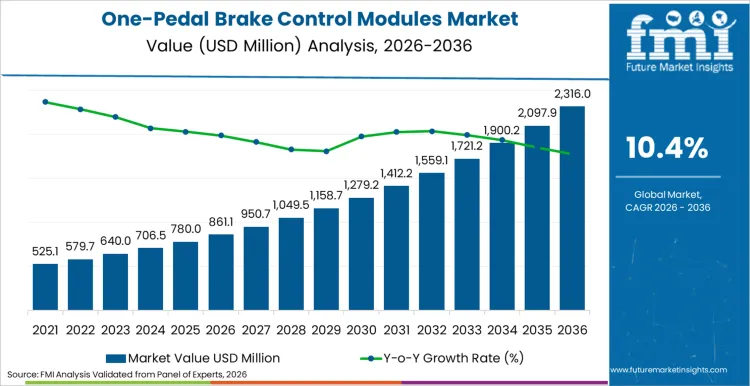
What is the Growth Forecast for the One Pedal Brake Control Modules Market through 2036?
Driver interface strategy defines the role of these modules more than brake hardware layout. One pedal control logic links deceleration, energy recovery, creep behavior, and stop hold inside a single command layer. In 2026, the one pedal brake control modules market stands at USD 861.1 million, up from USD 525.1 million in 2021, reflecting steady adoption across passenger EV platforms. Platform teams judge these modules through pedal mapping accuracy, transition stability to friction braking, and fault handling under low traction. Program awards sit inside vehicle architecture decisions, not inside feature packages. The rise to USD 2,316.0 million by 2036 represents a 10.4% growth path supported by wider standardization of single pedal driving modes and deeper software integration per vehicle.
Vehicle platform governance shapes commercial behavior in the one pedal brake control modules market. Volumes move under multi year supply agreements tied to homologation cycles and safety case approvals. Inventory exposure stays limited since value concentrates in controllers, sensors, and embedded software. Cost structure reflects control unit hardware, validation mileage, calibration effort, and compliance testing. OEM teams track stop smoothness, energy recovery consistency, and driver acceptance metrics rather than unit module price. Annual values pass through USD 1,279.2 million in 2030 and USD 1,900.2 million in 2033 as more platforms migrate to single pedal driving logic. The approach to USD 2,316.0 million in 2036 comes from broader deployment in mass market vehicles, higher software content per module, and longer platform lifetimes that lock these systems into core control stacks.
One-Pedal Brake Control Modules Market Key Takeaways
| Metric | Value |
|---|---|
| Market Value (2026) | USD 861.1 million |
| Forecast Value (2036) | USD 2,316.0 million |
| Forecast CAGR (2026 to 2036) | 10.4% |
Source: FMI’s proprietary forecasting model and primary research
How Is the One Pedal Brake Control Modules Market Being Used to Simplify Driver Interaction While Preserving Braking Consistency?
One pedal driving changes braking from a discrete action into a continuous control problem managed by software and power electronics. Control modules in this market must translate accelerator release into predictable deceleration while coordinating motor torque, friction brakes, and stability systems. Calibration teams focus on initial lift off response, low speed creep behavior, and stop hold transitions because these define driver trust in daily use. Engineers also validate gradient handling and load variation since vehicle mass and road slope change the same pedal input into very different braking demands. Hardware integration tracks sensor agreement and actuator response times because delays or mismatches create surging or hesitation. Qualification depends on repeatable feel across temperatures, battery states, and tire conditions rather than on maximum energy recovery performance.
Program planning around these modules centers on driveability approval, platform reuse, and update control rather than on feature marketing. Vehicle makers measure success through complaint rates, consistency between trims, and time spent in calibration loops. A control strategy that feels acceptable in one vehicle configuration but unstable in another forces variant specific tuning and slows rollout. Manufacturing teams monitor pedal sensor tolerances and brake system bleeding because small differences shift control behavior. Service teams care about diagnostics and software version control since field issues often follow updates. Supplier selection favors groups that can support long term calibration ownership and documentation. Contracts define responsibility for control logic, safety functions, and fallback behavior because braking feel affects certification, warranty exposure, and brand risk more than incremental efficiency gains.
How Do Driver Interface Expectations and Regulatory Signaling Rules Shape Demand in the One-Pedal Brake Control Modules Market by Function and Platform in 2026?
In the one-pedal brake control modules market, system definition starts from deceleration predictability, release behavior, and legal signaling obligations rather than from control unit hardware cost. Programs serving passenger vehicle platforms, premium vehicle architectures, and light commercial electric fleets require software that converts accelerator lift into a consistent, auditable slowing response. By function, usage spans regen pedal map control, creep and stop-hold control, brake light logic and compliance, and other features. By platform, demand covers passenger EVs, premium and luxury EVs, LCV EVs, and other categories. Portfolio structure reflects validation scope, legal exposure, and reuse potential across multiple nameplates.
Why Do Regen Pedal Mapping and Low-Speed Hold Functions Define Module Architecture?
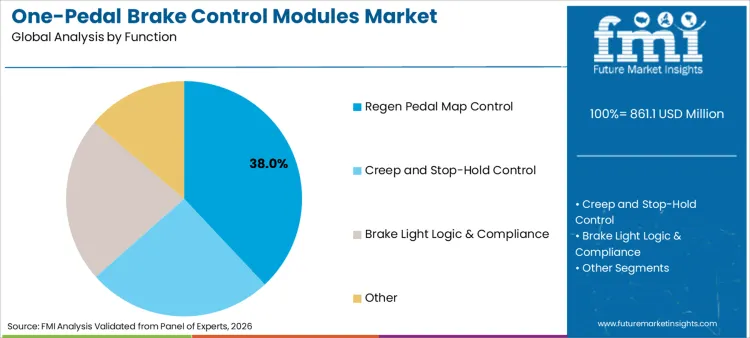
Regen pedal map control represents about 38% share, reflecting its role in setting the primary deceleration feel during lift-off. In passenger electric vehicle platforms, this map determines comfort, consistency, and energy recovery balance in daily traffic. Creep and stop-hold control supports low-speed maneuvering, parking, and hill starts, which influences acceptance in premium segments. Brake light logic and compliance functions ensure that deceleration behavior remains visible and legally correct across markets. Other functions remain secondary. Engineering teams assess functions through deceleration ramps, blending smoothness, and corner-case handling. Software teams assess through state management and fault transitions. Compliance teams assess through signaling thresholds and regulation mapping.
After a functional content set is fixed, state machines, calibration tables, and test cases are written around that logic. Any change introduces new drive cycle testing, new corner-case reviews, and updated legal sign-off. Program planning then protects extended software stabilization phases. Supplier interfaces and vehicle networks align to the chosen function split. Service diagnostics and update tools also follow that structure. Volume growth comes from reusing the same functional core across models rather than reshaping feature boundaries. The operating result favors stable regen mapping frameworks that limit subjective complaints and regulatory risk while preserving consistent energy recovery behavior across fleets.
Why Do Passenger EV Platforms Concentrate Most Deployment Volume?
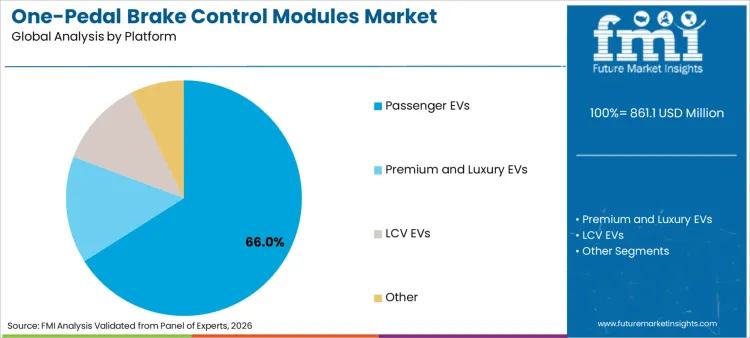
Passenger EVs account for about 66% share, driven by scale and by driver sensitivity to lift-off deceleration feel and low-speed control behavior. In this segment, one-pedal response becomes part of the brand driving signature and must remain consistent across trims and software updates. Premium and luxury EVs follow, with greater emphasis on seamless stop-hold transitions and imperceptible blending. LCV EVs prioritize predictability under load and clear signaling over refinement. Other platforms remain limited. Vehicle teams evaluate platforms through acceptance clinics and drive cycle repeatability. Validation teams evaluate through fault recovery and edge cases. Manufacturing teams evaluate through variant management.
Platform focus then defines the entire calibration and validation workload. Drive profiles, acceptance metrics, and endurance loops are written around the dominant use case. Shifting platform priority introduces new weight distributions, duty cycles, and regulatory checks. Program schedules and budgets align to that center of gravity. Supplier tooling and test benches follow. Training materials and service procedures also assume the same behavior. Expansion occurs by adding models within the same platform class rather than switching focus. Demand therefore concentrates in passenger EV programs where scale, driver perception, and software reuse converge.
Why Are Regenerative Braking Efficiency and Driver Experience Priorities Supporting the One-Pedal Brake Control Modules Market?
One-Pedal Brake Control Modules Market demand is influenced by vehicle manufacturers that seek to improve energy recovery and deliver a seamless driving experience in electrified and hybrid platforms. One-pedal control modules allow drivers to decelerate and stop primarily through regenerative braking, reducing dependency on friction braking in everyday driving and capturing kinetic energy into the battery. Automotive engineers evaluate modules based on responsiveness, integration with traction and stability systems, and consistency of deceleration feel across operating conditions. Buyers focus on modules that integrate with existing vehicle control networks, support predictable behavior profiles, and maintain performance across temperature and load ranges, helping balance range targets with driver comfort.
What Challenges Are Affecting Adoption and Integration in the One-Pedal Brake Control Modules Market?
One-Pedal Brake Control Modules Market expansion is influenced by control logic calibration needs, model-specific integration requirements, and extended validation cycles within vehicle programs. Modules must harmonize regenerative deceleration with traditional friction braking to satisfy safety performance criteria and driver expectations, requiring detailed tuning and system-level testing. Variations in vehicle mass, tire friction, and battery state of charge influence desired brake torque distribution, which complicates platform generalization. Component cost pressures in competitive vehicle segments affect system architecture choices and supplier selection. Integration with other vehicle systems, sensor fidelity, and fault management frameworks shape procurement timelines and engineering allocation for OEM and tier teams.
How Are Product Families and Supply Practices Shaping the One-Pedal Brake Control Modules Market?
One-pedal brake control modules market offerings are organized around control algorithm families, interface standards, and performance validation data that help vehicle engineers match module capabilities to program requirements. Suppliers provide documented behavior maps showing deceleration profiles, recovery efficiency, and integration notes for stability and traction systems. Portfolio segmentation by vehicle class, expected duty cycle, and drive architecture helps OEMs align module choice with program targets. Commercial practices increasingly include calibration support services, software update pathways, and long-term supply agreements that secure production continuity and responsiveness to change requests. Technical collaboration emphasizes control strategy mapping, integration checklists, and multi-condition validation to help manufacturers maintain consistent performance and reliability across diverse applications.
What is the Demand for One Pedal Brake Control Modules by Country?
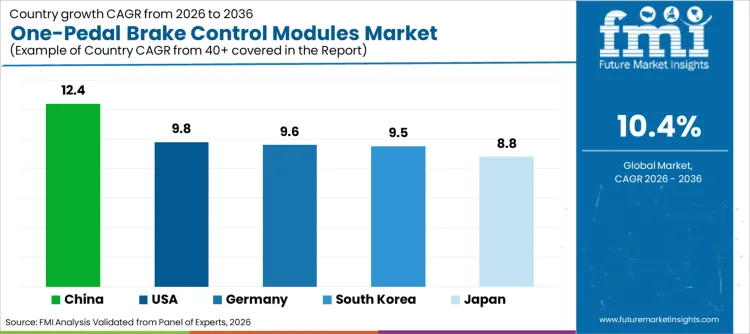
| Country | CAGR (%) |
|---|---|
| USA | 9.8% |
| Japan | 8.8% |
| South Korea | 9.5% |
| Germany | 9.6% |
| China | 12.4% |
Source: FMI’s proprietary forecasting model and primary research
The demand for one pedal brake control modules is rising across electric and hybrid vehicles where regenerative braking integration and simplified driver operation enhance efficiency and safety. China leads at 12.4% CAGR, supported by rapid EV adoption, domestic OEM integration, and government policies promoting energy recovery systems. The USA grows at 9.8%, driven by expanding EV production and consumer adoption of single pedal driving systems. Germany records 9.6%, shaped by premium and performance EV models incorporating advanced brake control technologies. South Korea advances at 9.5%, reflecting steady EV and hybrid vehicle production growth. Japan posts 8.8%, within a mature EV market focused on performance, safety, and integration with regenerative energy recovery systems.
How Do System Integration and Pedal Modulation Requirements Influence the One-Pedal Brake Control Modules Market in the USA?
The one-pedal brake control modules market in the United States is expanding at a 9.8% CAGR, driven by integration with electric vehicle platforms and regenerative braking architectures. Approval depends on validated pedal modulation, braking torque distribution, and responsiveness under variable load conditions. Engineers evaluate energy recovery efficiency, system latency, thermal stability, and interaction with traction control units. Once a module passes these assessments, deployment is standardized across multiple EV platforms and assembly lines. Volume growth is linked to new model launches, fleet expansion, and performance-oriented EV variants. Supplier access depends on technical documentation, audit compliance, and post-integration support. Production planning aligns with assembly schedules. Commercial success relies on reliable multi-platform performance, cross-compatibility, and technical support across high-volume production environments.
How Do Safety Protocols and Validation Tests Shape Adoption in the One-Pedal Brake Control Modules Market in Japan?
In Japan, the one-pedal brake control modules market is growing at an 8.8% CAGR due to stringent safety validation requirements. System approval requires verified responsiveness, braking stability, and integration with regenerative braking and electronic stability control. Engineers assess pedal feel, torque consistency, system thermal behavior, and energy recovery efficiency under repeated operation. Once validated, the same module is deployed across multiple EV lines. Supplier participation depends on complete documentation, audit compliance, and integration support. Volume growth tracks new vehicle platform introductions, fleet upgrades, and production expansion rather than isolated model launches. Commercial positioning relies on reliable braking behavior, compliance with safety standards, and consistent engineering support.
How Do Platform Standardization Requirements Influence Scale in the One-Pedal Brake Control Modules Market in South Korea?
Platform standardization is guiding the one-pedal brake control modules market in South Korea at a 9.5% CAGR. Modules are evaluated for compatibility with multiple EV variants within a shared platform, including regenerative and hydraulic braking subsystems. Testing focuses on pedal modulation, torque distribution, energy recovery, and thermal management. Once approved, deployment occurs across all compatible vehicles without additional validation. Supplier access is contingent on successful testing, documentation compliance, and technical alignment. Volume growth follows platform rollouts and fleet expansion rather than ad hoc adoption. Commercial success depends on repeatable system performance, integration reliability, and long-term technical support across multiple assembly lines.
How Do Central Approval Protocols Govern Supplier Participation in the One-Pedal Brake Control Modules Market in Germany?
Central approval protocols are shaping the one-pedal brake control modules market in Germany at a 9.6% CAGR. Individual assembly plants cannot introduce modules independently. Evaluation focuses on braking consistency, pedal modulation, energy recovery efficiency, and system reliability under repeated use. Once approved, deployment occurs across multiple assembly lines under uniform technical and safety standards. Volume growth follows fleet expansion and new platform introductions rather than local sourcing initiatives. Supplier access depends on audit performance, documentation quality, and technical integration capability. Change management is formal and closely monitored. Commercial success relies on predictable multi-platform performance, verified compliance, and reliable post-integration support.
How Do Replication Programs and Qualification Files Accelerate Adoption in the One-Pedal Brake Control Modules Market in China?
Replication programs are driving the one-pedal brake control modules market in China at a 12.4% CAGR. Once a module demonstrates verified braking performance, energy recovery, and thermal stability in one facility, it is deployed into parallel production lines with minimal redesign. Approval emphasizes repeatability, integration reliability, and compliance with safety standards. Expansion teams rely on standardized testing protocols, qualification files, and commissioning procedures. Domestic suppliers benefit from rapid rollout across multiple EV assembly facilities, while imported modules focus on high-performance or premium segments. Volume growth results from fleet expansion and replication of validated configurations. Commercial advantage depends on early inclusion in reference programs, consistent performance, and reliable technical support for large-scale deployment.
How Do Suppliers Compete in the One-Pedal Brake Control Modules Market?
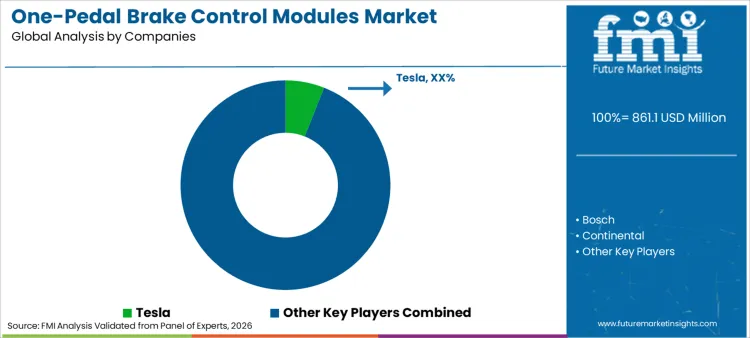
System responsiveness, integration with regenerative braking, and reliability under varying operating conditions determine adoption in the One-Pedal Brake Control Modules Market. Bosch, Continental, ZF Friedrichshafen, Aptiv, Hyundai Mobis, Nidec, Denso, Valeo, and Hitachi Astemo compete during component testing, vehicle-level validation, and software calibration trials. Once integrated into electric and hybrid vehicles, braking modulation, energy recovery efficiency, and compatibility with vehicle stability systems anchor supplier selection. Bosch emphasizes precise control algorithms and modular system design. Continental provides scalable one-pedal solutions for passenger and commercial EVs. ZF Friedrichshafen delivers high-precision modules compatible with multiple architectures. Aptiv focuses on electronic control integration. Hyundai Mobis and Valeo supply fully integrated braking modules. Nidec and Denso provide motor-integrated systems. Hitachi Astemo targets ready-to-install modules for diverse EV platforms.
Calibration accuracy, durability, and technical support shape competitive positioning in the One-Pedal Brake Control Modules Market. Engineers evaluate system response time, regenerative energy capture, thermal tolerance, and fail-safe performance during validation. Suppliers capable of reproducible production, scalable deployment, and on-vehicle integration support gain preference. Bosch maintains adoption through OEM partnerships and pilot integration support. Continental secures placements in high-volume EV programs. ZF Friedrichshafen captures share where precision and system reliability are critical. Aptiv focuses on integration in electronic control units. Hyundai Mobis and Valeo provide modular solutions for diverse EV platforms. Nidec and Denso compete in motor-integrated systems requiring high reliability. Hitachi Astemo supports multiple vehicle classes with validated modules. Market positions vary by system architecture, vehicle type, production scale, and regional automotive standards.
Key Players in One-Pedal Brake Control Modules Market
- Bosch GmbH
- Continental AG
- ZF Friedrichshafen AG
- Aptiv PLC
- Hyundai Mobis Co., Ltd.
- Nidec Corporation
- Denso Corporation
- Valeo SA
- Hitachi Astemo, Ltd.
Scope of the Report
| Items | Values |
|---|---|
| Quantitative Units (2026) | USD million |
| Function | Regen pedal map control, creep and stop-hold control, brake light logic and compliance, other |
| Platform | Passenger EVs, premium and luxury EVs, LCV EVs, other |
| Integration | Inverter and motor controller integrated, brake ECU integrated, vehicle domain controller, other |
| Delivery Model | Embedded software, OTA updates, calibration packages, other |
| Regions Covered | Asia Pacific, Europe, North America, Latin America, Middle East & Africa |
| Countries Covered | United States, Canada, Mexico, Germany, United Kingdom, France, Italy, Spain, Nordics, BENELUX, China, Japan, South Korea, India, Australia & New Zealand, ASEAN, Brazil, Chile, Saudi Arabia, Turkey, South Africa, and other regional markets |
| Key Companies Profiled | Bosch, Continental, ZF Friedrichshafen, Aptiv, Hyundai Mobis, Nidec, Denso, Valeo, Hitachi Astemo |
| Additional Attributes | Dollar sales by function, platform, integration, and delivery model, deceleration mapping and driver interface behavior, coordination between regenerative and friction braking, stop-hold and creep behavior management, brake light signaling compliance, calibration and safety validation cycles, integration with traction, stability, and battery management systems, OTA update and software lifecycle management, platform reuse and multi-year supply agreements, and regional demand patterns across passenger, premium, and light commercial electric vehicle programs |
One-Pedal Brake Control Modules Market Segmentation
Function:
- Regen Pedal Map Control
- Creep and Stop-Hold Control
- Brake Light Logic & Compliance
- Other
Platform:
- Passenger EVs
- Premium and Luxury EVs
- LCV EVs
- Other
Integration:
- Inverter and Motor Controller Integrated
- Brake ECU Integrated
- Vehicle Domain Controller
- Other
Delivery Model:
- Embedded Software
- OTA Updates
- Calibration Packages
- Other
Region
-
Asia Pacific
- China
- Japan
- South Korea
- India
- Australia & New Zealand
- ASEAN
- Rest of Asia Pacific
-
Europe
- Germany
- United Kingdom
- France
- Italy
- Spain
- Nordic
- BENELUX
- Rest of Europe
-
North America
- United States
- Canada
- Mexico
-
Latin America
- Brazil
- Chile
- Rest of Latin America
-
Middle East & Africa
- Kingdom of Saudi Arabia
- Other GCC Countries
- Turkey
- South Africa
- Other African Union
- Rest of Middle East & Africa
References
- United Nations Economic Commission for Europe. (2023). UN Regulation No. 13-H: Uniform provisions concerning the approval of passenger cars with regard to braking. UNECE.
- United Nations Economic Commission for Europe. (2023). UN Regulation No. 140: Electronic stability control systems. UNECE.
- United Nations Economic Commission for Europe. (2024). UN Regulation No. 79: Steering equipment and advanced driver control systems. UNECE.
- United Nations Economic Commission for Europe. (2024). UN Regulation No. 152: Advanced emergency braking systems. UNECE.
Frequently Asked Questions
How big is the one-pedal brake control modules market in 2026?
The one-pedal brake control modules market is projected to be valued at USD 861.1 million in 2026.
What will be the size of the one-pedal brake control modules market in 2036?
The market size for one-pedal brake control modules is projected to reach USD 2,316.0 million by 2036.
How much will the demand for one-pedal brake control modules grow between 2026 and 2036?
Demand for one-pedal brake control modules is projected to grow at a 10.4% CAGR between 2026 and 2036.
Which function holds a significant share in the one-pedal brake control modules market in 2026?
In terms of function, regen pedal map control is expected to account for a 38% share in 2026.
Which platform segment contributes a major share in the one-pedal brake control modules market in 2026?
The passenger EVs segment is expected to command a 66% share in the one-pedal brake control modules market in 2026.
Preview the report firsthand - request a free sample
Get SampleGet the brochure for pricing and purchase details.
Get PDFTable of Content
- Executive Summary
- Global Market Outlook
- Demand-side Trends
- Supply-side Trends
- Technology Roadmap Analysis
- Analysis and Recommendations
- Market Overview
- Market Coverage / Taxonomy
- Market Definition / Scope / Limitations
- Market Background
- Market Dynamics
- Drivers
- Restraints
- Opportunity
- Trends
- Scenario Forecast
- Demand in Optimistic Scenario
- Demand in Likely Scenario
- Demand in Conservative Scenario
- Opportunity Map Analysis
- Product Life Cycle Analysis
- Supply Chain Analysis
- Investment Feasibility Matrix
- Value Chain Analysis
- PESTLE and Porter’s Analysis
- Regulatory Landscape
- Regional Parent Market Outlook
- Production and Consumption Statistics
- Import and Export Statistics
- Market Dynamics
- Global Market Analysis 2021 to 2025 and Forecast, 2026 to 2036
- Historical Market Size Value (USD Million) Analysis, 2021 to 2025
- Current and Future Market Size Value (USD Million) Projections, 2026 to 2036
- Y-o-Y Growth Trend Analysis
- Absolute $ Opportunity Analysis
- Global Market Pricing Analysis 2021 to 2025 and Forecast 2026 to 2036
- Global Market Analysis 2021 to 2025 and Forecast 2026 to 2036, By Function
- Introduction / Key Findings
- Historical Market Size Value (USD Million) Analysis By Function , 2021 to 2025
- Current and Future Market Size Value (USD Million) Analysis and Forecast By Function , 2026 to 2036
- Regen Pedal Map Control
- Creep and Stop-Hold Control
- Brake Light Logic & Compliance
- Other
- Regen Pedal Map Control
- Y-o-Y Growth Trend Analysis By Function , 2021 to 2025
- Absolute $ Opportunity Analysis By Function , 2026 to 2036
- Global Market Analysis 2021 to 2025 and Forecast 2026 to 2036, By Platform
- Introduction / Key Findings
- Historical Market Size Value (USD Million) Analysis By Platform, 2021 to 2025
- Current and Future Market Size Value (USD Million) Analysis and Forecast By Platform, 2026 to 2036
- Passenger EVs
- Premium and Luxury EVs
- LCV EVs
- Other
- Passenger EVs
- Y-o-Y Growth Trend Analysis By Platform, 2021 to 2025
- Absolute $ Opportunity Analysis By Platform, 2026 to 2036
- Global Market Analysis 2021 to 2025 and Forecast 2026 to 2036, By Integration
- Introduction / Key Findings
- Historical Market Size Value (USD Million) Analysis By Integration, 2021 to 2025
- Current and Future Market Size Value (USD Million) Analysis and Forecast By Integration, 2026 to 2036
- Inverter and Motor Controller Integrated
- Brake ECU Integrated
- Vehicle Domain Controller
- Other
- Inverter and Motor Controller Integrated
- Y-o-Y Growth Trend Analysis By Integration, 2021 to 2025
- Absolute $ Opportunity Analysis By Integration, 2026 to 2036
- Global Market Analysis 2021 to 2025 and Forecast 2026 to 2036, By Delivery Model
- Introduction / Key Findings
- Historical Market Size Value (USD Million) Analysis By Delivery Model, 2021 to 2025
- Current and Future Market Size Value (USD Million) Analysis and Forecast By Delivery Model, 2026 to 2036
- Embedded Software
- OTA Updates
- Calibration Packages
- Other
- Embedded Software
- Y-o-Y Growth Trend Analysis By Delivery Model, 2021 to 2025
- Absolute $ Opportunity Analysis By Delivery Model, 2026 to 2036
- Global Market Analysis 2021 to 2025 and Forecast 2026 to 2036, By Region
- Introduction
- Historical Market Size Value (USD Million) Analysis By Region, 2021 to 2025
- Current Market Size Value (USD Million) Analysis and Forecast By Region, 2026 to 2036
- North America
- Latin America
- Western Europe
- Eastern Europe
- East Asia
- South Asia and Pacific
- Middle East & Africa
- Market Attractiveness Analysis By Region
- North America Market Analysis 2021 to 2025 and Forecast 2026 to 2036, By Country
- Historical Market Size Value (USD Million) Trend Analysis By Market Taxonomy, 2021 to 2025
- Market Size Value (USD Million) Forecast By Market Taxonomy, 2026 to 2036
- By Country
- USA
- Canada
- Mexico
- By Function
- By Platform
- By Integration
- By Delivery Model
- By Country
- Market Attractiveness Analysis
- By Country
- By Function
- By Platform
- By Integration
- By Delivery Model
- Key Takeaways
- Latin America Market Analysis 2021 to 2025 and Forecast 2026 to 2036, By Country
- Historical Market Size Value (USD Million) Trend Analysis By Market Taxonomy, 2021 to 2025
- Market Size Value (USD Million) Forecast By Market Taxonomy, 2026 to 2036
- By Country
- Brazil
- Chile
- Rest of Latin America
- By Function
- By Platform
- By Integration
- By Delivery Model
- By Country
- Market Attractiveness Analysis
- By Country
- By Function
- By Platform
- By Integration
- By Delivery Model
- Key Takeaways
- Western Europe Market Analysis 2021 to 2025 and Forecast 2026 to 2036, By Country
- Historical Market Size Value (USD Million) Trend Analysis By Market Taxonomy, 2021 to 2025
- Market Size Value (USD Million) Forecast By Market Taxonomy, 2026 to 2036
- By Country
- Germany
- UK
- Italy
- Spain
- France
- Nordic
- BENELUX
- Rest of Western Europe
- By Function
- By Platform
- By Integration
- By Delivery Model
- By Country
- Market Attractiveness Analysis
- By Country
- By Function
- By Platform
- By Integration
- By Delivery Model
- Key Takeaways
- Eastern Europe Market Analysis 2021 to 2025 and Forecast 2026 to 2036, By Country
- Historical Market Size Value (USD Million) Trend Analysis By Market Taxonomy, 2021 to 2025
- Market Size Value (USD Million) Forecast By Market Taxonomy, 2026 to 2036
- By Country
- Russia
- Poland
- Hungary
- Balkan & Baltic
- Rest of Eastern Europe
- By Function
- By Platform
- By Integration
- By Delivery Model
- By Country
- Market Attractiveness Analysis
- By Country
- By Function
- By Platform
- By Integration
- By Delivery Model
- Key Takeaways
- East Asia Market Analysis 2021 to 2025 and Forecast 2026 to 2036, By Country
- Historical Market Size Value (USD Million) Trend Analysis By Market Taxonomy, 2021 to 2025
- Market Size Value (USD Million) Forecast By Market Taxonomy, 2026 to 2036
- By Country
- China
- Japan
- South Korea
- By Function
- By Platform
- By Integration
- By Delivery Model
- By Country
- Market Attractiveness Analysis
- By Country
- By Function
- By Platform
- By Integration
- By Delivery Model
- Key Takeaways
- South Asia and Pacific Market Analysis 2021 to 2025 and Forecast 2026 to 2036, By Country
- Historical Market Size Value (USD Million) Trend Analysis By Market Taxonomy, 2021 to 2025
- Market Size Value (USD Million) Forecast By Market Taxonomy, 2026 to 2036
- By Country
- India
- ASEAN
- Australia & New Zealand
- Rest of South Asia and Pacific
- By Function
- By Platform
- By Integration
- By Delivery Model
- By Country
- Market Attractiveness Analysis
- By Country
- By Function
- By Platform
- By Integration
- By Delivery Model
- Key Takeaways
- Middle East & Africa Market Analysis 2021 to 2025 and Forecast 2026 to 2036, By Country
- Historical Market Size Value (USD Million) Trend Analysis By Market Taxonomy, 2021 to 2025
- Market Size Value (USD Million) Forecast By Market Taxonomy, 2026 to 2036
- By Country
- Kingdom of Saudi Arabia
- Other GCC Countries
- Turkiye
- South Africa
- Other African Union
- Rest of Middle East & Africa
- By Function
- By Platform
- By Integration
- By Delivery Model
- By Country
- Market Attractiveness Analysis
- By Country
- By Function
- By Platform
- By Integration
- By Delivery Model
- Key Takeaways
- Key Countries Market Analysis
- USA
- Pricing Analysis
- Market Share Analysis, 2025
- By Function
- By Platform
- By Integration
- By Delivery Model
- Canada
- Pricing Analysis
- Market Share Analysis, 2025
- By Function
- By Platform
- By Integration
- By Delivery Model
- Mexico
- Pricing Analysis
- Market Share Analysis, 2025
- By Function
- By Platform
- By Integration
- By Delivery Model
- Brazil
- Pricing Analysis
- Market Share Analysis, 2025
- By Function
- By Platform
- By Integration
- By Delivery Model
- Chile
- Pricing Analysis
- Market Share Analysis, 2025
- By Function
- By Platform
- By Integration
- By Delivery Model
- Germany
- Pricing Analysis
- Market Share Analysis, 2025
- By Function
- By Platform
- By Integration
- By Delivery Model
- UK
- Pricing Analysis
- Market Share Analysis, 2025
- By Function
- By Platform
- By Integration
- By Delivery Model
- Italy
- Pricing Analysis
- Market Share Analysis, 2025
- By Function
- By Platform
- By Integration
- By Delivery Model
- Spain
- Pricing Analysis
- Market Share Analysis, 2025
- By Function
- By Platform
- By Integration
- By Delivery Model
- France
- Pricing Analysis
- Market Share Analysis, 2025
- By Function
- By Platform
- By Integration
- By Delivery Model
- India
- Pricing Analysis
- Market Share Analysis, 2025
- By Function
- By Platform
- By Integration
- By Delivery Model
- ASEAN
- Pricing Analysis
- Market Share Analysis, 2025
- By Function
- By Platform
- By Integration
- By Delivery Model
- Australia & New Zealand
- Pricing Analysis
- Market Share Analysis, 2025
- By Function
- By Platform
- By Integration
- By Delivery Model
- China
- Pricing Analysis
- Market Share Analysis, 2025
- By Function
- By Platform
- By Integration
- By Delivery Model
- Japan
- Pricing Analysis
- Market Share Analysis, 2025
- By Function
- By Platform
- By Integration
- By Delivery Model
- South Korea
- Pricing Analysis
- Market Share Analysis, 2025
- By Function
- By Platform
- By Integration
- By Delivery Model
- Russia
- Pricing Analysis
- Market Share Analysis, 2025
- By Function
- By Platform
- By Integration
- By Delivery Model
- Poland
- Pricing Analysis
- Market Share Analysis, 2025
- By Function
- By Platform
- By Integration
- By Delivery Model
- Hungary
- Pricing Analysis
- Market Share Analysis, 2025
- By Function
- By Platform
- By Integration
- By Delivery Model
- Kingdom of Saudi Arabia
- Pricing Analysis
- Market Share Analysis, 2025
- By Function
- By Platform
- By Integration
- By Delivery Model
- Turkiye
- Pricing Analysis
- Market Share Analysis, 2025
- By Function
- By Platform
- By Integration
- By Delivery Model
- South Africa
- Pricing Analysis
- Market Share Analysis, 2025
- By Function
- By Platform
- By Integration
- By Delivery Model
- USA
- Market Structure Analysis
- Competition Dashboard
- Competition Benchmarking
- Market Share Analysis of Top Players
- By Regional
- By Function
- By Platform
- By Integration
- By Delivery Model
- Competition Analysis
- Competition Deep Dive
- Tesla
- Overview
- Product Portfolio
- Profitability by Market Segments (Product/Age /Sales Channel/Region)
- Sales Footprint
- Strategy Overview
- Marketing Strategy
- Product Strategy
- Channel Strategy
- Bosch
- Continental
- ZF
- Aptiv
- Hyundai Mobis
- Nidec
- Denso
- Valeo
- Hitachi Astemo
- Tesla
- Competition Deep Dive
- Assumptions & Acronyms Used
- Research Methodology


