

- Industry Size (2026)
- USD 1722.6 Mn
- Forecast (2036)
- USD 2649.7 Mn
- CAGR (2026 to 2036)
- 4.4%
Trailer EBS Modules and Brake Valves Market Forecast and Outlook 2026 to 2036
The trailer EBS modules and brake valves market is likely to be valued at USD 1,722.6 million in 2026 and is projected to reach USD 2,649.7 million by 2036, reflecting a CAGR of 4.4%. Value creation is anchored in the structural role of electronic braking in articulated freight operations rather than in trailer production growth alone. Electronic braking system modules and pneumatic brake valves are safety-critical components that directly influence stopping distance, directional stability, and load control under high gross combination weights. Adoption intensity tracks regulatory enforcement, fleet safety programs, and the increasing operational complexity of long-haul and regional logistics networks.
Demand behavior is shaped by compliance obligations and lifecycle risk management. Fleet operators prioritize EBS architectures that provide consistent brake response, fault diagnostics, and interoperability with tractor systems across mixed fleets. Brake valve selection emphasizes pressure accuracy, durability under high cycling frequency, and contamination resistance in harsh operating environments. Replacement demand reflects mileage accumulation, inspection outcomes, and retrofit requirements for legacy trailers entering stricter compliance regimes. Procurement decisions favor suppliers with validated safety records, established OEM fitment, and service network coverage that reduces downtime exposure. Growth quality therefore reflects regulatory alignment, utilization intensity, and maintenance-led replacement dynamics rather than discretionary technology upgrades.
Quick Stats for Trailer EBS Modules and Brake Valves Market
- Trailer EBS Modules and Brake Valves Market Value (2026): USD 1,722.6 million
- Trailer EBS Modules and Brake Valves Market Forecast Value (2036): USD 2,649.7 million
- Trailer EBS Modules and Brake Valves Market Forecast CAGR 2026 to 2036: 4.4%
- Leading Product Category by Demand Share: EBS Control Units
- Fastest-Growing Countries: China, Brazil, USA, Germany, South Korea
- Top Players in Global Demand: Knorr-Bremse, WABCO (ZF), Haldex, Bendix (Knorr-Bremse), Bosch, Continental, Meritor (Cummins), Aptiv, Hitachi Astemo
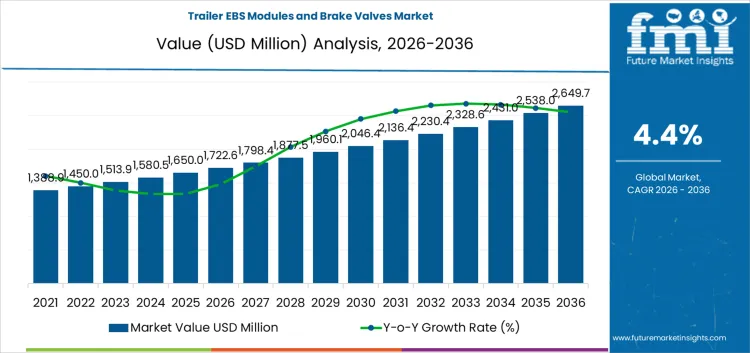
Trailer EBS Modules and Brake Valves Market Key Takeaways
| Metric | Value |
|---|---|
| Market Value (2026) | USD 1,722.6 million |
| Market Forecast Value (2036) | USD 2,649.7 million |
| Forecast CAGR 2026 to 2036 | 4.4% |
Why is the Demand for Trailer EBS Modules and Brake Valves Growing?
Demand for trailer electronic braking system modules and brake valves is increasing as logistics and commercial transport operators require precise control of braking functions to support safety and operational efficiency. Freight fleets and trailer manufacturers specify EBS modules that coordinate brake pressure with vehicle dynamics systems that maintain stability under variable loads and road conditions. Engineers evaluate module communication protocols, diagnostic feedback capability, and environmental resistance to ensure components meet performance expectations over extensive duty cycles. Brake valves are specified with attention to response accuracy and pressure regulation to maintain controlled deceleration in heavy trailer configurations.
Regulatory emphasis on braking performance and vehicle safety standards influences procurement decisions that align with compliance requirements across jurisdictions. Growth in long haul and regional transport activity is reinforcing adoption of advanced braking hardware that integrates with tractor systems and supports coordinated braking strategies. Fleet maintenance planners prioritize modules and valves that simplify fault detection and reduce downtime during service intervals. Manufacturers of trailer assemblies engage with suppliers to verify component compatibility with air supply systems and control networks. Training for service technicians on installation and calibration procedures enhances reliability in field operations. These technical and operational drivers sustain demand for trailer EBS modules and brake valves across evolving transport environments.
How Are the Segments Classified in the Trailer EBS Modules and Brake Valves Market?
Demand for trailer electronic braking system modules and brake valves is shaped by safety regulation compliance, braking stability requirements, and fleet reliability expectations. Trailer braking performance directly affects stopping distance, load control, and accident risk mitigation. Adoption aligns with regulatory mandates for electronic braking and anti-lock systems across commercial trailers. Component selection prioritizes response accuracy, fault tolerance, and compatibility with tractor braking architectures. Segment classification reflects differentiation by braking component role, trailer configuration, and sales channel structure. Structure highlights how control function, trailer application profile, and procurement pathway influence deployment scale, replacement behavior, and installation patterns across trailer braking systems.
Which Product Category Represents the Largest Share of Demand?
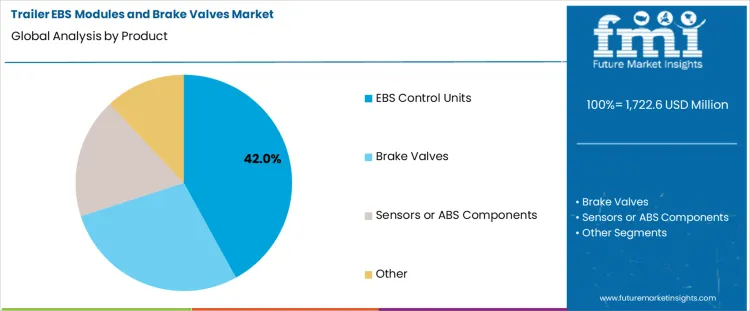
EBS control units hold 42.0%, representing the largest share among product categories due to central role in electronic braking coordination. These units process sensor inputs and modulate braking force across trailer axles to maintain stability. Integration supports compliance with electronic braking regulations and enhances safety during emergency stops. Design emphasis includes redundancy, diagnostics capability, and communication reliability with tractor systems. Brake valves regulate pneumatic pressure with supportive control function. Sensors and ABS components provide feedback and wheel control. Product segmentation reflects dominance of electronic control hardware where braking intelligence and regulatory compliance drive adoption.
Key Points
- EBS control units coordinate electronic braking responses.
- Regulatory compliance increases control unit integration.
- Other products support pressure regulation and feedback.
Which Trailer Type Accounts for the Highest Share of Demand?
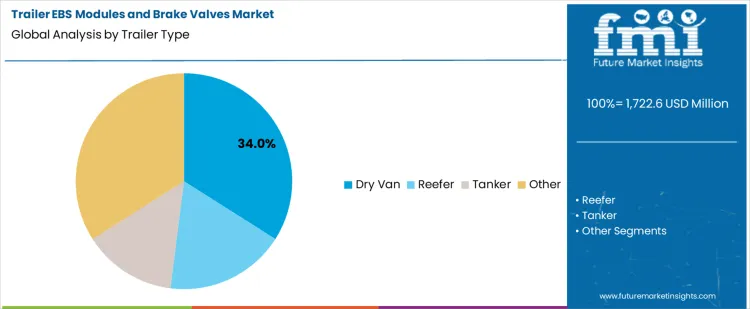
Dry van trailers hold 34.0%, representing the largest share among trailer types due to widespread use in freight transport. High fleet volumes and standardized configurations drive consistent braking system installation. Operational diversity across long-haul and regional routes increases reliance on stable braking performance. Reefer and tanker trailers operate under specialized load and safety requirements with lower aggregate volumes. Other trailer types collectively contribute similar volume distribution. Trailer segmentation reflects concentration of braking system demand within general-purpose trailers forming the backbone of commercial logistics operations.
Key Points
- Dry vans dominate trailer population and utilization.
- Standardized designs support consistent braking system adoption.
- Other trailer types address specialized transport needs.
Which Sales Channel Drives the Largest Share of Demand?
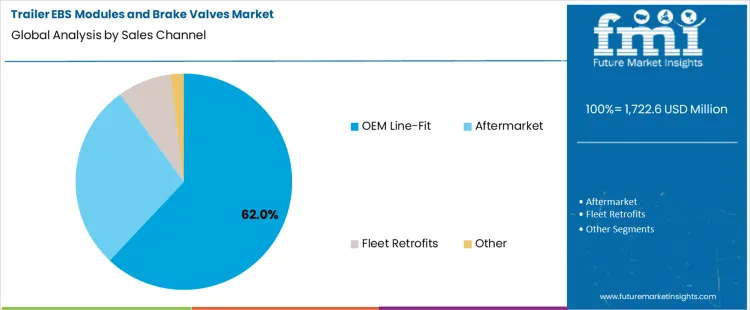
OEM line-fit holds 62.0%, representing the largest share among sales channels due to regulatory integration at production stage. Trailers are increasingly equipped with electronic braking systems during manufacturing to meet safety mandates. Line-fit installation ensures system compatibility, certification compliance, and warranty alignment. Aftermarket sales support replacement and service requirements across operating fleets. Fleet retrofits address compliance upgrades for existing trailers. Sales channel segmentation reflects preference for factory-installed solutions where safety certification and system integration remain critical.
Key Points
- OEM line-fit enables regulatory compliance at manufacturing stage.
- Factory installation ensures system compatibility and certification.
- Other channels support replacement and upgrade requirements.
What are the Key Dynamics in the Trailer EBS Modules and Brake Valves Market?
Demand for trailer EBS modules and brake valves reflects safety-critical requirements for electronically controlled braking in articulated commercial vehicles. Adoption spans long-haul trailers, tankers, refrigerated units, and specialized freight platforms. Global scope aligns with braking regulation compliance, stopping distance control, and vehicle stability expectations. Usage centers on electronic control modules, pneumatic valves, and sensors coordinating trailer braking with tractor systems.
How do braking safety regulation and vehicle stability requirements shape adoption?
Trailer braking performance directly affects stopping distance, jackknifing risk, and load stability during emergency maneuvers. Demand increases as electronic braking systems enable faster brake response compared with purely pneumatic systems. EBS modules coordinate braking force distribution between axles, improving stability under uneven load conditions. Integration with tractor ABS and stability control systems supports synchronized deceleration. Heavy trailers operating at higher gross combination weights rely on precise brake modulation to reduce tire lock and wear. Regulatory mandates in commercial transport corridors reinforce standardized EBS adoption. Fleet operators value diagnostic capability enabling fault detection and reduced roadside inspection risk. Adoption reflects non-discretionary safety compliance rather than optional performance enhancement.
How do system cost, maintenance exposure, and interoperability constraints influence market scalability?
EBS modules and brake valves increase upfront trailer cost compared with conventional braking hardware. Demand sensitivity rises among cost-focused trailer operators and regional fleets. Electronic components operate in harsh environments with vibration, moisture, and contamination exposure. Maintenance requires diagnostic tools and trained technicians, increasing service dependency. Interoperability challenges emerge across mixed tractor-trailer combinations and legacy fleets. Validation requirements for braking safety extend development timelines. Component failure risk elevates liability and warranty exposure. Supply chain dependence on electronic sensors and precision valves constrains rapid scaling across diverse trailer configurations.
How Is Demand for Trailer EBS Modules and Brake Valves Evolving Globally?
Demand for trailer EBS modules and brake valves is expanding globally due to safety regulation tightening, fleet digitization, and rising utilization of articulated freight combinations. Electronic braking supports stability control, shorter stopping distances, and data-enabled diagnostics across long-haul and regional operations. Adoption aligns with compliance timelines, tractor-trailer interoperability requirements, and maintenance-led upgrades. Electrified and advanced trailers increase need for precise pneumatic and electronic control. Growth rates in China at 6.0%, Brazil at 5.8%, USA at 4.0%, Germany at 3.8%, and South Korea at 3.6% indicate sustained expansion driven by safety compliance, operating intensity, and lifecycle replacement.
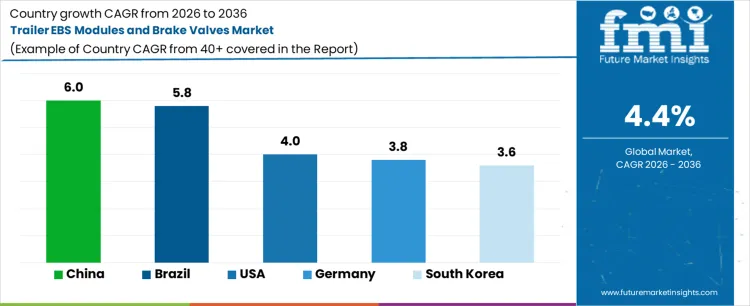
| Country | CAGR (%) |
|---|---|
| China | 6.0% |
| Brazil | 5.8% |
| USA | 4.0% |
| Germany | 3.8% |
| South Korea | 3.6% |
What Is Driving Growth of Trailer EBS Demand in China?
Trailer EBS module and brake valve demand in China is growing at a CAGR of 6.0%, supported by expanding articulated freight and stricter safety oversight. Long-distance logistics increases braking events under variable loads, elevating value of electronic control. Regulatory enforcement accelerates retrofit of legacy trailers to meet stability and stopping requirements. OEM trailer production sustains line-fit volumes, while fleet standardization improves interoperability with tractors. High utilization in e-commerce corridors reinforces maintenance-led replacement. Growth reflects compliance acceleration and operating intensity rather than trailer population expansion.
- Safety regulation enforcement accelerating EBS fitment
- High braking event frequency in long-haul logistics
- OEM trailer production sustaining line-fit volumes
- Retrofit activity across legacy trailer fleets
Why Is Brazil Experiencing Rapid Adoption of Trailer EBS Systems?
Operating risk management is shaping trailer EBS module and brake valve demand in Brazil, expanding at a CAGR of 5.8%. Long-haul routes and variable road conditions increase stability risk during braking. Fleet operators adopt EBS to improve control under uneven loads and adverse weather. Regulatory alignment encourages phased upgrades across trailers. Agricultural and mining logistics sustain heavy utilization, raising maintenance-driven replacement. Demand growth reflects safety performance needs and downtime reduction priorities rather than growth in trailer registrations.
- Long-haul routes increasing stability risk
- Variable road conditions elevating braking demands
- Regulatory alignment supporting phased upgrades
- Heavy utilization in agriculture and mining logistics
How Is the USA Sustaining Demand for Trailer EBS Modules?
Trailer EBS module and brake valve demand in the USA is expanding at a CAGR of 4.0%, driven by compliance programs and fleet analytics adoption. Large national fleets standardize EBS to improve stopping performance and diagnostics. High mileage accumulation accelerates wear on pneumatic valves, supporting aftermarket replacement. Interoperability with tractor systems influences specification choices. Capital budgeting favors staged retrofits alongside maintenance cycles. Growth remains measured, aligned with compliance timelines and lifecycle servicing.
- Fleet standardization for safety and diagnostics
- High mileage accelerating valve wear
- Tractor-trailer interoperability requirements
- Staged retrofits aligned with maintenance cycles
What Factors Are Shaping Trailer EBS Demand in Germany?
Engineering standards and regulation define trailer EBS module and brake valve demand in Germany, growing at a CAGR of 3.8%. Strict safety and inspection regimes support electronic braking adoption. Preventive maintenance practices create predictable replacement intervals. High expectations for stability and stopping performance influence component quality and redundancy. Export-driven logistics sustain steady utilization without rapid fleet growth. Demand reflects disciplined compliance within mature fleets rather than accelerated adoption waves.
- Strict safety and inspection requirements
- Predictable replacement under preventive maintenance
- High performance expectations for braking stability
- Stable utilization from export logistics
Why Is South Korea Showing Controlled Growth in Trailer EBS Demand?
Operational efficiency and compact geography shape trailer EBS module and brake valve demand in South Korea, expanding at a CAGR of 3.6%. Shorter routes limit cumulative braking stress, moderating replacement frequency. Strong maintenance discipline supports reliability with scheduled upgrades. Port-centric logistics sustain consistent articulated trailer usage. Regulatory alignment encourages steady adoption without rapid retrofit surges. Growth remains controlled, reflecting efficient operations and standardized fleet practices rather than expansion of trailer volumes.
- Shorter routes moderating cumulative brake stress
- Strong maintenance discipline across fleets
- Port-centric logistics sustaining utilization
- Gradual regulatory-aligned adoption patterns
What is the competitive landscape of demand for trailer EBS modules and brake valves globally?
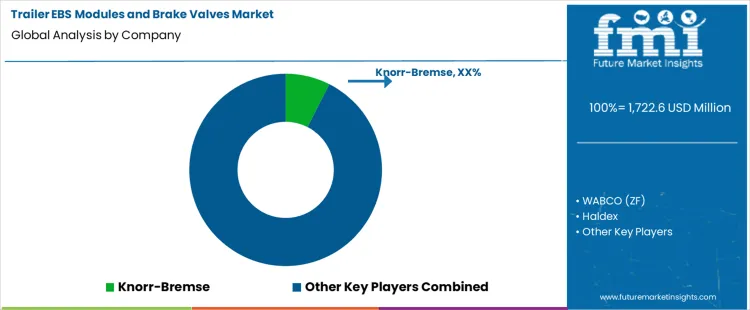
Demand for trailer electronic braking system (EBS) modules and brake valves is driven by safety regulations, fleet electrification, and requirements for advanced braking performance in commercial trailers. EBS modules integrate sensors and control logic to manage braking force, stability, and anti-lock functions, while brake valves regulate air pressure in pneumatic systems. Buyers evaluate system reliability, diagnostics capability, integration with tractor braking systems, and compliance with regional safety standards. Procurement teams prioritize suppliers with strong OEM qualifications, global service networks, and robust quality systems that support both new build and aftermarket channels. Trend in the global market reflects adoption of advanced driver assistance systems, emphasis on fleet operational safety, and integration of EBS with telematics and predictive maintenance platforms.
Knorr-Bremse holds leading positioning through comprehensive EBS modules and brake valve portfolios widely adopted across global trailer and truck platforms supported by extensive engineering and support networks. WABCO, operating within ZF, supports demand with advanced electronic braking systems and pneumatic control valves integrated into trailer control architectures. Haldex participates with EBS controllers, modulators, and valve systems tailored to heavy-duty and commercial applications. Bosch contributes braking control technologies and pneumatic valve solutions aligned with safety and performance benchmarks for commercial vehicles. Continental supplies integrated braking modules and control valves that enhance stability and safety while simplifying assembly. Competitive differentiation depends on system reliability, diagnostic depth, regulatory compliance, and ability to support connected fleet safety and maintenance strategies.
Key Players in the Trailer EBS Modules and Brake Valves Market
- Knorr-Bremse
- WABCO (ZF)
- Haldex
- Bendix (Knorr-Bremse)
- Bosch
- Continental
- Meritor (Cummins)
- Aptiv
- Hitachi Astemo
Scope of the Report
| Items | Values |
|---|---|
| Quantitative Units | USD million |
| Product | EBS Control Units; Brake Valves; Sensors or ABS Components; Other |
| Trailer Type | Dry Van; Reefer; Tanker; Other |
| Sales Channel | OEM Line-Fit; Aftermarket; Fleet Retrofits; Other |
| Regions Covered | Asia Pacific, Europe, North America, Latin America, Middle East & Africa |
| Countries Covered | China, Brazil, USA, Germany, South Korea, and 40+ countries |
| Key Companies Profiled | Knorr-Bremse; WABCO; Haldex; Bendix; Bosch; Continental; Meritor; Aptiv; Hitachi Astemo |
| Additional Attributes | Dollar sales by product and trailer type; adoption trends for electronic braking systems supporting stability, shorter stopping distances, and regulatory compliance; response time, modulation accuracy, and fail-safe redundancy performance metrics; integration with tractor EBS, telematics, and stability control; durability under harsh duty cycles, contamination resistance, and air system reliability; retrofit demand driven by safety mandates and fleet standardization; compliance with regional braking regulations and OEM validation requirements influencing trailer EBS module and brake valve specification. |
Trailer EBS Modules and Brake Valves Market by Segment
Product:
- EBS Control Units
- Brake Valves
- Sensors or ABS Components
- Other
Trailer Type:
- Dry Van
- Reefer
- Tanker
- Other
Sales Channel:
- OEM Line-Fit
- Aftermarket
- Fleet Retrofits
- Other
Region:
- Asia Pacific
- China
- Japan
- South Korea
- India
- Australia & New Zealand
- ASEAN
- Rest of Asia Pacific
- Europe
- Germany
- United Kingdom
- France
- Italy
- Spain
- Nordic
- BENELUX
- Rest of Europe
- North America
- United States
- Canada
- Mexico
- Latin America
- Brazil
- Chile
- Rest of Latin America
- Middle East & Africa
- Kingdom of Saudi Arabia
- Other GCC Countries
- Turkey
- South Africa
- Other African Union
- Rest of Middle East & Africa
Bibliography
- European Commission. (2023). Regulation (EU) 2019/2144 on type-approval requirements for motor vehicles and their trailers, systems, components and separate technical units, including braking performance and electronic braking system provisions (consolidated version with staged application effective through 2023-2024). Official Journal of the European Union.
- United Nations Economic Commission for Europe. (2023). UNECE Regulation No. 13: Uniform provisions concerning the approval of vehicles with regard to braking systems, including electronic braking systems for trailers (consolidated text incorporating amendments in force during 2023). United Nations.
- United Nations Economic Commission for Europe. (2024). UNECE Regulation No. 79: Uniform provisions concerning the approval of steering equipment and vehicle stability functions, including interaction with electronic braking systems (latest amendments applicable from 2024). United Nations.
- International Organization for Standardization. (2024). ISO 26262-1: Road vehicles-Functional safety-Vocabulary and system-level considerations (latest edition applied to electronic braking and control systems in commercial vehicles). International Organization for Standardization.
- International Transport Forum. (2023). Heavy vehicle braking performance, electronic control systems, and road safety outcomes in freight transport. OECD Publishing.
Frequently Asked Questions
How big is the trailer ebs modules and brake valves market in 2026?
The global trailer ebs modules and brake valves market is estimated to be valued at USD 1,722.6 million in 2026.
What will be the size of trailer ebs modules and brake valves market in 2036?
The market size for the trailer ebs modules and brake valves market is projected to reach USD 2,649.7 million by 2036.
How much will be the trailer ebs modules and brake valves market growth between 2026 and 2036?
The trailer ebs modules and brake valves market is expected to grow at a 4.4% CAGR between 2026 and 2036.
What are the key product types in the trailer ebs modules and brake valves market?
The key product types in trailer ebs modules and brake valves market are ebs control units, brake valves, sensors or abs components and other.
Which trailer type segment to contribute significant share in the trailer ebs modules and brake valves market in 2026?
In terms of trailer type, dry van segment to command 34.0% share in the trailer ebs modules and brake valves market in 2026.
Preview the report firsthand - request a free sample
Get SampleGet the brochure for pricing and purchase details.
Get PDFTable of Content
- Executive Summary
- Global Market Outlook
- Demand-side Trends
- Supply-side Trends
- Technology Roadmap Analysis
- Analysis and Recommendations
- Market Overview
- Market Coverage / Taxonomy
- Market Definition / Scope / Limitations
- Market Background
- Market Dynamics
- Drivers
- Restraints
- Opportunity
- Trends
- Scenario Forecast
- Demand in Optimistic Scenario
- Demand in Likely Scenario
- Demand in Conservative Scenario
- Opportunity Map Analysis
- Product Life Cycle Analysis
- Supply Chain Analysis
- Investment Feasibility Matrix
- Value Chain Analysis
- PESTLE and Porter’s Analysis
- Regulatory Landscape
- Regional Parent Market Outlook
- Production and Consumption Statistics
- Import and Export Statistics
- Market Dynamics
- Global Market Analysis 2021 to 2025 and Forecast, 2026 to 2036
- Historical Market Size Value (USD Million) Analysis, 2021 to 2025
- Current and Future Market Size Value (USD Million) Projections, 2026 to 2036
- Y-o-Y Growth Trend Analysis
- Absolute $ Opportunity Analysis
- Global Market Pricing Analysis 2021 to 2025 and Forecast 2026 to 2036
- Global Market Analysis 2021 to 2025 and Forecast 2026 to 2036, By Product
- Introduction / Key Findings
- Historical Market Size Value (USD Million) Analysis By Product , 2021 to 2025
- Current and Future Market Size Value (USD Million) Analysis and Forecast By Product , 2026 to 2036
- EBS Control Value (USD Million)s
- Brake Valves
- Sensors or ABS Components
- Other
- EBS Control Value (USD Million)s
- Y-o-Y Growth Trend Analysis By Product , 2021 to 2025
- Absolute $ Opportunity Analysis By Product , 2026 to 2036
- Global Market Analysis 2021 to 2025 and Forecast 2026 to 2036, By Trailer Type
- Introduction / Key Findings
- Historical Market Size Value (USD Million) Analysis By Trailer Type, 2021 to 2025
- Current and Future Market Size Value (USD Million) Analysis and Forecast By Trailer Type, 2026 to 2036
- Dry Van
- Reefer
- Tanker
- Other
- Dry Van
- Y-o-Y Growth Trend Analysis By Trailer Type, 2021 to 2025
- Absolute $ Opportunity Analysis By Trailer Type, 2026 to 2036
- Global Market Analysis 2021 to 2025 and Forecast 2026 to 2036, By Sales Channel
- Introduction / Key Findings
- Historical Market Size Value (USD Million) Analysis By Sales Channel, 2021 to 2025
- Current and Future Market Size Value (USD Million) Analysis and Forecast By Sales Channel, 2026 to 2036
- OEM Line-Fit
- Aftermarket
- Fleet Retrofits
- Other
- OEM Line-Fit
- Y-o-Y Growth Trend Analysis By Sales Channel, 2021 to 2025
- Absolute $ Opportunity Analysis By Sales Channel, 2026 to 2036
- Global Market Analysis 2021 to 2025 and Forecast 2026 to 2036, By Region
- Introduction
- Historical Market Size Value (USD Million) Analysis By Region, 2021 to 2025
- Current Market Size Value (USD Million) Analysis and Forecast By Region, 2026 to 2036
- North America
- Latin America
- Western Europe
- Eastern Europe
- East Asia
- South Asia and Pacific
- Middle East & Africa
- Market Attractiveness Analysis By Region
- North America Market Analysis 2021 to 2025 and Forecast 2026 to 2036, By Country
- Historical Market Size Value (USD Million) Trend Analysis By Market Taxonomy, 2021 to 2025
- Market Size Value (USD Million) Forecast By Market Taxonomy, 2026 to 2036
- By Country
- USA
- Canada
- Mexico
- By Product
- By Trailer Type
- By Sales Channel
- By Country
- Market Attractiveness Analysis
- By Country
- By Product
- By Trailer Type
- By Sales Channel
- Key Takeaways
- Latin America Market Analysis 2021 to 2025 and Forecast 2026 to 2036, By Country
- Historical Market Size Value (USD Million) Trend Analysis By Market Taxonomy, 2021 to 2025
- Market Size Value (USD Million) Forecast By Market Taxonomy, 2026 to 2036
- By Country
- Brazil
- Chile
- Rest of Latin America
- By Product
- By Trailer Type
- By Sales Channel
- By Country
- Market Attractiveness Analysis
- By Country
- By Product
- By Trailer Type
- By Sales Channel
- Key Takeaways
- Western Europe Market Analysis 2021 to 2025 and Forecast 2026 to 2036, By Country
- Historical Market Size Value (USD Million) Trend Analysis By Market Taxonomy, 2021 to 2025
- Market Size Value (USD Million) Forecast By Market Taxonomy, 2026 to 2036
- By Country
- Germany
- UK
- Italy
- Spain
- France
- Nordic
- BENELUX
- Rest of Western Europe
- By Product
- By Trailer Type
- By Sales Channel
- By Country
- Market Attractiveness Analysis
- By Country
- By Product
- By Trailer Type
- By Sales Channel
- Key Takeaways
- Eastern Europe Market Analysis 2021 to 2025 and Forecast 2026 to 2036, By Country
- Historical Market Size Value (USD Million) Trend Analysis By Market Taxonomy, 2021 to 2025
- Market Size Value (USD Million) Forecast By Market Taxonomy, 2026 to 2036
- By Country
- Russia
- Poland
- Hungary
- Balkan & Baltic
- Rest of Eastern Europe
- By Product
- By Trailer Type
- By Sales Channel
- By Country
- Market Attractiveness Analysis
- By Country
- By Product
- By Trailer Type
- By Sales Channel
- Key Takeaways
- East Asia Market Analysis 2021 to 2025 and Forecast 2026 to 2036, By Country
- Historical Market Size Value (USD Million) Trend Analysis By Market Taxonomy, 2021 to 2025
- Market Size Value (USD Million) Forecast By Market Taxonomy, 2026 to 2036
- By Country
- China
- Japan
- South Korea
- By Product
- By Trailer Type
- By Sales Channel
- By Country
- Market Attractiveness Analysis
- By Country
- By Product
- By Trailer Type
- By Sales Channel
- Key Takeaways
- South Asia and Pacific Market Analysis 2021 to 2025 and Forecast 2026 to 2036, By Country
- Historical Market Size Value (USD Million) Trend Analysis By Market Taxonomy, 2021 to 2025
- Market Size Value (USD Million) Forecast By Market Taxonomy, 2026 to 2036
- By Country
- India
- ASEAN
- Australia & New Zealand
- Rest of South Asia and Pacific
- By Product
- By Trailer Type
- By Sales Channel
- By Country
- Market Attractiveness Analysis
- By Country
- By Product
- By Trailer Type
- By Sales Channel
- Key Takeaways
- Middle East & Africa Market Analysis 2021 to 2025 and Forecast 2026 to 2036, By Country
- Historical Market Size Value (USD Million) Trend Analysis By Market Taxonomy, 2021 to 2025
- Market Size Value (USD Million) Forecast By Market Taxonomy, 2026 to 2036
- By Country
- Kingdom of Saudi Arabia
- Other GCC Countries
- Turkiye
- South Africa
- Other African Union
- Rest of Middle East & Africa
- By Product
- By Trailer Type
- By Sales Channel
- By Country
- Market Attractiveness Analysis
- By Country
- By Product
- By Trailer Type
- By Sales Channel
- Key Takeaways
- Key Countries Market Analysis
- USA
- Pricing Analysis
- Market Share Analysis, 2025
- By Product
- By Trailer Type
- By Sales Channel
- Canada
- Pricing Analysis
- Market Share Analysis, 2025
- By Product
- By Trailer Type
- By Sales Channel
- Mexico
- Pricing Analysis
- Market Share Analysis, 2025
- By Product
- By Trailer Type
- By Sales Channel
- Brazil
- Pricing Analysis
- Market Share Analysis, 2025
- By Product
- By Trailer Type
- By Sales Channel
- Chile
- Pricing Analysis
- Market Share Analysis, 2025
- By Product
- By Trailer Type
- By Sales Channel
- Germany
- Pricing Analysis
- Market Share Analysis, 2025
- By Product
- By Trailer Type
- By Sales Channel
- UK
- Pricing Analysis
- Market Share Analysis, 2025
- By Product
- By Trailer Type
- By Sales Channel
- Italy
- Pricing Analysis
- Market Share Analysis, 2025
- By Product
- By Trailer Type
- By Sales Channel
- Spain
- Pricing Analysis
- Market Share Analysis, 2025
- By Product
- By Trailer Type
- By Sales Channel
- France
- Pricing Analysis
- Market Share Analysis, 2025
- By Product
- By Trailer Type
- By Sales Channel
- India
- Pricing Analysis
- Market Share Analysis, 2025
- By Product
- By Trailer Type
- By Sales Channel
- ASEAN
- Pricing Analysis
- Market Share Analysis, 2025
- By Product
- By Trailer Type
- By Sales Channel
- Australia & New Zealand
- Pricing Analysis
- Market Share Analysis, 2025
- By Product
- By Trailer Type
- By Sales Channel
- China
- Pricing Analysis
- Market Share Analysis, 2025
- By Product
- By Trailer Type
- By Sales Channel
- Japan
- Pricing Analysis
- Market Share Analysis, 2025
- By Product
- By Trailer Type
- By Sales Channel
- South Korea
- Pricing Analysis
- Market Share Analysis, 2025
- By Product
- By Trailer Type
- By Sales Channel
- Russia
- Pricing Analysis
- Market Share Analysis, 2025
- By Product
- By Trailer Type
- By Sales Channel
- Poland
- Pricing Analysis
- Market Share Analysis, 2025
- By Product
- By Trailer Type
- By Sales Channel
- Hungary
- Pricing Analysis
- Market Share Analysis, 2025
- By Product
- By Trailer Type
- By Sales Channel
- Kingdom of Saudi Arabia
- Pricing Analysis
- Market Share Analysis, 2025
- By Product
- By Trailer Type
- By Sales Channel
- Turkiye
- Pricing Analysis
- Market Share Analysis, 2025
- By Product
- By Trailer Type
- By Sales Channel
- South Africa
- Pricing Analysis
- Market Share Analysis, 2025
- By Product
- By Trailer Type
- By Sales Channel
- USA
- Market Structure Analysis
- Competition Dashboard
- Competition Benchmarking
- Market Share Analysis of Top Players
- By Regional
- By Product
- By Trailer Type
- By Sales Channel
- Competition Analysis
- Competition Deep Dive
- Knorr-Bremse
- Overview
- Product Portfolio
- Profitability by Market Segments (Product/Age /Sales Channel/Region)
- Sales Footprint
- Strategy Overview
- Marketing Strategy
- Product Strategy
- Channel Strategy
- WABCO (ZF)
- Haldex
- Bendix (Knorr-Bremse)
- Bosch
- Continental
- Meritor (Cummins)
- Aptiv
- Hitachi Astemo
- Knorr-Bremse
- Competition Deep Dive
- Assumptions & Acronyms Used
- Research Methodology


