

- Industry Size (2026)
- USD 140.0 Mn
- Forecast (2036)
- USD 241.4 Mn
- CAGR (2026 to 2036)
- 5.6%
Brake Dust Reduction Kits Market Forecast and Outlook 2026 to 2036
The brake dust reduction kits market is likely to be valued at USD 140.0 million in 2026, and reach USD 241.4 million by 2036, at 5.6% CAGR. Value formation reflects maintenance-led purchasing rather than discretionary vehicle enhancement. Demand concentrates in urban driving environments where frequent braking accelerates particulate accumulation on exposed alloy wheels. Adoption aligns with appearance preservation, corrosion prevention, and reduced cleaning labor rather than braking performance upgrades. Low-dust pad formulations account for a majority of value capture because they address particulate generation at source without altering service routines. Procurement emphasis centers on friction stability, thermal tolerance, and compatibility with existing caliper and rotor configurations, since deviation from expected brake feel constrains acceptance.
Quick Stats for Brake Dust Reduction Kits Market
- Brake Dust Reduction Kits Market Value (2026): USD 140.0 million
- Brake Dust Reduction Kits Market Forecast Value (2036): USD 241.4 million
- Brake Dust Reduction Kits Market Forecast CAGR 2026 to 2036: 5.6%
- Leading Kit Type by Demand Share: Low-Dust Brake Pad Kits
- Fastest-Growing Countries: India, China, Mexico, Brazil, USA
- Top Players in Global Demand: Akebono Brake Corporation, Brembo, Bosch, EBC Brakes, TMD Friction
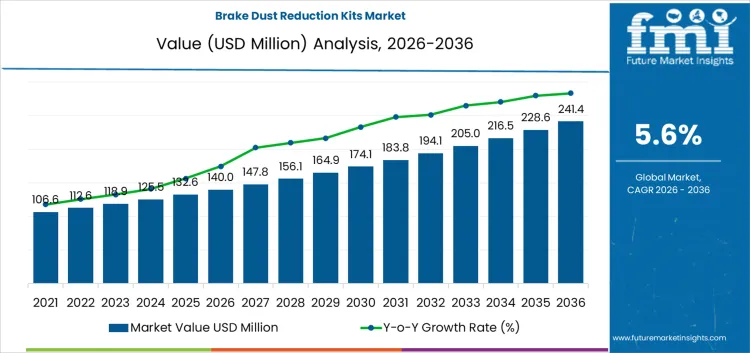
Volume expansion remains bounded by performance tradeoffs and fitment variability across braking architectures. Dust reduction effectiveness varies widely across formulations, creating uneven user outcomes and limiting repeat purchasing in price-sensitive segments. Performance-oriented vehicles face constraints due to heat management and pedal response expectations. Lack of standardized measurement for brake particulate reduction restricts comparability across products, reinforcing reliance on brand reputation and installer recommendation. Aftermarket penetration depends on service interval timing, as kits are typically adopted during pad replacement cycles rather than proactively. Growth follows urban vehicle density, alloy wheel penetration, and maintenance cost awareness rather than regulatory enforcement or broad-based emission mandates.
Brake Dust Reduction Kits Market Key Takeaways
| Metric | Value |
|---|---|
| Market Value (2026) | USD 140.0 million |
| Market Forecast Value (2036) | USD 241.4 million |
| Forecast CAGR (2026 to 2036) | 5.6% |
Why is the Demand for Brake Dust Reduction Kits Growing?
Demand for brake dust reduction kits is increasing as vehicle owners and fleet operators seek solutions that mitigate particulate accumulation on wheels and suspension components, preserve finish quality, and reduce maintenance burdens associated with frequent cleaning. Brake dust originates from friction material wear during deceleration, and accumulation on wheel surfaces can accelerate corrosion, degrade paint and alloy finishes, and trap moisture that affects long term component life. Automotive engineers and service technicians specify reduction kits that include shield plates, dust repellent coatings, and optimized rotor and pad geometries to minimize dust generation without impairing braking performance. Procurement decisions emphasize material durability, resistance to chemical exposure from road salt and brake cleaner, and compatibility with various wheel styles because pressure washing alone does not consistently remove embedded particulates.
Growth in premium wheel adoption and heightened consumer expectations for vehicle appearance reinforces uptake of brake dust reduction kits that extend periods between detailed cleaning and support resale value retention. Aftermarket demand remains strong in performance oriented and enthusiast segments where visible brake dust is perceived as detracting from aesthetic quality. Light truck and SUV owners also adopt reduction kits to protect wheels under heavy load and frequent braking typical of towing and urban stop-start traffic. Technical advances in coating chemistry and shield design improve particulate deflection while maintaining airflow for rotor cooling. Availability of kits that match original equipment specifications and simple installation procedures further supports adoption during routine service intervals. These application-specific performance and maintenance considerations are driving sustained demand growth in the brake dust reduction kits market.
How Are the Segments Classified in the Brake Dust Reduction Kits Market?
Demand for brake dust reduction kits is shaped by wheel cleanliness expectations, maintenance frequency concerns, and visual appearance preservation. Vehicle owners seek solutions that limit particulate accumulation on wheels and body surfaces during routine braking. Adoption aligns with rising use of alloy wheels, urban driving exposure, and preference for lower cleaning effort. Product selection prioritizes dust suppression effectiveness, compatibility with braking systems, and ease of installation. Segment classification reflects differentiation by kit configuration, vehicle application profile, and sales channel structure influencing adoption patterns and replacement behavior.
Which Kit Type Represents the Largest Share of Demand?
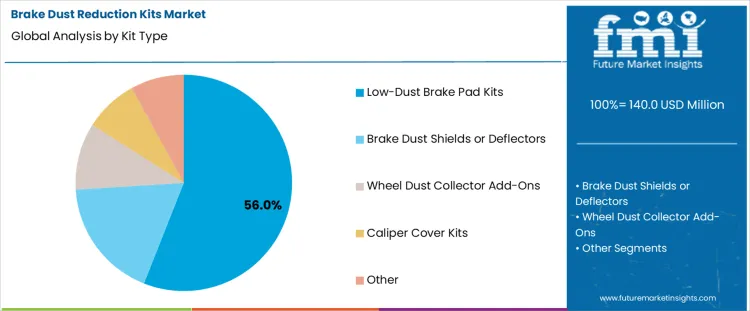
Low-dust brake pad kits hold 56.0%, representing the largest share among kit types due to direct dust generation control. These pads use modified friction formulations that reduce particulate release during braking. Performance remains acceptable for daily driving conditions while lowering wheel contamination. Installation follows standard brake service procedures, supporting widespread adoption. Brake dust shields or deflectors redirect particles away from wheels with limited effectiveness. Wheel dust collector add-ons capture debris externally with added complexity. Caliper cover kits provide aesthetic masking without reducing dust generation. Kit type segmentation reflects preference for integrated solutions addressing dust at the source.
Key Points
- Low-dust pads reduce particulate generation during braking.
- Standard installation supports broad vehicle compatibility.
- Other kits redirect or mask dust rather than preventing formation.
Which Vehicle Segment Accounts for the Highest Share of Demand?
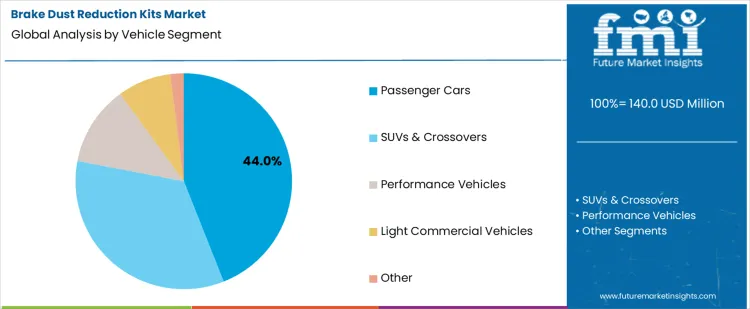
Passenger cars hold 44.0%, representing the largest share among vehicle segments due to high ownership volume. Urban driving conditions increase brake usage and visible dust accumulation on exposed wheels. Owners prioritize appearance maintenance and reduced cleaning effort. Standard brake configurations simplify kit selection and installation. SUVs and crossovers follow with larger wheels and similar appearance concerns. Performance vehicles adopt kits selectively with braking performance considerations. Light commercial vehicles focus less on cosmetic outcomes. Vehicle segmentation reflects concentration where daily use, urban exposure, and aesthetic sensitivity drive consistent adoption.
Key Points
- Passenger cars experience frequent urban braking cycles.
- Appearance maintenance drives dust reduction adoption.
- Other segments balance aesthetics with performance priorities.
Which Sales Channel Drives the Largest Share of Demand?
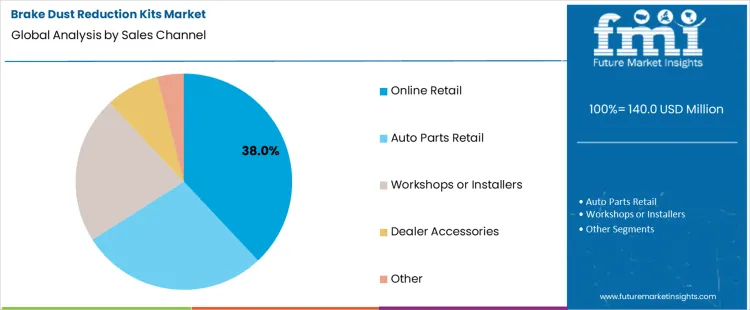
Online retail holds 38.0%, representing the largest share among sales channels due to product accessibility. Digital platforms offer broad product selection with vehicle-specific fitment guidance. Pricing transparency and user reviews support informed purchasing decisions. Direct shipping enables convenient replacement aligned with maintenance schedules. Auto parts retail supports in-person purchasing with limited assortment. Workshops or installers provide bundled service with higher labor cost. Dealer accessories serve new vehicle buyers with optional upgrades. Sales channel segmentation reflects preference for convenient access and informed selection through digital purchasing pathways.
Key Points
- Online platforms provide broad selection and fitment guidance.
- Convenience supports timely replacement decisions.
- Other channels combine product access with service or installation.
What are the Key Dynamics in the Brake Dust Reduction Kits Market?
Demand for brake dust reduction kits reflects need to limit particulate residue generated by braking systems on passenger vehicles and light commercial vehicles. Adoption concentrates in premium vehicles, urban fleets, and appearance-sensitive consumer segments. Global scope aligns with increased awareness of non-exhaust emissions and vehicle cleanliness expectations. Usage centers on low-dust brake pads, shields, caliper covers, and retrofit filtration or capture components designed to reduce visible wheel contamination.
How do non-exhaust emission awareness and vehicle maintenance preferences shape adoption?
Brake systems generate fine particulate matter during friction events, leading to wheel soiling and surface corrosion over time. Demand increases as urban drivers and fleet operators seek reduced cleaning frequency and improved exterior appearance. Premium vehicle owners prioritize low-dust solutions to preserve alloy wheel finishes. Low-dust pad formulations reduce particulate release through altered friction material composition. Shielding and capture devices limit dispersion toward wheel surfaces and surrounding air. Urban delivery fleets adopt kits to maintain vehicle presentation under frequent stop cycles. Growing attention to non-exhaust emissions supports interest from regulators and municipalities. Adoption reflects combined concern for aesthetics, maintenance effort, and localized particulate exposure.
How do performance tradeoffs, fitment limits, and cost sensitivity influence market scalability?
Brake dust reduction solutions must maintain braking performance under varied load and temperature conditions. Demand sensitivity rises where reduced dust output affects bite feel, noise, or pad life. Retrofit kits face fitment constraints across caliper designs and wheel sizes. Added components increase unsprung mass and installation complexity in some configurations. Aftermarket products vary widely in effectiveness, affecting consumer trust. Heat dissipation requirements limit applicability on performance-oriented vehicles. Cost justification remains challenging for price-sensitive segments. Lack of standardized testing for dust reduction limits comparability, constraining broad-based adoption across mass-market vehicle platforms.
How Is Demand for Brake Dust Reduction Kits Evolving Globally?
Demand for brake dust reduction kits is expanding globally due to particulate emission concerns, vehicle cleanliness expectations, and evolving inspection practices. Adoption aligns with passenger vehicles and light commercial fleets seeking reduced wheel contamination and lower non-exhaust emissions. Urban driving patterns and alloy wheel penetration increase visibility of brake residue, reinforcing accessory uptake. Replacement demand follows pad and rotor service intervals. Growth rates in India at 6.8%, China at 6.4%, Mexico at 5.5%, Brazil at 5.1%, and USA at 3.8% indicate steady expansion driven by urban usage intensity, maintenance-led purchases, and awareness of brake particulate control rather than styling-oriented customization.
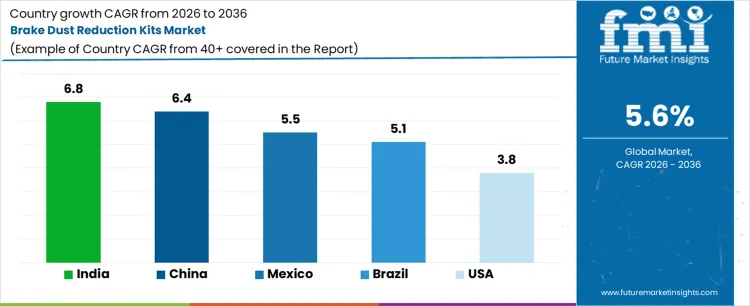
| Country | CAGR (%) |
|---|---|
| India | 6.8% |
| China | 6.4% |
| Mexico | 5.5% |
| Brazil | 5.1% |
| USA | 3.8% |
What Is Driving Expansion of Brake Dust Reduction Demand in India?
Demand for brake dust reduction kits in India is growing at a CAGR of 6.8%, supported by dense urban driving and rising alloy wheel adoption. Stop-and-go traffic increases pad wear, elevating visible dust accumulation. Owners prioritize wheel cleanliness and reduced maintenance frequency. Service centers recommend dust-control solutions during brake servicing. Aftermarket availability improves fitment across high-volume models. Growth reflects practical maintenance considerations and urban usage patterns rather than regulatory mandates on non-exhaust emissions.
- High urban congestion increasing brake wear
- Rising alloy wheel penetration in passenger vehicles
- Service-led upselling during brake maintenance
- Improved aftermarket model coverage
Why Is China Sustaining Growth in Brake Dust Reduction Kit Adoption?
Brake dust reduction demand in China is expanding at a CAGR of 6.4%, driven by urban air quality initiatives and vehicle appearance standards. High vehicle density in cities increases exposure to brake particulate residue. Owners of electric and hybrid vehicles seek cleaner wheels due to regenerative braking dynamics. Domestic suppliers offer coated components and shims targeting dust suppression. Fleet operators adopt kits to reduce cleaning downtime. Growth reflects urban usage intensity and maintenance efficiency rather than strict non-exhaust emission regulation.
- Urban air quality awareness influencing maintenance choices
- EV and hybrid ownership affecting brake residue patterns
- Availability of domestically produced dust-control kits
- Fleet focus on reduced cleaning downtime
How Are Brake Dust Reduction Kit Sales Developing in Mexico?
Sales of brake dust reduction kits in Mexico are growing at a CAGR of 5.5%, shaped by urban vehicle usage and cost-sensitive maintenance practices. Passenger cars operating in cities experience frequent braking cycles. Owners prefer add-on solutions that extend wheel cleaning intervals. Independent workshops promote kits alongside pad replacement. Compatibility with North American vehicle platforms supports product standardization. Growth reflects maintenance convenience and service-channel promotion rather than compliance-driven adoption.
- Frequent urban braking increasing dust accumulation
- Cost-effective add-on solutions preferred by owners
- Independent workshop promotion during brake service
- Platform compatibility with North American vehicles
What Factors Support Brake Dust Reduction Demand in Brazil?
Brake dust reduction demand in Brazil is expanding at a CAGR of 5.1%, influenced by urban driving conditions and consumer focus on vehicle upkeep. Dense traffic patterns accelerate brake wear and residue buildup. Owners seek solutions reducing cleaning frequency under humid conditions. Aftermarket distributors expand availability of dust-control components. Commercial fleets adopt kits to maintain vehicle presentation. Growth reflects practical maintenance needs and service efficiency rather than performance-oriented modifications.
- Dense urban traffic accelerating brake wear
- Humidity increasing residue adhesion on wheels
- Expanding aftermarket distribution networks
- Fleet emphasis on exterior vehicle upkeep
Why Is the USA Experiencing Measured Growth in Brake Dust Reduction Kits?
Brake dust reduction demand in the United States is growing at a CAGR of 3.8%, supported by selective adoption and replacement cycles. Mature brake material technology moderates incremental gains. Enthusiast and premium vehicle owners prioritize low-dust solutions. Service intervals drive replacement-led purchases. Regulatory focus remains limited on non-exhaust particulates. Growth remains measured, reflecting niche adoption and maintenance-led replacement rather than broad-based regulatory or fleet mandates.
- Mature brake materials limiting incremental adoption
- Premium and enthusiast segment uptake
- Replacement tied to brake service intervals
- Limited regulatory pressure on brake particulates
What is the competitive landscape of demand for the brake dust reduction kits market globally?
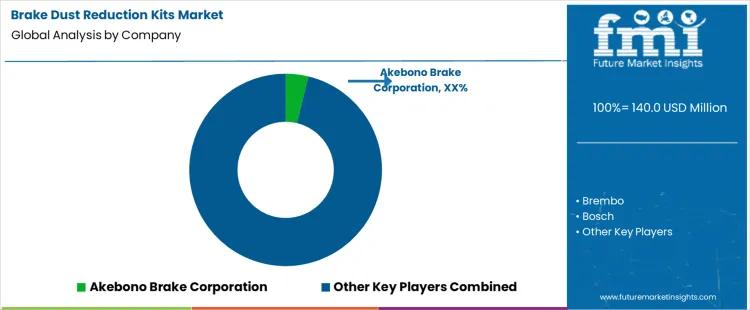
Demand for brake dust reduction kits is driven by the increasing awareness of environmental concerns, the push for cleaner air quality, and the growing demand for automotive maintenance solutions that enhance vehicle cleanliness. Buyers evaluate the effectiveness of brake dust reduction, compatibility with various braking systems, ease of installation, and the overall impact on brake performance. Procurement behavior prioritizes solutions that maintain brake efficiency while reducing harmful emissions and improving vehicle aesthetics. Purchasing decisions emphasize manufacturers with proven products that reduce wear, improve brake performance, and offer long-lasting solutions. Trend in the market reflects the growing regulatory push for environmentally friendly automotive components, especially in the context of hybrid and electric vehicles.
Akebono Brake Corporation leads the competitive positioning with advanced brake technologies that focus on minimizing dust generation, maintaining high-performance standards, and reducing maintenance. Brembo competes by offering high-performance kits designed for both passenger and high-end vehicles, integrating dust reduction with superior braking power. Bosch supports demand with innovative solutions that enhance braking performance while significantly reducing dust, targeting the growing aftermarket demand. EBC Brakes participates by providing durable and high-efficiency kits, focusing on reducing brake wear and maintaining optimal performance. TMD Friction offers a wide range of brake dust reduction kits designed for various vehicle types, balancing dust reduction and brake longevity.
Key Players in the Brake Dust Reduction Kits Market
- Akebono Brake Corporation
- Brembo
- Bosch
- EBC Brakes
- TMD Friction
- Nisshinbo
- ADVICS
- Wagner (DRiV)
- TRW (ZF Aftermarket)
Scope of the Report
| Items | Values |
|---|---|
| Quantitative Units | USD million |
| Kit Type | Low-Dust Brake Pad Kits; Brake Dust Shields or Deflectors; Wheel Dust Collector Add-Ons; Caliper Cover Kits; Other |
| Vehicle Segment | Passenger Cars; SUVs & Crossovers; Performance Vehicles; Light Commercial Vehicles; Other |
| Sales Channel | Online Retail; Auto Parts Retail; Workshops or Installers; Dealer Accessories; Other |
| Technology | Low-Metallic or NAO Formulations; Ceramic Low-Dust Formulations; Dust Shield Systems; Other |
| Regions Covered | Asia Pacific, Europe, North America, Latin America, Middle East & Africa |
| Countries Covered | India, China, Mexico, Brazil, USA, and 40+ countries |
| Key Companies Profiled | Akebono Brake Corporation; Brembo; Bosch; EBC Brakes; TMD Friction; Nisshinbo; ADVICS; Wagner (DRiV); TRW (ZF Aftermarket) |
| Additional Attributes | Dollar sales by kit type, vehicle segment, sales channel, and technology; performance metrics for dust reduction, noise control, and wear resistance across low-dust brake pads, dust shields, and collector add-ons; formulation trends driven by low-metallic, NAO, and ceramic materials; sales dynamics shaped by OEM supply contracts, aftermarket retail growth, and installer-driven demand. |
Brake Dust Reduction Kits Market by Segment
Kit Type:
- Low-Dust Brake Pad Kits
- Brake Dust Shields or Deflectors
- Wheel Dust Collector Add-Ons
- Caliper Cover Kits
- Other
Vehicle Segment:
- Passenger Cars
- SUVs & Crossovers
- Performance Vehicles
- Light Commercial Vehicles
- Other
Sales Channel:
- Online Retail
- Auto Parts Retail
- Workshops or Installers
- Dealer Accessories
- Other
Technology:
- Low-Metallic or NAO Formulations
- Ceramic Low-Dust Formulations
- Dust Shield Systems
- Other
Region:
- Asia Pacific
- China
- Japan
- South Korea
- India
- Australia & New Zealand
- ASEAN
- Rest of Asia Pacific
- Europe
- Germany
- United Kingdom
- France
- Italy
- Spain
- Nordic
- BENELUX
- Rest of Europe
- North America
- United States
- Canada
- Mexico
- Latin America
- Brazil
- Chile
- Rest of Latin America
- Middle East & Africa
- Kingdom of Saudi Arabia
- Other GCC Countries
- Turkey
- South Africa
- Other African Union
- Rest of Middle East & Africa
Bibliography
- International Organization for Standardization. (2023). Road vehicles—Brake systems—Test methods for brake wear particle emissions (ISO 26867:2023). ISO.
- European Commission. (2023). Commission Regulation (EU) 2023/… on non-exhaust particulate emissions from road transport, including brake wear particles. Official Journal of the European Union.
- Organisation for Economic Co-operation and Development. (2023). Non-exhaust particulate emissions from road transport: Health impacts, mitigation technologies, and vehicle maintenance practices. OECD Publishing.
Frequently Asked Questions
How big is the brake dust reduction kits market in 2026?
The global brake dust reduction kits market is estimated to be valued at USD 140.0 million in 2026.
What will be the size of brake dust reduction kits market in 2036?
The market size for the brake dust reduction kits market is projected to reach USD 241.4 million by 2036.
How much will be the brake dust reduction kits market growth between 2026 and 2036?
The brake dust reduction kits market is expected to grow at a 5.6% CAGR between 2026 and 2036.
What are the key product types in the brake dust reduction kits market?
The key product types in brake dust reduction kits market are low-dust brake pad kits, brake dust shields or deflectors, wheel dust collector add-ons, caliper cover kits and other.
Which vehicle segment segment to contribute significant share in the brake dust reduction kits market in 2026?
In terms of vehicle segment, passenger cars segment to command 44.0% share in the brake dust reduction kits market in 2026.
Preview the report firsthand - request a free sample
Get SampleGet the brochure for pricing and purchase details.
Get PDFTable of Content
- Executive Summary
- Global Market Outlook
- Demand-side Trends
- Supply-side Trends
- Technology Roadmap Analysis
- Analysis and Recommendations
- Market Overview
- Market Coverage / Taxonomy
- Market Definition / Scope / Limitations
- Market Background
- Market Dynamics
- Drivers
- Restraints
- Opportunity
- Trends
- Scenario Forecast
- Demand in Optimistic Scenario
- Demand in Likely Scenario
- Demand in Conservative Scenario
- Opportunity Map Analysis
- Product Life Cycle Analysis
- Supply Chain Analysis
- Investment Feasibility Matrix
- Value Chain Analysis
- PESTLE and Porter’s Analysis
- Regulatory Landscape
- Regional Parent Market Outlook
- Production and Consumption Statistics
- Import and Export Statistics
- Market Dynamics
- Global Market Analysis 2021 to 2025 and Forecast, 2026 to 2036
- Historical Market Size Value (USD Million) Analysis, 2021 to 2025
- Current and Future Market Size Value (USD Million) Projections, 2026 to 2036
- Y-o-Y Growth Trend Analysis
- Absolute $ Opportunity Analysis
- Global Market Pricing Analysis 2021 to 2025 and Forecast 2026 to 2036
- Global Market Analysis 2021 to 2025 and Forecast 2026 to 2036, By Kit Type
- Introduction / Key Findings
- Historical Market Size Value (USD Million) Analysis By Kit Type , 2021 to 2025
- Current and Future Market Size Value (USD Million) Analysis and Forecast By Kit Type , 2026 to 2036
- Low-Dust Brake Pad Kits
- Brake Dust Shields or Deflectors
- Wheel Dust Collector Add-Ons
- Caliper Cover Kits
- Other
- Low-Dust Brake Pad Kits
- Y-o-Y Growth Trend Analysis By Kit Type , 2021 to 2025
- Absolute $ Opportunity Analysis By Kit Type , 2026 to 2036
- Global Market Analysis 2021 to 2025 and Forecast 2026 to 2036, By Vehicle Segment
- Introduction / Key Findings
- Historical Market Size Value (USD Million) Analysis By Vehicle Segment, 2021 to 2025
- Current and Future Market Size Value (USD Million) Analysis and Forecast By Vehicle Segment, 2026 to 2036
- Passenger Cars
- SUVs & Crossovers
- Performance Vehicles
- Light Commercial Vehicles
- Other
- Passenger Cars
- Y-o-Y Growth Trend Analysis By Vehicle Segment, 2021 to 2025
- Absolute $ Opportunity Analysis By Vehicle Segment, 2026 to 2036
- Global Market Analysis 2021 to 2025 and Forecast 2026 to 2036, By Sales Channel
- Introduction / Key Findings
- Historical Market Size Value (USD Million) Analysis By Sales Channel, 2021 to 2025
- Current and Future Market Size Value (USD Million) Analysis and Forecast By Sales Channel, 2026 to 2036
- Online Retail
- Auto Parts Retail
- Workshops or Installers
- Dealer Accessories
- Other
- Online Retail
- Y-o-Y Growth Trend Analysis By Sales Channel, 2021 to 2025
- Absolute $ Opportunity Analysis By Sales Channel, 2026 to 2036
- Global Market Analysis 2021 to 2025 and Forecast 2026 to 2036, By Technology
- Introduction / Key Findings
- Historical Market Size Value (USD Million) Analysis By Technology, 2021 to 2025
- Current and Future Market Size Value (USD Million) Analysis and Forecast By Technology, 2026 to 2036
- Low-Metallic or NAO Formulations
- Ceramic Low-Dust Formulations
- Dust Shield Systems
- Other
- Low-Metallic or NAO Formulations
- Y-o-Y Growth Trend Analysis By Technology, 2021 to 2025
- Absolute $ Opportunity Analysis By Technology, 2026 to 2036
- Global Market Analysis 2021 to 2025 and Forecast 2026 to 2036, By Region
- Introduction
- Historical Market Size Value (USD Million) Analysis By Region, 2021 to 2025
- Current Market Size Value (USD Million) Analysis and Forecast By Region, 2026 to 2036
- North America
- Latin America
- Western Europe
- Eastern Europe
- East Asia
- South Asia and Pacific
- Middle East & Africa
- Market Attractiveness Analysis By Region
- North America Market Analysis 2021 to 2025 and Forecast 2026 to 2036, By Country
- Historical Market Size Value (USD Million) Trend Analysis By Market Taxonomy, 2021 to 2025
- Market Size Value (USD Million) Forecast By Market Taxonomy, 2026 to 2036
- By Country
- USA
- Canada
- Mexico
- By Kit Type
- By Vehicle Segment
- By Sales Channel
- By Technology
- By Country
- Market Attractiveness Analysis
- By Country
- By Kit Type
- By Vehicle Segment
- By Sales Channel
- By Technology
- Key Takeaways
- Latin America Market Analysis 2021 to 2025 and Forecast 2026 to 2036, By Country
- Historical Market Size Value (USD Million) Trend Analysis By Market Taxonomy, 2021 to 2025
- Market Size Value (USD Million) Forecast By Market Taxonomy, 2026 to 2036
- By Country
- Brazil
- Chile
- Rest of Latin America
- By Kit Type
- By Vehicle Segment
- By Sales Channel
- By Technology
- By Country
- Market Attractiveness Analysis
- By Country
- By Kit Type
- By Vehicle Segment
- By Sales Channel
- By Technology
- Key Takeaways
- Western Europe Market Analysis 2021 to 2025 and Forecast 2026 to 2036, By Country
- Historical Market Size Value (USD Million) Trend Analysis By Market Taxonomy, 2021 to 2025
- Market Size Value (USD Million) Forecast By Market Taxonomy, 2026 to 2036
- By Country
- Germany
- UK
- Italy
- Spain
- France
- Nordic
- BENELUX
- Rest of Western Europe
- By Kit Type
- By Vehicle Segment
- By Sales Channel
- By Technology
- By Country
- Market Attractiveness Analysis
- By Country
- By Kit Type
- By Vehicle Segment
- By Sales Channel
- By Technology
- Key Takeaways
- Eastern Europe Market Analysis 2021 to 2025 and Forecast 2026 to 2036, By Country
- Historical Market Size Value (USD Million) Trend Analysis By Market Taxonomy, 2021 to 2025
- Market Size Value (USD Million) Forecast By Market Taxonomy, 2026 to 2036
- By Country
- Russia
- Poland
- Hungary
- Balkan & Baltic
- Rest of Eastern Europe
- By Kit Type
- By Vehicle Segment
- By Sales Channel
- By Technology
- By Country
- Market Attractiveness Analysis
- By Country
- By Kit Type
- By Vehicle Segment
- By Sales Channel
- By Technology
- Key Takeaways
- East Asia Market Analysis 2021 to 2025 and Forecast 2026 to 2036, By Country
- Historical Market Size Value (USD Million) Trend Analysis By Market Taxonomy, 2021 to 2025
- Market Size Value (USD Million) Forecast By Market Taxonomy, 2026 to 2036
- By Country
- China
- Japan
- South Korea
- By Kit Type
- By Vehicle Segment
- By Sales Channel
- By Technology
- By Country
- Market Attractiveness Analysis
- By Country
- By Kit Type
- By Vehicle Segment
- By Sales Channel
- By Technology
- Key Takeaways
- South Asia and Pacific Market Analysis 2021 to 2025 and Forecast 2026 to 2036, By Country
- Historical Market Size Value (USD Million) Trend Analysis By Market Taxonomy, 2021 to 2025
- Market Size Value (USD Million) Forecast By Market Taxonomy, 2026 to 2036
- By Country
- India
- ASEAN
- Australia & New Zealand
- Rest of South Asia and Pacific
- By Kit Type
- By Vehicle Segment
- By Sales Channel
- By Technology
- By Country
- Market Attractiveness Analysis
- By Country
- By Kit Type
- By Vehicle Segment
- By Sales Channel
- By Technology
- Key Takeaways
- Middle East & Africa Market Analysis 2021 to 2025 and Forecast 2026 to 2036, By Country
- Historical Market Size Value (USD Million) Trend Analysis By Market Taxonomy, 2021 to 2025
- Market Size Value (USD Million) Forecast By Market Taxonomy, 2026 to 2036
- By Country
- Kingdom of Saudi Arabia
- Other GCC Countries
- Turkiye
- South Africa
- Other African Union
- Rest of Middle East & Africa
- By Kit Type
- By Vehicle Segment
- By Sales Channel
- By Technology
- By Country
- Market Attractiveness Analysis
- By Country
- By Kit Type
- By Vehicle Segment
- By Sales Channel
- By Technology
- Key Takeaways
- Key Countries Market Analysis
- USA
- Pricing Analysis
- Market Share Analysis, 2025
- By Kit Type
- By Vehicle Segment
- By Sales Channel
- By Technology
- Canada
- Pricing Analysis
- Market Share Analysis, 2025
- By Kit Type
- By Vehicle Segment
- By Sales Channel
- By Technology
- Mexico
- Pricing Analysis
- Market Share Analysis, 2025
- By Kit Type
- By Vehicle Segment
- By Sales Channel
- By Technology
- Brazil
- Pricing Analysis
- Market Share Analysis, 2025
- By Kit Type
- By Vehicle Segment
- By Sales Channel
- By Technology
- Chile
- Pricing Analysis
- Market Share Analysis, 2025
- By Kit Type
- By Vehicle Segment
- By Sales Channel
- By Technology
- Germany
- Pricing Analysis
- Market Share Analysis, 2025
- By Kit Type
- By Vehicle Segment
- By Sales Channel
- By Technology
- UK
- Pricing Analysis
- Market Share Analysis, 2025
- By Kit Type
- By Vehicle Segment
- By Sales Channel
- By Technology
- Italy
- Pricing Analysis
- Market Share Analysis, 2025
- By Kit Type
- By Vehicle Segment
- By Sales Channel
- By Technology
- Spain
- Pricing Analysis
- Market Share Analysis, 2025
- By Kit Type
- By Vehicle Segment
- By Sales Channel
- By Technology
- France
- Pricing Analysis
- Market Share Analysis, 2025
- By Kit Type
- By Vehicle Segment
- By Sales Channel
- By Technology
- India
- Pricing Analysis
- Market Share Analysis, 2025
- By Kit Type
- By Vehicle Segment
- By Sales Channel
- By Technology
- ASEAN
- Pricing Analysis
- Market Share Analysis, 2025
- By Kit Type
- By Vehicle Segment
- By Sales Channel
- By Technology
- Australia & New Zealand
- Pricing Analysis
- Market Share Analysis, 2025
- By Kit Type
- By Vehicle Segment
- By Sales Channel
- By Technology
- China
- Pricing Analysis
- Market Share Analysis, 2025
- By Kit Type
- By Vehicle Segment
- By Sales Channel
- By Technology
- Japan
- Pricing Analysis
- Market Share Analysis, 2025
- By Kit Type
- By Vehicle Segment
- By Sales Channel
- By Technology
- South Korea
- Pricing Analysis
- Market Share Analysis, 2025
- By Kit Type
- By Vehicle Segment
- By Sales Channel
- By Technology
- Russia
- Pricing Analysis
- Market Share Analysis, 2025
- By Kit Type
- By Vehicle Segment
- By Sales Channel
- By Technology
- Poland
- Pricing Analysis
- Market Share Analysis, 2025
- By Kit Type
- By Vehicle Segment
- By Sales Channel
- By Technology
- Hungary
- Pricing Analysis
- Market Share Analysis, 2025
- By Kit Type
- By Vehicle Segment
- By Sales Channel
- By Technology
- Kingdom of Saudi Arabia
- Pricing Analysis
- Market Share Analysis, 2025
- By Kit Type
- By Vehicle Segment
- By Sales Channel
- By Technology
- Turkiye
- Pricing Analysis
- Market Share Analysis, 2025
- By Kit Type
- By Vehicle Segment
- By Sales Channel
- By Technology
- South Africa
- Pricing Analysis
- Market Share Analysis, 2025
- By Kit Type
- By Vehicle Segment
- By Sales Channel
- By Technology
- USA
- Market Structure Analysis
- Competition Dashboard
- Competition Benchmarking
- Market Share Analysis of Top Players
- By Regional
- By Kit Type
- By Vehicle Segment
- By Sales Channel
- By Technology
- Competition Analysis
- Competition Deep Dive
- Akebono Brake Corporation
- Overview
- Product Portfolio
- Profitability by Market Segments (Product/Age /Sales Channel/Region)
- Sales Footprint
- Strategy Overview
- Marketing Strategy
- Product Strategy
- Channel Strategy
- Brembo
- Bosch
- EBC Brakes
- TMD Friction
- Nisshinbo
- ADVICS
- Wagner (DRiV)
- TRW (ZF Aftermarket)
- Akebono Brake Corporation
- Competition Deep Dive
- Assumptions & Acronyms Used
- Research Methodology


