

- Industry Size (2026)
- USD 267.8 Mn
- Forecast (2036)
- USD 802.5 Mn
- CAGR (2026 to 2036)
- 11.6%
Regenerative Brake Calibration Services Market Forecast and Outlook 2026 to 2036
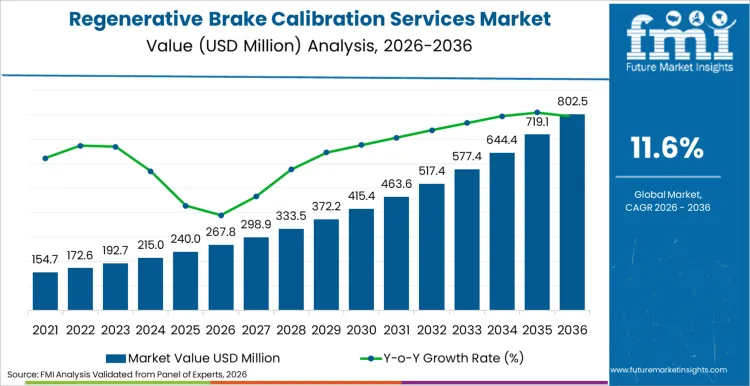
The regenerative brake calibration services market is likely to be valued at USD 267.8 million in 2026 and is projected to reach USD 802.5 million by 2036 at an 11.6% CAGR. Demand increases because each electric vehicle platform requires multiple tuning sets across powertrain variants, battery options, and regional approvals. Calibration work covers pedal maps, blending logic, and recovery limits that must be validated under many operating conditions. Once a vehicle family is defined, the scope of tuning expands with every derivative. Growth follows the rising number of software-controlled vehicle configurations and shorter product cycles across electric vehicle portfolios.
Assignment of work in the regenerative brake calibration services market depends on development ownership models and internal resource limits at manufacturers. Some companies retain core tuning tasks while using external teams for peak loads and variant expansion. Engagements align with development milestones rather than routine service schedules. Deliverables are defined as validated datasets, traceable change records, and approval packages. Contracts usually extend across full vehicle programs because compliance documentation references specific calibration baselines. Revenue progression reflects the number of platforms under parallel development. Competitive position depends on tool compatibility, audit acceptance, and confidence in result repeatability across vehicle lines.
Regenerative Brake Calibration Services Market Quick Stats
- Regenerative Brake Calibration Services Market Value (2026): USD 267.8 million
- Regenerative Brake Calibration Services Market Forecast Value (2036): USD 802.5 million
- Regenerative Brake Calibration Services Market Forecast CAGR (2026 to 2036): 11.6%
- Leading Service Type in Regenerative Brake Calibration Services Market: Vehicle-Level Calibration
- Key Growth Regions in Regenerative Brake Calibration Services Market: China, Brazil, USA, UK, Japan
- Top Players in Regenerative Brake Calibration Services Market: AVL List, Bosch Engineering, FEV Group, Ricardo, KPIT Technologies, Tata Technologies, dSPACE, Capgemini Engineering, ALTEN Group, EDAG Engineering
What is the Growth Forecast for the Regenerative Brake Calibration Services Market through 2036?
Vehicle programs now treat brake blending and energy recovery behavior as validation items that require repeated tuning across climates, loads, and software builds. The regenerative brake calibration services market in 2026 stands at USD 267.8 million, rising from USD 154.7 million in 2021 as more platforms rely on software defined deceleration behavior. Engineering groups commission these services to align pedal mapping, axle torque split, and low speed handover behavior with safety cases. Work scopes cover track testing, simulation correlation, and release readiness. The value path reaches USD 415.4 million in 2030 and moves toward USD 802.5 million in 2036. This trajectory represents an 11.6% growth rate supported by higher test intensity per vehicle and wider use across passenger and commercial EV lines.
Program governance sets the commercial shape of the regenerative brake calibration services market. Contracts follow vehicle platform lifetimes and release trains rather than feature refresh cycles. Spend concentrates in test mileage, data analysis, and toolchain integration. Cost structure reflects engineering labor, proving ground time, instrumentation, and compliance documentation. OEM teams judge outcomes through pedal consistency, recovery yield, and fault containment behavior. Annual values pass USD 463.6 million in 2031 and USD 644.4 million in 2034 as more nameplates adopt unified brake by wire stacks. The move to USD 802.5 million in 2036 comes from broader deployment across volume segments, higher software content per program, and longer validation campaigns tied to centralized vehicle control architectures.
Regenerative Brake Calibration Services Market Key Takeaways
| Metric | Value |
|---|---|
| Market Value (2026) | USD 267.8 million |
| Forecast Value (2036) | USD 802.5 million |
| Forecast CAGR (2026 to 2036) | 11.6% |
Source: Future Market Insights’ proprietary forecasting model and primary research
How Is the Regenerative Brake Calibration Services Market Being Used to Control Validation Risk and Release Timing in Electric Vehicle Programs?
Vehicle programs treat the regenerative brake calibration services market as part of the approval chain, not as a late stage tuning step. Teams use regenerative brake calibration services for electric vehicles to manage brake blending calibration, torque handover logic, and low speed creep behavior across variants. Hardware in the loop brake calibration validation service setups and software in the loop brake simulation services are used to expose integration faults before fleet builds. Engineering groups rely on brake control system calibration solutions and vehicle level brake tuning and calibration services to keep pedal maps consistent across trims. Functional safety and brake blending validation services anchor sign off packages. The work focuses on calibration precision, response repeatability, and audit documentation because a clean stop in testing does not replace traceable evidence in certification.
Program governance places braking system calibration consulting for OEMs inside schedule protection rather than inside performance marketing. Selection criteria for brake calibration service partners in automotive supply chains include continuity of tuning ownership and regression coverage discipline. Cost benefit analysis of regenerative braking calibration services is tied to avoided revalidation cycles and delayed launches. Service models for ongoing brake control calibration support reduce disruption when inverter logic or actuator behavior changes. Regulatory and compliance benchmarks for regenerative braking systems shape test scope and documentation depth. The impact of calibration precision on energy recovery and vehicle dynamics is tracked, but release decisions depend more on stability and fault containment. This makes benchmarking audit protocols for brake calibration services part of platform governance rather than optional quality activity.
How Do Platform Proliferation and Safety Case Complexity Shape Demand in the Regenerative Brake Calibration Services Market by Service Type and Customer in 2026?
In the Regenerative Brake Calibration Services, program demand is driven by the growth of software-defined braking, platform reuse strategies, and the rising cost of validation failure rather than by feature expansion alone. Organizations operating passenger electric vehicle platforms, vehicle dynamics integration programs, and advanced driver assistance development stacks require repeatable calibration processes that preserve brake feel consistency, energy recovery stability, and regulatory compliance across variants. By service type, demand spans vehicle-level calibration, HIL validation, SiL validation, safety testing, and compliance testing. By customer, engagement covers OEMs, Tier-1 suppliers, and autonomy development teams. Portfolio structure reflects release cadence pressure, audit exposure, and cross-program reuse requirements.
Why Does Vehicle-Level Calibration Anchor Most Service Demand?
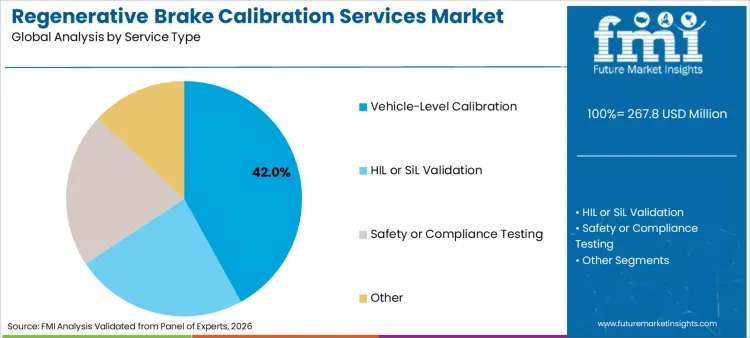
Vehicle-level calibration represents about 42% share, reflecting its role as the final authority on pedal feel tuning, regen-friction blending behavior, and deceleration predictability. In passenger electric vehicle platforms, this step reconciles regenerative maps, friction coordination, and stability control responses into one approved driving signature. HIL validation and SiL validation support early-stage logic verification and fault injection testing, reducing late-stage integration risk. Safety testing and compliance testing focus on brake light signaling, fallback modes, and homologation acceptance. Engineering teams evaluate through convergence speed and residual defect rates. Program teams evaluate through milestone risk and rework probability. Quality teams evaluate through audit findings and field issue exposure.
Once a calibration route is selected, test matrices, acceptance thresholds, and release gates are written around that service model. Any change forces re-planning of program schedules and resource allocation. Program management then protects extended software stabilization phases before SOP. Toolchains, data formats, and test vehicles align to the chosen approach. Supplier contracts and internal budgets follow the same structure. Expansion occurs by applying the same calibration framework to additional models and derivatives rather than redefining methods. The operating outcome favors vehicle-level calibration programs that concentrate accountability, reduce late-stage integration risk, and stabilize complex braking software stacks.
Why Do OEMs Represent the Largest Customer Group?
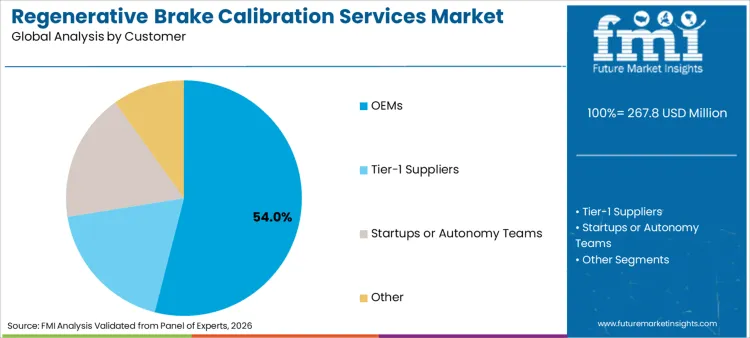
OEMs account for about 54% share, driven by their responsibility for final vehicle behavior, homologation sign-off, and brand-specific brake feel. In vehicle dynamics integration programs, this ownership forces direct control over calibration decisions and acceptance criteria. Tier-1 suppliers participate where subsystems or platforms are delivered as semi-complete stacks. Startups and autonomy teams rely on external services to compensate for limited internal validation infrastructure. Commercial teams evaluate customers through program duration and change frequency. Engineering teams evaluate through interface stability and decision authority. Quality teams evaluate through documentation depth and traceability requirements.
Customer type then shapes governance models, data ownership rules, and approval workflows. OEM-led programs impose structured review cycles, gated releases, and formal sign-off boards. Supplier-led or startup programs follow faster iterations with narrower scope. Tool access control, data retention policies, and audit preparation procedures also differ. Capacity planning aligns to the dominant customer profile. Training models and staffing plans follow the same logic. Growth comes from adding more vehicle programs under the same customer type rather than shifting focus. Demand therefore concentrates in OEM-driven engagements where liability, brand perception, and certification control remain centralized.
Why Is Cross-Domain Control Integration Driving the Regenerative Brake Calibration Services Market?
Vehicle platform design has shifted toward tightly coupled control stacks spanning the EV Powertrain Control Systems Market and the Brake by Wire Systems Market, which directly increases reliance on the Regenerative Brake Calibration Services Market. Regenerative torque behavior now depends on coordination between inverter logic, hydraulic fallback layers, and the battery management systems state limits. At the same time, the Vehicle Dynamics Control Software imposes constraints on how deceleration can be shaped during stability events. These overlapping control domains create calibration conflicts that cannot be resolved at component level. OEMs use calibration service providers to align these systems into unified behavior models, reduce late program integration risk, and stabilize driver response across operating conditions.
What Structural Factors Are Preventing Scale Economics in the Regenerative Brake Calibration Services Market?
Platform diversity across the Brake by Wire Systems and the EV powertrain control systems blocks reuse of calibration assets and limits standardization. Each vehicle program combines different motor types, inverter behaviors, hydraulic architectures, and sensor stacks. The battery management system adds another layer of variation because regeneration limits shift with thermal conditions, aging curves, and cell chemistry strategies. Control frameworks from the vehicle dynamics control software’s further fragment implementation because stability logic hierarchies differ by OEM. These dependencies force calibration work to remain program specific rather than library driven. Service engagements stay long and resource intensive, while procurement teams face limited opportunities to consolidate suppliers or compress development timelines.
How Are Platform Unification Efforts Changing the Regenerative Brake Calibration Services Market?
Development workflows are being reshaped by the brake integration platforms market and the vehicle control software toolchains market, which are pushing calibration work upstream into system architecture definition. Instead of tuning after hardware freeze, calibration providers now co-develop control maps with teams working in the EV powertrain control systems and the battery management systems. Virtual validation, model based calibration, and hardware in the loop pipelines are becoming default delivery methods. The goal is not single vehicle optimization but cross program behavior consistency. Competitive position in the Regenerative brake calibration services increasingly depends on data reuse frameworks, multi-platform calibration libraries, and deep integration with OEM software validation environments.
What is the Demand for Regenerative Brake Calibration Services by Country?
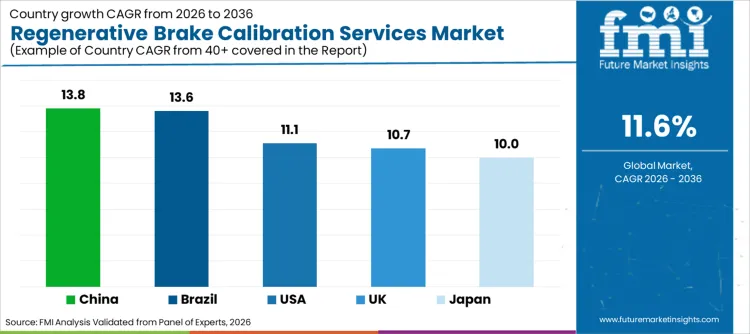
| Country | CAGR (%) |
|---|---|
| USA | 11.1% |
| Japan | 10.0% |
| China | 13.8% |
| UK | 10.7% |
| Brazil | 13.6% |
Source: Future Market Insights’ proprietary forecasting model and primary research
The demand for regenerative brake calibration services is rising across electric and hybrid vehicle platforms where precise tuning of braking force, energy recovery, and system integration is essential for safety and efficiency. China leads at 13.8% CAGR, supported by rapid EV adoption, domestic OEM production, and growing service requirements for calibration and validation of regenerative braking systems. Brazil follows at 13.6%, reflecting increased hybrid and EV production and adoption of professional calibration services. The USA grows at 11.1%, driven by fleet electrification and regulatory compliance in braking performance. The UK records 10.7%, shaped by developing EV infrastructure and safety standards. Japan posts 10.0%, within a mature EV market focused on reliability, drivability, and energy recovery optimization.
How EV Fleet Expansion Drives the Regenerative Brake Calibration Services Market in the USA
The regenerative brake calibration services market in the United States is expanding at an 11.1% CAGR as manufacturers scale EV fleets and require precise energy recovery tuning. Adoption focuses on verified calibration of torque distribution, pedal modulation, and regenerative integration with traction and battery management systems. Engineers assess system responsiveness, thermal stability, and interaction with electronic stability controls. Once a calibration protocol is approved, it is applied across multiple vehicle lines and production facilities. Volume growth corresponds with new model introductions, fleet scaling, and performance-focused EV programs. Supplier participation depends on documentation, audit compliance, and technical support. Commercial success relies on reproducible calibration outcomes, multi-platform consistency, and operational reliability across assembly lines.
How Quality Assurance and Testing Standards Influence the Regenerative Brake Calibration Services Market in Japan
In Japan, the regenerative brake calibration services market is growing at a 10% CAGR under strict quality assurance and testing requirements. Services must demonstrate consistent braking performance, torque distribution, and energy recovery under high-frequency usage. Engineers evaluate control unit response, pedal modulation, thermal behavior, and integration with vehicle dynamics and battery systems. Once validated, calibration procedures are implemented across multiple EV platforms. Supplier eligibility depends on audit performance, technical documentation, and the ability to support multi-line deployment. Volume growth is linked to new EV platform rollouts, fleet expansion, and upgrades to performance-oriented vehicles. Commercial positioning relies on predictable calibration outcomes, verified operational reliability, and technical support for ongoing adjustments.
How Production Line Scheduling Shapes the Regenerative Brake Calibration Services Market in China
Operational scheduling in high-volume assembly facilities is guiding the regenerative brake calibration services market in China at a 13.8% CAGR. Calibration workflows are assessed for energy recovery optimization, braking consistency, and system stability across multiple vehicle platforms. Technical teams monitor torque response, pedal modulation, thermal management, and integration with battery and traction control units. Once procedures are validated, they are replicated across multiple production lines with minimal adjustments. Volume growth follows fleet expansion, new model introductions, and platform scaling. Supplier access relies on technical documentation, audit compliance, and capacity to support high-volume EV assembly. Commercial success depends on consistent calibration quality, operational reliability, and scalable technical support.
How Multi-Model Integration Needs Drive the Regenerative Brake Calibration Services Market in the UK
In the United Kingdom, the regenerative brake calibration services market is advancing at a 10.7% CAGR due to the need for seamless integration across multiple EV models. Calibration focuses on torque distribution, braking response, and energy recovery efficiency under repeated testing. Engineers assess system latency, thermal performance, and compatibility with traction and battery management systems. Once approved, calibration protocols are applied across multiple platforms without repeated validation. Supplier participation depends on audit compliance, technical documentation, and engineering support. Volume growth tracks fleet expansion, platform adoption, and new vehicle launches. Commercial success relies on consistent calibration results, reproducible system performance, and reliable technical support for multi-line operations.
How Fleet Electrification and Platform Scaling Shape the Regenerative Brake Calibration Services Market in Brazil
Regenerative brake calibration services market in Brazil is expanding at a 13.6% CAGR as fleet electrification and EV platform scaling increase calibration demand. Services are selected based on verified energy recovery optimization, braking consistency, and system stability under diverse load conditions. Engineers evaluate pedal modulation, torque distribution, thermal management, and integration with traction and battery control systems. Once validated, calibration procedures are applied across multiple EV models and assembly lines. Supplier access depends on documentation accuracy, audit compliance, and technical support capacity. Volume growth follows fleet expansion, new platform rollouts, and large-scale production programs. Commercial advantage depends on predictable calibration outcomes, multi-platform reliability, and support for operational scaling across assembly facilities.
What Methods Are Companies Using in the Regenerative Brake Calibration Services Market?
Vehicle performance, braking system optimization, and calibration accuracy determine adoption in the Regenerative Brake Calibration Services Market. AVL List, Bosch Engineering, FEV Group, Ricardo, KPIT Technologies, Tata Technologies, dSPACE, Capgemini Engineering, ALTEN Group, and EDAG Engineering compete during pilot vehicle testing, simulation validation, and software tuning. Once services are applied, regenerative energy recovery, braking response consistency, and system integration anchor supplier selection. AVL List emphasizes full-vehicle calibration and performance benchmarking. Bosch Engineering provides OEM-specific optimization services. FEV Group delivers control strategy validation and tuning. Ricardo focuses on system-level braking performance improvements. KPIT Technologies and Tata Technologies offer embedded software calibration support. dSPACE supplies HIL-based validation and control integration. Capgemini Engineering, ALTEN, and EDAG provide consulting and engineering support for multi-platform braking systems.
Integration reliability, reproducibility, and technical support define competitive positioning in the Regenerative Brake Calibration Services Market. Engineers evaluate energy recovery efficiency, torque modulation, fail-safe performance, and software stability during calibration. Suppliers capable of reproducible service delivery, scalable project support, and integration guidance gain preference. AVL List maintains adoption through end-to-end calibration support. Bosch Engineering secures positions in high-volume OEM programs. FEV Group competes in system validation for EV and hybrid platforms. Ricardo targets performance improvement projects. KPIT Technologies and Tata Technologies focus on embedded software tuning. dSPACE provides real-time HIL testing for calibration verification. Capgemini Engineering, ALTEN, and EDAG support multi-platform implementation and integration. Market positions vary by service scope, vehicle type, system architecture, and regional automotive regulations.
Key Players in Regenerative Brake Calibration Services Market
- AVL List GmbH
- Bosch Engineering GmbH
- FEV Group GmbH
- Ricardo plc
- KPIT Technologies Ltd.
- Tata Technologies Limited
- dSPACE GmbH
- Capgemini Engineering
- ALTEN Group
- EDAG Engineering Group AG
Scope of the Report
| Items | Values |
|---|---|
| Quantitative Units (2026) | USD million |
| Service Type | Vehicle-level calibration, HIL or SiL validation, safety or compliance testing, other |
| Customer | OEMs, Tier-1 suppliers, startups or autonomy teams, other |
| Engagement Model | Project-based, retainer or CoE support, on-site campaigns, other |
| Vehicle Segment | Passenger EVs, LCV EVs, heavy-duty EVs, other |
| Regions Covered | Asia Pacific, Europe, North America, Latin America, Middle East & Africa |
| Countries Covered | United States, Canada, Mexico, Germany, United Kingdom, France, Italy, Spain, Nordics, BENELUX, China, Japan, South Korea, India, Australia & New Zealand, ASEAN, Brazil, Chile, Saudi Arabia, Turkey, South Africa, and other regional markets |
| Key Companies Profiled | AVL List, Bosch Engineering, FEV Group, Ricardo, KPIT Technologies, Tata Technologies, dSPACE, Capgemini Engineering, ALTEN Group, EDAG Engineering |
| Additional Attributes | Dollar sales by service type, customer, engagement model, and vehicle segment, calibration of pedal maps, regen-friction blending logic, and low-speed handover behavior, HIL and SiL based validation pipelines, safety case and compliance documentation support, track testing, simulation correlation, and release readiness activities, control of validation risk and release timing, integration with brake-by-wire, powertrain, and vehicle dynamics control stacks, multi-year program engagements tied to platform lifecycles, and regional demand patterns across passenger, light commercial, and heavy-duty electric vehicle programs |
Regenerative Brake Calibration Services Market Segmentation
Service Type:
- Vehicle-Level Calibration
- HIL or SiL Validation
- Safety or Compliance Testing
- Other
Customer:
- OEMs
- Tier-1 Suppliers
- Startups or Autonomy Teams
- Other
Engagement Model:
- Project-Based
- Retainer or CoE Support
- On-Site Campaigns
- Other
Vehicle Segment:
- Passenger EVs
- LCV EVs
- Heavy-Duty EVs
- Other
Region
- Asia Pacific
- China
- Japan
- South Korea
- India
- Australia & New Zealand
- ASEAN
- Rest of Asia Pacific
- Europe
- Germany
- United Kingdom
- France
- Italy
- Spain
- Nordic
- BENELUX
- Rest of Europe
- North America
- United States
- Canada
- Mexico
- Latin America
- Brazil
- Chile
- Rest of Latin America
- Middle East & Africa
- Kingdom of Saudi Arabia
- Other GCC Countries
- Turkey
- South Africa
- Other African Union
- Rest of Middle East & Africa
Bibliography
- International Energy Agency. (2024). Global EV Outlook 2024. International Energy Agency. - Verified IEA publication on EV trends.
- National Highway Traffic Safety Administration. (2024). Federal Motor Vehicle Safety Standard No. 135: Light Vehicle Brake Systems. USA Department of Transportation.
- United Nations Economic Commission for Europe. (2023). UN Regulation No. 13-H: Uniform provisions concerning the approval of passenger cars with regard to braking. UNECE.
Frequently Asked Questions
How big is the regenerative brake calibration services market in 2026?
The regenerative brake calibration services market is projected to be valued at USD 267.8 million in 2026.
What will be the size of the regenerative brake calibration services market in 2036?
The market size for regenerative brake calibration services is projected to reach USD 802.5 million by 2036.
How much will the demand for regenerative brake calibration services grow between 2026 and 2036?
Demand for regenerative brake calibration services is projected to grow at an 11.6% CAGR between 2026 and 2036.
Which service type holds a significant share in the regenerative brake calibration services market in 2026?
In terms of service type, vehicle-level calibration is expected to account for a 42% share in 2026.
Which customer segment contributes a major share in the regenerative brake calibration services market in 2026?
The OEMs segment is expected to command a 54% share in the regenerative brake calibration services market in 2026.
Preview the report firsthand - request a free sample
Get SampleGet the brochure for pricing and purchase details.
Get PDFTable of Content
- Executive Summary
- Global Market Outlook
- Demand-side Trends
- Supply-side Trends
- Technology Roadmap Analysis
- Analysis and Recommendations
- Market Overview
- Market Coverage / Taxonomy
- Market Definition / Scope / Limitations
- Market Background
- Market Dynamics
- Drivers
- Restraints
- Opportunity
- Trends
- Scenario Forecast
- Demand in Optimistic Scenario
- Demand in Likely Scenario
- Demand in Conservative Scenario
- Opportunity Map Analysis
- Product Life Cycle Analysis
- Supply Chain Analysis
- Investment Feasibility Matrix
- Value Chain Analysis
- PESTLE and Porter’s Analysis
- Regulatory Landscape
- Regional Parent Market Outlook
- Production and Consumption Statistics
- Import and Export Statistics
- Market Dynamics
- Global Market Analysis 2021 to 2025 and Forecast, 2026 to 2036
- Historical Market Size Value (USD Million) Analysis, 2021 to 2025
- Current and Future Market Size Value (USD Million) Projections, 2026 to 2036
- Y-o-Y Growth Trend Analysis
- Absolute $ Opportunity Analysis
- Global Market Pricing Analysis 2021 to 2025 and Forecast 2026 to 2036
- Global Market Analysis 2021 to 2025 and Forecast 2026 to 2036, By Service Type
- Introduction / Key Findings
- Historical Market Size Value (USD Million) Analysis By Service Type , 2021 to 2025
- Current and Future Market Size Value (USD Million) Analysis and Forecast By Service Type , 2026 to 2036
- Vehicle-Level Calibration
- HIL or SiL Validation
- Safety or Compliance Testing
- Other
- Vehicle-Level Calibration
- Y-o-Y Growth Trend Analysis By Service Type , 2021 to 2025
- Absolute $ Opportunity Analysis By Service Type , 2026 to 2036
- Global Market Analysis 2021 to 2025 and Forecast 2026 to 2036, By Customer
- Introduction / Key Findings
- Historical Market Size Value (USD Million) Analysis By Customer, 2021 to 2025
- Current and Future Market Size Value (USD Million) Analysis and Forecast By Customer, 2026 to 2036
- OEMs
- Tier-1 Suppliers
- Startups or Autonomy Teams
- Other
- OEMs
- Y-o-Y Growth Trend Analysis By Customer, 2021 to 2025
- Absolute $ Opportunity Analysis By Customer, 2026 to 2036
- Global Market Analysis 2021 to 2025 and Forecast 2026 to 2036, By Engagement Model
- Introduction / Key Findings
- Historical Market Size Value (USD Million) Analysis By Engagement Model, 2021 to 2025
- Current and Future Market Size Value (USD Million) Analysis and Forecast By Engagement Model, 2026 to 2036
- Project-Based
- Retainer or CoE Support
- On-Site Campaigns
- Other
- Project-Based
- Y-o-Y Growth Trend Analysis By Engagement Model, 2021 to 2025
- Absolute $ Opportunity Analysis By Engagement Model, 2026 to 2036
- Global Market Analysis 2021 to 2025 and Forecast 2026 to 2036, By Vehicle Segment
- Introduction / Key Findings
- Historical Market Size Value (USD Million) Analysis By Vehicle Segment, 2021 to 2025
- Current and Future Market Size Value (USD Million) Analysis and Forecast By Vehicle Segment, 2026 to 2036
- Passenger EVs
- LCV EVs
- Heavy-Duty EVs
- Other
- Passenger EVs
- Y-o-Y Growth Trend Analysis By Vehicle Segment, 2021 to 2025
- Absolute $ Opportunity Analysis By Vehicle Segment, 2026 to 2036
- Global Market Analysis 2021 to 2025 and Forecast 2026 to 2036, By Region
- Introduction
- Historical Market Size Value (USD Million) Analysis By Region, 2021 to 2025
- Current Market Size Value (USD Million) Analysis and Forecast By Region, 2026 to 2036
- North America
- Latin America
- Western Europe
- Eastern Europe
- East Asia
- South Asia and Pacific
- Middle East & Africa
- Market Attractiveness Analysis By Region
- North America Market Analysis 2021 to 2025 and Forecast 2026 to 2036, By Country
- Historical Market Size Value (USD Million) Trend Analysis By Market Taxonomy, 2021 to 2025
- Market Size Value (USD Million) Forecast By Market Taxonomy, 2026 to 2036
- By Country
- USA
- Canada
- Mexico
- By Service Type
- By Customer
- By Engagement Model
- By Vehicle Segment
- By Country
- Market Attractiveness Analysis
- By Country
- By Service Type
- By Customer
- By Engagement Model
- By Vehicle Segment
- Key Takeaways
- Latin America Market Analysis 2021 to 2025 and Forecast 2026 to 2036, By Country
- Historical Market Size Value (USD Million) Trend Analysis By Market Taxonomy, 2021 to 2025
- Market Size Value (USD Million) Forecast By Market Taxonomy, 2026 to 2036
- By Country
- Brazil
- Chile
- Rest of Latin America
- By Service Type
- By Customer
- By Engagement Model
- By Vehicle Segment
- By Country
- Market Attractiveness Analysis
- By Country
- By Service Type
- By Customer
- By Engagement Model
- By Vehicle Segment
- Key Takeaways
- Western Europe Market Analysis 2021 to 2025 and Forecast 2026 to 2036, By Country
- Historical Market Size Value (USD Million) Trend Analysis By Market Taxonomy, 2021 to 2025
- Market Size Value (USD Million) Forecast By Market Taxonomy, 2026 to 2036
- By Country
- Germany
- UK
- Italy
- Spain
- France
- Nordic
- BENELUX
- Rest of Western Europe
- By Service Type
- By Customer
- By Engagement Model
- By Vehicle Segment
- By Country
- Market Attractiveness Analysis
- By Country
- By Service Type
- By Customer
- By Engagement Model
- By Vehicle Segment
- Key Takeaways
- Eastern Europe Market Analysis 2021 to 2025 and Forecast 2026 to 2036, By Country
- Historical Market Size Value (USD Million) Trend Analysis By Market Taxonomy, 2021 to 2025
- Market Size Value (USD Million) Forecast By Market Taxonomy, 2026 to 2036
- By Country
- Russia
- Poland
- Hungary
- Balkan & Baltic
- Rest of Eastern Europe
- By Service Type
- By Customer
- By Engagement Model
- By Vehicle Segment
- By Country
- Market Attractiveness Analysis
- By Country
- By Service Type
- By Customer
- By Engagement Model
- By Vehicle Segment
- Key Takeaways
- East Asia Market Analysis 2021 to 2025 and Forecast 2026 to 2036, By Country
- Historical Market Size Value (USD Million) Trend Analysis By Market Taxonomy, 2021 to 2025
- Market Size Value (USD Million) Forecast By Market Taxonomy, 2026 to 2036
- By Country
- China
- Japan
- South Korea
- By Service Type
- By Customer
- By Engagement Model
- By Vehicle Segment
- By Country
- Market Attractiveness Analysis
- By Country
- By Service Type
- By Customer
- By Engagement Model
- By Vehicle Segment
- Key Takeaways
- South Asia and Pacific Market Analysis 2021 to 2025 and Forecast 2026 to 2036, By Country
- Historical Market Size Value (USD Million) Trend Analysis By Market Taxonomy, 2021 to 2025
- Market Size Value (USD Million) Forecast By Market Taxonomy, 2026 to 2036
- By Country
- India
- ASEAN
- Australia & New Zealand
- Rest of South Asia and Pacific
- By Service Type
- By Customer
- By Engagement Model
- By Vehicle Segment
- By Country
- Market Attractiveness Analysis
- By Country
- By Service Type
- By Customer
- By Engagement Model
- By Vehicle Segment
- Key Takeaways
- Middle East & Africa Market Analysis 2021 to 2025 and Forecast 2026 to 2036, By Country
- Historical Market Size Value (USD Million) Trend Analysis By Market Taxonomy, 2021 to 2025
- Market Size Value (USD Million) Forecast By Market Taxonomy, 2026 to 2036
- By Country
- Kingdom of Saudi Arabia
- Other GCC Countries
- Turkiye
- South Africa
- Other African Union
- Rest of Middle East & Africa
- By Service Type
- By Customer
- By Engagement Model
- By Vehicle Segment
- By Country
- Market Attractiveness Analysis
- By Country
- By Service Type
- By Customer
- By Engagement Model
- By Vehicle Segment
- Key Takeaways
- Key Countries Market Analysis
- USA
- Pricing Analysis
- Market Share Analysis, 2025
- By Service Type
- By Customer
- By Engagement Model
- By Vehicle Segment
- Canada
- Pricing Analysis
- Market Share Analysis, 2025
- By Service Type
- By Customer
- By Engagement Model
- By Vehicle Segment
- Mexico
- Pricing Analysis
- Market Share Analysis, 2025
- By Service Type
- By Customer
- By Engagement Model
- By Vehicle Segment
- Brazil
- Pricing Analysis
- Market Share Analysis, 2025
- By Service Type
- By Customer
- By Engagement Model
- By Vehicle Segment
- Chile
- Pricing Analysis
- Market Share Analysis, 2025
- By Service Type
- By Customer
- By Engagement Model
- By Vehicle Segment
- Germany
- Pricing Analysis
- Market Share Analysis, 2025
- By Service Type
- By Customer
- By Engagement Model
- By Vehicle Segment
- UK
- Pricing Analysis
- Market Share Analysis, 2025
- By Service Type
- By Customer
- By Engagement Model
- By Vehicle Segment
- Italy
- Pricing Analysis
- Market Share Analysis, 2025
- By Service Type
- By Customer
- By Engagement Model
- By Vehicle Segment
- Spain
- Pricing Analysis
- Market Share Analysis, 2025
- By Service Type
- By Customer
- By Engagement Model
- By Vehicle Segment
- France
- Pricing Analysis
- Market Share Analysis, 2025
- By Service Type
- By Customer
- By Engagement Model
- By Vehicle Segment
- India
- Pricing Analysis
- Market Share Analysis, 2025
- By Service Type
- By Customer
- By Engagement Model
- By Vehicle Segment
- ASEAN
- Pricing Analysis
- Market Share Analysis, 2025
- By Service Type
- By Customer
- By Engagement Model
- By Vehicle Segment
- Australia & New Zealand
- Pricing Analysis
- Market Share Analysis, 2025
- By Service Type
- By Customer
- By Engagement Model
- By Vehicle Segment
- China
- Pricing Analysis
- Market Share Analysis, 2025
- By Service Type
- By Customer
- By Engagement Model
- By Vehicle Segment
- Japan
- Pricing Analysis
- Market Share Analysis, 2025
- By Service Type
- By Customer
- By Engagement Model
- By Vehicle Segment
- South Korea
- Pricing Analysis
- Market Share Analysis, 2025
- By Service Type
- By Customer
- By Engagement Model
- By Vehicle Segment
- Russia
- Pricing Analysis
- Market Share Analysis, 2025
- By Service Type
- By Customer
- By Engagement Model
- By Vehicle Segment
- Poland
- Pricing Analysis
- Market Share Analysis, 2025
- By Service Type
- By Customer
- By Engagement Model
- By Vehicle Segment
- Hungary
- Pricing Analysis
- Market Share Analysis, 2025
- By Service Type
- By Customer
- By Engagement Model
- By Vehicle Segment
- Kingdom of Saudi Arabia
- Pricing Analysis
- Market Share Analysis, 2025
- By Service Type
- By Customer
- By Engagement Model
- By Vehicle Segment
- Turkiye
- Pricing Analysis
- Market Share Analysis, 2025
- By Service Type
- By Customer
- By Engagement Model
- By Vehicle Segment
- South Africa
- Pricing Analysis
- Market Share Analysis, 2025
- By Service Type
- By Customer
- By Engagement Model
- By Vehicle Segment
- USA
- Market Structure Analysis
- Competition Dashboard
- Competition Benchmarking
- Market Share Analysis of Top Players
- By Regional
- By Service Type
- By Customer
- By Engagement Model
- By Vehicle Segment
- Competition Analysis
- Competition Deep Dive
- AVL
- Overview
- Product Portfolio
- Profitability by Market Segments (Product/Age /Sales Channel/Region)
- Sales Footprint
- Strategy Overview
- Marketing Strategy
- Product Strategy
- Channel Strategy
- Bosch Engineering
- FEV
- Ricardo
- KPIT
- Tata Technologies
- dSPACE Services
- Capgemini Engineering
- ALTEN
- EDAG
- AVL
- Competition Deep Dive
- Assumptions & Acronyms Used
- Research Methodology


