

- Industry Size (2026)
- USD 8.18 Bn
- Forecast (2036)
- USD 17.01 Bn
- CAGR (2026 to 2036)
- 7.60%
Controlled and Slow Release Fertilizers Market Size, Market Forecast and Outlook By FMI
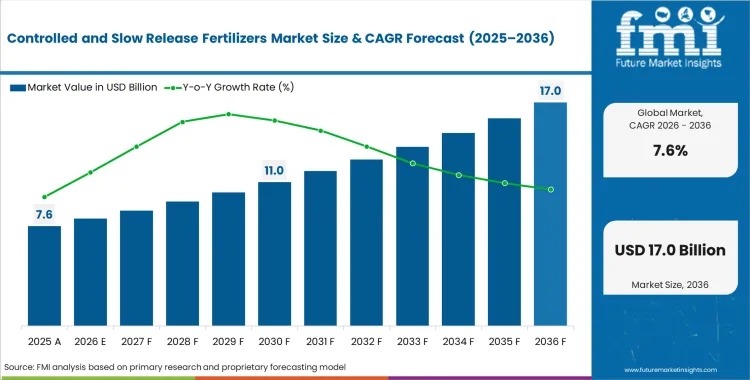
The controlled and slow release fertilizers market was valued at USD 7.60 billion in 2025, projected to reach USD 8.18 billion in 2026, and is forecast to expand to USD 17.01 billion by 2036 at a 7.60% CAGR. Structural shifts in end-use procurement cycles and tightening performance specifications across downstream sectors are accelerating capital allocation toward controlled and slow release fertilizers categories. Procurement teams operating across global supply chains now require standardized compliance certifications, compressing qualification timelines and elevating minimum specification thresholds for approved supplier lists.
Summary of Controlled and Slow Release Fertilizers Market
- Market Snapshot
- The controlled and slow release fertilizers market is valued at USD 7.60 billion in 2025 and is projected to reach USD 17.01 billion by 2036.
- The industry is expected to grow at a 7.60% CAGR from 2026 to 2036, creating an incremental opportunity of USD 8.83 billion.
- The market operates as a specification-driven procurement category where compliance certifications, material performance standards, and supply chain integration define competitive positioning.
- Demand and Growth Drivers
- Demand is rising as downstream industries face tightening performance specifications and mandatory compliance requirements across procurement cycles.
- Technology upgrades and process automation are accelerating adoption of higher-specification controlled and slow release fertilizers products across manufacturing operations.
- Infrastructure expansion programs in emerging economies are creating greenfield demand that bypasses legacy supplier constraints.
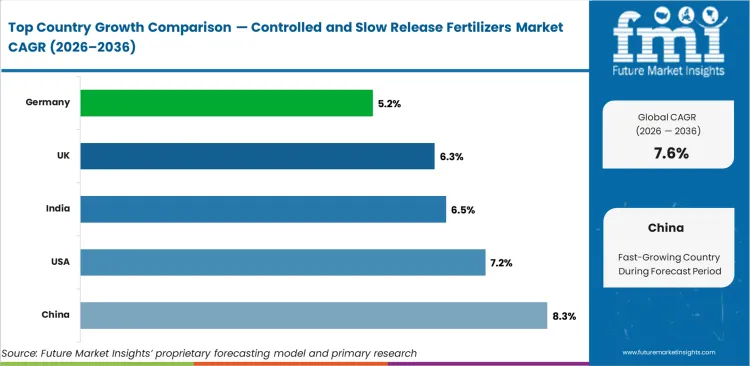
- Among key countries, China at 8.30%, USA at 7.20%, India at 6.50%, UK at 6.30%, Germany at 5.20%.
- Product and Segment View
- The market includes controlled and slow release fertilizers products segmented across product, application categories serving diverse industrial and commercial applications.
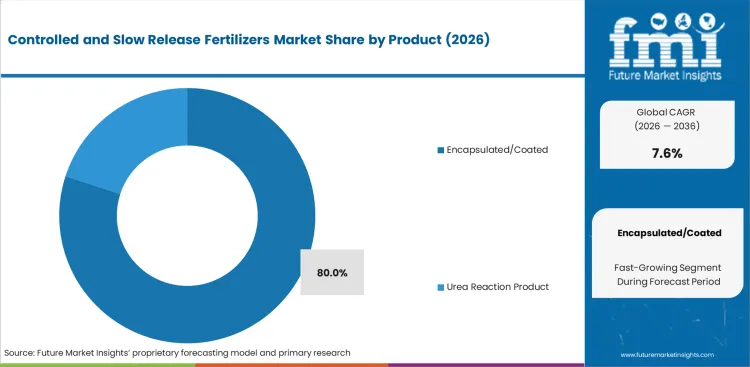
- Encapsulated/Coated leads by product with 80.0% share in 2026.
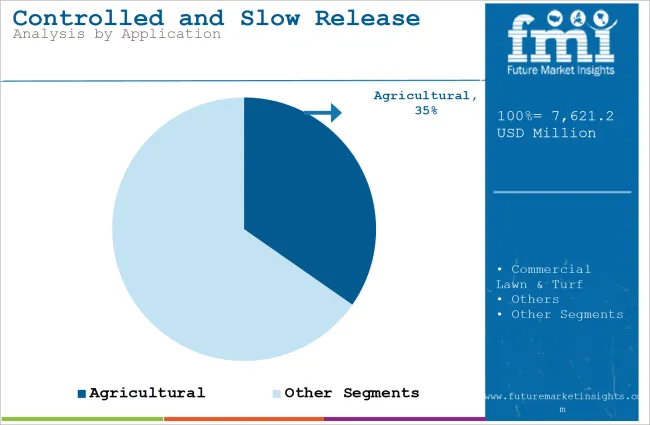
- Agricultural leads by application with 35.0% share in 2026.
- The scope covers Encapsulated/Coated, Urea Reaction Product, Agricultural, Commercial Lawn & Turf configurations among other formats, while excluding unrelated commodity categories and non-specialized alternatives.
- Geography and Competitive Outlook
- China and USA are the fastest-growing markets due to infrastructure expansion and rising industrial demand, while North America and Europe remain high-value mature demand bases.
- Competition is shaped by vertical integration capabilities, specification compliance certifications, and established procurement channel relationships, with key players including Nutrien, Israel Chemicals, Yara International, Kingenta Ecological Engineering Group Co. Ltd, Haifa Chemicals Ltd., EuroChem Group, JNC Corporation.
- Market consolidation trends are evident as leading suppliers acquire complementary capabilities to meet broadening customer specification requirements.
- Analyst Opinion at FMI
- Nikhil Kaitwade, Principal Consultant, opines: 'As per FMI analysis, the controlled and slow release fertilizers market is transitioning from a volume-driven procurement model to a specification-led qualification framework. Buyers who delay integration of higher-performance controlled and slow release fertilizers solutions into their supply chains face material cost escalation as compliance timelines compress. FMI analysts observe that suppliers lacking certified production capabilities will find themselves excluded from approved vendor lists as downstream operators enforce tighter material specifications.'
- Strategic Implications / Executive Takeaways
- Procurement directors must transition vendor qualification processes to prioritize lifecycle cost models and specification compliance certifications over lowest unit price evaluations.
- Capital project teams should mandate compatibility with next-generation performance standards in all new equipment procurement specifications entering the 2027 tender cycle.
- Supply chain architects must develop multi-source qualification programs to mitigate concentration risk across critical controlled and slow release fertilizers supply categories.
Controlled and Slow Release Fertilizers Market Key Takeaways
| Metric | Details |
|---|---|
| Industry Size (2026) | USD 8.18 billion |
| Industry Value (2036) | USD 17.01 billion |
| CAGR (2026-2036) | 7.60% |
Source: Future Market Insights, 2026
Capital expenditure planning cycles across verticals consuming controlled and slow release fertilizers products have shifted from discretionary upgrades to mandated replacements. Regulatory frameworks governing material performance, safety testing, and environmental compliance are tightening across all major consumption regions. Buyers evaluating supplier contracts increasingly weight lifecycle cost models over upfront unit pricing, favoring suppliers with vertically integrated operations and certified testing capabilities.
Regional deployment parameters reflect differentiated adoption velocities. China sets the pace with a 8.30% CAGR, followed by USA at 7.20% as infrastructure expansion programs bypass legacy procurement constraints. India operations advance at a 6.50% rate, supported by regulatory compliance mandates. UK tracks at 6.30%. Germany networks maintain a 5.20% expansion trajectory.
Controlled and Slow Release Fertilizers Market Definition
Controlled and Slow Release Fertilizers constitutes the material, product, or technology category defined by its primary industrial function within downstream manufacturing and end-use sectors. The scope encompasses standardized and specialty configurations compliant with global performance and safety specifications. Core inclusions govern products meeting defined procurement parameters across industrial, commercial, and institutional buyer categories.
Controlled and Slow Release Fertilizers Market Inclusions
Market scope includes Encapsulated/Coated, Urea Reaction Product, Agricultural, Commercial Lawn & Turf, Others configurations and related product variants. Global and regional market sizes, forecast period 2026 to 2036, and segment breakdowns by product, application are fully incorporated within the analytical boundary.
Controlled and Slow Release Fertilizers Market Exclusions
Standard commodity alternatives lacking specialized performance certifications are excluded. Downstream finished goods, standalone accessory components, and non-standardized custom fabrications fall outside the analytical parameters. Legacy product formats without current industry specification compliance are explicitly omitted from the valuation.
Controlled and Slow Release Fertilizers Market Research Methodology
- Primary Research: Analysts engaged with procurement specification leads, technical managers, and supply chain directors across key consumption sectors to map decision gates triggering product upgrades and supplier requalification.
- Desk Research: Data collection phases aggregated regulatory compliance frameworks, industry standards ratification schedules, and published procurement guidelines from major institutional buyers.
- Market-Sizing and Forecasting: Baseline values derive from a bottom-up aggregation of product volumes and contract values, applying region-specific adoption curves to project future demand velocity.
- Data Validation and Update Cycle: Projections are tested against publicly reported expenditure guidance from leading industrial consumers and trade association production statistics.
Category-wise Insights
The section explains the growth trajectories of the leading segments in the industry. In terms of product type, the Encapsulated/ Coated will likely dominate and generate a share of around 79.5% in 2026.
Based on the application, the Agricultural industry is projected to hold a major share of 60.0% in 2026. The analysis would enable potential clients to make effective business decisions for investment purposes.
Increased efficiency and reduced environmental impact drive demand for encapsulated/coated fertilizers
| Segment | Encapsulated/ Coated (Product Type) |
|---|---|
| Value Share (2026) | 79.5% |
Controlled and slow release fertilizers sector is dominated by encapsulated or coated fertilizers, which account for 79.5% of the product types. These fertilizers feature a nutrient core surrounded by a protective coating that controls the release rate.
The coatings are usually made from polymers, resins, or sulfur, providing a controlled nutrient release that matches plant needs over extended periods, improving efficiency and reducing waste.
The encapsulated/coated fertilizers are thus preferred for the environmental benefits associated with them. They minimize nutrient leaching and runoff, reducing the risk of water contamination-the major issue related to agriculture.
This approach goes in line with modern farming methods that aim at protecting ecosystems but still produce at high yields. These fertilizers also go with the principles of precision agriculture that deliver nutrients right where and when they are needed.
Economic benefits accrued to the farmer and grower through encapsulated/coated fertilizers include few applications being made, hence requiring less labor input and reducing cost of operation.
The consistent flow of nutrients means that growth as well as crop productivity improves plant quality and eventually yields. Overall, these have placed encapsulated/coated fertilizers in an uncompromising advantage in the market, as critical components of today's agricultural endeavors.
Rising demand for sustainable farming practices drives the adoption of controlled-release fertilizers in agriculture
| Segment | Agricultural (Application) |
|---|---|
| Value Share (2026) | 34.7% |
The agricultural segment is the most significant contributor to the controlled and slow release fertilizers (csrf) industry, with an application share of 60.0%. This high demand is mainly because of the increasing need for sustainable farming practices.
These fertilizers release nutrients gradually, ensuring crops receive a steady supply, which leads to improved yield, nutrient uptake efficiency, and reduced environmental impact. Farmers favor CSRF because it minimizes nutrient loss and reduces the frequency of fertilizer applications.
In agriculture, CSRF also assists in solving the issues of nutrient leaching and runoff, especially in areas that have heavy rainfall. Since they control the release rate, these fertilizers ensure there is no concentration of excess nutrients in the soil, which will have adverse effects on water quality and soil health.
This efficiency aligns with growing environmental regulations and farmer concerns about sustainable land management, thus making controlled-release fertilizers the preferred choice for long-term improvement of soil fertility.
Agro-based is another sector that benefits from crop health and productivity improvement due to controlled-release fertilizers. The demand for increasing food production sustainably, prompted by a growing world population, has reached a new peak.
CSRF contributes to this by maintaining optimum nutrient delivery over an extended period to support the farms' crop growth cycle, which ultimately enhances food security. Agro-based is, therefore, a major growth driver in the CSRF market.
Key Industry Highlights
Precision Agriculture Increases Demand for Smart Fertilizers
Precision agriculture is transforming farming by adding technology to make better use of resources. Some of the tools include GPS mapping, soil sensors, and drones that allow farmers to analyze their fields and apply fertilizers precisely where needed. Controlled and slow-release fertilizers go hand in hand with these practices, as they release nutrients gradually over time, minimizing waste and increasing efficiency.
For instance, in the United States, farmers who use GPS-enabled tractors can identify specific sections of a field to use more fertilizer. There will be no waste of over-fertilization but instead, improve yields and profitability. This is the trend globally as farmers embrace precision agriculture in conserving resources and increasing productivity.
Organic Farming Boosts Demand for Natural Slow-Release Fertilizers
Organic farming is gaining pace because the consumers prefer crops free of synthetic chemicals. Organic fertilizers, for example slow release from bone meal, feather meal, or plant product, have gained acceptance among organic farmers as they adhere to rigid criteria for organic certification and ensure consistent availability of nutrients.
The examples include organic vineyards in California that use organic slow-release fertilizers to fertilize the soils without losing organic certification. There is a very high demand for organic produce within regions such as North America and Europe, with this trend increasingly fueling massive growth in this market.
Innovation in Fertilizer Technology Boosts Market Growth
Research and development of fertilizer technology push the manufacture of new generations. New breakthroughs, like nanotechnology, multi-layer coating, and nutrient encapsulation, provide controlled slow release and effective use of controlled slow-release fertilizers with environment protection.
Such advancements include fertilizers by ICL specialty fertilizers, having nanotechnology-based coatings that detect soil temperature and moisture levels to make nutrient delivery much more precise.
Such innovations would be able to solve problems concerning climate variability, soil degradation, and the required increase in crop yields. Going forward, further development of fertilizers will make the product more efficient and accessible for farmers around the world.
High Production Costs of Controlled and Slow-Release Fertilizers Limit Market Accessibility
Controlled and slow-release fertilizers are also more expensive to manufacture than conventional fertilizers. The reason behind this is that special technologies, including advanced coating methods using polymers, resins, or sulfur, are needed for their production.
These coatings are intended for gradual nutrient release, thereby achieving better efficiency for the crops, but they considerably increase the production cost as well. In polymer-coated fertilizers, for instance, companies use materials of high quality, which are expensive for them, so that raises the final cost at farm's end.
A main reason for higher costs is investments in sophisticated machines and research into better coating processes and nutrient mixtures. Such firms must continue to innovate as they seek the best coating systems and nutrient products, increasing expenses.
Smaller producers cannot hope to compete given these high prices; thus, a large proportion of the market lies with large companies that can cope with such investment pressures.
Such fertilizers are relatively pricier than others, thus not attractive for farmers in the price-sensitive areas of Africa and South Asia. The benefits in terms of application frequency and efficiency can hardly benefit smallholder farmers who stand to gain most without subsidies to support their acquisition.
For example, rural-based farmers may be challenged to absorb the upfront cost although the savings down the line will be sizeable. Without subsidies or efforts to reduce production costs, these fertilizers will remain inaccessible to many and slow their adoption and limit market growth.
2021 to 2025 Global Controlled and Slow Release Fertilizers Sales Outlook Compared to Demand Forecast from 2026 to 3036
From 2021 to 2025, controlled and slow-release fertilizers in the global market increased steadily. This growth came with the high demand for more efficient and environmentally friendly agricultural production.
Farmers mainly sought to boost crop yields without compromising the environmental impacts, primarily in North America and Europe. The governments in these regions further strengthened environmental legislation, which put a check on nutrient runoff and pollution, prompting the use of more environmentally friendly fertilizers.
Advances in biodegradable coatings and sustainable formulations also had a significant impact on the increasing adoption of controlled and slow-release fertilizers.
However, some of the issues such as a higher cost than conventional fertilizers and lack of awareness among the farmers in the developing regions such as parts of Africa and South Asia slowed down the adoption during this period.
From 2026 to 2036, it is projected that the market will grow faster as demand for food and growth in population will rise. As more people develop an awareness and as governments make the effort by subsidies and training, the fertilizer uptake will become even more common in farmers' practice in the developing regions such as Asia-Pacific, Africa, and Latin America.
Technological advancements such as nanotechnology and better delivery systems for nutrients will make the fertilizers more efficient and less expensive, and therefore more popular.
Increased usage of precision agriculture and sustainable farming practices will continue to fuel growth in demand. Controlled and slow-release fertilizers will be pivotal in helping farmers achieve productivity gains with minimal environmental concerns, thus a part of any future agricultural plan.
Market Concentration
The controlled and slow release fertilizers sector is moderately fragmented, where Tier-1 companies hold 40-45% of the total share. The companies that dominate this segment include Kingenta Ecological Engineering Group Co. Ltd , Israel Chemicals , Yara International , Nutrien, and Sociedad Quimica Y Minera S.A. The annual revenues of such companies are more than USD 200 million.
Their strategic focus on innovation, expansion, and automation technologies at advanced levels, the companies continue to lead the sector. Tier-1 companies always consider superior production and offer their products to diversified sectors including automobiles, electronics, and packaging.
Tier-2 companies control a huge amount that is 20-30% of the total share. This category comprises Haifa Chemicals Ltd., EuroChem Group , JNC Corporation , Morral Companies LLC, Suståne Natural Fertilizer, Inc., with annual revenues between USD 50 to 100 million.
Tier-2 players have regional industry as their target, providing cost-effective, customized solutions to address regional needs. Their large size is indicative of the very fragmented nature of the market, where smaller firms take advantage of niche applications to compete effectively.
Country-wise Insights
The section below covers the industry analysis for controlled and slow release fertilizers demand in different countries. The demand analysis on key countries in several regions of the globe, including North America, Latin America, East Asia, South Asia Pacific, Western Europe, Eastern Europe and Middle East and Africa is provided.
.webp "Top Country Growth Comparison Controlled And Slow Release Fertilizers Market Cagr (2026 2036)")
| Countries | Value CAGR (2026 to 2036) |
|---|---|
| China | 8.3% |
| The USA | 7.2% |
| India | 6.5% |
| UK | 6.3% |
| Germany | 5.2% |
Source: FMI analysis based on primary research and proprietary forecasting model
United States: Leader in Precision Agriculture and Sustainable Practices
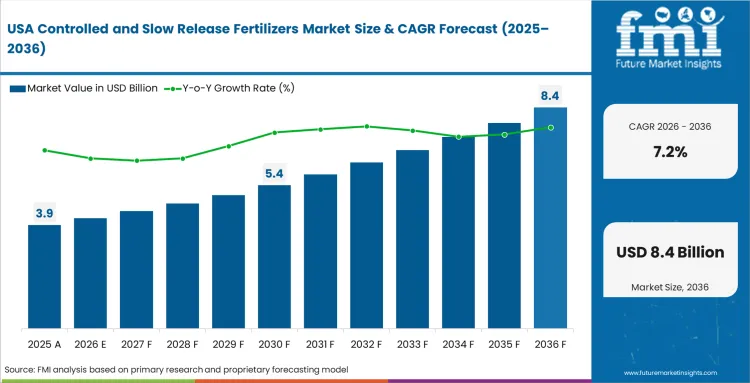
The United States leads the way in controlled and slow-release fertilizer application, due in part to the country's leading-edge farming methods and environmental legislation. Precision agriculture is the predominant practice in Iowa, Illinois, and California and employs advanced technologies such as GPS-enabled tractors, drones, and soil sensors to maximize the application of fertilizer.
Controlled-release fertilizers therefore fit in quite well with such technologies, ensuring that nutrients are delivered precisely without waste and thereby maximizing efficiency. High-value crops such as almonds, citrus fruits, and vegetables increase the demand for these fertilizers because they ensure superior quality and yield with consistent nutrient release.
Environmental factors also influence the USA fertilizer industry. For instance, the Clean Water Act forces farmers to embrace practices that prevent nitrogen from entering water bodies.
Controlled and slow-release fertilizers help address such concerns by avoiding over-application and leaching, thus enabling farmers to achieve compliance without sacrificing productivity.
The USDA funds and sustainability programs for these developments, hence encouraging their adoption. Together, precision requirements, environmental stewardship, and high-value agriculture requirements make the United States an enduring leader in controlled and slow-release fertilizers.
China: Advancing Sustainability in the World’s Largest Agricultural Sector
China, the largest agricultural producer worldwide, is relying more on controlled and slow-release fertilizers that can balance food production with sustainability in the environment. Over-fertilization in China has been a common problem for centuries, leading to soil degradation and water pollution.
To address the issue, the government has begun to implement several initiatives, one of which is the "Zero Growth of Fertilizer Use" campaign, advocating efficient nutrient utilization without sacrificing yield.
It hastened the entry of controlled-release fertilizers for staple crops like rice and wheat. For instance, sulfur-coated urea is being applied by farmers in Hunan and Jiangsu regions to minimize losses of nitrogen from paddy fields.
The major emphasis in China on horticulture and fruit production is both for home consumption and export. This has created significant demand for controlled and slow-release fertilizers. High-value crops such as apples, strawberries, and pears need accurate nutrient management to satisfy the quality standards.
There are regional formulations, developed by local manufacturers supported by government subsidies, to cater to diversified agricultural needs. With its immense agricultural base, strong policy backing, and a commitment to sustainability, China remains an important market for controlled and slow-release fertilizers.
India: Addressing Food Security and Resource Efficiency
Controlled and slow-release fertilizers play a vital role in improving productivity for India's growing population, as the agricultural sector is the backbone of the country. As the country faces soil degradation and water scarcity, these fertilizers provide a sustainable solution by giving consistent nutrient delivery and reducing waste.
High-value crops such as sugarcane, cotton, and mangoes are the primary drivers of demand. Maharashtra is another example of where farmers have embraced polymer-coated urea, especially to enhance yields and minimize labor cost especially in water-stressed areas.
Government support is another critical driver for fertilizer adoption in India. Programs such as the Pradhan Mantri Krishi Sinchayee Yojana focus on efficient irrigation and nutrient management, while subsidies make high-tech fertilizers available to small-scale farmers.
In addition, India's increasing export sector for horticultural products has created a demand for high-quality output, which further boosts the demand for controlled-release fertilizers. Population pressure, government initiatives, and crop diversity make India a large consumer in the global industry.
Competitive Landscape
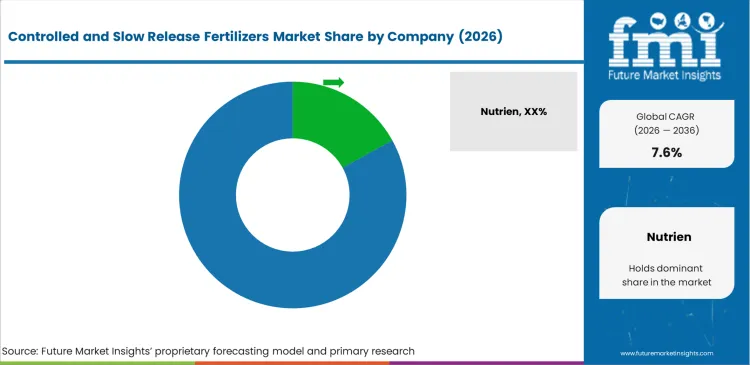
The controlled and slow release fertilizers (csrf) market is characterized by a moderately fragmented competitive landscape, with key players commanding 50-55% of the total market share. Major industry participants are focusing on technological advancements, sustainable practices, and regional expansion to retain their competitive edge.
Companies are investing heavily in research and development (R&D) to create innovative solutions that meet the diverse and evolving needs of industries, particularly in agriculture, horticulture, and commercial lawn care.
Advanced technologies such as controlled-release mechanisms that allow fertilizers to release nutrients gradually over time are being adopted by leading companies in the CSRF market, making the process more efficient and reducing environmental impact.
In addition, players are becoming more concerned about sustainability, trying to meet the growing demand for eco-friendly products and solutions in line with environmental regulations. As precision agriculture spreads, manufacturers adapt their products to offer fertilizers that enhance the efficiency of nutrient use, develop healthy soil, and increase crop productivity.
Critical strategic collaborations and partnerships with players in the CSRF value chain from technology providers and research institutions down to regional distributors are necessary for maintaining leadership in the CSRF market.
Companies are also utilizing Industry 4.0 technologies, such as IoT-enabled systems and AI-driven analytics, into their solutions in order to further enhance performance and customer satisfaction.
Such efforts become crucial in such a dynamic environment, as companies try to achieve higher demand of smarter and sustainable fertilization solution for agriculture and landscaping industries.
Scope of the Report
| Metric | Value |
|---|---|
| Quantitative Units | USD 8.18 billion to USD 17.01 billion, at a CAGR of 7.60% |
| Market Definition | Controlled and Slow Release Fertilizers encompasses the material, product, or technology category serving downstream industrial, commercial, and institutional end-use sectors under defined performance and safety specifications. |
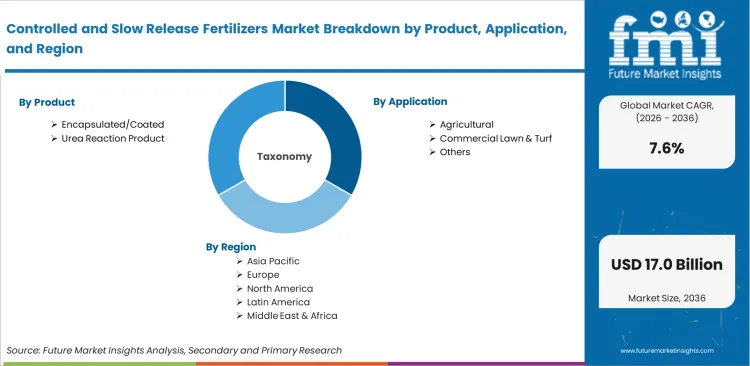
| Product Segmentation | Encapsulated/Coated, Urea Reaction Product |
| Application Segmentation | Agricultural, Commercial Lawn & Turf, Others |
| Regions Covered | North America, Latin America, Europe, East Asia, South Asia, Oceania, Middle East & Africa |
| Countries Covered | China, USA, India, UK, Germany, and 40 plus countries |
| Key Companies Profiled | Nutrien, Israel Chemicals, Yara International, Kingenta Ecological Engineering Group Co. Ltd, Haifa Chemicals Ltd., EuroChem Group, JNC Corporation, Morral Companies LLC., Suståne Natural Fertilizer, Inc., Koch Industries, Inc. |
| Forecast Period | 2026 to 2036 |
| Approach | Forecasting models apply a bottom-up methodology starting with global installed base metrics and projecting conversion rates to higher-specification product categories. |
Key Segmentation
By Product Type:
The product type segment is further categorized into Urea Reaction Product and Encapsulated/ Coated
By Application:
The application segment is classified into Agricultural, Commercial Lawn & Turf and Others
By Region:
Regions considered in the study include North America, Latin America, Western Europe, Eastern Europe, East Asia, South Asia & Pacific, and the Middle East and Africa.
Bibliography
- 1. Organisation for Economic Co-operation and Development. (2025, June). Industrial performance and competitiveness indicators. OECD.
- 2. World Bank Group. (2025). Global economic prospects: Industrial supply chains and trade facilitation. World Bank.
- 3. United Nations Industrial Development Organization. (2025). Industrial development report: Manufacturing and global value chains. UNIDO.
- 4. International Organization for Standardization. (2025). ISO standards catalogue: Materials testing and quality management. ISO.
- 5. European Commission, Directorate-General for Internal Market, Industry, Entrepreneurship and SMEs. (2025). Single market for goods: Industrial product compliance. European Commission.
- 6. USA Bureau of Labor Statistics. (2025). Producer price indexes for intermediate demand. USA Department of Labor.
This bibliography is provided for reader reference. The full Future Market Insights report contains the complete reference list with primary research documentation.
Frequently Asked Questions
How large is the demand for Controlled and Slow Release Fertilizers in the global market in 2026?
Demand for Controlled and Slow Release Fertilizers in the global market is estimated to be valued at USD 8.18 billion in 2026.
What will be the market size of Controlled and Slow Release Fertilizers in the global market by 2036?
Market size for Controlled and Slow Release Fertilizers is projected to reach USD 17.01 billion by 2036.
What is the expected demand growth for Controlled and Slow Release Fertilizers in the global market between 2026 and 2036?
Demand for Controlled and Slow Release Fertilizers is expected to grow at a CAGR of 7.60% between 2026 and 2036.
Which Product is poised to lead global sales by 2026?
Encapsulated/Coated accounts for 80.0% in 2026, driven by established procurement specifications and downstream integration requirements.
What is driving demand in China?
China leads with a 8.30% CAGR as greenfield industrial facilities deploying modern procurement frameworks create scaled demand for specification-compliant controlled and slow release fertilizers products.
What is the USA growth outlook in this report?
USA is projected to grow at a CAGR of 7.20% during 2026 to 2036.
What is Controlled and Slow Release Fertilizers and what is it mainly used for?
Controlled and Slow Release Fertilizers constitutes the specialized material, product, or technology category designed for defined industrial, commercial, and institutional applications. End-use sectors primarily deploy it to meet performance, safety, and regulatory compliance requirements.
How does FMI build and validate the Controlled and Slow Release Fertilizers forecast?
Forecasting models apply a bottom-up methodology starting with global installed base metrics and cross-validate projections against quarterly industry production and trade volumes.
Preview the report firsthand - request a free sample
Get SampleGet the brochure for pricing and purchase details.
Get PDFTable of Content
- Executive Summary
- Global Market Outlook
- Demand-side Trends
- Technology Roadmap Analysis
- Analysis and Recommendations
- Market Overview
- Market Coverage / Taxonomy
- Market Definition / Scope / Limitations
- Research Methodology
- Chapter Orientation
- Analytical Lens and Working Hypotheses
- Market Structure, Signals, and Trend Drivers
- Benchmarking and Cross-market Comparability
- Market Sizing, Forecasting, and Opportunity Mapping
- Research Design and Evidence Framework
- Desk Research Programme (Secondary Evidence)
- Company Annual and Sustainability Reports
- Peer-reviewed Journals and Academic Literature
- Corporate Websites, Product Literature, and Technical Notes
- Earnings Decks and Investor Briefings
- Statutory Filings and Regulatory Disclosures
- Technical White Papers and Standards Notes
- Trade Journals, Industry Magazines, and Analyst Briefs
- Conference Proceedings, Webinars, and Seminar Materials
- Government Statistics Portals and Public Data Releases
- Press Releases and Reputable Media Coverage
- Specialist Newsletters and Curated Briefings
- Sector Databases and Reference Repositories
- FMI Internal Proprietary Databases and Historical Market Datasets
- Subscription Datasets and Paid Sources
- Social Channels, Communities, and Digital Listening Inputs
- Additional Desk Sources
- Expert Input and Fieldwork (Primary Evidence)
- Primary Modes
- Qualitative Interviews and Expert Elicitation
- Quantitative Surveys and Structured Data Capture
- Blended Approach
- Why Primary Evidence is Used
- Field Techniques
- Interviews
- Surveys
- Focus Groups
- Demand in Conservative Scenario
- Opportunity Map Analysis
- Product Life Cycle Analysis
- Supply Chain Analysis
- Investment Feasibility Matrix
- Value Chain Analysis
- PESTLE and Porter’s Analysis
- Regulatory Landscape
- Regional Parent Market Outlook
- Production and Consumption Statistics
- Import and Export Statistics
- Primary Modes
- Global Market Analysis 2021 to 2025 and Forecast, 2026 to 2036
- Historical Market Size Value (USD Million) Analysis, 2021 to 2025
- Current and Future Market Size Value (USD Million) Projections, 2026 to 2036
- Y-o-Y Growth Trend Analysis
- Absolute $ Opportunity Analysis
- Global Market Pricing Analysis 2021 to 2025 and Forecast 2026 to 2036
- Global Market Analysis 2021 to 2025 and Forecast 2026 to 2036, By Product
- Introduction / Key Findings
- Historical Market Size Value (USD Million) Analysis By Product , 2021 to 2025
- Current and Future Market Size Value (USD Million) Analysis and Forecast By Product , 2026 to 2036
- Encapsulated/Coated
- Urea Reaction Product
- Encapsulated/Coated
- Y-o-Y Growth Trend Analysis By Product , 2021 to 2025
- Absolute $ Opportunity Analysis By Product , 2026 to 2036
- Global Market Analysis 2021 to 2025 and Forecast 2026 to 2036, By Application
- Introduction / Key Findings
- Historical Market Size Value (USD Million) Analysis By Application, 2021 to 2025
- Current and Future Market Size Value (USD Million) Analysis and Forecast By Application, 2026 to 2036
- Agricultural
- Commercial Lawn & Turf
- Others
- Agricultural
- Y-o-Y Growth Trend Analysis By Application, 2021 to 2025
- Absolute $ Opportunity Analysis By Application, 2026 to 2036
- Global Market Analysis 2021 to 2025 and Forecast 2026 to 2036, By Region
- Introduction
- Historical Market Size Value (USD Million) Analysis By Region, 2021 to 2025
- Current Market Size Value (USD Million) Analysis and Forecast By Region, 2026 to 2036
- North America
- Latin America
- Western Europe
- Eastern Europe
- East Asia
- South Asia and Pacific
- Middle East & Africa
- Market Attractiveness Analysis By Region
- North America Market Analysis 2021 to 2025 and Forecast 2026 to 2036, By Country
- Historical Market Size Value (USD Million) Trend Analysis By Market Taxonomy, 2021 to 2025
- Market Size Value (USD Million) Forecast By Market Taxonomy, 2026 to 2036
- By Country
- USA
- Canada
- Mexico
- By Product
- By Application
- By Country
- Market Attractiveness Analysis
- By Country
- By Product
- By Application
- Key Takeaways
- Latin America Market Analysis 2021 to 2025 and Forecast 2026 to 2036, By Country
- Historical Market Size Value (USD Million) Trend Analysis By Market Taxonomy, 2021 to 2025
- Market Size Value (USD Million) Forecast By Market Taxonomy, 2026 to 2036
- By Country
- Brazil
- Chile
- Rest of Latin America
- By Product
- By Application
- By Country
- Market Attractiveness Analysis
- By Country
- By Product
- By Application
- Key Takeaways
- Western Europe Market Analysis 2021 to 2025 and Forecast 2026 to 2036, By Country
- Historical Market Size Value (USD Million) Trend Analysis By Market Taxonomy, 2021 to 2025
- Market Size Value (USD Million) Forecast By Market Taxonomy, 2026 to 2036
- By Country
- Germany
- UK
- Italy
- Spain
- France
- Nordic
- BENELUX
- Rest of Western Europe
- By Product
- By Application
- By Country
- Market Attractiveness Analysis
- By Country
- By Product
- By Application
- Key Takeaways
- Eastern Europe Market Analysis 2021 to 2025 and Forecast 2026 to 2036, By Country
- Historical Market Size Value (USD Million) Trend Analysis By Market Taxonomy, 2021 to 2025
- Market Size Value (USD Million) Forecast By Market Taxonomy, 2026 to 2036
- By Country
- Russia
- Poland
- Hungary
- Balkan & Baltic
- Rest of Eastern Europe
- By Product
- By Application
- By Country
- Market Attractiveness Analysis
- By Country
- By Product
- By Application
- Key Takeaways
- East Asia Market Analysis 2021 to 2025 and Forecast 2026 to 2036, By Country
- Historical Market Size Value (USD Million) Trend Analysis By Market Taxonomy, 2021 to 2025
- Market Size Value (USD Million) Forecast By Market Taxonomy, 2026 to 2036
- By Country
- China
- Japan
- South Korea
- By Product
- By Application
- By Country
- Market Attractiveness Analysis
- By Country
- By Product
- By Application
- Key Takeaways
- South Asia and Pacific Market Analysis 2021 to 2025 and Forecast 2026 to 2036, By Country
- Historical Market Size Value (USD Million) Trend Analysis By Market Taxonomy, 2021 to 2025
- Market Size Value (USD Million) Forecast By Market Taxonomy, 2026 to 2036
- By Country
- India
- ASEAN
- Australia & New Zealand
- Rest of South Asia and Pacific
- By Product
- By Application
- By Country
- Market Attractiveness Analysis
- By Country
- By Product
- By Application
- Key Takeaways
- Middle East & Africa Market Analysis 2021 to 2025 and Forecast 2026 to 2036, By Country
- Historical Market Size Value (USD Million) Trend Analysis By Market Taxonomy, 2021 to 2025
- Market Size Value (USD Million) Forecast By Market Taxonomy, 2026 to 2036
- By Country
- Kingdom of Saudi Arabia
- Other GCC Countries
- Turkiye
- South Africa
- Other African Union
- Rest of Middle East & Africa
- By Product
- By Application
- By Country
- Market Attractiveness Analysis
- By Country
- By Product
- By Application
- Key Takeaways
- Key Countries Market Analysis
- USA
- Pricing Analysis
- Market Share Analysis, 2025
- By Product
- By Application
- Canada
- Pricing Analysis
- Market Share Analysis, 2025
- By Product
- By Application
- Mexico
- Pricing Analysis
- Market Share Analysis, 2025
- By Product
- By Application
- Brazil
- Pricing Analysis
- Market Share Analysis, 2025
- By Product
- By Application
- Chile
- Pricing Analysis
- Market Share Analysis, 2025
- By Product
- By Application
- Germany
- Pricing Analysis
- Market Share Analysis, 2025
- By Product
- By Application
- UK
- Pricing Analysis
- Market Share Analysis, 2025
- By Product
- By Application
- Italy
- Pricing Analysis
- Market Share Analysis, 2025
- By Product
- By Application
- Spain
- Pricing Analysis
- Market Share Analysis, 2025
- By Product
- By Application
- France
- Pricing Analysis
- Market Share Analysis, 2025
- By Product
- By Application
- India
- Pricing Analysis
- Market Share Analysis, 2025
- By Product
- By Application
- ASEAN
- Pricing Analysis
- Market Share Analysis, 2025
- By Product
- By Application
- Australia & New Zealand
- Pricing Analysis
- Market Share Analysis, 2025
- By Product
- By Application
- China
- Pricing Analysis
- Market Share Analysis, 2025
- By Product
- By Application
- Japan
- Pricing Analysis
- Market Share Analysis, 2025
- By Product
- By Application
- South Korea
- Pricing Analysis
- Market Share Analysis, 2025
- By Product
- By Application
- Russia
- Pricing Analysis
- Market Share Analysis, 2025
- By Product
- By Application
- Poland
- Pricing Analysis
- Market Share Analysis, 2025
- By Product
- By Application
- Hungary
- Pricing Analysis
- Market Share Analysis, 2025
- By Product
- By Application
- Kingdom of Saudi Arabia
- Pricing Analysis
- Market Share Analysis, 2025
- By Product
- By Application
- Turkiye
- Pricing Analysis
- Market Share Analysis, 2025
- By Product
- By Application
- South Africa
- Pricing Analysis
- Market Share Analysis, 2025
- By Product
- By Application
- USA
- Market Structure Analysis
- Competition Dashboard
- Competition Benchmarking
- Market Share Analysis of Top Players
- By Regional
- By Product
- By Application
- Competition Analysis
- Competition Deep Dive
- Nutrien
- Overview
- Product Portfolio
- Profitability by Market Segments (Product/Age /Sales Channel/Region)
- Sales Footprint
- Strategy Overview
- Marketing Strategy
- Product Strategy
- Channel Strategy
- Israel Chemicals
- Yara International
- Kingenta Ecological Engineering Group Co. Ltd
- Haifa Chemicals Ltd.
- EuroChem Group
- JNC Corporation
- Morral Companies LLC.
- Suståne Natural Fertilizer, Inc.
- Koch Industries, Inc.
- Nutrien
- Competition Deep Dive
- Desk Research Programme (Secondary Evidence)
- Assumptions & Acronyms Used


