

- Industry Size (2026)
- USD 423.2 Mn
- Forecast (2036)
- USD 956.8 Mn
- CAGR (2026 to 2036)
- 8.50%
Biodegradable Implant Succinic Coatings Market Forecast and Outlook 2026 to 2036
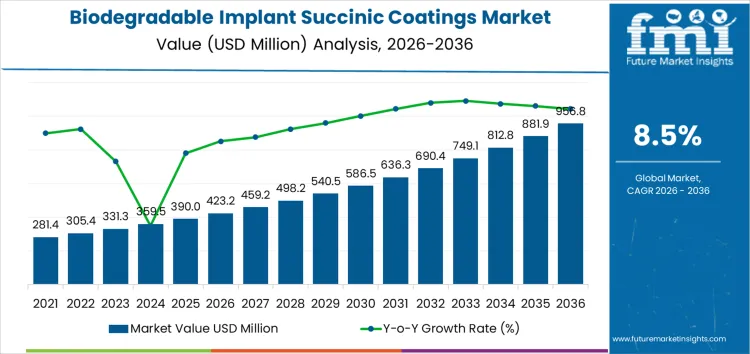
The global biodegradable implant succinic coatings market is valued at USD 423.2 million in 2026 and is expected to grow to USD 956.8 million by 2036, reflecting a CAGR of 8.50%. The demand for biodegradable succinic coatings is driven not just by volume but by the increasing emphasis on demand quality focusing on consistency, repeat usage, and long-term buyer commitment. Buyers in this market, such as medical device manufacturers, are prioritizing products that guarantee sustained performance over time, with coatings that ensure safe integration with human tissue, enhance healing, and reduce the risk of complications.
As the medical field continues to evolve toward sustainable and biocompatible solutions, manufacturers are investing in technologies that meet both environmental and patient safety standards. This trend reflects a strong commitment to performance quality, with repeat demand anticipated as healthcare providers seek durable and eco-friendly alternatives for implants in orthopedic, dental, and cardiovascular applications.
Quick Stats for Biodegradable Implant Succinic Coatings Market
- Biodegradable Implant Succinic Coatings Market Value (2026): USD 423.2 Million
- Biodegradable Implant Succinic Coatings Market Forecast Value (2036): USD 956.8 Million
- Biodegradable Implant Succinic Coatings Market Forecast CAGR 2026 to 2036: 8.50%
- Leading Implant Type in Biodegradable Implant Succinic Coatings Market: Orthopedic Implants
- Key Growth Regions in Biodegradable Implant Succinic Coatings Market: Asia Pacific, North America
- Top Key Players in Biodegradable Implant Succinic Coatings Market: HiMED, Hydromer, Medicoat AG, CAM Bioceramics B.V., APS Materials, Inc.
Biodegradable Implant Succinic Coatings Market Key Takeaways
| Metric | Value |
|---|---|
| Industry Value (2026) | USD 423.2 Million |
| Forecast Value (2036) | USD 956.8 Million |
| Forecast CAGR 2026 to 2036 | 8.50% |
How Is the Global Biodegradable Implant Succinic Coatings Market Advancing?
The global biodegradable implant succinic coatings market is experiencing notable growth, driven by increasing demand for environmentally friendly and biocompatible coatings in medical implants. Biodegradable succinic acid-based coatings are used in implantable medical devices to improve their performance, enhance biocompatibility, and reduce the risk of adverse reactions in the human body. These coatings offer the advantage of gradually degrading inside the body, which eliminates the need for surgical removal, making them a promising solution in various medical applications, including orthopedic, dental, and cardiovascular implants.
A major factor driving market growth is the rising focus on developing medical implants that are not only functional but also safer for long-term use. Traditional implants made from metals and synthetic materials may pose risks such as inflammation, infection, and the need for further surgical interventions. Biodegradable succinic coatings, on the other hand, offer enhanced biocompatibility, reducing the risk of complications and improving patient outcomes. As the healthcare industry continues to prioritize patient safety and the development of advanced medical devices, the demand for biodegradable coatings is expected to increase.
Technological advancements in materials science and coating technologies are further fueling market expansion. Researchers are continually exploring new succinic acid derivatives and polymer-based formulations to enhance the mechanical properties, degradation rates, and overall performance of these coatings. The growing trend toward personalized medicine and minimally invasive procedures is creating new opportunities for biodegradable coatings in the medical implant sector. As the demand for safer, more efficient, and patient-friendly implants rises, the biodegradable implant succinic coatings market is set for sustained growth in the coming years.
What Is the Segment-Wise Analysis for the Biodegradable Implant Succinic Coatings Market?
The biodegradable implant succinic coatings market is segmented by implant type and application. Orthopedic implants lead the implant type segment with a 35% share, followed by dental implants, cardiovascular implants, neurological implants, and other implant types. Orthopedic implants are the most widely used and require coatings that enhance integration with bone tissue. In terms of application, osseointegration enhancement leads the market with a 32% share, followed by infection prevention, biocompatibility improvement, wear resistance & durability, and other applications. The growing demand for advanced materials in medical implants is driving the adoption of biodegradable succinic coatings to improve performance and longevity.
Why Do Orthopedic Implants Lead the Biodegradable Implant Succinic Coatings Market?
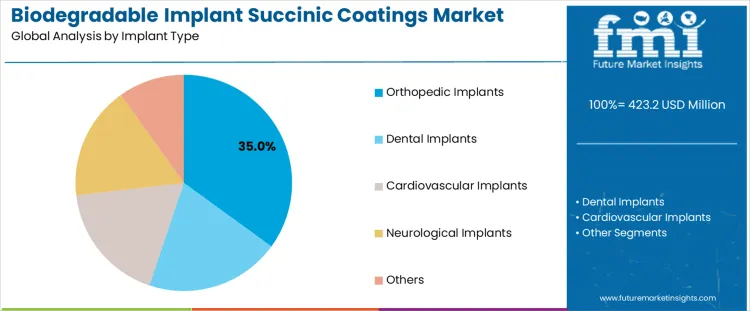
Orthopedic implants lead the biodegradable implant succinic coatings market with a 35% share due to their widespread use and the need for enhanced osseointegration. These implants, such as hip and knee replacements, require coatings that allow for better integration with bone tissue and promote long-term stability. Biodegradable succinic coatings are ideal for this purpose as they not only enhance osseointegration but also reduce the risk of complications. As the demand for joint replacement surgeries and advanced orthopedic devices increases, the role of biodegradable coatings in improving the performance of orthopedic implants continues to drive the segment's dominance in the market.
How Does Osseointegration Enhancement Contribute to the Biodegradable Implant Succinic Coatings Market?
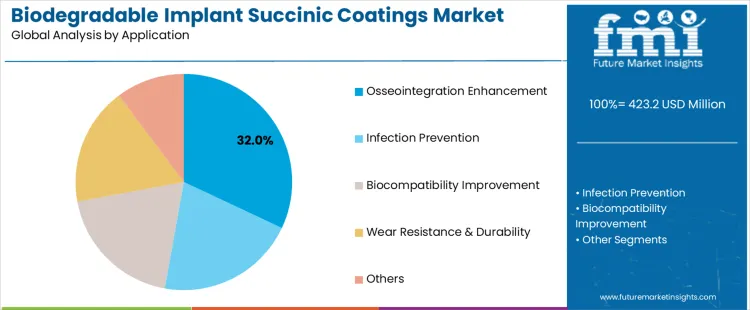
Osseointegration enhancement accounts for 32% of the application segment in the biodegradable implant succinic coatings market. Osseointegration, the process by which implants fuse with bone tissue, is crucial for the long-term success of orthopedic and dental implants. Succinic coatings help improve this process by providing a conducive surface for bone attachment and growth. Biodegradable coatings offer the added benefit of being absorbed over time, reducing the need for surgical removal and improving patient outcomes. As the demand for better integration between implants and biological tissue rises, osseointegration enhancement remains a significant application driving the adoption of biodegradable succinic coatings in medical implants.
What Are the Key Dynamics for the Biodegradable Implant Succinic Coatings Market?
The biodegradable implant succinic coatings market is driven by the increasing demand for sustainable, biocompatible coatings in medical implants. These coatings, made from succinic acid derivatives, offer enhanced biodegradability, reducing the environmental impact and the need for surgical removal after the implant's function has been fulfilled. The growing focus on minimizing complications from implant surgeries and improving patient safety is propelling the adoption of biodegradable coatings. Regulatory pressures for safer and more environmentally friendly materials in medical devices are supporting the growth of succinic-based coatings in implantable products, such as orthopedic and dental implants.
Why Is the Biodegradable Implant Succinic Coatings Market Growing?
The market for biodegradable implant succinic coatings is growing due to the increasing demand for sustainable and patient-friendly materials in the medical device industry. Succinic acid-based biodegradable coatings offer improved bioactivity, promoting better integration between implants and surrounding tissues. The growing preference for minimally invasive procedures, combined with the need for implants that naturally degrade in the body, is further driving market growth. The ability of succinic acid derivatives to reduce long-term complications associated with traditional implant coatings, such as the need for removal surgeries, is also contributing to the demand for these biodegradable solutions.
How Are the Key Drivers Shaping the Biodegradable Implant Succinic Coatings Market?
Key drivers for the biodegradable implant succinic coatings market include the rising demand for environmentally friendly and biocompatible materials in the medical field. With increasing concerns about the environmental impact of permanent implants and the associated risks, succinic acid-based biodegradable coatings provide a solution by naturally degrading in the body over time. The focus on improving patient safety and reducing complications from traditional implants is pushing the adoption of these coatings. The continued research and development of biodegradable polymers and coatings are also enhancing the performance and reliability of succinic acid-based coatings, supporting market growth.
What is the Growth Outlook for the Biodegradable Implant Succinic Coatings Market by Country?
| Country | CAGR (%) |
|---|---|
| India | 10.6% |
| China | 9.4% |
| USA | 7.8% |
| Germany | 7.2% |
| Japan | 6.9% |
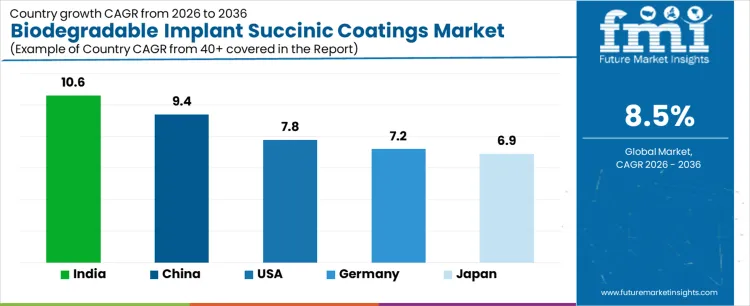
The biodegradable implant succinic coatings market is experiencing growth across key regions. India leads at 10.6%, driven by the expanding healthcare infrastructure, an aging population, and the growing demand for sustainable medical solutions. China follows at 9.4%, supported by its rapidly growing healthcare sector and increasing demand for eco-friendly medical devices. The USA grows at 7.8%, fueled by the need for advanced, biocompatible implant solutions and sustainability in healthcare. Germany expands at 7.2%, backed by its leadership in medical device manufacturing and regulatory push for sustainable materials. Japan grows at 6.9%, supported by its focus on innovation and sustainable medical technologies.
What is Driving the Growth of the Biodegradable Implant Succinic Coatings Market in India?
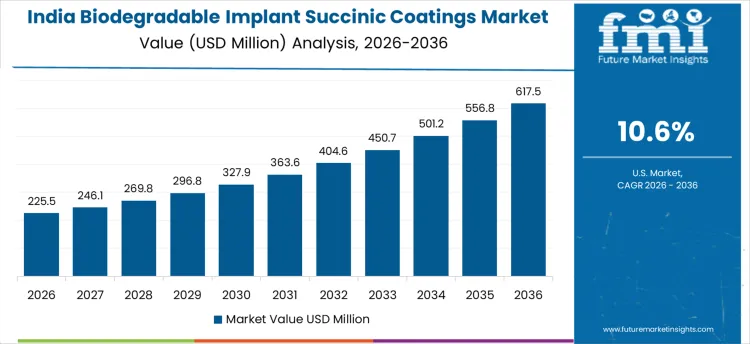
India’s biodegradable implant succinic coatings market is growing at 10.6%, driven by the country’s expanding healthcare sector and increasing demand for sustainable, eco-friendly medical devices. The growing adoption of biodegradable coatings in implants, particularly in orthopedic and dental applications, is propelling the market. These coatings offer advantages such as enhanced biocompatibility, reduced risk of infection, and faster healing times. With India’s large and aging population, along with the rise in healthcare infrastructure and medical tourism, the need for advanced, environmentally friendly implant solutions is on the rise. The country’s strong focus on sustainability and growing awareness about the benefits of biodegradable materials in healthcare is driving the adoption of succinic-based coatings in medical implants. As India continues to modernize its healthcare sector, demand for biodegradable implants will continue to rise.
How is the Biodegradable Implant Succinic Coatings Market Expanding in China?
China’s biodegradable implant succinic coatings market is growing at 9.4%, driven by the country’s booming healthcare sector and the increasing demand for eco-friendly and sustainable medical solutions. China is increasingly adopting biodegradable coatings for implants, particularly in orthopedic, cardiovascular, and dental applications, due to their superior biocompatibility and reduced environmental impact compared to traditional coatings. The Chinese government’s focus on advancing healthcare infrastructure and medical technologies, along with growing awareness about the environmental impact of medical waste, is fueling market growth. China’s growing aging population and rising demand for advanced medical devices further contribute to the market’s expansion. As China continues to prioritize sustainability and innovation in healthcare, the demand for biodegradable implant succinic coatings will continue to rise.
How is the Biodegradable Implant Succinic Coatings Market Expanding in the USA?
The biodegradable implant succinic coatings market in the USA is growing at 7.8%, driven by the country’s advanced healthcare sector and rising demand for sustainable, eco-friendly medical devices. The USA is witnessing increased adoption of biodegradable coatings in implants, particularly in orthopedic and dental applications, as healthcare providers focus on improving patient outcomes, reducing post-surgical complications, and minimizing environmental impact. With rising healthcare costs and a growing emphasis on minimally invasive and bio-compatible medical solutions, biodegradable implants are gaining popularity. The growing trend of using eco-friendly materials in healthcare products, coupled with regulatory frameworks promoting sustainability, is contributing to market growth. As the USA continues to lead in medical device innovation, the demand for biodegradable implant succinic coatings is expected to grow steadily.
What is Driving the Growth of the Biodegradable Implant Succinic Coatings Market in Germany?
Germany’s biodegradable implant succinic coatings market is growing at 7.2%, supported by the country’s robust healthcare and medical device manufacturing sectors. As Germany continues to focus on sustainability and reducing the environmental impact of medical devices, biodegradable implant coatings are becoming increasingly popular. Succinic-based coatings are gaining traction due to their biocompatibility, reduced toxicity, and ability to enhance healing. Germany’s strong emphasis on high-quality healthcare solutions, coupled with its leadership in the global medical device market, is driving the demand for biodegradable materials in implants. The country’s regulatory environment, which promotes the use of sustainable and eco-friendly materials, is also contributing to the market’s growth. As Germany continues to prioritize sustainability in healthcare, the demand for biodegradable implant coatings will rise.
How is the Biodegradable Implant Succinic Coatings Market Expanding in Japan?
Japan’s biodegradable implant succinic coatings market is growing at 6.9%, driven by the country’s advancements in medical technology and its focus on sustainability in healthcare. Japan is increasingly adopting biodegradable materials in medical devices, particularly in implants for orthopedic and dental applications. Succinic coatings are being preferred for their biocompatibility, ability to enhance healing, and lower environmental impact compared to traditional coatings. With an aging population and rising healthcare needs, Japan is seeing an increased demand for innovative, sustainable medical solutions. The government’s focus on green technologies, along with Japan’s ongoing efforts to reduce medical waste, is driving the adoption of biodegradable implant coatings. As Japan continues to innovate in medical device development and prioritize sustainability, the demand for biodegradable implant succinic coatings will continue to expand.
How Are Companies Competing in the Biodegradable Implant Succinic Coatings Market?
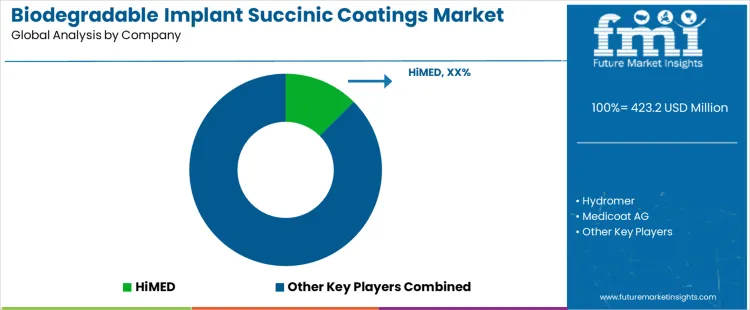
Competition in the biodegradable implant succinic coatings market is driven by biocompatibility, controlled degradation profiles, mechanical integrity, and ease of application on diverse implant substrates. HiMED positions its succinic-acid-based coating solutions with a focus on precise degradation rates and strong tissue integration, and its product materials emphasize predictable resorption behavior that supports healing without adverse reactions. Hydromer competes by offering tailored polymer systems incorporating succinic acid chemistries that balance adhesion strength and biodegradability, with brochures highlighting controlled release of therapeutic agents and minimal inflammatory response.
Medicoat AG differentiates through surface engineering expertise, marketing succinic coatings that provide uniform film formation and excellent substrate adherence on titanium and other implant metals. Its documentation stresses consistent coating thickness and reproducibility that help device manufacturers meet stringent quality standards. CAM Bioceramics B.V. brings ceramic-enhanced succinic coating technologies that combine bioactivity with structural support, and its product literature highlights enhanced osteoconductivity and integration in bone repair applications.
APS Materials, Inc. adds value with specialized succinic acid hybrid coatings designed for mechanical resilience and tailored degradation, with collateral emphasizing support for complex implant geometries and regulatory alignment. Others in the market contribute with niche succinic coating chemistries and custom formulation services that address specific therapeutic goals or material platforms. Across all vendors, product materials underscore biocompatibility, controlled resorption rates, strong adhesion, and application flexibility as key differentiators that help medical device developers select coatings aligned with performance, safety, and regulatory requirements.
Key Players in Biodegradable Implant Succinic Coatings Market
- HiMED
- Hydromer
- Medicoat AG
- CAM Bioceramics B.V.
- APS Materials, Inc.
- Others
Scope of Report
| Attributes | Description |
|---|---|
| Quantitative Unit (2026) | USD Million |
| Implant Type | Orthopedic Implants, Dental Implants, Cardiovascular Implants, Neurological Implants, Others |
| Application | Osseointegration Enhancement, Infection Prevention, Biocompatibility Improvement, Wear Resistance & Durability, Others |
| Regions Covered | Asia Pacific, Europe, North America, Latin America, Middle East & Africa |
| Countries Covered | China, Japan, South Korea, India, Australia & New Zealand, ASEAN, Germany, United Kingdom, France, Italy, Spain, Nordic, BENELUX, United States, Canada, Mexico, Brazil, Chile, Turkey, South Africa, Other GCC Countries |
| Key Companies Profiled | HiMED, Hydromer, Medicoat AG, CAM Bioceramics B.V., APS Materials, Inc., Others |
| Additional Attributes | Dollar sales by implant type, application, and region; regional CAGR and growth outlook for the biodegradable implant succinic coatings |
Biodegradable Implant Succinic Coatings Market by Key Segments
Implant Type
- Orthopedic Implants
- Dental Implants
- Cardiovascular Implants
- Neurological Implants
- Others
Application
- Osseointegration Enhancement
- Infection Prevention
- Biocompatibility Improvement
- Wear Resistance & Durability
- Others
Region:
- Asia Pacific
- China
- Japan
- South Korea
- India
- Australia & New Zealand
- ASEAN
- Rest of Asia Pacific
- Europe
- Germany
- United Kingdom
- France
- Italy
- Spain
- Nordic
- BENELUX
- Rest of Europe
- North America
- United States
- Canada
- Mexico
- Latin America
- Brazil
- Chile
- Rest of Latin America
- Middle East & Africa
- Kingdom of Saudi Arabia
- Other GCC Countries
- Turkey
- South Africa
- Other African Union
- Rest of Middle East & Africa
Bibliography
- Boccaccini, A. R., et al. (2024). Biodegradable and bioresorbable coatings for next‑generation medical implants. Acta Biomaterialia.
- Li, X., Zhang, Y., & Wang, H. (2024). Organic acid‑based surface coatings for biodegradable implant applications. Materials Science & Engineering C.
- ISO 10993‑1:2018 / Reviewed 2024. Biological evaluation of medical devices — Risk management framework. International Organization for Standardization (ISO).
- European Commission – Joint Research Centre (JRC). (2024). Biodegradable materials in implantable medical devices: Safety and lifecycle assessment. Journal of the Royal Society Interface.
- Zhang, L., Chen, Q., & Liu, Y. (2025). Controlled degradation and bioactivity of organic‑acid‑modified implant coatings. Bioactive Materials.
Frequently Asked Questions
How big is the biodegradable implant succinic coatings market in 2026?
The global biodegradable implant succinic coatings market is estimated to be valued at USD 423.2 million in 2026.
What will be the size of biodegradable implant succinic coatings market in 2036?
The market size for the biodegradable implant succinic coatings market is projected to reach USD 956.8 million by 2036.
How much will be the biodegradable implant succinic coatings market growth between 2026 and 2036?
The biodegradable implant succinic coatings market is expected to grow at a 8.5% CAGR between 2026 and 2036.
What are the key product types in the biodegradable implant succinic coatings market?
The key product types in biodegradable implant succinic coatings market are orthopedic implants, dental implants, cardiovascular implants, neurological implants and others.
Which application segment to contribute significant share in the biodegradable implant succinic coatings market in 2026?
In terms of application, osseointegration enhancement segment to command 32.0% share in the biodegradable implant succinic coatings market in 2026.
Preview the report firsthand - request a free sample
Get SampleGet the brochure for pricing and purchase details.
Get PDFTable of Content
- Executive Summary
- Global Market Outlook
- Demand-side Trends
- Supply-side Trends
- Technology Roadmap Analysis
- Analysis and Recommendations
- Market Overview
- Market Coverage / Taxonomy
- Market Definition / Scope / Limitations
- Market Background
- Market Dynamics
- Drivers
- Restraints
- Opportunity
- Trends
- Scenario Forecast
- Demand in Optimistic Scenario
- Demand in Likely Scenario
- Demand in Conservative Scenario
- Opportunity Map Analysis
- Product Life Cycle Analysis
- Supply Chain Analysis
- Investment Feasibility Matrix
- Value Chain Analysis
- PESTLE and Porter’s Analysis
- Regulatory Landscape
- Regional Parent Market Outlook
- Production and Consumption Statistics
- Import and Export Statistics
- Market Dynamics
- Global Market Analysis 2021 to 2025 and Forecast, 2026 to 2036
- Historical Market Size Value (USD Million) Analysis, 2021 to 2025
- Current and Future Market Size Value (USD Million) Projections, 2026 to 2036
- Y-o-Y Growth Trend Analysis
- Absolute $ Opportunity Analysis
- Global Market Pricing Analysis 2021 to 2025 and Forecast 2026 to 2036
- Global Market Analysis 2021 to 2025 and Forecast 2026 to 2036, By Implant Type
- Introduction / Key Findings
- Historical Market Size Value (USD Million) Analysis By Implant Type , 2021 to 2025
- Current and Future Market Size Value (USD Million) Analysis and Forecast By Implant Type , 2026 to 2036
- Orthopedic Implants
- Dental Implants
- Cardiovascular Implants
- Neurological Implants
- Others
- Orthopedic Implants
- Y-o-Y Growth Trend Analysis By Implant Type , 2021 to 2025
- Absolute $ Opportunity Analysis By Implant Type , 2026 to 2036
- Global Market Analysis 2021 to 2025 and Forecast 2026 to 2036, By Application
- Introduction / Key Findings
- Historical Market Size Value (USD Million) Analysis By Application, 2021 to 2025
- Current and Future Market Size Value (USD Million) Analysis and Forecast By Application, 2026 to 2036
- Osseointegration Enhancement
- Infection Prevention
- Biocompatibility Improvement
- Wear Resistance & Durability
- Others
- Osseointegration Enhancement
- Y-o-Y Growth Trend Analysis By Application, 2021 to 2025
- Absolute $ Opportunity Analysis By Application, 2026 to 2036
- Global Market Analysis 2021 to 2025 and Forecast 2026 to 2036, By Region
- Introduction
- Historical Market Size Value (USD Million) Analysis By Region, 2021 to 2025
- Current Market Size Value (USD Million) Analysis and Forecast By Region, 2026 to 2036
- North America
- Latin America
- Western Europe
- Eastern Europe
- East Asia
- South Asia and Pacific
- Middle East & Africa
- Market Attractiveness Analysis By Region
- North America Market Analysis 2021 to 2025 and Forecast 2026 to 2036, By Country
- Historical Market Size Value (USD Million) Trend Analysis By Market Taxonomy, 2021 to 2025
- Market Size Value (USD Million) Forecast By Market Taxonomy, 2026 to 2036
- By Country
- USA
- Canada
- Mexico
- By Implant Type
- By Application
- By Country
- Market Attractiveness Analysis
- By Country
- By Implant Type
- By Application
- Key Takeaways
- Latin America Market Analysis 2021 to 2025 and Forecast 2026 to 2036, By Country
- Historical Market Size Value (USD Million) Trend Analysis By Market Taxonomy, 2021 to 2025
- Market Size Value (USD Million) Forecast By Market Taxonomy, 2026 to 2036
- By Country
- Brazil
- Chile
- Rest of Latin America
- By Implant Type
- By Application
- By Country
- Market Attractiveness Analysis
- By Country
- By Implant Type
- By Application
- Key Takeaways
- Western Europe Market Analysis 2021 to 2025 and Forecast 2026 to 2036, By Country
- Historical Market Size Value (USD Million) Trend Analysis By Market Taxonomy, 2021 to 2025
- Market Size Value (USD Million) Forecast By Market Taxonomy, 2026 to 2036
- By Country
- Germany
- UK
- Italy
- Spain
- France
- Nordic
- BENELUX
- Rest of Western Europe
- By Implant Type
- By Application
- By Country
- Market Attractiveness Analysis
- By Country
- By Implant Type
- By Application
- Key Takeaways
- Eastern Europe Market Analysis 2021 to 2025 and Forecast 2026 to 2036, By Country
- Historical Market Size Value (USD Million) Trend Analysis By Market Taxonomy, 2021 to 2025
- Market Size Value (USD Million) Forecast By Market Taxonomy, 2026 to 2036
- By Country
- Russia
- Poland
- Hungary
- Balkan & Baltic
- Rest of Eastern Europe
- By Implant Type
- By Application
- By Country
- Market Attractiveness Analysis
- By Country
- By Implant Type
- By Application
- Key Takeaways
- East Asia Market Analysis 2021 to 2025 and Forecast 2026 to 2036, By Country
- Historical Market Size Value (USD Million) Trend Analysis By Market Taxonomy, 2021 to 2025
- Market Size Value (USD Million) Forecast By Market Taxonomy, 2026 to 2036
- By Country
- China
- Japan
- South Korea
- By Implant Type
- By Application
- By Country
- Market Attractiveness Analysis
- By Country
- By Implant Type
- By Application
- Key Takeaways
- South Asia and Pacific Market Analysis 2021 to 2025 and Forecast 2026 to 2036, By Country
- Historical Market Size Value (USD Million) Trend Analysis By Market Taxonomy, 2021 to 2025
- Market Size Value (USD Million) Forecast By Market Taxonomy, 2026 to 2036
- By Country
- India
- ASEAN
- Australia & New Zealand
- Rest of South Asia and Pacific
- By Implant Type
- By Application
- By Country
- Market Attractiveness Analysis
- By Country
- By Implant Type
- By Application
- Key Takeaways
- Middle East & Africa Market Analysis 2021 to 2025 and Forecast 2026 to 2036, By Country
- Historical Market Size Value (USD Million) Trend Analysis By Market Taxonomy, 2021 to 2025
- Market Size Value (USD Million) Forecast By Market Taxonomy, 2026 to 2036
- By Country
- Kingdom of Saudi Arabia
- Other GCC Countries
- Turkiye
- South Africa
- Other African Union
- Rest of Middle East & Africa
- By Implant Type
- By Application
- By Country
- Market Attractiveness Analysis
- By Country
- By Implant Type
- By Application
- Key Takeaways
- Key Countries Market Analysis
- USA
- Pricing Analysis
- Market Share Analysis, 2025
- By Implant Type
- By Application
- Canada
- Pricing Analysis
- Market Share Analysis, 2025
- By Implant Type
- By Application
- Mexico
- Pricing Analysis
- Market Share Analysis, 2025
- By Implant Type
- By Application
- Brazil
- Pricing Analysis
- Market Share Analysis, 2025
- By Implant Type
- By Application
- Chile
- Pricing Analysis
- Market Share Analysis, 2025
- By Implant Type
- By Application
- Germany
- Pricing Analysis
- Market Share Analysis, 2025
- By Implant Type
- By Application
- UK
- Pricing Analysis
- Market Share Analysis, 2025
- By Implant Type
- By Application
- Italy
- Pricing Analysis
- Market Share Analysis, 2025
- By Implant Type
- By Application
- Spain
- Pricing Analysis
- Market Share Analysis, 2025
- By Implant Type
- By Application
- France
- Pricing Analysis
- Market Share Analysis, 2025
- By Implant Type
- By Application
- India
- Pricing Analysis
- Market Share Analysis, 2025
- By Implant Type
- By Application
- ASEAN
- Pricing Analysis
- Market Share Analysis, 2025
- By Implant Type
- By Application
- Australia & New Zealand
- Pricing Analysis
- Market Share Analysis, 2025
- By Implant Type
- By Application
- China
- Pricing Analysis
- Market Share Analysis, 2025
- By Implant Type
- By Application
- Japan
- Pricing Analysis
- Market Share Analysis, 2025
- By Implant Type
- By Application
- South Korea
- Pricing Analysis
- Market Share Analysis, 2025
- By Implant Type
- By Application
- Russia
- Pricing Analysis
- Market Share Analysis, 2025
- By Implant Type
- By Application
- Poland
- Pricing Analysis
- Market Share Analysis, 2025
- By Implant Type
- By Application
- Hungary
- Pricing Analysis
- Market Share Analysis, 2025
- By Implant Type
- By Application
- Kingdom of Saudi Arabia
- Pricing Analysis
- Market Share Analysis, 2025
- By Implant Type
- By Application
- Turkiye
- Pricing Analysis
- Market Share Analysis, 2025
- By Implant Type
- By Application
- South Africa
- Pricing Analysis
- Market Share Analysis, 2025
- By Implant Type
- By Application
- USA
- Market Structure Analysis
- Competition Dashboard
- Competition Benchmarking
- Market Share Analysis of Top Players
- By Regional
- By Implant Type
- By Application
- Competition Analysis
- Competition Deep Dive
- HiMED
- Overview
- Product Portfolio
- Profitability by Market Segments (Product/Age /Sales Channel/Region)
- Sales Footprint
- Strategy Overview
- Marketing Strategy
- Product Strategy
- Channel Strategy
- Hydromer
- Medicoat AG
- CAM Bioceramics B.V.
- APS Materials, Inc.
- Others
- HiMED
- Competition Deep Dive
- Assumptions & Acronyms Used
- Research Methodology


