

- Industry Size (2026)
- USD 1.2 Bn
- Forecast (2036)
- USD 2.6 Bn
- CAGR (2026 to 2036)
- 8.0%
Soil-Release Functionalized Polyester Apparel Fiber Market Forecast and Outlook 2026 to 2036
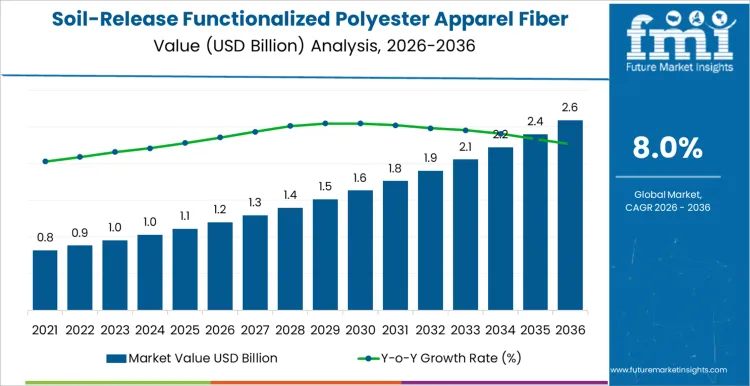
USD 1.2 billion defines the starting scale of the soil-release functionalized polyester apparel fiber market in 2026, with the total expected to reach USD 2.6 billion by 2036 at an 8% CAGR. Adoption is driven by lifecycle appearance targets, rental and uniform service requirements, and consumer expectations for low-effort garment care. Fiber selection is determined during fabric platform planning through defined stain categories, wash cycle limits, and visual retention criteria. Once a brand approves a fabric family, later material substitution requires renewed consumer testing and care-label validation. Volume development follows growth in uniforms, school wear, hospitality textiles, and value-focused apparel lines.
Commercial positioning inside the soil-release functionalized polyester apparel fiber market depends on control of performance claims and continuity across sourcing cycles. Brands and large retailers manage access through locked fabric programs and multi-season material lists. Entry requires evidence of repeatable stain release behavior across defined laundering protocols and fabric constructions. Range planning cycles, not spot sourcing decisions, govern supplier rotation. Revenue progression reflects the number of apparel programs built on easy-care positioning. Competitive advantage is achieved through early involvement in fabric platform design and long-term retention within standardized collections. Supplier evaluation emphasizes documentation quality, consistency across mills, and stability of finishing performance across production regions.
Soil-Release Functionalized Polyester Apparel Fiber Market Quick Stats
- Soil-Release Functionalized Polyester Apparel Fiber Market Value (2026): USD 1.2 billion
- Soil-Release Functionalized Polyester Apparel Fiber Market Forecast Value (2036): USD 2.6 billion
- Soil-Release Functionalized Polyester Apparel Fiber Market Forecast CAGR (2026-2036): 8.0%
- Leading Technology in Soil-Release Functionalized Polyester Apparel Fiber Market: Hydrophilic block copolymer finishes
- Leading Apparel Category in Soil-Release Functionalized Polyester Apparel Fiber Market: Casualwear and everyday apparel
- Key Growth Regions in Soil-Release Functionalized Polyester Apparel Fiber Market: China, USA, Germany, South Korea, Japan
- Top Players in Soil-Release Functionalized Polyester Apparel Fiber Market: Toray Industries, Teijin, Indorama Ventures, Reliance Industries, Far Eastern New Century, Huvis, Jiangsu Sanfangxiang Group, UNIFI, ADVANSA
What is the Growth Forecast for the Soil Release Functionalized Polyester Apparel Fiber Market through 2036?
The soil release functionalized polyester apparel fiber market in 2026 stands near USD 1.2 billion, shaped by how brands manage return rates, appearance claims, and care label positioning. Sourcing teams evaluate this fiber through mill trials that measure stain detachment, drying marks, and fabric look after repeated home laundering. Decisions sit with brand material councils and nominated mills rather than with seasonal buyers. Integration usually happens at the yarn or fabric platform level, not at the trim stage. The progression toward USD 2.6 billion in 2036 follows an 8% growth profile tied to expansion of easy care specifications across everyday apparel categories and higher inclusion rates in core fabric programs.
Operating practice across apparel supply chains sets the commercial rhythm of the soil release functionalized polyester apparel fiber market. Orders align with fabric booking cycles and long program commitments. Inventory strategy favors stable access to approved grades that hold performance across dye lots and finishing routes. Cost structure reflects additive integration, quality testing, and segregation inside spinning and finishing plants. Mills value low reprocessing rates and predictable finishing windows. Annual values move through the mid and upper one billions during the early 2030s as more base fabrics adopt built in release performance. The rise to USD 2.6 billion in 2036 comes from wider standardization, higher treated fiber share per garment, and longer contracts that lock this functionality into permanent material specifications.
Soil-Release Functionalized Polyester Apparel Fiber Market Key Takeaways
| Metric | Value |
|---|---|
| Market Value (2026) | USD 1.2 billion |
| Forecast Value (2036) | USD 2.6 billion |
| Forecast CAGR (2026-2036) | 8.0% |
How Is the Soil Release Functionalized Polyester Apparel Fiber Market Being Used to Control Stain Removal Performance and Garment Service Life?
The soil release functionalized polyester apparel fiber market is specified where appearance retention must survive repeated wearing and laundering without surface treatments. Apparel programs supplying work-wear uniforms evaluate these fibers for oily stain removal and re-deposition control because visible residue drives early replacement. Brands producing hospital staff garments examine compatibility with disinfectant washes and high temperature cycles. Manufacturers serving food service apparel track color change and surface wetting behavior after repeated exposure to grease. Developers working with school uniforms focus on abrasion resistance and pilling because surface damage reduces release efficiency. Buyers supplying rental textile programs review consistency across lots to keep wash results predictable. Qualification centers on finish durability, fiber surface chemistry stability, and tensile retention because inconsistent behavior forces reprocessing, customer complaints, and accelerated garment write offs.
The soil release functionalized polyester apparel fiber market is managed through lifetime cost control and appearance standards rather than first wash performance claims. Laundry operators track rewash rates and stain carryover because both affect throughput and chemical use. Garment makers measure value through usable wash cycles before visual downgrade, not through initial repellency. Storage and handling receive attention because contamination before sewing reduces release effectiveness. Contracts define acceptance limits for stain removal retention, shade stability, and strength loss after defined wash counts. Demand concentrates in supply chains where uniform appearance, hygiene inspection, and predictable service life determine contract renewal, which places fiber selection inside operational planning and quality assurance rather than seasonal style decisions.
How do laundering performance targets and garment life-cycle specifications shape demand in the Soil-Release Functionalized Polyester Apparel Fiber Market by soil-release technology and apparel category in 2026?
In the Soil-Release Functionalized Polyester Apparel Fiber Market, specifications start from stain detachment after repeated washes, drying behavior, and appearance retention rather than fiber cost. Programs supplying apparel fabric finishing lines, industrial garment laundry services, and mass retail apparel production require fibers that keep release performance while preserving shade and hand. By soil-release technology, usage spans hydrophilic block copolymer finishes, carboxyl-functional polyester fibers, crosslinked polyester systems, and other approaches, each with different fixation and durability profiles. By apparel category, consumption covers casualwear and everyday apparel, sportswear and athleisure, workwear and uniforms, and other apparel. Once a construction enters care labels and approval files, substitution triggers new wash testing and customer sign-offs.
Why do finish chemistries remain fixed once approved in production?
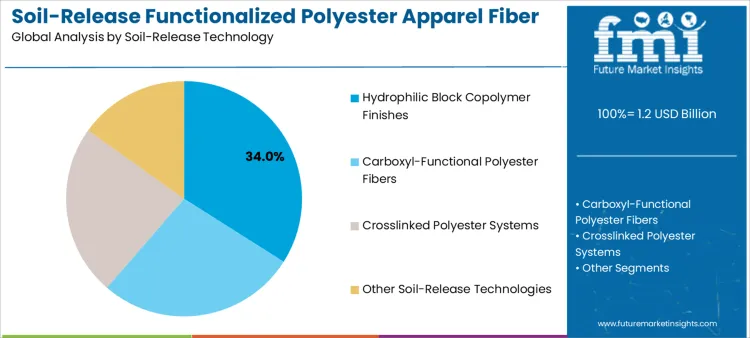
Hydrophilic block copolymer finishes hold about 34% share because they deliver repeatable wetting and detachment without changing base yarn behavior. In the Soil-Release functionalized polyester apparel fiber market, mills feeding apparel fabric finishing lines favor systems that survive tumble drying and ironing while keeping shade change low. Carboxyl-functional polyester fibers place functionality inside the polymer, which suits products that face abrasion and frequent washing. Crosslinked polyester systems improve permanence, though they narrow finishing windows and complicate reprocessing. Other technologies remain tied to narrow equipment envelopes. Engineers screen chemistries through release after multiple cycles, shade shift, and tensile retention. Process teams screen them through pad pickup, cure tolerance, and lint. Quality teams screen them through lot identity and aging. A chemistry that clears these gates becomes standard across many styles.
Once selected, the finish route becomes embedded in recipes, cure profiles, and inspection plans. Changing it forces new wash series, new color standards, and new acceptance limits. Documentation must be rewritten to keep care claims aligned. Planning then protects the approved route with dedicated schedules. Inventory rules prevent mixing to avoid label disputes. The commercial outcome favors repeating the same chemistry across seasons. Capacity grows by adding widths and shifts rather than altering finish systems. This discipline explains the persistence of surface-applied and in-polymer approaches in programs where verification and repeatability dominate decisions.
How do garment use patterns and care labels lock in application demand?
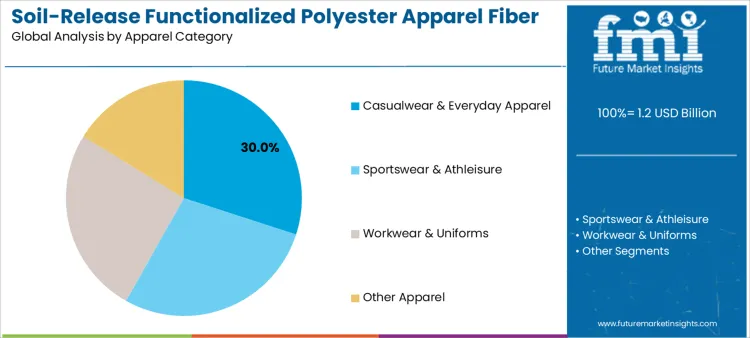
Casualwear and everyday apparel represent about 30% of demand because consumers expect visible cleanliness after normal home washing. In mass retail apparel production, approval files link soil release to shade, hand, and seam appearance. Sportswear and athleisure follow where repeated sweating and washing create combined soil loads and redeposition risks. Workwear and uniforms rely on predictable release in industrial garment laundry services where batch processing and higher temperatures are common. Other apparel remains tied to brand-specific standards. Converters approve routes through fabric runnability, cutting yield, and sewing performance. Compliance teams define sampling and record retention. Service teams define replacement timing based on appearance audits. Once a route clears these checks, it becomes fixed to a narrow window.
Switching the apparel category resets wash protocols, visual standards, and customer files. Tooling and finishing schedules also change. Training and inspection sheets must be updated. Supervisors then protect the approved route with dedicated planning. Orders expand by adding styles and colors rather than changing fiber treatments. Demand follows categories where care labels and appearance audits govern acceptance more than short purchasing cycles.
Why Are Garment Lifecycle Cost and Appearance Standards Driving the Soil-Release Functionalized Polyester Apparel Fiber Market?
Soil-Release Functionalized Polyester Apparel Fiber Market demand is shaped by apparel programs that measure success over repeated wash and wear cycles rather than first-use appearance. Brands in workwear, uniforms, and everyday apparel want fabrics that retain a clean look without aggressive detergents or special care. Soil-release functionalization reduces the bonding strength between oily or particulate soils and the fiber surface, improving cleaning efficiency in standard laundering. Sourcing teams evaluate fibers based on retained performance after many wash cycles, color stability, and compatibility with existing dyeing and finishing routes. Value is realized through lower complaint rates, longer garment service life, and more predictable in-use appearance across production lots.
What Is Limiting Rapid Substitution of Standard Polyester in the Soil-Release Functionalized Polyester Apparel Fiber Market?
Soil-Release Functionalized Polyester Apparel Fiber Market expansion is held back by production discipline requirements, price thresholds, and risk management inside apparel supply chains. Functionalization must survive spinning, knitting or weaving, dyeing, and garment finishing without loss of effect, which narrows acceptable processing windows. Any inconsistency in treatment level can produce visible performance variation across garments, raising inspection and rejection risk. Cost differences versus standard polyester remain a barrier in volume driven apparel categories. Brands also require multi-cycle wash testing before approving fiber changes, which ties adoption to seasonal development calendars rather than continuous substitution. Supply reliability matters because reformulation after approval disrupts fabric and garment qualification programs.
How Are Sourcing Models and Fiber Portfolios Changing in the Soil-Release Functionalized Polyester Apparel Fiber Market?
Soil-Release Functionalized Polyester Apparel Fiber Market development is moving toward standardized, application-mapped fiber families rather than one-off treated grades. Producers align fiber offerings to garment categories such as uniforms, casualwear, and active basics, each with defined care and performance targets. Mills and brands increasingly lock fiber specifications into fabric platforms to stabilize long-term quality and reduce requalification work. Commercial discussions focus on performance retention guarantees, batch consistency, and continuity of treatment chemistry. Technical service shifts toward wash protocol alignment, stain type benchmarking, and fabric construction guidance. Competitive advantage centers on predictable real-world garment behavior rather than laboratory stain release scores alone.
What is the Demand for Soil Release Functionalized Polyester Apparel Fiber by Country?
| Country | CAGR (%) |
|---|---|
| USA | 7.7% |
| Japan | 6.5% |
| South Korea | 7.2% |
| Germany | 7.6% |
| China | 9.2% |
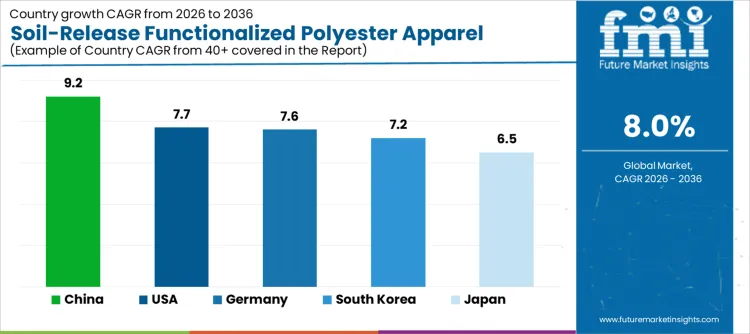
The demand for soil release functionalized polyester apparel fiber is increasing across workwear, uniforms, and everyday clothing where ease of laundering and fabric appearance retention are important performance criteria. China leads at 9.2% CAGR, supported by large scale apparel manufacturing and growing use of performance treated fabrics in domestic and export garments. The USA grows at 7.7%, driven by steady demand from workwear, hospitality, and institutional apparel segments. Germany records 7.6%, shaped by quality focused uniform and professional clothing markets. South Korea advances at 7.2%, reflecting adoption in functional apparel and school uniforms. Japan posts 6.5%, within a mature but specification driven apparel textile sector focused on fabric durability and maintenance performance.
How Do Brand Performance Specifications Shape Procurement in the Soil-Release Functionalized Polyester Apparel Fiber Market in the USA?
In the United States, growth in the soil-release functionalized polyester apparel fiber market is proceeding at a pace consistent with a 7.7% CAGR. Procurement is driven by brand performance specifications that define stain removal efficiency, laundering durability, and fabric hand stability over repeated use cycles. Evaluation programs measure soil detachment after standardized wash tests, retention of the functional finish, tensile strength preservation, and colorfastness. Once a fiber grade satisfies these criteria, the same approval file governs sourcing and material substitution remains infrequent. Volume increases only when apparel programs expand seasonal ranges or extend uniform platforms. Technical committees retain authority over specification changes. Supplier access depends on documentation quality and audit outcomes. Inventory policies follow program schedules rather than spot purchasing. Commercial success depends on specification inclusion and consistent batch performance across multiple manufacturing sites.
How Do Factory Governance Systems Determine Adoption in the Soil-Release Functionalized Polyester Apparel Fiber Market in Japan?
Within Japanese operations, material governance is directing the soil-release functionalized polyester apparel fiber market along a path consistent with a 6.5% CAGR. Fiber selection is treated as a manufacturing control variable rather than a procurement preference. Any proposed change enters a formal review cycle that includes extended wash durability checks and surface chemistry stability assessments. Engineers examine soil release consistency, filament cohesion, abrasion resistance, and tolerance to finishing processes. Once approved, the same fiber remains embedded in identical constructions for extended production cycles. Change requests trigger complete revalidation procedures. Supplier access depends on documentation completeness and inspection outcomes. Local sources benefit from proximity to audit teams and quality oversight groups. Volume growth follows gradual portfolio extension rather than replacement initiatives. Commercial positioning relies on procedural discipline, documentation rigor, and sustained performance verification under controlled production conditions.
How Do Platform Product Definitions Drive Scale in the Soil-Release Functionalized Polyester Apparel Fiber Market in South Korea?
Product platform strategy explains why the soil-release functionalized polyester apparel fiber market in South Korea is advancing in line with a 7.2% CAGR. Development organizations define standard fiber sets that apply across several apparel families. A single material decision can influence numerous product lines without separate approvals. Evaluation centers on soil release efficiency, finish durability, tensile stability, and compatibility with existing dyeing and finishing routes. When a fiber enters the platform baseline, scale follows through synchronized product introductions. Plant-level changes remain limited because the platform file governs material use. Suppliers secure positions through joint testing and alignment with documentation requirements. Volume growth mirrors platform rollout schedules. Inventory planning aligns with coordinated manufacturing programs. Commercial success depends on early inclusion in platform definitions and stable execution during multi-line production deployments.
How Do Central Approval Structures Control Material Choice in the Soil-Release Functionalized Polyester Apparel Fiber Market in Germany?
In Germany, centralized technical governance is steering the soil-release functionalized polyester apparel fiber market in accordance with a 7.6% CAGR. Material access is controlled through central approval registers that apply across multiple production sites. Individual plants do not possess authority to introduce new fibers independently. Reviews focus on reproducibility, soil release performance retention, and audit completeness across operations. After approval, the same fiber grade is released for use in several factories under identical specification rules. Volume expansion follows program growth rather than local purchasing initiatives. Supplier positioning depends on audit performance and documentation discipline. Change control remains formal and closely supervised. Inventory policies reflect coordinated production planning. Commercial success depends on passing central reviews and maintaining identical performance across distributed manufacturing environments over extended operating periods.
How Do Network Replication Programs Create Scale in the Soil-Release Functionalized Polyester Apparel Fiber Market in China?
Replication across manufacturing networks explains why the soil-release functionalized polyester apparel fiber market in China is advancing in line with a 9.2% CAGR. Once a fiber performs within defined soil release and laundering endurance limits in one plant, it is transferred into parallel lines with limited redesign. Approval focuses on consistency and tolerance to high-volume production rather than incremental optimization. Expansion teams rely on standardized qualification files and rollout checklists. Domestic suppliers dominate because they can follow capacity additions and regional program expansion. Imports remain concentrated in higher specification applications. Volume growth results from repeating approved constructions across sites. Commercial advantage depends on being present when a product configuration becomes a reference template rather than competing for each individual facility.
What is the competitive landscape for the Soil-Release Functionalized Polyester Apparel Fiber globally?
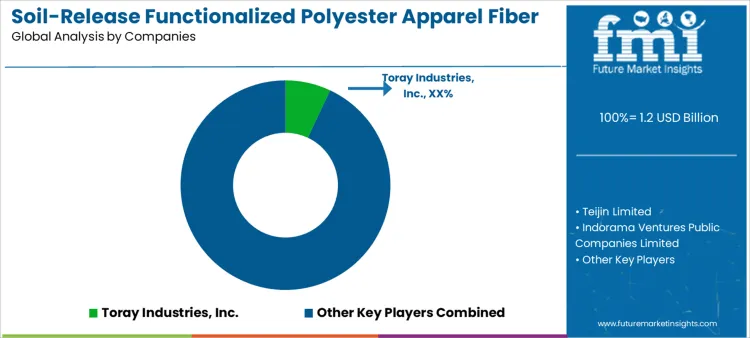
Fiber performance, functional finish durability, and processing compatibility drive adoption in the Soil-Release Functionalized Polyester Apparel Fiber Market. Toray Industries, Teijin, Indorama Ventures, Reliance Industries (Polyester Division), Far Eastern New Century, Huvis, Jiangsu Sanfangxiang Group, UNIFI, and ADVANSA compete during fiber trials, pilot spinning, and textile line validation. Once incorporated into apparel and performance fabrics, soil-release efficiency, fiber uniformity, and thermal stability anchor supplier selection. Toray Industries emphasizes advanced polymer structures with durable soil-release functionality. Teijin provides fibers tailored for high-speed spinning and finishing. Indorama Ventures focuses on polyester blends with functionalized finishes. Reliance Industries supplies fibers optimized for large-scale apparel production. Far Eastern New Century and Huvis deliver fibers for industrial and technical textile applications. Jiangsu Sanfangxiang and UNIFI target specialty apparel and functional fabrics. ADVANSA offers engineered fibers with consistent functional finish performance.
Consistency, processing reliability, and functional performance define competitive positioning in the Soil-Release Functionalized Polyester Apparel Fiber Market. Fiber developers assess soil repellency retention, tensile strength, fiber uniformity, and finish integration during trials. Production teams favor suppliers capable of reproducible lot quality, scalable supply, and integration guidance for spinning and finishing lines. Toray Industries maintains adoption through technical support and process validation. Teijin secures placements where high-speed production requires functional durability. Indorama Ventures competes in polyester blends with integrated finishes. Reliance Industries holds share in large-volume textile operations. Far Eastern New Century and Huvis support industrial apparel and nonwoven programs. Jiangsu Sanfangxiang and UNIFI gain adoption in specialty functional fabrics. ADVANSA captures adoption in engineered apparel fibers requiring consistent finish performance. Market positions vary by fiber type, end-use application, finishing process, and regional production scale.
Key Players in the Soil-Release Functionalized Polyester Apparel Fiber Market
- Toray Industries, Inc.
- Teijin Limited
- Indorama Ventures Public Company Limited
- Reliance Industries Limited (Polyester Division)
- Far Eastern New Century Corporation
- Huvis Corporation
- Jiangsu Sanfangxiang Group Co., Ltd.
- UNIFI, Inc.
- ADVANSA GmbH
Scope of the Report
| Items | Values |
|---|---|
| Quantitative Units (2026) | USD billion |
| Soil-Release Technology | Hydrophilic block copolymer finishes, carboxyl-functional polyester fibers, crosslinked polyester systems, other soil-release technologies |
| Apparel Category | Casualwear and everyday apparel, sportswear and athleisure, workwear and uniforms, other apparel |
| Fabric Construction | Knits, wovens, nonwovens and other constructions |
| Sales Channel | Brand-led programs, mill-led programs, private label and retailer initiatives |
| Regions Covered | Asia Pacific, Europe, North America, Latin America, Middle East & Africa |
| Countries Covered | United States, Canada, Mexico, Germany, United Kingdom, France, Italy, Spain, Nordics, BENELUX, China, Japan, South Korea, India, Australia & New Zealand, ASEAN, Brazil, Chile, Saudi Arabia, Turkey, South Africa, and other regional markets |
| Key Companies Profiled | Toray Industries, Teijin, Indorama Ventures, Reliance Industries, Far Eastern New Century, Huvis, Jiangsu Sanfangxiang Group, UNIFI, ADVANSA |
| Additional Attributes | Dollar sales by soil-release technology, apparel category, fabric construction, and sales channel, stain release performance retention after repeated home and industrial laundering, shade and appearance stability, finish durability and fixation behavior, integration into apparel fabric platforms, control of rewash rates and garment service life, qualification and reapproval cycles tied to brand care-label programs, and regional demand patterns driven by uniforms, workwear, hospitality textiles, and everyday apparel programs |
Soil-Release Functionalized Polyester Apparel Fiber Market Segmentation
Soil-Release Technology:
- Hydrophilic Block Copolymer Finishes
- Carboxyl-Functional Polyester Fibers
- Crosslinked Polyester Systems
- Other Soil-Release Technologies
Apparel Category:
- Casualwear & Everyday Apparel
- Sportswear & Athleisure
- Workwear & Uniforms
- Other Apparel
Fabric Construction:
- Knits
- Wovens
- Nonwovens & Other Constructions
Sales Channel:
- Brand-Led Programs
- Mill-Led Programs
- Private Label & Retailer Initiatives
Region
- Asia Pacific
- China
- Japan
- South Korea
- India
- Australia & New Zealand
- ASEAN
- Rest of Asia Pacific
- Europe
- Germany
- United Kingdom
- France
- Italy
- Spain
- Nordic
- BENELUX
- Rest of Europe
- North America
- United States
- Canada
- Mexico
- Latin America
- Brazil
- Chile
- Rest of Latin America
- Middle East & Africa
- Kingdom of Saudi Arabia
- Other GCC Countries
- Turkey
- South Africa
- Other African Union
- Rest of Middle East & Africa
Bibliography
- American Association of Textile Chemists and Colorists. (2025). AATCC Test Method 130: Soil release—Oily stain release method. AATCC.
- International Organization for Standardization. (2023). ISO 6330:2023—Textiles—Domestic washing and drying procedures for textile testing. ISO.
- Kim, S., Park, J., & Lee, K. (2024). Effect of hydrophilic block copolymer finishes on stain release and appearance retention of polyester textiles. Textile Research Journal, 94(5–6), 789–803.
Frequently Asked Questions
How big is the soil-release functionalized polyester apparel fiber market in 2026?
The soil-release functionalized polyester apparel fiber market is estimated to reach USD 1.2 billion in 2026.
What will be the size of the soil-release functionalized polyester apparel fiber market in 2036?
What will be the size of the soil-release functionalized polyester apparel fiber market in 2036?
How fast will demand for soil-release functionalized polyester apparel fiber grow between 2026 and 2036?
How fast will demand for soil-release functionalized polyester apparel fiber grow between 2026 and 2036?
Which soil-release technology holds a leading share in the soil-release functionalized polyester apparel fiber market in 2026?
Hydrophilic block copolymer finishes are expected to account for about a 34% share in 2026.
Which apparel category contributes a major share in the soil-release functionalized polyester apparel fiber market in 2026?
Casualwear and everyday apparel are projected to represent about 30% of total demand in 2026.
Preview the report firsthand - request a free sample
Get SampleGet the brochure for pricing and purchase details.
Get PDFTable of Content
- Executive Summary
- Global Market Outlook
- Demand-side Trends
- Supply-side Trends
- Technology Roadmap Analysis
- Analysis and Recommendations
- Market Overview
- Market Coverage / Taxonomy
- Market Definition / Scope / Limitations
- Market Background
- Market Dynamics
- Drivers
- Restraints
- Opportunity
- Trends
- Scenario Forecast
- Demand in Optimistic Scenario
- Demand in Likely Scenario
- Demand in Conservative Scenario
- Opportunity Map Analysis
- Product Life Cycle Analysis
- Supply Chain Analysis
- Investment Feasibility Matrix
- Value Chain Analysis
- PESTLE and Porter’s Analysis
- Regulatory Landscape
- Regional Parent Market Outlook
- Production and Consumption Statistics
- Import and Export Statistics
- Market Dynamics
- Global Market Analysis 2021 to 2025 and Forecast, 2026 to 2036
- Historical Market Size Value (USD Million) Analysis, 2021 to 2025
- Current and Future Market Size Value (USD Million) Projections, 2026 to 2036
- Y-o-Y Growth Trend Analysis
- Absolute $ Opportunity Analysis
- Global Market Pricing Analysis 2021 to 2025 and Forecast 2026 to 2036
- Global Market Analysis 2021 to 2025 and Forecast 2026 to 2036, By Soil-Release Technology
- Introduction / Key Findings
- Historical Market Size Value (USD Million) Analysis By Soil-Release Technology , 2021 to 2025
- Current and Future Market Size Value (USD Million) Analysis and Forecast By Soil-Release Technology , 2026 to 2036
- Hydrophilic Block Copolymer Finishes
- Carboxyl-Functional Polyester Fibers
- Crosslinked Polyester Systems
- Other Soil-Release Technologies
- Hydrophilic Block Copolymer Finishes
- Y-o-Y Growth Trend Analysis By Soil-Release Technology , 2021 to 2025
- Absolute $ Opportunity Analysis By Soil-Release Technology , 2026 to 2036
- Global Market Analysis 2021 to 2025 and Forecast 2026 to 2036, By Apparel Category
- Introduction / Key Findings
- Historical Market Size Value (USD Million) Analysis By Apparel Category, 2021 to 2025
- Current and Future Market Size Value (USD Million) Analysis and Forecast By Apparel Category, 2026 to 2036
- Casualwear & Everyday Apparel
- Sportswear & Athleisure
- Workwear & Uniforms
- Other Apparel
- Casualwear & Everyday Apparel
- Y-o-Y Growth Trend Analysis By Apparel Category, 2021 to 2025
- Absolute $ Opportunity Analysis By Apparel Category, 2026 to 2036
- Global Market Analysis 2021 to 2025 and Forecast 2026 to 2036, By Fabric Construction
- Introduction / Key Findings
- Historical Market Size Value (USD Million) Analysis By Fabric Construction, 2021 to 2025
- Current and Future Market Size Value (USD Million) Analysis and Forecast By Fabric Construction, 2026 to 2036
- Knits
- Wovens
- Nonwovens & Other Constructions
- Knits
- Y-o-Y Growth Trend Analysis By Fabric Construction, 2021 to 2025
- Absolute $ Opportunity Analysis By Fabric Construction, 2026 to 2036
- Global Market Analysis 2021 to 2025 and Forecast 2026 to 2036, By Sales Channel
- Introduction / Key Findings
- Historical Market Size Value (USD Million) Analysis By Sales Channel, 2021 to 2025
- Current and Future Market Size Value (USD Million) Analysis and Forecast By Sales Channel, 2026 to 2036
- Brand-Led Programs
- Mill-Led Programs
- Private Label & Retailer Initiatives
- Brand-Led Programs
- Y-o-Y Growth Trend Analysis By Sales Channel, 2021 to 2025
- Absolute $ Opportunity Analysis By Sales Channel, 2026 to 2036
- Global Market Analysis 2021 to 2025 and Forecast 2026 to 2036, By Region
- Introduction
- Historical Market Size Value (USD Million) Analysis By Region, 2021 to 2025
- Current Market Size Value (USD Million) Analysis and Forecast By Region, 2026 to 2036
- North America
- Latin America
- Western Europe
- Eastern Europe
- East Asia
- South Asia and Pacific
- Middle East & Africa
- Market Attractiveness Analysis By Region
- North America Market Analysis 2021 to 2025 and Forecast 2026 to 2036, By Country
- Historical Market Size Value (USD Million) Trend Analysis By Market Taxonomy, 2021 to 2025
- Market Size Value (USD Million) Forecast By Market Taxonomy, 2026 to 2036
- By Country
- USA
- Canada
- Mexico
- By Soil-Release Technology
- By Apparel Category
- By Fabric Construction
- By Sales Channel
- By Country
- Market Attractiveness Analysis
- By Country
- By Soil-Release Technology
- By Apparel Category
- By Fabric Construction
- By Sales Channel
- Key Takeaways
- Latin America Market Analysis 2021 to 2025 and Forecast 2026 to 2036, By Country
- Historical Market Size Value (USD Million) Trend Analysis By Market Taxonomy, 2021 to 2025
- Market Size Value (USD Million) Forecast By Market Taxonomy, 2026 to 2036
- By Country
- Brazil
- Chile
- Rest of Latin America
- By Soil-Release Technology
- By Apparel Category
- By Fabric Construction
- By Sales Channel
- By Country
- Market Attractiveness Analysis
- By Country
- By Soil-Release Technology
- By Apparel Category
- By Fabric Construction
- By Sales Channel
- Key Takeaways
- Western Europe Market Analysis 2021 to 2025 and Forecast 2026 to 2036, By Country
- Historical Market Size Value (USD Million) Trend Analysis By Market Taxonomy, 2021 to 2025
- Market Size Value (USD Million) Forecast By Market Taxonomy, 2026 to 2036
- By Country
- Germany
- UK
- Italy
- Spain
- France
- Nordic
- BENELUX
- Rest of Western Europe
- By Soil-Release Technology
- By Apparel Category
- By Fabric Construction
- By Sales Channel
- By Country
- Market Attractiveness Analysis
- By Country
- By Soil-Release Technology
- By Apparel Category
- By Fabric Construction
- By Sales Channel
- Key Takeaways
- Eastern Europe Market Analysis 2021 to 2025 and Forecast 2026 to 2036, By Country
- Historical Market Size Value (USD Million) Trend Analysis By Market Taxonomy, 2021 to 2025
- Market Size Value (USD Million) Forecast By Market Taxonomy, 2026 to 2036
- By Country
- Russia
- Poland
- Hungary
- Balkan & Baltic
- Rest of Eastern Europe
- By Soil-Release Technology
- By Apparel Category
- By Fabric Construction
- By Sales Channel
- By Country
- Market Attractiveness Analysis
- By Country
- By Soil-Release Technology
- By Apparel Category
- By Fabric Construction
- By Sales Channel
- Key Takeaways
- East Asia Market Analysis 2021 to 2025 and Forecast 2026 to 2036, By Country
- Historical Market Size Value (USD Million) Trend Analysis By Market Taxonomy, 2021 to 2025
- Market Size Value (USD Million) Forecast By Market Taxonomy, 2026 to 2036
- By Country
- China
- Japan
- South Korea
- By Soil-Release Technology
- By Apparel Category
- By Fabric Construction
- By Sales Channel
- By Country
- Market Attractiveness Analysis
- By Country
- By Soil-Release Technology
- By Apparel Category
- By Fabric Construction
- By Sales Channel
- Key Takeaways
- South Asia and Pacific Market Analysis 2021 to 2025 and Forecast 2026 to 2036, By Country
- Historical Market Size Value (USD Million) Trend Analysis By Market Taxonomy, 2021 to 2025
- Market Size Value (USD Million) Forecast By Market Taxonomy, 2026 to 2036
- By Country
- India
- ASEAN
- Australia & New Zealand
- Rest of South Asia and Pacific
- By Soil-Release Technology
- By Apparel Category
- By Fabric Construction
- By Sales Channel
- By Country
- Market Attractiveness Analysis
- By Country
- By Soil-Release Technology
- By Apparel Category
- By Fabric Construction
- By Sales Channel
- Key Takeaways
- Middle East & Africa Market Analysis 2021 to 2025 and Forecast 2026 to 2036, By Country
- Historical Market Size Value (USD Million) Trend Analysis By Market Taxonomy, 2021 to 2025
- Market Size Value (USD Million) Forecast By Market Taxonomy, 2026 to 2036
- By Country
- Kingdom of Saudi Arabia
- Other GCC Countries
- Turkiye
- South Africa
- Other African Union
- Rest of Middle East & Africa
- By Soil-Release Technology
- By Apparel Category
- By Fabric Construction
- By Sales Channel
- By Country
- Market Attractiveness Analysis
- By Country
- By Soil-Release Technology
- By Apparel Category
- By Fabric Construction
- By Sales Channel
- Key Takeaways
- Key Countries Market Analysis
- USA
- Pricing Analysis
- Market Share Analysis, 2025
- By Soil-Release Technology
- By Apparel Category
- By Fabric Construction
- By Sales Channel
- Canada
- Pricing Analysis
- Market Share Analysis, 2025
- By Soil-Release Technology
- By Apparel Category
- By Fabric Construction
- By Sales Channel
- Mexico
- Pricing Analysis
- Market Share Analysis, 2025
- By Soil-Release Technology
- By Apparel Category
- By Fabric Construction
- By Sales Channel
- Brazil
- Pricing Analysis
- Market Share Analysis, 2025
- By Soil-Release Technology
- By Apparel Category
- By Fabric Construction
- By Sales Channel
- Chile
- Pricing Analysis
- Market Share Analysis, 2025
- By Soil-Release Technology
- By Apparel Category
- By Fabric Construction
- By Sales Channel
- Germany
- Pricing Analysis
- Market Share Analysis, 2025
- By Soil-Release Technology
- By Apparel Category
- By Fabric Construction
- By Sales Channel
- UK
- Pricing Analysis
- Market Share Analysis, 2025
- By Soil-Release Technology
- By Apparel Category
- By Fabric Construction
- By Sales Channel
- Italy
- Pricing Analysis
- Market Share Analysis, 2025
- By Soil-Release Technology
- By Apparel Category
- By Fabric Construction
- By Sales Channel
- Spain
- Pricing Analysis
- Market Share Analysis, 2025
- By Soil-Release Technology
- By Apparel Category
- By Fabric Construction
- By Sales Channel
- France
- Pricing Analysis
- Market Share Analysis, 2025
- By Soil-Release Technology
- By Apparel Category
- By Fabric Construction
- By Sales Channel
- India
- Pricing Analysis
- Market Share Analysis, 2025
- By Soil-Release Technology
- By Apparel Category
- By Fabric Construction
- By Sales Channel
- ASEAN
- Pricing Analysis
- Market Share Analysis, 2025
- By Soil-Release Technology
- By Apparel Category
- By Fabric Construction
- By Sales Channel
- Australia & New Zealand
- Pricing Analysis
- Market Share Analysis, 2025
- By Soil-Release Technology
- By Apparel Category
- By Fabric Construction
- By Sales Channel
- China
- Pricing Analysis
- Market Share Analysis, 2025
- By Soil-Release Technology
- By Apparel Category
- By Fabric Construction
- By Sales Channel
- Japan
- Pricing Analysis
- Market Share Analysis, 2025
- By Soil-Release Technology
- By Apparel Category
- By Fabric Construction
- By Sales Channel
- South Korea
- Pricing Analysis
- Market Share Analysis, 2025
- By Soil-Release Technology
- By Apparel Category
- By Fabric Construction
- By Sales Channel
- Russia
- Pricing Analysis
- Market Share Analysis, 2025
- By Soil-Release Technology
- By Apparel Category
- By Fabric Construction
- By Sales Channel
- Poland
- Pricing Analysis
- Market Share Analysis, 2025
- By Soil-Release Technology
- By Apparel Category
- By Fabric Construction
- By Sales Channel
- Hungary
- Pricing Analysis
- Market Share Analysis, 2025
- By Soil-Release Technology
- By Apparel Category
- By Fabric Construction
- By Sales Channel
- Kingdom of Saudi Arabia
- Pricing Analysis
- Market Share Analysis, 2025
- By Soil-Release Technology
- By Apparel Category
- By Fabric Construction
- By Sales Channel
- Turkiye
- Pricing Analysis
- Market Share Analysis, 2025
- By Soil-Release Technology
- By Apparel Category
- By Fabric Construction
- By Sales Channel
- South Africa
- Pricing Analysis
- Market Share Analysis, 2025
- By Soil-Release Technology
- By Apparel Category
- By Fabric Construction
- By Sales Channel
- USA
- Market Structure Analysis
- Competition Dashboard
- Competition Benchmarking
- Market Share Analysis of Top Players
- By Regional
- By Soil-Release Technology
- By Apparel Category
- By Fabric Construction
- By Sales Channel
- Competition Analysis
- Competition Deep Dive
- Toray Industries, Inc.
- Overview
- Product Portfolio
- Profitability by Market Segments (Product/Age /Sales Channel/Region)
- Sales Footprint
- Strategy Overview
- Marketing Strategy
- Product Strategy
- Channel Strategy
- Teijin Limited
- Indorama Ventures Public Companies Limited
- Reliance Industries Limited (Polyester Division)
- Far Eastern New Century Corporation
- Huvis Corporation
- Jiangsu Sanfangxiang Group Co., Ltd.
- UNIFI, Inc.
- ADVANSA GmbH
- Toray Industries, Inc.
- Competition Deep Dive
- Assumptions & Acronyms Used
- Research Methodology


