

- Market Size (2026)
- USD 0.5 Bn
- Forecast (2036)
- USD 1.0 Bn
- CAGR (2026 to 2036)
- 7.2%
Cationic-Dyeable Recycled Polyester Apparel Fiber Market Size, Forecast, and Outlook By FMI
Summary of the Cationic-Dyeable Recycled Polyester Apparel Fiber Market
- Demand and Growth Drivers
- Recycled PET bottle streams support fiber availability as yarn producers need steady chip quality for apparel dyeing programs.
- Shade-control needs raise use of cationic-modified recycled polyester as mills manage heather effects and two-tone fabrics.
- Textile-to-textile recycling programs add long-term feedstock options as apparel waste sorting improves across large brand programs.
- Product and Segment View
- Filament yarn is expected to lead the fiber form segment with 41.0% share in 2026, reflecting use in smooth knit apparel.
- Post-consumer bottles are predicted to lead feedstock source demand with 58.0% share in 2026, reflecting scale in recycled PET supply.
- Activewear is expected to hold a high-value apparel use segment as polyester-rich knitwear needs color depth and wash stability.
- Geography and Competitive Outlook
- China is forecast to record a 9.8% CAGR across the 2026 to 2036 period due to large polyester spinning capacity and export-focused apparel production.
- India’s market is anticipated to advance at 9.5% CAGR over the same forecast period, with man-made fiber processing strength and improving apparel exports lifting demand.
- Companies combining recycled PET access with dyeing know-how are improving their position during the forecast period.
- Analyst Opinion
- Nikhil Kaitwade, Principal Consultant for Chemicals and Materials domain at FMI says, “Cationic-dyeable recycled polyester apparel fiber now supports dyehouse qualification through recycled content and repeatable dye pickup. Stable recycled PET streams with polymer modification skill reduce shade approval rework. Traceability proof and fastness results shape large fabric program commitment decisions.”
- Cationic-Dyeable Recycled Polyester Apparel Fiber Market Value Analysis
- The cationic-dyeable recycled polyester apparel fiber market is shifting from limited specialty yarn use into a structured apparel fiber base.
- Recycled content targets and controlled dye uptake raise use across polyester-rich apparel platforms.
- Manufacturers benefit from wider use of recycled polyester apparel fiber across verified apparel sourcing programs.
- Color consistency records help brands and dyehouses approve recycled polyester yarns for repeat apparel programs.
- Color consistency records help apparel mills manage repeat orders and reduce shade rejection during production.
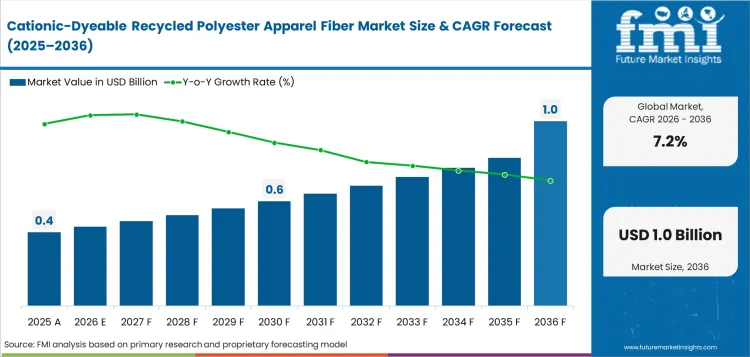
Key Takeaways, Market Size, and Forecast
- The cationic-dyeable recycled polyester apparel fiber market was valued at USD 0.4 billion in 2025.
- By 2036, the cationic-dyeable recycled polyester apparel fiber market is forecast at USD 1.0 billion.
- From 2026 to 2036, the market is projected to expand at a CAGR of 7.2%.
- The market is projected to create an incremental opportunity of USD 0.5 billion between 2026 and 2036.
- In 2026, post-consumer bottles are expected to account for 58.0% of feedstock source demand.
- China at 9.8% CAGR and India at 9.5% CAGR are among the faster-expanding country markets.
Cationic-Dyeable Recycled Polyester Apparel Fiber Market Definition
The cationic-dyeable recycled polyester apparel fiber market includes recycled polyester fiber and yarn modified to accept cationic dyes. Modified fibers serve apparel uses needing heather effects, deeper shades, and controlled dye response. Scope includes filament yarn, staple fiber, textured yarn, and spun yarn for apparel fabrics. Virgin cationic polyester, carpets, industrial yarns, and finished garments are outside the scope.
Cationic-Dyeable Recycled Polyester Apparel Fiber Market Inclusions
Market scope covers all commercially traded cationic-dyeable recycled polyester apparel fiber products categorized by fiber form, including filament yarn, staple fiber, textured yarn, and spun yarn. Feedstock source, including post-consumer bottles, textile waste, industrial waste, and mixed PET. Apparel use, including activewear, fashion tops, outerwear, and sportswear. Dyeing type, including atmospheric dyeing, high-pressure dyeing, cross-dyeing, and one-bath dyeing. Sales channel, including direct mills, yarn traders, brand programs, and online tenders. Revenue scope covers 2026 to 2036. Market stakeholders include recycled PET converters, polyester yarn producers, apparel fabric mills, dyehouse operators, garment manufacturers, brand sourcing teams, textile recyclers, fiber testing laboratories, distributors, and regulatory bodies.
Cationic-Dyeable Recycled Polyester Apparel Fiber Market Exclusions
Scope does not include virgin cationic polyester, bottle-grade resin sales, carpet yarns, industrial textile yarns, packaging resin, or finished apparel retail sales.
Cationic-Dyeable Recycled Polyester Apparel Fiber Market Research Methodology
- Primary Research: FMI analysts interviewed recycled PET converters, polyester yarn makers, dyehouse operators, and apparel fabric mills in major markets.
- Desk Research: FMI combined data from fiber output reports, textile recycling policy sources, company product portfolios, and apparel sourcing requirements.
- Market sizing and forecasting: FMI added specialty fiber use across recycled polyester apparel fiber demand from the bottom up.
- Data validation: FMI cross-checked every three months against recycled PET supply, yarn qualification patterns, and company service coverage.
Why is the Cationic-Dyeable Recycled Polyester Apparel Fiber Market Growing?
- Apparel mills use cationic-dyeable recycled polyester earlier to reduce shade rework in two-tone fabric programs.
- Fiber producers improve recycled PET sorting discipline as bottle-based feedstock carries scale and traceability value.
- Brand material teams request recycled content proof before approving long-running apparel fabric programs.
As per Textile Exchange’s September 2025 report, recycled polyester fiber production increased from around 8.9 million tonnes in 2023 to around 9.3 million tonnes in 2024. The larger recycled polyester base raises the available pool for modified apparel yarns. Cationic modification adds dye affinity to recycled PET and helps mills create deeper shades and heather looks. Suppliers with chip control and shade trial assistance can reduce rejection risk during apparel qualification.
Polyester is the main fiber platform for apparel mills using recycled synthetic inputs. Polyester accounted for 59% of total global fiber output in 2024, according to Textile Exchange. Polyester scale gives specialty recycled polyester grades a practical path into large fabric programs. Mills can test cationic-dyeable recycled yarn inside existing polyester fabric systems without changing every production step.
Market Segmentation Analysis
- Filament yarn is estimated to represent 41.0% of fiber form use in 2026 as smooth knit fabrics need even shade uptake and stable surface feel.
- Post-consumer bottles are expected to form 58.0% of feedstock source share in 2026, supported by established recycled PET collection and flake processing.
- Activewear is projected to capture 34.0% of apparel use in 2026 as performance garments rely on polyester-rich fabrics with repeatable color behavior.
- Atmospheric dyeing is estimated at 46.0% of dyeing type adoption in 2026 for mills seeking lower process strain in modified recycled polyester fabrics.
- Direct mills are projected to contribute 47.2% of sales channel value in 2026, reflecting shade trial control and faster yarn approval workflows.
Cationic-dyeable recycled polyester apparel fiber is divided into five primary segment groups based on fiber form, feedstock source, apparel use, dyeing type, and sales channel. Fiber form includes filament yarn, staple fiber, textured yarn, and spun yarn. Feedstock source includes post-consumer bottles, textile waste, industrial waste, and mixed PET. Apparel use includes activewear, fashion tops, outerwear, and sportswear. Dyeing types include atmospheric dyeing, high-pressure dyeing, cross-dyeing, and one-bath dyeing. Sales channel includes direct mills, yarn traders, brand programs, and online tenders.
Insights into the Filament Yarn Fiber Form Segment
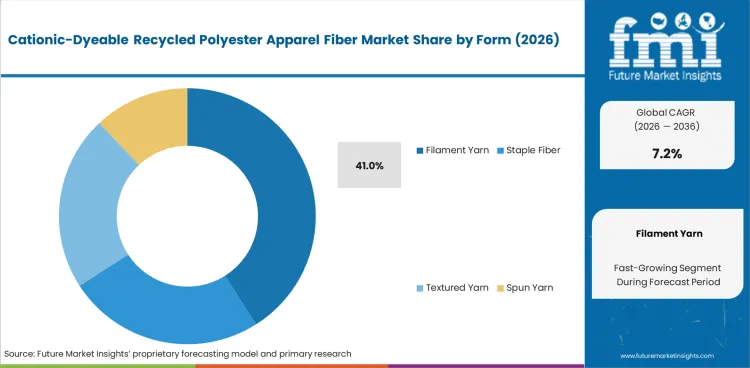
- In 2026, filament yarn is expected to make up 41.0% of the fiber form segment. Filament products suit knitwear mills needing even shade depth and smoother fabric surfaces during repeat dyeing runs.
- Textured and spun options address fabric programs needing bulk or softer hand feel for specific apparel lines. Their value improves in fashion tops and sportswear using mixed yarn constructions.
Insights into the Post-Consumer Bottles Feedstock Source Segment
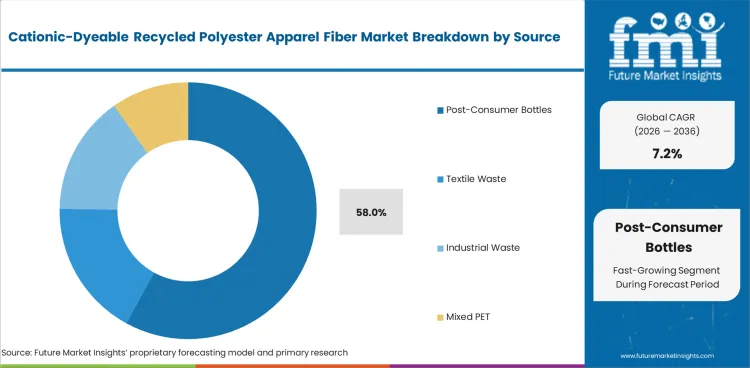
- Post-consumer bottles are projected to account for 58.0% of the feedstock source segment in 2026. Bottle-based recycled PET offers established collection scale and steadier flake supply for apparel yarn producers.
- Textile waste and industrial waste serve selected recycled fiber programs requiring stronger traceability records. Their use improves as sorting quality and polyester recovery systems become more reliable.
Insights into the Activewear Apparel Use Segment
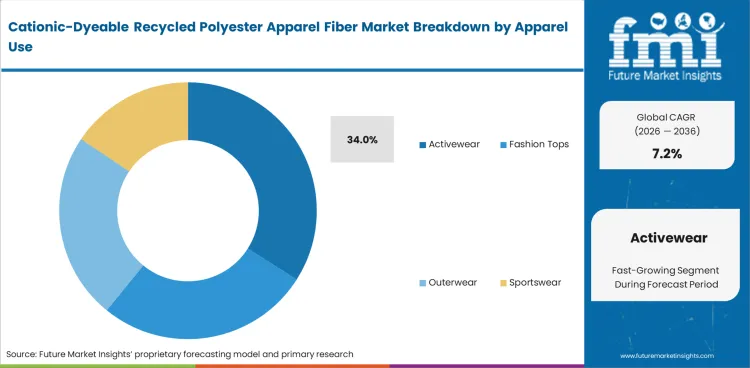
Activewear is expected to represent 34.0% of the apparel use segment in 2026. Polyester-rich performance garments need color consistency and wash durability across repeated fabric production cycles.
Fashion tops and sportswear create additional demand for cationic-dyeable recycled yarn. Fashion-top and sportswear applications value heather effects and soft appearance without changing the full fabric base.
Insights into the Atmospheric Dyeing Type Segment
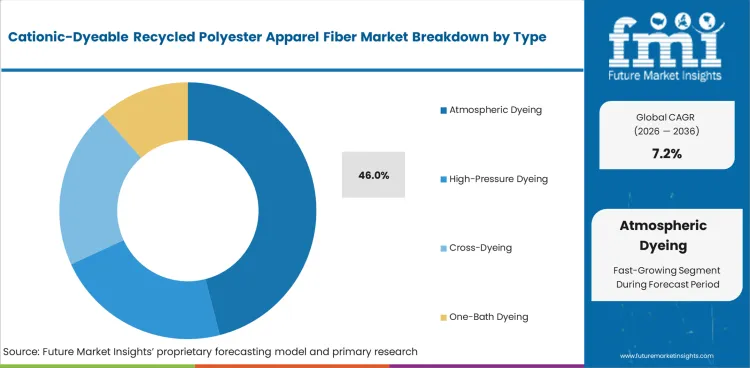
- In 2026, atmospheric dyeing is estimated to hold 46.0% of the dyeing type segment. Lower pressure processing helps mills manage energy use and shade control in selected recycled polyester fabrics.
- High-pressure and cross-dyeing formats serve fabrics needing deeper shade range or stronger contrast effects. Their use is higher in programs with tighter color matching requirements.
Insights into the Direct Mills Sales Channel Segment
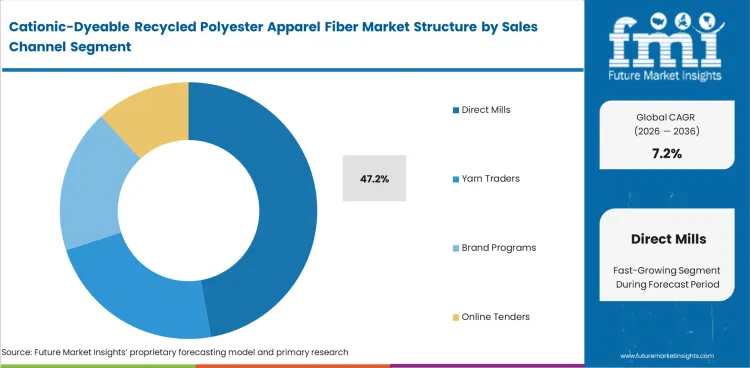
- Direct mills are projected to hold 47.2% of the sales channel segment in 2026. Large dyehouses prefer direct sourcing for yarn data access and faster shade approval work.
- Yarn traders serve smaller mills requiring quicker local availability and flexible order sizes. Brand programs add value if recycled content proof and fabric approval records are needed.
Cationic-Dyeable Recycled Polyester Apparel Fiber Market Drivers, Restraints, and Opportunities
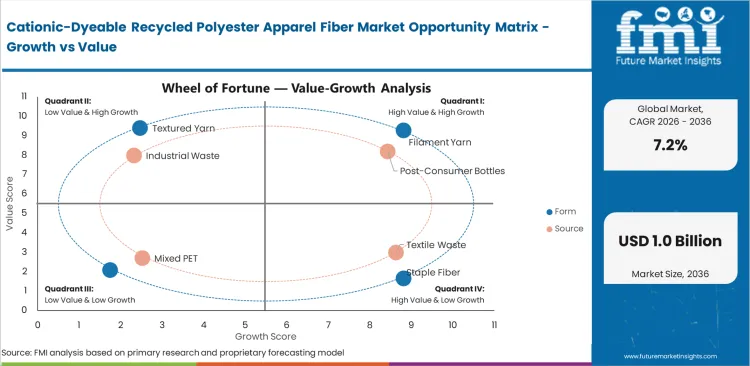
- Recycled PET access creates structured demand for modified polyester yarns across apparel programs.
- Shade variation risk increases pricing pressure for smaller yarn sellers without polymer control and dyehouse test depth.
- Textile waste sorting improves opportunity through apparel-derived polyester feedstock and brand-led recycling programs.
Cationic-dyeable recycled polyester apparel fiber demand continues to expand as apparel mills need recycled yarns with stable dye pickup and repeatable shade performance. Recycled PET quality variation and dyehouse trial delays can slow broader use for mills planning repeat production runs. Expansion continues through activewear fabrics and brand recycled-content programs that require verified fiber inputs and consistent color approval.
Virgin PET Discounts Are Capping Fiber Price Recovery
Cationic-dyeable recycled polyester apparel fiber faces a pricing ceiling because buyers compare it against low-cost virgin polyester even if they need recycled-content claims. In October 2025, the Bureau of International Recycling reported virgin PET availability at about US$800 per tonne, with recycled PET priced roughly twice as high in developed markets. BIR reported that Europe lost nearly one million tonnes of plastics recycling capacity over two years. For apparel fiber suppliers, CD-rPET premiums must be justified through dyeing efficiency and certification because resin parity alone is not enough. Sourcing teams should expect sharper negotiations as sustainability targets are flexible.
Recycled Feedstock Premiums Are Protecting Price Floors
Prices for cationic-dyeable recycled polyester apparel fiber are unlikely to fall in line with conventional polyester when verified rPET is expensive. ECOS stated in July 2025 that recycled PET carried a €600 per tonne premium over virgin PET in early 2025 and PET represented over 80% of plastics in beverage bottles covered by recycled-content targets. This matters because apparel-grade CD-rPET fiber competes for the same high-quality bottle feedstock used by packaging. Mills can discount slow-moving yarn. Certified recycled fiber has a firmer cost floor because bale quality and extrusion yield require tighter control.
Analysis of Cationic-Dyeable Recycled Polyester Apparel Fiber Market By Key Countries
.webp "Top Country Growth Comparison Cationic Dyeable Recycled Polyester Apparel Fiber Market Cagr (2026 2036)")
| Country | CAGR |
|---|---|
| China | 9.8% |
| India | 9.5% |
| Vietnam | 9.2% |
| USA | 8.5% |
| Germany | 7.4% |
Source: Future Market Insights, 2026.
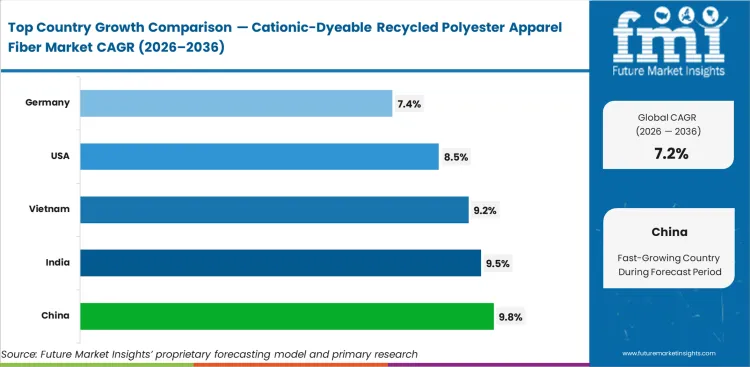
Cationic-Dyeable Recycled Polyester Apparel Fiber Market CAGR Analysis By Country
- China is projected to record a 9.8% CAGR through 2036, backed by polyester spinning capacity and export-focused apparel production.
- India is expected to expand at 9.5% CAGR as man-made fiber processing improves alongside textile export programs.
- Vietnam’s 9.2% CAGR reflects export apparel manufacturing and stronger use of recycled polyester fabrics.
- USA demand is forecast to rise at 8.5% CAGR by 2036 as brands tighten recycled fiber qualification needs.
- Germany is projected at 7.4% CAGR as mature apparel demand aligns with stricter recycling policy discipline.
Demand for cationic-dyeable recycled polyester apparel fiber is forecast to rise at 7.2% CAGR from 2026 to 2036. Country-level analysis covers the major markets contributing to this forecast, with the listed markets listed below.
Demand Outlook for Cationic-Dyeable Recycled Polyester Apparel Fiber Market in China
Cationic-dyeable recycled polyester apparel fiber industry in China is projected to record a CAGR of 9.8% through 2036. A large export base supports demand for China cationic-dyeable recycled polyester apparel fiber. Local mills can gain from yarns that combine recycled PET content with stable dye performance.
- Polyester spinning scale reinforces demand for modified recycled yarn in apparel fabric programs.
- Export-facing dyehouses need shade records to satisfy large brand approval routines.
- Local recycled PET access helps yarn makers reduce input risk during repeat fabric production.
Sales Analysis of Cationic-Dyeable Recycled Polyester Apparel Fiber Market in India
The cationic-dyeable recycled polyester apparel fiber sector in India is expected to expand at a CAGR of 9.5% during the assessment period. India’s Ministry of Textiles reported total textile exports including handicrafts at ₹3,16,334.9 crore in FY 2025 to 2026. India's export base raises demand for India cationic-dyeable recycled polyester apparel fiber. Domestic mills benefit from specialty yarns that reduce shade rework in polyester-rich fabrics.
- Man-made fiber clusters make a base for recycled polyester filament and textured yarn trials.
- Apparel exporters need material files to combine recycled content proof with dyeing performance.
- Domestic yarn producers can serve mills better through repeatable shade lots and flake quality checks.
Demand Outlook for Cationic-Dyeable Recycled Polyester Apparel Fiber Market in Vietnam
Vietnam cationic-dyeable recycled polyester apparel fiber industry is forecast to grow at a CAGR of 9.2% by 2036. Vietnam’s Ministry of Industry and Trade noted industry data showing textile and garment exports near USD 46 billion in 2025. Vietnam's manufacturing base supports demand for Vietnam cationic-dyeable recycled polyester apparel fiber. Export mills need stable yarn inputs to match brand specifications for recycled content and color performance.
- Export garment scale boosts steady need for polyester-rich knit and woven fabric inputs.
- Brand programs favor mills able to document recycled PET origin and shade approval.
- Direct yarn supply improves response time during fabric sampling and buyer review.
Opportunity Analysis of Cationic-Dyeable Recycled Polyester Apparel Fiber Market in the USA
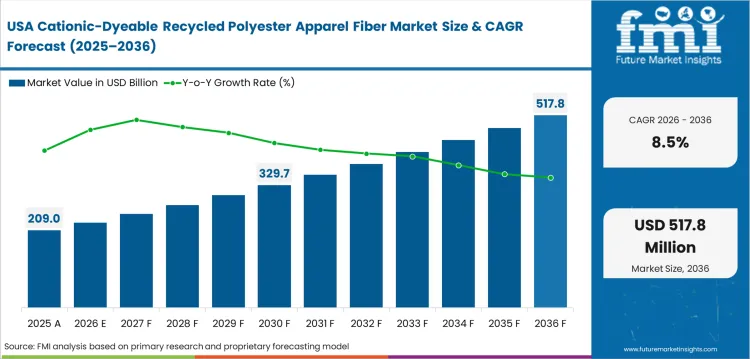
The cationic-dyeable recycled polyester apparel fiber sector in the USA is forecast to advance at 8.5% CAGR over the forecast years. The National Council of Textile Organizations reported that United States man-made fiber, textile, and apparel shipments totaled USD 60.9 billion in 2025. The domestic base supports demand for USA cationic-dyeable recycled polyester apparel fiber. Brands and fabric developers need traceable yarns for performance apparel lines.
- Domestic textile programs need specialty recycled yarns with documented input quality.
- Brand-facing fiber projects value traceability data and repeatable dyeing behavior.
- Performance apparel developers can use mono-material recyclable stretch yarn ideas to simplify future recycling.
Future Outlook for Cationic-Dyeable Recycled Polyester Apparel Fiber Market in Germany
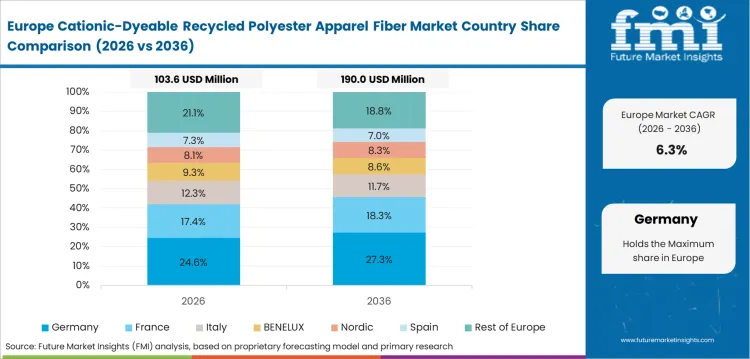
Germany cationic-dyeable recycled polyester apparel fiber industry is expected to post 7.4% CAGR through 2036. EU textile waste rules and Germany’s recycling discipline create a practical base for Germany cationic-dyeable recycled polyester apparel fiber. Demand is strongest in apparel programs needing documented recycled inputs and stable dyed fabric quality. Suppliers with detailed evidence files can serve brand and converter accounts better.
- EU textile waste policy improves attention to sorted polyester-rich apparel streams.
- German converters value yarn suppliers with traceability records and repeatable dye behavior.
- European post-consumer polyester apparel fibre-to-fibre chemical recycling programs can improve feedstock planning.
Competitive Landscape and Strategic Positioning
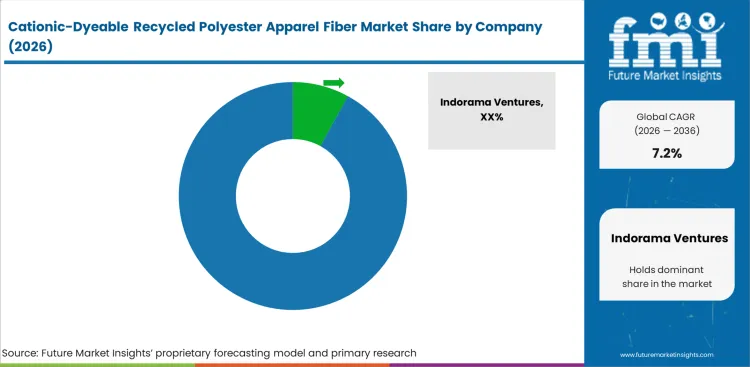
Cationic-Dyeable Recycled Polyester Apparel Fiber Market Analysis By Company
- Indorama Ventures emphasizes recycled PET processing depth and polyester yarn capacity serving apparel fiber programs.
- Far Eastern New Century and Reliance Industries offer polyester scale and access to recycled polymer inputs.
- Specialist players focus on brand-facing recycled yarn programs and dyehouse approval work for apparel mills.
Competition in the cationic-dyeable recycled polyester apparel fiber market is shaped by recycled PET access and dyehouse approval capability. Large producers compete on feedstock control and yarn consistency. Specialist companies focus on brand-facing recycled yarn platforms and faster fabric trial response.
Indorama Ventures holds a strong position through recycled product streams covering flakes and recycled polyester yarns. Far Eastern New Century brings recycled polyester depth across apparel and industrial textile uses. Reliance Industries highlights polymer scale and man-made fiber supply in India. Toray Industries and Teijin add polyester material skill for technical apparel programs. UNIFI and Hyosung retain strong brand-facing positions across recycled polyester apparel fiber platforms.
Competitive pressure is strongest around recycled chip quality and color approval delays in dyehouse workflows. Priority areas include feedstock traceability and faster shade reporting for apparel mills. Companies positioned to win combine recycled PET proof with dyeing guidance during the same approval cycle.
Key Companies in the Cationic-Dyeable Recycled Polyester Apparel Fiber Market
Global companies active in the cationic-dyeable recycled polyester apparel fiber market include:
- Indorama Ventures, Reliance Industries, and Far Eastern New Century have strong recycled polyester infrastructure for apparel yarn supply.
- Toray Industries and Teijin serve manufacturers through polyester material depth and high-quality fiber development.
- UNIFI and Hyosung hold specialist positions across brand-facing recycled yarn programs and apparel qualification.
Competitive Benchmarking: Cationic-Dyeable Recycled Polyester Apparel Fiber Market
| Company | Recycled PET Access | Dyeing Knowledge | Apparel Mill Reach | Geographic Footprint |
|---|---|---|---|---|
| Indorama Ventures | High | Medium | Strong | Asia Pacific, Europe, and North America |
| Reliance Industries | High | Medium | Strong | India with export reach across Asia and global textile markets |
| Far Eastern New Century | High | High | Strong | Taiwan, China, Southeast Asia, and North America |
| Toray Industries | Medium | High | Strong | Japan, China, Southeast Asia, Europe, and North America |
| Teijin | Medium | High | Strong | Japan, China, Europe, and North America |
| UNIFI | Medium | Medium | Strong | United States, Central America, and Brazil |
| Hyosung | Medium | Medium | Strong | South Korea, Vietnam, China, Europe, and North America |
Source: Future Market Insights, 2026.
Key Developments in Cationic-Dyeable Recycled Polyester Apparel Fiber Market
- In November 2025, Loop Industries executed a multi-year offtake agreement with Nike to supply Twist circular polyester resin made exclusively from textile waste.
- In December 2025, Syre announced that Nike selected Syre as the lead strategic supplier for textile-to-textile recycled polyester in core performance lines.
- In October 2025, REI Co-op and Ambercycle announced a three-year offtake agreement for cycora regenerated polyester for outdoor apparel.
Key Players in the Cationic-Dyeable Recycled Polyester Apparel Fiber Market
Major Global Players:
- Indorama Ventures
- Reliance Industries
- Far Eastern New Century
- Toray Industries
- Teijin
Specialist Players:
- UNIFI
- Hyosung
Report Scope and Coverage
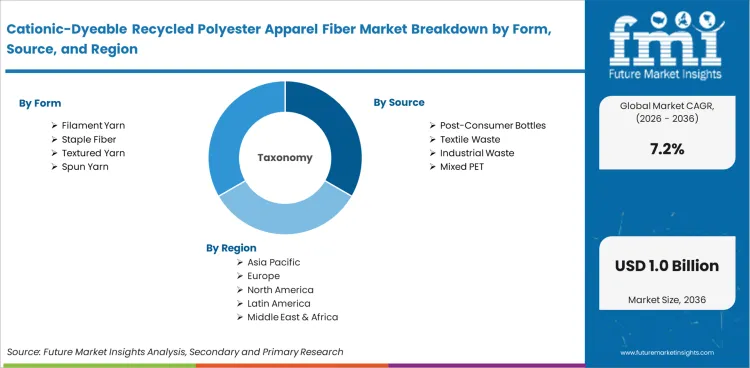
Cationic-Dyeable Recycled Polyester Apparel Fiber Market Breakdown By Fiber Form, Feedstock Source, And Region
| Parameter | Details |
|---|---|
| Quantitative Units | USD 0.5 billion to USD 1.0 billion, at a CAGR of 7.2% |
| Market Definition | The market includes recycled polyester fiber and yarn modified to accept cationic dyes for apparel fabrics. |
| Regions Covered | North America, Latin America, Europe, East Asia, South Asia and Pacific, Middle East and Africa |
| Countries Covered | USA, Germany, China, India, Vietnam, Japan, South Korea, and 30 plus countries |
| Key Companies Profiled | Indorama Ventures, Reliance Industries, Far Eastern New Century, Toray Industries, Teijin, UNIFI, Hyosung |
| Forecast Period | 2026 to 2036 |
| Approach | Hybrid bottom-up and top-down methodology starting with recycled polyester apparel fiber demand and verified dyehouse use patterns. |
Source: Future Market Insights, 2026.
Cationic-Dyeable Recycled Polyester Apparel Fiber Market by Segments
Cationic-Dyeable Recycled Polyester Apparel Fiber Market Segmented by Fiber Form:
- Filament Yarn
- Staple Fiber
- Textured Yarn
- Spun Yarn
Cationic-Dyeable Recycled Polyester Apparel Fiber Market Segmented by Feedstock Source:
- Post-Consumer Bottles
- Textile Waste
- Industrial Waste
- Mixed PET
Cationic-Dyeable Recycled Polyester Apparel Fiber Market Segmented by Apparel Use:
- Activewear
- Fashion Tops
- Outerwear
- Sportswear
Cationic-Dyeable Recycled Polyester Apparel Fiber Market Segmented by Dyeing Type:
- Atmospheric Dyeing
- High-Pressure Dyeing
- Cross-Dyeing
- One-Bath Dyeing
Cationic-Dyeable Recycled Polyester Apparel Fiber Market Segmented by Sales Channel:
- Direct Mills
- Yarn Traders
- Brand Programs
- Online Tenders
Cationic-Dyeable Recycled Polyester Apparel Fiber Market by Region:
- North America
- USA
- Canada
- Mexico
- Latin America
- Brazil
- Chile
- Rest of Latin America
- Europe
- Germany
- UK
- Italy
- Spain
- France
- Rest of Europe
- East Asia
- China
- Japan
- South Korea
- South Asia and Pacific
- India
- ASEAN
- Australia & New Zealand
- Rest of South Asia and Pacific
- Middle East and Africa
- Saudi Arabia
- Other GCC Countries
- South Africa
- Rest of Middle East and Africa
Research Sources and Bibliography
- Bureau of International Recycling. (2025, October 28). BIR Bangkok 2025 - Plastics Division: ‘Glimmer of hope’ for plastics recyclers in continued tough market.
- ECOS. (2025, July 31). EU accounting methodology for recycled plastic content: ECOS feedback | Draft implementing decision, Single-Use Plastic Directive.
- Textile Exchange. (2025, September 18). Materials Market Report 2025. Textile Exchange.
- Ministry of Textiles. (2026, April 22). India’s textile exports register growth of 2.1% in FY 2025 to 2026. Press Information Bureau.
- Ministry of Industry and Trade. (2026, April 27). Vietnam-India: Growing opportunities for integrated textile industrial parks. Government of Vietnam.
- National Council of Textile Organizations. (2026, April 27). USA textile industry demonstrates resilience amid global disruptions. NCTO.
- Syre. (2025, December 2). Nike and Syre: The next chapter for circularity. Syre.
- Ambercycle. (2025, October 28). REI Co-op and Ambercycle reach three-year agreement to scale regenerated polyester. Ambercycle.
- Loop Industries. (2025, November 10). Loop Industries signs an offtake agreement with Nike. Loop Industries.
- Indorama Ventures. (2025, May 27). Indorama Ventures expands deja portfolio to boost textile industry sustainability. Indorama Ventures.
This Report Answers
- What is the current and future size of the cationic-dyeable recycled polyester apparel fiber market?
- How fast is the cationic-dyeable recycled polyester apparel fiber market expected to expand between 2026 and 2036?
- Which feedstock source is expected to lead the market by 2026?
- Which fiber form segment is expected to account for the highest demand by 2026?
- What factors are driving demand for cationic-dyeable recycled polyester apparel fiber globally?
- How are recycled PET feedstock conditions influencing adoption of modified polyester yarns?
- Why are post-consumer bottles the main feedstock base for this market?
- How are dyehouse approval needs creating demand for cationic-modified recycled polyester?
- Which countries are projected to record faster expansion through 2036?
- What is driving market expansion in China and India?
- Who are the key companies active in the cationic-dyeable recycled polyester apparel fiber market?
- How does FMI estimate and validate the market forecast?
Frequently Asked Questions
What is the global market demand for Cationic-Dyeable Recycled Polyester Apparel Fiber in 2026?
In 2026, the global market for cationic-dyeable recycled polyester apparel fiber is expected to be worth USD 0.5 billion.
How big will the market for Cationic-Dyeable Recycled Polyester Apparel Fiber be in 2036?
By 2036, the market for cationic-dyeable recycled polyester apparel fiber is expected to be worth USD 1.0 billion.
How much is demand for Cationic-Dyeable Recycled Polyester Apparel Fiber expected to expand between 2026 and 2036?
Between 2026 and 2036, demand for cationic-dyeable recycled polyester apparel fiber is expected to expand at a CAGR of 7.2%.
Which feedstock source segment is likely to be the lead globally by 2026?
Post-consumer bottles are expected to make up 58.0% of the feedstock source segment in 2026.
What is causing demand to rise in China?
China cationic-dyeable recycled polyester apparel fiber demand is projected to record 9.8% CAGR through 2036, backed by polyester spinning scale and apparel export capacity.
What is causing demand to rise in India?
India cationic-dyeable recycled polyester apparel fiber demand is projected to expand at 9.5% CAGR through 2036, backed by man-made fiber processing and textile export activity.
What does this report mean by Cationic-Dyeable Recycled Polyester Apparel Fiber Market definition?
The market includes recycled polyester fiber and yarn modified to accept cationic dyes before use in apparel fabrics.
How does FMI make the Cationic-Dyeable Recycled Polyester Apparel Fiber forecast and check it?
Forecasting models use a hybrid bottom-up and top-down approach, starting with recycled polyester apparel fiber demand and verified dyehouse use patterns.
Preview the report firsthand - request a free sample
Get SampleGet the brochure for pricing and purchase details.
Get PDFTable of Content
- Key Takeaways
- Market Size and CAGR
- Top Growth Driver
- Fastest Growing Segment
- Leading Region
- Key Companies
- Emerging Opportunities
- Executive Summary
- Global Market Outlook
- Demand-side Trends
- Supply-side Trends
- Technology Roadmap Analysis
- Analysis and Recommendations
- Analyst Perspective (What is happening? Why now? What should investors know?)
- Key Questions Answered
- How large is the market?
- What is the CAGR?
- What are key trends?
- Which region dominates?
- Who are the leaders?
- Market Overview
- Market Coverage / Taxonomy
- Market Definition / Scope / Limitations
- Research Methodology
- Chapter Orientation
- Analytical Lens and Working Hypotheses
- Market Structure, Signals, and Trend Drivers
- Benchmarking and Cross-market Comparability
- Market Sizing, Forecasting, and Opportunity Mapping
- Research Design and Evidence Framework
- Desk Research Programme (Secondary Evidence)
- Expert Input and Fieldwork (Primary Evidence)
- Tooling, Models, and Reference Databases
- Data Engineering and Model Build
- Quality Assurance and Audit Trail
- Market Background
- Market Dynamics (Drivers, Restraints, Opportunity, Trends)
- Scenario Forecast (Optimistic, Likely, Conservative)
- Impact Analysis
- AI Impact
- Sustainability Impact
- Regulatory Impact
- Technology Impact
- Consumer / Buyer Analysis
- Purchase Drivers
- Adoption Barriers
- Buyer Journey
- Opportunity Map Analysis
- Product Life Cycle Analysis
- Supply Chain Analysis
- Investment Feasibility Matrix
- Value Chain Analysis
- PESTLE and Porter's Analysis
- Regulatory Landscape
- Regional Parent Market Outlook
- Production and Consumption Statistics
- Import and Export Statistics
- Global Market Analysis and Forecast, 2021 to 2036
- Historical Market Size Value (USD Billion) & Volume (Unit) Analysis, 2021 to 2025
- Current and Future Market Size Value (USD Billion) & Volume (Unit) Projections, 2026 to 2036
- Y-o-Y Growth Trend Analysis
- Absolute $ Opportunity Analysis
- Global Market Pricing Analysis, 2021 to 2036
- Global Market Analysis and Forecast, By Fiber Form, 2021 to 2036
- Introduction / Key Findings
- Historical Market Size Value (USD Billion) & Volume (Unit) Analysis By Fiber Form, 2021 to 2025
- Current and Future Market Size Value (USD Billion) & Volume (Unit) Analysis and Forecast By Fiber Form, 2026 to 2036
- Filament Yarn
- Staple Fiber
- Textured Yarn
- Spun Yarn
- Filament Yarn
- Y-o-Y Growth Trend Analysis By Fiber Form, 2021 to 2025
- Absolute $ Opportunity Analysis By Fiber Form, 2026 to 2036
- Global Market Analysis and Forecast, By Feedstock Source, 2021 to 2036
- Introduction / Key Findings
- Historical Market Size Value (USD Billion) & Volume (Unit) Analysis By Feedstock Source, 2021 to 2025
- Current and Future Market Size Value (USD Billion) & Volume (Unit) Analysis and Forecast By Feedstock Source, 2026 to 2036
- Post-Consumer Bottles
- Textile Waste
- Industrial Waste
- Mixed PET
- Post-Consumer Bottles
- Y-o-Y Growth Trend Analysis By Feedstock Source, 2021 to 2025
- Absolute $ Opportunity Analysis By Feedstock Source, 2026 to 2036
- Global Market Analysis and Forecast, By Apparel Use, 2021 to 2036
- Introduction / Key Findings
- Historical Market Size Value (USD Billion) & Volume (Unit) Analysis By Apparel Use, 2021 to 2025
- Current and Future Market Size Value (USD Billion) & Volume (Unit) Analysis and Forecast By Apparel Use, 2026 to 2036
- Activewear
- Fashion Tops
- Outerwear
- Sportswear
- Activewear
- Y-o-Y Growth Trend Analysis By Apparel Use, 2021 to 2025
- Absolute $ Opportunity Analysis By Apparel Use, 2026 to 2036
- Global Market Analysis and Forecast, By Dyeing Type, 2021 to 2036
- Introduction / Key Findings
- Historical Market Size Value (USD Billion) & Volume (Unit) Analysis By Dyeing Type, 2021 to 2025
- Current and Future Market Size Value (USD Billion) & Volume (Unit) Analysis and Forecast By Dyeing Type, 2026 to 2036
- Atmospheric Dyeing
- High-Pressure Dyeing
- Cross-Dyeing
- One-Bath Dyeing
- Atmospheric Dyeing
- Y-o-Y Growth Trend Analysis By Dyeing Type, 2021 to 2025
- Absolute $ Opportunity Analysis By Dyeing Type, 2026 to 2036
- Global Market Analysis and Forecast, By Sales Channel, 2021 to 2036
- Introduction / Key Findings
- Historical Market Size Value (USD Billion) & Volume (Unit) Analysis By Sales Channel, 2021 to 2025
- Current and Future Market Size Value (USD Billion) & Volume (Unit) Analysis and Forecast By Sales Channel, 2026 to 2036
- Direct Mills
- Yarn Traders
- Brand Programs
- Online Tenders
- Direct Mills
- Y-o-Y Growth Trend Analysis By Sales Channel, 2021 to 2025
- Absolute $ Opportunity Analysis By Sales Channel, 2026 to 2036
- Global Market Analysis and Forecast, By Region, 2021 to 2036
- Introduction
- Historical Market Size Value (USD Billion) & Volume (Unit) Analysis By Region, 2021 to 2025
- Current Market Size Value (USD Billion) & Volume (Unit) Analysis and Forecast By Region, 2026 to 2036
- North America
- Latin America
- Western Europe
- Eastern Europe
- East Asia
- South Asia and Pacific
- Middle East & Africa
- Market Attractiveness Analysis By Region
- North America Market Analysis and Forecast, By Country, 2021 to 2036
- Historical Market Size Value (USD Billion) & Volume (Unit) Trend Analysis By Market Taxonomy, 2021 to 2025
- Market Size Value (USD Billion) & Volume (Unit) Forecast By Market Taxonomy, 2026 to 2036
- By Country
- USA
- Canada
- Mexico
- By Fiber Form
- By Feedstock Source
- By Apparel Use
- By Dyeing Type
- By Sales Channel
- By Country
- Market Attractiveness Analysis
- By Country
- By Fiber Form
- By Feedstock Source
- By Apparel Use
- By Dyeing Type
- By Sales Channel
- Key Takeaways
- Latin America Market Analysis and Forecast, By Country
- Historical Market Size Value (USD Billion) & Volume (Unit) Trend Analysis By Market Taxonomy, 2021 to 2025
- Market Size Value (USD Billion) & Volume (Unit) Forecast By Market Taxonomy, 2026 to 2036
- By Country
- Brazil
- Chile
- Rest of Latin America
- By Fiber Form
- By Feedstock Source
- By Apparel Use
- By Dyeing Type
- By Sales Channel
- By Country
- Market Attractiveness Analysis
- By Country
- By Fiber Form
- By Feedstock Source
- By Apparel Use
- By Dyeing Type
- By Sales Channel
- Key Takeaways
- Western Europe Market Analysis and Forecast, By Country
- Historical Market Size Value (USD Billion) & Volume (Unit) Trend Analysis By Market Taxonomy, 2021 to 2025
- Market Size Value (USD Billion) & Volume (Unit) Forecast By Market Taxonomy, 2026 to 2036
- By Country
- Germany
- UK
- Italy
- Spain
- France
- Nordic
- BENELUX
- Rest of Western Europe
- By Fiber Form
- By Feedstock Source
- By Apparel Use
- By Dyeing Type
- By Sales Channel
- By Country
- Market Attractiveness Analysis
- By Country
- By Fiber Form
- By Feedstock Source
- By Apparel Use
- By Dyeing Type
- By Sales Channel
- Key Takeaways
- Eastern Europe Market Analysis and Forecast, By Country
- Historical Market Size Value (USD Billion) & Volume (Unit) Trend Analysis By Market Taxonomy, 2021 to 2025
- Market Size Value (USD Billion) & Volume (Unit) Forecast By Market Taxonomy, 2026 to 2036
- By Country
- Russia
- Poland
- Hungary
- Balkan & Baltic
- Rest of Eastern Europe
- By Fiber Form
- By Feedstock Source
- By Apparel Use
- By Dyeing Type
- By Sales Channel
- By Country
- Market Attractiveness Analysis
- By Country
- By Fiber Form
- By Feedstock Source
- By Apparel Use
- By Dyeing Type
- By Sales Channel
- Key Takeaways
- East Asia Market Analysis and Forecast, By Country
- Historical Market Size Value (USD Billion) & Volume (Unit) Trend Analysis By Market Taxonomy, 2021 to 2025
- Market Size Value (USD Billion) & Volume (Unit) Forecast By Market Taxonomy, 2026 to 2036
- By Country
- China
- Japan
- South Korea
- By Fiber Form
- By Feedstock Source
- By Apparel Use
- By Dyeing Type
- By Sales Channel
- By Country
- Market Attractiveness Analysis
- By Country
- By Fiber Form
- By Feedstock Source
- By Apparel Use
- By Dyeing Type
- By Sales Channel
- Key Takeaways
- South Asia and Pacific Market Analysis and Forecast, By Country
- Historical Market Size Value (USD Billion) & Volume (Unit) Trend Analysis By Market Taxonomy, 2021 to 2025
- Market Size Value (USD Billion) & Volume (Unit) Forecast By Market Taxonomy, 2026 to 2036
- By Country
- India
- ASEAN
- Australia & New Zealand
- Rest of South Asia and Pacific
- By Fiber Form
- By Feedstock Source
- By Apparel Use
- By Dyeing Type
- By Sales Channel
- By Country
- Market Attractiveness Analysis
- By Country
- By Fiber Form
- By Feedstock Source
- By Apparel Use
- By Dyeing Type
- By Sales Channel
- Key Takeaways
- Middle East & Africa Market Analysis and Forecast, By Country
- Historical Market Size Value (USD Billion) & Volume (Unit) Trend Analysis By Market Taxonomy, 2021 to 2025
- Market Size Value (USD Billion) & Volume (Unit) Forecast By Market Taxonomy, 2026 to 2036
- By Country
- Kingdom of Saudi Arabia
- Other GCC Countries
- Türkiye
- South Africa
- Other African Union
- Rest of Middle East & Africa
- By Fiber Form
- By Feedstock Source
- By Apparel Use
- By Dyeing Type
- By Sales Channel
- By Country
- Market Attractiveness Analysis
- By Country
- By Fiber Form
- By Feedstock Source
- By Apparel Use
- By Dyeing Type
- By Sales Channel
- Key Takeaways
- Key Countries Market Analysis
- USA
- Pricing Analysis
- Market Share Analysis, 2025
- By Fiber Form
- By Feedstock Source
- By Apparel Use
- By Dyeing Type
- By Sales Channel
- Canada
- Pricing Analysis
- Market Share Analysis, 2025
- By Fiber Form
- By Feedstock Source
- By Apparel Use
- By Dyeing Type
- By Sales Channel
- Mexico
- Pricing Analysis
- Market Share Analysis, 2025
- By Fiber Form
- By Feedstock Source
- By Apparel Use
- By Dyeing Type
- By Sales Channel
- Brazil
- Pricing Analysis
- Market Share Analysis, 2025
- By Fiber Form
- By Feedstock Source
- By Apparel Use
- By Dyeing Type
- By Sales Channel
- Chile
- Pricing Analysis
- Market Share Analysis, 2025
- By Fiber Form
- By Feedstock Source
- By Apparel Use
- By Dyeing Type
- By Sales Channel
- Germany
- Pricing Analysis
- Market Share Analysis, 2025
- By Fiber Form
- By Feedstock Source
- By Apparel Use
- By Dyeing Type
- By Sales Channel
- UK
- Pricing Analysis
- Market Share Analysis, 2025
- By Fiber Form
- By Feedstock Source
- By Apparel Use
- By Dyeing Type
- By Sales Channel
- Italy
- Pricing Analysis
- Market Share Analysis, 2025
- By Fiber Form
- By Feedstock Source
- By Apparel Use
- By Dyeing Type
- By Sales Channel
- Spain
- Pricing Analysis
- Market Share Analysis, 2025
- By Fiber Form
- By Feedstock Source
- By Apparel Use
- By Dyeing Type
- By Sales Channel
- France
- Pricing Analysis
- Market Share Analysis, 2025
- By Fiber Form
- By Feedstock Source
- By Apparel Use
- By Dyeing Type
- By Sales Channel
- India
- Pricing Analysis
- Market Share Analysis, 2025
- By Fiber Form
- By Feedstock Source
- By Apparel Use
- By Dyeing Type
- By Sales Channel
- ASEAN
- Pricing Analysis
- Market Share Analysis, 2025
- By Fiber Form
- By Feedstock Source
- By Apparel Use
- By Dyeing Type
- By Sales Channel
- Australia & New Zealand
- Pricing Analysis
- Market Share Analysis, 2025
- By Fiber Form
- By Feedstock Source
- By Apparel Use
- By Dyeing Type
- By Sales Channel
- China
- Pricing Analysis
- Market Share Analysis, 2025
- By Fiber Form
- By Feedstock Source
- By Apparel Use
- By Dyeing Type
- By Sales Channel
- Japan
- Pricing Analysis
- Market Share Analysis, 2025
- By Fiber Form
- By Feedstock Source
- By Apparel Use
- By Dyeing Type
- By Sales Channel
- South Korea
- Pricing Analysis
- Market Share Analysis, 2025
- By Fiber Form
- By Feedstock Source
- By Apparel Use
- By Dyeing Type
- By Sales Channel
- Russia
- Pricing Analysis
- Market Share Analysis, 2025
- By Fiber Form
- By Feedstock Source
- By Apparel Use
- By Dyeing Type
- By Sales Channel
- Poland
- Pricing Analysis
- Market Share Analysis, 2025
- By Fiber Form
- By Feedstock Source
- By Apparel Use
- By Dyeing Type
- By Sales Channel
- Hungary
- Pricing Analysis
- Market Share Analysis, 2025
- By Fiber Form
- By Feedstock Source
- By Apparel Use
- By Dyeing Type
- By Sales Channel
- Kingdom of Saudi Arabia
- Pricing Analysis
- Market Share Analysis, 2025
- By Fiber Form
- By Feedstock Source
- By Apparel Use
- By Dyeing Type
- By Sales Channel
- Türkiye
- Pricing Analysis
- Market Share Analysis, 2025
- By Fiber Form
- By Feedstock Source
- By Apparel Use
- By Dyeing Type
- By Sales Channel
- South Africa
- Pricing Analysis
- Market Share Analysis, 2025
- By Fiber Form
- By Feedstock Source
- By Apparel Use
- By Dyeing Type
- By Sales Channel
- USA
- Market Structure Analysis
- Competition Dashboard
- Competition Benchmarking
- Market Share Analysis of Top Players
- By Regional
- By Fiber Form
- By Feedstock Source
- By Apparel Use
- By Dyeing Type
- By Sales Channel
- Emerging Startups
- Innovation Benchmarking
- Competition Analysis
- Competition Deep Dive
- Indorama Ventures
- Overview
- Product Portfolio
- Profitability by Market Segments (Product/Region/Sales Channel)
- Sales Footprint
- Strategy Overview
- Marketing Strategy
- Product Strategy
- Channel Strategy
- Reliance Industries
- Far Eastern New Century
- Toray Industries
- Teijin
- UNIFI
- Hyosung
- Indorama Ventures
- Case Studies
- Success Stories
- Recent Developments
- Competition Deep Dive
- Assumptions & Acronyms Used


