

- Industry Size (2026)
- USD 1041.5 Mn
- Forecast (2036)
- USD 2581.1 Mn
- CAGR (2026 to 2036)
- 9.5%
Mono-Material Recyclable Stretch Yarn Market Forecast and Outlook 2026 to 2036
The mono-material recyclable stretch yarn market is likely to be valued at USD 1,041.5 million in 2026 and is projected to reach USD 2,581.1 million by 2036, expanding at a CAGR of 9.5%. Growth is driven by apparel brands shifting toward design-for-recycling strategies that reduce textile waste while preserving stretch, recovery, and wearer comfort. Mono-material yarns, primarily polyester- and polyamide-based, eliminate multi-fiber incompatibility that limits recyclability in conventional stretch fabrics. Adoption is strongest in activewear, athleisure, swimwear, and performance underwear, where consistent elasticity, dimensional stability, and compatibility with existing knitting and weaving systems remain essential.
Woven and seamless constructions adopt mono-material stretch yarns for controlled comfort stretch while maintaining recyclability targets. Market expansion is shaped by regulatory pressure on textile waste, brand sustainability commitments, and gradual improvement in recycling readiness for stretch textiles. Performance trade-offs, cost premiums, and infrastructure maturity moderate adoption speed, positioning growth around substitution within existing apparel categories rather than volume-driven textile expansion.
Quick Stats for Mono-Material Recyclable Stretch Yarn Market
- Mono-Material Recyclable Stretch Yarn Market Value (2026): USD 1,041.5 million
- Mono-Material Recyclable Stretch Yarn Market Forecast Value (2036): USD 2,581.1 million
- Mono-Material Recyclable Stretch Yarn Market Forecast CAGR 2026 to 2036: 9.5%
- Leading Polymer Type by Demand Share: Polyester-Based Mono-Stretch Yarns
- Fastest-Growing Regions: China, Brazil, USA, Germany, South Korea
- Key Industry Participants: Toray Industries, Teijin Frontier, Hyosung, Lycra Company, Indorama Ventures
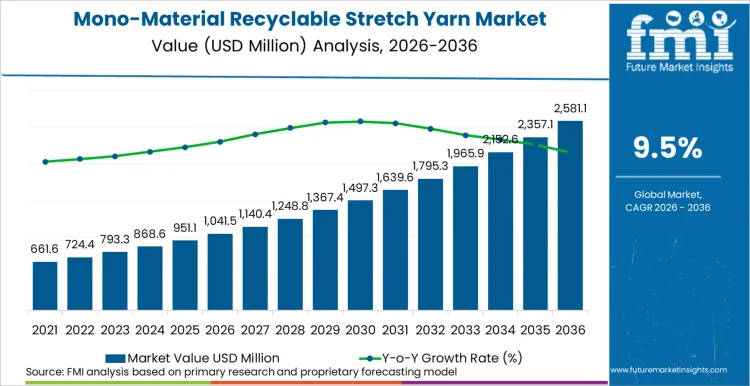
Mono-Material Recyclable Stretch Yarn Market Key Takeaways
| Metric | Value |
|---|---|
| Market Value (2026) | USD 1,041.5 million |
| Market Forecast Value (2036) | USD 2,581.1 million |
| Forecast CAGR 2026 to 2036 | 9.5% |
Source: FMI’s proprietary forecasting model and primary research
Why is the Demand for Mono Material Recyclable Stretch Yarn Growing?
Apparel manufacturers are increasingly adopting mono‑material recyclable stretch yarn because it simplifies end‑of‑life recycling while supporting the comfort and performance consumers expect in garments. Traditional stretch fabrics often combine incompatible fibers that make mechanical and chemical recycling difficult or economically unviable. Mono‑material stretch yarns, typically polyester or polyamide based with integrated elastomeric properties, enable full garments to remain in a single polymer category. Brands producing activewear, athleisure, swimwear, and performance underwear specify these yarns to achieve consistent stretch and recovery while designing products that fit into existing recycling streams. Fabric engineers value the predictable behavior of mono‑material yarns in knitting and weaving operations, where uniform polymer chemistry aids in dye uptake, thermal bonding, and finishing processes.
Purchase decisions in this market are shaped by sustainability commitments tied to circular fashion and regulatory pressure on textile waste. Retailers and brand owners aim to demonstrate measurable progress in reducing landfill contribution by increasing the recyclability of finished products. Material scientists focus on optimizing the balance between elasticity and strength, ensuring that yarns retain performance after repeated wear and laundering without compromising recyclability at the garment’s end of life. Retailers seeking to elevate eco‑credentials of seasonal collections invest in sourcing frameworks that track polymer origins and support recovery programs. Growth in consumer awareness of textile recyclability and demand for transparent sustainability practices is reinforcing adoption of mono‑material stretch yarn across diverse apparel segments.
How Is the Mono-Material Recyclable Stretch Yarn Industry Segmented by Polymer Type and Application?
Mono-material recyclable stretch yarn development focuses on enabling fabric stretch while maintaining single-polymer composition for easier mechanical or chemical recycling. Demand is influenced by circular textile mandates, brand sustainability targets, and recyclability constraints in apparel supply chains. Segmenting the industry by polymer type and application highlights how material science choices align with end-use fabric engineering.
Which Polymer Types Lead Mono-Material Recyclable Stretch Yarn Adoption?
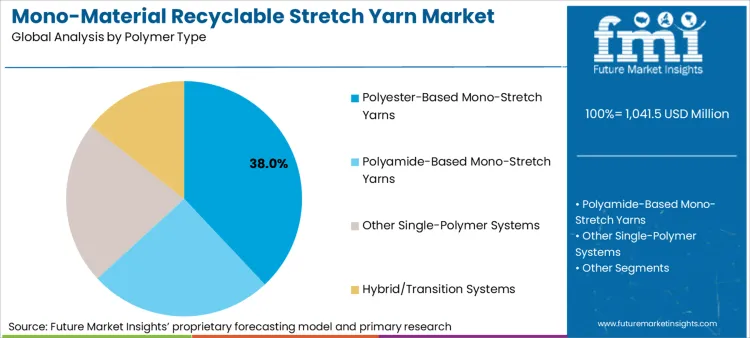
Polyester-based mono-stretch yarns account for 38.0%, supported by polyester’s global recycling infrastructure, thermal stability, and compatibility with existing spinning and knitting systems. These yarns rely on mechanical crimp, molecular orientation, or engineered filament geometry to deliver stretch without elastane. Polyamide-based mono-stretch yarns are used where higher resilience, abrasion resistance, or recovery is required, particularly in performance apparel. Other single-polymer systems include emerging mono-PP or specialty polyester variants designed for niche applications. Hybrid or transition systems are used during sustainability conversion phases, balancing recyclability goals with interim performance requirements.
Key Points
- Polyester leads due to recyclability scale and processing familiarity.
- Polyamide supports higher resilience and performance fabrics.
- Transition systems reflect gradual phase-out of multi-material stretch yarns.
How Are Mono-Material Stretch Yarns Used Across Fabric Applications?
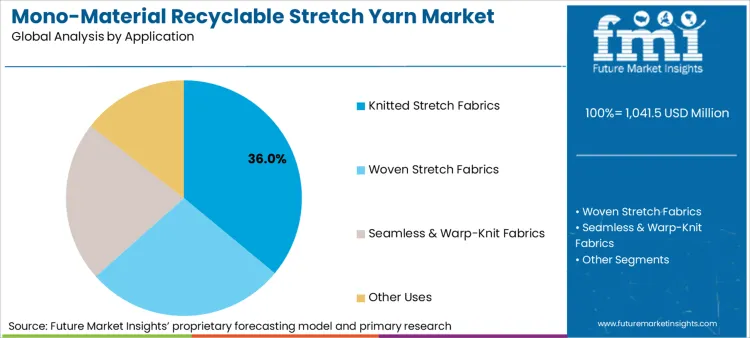
Knitted stretch fabrics represent 36.0%, as knit structures naturally amplify yarn-level stretch, reducing reliance on high-elastic components. Mono-material stretch yarns are increasingly specified in circular knits, weft knits, and jersey fabrics for sportswear and casualwear. Woven stretch fabrics adopt these yarns in warp or weft to provide controlled comfort stretch while preserving recyclability. Seamless and warp-knit fabrics use mono-material stretch yarns to meet durability and fit requirements in bodywear and active garments. Other uses include linings, lightweight technical textiles, and recyclable uniform programs.
Key Points
- Knits dominate due to inherent structural stretch advantages.
- Wovens adopt mono-stretch yarns for subtle comfort elasticity.
- Seamless constructions benefit from recyclability-driven yarn innovation.
What are the Key Dynamics in the Mono Material Recyclable Stretch Yarn Market?
Demand in the mono material recyclable stretch yarn market is shaped by apparel brands’ drive to improve garment recyclability while maintaining stretch performance. European manufacturers increasingly seek yarns that enable end of life circularity by combining elastomeric properties with compatibility in single polymer recycling streams. Growth in activewear, athleisure and performance base layers reflects consumer preference for comfort, fit retention and product longevity, alongside brand commitments to sustainable design. Purchasing decisions emphasize yarn recyclability credentials, mechanical performance, and integration with existing knit and weave processes.
How do circularity goals and application performance needs shape uptake?
Uptake of mono material recyclable stretch yarn arises where brands aim to simplify recycling pathways without compromising elastic recovery or fabric hand feel. Traditional stretch fabrics often blend elastane with polyamide or polyester, creating challenges in mechanical recycling due to incompatible polymer streams. Mono material solutions that embed stretch within a single recycling family, such as all polyester or all polyamide systems engineered for recoverable elasticity, reduce barriers to closed loop recycling. Activewear and sportswear developers specify these yarns to support longer garment lifecycles and post consumer material reclamation, improving alignment with regulatory nudges toward design for recycling. Fit centric product lines like leggings, compression tops and cycling wear depend on predictable elongation and recovery metrics, and recyclability performance is tested against industry recycling processing conditions to ensure recovery yield and fibre integrity.
How do performance trade offs and supply chain readiness influence market uptake?
Market uptake is influenced by perceived performance trade offs and the readiness of recycling infrastructure to handle mono material stretch textiles. Some mono material recyclable yarns exhibit differences in elasticity, recovery speed or abrasion resistance compared with traditional elastane blends, prompting iterative development work to ensure that performance meets wearer expectations. Converters assess how these yarns influence knitting tension, fabric stability and dye uptake, aiming for minimal disruption to existing production parameters. Cost considerations arise where advanced mono material stretch yarns command a premium relative to standard blends, particularly in value oriented segments. Collaboration between brands, converters and recyclers on pilot programs and seasonal collections helps validate performance and inform procurement strategies, shaping where mono material recyclable stretch yarns are adopted across product tiers.
How Is Demand for the Mono-Material Recyclable Stretch Yarn Market Evolving Globally?
Global demand for mono-material recyclable stretch yarn is rising as the textile and fashion industries focus on sustainable practices and reducing packaging waste. Growth reflects increased demand for recyclable, high-performance fabrics in apparel, activewear, and other textile applications where elasticity and recyclability are crucial. Mono-material yarns simplify recycling processes, enabling end-of-life fabric recovery and reducing environmental impact. China records 10.7% CAGR, Brazil records 10.3% CAGR, USA records 9.2% CAGR, Germany records 9.1% CAGR, and South Korea records 8.7% CAGR. Adoption is driven by regulatory requirements, consumer preferences for sustainable materials, and the demand for high-quality performance fabrics.
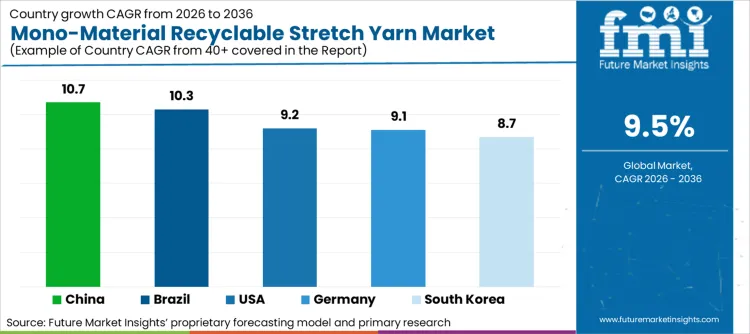
| Country | CAGR (%) |
|---|---|
| China | 10.7% |
| Brazil | 10.3% |
| USA | 9.2% |
| Germany | 9.1% |
| South Korea | 8.7% |
Source: FMI’s proprietary forecasting model and primary research
What is driving growth of mono-material recyclable stretch yarn demand in China?
Demand for mono-material recyclable stretch yarn in China is expanding as the textile industry adopts more sustainable and recyclable solutions. Growth at 10.7% CAGR reflects rising consumer demand for eco-friendly and recyclable fabrics, particularly in activewear, sportswear, and intimate apparel. China’s large textile manufacturing base and export orientation are driving the demand for recyclable stretch yarns that meet both local and international standards. The regulatory push for reducing waste and improving recycling rates in textiles is accelerating the shift toward mono-material yarns, which simplify the recycling process and reduce environmental impact.
- Increased consumer demand for eco-friendly fabrics
- Regulatory pressure for recyclable textile solutions
- Expansion of activewear and performance fabrics markets
- Shift toward sustainable, recyclable mono-material solutions
Why is Brazil seeing expansion in mono-material recyclable stretch yarn adoption?
Mono-material recyclable stretch yarn demand in Brazil is growing as the textile and apparel industries respond to sustainability trends and regulatory pressures. Growth at 10.3% CAGR reflects rising demand for recyclable materials in fashion and activewear, where stretchability and recyclability are key factors. Brazil’s textile industry is embracing innovations in sustainable yarn production, and mono-material solutions are gaining traction due to their ease of recycling. As Brazil works to align with international sustainability standards, mono-material recyclable yarns are becoming an essential component in meeting both consumer expectations and environmental regulations.
- Increasing demand for sustainable fabrics in fashion
- Growing adoption of recyclable textile solutions
- Regulatory alignment with international sustainability standards
- Innovation in recyclable and performance-enhancing yarns
What factors are shaping mono-material recyclable stretch yarn sales in the USA?
Sales of mono-material recyclable stretch yarn in the USA are increasing as the apparel industry shifts toward sustainable and recyclable fabric solutions. Growth at 9.2% CAGR reflects the rising adoption of recyclable stretch fabrics in activewear, sportswear, and other performance textiles, where stretchability and recyclability are critical. Brands are responding to consumer demand for eco-friendly products and incorporating mono-material yarns that can be easily recycled at the end of their lifecycle. The regulatory focus on reducing textile waste and improving recycling rates is further fueling the growth of mono-material recyclable stretch yarns.
- Growing consumer demand for sustainable and recyclable fabrics
- Strong focus on performance fabrics in activewear
- Regulatory pressures to reduce textile waste
- Increasing use of mono-material solutions in textile production
How is Germany supporting growth of mono-material recyclable stretch yarn demand?
Mono-material recyclable stretch yarn demand in Germany is advancing as the country prioritizes sustainable textile production in line with EU regulations. Growth at 9.1% CAGR reflects the increasing use of recyclable materials in fashion, activewear, and technical textiles. German manufacturers are embracing innovations in mono-material yarns that offer improved recyclability while maintaining high performance, stretchability, and durability. Regulatory frameworks, including circular economy directives and waste reduction goals, are pushing textile producers toward sustainable solutions. The demand for mono-material yarns is also driven by Germany’s leadership in eco-conscious textile production and export-oriented markets.
- Strong regulatory support for circular economy initiatives
- Demand for sustainable textiles across fashion and technical sectors
- Focus on reducing textile waste and increasing recycling rates
- Innovation in high-performance, recyclable yarns
What is driving expansion of mono-material recyclable stretch yarn demand in South Korea?
Demand for mono-material recyclable stretch yarn in South Korea is rising as the textile industry adapts to sustainability requirements and consumer demand for eco-friendly materials. Growth at 8.7% CAGR reflects the increasing integration of recyclable yarns in activewear and sportswear, where both stretchability and recyclability are essential. South Korea’s textile industry is known for its innovation and high-quality production, and the adoption of mono-material recyclable stretch yarns is accelerating in response to both local and international sustainability standards. Brands are incorporating these materials to meet the growing consumer demand for eco-conscious and performance-driven fabrics.
- Innovation and high-quality production in textile manufacturing
- Demand for recyclable fabrics in activewear and sportswear
- Consumer demand for sustainable, eco-friendly textiles
- Adoption of circular economy principles in textile production
What Defines the Competitive Landscape for the Mono-Material Recyclable Stretch Yarn Market Globally?
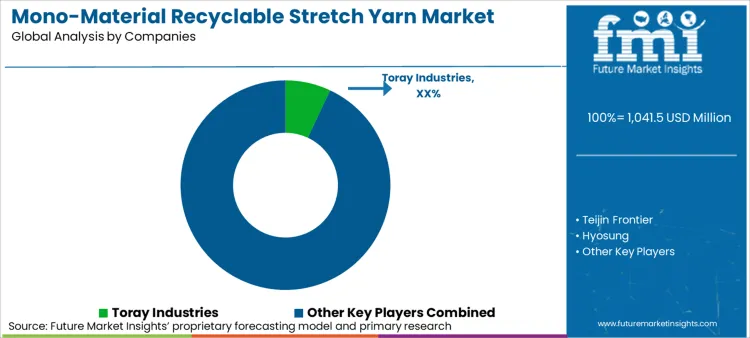
The global demand for mono-material recyclable stretch yarn is growing as sustainability becomes a core focus for the fashion and textile industries, driven by the need for circular economy solutions. Buyers evaluate yarns based on their recyclability, elasticity, colorfastness, and ability to provide durability and comfort without compromising environmental impact. As consumers and manufacturers push for eco-friendly materials, the focus is on yarns that can be fully recycled into the same material, offering a more efficient reuse cycle. Procurement behavior favors manufacturers who can offer high-quality mono-material solutions that perform well in both stretchability and recyclability, while meeting the rising regulatory standards for sustainable packaging and textiles.
Toray Industries leads competitive positioning with its innovative mono-material yarns, offering stretch and performance while ensuring complete recyclability, targeting the premium activewear and sportswear markets. Teijin Frontier competes by producing high-performance stretch yarns with an emphasis on sustainable solutions that allow for both comfort and easy recyclability in apparel. Hyosung remains a key player with its commitment to high-quality, eco-friendly yarns, focusing on mono-material, recyclable solutions for fashion and functional textiles. Lycra Company contributes by incorporating its iconic LYCRA® fibers into mono-material recyclable yarns, expanding into sustainable applications in sportswear and leisurewear.
Indorama Ventures leads with its expansive production capacity of recycled and recyclable fibers, supporting large-scale mono-material stretch yarns for the apparel industry. Unifi continues to innovate with sustainable products, providing mono-material yarn solutions designed for easy recycling in consumer goods and fashion. Mitsubishi Chemical Group and Kolon Industries offer competitive products focused on performance and environmental compliance. Asahi Kasei and Far Eastern New Century provide specialized solutions with a focus on recycling technology and waste reduction in textile production. Competitive differentiation centers on product performance, recyclability standards, brand adoption, and the integration of sustainable material technologies.
Key Players in the Mono-Material Recyclable Stretch Yarn Market
- Toray Industries
- Teijin Frontier
- Hyosung
- Lycra Company
- Indorama Ventures
- Unifi
- Mitsubishi Chemical Group
- Kolon Industries
- Asahi Kasei
- Far Eastern New Century
Scope of the Report
| Items | Values |
|---|---|
| Quantitative Units | USD million |
| Polymer Type | Polyester-Based Mono-Stretch Yarns; Polyamide-Based Mono-Stretch Yarns; Other Single-Polymer Systems; Hybrid/Transition Systems |
| Application | Knitted Stretch Fabrics; Woven Stretch Fabrics; Seamless & Warp-Knit Fabrics; Other Uses |
| Regions Covered | Asia Pacific, Europe, North America, Latin America, Middle East & Africa |
| Countries Covered | China, Brazil, USA, Germany, South Korea, and 40+ countries |
| Key Companies Profiled | Toray Industries; Teijin Frontier; Hyosung; Lycra Company; Indorama Ventures; Unifi; Mitsubishi Chemical Group; Kolon Industries; Asahi Kasei; Far Eastern New Century |
| Additional Attributes | Dollar sales by polymer type, application, and product systems; market shift towards eco-friendly and recyclable stretch yarns; developments in mono-material recycling technologies for textiles; growing demand for sustainable fabrics in fashion and industrial applications; procurement trends focused on cost-effective, high-performance recyclable yarns. |
Mono-Material Recyclable Stretch Yarn Market by Segment
Polymer Type:
- Polyester-Based Mono-Stretch Yarns
- Polyamide-Based Mono-Stretch Yarns
- Other Single-Polymer Systems
- Hybrid/Transition Systems
Application:
- Knitted Stretch Fabrics
- Woven Stretch Fabrics
- Seamless & Warp-Knit Fabrics
- Other Uses
Region:
- Asia Pacific
- China
- Japan
- South Korea
- India
- Australia & New Zealand
- ASEAN
- Rest of Asia Pacific
- Europe
- Germany
- United Kingdom
- France
- Italy
- Spain
- Nordic
- BENELUX
- Rest of Europe
- North America
- United States
- Canada
- Mexico
- Latin America
- Brazil
- Chile
- Rest of Latin America
- Middle East & Africa
- Kingdom of Saudi Arabia
- Other GCC Countries
- Turkey
- South Africa
- Other African Union
- Rest of Middle East & Africa
Bibliography
- European Commission. (2023). EU strategy for sustainable and circular textiles. Publications Office of the European Union.
- Textile Exchange. (2023). Recycled polyester and mono-material textile pathways. Textile Exchange.
- International Organization for Standardization. (2024). ISO 22766: Textiles-Recyclability and recoverability assessment of textile products. ISO.
- European Apparel and Textile Confederation. (2024). Design for recyclability in stretch and performance textiles. EURATEX.
- Hohenstein Institute. (2023). Mono-material textile systems: Performance, stretch behavior, and recycling compatibility. Hohenstein Research Reports.
- OECD. (2023). Global policy perspectives on circular economy in textiles and apparel. OECD Publishing.
Frequently Asked Questions
How big is the mono-material recyclable stretch yarn market in 2026?
The global mono-material recyclable stretch yarn market is estimated to be valued at USD 1,041.5 million in 2026.
What will be the size of mono-material recyclable stretch yarn market in 2036?
The market size for the mono-material recyclable stretch yarn market is projected to reach USD 2,581.1 million by 2036.
How much will be the mono-material recyclable stretch yarn market growth between 2026 and 2036?
The mono-material recyclable stretch yarn market is expected to grow at a 9.5% CAGR between 2026 and 2036.
What are the key product types in the mono-material recyclable stretch yarn market?
The key product types in mono-material recyclable stretch yarn market are polyester-based mono-stretch yarns, polyamide-based mono-stretch yarns, other single-polymer systems and hybrid/transition systems.
Which application segment to contribute significant share in the mono-material recyclable stretch yarn market in 2026?
In terms of application, knitted stretch fabrics segment to command 36.0% share in the mono-material recyclable stretch yarn market in 2026.
Preview the report firsthand - request a free sample
Get SampleGet the brochure for pricing and purchase details.
Get PDFTable of Content
- Executive Summary
- Global Market Outlook
- Demand-side Trends
- Supply-side Trends
- Technology Roadmap Analysis
- Analysis and Recommendations
- Market Overview
- Market Coverage / Taxonomy
- Market Definition / Scope / Limitations
- Market Background
- Market Dynamics
- Drivers
- Restraints
- Opportunity
- Trends
- Scenario Forecast
- Demand in Optimistic Scenario
- Demand in Likely Scenario
- Demand in Conservative Scenario
- Opportunity Map Analysis
- Product Life Cycle Analysis
- Supply Chain Analysis
- Investment Feasibility Matrix
- Value Chain Analysis
- PESTLE and Porter’s Analysis
- Regulatory Landscape
- Regional Parent Market Outlook
- Production and Consumption Statistics
- Import and Export Statistics
- Market Dynamics
- Global Market Analysis 2021 to 2025 and Forecast, 2026 to 2036
- Historical Market Size Value (USD Million) Analysis, 2021 to 2025
- Current and Future Market Size Value (USD Million) Projections, 2026 to 2036
- Y-o-Y Growth Trend Analysis
- Absolute $ Opportunity Analysis
- Global Market Pricing Analysis 2021 to 2025 and Forecast 2026 to 2036
- Global Market Analysis 2021 to 2025 and Forecast 2026 to 2036, By Polymer Type
- Introduction / Key Findings
- Historical Market Size Value (USD Million) Analysis By Polymer Type , 2021 to 2025
- Current and Future Market Size Value (USD Million) Analysis and Forecast By Polymer Type , 2026 to 2036
- Polyester-Based Mono-Stretch Yarns
- Polyamide-Based Mono-Stretch Yarns
- Other Single-Polymer Systems
- Hybrid/Transition Systems
- Polyester-Based Mono-Stretch Yarns
- Y-o-Y Growth Trend Analysis By Polymer Type , 2021 to 2025
- Absolute $ Opportunity Analysis By Polymer Type , 2026 to 2036
- Global Market Analysis 2021 to 2025 and Forecast 2026 to 2036, By Application
- Introduction / Key Findings
- Historical Market Size Value (USD Million) Analysis By Application, 2021 to 2025
- Current and Future Market Size Value (USD Million) Analysis and Forecast By Application, 2026 to 2036
- Knitted Stretch Fabrics
- Woven Stretch Fabrics
- Seamless & Warp-Knit Fabrics
- Other Uses
- Knitted Stretch Fabrics
- Y-o-Y Growth Trend Analysis By Application, 2021 to 2025
- Absolute $ Opportunity Analysis By Application, 2026 to 2036
- Global Market Analysis 2021 to 2025 and Forecast 2026 to 2036, By Region
- Introduction
- Historical Market Size Value (USD Million) Analysis By Region, 2021 to 2025
- Current Market Size Value (USD Million) Analysis and Forecast By Region, 2026 to 2036
- North America
- Latin America
- Western Europe
- Eastern Europe
- East Asia
- South Asia and Pacific
- Middle East & Africa
- Market Attractiveness Analysis By Region
- North America Market Analysis 2021 to 2025 and Forecast 2026 to 2036, By Country
- Historical Market Size Value (USD Million) Trend Analysis By Market Taxonomy, 2021 to 2025
- Market Size Value (USD Million) Forecast By Market Taxonomy, 2026 to 2036
- By Country
- USA
- Canada
- Mexico
- By Polymer Type
- By Application
- By Country
- Market Attractiveness Analysis
- By Country
- By Polymer Type
- By Application
- Key Takeaways
- Latin America Market Analysis 2021 to 2025 and Forecast 2026 to 2036, By Country
- Historical Market Size Value (USD Million) Trend Analysis By Market Taxonomy, 2021 to 2025
- Market Size Value (USD Million) Forecast By Market Taxonomy, 2026 to 2036
- By Country
- Brazil
- Chile
- Rest of Latin America
- By Polymer Type
- By Application
- By Country
- Market Attractiveness Analysis
- By Country
- By Polymer Type
- By Application
- Key Takeaways
- Western Europe Market Analysis 2021 to 2025 and Forecast 2026 to 2036, By Country
- Historical Market Size Value (USD Million) Trend Analysis By Market Taxonomy, 2021 to 2025
- Market Size Value (USD Million) Forecast By Market Taxonomy, 2026 to 2036
- By Country
- Germany
- UK
- Italy
- Spain
- France
- Nordic
- BENELUX
- Rest of Western Europe
- By Polymer Type
- By Application
- By Country
- Market Attractiveness Analysis
- By Country
- By Polymer Type
- By Application
- Key Takeaways
- Eastern Europe Market Analysis 2021 to 2025 and Forecast 2026 to 2036, By Country
- Historical Market Size Value (USD Million) Trend Analysis By Market Taxonomy, 2021 to 2025
- Market Size Value (USD Million) Forecast By Market Taxonomy, 2026 to 2036
- By Country
- Russia
- Poland
- Hungary
- Balkan & Baltic
- Rest of Eastern Europe
- By Polymer Type
- By Application
- By Country
- Market Attractiveness Analysis
- By Country
- By Polymer Type
- By Application
- Key Takeaways
- East Asia Market Analysis 2021 to 2025 and Forecast 2026 to 2036, By Country
- Historical Market Size Value (USD Million) Trend Analysis By Market Taxonomy, 2021 to 2025
- Market Size Value (USD Million) Forecast By Market Taxonomy, 2026 to 2036
- By Country
- China
- Japan
- South Korea
- By Polymer Type
- By Application
- By Country
- Market Attractiveness Analysis
- By Country
- By Polymer Type
- By Application
- Key Takeaways
- South Asia and Pacific Market Analysis 2021 to 2025 and Forecast 2026 to 2036, By Country
- Historical Market Size Value (USD Million) Trend Analysis By Market Taxonomy, 2021 to 2025
- Market Size Value (USD Million) Forecast By Market Taxonomy, 2026 to 2036
- By Country
- India
- ASEAN
- Australia & New Zealand
- Rest of South Asia and Pacific
- By Polymer Type
- By Application
- By Country
- Market Attractiveness Analysis
- By Country
- By Polymer Type
- By Application
- Key Takeaways
- Middle East & Africa Market Analysis 2021 to 2025 and Forecast 2026 to 2036, By Country
- Historical Market Size Value (USD Million) Trend Analysis By Market Taxonomy, 2021 to 2025
- Market Size Value (USD Million) Forecast By Market Taxonomy, 2026 to 2036
- By Country
- Kingdom of Saudi Arabia
- Other GCC Countries
- Turkiye
- South Africa
- Other African Union
- Rest of Middle East & Africa
- By Polymer Type
- By Application
- By Country
- Market Attractiveness Analysis
- By Country
- By Polymer Type
- By Application
- Key Takeaways
- Key Countries Market Analysis
- USA
- Pricing Analysis
- Market Share Analysis, 2025
- By Polymer Type
- By Application
- Canada
- Pricing Analysis
- Market Share Analysis, 2025
- By Polymer Type
- By Application
- Mexico
- Pricing Analysis
- Market Share Analysis, 2025
- By Polymer Type
- By Application
- Brazil
- Pricing Analysis
- Market Share Analysis, 2025
- By Polymer Type
- By Application
- Chile
- Pricing Analysis
- Market Share Analysis, 2025
- By Polymer Type
- By Application
- Germany
- Pricing Analysis
- Market Share Analysis, 2025
- By Polymer Type
- By Application
- UK
- Pricing Analysis
- Market Share Analysis, 2025
- By Polymer Type
- By Application
- Italy
- Pricing Analysis
- Market Share Analysis, 2025
- By Polymer Type
- By Application
- Spain
- Pricing Analysis
- Market Share Analysis, 2025
- By Polymer Type
- By Application
- France
- Pricing Analysis
- Market Share Analysis, 2025
- By Polymer Type
- By Application
- India
- Pricing Analysis
- Market Share Analysis, 2025
- By Polymer Type
- By Application
- ASEAN
- Pricing Analysis
- Market Share Analysis, 2025
- By Polymer Type
- By Application
- Australia & New Zealand
- Pricing Analysis
- Market Share Analysis, 2025
- By Polymer Type
- By Application
- China
- Pricing Analysis
- Market Share Analysis, 2025
- By Polymer Type
- By Application
- Japan
- Pricing Analysis
- Market Share Analysis, 2025
- By Polymer Type
- By Application
- South Korea
- Pricing Analysis
- Market Share Analysis, 2025
- By Polymer Type
- By Application
- Russia
- Pricing Analysis
- Market Share Analysis, 2025
- By Polymer Type
- By Application
- Poland
- Pricing Analysis
- Market Share Analysis, 2025
- By Polymer Type
- By Application
- Hungary
- Pricing Analysis
- Market Share Analysis, 2025
- By Polymer Type
- By Application
- Kingdom of Saudi Arabia
- Pricing Analysis
- Market Share Analysis, 2025
- By Polymer Type
- By Application
- Turkiye
- Pricing Analysis
- Market Share Analysis, 2025
- By Polymer Type
- By Application
- South Africa
- Pricing Analysis
- Market Share Analysis, 2025
- By Polymer Type
- By Application
- USA
- Market Structure Analysis
- Competition Dashboard
- Competition Benchmarking
- Market Share Analysis of Top Players
- By Regional
- By Polymer Type
- By Application
- Competition Analysis
- Competition Deep Dive
- Toray Industries
- Overview
- Product Portfolio
- Profitability by Market Segments (Product/Age /Sales Channel/Region)
- Sales Footprint
- Strategy Overview
- Marketing Strategy
- Product Strategy
- Channel Strategy
- Teijin Frontier
- Hyosung
- Lycra Company
- Indorama Ventures
- Unifi
- Mitsubishi Chemical Group
- Kolon Industries
- Asahi Kasei
- Far Eastern New Century
- Toray Industries
- Competition Deep Dive
- Assumptions & Acronyms Used
- Research Methodology


