

- Industry Size (2026)
- USD 909.7 Mn
- Forecast (2036)
- USD 2275.1 Mn
- CAGR (2026 to 2036)
- 9.6%
Recyclable Perfume Dropper Resins Market Forecast and Outlook 2026 to 2036
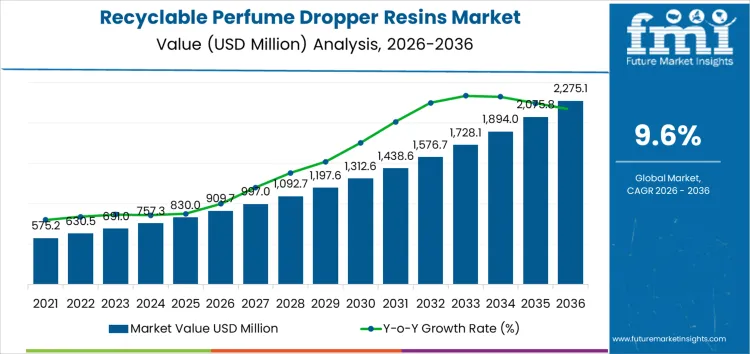
The recyclable perfume dropper resins market is valued at USD 909.7 million in 2026 and is projected to reach USD 2,275.1 million by 2036, reflecting a CAGR of 9.6%. Production concentration is observed among suppliers capable of delivering high-purity, recyclable polymer resins suitable for premium and mass-market fragrance packaging. Regional control over feedstock supply, extrusion, and molding facilities affects consistency and lead times. Volume stability is influenced by adoption in luxury and mainstream perfume brands, regulatory compliance, and sustainability mandates. Operators providing validated, recyclable resins capture predictable revenue streams, while smaller producers face variability and limited leverage in large-scale programs.
Revenue concentration is shaped by alignment with brand packaging programs and multi-product line compatibility. Adoption varies by region according to environmental regulations, sustainability commitments, and consumer demand for recyclable packaging. Margins favor operators supplying certified, high-performance resins with technical support and integration guidance. Fragmentation persists among regional or niche suppliers, whereas established companies secure concentrated value through production control, validated recyclability, and alignment with major fragrance brands rather than output volume alone.
Quick Stats of the Recyclable Perfume Dropper Resins Market
- Recyclable Perfume Dropper Resins Market Value (2026): USD 909.7 million
- Recyclable Perfume Dropper Resins Forecast Value (2036): USD 2,275.1 million
- Recyclable Perfume Dropper Resins Forecast CAGR 2026 to 2036: 9.6%
- Leading Resin Type in Recyclable Perfume Dropper Resins Market: Polyethylene Terephthalate (PET) (32.9% share)
- Leading Dropper Type in Recyclable Perfume Dropper Resins Market: Glass Dropper Bottles with Recyclable Resin Caps (41.6% share)
- Key Growth Regions in Recyclable Perfume Dropper Resins Market: India, China, USA, Germany, France
- Top Players in Recyclable Perfume Dropper Resins Market: Amcor plc, AptarGroup, Inc., Berry Global, Inc., Albéa (Groupe Pochet), HCT Group
What is the Growth Forecast for Recyclable Perfume Dropper Resins Market through 2036?
Between 2026 and 2031, the recyclable perfume dropper resins market is expected to grow from USD 909.7 million to USD 1,307 million, driven by rising adoption of PET, HDPE, PP, and bio-based resins in glass and all-resin dropper bottles. Premium perfumes, mass-market fragrances, and natural or organic lines are increasingly using recyclable components to meet sustainability goals. Growth is supported by regulatory pressure, brand emphasis on eco-friendly packaging, and consumer preference for recyclable and reusable materials. Suppliers are focusing on resin quality, compliance, and compatibility with fragrance stability and dropper functionality.
From 2031 to 2036, the market is anticipated to expand from USD 1,307 million to USD 2,275.1 million, fueled by broader adoption across premium, mass-market, and travel-sized fragrances. Innovation in sustainable and bio-based resins drives differentiation, enabling high-performance droppers with recyclability. Market expansion is supported by increasing awareness of circular packaging, brand sustainability initiatives, and regulatory mandates. Competitive advantage favors suppliers with validated resin quality, high-performance dropper compatibility, and scalable production. Leading companies include Amcor plc, AptarGroup, Inc., Berry Global, Inc., Albéa (Groupe Pochet), and HCT Group.
Recyclable Perfume Dropper Resins Market Key Takeaways
| Metric | Value |
|---|---|
| Market Value (2026) | USD 909.7 million |
| Forecast Value (2036) | USD 2,275.1 million |
| Forecast CAGR 2026 to 2036 | 9.60% |
What Is Driving Demand for Recyclable Perfume Dropper Resins?
Recyclable perfume dropper resins are increasingly adopted to reduce environmental impact while maintaining functionality, aesthetics, and chemical resistance in fragrance packaging. Historically, droppers were manufactured using mixed or non-recyclable plastics, complicating recycling and sustainability efforts. Modern resins use mono-materials, bio-based polymers, or easily recyclable plastics that provide durability, chemical stability, and compatibility with fragrance oils. Cosmetic brands, packaging manufacturers, and R&D teams prioritize material performance, recyclability, and regulatory compliance. Early adoption focused on premium or eco-conscious fragrance lines, while current demand spans mainstream perfumes, skincare, and personal care products driven by sustainability mandates, corporate ESG goals, and consumer preference for environmentally responsible packaging. Material consistency, chemical resistance, and design flexibility influence supplier selection.
Increasing regulatory pressure, consumer awareness, and sustainability initiatives are shaping growth in recyclable perfume dropper resins. Compared with conventional plastics, contemporary resins emphasize recyclability, chemical compatibility, and structural integrity while enabling aesthetic design. Cost considerations include raw material sourcing, molding processes, and quality control, concentrating margins among suppliers capable of delivering consistent, high-performance resins. Cosmetic brands adopt recyclable dropper resins to support sustainable packaging, maintain product safety, and meet consumer expectations for eco-friendly solutions. By 2036, recyclable perfume dropper resins are expected to become standard in fragrance packaging, supporting circularity, sustainability, and responsible consumer engagement.
What Factors Are Shaping the Demand for Recyclable Perfume Dropper Resins in Terms of Resin Type and Dropper Type?
The demand for recyclable perfume dropper resins is segmented by resin type and dropper type. Resin types include polyethylene terephthalate (PET), high-density polyethylene (HDPE), polypropylene (PP), bio-based or sustainable resins, and other materials. Dropper types include glass dropper bottles with recyclable resin caps, all-resin recyclable droppers, resin dropper inserts, and other variants. Adoption is influenced by material sustainability, chemical resistance, and design compatibility. Uptake is driven by consumer preference for recyclable packaging, operational efficiency, and regulatory compliance. Resin and dropper selection depends on product formulation, aesthetic requirements, and recyclability, ensuring functional, sustainable, and cost-efficient packaging solutions.
Why Is Polyethylene Terephthalate (PET) Leading the Resin Type Segment in Recyclable Perfume Droppers?
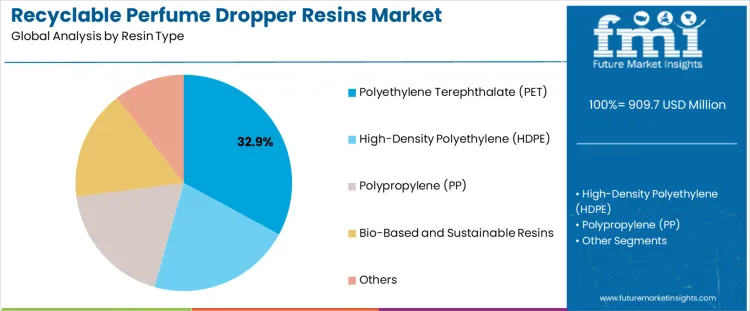
PET accounts for 32.9% of total resin type demand, making it the leading category. PET is valued for chemical resistance, dimensional stability, and recyclability, making it suitable for dropper caps and inserts. Adoption is reinforced by its compatibility with fragrance formulations, manufacturing ease, and ability to maintain transparency and premium appearance. Manufacturers select PET to produce durable, reusable, and recyclable components that preserve product quality. Operational considerations include monitoring material flow, molding precision, and post-production quality checks. The segment leads because PET combines recyclability, performance, and aesthetic appeal, meeting sustainability and operational requirements in perfume packaging.
Performance factors further support adoption. PET must resist thermal stress, chemical exposure, and mechanical wear during repeated use. Integration with glass bottles and precision dropper mechanisms ensures leak-free operation and user convenience. The segment leads because PET delivers predictable mechanical performance, visual quality, and recyclability, aligning with circular packaging objectives for premium fragrance products.
Why Are Glass Dropper Bottles with Recyclable Resin Caps Representing the Largest Dropper Type Segment?
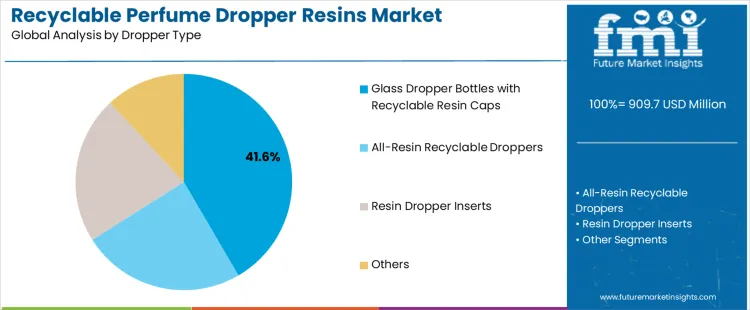
Glass dropper bottles with recyclable resin caps account for 41.6% of total dropper type demand, making them the largest segment. Adoption is driven by the combination of premium aesthetics, chemical inertness of glass, and recyclability of resin caps. Perfume brands integrate this design to ensure fragrance stability, leak-proof performance, and environmentally responsible packaging. Maintenance and quality control involve monitoring cap fit, sealing performance, and dropper precision. The segment leads because this combination provides functional reliability, visual appeal, and alignment with consumer expectations for sustainable luxury packaging.
Operational and functional factors influence adoption. Caps and bottles must withstand repeated opening, exposure to oils and alcohols, and transport handling without compromising integrity. Proper assembly ensures leak resistance and user convenience. Glass bottles with recyclable resin caps lead because they combine premium design, operational performance, and sustainability, establishing them as the preferred choice for recyclable perfume droppers.
How Are Recyclable Perfume Dropper Resins Supporting Sustainable Packaging?
Recyclable perfume dropper resins are increasingly adopted by cosmetic and fragrance brands to create eco-friendly, refillable, and recyclable droppers. Adoption is strongest in regions with high cosmetic consumption, strict packaging regulations, and sustainability-driven consumer demand. Resins are selected for chemical resistance, clarity, durability, and compatibility with fragrance formulations. Growth is driven by environmental compliance, brand sustainability initiatives, and consumer preference for recyclable packaging. Investment focuses on material quality, moldability, and functional performance. Brands prioritize resins that maintain dropper integrity, prevent leakage, and meet regional recycling and regulatory standards.
Why Are Regional Sustainability Regulations and Consumer Awareness Driving Demand?
Demand is influenced by local laws governing recyclable packaging, environmental responsibility, and waste reduction. Cosmetic companies adopt recyclable resins to comply with regulations, enhance brand image, and reduce ecological footprint. Materials offering clarity, durability, and chemical compatibility gain preference. Adoption is concentrated in regions with strong sustainability policies and environmentally conscious consumers. Regulatory compliance, product functionality, and consumer perception drive procurement rather than cost. Suppliers providing certified, high-performance recyclable resins gain advantages among fragrance brands and packaging manufacturers.
What Factors Restrict Broader Adoption of Recyclable Perfume Dropper Resins?
Higher resin costs, limited availability, and technical challenges in molding and dropper assembly restrict adoption. Chemical interaction with fragrance oils and adhesives can affect performance. Compatibility with existing production lines requires adaptation. Certification and regulatory approval processes may delay deployment. Smaller brands or regions with limited access to sustainable materials adopt more slowly. These factors concentrate early use among premium cosmetic brands, multinational manufacturers, and regions with strong sustainability frameworks.
How Are Technological Innovation and Collaboration Shaping Market Growth?
Recent developments include bio-based and fully recyclable polymers with enhanced clarity, chemical resistance, and mechanical strength. Collaboration between resin suppliers, packaging designers, and cosmetic manufacturers ensures functional performance, regulatory compliance, and aesthetic appeal. Pilot testing evaluates durability, leak-proof performance, and recyclability before large-scale use. Quality control, traceability, and standardized manufacturing processes maintain consistency. Focus is on sustainability, performance, and regulatory alignment rather than cost or volume. Collaborative efforts enable broader adoption of recyclable perfume dropper resins in environmentally conscious fragrance markets.
What is the Demand for Recyclable Perfume Dropper Resins by Country?
| Country | CAGR (%) |
|---|---|
| USA | 10.2% |
| China | 11.1% |
| India | 11.6% |
| Germany | 9.0% |
| France | 8.5% |
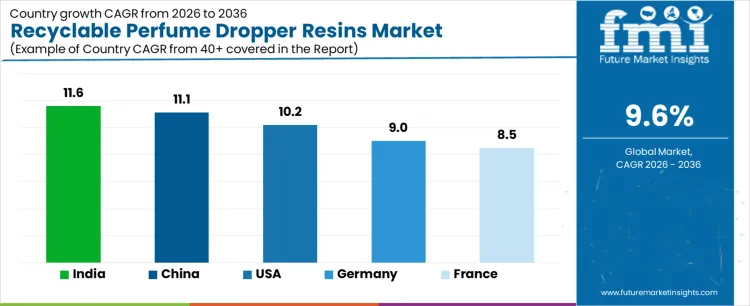
Demand for recyclable perfume dropper resins is rising as cosmetic brands adopt sustainable packaging solutions to reduce environmental impact and meet consumer demand for eco-friendly products. India leads with an 11.6% CAGR, driven by growing domestic cosmetic production, increasing awareness of recyclable packaging, and expansion of premium fragrance lines. China follows at 11.1%, supported by large-scale cosmetics manufacturing, regulatory encouragement for sustainable materials, and adoption of recyclable resins. The USA grows at 10.2%, shaped by brand initiatives in eco-friendly packaging and consumer preference for sustainable beauty products. Germany records 9.0% growth, reflecting steady adoption of recyclable resins in premium cosmetics. France shows 8.5% CAGR, driven by established cosmetic markets and gradual shift toward recyclable packaging solutions.
How Is the United States Experiencing Growth in the Recyclable Perfume Dropper Resins Market?
United States is experiencing growth at a CAGR of 10.2%, supported by adoption of recyclable resins in perfume droppers to improve sustainability and reduce environmental impact in the cosmetics industry. Cosmetic manufacturers and packaging suppliers are producing resins optimized for chemical resistance, durability, and recyclability. Demand is concentrated in urban cosmetic production hubs, R&D centers, and high-volume retail packaging operations. Investments focus on material innovation, regulatory compliance, and manufacturing precision rather than large-scale expansion. Growth reflects rising consumer demand for eco-friendly packaging, industrial adoption of recyclable materials, and brand focus on sustainable cosmetics.
- Eco-friendly packaging drives adoption.
- Resins provide chemical resistance, durability, and recyclability.
- Cosmetic hubs and R&D centers concentrate demand.
- Material innovation and regulatory compliance guide investment.
How Is China Witnessing Rapid Growth With Sustainable Packaging Initiatives?
China is witnessing growth at a CAGR of 11.1%, fueled by adoption of recyclable perfume dropper resins to support sustainable packaging in cosmetics and personal care products. Manufacturers and suppliers are deploying resins optimized for durability, chemical resistance, and recyclability. Demand is concentrated in urban cosmetic production hubs, R&D centers, and retail-focused packaging facilities. Investments prioritize material performance, process efficiency, and regulatory adherence rather than broad-scale deployment. Growth reflects government support for sustainable materials, rising consumer awareness, and adoption of eco-friendly packaging technologies across the cosmetic sector.
- Sustainable packaging initiatives drive adoption.
- Resins are optimized for durability and recyclability.
- Urban production hubs and R&D centers concentrate demand.
- Material performance and regulatory adherence guide investment.
How Is India Experiencing Rapid Growth With Eco-Conscious Cosmetic Practices?
India is experiencing growth at a CAGR of 11.6%, supported by adoption of recyclable resins in perfume droppers to meet increasing demand for sustainable cosmetics and environmentally responsible packaging. Cosmetic manufacturers and suppliers are producing resins optimized for chemical resistance, durability, and recyclability. Demand is concentrated in major cosmetic production hubs, R&D centers, and retail packaging networks. Investments focus on material innovation, process efficiency, and regulatory compliance rather than large-scale expansion. Growth reflects rising consumer preference for eco-friendly products, industrial adoption of recyclable materials, and initiatives promoting sustainable packaging practices.
- Eco-conscious cosmetic practices drive adoption.
- Resins provide chemical resistance, durability, and recyclability.
- Cosmetic hubs and R&D centers concentrate demand.
- Material innovation and regulatory compliance guide investment.
How Is Germany Witnessing Steady Growth With Sustainable Packaging Adoption?
Germany is witnessing growth at a CAGR of 9%, supported by adoption of recyclable resins in perfume droppers to reduce environmental impact and enhance sustainability in cosmetic packaging. Manufacturers and suppliers are deploying resins optimized for durability, chemical resistance, and recyclability. Demand is concentrated in cosmetic production hubs, R&D centers, and high-volume packaging operations. Investments prioritize material performance, process precision, and regulatory adherence rather than large-scale production expansion. Growth reflects industrial focus on sustainable packaging, rising consumer awareness, and adoption of eco-friendly materials in cosmetics manufacturing.
- Sustainable packaging drives adoption.
- Resins optimize durability, chemical resistance, and recyclability.
- Cosmetic hubs and R&D centers concentrate demand.
- Material performance and process precision guide investment.
How Is France Experiencing Moderate Growth With Eco-Friendly Packaging Practices?
France is experiencing growth at a CAGR of 8.5%, fueled by adoption of recyclable perfume dropper resins to support environmentally conscious cosmetic packaging and meet consumer demand for sustainability. Cosmetic manufacturers and suppliers are deploying resins designed for durability, chemical resistance, and recyclability. Demand is concentrated in urban production hubs, R&D centers, and retail packaging operations. Investments focus on material quality, regulatory compliance, and manufacturing precision rather than large-scale deployment. Growth reflects increasing consumer preference for sustainable packaging, industrial adoption of recyclable materials, and integration of eco-friendly resins in cosmetic packaging solutions.
- Eco-friendly packaging drives adoption.
- Resins ensure durability, chemical resistance, and recyclability.
- Urban cosmetic hubs and R&D centers concentrate demand.
- Material quality and regulatory compliance guide investment.
Who Competes in the Recyclable Perfume Dropper Resins Market and What Defines Their Capabilities?
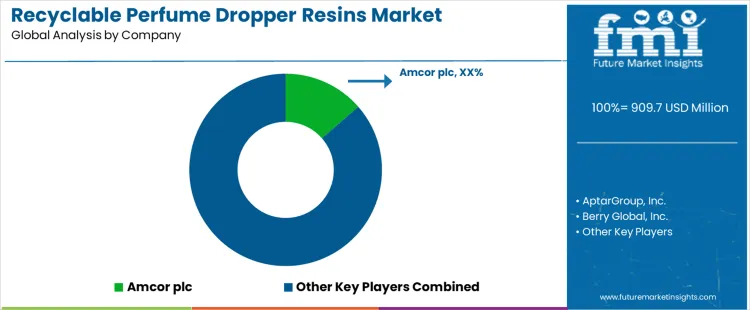
Competition in the recyclable perfume dropper resins market is defined by polymer performance, recyclability, and compatibility with cosmetic formulation requirements. Amcor plc supplies recyclable polymer resins engineered for durability, clarity, and chemical resistance suitable for perfume droppers while maintaining circularity standards. AptarGroup, Inc. focuses on resin systems that support dropper precision, material resilience, and integration with refillable cosmetic formats. Berry Global, Inc. provides engineered resins optimized for structural integrity and compatibility with automated filling processes.
Albéa (Groupe Pochet) develops polymer blends that deliver aesthetic finish, functional performance, and recyclability compliance. HCT Group supplies customizable resins designed for rapid prototyping and small-batch production. Other market participants include regional and specialty resin suppliers that focus on sustainable, chemically resistant polymers suitable for cosmetic droppers. Adoption is influenced by recyclability certification, chemical stability with fragrances, and compatibility with refillable packaging designs.
Market differentiation in the recyclable perfume dropper resins segment emerges from polymer composition, processability, and ability to meet cosmetic regulatory standards. Amcor plc emphasizes materials engineered for chemical resistance and clarity to preserve fragrance integrity while supporting post-consumer recyclability. AptarGroup, Inc. develops resins that enable precise dropper functionality and maintain mechanical performance over repeated use. Berry Global, Inc. focuses on polymer blends compatible with high-speed manufacturing and automated filling equipment.
Albéa (Groupe Pochet) delivers aesthetic finishes while ensuring recyclability compliance and process consistency. HCT Group provides rapid-prototyping resins optimized for material testing and customization. Other competitors supply specialty polymers that balance durability, chemical resistance, and sustainability compliance. Competitive differences are influenced by recyclability certification, mechanical performance, fragrance compatibility, and alignment with brand sustainability goals in luxury cosmetic packaging.
Key Players in the Recyclable Perfume Dropper Resins Market
- Amcor plc
- AptarGroup, Inc.
- Berry Global, Inc.
- Albéa (Groupe Pochet)
- HCT Group
- Others
Scope of the Report
| Items | Values |
|---|---|
| Quantitative Units (2026) | USD million |
| Resin Type | Polyethylene Terephthalate (PET), High-Density Polyethylene (HDPE), Polypropylene (PP), Bio-Based/Sustainable Resins, Others |
| Dropper Type | Glass Dropper Bottles with Recyclable Resin Caps, All Resin Recyclable Droppers, Resin Dropper Inserts, Others |
| End Use Product | Premium Perfume, Mass-Market Fragrances, Natural/Organic Fragrance Lines, Travel & Sample Sizes, Others |
| Region | Asia Pacific, Europe, North America, Latin America, Middle East & Africa |
| Key Countries Covered | China, Japan, South Korea, India, Australia & New Zealand, Germany, United Kingdom, France, Italy, Spain, Nordic, BENELUX, United States, Canada, Mexico, Brazil, Chile, Kingdom of Saudi Arabia, Other GCC Countries, Turkey, South Africa, Other African Union |
| Key Companies Profiled | Amcor plc, AptarGroup, Inc., Berry Global, Inc., Albéa (Groupe Pochet), HCT Group, Others |
| Additional Attributes | Dollar sales by resin type, dropper type, and end-use product; regional CAGR, volume and value growth projections; adoption across premium, mass-market, natural/organic, and travel-sized fragrances; high-performance recyclable and bio-based resins; regulatory and sustainability compliance; compatibility with fragrance formulations and dropper functionality |
Recyclable Perfume Dropper Resins Market Segmentation
Resin Type:
- Polyethylene Terephthalate (PET)
- High Density Polyethylene (HDPE)
- Polypropylene (PP)
- Bio Based/Sustainable Resins
- Others
Dropper Type:
- Glass Dropper Bottles with Recyclable Resin Caps
- All Resin Recyclable Droppers
- Resin Dropper Inserts
- Others
End Use Product:
- Premium Perfume
- Mass Market Fragrances
- Natural/Organic Fragrance Lines
- Travel & Sample Sizes
- Others
Region:
- Asia Pacific
- China
- Japan
- South Korea
- India
- Australia & New Zealand
- ASEAN
- Rest of Asia Pacific
- Europe
- Germany
- United Kingdom
- France
- Italy
- Spain
- Nordic
- BENELUX
- Rest of Europe
- North America
- United States
- Canada
- Mexico
- Latin America
- Brazil
- Chile
- Rest of Latin America
- Middle East & Africa
- Kingdom of Saudi Arabia
- Other GCC Countries
- Turkey
- South Africa
- Other African Union
- Rest of Middle East & Africa
Bibliography
- European Commission – Joint Research Centre (JRC). (2024). Sustainable and recyclable plastic materials for cosmetic and personal care packaging. Publications Office of the European Union.
- Organisation for Economic Co‑operation and Development (OECD). (2024). Design for recyclability and circular plastics in consumer packaging. OECD Environment, Health and Safety Programme.
- European Chemicals Agency (ECHA). (2024). Safe and sustainable polymers in consumer and cosmetic packaging under REACH. European Chemicals Agency.
- United Nations Environment Programme (UNEP). (2025). Plastic packaging sustainability, recyclability, and circular economy pathways. UNEP Chemicals and Health Branch.
- International Organization for Standardization (ISO). (2024). Packaging and plastics — Requirements for recyclable plastic packaging (latest revisions). International Organization for Standardization.
Frequently Asked Questions
How big is the recyclable perfume dropper resins market in 2026?
The global recyclable perfume dropper resins market is estimated to be valued at USD 909.7 million in 2026.
What will be the size of recyclable perfume dropper resins market in 2036?
The market size for the recyclable perfume dropper resins market is projected to reach USD 2,275.1 million by 2036.
How much will be the recyclable perfume dropper resins market growth between 2026 and 2036?
The recyclable perfume dropper resins market is expected to grow at a 9.6% CAGR between 2026 and 2036.
What are the key product types in the recyclable perfume dropper resins market?
The key product types in recyclable perfume dropper resins market are polyethylene terephthalate (pet), high‑density polyethylene (hdpe), polypropylene (pp), bio‑based and sustainable resins and others.
Which dropper type segment to contribute significant share in the recyclable perfume dropper resins market in 2026?
In terms of dropper type, glass dropper bottles with recyclable resin caps segment to command 41.6% share in the recyclable perfume dropper resins market in 2026.
Preview the report firsthand - request a free sample
Get SampleGet the brochure for pricing and purchase details.
Get PDFTable of Content
- Executive Summary
- Global Market Outlook
- Demand-side Trends
- Supply-side Trends
- Technology Roadmap Analysis
- Analysis and Recommendations
- Market Overview
- Market Coverage / Taxonomy
- Market Definition / Scope / Limitations
- Market Background
- Market Dynamics
- Drivers
- Restraints
- Opportunity
- Trends
- Scenario Forecast
- Demand in Optimistic Scenario
- Demand in Likely Scenario
- Demand in Conservative Scenario
- Opportunity Map Analysis
- Product Life Cycle Analysis
- Supply Chain Analysis
- Investment Feasibility Matrix
- Value Chain Analysis
- PESTLE and Porter’s Analysis
- Regulatory Landscape
- Regional Parent Market Outlook
- Production and Consumption Statistics
- Import and Export Statistics
- Market Dynamics
- Global Market Analysis 2021 to 2025 and Forecast, 2026 to 2036
- Historical Market Size Value (USD Million) Analysis, 2021 to 2025
- Current and Future Market Size Value (USD Million) Projections, 2026 to 2036
- Y-o-Y Growth Trend Analysis
- Absolute $ Opportunity Analysis
- Global Market Pricing Analysis 2021 to 2025 and Forecast 2026 to 2036
- Global Market Analysis 2021 to 2025 and Forecast 2026 to 2036, By Resin Type
- Introduction / Key Findings
- Historical Market Size Value (USD Million) Analysis By Resin Type , 2021 to 2025
- Current and Future Market Size Value (USD Million) Analysis and Forecast By Resin Type , 2026 to 2036
- Polyethylene Terephthalate (PET)
- High‑Density Polyethylene (HDPE)
- Polypropylene (PP)
- Bio‑Based and Sustainable Resins
- Others
- Polyethylene Terephthalate (PET)
- Y-o-Y Growth Trend Analysis By Resin Type , 2021 to 2025
- Absolute $ Opportunity Analysis By Resin Type , 2026 to 2036
- Global Market Analysis 2021 to 2025 and Forecast 2026 to 2036, By Dropper Type
- Introduction / Key Findings
- Historical Market Size Value (USD Million) Analysis By Dropper Type, 2021 to 2025
- Current and Future Market Size Value (USD Million) Analysis and Forecast By Dropper Type, 2026 to 2036
- Glass Dropper Bottles with Recyclable Resin Caps
- All‑Resin Recyclable Droppers
- Resin Dropper Inserts
- Others
- Glass Dropper Bottles with Recyclable Resin Caps
- Y-o-Y Growth Trend Analysis By Dropper Type, 2021 to 2025
- Absolute $ Opportunity Analysis By Dropper Type, 2026 to 2036
- Global Market Analysis 2021 to 2025 and Forecast 2026 to 2036, By End‑Use Product
- Introduction / Key Findings
- Historical Market Size Value (USD Million) Analysis By End‑Use Product, 2021 to 2025
- Current and Future Market Size Value (USD Million) Analysis and Forecast By End‑Use Product, 2026 to 2036
- Premium Perfume
- Mass Market Fragrances
- Natural and Organic Fragrance Lines
- Travel & Sample Sizes
- Others
- Premium Perfume
- Y-o-Y Growth Trend Analysis By End‑Use Product, 2021 to 2025
- Absolute $ Opportunity Analysis By End‑Use Product, 2026 to 2036
- Global Market Analysis 2021 to 2025 and Forecast 2026 to 2036, By Region
- Introduction
- Historical Market Size Value (USD Million) Analysis By Region, 2021 to 2025
- Current Market Size Value (USD Million) Analysis and Forecast By Region, 2026 to 2036
- North America
- Latin America
- Western Europe
- Eastern Europe
- East Asia
- South Asia and Pacific
- Middle East & Africa
- Market Attractiveness Analysis By Region
- North America Market Analysis 2021 to 2025 and Forecast 2026 to 2036, By Country
- Historical Market Size Value (USD Million) Trend Analysis By Market Taxonomy, 2021 to 2025
- Market Size Value (USD Million) Forecast By Market Taxonomy, 2026 to 2036
- By Country
- USA
- Canada
- Mexico
- By Resin Type
- By Dropper Type
- By End‑Use Product
- By Country
- Market Attractiveness Analysis
- By Country
- By Resin Type
- By Dropper Type
- By End‑Use Product
- Key Takeaways
- Latin America Market Analysis 2021 to 2025 and Forecast 2026 to 2036, By Country
- Historical Market Size Value (USD Million) Trend Analysis By Market Taxonomy, 2021 to 2025
- Market Size Value (USD Million) Forecast By Market Taxonomy, 2026 to 2036
- By Country
- Brazil
- Chile
- Rest of Latin America
- By Resin Type
- By Dropper Type
- By End‑Use Product
- By Country
- Market Attractiveness Analysis
- By Country
- By Resin Type
- By Dropper Type
- By End‑Use Product
- Key Takeaways
- Western Europe Market Analysis 2021 to 2025 and Forecast 2026 to 2036, By Country
- Historical Market Size Value (USD Million) Trend Analysis By Market Taxonomy, 2021 to 2025
- Market Size Value (USD Million) Forecast By Market Taxonomy, 2026 to 2036
- By Country
- Germany
- UK
- Italy
- Spain
- France
- Nordic
- BENELUX
- Rest of Western Europe
- By Resin Type
- By Dropper Type
- By End‑Use Product
- By Country
- Market Attractiveness Analysis
- By Country
- By Resin Type
- By Dropper Type
- By End‑Use Product
- Key Takeaways
- Eastern Europe Market Analysis 2021 to 2025 and Forecast 2026 to 2036, By Country
- Historical Market Size Value (USD Million) Trend Analysis By Market Taxonomy, 2021 to 2025
- Market Size Value (USD Million) Forecast By Market Taxonomy, 2026 to 2036
- By Country
- Russia
- Poland
- Hungary
- Balkan & Baltic
- Rest of Eastern Europe
- By Resin Type
- By Dropper Type
- By End‑Use Product
- By Country
- Market Attractiveness Analysis
- By Country
- By Resin Type
- By Dropper Type
- By End‑Use Product
- Key Takeaways
- East Asia Market Analysis 2021 to 2025 and Forecast 2026 to 2036, By Country
- Historical Market Size Value (USD Million) Trend Analysis By Market Taxonomy, 2021 to 2025
- Market Size Value (USD Million) Forecast By Market Taxonomy, 2026 to 2036
- By Country
- China
- Japan
- South Korea
- By Resin Type
- By Dropper Type
- By End‑Use Product
- By Country
- Market Attractiveness Analysis
- By Country
- By Resin Type
- By Dropper Type
- By End‑Use Product
- Key Takeaways
- South Asia and Pacific Market Analysis 2021 to 2025 and Forecast 2026 to 2036, By Country
- Historical Market Size Value (USD Million) Trend Analysis By Market Taxonomy, 2021 to 2025
- Market Size Value (USD Million) Forecast By Market Taxonomy, 2026 to 2036
- By Country
- India
- ASEAN
- Australia & New Zealand
- Rest of South Asia and Pacific
- By Resin Type
- By Dropper Type
- By End‑Use Product
- By Country
- Market Attractiveness Analysis
- By Country
- By Resin Type
- By Dropper Type
- By End‑Use Product
- Key Takeaways
- Middle East & Africa Market Analysis 2021 to 2025 and Forecast 2026 to 2036, By Country
- Historical Market Size Value (USD Million) Trend Analysis By Market Taxonomy, 2021 to 2025
- Market Size Value (USD Million) Forecast By Market Taxonomy, 2026 to 2036
- By Country
- Kingdom of Saudi Arabia
- Other GCC Countries
- Turkiye
- South Africa
- Other African Union
- Rest of Middle East & Africa
- By Resin Type
- By Dropper Type
- By End‑Use Product
- By Country
- Market Attractiveness Analysis
- By Country
- By Resin Type
- By Dropper Type
- By End‑Use Product
- Key Takeaways
- Key Countries Market Analysis
- USA
- Pricing Analysis
- Market Share Analysis, 2025
- By Resin Type
- By Dropper Type
- By End‑Use Product
- Canada
- Pricing Analysis
- Market Share Analysis, 2025
- By Resin Type
- By Dropper Type
- By End‑Use Product
- Mexico
- Pricing Analysis
- Market Share Analysis, 2025
- By Resin Type
- By Dropper Type
- By End‑Use Product
- Brazil
- Pricing Analysis
- Market Share Analysis, 2025
- By Resin Type
- By Dropper Type
- By End‑Use Product
- Chile
- Pricing Analysis
- Market Share Analysis, 2025
- By Resin Type
- By Dropper Type
- By End‑Use Product
- Germany
- Pricing Analysis
- Market Share Analysis, 2025
- By Resin Type
- By Dropper Type
- By End‑Use Product
- UK
- Pricing Analysis
- Market Share Analysis, 2025
- By Resin Type
- By Dropper Type
- By End‑Use Product
- Italy
- Pricing Analysis
- Market Share Analysis, 2025
- By Resin Type
- By Dropper Type
- By End‑Use Product
- Spain
- Pricing Analysis
- Market Share Analysis, 2025
- By Resin Type
- By Dropper Type
- By End‑Use Product
- France
- Pricing Analysis
- Market Share Analysis, 2025
- By Resin Type
- By Dropper Type
- By End‑Use Product
- India
- Pricing Analysis
- Market Share Analysis, 2025
- By Resin Type
- By Dropper Type
- By End‑Use Product
- ASEAN
- Pricing Analysis
- Market Share Analysis, 2025
- By Resin Type
- By Dropper Type
- By End‑Use Product
- Australia & New Zealand
- Pricing Analysis
- Market Share Analysis, 2025
- By Resin Type
- By Dropper Type
- By End‑Use Product
- China
- Pricing Analysis
- Market Share Analysis, 2025
- By Resin Type
- By Dropper Type
- By End‑Use Product
- Japan
- Pricing Analysis
- Market Share Analysis, 2025
- By Resin Type
- By Dropper Type
- By End‑Use Product
- South Korea
- Pricing Analysis
- Market Share Analysis, 2025
- By Resin Type
- By Dropper Type
- By End‑Use Product
- Russia
- Pricing Analysis
- Market Share Analysis, 2025
- By Resin Type
- By Dropper Type
- By End‑Use Product
- Poland
- Pricing Analysis
- Market Share Analysis, 2025
- By Resin Type
- By Dropper Type
- By End‑Use Product
- Hungary
- Pricing Analysis
- Market Share Analysis, 2025
- By Resin Type
- By Dropper Type
- By End‑Use Product
- Kingdom of Saudi Arabia
- Pricing Analysis
- Market Share Analysis, 2025
- By Resin Type
- By Dropper Type
- By End‑Use Product
- Turkiye
- Pricing Analysis
- Market Share Analysis, 2025
- By Resin Type
- By Dropper Type
- By End‑Use Product
- South Africa
- Pricing Analysis
- Market Share Analysis, 2025
- By Resin Type
- By Dropper Type
- By End‑Use Product
- USA
- Market Structure Analysis
- Competition Dashboard
- Competition Benchmarking
- Market Share Analysis of Top Players
- By Regional
- By Resin Type
- By Dropper Type
- By End‑Use Product
- Competition Analysis
- Competition Deep Dive
- Amcor plc
- Overview
- Product Portfolio
- Profitability by Market Segments (Product/Age /Sales Channel/Region)
- Sales Footprint
- Strategy Overview
- Marketing Strategy
- Product Strategy
- Channel Strategy
- AptarGroup, Inc.
- Berry Global, Inc.
- Albéa (Groupe Pochet)
- HCT Group
- Others
- Amcor plc
- Competition Deep Dive
- Assumptions & Acronyms Used
- Research Methodology


