

- Industry Size (2026)
- USD 1.6 Bn
- Forecast (2036)
- USD 3.1 Bn
- CAGR (2026 to 2036)
- 7.1%
Recyclable Polyolefin Impact Modifiers Market Forecast and Outlook 2026 to 2036
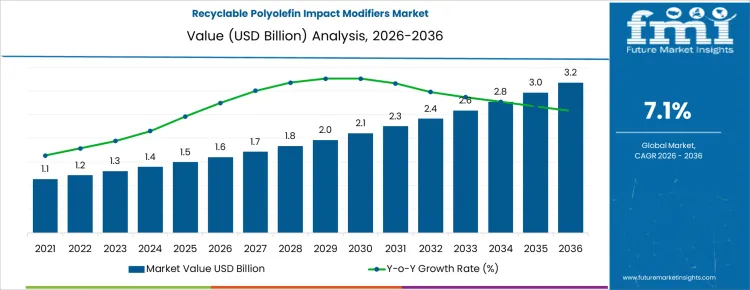
The recyclable polyolefin impact modifiers market is expected to witness steady growth from 2026 to 2036. In 2026, the market is projected to be valued at USD 1.6 billion, with consistent growth anticipated, reaching USD 3.1 billion by 2036. The compound annual growth rate (CAGR) is forecasted to be 7.1%, driven by increasing demand for environmentally sustainable materials across industries. These modifiers are essential for enhancing the impact strength of polyolefin materials, making them valuable for various applications, particularly in packaging, automotive, and construction sectors.
The adoption of recyclable polyolefin impact modifiers is influenced by the growing emphasis on reducing plastic waste and improving the recyclability of materials. With more manufacturers focusing on sustainable product solutions, the market for these modifiers is expected to expand. As demand for eco-friendly products continues to rise, the market will likely benefit from increased use in products requiring enhanced durability without compromising recyclability.
Quick Stats of the Recyclable Polyolefin Impact Modifiers Market
- Recyclable Polyolefin Impact Modifiers Market Value (2026): USD 1.6 billion
- Recyclable Polyolefin Impact Modifiers Market Forecast Value (2036): USD 3.1 billion
- Recyclable Polyolefin Impact Modifiers Market Global Forecast CAGR (2026-2036): 7.1%
- Recyclable Polyolefin Impact Modifiers Market Leading Segment: Application (Packaging - rigid & flexible) 36%
- Key Growth Regions in Recyclable Polyolefin Impact Modifiers Market: China
- Top Players in Recyclable Polyolefin Impact Modifiers Market: Dow, ExxonMobil Chemical, LyondellBasell, SABIC, Borealis, Mitsui Chemicals, LG Chem, DuPont, Repsol, Avient
What is the Growth Forecast for the Recyclable Polyolefin Impact Modifiers Market through 2036?
The recyclable polyolefin impact modifiers market is expected to grow at a CAGR of 7.1% from 2026 to 2036. The market will rise from USD 1.6 billion in 2026 to USD 3.1 billion by 2036. Year-on-year growth is projected, with values increasing to USD 1.7 billion in 2027, USD 1.8 billion in 2028, and USD 1.9 billion in 2029. By 2030, the market value will reach USD 2.1 billion, continuing to grow steadily.
From 2031 to 2036, the market will continue to expand, reaching USD 2.2 billion in 2031, USD 2.4 billion in 2032, and USD 2.6 billion in 2033. The market is projected to grow to USD 2.8 billion in 2034, USD 2.9 billion in 2035, and finally USD 3.1 billion by 2036, demonstrating the strong demand for recyclable polyolefin impact modifiers throughout the forecast period. The absolute dollar opportunity over the forecast period indicates a significant increase in value, reflecting the market’s expanding role in various industries.
Recyclable Polyolefin Impact Modifiers Market Key Takeaways
| Metric | Value |
|---|---|
| Industry Sales Value (2026) | USD 1.6 billion |
| Industry Forecast Value (2036) | USD 3.1 billion |
| Industry Forecast CAGR (2026-2036) | 7.1% |
What Is Driving the Demand for the Recyclable Polyolefin Impact Modifiers Market Globally?
The global demand for recyclable polyolefin impact modifiers is driven by the increasing need to balance enhanced mechanical performance with sustainability and circularity in plastics. Polyolefins such as polyethylene (PE) and polypropylene (PP) are widely used in packaging, automotive, consumer goods, and construction because of their lightweight nature, chemical resistance, and low cost. However, these materials can be brittle or lack sufficient toughness for demanding end-use requirements. Impact modifiers are added to improve ductility, impact resistance, and durability, enabling polyolefin parts and films to withstand mechanical stresses during use and handling.
At the same time, regulatory pressure and corporate commitments to reduce environmental impact are pushing industry to prioritise recyclability and reduce barriers to material recovery. Traditional impact modifiers-especially those with non-polyolefin backbones-can complicate recycling processes by creating incompatible polymer blends or lowering recycled resin quality. In response, formulators and material suppliers are developing impact modifiers that maintain polyolefin compatibility and support closed-loop recycling, enhancing retention of mechanical properties in recycled streams. Consumer demand for more sustainable materials in packaging, automotive interiors, and durable goods further reinforces uptake of recyclable impact modifier technologies that enable performance without compromising end-of-life recovery.
Future demand for recyclable polyolefin impact modifiers is expected to grow as sustainability criteria become more embedded in material selection policies and manufacturing standards across industries. Continued innovation in compatibilizers, block copolymers, and tailored additive systems will expand options that deliver target impact performance while preserving recyclability in mono-polyolefin streams. Extended producer responsibility (EPR) mandates and recycled content requirements will encourage brand owners to specify modifiers that support circular material flows, especially in high-volume segments such as rigid and flexible packaging.
Advances in recycling infrastructure-such as improved sorting, mechanical reprocessing, and chemical recycling-will increase the availability and quality of recycled polyolefins, reinforcing the value of compatible impact modifier systems. Growth in automotive electrification and lightweighting trends will further elevate demand for materials that combine toughness, recyclability, and compliance with environmental standards. As global markets prioritise circular economy outcomes alongside performance, impact modifier technologies that align with recycled-content goals and efficient end-of-life pathways are expected to see steady adoption and expansion.
What are the Leading Segments in the Global Recyclable Polyolefin Impact Modifiers Market?
The global recyclable polyolefin impact modifiers market is segmented by application and product type. Among applications, packaging (rigid & flexible) holds the largest share at 36%, followed by automotive interiors, consumer goods, pipes & profiles, and cable & others. Packaging is a dominant segment due to the increasing demand for recyclable and durable materials in both rigid and flexible packaging applications. On the product type side, POE/plastomers lead the market, accounting for 34% of the share, followed by EPR/EPDM modifiers, SBC-based modifiers, EVA-based modifiers, and other modifiers. POE/plastomers are preferred for their excellent impact resistance and compatibility with polyolefins, making them ideal for enhancing the performance of polyolefin-based materials in various applications.
What Drives the Growth of Packaging (Rigid & Flexible) in the Recyclable Polyolefin Impact Modifiers Market?
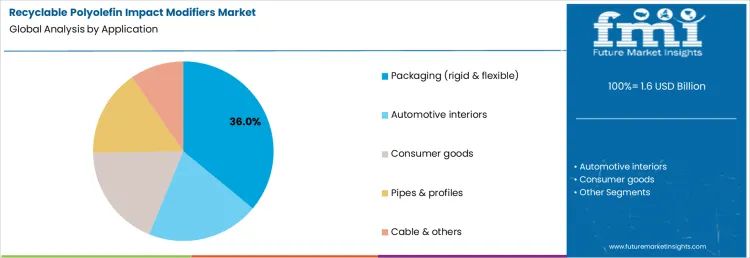
Packaging (rigid & flexible) is the leading application in the recyclable polyolefin impact modifiers market, capturing 36% of the share. This growth is driven by the increasing demand for sustainable, durable, and recyclable packaging solutions across industries such as food and beverage, consumer goods, and e-commerce. Polyolefin impact modifiers are essential for improving the mechanical properties of packaging materials, particularly for rigid and flexible packaging, where durability, impact resistance, and recyclability are crucial.
The rise in consumer preference for environmentally friendly packaging solutions and stricter regulations regarding waste management and recycling are further contributing to the demand for recyclable polyolefin impact modifiers. These modifiers enhance the performance of polyolefin materials, making them more suitable for use in high-impact applications while maintaining their recyclability. As the packaging industry continues to focus on sustainability, the demand for recyclable polyolefin impact modifiers in both rigid and flexible packaging applications is expected to remain strong, ensuring its continued dominance in the market.
What is Driving the Demand for POE/Plastomers in the Recyclable Polyolefin Impact Modifiers Market?
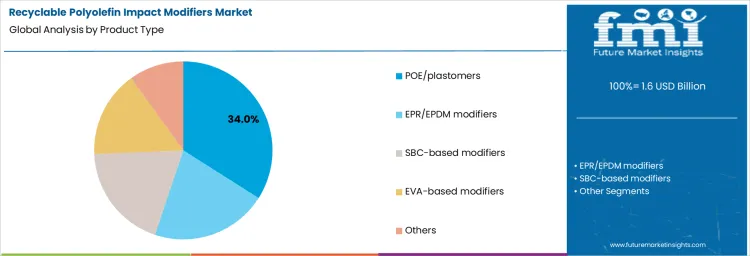
POE/plastomers are the leading product type in the recyclable polyolefin impact modifiers market, holding 34% of the share. POE (Polyolefin Elastomer) and plastomers are highly valued for their ability to enhance the impact resistance and flexibility of polyolefin materials, making them ideal for applications in packaging, automotive interiors, and consumer goods. POE/plastomers provide excellent low-temperature flexibility, high transparency, and superior impact strength, which are important properties for improving the performance of polyolefin-based products. The growing focus on producing high-quality, durable, and recyclable materials has driven the adoption of POE/plastomers, particularly in the packaging industry, where these materials offer improved processing and performance characteristics.
Additionally, POE/plastomers are compatible with a wide range of polyolefin resins, further increasing their versatility in various applications. As the demand for high-performance and recyclable materials continues to rise, especially in sustainable packaging solutions, POE/plastomers are expected to maintain their dominant position in the recyclable polyolefin impact modifiers market. Their ability to provide enhanced impact resistance while maintaining recyclability makes them an essential component in the production of environmentally friendly polyolefin-based products.
What is the Summary of the Global Recyclable Polyolefin Impact Modifiers Market?
The global recyclable polyolefin impact modifiers market is growing as demand increases for materials that enhance toughness, durability and performance of polyolefin plastics while supporting recyclability and circular value recovery. Impact modifiers improve resistance to cracking and mechanical stress in polypropylene and polyethylene used in packaging, automotive parts, consumer goods and building materials. Growth is driven by sustainability commitments, regulatory focus on recycled content, and expanded recycling infrastructure that makes material recovery more feasible. Adoption is strong where performance and environmental considerations intersect, enabling manufacturers to deliver resilient products with a reduced footprint.
What are the Key Drivers for the Global Recyclable Polyolefin Impact Modifiers Market?
A key driver is rising demand for high-performance plastics that can withstand impact, stress and dynamic loads while remaining compatible with mechanical recycling streams. Brands and converters seek modifiers that maintain toughness without compromising recyclability or contaminating recycled polymer batches. Regulatory and corporate initiatives to increase recycled content in products encourage selection of additive systems that align with circular economy goals. Growth in automotive lightweighting, durable consumer goods and flexible and rigid packaging drives use of impact modifiers to improve product life and reliability. Advances in modifier chemistry enable tailored performance with minimal sacrifice in processing efficiency and end-use properties.
What are the Restraints for the Global Recyclable Polyolefin Impact Modifiers Market?
One restraint is technical complexity in balancing enhanced impact performance with compatibility in recycling processes, particularly where multiple additive systems are present. Some impact modifiers designed for high performance may not re-blend seamlessly into recycled polymer streams, requiring careful selection and testing. Cost pressures in price-sensitive markets can limit adoption of premium modifier technologies, especially where conventional additives are entrenched. Variability in global recycling infrastructure and collection rates affects availability of high-quality recycled polyolefin feedstock, which influences investment decisions by converters and brands. Differing regional standards for recycled content and additive labelling can also complicate formulation and compliance strategies.
What is the Key Trends in the Global Recyclable Polyolefin Impact Modifiers Market?
A key trend is development of additive systems that support both performance enhancement and circularity by being compatible with high-purity recycling processes, including advanced mechanical and chemical recycling. Material suppliers are focusing on bio-based and sustainable impact modifiers that reduce reliance on fossil-derived chemistries while improving toughness. Collaboration between resin producers, recyclers and brand owners is increasing to co-develop modifier solutions tailored to specific application, processing and recycling conditions. Standardisation of recyclable polyolefin grades and certification schemes for recycled content helps build market confidence. Simulation, predictive modelling and high-throughput testing accelerate design of impact modifiers that meet targeted mechanical and recyclability criteria across industries.
What is the Country-Wise Analysis of the Recyclable Polyolefin Impact Modifiers Market?
The recyclable polyolefin impact modifiers market is projected to experience steady growth, driven by the increasing demand for eco-friendly, high-performance materials across various industries, including packaging, automotive, and construction. These modifiers are used to improve the toughness and impact resistance of polyolefin plastics, which are increasingly favored for their recyclability and environmental benefits. As sustainability becomes a key focus in global manufacturing, the adoption of recyclable polyolefins is rising. High-growth markets like China are leading the way due to rapid industrialization and growing consumer awareness of environmental issues, while developed markets such as the USA, UK, and Germany are also experiencing growth, supported by stringent environmental regulations and the demand for high-quality, recyclable materials.
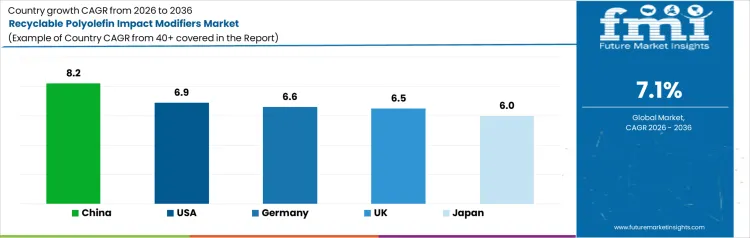
| Country | CAGR (2026-2036) |
|---|---|
| China | 8.2% |
| United States | 6.9% |
| United Kingdom | 6.5% |
| Germany | 6.6% |
| Japan | 6% |
Source: FMI analysis based on primary research and proprietary forecasting model
What is the Growth Outlook for the Recyclable Polyolefin Impact Modifiers Market in China?
The recyclable polyolefin impact modifiers market in China is expected to grow at the highest rate, with a projected CAGR of 8.2%. China’s rapidly expanding industrial base, coupled with increasing demand for sustainable and high-performance materials in sectors like automotive, packaging, and construction, is driving this market growth. As the country seeks to reduce its environmental impact and improve the recyclability of materials, polyolefins are becoming a preferred choice. The growing awareness of environmental issues and rising consumer demand for eco-friendly products are further boosting the adoption of recyclable polyolefin impact modifiers. With strong government support for sustainable development and innovations in material science, China is set to lead the global market for recyclable polyolefin impact modifiers.
What is the Market Outlook for the Recyclable Polyolefin Impact Modifiers Market in the United States?
The recyclable polyolefin impact modifiers market in the United States is projected to grow steadily, with a projected CAGR of 6.9%. In the USA, the demand for high-performance, recyclable materials is increasing across industries such as packaging, automotive, and consumer goods. As environmental concerns grow, industries are turning to recyclable polyolefin solutions to improve sustainability and reduce environmental impact. The USA market is also driven by increasing regulatory pressures to adopt eco-friendly materials and the growing consumer preference for sustainable products. With technological advancements and the rising focus on recycling and waste reduction, the market for recyclable polyolefin impact modifiers in the USA is expected to see steady growth in the coming years.
What is the Growth Forecast for the Recyclable Polyolefin Impact Modifiers Market in the United Kingdom?
The recyclable polyolefin impact modifiers market in the United Kingdom is expected to grow at a moderate pace, with a projected CAGR of 6.5%. The UK’s strong emphasis on sustainability and environmental responsibility is driving demand for recyclable materials, including polyolefins, in various sectors such as packaging and automotive. As UK manufacturers focus on reducing their environmental footprint, the demand for recyclable polyolefins that offer superior performance and recyclability is increasing. The market is also being driven by the growing demand for packaging solutions that meet both environmental regulations and consumer preferences for eco-friendly products. As the UK continues to prioritize sustainability, the demand for recyclable polyolefin impact modifiers is expected to grow steadily.
What is the Market Outlook for the Recyclable Polyolefin Impact Modifiers Market in Germany?
The recyclable polyolefin impact modifiers market in Germany is projected to grow at a steady pace, with a projected CAGR of 6.6%. Germany’s strong industrial and manufacturing sectors, coupled with its commitment to sustainability, are driving the demand for recyclable polyolefins. With an increasing focus on eco-friendly materials in automotive, packaging, and construction applications, Germany is seeing a growing adoption of recyclable polyolefin impact modifiers. The country’s regulatory framework, which encourages the use of recyclable and environmentally friendly materials, is further supporting this trend. As consumer demand for sustainable products increases and industries continue to innovate, the market for recyclable polyolefin impact modifiers in Germany is expected to experience steady growth.
What are the Growth Prospects for the Recyclable Polyolefin Impact Modifiers Market in Japan?
The recyclable polyolefin impact modifiers market in Japan is expected to grow at a moderate pace, with a projected CAGR of 6%. Japan’s commitment to sustainability and high-performance manufacturing is driving the demand for recyclable polyolefins across various industries. The need for impact-resistant materials that are also environmentally friendly is pushing the adoption of polyolefin-based solutions, particularly in packaging and automotive sectors. As Japan increasingly focuses on reducing waste and enhancing recyclability, the demand for recyclable polyolefin impact modifiers is expected to rise. While Japan’s growth rate may be slower compared to other regions, the market for recyclable polyolefin impact modifiers will continue to expand steadily, driven by ongoing sustainability efforts and technological advancements.
What is the Competitive Landscape for the Recyclable Polyolefin Impact Modifiers Market?
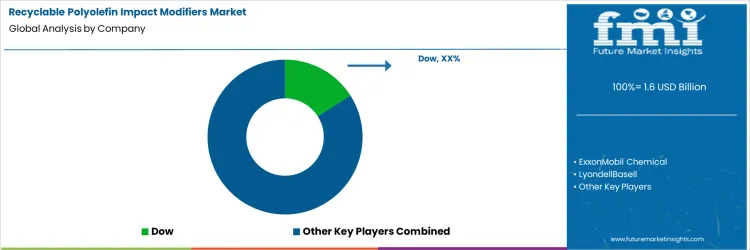
The recyclable polyolefin impact modifiers market is expanding as industries seek sustainable solutions to improve the performance and recyclability of polyolefin-based materials, particularly in packaging, automotive, and consumer goods. Dow leads the market with its advanced recyclable polyolefin impact modifiers, offering high-performance solutions that enhance material strength and impact resistance while maintaining recyclability. Their focus on innovation, sustainability, and product performance has positioned them as a dominant player in this space. ExxonMobil Chemical, LyondellBasell, and SABIC are key competitors, each providing specialized impact modifiers designed to improve the durability and recyclability of polyolefins. ExxonMobil Chemical and LyondellBasell focus on improving polyolefin processing and performance, while SABIC delivers sustainable solutions for a variety of applications.
Borealis, Mitsui Chemicals, LG Chem, DuPont, Repsol, and Avient contribute to the competitive landscape by offering tailored impact modifiers for polyolefins. Borealis and Mitsui Chemicals focus on providing advanced modifiers that enhance material properties while ensuring sustainability. LG Chem offers high-performance modifiers that improve polyolefin impact resistance, while DuPont and Repsol deliver innovative solutions for enhancing recyclability in polyolefin-based products. Avient focuses on creating sustainable impact modifiers with a focus on performance and environmental responsibility. These companies compete by focusing on product innovation, improving material performance, and meeting the growing demand for recyclable, high-performance polyolefin modifiers.
Key Players of the Recyclable Polyolefin Impact Modifiers Market
- Dow
- ExxonMobil Chemical
- LyondellBasell
- SABIC
- Borealis
- Mitsui Chemicals
- LG Chem
- DuPont
- Repsol
- Avient
Scope of the Report
| Items | Values |
|---|---|
| Quantitative Units (2026) | USD Billion |
| Product Type | POE/Plastomers, EPR/EPDM Modifiers, SBC-Based Modifiers, EVA-Based Modifiers |
| Application | Packaging (Rigid & Flexible), Automotive Interiors, Consumer Goods, Pipes & Profiles, Cable & Others |
| Processing Route | Extrusion, Injection Molding, Blow Molding, Thermoforming, Others |
| Recycling Focus | PE Recycling Streams, PP Recycling Streams, Mixed PE/PP Streams, High-Fill Recycled Compounds, Others |
| Companies | Dow, ExxonMobil Chemical, LyondellBasell, SABIC, Borealis, Mitsui Chemicals, LG Chem, DuPont, Repsol, Avient |
| Regions Covered | North America, Latin America, Western Europe, Eastern Europe, South Asia and Pacific, East Asia, Middle East & Africa |
| Countries Covered | United States, Canada, Mexico, Brazil, Argentina, Germany, France, United Kingdom, Italy, Spain, Netherlands, China, India, Japan, South Korea, ANZ, GCC Countries, South Africa |
| Additional Attributes | Dollar by sales by product type, application, processing route, recycling focus, and region. Includes market trends in recyclable polyolefin impact modifiers, focusing on POE, EPR/EPDM, SBC, and EVA modifiers. Highlights the role of extrusion, injection molding, blow molding, and thermoforming in packaging, automotive, consumer goods, and pipe applications. Focus on recycling streams like PE, PP, and mixed streams, as well as high-fill recycled compounds, market share, and competitive positioning of key companies in the polyolefin modifiers market. |
Recyclable Polyolefin Impact Modifiers Market Segmentation
Product Type
- POE/plastomers
- EPR/EPDM modifiers
- SBC-based modifiers
- EVA-based modifiers
- Others
Application
- Packaging (rigid & flexible)
- Automotive interiors
- Consumer goods
- Pipes & profiles
- Cable & others
Processing Route
- Extrusion
- Injection molding
- Blow molding
- Thermoforming
- Others
Recycling Focus
- PE recycling streams
- PP recycling streams
- Mixed PE/PP streams
- High-fill recycled compounds
- Others
Region
- Asia Pacific
- China
- Japan
- South Korea
- India
- Australia & New Zealand
- ASEAN
- Rest of Asia Pacific
- Europe
- Germany
- United Kingdom
- France
- Italy
- Spain
- Nordic
- BENELUX
- Rest of Europe
- North America
- United States
- Canada
- Mexico
- Latin America
- Brazil
- Chile
- Rest of Latin America
- Middle East & Africa
- Kingdom of Saudi Arabia
- Other GCC Countries
- Turkey
- South Africa
- Other African Union
- Rest of Middle East & Africa
Bibliography
- International Organization for Standardization. (2023). Plastics - Determination of impact resistance and performance criteria for polyolefin materials. ISO Standards Publications.
- American Society for Testing and Materials. (2023). ASTM test methods and performance standards for impact modifiers and polymer additives. ASTM Standards and Technical Papers.
- Plastics Industry Association. (2023). Guidelines on recyclable polyolefin formulations and additive performance in plastic applications. Plastics Industry Association Technical Publications.
- European Association for Chemical and Molecular Sciences. (2023). Polyolefin modification technologies, sustainability considerations, and recyclable polymer additive frameworks.
Frequently Asked Questions
How big is the recyclable polyolefin impact modifiers market in 2026?
The global recyclable polyolefin impact modifiers market is estimated to be valued at USD 1.6 billion in 2026.
What will be the size of recyclable polyolefin impact modifiers market in 2036?
The market size for the recyclable polyolefin impact modifiers market is projected to reach USD 3.2 billion by 2036.
How much will be the recyclable polyolefin impact modifiers market growth between 2026 and 2036?
The recyclable polyolefin impact modifiers market is expected to grow at a 7.1% CAGR between 2026 and 2036.
What are the key product types in the recyclable polyolefin impact modifiers market?
The key product types in recyclable polyolefin impact modifiers market are poe/plastomers, epr/epdm modifiers, sbc-based modifiers, eva-based modifiers and others.
Which application segment to contribute significant share in the recyclable polyolefin impact modifiers market in 2026?
In terms of application, packaging (rigid & flexible) segment to command 36.0% share in the recyclable polyolefin impact modifiers market in 2026.
Preview the report firsthand - request a free sample
Get SampleGet the brochure for pricing and purchase details.
Get PDFTable of Content
- Executive Summary
- Global Market Outlook
- Demand-side Trends
- Supply-side Trends
- Technology Roadmap Analysis
- Analysis and Recommendations
- Market Overview
- Market Coverage / Taxonomy
- Market Definition / Scope / Limitations
- Market Background
- Market Dynamics
- Drivers
- Restraints
- Opportunity
- Trends
- Scenario Forecast
- Demand in Optimistic Scenario
- Demand in Likely Scenario
- Demand in Conservative Scenario
- Opportunity Map Analysis
- Product Life Cycle Analysis
- Supply Chain Analysis
- Investment Feasibility Matrix
- Value Chain Analysis
- PESTLE and Porter’s Analysis
- Regulatory Landscape
- Regional Parent Market Outlook
- Production and Consumption Statistics
- Import and Export Statistics
- Market Dynamics
- Global Market Analysis 2021 to 2025 and Forecast, 2026 to 2036
- Historical Market Size Value (USD Million) Analysis, 2021 to 2025
- Current and Future Market Size Value (USD Million) Projections, 2026 to 2036
- Y-o-Y Growth Trend Analysis
- Absolute $ Opportunity Analysis
- Global Market Pricing Analysis 2021 to 2025 and Forecast 2026 to 2036
- Global Market Analysis 2021 to 2025 and Forecast 2026 to 2036, By Product Type
- Introduction / Key Findings
- Historical Market Size Value (USD Million) Analysis By Product Type , 2021 to 2025
- Current and Future Market Size Value (USD Million) Analysis and Forecast By Product Type , 2026 to 2036
- POE/plastomers
- EPR/EPDM modifiers
- SBC-based modifiers
- EVA-based modifiers
- Others
- Y-o-Y Growth Trend Analysis By Product Type , 2021 to 2025
- Absolute $ Opportunity Analysis By Product Type , 2026 to 2036
- Global Market Analysis 2021 to 2025 and Forecast 2026 to 2036, By Application
- Introduction / Key Findings
- Historical Market Size Value (USD Million) Analysis By Application, 2021 to 2025
- Current and Future Market Size Value (USD Million) Analysis and Forecast By Application, 2026 to 2036
- Packaging (rigid & flexible)
- Automotive interiors
- Consumer goods
- Pipes & profiles
- Cable & others
- Y-o-Y Growth Trend Analysis By Application, 2021 to 2025
- Absolute $ Opportunity Analysis By Application, 2026 to 2036
- Global Market Analysis 2021 to 2025 and Forecast 2026 to 2036, By Processing Route
- Introduction / Key Findings
- Historical Market Size Value (USD Million) Analysis By Processing Route, 2021 to 2025
- Current and Future Market Size Value (USD Million) Analysis and Forecast By Processing Route, 2026 to 2036
- Extrusion
- Injection molding
- Blow molding
- Thermoforming
- Others
- Y-o-Y Growth Trend Analysis By Processing Route, 2021 to 2025
- Absolute $ Opportunity Analysis By Processing Route, 2026 to 2036
- Global Market Analysis 2021 to 2025 and Forecast 2026 to 2036, By Recycling Focus
- Introduction / Key Findings
- Historical Market Size Value (USD Million) Analysis By Recycling Focus, 2021 to 2025
- Current and Future Market Size Value (USD Million) Analysis and Forecast By Recycling Focus, 2026 to 2036
- PE recycling streams
- PP recycling streams
- Mixed PE/PP streams
- High-fill recycled compounds
- Others
- Y-o-Y Growth Trend Analysis By Recycling Focus, 2021 to 2025
- Absolute $ Opportunity Analysis By Recycling Focus, 2026 to 2036
- Global Market Analysis 2021 to 2025 and Forecast 2026 to 2036, By Region
- Introduction
- Historical Market Size Value (USD Million) Analysis By Region, 2021 to 2025
- Current Market Size Value (USD Million) Analysis and Forecast By Region, 2026 to 2036
- North America
- Latin America
- Western Europe
- Eastern Europe
- East Asia
- South Asia and Pacific
- Middle East & Africa
- Market Attractiveness Analysis By Region
- North America Market Analysis 2021 to 2025 and Forecast 2026 to 2036, By Country
- Historical Market Size Value (USD Million) Trend Analysis By Market Taxonomy, 2021 to 2025
- Market Size Value (USD Million) Forecast By Market Taxonomy, 2026 to 2036
- By Country
- USA
- Canada
- Mexico
- By Product Type
- By Application
- By Processing Route
- By Recycling Focus
- By Country
- Market Attractiveness Analysis
- By Country
- By Product Type
- By Application
- By Processing Route
- By Recycling Focus
- Key Takeaways
- Latin America Market Analysis 2021 to 2025 and Forecast 2026 to 2036, By Country
- Historical Market Size Value (USD Million) Trend Analysis By Market Taxonomy, 2021 to 2025
- Market Size Value (USD Million) Forecast By Market Taxonomy, 2026 to 2036
- By Country
- Brazil
- Chile
- Rest of Latin America
- By Product Type
- By Application
- By Processing Route
- By Recycling Focus
- By Country
- Market Attractiveness Analysis
- By Country
- By Product Type
- By Application
- By Processing Route
- By Recycling Focus
- Key Takeaways
- Western Europe Market Analysis 2021 to 2025 and Forecast 2026 to 2036, By Country
- Historical Market Size Value (USD Million) Trend Analysis By Market Taxonomy, 2021 to 2025
- Market Size Value (USD Million) Forecast By Market Taxonomy, 2026 to 2036
- By Country
- Germany
- UK
- Italy
- Spain
- France
- Nordic
- BENELUX
- Rest of Western Europe
- By Product Type
- By Application
- By Processing Route
- By Recycling Focus
- By Country
- Market Attractiveness Analysis
- By Country
- By Product Type
- By Application
- By Processing Route
- By Recycling Focus
- Key Takeaways
- Eastern Europe Market Analysis 2021 to 2025 and Forecast 2026 to 2036, By Country
- Historical Market Size Value (USD Million) Trend Analysis By Market Taxonomy, 2021 to 2025
- Market Size Value (USD Million) Forecast By Market Taxonomy, 2026 to 2036
- By Country
- Russia
- Poland
- Hungary
- Balkan & Baltic
- Rest of Eastern Europe
- By Product Type
- By Application
- By Processing Route
- By Recycling Focus
- By Country
- Market Attractiveness Analysis
- By Country
- By Product Type
- By Application
- By Processing Route
- By Recycling Focus
- Key Takeaways
- East Asia Market Analysis 2021 to 2025 and Forecast 2026 to 2036, By Country
- Historical Market Size Value (USD Million) Trend Analysis By Market Taxonomy, 2021 to 2025
- Market Size Value (USD Million) Forecast By Market Taxonomy, 2026 to 2036
- By Country
- China
- Japan
- South Korea
- By Product Type
- By Application
- By Processing Route
- By Recycling Focus
- By Country
- Market Attractiveness Analysis
- By Country
- By Product Type
- By Application
- By Processing Route
- By Recycling Focus
- Key Takeaways
- South Asia and Pacific Market Analysis 2021 to 2025 and Forecast 2026 to 2036, By Country
- Historical Market Size Value (USD Million) Trend Analysis By Market Taxonomy, 2021 to 2025
- Market Size Value (USD Million) Forecast By Market Taxonomy, 2026 to 2036
- By Country
- India
- ASEAN
- Australia & New Zealand
- Rest of South Asia and Pacific
- By Product Type
- By Application
- By Processing Route
- By Recycling Focus
- By Country
- Market Attractiveness Analysis
- By Country
- By Product Type
- By Application
- By Processing Route
- By Recycling Focus
- Key Takeaways
- Middle East & Africa Market Analysis 2021 to 2025 and Forecast 2026 to 2036, By Country
- Historical Market Size Value (USD Million) Trend Analysis By Market Taxonomy, 2021 to 2025
- Market Size Value (USD Million) Forecast By Market Taxonomy, 2026 to 2036
- By Country
- Kingdom of Saudi Arabia
- Other GCC Countries
- Turkiye
- South Africa
- Other African Union
- Rest of Middle East & Africa
- By Product Type
- By Application
- By Processing Route
- By Recycling Focus
- By Country
- Market Attractiveness Analysis
- By Country
- By Product Type
- By Application
- By Processing Route
- By Recycling Focus
- Key Takeaways
- Key Countries Market Analysis
- USA
- Pricing Analysis
- Market Share Analysis, 2025
- By Product Type
- By Application
- By Processing Route
- By Recycling Focus
- Canada
- Pricing Analysis
- Market Share Analysis, 2025
- By Product Type
- By Application
- By Processing Route
- By Recycling Focus
- Mexico
- Pricing Analysis
- Market Share Analysis, 2025
- By Product Type
- By Application
- By Processing Route
- By Recycling Focus
- Brazil
- Pricing Analysis
- Market Share Analysis, 2025
- By Product Type
- By Application
- By Processing Route
- By Recycling Focus
- Chile
- Pricing Analysis
- Market Share Analysis, 2025
- By Product Type
- By Application
- By Processing Route
- By Recycling Focus
- Germany
- Pricing Analysis
- Market Share Analysis, 2025
- By Product Type
- By Application
- By Processing Route
- By Recycling Focus
- UK
- Pricing Analysis
- Market Share Analysis, 2025
- By Product Type
- By Application
- By Processing Route
- By Recycling Focus
- Italy
- Pricing Analysis
- Market Share Analysis, 2025
- By Product Type
- By Application
- By Processing Route
- By Recycling Focus
- Spain
- Pricing Analysis
- Market Share Analysis, 2025
- By Product Type
- By Application
- By Processing Route
- By Recycling Focus
- France
- Pricing Analysis
- Market Share Analysis, 2025
- By Product Type
- By Application
- By Processing Route
- By Recycling Focus
- India
- Pricing Analysis
- Market Share Analysis, 2025
- By Product Type
- By Application
- By Processing Route
- By Recycling Focus
- ASEAN
- Pricing Analysis
- Market Share Analysis, 2025
- By Product Type
- By Application
- By Processing Route
- By Recycling Focus
- Australia & New Zealand
- Pricing Analysis
- Market Share Analysis, 2025
- By Product Type
- By Application
- By Processing Route
- By Recycling Focus
- China
- Pricing Analysis
- Market Share Analysis, 2025
- By Product Type
- By Application
- By Processing Route
- By Recycling Focus
- Japan
- Pricing Analysis
- Market Share Analysis, 2025
- By Product Type
- By Application
- By Processing Route
- By Recycling Focus
- South Korea
- Pricing Analysis
- Market Share Analysis, 2025
- By Product Type
- By Application
- By Processing Route
- By Recycling Focus
- Russia
- Pricing Analysis
- Market Share Analysis, 2025
- By Product Type
- By Application
- By Processing Route
- By Recycling Focus
- Poland
- Pricing Analysis
- Market Share Analysis, 2025
- By Product Type
- By Application
- By Processing Route
- By Recycling Focus
- Hungary
- Pricing Analysis
- Market Share Analysis, 2025
- By Product Type
- By Application
- By Processing Route
- By Recycling Focus
- Kingdom of Saudi Arabia
- Pricing Analysis
- Market Share Analysis, 2025
- By Product Type
- By Application
- By Processing Route
- By Recycling Focus
- Turkiye
- Pricing Analysis
- Market Share Analysis, 2025
- By Product Type
- By Application
- By Processing Route
- By Recycling Focus
- South Africa
- Pricing Analysis
- Market Share Analysis, 2025
- By Product Type
- By Application
- By Processing Route
- By Recycling Focus
- USA
- Market Structure Analysis
- Competition Dashboard
- Competition Benchmarking
- Market Share Analysis of Top Players
- By Regional
- By Product Type
- By Application
- By Processing Route
- By Recycling Focus
- Competition Analysis
- Competition Deep Dive
- Dow
- Overview
- Product Portfolio
- Profitability by Market Segments (Product/Age /Sales Channel/Region)
- Sales Footprint
- Strategy Overview
- Marketing Strategy
- Product Strategy
- Channel Strategy
- ExxonMobil Chemical
- LyondellBasell
- SABIC
- Borealis
- Mitsui Chemicals
- LG Chem
- DuPont
- Repsol
- Avient
- Dow
- Competition Deep Dive
- Assumptions & Acronyms Used
- Research Methodology


