

- Industry Size (2026)
- USD 1.6 Bn
- Forecast (2036)
- USD 1.6 Bn
- CAGR (2026 to 2036)
- 5.8%
Low-Impact Asphalt Additives and Warm-Mix Agents Market Forecast and Outlook 2026 to 2036
The global low-impact asphalt additives and warm-mix agents market is experiencing steady growth, with a market value of USD 1.6 billion in 2025, projected to reach at USD 2.8 billion by 2036, growing at a CAGR of 5.8%. The market is segmented by additive type and application area. Organic wax WMA additives, such as Fischer-Tropsch and bio-waxes, lead the market with a 24% share due to their effectiveness in improving the performance and workability of warm-mix asphalt. These additives help lower mixing and compaction temperatures, reducing energy consumption and CO2 emissions, making them ideal for environmentally sustainable road construction. Other significant additives include chemical WMA additives (surfactants, emulsifiers), bio-based rejuvenators (tall oils, lignin blends), polymer modifiers (low-temperature performance enhancers), and anti-strip & adhesion promoters, which further enhance asphalt's durability and performance.
Quick Stats for Low-Impact Asphalt Additives and Warm-Mix Agents Market
- Low-Impact Asphalt Additives and Warm-Mix Agents Market Value (2026): USD 1.6 billion
- Low-Impact Asphalt Additives and Warm-Mix Agents Market Forecast Value (2036): USD 2.8 billion
- Low-Impact Asphalt Additives and Warm-Mix Agents Market Forecast CAGR (2026 to 2036): 5.8%
- Leading Additive Type in Low-Impact Asphalt Additives and Warm-Mix Agents Market: Organic wax WMA additives (Fischer-Tropsch, bio-waxes)
- Key Growth Regions in Low-Impact Asphalt Additives and Warm-Mix Agents Market: Asia Pacific, North America
- Top Players in Low-Impact Asphalt Additives and Warm-Mix Agents Market: Ingevity, Evonik, Nouryon, Dow Chemical, Arkema, Cargill (bio-based additives)
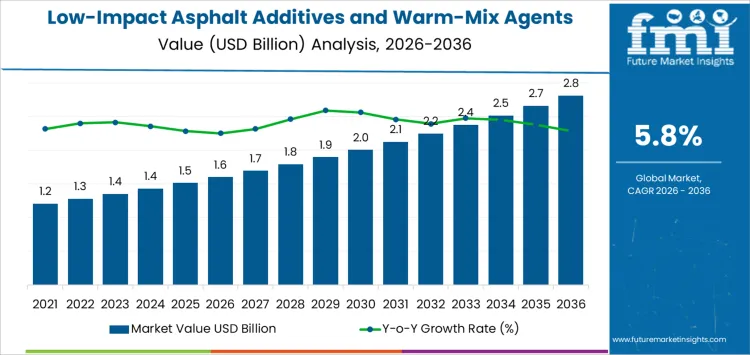
In terms of application, road construction for highways and expressways holds the largest share at 36%, driven by the need for durable, high-performance materials that can withstand heavy traffic loads and harsh conditions. Warm-mix agents are especially beneficial in these large-scale infrastructure projects as they reduce the environmental impact of the construction process. Other applications include urban roads and municipal resurfacing, airport pavements, industrial and commercial pavements, low-temperature paving, night operations, and rural road development. These diverse applications highlight the widespread adoption of low-impact asphalt additives and warm-mix agents across various types of road construction, as infrastructure projects increasingly focus on sustainability and energy efficiency.
Low-Impact Asphalt Additives and Warm-Mix Agents Market Key Takeaways
| Metric | Value |
|---|---|
| Industry Value (2026) | USD 1.6 billion |
| Forecast Value (2036) | USD 2.8 billion |
| Forecast CAGR (2026 to 2036) | 5.8% |
How is the Global Low-Impact Asphalt Additives and Warm-Mix Agents Sector Advancing?
The global low-impact asphalt additives and warm-mix agents market is growing, driven by the increasing demand for environmentally friendly construction materials and the need to reduce the carbon footprint of road-building processes. These additives and agents are designed to lower the production temperatures of asphalt, reducing energy consumption and emissions during the paving process. Initially, traditional hot-mix asphalt production led to high energy usage and significant environmental impact, but the development of low-impact and warm-mix solutions has addressed these challenges, making them increasingly popular in road construction projects globally.
The market is expected to expand as governments and construction companies prioritize sustainability and adhere to stricter environmental regulations. The shift toward warm-mix technology, which allows for lower emissions and less energy consumption, will drive further adoption. Innovations in low-impact additives that enhance the durability and performance of asphalt while maintaining environmental standards will contribute to market growth. Challenges such as higher initial costs, limited infrastructure for warm-mix technologies in some regions, and the need for continuous product development will shape market dynamics. As the construction industry focuses on sustainable solutions, low-impact asphalt additives and warm-mix agents will play a pivotal role in shaping the future of eco-friendly road construction.
What Is the Segment-Wise Analysis for the Low-Impact Asphalt Additives and Warm-Mix Agents Market?
The global low-impact asphalt additives and warm-mix agents market is driven by additive types and application areas. Organic wax WMA additives (Fischer-Tropsch, bio-waxes) lead the market with a 24% share due to their ability to improve the performance and workability of warm-mix asphalt. Other significant additives include chemical WMA additives, bio-based rejuvenators, polymer modifiers, anti-strip & adhesion promoters, and recycled asphalt compatibility enhancers. In terms of application, road construction for highways and expressways accounts for 36%, driven by the demand for sustainable paving solutions.
Why Do Organic Wax WMA Additives Lead the Global Low-Impact Asphalt Additives and Warm-Mix Agents Market?
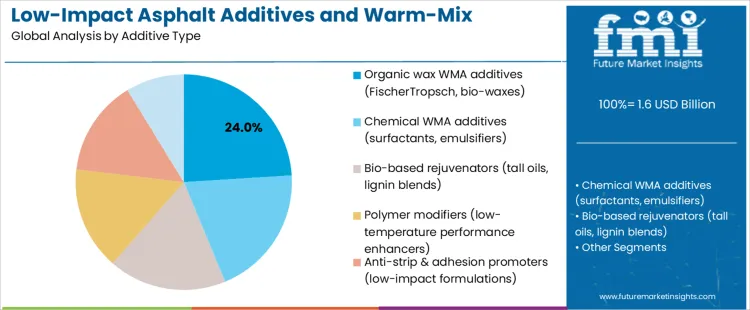
Organic wax WMA additives (Fischer-Tropsch, bio-waxes) hold a 24% share of the global low-impact asphalt additives and warm-mix agents market due to their ability to reduce the mixing and compaction temperatures of asphalt without compromising performance. These additives help in producing warm-mix asphalt, which offers environmental benefits by reducing energy consumption and CO2 emissions. They improve the workability of the asphalt while enhancing its durability and performance, making them ideal for sustainable road construction. As the demand for environmentally friendly and cost-effective paving solutions grows, organic wax additives continue to lead the market.
Why Does Road Construction for Highways and Expressways Hold the Largest Share in the Global Low-Impact Asphalt Additives and Warm-Mix Agents Market?
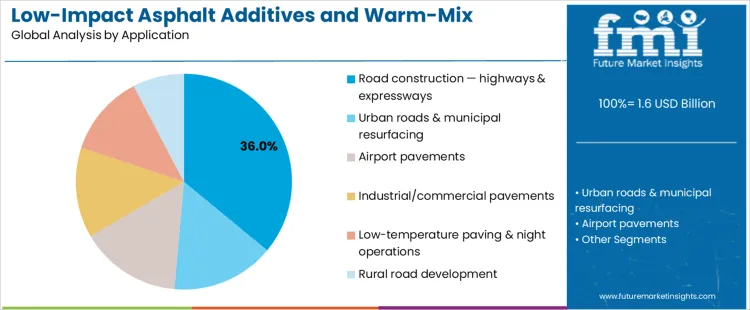
Road construction, particularly for highways and expressways, holds a 36% share of the global low-impact asphalt additives and warm-mix agents market due to the extensive demand for durable and sustainable infrastructure. Highways and expressways require high-performance materials that can withstand heavy traffic loads and harsh weather conditions. The use of low-impact asphalt additives and warm-mix agents in these projects helps reduce the carbon footprint and enhance the overall performance of the pavement. With increased focus on sustainability and energy efficiency, the demand for warm-mix solutions in large-scale road construction projects continues to drive this sector's dominance in the market.
What is Shaping the Low-Impact Asphalt Additives and Warm-Mix Agents Market?
The low impact asphalt additives and warm mix agents market is shaped by the growing need for sustainable road construction practices that reduce energy use, emissions, and environmental impact. Warm mix technologies enable asphalt to be produced and applied at lower temperatures, cutting fuel consumption and greenhouse gas emissions. Environmental regulations and government initiatives promoting greener infrastructure solutions are driving adoption. Advances in additive formulations that enhance workability, durability, and performance at lower temperatures are influencing market growth.
What Are the Constraints Limiting the Adoption of Low Impact Asphalt Additives and Warm Mix Agents?
Adoption is limited by initial cost considerations and performance perceptions among some contractors. Warm mix additives can carry higher upfront costs compared with traditional asphalt processes, potentially deterring price sensitive projects. Some stakeholders may question long term durability or perceived performance differences, especially in extreme climates or heavy traffic applications. Technical expertise and training are also needed to optimize warm mix processes and ensure proper additive use, which can be a barrier for smaller operators. Regional variation in infrastructure priorities and slower regulatory implementation in certain markets can delay wider uptake of low impact asphalt solutions.
What Are the Key Trends Shaping the Low Impact Asphalt Additives and Warm Mix Agents Market?
Key trends include the development of advanced additive chemistries that improve low temperature performance while maintaining or enhancing pavement durability. There is increasing integration of recycled materials such as reclaimed asphalt pavement (RAP) with warm mix technologies to further reduce environmental impact. Industry collaboration between additive manufacturers and paving contractors is boosting tailored solutions that meet specific project needs. Digital construction technologies and performance monitoring tools are emerging to optimize warm mix applications and lifecycle outcomes. Growing sustainability initiatives and green infrastructure funding from governments are accelerating adoption of low impact asphalt additives and warm mix agents globally.
What is the Growth Outlook for the Low-Impact Asphalt Additives and Warm-Mix Agents Market by Country?
<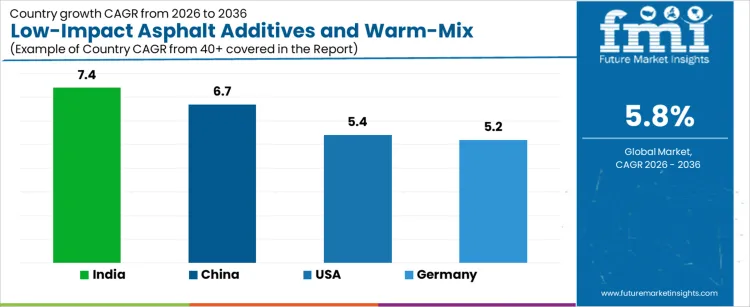
| Country | CAGR (%) |
|---|---|
| United States | 5.4% |
| China | 6.7% |
| Germany | 5.2% |
| India | 7.4% |
The low-impact asphalt additives and warm-mix agents market is witnessing steady growth, with India leading at a 7.4% CAGR, driven by the country’s rapid infrastructure development and increasing focus on sustainability in construction. China follows with a 6.7% growth rate, supported by its vast infrastructure projects and commitment to greener construction technologies. The United States shows steady growth at 5.4%, fueled by the ongoing adoption of low-emission and energy-efficient construction practices. Germany’s market grows at 5.2%, driven by strict environmental regulations and the demand for sustainable road construction materials.
Why is the Low-Impact Asphalt Additives and Warm-Mix Agents Market Growing in India?
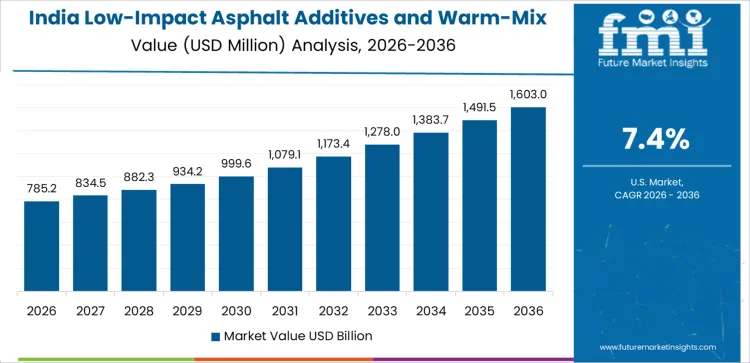
India’s low-impact asphalt additives and warm-mix agents market is growing at a 7.4% CAGR, driven by the country’s rapidly expanding infrastructure sector and increasing adoption of sustainable construction practices. As India continues to invest heavily in road infrastructure, there is a growing need for materials that reduce environmental impact while maintaining high performance. Warm-mix agents are becoming increasingly popular because they lower production temperatures, reducing energy consumption and emissions during asphalt manufacturing. India’s government is also encouraging the use of eco-friendly technologies and sustainable materials through policies and incentives, further fueling demand for low-impact additives. As infrastructure projects continue to rise, the market for low-impact asphalt additives and warm-mix agents in India is expected to grow rapidly.
What is Contributing to the Growth of the Low-Impact Asphalt Additives and Warm-Mix Agents Market in China?
China’s low-impact asphalt additives and warm-mix agents market is growing at a 6.7% CAGR, fueled by the country’s large-scale infrastructure projects and emphasis on environmental sustainability. As China continues to develop its vast transportation network, including roads, highways, and urban infrastructure, the demand for sustainable road construction materials is on the rise. The use of warm-mix agents, which allow for lower production temperatures, helps reduce energy consumption and emissions, aligning with China’s environmental policies. The government’s push for green construction technologies and policies encouraging cleaner manufacturing practices are driving the adoption of low-impact asphalt additives. With continued growth in infrastructure development and a focus on environmental responsibility, the market for low-impact asphalt additives and warm-mix agents in China is set to expand further.
How is the Low-Impact Asphalt Additives and Warm-Mix Agents Market Expanding in the United States?
The United States’ low-impact asphalt additives and warm-mix agents market is growing at 5.4%, driven by the increasing demand for energy-efficient and sustainable construction materials. As the US construction industry focuses on reducing its environmental footprint, there is growing adoption of warm-mix agents that reduce emissions and energy consumption during the production of asphalt. The demand for low-impact asphalt additives is also rising as infrastructure projects focus on sustainability and durability. Government regulations and incentives to encourage green construction methods are contributing to the adoption of these additives. As the US continues to invest in infrastructure and adopt eco-friendly practices, the market for low-impact asphalt additives and warm-mix agents is expected to grow steadily.
What is Driving the Low-Impact Asphalt Additives and Warm-Mix Agents Market in Germany?
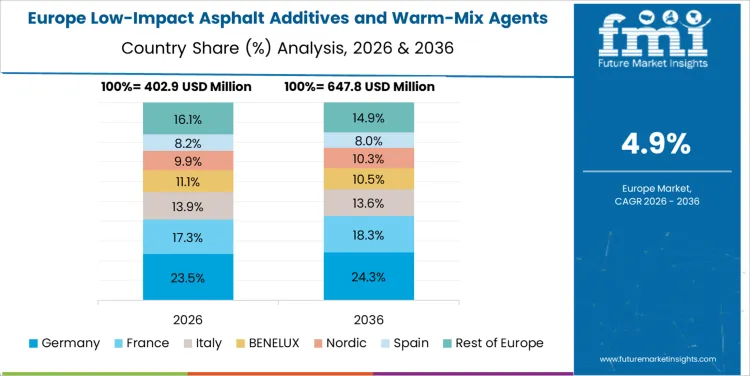
Germany’s low-impact asphalt additives and warm-mix agents market is growing at 5.2%, supported by the country’s stringent environmental regulations and commitment to sustainability in construction. Germany’s focus on reducing carbon emissions and improving energy efficiency in road construction is driving the adoption of warm-mix agents, which reduce energy consumption and lower production temperatures. The increasing demand for sustainable and eco-friendly construction materials is contributing to the market’s growth. Germany’s commitment to renewable energy and green building practices has pushed road construction projects to adopt low-impact asphalt additives. With a strong regulatory framework and focus on clean technologies, the market for low-impact asphalt additives and warm-mix agents in Germany is expected to grow steadily in the coming years.
What Are the Competitive Strategies in the Low‑Impact Asphalt Additives and Warm‑Mix Agents Market?
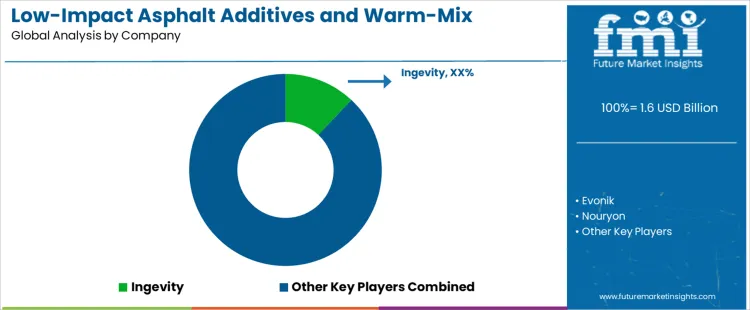
Ingevity, Evonik, Nouryon, Dow Chemical, Arkema, and Cargill (bio‑based additives) compete with distinct low‑impact asphalt additives and warm‑mix agents designed to reduce production temperatures and environmental footprint in paving applications. Ingevity brochures spotlight proprietary warm‑mix technologies that deliver reduced energy use and maintain pavement performance. Evonik emphasizes specialty additives that improve asphalt workability, enhance durability, and contribute to lower emissions. Nouryon materials present tailored chemistry solutions that optimize mixing and application efficiency at reduced temperatures.
Dow Chemical’s literature focuses on engineered agents that enable fuel savings and lower energy usage in asphalt production processes. Arkema features multifunctional additives that balance performance with lower environmental impact across diverse road types and traffic demands. Cargill positions bio‑based additives derived from renewable sources, appealing to buyers who prioritize reduced carbon footprint and sustainable material use.
Across firms, product collateral highlights key technical attributes such as improved coating, enhanced compaction, compatibility with recycled asphalt materials, and lower required mixing temperatures. Sustainability credentials and compliance with environmental standards are prominent themes aimed at influencing specification and procurement decisions. Competitive strategies include robust innovation pipelines, clear performance evidence, targeted applications for different infrastructure segments, and support resources for paving professionals looking to achieve performance goals with low‑impact solutions.
Key Players in Low-Impact Asphalt Additives and Warm-Mix Agents Market
- Ingevity
- Evonik
- Nouryon
- Dow Chemical
- Arkema
- Cargill (bio-based additives)
Scope of Report
| Items | Values |
|---|---|
| Quantitative Units (2026) | USD billion |
| Application Stage | Electrolyte Formulation (Additives Blended by Electrolyte Producers), Cell Formation & Conditioning (Formation Aids), Separator & Interface Coatings (Additive-Enhanced Layers), Recycling & Solvent Recovery Chemistries (Reclaimer Use) |
| Battery Chemistry Targeted | NMC / NCA (High-Energy Chemistries), LFP (Safety & Recyclability Focus), Solid-State / Next-Gen (Early Adopter Safety Chemistries), Sodium / Alternative Chemistries (Emerging), Other Specialty Chemistries / Hybrid Systems |
| Regions Covered | Asia Pacific, Europe, North America, Latin America, Middle East & Africa |
| Countries Covered | USA, China, Japan, South Korea, India, Australia & New Zealand, ASEAN, Germany, UK, France, Italy, Spain, Nordic, BENELUX, Brazil, Chile, Mexico, Saudi Arabia, Other GCC Countries, Turkey, South Africa, Other African Union |
| Key Companies Profiled | BASF, Mitsubishi Chemical, Solvay, Capchem |
| Additional Attributes | Dollar sales by battery chemistry targeted, application stage, and end-use sector; regional CAGR and growth outlook; distribution channels including electrolyte producers, battery manufacturers, and recyclers; innovation trends in safety and recyclability additives; competitive positioning of global vs regional suppliers. |
Low-Impact Asphalt Additives and Warm-Mix Agents Market by Segments
Additive Type
- Organic wax WMA additives (Fischer–Tropsch, bio-waxes)
- Chemical WMA additives (surfactants, emulsifiers)
- Bio-based rejuvenators (tall oils, lignin blends)
- Polymer modifiers (low-temperature performance enhancers)
- Anti-strip & adhesion promoters (low-impact formulations)
- Recycled asphalt compatibility enhancers
Application
- Road construction highways & expressways
- Urban roads & municipal resurfacing
- Airport pavements
- Industrial/commercial pavements
- Low-temperature paving & night operations
- Rural road development
Region
- Asia Pacific
- China
- Japan
- South Korea
- India
- Australia & New Zealand
- ASEAN
- Rest of Asia Pacific
- Europe
- Germany
- United Kingdom
- France
- Italy
- Spain
- Nordic
- BENELUX
- Rest of Europe
- North America
- United States
- Canada
- Mexico
- Latin America
- Brazil
- Chile
- Rest of Latin America
- Middle East & Africa
- Kingdom of Saudi Arabia
- Other GCC Countries
- Turkey
- South Africa
- Other African Union
- Rest of Middle East & Africa
Frequently Asked Questions
How big is the low-impact asphalt additives and warm-mix agents market in 2026?
The global low-impact asphalt additives and warm-mix agents market is estimated to be valued at USD 1.6 billion in 2026.
What will be the size of low-impact asphalt additives and warm-mix agents market in 2036?
The market size for the low-impact asphalt additives and warm-mix agents market is projected to reach USD 2.8 billion by 2036.
How much will be the low-impact asphalt additives and warm-mix agents market growth between 2026 and 2036?
The low-impact asphalt additives and warm-mix agents market is expected to grow at a 5.8% CAGR between 2026 and 2036.
What are the key product types in the low-impact asphalt additives and warm-mix agents market?
The key product types in low-impact asphalt additives and warm-mix agents market are organic wax wma additives (fischertropsch, bio-waxes), chemical wma additives (surfactants, emulsifiers), bio-based rejuvenators (tall oils, lignin blends), polymer modifiers (low-temperature performance enhancers), anti-strip & adhesion promoters (low-impact formulations) and recycled asphalt compatibility enhancers.
Which application segment to contribute significant share in the low-impact asphalt additives and warm-mix agents market in 2026?
In terms of application, road construction — highways & expressways segment to command 36.0% share in the low-impact asphalt additives and warm-mix agents market in 2026.
Preview the report firsthand - request a free sample
Get SampleGet the brochure for pricing and purchase details.
Get PDFTable of Content
- Executive Summary
- Global Market Outlook
- Demand-side Trends
- Supply-side Trends
- Technology Roadmap Analysis
- Analysis and Recommendations
- Market Overview
- Market Coverage / Taxonomy
- Market Definition / Scope / Limitations
- Market Background
- Market Dynamics
- Drivers
- Restraints
- Opportunity
- Trends
- Scenario Forecast
- Demand in Optimistic Scenario
- Demand in Likely Scenario
- Demand in Conservative Scenario
- Opportunity Map Analysis
- Product Life Cycle Analysis
- Supply Chain Analysis
- Investment Feasibility Matrix
- Value Chain Analysis
- PESTLE and Porter’s Analysis
- Regulatory Landscape
- Regional Parent Market Outlook
- Production and Consumption Statistics
- Import and Export Statistics
- Market Dynamics
- Global Market Analysis 2021 to 2025 and Forecast, 2026 to 2036
- Historical Market Size Value (USD Million) Analysis, 2021 to 2025
- Current and Future Market Size Value (USD Million) Projections, 2026 to 2036
- Y-o-Y Growth Trend Analysis
- Absolute $ Opportunity Analysis
- Global Market Pricing Analysis 2021 to 2025 and Forecast 2026 to 2036
- Global Market Analysis 2021 to 2025 and Forecast 2026 to 2036, By Additive Type
- Introduction / Key Findings
- Historical Market Size Value (USD Million) Analysis By Additive Type , 2021 to 2025
- Current and Future Market Size Value (USD Million) Analysis and Forecast By Additive Type , 2026 to 2036
- Organic wax WMA additives (FischerTropsch, bio-waxes)
- Chemical WMA additives (surfactants, emulsifiers)
- Bio-based rejuvenators (tall oils, lignin blends)
- Polymer modifiers (low-temperature performance enhancers)
- Anti-strip & adhesion promoters (low-impact formulations)
- Recycled asphalt compatibility enhancers
- Y-o-Y Growth Trend Analysis By Additive Type , 2021 to 2025
- Absolute $ Opportunity Analysis By Additive Type , 2026 to 2036
- Global Market Analysis 2021 to 2025 and Forecast 2026 to 2036, By Application
- Introduction / Key Findings
- Historical Market Size Value (USD Million) Analysis By Application, 2021 to 2025
- Current and Future Market Size Value (USD Million) Analysis and Forecast By Application, 2026 to 2036
- Road construction — highways & expressways
- Urban roads & municipal resurfacing
- Airport pavements
- Industrial/commercial pavements
- Low-temperature paving & night operations
- Rural road development
- Y-o-Y Growth Trend Analysis By Application, 2021 to 2025
- Absolute $ Opportunity Analysis By Application, 2026 to 2036
- Global Market Analysis 2021 to 2025 and Forecast 2026 to 2036, By Material Function
- Introduction / Key Findings
- Historical Market Size Value (USD Million) Analysis By Material Function, 2021 to 2025
- Current and Future Market Size Value (USD Million) Analysis and Forecast By Material Function, 2026 to 2036
- Viscosity reduction for warm-mix asphalt
- Compaction improvement & energy savings
- Moisture damage mitigation (anti-strip)
- Durability & cracking resistance
- Workability & extended hauling flexibility
- Y-o-Y Growth Trend Analysis By Material Function, 2021 to 2025
- Absolute $ Opportunity Analysis By Material Function, 2026 to 2036
- Global Market Analysis 2021 to 2025 and Forecast 2026 to 2036, By End User
- Introduction / Key Findings
- Historical Market Size Value (USD Million) Analysis By End User, 2021 to 2025
- Current and Future Market Size Value (USD Million) Analysis and Forecast By End User, 2026 to 2036
- Road construction contractors
- Municipal & highway agencies
- Asphalt mix producers
- Airport authorities
- Industrial/real-estate developers
- Y-o-Y Growth Trend Analysis By End User, 2021 to 2025
- Absolute $ Opportunity Analysis By End User, 2026 to 2036
- Global Market Analysis 2021 to 2025 and Forecast 2026 to 2036, By Region
- Introduction
- Historical Market Size Value (USD Million) Analysis By Region, 2021 to 2025
- Current Market Size Value (USD Million) Analysis and Forecast By Region, 2026 to 2036
- North America
- Latin America
- Western Europe
- Eastern Europe
- East Asia
- South Asia and Pacific
- Middle East & Africa
- Market Attractiveness Analysis By Region
- North America Market Analysis 2021 to 2025 and Forecast 2026 to 2036, By Country
- Historical Market Size Value (USD Million) Trend Analysis By Market Taxonomy, 2021 to 2025
- Market Size Value (USD Million) Forecast By Market Taxonomy, 2026 to 2036
- By Country
- USA
- Canada
- Mexico
- By Additive Type
- By Application
- By Material Function
- By End User
- By Country
- Market Attractiveness Analysis
- By Country
- By Additive Type
- By Application
- By Material Function
- By End User
- Key Takeaways
- Latin America Market Analysis 2021 to 2025 and Forecast 2026 to 2036, By Country
- Historical Market Size Value (USD Million) Trend Analysis By Market Taxonomy, 2021 to 2025
- Market Size Value (USD Million) Forecast By Market Taxonomy, 2026 to 2036
- By Country
- Brazil
- Chile
- Rest of Latin America
- By Additive Type
- By Application
- By Material Function
- By End User
- By Country
- Market Attractiveness Analysis
- By Country
- By Additive Type
- By Application
- By Material Function
- By End User
- Key Takeaways
- Western Europe Market Analysis 2021 to 2025 and Forecast 2026 to 2036, By Country
- Historical Market Size Value (USD Million) Trend Analysis By Market Taxonomy, 2021 to 2025
- Market Size Value (USD Million) Forecast By Market Taxonomy, 2026 to 2036
- By Country
- Germany
- UK
- Italy
- Spain
- France
- Nordic
- BENELUX
- Rest of Western Europe
- By Additive Type
- By Application
- By Material Function
- By End User
- By Country
- Market Attractiveness Analysis
- By Country
- By Additive Type
- By Application
- By Material Function
- By End User
- Key Takeaways
- Eastern Europe Market Analysis 2021 to 2025 and Forecast 2026 to 2036, By Country
- Historical Market Size Value (USD Million) Trend Analysis By Market Taxonomy, 2021 to 2025
- Market Size Value (USD Million) Forecast By Market Taxonomy, 2026 to 2036
- By Country
- Russia
- Poland
- Hungary
- Balkan & Baltic
- Rest of Eastern Europe
- By Additive Type
- By Application
- By Material Function
- By End User
- By Country
- Market Attractiveness Analysis
- By Country
- By Additive Type
- By Application
- By Material Function
- By End User
- Key Takeaways
- East Asia Market Analysis 2021 to 2025 and Forecast 2026 to 2036, By Country
- Historical Market Size Value (USD Million) Trend Analysis By Market Taxonomy, 2021 to 2025
- Market Size Value (USD Million) Forecast By Market Taxonomy, 2026 to 2036
- By Country
- China
- Japan
- South Korea
- By Additive Type
- By Application
- By Material Function
- By End User
- By Country
- Market Attractiveness Analysis
- By Country
- By Additive Type
- By Application
- By Material Function
- By End User
- Key Takeaways
- South Asia and Pacific Market Analysis 2021 to 2025 and Forecast 2026 to 2036, By Country
- Historical Market Size Value (USD Million) Trend Analysis By Market Taxonomy, 2021 to 2025
- Market Size Value (USD Million) Forecast By Market Taxonomy, 2026 to 2036
- By Country
- India
- ASEAN
- Australia & New Zealand
- Rest of South Asia and Pacific
- By Additive Type
- By Application
- By Material Function
- By End User
- By Country
- Market Attractiveness Analysis
- By Country
- By Additive Type
- By Application
- By Material Function
- By End User
- Key Takeaways
- Middle East & Africa Market Analysis 2021 to 2025 and Forecast 2026 to 2036, By Country
- Historical Market Size Value (USD Million) Trend Analysis By Market Taxonomy, 2021 to 2025
- Market Size Value (USD Million) Forecast By Market Taxonomy, 2026 to 2036
- By Country
- Kingdom of Saudi Arabia
- Other GCC Countries
- Turkiye
- South Africa
- Other African Union
- Rest of Middle East & Africa
- By Additive Type
- By Application
- By Material Function
- By End User
- By Country
- Market Attractiveness Analysis
- By Country
- By Additive Type
- By Application
- By Material Function
- By End User
- Key Takeaways
- Key Countries Market Analysis
- USA
- Pricing Analysis
- Market Share Analysis, 2025
- By Additive Type
- By Application
- By Material Function
- By End User
- Canada
- Pricing Analysis
- Market Share Analysis, 2025
- By Additive Type
- By Application
- By Material Function
- By End User
- Mexico
- Pricing Analysis
- Market Share Analysis, 2025
- By Additive Type
- By Application
- By Material Function
- By End User
- Brazil
- Pricing Analysis
- Market Share Analysis, 2025
- By Additive Type
- By Application
- By Material Function
- By End User
- Chile
- Pricing Analysis
- Market Share Analysis, 2025
- By Additive Type
- By Application
- By Material Function
- By End User
- Germany
- Pricing Analysis
- Market Share Analysis, 2025
- By Additive Type
- By Application
- By Material Function
- By End User
- UK
- Pricing Analysis
- Market Share Analysis, 2025
- By Additive Type
- By Application
- By Material Function
- By End User
- Italy
- Pricing Analysis
- Market Share Analysis, 2025
- By Additive Type
- By Application
- By Material Function
- By End User
- Spain
- Pricing Analysis
- Market Share Analysis, 2025
- By Additive Type
- By Application
- By Material Function
- By End User
- France
- Pricing Analysis
- Market Share Analysis, 2025
- By Additive Type
- By Application
- By Material Function
- By End User
- India
- Pricing Analysis
- Market Share Analysis, 2025
- By Additive Type
- By Application
- By Material Function
- By End User
- ASEAN
- Pricing Analysis
- Market Share Analysis, 2025
- By Additive Type
- By Application
- By Material Function
- By End User
- Australia & New Zealand
- Pricing Analysis
- Market Share Analysis, 2025
- By Additive Type
- By Application
- By Material Function
- By End User
- China
- Pricing Analysis
- Market Share Analysis, 2025
- By Additive Type
- By Application
- By Material Function
- By End User
- Japan
- Pricing Analysis
- Market Share Analysis, 2025
- By Additive Type
- By Application
- By Material Function
- By End User
- South Korea
- Pricing Analysis
- Market Share Analysis, 2025
- By Additive Type
- By Application
- By Material Function
- By End User
- Russia
- Pricing Analysis
- Market Share Analysis, 2025
- By Additive Type
- By Application
- By Material Function
- By End User
- Poland
- Pricing Analysis
- Market Share Analysis, 2025
- By Additive Type
- By Application
- By Material Function
- By End User
- Hungary
- Pricing Analysis
- Market Share Analysis, 2025
- By Additive Type
- By Application
- By Material Function
- By End User
- Kingdom of Saudi Arabia
- Pricing Analysis
- Market Share Analysis, 2025
- By Additive Type
- By Application
- By Material Function
- By End User
- Turkiye
- Pricing Analysis
- Market Share Analysis, 2025
- By Additive Type
- By Application
- By Material Function
- By End User
- South Africa
- Pricing Analysis
- Market Share Analysis, 2025
- By Additive Type
- By Application
- By Material Function
- By End User
- USA
- Market Structure Analysis
- Competition Dashboard
- Competition Benchmarking
- Market Share Analysis of Top Players
- By Regional
- By Additive Type
- By Application
- By Material Function
- By End User
- Competition Analysis
- Competition Deep Dive
- Ingevity
- Overview
- Product Portfolio
- Profitability by Market Segments (Product/Age /Sales Channel/Region)
- Sales Footprint
- Strategy Overview
- Marketing Strategy
- Product Strategy
- Channel Strategy
- Evonik
- Nouryon
- Dow Chemical
- Arkema
- Cargill (bio-based additives)
- Ingevity
- Competition Deep Dive
- Assumptions & Acronyms Used
- Research Methodology


