

- Industry Size (2026)
- USD 2.69 Bn
- Forecast (2036)
- USD 3.72 Bn
- CAGR (2026 to 2036)
- 3.3%
Additives for Metalworking Fluids Market Size, Market Forecast and Outlook By FMI
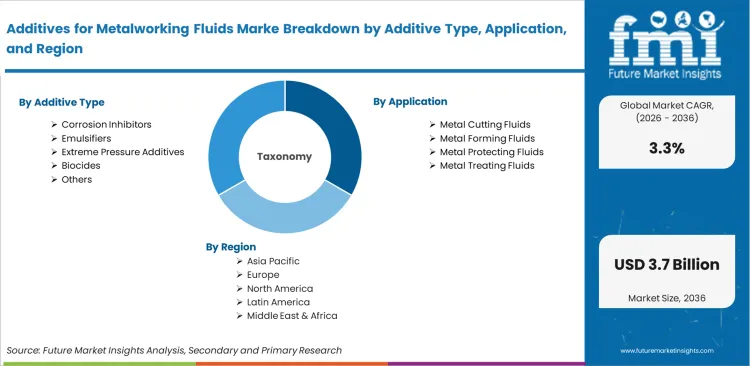
The Additives for Metalworking Fluids market was valued at USD 2.60 billion in 2025, projected to reach USD 2.69 billion in 2026, and is forecast to expand to USD 3.72 billion by 2036 at a 3.3% CAGR. Rising precision manufacturing requirements across aerospace, automotive, and general engineering sectors are accelerating the adoption of performance-grade fluid additive chemistries globally. What were once commodity-grade formulation inputs have become specification-driven components in advanced metalworking fluid systems, compelling procurement managers to prioritize additive performance verification across all major industrial supply chains.
Summary of Additives for Metalworking Fluids Market
- The market is forecast to reach USD 3.72 billion by 2036.
- The market is expected to grow at a CAGR of 3.3% from 2026 to 2036.
- The market was estimated at USD 2.60 billion in 2025.
- The market is projected to reach USD 2.69 billion in 2026.
- The forecast period represents an incremental opportunity of USD 1.03 billion.
- Corrosion inhibitors lead by additive type with a 32.0% share in 2026.
- Metal cutting fluids dominate application share with 45.0% in 2026.
- China is the fastest-growing market at 4.5%, followed by India at 4.1% and Germany at 3.8%.
- The market is increasingly driven by precision manufacturing requirements, regulatory compliance, and performance verification standards.
- Key companies in the market include Lubrizol, Infineum, Afton Chemical, Lanxess, Chevron Oronite, Evonik Industries, Dow, and BASF.
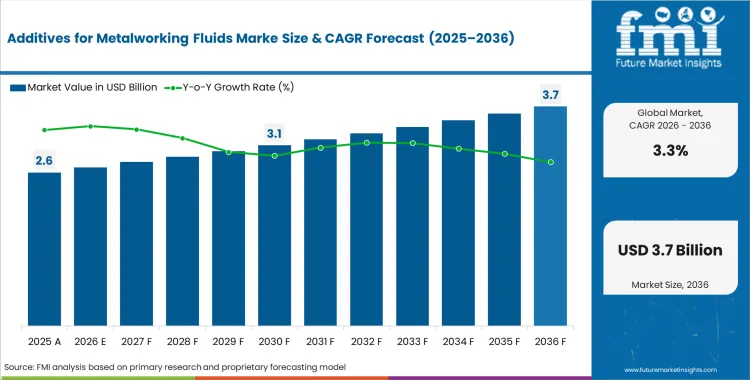
The absolute dollar growth of USD 1.03 billion over the forecast horizon reflects structural demand shifts driven by tightening environmental regulations on biocide content and growing pressure on corrosion inhibitor reformulation across European and North American markets. FMI analysts observe that manufacturers are navigating a dual constraint of performance compliance and regulatory conformance, with extreme pressure additive suppliers responding through phosphorus-free and chlorine-free formulation portfolios. The lubricant additive supply chain has experienced meaningful consolidation, concentrating purchasing influence among large-volume metalworking fluid blenders in Asia Pacific and Central European manufacturing hubs.
As per FMI, regional growth trajectories reflect distinct industrial and regulatory conditions across key manufacturing geographies. China sets the pace with a 4.5% CAGR, followed by India at 4.1% and followed by Germany at 3.8%. Brazil advances at 3.5%, USA advances at 3.1%, each driven by specific procurement and regulatory frameworks. UK registers at 2.8% while Japan registers at 2.5%, reflecting precision manufacturing replacement demand in mature industrial sectors.
Additives for Metalworking Fluids Market Key Takeaways
| Metric | Details |
|---|---|
| Industry Size (2026) | USD 2.69 billion |
| Industry Value (2036) | USD 3.72 billion |
| CAGR (2026-2036) | 3.3% |
| Source | Future Market Insights, 2026 |
Additives for Metalworking Fluids Market Definition
The Additives for Metalworking Fluids market encompasses specialty chemical compounds and additive packages designed to enhance the functional performance, biological stability, corrosion protection, and lubrication efficiency of metalworking fluids deployed in industrial machining, forming, protecting, and treating processes. These additives are formulated for compatibility with water-miscible emulsions, semi-synthetic, synthetic, and straight oil base fluid systems used across ferrous and non-ferrous metal processing operations. The scope governs additives that directly modify fluid performance parameters within production and machining environments.
Additives for Metalworking Fluids Market Inclusions
Market scope includes corrosion inhibitors, emulsifiers and emulsification aids, extreme pressure and anti-wear additives, biocides and antimicrobial preservatives, pH buffers, coupling agents, and multifunctional additive packages for metalworking fluid formulation. Protocol-specific additive systems for aluminium, magnesium, ferrous, and mixed-metal machining applications are fully incorporated. Specialty additive packages supporting extended fluid service life and recyclable fluid system compatibility are included within defined boundaries.
Additives for Metalworking Fluids Market Exclusions
Finished and formulated metalworking fluid products sold as ready-to-use cutting oils, grinding fluids, or forming lubricants are excluded from the scope. Base oils, mineral oils, synthetic base stocks, and water used as fluid carriers fall outside the analytical boundary. Metalworking machinery maintenance chemicals, cleaning agents, and coolant system treatments not integrated into fluid additive formulation are explicitly omitted from the market valuation.
Additives for Metalworking Fluids Market Research Methodology
- Primary Research: Analysts conducted structured interviews with metalworking fluid formulators, additive procurement managers, specialty chemical producers, and industrial end-user technical teams to map the decision criteria and specification thresholds governing additive selection and qualification.
- Desk Research: Data collection phases aggregated regulatory guidance from REACH, EPA, and national biocide approval registries, alongside technical standards from ISO 6743 and ASTM metalworking fluid test protocols, industry association publications, and company annual reports and investor disclosures.
- Market-Sizing and Forecasting: Baseline values derive from a bottom-up aggregation of additive volume consumption across metalworking fluid application segments, applying region-specific growth multipliers derived from industrial production index trajectories and manufacturing sector capital expenditure data.
- Data Validation and Update Cycle: Projections are cross-validated against publicly reported specialty chemical revenue guidance from leading additive producers and benchmarked against metalworking fluid production volume estimates from national chemical industry associations in key manufacturing geographies.
Why is the Additives for Metalworking Fluids Market Growing?
Market expansion is being supported by the increasing manufacturing activities across global industrial markets and the corresponding need for high-performance metalworking operations that require advanced fluid formulations. Modern manufacturing processes demand precision machining capabilities and extended equipment life, creating sustained demand for specialized additives that enhance metalworking fluid performance. The critical role of additives in improving cutting efficiency, reducing tool wear, and preventing corrosion makes them essential components in demanding industrial environments where operational efficiency and equipment protection are paramount.
The growing emphasis on manufacturing productivity and equipment reliability is driving demand for advanced metalworking fluid additives from certified suppliers with proven track records of performance enhancement and technical expertise. Industrial manufacturers are increasingly investing in premium additive solutions that offer superior lubrication properties while meeting stringent environmental and safety requirements. Industry standards and manufacturing specifications are establishing performance benchmarks that favor precision-engineered additives with enhanced protective characteristics and operational efficiency benefits.
The manufacturing industry's focus on automation and precision machining is creating substantial demand for specialized additives capable of supporting high-speed operations and extended equipment service intervals. The aerospace and automotive sectors continue to drive innovation in advanced machining applications while maintaining cost-effectiveness, leading to development of specialized additive formulations with optimized performance characteristics and enhanced compatibility with diverse metalworking operations.
Segmental Analysis
The market is segmented by additive type, application, and region. By additive type, the market is divided into emulsifiers, corrosion inhibitors, extreme pressure additives, biocides, and other configurations. Based on application, the market is categorized into metal cutting fluids, metal forming fluids, metal protecting fluids, and metal treating fluids. Regionally, the market is divided into North America, Europe, East Asia, South Asia & Pacific, Latin America, and Middle East & Africa.
By Additive Type, Corrosion Inhibitors Segment Accounts for 32% Market Share
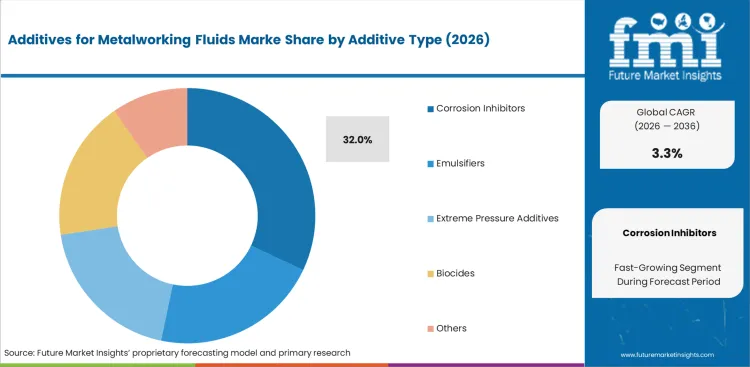
Corrosion inhibitors configurations are projected to account for 32% of the additives for metalworking fluids market in 2026. This leading share is supported by the critical importance of corrosion protection in metalworking operations and growing demand for equipment longevity enhancement across industrial manufacturing sectors. Corrosion inhibitors provide essential protection against metal degradation and equipment damage, making them indispensable components for metalworking fluids used in demanding industrial environments. The segment benefits from continuous technological advancement that has improved inhibitor effectiveness while maintaining compatibility with diverse metalworking applications.
Modern corrosion inhibitors incorporate advanced chemical formulations and enhanced protective mechanisms that maximize equipment protection while ensuring consistent performance across varying operational conditions. These innovations have significantly improved metalworking equipment durability while reducing maintenance requirements and operational downtime for industrial manufacturing processes. The precision machining industry particularly drives demand for corrosion inhibitor solutions, as these applications require absolute equipment protection and extended service intervals to maintain competitive manufacturing efficiency.
Additionally, the automotive and aerospace manufacturing sectors increasingly adopt specialized corrosion inhibitors to protect high-value machining equipment and ensure consistent product quality in critical manufacturing operations. The growing emphasis on sustainable manufacturing creates opportunities for environmentally responsible corrosion inhibitor formulations designed for reduced environmental impact while maintaining superior protective performance.
By Application, Metal Cutting Fluids Segment Accounts for 45% Market Share
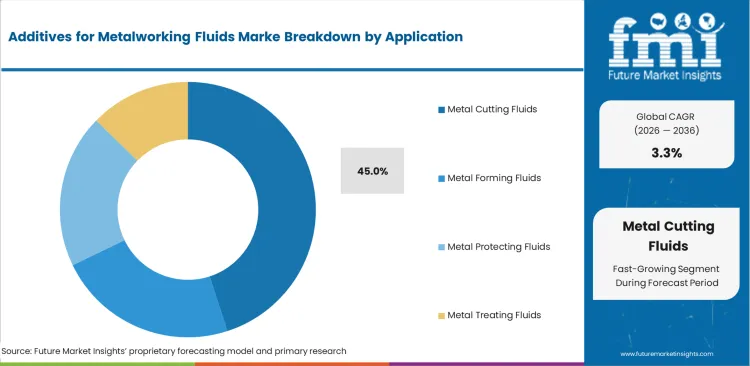
Metal cutting fluids applications are expected to represent 45% of additives for metalworking fluids demand in 2026. This dominant share reflects the massive scale of metal cutting operations across global manufacturing industries and the critical role of additives in enhancing cutting performance and tool life. Metal cutting fluid manufacturers require specialized additives capable of providing superior lubrication, cooling, and chip evacuation while maintaining fluid stability and equipment protection. The segment benefits from continuous innovation in cutting technology that utilizes advanced additive formulations for enhanced machining performance.
The global manufacturing industry drives significant demand for cutting fluid additives that provide exceptional performance characteristics and extended fluid life for high-volume machining operations. These applications require additives with superior thermal stability and lubrication properties to ensure consistent cutting performance and tool longevity. The segment benefits from growing manufacturing automation and increasing demand for precision machining capabilities that require advanced fluid formulations.
Aerospace and automotive manufacturing sectors contribute substantially to market growth as companies implement specialized cutting fluid additives in high-precision machining operations and advanced material processing applications. The growing adoption of advanced manufacturing technologies creates opportunities for specialized additive formulations designed for high-speed machining and exotic material processing. Additionally, the trend toward lean manufacturing drives demand for efficient additive solutions that enable extended fluid life and reduced manufacturing waste.
What are the Market Drivers, Restraints, and Key Trends of the Additives for Metalworking Fluids Market?
The additives for metalworking fluids market is advancing steadily due to increasing manufacturing activities and growing recognition of additive importance in operational efficiency and equipment protection. However, the market faces challenges including stringent environmental regulations, need for sustainable formulations, and varying performance requirements across different industrial applications. Environmental standards and manufacturing specifications continue to influence formulation practices and market development patterns.
Integration of Advanced Additive Technologies and Performance Enhancement
The growing adoption of sophisticated additive chemistry and enhanced performance optimization is enabling significant operational improvements while maintaining environmental compliance in metalworking fluid applications. Advanced formulation techniques and specialized chemical additives provide better machining performance and extended equipment life, enabling superior manufacturing efficiency and reduced operational costs. These technologies are particularly valuable for precision manufacturing applications that require maximum performance reliability and extended service intervals.
Development of Sustainable and Environmentally Compliant Solutions
Modern metalworking fluid additive manufacturers are implementing comprehensive sustainability programs and environmental compliance systems that ensure responsible formulation practices while maintaining superior performance characteristics and industrial compatibility. Advanced additive technologies enable precise optimization of performance properties while supporting certification requirements for environmental standards and occupational safety regulations.
Analysis of Additives for Metalworking Fluids Market by Key Country
.webp "Top Country Growth Comparison Additives For Metalworking Fluids Marke Cagr (2026 2036)")
| Country | CAGR (2026-2036) |
|---|---|
| China | 4.5% |
| India | 4.1% |
| Germany | 3.8% |
| Brazil | 3.5% |
| United States | 3.1% |
| United Kingdom | 2.8% |
| Japan | 2.5% |
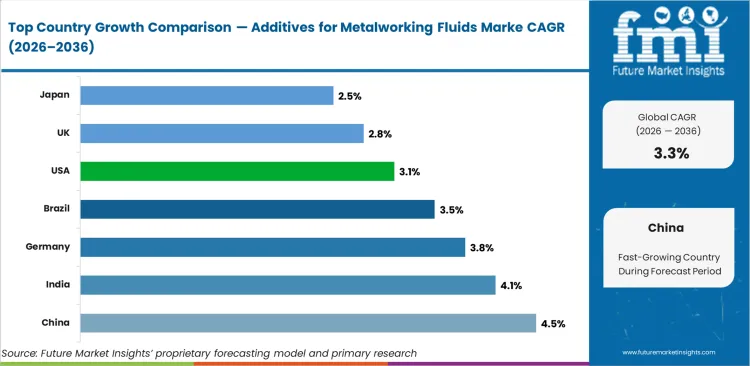
The additives for metalworking fluids market is growing robustly, with China leading at a 4.5% CAGR through 2036, driven by massive manufacturing sector expansion and increasing adoption of advanced machining technologies. India follows at 4.1%, supported by rapid industrialization and growing manufacturing infrastructure development. Germany records strong growth at 3.8%, emphasizing precision manufacturing excellence and advanced metalworking technologies. Brazil grows solidly at 3.5%, benefiting from expanding manufacturing capabilities and industrial modernization programs. The United States shows steady growth at 3.1%, focusing on advanced manufacturing innovation and precision machining applications. The United Kingdom maintains moderate expansion at 2.8%, supported by manufacturing technology advancement. Japan demonstrates growth at 2.5%, emphasizing quality excellence and precision manufacturing technologies.
The report covers an in-depth analysis of 40+ countries, the; seven top-performing countries are highlighted below.
Opportunity Analysis for Additives for Metalworking Fluids Market in China China Leads Global Market Growth with Manufacturing Sector Dominance
The additives for metalworking fluids market Revenue from additives for metalworking fluids in China is projected to exhibit the highest growth rate with a CAGR of 4.5% through 2036, driven by the country's position as the world's largest manufacturing hub and rapidly expanding adoption of advanced machining technologies. The extensive manufacturing infrastructure and increasing investment in precision manufacturing capabilities are creating substantial opportunities for high-performance additive adoption. Major manufacturing companies are implementing comprehensive metalworking fluid systems to support large-scale production operations while meeting evolving quality standards and operational efficiency requirements.
Manufacturing sector expansion and precision machining adoption are supporting widespread integration of advanced metalworking fluid additive technologies across industrial production operations, driving demand for high-performance additive solutions and specialized formulation capabilities. Industrial modernization programs and manufacturing efficiency initiatives are creating significant opportunities for Chinese manufacturing facilities in global supply chains requiring advanced machining capabilities and consistent quality standards.
In-depth Review of Additives for Metalworking Fluids Market in India India Demonstrates Strong Market Potential with Industrial Development
The additives for metalworking fluids market Revenue from additives for metalworking fluids in India is expanding at a CAGR of 4.1%, supported by the country's rapid industrialization and growing manufacturing infrastructure development under government industrial advancement initiatives. The expanding manufacturing capabilities and increasing investment in modern machining technologies are driving substantial metalworking fluid additive demand potential. Manufacturing facilities are leveraging cost advantages while adopting international quality standards to meet domestic manufacturing requirements and export market opportunities.
Industrial development expansion and manufacturing infrastructure growth are creating opportunities for high-quality metalworking fluid additive integration across diverse manufacturing categories requiring advanced machining capabilities and performance optimization systems. International manufacturing collaboration and quality achievement programs are driving investments in advanced additive technologies for metalworking applications throughout major industrial regions and manufacturing centers.
Demand Assessment for Additives for Metalworking Fluids Market in Germany Germany Maintains Leadership with Precision Manufacturing Excellence
The additives for metalworking fluids market Demand for additives for metalworking fluids in Germany is projected to grow at a CAGR of 3.8%, supported by the country's leadership in precision manufacturing development and advanced metalworking technology applications. German manufacturing companies are implementing sophisticated metalworking fluid additive systems that meet stringent quality standards and precision manufacturing requirements. The market is characterized by focus on manufacturing innovation, advanced additive technologies, and compliance with comprehensive environmental and safety regulations.
Precision manufacturing investments are prioritizing advanced metalworking fluid additive technologies that demonstrate superior performance characteristics and environmental compliance while meeting German manufacturing quality and sustainability standards for precision machining applications. Innovation programs and manufacturing technology development initiatives are driving adoption of precision-engineered additive systems that support optimal machining performance and enhanced operational efficiency.
Market Analysis for Additives for Metalworking Fluids Market in Brazil Brazil Expands Market with Manufacturing Capability Development
The additives for metalworking fluids market Revenue from additives for metalworking fluids in Brazil is growing at a CAGR of 3.5%, driven by expanding manufacturing capabilities and increasing integration of advanced machining technologies across industrial production sectors. The growing investment in modern manufacturing infrastructure and increasing focus on precision machining development are creating opportunities for metalworking fluid additive adoption. Manufacturing facilities are adopting advanced technologies to support growing domestic industrial demand and export manufacturing requirements while maintaining operational cost competitiveness.
Manufacturing capability development and precision machining expansion are facilitating adoption of effective metalworking fluid additive systems capable of meeting diverse manufacturing requirements and industrial specifications across automotive, aerospace, and machinery applications. Regional manufacturing enhancement and industrial development programs are creating demand for standardized additive products that meet manufacturing specifications and performance requirements.
Growth Outlook for Additives for Metalworking Fluids Market in the United States Focuses on Advanced Manufacturing Innovation
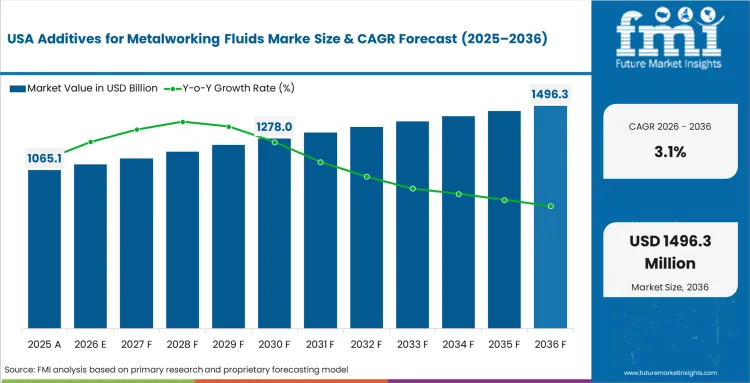
The additives for metalworking fluids market Demand for additives for metalworking fluids in the United States is expanding at a CAGR of 3.1%, driven by the country's advanced manufacturing innovation leadership and increasing emphasis on precision machining technology development. The sophisticated manufacturing ecosystem and focus on cutting-edge machining applications create consistent demand for high-quality metalworking fluid additive solutions. The market benefits from manufacturing technology advancement and industrial innovation across aerospace, automotive, and precision machinery segments.
Advanced manufacturing innovation programs and precision machining initiatives are driving adoption of premium metalworking fluid additives that offer superior performance characteristics and reliability for advanced manufacturing applications. Research and development investments and manufacturing technology advancement are supporting demand for specialized additive formulations that meet stringent performance requirements and innovation standards.
Revenue Prospects for Additives for Metalworking Fluids Market in the United Kingdom Emphasizes Manufacturing Technology Advancement
The additives for metalworking fluids market Demand for additives for metalworking fluids in the United Kingdom is projected to grow at a CAGR of 2.8%, supported by ongoing manufacturing technology advancement and increasing emphasis on precision machining quality in industrial operations. Manufacturing companies are investing in high-quality metalworking fluid additive solutions that provide consistent performance characteristics and meet operational efficiency requirements for advanced manufacturing applications. The market is characterized by focus on manufacturing excellence, operational optimization, and advanced machining technology integration.
Manufacturing technology advancement and precision machining programs are supporting adoption of validated metalworking fluid additive solutions that meet contemporary performance and environmental standards for industrial manufacturing applications. Quality enhancement initiatives and manufacturing optimization programs are creating demand for specialized additive applications that provide superior performance consistency and operational efficiency verification.
Sales Forecast for Additives for Metalworking Fluids Market in Japan Japan Demonstrates Manufacturing Quality Excellence and Technology Innovation
The additives for metalworking fluids market Demand for additives for metalworking fluids in Japan is expanding at a CAGR of 2.5%, driven by the country's emphasis on manufacturing quality excellence and advanced machining technology innovation development. Japanese manufacturing companies are developing sophisticated metalworking fluid additive applications that incorporate precision engineering and performance optimization principles. The market benefits from focus on manufacturing precision, operational reliability, and continuous improvement in machining performance and equipment protection.
Manufacturing quality excellence programs and technology innovation initiatives are driving advancement of premium metalworking fluid additive applications that demonstrate superior performance characteristics and operational reliability. Manufacturing technology excellence programs and quality advancement initiatives are supporting adoption of precision-engineered additive solutions that optimize machining performance and ensure consistent operation in demanding manufacturing applications and precision machining environments.
Europe Market Split by Country
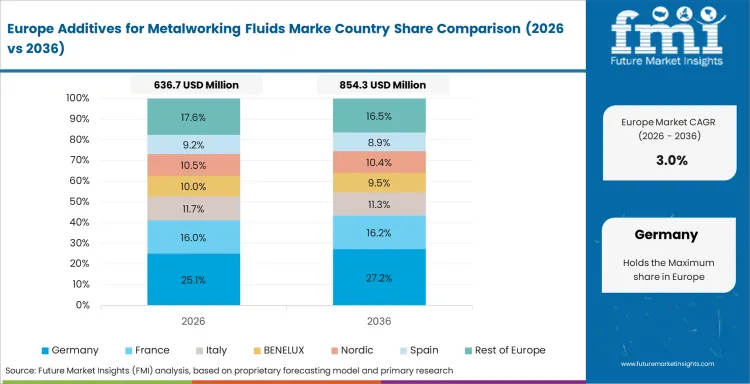
The additives for metalworking fluids market in Europe is projected to grow from USD 716.8 million in 2026 to USD 962.4 million by 2036, registering a CAGR of 3.0% over the forecast period. Germany is expected to maintain its leadership with a 25.7% share in 2026, supported by its advanced manufacturing industry and precision machining excellence. The United Kingdom follows with 18.3% market share, driven by manufacturing technology advancement and industrial optimization programs. France holds 16.9% of the European market, benefiting from manufacturing industry expansion and advanced machining technology development. Italy and Spain collectively represent 22.4% of regional demand, with growing focus on precision manufacturing development and industrial applications. The Rest of Europe region accounts for 16.7% of the market, supported by manufacturing development in Eastern European countries and Nordic industrial technology advancement.
Competitive Landscape
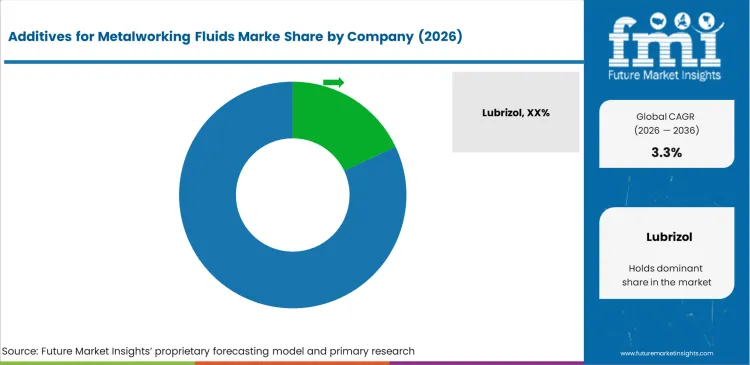
The additives for metalworking fluids market is defined by competition among established chemical manufacturers, specialized additive companies, and integrated fluid solution providers. Companies are investing in advanced formulation technologies, performance optimization programs, environmental compliance systems, and technical support capabilities to deliver reliable, effective, and sustainable metalworking fluid additive solutions. Strategic partnerships, technological advancement, and geographic expansion are central to strengthening product portfolios and market presence.
Lubrizol, operating globally, offers comprehensive additive solutions with focus on performance optimization, technical innovation, and customer support services for metalworking fluid applications. Infineum, established chemical leader, provides advanced additive technologies with emphasis on formulation excellence and manufacturing scalability for industrial applications. Afton Chemical delivers specialized additive solutions with focus on performance enhancement and cost-effectiveness. Lanxess offers comprehensive chemical solutions with standardized procedures and industrial manufacturing support.
Chevron Oronite provides advanced additive capabilities with emphasis on performance excellence and technical expertise for metalworking applications. Evonik Industries delivers specialized chemical technologies with focus on innovation and application optimization. Ingevity offers comprehensive specialty chemical solutions with performance optimization and technical support. Univar Solutions provides advanced chemical distribution and technical services with global manufacturing capabilities.
Syensqo, Dover Chemical, Dow, Vanderbilt Chemicals, ABITEC, BASF, Clariant, Starry Chemical, Nelson Brothers, Arkema, Emery Oleochemicals, and Richful Lube Additive offer specialized metalworking fluid additive expertise, regional production capabilities, and technical support across chemical technology and industrial application networks.
Global Additives for Metalworking Fluids Market - Stakeholder Contribution Framework
The additives for metalworking fluids market underpins manufacturing efficiency excellence, equipment protection optimization, precision machining advancement, and sustainable industrial operations. With growing manufacturing automation, environmental compliance requirements, and performance optimization demands, the sector faces pressure to balance operational effectiveness, environmental sustainability, and cost competitiveness. Coordinated contributions from governments, industry bodies, OEMs/technology integrators, suppliers, and investors will accelerate the transition toward high-performance, environmentally sustainable, and cost-optimized metalworking fluid additive solutions.
How Governments Could Spur Market Growth and Adoption
- Manufacturing Incentives: Provide tax credits for advanced manufacturing facility development and incentivize adoption of high-performance metalworking technologies in industrial operations.
- R&D Support: Fund research programs on advanced additive technologies, sustainable formulation processes, and environmental compliance optimization in industrial fluid applications.
- Industrial Standards: Establish comprehensive performance standards to ensure additive effectiveness and promote manufacturing efficiency in industrial metalworking applications.
- Trade Facilitation: Reduce tariffs for importing advanced manufacturing chemicals while supporting local exports of high-quality metalworking fluid additives.
- Environmental Mandates: Integrate sustainable manufacturing requirements into industrial regulations and environmental compliance frameworks.
How Industry Bodies Could Support Market Development
- Standardization & Certification: Develop harmonized guidelines for metalworking fluid additive specifications, performance benchmarks, and environmental compliance testing protocols.
- Global Branding: Position regional additive manufacturers as leaders in high-performance and sustainable metalworking fluid solutions.
- Training & Workforce Development: Create curricula for additive technologies, formulation techniques, and environmental compliance methods to address technical skill shortages.
- Policy Advocacy: Engage with regulators to shape favorable manufacturing policies and industrial requirements that drive metalworking fluid additive adoption.
How OEMs and Technology Integrators Could Strengthen the Ecosystem
- Formulation Innovation: Advance additive chemistry technologies, performance optimization systems, and sustainable formulation processes for improved efficiency and environmental compliance.
- Partnerships: Collaborate with manufacturing companies to develop application-specific additive formulations optimized for metal cutting, forming, protecting, and treating applications.
- Product Innovation: Develop specialized additive technologies, advanced performance systems, and integrated fluid solutions for enhanced metalworking performance and equipment protection.
- Turnkey Solutions: Bundle metalworking fluid additives with complete fluid management systems, offering end-to-end performance optimization and technical support services.
How Suppliers Could Navigate the Shift
- Performance Excellence: Provide high-performance additive chemicals, advanced formulation technologies, and comprehensive quality control systems to enhance fluid performance and operational efficiency.
- Sustainability Focus: Establish environmentally responsible production processes and sustainable formulation capabilities to meet evolving environmental compliance requirements.
- Portfolio Diversification: Expand from standard additives into specialty segments (bio-based formulations, extreme performance applications, sustainable solutions).
- Technical Support: Deploy application engineering teams to demonstrate performance benefits and optimization advantages of advanced metalworking fluid additive solutions.
How Investors and Financial Enablers Could Unlock Value
- Infrastructure Financing: Fund additive manufacturing facilities, advanced formulation equipment, and quality control systems in key industrial markets like China, India, and Germany.
- Innovation Finance: Support companies developing breakthrough additive technologies, sustainable formulation processes, and advanced performance optimization systems.
- M&A and Consolidation: Back strategic acquisitions to integrate additive expertise and expand geographic manufacturing capabilities for global industrial market access.
- Risk Management Tools: Provide insurance and financing products against raw material volatility and environmental compliance risks.
- Sustainability Investment: Channel capital toward bio-based additives, sustainable production processes, and environmental compliance technologies for enhanced market positioning and regulatory adherence.
Key Players in the Additives for Metalworking Fluids Market
- Lubrizol
- Infineum
- Afton Chemical
- Lanxess
- Chevron Oronite
- Evonik Industries
- Ingevity
- Univar Solutions
- Syensqo
- Dover Chemical
- Dow
- Vanderbilt Chemicals
- ABITEC
- BASF
- Clariant
- Starry Chemical
- Nelson Brothers
- Arkema
- Emery Oleochemicals
- Richful Lube Additive
Scope of the Report
| Metric | Value |
|---|---|
| Quantitative Units | USD billion 2.69 billion to USD billion 3.72 billion, at a CAGR of 3.3% |
| Market Definition | Additives for Metalworking Fluids encompasses specialty chemical additives and additive packages formulated to enhance corrosion protection, lubrication performance, biological stability, and regulatory compliance of metalworking fluids used in industrial cutting, forming, protecting, and treating operations. |
| Additive Type Segmentation | Corrosion Inhibitors, Emulsifiers, Extreme Pressure Additives, Biocides, Others |
| Application Segmentation | Metal Cutting Fluids, Metal Forming Fluids, Metal Protecting Fluids, Metal Treating Fluids, Others |
| Regions Covered | North America, Latin America, Europe, East Asia, South Asia, Oceania, Middle East & Africa |
| Countries Covered | India, China, USA, Germany, UK, Japan, Brazil, and 40 plus countries |
| Key Companies Profiled | Lubrizol, Infineum, Afton Chemical, Lanxess, Chevron Oronite, Evonik Industries, Ingevity, Univar Solutions |
| Forecast Period | 2026 to 2036 |
| Approach | Forecasting models apply a bottom-up methodology anchored on additive consumption volumes across metalworking fluid application segments, with region-specific manufacturing output and regulatory transition curves applied to project adoption and reformulation velocity. |
Additives for Metalworking Fluids Market by Segments
Additive Type:
- Emulsifiers
- Corrosion Inhibitors
- Extreme Pressure Additives
- Biocides
- Others
Application:
- Metal Cutting Fluids
- Metal Forming Fluids
- Metal Protecting Fluids
- Metal Treating Fluids
Region:
- North America
- United States
- Canada
- Mexico
- Europe
- Germany
- United Kingdom
- France
- Italy
- Spain
- Nordic
- BENELUX
- Rest of Europe
- East Asia
- China
- Japan
- South Korea
- South Asia & Pacific
- India
- ASEAN
- Australia & New Zealand
- Rest of South Asia & Pacific
- Latin America
- Brazil
- Chile
- Rest of Latin America
- Middle East & Africa
- Kingdom of Saudi Arabia
- Other GCC Countries
- Turkey
- South Africa
- Other African Union
- Rest of Middle East & Africa
Bibliography
- European Chemicals Agency. (2025). Biocidal Products Regulation (BPR) active substance approval status. ECHA.
- Organisation for Economic Co-operation and Development. (2023). Industrial production and capacity utilisation: Manufacturing sector trends. OECD Statistics.
- United States Environmental Protection Agency. (2025). TSCA chemical data reporting: Specialty chemical manufacturing. USA EPA.
- International Organization for Standardization. (2021). ISO 6743-7: Lubricants, industrial oils and related products- Classification of metalworking fluids. ISO.
- German Federal Institute for Occupational Safety and Health (BAuA). (2025). TRGS 611: Use restrictions for metalworking fluids. BAuA.
- Ministry of Commerce and Industry, Government of India. (2023). Annual survey of industries: Chemical and chemical products manufacturing output. Government of India.
This bibliography is provided for reader reference. The full Future Market Insights report contains the complete reference list with primary research documentation.
Frequently Asked Questions
How large is the demand for Additives for Metalworking Fluids in the global market in 2026?
Demand for Additives for Metalworking Fluids in the global market is estimated to be valued at USD 2.69 billion in 2026.
What will the market size of Additives for Metalworking Fluids be by 2036?
The Additives for Metalworking Fluids market is projected to reach USD 3.72 billion by 2036.
What is the expected CAGR for the Additives for Metalworking Fluids market between 2026 and 2036?
The market is expected to grow at a CAGR of 3.3% between 2026 and 2036.
Which Additive Type is poised to lead global sales in 2026?
Corrosion Inhibitors account for 32.0% share in 2026, driven by mandatory ferrous metal protection requirements across high-volume precision machining operations.
Which Application segment is estimated to dominate the market in 2026?
Metal Cutting Fluids represent 45.0% of Application segment share in 2026, reflecting the dominant volume of turning, milling, grinding, and drilling operations.
Which country is projected to record the fastest growth through 2036?
China is projected to grow at a CAGR of 4.5% during 2026 to 2036, driven by rapid expansion of automotive and electronics precision machining capacity.
What is included and excluded from the scope of this report?
The report covers corrosion inhibitors, emulsifiers, extreme pressure additives, biocides, and multifunctional additive packages. It excludes finished metalworking fluid products, base oils, and machinery maintenance chemicals.
Preview the report firsthand - request a free sample
Get SampleGet the brochure for pricing and purchase details.
Get PDFTable of Content
- Executive Summary
- Global Market Outlook
- Demand-side Trends
- Supply-side Trends
- Analysis and Recommendations
- Market Overview
- Market Coverage / Taxonomy
- Market Definition / Scope / Limitations
- Research Methodology
- Chapter Orientation
- Analytical Lens and Working Hypotheses
- Market Structure, Signals, and Trend Drivers
- Benchmarking and Cross-market Comparability
- Company Annual and Sustainability Reports
- Peer-reviewed Journals and Academic Literature
- Corporate Websites, Product Literature, and Technical Notes
- Earnings Decks and Investor Briefings
- Statutory Filings and Regulatory Disclosures
- Technical White Papers and Standards Notes
- Trade Journals, Industry Magazines, and Analyst Briefs
- Conference Proceedings, Webinars, and Seminar Materials
- Government Statistics Portals and Public Data Releases
- Press Releases and Reputable Media Coverage
- Specialist Newsletters and Curated Briefings
- Sector Databases and Reference Repositories
- FMI Internal Proprietary Databases and Historical Market Datasets
- Subscription Datasets and Paid Sources
- Social Channels, Communities, and Digital Listening Inputs
- Additional Desk Sources
- Expert Input and Fieldwork (Primary Evidence)
- Primary Modes
- Qualitative Interviews and Expert Elicitation
- Quantitative Surveys and Structured Data Capture
- Blended Approach
- Why Primary Evidence is Used
- Field Techniques
- Interviews
- Surveys
- Focus Groups
- Observational and In-context Research
- Social and Community Interactions
- Stakeholder Universe Engaged
- C-suite Leaders
- Board Members
- Presidents and Vice Presidents
- R&D and Innovation Heads
- Technical Specialists
- Domain Subject-matter Experts
- Scientists
- Physicians and Other Healthcare Professionals
- Governance, Ethics, and Data Stewardship
- Research Ethics
- Data Integrity and Handling
- Primary Modes
- Tooling, Models, and Reference Databases
- Data Engineering and Model Build
- Data Acquisition and Ingestion
- Cleaning, Normalisation, and Verification
- Synthesis, Triangulation, and Analysis
- Quality Assurance and Audit Trail
- Market Background
- Market Dynamics
- Drivers
- Restraints
- Opportunity
- Trends
- Scenario Forecast
- Demand in Optimistic Scenario
- Demand in Likely Scenario
- Demand in Conservative Scenario
- Opportunity Map Analysis
- Product Life Cycle Analysis
- Supply Chain Analysis
- Investment Feasibility Matrix
- Value Chain Analysis
- PESTLE and Porter’s Analysis
- Regulatory Landscape
- Regional Parent Market Outlook
- Production and Consumption Statistics
- Import and Export Statistics
- Market Dynamics
- Global Market Analysis 2021 to 2025 and Forecast, 2026 to 2036
- Historical Market Size Value (USD Million) Analysis, 2021 to 2025
- Current and Future Market Size Value (USD Million) Projections, 2026 to 2036
- Y-o-Y Growth Trend Analysis
- Absolute $ Opportunity Analysis
- Global Market Pricing Analysis 2021 to 2025 and Forecast 2026 to 2036
- Global Market Analysis 2021 to 2025 and Forecast 2026 to 2036, By Additive Type
- Introduction / Key Findings
- Historical Market Size Value (USD Million) Analysis By Additive Type , 2021 to 2025
- Current and Future Market Size Value (USD Million) Analysis and Forecast By Additive Type , 2026 to 2036
- Corrosion Inhibitors
- Emulsifiers
- Extreme Pressure Additives
- Biocides
- Others
- Corrosion Inhibitors
- Y-o-Y Growth Trend Analysis By Additive Type , 2021 to 2025
- Absolute $ Opportunity Analysis By Additive Type , 2026 to 2036
- Global Market Analysis 2021 to 2025 and Forecast 2026 to 2036, By Application
- Introduction / Key Findings
- Historical Market Size Value (USD Million) Analysis By Application, 2021 to 2025
- Current and Future Market Size Value (USD Million) Analysis and Forecast By Application, 2026 to 2036
- Metal Cutting Fluids
- Metal Forming Fluids
- Metal Protecting Fluids
- Metal Treating Fluids
- Metal Cutting Fluids
- Y-o-Y Growth Trend Analysis By Application, 2021 to 2025
- Absolute $ Opportunity Analysis By Application, 2026 to 2036
- Global Market Analysis 2021 to 2025 and Forecast 2026 to 2036, By Region
- Introduction
- Historical Market Size Value (USD Million) Analysis By Region, 2021 to 2025
- Current Market Size Value (USD Million) Analysis and Forecast By Region, 2026 to 2036
- North America
- Latin America
- Western Europe
- Eastern Europe
- East Asia
- South Asia and Pacific
- Middle East & Africa
- Market Attractiveness Analysis By Region
- North America Market Analysis 2021 to 2025 and Forecast 2026 to 2036, By Country
- Historical Market Size Value (USD Million) Trend Analysis By Market Taxonomy, 2021 to 2025
- Market Size Value (USD Million) Forecast By Market Taxonomy, 2026 to 2036
- By Country
- USA
- Canada
- Mexico
- By Additive Type
- By Application
- By Country
- Market Attractiveness Analysis
- By Country
- By Additive Type
- By Application
- Key Takeaways
- Latin America Market Analysis 2021 to 2025 and Forecast 2026 to 2036, By Country
- Historical Market Size Value (USD Million) Trend Analysis By Market Taxonomy, 2021 to 2025
- Market Size Value (USD Million) Forecast By Market Taxonomy, 2026 to 2036
- By Country
- Brazil
- Chile
- Rest of Latin America
- By Additive Type
- By Application
- By Country
- Market Attractiveness Analysis
- By Country
- By Additive Type
- By Application
- Key Takeaways
- Western Europe Market Analysis 2021 to 2025 and Forecast 2026 to 2036, By Country
- Historical Market Size Value (USD Million) Trend Analysis By Market Taxonomy, 2021 to 2025
- Market Size Value (USD Million) Forecast By Market Taxonomy, 2026 to 2036
- By Country
- Germany
- UK
- Italy
- Spain
- France
- Nordic
- BENELUX
- Rest of Western Europe
- By Additive Type
- By Application
- By Country
- Market Attractiveness Analysis
- By Country
- By Additive Type
- By Application
- Key Takeaways
- Eastern Europe Market Analysis 2021 to 2025 and Forecast 2026 to 2036, By Country
- Historical Market Size Value (USD Million) Trend Analysis By Market Taxonomy, 2021 to 2025
- Market Size Value (USD Million) Forecast By Market Taxonomy, 2026 to 2036
- By Country
- Russia
- Poland
- Hungary
- Balkan & Baltic
- Rest of Eastern Europe
- By Additive Type
- By Application
- By Country
- Market Attractiveness Analysis
- By Country
- By Additive Type
- By Application
- Key Takeaways
- East Asia Market Analysis 2021 to 2025 and Forecast 2026 to 2036, By Country
- Historical Market Size Value (USD Million) Trend Analysis By Market Taxonomy, 2021 to 2025
- Market Size Value (USD Million) Forecast By Market Taxonomy, 2026 to 2036
- By Country
- China
- Japan
- South Korea
- By Additive Type
- By Application
- By Country
- Market Attractiveness Analysis
- By Country
- By Additive Type
- By Application
- Key Takeaways
- South Asia and Pacific Market Analysis 2021 to 2025 and Forecast 2026 to 2036, By Country
- Historical Market Size Value (USD Million) Trend Analysis By Market Taxonomy, 2021 to 2025
- Market Size Value (USD Million) Forecast By Market Taxonomy, 2026 to 2036
- By Country
- India
- ASEAN
- Australia & New Zealand
- Rest of South Asia and Pacific
- By Additive Type
- By Application
- By Country
- Market Attractiveness Analysis
- By Country
- By Additive Type
- By Application
- Key Takeaways
- Middle East & Africa Market Analysis 2021 to 2025 and Forecast 2026 to 2036, By Country
- Historical Market Size Value (USD Million) Trend Analysis By Market Taxonomy, 2021 to 2025
- Market Size Value (USD Million) Forecast By Market Taxonomy, 2026 to 2036
- By Country
- Kingdom of Saudi Arabia
- Other GCC Countries
- Turkiye
- South Africa
- Other African Union
- Rest of Middle East & Africa
- By Additive Type
- By Application
- By Country
- Market Attractiveness Analysis
- By Country
- By Additive Type
- By Application
- Key Takeaways
- Key Countries Market Analysis
- USA
- Pricing Analysis
- Market Share Analysis, 2025
- By Additive Type
- By Application
- Canada
- Pricing Analysis
- Market Share Analysis, 2025
- By Additive Type
- By Application
- Mexico
- Pricing Analysis
- Market Share Analysis, 2025
- By Additive Type
- By Application
- Brazil
- Pricing Analysis
- Market Share Analysis, 2025
- By Additive Type
- By Application
- Chile
- Pricing Analysis
- Market Share Analysis, 2025
- By Additive Type
- By Application
- Germany
- Pricing Analysis
- Market Share Analysis, 2025
- By Additive Type
- By Application
- UK
- Pricing Analysis
- Market Share Analysis, 2025
- By Additive Type
- By Application
- Italy
- Pricing Analysis
- Market Share Analysis, 2025
- By Additive Type
- By Application
- Spain
- Pricing Analysis
- Market Share Analysis, 2025
- By Additive Type
- By Application
- France
- Pricing Analysis
- Market Share Analysis, 2025
- By Additive Type
- By Application
- India
- Pricing Analysis
- Market Share Analysis, 2025
- By Additive Type
- By Application
- ASEAN
- Pricing Analysis
- Market Share Analysis, 2025
- By Additive Type
- By Application
- Australia & New Zealand
- Pricing Analysis
- Market Share Analysis, 2025
- By Additive Type
- By Application
- China
- Pricing Analysis
- Market Share Analysis, 2025
- By Additive Type
- By Application
- Japan
- Pricing Analysis
- Market Share Analysis, 2025
- By Additive Type
- By Application
- South Korea
- Pricing Analysis
- Market Share Analysis, 2025
- By Additive Type
- By Application
- Russia
- Pricing Analysis
- Market Share Analysis, 2025
- By Additive Type
- By Application
- Poland
- Pricing Analysis
- Market Share Analysis, 2025
- By Additive Type
- By Application
- Hungary
- Pricing Analysis
- Market Share Analysis, 2025
- By Additive Type
- By Application
- Kingdom of Saudi Arabia
- Pricing Analysis
- Market Share Analysis, 2025
- By Additive Type
- By Application
- Turkiye
- Pricing Analysis
- Market Share Analysis, 2025
- By Additive Type
- By Application
- South Africa
- Pricing Analysis
- Market Share Analysis, 2025
- By Additive Type
- By Application
- USA
- Market Structure Analysis
- Competition Dashboard
- Competition Benchmarking
- Market Share Analysis of Top Players
- By Region
- By Additive Type
- By Application
- Competition Analysis
- Competition Deep Dive
- Lubrizol
- Overview
- Product Portfolio
- Profitability by Market Segments (Product/Age /Sales Channel/Region)
- Sales Footprint
- Strategy Overview
- Marketing Strategy
- Product Strategy
- Channel Strategy
- Infineum
- Afton Chemical
- Lanxess
- Chevron Oronite
- Evonik Industries
- Ingevity
- Univar Solutions
- Syensqo
- Dover Chemical
- Dow
- Vanderbilt Chemicals
- ABITEC
- BASF
- Clariant
- Starry Chemical
- Nelson Brothers
- Arkema
- Emery Oleochemicals
- Richful Lube Additive
- Lubrizol
- Competition Deep Dive
- Assumptions & Acronyms Used


