

- Industry Size (2026)
- USD Mn 6345.68
- Forecast (2036)
- USD Mn 12024.04
- CAGR (2026 to 2036)
- 6.6%
Novel Feed Additives Market Size, Market Forecast and Outlook By FMI
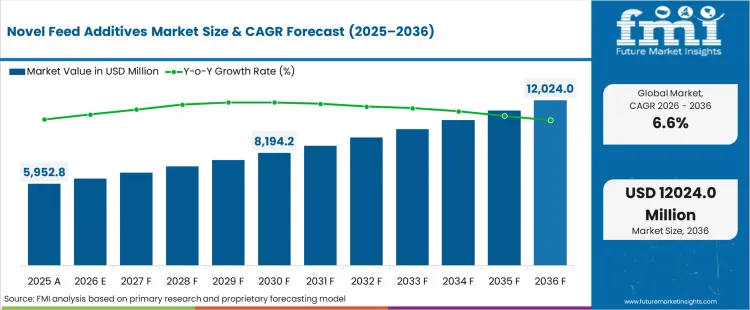
The novel feed additives market was valued at USD 5,952.80 million in 2025, projected to reach USD 6,345.68 million in 2026, and is forecast to expand to USD 12,024.04 million by 2036 at a 6.6% CAGR. Antibiotic growth promoter bans, methane emission reduction targets, and precision livestock nutrition programmes are creating demand for a new generation of feed additives including phytogenics, postbiotics, microalgae-derived ingredients, and methane-inhibiting compounds. These novel additives address performance, health, and environmental objectives that conventional feed additive categories were not designed to meet.
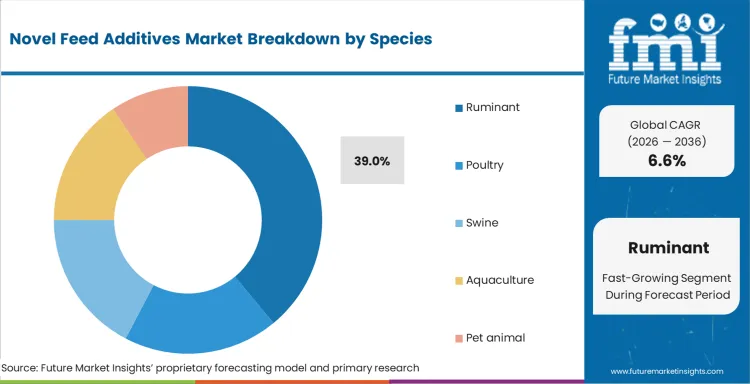
FMI is of the opinion that natural sources hold 37.5% share because regulatory and consumer pressure against synthetic feed additives is driving adoption of plant-derived, microbial, and algal feed ingredients that align with antibiotic-free and sustainable production positioning. Ruminant species command 39.0% of livestock share because methane emission reduction mandates and dairy productivity optimization programmes create the highest-value application for novel feed additive technologies including 3-NOP methane inhibitors and essential oil-based rumen modifiers.
Summary of Novel Feed Additives Market
- Novel Feed Additives Market Definition
- Novel feed additives are next-generation animal nutrition ingredients including phytogenic compounds, postbiotics, microalgae-derived nutrients, methane-inhibiting agents, and precision delivery systems designed to improve livestock performance, health, and environmental outcomes beyond what conventional feed additives achieve. These products address antibiotic replacement, emissions reduction, and precision nutrition objectives.
- Demand Drivers in the Market
- Antibiotic growth promoter replacement: Legislative bans on antibiotic growth promoters in the EU, China, and multiple Asia Pacific countries create a structural demand void that novel feed additives fill. As per FMI, phytogenic compounds, organic acids, and postbiotic products provide gut health and growth performance benefits that partially replace antibiotic growth promotion without contributing to antimicrobial resistance.
- Methane emission reduction mandates: FMI analysts note that dairy and beef sector methane reduction targets under national climate commitments are driving adoption of methane-inhibiting feed additives such as 3-nitrooxypropanol (3-NOP) and essential oil-based rumen modifiers. The EU regulatory authorization of 3-NOP in 2022 opened a high-value application channel for novel feed additive technology in ruminant production.
- Microalgae and postbiotic ingredient commercialization: Based on FMI's analysis, microalgae-derived DHA omega-3, astaxanthin, and beta-glucan feed ingredients are entering commercial-scale production as algae cultivation technology matures. Postbiotic products derived from controlled microbial fermentation are similarly scaling, offering heat-stable alternatives to live probiotics that simplify feed manufacturing and storage logistics.
- Key Segments Analyzed in the FMI Report
- Natural source regulatory alignment: Natural holds 37.5% share in 2026. Plant-derived, microbial, and algal feed additives align with antibiotic-free production certification requirements and consumer sustainability expectations, creating a regulatory and market access advantage over synthetic novel additive categories.
- Ruminant methane reduction opportunity: Ruminant commands 39.0% share in 2026. Methane emission reduction mandates and dairy productivity optimization create the highest-value application for novel feed additive technologies, with methane inhibitors and rumen modifiers commanding premium pricing justified by quantifiable environmental and production outcomes.
- Poultry antibiotic replacement demand: Poultry represents the second-largest species segment as antibiotic growth promoter bans force poultry integrators to adopt novel gut health additives that maintain flock performance metrics without contributing to antimicrobial resistance concerns.
- Analyst Opinion at FMI
- Nandini Roy Choudhury, Principal Consultant for Food & Beverage observe that the novel feed additives market is at a regulatory-driven inflection point where antibiotic bans and climate mandates create non-discretionary demand for additive categories that did not exist at commercial scale a decade ago. The winners in this market will be companies that combine regulatory dossier development with on-farm efficacy documentation, because novel feed additives require both regulatory authorization to sell and field trial data to convince livestock producers to adopt.
- Strategic Implications / Executive Takeaways
- Feed additive companies should prioritize regulatory dossier development for novel compounds targeting antibiotic replacement and methane reduction, as regulatory authorization is the primary market access barrier.
- Livestock producers should evaluate novel feed additive adoption as both a production efficiency investment and an environmental compliance strategy that addresses emerging methane and antibiotic resistance regulations.
- Microalgae and postbiotic producers should invest in commercial-scale production capacity to meet the growing demand from compound feed manufacturers seeking authorized novel ingredients.
- Methodology
- Primary Research: FMI conducted detailed technical interviews with procurement specialists, production engineers, and operations directors across 40 countries to validate adoption timelines.
- Desk Research: Analysts aggregated public regulatory documentation, industry standards publications, and corporate disclosure filings.
- Market-Sizing and Forecasting: Forecasting models apply a hybrid methodology starting with global production and trade metrics and projecting adoption conversion rates.
- Data Validation and Update Cycle: Segment forecasts undergo cross-validation against quarterly and annual industry production and trade volumes.
Novel Feed Additives Market Key Takeaways
| Metric | Details |
|---|---|
| Industry Size (2026) | USD Million 6,345.68 |
| Industry Value (2036) | USD Million 12,024.04 |
| CAGR (2026-2036) | 6.6% |
Source: Future Market Insights, 2026
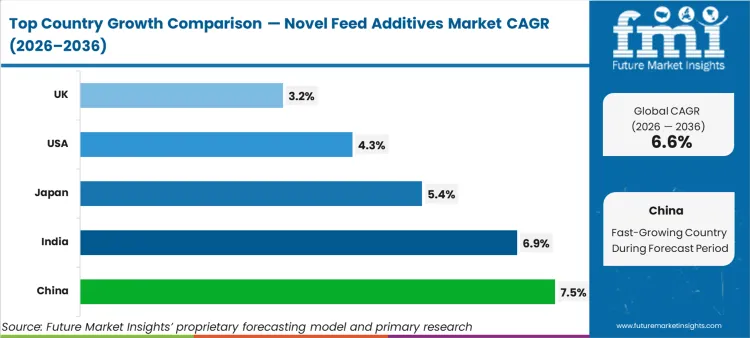
China leads with a 7.5% CAGR, driven by antibiotic growth promoter restrictions and the government's focus on livestock production efficiency and environmental sustainability. India follows at 6.9% as the dairy and poultry sectors invest in non-antibiotic performance enhancement solutions. Japan registers a 5.4% pace anchored by strict feed safety standards and the adoption of functional feed additive technologies. USA tracks at 4.3% driven by the antibiotic-free livestock production trend and methane reduction research. UK operations advance at 3.2% reflecting post-Brexit feed additive regulation and sustainability procurement standards.
Novel Feed Additives Market Definition
Novel feed additives are next-generation animal nutrition ingredients including phytogenic compounds, postbiotics, microalgae-derived nutrients, methane-inhibiting agents, and precision delivery systems designed to improve livestock performance, health, and environmental outcomes beyond what conventional feed additives achieve. These products address antibiotic replacement, emissions reduction, and precision nutrition objectives.
Novel Feed Additives Market Inclusions
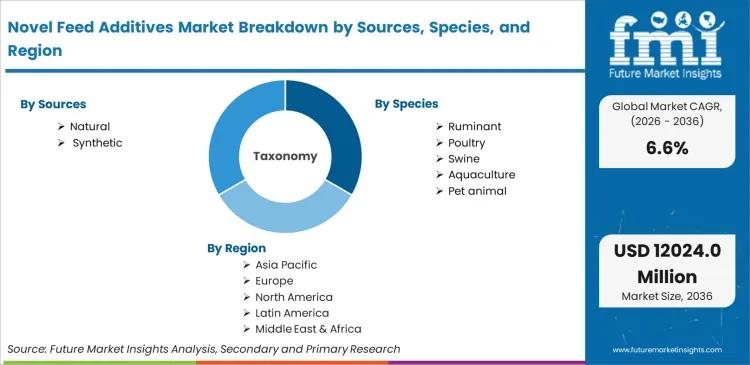
Market scope includes natural and synthetic novel feed additives for ruminant, poultry, swine, aquaculture, and pet animal applications. The report covers global and regional market sizes from 2026 to 2036, segmented by source, species, and geography.
Novel Feed Additives Market Exclusions
Conventional feed additives with established regulatory authorization and multi-decade commercial history (standard vitamins, minerals, amino acids) are excluded. Veterinary pharmaceutical products requiring prescription are outside scope. Complete feed and premix products are excluded from the valuation.
Novel Feed Additives Market Research Methodology
- Primary Research: Analysts engaged with procurement specialists, production managers, and supply chain directors to map the decision gates triggering purchasing cycles and supplier qualification requirements.
- Desk Research: Data collection phases aggregated regulatory filings, industry standards documentation, trade association publications, and public company disclosures.
- Market-Sizing and Forecasting: Baseline values derive from a hybrid top-down and bottom-up methodology, applying region-specific adoption curves to project growth velocity through 2036.
- Data Validation and Update Cycle: Projections are tested against publicly reported production volumes, trade data, and industry benchmarks with annual model recalibration.
Top Novel Feed Additives Market Dynamics and Industry Trends
The Role of Novel Feed Additives in Improving Climate Resilience
It is worth addressing the concern of climate resilience as animals continue to be subjected to environmental stresses. Firms such as Phileo by Lesaffre have taken the lead in such causes by formulating yeast-based additives that reduce animals' susceptibility to heat stress.
These additives promote gut health and immunocompetence so that production animals can be productive even in extreme conditions. Such innovations are highly needed. In the same way, Alltech has come up with products such as Actigen, which protects not only the gut but also the animal’s health from temperature shifts.
This development not only caters to the increasing consumer demand for sturdier and greener systems of agriculture but also complements the economic efficiency and viability of livestock rearing. As climate issues continue and grow in intensity, the adoption of novel feed additives to improve the resilience of animals will continue to be critical.
Embracing Natural Alternatives in Feed Additives
There has been a gradual shift in the feed additive industry focus on natural and natural brands rather than synthetic ones because today's consumers are more concerned about food safety, therefore the demand for better animal produce. According to Kemin Industries, they are leading in the provision of pure natural antioxidants and essential oils, as synthetic additive alternatives.
These products also defend the health and increase the performance of the animal, but they meet the growing trend of clean-label products. According to Cargill, gut health and the improvement of immune systems in livestock have been supported by the provision of additives from plants.
Their natural solutions help meet the growing need for meat and dairy products free from antibiotics. Biomin also plays a role in introducing mycotoxin binders and probiotics with natural products in the feed. All these trends favor the changing face of the feed additives industry because manufacturers continue to invent for changing producer and consumer needs that are sustainability and animal welfare.
Tackling Anti-microbial Resistance with Innovative Solutions
Within the new animal nutrition additives sector, the end of antimicrobial resistance (AMR) is a high priority. Elanco, among other companies, undertakes the creation of non-antibiotic growth promoters and health enhancers. Such solutions are particularly important since consumers are influenced by health concerns and legal restrictions and demand antibiotic-free animal products.
Enzyme and probiotic products of Elanco improve beef and production animal health, without the use of antibiotics. Chr. Hansen is another important player in this industry developing preparations that is preventing the need for antibiotics through microbial improvement of gut health and immunity.
Their probiotic formulations are species-specific to target the best effect. Such innovations are driven by the increasing, consumer demand for safer, antibiotic-free meat and dairy foods. This is being penetrated by the farmers to meet the industry and regulatory requirements. This shift addresses not only the AMR issue but also encourages appropriate and sustainable animal farming and health and productivity over time.
Comparison of Historical vs Forecast Outlook for Novel Feed Additives Sales (2021 to 2026 vs 2026 to 2036)
Global sales increased at a CAGR of 5.7% from 2026 to 2036. For the next ten years (2024 to 2034), projections are that expenditure on such products will rise at 6.6% CAGR.
The shift towards being more concerned about how the animals are raised has contributed to the need for feed additives that improve the health and well-being of the animals. New agricultural practices are also a big reason as they are causing the creation of more efficient and oriented feed additives.
Another interesting trend that aids this growth is precision fermentation and synthetic biology, which helps in developing specific action-targeted additives for the manufacturers to improve feed and animal weight gain.
A similar concern over inputs in agriculture is forcing change in the industry. The rational use of feeding substances with a reduced environmental impact is more and more practiced. Amino acid additives produced by Evonik Industries are the first step in this revolution by enhancing nitrogen efficiency and hence lowering greenhouse emissions and nutrient water pollutants.
Moreover, the growing trend of aquaculture has been sparking the expansion of the novel feed additives industry as well. The rising competition in the seafood sector has brought an adequate need for specialized aquaculture feed additives that improve the growth and health of aquatic species.
Also, the rise in the incidence of zoonotic diseases is leading to a growing use of feed supplements that help to enhance the immunity of animals and limit disease transmission.
Market Concentration in the Novel Feed Additives Sector
Tier 1 Companies are the world's leaders having huge geographical areas of operation and contribution in terms of market share. They have a high degree of strategic and planning functions and a wide variety of products. Such companies are Cargill, DSM, and Evonik Industries. These companies capture most of the industry owing to their capability to bring in new ideas and mass produce within a short time.
Tier 2 Companies include companies that are considerably larger in and have a well-established regional presence, along with certain specialized product lines. They usually deal with certain targeted niche areas or product lines of a certain class of feed additives.
This category of companies is skilled in tailoring and can respond to dynamic business ecosystem in real-time. They invest in a big way in research and development and manufacture products that fulfil specific customer-oriented demands.
Tier 3 Companies are smaller and often hold the position for local or regional companies serving specific areas or customers. They can develop and produce one kind of feed additive or cover a specific region. They typically have low target market revenue. They may be smaller-sized companies, but they are important in the market for offering focused solutions and keeping the customers.
Analysis of Top Countries Using Innovative Feed Additives
The following table shows the estimated growth rates of the top three territories. USA and China are set to exhibit high consumption, recording CAGRs of 4.3% and 7.5%, respectively, through 2034.
.webp "Top Country Growth Comparison Novel Feed Additives Market Cagr (2026 2036)")
| Countries | CAGR 2026 to 2036 |
|---|---|
| The USA | 4.3% |
| India | 6.9% |
| China | 7.5% |
| UK | 3.2% |
| Japan | 5.4% |
Rising Emphasis on Antibiotic-Free Livestock Boosting the Sales in USA
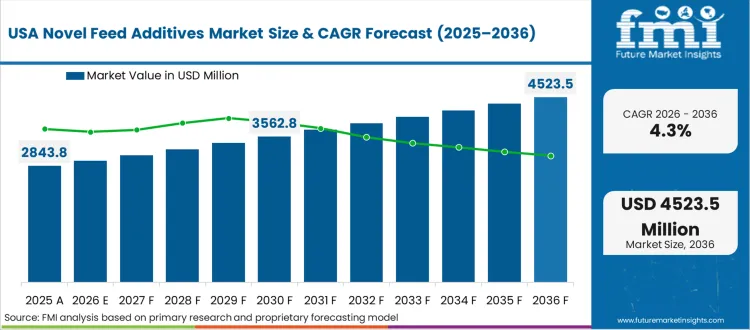
One significant factor is the growing focus on the production of livestock without the use of antibiotics. Restrictions as well as consumer preference towards meat that does not use antibiotics have made companies like Elance and Zoetis come up with new products in the form of feed ingredients that do not require the use of antibiotics but instead promote the health and growth of the livestock.
Also, there has been the introduction of new techniques in farming. There is also the incorporation of precision farming and data analytics in the management of feeds to improve the efficiency and the targeting of feed additives.
Cargill is using such technologies to enhance the formulation of feeds and the performance of animals. Moreover, within the USA market, there is also a growing trend in the use of alternative protein in feed additives. Calysta is one of the companies that are focused on using single-cell proteins as an alternative to conventional feed ingredients.
Demand Outlook in China
The factor that is contributing strongly to the healthy growth of the industry is the government’s focus on eco-friendly and productive livestock production. Policies aiming to lessen the use of antibiotics as well as policies enhancing feed efficiency are making it possible for inventive feed additives to be used.
Nutrient-enhancing enzyme additives that minimize wastage are now gaining popularity in usage. Dairy and meat products that do not contain synthetic ingredients are becoming very popular, especially among the younger demographic and informed consumers in China.
Natural and organic feed supplements that enhance the well-being of livestock as well as the quality of the end products are highly demanded. Also, the adoption of technologies such as precision feeding systems in the feed manufacturing process is appreciated. These strategies enhance the formulation of feeds and the general productivity of animals and hence the stimulated market.
Enhanced Focus on Dairy and Poultry Sectors is Pushing the Industry Sales
In India, the rising concern about the productivity of livestock to satisfy the growing demand for animal protein is driving market sales. Farmers are using modern feed additives to improve the growth rates and feed efficiency of livestock. Another trend is the shift towards mitigating the use of antibiotics in livestock farming.
As resistance to antibiotic treatment medicines becomes common, there is a trend to seek options for antibiotics for animal health improvement which includes vegan and organic additives. These programs related to the Indian government supporting the dairy and poultry industries are translated into a need for new additive feeds.
The purpose of these programs is to improve the health of animals and their performance, thus the demand for such innovative products. Due to these trends, companies in India are developing and selling feed additives that are appropriate for specific regions to promote effective and organized livestock farming.
Novel Feed Additives Industry Analysis by Top Investment Segments
Appeal for Naturally Derived Feed Additives on the Rise
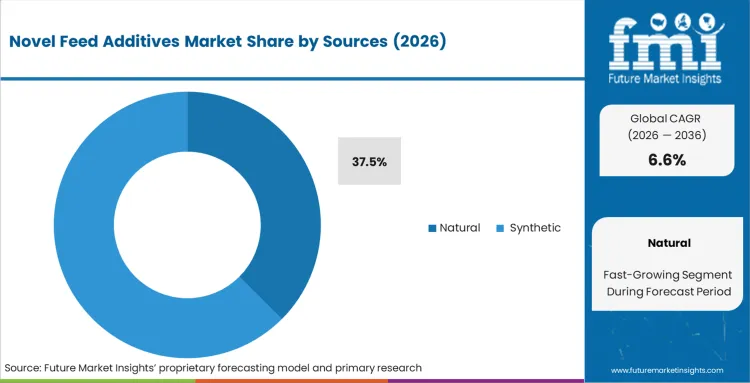
| Segment | Natural (By Sources) |
|---|---|
| Value Share (2026) | 37.5% |
The appeal of the consumers for an organic and antibiotic-free animal product is making the farmers turn to natural feed additives. These feed products are mainly sourced from plants, animals, or even microorganisms. Manufacturers such as Kemin Industries are employing advanced technologies to develop natural performance enhancers, such as antioxidants and essential oils.
These products are in very high demand because they meet the consumers’ preferences and satisfy the recommended policies to produce organic foods. The increasing concern regarding the environmental impacts of livestock production is also contributing to the use of natural alternative additives.
Companies are integrating sustainable raw material sourcing as well as sustainable production tactics into their business models. This is matched by biotechnology development, with the potential to create potent natural additives that will enhance feed utilization and animal well-being.
Rising Demand for Enhanced Egg Production and Quality Leading to Higher Need for Novel Poultry Feed Additives
| Segment | Poultry (By Species) |
|---|---|
| Value Share (2026) | 39% |
To meet the increasing demand for poultry products, producers must improve feed conversion efficiency and the health of the animals. Probiotics, prebiotics, and other similar additives are now being used in the industry to help improve poultry gut health, and consequently growth and decrease mortality rates.
Along with probiotics, the focus of the manufacturers is also on the formulation of the additives that help in increasing the quantity and quality of eggs. For example, calcium regulators are important for the chickens' reproductive processes. Companies are adopting new ideas to support the growth of poultry makers by improving nutrient absorption through enzyme-based food supplements.
Furthermore, the increasing trends of natural poultry farming are encouraging the use of such alternatives. Such feed additives do not contain antibiotics but sustain gut health and disease prevention.
Competitive Outlook of the Novel Feed Additives Market
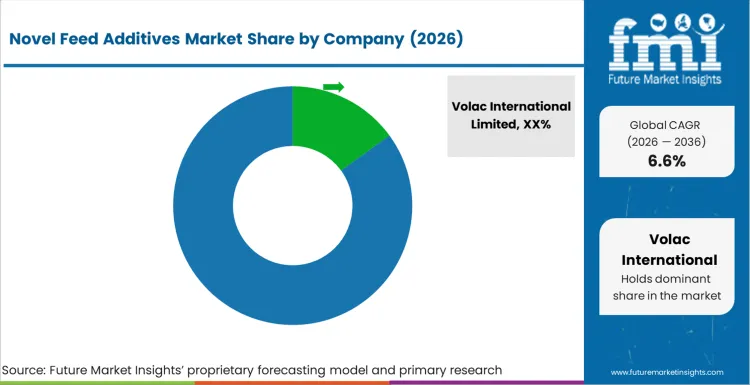
The competition in the market for innovative feed additives is quite intense and the companies are using different plans to expand the market coverage. Having diverse solution-oriented products is one of the ideas to drive product differentiation.
The firms are also seeking to protect their positions by offering patented compounding and formulations. Manufacturers collaborate with research institutions and universities, to be relevant and remain competitive. Alltech collaborates with some of the academic institutions to come up with new generations of feed.
Geographic expansion is another strategy. Companies are moving into new territories to find more customers. Nutreco has been growing its business in Asia and Africa and adapting the products for the local population. Manufacturers are targeting environment-loving consumers by producing sustainable goods and extending their practices.
ADM practices the principles of sustainable sourcing and production. The policies are attractive to the manufacturers aiming at improving their market share and sales within the competitive industry.
For instance
- In 2023, MiAlgae introduced its omega-3 product NaturAlgae, which includes a high DHA and other oils containing dry powder suited for the aquafeed recipes promoting the well-known omega-3 health benefits. The company has developed its own technologically advanced production to lessen the load on naturally captured fish, the long-known source of omega-3.
- In 2024, DSM-firmenich’s product named Bovaer, a methane-reducing feed additive for beef cattle was granted approval for marketing in South Korea. This approval represents a major advancement in the goals of sustainable agriculture in South Korea.
Leading Brands in the Novel Feed Additives Industry
- Volac International Limited
- Chemlife Innovations Pvt Ltd
- All microalgae
- DSM
- Corbion
- Bioproton
- Land O'Lakes, Inc. (PMI Nutrition)
- Orffa
- Arshine Feed Additives Co., Ltd.
- Imerys
- Others
Scope of the Report
| Metric | Value |
|---|---|
| Quantitative Units | USD Million 6,345.68 to USD Million 12,024.04, at a CAGR of 6.6% |
| Market Definition | Novel feed additives are next-generation animal nutrition ingredients including phytogenic compounds, postbiotics, microalgae-derived nutrients, methane-inhibiting agents, and precision delivery systems designed to improve livestock performance, health, and environmental outcomes beyond what conventional feed additives achieve. These products address antibiotic replacement, emissions reduction, and precision nutrition objectives. |
| Sources Segmentation | Natural, Synthetic |
| Species Segmentation | Ruminant, Poultry, Swine, Aquaculture, Pet Animal |
| Regions Covered | North America, Latin America, Europe, East Asia, South Asia, Oceania, Middle East & Africa |
| Countries Covered | China, India, Japan, USA, UK, and 40 plus countries |
| Key Companies Profiled | Volac International Limited, Chemlife Innovations Pvt Ltd, All Microalgae, DSM, Corbion, Bioproton, Land O'Lakes Inc. (PMI Nutrition), Orffa, Arshine Feed Additives Co. Ltd., Imerys |
| Forecast Period | 2026 to 2036 |
| Approach | Hybrid top-down and bottom-up modelling anchored by primary interviews and public data benchmarking |
Top Investment Segments Studied in the Novel Feed Additives Market
By Ingredients:
As per Ingredients, the industry has been categorized into Microalgae based ingredients (De-oiled Microalgae meal, and Microalgae oil), Probiotics/ Direct Fed Microbial (DFM), Prebiotics (Yeast Cell Wall, and Clay minerals), Alkalizers and buffers, Antibiotic Growth Promoters, Phyto biotics, Acidifiers/ Organic Acids, Nanoparticles as Feed additive, Antifungal Additives and Mycotoxin Binders, Bio-minerals or Chelated trace minerals, and Others.
By Sources:
As per sources, the industry has been categorized into Natural, (Plants, Animals, Micro-organisms), and Synthetic.
By Form:
This segment is further categorized into Powder and Liquid.
By Species:
As per species, the industry has been categorized into Ruminant (Calves, Dairy, Cattle, Beef Cattle, and Others), Poultry (Boilers, Layers, Ducks, Turkey, and Others (Geese, pheasants)), Swine, Aquaculture, and Pet animal.
By Region:
Industry analysis has been carried out in key countries of North America, Latin America, Western Europe, Eastern Europe, Balkans & Baltic, Russia & Belarus, Central Asia, East Asia, South Asia & Pacific, and Middle East & Africa.
Bibliography
- European Food Safety Authority. (2024). Scientific Opinions on Novel Feed Additive Applications: Annual Review. EFSA Journal.
- European Commission. (2024). Commission Implementing Regulation on the authorization of 3-nitrooxypropanol as a feed additive. EUR-Lex.
- Food and Agriculture Organization of the United Nations. (2024). The Role of Novel Feed Additives in Sustainable Livestock Production. FAO.
- World Organisation for Animal Health. (2024). Annual Report on Antimicrobial Agents Intended for Use in Animals. WOAH.
- Intergovernmental Panel on Climate Change. (2024). Chapter on Agriculture, Forestry and Other Land Use: Livestock Methane Mitigation. IPCC.
This bibliography is provided for reader reference. The full FMI report contains the complete reference list with primary research documentation.
Frequently Asked Questions
How large is the demand for Novel Feed Additives in the global market in 2026?
Demand for Novel Feed Additives in the global market is estimated to be valued at USD Million 6,345.68 in 2026.
What will be the market size of Novel Feed Additives in the global market by 2036?
Market size for Novel Feed Additives is projected to reach USD Million 12,024.04 by 2036.
What is the expected demand growth for Novel Feed Additives in the global market between 2026 and 2036?
Demand for Novel Feed Additives is expected to grow at a CAGR of 6.6% between 2026 and 2036.
Which Sources is poised to lead global sales by 2026?
Natural accounts for 37.5% share in 2026.
How significant is the role of Ruminant in Species?
Ruminant commands 39.0% of the species segment in 2026.
What is the growth outlook for China?
China is projected to grow at a CAGR of 7.5% during 2026 to 2036.
What is the growth rate for India in this market?
India is projected to expand at a CAGR of 6.9% during 2026 to 2036.
What is Novel Feed Additives and what is it mainly used for?
Novel feed additives are next-generation animal nutrition ingredients including phytogenic compounds, postbiotics, microalgae-derived nutrients, methane-inhibiting agents, and precision delivery systems designed to improve livestock performance, health, and environmental outcomes beyond what conventional feed additives achieve. These products address antibiotic replacement, emissions reduction, and precision nutrition objectives.
What is included in the scope of this Novel Feed Additives report?
Market scope includes natural and synthetic novel feed additives for ruminant, poultry, swine, aquaculture, and pet animal applications. The report covers global and regional market sizes from 2026 to 2036, segmented by source, species, and geography.
What is excluded from the scope of this report?
Conventional feed additives with established regulatory authorization and multi-decade commercial history (standard vitamins, minerals, amino acids) are excluded. Veterinary pharmaceutical products requiring prescription are outside scope.
What does market forecast mean on this page?
The market forecast represents a model-based projection built on defined industry and supply chain assumptions for strategic planning purposes.
How does FMI build and validate the Novel Feed Additives forecast?
Forecasting models apply a hybrid top-down and bottom-up methodology and cross-validate projections against publicly available industry data and primary research inputs.
What does zero reliance on speculative third-party market research mean here?
Primary interviews, verified public regulatory documentation, and official industry standards registries are used instead of unverified syndicated estimates.
Preview the report firsthand - request a free sample
Get SampleGet the brochure for pricing and purchase details.
Get PDFTable of Content
- Executive Summary
- Global Market Outlook
- Demand-side Trends
- Supply-side Trends
- Technology Roadmap Analysis
- Analysis and Recommendations
- Market Overview
- Market Coverage / Taxonomy
- Market Definition / Scope / Limitations
- Research Methodology
- Chapter Orientation
- Analytical Lens and Working Hypotheses
- Market Structure, Signals, and Trend Drivers
- Benchmarking and Cross-market Comparability
- Market Sizing, Forecasting, and Opportunity Mapping
- Research Design and Evidence Framework
- Desk Research Programme (Secondary Evidence)
- Company Annual and Sustainability Reports
- Peer-reviewed Journals and Academic Literature
- Corporate Websites, Product Literature, and Technical Notes
- Earnings Decks and Investor Briefings
- Statutory Filings and Regulatory Disclosures
- Technical White Papers and Standards Notes
- Qualitative Interviews and Expert Elicitation
- Quantitative Surveys and Structured Data Capture
- Blended Approach
- Why Primary Evidence is Used
- Field Techniques
- Interviews
- Surveys
- Focus Groups
- Observational and In-context Research
- Social and Community Interactions
- Stakeholder Universe Engaged
- C-suite Leaders
- Board Members
- Presidents and Vice Presidents
- R&D and Innovation Heads
- Technical Specialists
- Domain Subject-matter Experts
- Scientists
- Physicians and Other Healthcare Professionals
- Governance, Ethics, and Data Stewardship
- Research Ethics
- Data Integrity and Handling
- Desk Research Programme (Secondary Evidence)
- Tooling, Models, and Reference Databases
- Data Engineering and Model Build
- Data Acquisition and Ingestion
- Cleaning, Normalisation, and Verification
- Synthesis, Triangulation, and Analysis
- Quality Assurance and Audit Trail
- Market Background
- Market Dynamics
- Drivers
- Restraints
- Opportunity
- Trends
- Scenario Forecast
- Demand in Optimistic Scenario
- Demand in Likely Scenario
- Demand in Conservative Scenario
- Opportunity Map Analysis
- Product Life Cycle Analysis
- Supply Chain Analysis
- Investment Feasibility Matrix
- Value Chain Analysis
- PESTLE and Porter’s Analysis
- Regulatory Landscape
- Regional Parent Market Outlook
- Production and Consumption Statistics
- Import and Export Statistics
- Market Dynamics
- Global Market Analysis 2021 to 2025 and Forecast, 2026 to 2036
- Historical Market Size Value (USD Million) Analysis, 2021 to 2025
- Current and Future Market Size Value (USD Million) Projections, 2026 to 2036
- Y-o-Y Growth Trend Analysis
- Absolute $ Opportunity Analysis
- Global Market Pricing Analysis 2021 to 2025 and Forecast 2026 to 2036
- Global Market Analysis 2021 to 2025 and Forecast 2026 to 2036, By Sources
- Introduction / Key Findings
- Historical Market Size Value (USD Million) Analysis By Sources , 2021 to 2025
- Current and Future Market Size Value (USD Million) Analysis and Forecast By Sources , 2026 to 2036
- Natural
- Synthetic
- Natural
- Y-o-Y Growth Trend Analysis By Sources , 2021 to 2025
- Absolute $ Opportunity Analysis By Sources , 2026 to 2036
- Global Market Analysis 2021 to 2025 and Forecast 2026 to 2036, By Species
- Introduction / Key Findings
- Historical Market Size Value (USD Million) Analysis By Species, 2021 to 2025
- Current and Future Market Size Value (USD Million) Analysis and Forecast By Species, 2026 to 2036
- Ruminant
- Poultry
- Swine
- Aquaculture
- Pet animal
- Ruminant
- Y-o-Y Growth Trend Analysis By Species, 2021 to 2025
- Absolute $ Opportunity Analysis By Species, 2026 to 2036
- Global Market Analysis 2021 to 2025 and Forecast 2026 to 2036, By Region
- Introduction
- Historical Market Size Value (USD Million) Analysis By Region, 2021 to 2025
- Current Market Size Value (USD Million) Analysis and Forecast By Region, 2026 to 2036
- North America
- Latin America
- Western Europe
- Eastern Europe
- East Asia
- South Asia and Pacific
- Middle East & Africa
- Market Attractiveness Analysis By Region
- North America Market Analysis 2021 to 2025 and Forecast 2026 to 2036, By Country
- Historical Market Size Value (USD Million) Trend Analysis By Market Taxonomy, 2021 to 2025
- Market Size Value (USD Million) Forecast By Market Taxonomy, 2026 to 2036
- By Country
- USA
- Canada
- Mexico
- By Sources
- By Species
- By Country
- Market Attractiveness Analysis
- By Country
- By Sources
- By Species
- Key Takeaways
- Latin America Market Analysis 2021 to 2025 and Forecast 2026 to 2036, By Country
- Historical Market Size Value (USD Million) Trend Analysis By Market Taxonomy, 2021 to 2025
- Market Size Value (USD Million) Forecast By Market Taxonomy, 2026 to 2036
- By Country
- Brazil
- Chile
- Rest of Latin America
- By Sources
- By Species
- By Country
- Market Attractiveness Analysis
- By Country
- By Sources
- By Species
- Key Takeaways
- Western Europe Market Analysis 2021 to 2025 and Forecast 2026 to 2036, By Country
- Historical Market Size Value (USD Million) Trend Analysis By Market Taxonomy, 2021 to 2025
- Market Size Value (USD Million) Forecast By Market Taxonomy, 2026 to 2036
- By Country
- Germany
- UK
- Italy
- Spain
- France
- Nordic
- BENELUX
- Rest of Western Europe
- By Sources
- By Species
- By Country
- Market Attractiveness Analysis
- By Country
- By Sources
- By Species
- Key Takeaways
- Eastern Europe Market Analysis 2021 to 2025 and Forecast 2026 to 2036, By Country
- Historical Market Size Value (USD Million) Trend Analysis By Market Taxonomy, 2021 to 2025
- Market Size Value (USD Million) Forecast By Market Taxonomy, 2026 to 2036
- By Country
- Russia
- Poland
- Hungary
- Balkan & Baltic
- Rest of Eastern Europe
- By Sources
- By Species
- By Country
- Market Attractiveness Analysis
- By Country
- By Sources
- By Species
- Key Takeaways
- East Asia Market Analysis 2021 to 2025 and Forecast 2026 to 2036, By Country
- Historical Market Size Value (USD Million) Trend Analysis By Market Taxonomy, 2021 to 2025
- Market Size Value (USD Million) Forecast By Market Taxonomy, 2026 to 2036
- By Country
- China
- Japan
- South Korea
- By Sources
- By Species
- By Country
- Market Attractiveness Analysis
- By Country
- By Sources
- By Species
- Key Takeaways
- South Asia and Pacific Market Analysis 2021 to 2025 and Forecast 2026 to 2036, By Country
- Historical Market Size Value (USD Million) Trend Analysis By Market Taxonomy, 2021 to 2025
- Market Size Value (USD Million) Forecast By Market Taxonomy, 2026 to 2036
- By Country
- India
- ASEAN
- Australia & New Zealand
- Rest of South Asia and Pacific
- By Sources
- By Species
- By Country
- Market Attractiveness Analysis
- By Country
- By Sources
- By Species
- Key Takeaways
- Middle East & Africa Market Analysis 2021 to 2025 and Forecast 2026 to 2036, By Country
- Historical Market Size Value (USD Million) Trend Analysis By Market Taxonomy, 2021 to 2025
- Market Size Value (USD Million) Forecast By Market Taxonomy, 2026 to 2036
- By Country
- Kingdom of Saudi Arabia
- Other GCC Countries
- Turkiye
- South Africa
- Other African Union
- Rest of Middle East & Africa
- By Sources
- By Species
- By Country
- Market Attractiveness Analysis
- By Country
- By Sources
- By Species
- Key Takeaways
- Key Countries Market Analysis
- USA
- Pricing Analysis
- Market Share Analysis, 2025
- By Sources
- By Species
- Canada
- Pricing Analysis
- Market Share Analysis, 2025
- By Sources
- By Species
- Mexico
- Pricing Analysis
- Market Share Analysis, 2025
- By Sources
- By Species
- Brazil
- Pricing Analysis
- Market Share Analysis, 2025
- By Sources
- By Species
- Chile
- Pricing Analysis
- Market Share Analysis, 2025
- By Sources
- By Species
- Germany
- Pricing Analysis
- Market Share Analysis, 2025
- By Sources
- By Species
- UK
- Pricing Analysis
- Market Share Analysis, 2025
- By Sources
- By Species
- Italy
- Pricing Analysis
- Market Share Analysis, 2025
- By Sources
- By Species
- Spain
- Pricing Analysis
- Market Share Analysis, 2025
- By Sources
- By Species
- France
- Pricing Analysis
- Market Share Analysis, 2025
- By Sources
- By Species
- India
- Pricing Analysis
- Market Share Analysis, 2025
- By Sources
- By Species
- ASEAN
- Pricing Analysis
- Market Share Analysis, 2025
- By Sources
- By Species
- Australia & New Zealand
- Pricing Analysis
- Market Share Analysis, 2025
- By Sources
- By Species
- China
- Pricing Analysis
- Market Share Analysis, 2025
- By Sources
- By Species
- Japan
- Pricing Analysis
- Market Share Analysis, 2025
- By Sources
- By Species
- South Korea
- Pricing Analysis
- Market Share Analysis, 2025
- By Sources
- By Species
- Russia
- Pricing Analysis
- Market Share Analysis, 2025
- By Sources
- By Species
- Poland
- Pricing Analysis
- Market Share Analysis, 2025
- By Sources
- By Species
- Hungary
- Pricing Analysis
- Market Share Analysis, 2025
- By Sources
- By Species
- Kingdom of Saudi Arabia
- Pricing Analysis
- Market Share Analysis, 2025
- By Sources
- By Species
- Turkiye
- Pricing Analysis
- Market Share Analysis, 2025
- By Sources
- By Species
- South Africa
- Pricing Analysis
- Market Share Analysis, 2025
- By Sources
- By Species
- USA
- Market Structure Analysis
- Competition Dashboard
- Competition Benchmarking
- Market Share Analysis of Top Players
- By Regional
- By Sources
- By Species
- Competition Analysis
- Competition Deep Dive
- Volac International Limited
- Overview
- Product Portfolio
- Profitability by Market Segments (Product/Age /Sales Channel/Region)
- Sales Footprint
- Strategy Overview
- Marketing Strategy
- Product Strategy
- Channel Strategy
- Chemlife Innovations Pvt Ltd
- All microalgae
- DSM
- Corbion
- Bioproton
- Land O'Lakes, Inc. (PMI Nutrition)
- Orffa
- Arshine Feed Additives Co., Ltd.
- Imerys
- Others
- Volac International Limited
- Competition Deep Dive
- Assumptions & Acronyms Used


