

- Market Size (2026)
- USD 5.0 Bn
- Forecast (2036)
- USD 10.0 Bn
- CAGR (2026 to 2036)
- 7.1%
Microbial Feed Additives Market Size, Market Forecast and Outlook By FMI
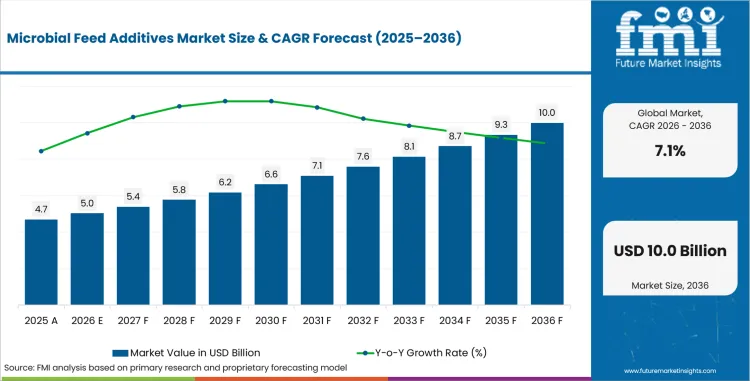
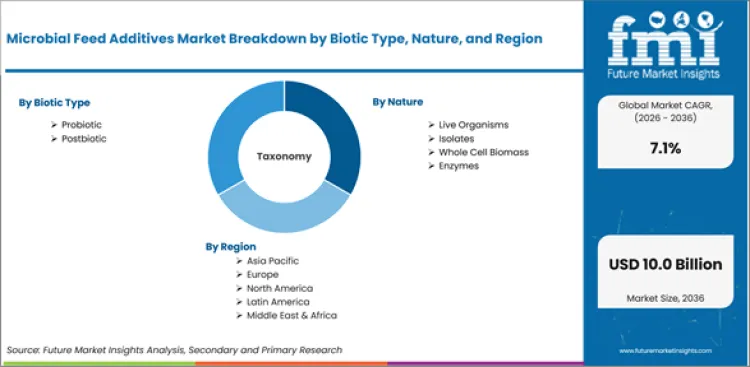
The microbial feed additives market was valued at USD 4.7 billion in 2025. The market is set to reach USD 5.0 billion by 2026-end and grow at a CAGR of 7.1% between 2026-2036 to reach USD 10.0 billion by 2036. Probiotic will dominate with a 58.6% share, while Live Organisms will lead with a 38.0% share.
Key Takeaways, Market Size, and Forecast
- 2026 Market Size: USD 5.0 billion
- 2036 Market Size: USD 10.0 billion
- Compound Annual Growth Rate (CAGR): 7.1% from 2026 to 2036
- Absolute $ Opportunity: USD 5.0 billion between 2026 and 2036
- Leading Biotic Type Segment: Probiotic
- Probiotic Share in 2026: 58.6%
- Fastest-growing Country: India
- India CAGR: 8.4% through 2036
| Parameter | Details |
|---|---|
| Market Size in 2026 (Value) | USD 5.0 billion |
| Market Forecast in 2036 (Value) | USD 10.0 billion |
| Compound Annual Growth Rate (CAGR) | 7.1% from 2026 to 2036 |
| Years Considered | 2021 to 2036 |
| Base Year | 2025 |
| Forecast Period | 2026 to 2036 |
| Units Considered | Value (USD Bn) |
| Leading Sub-Region | India |
Summary of the Microbial Feed Additives Market
- Demand and Growth Drivers
- Antibiotic reduction mandates in livestock production are expected to sustain demand for microbial feed additives as poultry, swine, and ruminant producers adopt probiotic, prebiotic, and enzyme-based alternatives for growth promotion and disease prevention through 2036.
- Gut health optimization and feed conversion efficiency improvement are likely to remain the primary commercial drivers for microbial feed additive adoption across intensive livestock operations.
- Expanding livestock production in Asia-Pacific and Latin America is anticipated to generate the primary volume growth for microbial feed additives during the forecast period.
- Product and Segment View
- Probiotics are likely to account for 58.6% of the biotic type segment in 2026, supported by documented efficacy in gut health maintenance, immune support, and growth promotion across poultry, swine, and ruminant species.
- Poultry accounts for 36.0% of livestock demand, with broiler and layer operations as the primary feed additive procurement channels.
- Bacteria hold 35.6% of the source segment, reflecting the dominance of Bacillus, Lactobacillus, and Enterococcus strains in commercial probiotic feed additive products.
- Geography and Competitive Outlook
- India is projected to lead with an 8.4% CAGR through 2036, driven by expanding poultry and dairy production, antibiotic reduction awareness, and government livestock development programs.
- Brazil at 7.9% reflects large-scale poultry and swine production operations adopting microbial feed additives for performance optimization and antibiotic-free production programs.
- Companies with documented probiotic strain efficacy, regulatory registration across livestock species, and distribution networks in high-growth markets are likely to consolidate positions during the forecast period.
- Analyst Opinion
- Nandini Roy Choudhury, Principal Consultant at FMI says, 'Feed additive companies that can deliver multi-species probiotic formulations with documented performance data across poultry, swine, and ruminant applications are likely to strengthen supply agreements with compound feed manufacturers through 2036.'
- The microbial feed additives market is evolving from an alternative growth promoter category into a specified gut health management platform with defined roles across production efficiency, immunity, and food safety.
- Adoption is increasing due to antibiotic ban enforcement in the EU, restriction programs in the USA and Asia-Pacific, and consumer demand for antibiotic-free meat and poultry products.
- Probiotic dominance at 58.6% reflects commercial preference for live organism-based solutions that provide measurable gut health and feed conversion improvements.
- Powder form at 58.0% of form demand reflects the preference of compound feed manufacturers for dry probiotic formats that integrate into standard feed mixing operations.
Microbial Feed Additives Market Definition
The microbial feed additives market encompasses commercially produced live microorganism-based and microorganism-derived products used in animal feed, including probiotics, prebiotics, synbiotics, and microbial enzymes. These products serve poultry, swine, ruminant, aquaculture, and companion animal nutrition applications.
Microbial Feed Additives Market Inclusions
Market scope covers all commercially traded microbial feed additive products categorized by biotic type (probiotic, prebiotic, synbiotic, microbial enzyme), nature (live organisms, metabolites, spore-forming), source (bacteria, yeast, fungi, algae), form (powder, liquid, granule), and livestock (poultry, swine, ruminant, aquaculture, companion animals). Revenue coverage spans 2026 to 2036.
Microbial Feed Additives Market Exclusions
The scope does not include pharmaceutical-grade antibiotics, synthetic growth promoters, or chemical feed preservatives without microbial origin.
Microbial Feed Additives Market Research Methodology
- Primary Research: FMI analysts conducted interviews with microbial feed additive manufacturers, compound feed producers, livestock nutrition consultants, and veterinary procurement specialists in key markets.
- Desk Research: Combined data from animal feed additive trade databases, veterinary regulation databases, and livestock production industry reports.
- Market Sizing and Forecasting: Bottom-up aggregation from poultry, swine, ruminant, and aquaculture application volumes across regional antibiotic reduction and adoption curves.
- Data Validation: Cross-checked quarterly against feed production statistics, feed additive trade data, and manufacturer shipment reports.
Why is the Microbial Feed Additives Market Growing?
- Antibiotic reduction mandates and livestock production expansion are driving sustained growth, with the microbial feed additives market projected to reach USD 10.00 billion by 2036.
- India leads at 8.4% CAGR, driven by expanding poultry and dairy production, antibiotic reduction awareness, and government livestock sector development.
- Probiotics at 58.6% of biotic type reflect commercial preference for live organism solutions with documented gut health and feed conversion performance.
The microbial feed additives market is estimated at USD 5.03 billion in 2026 and is projected to reach USD 10.00 billion by 2036, expanding at a CAGR of 7.1%. Demand is shaped by the global regulatory transition from prophylactic antibiotic use to microbial alternatives for gut health management and growth promotion in livestock production.
Probiotics account for 58.6% of biotic type demand. Live organisms hold 38.0% of nature segment. Bacteria represent 35.6% of source demand. Powder form holds 58.0% of form demand. Poultry accounts for 36.0% of livestock demand.
Growth reflects the convergence of antibiotic regulation, livestock production intensification, and improving probiotic efficacy documentation that supports mainstream adoption in compound feed formulations across poultry, swine, and ruminant operations.
Market Segmentation Analysis
- Probiotics hold 58.6% of biotic type demand in 2026, serving as the primary microbial alternative to antibiotic growth promoters in poultry, swine, and ruminant feed.
- Poultry accounts for 36.0% of livestock demand, with broiler and layer operations as the largest feed additive procurement channels.
- Powder form represents 58.0% of form demand, reflecting compound feed manufacturer preference for dry-format probiotic products.
The microbial feed additives market is segmented by biotic type (probiotic, prebiotic, synbiotic, microbial enzyme), nature (live organisms, metabolites, spore-forming), source (bacteria, yeast, fungi, algae), form (powder, liquid, granule), and livestock (poultry, swine, ruminant, aquaculture, companion animals).
Insights into the Probiotic Biotic Type Segment
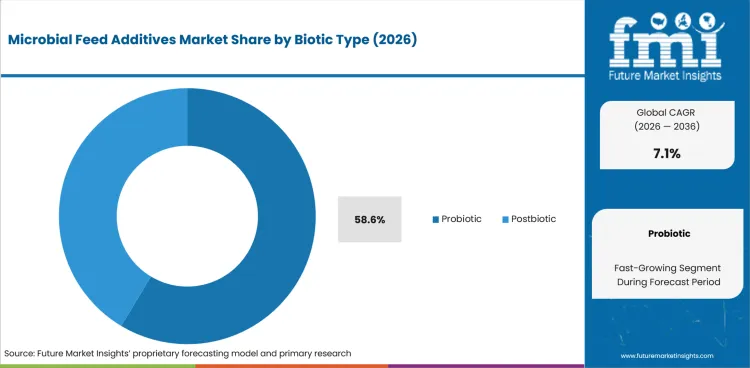
In 2026, probiotics account for 58.6% of biotic type demand. Bacillus, Lactobacillus, and Enterococcus strains dominate commercial formulations, with spore-forming Bacillus strains valued for their thermal stability during feed pelleting. Multi-strain probiotic blends serve broad-spectrum gut health and immune support applications.
Prebiotics and synbiotics represent complementary segments that support probiotic efficacy through substrate provision and combined formulations. Microbial enzymes, including phytase and protease from microbial sources, serve feed digestibility improvement applications.
Insights into the Poultry Livestock Segment
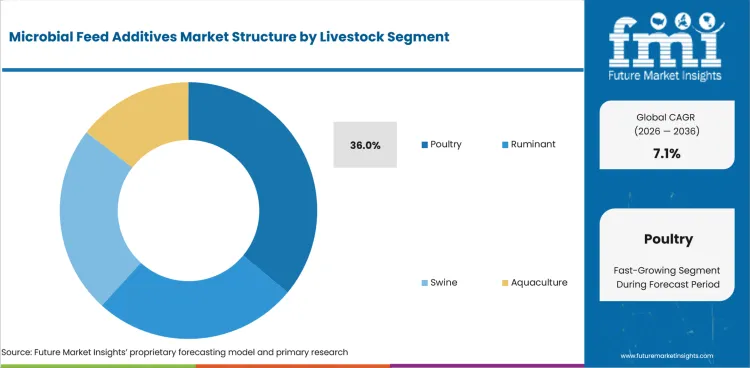
Poultry accounts for 36.0% of livestock demand in 2026. Broiler operations represent the largest sub-segment, with probiotic feed additives used for growth promotion, feed conversion improvement, and Salmonella reduction in antibiotic-free production programs. Layer operations use probiotics for egg quality and intestinal health.
Swine feed represents the second-largest livestock segment, followed by ruminant applications for dairy and beef cattle. Aquaculture is the fastest-growing livestock segment for microbial feed additives, with probiotics used for gut health in fish and shrimp production.
Microbial Feed Additives Market Drivers, Restraints, and Opportunities
- Antibiotic ban enforcement and consumer demand for antibiotic-free meat are creating structured procurement demand for microbial feed alternatives across livestock categories.
- Probiotic strain variability and inconsistent field performance constrain confidence among feed manufacturers and livestock producers in some production environments.
- Expanding livestock production in India, Brazil, China, and Southeast Asia is generating the primary volume growth opportunity for microbial feed additive suppliers.
The microbial feed additives market expands on the basis of antibiotic regulation, gut health science advancement, and livestock production growth. Constraints include strain efficacy variability, cost premiums, and the need for species-specific performance documentation.
Antibiotic Regulation and Alternative Demand
Demand is shaped by EU antibiotic growth promoter ban, FDA Veterinary Feed Directive, and similar regulations in Asia-Pacific that restrict prophylactic antibiotic use in livestock production. Probiotic and prebiotic feed additives provide functional alternatives that address gut health and growth performance without contributing to antimicrobial resistance.
Strain Efficacy and Performance Consistency
Adoption is constrained by variability in probiotic strain performance across different production environments, feed formulations, and livestock species. Feed manufacturers require documented multi-trial efficacy data before incorporating microbial additives into standard formulations.
Emerging Market Livestock Production Growth
Growth is supported by expanding poultry, swine, and dairy production in India, Brazil, China, and Southeast Asia. Rising production intensity and increasing antibiotic awareness in these markets create structural demand for microbial feed additive solutions.
Analysis of Microbial Feed Additives Market By Key Countries
.webp "Top Country Growth Comparison Microbial Feed Additives Market Cagr (2026 2036)")
| Country | CAGR |
|---|---|
| India | 8.4% |
| Brazil | 7.9% |
| South Korea | 6.6% |
| China | 6.0% |
| Japan | 5.8% |
| Germany | 5.2% |
| USA | 4.5% |
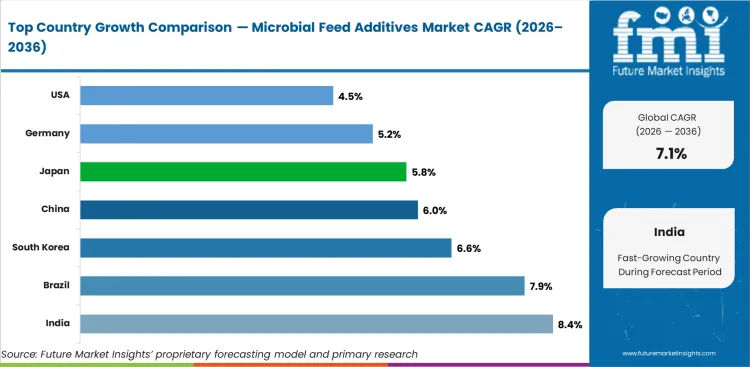
- India at 8.4% leads growth, driven by expanding poultry and dairy production, antibiotic reduction programs, and government livestock development initiatives.
- Brazil at 7.9% reflects large-scale poultry and swine production adopting microbial feed additives for performance optimization and antibiotic-free programs.
- South Korea (6.6%) and China (6.0%) sustain growth through intensive livestock operations and tightening antibiotic use regulations.
- Japan (5.8%) and Germany (5.2%) maintain demand through quality-driven livestock production and EU-aligned antibiotic restriction compliance.
The global microbial feed additives market is projected to expand at a CAGR of 7.1% from 2026 to 2036. The study covers more than 30 countries, and the primary markets are analyzed below.
Demand Outlook for Microbial Feed Additives Market in India
India is projected to lead with an 8.4% CAGR through 2036. Expanding poultry and dairy production, antibiotic reduction awareness, and National Livestock Mission programs support microbial feed additive adoption.
- Poultry integrators in India adopt probiotic feed additives as antibiotic-free production programs expand to meet export requirements and domestic consumer expectations.
- National Livestock Mission and state animal husbandry programs support feed quality improvement initiatives that include microbial additive adoption.
- Dairy cooperatives in India incorporate probiotic and prebiotic feed additives for rumen health optimization in buffalo and cow dairy operations.
Future Outlook for Microbial Feed Additives Market in Brazil
Brazil is expected to grow at 7.9% through 2036. Large-scale poultry and swine operations, antibiotic reduction programs, and export market compliance drive structured demand for microbial feed alternatives.
- Brazilian poultry exporters adopt probiotic feed additives to meet EU and Japanese import requirements for antibiotic-free production documentation.
- MAPA (Ministry of Agriculture) regulation of antimicrobial use in animal production creates regulatory-driven demand for microbial feed alternatives.
- Compound feed manufacturers in Brazil integrate multi-strain probiotic formulations into standard broiler and swine feed programs.
Opportunity Analysis of Microbial Feed Additives Market in South Korea
South Korea is projected to expand at 6.6% through 2036. Intensive livestock operations, strict feed additive quality standards, and government antibiotic use monitoring drive microbial additive procurement.
- Korean compound feed manufacturers procure specification-grade probiotic products with documented efficacy data for poultry and swine applications.
- Government antibiotic use monitoring programs create regulatory incentive for livestock producers to adopt microbial feed alternatives.
- Advanced feed technology infrastructure in South Korea supports rapid adoption of new probiotic strain formulations with documented performance benefits.
In-depth Analysis of Microbial Feed Additives Market in Germany
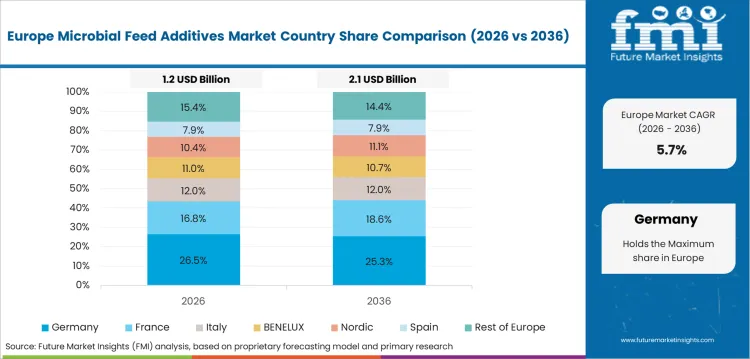
Germany is projected to grow at 5.2% through 2036. EU antibiotic growth promoter ban, established compound feed manufacturing, and livestock production quality standards sustain microbial feed additive demand.
- EU Regulation on medicated feed and antibiotic restrictions maintains structural demand for probiotic and prebiotic feed alternatives in German livestock production.
- German compound feed manufacturers maintain rigorous additive qualification protocols that favor documented, multi-trial probiotic efficacy data.
- Evonik and other German-based feed additive companies invest in microbial strain development and formulation technology for global markets.
Sales Analysis of Microbial Feed Additives Market in the United States
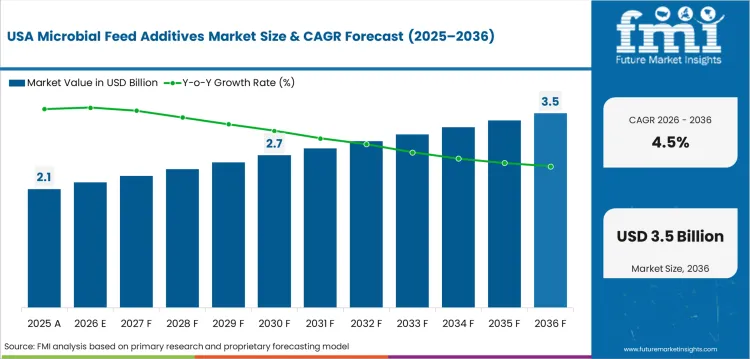
The USA is projected to grow at 4.5% through 2036. FDA Veterinary Feed Directive compliance, antibiotic-free production programs, and consumer demand for raised-without-antibiotics meat sustain microbial feed additive procurement.
- Major US poultry integrators maintain probiotic feed programs as part of raised-without-antibiotics production that commands retail price premiums.
- FDA Veterinary Feed Directive compliance requires veterinary oversight of medically important antibiotics, creating demand for over-the-counter microbial alternatives.
- Feed additive companies including Kemin Industries and Cargill provide multi-species probiotic solutions for US poultry, swine, and dairy operations.
Competitive Landscape and Strategic Positioning
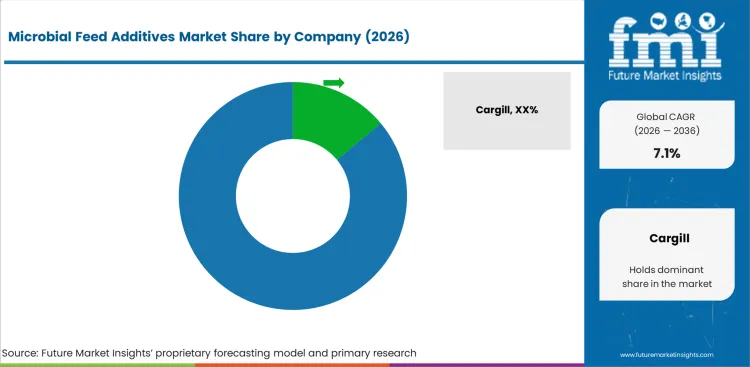
- Cargill and Evonik lead with diversified animal nutrition platforms that integrate microbial feed additives with amino acids, enzymes, and other functional ingredients.
- Kemin Industries and Orffa Feed Solutions compete through focused feed additive portfolios and documented probiotic strain efficacy across livestock species.
- Angel Yeast and Lanxess serve regional markets with yeast-based and specialty microbial feed additive products.
Cargill and Evonik hold leading positions through comprehensive animal nutrition platforms that combine microbial feed additives with complementary products. Kemin Industries competes through specialized feed additive expertise and global distribution.
Orffa Feed Solutions provides focused microbial feed additive portfolios for European markets. Angel Yeast and Lanxess serve regional segments with yeast-based probiotics and specialty microbial products.
Barriers include strain development and registration costs, multi-species efficacy documentation, and distribution network development in fragmented livestock production markets. Strategic priorities center on strain efficacy, regulatory registration, and emerging market distribution.
Key Companies in the Microbial Feed Additives Market
Key global companies leading the microbial feed additives market include:
- Cargill (USA), Evonik (Germany), and Kemin Industries (USA) maintain diversified animal nutrition platforms with comprehensive microbial feed additive portfolios and global distribution to compound feed manufacturers.
- Orffa Feed Solutions (Netherlands), Angel Yeast (China), and Lanxess (Germany) hold positions through focused feed additive expertise, yeast-based probiotic products, and regional distribution networks.
- Emerging players focus on next-generation probiotic strains, precision fermentation, and species-specific microbial feed formulations.
Competitive Benchmarking: Microbial Feed Additives Market
| Company | Microbial Portfolio | Strain R&D | Feed Manufacturer Access | Geographic Footprint |
|---|---|---|---|---|
| Cargill | High | High | Strong | Global |
| Evonik | High | High | Strong | Global |
| Kemin Industries | High | High | Strong | Global |
| Orffa Feed Solutions | Medium | Medium | Moderate | Europe |
| Angel Yeast | Medium | Medium | Moderate | Asia, Global |
| Lanxess | Medium | Medium | Moderate | Europe, Global |
Source: Future Market Insights competitive analysis, 2026.
Key Developments in Microbial Feed Additives Market
- In 2025, Evonik launched a new multi-strain probiotic feed additive for antibiotic-free broiler production programs in European and Asian markets.
- In 2025, Kemin Industries expanded its microbial feed additive portfolio with a new synbiotic formulation targeting swine gut health improvement.
Key Players in the Microbial Feed Additives Market
Major Global Players
- Cargill
- Evonik
- Kemin Industries
- Orffa Feed Solutions
- Angel Yeast
- Lanxess
Emerging Players/Startups
- Next-generation probiotic companies
- Precision fermentation startups
- Regional microbial feed additive producers
Report Scope and Coverage
| Parameter | Details |
|---|---|
| Market size by 2036 | USD 10.00 billion |
| Growth rate | 7.1% CAGR (2026 to 2036) |
| Forecast period | 2026 to 2036 |
| Base year value (2025) | USD 4.7 billion |
| Key Segment Covered | Biotic Type, Nature, Source, Form, Livestock |
| Regions covered | North America, Latin America, Europe, East Asia, South Asia and Pacific, Middle East and Africa |
| Countries covered | India, Brazil, South Korea, China, Japan, Germany, USA, 30 plus countries |
| Key companies profiled | Cargill, Evonik, Kemin Industries, Orffa Feed Solutions, Angel Yeast, Lanxess |
| Approach | Hybrid bottom-up and top-down methodology starting with verified feed additive trade and livestock production data, projecting adoption velocity across biotic types, species, and regions. |
Market Segmentation Analysis
Microbial Feed Additives Market Segmented by Biotic Type:
- Probiotic
- Live Microbial Feed Additives
- Gut Health Improvement
- Digestive Efficiency Enhancement
- Functional Probiotic Blends
- Immune System Support
- Livestock Performance Optimization
- Live Microbial Feed Additives
- Postbiotic
- Metabolite Based Feed Additives
- Improved Nutrient Absorption
- Stress Reduction Benefits
- Non Viable Bioactive Compounds
- Enhanced Animal Immunity
- Feed Stability Improvement
- Metabolite Based Feed Additives
Microbial Feed Additives Market Segmented by Nature:
- Live Organisms
- Live Bacterial Cultures
- Digestive Tract Colonization
- Enhanced Gut Flora Balance
- Live Yeast Supplements
- Rumen Health Improvement
- Feed Digestibility Enhancement
- Live Bacterial Cultures
- Isolates
- Bacterial Isolates
- Targeted Gut Health Support
- Species Specific Applications
- Purified Microbial Extracts
- High Potency Feed Additives
- Consistent Product Performance
- Bacterial Isolates
- Whole Cell Biomass
- Dried Microbial Biomass
- Protein Rich Feed Supplements
- Nutritional Enhancement
- Fermented Biomass Products
- Improved Feed Conversion
- Livestock Growth Support
- Dried Microbial Biomass
- Enzymes
- Digestive Enzyme Additives
- Improved Nutrient Breakdown
- Feed Efficiency Optimization
- Multi Enzyme Complexes
- Fiber Digestion Support
- Enhanced Animal Productivity
- Digestive Enzyme Additives
Microbial Feed Additives Market Segmented by Source:
- Bacteria
- Lactic Acid Bacteria
- Gut Microbiome Support
- Disease Resistance Enhancement
- Bacillus Based Additives
- Feed Stability Improvement
- Digestive Health Support
- Lactic Acid Bacteria
- Algae
- Microalgae Based Feed Additives
- Omega 3 Enrichment
- Aquaculture Nutrition Applications
- Algal Biomass Supplements
- Natural Pigmentation Support
- Immune Health Benefits
- Microalgae Based Feed Additives
- Fungi
- Fungal Fermentation Products
- Fiber Digestion Enhancement
- Ruminant Feed Applications
- Mycoprotein Ingredients
- Protein Enrichment Solutions
- Sustainable Feed Alternatives
- Fungal Fermentation Products
- Yeast
- Saccharomyces Yeast Products
- Rumen Stabilization
- Improved Feed Intake
- Yeast Derived Nutrients
- Immune Modulation Benefits
- Stress Management Support
- Saccharomyces Yeast Products
Microbial Feed Additives Market Segmented by Form:
- Powder
- Spray Dried Formulations
- Easy Feed Blending
- Long Shelf Life
- Microencapsulated Powders
- Improved Stability
- Controlled Nutrient Release
- Spray Dried Formulations
- Liquid
- Concentrated Liquid Additives
- Water Soluble Applications
- Rapid Absorption Benefits
- Fermented Liquid Cultures
- Direct Feed Supplementation
- High Bioavailability
- Concentrated Liquid Additives
- Granules
- Pelletized Feed Additives
- Uniform Feed Distribution
- Reduced Dust Formation
- Controlled Release Granules
- Enhanced Storage Stability
- Industrial Feed Applications
- Pelletized Feed Additives
Microbial Feed Additives Market Segmented by Livestock:
- Poultry
- Broiler Chickens
- Growth Performance Enhancement
- Disease Resistance Support
- Layer Birds
- Egg Production Improvement
- Gut Health Management
- Broiler Chickens
- Ruminant
- Dairy Cattle
- Milk Yield Improvement
- Rumen Health Support
- Beef Cattle
- Weight Gain Optimization
- Feed Conversion Efficiency
- Dairy Cattle
- Swine
- Piglet Nutrition
- Digestive Health Support
- Early Growth Enhancement
- Finisher Swine Feed
- Feed Efficiency Improvement
- Immune Function Support
- Piglet Nutrition
- Aquaculture
- Fish Farming
- Water Quality Support
- Improved Growth Rates
- Shrimp Aquaculture
- Disease Resistance Enhancement
- Feed Utilization Optimization
- Fish Farming
Microbial Feed Additives Market by Region:
- North America
- USA
- Canada
- Mexico
- Latin America
- Brazil
- Chile
- Rest of Latin America
- Western Europe
- Germany
- UK
- Italy
- Spain
- France
- Nordic
- BENELUX
- Rest of Western Europe
- Eastern Europe
- Russia
- Poland
- Hungary
- Balkan & Baltic
- Rest of Eastern Europe
- East Asia
- China
- Japan
- South Korea
- South Asia and Pacific
- India
- ASEAN
- Australia & New Zealand
- Rest of South Asia and Pacific
- Middle East & Africa
- Kingdom of Saudi Arabia
- Other GCC Countries
- Türkiye
- South Africa
- Other African Union
- Rest of Middle East & Africa
Research Sources and Bibliography
- 1. European Commission. (2025). EU Regulation on Medicated Feed and Feed Additives: Antimicrobial Reduction Standards. EC.
- 2. USA Food and Drug Administration. (2025). FDA Veterinary Feed Directive: Updated Guidance on Antimicrobial Use in Animal Feed. FDA.
- 3. Food and Agriculture Organization. (2025). FAO Action Plan on Antimicrobial Resistance: Livestock Feed Additive Alternatives. FAO.
- 4. World Organisation for Animal Health. (2025). WOAH Annual Report: Antimicrobial Use in Animals and Feed Additive Standards. WOAH.
- 5. International Feed Industry Federation. (2025). IFIF Global Feed Production and Additive Usage Statistics. IFIF.
This bibliography is provided for reader reference.
This Report Answers
- Estimating the size of the microbial feed additives market and projected revenue from 2026 to 2036.
- Segmenting by biotic type, nature, source, form, and livestock.
- Regional and country-level insights across more than 30 markets.
- Analysis of probiotic, prebiotic, synbiotic, and microbial enzyme technologies.
- Assessment of the competitive landscape and company benchmarking.
- Identifying investment opportunities in antibiotic-free production, gut health, and emerging markets.
- Tracking supply chain dynamics from microbial production to feed additive distribution.
- Delivery of data in PDF and Excel formats.
Frequently Asked Questions
How big is the microbial feed additives market in 2026?
The global microbial feed additives market is estimated to be valued at USD 5.0 billion in 2026.
What will be the size of microbial feed additives market in 2036?
The market size for the microbial feed additives market is projected to reach USD 10.0 billion by 2036.
How much will be the microbial feed additives market growth between 2026 and 2036?
The microbial feed additives market is expected to grow at a 7.1% CAGR between 2026 and 2036.
What are the key biotic types in the microbial feed additives market?
The key biotic types in the microbial feed additives market are Probiotic and Postbiotic.
Which nature segment is expected to contribute significant share in the microbial feed additives market in 2026?
In terms of nature, live organisms segment is expected to command 38.0% share in the microbial feed additives market in 2026.
Preview the report firsthand - request a free sample
Get SampleGet the brochure for pricing and purchase details.
Get PDFTable of Content
- Key Takeaways
- Market Size and CAGR
- Top Growth Driver
- Fastest Growing Segment
- Leading Region
- Key Companies
- Emerging Opportunities
- Executive Summary
- Global Market Outlook
- Demand-side Trends
- Supply-side Trends
- Technology Roadmap Analysis
- Analysis and Recommendations
- Analyst Perspective (What is happening? Why now? What should investors know?)
- Key Questions Answered
- How large is the market?
- What is the CAGR?
- What are key trends?
- Which region dominates?
- Who are the leaders?
- Market Overview
- Market Coverage / Taxonomy
- Market Definition / Scope / Limitations
- Research Methodology
- Chapter Orientation
- Analytical Lens and Working Hypotheses
- Market Structure, Signals, and Trend Drivers
- Benchmarking and Cross-market Comparability
- Market Sizing, Forecasting, and Opportunity Mapping
- Research Design and Evidence Framework
- Desk Research Programme (Secondary Evidence)
- Expert Input and Fieldwork (Primary Evidence)
- Tooling, Models, and Reference Databases
- Data Engineering and Model Build
- Quality Assurance and Audit Trail
- Market Background
- Market Dynamics (Drivers, Restraints, Opportunity, Trends)
- Scenario Forecast (Optimistic, Likely, Conservative)
- Impact Analysis
- AI Impact
- Sustainability Impact
- Regulatory Impact
- Technology Impact
- Consumer / Buyer Analysis
- Purchase Drivers
- Adoption Barriers
- Buyer Journey
- Opportunity Map Analysis
- Product Life Cycle Analysis
- Supply Chain Analysis
- Investment Feasibility Matrix
- Value Chain Analysis
- PESTLE and Porter's Analysis
- Regulatory Landscape
- Regional Parent Market Outlook
- Production and Consumption Statistics
- Import and Export Statistics
- Global Market Analysis and Forecast, 2021 to 2036
- Historical Market Size Value (USD Million) Analysis, 2021 to 2025
- Current and Future Market Size Value (USD Million) Projections, 2026 to 2036
- Y-o-Y Growth Trend Analysis
- Absolute $ Opportunity Analysis
- Global Market Pricing Analysis, 2021 to 2036
- Global Market Analysis and Forecast, By Biotic Type, 2021 to 2036
- Introduction / Key Findings
- Historical Market Size Value (USD Million) Analysis By Biotic Type, 2021 to 2025
- Current and Future Market Size Value (USD Million) Analysis and Forecast By Biotic Type, 2026 to 2036
- Probiotic
- Live Microbial Feed Additives
- Functional Probiotic Blends
- Postbiotic
- Metabolite Based Feed Additives
- Non Viable Bioactive Compounds
- Probiotic
- Y-o-Y Growth Trend Analysis By Biotic Type, 2021 to 2025
- Absolute $ Opportunity Analysis By Biotic Type, 2026 to 2036
- Global Market Analysis and Forecast, By Nature, 2021 to 2036
- Introduction / Key Findings
- Historical Market Size Value (USD Million) Analysis By Nature, 2021 to 2025
- Current and Future Market Size Value (USD Million) Analysis and Forecast By Nature, 2026 to 2036
- Live Organisms
- Live Bacterial Cultures
- Live Yeast Supplements
- Isolates
- Bacterial Isolates
- Purified Microbial Extracts
- Whole Cell Biomass
- Dried Microbial Biomass
- Fermented Biomass Products
- Enzymes
- Digestive Enzyme Additives
- Multi Enzyme Complexes
- Live Organisms
- Y-o-Y Growth Trend Analysis By Nature, 2021 to 2025
- Absolute $ Opportunity Analysis By Nature, 2026 to 2036
- Global Market Analysis and Forecast, By Source, 2021 to 2036
- Introduction / Key Findings
- Historical Market Size Value (USD Million) Analysis By Source, 2021 to 2025
- Current and Future Market Size Value (USD Million) Analysis and Forecast By Source, 2026 to 2036
- Bacteria
- Lactic Acid Bacteria
- Bacillus Based Additives
- Algae
- Microalgae Based Feed Additives
- Algal Biomass Supplements
- Fungi
- Fungal Fermentation Products
- Mycoprotein Ingredients
- Yeast
- Saccharomyces Yeast Products
- Yeast Derived Nutrients
- Bacteria
- Y-o-Y Growth Trend Analysis By Source, 2021 to 2025
- Absolute $ Opportunity Analysis By Source, 2026 to 2036
- Global Market Analysis and Forecast, By Form, 2021 to 2036
- Introduction / Key Findings
- Historical Market Size Value (USD Million) Analysis By Form, 2021 to 2025
- Current and Future Market Size Value (USD Million) Analysis and Forecast By Form, 2026 to 2036
- Powder
- Spray Dried Formulations
- Microencapsulated Powders
- Liquid
- Concentrated Liquid Additives
- Fermented Liquid Cultures
- Granules
- Pelletized Feed Additives
- Controlled Release Granules
- Powder
- Y-o-Y Growth Trend Analysis By Form, 2021 to 2025
- Absolute $ Opportunity Analysis By Form, 2026 to 2036
- Global Market Analysis and Forecast, By Livestock, 2021 to 2036
- Introduction / Key Findings
- Historical Market Size Value (USD Million) Analysis By Livestock, 2021 to 2025
- Current and Future Market Size Value (USD Million) Analysis and Forecast By Livestock, 2026 to 2036
- Poultry
- Broiler Chickens
- Layer Birds
- Ruminant
- Dairy Cattle
- Beef Cattle
- Swine
- Piglet Nutrition
- Finisher Swine Feed
- Aquaculture
- Fish Farming
- Shrimp Aquaculture
- Poultry
- Y-o-Y Growth Trend Analysis By Livestock, 2021 to 2025
- Absolute $ Opportunity Analysis By Livestock, 2026 to 2036
- Global Market Analysis and Forecast, By Region, 2021 to 2036
- Introduction
- Historical Market Size Value (USD Million) Analysis By Region, 2021 to 2025
- Current Market Size Value (USD Million) Analysis and Forecast By Region, 2026 to 2036
- North America
- Latin America
- Western Europe
- Eastern Europe
- East Asia
- South Asia and Pacific
- Middle East & Africa
- Market Attractiveness Analysis By Region
- North America Market Analysis and Forecast, By Country, 2021 to 2036
- Historical Market Size Value (USD Million) Trend Analysis By Market Taxonomy, 2021 to 2025
- Market Size Value (USD Million) Forecast By Market Taxonomy, 2026 to 2036
- By Country
- USA
- Canada
- Mexico
- By Biotic Type
- By Nature
- By Source
- By Form
- By Livestock
- By Country
- Market Attractiveness Analysis
- By Country
- By Biotic Type
- By Nature
- By Source
- By Form
- By Livestock
- Key Takeaways
- Latin America Market Analysis and Forecast, By Country
- Historical Market Size Value (USD Million) Trend Analysis By Market Taxonomy, 2021 to 2025
- Market Size Value (USD Million) Forecast By Market Taxonomy, 2026 to 2036
- By Country
- Brazil
- Chile
- Rest of Latin America
- By Biotic Type
- By Nature
- By Source
- By Form
- By Livestock
- By Country
- Market Attractiveness Analysis
- By Country
- By Biotic Type
- By Nature
- By Source
- By Form
- By Livestock
- Key Takeaways
- Western Europe Market Analysis and Forecast, By Country
- Historical Market Size Value (USD Million) Trend Analysis By Market Taxonomy, 2021 to 2025
- Market Size Value (USD Million) Forecast By Market Taxonomy, 2026 to 2036
- By Country
- Germany
- UK
- Italy
- Spain
- France
- Nordic
- BENELUX
- Rest of Western Europe
- By Biotic Type
- By Nature
- By Source
- By Form
- By Livestock
- By Country
- Market Attractiveness Analysis
- By Country
- By Biotic Type
- By Nature
- By Source
- By Form
- By Livestock
- Key Takeaways
- Eastern Europe Market Analysis and Forecast, By Country
- Historical Market Size Value (USD Million) Trend Analysis By Market Taxonomy, 2021 to 2025
- Market Size Value (USD Million) Forecast By Market Taxonomy, 2026 to 2036
- By Country
- Russia
- Poland
- Hungary
- Balkan & Baltic
- Rest of Eastern Europe
- By Biotic Type
- By Nature
- By Source
- By Form
- By Livestock
- By Country
- Market Attractiveness Analysis
- By Country
- By Biotic Type
- By Nature
- By Source
- By Form
- By Livestock
- Key Takeaways
- East Asia Market Analysis and Forecast, By Country
- Historical Market Size Value (USD Million) Trend Analysis By Market Taxonomy, 2021 to 2025
- Market Size Value (USD Million) Forecast By Market Taxonomy, 2026 to 2036
- By Country
- China
- Japan
- South Korea
- By Biotic Type
- By Nature
- By Source
- By Form
- By Livestock
- By Country
- Market Attractiveness Analysis
- By Country
- By Biotic Type
- By Nature
- By Source
- By Form
- By Livestock
- Key Takeaways
- South Asia and Pacific Market Analysis and Forecast, By Country
- Historical Market Size Value (USD Million) Trend Analysis By Market Taxonomy, 2021 to 2025
- Market Size Value (USD Million) Forecast By Market Taxonomy, 2026 to 2036
- By Country
- India
- ASEAN
- Australia & New Zealand
- Rest of South Asia and Pacific
- By Biotic Type
- By Nature
- By Source
- By Form
- By Livestock
- By Country
- Market Attractiveness Analysis
- By Country
- By Biotic Type
- By Nature
- By Source
- By Form
- By Livestock
- Key Takeaways
- Middle East & Africa Market Analysis and Forecast, By Country
- Historical Market Size Value (USD Million) Trend Analysis By Market Taxonomy, 2021 to 2025
- Market Size Value (USD Million) Forecast By Market Taxonomy, 2026 to 2036
- By Country
- Kingdom of Saudi Arabia
- Other GCC Countries
- Türkiye
- South Africa
- Other African Union
- Rest of Middle East & Africa
- By Biotic Type
- By Nature
- By Source
- By Form
- By Livestock
- By Country
- Market Attractiveness Analysis
- By Country
- By Biotic Type
- By Nature
- By Source
- By Form
- By Livestock
- Key Takeaways
- Key Countries Market Analysis
- USA
- Pricing Analysis
- Market Share Analysis, 2025
- By Biotic Type
- By Nature
- By Source
- By Form
- By Livestock
- Canada
- Pricing Analysis
- Market Share Analysis, 2025
- By Biotic Type
- By Nature
- By Source
- By Form
- By Livestock
- Mexico
- Pricing Analysis
- Market Share Analysis, 2025
- By Biotic Type
- By Nature
- By Source
- By Form
- By Livestock
- Brazil
- Pricing Analysis
- Market Share Analysis, 2025
- By Biotic Type
- By Nature
- By Source
- By Form
- By Livestock
- Chile
- Pricing Analysis
- Market Share Analysis, 2025
- By Biotic Type
- By Nature
- By Source
- By Form
- By Livestock
- Germany
- Pricing Analysis
- Market Share Analysis, 2025
- By Biotic Type
- By Nature
- By Source
- By Form
- By Livestock
- UK
- Pricing Analysis
- Market Share Analysis, 2025
- By Biotic Type
- By Nature
- By Source
- By Form
- By Livestock
- Italy
- Pricing Analysis
- Market Share Analysis, 2025
- By Biotic Type
- By Nature
- By Source
- By Form
- By Livestock
- Spain
- Pricing Analysis
- Market Share Analysis, 2025
- By Biotic Type
- By Nature
- By Source
- By Form
- By Livestock
- France
- Pricing Analysis
- Market Share Analysis, 2025
- By Biotic Type
- By Nature
- By Source
- By Form
- By Livestock
- India
- Pricing Analysis
- Market Share Analysis, 2025
- By Biotic Type
- By Nature
- By Source
- By Form
- By Livestock
- ASEAN
- Pricing Analysis
- Market Share Analysis, 2025
- By Biotic Type
- By Nature
- By Source
- By Form
- By Livestock
- Australia & New Zealand
- Pricing Analysis
- Market Share Analysis, 2025
- By Biotic Type
- By Nature
- By Source
- By Form
- By Livestock
- China
- Pricing Analysis
- Market Share Analysis, 2025
- By Biotic Type
- By Nature
- By Source
- By Form
- By Livestock
- Japan
- Pricing Analysis
- Market Share Analysis, 2025
- By Biotic Type
- By Nature
- By Source
- By Form
- By Livestock
- South Korea
- Pricing Analysis
- Market Share Analysis, 2025
- By Biotic Type
- By Nature
- By Source
- By Form
- By Livestock
- Russia
- Pricing Analysis
- Market Share Analysis, 2025
- By Biotic Type
- By Nature
- By Source
- By Form
- By Livestock
- Poland
- Pricing Analysis
- Market Share Analysis, 2025
- By Biotic Type
- By Nature
- By Source
- By Form
- By Livestock
- Hungary
- Pricing Analysis
- Market Share Analysis, 2025
- By Biotic Type
- By Nature
- By Source
- By Form
- By Livestock
- Kingdom of Saudi Arabia
- Pricing Analysis
- Market Share Analysis, 2025
- By Biotic Type
- By Nature
- By Source
- By Form
- By Livestock
- Türkiye
- Pricing Analysis
- Market Share Analysis, 2025
- By Biotic Type
- By Nature
- By Source
- By Form
- By Livestock
- South Africa
- Pricing Analysis
- Market Share Analysis, 2025
- By Biotic Type
- By Nature
- By Source
- By Form
- By Livestock
- USA
- Market Structure Analysis
- Competition Dashboard
- Competition Benchmarking
- Market Share Analysis of Top Players
- By Regional
- By Biotic Type
- By Nature
- By Source
- By Form
- By Livestock
- Emerging Startups
- Innovation Benchmarking
- Competition Analysis
- Competition Deep Dive
- Cargill
- Overview
- Product Portfolio
- Profitability by Market Segments (Product/Region/Sales Channel)
- Sales Footprint
- Strategy Overview
- Marketing Strategy
- Product Strategy
- Channel Strategy
- Evonik
- Kemin Industries
- Orffa Feed Solutions
- Angel Yeast
- Lanxess
- MIXscience
- Avril
- Arshine Feed
- Altron Biotech
- GenoScreen
- Biovencer
- AG Chemical Group
- Papillon
- Prions Biotech
- Kuze Nutrition
- Textan Biosciences
- Others
- Cargill
- Case Studies
- Success Stories
- Recent Developments
- Competition Deep Dive
- Assumptions & Acronyms Used


