

- Industry Size (2026)
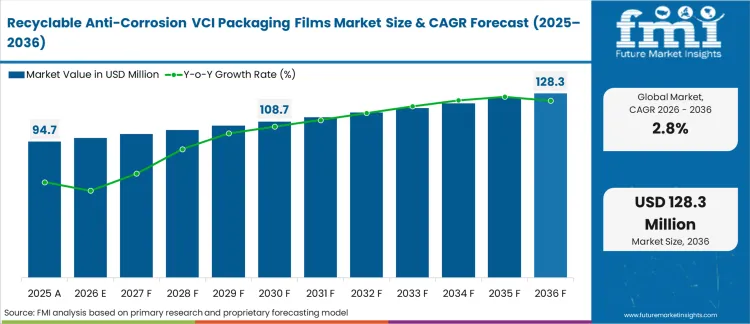
- USD 97.326 Mn
- Forecast (2036)
- USD 128.3 Mn
- CAGR (2026 to 2036)
- 2.8%
Recyclable Anti-Corrosion VCI Packaging Films Market Size, Market Forecast and Outlook By FMI
Recyclable anti-corrosion VCI packaging films market registered USD 94.675 million in 2025. FMI analysis estimates the valuation to reach USD 97.326 million in 2026. Driven by the ongoing shift toward circular logistics systems pushing revenues to USD 128.3 million by 2036, supported by a steady 2.8% annual growth rate. This transition is accelerated as original equipment manufacturers move away from traditional multi‑material barrier foils in favor of mono‑layer polyethylene solutions, which eliminate complex separation requirements at destination ports. Packaging engineers who secure validated post-consumer recycled structures avoid regulatory penalties associated with extended producer responsibility frameworks. Buyers delaying material upgrades forfeit critical contract renewals as sustainability thresholds become mandatory vendor qualifications.
Supply chain sustainability targets force a structural pivot away from single-use synthetic rust inhibitors. Operations directors interpret this material science advancement as proof that heavy-duty metal protection no longer requires permanent landfill accumulation. Facilities integrating these advanced structures directly into standard volatile corrosion inhibitors (VCI) packaging workflows maintain protection profiles while improving end-of-life environmental metrics. Buyers operating without approved circularity documentation forfeit access to European automotive supply contracts before the next formal compliance audit.
Summary of Recyclable Anti-Corrosion VCI Packaging Films Market
- Recyclable Anti-Corrosion VCI Packaging Films Market Definition
- A specialized industrial protective material combining active volatile corrosion inhibitors with easily recovered mono-material polymers to prevent metal oxidation during transit.
- Demand Drivers in the Market
- Stringent extended producer responsibility laws compel industrial exporters to replace unrecyclable multi-layer laminates with compliant mono-material formats.
- Surging global maritime trade volumes elevate baseline requirements for effective salt-fog and humidity barriers during extended transit sequences.
- Advancements in extrusion technology allow converters to incorporate post-consumer recycled resins without diluting the active chemical vapor saturation rates.
- Key Segments Analyzed in the FMI Report
- Shrink VCI Films: 43.1% share driven by demand for conforming protective barriers that eliminate internal condensation on complex geometric machinery.
- Polyethylene (PE): 50.0% share anchored by exceptional chemical inertness and ubiquitous global recycling infrastructure compatibility.
- Metallurgy: 36.0% share supported by massive raw steel and machined component export volumes requiring uncompromised surface preservation.
- Analyst Opinion at FMI
- Ismail Sutaria, Principal Consultant for Packaging, opines, "Most logistics directors assume post-consumer recycled VCI films sacrifice vapor-phase saturation speed, but recent multi-continent shipment data confirms identical corrosion inhibition performance. Operators delaying mono-material adoption citing quality risks will surrender their vendor-list positions to competitors who validated these structures during the last automotive design cycle."
- Strategic Implications / Executive Takeaways
- Replace legacy multi-layer barrier foils with certified recyclable structures to secure preferred vendor status in tier-1 automotive supply chains.
- Formulate localized take-back agreements with key industrial customers to guarantee clean post-consumer resin streams for future extrusion runs.
- Specify mono-material polyethylene bases to bypass incoming European packaging taxes aimed at complex unrecoverable industrial plastics.
- Methodology
- Primary Research: Direct interviews with resin formulators, industrial packaging engineers, and automotive logistics directors across core manufacturing hubs.
- Desk Research: Evaluation of global trade databases, corporate sustainability pledges, and regulatory phase-out schedules for non-recyclable materials.
- Market-Sizing and Forecasting: Bottom-up demand modeling starting from regional metallurgy output volumes and applying verifiable VCI adoption ratios.
- Data Validation and Update Cycle: Findings cross-verified against official national waste reduction mandates and maritime shipping volume trajectories.
Martin Simpson, President & CEO at Daubert Cromwell, opined, "Our new biodegradable VCI films help companies meet sustainability targets with low environmental impact and high recyclability, all without sacrificing performance" [2]. Procurement teams are shifting focus from standalone material cost to total system compliance and end-of-life recovery viability. Packaging coordinators who specify certified circular structures avoid the severe basis-risk exposure currently penalizing operators reliant on fragmented disposal networks. Vendors formulating highly pure mono-material solutions will capture premium VCI films contracts from buyers facing strict regulatory scrutiny.
Asia Pacific captures significant value as expanding domestic manufacturing and heavy machinery exports necessitate robust baseline protection. North American and European sectors transition rapidly toward specialized formulations to satisfy intense local environmental mandates. Latin America and Middle East & Africa show gradual uptake as localized precision engineering projects multiply.
Recyclable Anti-Corrosion VCI Packaging Films Market Definition
Recyclable anti-corrosion VCI packaging films represent specialized extruded polymer substrates infused with volatile corrosion inhibitors designed for complete material recovery. Converters utilize precise dosing techniques to ensure the chemical additives do not disrupt the polymer's downstream reprocessing potential. Manufacturers deploy these materials to establish protective micro-atmospheres around metal assets during challenging transport conditions.
Recyclable Anti-Corrosion VCI Packaging Films Market Inclusions
The category covers mono-layer polyethylene and polypropylene formats, active shrink configurations, and specialized stretch variants containing functional VCI chemistry. It includes structures explicitly designed to enter established commercial recycling streams after their protective lifespan ends. Polyethylene bags incorporating certified post-consumer recycled content while maintaining active vapor emission standards fall strictly within scope.
Recyclable Anti-Corrosion VCI Packaging Films Market Exclusions
The scope excludes conventional non-recyclable multi-layer foil barrier bags and pure kraft papers lacking polymer substrates. It does not include standard rust-preventative oils, liquid coatings, or desiccants used independently of film structures. General-purpose plastic wraps containing zero active corrosion-inhibiting chemical agents are completely excluded from this specific market analysis.
Recyclable Anti-Corrosion VCI Packaging Films Market Research Methodology
- Primary Research: Direct interviews with polymer scientists, global logistics coordinators, and recycling facility operators verified material recovery rates.
- Desk Research: Custom data sets from national environmental protection agencies, corporate product launch announcements, and official maritime trade logs.
- Market-Sizing and Forecasting: Analysts developed a bottom-up adoption model starting from baseline regional crude steel outputs.
- Data Validation and Update Cycle: Projections underwent strict cross-verification against peer-reviewed material science journals and verified industrial benchmarks.
Segmental Analysis
Recyclable Anti-Corrosion VCI Packaging Films Market Analysis by Product
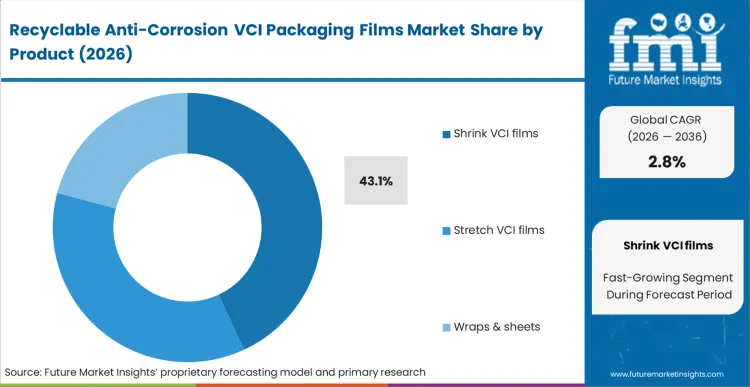
With 12.3 billion tons of maritime trade recorded globally in 2023 [3], ocean transit environments expose untreated industrial metals to severe saline condensation risks. Shrink VCI films capture 43.1% of 2026 category volumes. Logistics planners specify these conformal barriers to eliminate mechanical scuffing during volatile sea crossings. Facilities lacking active VCI shrink films face immediate cargo rejection at receiving docks.
- Conformal Protection: Shrink profiles tightly mirror complex equipment geometries to minimize internal atmospheric volume. Cortec Recycling reported its UV shrink film provides multi-metal protection for up to three years in aggressive outdoor conditions [5].
- Friction Reduction: Tight material adherence prevents abrasive wear on machined surfaces during persistent transit vibrations. Procurement engineers require certified tight-tolerance wrapping to protect high-value turbine components.
- Moisture Exclusion: Continuous thermal seals block external humidity from breaching the active chemical micro-environment. Shippers bypassing continuous sealing protocols suffer catastrophic flash rust incidents during extended staging.
Recyclable Anti-Corrosion VCI Packaging Films Market Analysis by Material
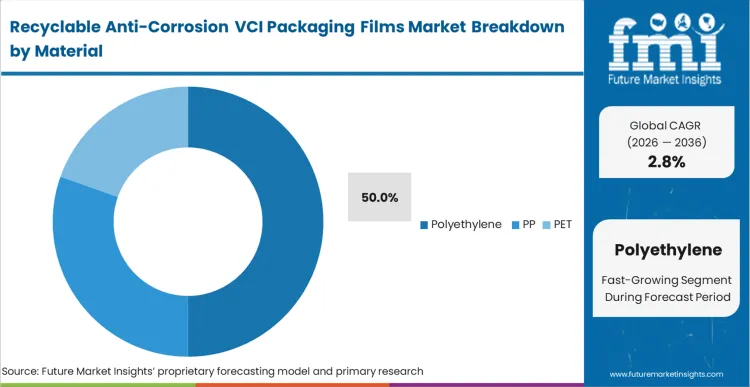
Every automotive exporter bidding on European assembly contracts now faces strict extended producer responsibility documentation requirements. Polyethylene commands 50.0% of 2026 material volumes. Resins providing mono-material purity simplify downstream standard liner recovery streams. Brands utilizing multi-layer laminates forfeit compliance approvals before formal procurement evaluations commence.
- Infrastructure Compatibility: Polyethylene streams represent the most mature and widely accessible industrial recycling networks globally. Buyers prioritize PE structures to guarantee their facilities can seamlessly offload spent materials.
- Chemical Retention: Advanced resin architectures slowly release active molecules without compromising base structural integrity. Formulators achieving precise emission curves dominate preferred supplier rosters.
- Cost Physics: High-volume extrusion runs minimize unit costs compared to complex multi-substrate lamination processes. Manufacturers avoiding pure polymers suffer compounding margin pressure during extended supply contracts.
Recyclable Anti-Corrosion VCI Packaging Films Market Analysis by End use
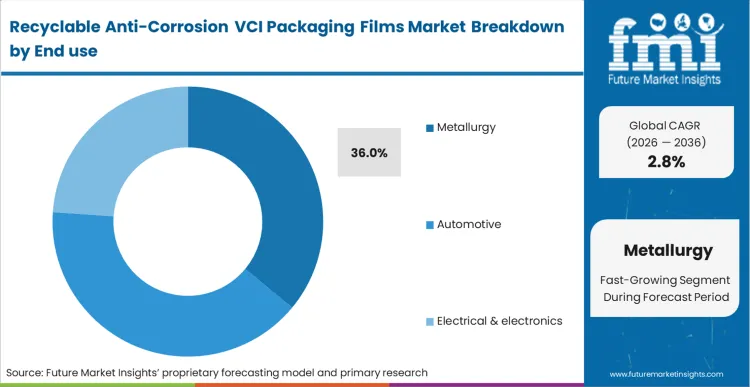
Heavy industrial sectors require prolonged storage stability for raw machined components before final assembly sequences. World Steel Association data confirms global crude steel production reached 1,892.2 million tonnes in 2023 [7]. Metallurgy applications generate 36.0% of demand share. Parts managers depend on active vapor environments to preserve surface finish without applying messy grease coatings. Operations relying on manual oiling incur prohibitive labor costs during component unpackaging sequences.
- Surface Preservation: Active atmospheres eliminate the need for secondary solvent-based cleaning operations upon delivery.
- Process Velocity: Dry packaging formats allow immediate integration of received parts directly into automated assembly lines. Factories demanding rapid throughput disqualify suppliers utilizing viscous rust preventatives.
- Contamination Control: Precise packing paper and film barriers prevent microscopic particulate accumulation on sensitive bearing surfaces. Facilities failing to maintain strict barrier discipline experience elevated post-assembly failure rates.
Recyclable Anti-Corrosion VCI Packaging Films Market Analysis by Format
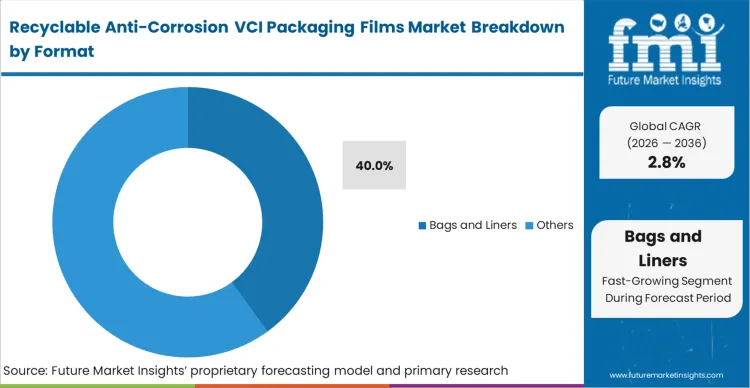
Legacy preservation techniques demanded thick barrier foils combined with complex desiccant configurations. Bags and liners represent 40.0% of 2026 format adoption. United Nations Environment Programme assessments track over 400 million tonnes of annual plastic generation [9]. Converters engineering highly functional thin-gauge anti-corrosion bags reduce total polymer consumption while maintaining active anti-corrosive atmospheres. Warehouses deploying standard barrier plastics suffer accelerated inventory degradation.
- Enclosure Efficiency: Pre-formed dimensions drastically reduce manual packaging time compared to custom sheet wrapping. Assembly directors mandate specific bag geometries to standardize outbound logistics velocity.
- Atmospheric Containment: Sealed environments concentrate vapor molecules directly against vulnerable metal surfaces. Shippers compromising seal integrity forfeit the chemical protection designed into the substrate.
- Volume Optimization: Flexible enclosures adapt to variable cargo configurations within standardized outer shipping crates. Operations failing to optimize internal package volumes face escalating volumetric freight penalties.
Recyclable Anti-Corrosion VCI Packaging Films Market Analysis by Thickness
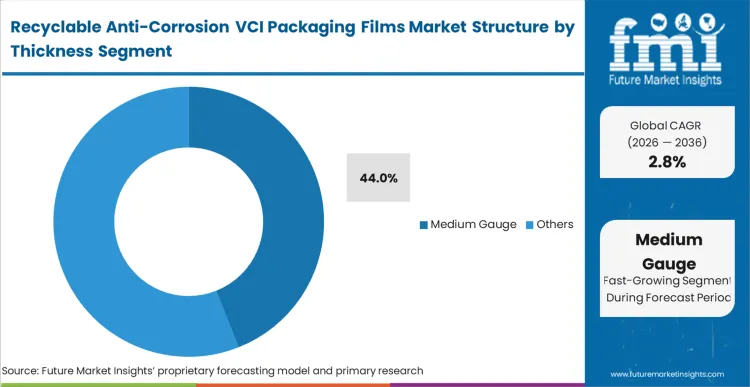
Medium gauge formulations balance physical puncture resistance with optimal active chemical diffusion rates. Medium gauge materials secure 44.0% of 2026 usage. Environmental Protection Agency data shows plastics constituted 12.2% of municipal solid waste generation in the United States [10]. Industrial packers select optimal gauges to minimize unnecessary material weight while guaranteeing structural survival. Distributors over-specifying thickness face compounding freight penalties without realizing measurable protection benefits.
- Puncture Resistance: Machined metal edges require sufficient polymer density to prevent localized barrier breaches. Procurement directors test specific puncture tolerances before approving materials for heavy casting transport.
- Diffusion Kinetics: Vapor release rates correlate directly with the physical polymer matrix construction. Engineers matching specific gauges to expected transit durations avoid premature chemical depletion.
- Weight Reduction: Optimizing material thickness directly lowers total carbon footprint metrics for enterprise sustainability reports. Sustainability officers mandate precise gauge specifications to hit corporate reduction targets.
Recyclable Anti-Corrosion VCI Packaging Films Market Drivers, Restraints, and Opportunities
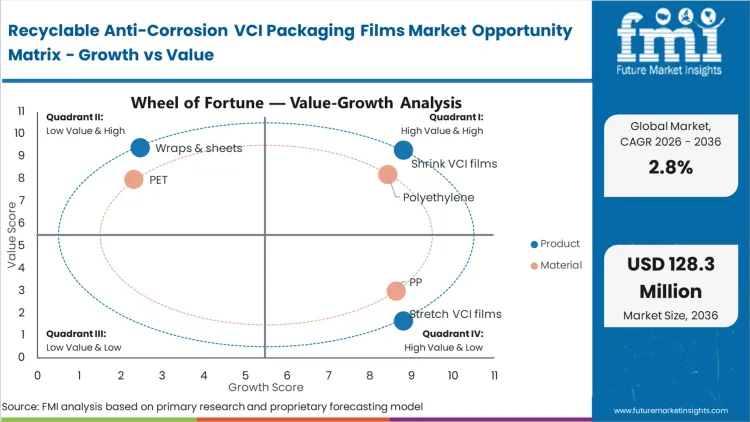
Supply chain sustainability targets fundamentally alter vendor qualification criteria across the industrial packaging sector. United Nations Environment Programme states 19 to 23 million tonnes of plastic waste leak into aquatic ecosystems annually [11]. Logistics directors replacing conventional unrecoverable plastics with certified circular logistics packaging solutions avoid severe impending regulatory penalties. Manufacturers lacking verifiable post-consumer recycled content lose contract bidding rights in advanced European and North American markets.
Severe constraints in flexible plastic recycling infrastructure restrict rapid market conversion. The Recycling Partnership reports less than half of plastic packaging is currently recyclable in the United States [12]. Converters mitigate this bottleneck by establishing dedicated localized take-back programs directly with high-volume industrial clients. Facilities utilizing generic disposal networks face disrupted supply lines when specialized resins fail to process correctly.
- Automotive OEM Mandates: Tier-1 suppliers demand fully circular packaging ecosystems to meet corporate carbon pledges. Cortec updated product information for VpCI-126 HP UV Shrink Film describing multi-metal protection for up to three years [13].
- Marine Transport Expansion: Rising export volumes necessitate advanced salt-fog protection. United Nations Conference on Trade and Development reports over 80% of world trade volume is carried by sea [14].
- Closed-loop Recovery: Direct material repatriation programs guarantee high-purity resin streams for future extrusion. Cortec highlighted circular-economy implementation with Jakob Schober to reduce logistics footprint [15].
Regional Analysis
Based on the regional analysis, the Recyclable Anti-Corrosion VCI Packaging Films market is segmented into North America, Latin America, Europe, East Asia, South Asia, Oceania and Middle East & Africa across 40+ countries. The full report also offers market attractiveness analysis based on regional trends.
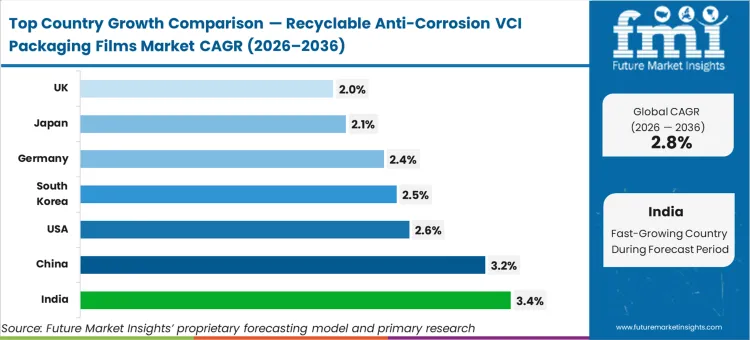
.webp "Top Country Growth Comparison Recyclable Anti Corrosion Vci Packaging Films Market Cagr (2026 2036)")
| Country | CAGR (2026 to 2036) |
|---|---|
| India | 3.4% |
| China | 3.2% |
| USA | 2.6% |
| South Korea | 2.5% |
| Germany | 2.4% |
| Japan | 2.1% |
| UK | 2.0% |
Source: Future Market Insights (FMI) analysis, based on proprietary forecasting model and primary research
East Asia Recyclable Anti-Corrosion VCI Packaging Films Market Analysis
East Asia's manufacturing infrastructure generates unprecedented baseline requirements for effective transit protection. Factories orchestrating vast export volumes depend on reliable vapor-phase coverage to prevent flash rust during extended trans-Pacific shipping routes. United Nations Conference on Trade and Development projects maritime trade growth at approximately 2.4% average annually through 2029 [16]. Procurement teams failing to integrate mono-material barrier films lose their preferred supplier status with multinational corporations enforcing strict supply-chain sustainability quotas. Export coordinators must pivot to verifiable cast stretch films to maintain market access.
- China: China's dominance in heavy industrial equipment manufacturing creates massive demand for metal protection during long-haul logistics. Exporters require robust active environments to shield machinery from variable maritime conditions. United States Geological Survey data measures Chinese cement production at 2.1 billion tonnes in 2023 [17]. This immense infrastructure and machinery output anchors China's 3.2% CAGR for recyclable VCI solutions through the forecast decade. Plant managers utilizing non-compliant packaging face outright rejection at international customs checkpoints.
- South Korea: South Korea's export-oriented automotive sector enforces strict zero-corrosion tolerances for shipped vehicle components. Assembly coordinators mandate specialized UV-stable structures for outdoor staging environments. World Steel Association shows South Korea crude steel production reached 66.7 million tonnes in 2023 [18]. Securing this vital industrial base drives South Korea's 2.5% compound expansion rate for active protective films to 2036. Logistics directors must deploy certified materials before the next procurement cycle closes to retain lucrative OEM contracts.
- Japan: Japan's precision electronics and machinery sectors demand flawless surface preservation during complex supply chain movements. Quality assurance teams validate high-performance mono-layer films to guarantee pristine conditions upon final delivery. United States Geological Survey lists Japan cement production at 50 million tonnes in 2023 [19]. This rigorous quality baseline sustains a 2.1% annual growth rate for specialized corrosion-inhibiting packaging across Japan's industrial corridor. Sourcing executives failing to secure compliant stretch sleeve and shrink sleeve labels forfeit vital technical qualification approvals.
FMI's report includes comprehensive analysis of East Asian market dynamics covering Taiwan and neighboring industrial zones. Rising regulatory pressure regarding single-use plastics forces rapid adoption of pure polyethylene structures across regional trade routes.
North America Recyclable Anti-Corrosion VCI Packaging Films Market Analysis
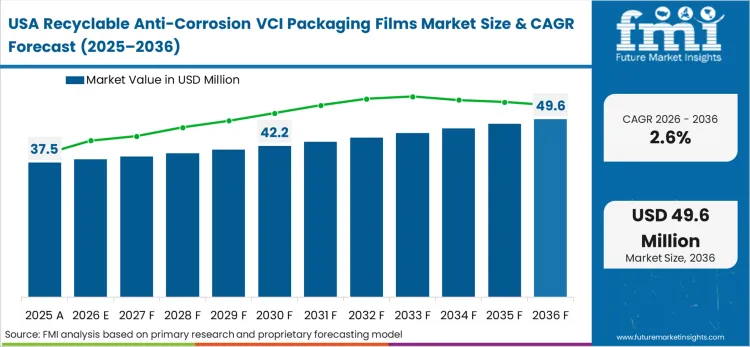
North America's sprawling industrial geography necessitates advanced materials to shield components during cross-continental transit. Supply chain operators transition toward verifiable circular structures to align with intensifying state-level recycling mandates. Bureau of Transportation Statistics reports approximately USD 3.5 billion per day in United States land-border freight shipments [20]. Manufacturers ignoring these sustainability metrics face systematic exclusion from high-value government and defense procurement frameworks. Buyers must secure compliant industrial chemical packaging immediately to maintain operational continuity.
- USA: The vast internal logistics network within the United States exposes unprotected metal components to diverse temperature and humidity extremes. Fleet managers require reliable active barriers to prevent oxidation during extended rail and truck transport. The USA Plastics Pact lists 13.3% as the national recycling rate for plastic packaging [21]. This structural drive toward higher material recovery supports the 2.6% CAGR for specialized anti-corrosion films across the United States. Vendors failing to incorporate verifiable post-consumer recycled content lose their competitive bidding advantage in corporate sustainability tenders.
FMI's report includes detailed evaluation of North American supply networks including Canada and Mexico. Cross-border automotive parts transit heavily dictates the specification requirements for resilient mono-material wrapping solutions.
Europe Recyclable Anti-Corrosion VCI Packaging Films Market Analysis
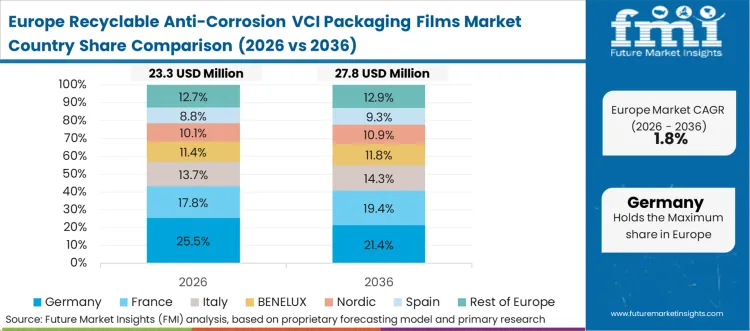
Europe's aggressive environmental legislative agenda accelerates the phase-out of complex unrecyclable barrier materials. Regulators enforce stringent extended producer responsibility taxes that penalize operations utilizing multi-layer laminates. World Steel Association shows Germany crude steel production reached 35.4 million tonnes in 2023 [22]. Shippers avoiding these specialized mono-material adaptations incur devastating financial penalties that erode fundamental profit margins. Production leads must upgrade their linear low density polyethylene specifications before the impending fiscal enforcement deadlines hit.
- Germany: Germany's high-precision machinery sector demands uncompromising rust prevention coupled with strict ecological compliance. Procurement directors specify mono-material formats to satisfy rigorous national packaging waste ordinances. The Recycling Partnership reports 87% of material is sorted and sent to market in today's system estimate [23]. This advanced recovery infrastructure directly enables Germany's 2.4% compound growth rate for circular VCI formats through the 2036 horizon. Operators failing to deploy certified recyclable enclosures face immediate fines and supply chain disqualification under updated federal laws.
- UK: The United Kingdom's specialized aerospace and electronics manufacturing bases require pristine component delivery profiles. Material engineers validate new circular formulations to replace environmentally taxing legacy foils. WWF Transparent 2024 reports flexibles recycling estimated at 7% [24]. Overcoming this specific material recovery constraint sustains the UK's 2.0% annual expansion rate for advanced protective films. Brand owners who do not pivot to verifiable sustainable structures surrender valuable market share to eco-compliant competitors.
FMI's report includes deep structural tracking across European markets including France and Italy. Stringent circular economy directives fundamentally dictate which industrial materials remain legally viable for cross-border transit.
Competitive Aligners for Market Players
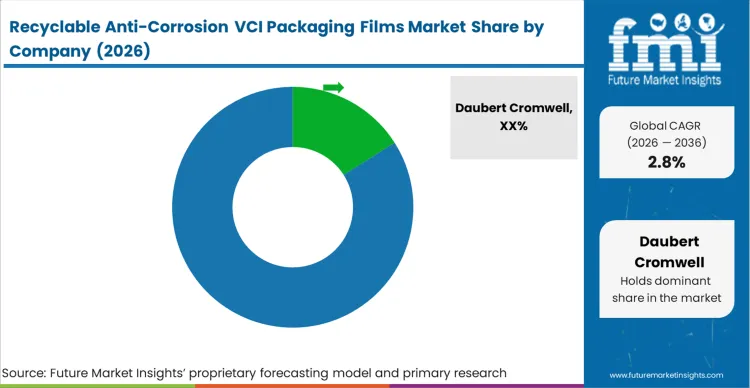
New extended producer responsibility frameworks establish the non-negotiable barrier for industrial packaging qualification. Daubert Cromwell posted details describing BioNatur films as 100% biodegradable and 100% recyclable in April 2025 [25]. Operations directors mandate these verified materials to eliminate downstream disposal liabilities. Packaging suppliers without validated circularity certificates face total disqualification from tier-1 automotive tenders.
Polymer extrusion advancements reset the economic fundamentals of active packaging production. ZERUST published an update describing ZeCycle as a closed-loop recycling program turning used materials into new films [26]. Procurement teams exploit these closed-loop systems to stabilize raw resin costs. Converters reliant on generic open-market plastic supplies suffer devastating margin compression.
Documentation and material transparency shift to central requirements for cross-border shipping approvals. Cortec published a product page for VpCI-126 HP UV Shrink Film PCR explicitly detailing post-consumer recycled metrics [27]. Supply chain coordinators require exact compositional data to satisfy international customs audits. Manufacturers failing to provide absolute material traceability experience severe shipment impoundments.
Recent Developments
The report includes full coverage of key trends from competitive benchmarking. Some of the recent developments covered in the reports:
- In February 2025, Cortec Corporation announced VpCI-126 HP UV Shrink Film PCR combining UV stabilizers with 30% PCR content. [4]
- In March 2025, ZERUST published an update describing ZeCycle, a closed-loop recycling program turning used VCI packaging into new PCR VCI films. [6]
Key Players in Recyclable Anti-Corrosion VCI Packaging Films Market
- Daubert Cromwell
- Cortec Corporation
- Zavenir Daubert
- BRANOpac
- Armor Protective Packaging
- Aicello Corporation
- Nefab Group
Scope of the Report
| Metric | Value |
|---|---|
| Quantitative Units | USD 97.3 million to USD 128.3 million, at a CAGR of 2.8% |
| Market Definition | A specialized industrial protective material combining active volatile corrosion inhibitors with easily recovered mono-material polymers to prevent metal oxidation during transit. |
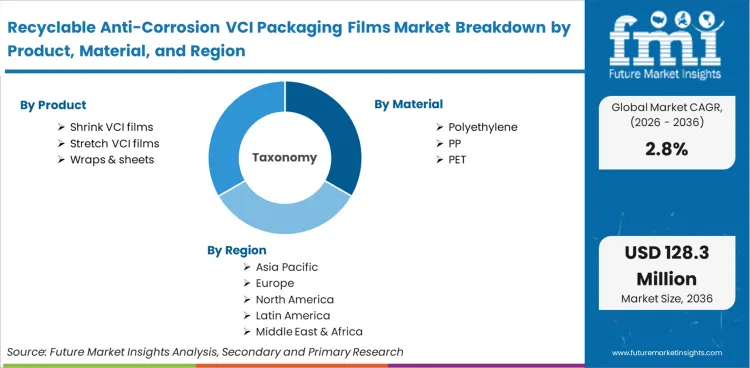
| Product Segmentation | Shrink VCI films, Stretch VCI films, Wraps & sheets, Pouches |
| Material Segmentation | Polyethylene (PE), PP, PET |
| End use Segmentation | Metallurgy, Automotive, Electrical & electronics, Aerospace & defense, Others |
| Format Segmentation | Bags & liners |
| Regions Covered | North America, Latin America, Europe, East Asia, South Asia, Oceania, Middle East and Africa |
| Countries Covered | United States, Canada, Mexico, Brazil, Argentina, Germany, France, United Kingdom, Italy, Spain, China, India, Japan, South Korea, Indonesia, Australia and 40 plus countries |
| Key Companies Profiled | Daubert Cromwell, Cortec Corporation, Zavenir Daubert, BRANOpac, Armor Protective Packaging, Aicello Corporation, Nefab Group |
| Forecast Period | 2026 to 2036 |
| Approach | Bottom-up demand modeling starting from regional metallurgy output volumes and applying verifiable VCI adoption ratios. |
Source: Future Market Insights (FMI) analysis, based on proprietary forecasting model and primary research
Segmental Analysis
Product:
- Shrink VCI films
- Stretch VCI films
- Wraps & sheets
- Pouches
Material:
- Polyethylene (PE)
- PP
- PET
End Use:
- Metallurgy
- Automotive
- Electrical & electronics
- Aerospace & defense
- Others
Format:
- Bags & liners
Region:
- Asia Pacific
- India
- China
- Japan
- South Korea
- Indonesia
- Australia & New Zealand
- ASEAN
- Rest of Asia Pacific
- Europe
- Germany
- Italy
- France
- United Kingdom
- Spain
- Benelux
- Nordics
- Central & Eastern Europe
- Rest of Europe
- North America
- United States
- Canada
- Mexico
- Latin America
- Brazil
- Argentina
- Chile
- Rest of Latin America
- Middle East & Africa
- Kingdom of Saudi Arabia
- United Arab Emirates
- South Africa
- Turkey
- Rest of Middle East & Africa
Bibliography
- [2] Daubert Cromwell. (2025, April). Daubert Cromwell launches world’s first 100% biodegradable and recyclable VCI films with BioNatur® technology. Daubert Cromwell.
- [3] UN Trade and Development (UNCTAD). (2024, October 22). Review of Maritime Transport 2024 (Publication page). UNCTAD.
- [4] Cortec Corporation (EcoCortec®). (2025, February 25). EcoCortec® and Jakob Schober GmbH implementing a circular economy in the VCI films market: Cortec’s powerful VpCI®-126 HP UV Shrink Film now available in PCR version (Press release). Cortec Corporation.
- [5] Cortec Recycling. (2024, February 19). Powerful UV shrink film with 30% recycled content stops corrosion in aggressive environments (Press release). Cortec Recycling.
- [6] ZERUST Solutions. (2025, March 4). Introducing ZeCycle: A sustainable closed-loop VCI recycling program from ZERUST® & RecycleMax® (Company update). ZERUST.
- [7] World Steel Association (worldsteel). (2024, May 27). World Steel in Figures 2024. worldsteel.
- [9] United Nations Environment Programme (UNEP). (2024). Taking on plastic pollution (UNEP Annual Report 2024 story). UNEP.
- [11] United Nations Environment Programme (UNEP). (2025, July 1). Plastic pollution (Topic page). UNEP.
- [12] The Recycling Partnership. (2024, January 12). State of Recycling 2024 (Report). The Recycling Partnership.
- [13] Cortec Corporation. (2026, February 10). VpCI®-126 HP UV Shrink Film (Product page/update). Cortec Corporation.
- [14] UN Trade and Development (UNCTAD). (n.d.). Review of Maritime Transport. UNCTAD.
- [15] Cortec Corporation (EcoCortec®). (2025, February 25). EcoCortec® and Jakob Schober GmbH implementing a circular economy in the VCI films market (Press release). Cortec Corporation.
- [16] UN Trade and Development (UNCTAD). (2024, October 22). Review of Maritime Transport 2024. UNCTAD.
- [17] USA Geological Survey. (2024, January). Mineral Commodity Summaries 2024: Cement (Commodity chapter). USGS.
- [18] World Steel Association (worldsteel). (2024, May 27). World Steel in Figures 2024. worldsteel.
- [19] USA Geological Survey. (2024, January). Mineral Commodity Summaries 2024: Cement. USGS.
- [20] Bureau of Transportation Statistics. (2025, March 20). TransBorder Freight Annual Report 2024 (Government report page). USA Department of Transportation.
- [21] USA Plastics Pact. (2024-2025). 2023-24 Impact Report (Impact report page). USA Plastics Pact.
- [22] World Steel Association (worldsteel). (2024, May 27). World Steel in Figures 2024. worldsteel.
- [23] EUROFER. (2024). European Steel in Figures 2024. EUROFER.
- [24] WRAP. (2024, July). Film and flexible packaging roadmap 2025 (Report). WRAP.
- [25] Daubert Cromwell. (2025, April). Daubert Cromwell launches world’s first 100% biodegradable and recyclable VCI films with BioNatur® technology (Press release PDF; posted April 2, 2025). Daubert Cromwell.
- [26] ZERUST Solutions. (2025, March 4). Introducing ZeCycle: A sustainable closed-loop VCI recycling program from ZERUST® & RecycleMax® (Company news release/blog). ZERUST.
- [27] Cortec Corporation. (2024, December 20). VpCI®-126 HP UV Shrink Film PCR (Product Data Sheet; guaranteed 30% PCR). Cortec Corporation.
This bibliography is provided for reader reference and is not exhaustive. The full report contains the complete reference list and detailed citations.
This Report Addresses
- Market sizing data covering the 2025 baseline and precise expansion trajectories through 2036.
- Regulatory tracking logic defining material transition deadlines across European and North American industrial hubs.
- Format substitution analysis detailing the shift from heavy-gauge multi-layer foils to optimized mono-material films.
- Polymer utilization metrics mapping the required inclusion of certified post-consumer recycled content in new extrusions.
- Supply chain vulnerability assessments pinpointing critical bottlenecks in localized plastic recovery networks.
- Vendor compliance thresholds dictating immediate operational adjustments for protective packaging convertors.
- Regional demand breakdowns aligning raw material output with specific corrosion-inhibiting asset protection needs.
- Report delivery modules encompassing actionable PDF files, raw Excel datasets, comprehensive PPT summaries, and interactive operational dashboards.
Frequently Asked Questions
How large is the demand for Recyclable Anti-Corrosion VCI Packaging Films in the global market in 2026?
Demand for Recyclable Anti-Corrosion VCI Packaging Films in the global market is estimated to be valued at USD 97.3 million in 2026.
What will be the market size of Recyclable Anti-Corrosion VCI Packaging Films in the global market by 2036?
Market size for Recyclable Anti-Corrosion VCI Packaging Films is projected to reach USD 128.3 million by 2036.
What is the expected demand growth for Recyclable Anti-Corrosion VCI Packaging Films in the global market between 2026 and 2036?
Demand for Recyclable Anti-Corrosion VCI Packaging Films is expected to grow at a CAGR of 2.8% between 2026 and 2036.
Which Product is poised to lead global sales by 2026?
Shrink VCI films accounts for 43.1% in 2026 as logistics planners specify conforming barriers to eliminate internal condensation during transit.
How significant is the role of Metallurgy in driving Recyclable Anti-Corrosion VCI Packaging Films adoption in 2026?
Metallurgy represents 36.0% of segment share as heavy parts managers require prolonged storage stability without grease coatings.
What is driving demand in India?
Surging manufacturing output drives critical requirements for verifiable export protection materials.
What compliance standards or regulations are referenced for Germany?
Strict national packaging waste ordinances and extended producer responsibility laws mandate verifiable mono-material designs.
What is the China growth outlook in this report?
China is projected to grow at a CAGR of 3.2% during 2026 to 2036.
Why is North America described as a priority region in this report?
Expanding internal land-border freight networks force rapid upgrades to durable, compliance-ready protective enclosures.
What type of demand dominates in North America?
Cross-continental industrial component transit demanding robust puncture resistance and active vapor saturation.
What is USA's growth outlook in this report?
USA is projected to expand at a CAGR of 2.6% during 2026 to 2036.
Does the report cover South Korea in its regional analysis?
Yes, South Korea is included within East Asia under the regional scope of analysis.
What are the sources referred to for analyzing South Korea?
Official crude steel production metrics from the World Steel Association and corporate product launch specifications form the analytical basis.
What is the main demand theme linked to South Korea in its region coverage?
Zero-tolerance export qualifications force rapid adoption of UV-stable circular film configurations.
Does the report cover Japan in its regional analysis?
Yes, Japan is included within East Asia under the regional coverage framework.
What is the main Japan related demand theme in its region coverage?
Precision automotive requirements dictate flawless surface preservation and strict material documentation.
Which product formats or configurations are strategically important for Europe supply chains?
Mono-material polyethylene bases incorporating certified post-consumer recycled content hold immense strategic value.
What is Recyclable Anti-Corrosion VCI Packaging Films and what is it mainly used for?
It is a specialized protective polymer substrate infused with active chemical vapor molecules designed to prevent metal oxidation while ensuring complete downstream recyclability.
What does Recyclable Anti-Corrosion VCI Packaging Films mean in this report?
The market refers to active mono-material wrapping solutions built to enter established commercial disposal streams post-use.
What is included in the scope of this Recyclable Anti-Corrosion VCI Packaging Films report?
Included are polyethylene and polypropylene formats, shrink configurations, and active stretch variants containing verifiable functional chemistry.
What is excluded from the scope of this report?
Non-recyclable multi-layer foil bags, generic liquid coatings, isolated desiccants, and inert plastic wraps are strictly excluded.
What does market forecast mean on this page?
The market forecast represents a model-based projection built on defined industrial and capacity assumptions for strategic planning purposes.
How does FMI build and validate the Recyclable Anti-Corrosion VCI Packaging Films forecast?
Forecasts combine bottom-up demand modeling starting from regional metallurgy output volumes, validated by direct interviews with packaging engineers.
What does zero reliance on speculative third-party market research mean here?
Primary interviews, verified corporate launch documents, and official government logistics datasets are used exclusively instead of unverified syndicated estimates.
Preview the report firsthand - request a free sample
Get SampleGet the brochure for pricing and purchase details.
Get PDFTable of Content
- Executive Summary
- Global Market Outlook
- Demand-side Trends
- Supply-side Trends
- Technology Roadmap Analysis
- Analysis and Recommendations
- Market Overview
- Market Coverage / Taxonomy
- Market Definition / Scope / Limitations
- Research Methodology
- Chapter Orientation
- Analytical Lens and Working Hypotheses
- Market Structure, Signals, and Trend Drivers
- Benchmarking and Cross-market Comparability
- Market Sizing, Forecasting, and Opportunity Mapping
- Research Design and Evidence Framework
- Desk Research Programme (Secondary Evidence)
- Company Annual and Sustainability Reports
- Peer-reviewed Journals and Academic Literature
- Corporate Websites, Product Literature, and Technical Notes
- Earnings Decks and Investor Briefings
- Statutory Filings and Regulatory Disclosures
- Technical White Papers and Standards Notes
- Trade Journals, Industry Magazines, and Analyst Briefs
- Conference Proceedings, Webinars, and Seminar Materials
- Government Statistics Portals and Public Data Releases
- Press Releases and Reputable Media Coverage
- Specialist Newsletters and Curated Briefings
- Sector Databases and Reference Repositories
- FMI Internal Proprietary Databases and Historical Market Datasets
- Subscription Datasets and Paid Sources
- Social Channels, Communities, and Digital Listening Inputs
- Additional Desk Sources
- Expert Input and Fieldwork (Primary Evidence)
- Primary Modes
- Qualitative Interviews and Expert Elicitation
- Quantitative Surveys and Structured Data Capture
- Blended Approach
- Why Primary Evidence is Used
- Field Techniques
- Interviews
- Surveys
- Focus Groups
- Observational and In-context Research
- Social and Community Interactions
- Stakeholder Universe Engaged
- C-suite Leaders
- Board Members
- Presidents and Vice Presidents
- R&D and Innovation Heads
- Technical Specialists
- Domain Subject-matter Experts
- Scientists
- Physicians and Other Healthcare Professionals
- Governance, Ethics, and Data Stewardship
- Research Ethics
- Data Integrity and Handling
- Primary Modes
- Tooling, Models, and Reference Databases
- Desk Research Programme (Secondary Evidence)
- Data Engineering and Model Build
- Data Acquisition and Ingestion
- Cleaning, Normalisation, and Verification
- Synthesis, Triangulation, and Analysis
- Quality Assurance and Audit Trail
- Market Background
- Market Dynamics
- Drivers
- Restraints
- Opportunity
- Trends
- Scenario Forecast
- Demand in Optimistic Scenario
- Demand in Likely Scenario
- Demand in Conservative Scenario
- Opportunity Map Analysis
- Product Life Cycle Analysis
- Supply Chain Analysis
- Investment Feasibility Matrix
- Value Chain Analysis
- PESTLE and Porter’s Analysis
- Regulatory Landscape
- Regional Parent Market Outlook
- Production and Consumption Statistics
- Import and Export Statistics
- Market Dynamics
- Global Market Analysis 2021 to 2025 and Forecast, 2026 to 2036
- Historical Market Size Value (USD Million) Analysis, 2021 to 2025
- Current and Future Market Size Value (USD Million) Projections, 2026 to 2036
- Y-o-Y Growth Trend Analysis
- Absolute $ Opportunity Analysis
- Global Market Pricing Analysis 2021 to 2025 and Forecast 2026 to 2036
- Global Market Analysis 2021 to 2025 and Forecast 2026 to 2036, By Product
- Introduction / Key Findings
- Historical Market Size Value (USD Million) Analysis By Product , 2021 to 2025
- Current and Future Market Size Value (USD Million) Analysis and Forecast By Product , 2026 to 2036
- Shrink VCI films
- Stretch VCI films
- Wraps & sheets
- Shrink VCI films
- Y-o-Y Growth Trend Analysis By Product , 2021 to 2025
- Absolute $ Opportunity Analysis By Product , 2026 to 2036
- Global Market Analysis 2021 to 2025 and Forecast 2026 to 2036, By Material
- Introduction / Key Findings
- Historical Market Size Value (USD Million) Analysis By Material, 2021 to 2025
- Current and Future Market Size Value (USD Million) Analysis and Forecast By Material, 2026 to 2036
- Polyethylene
- PP
- PET
- Polyethylene
- Y-o-Y Growth Trend Analysis By Material, 2021 to 2025
- Absolute $ Opportunity Analysis By Material, 2026 to 2036
- Global Market Analysis 2021 to 2025 and Forecast 2026 to 2036, By End use
- Introduction / Key Findings
- Historical Market Size Value (USD Million) Analysis By End use, 2021 to 2025
- Current and Future Market Size Value (USD Million) Analysis and Forecast By End use, 2026 to 2036
- Metallurgy
- Automotive
- Electrical & electronics
- Metallurgy
- Y-o-Y Growth Trend Analysis By End use, 2021 to 2025
- Absolute $ Opportunity Analysis By End use, 2026 to 2036
- Global Market Analysis 2021 to 2025 and Forecast 2026 to 2036, By Format
- Introduction / Key Findings
- Historical Market Size Value (USD Million) Analysis By Format, 2021 to 2025
- Current and Future Market Size Value (USD Million) Analysis and Forecast By Format, 2026 to 2036
- Bags and Liners
- Others
- Bags and Liners
- Y-o-Y Growth Trend Analysis By Format, 2021 to 2025
- Absolute $ Opportunity Analysis By Format, 2026 to 2036
- Global Market Analysis 2021 to 2025 and Forecast 2026 to 2036, By Thickness
- Introduction / Key Findings
- Historical Market Size Value (USD Million) Analysis By Thickness, 2021 to 2025
- Current and Future Market Size Value (USD Million) Analysis and Forecast By Thickness, 2026 to 2036
- Medium Gauge
- Others
- Medium Gauge
- Y-o-Y Growth Trend Analysis By Thickness, 2021 to 2025
- Absolute $ Opportunity Analysis By Thickness, 2026 to 2036
- Global Market Analysis 2021 to 2025 and Forecast 2026 to 2036, By Region
- Introduction
- Historical Market Size Value (USD Million) Analysis By Region, 2021 to 2025
- Current Market Size Value (USD Million) Analysis and Forecast By Region, 2026 to 2036
- North America
- Latin America
- Western Europe
- Eastern Europe
- East Asia
- South Asia and Pacific
- Middle East & Africa
- Market Attractiveness Analysis By Region
- North America Market Analysis 2021 to 2025 and Forecast 2026 to 2036, By Country
- Historical Market Size Value (USD Million) Trend Analysis By Market Taxonomy, 2021 to 2025
- Market Size Value (USD Million) Forecast By Market Taxonomy, 2026 to 2036
- By Country
- USA
- Canada
- Mexico
- By Product
- By Material
- By End use
- By Format
- By Thickness
- By Country
- Market Attractiveness Analysis
- By Country
- By Product
- By Material
- By End use
- By Format
- By Thickness
- Key Takeaways
- Latin America Market Analysis 2021 to 2025 and Forecast 2026 to 2036, By Country
- Historical Market Size Value (USD Million) Trend Analysis By Market Taxonomy, 2021 to 2025
- Market Size Value (USD Million) Forecast By Market Taxonomy, 2026 to 2036
- By Country
- Brazil
- Chile
- Rest of Latin America
- By Product
- By Material
- By End use
- By Format
- By Thickness
- By Country
- Market Attractiveness Analysis
- By Country
- By Product
- By Material
- By End use
- By Format
- By Thickness
- Key Takeaways
- Western Europe Market Analysis 2021 to 2025 and Forecast 2026 to 2036, By Country
- Historical Market Size Value (USD Million) Trend Analysis By Market Taxonomy, 2021 to 2025
- Market Size Value (USD Million) Forecast By Market Taxonomy, 2026 to 2036
- By Country
- Germany
- UK
- Italy
- Spain
- France
- Nordic
- BENELUX
- Rest of Western Europe
- By Product
- By Material
- By End use
- By Format
- By Thickness
- By Country
- Market Attractiveness Analysis
- By Country
- By Product
- By Material
- By End use
- By Format
- By Thickness
- Key Takeaways
- Eastern Europe Market Analysis 2021 to 2025 and Forecast 2026 to 2036, By Country
- Historical Market Size Value (USD Million) Trend Analysis By Market Taxonomy, 2021 to 2025
- Market Size Value (USD Million) Forecast By Market Taxonomy, 2026 to 2036
- By Country
- Russia
- Poland
- Hungary
- Balkan & Baltic
- Rest of Eastern Europe
- By Product
- By Material
- By End use
- By Format
- By Thickness
- By Country
- Market Attractiveness Analysis
- By Country
- By Product
- By Material
- By End use
- By Format
- By Thickness
- Key Takeaways
- East Asia Market Analysis 2021 to 2025 and Forecast 2026 to 2036, By Country
- Historical Market Size Value (USD Million) Trend Analysis By Market Taxonomy, 2021 to 2025
- Market Size Value (USD Million) Forecast By Market Taxonomy, 2026 to 2036
- By Country
- China
- Japan
- South Korea
- By Product
- By Material
- By End use
- By Format
- By Thickness
- By Country
- Market Attractiveness Analysis
- By Country
- By Product
- By Material
- By End use
- By Format
- By Thickness
- Key Takeaways
- South Asia and Pacific Market Analysis 2021 to 2025 and Forecast 2026 to 2036, By Country
- Historical Market Size Value (USD Million) Trend Analysis By Market Taxonomy, 2021 to 2025
- Market Size Value (USD Million) Forecast By Market Taxonomy, 2026 to 2036
- By Country
- India
- ASEAN
- Australia & New Zealand
- Rest of South Asia and Pacific
- By Product
- By Material
- By End use
- By Format
- By Thickness
- By Country
- Market Attractiveness Analysis
- By Country
- By Product
- By Material
- By End use
- By Format
- By Thickness
- Key Takeaways
- Middle East & Africa Market Analysis 2021 to 2025 and Forecast 2026 to 2036, By Country
- Historical Market Size Value (USD Million) Trend Analysis By Market Taxonomy, 2021 to 2025
- Market Size Value (USD Million) Forecast By Market Taxonomy, 2026 to 2036
- By Country
- Kingdom of Saudi Arabia
- Other GCC Countries
- Turkiye
- South Africa
- Other African Union
- Rest of Middle East & Africa
- By Product
- By Material
- By End use
- By Format
- By Thickness
- By Country
- Market Attractiveness Analysis
- By Country
- By Product
- By Material
- By End use
- By Format
- By Thickness
- Key Takeaways
- Key Countries Market Analysis
- USA
- Pricing Analysis
- Market Share Analysis, 2025
- By Product
- By Material
- By End use
- By Format
- By Thickness
- Canada
- Pricing Analysis
- Market Share Analysis, 2025
- By Product
- By Material
- By End use
- By Format
- By Thickness
- Mexico
- Pricing Analysis
- Market Share Analysis, 2025
- By Product
- By Material
- By End use
- By Format
- By Thickness
- Brazil
- Pricing Analysis
- Market Share Analysis, 2025
- By Product
- By Material
- By End use
- By Format
- By Thickness
- Chile
- Pricing Analysis
- Market Share Analysis, 2025
- By Product
- By Material
- By End use
- By Format
- By Thickness
- Germany
- Pricing Analysis
- Market Share Analysis, 2025
- By Product
- By Material
- By End use
- By Format
- By Thickness
- UK
- Pricing Analysis
- Market Share Analysis, 2025
- By Product
- By Material
- By End use
- By Format
- By Thickness
- Italy
- Pricing Analysis
- Market Share Analysis, 2025
- By Product
- By Material
- By End use
- By Format
- By Thickness
- Spain
- Pricing Analysis
- Market Share Analysis, 2025
- By Product
- By Material
- By End use
- By Format
- By Thickness
- France
- Pricing Analysis
- Market Share Analysis, 2025
- By Product
- By Material
- By End use
- By Format
- By Thickness
- India
- Pricing Analysis
- Market Share Analysis, 2025
- By Product
- By Material
- By End use
- By Format
- By Thickness
- ASEAN
- Pricing Analysis
- Market Share Analysis, 2025
- By Product
- By Material
- By End use
- By Format
- By Thickness
- Australia & New Zealand
- Pricing Analysis
- Market Share Analysis, 2025
- By Product
- By Material
- By End use
- By Format
- By Thickness
- China
- Pricing Analysis
- Market Share Analysis, 2025
- By Product
- By Material
- By End use
- By Format
- By Thickness
- Japan
- Pricing Analysis
- Market Share Analysis, 2025
- By Product
- By Material
- By End use
- By Format
- By Thickness
- South Korea
- Pricing Analysis
- Market Share Analysis, 2025
- By Product
- By Material
- By End use
- By Format
- By Thickness
- Russia
- Pricing Analysis
- Market Share Analysis, 2025
- By Product
- By Material
- By End use
- By Format
- By Thickness
- Poland
- Pricing Analysis
- Market Share Analysis, 2025
- By Product
- By Material
- By End use
- By Format
- By Thickness
- Hungary
- Pricing Analysis
- Market Share Analysis, 2025
- By Product
- By Material
- By End use
- By Format
- By Thickness
- Kingdom of Saudi Arabia
- Pricing Analysis
- Market Share Analysis, 2025
- By Product
- By Material
- By End use
- By Format
- By Thickness
- Turkiye
- Pricing Analysis
- Market Share Analysis, 2025
- By Product
- By Material
- By End use
- By Format
- By Thickness
- South Africa
- Pricing Analysis
- Market Share Analysis, 2025
- By Product
- By Material
- By End use
- By Format
- By Thickness
- USA
- Market Structure Analysis
- Competition Dashboard
- Competition Benchmarking
- Market Share Analysis of Top Players
- By Regional
- By Product
- By Material
- By End use
- By Format
- By Thickness
- Competition Analysis
- Competition Deep Dive
- Daubert Cromwell
- Overview
- Product Portfolio
- Profitability by Market Segments (Product/Age /Sales Channel/Region)
- Sales Footprint
- Strategy Overview
- Marketing Strategy
- Product Strategy
- Channel Strategy
- Cortec Corporation
- Zavenir Daubert
- BRANOpac
- Armor Protective Packaging
- Aicello Corporation
- Nefab Group
- Daubert Cromwell
- Competition Deep Dive
- Assumptions & Acronyms Used


