

- Industry Size (2026)
- USD 2.1 Bn
- Forecast (2036)
- USD 4.7 Bn
- CAGR (2026 to 2036)
- 8.60%
Recyclable Lidding Films Market Size, Market Forecast and Outlook By FMI
The recyclable lidding films market was valued at USD 1.9 billion in 2025. Revenue is poised to cross USD 2.1 billion in 2026 at a CAGR of 8.60% during the forecast period. Cumulative buildup lifts the overall opportunity to USD 4.7 billion through 2036 as converter migration toward mono-material lidding films locks into standard production lines.
Packaging engineers face immediate compliance mandates under incoming regional waste regulations. Transitioning away from mixed-polymer laminates requires requalifying entire sealing architectures before upcoming bans take effect. Delaying validation forces brands into steep extended producer responsibility penalties. Finding valid lidding films requires balancing seal integrity against recycling stream compatibility. Material scientists face difficult choices where specific high barrier recyclable lidding film formats achieve compliance at the expense of peel consistency.
Summary of Recyclable Lidding Films Market
- Recyclable Lidding Films Market Definition
- Recyclable top-web sealing structures define this specific sector. These formats close thermoformed trays while maintaining compatibility with established mechanical recovery streams. Functional boundaries rest strictly on post-consumer processing capability and sorting facility compatibility.
- Demand Drivers in the Market
- Legislative waste penalties force procurement directors to replace unrecyclable laminates.
- Retailer sustainability pledges require category managers to adopt mono-material tray combinations.
- Sorting facility mandates compel packaging engineers to specify near-infrared detectable polymer blends.
- Key Segments Analyzed in the FMI Report
- Material: PET films are expected to hold 34.0% share in 2026, matching existing rigid tray substrates perfectly for food grade recyclable lid film applications.
- End Use: Fresh food is projected to capture 46.0% share in 2026, balancing moisture control requirements with shelf-life extension.
- Seal Type: Easy-peel is poised to reach 39.0% share in 2026, satisfying consumer accessibility demands.
- Tray Substrate: PET trays are anticipated to represent 36.0% share in 2026, anchoring widespread flexible packaging circularity initiatives.
- Thickness: 30-50 micron is estimated to secure 41.0% share in 2026, optimizing barrier protection against material weight.
- India: The packaged food sector is recording compound growth of 10.4%, supported by rapid expansion from a relatively low installed base.
- Analyst Opinion at FMI
- Ismail Sutaria, Principal Analyst, Packaging, at FMI, points out, "Standard permeation testing measures oxygen transmission rates on perfectly flat film samples under ideal laboratory conditions. This baseline measurement misses what actually happens during high-speed thermoforming cycles. Once a mono-polymer web undergoes mechanical stretching and aggressive jaw sealing, inherent barrier coatings frequently develop microscopic fractures. Packaging engineers relying solely on technical data sheets often experience catastrophic shelf-life failures during real-world distribution. True validation requires measuring gas exchange after full machine cycling. Suppliers providing predictive models for post-seal barrier degradation secure immediate technical approval from wary procurement teams."
- Strategic Implications / Executive Takeaways
- Procurement heads face immediate requalification requirements to avoid incoming legislative taxation.
- Tooling engineers must recalibrate aging heat-seal jaws to handle precise mono-polymer melting points.
- Merchandising directors risk severe product delisting if legacy laminates fail retail recyclability audits.
- Methodology
- Primary conversations engage procurement directors and senior packaging engineers.
- Secondary verification reviews extended producer responsibility guidelines and Association of Plastic Recyclers design standards.
- Baseline calculations derive from installed thermoforming capacity.
- Independent validation utilizes polymer extrusion resin shipment tracking.
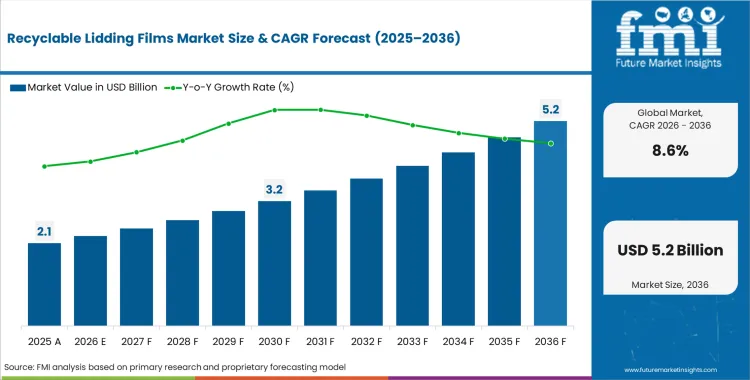
Recyclable Lidding Films Market Key Takeaways
| Metric | Details |
|---|---|
| Industry Size (2026) | USD 2.1 billion |
| Industry Value (2036) | USD 4.7 billion |
| CAGR (2026-2036) | 8.60% |
Source: Future Market Insights (FMI) analysis, based on proprietary forecasting model and primary research
When top-tier thermoformers standardize heating profiles for mono PET lid film for trays, industry adoption accelerates immediately. Converters wait for machinery makers to solve jaw-temperature sensitivities inherent to biodegradable lidding films before scaling output. Reaching this thermal validation threshold removes primary conversion risks for mid-sized packers.
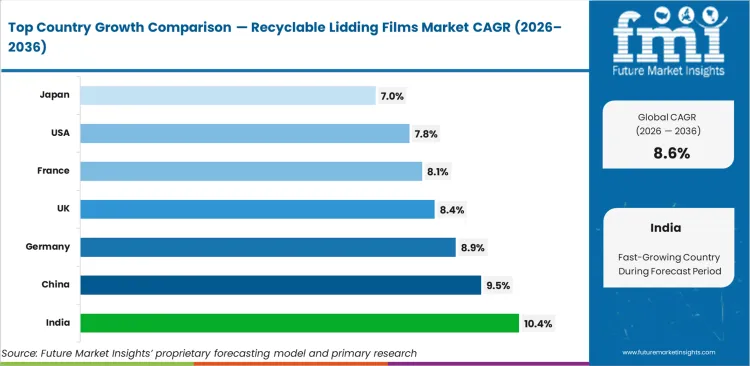
India leads at 10.4% compound growth, driven by rapid packaged-food expansion scaling from a lower installed flexible-packaging base. China tracks closely at 9.5% on similar mass-market retail transition logic. Germany follows at 8.9% as intense regulatory design-for-recycling compliance forces rapid substitution across the Europe recyclable lidding films sector. United Kingdom advances at 8.4% on retail-mandated mono-material directives. France expands at 8.1% supported by local producer responsibility schemes. United States grows at 7.8% as slower conversion cycles dictate measured adoption across mature packaging systems. Japan registers 7.0% owing to extensive existing line validation requirements delaying immediate overhauls. Structural divergence separates high-growth developing retail systems from mature markets burdened by legacy machinery requalification.
Recyclable Lidding Films Market Definition
The recyclable lidding films market comprises top-web sealing structures designed for rigid container applications. These formats close thermoformed trays while maintaining compatibility with established mechanical recovery streams. The functional scope is defined by post-consumer processing capability and compatibility with existing sorting infrastructure. Material constructions are designed to withstand commercial sorting and re-pelletization processes without compromising recyclability. Incorporating breathable lidding film formats adds specific gas-exchange variables for fresh produce applications.
Recyclable Lidding Films Market Inclusions
Scope includes recyclable PET lidding film, recyclable PP lidding film, and mono-PE sealing substrates designed for rigid container closure. The scope also includes paper-hybrid formats that meet recyclability criteria. Formats include lock-seal, easy-peel, and anti-fog variants meeting recognized design-for-recycling guidelines. Specialized dual ovenable lidding films qualify only if certified compatible with standard rigid recycling infrastructure. Rollstock materials sold to primary food packers represent the core focus.
Recyclable Lidding Films Market Exclusions
Multi-material laminates containing non-separable EVOH or PVdC layers are excluded due to their incompatibility with recycling processes. The scope excludes structures that are incompatible with automated sorting systems. General packaging films used for flow-wrapping or vertical form-fill-seal pouches are excluded entirely. Compostable or biodegradable substrates that do not meet mechanical recyclability standards are excluded from the market definition.
Recyclable Lidding Films Market Research Methodology
- Primary Research: Procurement directors and senior packaging engineers active in rigid tray conversion facilities evaluate material performance specifications.
- Desk Research: Extended producer responsibility guidelines, Association of Plastic Recyclers design standards, and regional packaging waste directives provide structural compliance data.
- Market-Sizing and Forecasting: Installed base capacity for thermoforming and tray-sealing equipment anchors baseline material consumption volume.
- Data Validation and Update Cycle: Polymer extrusion resin shipments and secondary recycling facility intake volumes cross-validate projected market scaling.
Segmental Analysis
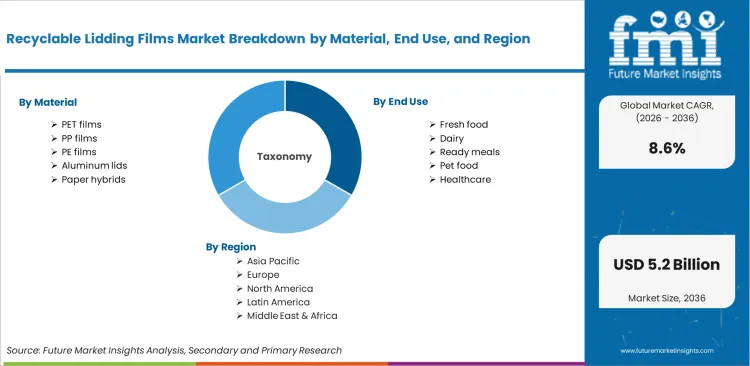
Recyclable Lidding Films Market Analysis by Material
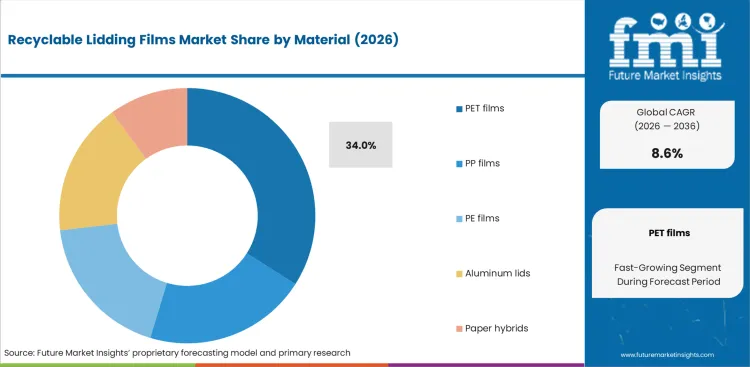
Polymer purity plays a key role in determining how effectively materials can be recovered after use, particularly within European sorting systems. High-purity polymers are more compatible with existing collection and reprocessing infrastructure, which improves sorting efficiency and limits contamination during recycling. PET films are expected to hold a 34.0% share in 2026, largely due to their strong integration with established rPET recycling loops. Packaging engineers often choose PET to align with rigid PET trays, helping create consistent mono-material packaging formats.
Using recycle-ready films requires careful adjustments in sealing conditions. Teams need to fine-tune sealing jaw temperatures so that heat-seal layers bond properly without affecting the base material. One important but often overlooked issue is that certain anti-fog coatings can interfere with near-infrared sorting systems, which may cause otherwise recyclable materials to be diverted into waste streams. Procurement teams comparing mono-material and multilayer lidding films also face regulatory pressure, as failing optical sorting requirements under EU packaging waste rules can lead to product delisting.
- Thermal tolerance: Mono-PET can handle high sealing temperatures during fast production cycles. This allows operators to maintain higher speeds without risking film damage.
- Optical sorting: Near-infrared scanners can easily detect pure PET materials. This helps recycling facilities separate them efficiently into high-quality recycled streams.
- Layer adhesion: Sealant layers need to be kept minimal to maintain the purity of the base polymer. Quality control teams monitor thickness closely to ensure the material meets recycling standards.
Recyclable Lidding Films Market Analysis by End Use
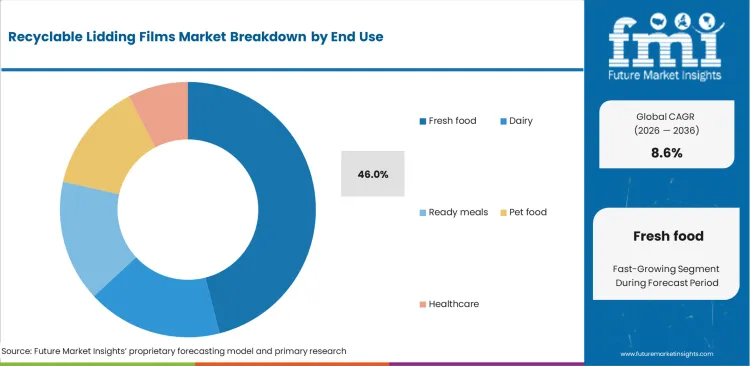
Fresh food is expected to hold a 46.0% share in 2026, as supermarkets push for extended freshness without relying on mixed-plastic materials. Balancing longer shelf life with proper moisture control creates a challenging trade-off in packaging design. Category managers are increasingly choosing mono-material packaging to meet sustainability commitments. Adapting recyclable lidding films for fresh meat trays requires maintaining modified atmosphere conditions over distribution cycles that can last up to ten days. At the same time, replacing traditional laminates means adjusting gas flushing settings on existing tray lines. While it is often assumed that dairy will lead this shift, actual growth is driven more by high-volume protein and produce categories where film usage is highest. Delaying this transition can leave regional brands exposed to upcoming plastic tax regulations.
- Gas permeability: Micro-perforated films help control oxygen levels for fresh produce. Agronomists define precise perforation patterns to slow down spoilage during transport.
- Condensation control: Anti-fog additives reduce moisture buildup under cold storage conditions. Clear visibility plays a key role in influencing consumer buying decisions.
- Puncture resistance: Bone-in meat products can damage packaging during vacuum sealing. Weak films increase the risk of spoilage and product loss during transportation.
Recyclable Lidding Films Market Analysis by Seal Type
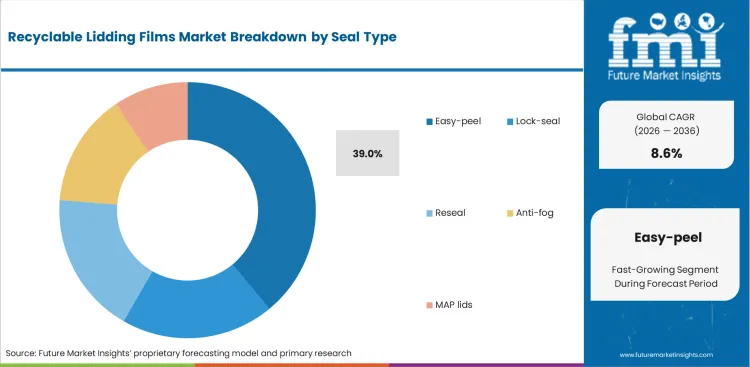
Easy-peel formats are expected to hold a 39.0% share in 2026, driven by advancements in controlled sealing and peeling performance. Balancing a secure seal with easy consumer access is a key challenge in flexible packaging design. The shift toward mono-material packaging films requires tooling engineers to redesign sealing profiles entirely. Earlier peel systems depended on different materials separating under pressure, but achieving the same performance with mono PP easy-peel films requires carefully engineered sealant layers. While many assume peel consistency is mainly influenced by film thickness, tray flange design matters far more in how the seal breaks. If film and tray specifications are not properly aligned, it can lead to serious seal failures, especially during high-altitude transport.
- Fracture initiation: Specialized sealant materials are designed to break at specific stress levels. Formulation experts adjust material properties to ensure smooth peeling without tearing the film.
- Contamination sealing: Heat-seal layers must work effectively even when there is fat or liquid residue on tray edges. Choosing the right resin helps avoid sealing issues and production delays.
- Residue prevention: A clean peel ensures no material is left behind on the tray edges. This is important for maintaining recyclability and meeting brand compliance standards.
Recyclable Lidding Films Market Analysis by Tray Substrate
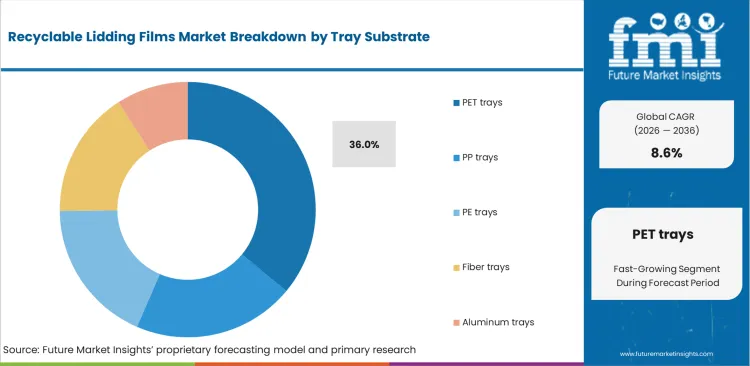
The alignment between lidding films and rigid trays plays a crucial role in packaging recyclability. PET trays are expected to hold a 36.0% share in 2026, supporting the wider adoption of recyclable flexible packaging. Sustainability teams are increasingly focusing on using the same polymer type across packaging to meet extended producer responsibility requirements. The choice between PET and PP lidding films comes down to matching the existing tray material. Traditional adhesive layers can reduce recycling quality, which is why manufacturers are shifting toward direct polymer bonding. Variations in recycled-content trays can affect heat-sealing conditions, sometimes leading to seal failures even on well-calibrated machines. Delaying this transition can leave brands dependent on non-recyclable formats that may face higher regulatory costs.
- Polymer fusion: Applying heat allows identical materials to bond at a molecular level. Technicians often need to fine-tune sealing pressure and temperature for consistent results.
- Flange rigidity: Strong tray edges help maintain stability during sealing. Tooling teams adjust support systems to prevent deformation under pressure.
- Recycled content: Recycled materials can slightly change heat transfer behavior. Engineers monitor processing conditions closely to manage variations in material quality.
Recyclable Lidding Films Market Analysis by Thickness
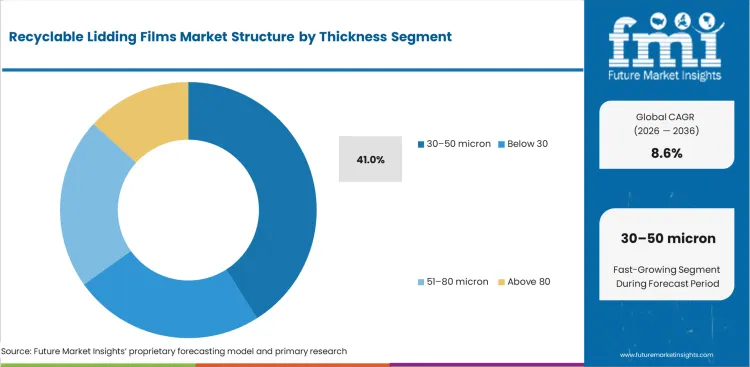
Reducing film thickness reaches practical limits when barrier performance starts to drop sharply. The 30-50 micron range is expected to hold a 41.0% share in 2026, as it offers a balance between material reduction and durability. Procurement managers often prefer this range when sourcing mono-material pouches and similar formats. Thinner films can struggle to maintain stability across wide thermoforming machines, where web breakage during high-speed operations can lead to major downtime. Although suppliers promote ultra-thin films, operators often increase machine tension to compensate, which can stretch the material beyond its effective limits. Sourcing teams that focus only on minimizing thickness may face issues like higher oxygen transmission, especially during warmer distribution conditions.
- Web tensioning: A balanced film thickness helps prevent stretching during fast machine operations. Operators can maintain stable settings with fewer adjustments.
- Barrier coating: Adequate thickness supports protective coating layers. Extremely thin films are more prone to damage, which can affect barrier performance.
- Thermal mass: Mid-range films handle heat more evenly without burning. This allows more flexibility in temperature settings, especially on older sealing equipment.
Recyclable Lidding Films Market Drivers, Restraints, and Opportunities
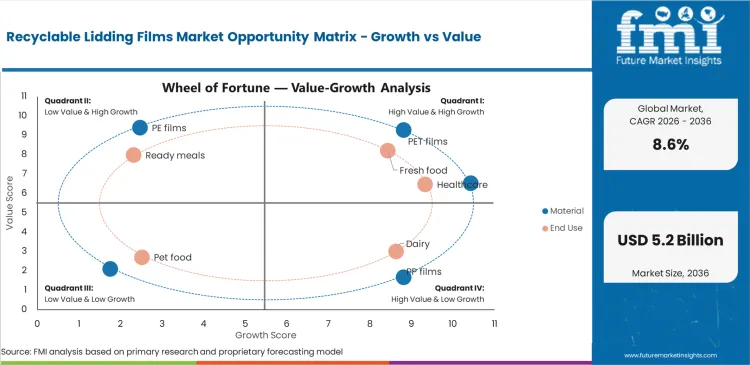
Corporate sustainability commitments face hard legislative deadlines under European packaging waste mandates. Packaging procurement heads must replace complex laminate structures immediately to avoid severe retail delisting. Transitioning to monomaterial pe solution formats prevents exorbitant extended producer responsibility taxes levied on unrecyclable plastics. Delayed compliance transfers millions in penalty costs directly to brand bottom lines. High-volume food producers recognize this regulatory cliff requires complete portfolio requalification.
Existing machinery base friction severely limits adoption speed regardless of corporate intent. Legacy thermoforming lines operate with wide temperature tolerances suited for robust laminates. Switching to precise mono-polymer sealant web films requires micro-degree thermal control. Plant managers cannot halt twenty-four-hour food production to retrofit hundreds of sealing stations simultaneously. Incremental machine upgrades create multi-year bottlenecks.
Opportunities in Recyclable Lidding Films Market
- Chemical recycling integration: Advanced pyrolysis plants accept previously unrecyclable mixed polyolefins. Suppliers formulating specific multilayer flexible packaging compatible with these emerging chemical reactors capture early-mover advantage.
- Atmosphere control: Modifying internal package environments extends shelf life dramatically. Material scientists developing a reliable MAP recyclable lid film secure lucrative contracts with extended-shelf-life meat packers.
- Ultrasonic sealing: Cold-weld technology eliminates jaw temperature sensitivities completely. Equipment manufacturers partnering with film extruders dominate replacement cycles for sensitive biological products.
Regional Analysis
Based on regional analysis, Recyclable Lidding Films Market is segmented into North America, Europe, and Asia Pacific across 40 plus countries.
.webp "Top Country Growth Comparison Recyclable Lidding Films Market Cagr (2026 2036)")
| Country | CAGR (2026 to 2036) |
|---|---|
| India | 10.4% |
| China | 9.5% |
| Germany | 8.9% |
| United Kingdom | 8.4% |
| France | 8.1% |
| United States | 7.8% |
| Japan | 7.0% |
Source: Future Market Insights (FMI) analysis, based on proprietary forecasting model and primary research
Asia Pacific Recyclable Lidding Films Market Analysis
Rapid modernization of food retail in emerging markets is driving changes in packaging formats. As systems shift from traditional wet markets to organized supermarkets, there is a growing need for longer shelf-life solutions that were not required earlier. FMI finds that regional converters are moving directly toward mono-material packaging, skipping older multi-material approaches. Local equipment manufacturers are developing tray sealing machines designed specifically for recyclable materials. In the past, high costs of imported European machinery limited adoption, but domestic production has improved thermal control systems, making these technologies more accessible to mid-sized food producers.
- India: New extended producer responsibility rules are accelerating the shift toward recyclable lidding films across India’s food packaging sector. As brands replace non‑recyclable laminates to remain compliant, the India recyclable lidding films market is projected to rise at a CAGR of 10.4% over the forecast period. Suppliers that can ensure consistent domestic mono‑PET availability are gaining preferred status with organized retailers, where compliance audits increasingly influence shelf access.
- China: The expansion of centralized grocery distribution in China is reshaping packaging requirements, particularly for products traveling long distances. To meet durability and recyclability expectations, manufacturers are prioritizing recyclable lidding films, supporting a forecast CAGR of 9.5% for the China recyclable lidding films sector. Local film producers that secure supply agreements with national retail chains are scaling quickly, benefiting from volume efficiencies and long‑term contracts.
- Japan: Japan industry reflects a more measured pace of change, driven by strict visual standards for fresh food packaging. Packaging teams are reluctant to alter proven anti‑fog systems, slowing conversion to newer recyclable formats. Recyclable lidding films sector in country is expected to expand at a CAGR of 7.0%, with future expansion hinging on the ability of mono‑material films to deliver moisture control without compromising appearance.
FMI’s report includes South Korea, Australia, and ASEAN nations. Domestic infrastructure readiness for post-consumer film sorting continues to shape the pace of adoption at a country level. Japan is gaining attention due to its well-established waste separation systems and early movement toward recyclable film formats. India is also beginning to feature more prominently, as packaged food growth and gradual improvements in collection and sorting capacity create longer-term opportunities that FMI factors into its regional coverage.
Europe Recyclable Lidding Films Market Analysis
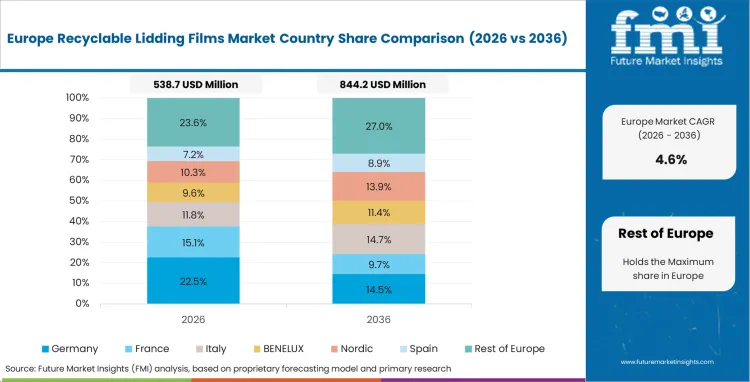
Strict regulatory frameworks are reshaping packaging economics across markets. Packaging waste regulations are pushing companies to fully comply with design-for-recycling requirements within defined timelines. Regional food brands face financial penalties if their packaging does not meet these standards. Upgrading older meal tray sealing machines has become a major area of capital investment. Material innovation efforts are increasingly concentrated in regions facing the highest regulatory pressure.
- Germany: Strict polymer identification rules within highly structured sorting systems have made Germany one of the most technically demanding markets for recyclable packaging. Compliance and quality teams regularly test near‑infrared (NIR) sorting accuracy to confirm materials behave predictably in automated recovery lines. This focus on optical performance is supporting an estimated 8.9% CAGR for recyclable packaging films in Germany, as brands that meet sorting thresholds see fewer rejections and lower waste‑handling costs.
- United Kingdom: Retail pressure is shaping adoption patterns in the United Kingdom, where major supermarket chains are moving ahead of national policy on plastic reduction and recyclability. Buyers are actively removing packaging that cannot demonstrate credible end‑of‑life outcomes, forcing changes in supplier specifications across food and beverage categories. These retail‑led requirements are contributing to an expected 8.4% CAGR in compliant flexible packaging formats, with shelf access increasingly tied to independently verified recyclability data.
- France: In France, circular economy regulations continue to narrow the scope for single‑use plastics, particularly in consumer‑facing food applications. Packaging and sustainability teams are responding by testing paper‑based hybrid structures that can meet recyclability targets without sacrificing functional performance. This material shift is driving an anticipated 8.1% CAGR in alternative and hybrid packaging solutions, as improving barrier performance enables broader use in ready‑meal and convenience food packaging.
FMI’s report includes Italy, Spain, and the Nordic countries. Extended producer responsibility fee structures vary significantly across municipal borders, creating uneven cost exposure for packaging producers. The Netherlands is emerging as an important reference market, supported by early investment in advanced sorting systems and tighter enforcement of recyclability requirements. These conditions are accelerating adoption of compliant packaging formats and influencing how suppliers across Europe design materials to manage producer fee liabilities.
North America Recyclable Lidding Films Market Analysis
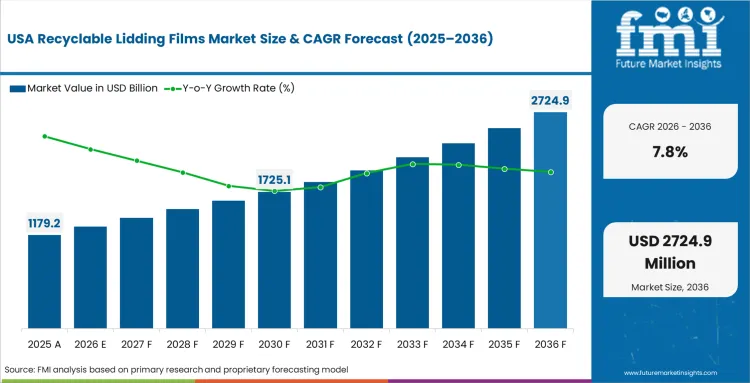
Differences in municipal recycling systems make packaging design more complex for national brands. Companies supplying products across multiple regions often rely on widely accepted recyclable formats to ensure compatibility. Upgrading automated tray filling and sealing machines happens more slowly due to the large number of existing machines in use. In this market, voluntary corporate commitments are driving material changes more than strict federal regulations.
- United States: In the United States, large‑scale manufacturing operations leave little room for material changes that could disrupt throughput. Plant managers typically run extended trials of mono‑material packaging on high‑speed lines to ensure performance remains stable under commercial conditions. These operational realities are supporting an expected 7.8% CAGR in mono‑material flexible packaging adoption, as suppliers that can integrate seamlessly without slowing line speeds are more likely to win multi‑site, enterprise‑level supply agreements.
FMI’s report includes Canada and Mexico. Cross‑border supply chains necessitate harmonized polymer specifications to maintain logistics efficiency. Brazil is also emerging as a relevant growth market, driven by rising packaged food output and early shifts toward recyclable flexible formats. As investment in domestic processing and collection improves, Brazilian material standards are beginning to influence supplier strategies.
Competitive Aligners for Market Players
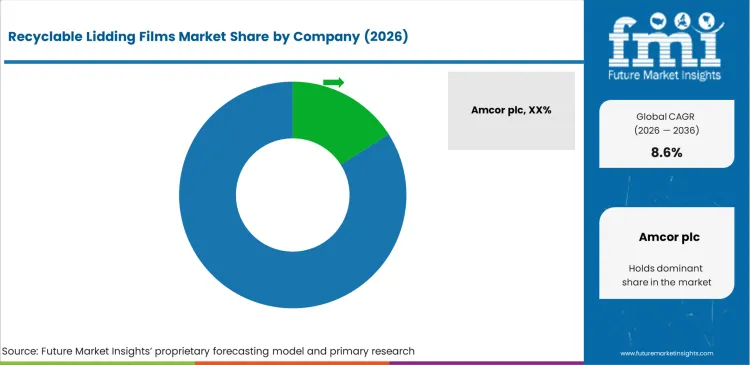
The supply side is largely dominated by major global converters with strong extrusion capabilities. Amcor plc holds an estimated to lead the industry with significant share, supported by its expertise in polymer blending technologies. Top recyclable lidding film suppliers increasingly focus on post-consumer recovery certifications when selecting partners, rather than just unit cost. New entrants must prove consistent performance across different thermal sealing systems to remain competitive.
Established manufacturers have extensive experience with heat-seal formulations designed for high-speed rotary tray sealers. Developing these precise material properties takes years of continuous refinement in polymer science. New recyclable lidding film manufacturers trying to replicate mono-material barrier films often struggle to meet performance requirements during real-world transport. Limited access to dedicated pilot lines for testing and validation creates an additional challenge for new entrants.
Large food companies use their high purchasing volumes to avoid relying on a single supplier. Finding alternative sources for the same recycle-ready lidding film specifications is challenging due to proprietary resin formulations. To reduce dependence on major converters, global brands are supporting smaller, innovative film producers. At the same time, adjusting barrier performance without affecting the base polymer’s recyclability remains a key technical challenge.
Key Players in Recyclable Lidding Films Market
- Amcor plc
- Winpak Ltd.
- Sealed Air Corporation
- Coveris Management GmbH
- Constantia Flexibles
- Mondi plc
- Südpack Verpackungen SE & Co. KG
Scope of the Report
| Metric | Value |
|---|---|
| Quantitative Units | USD 2.1 billion to USD 4.7 billion, at a CAGR of 8.60% |
| Market Definition | Recyclable top-web sealing structures define this specific sector. These formats close thermoformed trays while maintaining compatibility with established mechanical recovery streams. Functional boundaries rest strictly on post-consumer processing capability and sorting facility compatibility. |
| Segmentation | Material, End Use, Seal Type, Tray Substrate, Thickness |
| Regions Covered | North America, Latin America, Europe, Asia Pacific, Middle East and Africa |
| Countries Covered | United States, Canada, Mexico, Germany, United Kingdom, France, Italy, Spain, Nordic countries, China, India, Japan, South Korea, Australia, ASEAN nations |
| Key Companies Profiled | Amcor plc, Winpak Ltd., Sealed Air Corporation, Coveris Management GmbH, Constantia Flexibles, Mondi plc, Südpack Verpackungen SE & Co. KG |
| Forecast Period | 2026 to 2036 |
| Approach | Installed base capacity for thermoforming and tray-sealing equipment anchors baseline material consumption volume. |
Source: Future Market Insights (FMI) analysis, based on a proprietary forecasting model and primary research
Recyclable Lidding Films Market Analysis by Segments
Material
- PET films
- PP films
- PE films
- Aluminum lids
- Paper hybrids
End Use
- Fresh food
- Dairy
- Ready meals
- Pet food
- Healthcare
Seal Type
- Easy-peel
- Lock-seal
- Reseal
- Anti-fog
- MAP lids
Tray Substrate
- PET trays
- PP trays
- PE trays
- Fiber trays
- Aluminum trays
Thickness
- 30-50 micron
- Below 30
- 51-80 micron
- Above 80
Region
- North America
- Latin America
- Europe
- Asia Pacific
- Middle East and Africa
Bibliography
- Association of Plastic Recyclers. (2024, March 11). 2024 how to scale the recycling of flexible film packaging.
- Austria Recycling. (2024). Circular Packaging Design Guideline.
- Canada Plastics Pact. (2025, June). Pathways to Mono-Material Flexible Plastic Packaging.
- Cerbone, A., Palazzo, I., Ceriello, A., Castaldo, R., Stanzione, M., Lavorgna, M., Buonocore, G. G., & Gentile, G. (2025). Delamination of multilayer flexible packaging: A promising approach towards the recycling of their components. A review. Resources, Conservation and Recycling, 216, 108493.
- India Plastics Pact. (2024, December 23). Design for recycling guidance for films and flexible packaging.
- Sustainable Packaging Coalition. (2025). 2025 Sustainable Packaging Trends Report.
- World Packaging Organisation. (2025, May). Packaging. Design for Recycling Guide.
This bibliography is provided for reader reference. The full FMI report contains the complete reference list with primary source documentation.
This Report Addresses
- How precise mono-PET formulations alter heat-seal windows across aging thermoforming lines.
- Why anti-fog coatings compromise near-infrared optical sorting metrics in municipal waste facilities.
- Which specific jaw-temperature sensitivities restrict biodegradable substrate adoptions.
- What prevents legacy adhesive systems from surviving post-consumer chemical recycling processes.
- How extended producer responsibility fees dictate material substitution velocity across European borders.
- Why tray flange geometry determines consumer peel consistency more effectively than film gauge.
- Which advanced vacuum-deposited barrier coatings replace non-recyclable EVOH layers completely.
- How secondary sourcing requires matching exact molecular weight distributions across diverse suppliers.
Frequently Asked Questions
What limits immediate mono-material adoption across aging food production lines?
Micro-degree thermal control requirements block fast conversions. Legacy thermoforming machinery operates with wide temperature tolerances originally designed for robust laminates. Plant operators cannot process precise mono-polymer films without inducing web distortion or burn-through under inconsistent jaw heating.
Why do specific anti-fog additives threaten ultimate material recyclability?
Aggressive moisture control coatings alter polymer surface chemistry significantly. Near-infrared scanners in municipal sorting facilities misread these coated structures, failing to identify underlying PET bases. This technical glitch forces perfectly recyclable materials into designated waste streams.
How does tray substrate geometry influence lidding film peel consistency?
Retail buyers incorrectly correlate peel performance entirely with film thickness. Flange rigidity and sealing surface width dictate fracture initiation mechanics under tension. Tooling engineers matching precise weld profiles against stiff tray edges achieve clean separation without web tearing.
Why is chemical recycling integration critical for mixed polyolefin formats?
Mechanical sorting struggles separating identically weighted PE and PP films efficiently. Advanced pyrolysis plants convert these complex flexible bundles directly back into base monomers. Suppliers validating structures for these specific chemical reactors secure future-proof compliance advantages.
What structural difference separates packaging growth in India compared to Japan?
India replaces unrecyclable laminates across rapidly expanding modern retail channels lacking legacy machinery constraints. Japan possesses massive installed thermoforming bases requiring extensive requalification before altering proven moisture-control formats. Emerging markets leapfrog directly into compliant formats faster than mature systems upgrade.
How do extended producer responsibility directives force immediate procurement shifts?
Legislative mandates link plastic taxation directly to verified material recyclability metrics. Using legacy multi-material laminates incurs prohibitive financial penalties per unit sold. Securing certified mono-material supplies shields corporate margins from these aggressive statutory levies.
Why do sustainability directors prefer ultrasonic sealing technology?
Cold-weld systems eliminate jaw temperature sensitivities completely during high-speed production. Bonding mono-polymer films without applied heat prevents molecular degradation along seal seams. This mechanical fusion guarantees hermetic closure while preserving total material recyclability.
What prevents brands from dual-sourcing recyclable lidding films easily?
Replicating precise post-consumer recovery performance requires exact molecular weight distributions. Each supplier utilizes proprietary resin blends to balance machinability against barrier protection. Replacing primary suppliers forces packaging technologists into lengthy multi-month revalidation cycles.
How do micro-perforated structures benefit fresh produce logistics?
Regulating oxygen transmission rates manages biological respiration during extended transit. Agronomists specify exact hole geometries matching specific fruit or vegetable metabolic needs. Modifying atmospheric exchange delays senescence significantly without compromising substrate recyclability.
Why do mid-gauge films dominate adoption over ultra-thin alternatives?
Web tensioning limits dictate minimum functional thickness during rapid machine indexing. Ultra-thin films snap under high-speed mechanical pulling, causing unacceptable production downtime. Maintaining 30–50 micron thickness supports necessary vacuum-deposited barrier layers without cracking.
What determines post-consumer recovery success for paper-hybrid sealing substrates?
Fat-barrier limitations restrict fiber formats across protein packaging applications. Achieving compliance requires minimizing polymeric liner thickness while surviving aggressive supply chain handling. Overcoming these specific moisture constraints unlocks massive adoption potential across refrigerated ready-meal categories.
How does recycled-content flake alter direct heat-seal performance?
Post-consumer material introduces microscopic thermal conductivity variations across rigid tray sheets. Extrusion engineers continuously adjust parameters because top webs must melt flawlessly into these inconsistent bases. Poorly matched thermal profiles generate unexpected microscopic seal fractures.
Why do multi-material laminates fail mechanical recycling requirements fundamentally?
Commercial granulators cannot separate integrated EVOH or PVdC layers economically. Melt temperatures differ significantly between base polyolefins and specific barrier resins. Processing these structures together produces contaminated regrind completely unsuitable for secondary manufacturing applications.
What drives European material science innovation faster than North American development?
Strict continental packaging waste regulations impose hard legal deadlines for circular economy compliance. North American markets rely heavily on voluntary corporate sustainability pledges across fragmented municipal infrastructure. Hard legislative pressure compels immediate European capital expenditure on material redesign.
How do tooling designers modify support plates for mono-PET trays?
Stiff edges provide necessary resistance during downward sealing strokes to ensure complete fusion. Engineers recalibrate lower support geometries to prevent flange collapse under high compression. Maximizing uniform contact pressure guarantees hermetic closure across complete tray perimeters.
Why do supply chain managers reject poorly downgauged flexible structures?
Bone-in meat cuts threaten film integrity during intense vacuum cycles and rough transit. Insufficient puncture resistance generates elevated spoilage claims and retailer rejections. Maintaining adequate gauge thickness prevents catastrophic barrier failure before products reach consumer refrigerators.
What enables reliable dual ovenable performance using recyclable specifications?
Surviving massive temperature swings requires specialized heat-resistant polymer orientations. Extrusion technicians stretch films biaxially to lock molecular structures against extreme thermal shock. Formats must transition seamlessly from sub-zero freezing through high-heat microwave or conventional baking.
How do brand compliance officers verify true post-consumer recovery compatibility?
Visual inspection provides insufficient evidence against strict extended producer responsibility audits. Companies utilize independent laboratories testing structures through miniature simulated mechanical sorting processes. Passing rigorous Association of Plastic Recyclers design standards grants official recyclable status.
Why does securing secondary sourcing remain critical for major food conglomerates?
Purchasing immense flexible packaging volumes concentrates supply chain risk dangerously. Depending solely on one converter exposes brands to catastrophic regional extrusion line failures. Procurement directors actively fund smaller innovative producers to establish reliable fallback capacity.
What alters gas flushing parameters when converting fresh meat packaging lines?
Switching from legacy laminates to mono-polymer films changes inherent material porosity immediately. Operations managers recalibrate mixed gas injection volumes to maintain optimal internal atmospheres. Incorrect calculations accelerate meat discoloration and shorten functional shelf life significantly.
How do domestic machine builders in emerging markets accelerate material adoption?
Imported European sealing equipment carries prohibitive initial capital costs for local producers. Domestic manufacturing localized precision thermal controls required for sensitive mono-materials. Democratizing equipment access allows mid-tier packers to comply with incoming national plastic pacts.
Why do senior formulation chemists fine-tune melt flow indices specifically?
Controlling exact polymer viscosity under heat dictates how sealants spread across tray flanges. Preventing resin tearing during consumer opening requires highly engineered fracture points. Perfecting this molecular separation provides consistent easy-peel functionality without leaving plastic residue.
Preview the report firsthand - request a free sample
Get SampleGet the brochure for pricing and purchase details.
Get PDFTable of Content
- Executive Summary
- Global Market Outlook
- Demand-side Trends
- Supply-side Trends
- Technology Roadmap Analysis
- Analysis and Recommendations
- Market Overview
- Market Coverage / Taxonomy
- Market Definition / Scope / Limitations
- Research Methodology
- Chapter Orientation
- Analytical Lens and Working Hypotheses
- Market Structure, Signals, and Trend Drivers
- Benchmarking and Cross-market Comparability
- Market Sizing, Forecasting, and Opportunity Mapping
- Research Design and Evidence Framework
- Desk Research Programme (Secondary Evidence)
- Company Annual and Sustainability Reports
- Peer-reviewed Journals and Academic Literature
- Corporate Websites, Product Literature, and Technical Notes
- Earnings Decks and Investor Briefings
- Statutory Filings and Regulatory Disclosures
- Technical White Papers and Standards Notes
- Trade Journals, Industry Magazines, and Analyst Briefs
- Conference Proceedings, Webinars, and Seminar Materials
- Government Statistics Portals and Public Data Releases
- Press Releases and Reputable Media Coverage
- Specialist Newsletters and Curated Briefings
- Sector Databases and Reference Repositories
- FMI Internal Proprietary Databases and Historical Market Datasets
- Subscription Datasets and Paid Sources
- Social Channels, Communities, and Digital Listening Inputs
- Additional Desk Sources
- Expert Input and Fieldwork (Primary Evidence)
- Primary Modes
- Qualitative Interviews and Expert Elicitation
- Quantitative Surveys and Structured Data Capture
- Blended Approach
- Why Primary Evidence is Used
- Field Techniques
- Interviews
- Surveys
- Focus Groups
- Observational and In-context Research
- Social and Community Interactions
- Stakeholder Universe Engaged
- C-suite Leaders
- Board Members
- Presidents and Vice Presidents
- R&D and Innovation Heads
- Technical Specialists
- Domain Subject-matter Experts
- Scientists
- Physicians and Other Healthcare Professionals
- Governance, Ethics, and Data Stewardship
- Research Ethics
- Data Integrity and Handling
- Primary Modes
- Tooling, Models, and Reference Databases
- Desk Research Programme (Secondary Evidence)
- Data Engineering and Model Build
- Data Acquisition and Ingestion
- Cleaning, Normalisation, and Verification
- Synthesis, Triangulation, and Analysis
- Quality Assurance and Audit Trail
- Market Background
- Market Dynamics
- Drivers
- Restraints
- Opportunity
- Trends
- Scenario Forecast
- Demand in Optimistic Scenario
- Demand in Likely Scenario
- Demand in Conservative Scenario
- Opportunity Map Analysis
- Product Life Cycle Analysis
- Supply Chain Analysis
- Investment Feasibility Matrix
- Value Chain Analysis
- PESTLE and Porter’s Analysis
- Regulatory Landscape
- Regional Parent Market Outlook
- Production and Consumption Statistics
- Import and Export Statistics
- Market Dynamics
- Global Market Analysis 2021 to 2025 and Forecast, 2026 to 2036
- Historical Market Size Value (USD Million) Analysis, 2021 to 2025
- Current and Future Market Size Value (USD Million) Projections, 2026 to 2036
- Y-o-Y Growth Trend Analysis
- Absolute $ Opportunity Analysis
- Global Market Pricing Analysis 2021 to 2025 and Forecast 2026 to 2036
- Global Market Analysis 2021 to 2025 and Forecast 2026 to 2036, By Material
- Introduction / Key Findings
- Historical Market Size Value (USD Million) Analysis By Material , 2021 to 2025
- Current and Future Market Size Value (USD Million) Analysis and Forecast By Material , 2026 to 2036
- PET films
- PP films
- PE films
- Aluminum lids
- Paper hybrids
- PET films
- Y-o-Y Growth Trend Analysis By Material , 2021 to 2025
- Absolute $ Opportunity Analysis By Material , 2026 to 2036
- Global Market Analysis 2021 to 2025 and Forecast 2026 to 2036, By End Use
- Introduction / Key Findings
- Historical Market Size Value (USD Million) Analysis By End Use, 2021 to 2025
- Current and Future Market Size Value (USD Million) Analysis and Forecast By End Use, 2026 to 2036
- Fresh food
- Dairy
- Ready meals
- Pet food
- Healthcare
- Fresh food
- Y-o-Y Growth Trend Analysis By End Use, 2021 to 2025
- Absolute $ Opportunity Analysis By End Use, 2026 to 2036
- Global Market Analysis 2021 to 2025 and Forecast 2026 to 2036, By Seal Type
- Introduction / Key Findings
- Historical Market Size Value (USD Million) Analysis By Seal Type, 2021 to 2025
- Current and Future Market Size Value (USD Million) Analysis and Forecast By Seal Type, 2026 to 2036
- Easy-peel
- Lock-seal
- Reseal
- Anti-fog
- MAP lids
- Easy-peel
- Y-o-Y Growth Trend Analysis By Seal Type, 2021 to 2025
- Absolute $ Opportunity Analysis By Seal Type, 2026 to 2036
- Global Market Analysis 2021 to 2025 and Forecast 2026 to 2036, By Tray Substrate
- Introduction / Key Findings
- Historical Market Size Value (USD Million) Analysis By Tray Substrate, 2021 to 2025
- Current and Future Market Size Value (USD Million) Analysis and Forecast By Tray Substrate, 2026 to 2036
- PET trays
- PP trays
- PE trays
- Fiber trays
- Aluminum trays
- PET trays
- Y-o-Y Growth Trend Analysis By Tray Substrate, 2021 to 2025
- Absolute $ Opportunity Analysis By Tray Substrate, 2026 to 2036
- Global Market Analysis 2021 to 2025 and Forecast 2026 to 2036, By Thickness
- Introduction / Key Findings
- Historical Market Size Value (USD Million) Analysis By Thickness, 2021 to 2025
- Current and Future Market Size Value (USD Million) Analysis and Forecast By Thickness, 2026 to 2036
- 30-50 micron
- Below 30
- 51-80 micron
- Above 80
- 30-50 micron
- Y-o-Y Growth Trend Analysis By Thickness, 2021 to 2025
- Absolute $ Opportunity Analysis By Thickness, 2026 to 2036
- Global Market Analysis 2021 to 2025 and Forecast 2026 to 2036, By Region
- Introduction
- Historical Market Size Value (USD Million) Analysis By Region, 2021 to 2025
- Current Market Size Value (USD Million) Analysis and Forecast By Region, 2026 to 2036
- North America
- Latin America
- Western Europe
- Eastern Europe
- East Asia
- South Asia and Pacific
- Middle East & Africa
- Market Attractiveness Analysis By Region
- North America Market Analysis 2021 to 2025 and Forecast 2026 to 2036, By Country
- Historical Market Size Value (USD Million) Trend Analysis By Market Taxonomy, 2021 to 2025
- Market Size Value (USD Million) Forecast By Market Taxonomy, 2026 to 2036
- By Country
- USA
- Canada
- Mexico
- By Material
- By End Use
- By Seal Type
- By Tray Substrate
- By Thickness
- By Country
- Market Attractiveness Analysis
- By Country
- By Material
- By End Use
- By Seal Type
- By Tray Substrate
- By Thickness
- Key Takeaways
- Latin America Market Analysis 2021 to 2025 and Forecast 2026 to 2036, By Country
- Historical Market Size Value (USD Million) Trend Analysis By Market Taxonomy, 2021 to 2025
- Market Size Value (USD Million) Forecast By Market Taxonomy, 2026 to 2036
- By Country
- Brazil
- Chile
- Rest of Latin America
- By Material
- By End Use
- By Seal Type
- By Tray Substrate
- By Thickness
- By Country
- Market Attractiveness Analysis
- By Country
- By Material
- By End Use
- By Seal Type
- By Tray Substrate
- By Thickness
- Key Takeaways
- Western Europe Market Analysis 2021 to 2025 and Forecast 2026 to 2036, By Country
- Historical Market Size Value (USD Million) Trend Analysis By Market Taxonomy, 2021 to 2025
- Market Size Value (USD Million) Forecast By Market Taxonomy, 2026 to 2036
- By Country
- Germany
- UK
- Italy
- Spain
- France
- Nordic
- BENELUX
- Rest of Western Europe
- By Material
- By End Use
- By Seal Type
- By Tray Substrate
- By Thickness
- By Country
- Market Attractiveness Analysis
- By Country
- By Material
- By End Use
- By Seal Type
- By Tray Substrate
- By Thickness
- Key Takeaways
- Eastern Europe Market Analysis 2021 to 2025 and Forecast 2026 to 2036, By Country
- Historical Market Size Value (USD Million) Trend Analysis By Market Taxonomy, 2021 to 2025
- Market Size Value (USD Million) Forecast By Market Taxonomy, 2026 to 2036
- By Country
- Russia
- Poland
- Hungary
- Balkan & Baltic
- Rest of Eastern Europe
- By Material
- By End Use
- By Seal Type
- By Tray Substrate
- By Thickness
- By Country
- Market Attractiveness Analysis
- By Country
- By Material
- By End Use
- By Seal Type
- By Tray Substrate
- By Thickness
- Key Takeaways
- East Asia Market Analysis 2021 to 2025 and Forecast 2026 to 2036, By Country
- Historical Market Size Value (USD Million) Trend Analysis By Market Taxonomy, 2021 to 2025
- Market Size Value (USD Million) Forecast By Market Taxonomy, 2026 to 2036
- By Country
- China
- Japan
- South Korea
- By Material
- By End Use
- By Seal Type
- By Tray Substrate
- By Thickness
- By Country
- Market Attractiveness Analysis
- By Country
- By Material
- By End Use
- By Seal Type
- By Tray Substrate
- By Thickness
- Key Takeaways
- South Asia and Pacific Market Analysis 2021 to 2025 and Forecast 2026 to 2036, By Country
- Historical Market Size Value (USD Million) Trend Analysis By Market Taxonomy, 2021 to 2025
- Market Size Value (USD Million) Forecast By Market Taxonomy, 2026 to 2036
- By Country
- India
- ASEAN
- Australia & New Zealand
- Rest of South Asia and Pacific
- By Material
- By End Use
- By Seal Type
- By Tray Substrate
- By Thickness
- By Country
- Market Attractiveness Analysis
- By Country
- By Material
- By End Use
- By Seal Type
- By Tray Substrate
- By Thickness
- Key Takeaways
- Middle East & Africa Market Analysis 2021 to 2025 and Forecast 2026 to 2036, By Country
- Historical Market Size Value (USD Million) Trend Analysis By Market Taxonomy, 2021 to 2025
- Market Size Value (USD Million) Forecast By Market Taxonomy, 2026 to 2036
- By Country
- Kingdom of Saudi Arabia
- Other GCC Countries
- Turkiye
- South Africa
- Other African Union
- Rest of Middle East & Africa
- By Material
- By End Use
- By Seal Type
- By Tray Substrate
- By Thickness
- By Country
- Market Attractiveness Analysis
- By Country
- By Material
- By End Use
- By Seal Type
- By Tray Substrate
- By Thickness
- Key Takeaways
- Key Countries Market Analysis
- USA
- Pricing Analysis
- Market Share Analysis, 2025
- By Material
- By End Use
- By Seal Type
- By Tray Substrate
- By Thickness
- Canada
- Pricing Analysis
- Market Share Analysis, 2025
- By Material
- By End Use
- By Seal Type
- By Tray Substrate
- By Thickness
- Mexico
- Pricing Analysis
- Market Share Analysis, 2025
- By Material
- By End Use
- By Seal Type
- By Tray Substrate
- By Thickness
- Brazil
- Pricing Analysis
- Market Share Analysis, 2025
- By Material
- By End Use
- By Seal Type
- By Tray Substrate
- By Thickness
- Chile
- Pricing Analysis
- Market Share Analysis, 2025
- By Material
- By End Use
- By Seal Type
- By Tray Substrate
- By Thickness
- Germany
- Pricing Analysis
- Market Share Analysis, 2025
- By Material
- By End Use
- By Seal Type
- By Tray Substrate
- By Thickness
- UK
- Pricing Analysis
- Market Share Analysis, 2025
- By Material
- By End Use
- By Seal Type
- By Tray Substrate
- By Thickness
- Italy
- Pricing Analysis
- Market Share Analysis, 2025
- By Material
- By End Use
- By Seal Type
- By Tray Substrate
- By Thickness
- Spain
- Pricing Analysis
- Market Share Analysis, 2025
- By Material
- By End Use
- By Seal Type
- By Tray Substrate
- By Thickness
- France
- Pricing Analysis
- Market Share Analysis, 2025
- By Material
- By End Use
- By Seal Type
- By Tray Substrate
- By Thickness
- India
- Pricing Analysis
- Market Share Analysis, 2025
- By Material
- By End Use
- By Seal Type
- By Tray Substrate
- By Thickness
- ASEAN
- Pricing Analysis
- Market Share Analysis, 2025
- By Material
- By End Use
- By Seal Type
- By Tray Substrate
- By Thickness
- Australia & New Zealand
- Pricing Analysis
- Market Share Analysis, 2025
- By Material
- By End Use
- By Seal Type
- By Tray Substrate
- By Thickness
- China
- Pricing Analysis
- Market Share Analysis, 2025
- By Material
- By End Use
- By Seal Type
- By Tray Substrate
- By Thickness
- Japan
- Pricing Analysis
- Market Share Analysis, 2025
- By Material
- By End Use
- By Seal Type
- By Tray Substrate
- By Thickness
- South Korea
- Pricing Analysis
- Market Share Analysis, 2025
- By Material
- By End Use
- By Seal Type
- By Tray Substrate
- By Thickness
- Russia
- Pricing Analysis
- Market Share Analysis, 2025
- By Material
- By End Use
- By Seal Type
- By Tray Substrate
- By Thickness
- Poland
- Pricing Analysis
- Market Share Analysis, 2025
- By Material
- By End Use
- By Seal Type
- By Tray Substrate
- By Thickness
- Hungary
- Pricing Analysis
- Market Share Analysis, 2025
- By Material
- By End Use
- By Seal Type
- By Tray Substrate
- By Thickness
- Kingdom of Saudi Arabia
- Pricing Analysis
- Market Share Analysis, 2025
- By Material
- By End Use
- By Seal Type
- By Tray Substrate
- By Thickness
- Turkiye
- Pricing Analysis
- Market Share Analysis, 2025
- By Material
- By End Use
- By Seal Type
- By Tray Substrate
- By Thickness
- South Africa
- Pricing Analysis
- Market Share Analysis, 2025
- By Material
- By End Use
- By Seal Type
- By Tray Substrate
- By Thickness
- USA
- Market Structure Analysis
- Competition Dashboard
- Competition Benchmarking
- Market Share Analysis of Top Players
- By Regional
- By Material
- By End Use
- By Seal Type
- By Tray Substrate
- By Thickness
- Competition Analysis
- Competition Deep Dive
- Amcor plc
- Overview
- Product Portfolio
- Profitability by Market Segments (Product/Age /Sales Channel/Region)
- Sales Footprint
- Strategy Overview
- Marketing Strategy
- Product Strategy
- Channel Strategy
- Winpak Ltd.
- Sealed Air Corporation
- Coveris Management GmbH
- Constantia Flexibles
- Mondi plc
- Südpack Verpackungen SE & Co. KG
- Amcor plc
- Competition Deep Dive
- Assumptions & Acronyms Used


