

- Industry Size (2026)
- USD 103 Mn
- Forecast (2036)
- USD 226.5 Mn
- CAGR (2026 to 2036)
- 8.2%
Recyclable Thermoplastic Powder Coatings for Consumer Electronics Market Forecast and Outlook 2026 to 2036
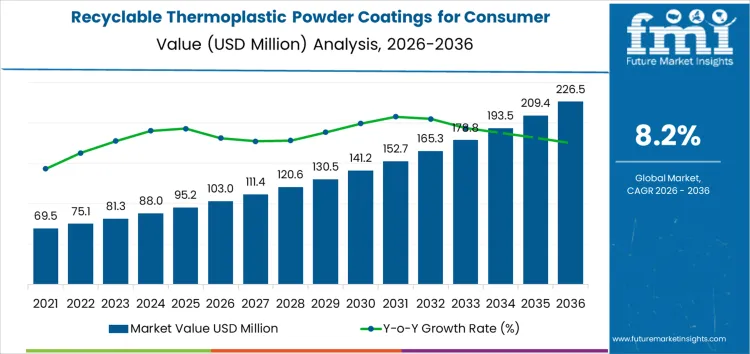
The recyclable thermoplastic powder coatings for consumer electronics market is valued at USD 103 million in 2026 and is projected to reach USD 226.5 million by 2036, reflecting a CAGR of 8.2%. Procurement decisions during this period are shaped by qualification risk, supply continuity, and consistency across short device life cycles. Preference is given to coatings with established performance histories and validated processing behavior. Cost evaluation is influenced by rejection rates, rework exposure, and compatibility with existing coating lines. Buyer risk aversion favors suppliers with proven delivery reliability. As a result, pricing discipline is maintained where procurement stability is prioritized over marginal unit cost reductions.
Between 2026 and 2036, outcomes are influenced by vendor lock in created through tooling alignment, process calibration, and material approval protocols. Switching costs are elevated due to retesting requirements and potential disruption to device launch schedules. Procurement flexibility is constrained once coatings are embedded within specific device platforms. Risk mitigation drives longer contract durations and limits supplier rotation. Fragmentation persists across device categories due to varied functional requirements. At the same time, consolidation occurs within high volume programs where repeat qualification supports scale efficiency. Market structure is shaped by procurement caution rather than aggressive supplier competition.
Quick Stats for Recyclable Thermoplastic Powder Coatings for Consumer Electronics Market
- Recyclable Thermoplastic Powder Coatings for Consumer Electronics Market Value (2026): USD 103 million
- Recyclable Thermoplastic Powder Coatings for Consumer Electronics Market Forecast Value (2036): USD 226.5 million
- Recyclable Thermoplastic Powder Coatings for Consumer Electronics Market Forecast CAGR (2026–2036): 8.2%
- Leading Polymer and Resin Type in Recyclable Thermoplastic Powder Coatings for Consumer Electronics Market: PET based recyclable thermoplastic powder coatings including rPET blends
- Key Growth Regions in Recyclable Thermoplastic Powder Coatings for Consumer Electronics Market: Asia Pacific, North America, Europe
- Top Players in Recyclable Thermoplastic Powder Coatings for Consumer Electronics Market: Axalta, AkzoNobel, PPG Industries, The Sherwin-Williams Company
What Is the Growth Forecast for Recyclable Thermoplastic Powder Coatings for Consumer Electronics Market through 2036?
Product miniaturization and surface durability requirements define the early growth phase of the recyclable thermoplastic powder coatings for consumer electronics market between 2026 and 2031. During this period, the market expands from USD 103 million to USD 145 million, adding USD 42 million in value. Annual progression from USD 63 million to USD 103 million reflects rising use of coated housings and components in smartphones, laptops, wearables, and peripheral devices. Historical growth was limited by processing constraints and preference for liquid coatings. Forward expansion in this phase is supported by improved coating uniformity, better impact resistance, and increasing compatibility with complex geometries used in consumer electronics enclosures.
Design standardization and higher production volumes drive growth from 2031 to 2036. Over this period, the market increases from USD 145 million to USD 226.5 million, adding USD 91 million and representing the stronger expansion window. Annual values rise from USD 158 million to USD 226.5 million, indicating steady year over year momentum. Earlier demand focused on selective premium devices, while future growth reflects broader adoption across mass market electronics. Higher throughput coating lines, reduced material waste, and consistent surface finish requirements support sustained expansion as recyclable thermoplastic powder coatings gain wider acceptance in consumer electronics manufacturing.
Recyclable Thermoplastic Powder Coatings for Consumer Electronics Market Key Takeaways
| Metric | Value |
|---|---|
| Market Value (2026) | USD 103 million |
| Forecast Value (2036) | USD 226.5 million |
| Forecast CAGR (2026–2036) | 8.2% |
What Is Driving Demand in the Recyclable Thermoplastic Powder Coatings for Consumer Electronics Market?
Demand for recyclable thermoplastic powder coatings in consumer electronics reflects distinct performance and end-of-life expectations rather than general surface finishing trends. Traditional thermoset powder coatings provide durable, scratch-resistant surfaces but cure into crosslinked polymers that cannot be remelted or reprocessed, complicating recycling at product disposal. Consumer electronics increasingly incorporate sustainable design criteria and circularity targets, prompting material engineers to re-evaluate coating choices for housings, frames, and enclosures. Electronics manufacturers observed that thermoset coatings hindered recovery of underlying plastics and metals during recycling streams, increasing landfill waste and recycling costs. Early adoption of recyclable thermoplastic powder coatings emerged where material recovery imperatives intersected with performance demands in higher-end products rather than across all electronics.
Future growth in this market will be shaped by regulatory recycled content mandates, extended producer responsibility requirements, and product stewardship frameworks rather than incremental surface durability preferences alone. Governments in key regions are defining recyclability standards and specifying that coatings should not impede end-of-life processing or recovery of constituent materials. Procurement criteria are shifting to include documented recyclability performance, processing compatibility with automated reclaim systems, and lifecycle impact analyses that prioritise minimal technical barriers to material reuse. Advances in thermoplastic powder coating chemistry are improving adhesion, color stability, and scratch resistance to match or exceed thermoset performance while enabling re-melting and reapplication. Circuitry housings, wearable device enclosures, and modular electronics designs are increasingly specified with these coatings as part of defined sustainability reporting and compliance documentation.
What Factors Are Affecting the Demand for Recyclable Thermoplastic Powder Coatings for Consumer Electronics Market in Terms of Polymer and Resin Type and Application Location?
The recyclable thermoplastic powder coatings market for consumer electronics is shaped by circularity targets, durability requirements, and rising use of coated plastic housings. Demand focuses on resin systems that deliver scratch resistance, aesthetic stability, and recyclability without solvent emissions. Adoption depends on coating process compatibility, surface feel, and device lifecycle considerations. Market leadership reflects balance between mechanical performance, recyclability pathways, and suitability for high volume electronics manufacturing rather than specialty functionality alone.
What Is Driving Leadership by Polymer and Resin Type in the Recyclable Thermoplastic Powder Coatings Market?
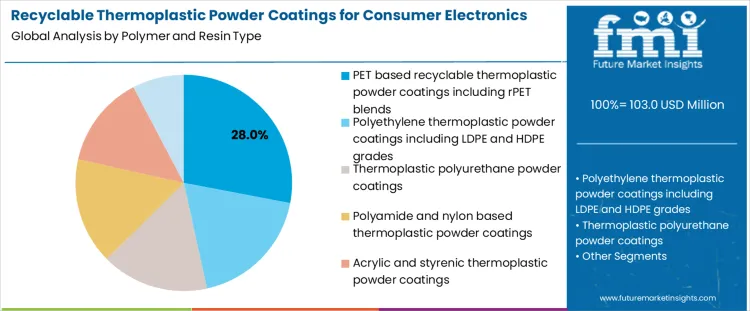
PET based recyclable thermoplastic powder coatings, including rPET blends, account for about 28% of demand because they align with established recycling streams and deliver adequate toughness for consumer electronics housings. These coatings provide dimensional stability, color consistency, and resistance to handling wear while supporting closed loop material strategies. Electronics manufacturers favor PET based systems due to compatibility with molded PET and blended substrates used in trims and frames. Their processing window supports consistent film formation at controlled temperatures, limiting part distortion. Growing availability of rPET feedstock further reinforces adoption, enabling brands to link coating choice with recycled content claims across device enclosures and accessories.
Polyethylene, TPU, polyamide, acrylic, and styrenic systems serve important secondary roles. Polyethylene coatings offer flexibility for larger casings. TPU powders provide impact resistance for wearables. Polyamide systems support abrasion resistance for peripherals. Acrylic and styrenic coatings deliver clarity and surface smoothness for display-adjacent parts. Specialty fluoropolymer and functional coatings remain limited to niche requirements. Polymer leadership therefore reflects recyclability alignment, supply consistency, and broad applicability rather than peak durability or advanced functionality.
What Is Driving Leadership by Application Location in the Recyclable Thermoplastic Powder Coatings Market?
.webp "Recyclable Thermoplastic Powder Coatings For Consumer Electronics Market Analysis By Application (device Location)")
Smartphone housings and frame trims represent about 30% of demand because smartphones dominate consumer electronics volumes and undergo frequent handling. Coatings in this location must resist scratches, fingerprints, and color fading while maintaining tactile quality. High production volumes and short product cycles favor coating systems that deliver repeatable aesthetics and support recycling at end of life. Manufacturers prioritize recyclable thermoplastic powders for frames and trims to reduce solvent use and align with sustainability messaging without compromising durability. Tight dimensional tolerances further reinforce selection of coatings with predictable film build.
Laptop and tablet casings, wearables, peripherals, displays, and small household electronics contribute secondary demand. Wearables emphasize impact resistance and comfort. Peripherals require abrasion resistance over long use cycles. Displays and bezels demand surface smoothness. Chargers and remotes focus on cost efficiency. These applications adopt recyclable coatings selectively based on exposure and handling intensity. Application leadership therefore reflects unit volume, touch frequency, and visual prominence rather than device complexity or component count.
How Are Recyclable Thermoplastic Powder Coatings Being Applied Across Consumer Electronics?
Use appears in smartphones, laptops, wearable devices, and household electronics where durable, visually appealing, and environmentally compliant finishes are required. Manufacturers adopt recyclable thermoplastic powder coatings to provide scratch resistance, corrosion protection, and uniform aesthetics while enabling material recovery at end-of-life. Assembly lines integrate these coatings on metal and plastic housings, frames, and panels to enhance product durability and support circular economy objectives. These applications reflect operational and sustainability priorities rather than purely decorative purposes, with adoption driven by performance, recyclability, and regulatory compliance.
What Operational and Material Conditions Support Adoption of Recyclable Thermoplastic Powder Coatings?
Selection aligns with substrates compatible with electrostatic or fluidized bed application methods and thermoplastic curing temperatures. Formulations are optimized for adhesion, flow, gloss, and thermal stability to maintain functional and aesthetic performance. Manufacturing workflows monitor coating thickness, curing conditions, and surface preparation to ensure uniform coverage and durability. Quality control evaluates scratch resistance, color consistency, and recyclate recovery potential to comply with industry standards and environmental regulations. These conditions emerge from operational efficiency, material performance, and circularity priorities in structured electronics manufacturing workflows.
Which Practical Considerations Limit Wider Use of Recyclable Thermoplastic Powder Coatings?
Higher material and processing costs may limit adoption in budget electronics segments. Substrate compatibility, surface preparation, and curing precision must be ensured. Recycling streams require controlled collection, separation, and reprocessing for effective material recovery. Regulatory approvals for environmental compliance vary by region. These factors lead to selective deployment where product durability, recyclability, and operational efficiency justify incremental cost and workflow adaptation.
What is the Demand for Recyclable Thermoplastic Powder Coatings for Consumer Electronics by Country?
| Country | CAGR (%) |
|---|---|
| China | 10.0% |
| USA | 7.0% |
| South Korea | 9.0% |
| Germany | 6.5% |
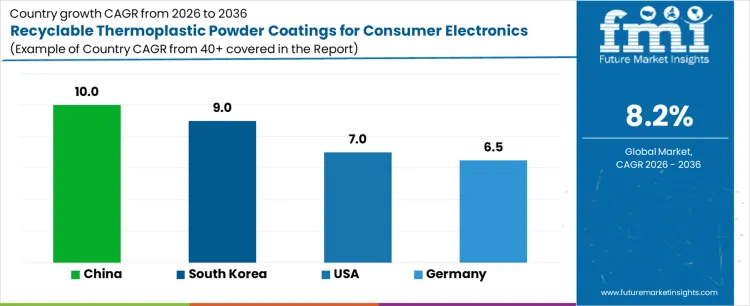
The demand for recyclable thermoplastic powder coatings for consumer electronics varies across countries, driven by electronic device production, sustainability initiatives, and regulatory compliance for recyclable materials. China leads with a 10.0% CAGR, supported by large scale consumer electronics manufacturing, adoption of eco-friendly coatings, and regulatory focus on recyclability. South Korea follows at 9.0%, driven by electronics production and integration of sustainable materials. The USA grows at 7.0%, reflecting steady adoption in electronic device manufacturing. Germany records 6.5%, shaped by mature electronics markets and regulatory compliance. These coatings help reduce environmental impact, enhance product durability, and improve recyclability of electronic devices.
How Are Recyclable Thermoplastic Powder Coatings Expanding Consumer Electronics Applications in China?
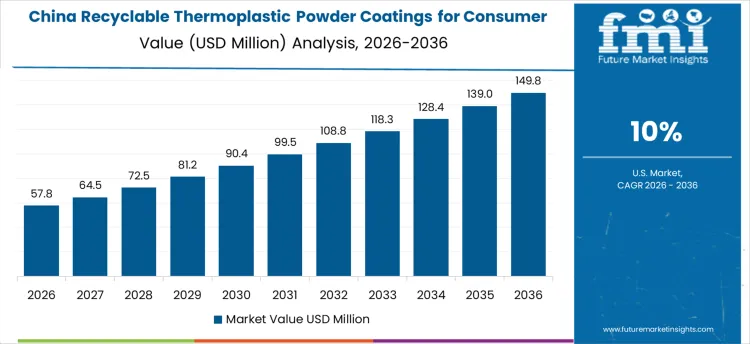
In China, the Recyclable Thermoplastic Powder Coatings for Consumer Electronics Market is growing at a CAGR of 10% through 2036, driven by rapid expansion of electronics manufacturing, e-waste recycling initiatives, and government sustainability incentives. Manufacturers are adopting recyclable powder coatings to improve surface durability, reduce VOC emissions, and enable closed-loop recycling for casings and components. Demand is concentrated in electronics production hubs, industrial coating facilities, and assembly plants for consumer devices. Compared to the USA, China emphasizes large-scale industrial adoption and volume-driven production. Domestic suppliers provide high-performance, recyclable coatings suitable for recurring assembly and finishing operations.
- Electronics production hubs, industrial coating facilities, and assembly plants drive adoption
- Coatings enhance surface durability and enable closed-loop recycling
- Domestic suppliers provide high-performance, recyclable solutions
- Recurring assembly and finishing operations sustain adoption
How Are E-Waste and Sustainability Initiatives Driving Growth in the United States?
In the United States, revenue is growing at a CAGR of 7% through 2036, supported by increasing production of consumer electronics, environmental regulations, and corporate sustainability commitments. Manufacturers and coating specialists are adopting recyclable thermoplastic powder coatings to reduce VOC emissions, improve component lifespan, and support e-waste recycling programs. Demand is concentrated in electronics manufacturing hubs, consumer device assembly facilities, and industrial coating centers. Compared to China, adoption emphasizes regulatory compliance and sustainability integration rather than large-volume industrial deployment. Domestic suppliers provide durable, recyclable coatings suitable for recurring assembly and finishing cycles.
- Electronics manufacturing hubs, consumer device assembly facilities, and industrial coating centers drive adoption
- Coatings reduce VOC emissions and support recycling programs
- Domestic suppliers provide durable, recyclable solutions
- Recurring assembly and finishing cycles sustain adoption
How Are Electronics Manufacturing and Environmental Standards Driving Adoption in South Korea?
.webp "Recyclable Thermoplastic Powder Coatings For Consumer Electronics Market South Korea Market Share Analysis By Application (device Location)")
In South Korea, the market is expanding at a CAGR of 9% through 2036, driven by high-tech consumer electronics production, sustainable manufacturing practices, and environmental regulations. Manufacturers are integrating recyclable thermoplastic powder coatings to enhance surface protection, reduce environmental impact, and facilitate recycling of electronic components. Demand is concentrated in industrial electronics hubs, consumer device assembly plants, and coating production facilities. Compared to Germany, adoption emphasizes integration with advanced manufacturing and eco-friendly standards. Domestic suppliers provide high-quality, recyclable coatings suitable for recurring assembly and surface finishing operations.
- Industrial electronics hubs, consumer device assembly plants, and coating production facilities drive adoption
- Coatings enhance surface protection and facilitate recycling
- Domestic suppliers provide high-quality, recyclable solutions
- Recurring assembly and finishing operations sustain adoption
How Are Regulatory Standards and Electronics Manufacturing Supporting Growth in Germany?
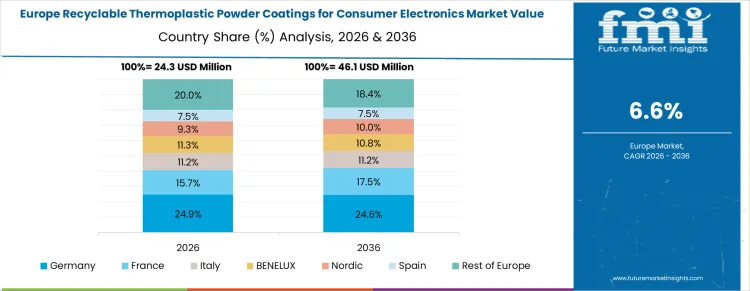
In Germany, revenue is growing at a CAGR of 6.5% through 2036, supported by strict environmental and recycling regulations, industrial electronics production, and sustainability initiatives. Contractors and electronics manufacturers are adopting recyclable thermoplastic powder coatings to improve durability, maintain surface quality, and comply with EU e-waste standards. Demand is concentrated in electronics manufacturing hubs, industrial coating facilities, and consumer device assembly plants. Compared to China, adoption emphasizes regulatory compliance and high-quality performance over volume-driven deployment. Domestic suppliers provide EU-certified, high-performance coatings suitable for recurring assembly and finishing operations.
- Electronics manufacturing hubs, industrial coating facilities, and assembly plants drive adoption
- Coatings improve durability and ensure compliance with recycling standards
- Domestic suppliers provide EU-certified, high-performance solutions
- Recurring assembly and finishing operations sustain adoption
Which Strategic Approaches Define Competition in the Recyclable Thermoplastic Powder Coatings for Consumer Electronics Market?
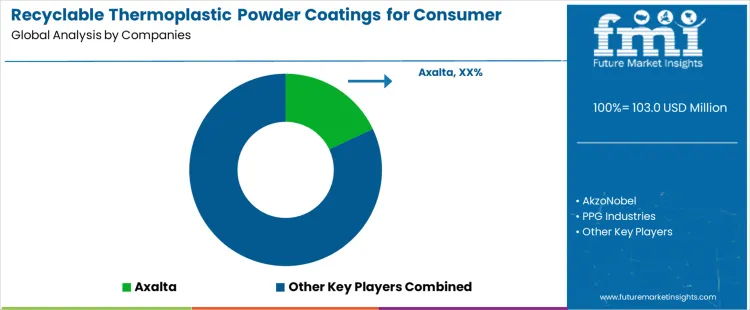
Competition in recyclable thermoplastic powder coatings for consumer electronics is shaped by how suppliers balance circularity targets with tight cosmetic and functional tolerances. Axalta and AkzoNobel approach this market by refining thermoplastic formulations that allow remelting or mechanical recovery without degrading surface appearance or adhesion. Their strategies emphasize uniform film build, scratch resistance, and color consistency on thin housings and complex geometries used in laptops, monitors, and small appliances. Qualification focuses on coating behavior during repeated thermal exposure, resistance to skin oils and cleaning agents, and compatibility with high throughput finishing lines. Electronics manufacturers prioritize coatings that support recyclability goals without introducing variability into assembly or end of life processing.
A different competitive logic is evident among suppliers focused on integration with existing finishing infrastructure. PPG Industries positions recyclable thermoplastic powders within broader electronics coating portfolios, supporting customers transitioning from thermoset systems without major equipment changes. The Sherwin Williams Company emphasizes process robustness, offering coatings designed to tolerate grounding variation, part density changes, and short cycle times common in electronics manufacturing. Across the market, strategies favor incremental material evolution, extensive line trials, and coordination with OEM sustainability teams. Competitive advantage depends on visual durability, process stability, and credible recyclability pathways rather than on novelty of resin chemistry or rapid portfolio expansion.
Key Players in the Recyclable Thermoplastic Powder Coatings for Consumer Electronics Market
- Axalta
- AkzoNobel
- PPG Industries
- The Sherwin-Williams Company
Scope of the Report
| Items | Values |
|---|---|
| Quantitative Units (2026) | USD million |
| Type | PET-based recyclable thermoplastic powder coatings including rPET blends, Polyethylene thermoplastic powder coatings, Thermoplastic polyurethane powder coatings, Polyamide and nylon-based thermoplastic powder coatings, Acrylic and styrenic thermoplastic powder coatings, Specialty fluoropolymer and electrically functional thermoplastic coatings |
| Application | Smartphone housings and frame trims, Laptop and tablet casings, Wearable device enclosures, Computer peripherals including keyboards mice and headsets, Displays and bezels, Small household electronics including remote controls and chargers |
| End Users | Consumer electronics OEMs, Electronics contract manufacturers, Device enclosure and housing suppliers, Electronics assembly and finishing service providers |
| Regions Covered | Asia Pacific, Europe, North America, Latin America, Middle East and Africa |
| Countries Covered | China, United States, South Korea, Germany, Japan, India, United Kingdom, France, Italy, Taiwan, Vietnam, Mexico, Brazil, and other major electronics manufacturing locations |
| Key Companies Profiled | Axalta, AkzoNobel, PPG Industries, The Sherwin-Williams Company |
| Additional Attributes | Dollar by sales across polymer and resin type application location and functional property, recyclability and recycled content qualification requirements, compatibility with electronics recycling streams and end-of-life disassembly, coating uniformity and cosmetic defect tolerance benchmarks, process integration with electrostatic and fluidized bed application lines, procurement lock-in effects driven by tooling alignment and material approval protocols |
Recyclable Thermoplastic Powder Coatings for Consumer Electronics Market Segmentation
Polymer and Resin Type:
- PET based recyclable thermoplastic powder coatings including rPET blends
- Polyethylene thermoplastic powder coatings including LDPE and HDPE grades
- Thermoplastic polyurethane powder coatings
- Polyamide and nylon based thermoplastic powder coatings
- Acrylic and styrenic thermoplastic powder coatings
- Specialty fluoropolymer and electrically functional thermoplastic coatings
Application (device location):
- Smartphone housings and frames used for trim surfaces
- Laptop and tablet casings
- Wearable devices including smartwatches and earbud cases
- Computer peripherals including keyboards, mice, and headsets
- Displays and bezels used for protective and touch surfaces
- Small household electronics including remote controls and chargers
Functional Property:
- Recyclability and recycled content formulations
- Anti-scratch and abrasion resistance
- Soft touch and tactile surface feel
- Anti-fingerprint and oleophobic topcoats
- Electromagnetic interference shielding and conductive powder formulations
- Flame retardant modified thermoplastics
- Aesthetic and high gloss decorative finishes
Coating Process:
- Electrostatic spray and melt application for thin film thermoplastic coatings
- Fluidized bed and dip coating processes for thicker thermoplastic films
- Powder film transfer using pre formed film application
- Pre coated substrates supplied to OEMs using coil or sheet pre coating
- Other bespoke coating processes including laser assisted and localized methods
Region
Asia Pacific
- China
- Japan
- South Korea
- India
- Australia & New Zealand
- ASEAN
- Rest of Asia Pacific
Europe
- Germany
- United Kingdom
- France
- Italy
- Spain
- Nordic
- BENELUX
- Rest of Europe
North America
- United States
- Canada
- Mexico
Latin America
- Brazil
- Chile
- Rest of Latin America
Middle East & Africa
- Kingdom of Saudi Arabia
- Other GCC Countries
- Turkey
- South Africa
- Other African Union
- Rest of Middle East & Africa
Frequently Asked Questions
How big is the recyclable thermoplastic powder coatings for consumer electronics market in 2026?
The global recyclable thermoplastic powder coatings for consumer electronics market is estimated to be valued at USD 103.0 million in 2026.
What will be the size of recyclable thermoplastic powder coatings for consumer electronics market in 2036?
The market size for the recyclable thermoplastic powder coatings for consumer electronics market is projected to reach USD 226.5 million by 2036.
How much will be the recyclable thermoplastic powder coatings for consumer electronics market growth between 2026 and 2036?
The recyclable thermoplastic powder coatings for consumer electronics market is expected to grow at a 8.2% CAGR between 2026 and 2036.
What are the key product types in the recyclable thermoplastic powder coatings for consumer electronics market?
The key product types in recyclable thermoplastic powder coatings for consumer electronics market are pet based recyclable thermoplastic powder coatings including rpet blends, polyethylene thermoplastic powder coatings including ldpe and hdpe grades, thermoplastic polyurethane powder coatings, polyamide and nylon based thermoplastic powder coatings, acrylic and styrenic thermoplastic powder coatings and specialty fluoropolymer and electrically functional thermoplastic coatings.
Which application (device location) segment to contribute significant share in the recyclable thermoplastic powder coatings for consumer electronics market in 2026?
In terms of application (device location), smartphone housings and frames used for trim surfaces segment to command 30.0% share in the recyclable thermoplastic powder coatings for consumer electronics market in 2026.
Preview the report firsthand - request a free sample
Get SampleGet the brochure for pricing and purchase details.
Get PDFTable of Content
- Executive Summary
- Global Market Outlook
- Demand-side Trends
- Supply-side Trends
- Technology Roadmap Analysis
- Analysis and Recommendations
- Market Overview
- Market Coverage / Taxonomy
- Market Definition / Scope / Limitations
- Market Background
- Market Dynamics
- Drivers
- Restraints
- Opportunity
- Trends
- Scenario Forecast
- Demand in Optimistic Scenario
- Demand in Likely Scenario
- Demand in Conservative Scenario
- Opportunity Map Analysis
- Product Life Cycle Analysis
- Supply Chain Analysis
- Investment Feasibility Matrix
- Value Chain Analysis
- PESTLE and Porter’s Analysis
- Regulatory Landscape
- Regional Parent Market Outlook
- Production and Consumption Statistics
- Import and Export Statistics
- Market Dynamics
- Global Market Analysis 2021 to 2025 and Forecast, 2026 to 2036
- Historical Market Size Value (USD Million) Analysis, 2021 to 2025
- Current and Future Market Size Value (USD Million) Projections, 2026 to 2036
- Y-o-Y Growth Trend Analysis
- Absolute $ Opportunity Analysis
- Global Market Pricing Analysis 2021 to 2025 and Forecast 2026 to 2036
- Global Market Analysis 2021 to 2025 and Forecast 2026 to 2036, By Polymer and Resin Type
- Introduction / Key Findings
- Historical Market Size Value (USD Million) Analysis By Polymer and Resin Type , 2021 to 2025
- Current and Future Market Size Value (USD Million) Analysis and Forecast By Polymer and Resin Type , 2026 to 2036
- PET based recyclable thermoplastic powder coatings including rPET blends
- Polyethylene thermoplastic powder coatings including LDPE and HDPE grades
- Thermoplastic polyurethane powder coatings
- Polyamide and nylon based thermoplastic powder coatings
- Acrylic and styrenic thermoplastic powder coatings
- Specialty fluoropolymer and electrically functional thermoplastic coatings
- PET based recyclable thermoplastic powder coatings including rPET blends
- Y-o-Y Growth Trend Analysis By Polymer and Resin Type , 2021 to 2025
- Absolute $ Opportunity Analysis By Polymer and Resin Type , 2026 to 2036
- Global Market Analysis 2021 to 2025 and Forecast 2026 to 2036, By Application (device location)
- Introduction / Key Findings
- Historical Market Size Value (USD Million) Analysis By Application (device location), 2021 to 2025
- Current and Future Market Size Value (USD Million) Analysis and Forecast By Application (device location), 2026 to 2036
- Smartphone housings and frames used for trim surfaces
- Laptop and tablet casings
- Wearable devices including smartwatches and earbud cases
- Computer peripherals including keyboards, mice, and headsets
- Displays and bezels used for protective and touch surfaces
- Small household electronics including remote controls and chargers
- Smartphone housings and frames used for trim surfaces
- Y-o-Y Growth Trend Analysis By Application (device location), 2021 to 2025
- Absolute $ Opportunity Analysis By Application (device location), 2026 to 2036
- Global Market Analysis 2021 to 2025 and Forecast 2026 to 2036, By Functional Property
- Introduction / Key Findings
- Historical Market Size Value (USD Million) Analysis By Functional Property, 2021 to 2025
- Current and Future Market Size Value (USD Million) Analysis and Forecast By Functional Property, 2026 to 2036
- Recyclability and recycled content formulations
- Anti scratch and abrasion resistance
- Soft touch and tactile surface feel
- Anti fingerprint and oleophobic topcoats
- Electromagnetic interference shielding and conductive powder formulations
- Flame retardant modified thermoplastics
- Aesthetic and high gloss decorative finishes
- Recyclability and recycled content formulations
- Y-o-Y Growth Trend Analysis By Functional Property, 2021 to 2025
- Absolute $ Opportunity Analysis By Functional Property, 2026 to 2036
- Global Market Analysis 2021 to 2025 and Forecast 2026 to 2036, By Coating Process
- Introduction / Key Findings
- Historical Market Size Value (USD Million) Analysis By Coating Process, 2021 to 2025
- Current and Future Market Size Value (USD Million) Analysis and Forecast By Coating Process, 2026 to 2036
- Electrostatic spray and melt application for thin film thermoplastic coatings
- Fluidized bed and dip coating processes for thicker thermoplastic films
- Powder film transfer using pre formed film application
- Pre coated substrates supplied to OEMs using coil or sheet pre coating
- Other bespoke coating processes including laser assisted and localized methods
- Electrostatic spray and melt application for thin film thermoplastic coatings
- Y-o-Y Growth Trend Analysis By Coating Process, 2021 to 2025
- Absolute $ Opportunity Analysis By Coating Process, 2026 to 2036
- Global Market Analysis 2021 to 2025 and Forecast 2026 to 2036, By Region
- Introduction
- Historical Market Size Value (USD Million) Analysis By Region, 2021 to 2025
- Current Market Size Value (USD Million) Analysis and Forecast By Region, 2026 to 2036
- North America
- Latin America
- Western Europe
- Eastern Europe
- East Asia
- South Asia and Pacific
- Middle East & Africa
- Market Attractiveness Analysis By Region
- North America Market Analysis 2021 to 2025 and Forecast 2026 to 2036, By Country
- Historical Market Size Value (USD Million) Trend Analysis By Market Taxonomy, 2021 to 2025
- Market Size Value (USD Million) Forecast By Market Taxonomy, 2026 to 2036
- By Country
- USA
- Canada
- Mexico
- By Polymer and Resin Type
- By Application (device location)
- By Functional Property
- By Coating Process
- By Country
- Market Attractiveness Analysis
- By Country
- By Polymer and Resin Type
- By Application (device location)
- By Functional Property
- By Coating Process
- Key Takeaways
- Latin America Market Analysis 2021 to 2025 and Forecast 2026 to 2036, By Country
- Historical Market Size Value (USD Million) Trend Analysis By Market Taxonomy, 2021 to 2025
- Market Size Value (USD Million) Forecast By Market Taxonomy, 2026 to 2036
- By Country
- Brazil
- Chile
- Rest of Latin America
- By Polymer and Resin Type
- By Application (device location)
- By Functional Property
- By Coating Process
- By Country
- Market Attractiveness Analysis
- By Country
- By Polymer and Resin Type
- By Application (device location)
- By Functional Property
- By Coating Process
- Key Takeaways
- Western Europe Market Analysis 2021 to 2025 and Forecast 2026 to 2036, By Country
- Historical Market Size Value (USD Million) Trend Analysis By Market Taxonomy, 2021 to 2025
- Market Size Value (USD Million) Forecast By Market Taxonomy, 2026 to 2036
- By Country
- Germany
- UK
- Italy
- Spain
- France
- Nordic
- BENELUX
- Rest of Western Europe
- By Polymer and Resin Type
- By Application (device location)
- By Functional Property
- By Coating Process
- By Country
- Market Attractiveness Analysis
- By Country
- By Polymer and Resin Type
- By Application (device location)
- By Functional Property
- By Coating Process
- Key Takeaways
- Eastern Europe Market Analysis 2021 to 2025 and Forecast 2026 to 2036, By Country
- Historical Market Size Value (USD Million) Trend Analysis By Market Taxonomy, 2021 to 2025
- Market Size Value (USD Million) Forecast By Market Taxonomy, 2026 to 2036
- By Country
- Russia
- Poland
- Hungary
- Balkan & Baltic
- Rest of Eastern Europe
- By Polymer and Resin Type
- By Application (device location)
- By Functional Property
- By Coating Process
- By Country
- Market Attractiveness Analysis
- By Country
- By Polymer and Resin Type
- By Application (device location)
- By Functional Property
- By Coating Process
- Key Takeaways
- East Asia Market Analysis 2021 to 2025 and Forecast 2026 to 2036, By Country
- Historical Market Size Value (USD Million) Trend Analysis By Market Taxonomy, 2021 to 2025
- Market Size Value (USD Million) Forecast By Market Taxonomy, 2026 to 2036
- By Country
- China
- Japan
- South Korea
- By Polymer and Resin Type
- By Application (device location)
- By Functional Property
- By Coating Process
- By Country
- Market Attractiveness Analysis
- By Country
- By Polymer and Resin Type
- By Application (device location)
- By Functional Property
- By Coating Process
- Key Takeaways
- South Asia and Pacific Market Analysis 2021 to 2025 and Forecast 2026 to 2036, By Country
- Historical Market Size Value (USD Million) Trend Analysis By Market Taxonomy, 2021 to 2025
- Market Size Value (USD Million) Forecast By Market Taxonomy, 2026 to 2036
- By Country
- India
- ASEAN
- Australia & New Zealand
- Rest of South Asia and Pacific
- By Polymer and Resin Type
- By Application (device location)
- By Functional Property
- By Coating Process
- By Country
- Market Attractiveness Analysis
- By Country
- By Polymer and Resin Type
- By Application (device location)
- By Functional Property
- By Coating Process
- Key Takeaways
- Middle East & Africa Market Analysis 2021 to 2025 and Forecast 2026 to 2036, By Country
- Historical Market Size Value (USD Million) Trend Analysis By Market Taxonomy, 2021 to 2025
- Market Size Value (USD Million) Forecast By Market Taxonomy, 2026 to 2036
- By Country
- Kingdom of Saudi Arabia
- Other GCC Countries
- Turkiye
- South Africa
- Other African Union
- Rest of Middle East & Africa
- By Polymer and Resin Type
- By Application (device location)
- By Functional Property
- By Coating Process
- By Country
- Market Attractiveness Analysis
- By Country
- By Polymer and Resin Type
- By Application (device location)
- By Functional Property
- By Coating Process
- Key Takeaways
- Key Countries Market Analysis
- USA
- Pricing Analysis
- Market Share Analysis, 2025
- By Polymer and Resin Type
- By Application (device location)
- By Functional Property
- By Coating Process
- Canada
- Pricing Analysis
- Market Share Analysis, 2025
- By Polymer and Resin Type
- By Application (device location)
- By Functional Property
- By Coating Process
- Mexico
- Pricing Analysis
- Market Share Analysis, 2025
- By Polymer and Resin Type
- By Application (device location)
- By Functional Property
- By Coating Process
- Brazil
- Pricing Analysis
- Market Share Analysis, 2025
- By Polymer and Resin Type
- By Application (device location)
- By Functional Property
- By Coating Process
- Chile
- Pricing Analysis
- Market Share Analysis, 2025
- By Polymer and Resin Type
- By Application (device location)
- By Functional Property
- By Coating Process
- Germany
- Pricing Analysis
- Market Share Analysis, 2025
- By Polymer and Resin Type
- By Application (device location)
- By Functional Property
- By Coating Process
- UK
- Pricing Analysis
- Market Share Analysis, 2025
- By Polymer and Resin Type
- By Application (device location)
- By Functional Property
- By Coating Process
- Italy
- Pricing Analysis
- Market Share Analysis, 2025
- By Polymer and Resin Type
- By Application (device location)
- By Functional Property
- By Coating Process
- Spain
- Pricing Analysis
- Market Share Analysis, 2025
- By Polymer and Resin Type
- By Application (device location)
- By Functional Property
- By Coating Process
- France
- Pricing Analysis
- Market Share Analysis, 2025
- By Polymer and Resin Type
- By Application (device location)
- By Functional Property
- By Coating Process
- India
- Pricing Analysis
- Market Share Analysis, 2025
- By Polymer and Resin Type
- By Application (device location)
- By Functional Property
- By Coating Process
- ASEAN
- Pricing Analysis
- Market Share Analysis, 2025
- By Polymer and Resin Type
- By Application (device location)
- By Functional Property
- By Coating Process
- Australia & New Zealand
- Pricing Analysis
- Market Share Analysis, 2025
- By Polymer and Resin Type
- By Application (device location)
- By Functional Property
- By Coating Process
- China
- Pricing Analysis
- Market Share Analysis, 2025
- By Polymer and Resin Type
- By Application (device location)
- By Functional Property
- By Coating Process
- Japan
- Pricing Analysis
- Market Share Analysis, 2025
- By Polymer and Resin Type
- By Application (device location)
- By Functional Property
- By Coating Process
- South Korea
- Pricing Analysis
- Market Share Analysis, 2025
- By Polymer and Resin Type
- By Application (device location)
- By Functional Property
- By Coating Process
- Russia
- Pricing Analysis
- Market Share Analysis, 2025
- By Polymer and Resin Type
- By Application (device location)
- By Functional Property
- By Coating Process
- Poland
- Pricing Analysis
- Market Share Analysis, 2025
- By Polymer and Resin Type
- By Application (device location)
- By Functional Property
- By Coating Process
- Hungary
- Pricing Analysis
- Market Share Analysis, 2025
- By Polymer and Resin Type
- By Application (device location)
- By Functional Property
- By Coating Process
- Kingdom of Saudi Arabia
- Pricing Analysis
- Market Share Analysis, 2025
- By Polymer and Resin Type
- By Application (device location)
- By Functional Property
- By Coating Process
- Turkiye
- Pricing Analysis
- Market Share Analysis, 2025
- By Polymer and Resin Type
- By Application (device location)
- By Functional Property
- By Coating Process
- South Africa
- Pricing Analysis
- Market Share Analysis, 2025
- By Polymer and Resin Type
- By Application (device location)
- By Functional Property
- By Coating Process
- USA
- Market Structure Analysis
- Competition Dashboard
- Competition Benchmarking
- Market Share Analysis of Top Players
- By Regional
- By Polymer and Resin Type
- By Application (device location)
- By Functional Property
- By Coating Process
- Competition Analysis
- Competition Deep Dive
- Axalta
- Overview
- Product Portfolio
- Profitability by Market Segments (Product/Age /Sales Channel/Region)
- Sales Footprint
- Strategy Overview
- Marketing Strategy
- Product Strategy
- Channel Strategy
- AkzoNobel
- PPG Industries
- The Sherwin-Williams Company
- Axalta
- Competition Deep Dive
- Assumptions & Acronyms Used
- Research Methodology


