

- Industry Size (2026)
- USD 1390 Mn
- Forecast (2036)
- USD 2864.8 Mn
- CAGR (2026 to 2036)
- 7.50%
Zinc Powder for Zinc Rich Coatings Market Forecast and Outlook 2026 to 2036
The zinc powder for zinc rich coatings market is projected to grow from USD 1,390 million in 2026 to USD 2,864.8 million by 2036, expanding at a CAGR of 7.50%. This market occupies a structurally important position within the broader corrosion protection and industrial coatings ecosystem. Zinc powder is not a discretionary input but a functional core material that determines the performance credibility of zinc-rich coating systems. Its role extends beyond raw material supply, directly influencing coating specifications, qualification standards, and long-term asset protection strategies across infrastructure, energy, marine, and heavy industrial sectors.
Competitive weight in this space is defined by metallurgical control, supply reliability, and the ability to meet evolving performance benchmarks rather than by branding or scale alone. Suppliers operate within a specification-driven environment where acceptance is earned through consistency, documentation, and alignment with international coating standards. As infrastructure renewal and asset life-extension gain priority globally, zinc powder remains a strategically embedded material, reinforcing its durable positioning within the protective coatings value chain.
Quick Stats for Zinc Powder for Zinc Rich Coatings Market
- Zinc Powder for Zinc Rich Coatings Market Value (2026): USD 1,390 Million
- Zinc Powder for Zinc Rich Coatings Market Forecast Value (2036): USD 2,864.8 Million
- Zinc Powder for Zinc Rich Coatings Market Forecast CAGR 2026 to 2036: 7.50%
- Leading Powder Type in Zinc Powder for Zinc Rich Coatings Market: 325 Mesh Zinc Powder (28% share)
- Key Growth Regions in Zinc Powder for Zinc Rich Coatings Market: Asia Pacific, North America, Europe, Latin America, Middle East & Africa
- Top Key Players in Zinc Powder for Zinc Rich Coatings Market: EverZinc, US Zinc LLC, Purity Zinc Metals, Inc., Hindustan Zinc Limited, Mitsubishi Materials Corporation, Zinc Oxide LLC, Grillo Zinkoxid GmbH, Transpek-Silox Industry, Hanchang Chemical Co., Pars Zinc Dust
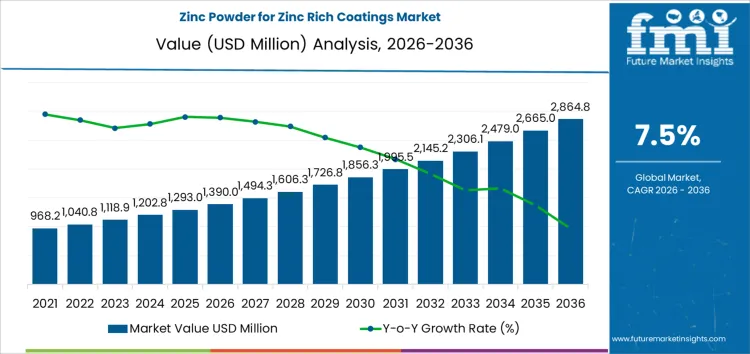
Zinc Powder for Zinc Rich Coatings Market Key Takeaways
| Metric | Value |
|---|---|
| Zinc Powder for Zinc Rich Coatings Market Value (2026) | USD 1,390 Million |
| Zinc Powder for Zinc Rich Coatings Market Forecast Value (2036) | USD 2,864.8 Million |
| Zinc Powder for Zinc Rich Coatings Market Forecast CAGR 2026 to 2036 | 7.50% |
How Are Infrastructure Durability and Coating Performance Requirements Driving the Zinc Powder for Zinc Rich Coatings Market?
The zinc powder for zinc rich coatings market is expanding as asset owners and coating applicators place greater emphasis on long-term corrosion protection and lifecycle cost reduction. Zinc rich coatings are widely specified for steel structures exposed to harsh environments, including marine infrastructure, bridges, power plants, pipelines, and offshore facilities. For zinc powder manufacturers, demand is increasingly tied to performance-based coating specifications that require high zinc purity, controlled particle size distribution, and consistent electrochemical behavior to ensure effective cathodic protection.
Coating formulators are also influencing zinc powder demand through evolving formulation strategies. Increasing use of inorganic and organic zinc-rich systems is driving preference for powders that deliver optimal packing density, dispersion stability, and film conductivity. Suppliers capable of offering customized zinc powder grades tailored by morphology, surface treatment, and fineness are gaining stronger positioning with high-performance coating producers. Reliability of supply and batch-to-batch consistency are becoming critical procurement criteria as coating manufacturers scale production for infrastructure and industrial maintenance projects.
Regulatory standards and regional infrastructure investment cycles are further shaping market opportunities. Stricter corrosion protection standards in transportation, energy, and industrial construction are reinforcing the use of zinc rich coatings as a primary protective layer. At the same time, large-scale infrastructure renewal programs in Asia Pacific, the Middle East, and parts of Europe are driving volume growth. For suppliers, competitive advantage increasingly depends on metallurgical expertise, application support, and the ability to align zinc powder performance with evolving coating system requirements across global markets.
How Is The Zinc Powder For Zinc Rich Coatings Market Segmented By Grade And Usage?
The zinc powder for zinc rich coatings market is segmented by powder type (mesh size) and application, reflecting how particle size and coating chemistry influence corrosion protection performance. By powder type, 325 mesh zinc powder represents the leading segment, as it offers an optimal balance between surface coverage, reactivity, and cost efficiency for protective coatings. Finer grades such as 400 mesh, 500 mesh, 600 mesh, 800 mesh, and other variants are selected for specialized formulation requirements. By application, inorganic zinc-rich coatings form the primary demand center, driven by their superior corrosion resistance and long service life in aggressive environments. Epoxy zinc-rich coatings and other systems support diversified industrial use.
Why Does 325 Mesh Zinc Powder Lead The Zinc Powder For Zinc Rich Coatings Market By Powder Type?
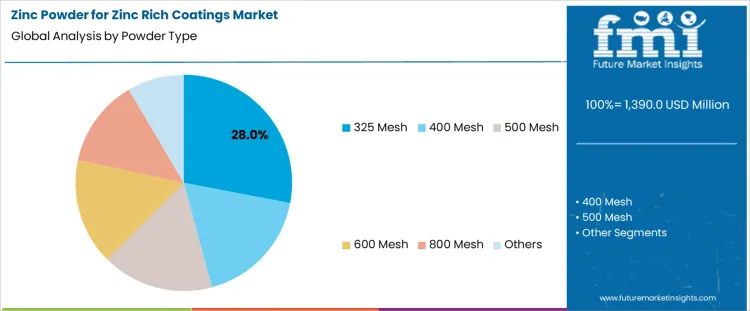
325 mesh zinc powder holds 28% share of the zinc powder for zinc rich coatings market because it delivers effective sacrificial protection while maintaining good dispersion within coating formulations. This mesh size provides sufficient surface area to enable electrochemical corrosion protection without excessive oxidation during storage or application. Coating manufacturers prefer 325 mesh zinc powder for infrastructure, marine, and industrial coatings where performance consistency and cost control are critical. The particle size supports smooth application and uniform film formation on steel substrates. For suppliers, 325 mesh grades enable high-volume production and standardized quality control. These technical and commercial advantages explain its leading adoption.
Why Do Inorganic Zinc-Rich Coatings Dominate The Zinc Powder For Zinc Rich Coatings Market By Application?
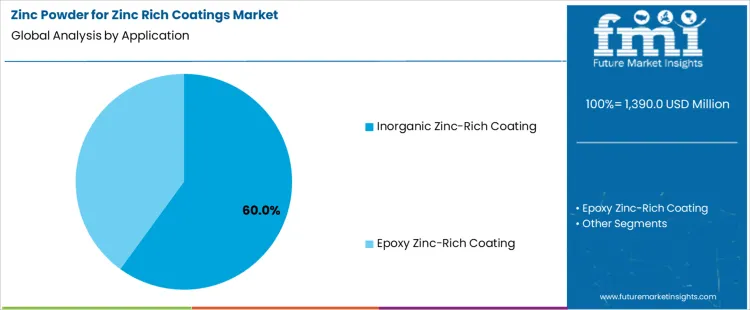
Inorganic zinc-rich coatings account for 60% share of the zinc powder for zinc rich coatings market because they provide long-term corrosion protection in harsh operating environments. These coatings form strong chemical bonds with steel substrates, offering superior resistance to abrasion, chemicals, and high temperatures. Infrastructure projects, offshore structures, and heavy industrial facilities rely on inorganic zinc-rich systems to meet durability and maintenance lifecycle requirements. High zinc loading levels drive sustained demand for quality zinc powder inputs. From a supplier perspective, inorganic systems require consistent particle performance and purity. These durability-driven advantages explain why inorganic zinc-rich coatings remain the dominant application segment.
What Are The Key Dynamics Of The Zinc Powder For Zinc Rich Coatings Market?
The zinc powder for zinc rich coatings market is driven by demand for long-term corrosion protection in infrastructure, marine, oil & gas, and industrial asset applications. Zinc-rich coatings rely on high-purity zinc powder to provide sacrificial cathodic protection to steel structures exposed to harsh environments. For manufacturers and suppliers, particle size distribution, zinc purity levels, and consistency of morphology directly influence coating performance and customer qualification. Infrastructure refurbishment cycles, asset life-extension strategies, and stricter corrosion protection specifications are shaping procurement decisions. Supply reliability, pricing stability of zinc raw materials, and technical support capabilities remain core competitive dynamics.
How Are Application And Specification Trends Influencing The Zinc Powder For Zinc Rich Coatings Market?
Application and specification trends are influencing the zinc powder for zinc rich coatings market through tighter performance requirements and broader end-use adoption. Engineering firms and coating formulators are increasingly specifying precise zinc content thresholds, optimized particle shapes, and controlled surface area to improve electrical connectivity and coating efficiency. Growth in offshore wind structures, bridges, pipelines, and storage tanks is increasing demand for high-performance zinc powders. Low-VOC and solvent-free coating systems are also shaping zinc powder compatibility requirements. Suppliers that align product grades with international coating standards and application-specific formulations gain stronger positioning with coating manufacturers.
Why Do Cost Volatility And Technical Qualification Challenges Restrain The Zinc Powder For Zinc Rich Coatings Market?
Cost volatility and technical qualification challenges restrain the zinc powder for zinc rich coatings market. Fluctuating zinc prices directly affect production costs and contract pricing, creating margin pressure for suppliers and formulators. High energy consumption during zinc powder manufacturing adds sensitivity to fuel and electricity costs. End users often require extensive qualification testing, including salt spray and cyclic corrosion testing, extending sales cycles. Variability in coating performance due to inconsistent zinc powder quality can lead to requalification risk. These factors require suppliers to invest in process control, inventory management, and long-term customer agreements.
What Are the Country-Level Growth Trends in the Zinc Powder for Zinc-Rich Coatings Market?
The zinc powder for zinc-rich coatings market is shaped by long-term corrosion protection requirements across infrastructure, energy, marine, and heavy industrial assets. Adoption patterns differ by country depending on infrastructure age, maintenance intensity, environmental exposure, and regulatory coating standards. Asia Pacific leads volume growth through large-scale infrastructure expansion, while North America and Europe emphasize performance consistency, particle quality, and compliance with coating specifications. Buyers increasingly evaluate zinc powder based on purity, particle size distribution, surface area, and compatibility with organic and inorganic binder systems. Suppliers that offer consistent quality, application support, and secure supply chains gain preference among coating manufacturers and asset owners.
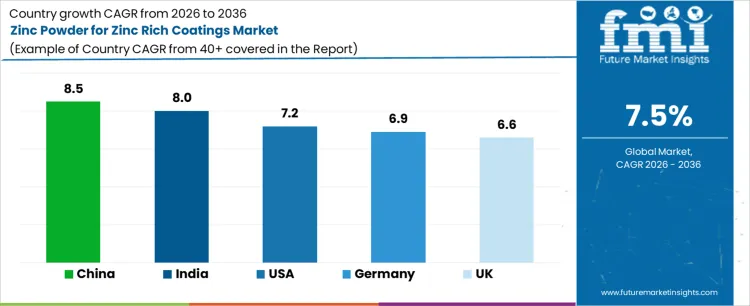
| Country | CAGR (%) |
|---|---|
| China | 8.5% |
| India | 8.0% |
| USA | 7.2% |
| Germany | 6.9% |
| UK | 6.6% |
Why Does China Dominate Volume Consumption of Zinc Powder for Zinc-Rich Coatings?
The zinc powder for zinc-rich coatings market in China, expanding at a CAGR of 8.5% during 2026 to 2036, is driven by construction of bridges, ports, power plants, rail corridors, and industrial facilities requiring long-term corrosion protection. Coating manufacturers emphasize cost efficiency, uninterrupted supply, and compatibility with high-throughput formulation processes. Domestic zinc powder producers dominate the supply landscape, creating intense price competition across standard-grade products. Export-oriented coating formulators increasingly specify higher-purity zinc powders to comply with international coating standards. Procurement commonly occurs through annual or multi-year supply contracts, favoring suppliers with large production capacity, integrated logistics, and stable pricing structures. Particle size consistency and batch uniformity are gaining importance as automated coating application expands. China represents a volume-led environment where supplier success depends on operational scale, production efficiency, and supply reliability rather than premium differentiation.
How Is India Developing into a Rapidly Expanding Zinc Powder Consumption Market?
Demand for zinc powder for zinc-rich coatings market in India, growing at a CAGR of 8.0% during 2026 to 2036, reflects expansion of highways, railways, transmission towers, refineries, and industrial plants. Coating applicators and formulators prioritize affordability, local availability, and suitability for field-applied coatings. While price sensitivity remains high, awareness of lifecycle asset protection is gradually increasing quality expectations. Import substitution policies encourage sourcing from domestic zinc powder manufacturers, supporting capacity expansion and localized supply chains. Buyers favor suppliers offering consistent particle size distribution, basic technical guidance, and dependable delivery. Demand growth is strongest in public infrastructure and heavy engineering sectors where zinc-rich primers are specified for long-term durability. Procurement decisions are often decentralized, requiring strong distributor networks and regional presence. India presents a growth-oriented market where volume expansion and incremental quality improvement occur simultaneously, offering supplier’s opportunities to scale gradually while upgrading product specifications.
What Defines the United States as a Specification-Driven Zinc Powder Market?
Sale of zinc powder for zinc-rich coatings market in the United States, expanding at a CAGR of 7.2% during 2026 to 2036, is shaped by maintenance of aging infrastructure, marine assets, and energy facilities. Buyers prioritize particle morphology, zinc purity, and adherence to ASTM and SSPC coating specifications. Procurement decisions emphasize traceability, documentation quality, and batch-to-batch consistency over price competitiveness. Consumption is largely replacement-driven, linked to recoating of bridges, pipelines, offshore platforms, and industrial equipment. Coating manufacturers require predictable performance to meet warranty and inspection requirements. Suppliers offering technical support, formulation assistance, and certification documentation gain preference. Volumes are moderate compared with Asia, but unit values remain higher due to stringent specifications. The United States favors suppliers positioned around reliability, compliance expertise, and long-term supply assurance rather than commodity-grade zinc powder offerings.
How Does Germany Reinforce Demand for High-Precision Zinc Powder?
The zinc powder for zinc-rich coatings market in Germany, growing at a CAGR of 6.9% during 2026 to 2036, is driven by maintenance of industrial facilities and export-oriented coating production. Industrial quality standards play a central role in zinc powder procurement across Germany. Buyers emphasize precise particle size control, uniform dispersion, and environmental compliance. Demand is primarily replacement-led, as manufacturers maintain protective coatings on machinery, steel structures, and industrial equipment. Procurement processes are structured and documentation-intensive, favoring suppliers with strong quality assurance systems. Germany rewards zinc powder producers capable of delivering high-purity grades with consistent performance characteristics. Volumes remain moderate, but technical expectations support premium pricing. Long-term supplier relationships and predictable maintenance cycles characterize purchasing behavior. This market favors precision engineering, process reliability, and regulatory alignment rather than high-volume cost competition.
Why Does the UK Remain a Stable, Quality-Oriented Zinc Powder Market?
Demand for zinc powder for zinc-rich coatings market in the UK, expanding at a CAGR of 6.6% during 2026 to 2036, reflects steady application across bridges, marine structures, and industrial assets.Infrastructure refurbishment and offshore maintenance activities shape zinc powder usage patterns in the United Kingdom. Buyers focus on compliance with coating standards, predictable supply, and consistent product performance. Procurement volumes are moderate, yet specification rigor remains high due to regulatory oversight. Replacement and maintenance coatings dominate consumption, supporting recurring purchasing cycles. Suppliers offering reliable logistics, documentation support, and technical consistency gain preference. The UK market values stability, quality assurance, and supplier dependability over aggressive price competition.
How Are Suppliers Competing in the Zinc Powder for Zinc Rich Coatings Market?
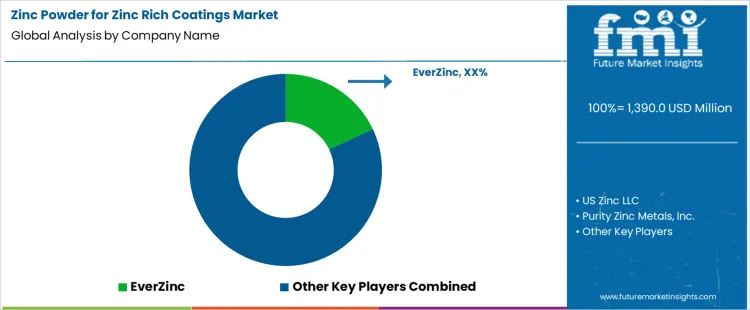
Competition in the zinc powder for zinc rich coatings market is shaped by product quality specifications, alloy control, and application-aligned performance data documented in official product literature. EverZinc positions its zinc powders with brochures highlighting controlled particle size distributions and high zinc purity for enhanced sacrificial protection in marine and infrastructure coatings. Technical materials emphasize consistent galvanic activity and optimized blend performance with epoxy and polyurethane binders. US Zinc LLC competes by offering a range of atomized and flake zinc powders with documented electrical conductivity and surface area metrics tailored to high-build corrosion systems. Its product literature underscores reproducible coating performance backed by stringent production controls.
Regional and specialized producers differentiate through tailored grades and supply reliability. Purity Zinc Metals, Inc. and Hindustan Zinc Limited focus on high-purity zinc powders with official data on impurity thresholds that influence long-term corrosion resistance. Their brochures describe sustainable sourcing and batch traceability, appealing to coatings formulators prioritizing consistency. Mitsubishi Materials Corporation brings alloying expertise with materials described in technical sheets for optimized adhesion and long-term barrier effects in heavy-duty coatings.
Mid-tier suppliers and niche players compete on customization and integration support. Zinc Oxide LLC and Grillo Zinkoxid GmbH emphasize engineered zinc dust grades with literature highlighting narrow particle distribution and moisture control, which aid in predictable rheology and reduced settling in liquid coatings. Transpek-Silox Industry positions its zinc powders with product guides that stress compatibility with hybrid resin systems used in industrial coatings. Hanchang Chemical Co. and Pars Zinc Dust differentiate via cost-competitive offerings with official specifications covering zinc content, surface area, and form factor (flake vs. atomized) to support both solvent-borne and water-based formulations.
Soil Tillage Implements Market
- EverZinc
- US Zinc LLC
- Purity Zinc Metals, Inc.
- Hindustan Zinc Limited
- Mitsubishi Materials Corporation
- Zinc Oxide LLC
- Grillo Zinkoxid GmbH
- Transpek-Silox Industry
- Hanchang Chemical Co.
- Pars Zinc Dust
- Others
Scope of Report
| Attribute | Description |
|---|---|
| Quantitative Unit | USD Million |
| Powder Type | 325 Mesh, 400 Mesh, 500 Mesh, 600 Mesh, 800 Mesh, Others |
| Application | Inorganic Zinc-Rich Coating, Epoxy Zinc-Rich Coating |
| Countries Covered | China, Japan, South Korea, India, Australia & New Zealand, ASEAN, Rest of Asia Pacific, Germany, United Kingdom, France, Italy, Spain, Nordic, BENELUX, Rest of Europe, United States, Canada, Mexico, Brazil, Chile, Rest of Latin America, Kingdom of Saudi Arabia, Other GCC Countries, Turkey, South Africa, Other African Union, Rest of Middle East & Africa |
| Regions Covered | Asia Pacific, Europe, North America, Latin America, Middle East & Africa |
| Key Companies Profiled | EverZinc, US Zinc LLC, Purity Zinc Metals, Inc., Hindustan Zinc Limited, Mitsubishi Materials Corporation, Zinc Oxide LLC, Grillo Zinkoxid GmbH, Transpek-Silox Industry, Hanchang Chemical Co., Pars Zinc Dust, Others |
| Additional Attributes | Dollar sales by powder type and application are assessed across corrosion protection and industrial coating systems. The report includes country-level demand assessment, growth projections for 2026 to 2036, evaluation of particle size distribution and purity requirements, assessment of performance standards in zinc-rich coatings, competitive benchmarking of suppliers, and analysis of consumption trends across infrastructure, marine, and industrial assets. |
Soil Tillage Implements Market
Powder Type
- 325 Mesh
- 400 Mesh
- 500 Mesh
- 600 Mesh
- 800 Mesh
- Others
Application
- Inorganic Zinc-Rich Coating
- Epoxy Zinc-Rich Coating
Region
- Asia Pacific
- China
- Japan
- South Korea
- India
- Australia & New Zealand
- ASEAN
- Rest of Asia Pacific
- Europe
- Germany
- United Kingdom
- France
- Italy
- Spain
- Nordic
- BENELUX
- Rest of Europe
- North America
- United States
- Canada
- Mexico
- Latin America
- Brazil
- Chile
- Rest of Latin America
- Middle East & Africa
- Kingdom of Saudi Arabia
- Other GCC Countries
- Turkey
- South Africa
- Other African Union
- Rest of Middle East & Africa
Bibliography
- ASTM International. (2025). ASTM D520-25: Standard specification for zinc dust pigment. ASTM International.
- International Organization for Standardization. (2024). ISO 3549:2024 Zinc dust pigments for paints and varnishes – Specifications and test methods. ISO.
- United States Geological Survey. (2025). Mineral commodity summaries 2025: Zinc. U.S. Department of the Interior.
Frequently Asked Questions
How big is the zinc powder for zinc rich coatings market in 2026?
The global zinc powder for zinc rich coatings market is estimated to be valued at USD 1,390.0 million in 2026.
What will be the size of zinc powder for zinc rich coatings market in 2036?
The market size for the zinc powder for zinc rich coatings market is projected to reach USD 2,864.8 million by 2036.
How much will be the zinc powder for zinc rich coatings market growth between 2026 and 2036?
The zinc powder for zinc rich coatings market is expected to grow at a 7.5% CAGR between 2026 and 2036.
What are the key product types in the zinc powder for zinc rich coatings market?
The key product types in zinc powder for zinc rich coatings market are 325 mesh, 400 mesh, 500 mesh, 600 mesh, 800 mesh and others.
Which application segment to contribute significant share in the zinc powder for zinc rich coatings market in 2026?
In terms of application, inorganic zinc-rich coating segment to command 60.0% share in the zinc powder for zinc rich coatings market in 2026.
Preview the report firsthand - request a free sample
Get SampleGet the brochure for pricing and purchase details.
Get PDFTable of Content
- Executive Summary
- Global Market Outlook
- Demand-side Trends
- Supply-side Trends
- Technology Roadmap Analysis
- Analysis and Recommendations
- Market Overview
- Market Coverage / Taxonomy
- Market Definition / Scope / Limitations
- Market Background
- Market Dynamics
- Drivers
- Restraints
- Opportunity
- Trends
- Scenario Forecast
- Demand in Optimistic Scenario
- Demand in Likely Scenario
- Demand in Conservative Scenario
- Opportunity Map Analysis
- Product Life Cycle Analysis
- Supply Chain Analysis
- Investment Feasibility Matrix
- Value Chain Analysis
- PESTLE and Porter’s Analysis
- Regulatory Landscape
- Regional Parent Market Outlook
- Production and Consumption Statistics
- Import and Export Statistics
- Market Dynamics
- Global Market Analysis 2021 to 2025 and Forecast, 2026 to 2036
- Historical Market Size Value (USD Million) Analysis, 2021 to 2025
- Current and Future Market Size Value (USD Million) Projections, 2026 to 2036
- Y-o-Y Growth Trend Analysis
- Absolute $ Opportunity Analysis
- Global Market Pricing Analysis 2021 to 2025 and Forecast 2026 to 2036
- Global Market Analysis 2021 to 2025 and Forecast 2026 to 2036, By Powder Type
- Introduction / Key Findings
- Historical Market Size Value (USD Million) Analysis By Powder Type , 2021 to 2025
- Current and Future Market Size Value (USD Million) Analysis and Forecast By Powder Type , 2026 to 2036
- 325 Mesh
- 400 Mesh
- 500 Mesh
- 600 Mesh
- 800 Mesh
- Others
- 325 Mesh
- Y-o-Y Growth Trend Analysis By Powder Type , 2021 to 2025
- Absolute $ Opportunity Analysis By Powder Type , 2026 to 2036
- Global Market Analysis 2021 to 2025 and Forecast 2026 to 2036, By Application
- Introduction / Key Findings
- Historical Market Size Value (USD Million) Analysis By Application, 2021 to 2025
- Current and Future Market Size Value (USD Million) Analysis and Forecast By Application, 2026 to 2036
- Inorganic Zinc-Rich Coating
- Epoxy Zinc-Rich Coating
- Inorganic Zinc-Rich Coating
- Y-o-Y Growth Trend Analysis By Application, 2021 to 2025
- Absolute $ Opportunity Analysis By Application, 2026 to 2036
- Global Market Analysis 2021 to 2025 and Forecast 2026 to 2036, By Region
- Introduction
- Historical Market Size Value (USD Million) Analysis By Region, 2021 to 2025
- Current Market Size Value (USD Million) Analysis and Forecast By Region, 2026 to 2036
- North America
- Latin America
- Western Europe
- Eastern Europe
- East Asia
- South Asia and Pacific
- Middle East & Africa
- Market Attractiveness Analysis By Region
- North America Market Analysis 2021 to 2025 and Forecast 2026 to 2036, By Country
- Historical Market Size Value (USD Million) Trend Analysis By Market Taxonomy, 2021 to 2025
- Market Size Value (USD Million) Forecast By Market Taxonomy, 2026 to 2036
- By Country
- USA
- Canada
- Mexico
- By Powder Type
- By Application
- By Country
- Market Attractiveness Analysis
- By Country
- By Powder Type
- By Application
- Key Takeaways
- Latin America Market Analysis 2021 to 2025 and Forecast 2026 to 2036, By Country
- Historical Market Size Value (USD Million) Trend Analysis By Market Taxonomy, 2021 to 2025
- Market Size Value (USD Million) Forecast By Market Taxonomy, 2026 to 2036
- By Country
- Brazil
- Chile
- Rest of Latin America
- By Powder Type
- By Application
- By Country
- Market Attractiveness Analysis
- By Country
- By Powder Type
- By Application
- Key Takeaways
- Western Europe Market Analysis 2021 to 2025 and Forecast 2026 to 2036, By Country
- Historical Market Size Value (USD Million) Trend Analysis By Market Taxonomy, 2021 to 2025
- Market Size Value (USD Million) Forecast By Market Taxonomy, 2026 to 2036
- By Country
- Germany
- UK
- Italy
- Spain
- France
- Nordic
- BENELUX
- Rest of Western Europe
- By Powder Type
- By Application
- By Country
- Market Attractiveness Analysis
- By Country
- By Powder Type
- By Application
- Key Takeaways
- Eastern Europe Market Analysis 2021 to 2025 and Forecast 2026 to 2036, By Country
- Historical Market Size Value (USD Million) Trend Analysis By Market Taxonomy, 2021 to 2025
- Market Size Value (USD Million) Forecast By Market Taxonomy, 2026 to 2036
- By Country
- Russia
- Poland
- Hungary
- Balkan & Baltic
- Rest of Eastern Europe
- By Powder Type
- By Application
- By Country
- Market Attractiveness Analysis
- By Country
- By Powder Type
- By Application
- Key Takeaways
- East Asia Market Analysis 2021 to 2025 and Forecast 2026 to 2036, By Country
- Historical Market Size Value (USD Million) Trend Analysis By Market Taxonomy, 2021 to 2025
- Market Size Value (USD Million) Forecast By Market Taxonomy, 2026 to 2036
- By Country
- China
- Japan
- South Korea
- By Powder Type
- By Application
- By Country
- Market Attractiveness Analysis
- By Country
- By Powder Type
- By Application
- Key Takeaways
- South Asia and Pacific Market Analysis 2021 to 2025 and Forecast 2026 to 2036, By Country
- Historical Market Size Value (USD Million) Trend Analysis By Market Taxonomy, 2021 to 2025
- Market Size Value (USD Million) Forecast By Market Taxonomy, 2026 to 2036
- By Country
- India
- ASEAN
- Australia & New Zealand
- Rest of South Asia and Pacific
- By Powder Type
- By Application
- By Country
- Market Attractiveness Analysis
- By Country
- By Powder Type
- By Application
- Key Takeaways
- Middle East & Africa Market Analysis 2021 to 2025 and Forecast 2026 to 2036, By Country
- Historical Market Size Value (USD Million) Trend Analysis By Market Taxonomy, 2021 to 2025
- Market Size Value (USD Million) Forecast By Market Taxonomy, 2026 to 2036
- By Country
- Kingdom of Saudi Arabia
- Other GCC Countries
- Turkiye
- South Africa
- Other African Union
- Rest of Middle East & Africa
- By Powder Type
- By Application
- By Country
- Market Attractiveness Analysis
- By Country
- By Powder Type
- By Application
- Key Takeaways
- Key Countries Market Analysis
- USA
- Pricing Analysis
- Market Share Analysis, 2025
- By Powder Type
- By Application
- Canada
- Pricing Analysis
- Market Share Analysis, 2025
- By Powder Type
- By Application
- Mexico
- Pricing Analysis
- Market Share Analysis, 2025
- By Powder Type
- By Application
- Brazil
- Pricing Analysis
- Market Share Analysis, 2025
- By Powder Type
- By Application
- Chile
- Pricing Analysis
- Market Share Analysis, 2025
- By Powder Type
- By Application
- Germany
- Pricing Analysis
- Market Share Analysis, 2025
- By Powder Type
- By Application
- UK
- Pricing Analysis
- Market Share Analysis, 2025
- By Powder Type
- By Application
- Italy
- Pricing Analysis
- Market Share Analysis, 2025
- By Powder Type
- By Application
- Spain
- Pricing Analysis
- Market Share Analysis, 2025
- By Powder Type
- By Application
- France
- Pricing Analysis
- Market Share Analysis, 2025
- By Powder Type
- By Application
- India
- Pricing Analysis
- Market Share Analysis, 2025
- By Powder Type
- By Application
- ASEAN
- Pricing Analysis
- Market Share Analysis, 2025
- By Powder Type
- By Application
- Australia & New Zealand
- Pricing Analysis
- Market Share Analysis, 2025
- By Powder Type
- By Application
- China
- Pricing Analysis
- Market Share Analysis, 2025
- By Powder Type
- By Application
- Japan
- Pricing Analysis
- Market Share Analysis, 2025
- By Powder Type
- By Application
- South Korea
- Pricing Analysis
- Market Share Analysis, 2025
- By Powder Type
- By Application
- Russia
- Pricing Analysis
- Market Share Analysis, 2025
- By Powder Type
- By Application
- Poland
- Pricing Analysis
- Market Share Analysis, 2025
- By Powder Type
- By Application
- Hungary
- Pricing Analysis
- Market Share Analysis, 2025
- By Powder Type
- By Application
- Kingdom of Saudi Arabia
- Pricing Analysis
- Market Share Analysis, 2025
- By Powder Type
- By Application
- Turkiye
- Pricing Analysis
- Market Share Analysis, 2025
- By Powder Type
- By Application
- South Africa
- Pricing Analysis
- Market Share Analysis, 2025
- By Powder Type
- By Application
- USA
- Market Structure Analysis
- Competition Dashboard
- Competition Benchmarking
- Market Share Analysis of Top Players
- By Regional
- By Powder Type
- By Application
- Competition Analysis
- Competition Deep Dive
- EverZinc
- Overview
- Product Portfolio
- Profitability by Market Segments (Product/Age /Sales Channel/Region)
- Sales Footprint
- Strategy Overview
- Marketing Strategy
- Product Strategy
- Channel Strategy
- US Zinc LLC
- Purity Zinc Metals, Inc.
- Hindustan Zinc Limited
- Mitsubishi Materials Corporation
- Zinc Oxide LLC
- Grillo Zinkoxid GmbH
- Transpek-Silox Industry
- Hanchang Chemical Co.
- Pars Zinc Dust
- Others
- EverZinc
- Competition Deep Dive
- Assumptions & Acronyms Used
- Research Methodology


