
- Market Size (2026)
- USD 5.0 Bn
- Forecast (2036)
- USD 9.4 Bn
- CAGR (2026 to 2036)
- 6.4%
How big is Zinc Oxide Market in 2026?
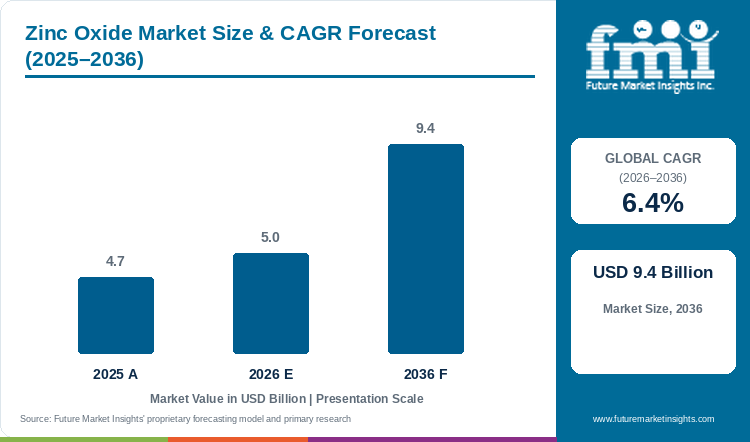
Sales of zinc oxide will grow at a CAGR of 6.4% from 2026 to 2036. Market size is USD 4.7 billion in 2025 and USD 5.0 billion in 2026, and is projected to reach USD 9.4 billion by 2036.
Zinc oxide market size stood at USD 4.7 billion in 2025, is estimated at USD 5.0 billion in 2026 and is projected to reach USD 9.4 billion by 2036. Sales of zinc oxide will grow at a CAGR of 6.4% from 2026 to 2036, according to FMI. Rubber is the leading application of the market, so demand for zinc oxide will follow tyre output. The International Rubber Study Group expects global rubber demand to reach 36.57 million tonnes by 2032, from 32.49 million tonnes in 2025. The group also forecasts average tyre production growth of 1.46% a year through 2032. Key challenges faced by producers include the modest tyre growth rate, so sales gains will have to come from new uses, new regions and better grades.
Key Market Trends & Insights
- By grade, industrial grade led the market with a share of 74.9% in 2026, ahead of pharma at 15% and food at 10.1%, supported by use in rubber, ceramics and paints.
- By process, the indirect (French) process held 77.6% of process sales in 2026, ahead of the direct (American) process at 14.8% and wet chemical at 7.6%. Tyre Trends reported in June 2026 that Punia Group recently commissioned a French process plant at Tirupati.
- By application, rubber accounted for 46.3% of sales in 2026, followed by ceramics at 12.5% and chemicals at 9%. Tyre production is forecast to grow by an average of 1.46% a year through 2032.
Regional Highlights
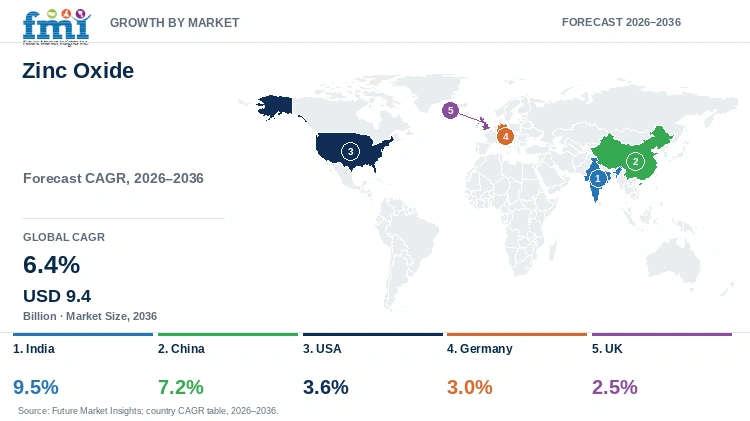
- Fastest-growing profiled country: India (9.5% CAGR, 2026 to 2036).
- By country: China follows at 7.2% and the USA at 3.6%, with Germany at 3% and the UK recording the lowest profiled CAGR at 2.5%.
- Indian tyre exports rose 9% to INR 25,051 crore in FY2024-25, according to Ministry of Commerce data reported in July 2025.
Market Size & Forecast
Table 1: Market Size and Forecast for the Zinc Oxide Market (USD billion and percentage), 2025 to 2036
| Metric | Value |
|---|---|
| 2025 Market Size | USD 4.7 billion |
| Estimated Market Size in 2026 | USD 5.0 billion |
| Projected Market Size by 2036 | USD 9.4 billion |
| CAGR, 2026 to 2036 | 6.4% |
| Added Revenue, 2026 to 2036 | USD 4.4 billion |
| Market Expansion Multiple | 1.9x |
Rubber is the largest source of zinc oxide demand at 46.3% of application sales in 2026, and tyre output grows slowly. Tyre production is forecast to rise 0.24% in 2025, according to the International Rubber Study Group outlook reported in January 2026. As per FMI, producers are responding with purer grades and recycled feed. GRILLO-Werke produces zinc oxide at Goslar, including a high-purity, EU-GMP-compliant cosmetic pigment, and growth in the halal cosmetics market is anticipated to widen the buyer pool for cosmetic grades. The global refined zinc market was in surplus by 120kt in the first half of 2026, per the International Lead and Zinc Study Group. That surplus may ease feed cost for French process plants and for zinc alloy makers in the die casting services market. Ferrite makers in the magnetic materials market are a further electronic buyer of high purity oxide.
Installed Capacity by Process Route
Installed capacity in the zinc oxide market is documented best for the indirect (French) process. J.G. Chemicals reported plant capacity of 43,704 MTPA at Naidupeta, 14,400 MTPA at Jangalpur and 1,800 MTPA at Belur in May 2025. Group capacity of 70,000 MTPA of zinc chemicals was cited on 8 August 2026, ahead of the Dahej start. Tyre Trends reported in June 2026 that heat recovery and furnace optimisation delivered 15 to 20 percent fuel savings at the Punia Group Tirupati plant. Recycling adds oxide outside the French route, as Befesa sold 189,867 tonnes of Waelz oxide in the first half of 2026.
Table 2: Installed Capacity and Process Route Indicators for the Zinc Oxide Market (tonnes per year and percentage), mixed reporting years from 2025 to 2026
| Indicator | Data Point | Relevance | Source |
|---|---|---|---|
| J.G. Chemicals, India plants, 2025 | Naidupeta 43,704 MTPA; Jangalpur 14,400 MTPA; Belur 1,800 MTPA | The plants form the documented Indian base for tyre and rubber buyers. | |
| J.G. Chemicals, Dahej | 40,000+ MTPA; commissioning expected in Q3 FY27, earlier targeted by H1 FY27 | The new Gujarat unit adds supply, and the start moved to a later quarter. | |
| J.G. Chemicals, group zinc chemicals, 2026 | Capacity of 70,000 MTPA of zinc chemicals | The group base comes before the Dahej start. | |
| Punia Group, Tirupati, 2026 | French process plant; zinc dross feed; 15 to 20 percent fuel savings | Recycled galvanising dross supports indirect process output. | |
| Befesa steel dust recycling, H1 2026 | Installed capacity 1,758,300 tonnes; throughput 587,796 tonnes; utilisation 67.4% | Spare capacity leaves room for more recycled zinc. | |
| Befesa Waelz oxide sold, H1 2026 | 189,867 tonnes, up 2.6% from 184,981 tonnes in H1 2025 | Recycled oxide volumes add supply outside the French route. | |
| USA crude zinc oxide recovery, 2025 | Crude zinc oxide recovered from electric arc furnace dust | Steel dust recovery gives the USA a secondary oxide source. |
Analyst Perspective
Zinc oxide is likely to remain anchored in rubber and industrial processing, and producers with feedstock control and consistent particle quality are expected to gain an advantage as downstream users tighten performance specifications.
- Nikhil Kaitwade, Principal Consultant, Future Market Insights.
How is the Zinc Oxide Market segmented?
The zinc oxide market is segmented into grade, process and application, and region. In 2026, industrial grade holds 74.9% of grade sales, pharma 15% and food 10.1%. The indirect (French) process holds 77.6% of process sales, direct (American) 14.8% and wet chemical 7.6%. Rubber holds 46.3% of application sales, followed by ceramics at 12.5%, chemicals at 9%, paints and coatings at 8.2%, cosmetics and personal care at 7.4%, agricultural at 5.6%, pharmaceutical at 4.8% and others at 6.2%.
By grade: industrial, pharma, and food.
By process: indirect (French) process, direct (American) process, and wet chemical process.
By application: rubber, ceramics, chemicals, cosmetics and personal care, paints and coatings, pharmaceutical, agricultural, and others.
By region: North America, Latin America, Western Europe, Eastern Europe, Balkan and Baltic Countries, Russia and Belarus, Central Asia, East Asia, South Asia and Pacific, and Middle East and Africa.
Why does industrial grade lead zinc oxide sales by grade?
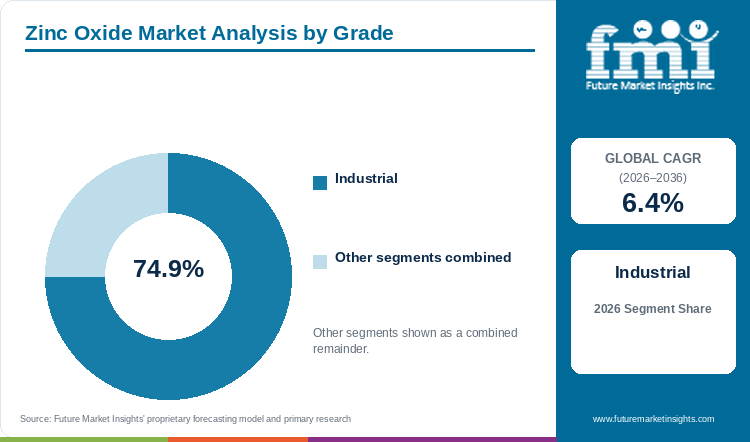
Industrial grade accounts for 74.9% of grade sales in 2026, owing to wide use in rubber, ceramics and paints.
Table 3: Grade Share for the Zinc Oxide Market (percentage share), 2026
| Grade | Share (2026) |
|---|---|
| Industrial Grade | 74.9% |
| Pharma Grade | 15% |
| Food Grade | 10.1% |
| Total | 100.0% |
Table 4: Grade Leadership and Market Growth for the Zinc Oxide Market (segment and CAGR percentage), 2026 to 2036
| Metric | Value |
|---|---|
| Global CAGR (2026 to 2036) | 6.4% |
| Leading Segment | Industrial Grade |
Sales of industrial grade zinc oxide follow the output of tyres and rubber goods, as rubber compounds use zinc oxide as an activator. As per FMI estimates, industrial grade holds 74.9% of grade sales in 2026, and pharma and food grades hold 15% and 10.1% for smaller groups of buyers. The GRILLO-Werke product page lists zinc oxide for the chemical and petrochemical industries, cosmetics and pharma, with a high-purity, EU-GMP-compliant cosmetic pigment. IRSG forecasts average tyre production growth of 1.46% a year through 2032.
- Rubber, ceramic and paint buyers use standard purity in volume, so industrial grade holds 74.9% of grade sales in 2026.
- Buyers comparing grades should check purity limits, particle size and plant certificates before approving a supplier.
Why does the indirect (French) process lead zinc oxide sales by process?
The indirect (French) process takes 77.6% of process sales in 2026, as plants vaporise zinc metal to make fine, consistent particles.
Table 5: Process Share for the Zinc Oxide Market (percentage share), 2026
| Process | Estimated Share (2026) |
|---|---|
| Indirect (French) process | 77.6% |
| Direct (American) process | 14.8% |
| Wet chemical process | 7.6% |
| Total | 100.0% |
Indirect (French) process plants lead because vaporised zinc metal gives fine particles with consistent morphology. As per FMI, this process holds 77.6% of process sales in 2026, and direct (American) and wet chemical plants hold 14.8% and 7.6%. Tyre Trends reported in June 2026 that the Punia Group Tirupati plant will take most raw material from galvanising zinc dross and has delivered 15 to 20 percent fuel savings. USGS reported in February 2026 that crude zinc oxide is recovered from electric arc furnace dust in the USA, which adds supply outside the French route.
- New builds in India extend the 77.6% share of the indirect (French) process in 2026.
- Producers with recycled zinc feed should compare dross and scrap supply contracts, as feed cost sets the margin on each tonne.
Why does rubber lead zinc oxide demand by application?
Rubber takes 46.3% of application sales in 2026, as tyre and rubber goods makers use zinc oxide to activate vulcanisation.
Table 6: Application Share for the Zinc Oxide Market (percentage share), 2026
| Application | Estimated Share (2026) |
|---|---|
| Rubber | 46.3% |
| Ceramics | 12.5% |
| Chemicals | 9% |
| Paints and coatings | 8.2% |
| Cosmetics and personal care | 7.4% |
| Agricultural | 5.6% |
| Pharmaceutical | 4.8% |
| Others | 6.2% |
| Total | 100.0% |
Use of zinc oxide in rubber compounds follows tyre and rubber goods output, as the compound needs zinc oxide to activate vulcanisation. FMI estimates that rubber holds 46.3% of application sales in 2026. Ceramics buyers include makers in the porcelain tableware market, and ceramics (12.5%), chemicals (9%), paints and coatings (8.2%), cosmetics and personal care (7.4%), agricultural (5.6%) and pharmaceutical (4.8%) buyers take the remainder, with others at 6.2%. J.G. Chemicals said in May 2025 that the company counts 9 of the top 10 global tyre manufacturers as customers. Global rubber demand is forecast to rise to 36.57 million tonnes in 2032 from 32.49 million tonnes in 2025.
- Steady tyre and rubber goods output supports a 46.3% share of application sales for rubber in 2026.
- Cosmetics buyers should confirm purity and certification, as GRILLO-Werke markets cosmetic zinc oxide as EU-GMP-compliant.
What are the drivers, restraints, and opportunities in the Zinc Oxide Market?
In the zinc oxide market, tyre output and new indirect process plants drive sales, slow growth of tyre production restrains order volumes, and recycled zinc feed opens the main opportunity for certified and purer grades.
- Driver: Steady rubber demand and new indirect process capacity in India support orders.
- Restraint: Tyre production grows more slowly than the market, and lower output at UK tyre plants reduces rubber grade orders.
- Opportunity: Recycled zinc oxide and purer grades for cosmetics and pharma buyers open added sales.
Tyre Exports and Indian Plants Support Orders
Rubber is the largest application of zinc oxide, and India shipped INR 25,051 crore of tyres abroad in FY2024-25, up 9%. J.G. Chemicals said in May 2025 that the company counts 9 of the top 10 global tyre manufacturers as customers.
Slow Tyre Growth Limits Order Volumes
Tyre production is forecast to grow by an average of 1.46% a year through 2032, against a market CAGR of 6.4%. The International Rubber Study Group put growth at only 0.24% in 2025. FMI expects new lines to arrive faster than tyre output grows, which may slow returns on new plants in the first forecast years.
Recycled Zinc Feed Opens Purer Grades
Producers are shifting toward recycled feed. Tyre Trends describes the Tirupati process as a closed-loop system that will take most raw material from galvanising zinc dross. J.G. Chemicals stated on 8 August 2026 that recycled metal cuts air pollution by 80% and water use by 40% per unit of zinc oxide produced, against virgin ores. Certified recycled grades for tyre makers and purer grades for cosmetics and pharma buyers carry the opportunity for higher unit prices. Agricultural use of zinc oxide as a micronutrient links the market with the sulphur bentonite market.
Which country CAGRs are profiled in the Zinc Oxide Market?
Table 7: Country CAGR Comparison for the Zinc Oxide Market (CAGR percentage), 2026 to 2036
| Country | CAGR |
|---|---|
| India | 9.5% |
| China | 7.2% |
| USA | 3.6% |
| Germany | 3% |
| UK | 2.5% |
How do country-level CAGRs compare in the zinc oxide market?
Growth of the zinc oxide market is fastest in India among the five profiled countries, at a 9.5% CAGR between 2026 and 2036. As per the analysis from FMI, China follows at 7.2% and the USA is estimated at 3.6%. Germany is projected at 3%, and the UK records the slowest rate at 2.5%.
- India pairs new French process plants with tyre export growth.
- China draws on a large rubber manufacturing sector.
- US growth draws on zinc oxide recovery from steel dust.
- Germany relies on high purity grades for cosmetics, pharma and catalysts.
- UK sales follow output at established tyre plants.
Full report country CAGRs cover North America; Latin America; Western Europe; Eastern Europe; Balkan and Baltic Countries; Russia and Belarus; Central Asia; East Asia; South Asia and Pacific; Middle East and Africa.
Country-wise Analysis
India Zinc Oxide Market Outlook (2026 to 2036)
India recorded 9% growth in tyre exports to INR 25,051 crore in FY2024-25, according to Ministry of Commerce data reported in July 2025. Export orders support demand for rubber grade zinc oxide at Indian plants. J.G. Chemicals lists 43,704 MTPA at Naidupeta, 14,400 MTPA at Jangalpur and 1,800 MTPA at Belur, with a 40,000+ MTPA unit at Dahej expected in the third quarter of FY27. Tyre Trends reported in June 2026 that Punia Group recently commissioned a French process plant at Tirupati that will take most raw material from galvanising zinc dross. New French process plants and tyre export growth drive demand, and the country is projected at 9.5% CAGR from 2026 to 2036, the fastest of the five profiled countries.
Key takeaway: India leads the profiled CAGRs at 9.5%, and the Dahej start in the third quarter of FY27 marks the next step in plant supply.
China Zinc Oxide Market Outlook (2026 to 2036)
The forecast for China is a 7.2% CAGR from 2026 to 2036, with large-scale rubber manufacturing as the main driver. USGS estimated in February 2026 that China mined 4.1 million tons of zinc in 2025, the highest output of any country. Refined zinc output in China grew 5.9% in the first half of 2026, the International Lead and Zinc Study Group reported on 26 August 2026, and world mine output fell 2.6% in the same period. Befesa states in the H1 2026 report that the high capex cycle to expand into the US and China is completed.
Key takeaway: China pairs the highest zinc mine output in the world with refined output growth of 5.9%.
USA Zinc Oxide Market Outlook (2026 to 2036)
Net imports met 73% of apparent refined zinc consumption in the USA in 2025, USGS reported in February 2026. U.S. zinc mine output fell by an estimated 12% in 2025, mainly on lower ore grades at the Red Dog Mine. Domestic oxide supply therefore leans on recovery, and crude zinc oxide is recovered from electric arc furnace dust. Befesa expects growth in the United States to be driven by new contracts with steel producers. Zinc oxide recovery from steel dust supports US demand, and the USA is projected at 3.6% CAGR from 2026 to 2036.
Key takeaway: US growth of 3.6% follows steel dust contracts with mills, as mine output declines at Red Dog.
Germany Zinc Oxide Market Outlook (2026 to 2036)
High purity grades for cosmetics, pharma and catalysts lead demand in Germany, projected at 3% CAGR from 2026 to 2036. GRILLO-Werke develops and produces zinc oxide in various qualities at Goslar, according to the company product page. Europe's refined zinc usage was broadly stable in the first half of 2026 against a year earlier. Befesa expects steel dust volumes to stay stable in Europe and Asia. Bulk zinc volumes are broadly stable, and purity and certification carry the growth.
Key takeaway: German producers earn growth through purity and certification, as bulk zinc volumes stay broadly stable.
UK Zinc Oxide Market Outlook (2026 to 2036)
European Rubber Journal reported on 9 October 2026 that Michelin UK revenue fell 1.6% in 2025 and exports fell 1.1% on lower production volumes at the Stoke factory.[10] Output at established tyre plants sets zinc oxide demand, so lower Stoke volumes press on rubber grade orders. The UK is projected at 2.5% CAGR from 2026 to 2036, the lowest of the five profiled countries.
Key takeaway: UK orders for rubber grade zinc oxide track tyre plant output at Stoke and similar sites.
Who are the notable companies in the Zinc Oxide Market?
USA Zinc, Rubamin, Zinc Oxide LLC, Grupo Promax, Weifang Longda Zinc Industry, Yongchang Zinc Industry, Pan Continental Chemical, J.G. Chemicals, Akrochem, and ZM Silesia are notable companies profiled in this market.
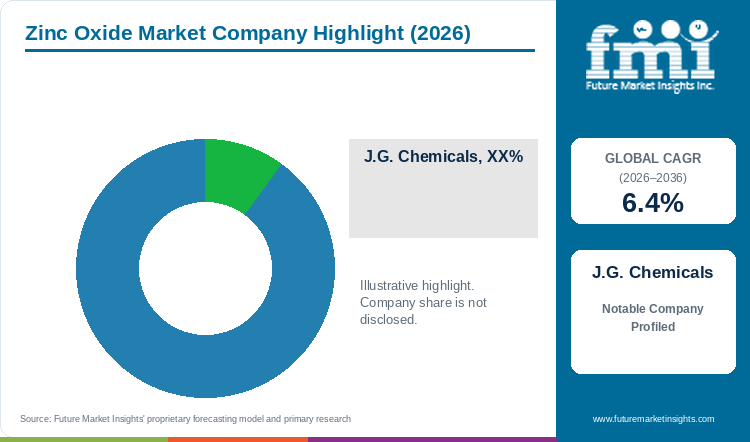
Zinc oxide producers differ by installed capacity, process route, recycled feed and grade range, as per FMI. J.G. Chemicals documents plant-level capacity and lists 70,000 MTPA of zinc chemicals. Punia Group, Befesa and GRILLO-Werke add documented French process, recycled oxide and high purity supply. USA Zinc, Rubamin, Zinc Oxide LLC, Grupo Promax and ZM Silesia serve regional rubber, ceramic and chemical buyers.
- Documented capacity builder: J.G. Chemicals.
- Established regional producers: USA Zinc, Rubamin, Zinc Oxide LLC, Grupo Promax, and ZM Silesia.
- Specialist and supply chain companies: Weifang Longda Zinc Industry, Yongchang Zinc Industry, Pan Continental Chemical, and Akrochem.
Competitive Benchmarking: Zinc Oxide Market
Table 8: Competitive Benchmarking for the Zinc Oxide Market (qualitative documentation ratings), 2026
| Company | Capacity | Process Route | Recycled Feed | Disclosure |
|---|---|---|---|---|
| J.G. Chemicals | High | Low | High | High |
| Punia Group | Low | High | High | Medium |
| Befesa | High | Low | High | High |
| GRILLO-Werke | Low | Low | Low | Medium |
Key Developments in the Zinc Oxide Market
- In August 2026, J.G. Chemicals reported that the 40,000+ MTPA Dahej unit is expected to be commissioned in the third quarter of FY27.
- In July 2026, Befesa reported steel dust throughput of 587,796 tonnes in the first half of 2026, up 6.8%.
- In June 2026, Tyre Trends reported that Punia Group recently commissioned a French process plant at Tirupati that will take most raw material from galvanising zinc dross.
- In February 2026, USGS reported that U.S. zinc mine output fell an estimated 12% in 2025.
Key Players in the Zinc Oxide Market
Profiled Producers
- USA Zinc
- Rubamin
- Zinc Oxide LLC
- Grupo Promax
- Weifang Longda Zinc Industry Co., Ltd.
- Yongchang Zinc Industry
- Pan Continental Chemical
- J.G. Chemicals Limited
- Akrochem
- ZM Silesia
Producers with Documented 2025 to 2026 Activity
- Punia Group
- Befesa S.A.
- GRILLO-Werke AG
Zinc Oxide Market - Report Scope
Table 9: Report Scope for the Zinc Oxide Market (coverage fields and definitions), 2026 to 2036
| Coverage field | Report scope |
|---|---|
| Market breakdown | Grade; process; application; region |
| Quantitative units | USD billion |
| Market definition | Industrial, pharma and food grades made by the indirect (French), direct (American) and wet chemical processes, tracked by application in rubber, ceramics, chemicals, cosmetics and personal care, paints and coatings, pharmaceutical, agricultural and other uses. |
| Regions covered | North America; Latin America; Western Europe; Eastern Europe; Balkan and Baltic Countries; Russia and Belarus; Central Asia; East Asia; South Asia and Pacific; Middle East and Africa |
| Countries covered | India; China; USA; Germany; UK |
| Key companies profiled | USA Zinc, Rubamin, Zinc Oxide LLC, Grupo Promax, Weifang Longda Zinc Industry, Yongchang Zinc Industry, Pan Continental Chemical, J.G. Chemicals, Akrochem, ZM Silesia |
| Forecast period | 2026 to 2036 |
Zinc Oxide Market - Research Methodology
Table 10: Research Methodology for the Zinc Oxide Market (research methods and approach), 2026 edition
| Method | Approach |
|---|---|
| Data Sources | Supply chain facts come from company filings, government and industry body publications, and trade press dated May 2025 or later. |
| Desk Research | Company filings, plant announcements, zinc supply statistics, rubber industry outlooks and trade press on zinc oxide, tyres and recycling. |
| Market Sizing and Forecasting | Sizing starts from the 2025 base market size of USD 4.7 billion and the 6.4% CAGR. |
| Data Validation | Plant, grade and trade facts are compared across filings, industry body data and trade press dated May 2025 or later. |
Zinc Oxide Market by Segments
Zinc Oxide Market segmented by Grade:
- Industrial
- Pharma
- Food
Zinc Oxide Market segmented by Process:
- Indirect (French) process
- Direct (American) process
- Wet chemical process
Zinc Oxide Market segmented by Application:
- Rubber
- Ceramics
- Chemicals
- Cosmetics and personal care
- Paints and coatings
- Pharmaceutical
- Agricultural
- Others
Zinc Oxide Market by Region
- North America
- United States
- Canada
- Latin America
- Brazil
- Mexico
- Argentina
- Chile
- Western Europe
- Germany
- France
- United Kingdom
- Italy
- Spain
- Benelux
- Nordics
- Eastern Europe
- Poland
- Czech Republic
- Romania
- Hungary
- Balkan and Baltic Countries
- Russia and Belarus
- Central Asia
- Kazakhstan
- Uzbekistan
- East Asia
- China
- Japan
- South Korea
- South Asia and Pacific
- India
- ASEAN
- Australia and New Zealand
- Middle East and Africa
- GCC Countries
- South Africa
- Turkiye
- Israel
Research Sources and Bibliography
- [1] European Rubber Journal (International Rubber Study Group outlook). (2026, January 21). IRSG expects 12% growth in rubber demand to 2032. https://www.european-rubber-journal.com/article/2098626/irsg-expects-12-growth-in-rubber-demand-to-2032
- [2] Tyre Trends. (2026, June 17). Relentless Growth In Zinc Oxide's Value Chain. https://www.tyre-trends.com/materials/relentless-growth-in-zinc-oxides-value-chain
- [3] Autocar Professional. (2025, July 2). Indian tyre exports cross INR 25,000 crore in FY25, industry maintains strong global momentum. https://www.autocarpro.in/news/indian-tyre-exports-cross-%e2%82%b925000-crore-in-fy25-industry-maintains-strong-global-momentum-127317
- [4] GRILLO-Werke AG. (n.d.). Zinc Oxide (product page, Goslar site). https://grillo.de/en/products/zinc-products/zinc-oxide/
- [5] International Lead and Zinc Study Group. (2026, August 26). ILZSG Press Release August 2026. https://www.ilzsg.org/wp-content/uploads/3.PRESS%20RELEASES/ILZSG%20Press%20Release%20August%202026.pdf
- [6] J.G. Chemicals Limited (investor presentation, Valorem Advisors). (2025, May 19). Earnings Presentation for Q4 and FY25. https://valoremadvisors.com/assets/admin/earnings_presentation/1747825603_f7327e88-f106-406d-ae1a-1e2ae53f57f4.pdf
- [7] J.G. Chemicals Limited (NSE filing). (2026, August 8). Earnings Presentation of Q1 FY27. https://nsearchives.nseindia.com/corporate/9903318000_08082026145827_Earnings_Presentation_of_Q1_FY_27.pdf
- [8] Befesa S.A. (2026, July 29). H1 2026 Interim Report. https://images.befesa.com/media/2026/07/H1_2026_Interim_Report-6a68ffb1b6fa1.pdf
- [9] U.S. Geological Survey. (2026, February). Mineral Commodity Summaries 2026: Zinc. https://pubs.usgs.gov/periodicals/mcs2026/mcs2026-zinc.pdf
- [10] European Rubber Journal. (2026, October 9). Michelin UK reports higher profit despite lower sales. https://www.european-rubber-journal.com/article/2099811/michelin-uk-reports-higher-profit-despite-lower-sales
This bibliography is provided for reader reference. The full report contains the complete reference list and detailed citations.
This Report Answers
- How big is the zinc oxide market during 2026?
- What market size is projected by 2036?
- Which process holds notable share?
- Which application holds notable share?
- Which countries have notable growth?
- Which companies are notable in the market?
Table of Content
- Key Takeaways
- Market Size and CAGR
- Top Growth Driver
- Fastest Growing Segment
- Leading Region
- Key Companies
- Emerging Opportunities
- Executive Summary
- Global Market Outlook
- Demand-side Trends
- Supply-side Trends
- Technology Roadmap Analysis
- Analysis and Recommendations
- Analyst Perspective (What is happening? Why now? What should investors know?)
- Key Questions Answered
- How large is the market?
- What is the CAGR?
- What are key trends?
- Which region dominates?
- Who are the leaders?
Read More...
- Market Overview
- Market Coverage / Taxonomy
- Market Definition / Scope / Limitations
- Research Methodology
- Chapter Orientation
- Analytical Lens and Working Hypotheses
- Market Structure, Signals, and Trend Drivers
- Benchmarking and Cross-market Comparability
- Market Sizing, Forecasting, and Opportunity Mapping
- Research Design and Evidence Framework
- Desk Research Programme (Secondary Evidence)
- Expert Input and Fieldwork (Primary Evidence)
- Tooling, Models, and Reference Databases
- Data Engineering and Model Build
- Quality Assurance and Audit Trail
- Market Background
- Market Dynamics (Drivers, Restraints, Opportunity, Trends)
- Scenario Forecast (Optimistic, Likely, Conservative)
- Impact Analysis
- AI Impact
- Sustainability Impact
- Regulatory Impact
- Technology Impact
- Consumer / Buyer Analysis
- Purchase Drivers
- Adoption Barriers
- Buyer Journey
- Opportunity Map Analysis
- Product Life Cycle Analysis
- Supply Chain Analysis
- Investment Feasibility Matrix
- Value Chain Analysis
- PESTLE and Porter's Analysis
- Regulatory Landscape
- Regional Parent Market Outlook
- Production and Consumption Statistics
- Import and Export Statistics
- Global Market Analysis and Forecast, 2021 to 2036
- Historical Market Size Value (USD Billion) Analysis, 2021 to 2025
- Current and Future Market Size Value (USD Billion) Projections, 2026 to 2036
- Y-o-Y Growth Trend Analysis
- Absolute $ Opportunity Analysis
- Global Market Pricing Analysis, 2021 to 2036
- Global Market Analysis and Forecast, By Grade, 2021 to 2036
- Introduction / Key Findings
- Historical Market Size Value (USD Billion) Analysis By Grade, 2021 to 2025
- Current and Future Market Size Value (USD Billion) Analysis and Forecast By Grade, 2026 to 2036
- Industrial
- Pharma
- Food
- Y-o-Y Growth Trend Analysis By Grade, 2021 to 2025
- Absolute $ Opportunity Analysis By Grade, 2026 to 2036
- Global Market Analysis and Forecast, By Process, 2021 to 2036
- Introduction / Key Findings
- Historical Market Size Value (USD Billion) Analysis By Process, 2021 to 2025
- Current and Future Market Size Value (USD Billion) Analysis and Forecast By Process, 2026 to 2036
- Indirect (French) process
- Direct (American) process
- Wet chemical process
- Y-o-Y Growth Trend Analysis By Process, 2021 to 2025
- Absolute $ Opportunity Analysis By Process, 2026 to 2036
- Global Market Analysis and Forecast, By Application, 2021 to 2036
- Introduction / Key Findings
- Historical Market Size Value (USD Billion) Analysis By Application, 2021 to 2025
- Current and Future Market Size Value (USD Billion) Analysis and Forecast By Application, 2026 to 2036
- Rubber
- Ceramics
- Chemicals
- Cosmetics and personal care
- Paints and coatings
- Pharmaceutical
- Agricultural
- Others
- Y-o-Y Growth Trend Analysis By Application, 2021 to 2025
- Absolute $ Opportunity Analysis By Application, 2026 to 2036
- Global Market Analysis and Forecast, By Region, 2021 to 2036
- Introduction
- Historical Market Size Value (USD Billion) Analysis By Region, 2021 to 2025
- Current Market Size Value (USD Billion) Analysis and Forecast By Region, 2026 to 2036
- North America
- Latin America
- Western Europe
- Eastern Europe
- East Asia
- South Asia and Pacific
- Middle East and Africa
- Market Attractiveness Analysis By Region
- North America Market Analysis and Forecast, By Country, 2021 to 2036
- Historical Market Size Value (USD Billion) Trend Analysis By Market Taxonomy, 2021 to 2025
- Market Size Value (USD Billion) Forecast By Market Taxonomy, 2026 to 2036
- By Country
- United States
- Canada
- By Grade
- By Process
- By Application
- By Country
- Market Attractiveness Analysis
- By Country
- By Grade
- By Process
- By Application
- Key Takeaways
- Latin America Market Analysis and Forecast, By Country
- Historical Market Size Value (USD Billion) Trend Analysis By Market Taxonomy, 2021 to 2025
- Market Size Value (USD Billion) Forecast By Market Taxonomy, 2026 to 2036
- By Country
- Brazil
- Mexico
- Argentina
- Chile
- By Grade
- By Process
- By Application
- By Country
- Market Attractiveness Analysis
- By Country
- By Grade
- By Process
- By Application
- Key Takeaways
- Western Europe Market Analysis and Forecast, By Country
- Historical Market Size Value (USD Billion) Trend Analysis By Market Taxonomy, 2021 to 2025
- Market Size Value (USD Billion) Forecast By Market Taxonomy, 2026 to 2036
- By Country
- Germany
- France
- United Kingdom
- Italy
- Spain
- Benelux
- Nordics
- By Grade
- By Process
- By Application
- By Country
- Market Attractiveness Analysis
- By Country
- By Grade
- By Process
- By Application
- Key Takeaways
- Eastern Europe Market Analysis and Forecast, By Country
- Historical Market Size Value (USD Billion) Trend Analysis By Market Taxonomy, 2021 to 2025
- Market Size Value (USD Billion) Forecast By Market Taxonomy, 2026 to 2036
- By Country
- Poland
- Czech Republic
- Romania
- Hungary
- Balkan and Baltic Countries
- Russia and Belarus
- Central Asia
- Kazakhstan
- Uzbekistan
- By Grade
- By Process
- By Application
- By Country
- Market Attractiveness Analysis
- By Country
- By Grade
- By Process
- By Application
- Key Takeaways
- East Asia Market Analysis and Forecast, By Country
- Historical Market Size Value (USD Billion) Trend Analysis By Market Taxonomy, 2021 to 2025
- Market Size Value (USD Billion) Forecast By Market Taxonomy, 2026 to 2036
- By Country
- China
- Japan
- South Korea
- By Grade
- By Process
- By Application
- By Country
- Market Attractiveness Analysis
- By Country
- By Grade
- By Process
- By Application
- Key Takeaways
- South Asia and Pacific Market Analysis and Forecast, By Country
- Historical Market Size Value (USD Billion) Trend Analysis By Market Taxonomy, 2021 to 2025
- Market Size Value (USD Billion) Forecast By Market Taxonomy, 2026 to 2036
- By Country
- India
- ASEAN
- Australia and New Zealand
- By Grade
- By Process
- By Application
- By Country
- Market Attractiveness Analysis
- By Country
- By Grade
- By Process
- By Application
- Key Takeaways
- Middle East and Africa Market Analysis and Forecast, By Country
- Historical Market Size Value (USD Billion) Trend Analysis By Market Taxonomy, 2021 to 2025
- Market Size Value (USD Billion) Forecast By Market Taxonomy, 2026 to 2036
- By Country
- GCC Countries
- South Africa
- Turkiye
- Israel
- By Grade
- By Process
- By Application
- By Country
- Market Attractiveness Analysis
- By Country
- By Grade
- By Process
- By Application
- Key Takeaways
- Key Countries Market Analysis
- United States
- Pricing Analysis
- Market Share Analysis, 2025
- By Grade
- By Process
- By Application
- Canada
- Pricing Analysis
- Market Share Analysis, 2025
- By Grade
- By Process
- By Application
- Mexico
- Pricing Analysis
- Market Share Analysis, 2025
- By Grade
- By Process
- By Application
- Brazil
- Pricing Analysis
- Market Share Analysis, 2025
- By Grade
- By Process
- By Application
- Chile
- Pricing Analysis
- Market Share Analysis, 2025
- By Grade
- By Process
- By Application
- Germany
- Pricing Analysis
- Market Share Analysis, 2025
- By Grade
- By Process
- By Application
- United Kingdom
- Pricing Analysis
- Market Share Analysis, 2025
- By Grade
- By Process
- By Application
- Italy
- Pricing Analysis
- Market Share Analysis, 2025
- By Grade
- By Process
- By Application
- Spain
- Pricing Analysis
- Market Share Analysis, 2025
- By Grade
- By Process
- By Application
- France
- Pricing Analysis
- Market Share Analysis, 2025
- By Grade
- By Process
- By Application
- India
- Pricing Analysis
- Market Share Analysis, 2025
- By Grade
- By Process
- By Application
- ASEAN
- Pricing Analysis
- Market Share Analysis, 2025
- By Grade
- By Process
- By Application
- Australia and New Zealand
- Pricing Analysis
- Market Share Analysis, 2025
- By Grade
- By Process
- By Application
- China
- Pricing Analysis
- Market Share Analysis, 2025
- By Grade
- By Process
- By Application
- Japan
- Pricing Analysis
- Market Share Analysis, 2025
- By Grade
- By Process
- By Application
- South Korea
- Pricing Analysis
- Market Share Analysis, 2025
- By Grade
- By Process
- By Application
- Poland
- Pricing Analysis
- Market Share Analysis, 2025
- By Grade
- By Process
- By Application
- Hungary
- Pricing Analysis
- Market Share Analysis, 2025
- By Grade
- By Process
- By Application
- South Africa
- Pricing Analysis
- Market Share Analysis, 2025
- By Grade
- By Process
- By Application
- United States
- Market Structure Analysis
- Competition Dashboard
- Competition Benchmarking
- Market Share Analysis of Top Players
- By Regional
- By Grade
- By Process
- By Application
- Emerging Startups
- Innovation Benchmarking
- Competition Analysis
- Competition Deep Dive
- J.G. Chemicals
- Overview
- Product Portfolio
- Profitability by Market Segments
- Sales Footprint
- Strategy Overview
- Marketing Strategy
- Product Strategy
- Channel Strategy
- Punia Group
- Befesa
- GRILLO-Werke
- USA Zinc
- Rubamin
- Zinc Oxide LLC
- Grupo Promax
- Weifang Longda Zinc Industry Co., Ltd.
- Yongchang Zinc Industry
- Pan Continental Chemical
- J.G. Chemicals Limited
- Akrochem
- ZM Silesia
- Befesa S.A.
- GRILLO-Werke AG
- J.G. Chemicals
- Case Studies
- Success Stories
- Recent Developments
- Competition Deep Dive
- Assumptions & Acronyms Used
List of Tables
- Table 1: Global Market Value (USD Billion) Forecast by Region, 2021 to 2036
- Table 2: Global Market Value (USD Billion) Forecast by Grade, 2021 to 2036
- Table 3: Global Market Value (USD Billion) Forecast by Process, 2021 to 2036
- Table 4: Global Market Value (USD Billion) Forecast by Application, 2021 to 2036
- Table 5: North America Market Value (USD Billion) Forecast by Country, 2021 to 2036
- Table 6: North America Market Value (USD Billion) Forecast by Grade, 2021 to 2036
- Table 7: North America Market Value (USD Billion) Forecast by Process, 2021 to 2036
- Table 8: North America Market Value (USD Billion) Forecast by Application, 2021 to 2036
- Table 9: Latin America Market Value (USD Billion) Forecast by Country, 2021 to 2036
- Table 10: Latin America Market Value (USD Billion) Forecast by Grade, 2021 to 2036
- Table 11: Latin America Market Value (USD Billion) Forecast by Process, 2021 to 2036
- Table 12: Latin America Market Value (USD Billion) Forecast by Application, 2021 to 2036
- Table 13: Western Europe Market Value (USD Billion) Forecast by Country, 2021 to 2036
- Table 14: Western Europe Market Value (USD Billion) Forecast by Grade, 2021 to 2036
- Table 15: Western Europe Market Value (USD Billion) Forecast by Process, 2021 to 2036
- Table 16: Western Europe Market Value (USD Billion) Forecast by Application, 2021 to 2036
- Table 17: Eastern Europe Market Value (USD Billion) Forecast by Country, 2021 to 2036
- Table 18: Eastern Europe Market Value (USD Billion) Forecast by Grade, 2021 to 2036
- Table 19: Eastern Europe Market Value (USD Billion) Forecast by Process, 2021 to 2036
- Table 20: Eastern Europe Market Value (USD Billion) Forecast by Application, 2021 to 2036
- Table 21: East Asia Market Value (USD Billion) Forecast by Country, 2021 to 2036
- Table 22: East Asia Market Value (USD Billion) Forecast by Grade, 2021 to 2036
- Table 23: East Asia Market Value (USD Billion) Forecast by Process, 2021 to 2036
- Table 24: East Asia Market Value (USD Billion) Forecast by Application, 2021 to 2036
- Table 25: South Asia and Pacific Market Value (USD Billion) Forecast by Country, 2021 to 2036
- Table 26: South Asia and Pacific Market Value (USD Billion) Forecast by Grade, 2021 to 2036
- Table 27: South Asia and Pacific Market Value (USD Billion) Forecast by Process, 2021 to 2036
- Table 28: South Asia and Pacific Market Value (USD Billion) Forecast by Application, 2021 to 2036
- Table 29: Middle East and Africa Market Value (USD Billion) Forecast by Country, 2021 to 2036
- Table 30: Middle East and Africa Market Value (USD Billion) Forecast by Grade, 2021 to 2036
- Table 31: Middle East and Africa Market Value (USD Billion) Forecast by Process, 2021 to 2036
- Table 32: Middle East and Africa Market Value (USD Billion) Forecast by Application, 2021 to 2036
List of Figures
- Figure 1: Global Market Pricing Analysis
- Figure 2: Global Market Value (USD Billion) Forecast 2021-2036
- Figure 3: Global Market Value Share and BPS Analysis by Grade, 2026 and 2036
- Figure 4: Global Market Y-o-Y Growth Comparison by Grade, 2026-2036
- Figure 5: Global Market Attractiveness Analysis by Grade
- Figure 6: Global Market Value Share and BPS Analysis by Process, 2026 and 2036
- Figure 7: Global Market Y-o-Y Growth Comparison by Process, 2026-2036
- Figure 8: Global Market Attractiveness Analysis by Process
- Figure 9: Global Market Value Share and BPS Analysis by Application, 2026 and 2036
- Figure 10: Global Market Y-o-Y Growth Comparison by Application, 2026-2036
- Figure 11: Global Market Attractiveness Analysis by Application
- Figure 12: Global Market Value (USD Billion) Share and BPS Analysis by Region, 2026 and 2036
- Figure 13: Global Market Y-o-Y Growth Comparison by Region, 2026-2036
- Figure 14: Global Market Attractiveness Analysis by Region
- Figure 15: North America Market Incremental Dollar Opportunity, 2026-2036
- Figure 16: Latin America Market Incremental Dollar Opportunity, 2026-2036
- Figure 17: Western Europe Market Incremental Dollar Opportunity, 2026-2036
- Figure 18: Eastern Europe Market Incremental Dollar Opportunity, 2026-2036
- Figure 19: East Asia Market Incremental Dollar Opportunity, 2026-2036
- Figure 20: South Asia and Pacific Market Incremental Dollar Opportunity, 2026-2036
- Figure 21: Middle East and Africa Market Incremental Dollar Opportunity, 2026-2036
- Figure 22: North America Market Value Share and BPS Analysis by Country, 2026 and 2036
- Figure 23: North America Market Value Share and BPS Analysis by Grade, 2026 and 2036
- Figure 24: North America Market Y-o-Y Growth Comparison by Grade, 2026-2036
- Figure 25: North America Market Attractiveness Analysis by Grade
- Figure 26: North America Market Value Share and BPS Analysis by Process, 2026 and 2036
- Figure 27: North America Market Y-o-Y Growth Comparison by Process, 2026-2036
- Figure 28: North America Market Attractiveness Analysis by Process
- Figure 29: North America Market Value Share and BPS Analysis by Application, 2026 and 2036
- Figure 30: North America Market Y-o-Y Growth Comparison by Application, 2026-2036
- Figure 31: North America Market Attractiveness Analysis by Application
- Figure 32: Latin America Market Value Share and BPS Analysis by Country, 2026 and 2036
- Figure 33: Latin America Market Value Share and BPS Analysis by Grade, 2026 and 2036
- Figure 34: Latin America Market Y-o-Y Growth Comparison by Grade, 2026-2036
- Figure 35: Latin America Market Attractiveness Analysis by Grade
- Figure 36: Latin America Market Value Share and BPS Analysis by Process, 2026 and 2036
- Figure 37: Latin America Market Y-o-Y Growth Comparison by Process, 2026-2036
- Figure 38: Latin America Market Attractiveness Analysis by Process
- Figure 39: Latin America Market Value Share and BPS Analysis by Application, 2026 and 2036
- Figure 40: Latin America Market Y-o-Y Growth Comparison by Application, 2026-2036
- Figure 41: Latin America Market Attractiveness Analysis by Application
- Figure 42: Western Europe Market Value Share and BPS Analysis by Country, 2026 and 2036
- Figure 43: Western Europe Market Value Share and BPS Analysis by Grade, 2026 and 2036
- Figure 44: Western Europe Market Y-o-Y Growth Comparison by Grade, 2026-2036
- Figure 45: Western Europe Market Attractiveness Analysis by Grade
- Figure 46: Western Europe Market Value Share and BPS Analysis by Process, 2026 and 2036
- Figure 47: Western Europe Market Y-o-Y Growth Comparison by Process, 2026-2036
- Figure 48: Western Europe Market Attractiveness Analysis by Process
- Figure 49: Western Europe Market Value Share and BPS Analysis by Application, 2026 and 2036
- Figure 50: Western Europe Market Y-o-Y Growth Comparison by Application, 2026-2036
- Figure 51: Western Europe Market Attractiveness Analysis by Application
- Figure 52: Eastern Europe Market Value Share and BPS Analysis by Country, 2026 and 2036
- Figure 53: Eastern Europe Market Value Share and BPS Analysis by Grade, 2026 and 2036
- Figure 54: Eastern Europe Market Y-o-Y Growth Comparison by Grade, 2026-2036
- Figure 55: Eastern Europe Market Attractiveness Analysis by Grade
- Figure 56: Eastern Europe Market Value Share and BPS Analysis by Process, 2026 and 2036
- Figure 57: Eastern Europe Market Y-o-Y Growth Comparison by Process, 2026-2036
- Figure 58: Eastern Europe Market Attractiveness Analysis by Process
- Figure 59: Eastern Europe Market Value Share and BPS Analysis by Application, 2026 and 2036
- Figure 60: Eastern Europe Market Y-o-Y Growth Comparison by Application, 2026-2036
- Figure 61: Eastern Europe Market Attractiveness Analysis by Application
- Figure 62: East Asia Market Value Share and BPS Analysis by Country, 2026 and 2036
- Figure 63: East Asia Market Value Share and BPS Analysis by Grade, 2026 and 2036
- Figure 64: East Asia Market Y-o-Y Growth Comparison by Grade, 2026-2036
- Figure 65: East Asia Market Attractiveness Analysis by Grade
- Figure 66: East Asia Market Value Share and BPS Analysis by Process, 2026 and 2036
- Figure 67: East Asia Market Y-o-Y Growth Comparison by Process, 2026-2036
- Figure 68: East Asia Market Attractiveness Analysis by Process
- Figure 69: East Asia Market Value Share and BPS Analysis by Application, 2026 and 2036
- Figure 70: East Asia Market Y-o-Y Growth Comparison by Application, 2026-2036
- Figure 71: East Asia Market Attractiveness Analysis by Application
- Figure 72: South Asia and Pacific Market Value Share and BPS Analysis by Country, 2026 and 2036
- Figure 73: South Asia and Pacific Market Value Share and BPS Analysis by Grade, 2026 and 2036
- Figure 74: South Asia and Pacific Market Y-o-Y Growth Comparison by Grade, 2026-2036
- Figure 75: South Asia and Pacific Market Attractiveness Analysis by Grade
- Figure 76: South Asia and Pacific Market Value Share and BPS Analysis by Process, 2026 and 2036
- Figure 77: South Asia and Pacific Market Y-o-Y Growth Comparison by Process, 2026-2036
- Figure 78: South Asia and Pacific Market Attractiveness Analysis by Process
- Figure 79: South Asia and Pacific Market Value Share and BPS Analysis by Application, 2026 and 2036
- Figure 80: South Asia and Pacific Market Y-o-Y Growth Comparison by Application, 2026-2036
- Figure 81: South Asia and Pacific Market Attractiveness Analysis by Application
- Figure 82: Middle East and Africa Market Value Share and BPS Analysis by Country, 2026 and 2036
- Figure 83: Middle East and Africa Market Value Share and BPS Analysis by Grade, 2026 and 2036
- Figure 84: Middle East and Africa Market Y-o-Y Growth Comparison by Grade, 2026-2036
- Figure 85: Middle East and Africa Market Attractiveness Analysis by Grade
- Figure 86: Middle East and Africa Market Value Share and BPS Analysis by Process, 2026 and 2036
- Figure 87: Middle East and Africa Market Y-o-Y Growth Comparison by Process, 2026-2036
- Figure 88: Middle East and Africa Market Attractiveness Analysis by Process
- Figure 89: Middle East and Africa Market Value Share and BPS Analysis by Application, 2026 and 2036
- Figure 90: Middle East and Africa Market Y-o-Y Growth Comparison by Application, 2026-2036
- Figure 91: Middle East and Africa Market Attractiveness Analysis by Application
- Figure 92: Global Market - Tier Structure Analysis
- Figure 93: Global Market - Company Share Analysis
Frequently Asked Questions
How large is the zinc oxide market expected in 2026?
Future Market Insights estimates the zinc oxide market size at USD 5.0 billion in 2026. The market is projected to reach USD 9.4 billion by 2036, reflecting steady growth over the forecast period.
What CAGR is projected for the zinc oxide market through 2036?
As per FMI analysis, zinc oxide sales will grow at a CAGR of 6.4% from 2026 to 2036. Tyre output and new indirect process plants support the outlook.
Which process holds a notable market share in 2026?
The indirect (French) process accounts for 77.6% of process sales in 2026. Direct (American) process holds 14.8% and wet chemical 7.6%.
Which application holds a notable market share in 2026?
Rubber accounts for 46.3% of application sales in 2026, followed by ceramics at 12.5% and chemicals at 9%.
Which country has a notable expansion outlook through 2036?
India is projected to record the fastest growth at 9.5% CAGR from 2026 to 2036, according to FMI. New French process plants and tyre export growth lead Indian demand.
Who are the key companies in the zinc oxide market?
Notable companies include USA Zinc, Rubamin, Zinc Oxide LLC, Grupo Promax, Weifang Longda Zinc Industry, Yongchang Zinc Industry, Pan Continental Chemical, J.G. Chemicals, Akrochem, and ZM Silesia.
Preview the report firsthand - request a free sample
Get SampleGet the brochure for pricing and purchase details.
Get PDF
