

- Industry Size (2025)
- USD 234.7 Mn
- Forecast (2035)
- USD 340.9 Mn
- CAGR (2025 to 2035)
- 3.8%
Zinc Carbonate Market Size and Share Forecast Outlook 2025 to 2035
The zinc carbonate market is valued at USD 234.7 million in 2025 and is expected to reach USD 340.9 million by 2035 at a CAGR of 3.8%. The pharma and food grade segment holds 58.9% share in 2025 as demand remains strong among formulators seeking high purity compounds for supplements, dermatological preparations, and food fortification systems. The pharmaceuticals application category leads with 29.6% share driven by increased use of zinc carbonate in topical care formulations, calamine preparations, anti inflammatory solutions, dermatology lotions, and gas absorption treatments.
Growth is influenced by expanding healthcare needs, wider adoption of zinc based compounds in dermatology, and rising consumption across cosmetics, agrochemicals, and chemical synthesis. Zinc carbonate remains widely used due to its mild reactivity, compatibility with organic and inorganic systems, and versatility across formulations. Increased emphasis on micronutrient fortification in developing economies strengthens its position in fertilizers and food grade applications. Demand patterns are shaped by its use in rubber vulcanization, flame retardant fillers, and pigment enhancement. Although fluctuating raw material pricing and availability of substitute zinc salts influence short term adoption, manufacturers continue refining grades and improving supply consistency to support long term market stability.
Quick Stats for Zinc Carbonate Market
- Zinc Carbonate Market Industry Value (2025): USD 234.7 million
- Zinc Carbonate Market Forecast Value (2035): USD 340.9 million
- Zinc Carbonate Market Forecast CAGR: 3.8%
- Leading Segment in Zinc Carbonate Market in 2025: Pharma & Food (58.9%)
- Key Growth Region in Zinc Carbonate Market: North America, Asia-Pacific, Europe
- Top Key Players in Zinc Carbonate Market: Shepherd Chemical, TIB Chemicals, Seido Chemical Industry, Bruggemann Chemical, Rubamin, Yanggu Zhongtian Zinc Industrial, Transpek-Silox, Pan-Continental Chemical Co., Ltd, Strem Chemicals Inc., Global Chemicals, Ava Chemicals, ABCR GmbH & CO. KG, S.K. CHEMICAL INDUSTRIES, KANSAI CATALYST Co., Ltd., American Elements

| Metric | Value |
|---|---|
| Zinc Carbonate Market Estimated Value in (2025 E) | USD 234.7 million |
| Zinc Carbonate Market Forecast Value in (2035 F) | USD 340.9 million |
| Forecast CAGR (2025 to 2035) | 3.8% |
Rationale for Segmental Growth in the Zinc Carbonate Market
Insights into the Pharma and Food Grade Segment
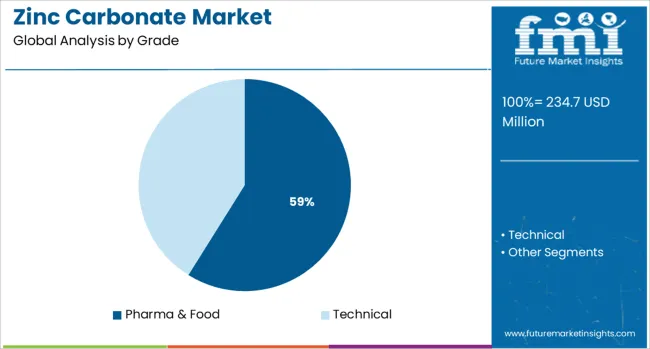
The pharma and food grade segment, commanding 58.9% share in 2025, leads the market due to its essential role in medical formulations, nutritional blends, and topical care categories. These grades support applications requiring high purity and controlled particle profiles. Their use in calamine lotions, anti itch creams, wound care solutions, and dermatology powders continues to expand as dermatological concerns rise globally. Pharma and food grade material is also used in dietary supplements to address zinc deficiency, especially in regions with poor soil micronutrient profiles. Increased fortification initiatives across emerging markets further strengthen the segment’s presence.
Insights into the Pharmaceuticals Application Segment
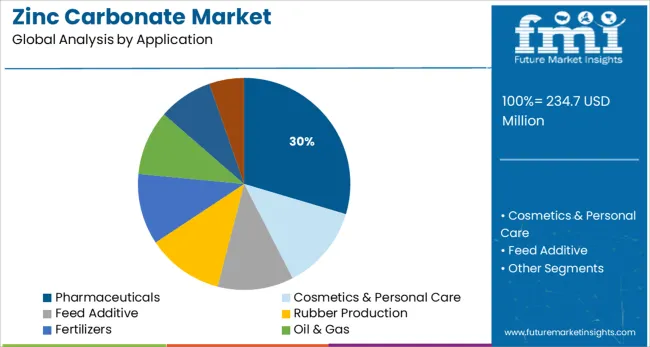
The pharmaceuticals application segment holds 29.6% share in 2025 as zinc carbonate is widely incorporated in dermatological treatments and therapeutic agents. Its anti inflammatory, soothing, and antipruritic properties drive usage in ointments, calamine preparations, and topical formulas addressing acne, eczema, and hypersensitivity conditions. Pharmaceutical demand is reinforced by its role in gas absorption treatments, dental desensitizing agents, and anti microbial powders.
2020 to 2024 Zinc Carbonate Market Outlook Compared To 2025 to 2035 Forecast
The demand for zinc carbonate grew at a 1.1% CAGR between 2020 and 2024. The market is expected to expand during the forecast period due to its widespread use in a variety of applications.
As per the report, sales are projected to increase at a CAGR of 3.8% over the assessment period. ZnCO3, or zinc carbonate, is an inorganic compound. It is also known as smithsonite, calamine, and zinc spar. Zinc carbonate is a water-insoluble white crystalline solid or powder. It is available in various grades depending on its application, such as pharma & food and technical grade.
Country-Wise Insights

What Will Be the India Zinc Carbonate Market Outlook?
Surging Adoption of Zinc Carbonate Powder in India Will Propel Growth
Zinc carbonate is consumed in the production of fertilizers, further, these fertilizers are used to increase crop yields and fulfill the deficiency of zinc in plants & crops. In India, the agriculture industry is one of the leading & dominating end-use industries and supports the overall Indian economy. Growing demand for food with the rising population is one of the major factors, which is propelling the demand for fertilizers in order to increase the production yield.
Zinc fertilizer is a cost-effective, long-term solution to zinc deficiency in soils, crops, and humans, resulting in increased food and nutrition security, increased farmer income, and a significant reduction in death and disease caused by zinc deficiency.
Hence, owing to the increased demand for fertilizers to enhance the yields, sales of zinc carbonate in India are forecast to increase at a CAGR of 4.7% during the assessment period.
What is Driving the China Zinc Carbonate Market?
Expansion of the Rubber Sector in China Will Fuel Sales of Zinc Carbonate
East Asia is expected to maintain its dominance over the forecast period owing to the high demand from the end use industries. China is anticipated to lead the region in terms of production as well as consumption.
China is said to be a manufacturing hub. One of the major industries utilizing zinc carbonate is the rubber industry. These rubbers are heavily used in auto parts, gloves, shoes, sporting goods, and car tires. The rubber industry is one of the lucrative segments for zinc carbonate. It is added to improve natural rubber's translucency or transparency.
Zinc carbonate can be used with more vibrantly pigmented rubber because it acts as a curing agent, hastening the hardening of the surface of the rubber. It is also used as a flame-retardants material by intervening as a fireproofing filler in high-temperature rubbers.
The growth in industrial machinery and automobile sectors has resulted in high demand for rubbers. The China zinc carbonate market is expected to reach about USD 76.5 Million by end of the forecast period.
Category-Wise Insights
What Factors Are Fueling Zinc Carbonate Utilization in Pharmaceuticals Application?
Demand for Zinc Carbonate Powder in the Pharmaceutical Sector Will Gain Traction
Zinc is one of the essential elements of the body and plays a vital role in the development of body parts. It has many uses in the medical field. Zinc carbonate is utilized to treat acne and eczema and to promote wound healing.
It has anti-inflammatory properties due to which it can be used to treat rheumatoid arthritis or psoriasis. Usually, due to its anti-inflammatory property, it is used in calamine lotions or powders, which are applied to the inflamed skin area.
Calamine lotion, which is composed of calamine (zinc oxide/carbonate), is widely used in dermatology where it works as a soothing agent. This lotion has antipruritic properties, which prevents itching. This lotion is listed in WHO’s essential list of medicines.
Zinc carbonate is used to remove toxic gases such as SO2 and HCN from the respiratory systems. For this purpose, nano-sized particles or powder form is used as powder form has more surface area, which means more interaction with these gases. Zinc carbonate is also used in dental treatment. It helps in reducing the hypersensitivity of teeth. Sales in the pharmaceuticals segment are expected to rise at a CAGR of 4.7% during the forecast period.
How is the Cosmetics & Personal Care Industry Propelling Zinc Carbonate Market?
Incorporation of Zinc Carbonate in Personal Care Products Will Boost Sales
Growing cosmetics & personal care industry is expected to favor the growth in the zinc carbonate market, as it is one of the most used ingredients in cosmetics & personal care products. Due to its antiseptic and fungicide properties, the cosmetic industry is one of the most promising markets for the use of zinc carbonate.
It is found in a variety of products such as make-up, bath, personal hygiene, shaving, and skin and hair care. It is widely used in sunscreen creams as it improves transparency. On the other hand, it can be used in shampoo as an opacifier to give the liquid a cloudy appearance.
Usage of zinc carbonate in shampoo helps in removing dandruff flakes by the moisturizing scalp. According to a study, skincare & hair care products collectively hold around 60% of the total cosmetics market. The consumption of zinc carbonate is expected to surge in the forthcoming years. The cosmetics & personal care segment is expected to reach about USD 68.0 Million during the forecast period.
Competitive Landscape
Key zinc carbonate manufacturers are concentrating their efforts on research and development to create tailored solutions for consumers. This strategy will enable manufacturers to reach a larger consumer base and capitalize on opportunities. Leading players are investing a significant portion of their revenues in product development in order to gain a competitive advantage in the market in the long run.
Scope Of Report
| Attribute | Details |
|---|---|
| Forecast Period | 2025 to 2035 |
| Historical Data Available for | 2020 to 2024 |
| Market Analysis | USD Million for Value and Tons for Volume |
| Key Countries Covered | The USA, Canada, Brazil, Mexico, Germany, Italy, France, the UK, Spain, BENELUX, Russia, China, Japan, South Korea, India, ASEAN, ANZ, GCC Countries, Turkey, South Africa, Northern Africa |
| Key Segments Covered | Grade, Application, and Region |
| Key Companies Profiled | Anron Chemicals Inc.; Global Chemicals; Shepherd Chemical; Seido Chemical Industry; Bruggemann Chemical; Rubamin; Yanggu Zhongtian Zinc Industrial; Transpek-Silox; Ava Chemicals; Pan-Continental Chemical Co., Ltd; Strem Chemicals Inc.; S.K. CHEMICAL INDUSTRIES; ABCR GmbH & CO. KG; TIB Chemicals; KANSAI CATALYST Co., Ltd. |
| Report Coverage | Market Forecast, Company Share Analysis, Competition Intelligence, DROT Analysis, Market Dynamics and Challenges, and Strategic Growth Initiatives |
Zinc Carbonate Market By Category
By Grade:
- Pharma & Food
- Technical
By Application:
- Pharmaceuticals
- Cosmetics & Personal Care
- Feed Additive
- Rubber Production
- Fertilizers
- Oil & Gas
- Chemicals
- Others
By Region:
- North America
- Latin America
- Europe
- East Asia
- South Asia & Pacific
- Middle East & Africa
Frequently Asked Questions
How big is the zinc carbonate market in 2025?
The global zinc carbonate market is estimated to be valued at USD 234.7 million in 2025.
What will be the size of zinc carbonate market in 2035?
The market size for the zinc carbonate market is projected to reach USD 340.9 million by 2035.
How much will be the zinc carbonate market growth between 2025 and 2035?
The zinc carbonate market is expected to grow at a 3.8% CAGR between 2025 and 2035.
What are the key product types in the zinc carbonate market?
The key product types in zinc carbonate market are pharma & food and technical.
Which application segment to contribute significant share in the zinc carbonate market in 2025?
In terms of application, pharmaceuticals segment to command 29.6% share in the zinc carbonate market in 2025.
Preview the report firsthand - request a free sample
Get SampleGet the brochure for pricing and purchase details.
Get PDFTable of Content
- Executive Summary
- Global Market Outlook
- Demand-side Trends
- Supply-side Trends
- Technology Roadmap Analysis
- Analysis and Recommendations
- Market Overview
- Market Coverage / Taxonomy
- Market Definition / Scope / Limitations
- Market Background
- Market Dynamics
- Drivers
- Restraints
- Opportunity
- Trends
- Scenario Forecast
- Demand in Optimistic Scenario
- Demand in Likely Scenario
- Demand in Conservative Scenario
- Opportunity Map Analysis
- Product Life Cycle Analysis
- Supply Chain Analysis
- Investment Feasibility Matrix
- Value Chain Analysis
- PESTLE and Porter’s Analysis
- Regulatory Landscape
- Regional Parent Market Outlook
- Production and Consumption Statistics
- Import and Export Statistics
- Market Dynamics
- Global Market Analysis 2020 to 2024 and Forecast, 2025 to 2035
- Historical Market Size Value (USD Million) Analysis, 2020 to 2024
- Current and Future Market Size Value (USD Million) Projections, 2025 to 2035
- Y-o-Y Growth Trend Analysis
- Absolute $ Opportunity Analysis
- Global Market Pricing Analysis 2020 to 2024 and Forecast 2025 to 2035
- Global Market Analysis 2020 to 2024 and Forecast 2025 to 2035, By Grade
- Introduction / Key Findings
- Historical Market Size Value (USD Million) Analysis By Grade , 2020 to 2024
- Current and Future Market Size Value (USD Million) Analysis and Forecast By Grade , 2025 to 2035
- Pharma & Food
- Technical
- Y-o-Y Growth Trend Analysis By Grade , 2020 to 2024
- Absolute $ Opportunity Analysis By Grade , 2025 to 2035
- Global Market Analysis 2020 to 2024 and Forecast 2025 to 2035, By Application
- Introduction / Key Findings
- Historical Market Size Value (USD Million) Analysis By Application, 2020 to 2024
- Current and Future Market Size Value (USD Million) Analysis and Forecast By Application, 2025 to 2035
- Pharmaceuticals
- Cosmetics & Personal Care
- Feed Additive
- Rubber Production
- Fertilizers
- Oil & Gas
- Chemicals
- Others
- Y-o-Y Growth Trend Analysis By Application, 2020 to 2024
- Absolute $ Opportunity Analysis By Application, 2025 to 2035
- Global Market Analysis 2020 to 2024 and Forecast 2025 to 2035, By Region
- Introduction
- Historical Market Size Value (USD Million) Analysis By Region, 2020 to 2024
- Current Market Size Value (USD Million) Analysis and Forecast By Region, 2025 to 2035
- North America
- Latin America
- Western Europe
- Eastern Europe
- East Asia
- South Asia and Pacific
- Middle East & Africa
- Market Attractiveness Analysis By Region
- North America Market Analysis 2020 to 2024 and Forecast 2025 to 2035, By Country
- Historical Market Size Value (USD Million) Trend Analysis By Market Taxonomy, 2020 to 2024
- Market Size Value (USD Million) Forecast By Market Taxonomy, 2025 to 2035
- By Country
- USA
- Canada
- Mexico
- By Grade
- By Application
- By Country
- Market Attractiveness Analysis
- By Country
- By Grade
- By Application
- Key Takeaways
- Latin America Market Analysis 2020 to 2024 and Forecast 2025 to 2035, By Country
- Historical Market Size Value (USD Million) Trend Analysis By Market Taxonomy, 2020 to 2024
- Market Size Value (USD Million) Forecast By Market Taxonomy, 2025 to 2035
- By Country
- Brazil
- Chile
- Rest of Latin America
- By Grade
- By Application
- By Country
- Market Attractiveness Analysis
- By Country
- By Grade
- By Application
- Key Takeaways
- Western Europe Market Analysis 2020 to 2024 and Forecast 2025 to 2035, By Country
- Historical Market Size Value (USD Million) Trend Analysis By Market Taxonomy, 2020 to 2024
- Market Size Value (USD Million) Forecast By Market Taxonomy, 2025 to 2035
- By Country
- Germany
- UK
- Italy
- Spain
- France
- Nordic
- BENELUX
- Rest of Western Europe
- By Grade
- By Application
- By Country
- Market Attractiveness Analysis
- By Country
- By Grade
- By Application
- Key Takeaways
- Eastern Europe Market Analysis 2020 to 2024 and Forecast 2025 to 2035, By Country
- Historical Market Size Value (USD Million) Trend Analysis By Market Taxonomy, 2020 to 2024
- Market Size Value (USD Million) Forecast By Market Taxonomy, 2025 to 2035
- By Country
- Russia
- Poland
- Hungary
- Balkan & Baltic
- Rest of Eastern Europe
- By Grade
- By Application
- By Country
- Market Attractiveness Analysis
- By Country
- By Grade
- By Application
- Key Takeaways
- East Asia Market Analysis 2020 to 2024 and Forecast 2025 to 2035, By Country
- Historical Market Size Value (USD Million) Trend Analysis By Market Taxonomy, 2020 to 2024
- Market Size Value (USD Million) Forecast By Market Taxonomy, 2025 to 2035
- By Country
- China
- Japan
- South Korea
- By Grade
- By Application
- By Country
- Market Attractiveness Analysis
- By Country
- By Grade
- By Application
- Key Takeaways
- South Asia and Pacific Market Analysis 2020 to 2024 and Forecast 2025 to 2035, By Country
- Historical Market Size Value (USD Million) Trend Analysis By Market Taxonomy, 2020 to 2024
- Market Size Value (USD Million) Forecast By Market Taxonomy, 2025 to 2035
- By Country
- India
- ASEAN
- Australia & New Zealand
- Rest of South Asia and Pacific
- By Grade
- By Application
- By Country
- Market Attractiveness Analysis
- By Country
- By Grade
- By Application
- Key Takeaways
- Middle East & Africa Market Analysis 2020 to 2024 and Forecast 2025 to 2035, By Country
- Historical Market Size Value (USD Million) Trend Analysis By Market Taxonomy, 2020 to 2024
- Market Size Value (USD Million) Forecast By Market Taxonomy, 2025 to 2035
- By Country
- Kingdom of Saudi Arabia
- Other GCC Countries
- Turkiye
- South Africa
- Other African Union
- Rest of Middle East & Africa
- By Grade
- By Application
- By Country
- Market Attractiveness Analysis
- By Country
- By Grade
- By Application
- Key Takeaways
- Key Countries Market Analysis
- USA
- Pricing Analysis
- Market Share Analysis, 2024
- By Grade
- By Application
- Canada
- Pricing Analysis
- Market Share Analysis, 2024
- By Grade
- By Application
- Mexico
- Pricing Analysis
- Market Share Analysis, 2024
- By Grade
- By Application
- Brazil
- Pricing Analysis
- Market Share Analysis, 2024
- By Grade
- By Application
- Chile
- Pricing Analysis
- Market Share Analysis, 2024
- By Grade
- By Application
- Germany
- Pricing Analysis
- Market Share Analysis, 2024
- By Grade
- By Application
- UK
- Pricing Analysis
- Market Share Analysis, 2024
- By Grade
- By Application
- Italy
- Pricing Analysis
- Market Share Analysis, 2024
- By Grade
- By Application
- Spain
- Pricing Analysis
- Market Share Analysis, 2024
- By Grade
- By Application
- France
- Pricing Analysis
- Market Share Analysis, 2024
- By Grade
- By Application
- India
- Pricing Analysis
- Market Share Analysis, 2024
- By Grade
- By Application
- ASEAN
- Pricing Analysis
- Market Share Analysis, 2024
- By Grade
- By Application
- Australia & New Zealand
- Pricing Analysis
- Market Share Analysis, 2024
- By Grade
- By Application
- China
- Pricing Analysis
- Market Share Analysis, 2024
- By Grade
- By Application
- Japan
- Pricing Analysis
- Market Share Analysis, 2024
- By Grade
- By Application
- South Korea
- Pricing Analysis
- Market Share Analysis, 2024
- By Grade
- By Application
- Russia
- Pricing Analysis
- Market Share Analysis, 2024
- By Grade
- By Application
- Poland
- Pricing Analysis
- Market Share Analysis, 2024
- By Grade
- By Application
- Hungary
- Pricing Analysis
- Market Share Analysis, 2024
- By Grade
- By Application
- Kingdom of Saudi Arabia
- Pricing Analysis
- Market Share Analysis, 2024
- By Grade
- By Application
- Turkiye
- Pricing Analysis
- Market Share Analysis, 2024
- By Grade
- By Application
- South Africa
- Pricing Analysis
- Market Share Analysis, 2024
- By Grade
- By Application
- USA
- Market Structure Analysis
- Competition Dashboard
- Competition Benchmarking
- Market Share Analysis of Top Players
- By Regional
- By Grade
- By Application
- Competition Analysis
- Competition Deep Dive
- Shepherd Chemical
- Overview
- Product Portfolio
- Profitability by Market Segments (Product/Age /Sales Channel/Region)
- Sales Footprint
- Strategy Overview
- Marketing Strategy
- Product Strategy
- Channel Strategy
- TIB Chemicals
- Seido Chemical Industry
- Bruggemann Chemical
- Rubamin
- Yanggu Zhongtian Zinc Industrial
- Transpek-Silox
- Pan-Continental Chemical Co., Ltd
- Strem Chemicals Inc.
- Global Chemicals
- Ava Chemicals
- ABCR GmbH & CO. KG
- S.K. CHEMICAL INDUSTRIES
- KANSAI CATALYST Co., Ltd.
- American Elements
- Shepherd Chemical
- Competition Deep Dive
- Assumptions & Acronyms Used
- Research Methodology


