

- Industry Size (2026)
- USD 145 Mn
- Forecast (2036)
- USD 259.7 Mn
- CAGR (2026 to 2036)
- 6.0%
Zinc Powder for Diamond Cutting Tools Market Forecast and Outlook 2026 to 2036
The zinc powder for diamond cutting tools market is projected to grow from USD 145 million in 2026 to USD 259.7 million by 2036, registering a CAGR of 6.0%. The market holds a specialized but strategically important position within the broader diamond tools and abrasive materials value chain. Zinc powder is not a bulk additive; its role is closely tied to bond engineering, sintering efficiency, and wear control in metal-bond diamond segments. Demand growth is therefore linked more to performance requirements and tool quality upgrades than to simple volume expansion.
Construction activity, stone processing, and precision machining continue to sustain steady consumption, while competitive pressure among tool manufacturers is increasing focus on consistency, reliability, and bond optimization. Asia Pacific drives volume growth through large-scale tool manufacturing, whereas North America and Europe contribute higher value demand through specification-driven applications. Between 2026 and 2036, market expansion is expected to be supported by infrastructure renewal, rising use of engineered stone and advanced materials, and closer technical collaboration between zinc powder suppliers and diamond tool manufacturers rather than commoditized raw material trade.
Quick Stats for Zinc Powder for Diamond Cutting Tools Market
- Zinc Powder for Diamond Cutting Tools Market Value (2026): USD 145 Million
- Zinc Powder for Diamond Cutting Tools Market Forecast Value (2036): USD 259.7 Million
- Zinc Powder for Diamond Cutting Tools Market Forecast CAGR 2026 to 2036: 6.0%
- Primary Role of Zinc Powder in Diamond Cutting Tools Market: Metal bond formulation for sintering control, bond strength, and wear regulation
- Key Growth Regions in Zinc Powder for Diamond Cutting Tools Market: Asia Pacific, Europe, North America, Latin America, Middle East & Africa
- Top Key Players in Zinc Powder for Diamond Cutting Tools Market: Purity Zinc Metals, EverZinc Group SA, GRILLO Zinc Powder GmbH, Noah Chemicals, PT. Indo Lysaght, Dharmit Recycling Industries LLP, PINKTO Chemicals

Zinc Powder for Diamond Cutting Tools Market Key Takeaways
| Metric | Value |
|---|---|
| Zinc Powder for Diamond Cutting Tools Market Value (2026) | USD 145 Million |
| Zinc Powder for Diamond Cutting Tools Market Forecast Value (2036) | USD 259.7 Million |
| Zinc Powder for Diamond Cutting Tools Market Forecast CAGR 2026 to 2036 | 6.0% |
How Are Tool Performance Requirements and Bond Engineering Advancing the Zinc Powder for Diamond Cutting Tools Market?
Demand for zinc powder in diamond cutting tools is being driven by rising performance expectations in construction, stone processing, and precision machining applications. Zinc powder is a critical component in metal bond systems used for diamond segments, where it influences sintering behavior, bond strength, and wear characteristics. Tool manufacturers are increasingly focused on achieving consistent cutting speed, controlled segment wear, and extended tool life, which is elevating the importance of zinc powder quality and formulation consistency.
From a manufacturing perspective, bond optimization is becoming a key differentiator. Diamond tool producers are seeking zinc powders with controlled particle size distribution, high purity, and predictable melting behavior to fine-tune bond matrices for specific materials such as concrete, granite, ceramics, and engineered stone. Suppliers capable of offering application-specific zinc powder grades optimized for hot pressing, cold pressing, or infiltration processes are gaining stronger alignment with premium tool manufacturers and OEM customers.
Market expansion is also supported by infrastructure development and renovation activity across emerging and developed regions. Growth in construction spending, urban redevelopment, and industrial flooring projects is sustaining demand for high-performance cutting tools. At the same time, competitive pressure among tool manufacturers is pushing greater emphasis on raw material reliability, batch consistency, and technical support. For zinc powder suppliers, long-term success in this market depends on metallurgical expertise, close collaboration with bond formulators, and the ability to support evolving diamond tool performance requirements.
How Is The Zinc Powder For Diamond Cutting Tools Market Structured By Product Form And Application?
The zinc powder for diamond cutting tools market is segmented by product form and application, reflecting how powder morphology and purity influence bonding performance and tool durability. By product form, electrolytic zinc powder leads the market, supported by its controlled particle size and high purity suited for precision tool formulations. Other product forms include atomized zinc powder, chemical zinc powder, and custom blend powders designed for specific sintering and bonding requirements. By application, metal bond alloy additive represents the primary demand segment, as zinc plays a critical role in improving bond strength and wear characteristics. Binder enhancement, surface modification, and other tool material applications expand usage across specialized cutting tools.
Why Does Electrolytic Zinc Powder Lead The Zinc Powder For Diamond Cutting Tools Market By Product Form?

Electrolytic zinc powder holds 45% share of the zinc powder for diamond cutting tools market because it offers uniform particle morphology and high chemical purity. These properties support consistent sintering behavior and reliable bonding in metal matrix systems used for diamond tools. Tool manufacturers rely on electrolytic zinc powder to achieve predictable hardness, controlled porosity, and improved diamond retention. Its fine particle distribution enhances alloy homogeneity during hot pressing and infiltration processes. For suppliers, electrolytic production enables tighter quality control and repeatable specifications demanded by high-performance tool manufacturers. This balance of technical reliability and manufacturing consistency explains its leading adoption.
Why Does Metal Bond Alloy Additive Dominate The Zinc Powder For Diamond Cutting Tools Market By Application?
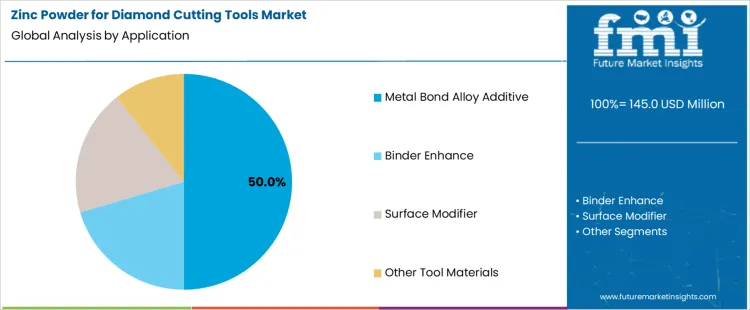
Metal bond alloy additive applications account for 50% share of the zinc powder for diamond cutting tools market because zinc is widely used to modify alloy composition and improve bonding efficiency. In metal-bonded diamond tools, zinc enhances wettability between the metal matrix and diamond particles, improving tool life and cutting efficiency. This application is critical for saw blades, grinding wheels, and drilling tools used in stone, concrete, and construction material processing. High-volume production of bonded diamond tools sustains steady demand for zinc additives. From a supplier perspective, alloy additive applications involve larger batch sizes and long-term supply contracts. These functional and commercial factors explain their dominance.
What Are The Key Dynamics Of The Zinc Powder For Diamond Cutting Tools Market?
The zinc powder for diamond cutting tools market is shaped by demand for high-performance abrasive tools used in stone, concrete, ceramic, glass, and advanced composites processing. Zinc powder plays a key role in metal bond formulations, influencing bond strength, wear resistance, and heat dissipation in diamond segments. Demand correlates with infrastructure projects, construction activity, and growth in precision cutting and grinding applications. For manufacturers and suppliers, controlling powder particle size, purity, morphology, and surface chemistry directly affects bond consistency and cutting tool performance. Supply reliability, raw material costs, and alignment with OEM specifications are central commercial dynamics shaping this market.
How Are Application And Bond Formulation Trends Influencing This Market?
Application and bond formulation trends are influencing the zinc powder for diamond cutting tools market toward tailored chemistries and optimized performance profiles. Tool makers are specifying zinc powder grades with controlled particle distribution and alloying to improve sintering behavior and segment density. Growth in specialty applications-such as high-precision stone fabrication, engineered surface processing, and ultra-high hardness composites-requires tighter performance tolerances and consistent bond behavior. Suppliers that align zinc powder characteristics with advanced bond systems across wet- and dry-cutting processes gain preference. Technical support for formulation optimization and failure analysis further differentiates suppliers in a competitive landscape.
What Commercial And Production Challenges Restrain Growth In This Market?
Commercial, production, and raw material challenges restrain growth in the zinc powder for diamond cutting tools market. Price volatility in zinc commodity markets directly affects powder production costs and contract pricing for tool makers. High-energy powder manufacturing processes and quality control systems add to operating expenses, putting pressure on margin management. Qualification cycles for new zinc powder grades such as accelerated wear and performance testing can delay product adoption. Inconsistent powder quality may lead to variation in finished tool performance, increasing rework and warranty exposure for tool manufacturers. These factors necessitate robust process control, inventory planning, and long-term supply agreements.
What Is the Country-Wise Outlook for the Zinc Powder for Diamond Cutting Tools Market?
The zinc powder for diamond cutting tools market is shaped by growth in construction, stone processing, automotive components, and precision machining. Zinc powder is widely used in metal bond formulations to improve sintering behavior, bonding strength, and tool life. Country-level growth varies based on construction intensity, manufacturing scale, export orientation of diamond tools, and adoption of precision cutting technologies. Asia leads volume growth due to large-scale tool production and infrastructure activity, while North America and Europe emphasize performance consistency, bond formulation control, and quality compliance. Suppliers that deliver controlled particle size, consistent purity, and application-specific technical support are better positioned across global markets.
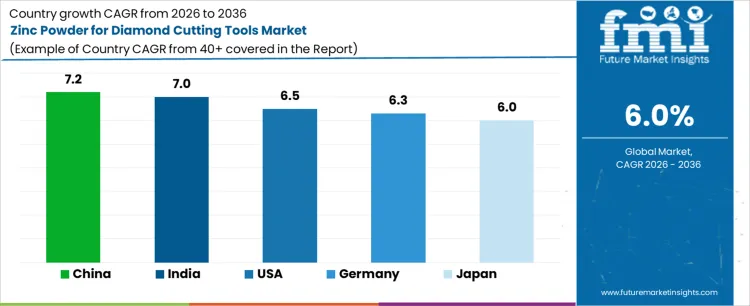
| Country | CAGR (%) |
|---|---|
| China | 7.2% |
| India | 7.0% |
| USA | 6.5% |
| Germany | 6.3% |
| Japan | 6.0% |
How Does China Lead Volume Expansion in the Zinc Powder for Diamond Cutting Tools Market?
Demand for zinc powder for diamond cutting tools in China, growing at a CAGR of 7.2% during 2026 to 2036, is driven by large-scale production of diamond tools for construction, stone processing, and infrastructure development. China hosts a dense cluster of diamond blade and segment manufacturers supplying both domestic and export markets. Zinc powder is widely used in metal bond formulations to improve sintering efficiency and tool wear characteristics. Buyers prioritize cost efficiency, steady availability, and compatibility with high-throughput manufacturing. Domestic zinc powder suppliers dominate volume segments, creating competitive pricing pressure. Export-oriented tool manufacturers increasingly specify controlled particle size and purity to meet international quality requirements. Procurement often involves long-term supply arrangements aligned with continuous production cycles.
Why Is India Emerging as a High-Growth Market for Zinc Powder in Diamond Tools?
The zinc powder for diamond cutting tools market in India, expanding at a CAGR of 7.0% during 2026 to 2036, reflects rising construction activity and rapid growth in domestic diamond tool manufacturing. Demand is driven by infrastructure projects, stone cutting, and increasing use of diamond tools in small and mid-sized fabrication units. Tool manufacturers favor zinc powder for its role in improving bond strength and controlling tool wear. Buyers remain price-sensitive but are gradually increasing focus on consistency and sintering performance. Local sourcing is preferred to reduce input costs and lead times. Procurement decisions are influenced by supplier reliability, technical guidance, and batch uniformity. India offers suppliers a growth-oriented environment where rising production volumes and gradual quality upgrades progress in parallel across regional diamond tool manufacturing clusters.
What Shapes Specification-Driven Demand in the United States Market?
Sale of zinc powder for diamond cutting tools in the United States, growing at a CAGR of 6.5% during 2026 to 2036, is shaped by emphasis on precision cutting, tool durability, and performance consistency. Demand is linked to construction refurbishment, automotive machining, and advanced manufacturing applications. Tool producers prioritize zinc powder purity, particle morphology, and predictable sintering behavior. Procurement decisions emphasize traceability, documentation, and technical support over cost competitiveness. Consumption is largely replacement- and maintenance-driven rather than volume expansion-led. Volumes are moderate, but unit values are higher due to stringent performance requirements. The United States favors suppliers offering controlled-quality zinc powder and application support aligned with high-performance diamond tool manufacturing standards.
How Does Germany Support High-Quality Zinc Powder Consumption for Diamond Tools?
The zinc powder for diamond cutting tools market in Germany, expanding at a CAGR of 6.3% during 2026 to 2036, reflects the country’s focus on precision engineering and industrial quality standards. Diamond tools are widely used in machinery manufacturing, automotive components, and stone processing. Buyers emphasize uniform particle size, high purity, and reproducible bonding performance. Demand is largely replacement-led, tied to steady industrial activity rather than rapid expansion. Procurement processes are structured and documentation-intensive, favoring suppliers with strong quality assurance systems. Germany rewards zinc powder manufacturers capable of delivering consistent, high-specification materials suitable for advanced metal bond formulations and export-oriented diamond tool production.
Why Does Japan Remain a Stable Market for Specialty Zinc Powder Applications?
Demand for zinc powder for diamond cutting tools in Japan, growing at a CAGR of 6.0% during the forecast period, is shaped by demand for high-precision cutting tools used in electronics, automotive, and industrial manufacturing. Tool producers emphasize tight control over bond composition and sintering behavior. Buyers favor zinc powder with consistent morphology and minimal impurity levels to ensure predictable tool performance. Demand is steady rather than rapid, supported by continuous equipment upgrades and replacement cycles. Procurement decisions prioritize supplier credibility, long-term consistency, and technical collaboration. Japan favors zinc powder suppliers with deep materials expertise and strong quality control practices aligned with precision diamond tool manufacturing.
What Is Driving Competition in the Zinc Powder for Diamond Cutting Tools Market?
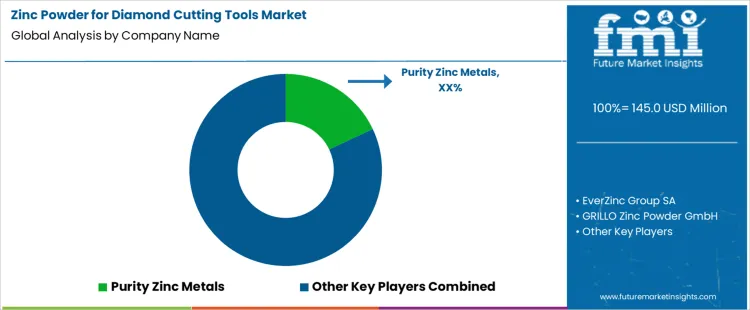
Competition in the zinc powder for diamond cutting tools market is defined by metallurgy control, particle morphology, and documented performance in binder systems used for sintered tool matrices. Purity Zinc Metals positions its zinc powders with specification sheets that highlight high zinc content and controlled impurity profiles tailored to carbide and diamond tool bonding. Product literature emphasizes consistent sintering behavior and predictable shrinkage compensation in premium cutting tool grades. EverZinc Group SA competes through atomized and flake zinc powders engineered for uniform particle size distribution documented to enhance binder wetting and densification in tool green bodies. Brochures stress tailored zinc grades optimized for brazed and sintered diamond tool applications.
European specialty producers differentiate through engineered surface characteristics. GRILLO Zinc Powder GmbH emphasizes high-purity zinc dust with narrow particle size fractions detailed in technical materials, aimed at improving mechanical strength and thermal stability of diamond tool matrices. Noah Chemicals and PT. Indo Lysaght focus brochures on cost-effective zinc dust variants with documented compatibility across common binder systems, appealing to high-volume production environments.
Regional suppliers and custom formulators add competitive breadth. Dharmit Recycling Industries LLP and PINKTO Chemicals position their zinc powders with official data highlighting recycled content and controlled milling processes suitable for standard tool grades. Sarda Industrial Enterprises and Plus Chem India emphasize tailored zinc powder blends with product guides that document particle shape control and sintering profiles. Parshva Chemicals, Vishnupriya Chemicals Pvt. Ltd., and A. B. Enterprises offer zinc powder variants targeted at local markets, with specification sheets covering zinc purity, surface area, and oxidation control. Across the market, differentiation is achieved through brochure-verified metallurgical performance, particle morphology control, and documented integration with diamond tool manufacturing processes rather than basic zinc content alone.
Key Players in Zinc Powder for Diamond Cutting Tools Market
- Purity Zinc Metals
- EverZinc Group SA
- GRILLO Zinc Powder GmbH
- Noah Chemicals
- PT. Indo Lysaght
- Dharmit Recycling Industries LLP
- PINKTO Chemicals
- Sarda Industrial Enterprises
- Plus Chem India
- Parshva Chemicals
- Vishnupriya Chemicals Pvt. Ltd.
- B. Enterprises
Scope of Report
| Attribute | Description |
|---|---|
| Quantitative Unit | USD Million |
| Product Form | Electrolytic Zinc Powder, Atomized Zinc Powder, Chemical Zinc Powder, Custom Blend Powders |
| Application | Metal Bond Alloy Additive, Binder Enhance, Surface Modifier, Other Tool Materials |
| Countries Covered | China, Japan, South Korea, India, Australia & New Zealand, ASEAN, Rest of Asia Pacific, Germany, United Kingdom, France, Italy, Spain, Nordic, BENELUX, Rest of Europe, United States, Canada, Mexico, Brazil, Chile, Rest of Latin America, Kingdom of Saudi Arabia, Other GCC Countries, Turkey, South Africa, Other African Union, Rest of Middle East & Africa |
| Regions Covered | Asia Pacific, Europe, North America, Latin America, Middle East & Africa |
| Key Companies Profiled | Purity Zinc Metals, EverZinc Group SA, GRILLO Zinc Powder GmbH, Noah Chemicals, PT. Indo Lysaght, Dharmit Recycling Industries LLP, PINKTO Chemicals, Sarda Industrial Enterprises, Plus Chem India, Parshva Chemicals, Vishnupriya Chemicals Pvt. Ltd., B. Enterprises |
| Additional Attributes | Dollar sales by product form and application are evaluated across diamond cutting and abrasive tool manufacturing processes. The report includes country-level demand assessment, growth projections for 2026 to 2036, evaluation of powder purity and particle morphology requirements, assessment of bonding and sintering performance trends, competitive benchmarking of suppliers, and analysis of consumption patterns across construction, stone processing, and industrial tooling sectors. |
Zinc Powder for Diamond Cutting Tools Market by Key Segments
Product Form:
- Electrolytic Zinc Powder
- Atomized Zinc Powder
- Chemical Zinc Powder
- Custom Blend Powders
Application:
- Metal Bond Alloy Additive
- Binder Enhance
- Surface Modifier
- Other Tool Materials
Region:
- Asia Pacific
- China
- Japan
- South Korea
- India
- Australia & New Zealand
- ASEAN
- Rest of Asia Pacific
- Europe
- Germany
- United Kingdom
- France
- Italy
- Spain
- Nordic
- BENELUX
- Rest of Europe
- North America
- United States
- Canada
- Mexico
- Latin America
- Brazil
- Chile
- Rest of Latin America
- Middle East & Africa
- Kingdom of Saudi Arabia
- Other GCC Countries
- Turkey
- South Africa
- Other African Union
- Rest of Middle East & Africa
Bibliography
- International Labour Organization (ILO). (2024). World employment and social outlook: Construction and manufacturing trends. ILO.
- National Institute of Standards and Technology (NIST). (2024). Powder metallurgy and additive manufacturing for metals: Measurement science priorities. USA Department of Commerce.
- International Organization for Standardization (ISO). (2024). ISO 23958:2024 Diamond abrasive tools - Specifications and test methods. ISO.
Frequently Asked Questions
How big is the zinc powder for diamond cutting tools market in 2026?
The global zinc powder for diamond cutting tools market is estimated to be valued at USD 145.0 million in 2026.
What will be the size of zinc powder for diamond cutting tools market in 2036?
The market size for the zinc powder for diamond cutting tools market is projected to reach USD 259.7 million by 2036.
How much will be the zinc powder for diamond cutting tools market growth between 2026 and 2036?
The zinc powder for diamond cutting tools market is expected to grow at a 6.0% CAGR between 2026 and 2036.
What are the key product types in the zinc powder for diamond cutting tools market?
The key product types in zinc powder for diamond cutting tools market are electrolytic zinc powder, atomized zinc powder, chemical zinc powder and custom blend powders.
Which application segment to contribute significant share in the zinc powder for diamond cutting tools market in 2026?
In terms of application, metal bond alloy additive segment to command 50.0% share in the zinc powder for diamond cutting tools market in 2026.
Preview the report firsthand - request a free sample
Get SampleGet the brochure for pricing and purchase details.
Get PDFTable of Content
- Executive Summary
- Global Market Outlook
- Demand-side Trends
- Supply-side Trends
- Technology Roadmap Analysis
- Analysis and Recommendations
- Market Overview
- Market Coverage / Taxonomy
- Market Definition / Scope / Limitations
- Market Background
- Market Dynamics
- Drivers
- Restraints
- Opportunity
- Trends
- Scenario Forecast
- Demand in Optimistic Scenario
- Demand in Likely Scenario
- Demand in Conservative Scenario
- Opportunity Map Analysis
- Product Life Cycle Analysis
- Supply Chain Analysis
- Investment Feasibility Matrix
- Value Chain Analysis
- PESTLE and Porter’s Analysis
- Regulatory Landscape
- Regional Parent Market Outlook
- Production and Consumption Statistics
- Import and Export Statistics
- Market Dynamics
- Global Market Analysis 2021 to 2025 and Forecast, 2026 to 2036
- Historical Market Size Value (USD Million) Analysis, 2021 to 2025
- Current and Future Market Size Value (USD Million) Projections, 2026 to 2036
- Y-o-Y Growth Trend Analysis
- Absolute $ Opportunity Analysis
- Global Market Pricing Analysis 2021 to 2025 and Forecast 2026 to 2036
- Global Market Analysis 2021 to 2025 and Forecast 2026 to 2036, By Product Form
- Introduction / Key Findings
- Historical Market Size Value (USD Million) Analysis By Product Form , 2021 to 2025
- Current and Future Market Size Value (USD Million) Analysis and Forecast By Product Form , 2026 to 2036
- Electrolytic Zinc Powder
- Atomized Zinc Powder
- Chemical Zinc Powder
- Custom Blend Powders
- Electrolytic Zinc Powder
- Y-o-Y Growth Trend Analysis By Product Form , 2021 to 2025
- Absolute $ Opportunity Analysis By Product Form , 2026 to 2036
- Global Market Analysis 2021 to 2025 and Forecast 2026 to 2036, By Application
- Introduction / Key Findings
- Historical Market Size Value (USD Million) Analysis By Application, 2021 to 2025
- Current and Future Market Size Value (USD Million) Analysis and Forecast By Application, 2026 to 2036
- Metal Bond Alloy Additive
- Binder Enhance
- Surface Modifier
- Other Tool Materials
- Metal Bond Alloy Additive
- Y-o-Y Growth Trend Analysis By Application, 2021 to 2025
- Absolute $ Opportunity Analysis By Application, 2026 to 2036
- Global Market Analysis 2021 to 2025 and Forecast 2026 to 2036, By Region
- Introduction
- Historical Market Size Value (USD Million) Analysis By Region, 2021 to 2025
- Current Market Size Value (USD Million) Analysis and Forecast By Region, 2026 to 2036
- North America
- Latin America
- Western Europe
- Eastern Europe
- East Asia
- South Asia and Pacific
- Middle East & Africa
- Market Attractiveness Analysis By Region
- North America Market Analysis 2021 to 2025 and Forecast 2026 to 2036, By Country
- Historical Market Size Value (USD Million) Trend Analysis By Market Taxonomy, 2021 to 2025
- Market Size Value (USD Million) Forecast By Market Taxonomy, 2026 to 2036
- By Country
- USA
- Canada
- Mexico
- By Product Form
- By Application
- By Country
- Market Attractiveness Analysis
- By Country
- By Product Form
- By Application
- Key Takeaways
- Latin America Market Analysis 2021 to 2025 and Forecast 2026 to 2036, By Country
- Historical Market Size Value (USD Million) Trend Analysis By Market Taxonomy, 2021 to 2025
- Market Size Value (USD Million) Forecast By Market Taxonomy, 2026 to 2036
- By Country
- Brazil
- Chile
- Rest of Latin America
- By Product Form
- By Application
- By Country
- Market Attractiveness Analysis
- By Country
- By Product Form
- By Application
- Key Takeaways
- Western Europe Market Analysis 2021 to 2025 and Forecast 2026 to 2036, By Country
- Historical Market Size Value (USD Million) Trend Analysis By Market Taxonomy, 2021 to 2025
- Market Size Value (USD Million) Forecast By Market Taxonomy, 2026 to 2036
- By Country
- Germany
- UK
- Italy
- Spain
- France
- Nordic
- BENELUX
- Rest of Western Europe
- By Product Form
- By Application
- By Country
- Market Attractiveness Analysis
- By Country
- By Product Form
- By Application
- Key Takeaways
- Eastern Europe Market Analysis 2021 to 2025 and Forecast 2026 to 2036, By Country
- Historical Market Size Value (USD Million) Trend Analysis By Market Taxonomy, 2021 to 2025
- Market Size Value (USD Million) Forecast By Market Taxonomy, 2026 to 2036
- By Country
- Russia
- Poland
- Hungary
- Balkan & Baltic
- Rest of Eastern Europe
- By Product Form
- By Application
- By Country
- Market Attractiveness Analysis
- By Country
- By Product Form
- By Application
- Key Takeaways
- East Asia Market Analysis 2021 to 2025 and Forecast 2026 to 2036, By Country
- Historical Market Size Value (USD Million) Trend Analysis By Market Taxonomy, 2021 to 2025
- Market Size Value (USD Million) Forecast By Market Taxonomy, 2026 to 2036
- By Country
- China
- Japan
- South Korea
- By Product Form
- By Application
- By Country
- Market Attractiveness Analysis
- By Country
- By Product Form
- By Application
- Key Takeaways
- South Asia and Pacific Market Analysis 2021 to 2025 and Forecast 2026 to 2036, By Country
- Historical Market Size Value (USD Million) Trend Analysis By Market Taxonomy, 2021 to 2025
- Market Size Value (USD Million) Forecast By Market Taxonomy, 2026 to 2036
- By Country
- India
- ASEAN
- Australia & New Zealand
- Rest of South Asia and Pacific
- By Product Form
- By Application
- By Country
- Market Attractiveness Analysis
- By Country
- By Product Form
- By Application
- Key Takeaways
- Middle East & Africa Market Analysis 2021 to 2025 and Forecast 2026 to 2036, By Country
- Historical Market Size Value (USD Million) Trend Analysis By Market Taxonomy, 2021 to 2025
- Market Size Value (USD Million) Forecast By Market Taxonomy, 2026 to 2036
- By Country
- Kingdom of Saudi Arabia
- Other GCC Countries
- Turkiye
- South Africa
- Other African Union
- Rest of Middle East & Africa
- By Product Form
- By Application
- By Country
- Market Attractiveness Analysis
- By Country
- By Product Form
- By Application
- Key Takeaways
- Key Countries Market Analysis
- USA
- Pricing Analysis
- Market Share Analysis, 2025
- By Product Form
- By Application
- Canada
- Pricing Analysis
- Market Share Analysis, 2025
- By Product Form
- By Application
- Mexico
- Pricing Analysis
- Market Share Analysis, 2025
- By Product Form
- By Application
- Brazil
- Pricing Analysis
- Market Share Analysis, 2025
- By Product Form
- By Application
- Chile
- Pricing Analysis
- Market Share Analysis, 2025
- By Product Form
- By Application
- Germany
- Pricing Analysis
- Market Share Analysis, 2025
- By Product Form
- By Application
- UK
- Pricing Analysis
- Market Share Analysis, 2025
- By Product Form
- By Application
- Italy
- Pricing Analysis
- Market Share Analysis, 2025
- By Product Form
- By Application
- Spain
- Pricing Analysis
- Market Share Analysis, 2025
- By Product Form
- By Application
- France
- Pricing Analysis
- Market Share Analysis, 2025
- By Product Form
- By Application
- India
- Pricing Analysis
- Market Share Analysis, 2025
- By Product Form
- By Application
- ASEAN
- Pricing Analysis
- Market Share Analysis, 2025
- By Product Form
- By Application
- Australia & New Zealand
- Pricing Analysis
- Market Share Analysis, 2025
- By Product Form
- By Application
- China
- Pricing Analysis
- Market Share Analysis, 2025
- By Product Form
- By Application
- Japan
- Pricing Analysis
- Market Share Analysis, 2025
- By Product Form
- By Application
- South Korea
- Pricing Analysis
- Market Share Analysis, 2025
- By Product Form
- By Application
- Russia
- Pricing Analysis
- Market Share Analysis, 2025
- By Product Form
- By Application
- Poland
- Pricing Analysis
- Market Share Analysis, 2025
- By Product Form
- By Application
- Hungary
- Pricing Analysis
- Market Share Analysis, 2025
- By Product Form
- By Application
- Kingdom of Saudi Arabia
- Pricing Analysis
- Market Share Analysis, 2025
- By Product Form
- By Application
- Turkiye
- Pricing Analysis
- Market Share Analysis, 2025
- By Product Form
- By Application
- South Africa
- Pricing Analysis
- Market Share Analysis, 2025
- By Product Form
- By Application
- USA
- Market Structure Analysis
- Competition Dashboard
- Competition Benchmarking
- Market Share Analysis of Top Players
- By Regional
- By Product Form
- By Application
- Competition Analysis
- Competition Deep Dive
- Purity Zinc Metals
- Overview
- Product Portfolio
- Profitability by Market Segments (Product/Age /Sales Channel/Region)
- Sales Footprint
- Strategy Overview
- Marketing Strategy
- Product Strategy
- Channel Strategy
- EverZinc Group SA
- GRILLO Zinc Powder GmbH
- Noah Chemicals
- PT. Indo Lysaght
- Dharmit Recycling Industries LLP
- PINKTO Chemicals
- Sarda Industrial Enterprises
- Plus Chem India
- Parshva Chemicals
- Vishnupriya Chemicals Pvt. Ltd.
- A. B. Enterprises
- Purity Zinc Metals
- Competition Deep Dive
- Assumptions & Acronyms Used
- Research Methodology


