

- Industry Size (2026)
- USD 1.41 Bn
- Forecast (2036)
- USD 3.19 Bn
- CAGR (2026 to 2036)
- 8.5%
Powdered Face Masks Market Forecast and Outlook 2026 to 2036
The powdered face masks market is valued at USD 1.41 billion in 2026 and is projected to reach USD 3.19 billion by 2036, expanding at an 8.5% CAGR. As per Future Market Insights, growth is driven by increasing adoption of dry, high-performance facial mask formats that deliver longer shelf life, reduced preservative dependence, and improved transport efficiency compared with liquid and cream masks. Powdered face masks address structural limitations of wet formulations by enabling point-of-use activation, which preserves ingredient potency and formulation stability. Product activity between 2024 and 2026 reflects rising focus on “dry-to-active” systems incorporating mineral clays, botanical powders, and bioactive complexes aligned with skin barrier support and recovery.
Broader consumer alignment with waterless skincare and wellness-oriented beauty is shaping how the powdered face masks category is evolving. These formats increasingly sit at the intersection of beauty and health, supporting targeted skin outcomes rather than purely cosmetic benefits. Future Market Insights observes that e-commerce plays a central role in category expansion, as powdered face masks are lightweight, cost-efficient to ship, and well suited for repeat replenishment. Growing acceptance of waterless, performance-driven skincare formats is expected to support sustained category growth through 2036.
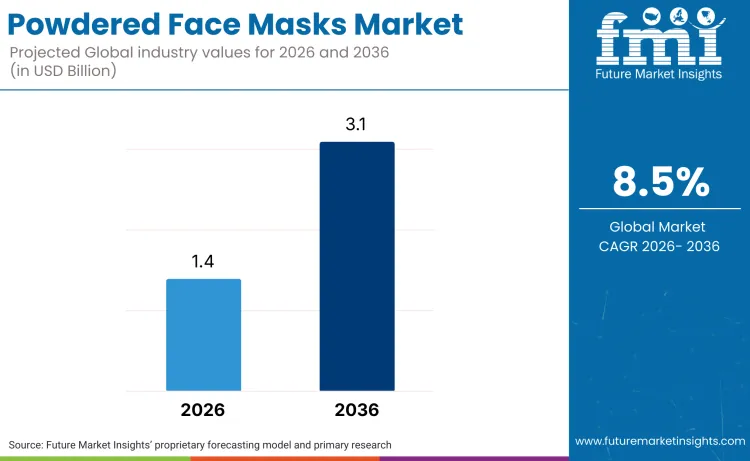
Summary of the Powdered Face Masks Market
What Is Growth Outlook for Powdered Face Masks Market as per Future Market Insights Projection?
Future Market Insights projects the powdered face masks market to grow at a CAGR of 8.5% from 2026 to 2036, expanding from USD 1.41 billion in 2026 to USD 3.19 billion by 2036.
FMI Research Approach: FMI proprietary forecasting model based on bottom-up revenue estimation, tracking adoption of dry-format facial masks across skincare portfolios, and demand modeling linked to acne care, hydration, and anti-aging routines.
How Do FMI Analysts Perceive Powdered Face Masks Market to Evolve?
FMI analysts perceive the market transitioning from niche professional-use products toward routine at-home treatments driven by waterless, high-performance skincare preferences. Powdered formats are increasingly positioned as stable, customizable solutions that activate at point of use, preserving ingredient potency.
FMI Research Approach: Assessment of product positioning around dry-to-active systems, expansion of powdered masks within mainstream skincare lines, and evaluation of ingredient systems such as clays, botanicals, and vitamin complexes.
Which Country Holds Largest Share in the Global Powdered Face Masks Market?
China holds the largest share of the global powdered face masks market by value, supported by strong demand for acne control, oil management, and professional-style skincare routines.
FMI Research Approach: Country-level demand assessment across urban consumers, analysis of acne-treatment application share, and tracking of online-first skincare brand penetration.
How Large Will the Powdered Face Masks Market Be by 2036?
The global powdered face masks market is projected to reach USD 3.19 billion by 2036.
FMI Research Approach: Long-term forecasting by country, product type, application, and distribution channel, incorporating scaling assumptions for online retail adoption and repeat-use behavior, with exclusion of cream and sheet masks.
What Is Definition of Powdered Face Masks Market?
The powdered face masks market comprises dry, water-activated facial mask formulations designed to deliver targeted skin benefits such as acne treatment, hydration, brightening, and anti-aging.
FMI Research Approach: FMI taxonomy covering clay-based, charcoal-based, herbal, vitamin-enriched, and enzyme powder masks, while excluding pre-mixed liquid, cream, and sheet masks.
What Are Globally Unique Trends Shaping Powdered Face Masks Market?
Globally unique trends include rapid adoption of dry-to-active skincare systems, strong growth in acne-focused applications, dominance of online retail channels, and women-led consumption patterns.
FMI Research Approach: Analysis of application-level demand shares, product-type contribution trends, country-wise growth differentials, and distribution channel performance.
Powdered Face Masks Market Key Takeaways
| Metric | Details |
|---|---|
| Industry Size (2026) | USD 1.41 billion |
| Industry Value (2036) | USD 3.19 Billion |
| CAGR (2026-2036) | 8.5% |
Source: Future Market Insights (FMI) analysis, based on proprietary forecasting model and primary research.
Why Is the Demand for Powdered Face Masks Growing?
Demand for powdered face masks is increasing as consumers incorporate facial masks more regularly into home skincare routines rather than reserving them for occasional use. As per Future Market Insights, interest is rising in dry formats that offer longer shelf life, lower preservative dependence, and activation at the time of application. Powdered masks address stability and storage limitations associated with pre-mixed creams and gels, making them suitable for repeat use across varied climates and usage frequencies.
This shift reflects broader acceptance of dry, mix-at-use skincare formats within everyday facial care rather than professional-only treatments. Product portfolio structures reflect this normalization. L'Oréal includes powdered and dry-mask systems within its professional and dermocosmetic brand portfolios, positioned alongside cream and gel masks rather than as standalone categories. These offerings follow standard application steps once mixed, supporting routine familiarity. FMI notes that as powdered masks are integrated into established skincare ranges with clear usage formats, the category continues to gain relevance beyond limited or occasional application.
What Segments Define the Powdered Face Masks Market?
The powdered face masks market is segmented by product type, application, distribution channel, and end user, reflecting varied skincare needs and purchasing patterns. By product type, the market includes clay-based masks, charcoal-based powders, herbal or natural formulations, vitamin-enriched blends, and other variants such as fruit-based or enzyme powders, with clay-based masks holding the largest share due to their effectiveness in oil control and acne care. By application, demand spans acne treatment, anti-aging, brightening, hydration, and oil control, with acne treatment leading usage. Online retail dominates distribution, supported by supermarkets, specialty skincare stores, and pharmacies. Women represent the primary end-user group, while men and unisex products contribute to incremental demand growth.
Why Do Clay-Based Powdered Face Masks Hold a Dominant Share?
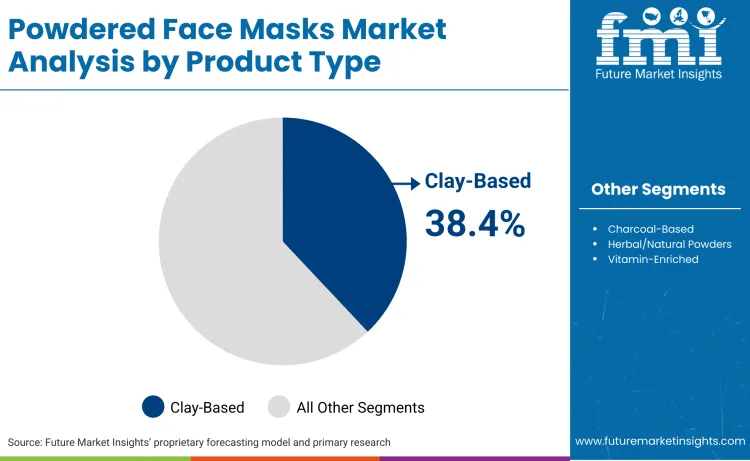
Clay-based powdered face masks account for 38.4% of the powdered face masks market, supported by their broad suitability across acne-prone and oily skin types. Kaolin and bentonite clays are widely used for their oil-absorbing and pore-cleansing properties, making them compatible with frequent use in home skincare routines. These powders offer predictable performance, easy mix-at-use preparation, and strong value perception compared with more specialized blends. Consumers associate clay powders with visible skin purification benefits and controlled application intensity. FMI observes that clay-based masks are positioned as foundational treatment products rather than occasional add-ons, allowing them to achieve higher repeat usage and consistent demand as powdered formats gain wider acceptance.
Why Does Acne Treatment Lead by Application?
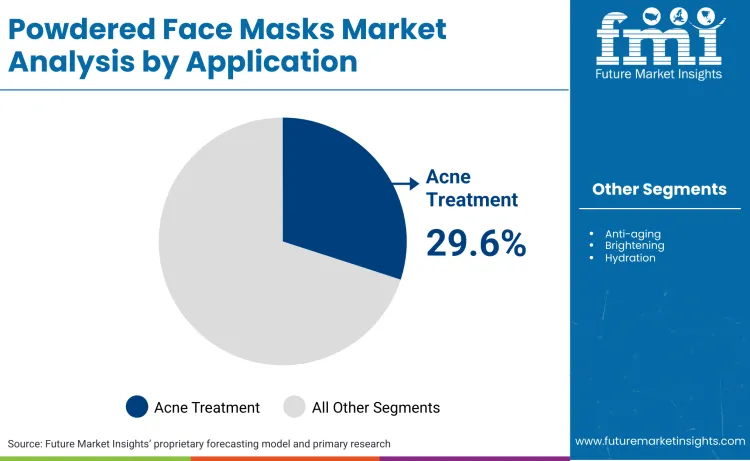
Acne treatment represents 29.6% of total application demand, reflecting sustained consumer focus on oil control, breakouts, and skin clarity across age groups. Powdered face masks are particularly suited for acne care because dry formats preserve ingredient stability and enable delivery of concentrated actives without relying on preservatives. Acne-related concerns often require repeated treatment cycles, supporting higher usage frequency compared with anti-aging or brightening applications. FMI observes that acne-focused powdered masks align well with routine skincare behavior, especially among younger and urban consumers who seek visible results and controlled application. This consistent, problem-solution usage pattern anchors demand, making acne treatment the primary application driver within the powdered face masks category.
Why Does Online Retail Dominate the Distribution Channel?
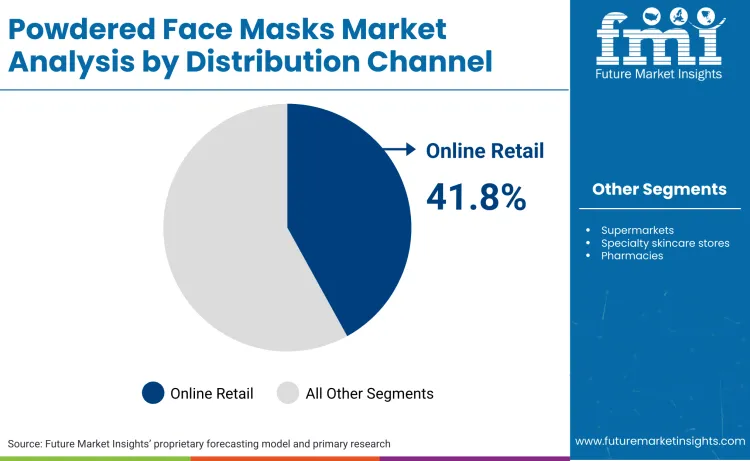
Online retail accounts for 41.8% of powdered face mask sales, supported by the category’s strong compatibility with e-commerce logistics and consumer purchasing behavior. Powdered masks are lightweight, non-liquid, and compact, which reduces shipping costs and minimizes damage risk compared with creams or gels. Digital platforms also enable detailed ingredient disclosure, usage instructions, and consumer reviews, which are important for dry-to-active formats requiring user preparation. FMI notes that online channels facilitate trial purchases, repeat replenishment, and subscription models, all of which support sustained engagement. As powdered face masks rely on education and routine reordering, online retail continues to provide the most scalable and efficient route to market.
Why Do Women Represent the Largest End-User Segment?
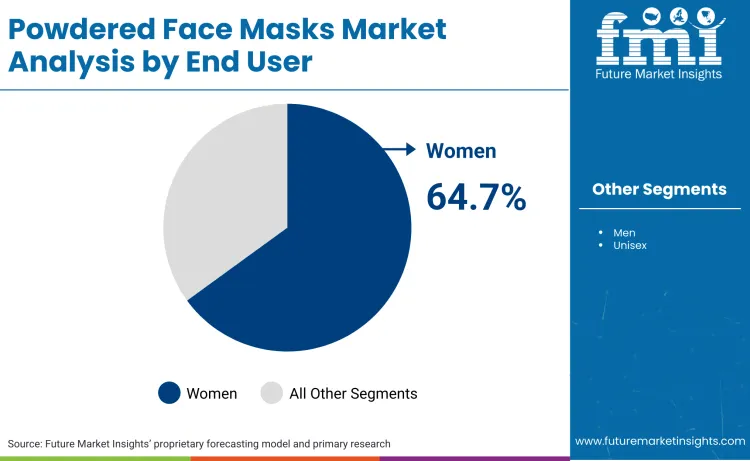
Women account for 64.7% of powdered face mask consumption, reflecting higher engagement with targeted skincare treatments and routine facial care practices. Powdered masks align well with multi-step skincare routines, offering flexibility to address specific concerns such as acne, hydration, or brightening. Women are also more likely to experiment with mix-at-use formats and adjust application frequency based on skin condition or season. FMI observes that higher usage frequency, stronger interest in customization, and greater familiarity with facial mask treatments contribute to volume concentration in this segment. While men and unisex products are gaining visibility, women continue to anchor demand through repeat usage and consistent replenishment patterns.
What Trends Define the Rise of Waterless Mask Formats?
Waterless mask formats are increasingly shaping the powdered face masks market as skincare brands move away from pre-mixed creams and gels that rely on preservatives and bulky packaging. Powdered face masks remove water from the formulation, which improves shelf stability and preserves ingredient integrity until activation at the point of use.
This structure reduces packaging volume and shipping weight while supporting high-performance delivery of clays, botanicals, and functional actives. Shiseido includes powder-based mask and treatment formats within its broader skincare portfolio, illustrating how dry formulations coexist with cream and gel masks without altering standard application routines. As per Future Market Insights, powdered masks are no longer positioned only as professional or occasional treatments. They are increasingly framed as regular at-home skincare solutions for acne control, oil management, and hydration. This evolution reflects growing confidence in dry-to-active systems and aligns powdered face masks with long-term, routine skincare behavior.
How Is Portfolio Integration Strengthening Powdered Face Mask Adoption?
Portfolio integration is playing a key role in expanding adoption by placing powdered face masks within established mask and treatment ranges rather than isolating them as specialty products. Brands are offering powdered formats alongside wash-off masks, sheet masks, and gels, allowing consumers to choose based on skin need without changing application habits. According to FMI, this approach enables companies to apply existing quality standards, ingredient sourcing frameworks, and distribution reach to powdered formats. Integration within core portfolios improves visibility, supports consumer trust, and normalizes dry masks as part of regular skincare routines. By reducing the perception of powdered masks as complex or niche, portfolio alignment encourages repeat use and supports scale across both premium and mass skincare channels.
Why Is Formulation Optimization Driving Product Differentiation?
Formulation optimization is a major driver of differentiation in the powdered face masks market, as performance depends on precise control of particle size, ingredient dispersion, and activation behavior. Small variations can affect texture, mixability, application comfort, and treatment efficacy. Manufacturers are refining powder blends to ensure smooth hydration, even spread, and consistent results across skin types and climates. FMI notes that as competition intensifies, brands are focusing on formulation discipline to balance efficacy with ease of use. Optimized dry formulations also support longer shelf life and predictable performance, which are critical for repeat purchase. This emphasis positions powdered face masks as reliable, routine treatments rather than experimental or professional-only skincare formats.
How Does the Powdered Face Masks Market Perform at a Country Level?
Country-level expansion of the powdered face masks market shows clear variation, shaped by local skincare practices, openness to dry formats, and frequency of mask usage. China leads with an 11.4% CAGR, supported by strong uptake of acne-focused and oil-control treatments and growing interest in professional-style home skincare. India follows at 10.6%, driven by rising urban beauty consumption and increasing appeal of waterless, mix-at-use products. Germany records 9.7% growth, reflecting sustainability-led purchasing and preference for preservative-light formulations. Brazil posts 8.9%, tracking broader global acceptance of powdered and clay-based masks. The United States registers 8.0%, signaling steady adoption within an established skincare market. The United Kingdom reaches 7.2%, while Japan posts 6.3%, influenced by slower transition away from ready-to-use mask formats.
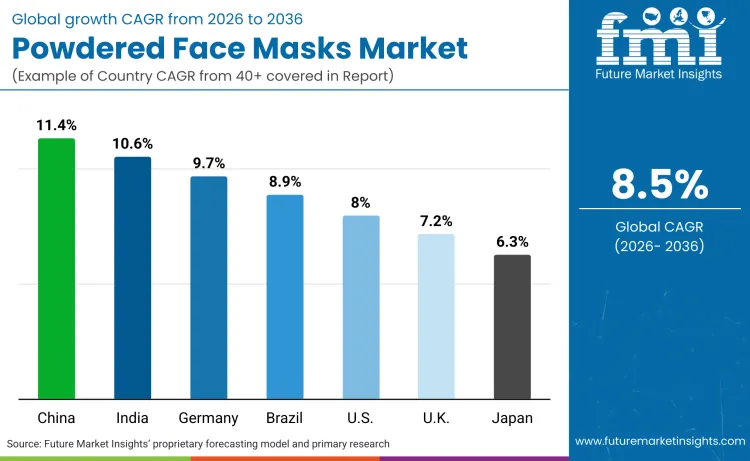
| Country | CAGR (2026 to 2036) |
|---|---|
| China | 11.4% |
| India | 10.6% |
| Germany | 9.7% |
| Brazil | 8.9% |
| United States | 8.0% |
| UK | 7.2% |
| Japan | 6.3% |
Source: FMI historical analysis and forecast data.
Why Is China Emerging as the Fastest-Growing Market for Powdered Face Masks?
China’s 11.4% CAGR reflects strong consumer acceptance of dry-to-active skincare formats and frequent facial masking habits. Urban consumers are highly familiar with acne-control, oil-balancing, and detox-focused routines, which aligns well with powdered masks that activate at the time of use. Compact, lightweight products suit dense urban living and frequent travel, while e-commerce-led purchasing accelerates trial and repeat usage. Powdered masks perform well on digital platforms due to low shipping costs and easy replenishment. Growth in China is driven less by first-time skincare adoption and more by higher usage frequency and substitution away from pre-mixed creams toward dry formats that offer stability, customization, and perceived freshness with each application.
What Factors Support Strong Growth in India?
India’s 10.6% CAGR is supported by expanding urban skincare awareness and growing experimentation among younger consumers. Powdered face masks appeal due to ease of storage, longer shelf life, and suitability for warm and humid conditions where pre-mixed masks can degrade faster. Increasing internet penetration has widened access to emerging skincare formats beyond major cities, supporting trial purchases and repeat adoption. Forest Essentials offers powder-based facial treatments within its skincare assortment, illustrating how dry mask formats sit alongside conventional creams and gels without changing familiar application practices. Powdered masks are increasingly viewed as practical routine products rather than premium or professional-only treatments. Growth is reinforced by rising interest in acne care, oil control, and ingredient-focused skincare, along with a gradual shift toward waterless and low-waste personal care options suited for frequent use.
What Is Enabling Sustained Growth in Germany?
Germany records a 9.7% CAGR, shaped by sustainability-oriented purchasing behavior and structured skincare routines. Consumers show strong interest in formats that reduce preservative load and packaging waste while maintaining formulation integrity. Powdered face masks align with preferences for concentrated, long-lasting products that offer predictable performance. Adoption tends to be steady and research-driven, with buyers prioritizing ingredient transparency and functional benefits over trend-led experimentation. Growth is supported by integration of powdered masks into existing skincare routines rather than disruptive switching. This measured adoption pattern keeps Germany above the global average, anchored by demand for stable, environmentally considerate, and performance-focused facial treatments.
Why Is Brazil Experiencing Consistent Expansion?
Brazil’s 8.9% CAGR reflects steady growth supported by climate-driven skincare needs and rising middle-income consumption. Warm temperatures and high humidity increase the frequency of facial cleansing and masking, favoring formats that are easy to store and prepare. Powdered face masks suit daily routines due to their stability and portability, especially for work and travel. Improved availability through online platforms and specialty beauty retail is expanding awareness and repeat usage. Adoption is gradual but reliable, as consumers increasingly treat powdered masks as practical additions to regular skincare rather than occasional treatments, supporting balanced demand across major urban centers.
Why Is Growth in the United States More Moderate?
The United States posts an 8.0% CAGR, indicating steady but selective adoption within a mature facial care market. Powdered face masks are often used alongside creams, gels, and sheet masks rather than fully replacing them. Growth is driven by ingredient-conscious consumers, frequent travelers, and those seeking preservative-minimal options. Digital retail supports experimentation and replenishment, though strong loyalty to ready-to-use formats limits rapid switching. As familiarity with dry-to-active systems improves and usage confidence builds, powdered masks continue to gain incremental traction, resulting in stable expansion without abrupt format displacement.
What Is Driving Growth in the United Kingdom?
The UK reaches a 7.2% CAGR, shaped by rising interest in waterless beauty and ingredient transparency. Consumers show growing preference for compact products that reduce packaging waste and offer longer shelf life. Powdered face masks fit well with at-home skincare routines focused on acne management, brightening, and oil control. Adoption is supported by online retail and specialty skincare stores, where education and usage guidance are readily available. Growth remains measured, as consumers balance experimentation with established mask formats. Powdered masks are increasingly incorporated as complementary treatments rather than primary replacements, supporting gradual but consistent demand growth.
Why Does Japan Trail Other Markets in Growth?
Japan records a 6.3% CAGR, influenced by cautious adoption patterns and strong loyalty to established cream and gel mask formats. Consumers prioritize proven performance, texture familiarity, and precise formulation behavior, which can slow transitions to newer dry formats. Powdered face masks are more commonly tested for specific concerns rather than integrated into daily routines. While awareness of waterless and stable formulations exists, adoption tends to be deliberate. This conservative approach limits rapid scale-up, keeping growth below faster-moving markets despite Japan’s high overall skincare sophistication and emphasis on product quality and efficacy.
How Is the Competition in the Powdered Face Masks Market?
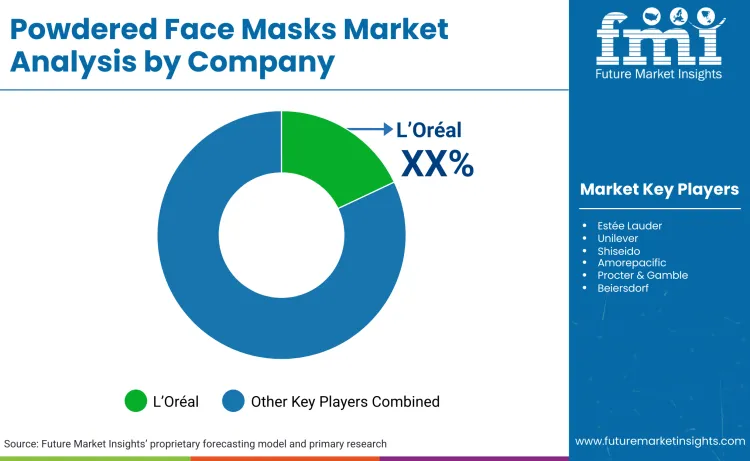
The powdered face masks market is moderately consolidated, led by global beauty companies with strong capabilities in formulation science and facial treatments. L’Oréal holds an estimated 17.9% share, reflecting its scale advantage and long-standing investment in professional, dermocosmetic, and science-led skincare portfolios. Other multinational players such as Estée Lauder, Shiseido, and Amorepacific strengthen competition through broad mask portfolios spanning clay, treatment, and specialty formats.
Their competitive edge lies in ingredient credibility, controlled activation systems, and strong brand trust across Asia, Europe, and North America. Competition is increasingly influenced by formulation stability, ease of mixing, and consistency of results rather than novelty alone. Mass and dermocosmetic-focused companies such as Unilever, Procter & Gamble, and Beiersdorf contribute to competitive pressure by emphasizing accessibility, skin tolerance, and routine compatibility. These players leverage strong distribution networks and established skincare credentials to position powdered masks as practical, repeat-use treatments. As the category matures, competition is shifting toward formulation reliability, ingredient transparency, and portfolio integration, favoring companies with disciplined R&D, scalable manufacturing, and trusted skincare franchises.
Recent Developments:
- In April 2025, Innisfree refreshed its volcanic care franchise with a powder-based clarifying mask pack sold alongside its clay and cream masks rather than as a stand-alone format. The update reinforces Innisfree’s focus on format diversity within its established treatment architecture.
- In February 2025, KraveBeauty piloted a powder-activated calming mask designed to reduce reliance on traditional preservatives and improve formula durability in warm climates. The pilot aligns with the brand’s interest in compact, low-waste formats that meet growing expectations for environmental efficiency.
- In September 2025, Kiehl’s introduced a powder-to-foam resurfacing mask designed to sit within its existing exfoliation and treatment lineup. The launch reflects the brand’s aim to offer low-water alternatives while retaining the mild resurfacing performance associated with its liquid and cream masks.
Key Players in Powdered Face Masks Market
- L’Oréal
- Estée Lauder
- Unilever
- Shiseido
- Amorepacific
- Procter & Gamble
- Beiersdorf
Market Definition
The powdered face masks market represents revenue generated from the sale of dry, water-activated facial mask products formulated in powder form and intended for at-home skincare use. The market, as operationally defined here, measures commercial sales of single-use and multi-use powdered masks that are mixed with water or other activators immediately prior to application. Market sizing reflects the value of finished consumer products sold through retail and digital channels, analyzed by product type, skin concern, distribution channel, and end user, and expressed in USD billion.
The market includes clay-based powders, charcoal-based masks, herbal and botanical blends, vitamin-enriched formulations, and other dry systems such as fruit-based or enzyme powders designed for acne treatment, oil control, hydration, brightening, and anti-aging. Revenue from waterless and preservative-minimal formulations, sachets, jars, and refill-oriented packaging formats is included. The scope captures adoption across mass, premium, and dermocosmetic skincare segments distributed through online retail, supermarkets, specialty skincare stores, and pharmacies across North America, Europe, Asia Pacific, Latin America, and the Middle East & Africa. The market excludes pre-mixed cream masks, gel masks, sheet masks, peel-off masks, and liquid facial treatments. Professional-use powders sold exclusively to salons or spas without retail availability are excluded. Bulk cosmetic powders sold as raw materials or private-label inputs are not counted within finished product revenues.
Scope of Report
| Items | Values |
|---|---|
| Quantitative Units (2026) | USD 1.41 Billion |
| Product Type | Clay-based (kaolin, bentonite, etc.); Charcoal-based; Herbal/Natural powders; Vitamin-enriched; Others (fruit-based, enzyme blends) |
| Application | Acne treatment; Anti-aging; Brightening; Hydration; Oil control |
| Distribution Channel | Online retail; Supermarkets; Specialty skincare stores; Pharmacies |
| End User | Women; Men; Unisex |
| Regions Covered | North America, Europe, Asia Pacific, Latin America, Middle East & Africa |
| Countries Covered | United States, Germany, United Kingdom, India, China, Brazil, and 40+ countries |
| Key Companies Profiled | L’Oréal; Estée Lauder; Unilever; Shiseido; Amorepacific; Procter & Gamble; Beiersdorf |
| Additional Attributes | Dollar sales by product type, application, distribution channel, and end user; country-wise growth analysis; adoption trends for dry-to-active and waterless skincare formats; packaging efficiency and shelf-stability considerations; ingredient positioning including mineral clays, botanicals, vitamins, and enzymes; competitive brand positioning across mass, premium, and dermocosmetic channels |
Source: FMI historical analysis and forecast data.
Powdered Face Masks Market by Segments
By Product Type:
- Clay-based (kaolin, bentonite, etc.)
- Charcoal-based
- Herbal / Natural powders
- Vitamin-enriched
- Others (fruit-based, enzyme blends)
By Application:
- Acne treatment
- Anti-aging
- Brightening
- Hydration
- Oil control
By Distribution Channel:
- Online retail
- Supermarkets
- Specialty skincare stores
- Pharmacies
By End User:
- Women
- Men
- Unisex
By Region:
- North America
- Europe
- Asia Pacific
- Latin America
- Middle East & Africa
Bibliography
- American Academy of Dermatology Association. (2023). Facial masking practices, acne management, and skin barrier considerations. AAD Clinical Guidance Series, 1-29.
- Cosmetic Ingredient Review Expert Panel. (2024). Safety assessment of clays, charcoal, botanical powders, and enzyme ingredients used in cosmetic masks. Cosmetic Ingredient Review, 1-76.
- Personal Care Products Council. (2024). Powdered and anhydrous formulation systems in skincare applications. PCPC Scientific Affairs White Paper, 1-45.
Frequently Asked Questions
What is the current global market size for Powdered Face Masks?
The global powdered face masks market is valued at USD 1.41 billion in 2026, supported by rising adoption of waterless skincare formats and increasing preference for dry, mix-at-use facial treatments.
What is the projected CAGR for the Powdered Face Masks market?
Market revenues are projected to grow at an 8.5% CAGR from 2026 to 2036, reaching USD 3.19 billion by the end of the forecast period.
Which segment currently dominates the industry?
Clay-based powdered face masks dominate the market with a 38.4% share, driven by widespread use in acne treatment and oil control routines and suitability for frequent at-home application.
What are the primary risks or barriers to adoption?
Key barriers include consumer familiarity with pre-mixed cream and sheet masks, the need for user preparation before application, and slower adoption in markets with strong loyalty to ready-to-use formats.
Who are the leading players in the Powdered Face Masks space?
Leading companies include L’Oréal, Estée Lauder, Shiseido, Amorepacific, Unilever, and Beiersdorf, leveraging strong formulation expertise and global skincare distribution networks.
Preview the report firsthand - request a free sample
Get SampleGet the brochure for pricing and purchase details.
Get PDFTable of Content
- Executive Summary
- Global Market Outlook
- Demand Side Trends
- Supply Side Trends
- Technology Roadmap Analysis
- Analysis and Recommendations
- Market Overview
- Market Coverage / Taxonomy
- Market Definition / Scope / Limitations
- Research Methodology
- Chapter Orientation
- Analytical Lens and Working Hypotheses
- Market Structure, Signals, and Trend Drivers
- Benchmarking and Cross-market Comparability
- Market Sizing, Forecasting, and Opportunity Mapping
- Research Design and Evidence Framework
- Desk Research Programme (Secondary Evidence)
- Expert Input and Fieldwork (Primary Evidence)
- Governance, Ethics, and Data Stewardship
- Tooling, Models, and Reference Databases
- Data Engineering and Model Build
- Data Acquisition and Ingestion
- Cleaning, Normalisation, and Verification
- Synthesis, Triangulation, and Analysis
- Quality Assurance and Audit Trail
- Market Background
- Market Dynamics
- Drivers
- Restraints
- Opportunities
- Trends
- Scenario Forecast
- Demand in Optimistic Scenario
- Demand in Likely Scenario
- Demand in Conservative Scenario
- Opportunity Map Analysis
- Product Life Cycle Analysis
- Supply Chain Analysis
- Investment Feasibility Matrix
- Value Chain Analysis
- PESTLE and Porter's Analysis
- Regulatory Landscape
- Regional Parent Market Outlook
- Production and Consumption Statistics
- Import and Export Statistics
- Market Dynamics
- Global Market Analysis 2021 to 2025 and Forecast, 2026 to 2036
- Historical Market Size Value (USD Billion) Analysis, 2021 to 2025
- Current and Future Market Size Value (USD Billion) Projections, 2026 to 2036
- Y-o-Y Growth Trend Analysis
- Absolute $ Opportunity Analysis
- Global Market Pricing Analysis 2021 to 2025 and Forecast 2026 to 2036
- Y-o-Y Growth Trend Analysis 2021 to 2025
- Absolute $ Opportunity Analysis 2026 to 2036
- Global Market Analysis 2021 to 2025 and Forecast 2026 to 2036, By Product Type
- Clay-based (kaolin, bentonite, etc.)
- Charcoal-based
- Herbal / Natural powders
- Vitamin-enriched
- Others (fruit-based, enzyme blends)
- Global Market Analysis 2021 to 2025 and Forecast 2026 to 2036, By Application
- Acne treatment
- Anti-aging
- Brightening
- Hydration
- Oil control
- Global Market Analysis 2021 to 2025 and Forecast 2026 to 2036, By Distribution Channel
- Online Retail
- Supermarkets
- Specialty Skincare Stores
- Pharmacies
- Global Market Analysis 2021 to 2025 and Forecast 2026 to 2036, By End User
- Women
- Men
- Unisex
- Global Market Analysis 2021 to 2025 and Forecast 2026 to 2036, By Region
- North America
- Latin America
- Europe
- Asia Pacific
- Middle East & Africa
- Market Attractiveness Analysis By Region
- Key Countries Market Analysis
- Market Structure Analysis
- Competition Dashboard
- Competition Benchmarking
- Market Share Analysis of Top Players
- Competition Analysis
- Competition Deep Dive
- L’Oréal
- Estée Lauder
- Unilever
- Shiseido
- Amorepacific
- Procter & Gamble
- Beiersdorf
- Competition Deep Dive
- Assumptions & Acronyms Used


