

- Industry Size (2025)
- USD 62.6 Mn
- Forecast (2035)
- USD 107.2 Mn
- CAGR (2025 to 2035)
- 5.5%
Kaolin Market Forecast and Outlook 2025 to 2035
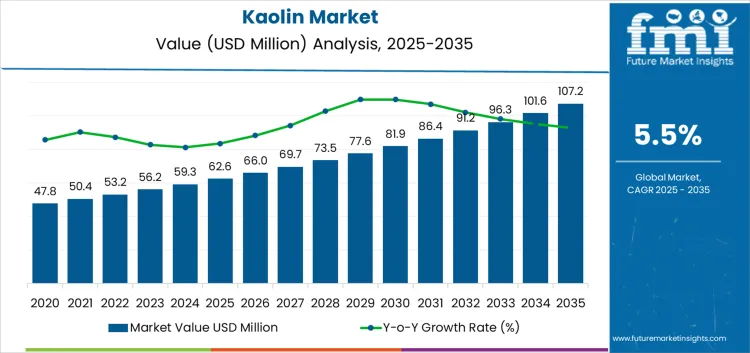
Shifts in functional filler demand and cosmetic mineral usage place the kaolin market at USD 62.6 million in 2025, with revenues expected to reach USD 107.2 million by 2035 at a CAGR of 5.5%. Powder remains the dominant traded form due to ease of processing and formulation flexibility. Asia Pacific leads in volume consumption, driven by China and India, supported by large ceramic and coating industries, while the United States, Germany, and Japan are key centers of specialty-grade demand. Major global suppliers include Imerys, KaMin, Sibelco, Thiele Kaolin Company, and Ashapura Group.
Paper and ceramic applications maintain steady baseline volumes through infrastructure, packaging, and construction-linked demand. In personal care, kaolin continues to gain preference in acne control, oil absorption, and detox formulations, supporting consistent specialty-grade offtake. Pharmaceuticals retain controlled usage through excipients and topical preparations, while rubber and plastics sustain incremental filler demand under cost-optimization programs. Asia Pacific remains the primary production and consumption hub, while Europe and North America sustain higher value through refined and surface-treated grades. Competitive positioning increasingly depends on brightness control, particle size distribution, and long-term supply reliability rather than short-term pricing leverage.
Quick Stats of the Kaolin Market:
- Kaolin Market Value (2025): USD 62.6 million
- Kaolin Market Forecast Value (2035): USD 107.2 million
- Kaolin Market Forecast CAGR (2025–2035): 5.5%
- Leading Product Form in Kaolin Market: Powder (17.8%)
- Key Growth Regions in Kaolin Market: India, China, Japan, USA, Germany, UK
- Top Players in Kaolin Market: BASF SE; Croda International; Evonik Industries; Symrise (incl. IFF/Givaudan actives); Dow / Dow Inc.; Ashland; Clariant; Seppic
What is the Growth Forecast for the Kaolin Market through 2035?
The global kaolin market grows from USD 62.6 million in 2025 to USD 77.6 million by 2030, delivering an absolute increase of USD 15.0 million in the first half of the forecast period. This phase reflects kaolin’s structurally embedded role across paper coating, ceramics, paints, rubber compounding, and select personal care applications where it functions as a filler, extender, and surface modifier. Annual value additions progress from about USD 3.4 million to over USD 4.1 million, indicating production-linked expansion rather than short-term demand surges. Growth is anchored in packaging board output, sanitaryware manufacturing, architectural coatings, and industrial plastics where kaolin supports opacity, smoothness, and mechanical strength at controlled cost points.
From 2030 to 2035, the market advances from USD 77.6 million to USD 107.2 million, adding a larger USD 29.6 million in the second half of the decade. Annual value gains widen from roughly USD 4.3 million to more than USD 5.6 million by the final years, indicating a firmer late-cycle expansion profile. This back-weighted growth reflects rising use in lightweight ceramics, engineered polymers, high-solids coatings, and pharmaceutical and cosmetic-grade formulations where particle refinement and purity standards lift unit value. As downstream industries push toward material optimization and surface performance enhancement, kaolin transitions into higher-specification applications, structurally strengthening global market value growth through 2035.
Kaolin Industry Key Takeaways
| Metric | Value |
|---|---|
| Industry Value (2025) | USD 62.6 million |
| Forecast Value (2035) | USD 107.2 million |
| Forecast CAGR (2025–2035) | 5.5% |
How Is Functional Mineral Demand Shaping the Kaolin Market Across Ceramics, Paper, and Specialty Applications?
The kaolin market is shaped by its long standing role as a multifunctional industrial clay used for whiteness control, surface smoothness, and structural reinforcement. In ceramics, kaolin remains a foundational raw material for tiles, sanitary ware, and tableware where it improves plasticity during forming and strength after firing. In paper manufacturing, it is widely used as a coating and filler to enhance brightness, opacity, ink receptivity, and print sharpness. Demand is also reinforced in rubber, plastics, paints, and fiberglass where kaolin improves dimensional stability, reduces resin consumption, and controls surface finish. This broad technical utility across high volume manufacturing industries creates a stable baseline demand cycle.
Future growth of the kaolin market will be shaped by construction activity, packaging demand, and expansion of performance driven composites. As infrastructure development and housing construction continue in emerging economies, ceramic and sanitary ware output will sustain kaolin consumption. Growth is also expected in high quality paperboard for packaging, electrical insulation materials, and fire resistant composites. Barriers include competition from alternative fillers, rising energy and transport costs, and environmental pressure on open pit mining operations. Substitution by engineered minerals in premium applications may limit growth at the high end. Long term market expansion will depend on how effectively kaolin producers balance resource availability, processing efficiency, environmental compliance, and consistent particle quality across industrial and specialty end use sectors.
How Do Absorption Behavior and Physical Handling Define Kaolin Demand Across Formulation Systems?
Kaolin demand is structured by end use application and product form based on how oil adsorption, gentle exfoliation, and opacity control are engineered into finished products. By application, usage spans skin care, body care, hair care, sun care, color cosmetics, men grooming, baby and kids care, and dermocosmetic or professional care. By physical format, supply moves through powder, granules or agglomerates, flakes, pellets or prills, liquid solution, concentrate, dispersion or suspension, emulsion, paste, gel, wax or solid block, and oil. These divisions reflect variation in clay purity requirements, texture influence, dispersion sequencing, and compliance oversight across cleansing products, facial masks, and corrective cosmetic manufacturing systems.
Why Do Cleansing and Clarifying Products Anchor Kaolin Use in Skin Care?
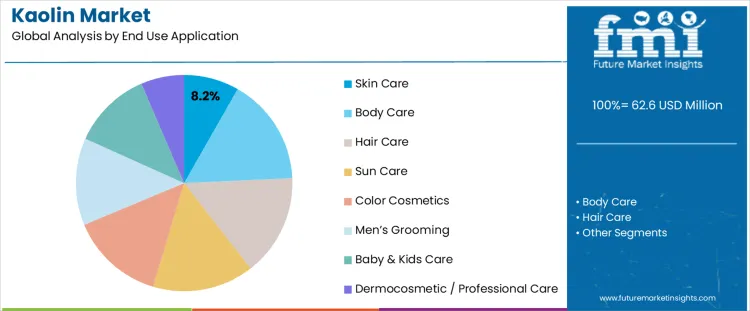
The skin care segment represents 8.2% of total kaolin demand in 2025, reflecting its revenue role within oil absorbing and detoxifying formulations. Consumption per unit output is defined by clay loading ranges used in facial cleansers, clay masks, exfoliating scrubs, and pore refining treatments. Usage remains stable across seasons because oil control and gentle cleansing are tied to routine skin maintenance rather than episodic cosmetic use. Procurement is anchored in long term sourcing contracts to ensure mineral purity consistency across production cycles. Price sensitivity remains moderate since kaolin influences both texture and functional cleaning performance. Specification control is strict due to heavy metal limits, microbial thresholds, and particle size distribution. Process integration occurs during slurry preparation and dispersion stages, supporting both batch compounding and continuous mixing across large skin care manufacturing environments.
Skin care contributes steady incremental kaolin growth through sustained demand for clarifying daily care and professional treatment products. Repeat purchase frequency remains high due to frequent consumer replenishment cycles. Buyers favor bulk procurement to stabilize mineral performance and reduce formulation drift. Margin structure remains tight under sustained pricing pressure from mass retail and private label brands. Certification dependence increases for baby care and sensitive skin positioning, extending documentation requirements. Import reliance persists for high purity cosmetic grade clays. Lead time exposure is managed through buffer inventories near blending operations. Competitive pressure from activated charcoal and synthetic absorbents remains present, though kaolin retains preference for mildness and tactile neutrality.
What Manufacturing Conditions Keep Powder the Core Format for Kaolin Processing?
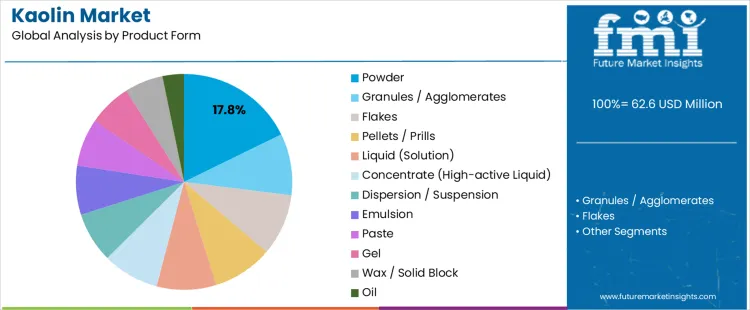
The powder format accounts for 17.8% of total kaolin demand in 2025, reflecting its combined volume concentration and revenue contribution across delivery forms. Consumption per unit output aligns with dry premix preparation for face masks, powders, cleansing bars, and exfoliating formulations. Dosage accuracy is maintained through volumetric and gravimetric feeding systems that regulate adsorption intensity. Procurement favors long term bulk supply contracts to limit freight volatility and moisture related agglomeration risk. Price elasticity remains low because functional clay substitution requires full sensory and stability requalification. Quality sensitivity centers on platelet structure, moisture content, and flow behavior. Process compatibility favors early stage blending into dry bases or aqueous slurries prior to emulsification, supporting high conversion efficiency across automated production environments.
The powder segment supports incremental growth through repeat usage across cleansing and professional skin care portfolios rather than narrow seasonal demand cycles. Buyer switching tendency remains low due to adsorption performance and texture behavior locked into approved formulations. Margin spread remains narrow under indexed annual supply agreements. Cost pass through is achievable only within scheduled contract adjustment windows. Impurity tolerance remains tight because trace contamination affects skin safety and visual clarity. Equipment dependence centers on sealed feeders, screening systems, and humidity controlled storage rooms. Asia led consumption reflects large scale clay processing and export oriented cosmetic manufacturing hubs. Competitive exposure from low cost producers persists, though qualification timelines restrict rapid entry into regulated cosmetic clay supply chains.
How Is Kaolin Serving as a Structural Functional Mineral Across Ceramics, Paper, Polymers, and Personal Care Systems?
Kaolin functions as a performance-driven aluminosilicate mineral rather than a simple extender. Its fine particle size, plate-like structure, chemical inertness, and whiteness make it essential in paper coating and filling, ceramic bodies, rubber, polymers, refractories, and personal care. In paper, it controls opacity, brightness, and print smoothness. In ceramics, it governs plasticity and firing behavior. In cosmetics, it provides oil absorption and tactile softness. Demand is spread across industrial and consumer sectors, creating a diversified market defined by surface control, rheology management, and thermal stability rather than low-cost bulk substitution alone.
How Is Performance-Focused Mineral Engineering Driving the Core Market Trend for Kaolin?
The dominant market trend for kaolin is its growing treatment as a precision-engineered functional mineral rather than a low-grade filler. In paper and packaging, engineered kaolin improves ink holdout, coating uniformity, and brightness control. In plastics and rubber, calcined kaolin enhances stiffness, scratch resistance, and dimensional stability. In personal care, fine-purity grades are used for sebum control, matte finish, and skin feel optimization. Surface modification, particle classification, and calcination are increasingly used to tailor performance. This trend reflects kaolin migration into value-added functional roles across coatings, consumer goods, and technical materials.
Why Is Packaging, Ceramics, and Personal Care Expansion Creating a Growth Opportunity?
Growth opportunity for kaolin is anchored in expanding packaging demand, ceramic tile production, and daily-use personal care consumption. Lightweight paperboard, folding cartons, and labels continue to depend on kaolin for print quality and stiffness. Construction growth in emerging regions sustains ceramic sanitaryware and tile production that rely on kaolin for shaping and firing control. In cosmetics and skin care, kaolin is gaining use in masks, cleansers, powders, and oil-control products aligned with natural positioning. These segments support stable long-term demand anchored in everyday industrial and consumer production cycles.
How Do Mining Regulation, Logistics Exposure, and Beneficiation Cost Act as Market Restraints?
Kaolin supply is structurally exposed to mining permits, land-use restrictions, and environmental rehabilitation requirements that slow new capacity development. High-volume transport requirements create sensitivity to freight costs due to its low value-to-weight ratio. Beneficiation processes such as washing, classification, and calcination add energy and water cost while generating waste streams that require regulatory management. In high-purity cosmetic and paper grades, impurity control increases rejection rates. These factors raise capital intensity and compress margins, making regulatory compliance, logistics economics, and processing cost persistent structural restraints on kaolin market scalability.
What Is the Global Growth Outlook for the Kaolin Industry by Country?
| Country | CAGR (%) |
|---|---|
| India | 7.5 |
| China | 6.9 |
| Japan | 6.4 |
| UK | 5.8 |
| Germany | 5.3 |
| USA | 4.7 |
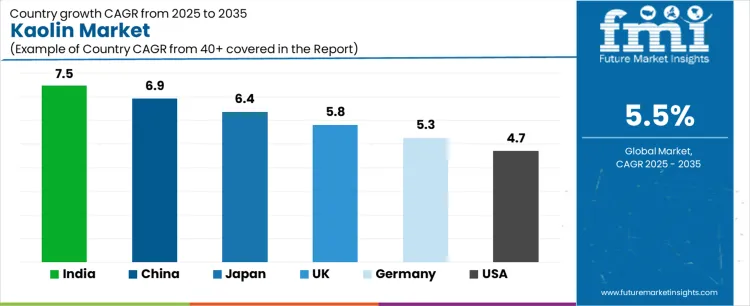
The kaolin industry is expanding steadily across global ceramics, paper, paints and coatings, rubber, and cosmetics sectors, with India leading at a 7.5% CAGR. Growth in India is supported by rising ceramic tile production, expanding paper manufacturing, and increasing use of kaolin in pharmaceuticals and personal care products. China follows at 6.9%, driven by large scale ceramic manufacturing, strong paper coating demand, and extensive industrial mineral processing capacity. Japan at 6.4% reflects stable demand from specialty ceramics, electronics components, and premium cosmetic formulations. The UK and Germany record 5.8% and 5.3% growth, supported by architectural coatings, paper processing, and specialty industrial fillers. The USA at 4.7% reflects a mature but steadily advancing market driven by construction materials, packaging paper, and regulated personal care applications.
What Is Driving Kaolin Demand Expansion in India Ceramics, Paper, and Paints?
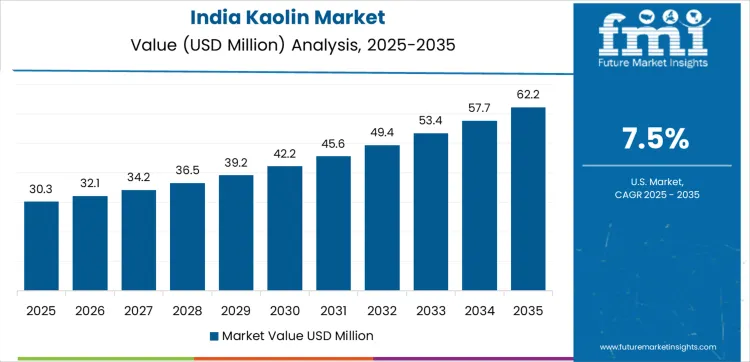
Growth in India is advancing at a CAGR of 7.5% through 2035 for kaolin demand, driven by rising ceramic tile production, paper coating usage, and decorative paint consumption. India contrasts with Japan by showing stronger volume demand from construction and packaging rather than high purity technical applications. Kaolin is widely used in wall tiles, sanitaryware, paper coating, rubber compounding, and architectural paints. Domestic mining supports most industrial grades, while ultra fine and calcined grades rely on imports. Key suppliers include Ashapura Group, EICL, and Imerys distribution partners.
- Ceramic tiles anchor bulk mineral demand
- Paper coating supports steady industrial usage
- High purity grades remain import dependent
- Ashapura and EICL supply major processors
How Is China Structuring Large Scale Kaolin Processing for Manufacturing Supply Chains?
Expansion in China reflects a CAGR of 6.9% through 2035 for kaolin utilization, supported by large scale ceramic manufacturing, paper production, and plastics compounding. China contrasts with India by operating integrated mining and refining hubs with strong export orientation. Kaolin is used in porcelain ceramics, coated paper, rubber fillers, and polymer composites. Regional mineral clusters enable high volume beneficiation and calcination. Key producers include Maoming Kaolin, Longyan Kaolin, and Imerys China units supplying domestic and export manufacturers.
- Porcelain ceramics drive major volume usage
- Coated paper sustains stable industrial demand
- Integrated processing strengthens supply security
- Maoming and Longyan lead domestic production
Why Does Japan Maintain Controlled Kaolin Usage in Electronics and Specialty Ceramics?
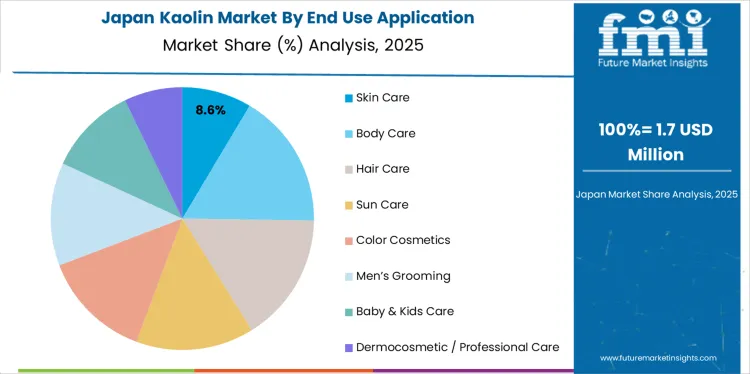
Demand in Japan is increasing at a CAGR of 6.4% through 2035 for kaolin usage, supported by advanced ceramics, electronics substrates, and precision coatings. Japan contrasts with China by prioritizing ultra fine particle sizing, low iron content, and thermal stability over volume scale. Kaolin is applied in multilayer ceramic capacitors, specialty refractories, high gloss coatings, and barrier films. Imports dominate raw supply, while surface treatment and dispersion occur locally. Key suppliers active in Japan include Imerys Japan, BASF partners, and specialty ceramic material distributors.
- Electronic ceramics sustain high purity demand
- Precision coatings support controlled filler usage
- Iron impurity control defines supplier selection
- Imerys Japan leads specialty grade distribution
What Is Supporting Stable Growth of Kaolin Usage in the United Kingdom?
Growth in the UK is advancing at a CAGR of 5.8% through 2035 for kaolin demand, supported by paper manufacturing, paints and coatings, and rubber processing. The UK contrasts with Germany through stronger reliance on decorative coatings and publishing paper rather than engineered automotive uses. Kaolin appears in coated paper, industrial paints, rubber hoses, and sealants. Imports dominate supply from European and global mineral producers. Key suppliers serving the UK include Imerys, KaMin distributors, and regional industrial mineral importers.
- Coated paper supports steady filler demand
- Decorative paints drive recurring mineral usage
- Import dependence remains higher than Germany
- Imerys and KaMin supply major customers
How Is Germany Applying Kaolin Under Regulated Automotive and Chemical Systems?
Growth in Germany reflects a CAGR of 5.3% through 2035 for kaolin consumption, driven by automotive coatings, engineered plastics, specialty rubber, and regulated construction materials. Germany contrasts with the UK and India through stronger dominance of OEM driven demand and strict filler performance validation. Kaolin is used in automotive primers, polymer composites, cable insulation, and industrial coatings. Domestic and EU based supply chains reduce import reliance. Key suppliers include BASF mineral programs, Imerys Europe, and Quarzwerke serving regulated industrial markets.
- Automotive coatings anchor engineered filler demand
- Polymer composites support technical application growth
- EU sourcing lowers import exposure
- BASF and Imerys dominate regulated supply
What Is Driving More Measured Kaolin Growth in the United States?
Expansion in the United States is progressing at a CAGR of 4.7% through 2035 for kaolin demand, supported by paper coating, construction materials, rubber processing, and paints. The United States contrasts with India and China through slower growth due to mature paper demand and stable construction cycles. Kaolin appears in packaging boards, drywall compounds, architectural coatings, and rubber goods. Large paper and coatings producers dominate procurement. Key suppliers include KaMin, Imerys, and Thiele Kaolin Company serving national industrial and consumer product manufacturers.
- Paper coating sustains baseline mineral demand
- Drywall and paints support steady construction usage
- Mature markets moderate overall growth pace
- KaMin and Thiele lead domestic production
Which Companies Shape Competitive Access and Processing Control in the Kaolin Industry
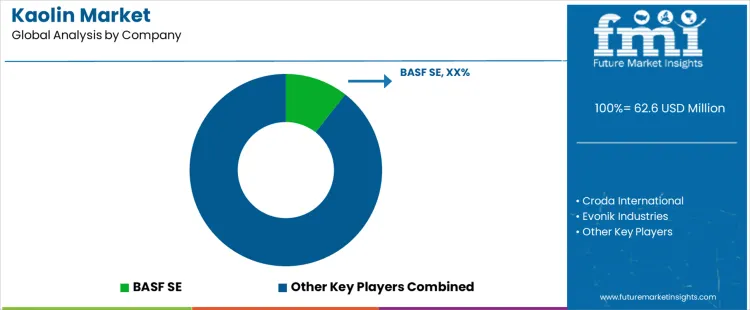
BASF SE holds a central processing and formulation facing role in the kaolin industry through refined mineral sourcing programs and multi region manufacturing across Europe North America and Asia. The company supplies cosmetic grade pharmaceutical grade and technical grade kaolin for use in skin care oral care coatings and specialty formulation systems. Croda International participates through dispersion technologies and surface treated clay systems used in regulated personal care and dermatology formulations. Evonik Industries supports demand through high purity carriers and functional mineral additives used in controlled application environments. Symrise with actives platforms associated with IFF and Givaudan supplies formulation compatible kaolin based systems for cosmetics skin care emulsions and sensory texture control where particle behavior guides supplier selection.
Dow and Ashland participate through downstream binder’s polymer systems and formulation matrices used to stabilize kaolin in coatings plastics rubber and specialty chemical products. Clariant supports regional demand across Europe Southeast Asia and the Middle East through formulation led buyer programs and distributor aligned supply networks. Seppic operates within regulated dermatology and cosmetic formulation environments where documentation depth and batch traceability define supplier access. Other suppliers serve localized demand through smaller scale clay beneficiation milling and toll processing models. These suppliers compete on particle size distribution moisture control impurity limits audit compliance and traceability rather than pricing leverage. Competitive positioning reflects access to consistent ore bodies beneficiation technology formulation support scope and regulatory file maintenance. Buyer preference favors suppliers with stable technical documentation multi region manufacturing coverage and validated long cycle supply continuity.
Key Players in the Kaolin Market
- BASF SE
- Croda International
- Evonik Industries
- Symrise (incl. IFF/Givaudan actives)
- Dow / Dow Inc.
- Ashland
- Clariant
- Seppic
- Others
Scope of the report
| Items | Values |
|---|---|
| Quantitative Units (2025) | USD million |
| End-Use Applications | Skin Care, Body Care, Hair Care, Sun Care, Color Cosmetics, Men’s Grooming, Baby & Kids Care, Dermocosmetic / Professional Care |
| Product Forms | Powder, Granules/Agglomerates, Flakes, Pellets/Prills, Liquid (Solution), Concentrate (High-active Liquid), Dispersion/Suspension, Emulsion, Paste, Gel, Wax / Solid Block, Oil |
| Regions Covered | Asia Pacific, Europe, North America, Latin America, Middle East & Africa |
| Countries Covered | China, Japan, South Korea, India, Australia & New Zealand, ASEAN, Germany, United Kingdom, France, Italy, Spain, Nordic, BENELUX, USA, Canada, Mexico, Brazil, Chile, Saudi Arabia, Turkey, South Africa, plus 40+ additional countries globally |
| Key Companies Profiled | BASF SE, Croda International, Evonik Industries, Symrise (incl. IFF/Givaudan actives), Dow Inc., Ashland, Clariant, Seppic, Lubrizol, Lonza, Inolex |
| Additional Attributes | Dollar by sales breakdown by region, country, end-use, and product form; global growth projections; multi-sector adoption (cosmetic, nutraceutical, functional food); extract bioactivity profiling; iodine and polyphenol standardization; contract harvesting; vertical integration; supply chain stability; regulatory compliance; sensory and bioavailability performance |
Kaolin Market Segmentation
End Use Application:
- Skin Care
- Body Care
- Hair Care
- Sun Care
- Color Cosmetics
- Men’s Grooming
- Baby & Kids Care
- Dermocosmetic / Professional Care
Product Form:
- Powder
- Granules / Agglomerates
- Flakes
- Pellets / Prills
- Liquid (Solution)
- Concentrate (High-active Liquid)
- Dispersion / Suspension
- Emulsion
- Paste
- Gel
- Wax / Solid Block
- Oil
Region
Asia Pacific
- China
- Japan
- South Korea
- India
- Australia & New Zealand
- ASEAN
- Rest of Asia Pacific
Europe
- Germany
- United Kingdom
- France
- Italy
- Spain
- Nordic
- BENELUX
- Rest of Europe
North America
- United States
- Canada
- Mexico
Latin America
- Brazil
- Chile
- Rest of Latin America
Middle East & Africa
- Kingdom of Saudi Arabia
- Other GCC Countries
- Turkey
- South Africa
- Other African Union
- Rest of Middle East & Africa
Frequently Asked Questions
How big is the kaolin market in 2025?
The global kaolin market is estimated to be valued at USD 62.6 million in 2025.
What will be the size of kaolin market in 2035?
The market size for the kaolin market is projected to reach USD 107.2 million by 2035.
How much will be the kaolin market growth between 2025 and 2035?
The kaolin market is expected to grow at a 5.5% CAGR between 2025 and 2035.
What are the key product types in the kaolin market?
The key product types in kaolin market are skin care, body care, hair care, sun care, color cosmetics, men’s grooming, baby & kids care and dermocosmetic / professional care.
Which product form segment to contribute significant share in the kaolin market in 2025?
In terms of product form , powder segment to command 17.8% share in the kaolin market in 2025.
Preview the report firsthand - request a free sample
Get SampleGet the brochure for pricing and purchase details.
Get PDFTable of Content
- Executive Summary
- Global Market Outlook
- Demand-side Trends
- Supply-side Trends
- Technology Roadmap Analysis
- Analysis and Recommendations
- Market Overview
- Market Coverage / Taxonomy
- Market Definition / Scope / Limitations
- Market Background
- Market Dynamics
- Drivers
- Restraints
- Opportunity
- Trends
- Scenario Forecast
- Demand in Optimistic Scenario
- Demand in Likely Scenario
- Demand in Conservative Scenario
- Opportunity Map Analysis
- Product Life Cycle Analysis
- Supply Chain Analysis
- Investment Feasibility Matrix
- Value Chain Analysis
- PESTLE and Porter’s Analysis
- Regulatory Landscape
- Regional Parent Market Outlook
- Production and Consumption Statistics
- Import and Export Statistics
- Market Dynamics
- Global Market Analysis 2020 to 2024 and Forecast, 2025 to 2035
- Historical Market Size Value (USD Million) Analysis, 2020 to 2024
- Current and Future Market Size Value (USD Million) Projections, 2025 to 2035
- Y-o-Y Growth Trend Analysis
- Absolute $ Opportunity Analysis
- Global Market Pricing Analysis 2020 to 2024 and Forecast 2025 to 2035
- Global Market Analysis 2020 to 2024 and Forecast 2025 to 2035, By End Use Application
- Introduction / Key Findings
- Historical Market Size Value (USD Million) Analysis By End Use Application , 2020 to 2024
- Current and Future Market Size Value (USD Million) Analysis and Forecast By End Use Application , 2025 to 2035
- Skin Care
- Body Care
- Hair Care
- Sun Care
- Color Cosmetics
- Men’s Grooming
- Baby & Kids Care
- Dermocosmetic / Professional Care
- Y-o-Y Growth Trend Analysis By End Use Application , 2020 to 2024
- Absolute $ Opportunity Analysis By End Use Application , 2025 to 2035
- Global Market Analysis 2020 to 2024 and Forecast 2025 to 2035, By Product Form
- Introduction / Key Findings
- Historical Market Size Value (USD Million) Analysis By Product Form, 2020 to 2024
- Current and Future Market Size Value (USD Million) Analysis and Forecast By Product Form, 2025 to 2035
- Powder
- Granules / Agglomerates
- Flakes
- Pellets / Prills
- Liquid (Solution)
- Concentrate (High-active Liquid)
- Dispersion / Suspension
- Emulsion
- Paste
- Gel
- Wax / Solid Block
- Y-o-Y Growth Trend Analysis By Product Form, 2020 to 2024
- Absolute $ Opportunity Analysis By Product Form, 2025 to 2035
- Global Market Analysis 2020 to 2024 and Forecast 2025 to 2035, By Region
- Introduction
- Historical Market Size Value (USD Million) Analysis By Region, 2020 to 2024
- Current Market Size Value (USD Million) Analysis and Forecast By Region, 2025 to 2035
- North America
- Latin America
- Western Europe
- Eastern Europe
- East Asia
- South Asia and Pacific
- Middle East & Africa
- Market Attractiveness Analysis By Region
- North America Market Analysis 2020 to 2024 and Forecast 2025 to 2035, By Country
- Historical Market Size Value (USD Million) Trend Analysis By Market Taxonomy, 2020 to 2024
- Market Size Value (USD Million) Forecast By Market Taxonomy, 2025 to 2035
- By Country
- USA
- Canada
- Mexico
- By End Use Application
- By Product Form
- By Country
- Market Attractiveness Analysis
- By Country
- By End Use Application
- By Product Form
- Key Takeaways
- Latin America Market Analysis 2020 to 2024 and Forecast 2025 to 2035, By Country
- Historical Market Size Value (USD Million) Trend Analysis By Market Taxonomy, 2020 to 2024
- Market Size Value (USD Million) Forecast By Market Taxonomy, 2025 to 2035
- By Country
- Brazil
- Chile
- Rest of Latin America
- By End Use Application
- By Product Form
- By Country
- Market Attractiveness Analysis
- By Country
- By End Use Application
- By Product Form
- Key Takeaways
- Western Europe Market Analysis 2020 to 2024 and Forecast 2025 to 2035, By Country
- Historical Market Size Value (USD Million) Trend Analysis By Market Taxonomy, 2020 to 2024
- Market Size Value (USD Million) Forecast By Market Taxonomy, 2025 to 2035
- By Country
- Germany
- UK
- Italy
- Spain
- France
- Nordic
- BENELUX
- Rest of Western Europe
- By End Use Application
- By Product Form
- By Country
- Market Attractiveness Analysis
- By Country
- By End Use Application
- By Product Form
- Key Takeaways
- Eastern Europe Market Analysis 2020 to 2024 and Forecast 2025 to 2035, By Country
- Historical Market Size Value (USD Million) Trend Analysis By Market Taxonomy, 2020 to 2024
- Market Size Value (USD Million) Forecast By Market Taxonomy, 2025 to 2035
- By Country
- Russia
- Poland
- Hungary
- Balkan & Baltic
- Rest of Eastern Europe
- By End Use Application
- By Product Form
- By Country
- Market Attractiveness Analysis
- By Country
- By End Use Application
- By Product Form
- Key Takeaways
- East Asia Market Analysis 2020 to 2024 and Forecast 2025 to 2035, By Country
- Historical Market Size Value (USD Million) Trend Analysis By Market Taxonomy, 2020 to 2024
- Market Size Value (USD Million) Forecast By Market Taxonomy, 2025 to 2035
- By Country
- China
- Japan
- South Korea
- By End Use Application
- By Product Form
- By Country
- Market Attractiveness Analysis
- By Country
- By End Use Application
- By Product Form
- Key Takeaways
- South Asia and Pacific Market Analysis 2020 to 2024 and Forecast 2025 to 2035, By Country
- Historical Market Size Value (USD Million) Trend Analysis By Market Taxonomy, 2020 to 2024
- Market Size Value (USD Million) Forecast By Market Taxonomy, 2025 to 2035
- By Country
- India
- ASEAN
- Australia & New Zealand
- Rest of South Asia and Pacific
- By End Use Application
- By Product Form
- By Country
- Market Attractiveness Analysis
- By Country
- By End Use Application
- By Product Form
- Key Takeaways
- Middle East & Africa Market Analysis 2020 to 2024 and Forecast 2025 to 2035, By Country
- Historical Market Size Value (USD Million) Trend Analysis By Market Taxonomy, 2020 to 2024
- Market Size Value (USD Million) Forecast By Market Taxonomy, 2025 to 2035
- By Country
- Kingdom of Saudi Arabia
- Other GCC Countries
- Turkiye
- South Africa
- Other African Union
- Rest of Middle East & Africa
- By End Use Application
- By Product Form
- By Country
- Market Attractiveness Analysis
- By Country
- By End Use Application
- By Product Form
- Key Takeaways
- Key Countries Market Analysis
- USA
- Pricing Analysis
- Market Share Analysis, 2024
- By End Use Application
- By Product Form
- Canada
- Pricing Analysis
- Market Share Analysis, 2024
- By End Use Application
- By Product Form
- Mexico
- Pricing Analysis
- Market Share Analysis, 2024
- By End Use Application
- By Product Form
- Brazil
- Pricing Analysis
- Market Share Analysis, 2024
- By End Use Application
- By Product Form
- Chile
- Pricing Analysis
- Market Share Analysis, 2024
- By End Use Application
- By Product Form
- Germany
- Pricing Analysis
- Market Share Analysis, 2024
- By End Use Application
- By Product Form
- UK
- Pricing Analysis
- Market Share Analysis, 2024
- By End Use Application
- By Product Form
- Italy
- Pricing Analysis
- Market Share Analysis, 2024
- By End Use Application
- By Product Form
- Spain
- Pricing Analysis
- Market Share Analysis, 2024
- By End Use Application
- By Product Form
- France
- Pricing Analysis
- Market Share Analysis, 2024
- By End Use Application
- By Product Form
- India
- Pricing Analysis
- Market Share Analysis, 2024
- By End Use Application
- By Product Form
- ASEAN
- Pricing Analysis
- Market Share Analysis, 2024
- By End Use Application
- By Product Form
- Australia & New Zealand
- Pricing Analysis
- Market Share Analysis, 2024
- By End Use Application
- By Product Form
- China
- Pricing Analysis
- Market Share Analysis, 2024
- By End Use Application
- By Product Form
- Japan
- Pricing Analysis
- Market Share Analysis, 2024
- By End Use Application
- By Product Form
- South Korea
- Pricing Analysis
- Market Share Analysis, 2024
- By End Use Application
- By Product Form
- Russia
- Pricing Analysis
- Market Share Analysis, 2024
- By End Use Application
- By Product Form
- Poland
- Pricing Analysis
- Market Share Analysis, 2024
- By End Use Application
- By Product Form
- Hungary
- Pricing Analysis
- Market Share Analysis, 2024
- By End Use Application
- By Product Form
- Kingdom of Saudi Arabia
- Pricing Analysis
- Market Share Analysis, 2024
- By End Use Application
- By Product Form
- Turkiye
- Pricing Analysis
- Market Share Analysis, 2024
- By End Use Application
- By Product Form
- South Africa
- Pricing Analysis
- Market Share Analysis, 2024
- By End Use Application
- By Product Form
- USA
- Market Structure Analysis
- Competition Dashboard
- Competition Benchmarking
- Market Share Analysis of Top Players
- By Regional
- By End Use Application
- By Product Form
- Competition Analysis
- Competition Deep Dive
- BASF SE
- Overview
- Product Portfolio
- Profitability by Market Segments (Product/Age /Sales Channel/Region)
- Sales Footprint
- Strategy Overview
- Marketing Strategy
- Product Strategy
- Channel Strategy
- Croda International
- Evonik Industries
- Symrise (incl. IFF/Givaudan actives)
- Dow / Dow Inc.
- Ashland
- Clariant
- Seppic
- Others
- BASF SE
- Competition Deep Dive
- Assumptions & Acronyms Used
- Research Methodology


