

- Industry Size (2026)
- USD 0.9 Bn
- Forecast (2036)
- USD 4.2 Bn
- CAGR (2026 to 2036)
- 17.4%
Blockchain-Traced Ethical Cosmetics Sourcing Market Size, Market Forecast and Outlook By FMI
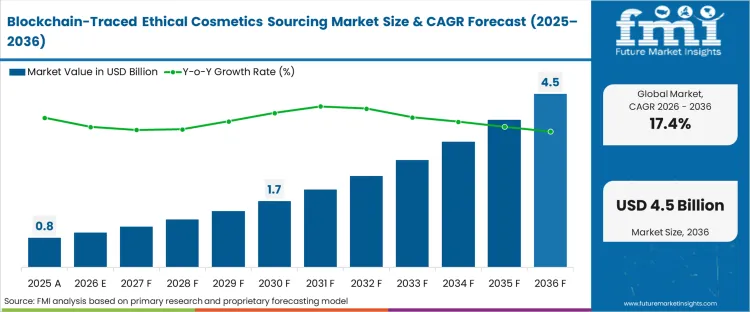
The blockchain-traced ethical cosmetics sourcing market was valued at USD 0.7 billion in 2025. The sector is poised to cross USD 0.9 billion in 2026 at a CAGR of 17.4% during the forecast period. Increasing investments in supply chain transparency technologies are expected to support expansion and reach market valuation to USD 4.2 billion through 2036 as luxury conglomerates mandate immutable digital provenance for ESG compliance before onboarding any botanical or mineral supplier.
Procurement leaders at global beauty brands implementing blockchain‑enabled cosmetics sourcing are increasingly confronted with a strategic choice: either build parallel traceability infrastructures or require their upstream agricultural suppliers to adopt unified ledger systems. Postponing this integration risks eroding competitiveness, particularly in premium retail channels where digital product passports for cosmetic packaging are rapidly becoming mandatory to substantiate ethical and sustainability claims.
The primary barrier to establishing transparent blockchain‑based beauty supply chains does not stem from consumer readiness, but from resolving the digital capability gap at the agricultural tier. In practice, the critical enabler for this transition is the standardization of API interfaces connecting legacy ERP platforms with distributed ledger technologies. Once these integrations evolve from bespoke implementations to standardized, automated workflows, the cost of validating ingredient provenance decreases significantly.
Summary of Blockchain-Traced Ethical Cosmetics Sourcing Market
- Blockchain-Traced Ethical Cosmetics Sourcing Market Definition
- This market provides the cryptographic software infrastructure required to authenticate the origin, ethical harvesting, and transit of cosmetic raw materials. It replaces manual compliance audits with automated, immutable ethical cosmetics supply chain traceability.
- Demand Drivers in the Market
- Impending regulatory frameworks regarding extended producer responsibility obligate compliance directors to secure immutable proof of origin for imported botanicals.
- Margin erosion from sophisticated counterfeit operations pushes brand protection officers to deploy cryptographic validation layers at the unit level.
- Luxury retail mandates compel procurement heads to demand node-level transparency from tier-3 agricultural suppliers to maintain shelf space.
- Key Segments Analyzed in the FMI Report
- Public blockchain platforms: Public blockchain platforms are expected to account for 41.2% share in 2026, driven by retail brands requiring independent, consumer-facing verifiability without proprietary firewalls.
- Plant-derived ingredients: Plant-derived ingredients are anticipated to hold 38.7% share in 2026, reflecting the acute vulnerability of botanical supply chains to undocumented substitution.
- Ingredient provenance verification: Ingredient provenance verification is projected to grab 36.5% share in 2026, serving as the foundational use case before expanding into broader ESG metrics.
- Cloud-based platforms: Cloud-based platforms are estimated to record 52.3% share in 2026, lowering the capital expenditure barrier for mid-market cosmetics brands.
- Cosmetics manufacturers: Cosmetics manufacturers are poised to capture 44.6% share in 2026, absorbing the primary cost of ledger integration to protect brand equity.
- China: China is set to register a CAGR of 19.4%, propelled by e-commerce platforms mandating immutable provenance layers to protect luxury import margins.
- Analyst Opinion at FMI
- Rahul Pandita, Principal Analyst, Consumer Goods, at FMI, states, "Brands pushing ledger mandates expect tier-3 agricultural suppliers to absorb the data entry costs while the brand harvests the premium pricing. This incentive misalignment is the exact reason adoption stalls at the raw material level. Until manufacturers subsidize the integration software for their agricultural base, the ledger remains an incomplete picture."
- Strategic Implications / Executive Takeaways
- Supply chain directors exploring blockchain traceability for cosmetics brands must subsidize API connections for their agricultural partners to achieve unbroken traceability before 2030.
- Brand protection officers should integrate consumer-facing ledger readouts into physical packaging to capture immediate return on transparency investments.
- ESG compliance leads face mounting pressure to transition from retrospective paper audits to real-time smart contract verification.
- Methodology
- Primary Research: Chief supply chain officers, ESG compliance directors, and blockchain architecture leads at tier-1 cosmetics manufacturers.
- Desk Research: Technical white papers from enterprise ledger consortiums, digital product passport regulatory frameworks, and smart-contract deployment case studies.
- Market-Sizing and Forecasting: Baseline anchored to the annual software licensing revenue and API integration fees generated by traceability providers within the beauty vertical.
- Data Validation and Update Cycle: Projections triangulated against enterprise IT procurement budgets allocated specifically for supply chain transparency initiatives.
Beauty brands that achieve automated, real‑time node updates will be able to conduct comprehensive formulation audits instantaneously, eliminating the need for manual reconciliation and positioning themselves ahead of the industry in compliance, transparency, and retailer expectations.
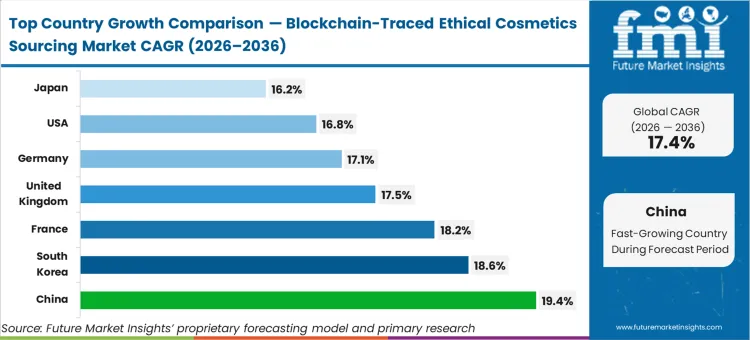
China (19.4%), South Korea (18.6%), France (18.2%), United Kingdom (17.5%), Germany (17.1%), United States (16.8%), and Japan (16.2%) define the geographic expansion trajectory. The Chinese sector is projected to register the most aggressive expansion, followed closely by South Korean formulation hubs. French luxury conglomerates are estimated to advance mature ledger adoptions, while United States manufacturers track slightly below the global average due to earlier pilot fatigue. This divergence reflects how distinct regional pressures from combating premium counterfeits in Asia to substantiating luxury heritage in Europe dictate ledger investments.
Blockchain-Traced Ethical Cosmetics Sourcing Market Key Takeaways
| Metric | Details |
|---|---|
| Industry Size (2026) | USD 0.9 billion |
| Industry Value (2036) | USD 4.2 billion |
| CAGR (2026–2036) | 17.4% |
Source: Future Market Insights (FMI) analysis, based on proprietary forecasting model and primary research
Blockchain-Traced Ethical Cosmetics Sourcing Market Definition
Addressing definition of blockchain traceability in cosmetics, this market encompasses the software platforms, distributed ledger architectures, and integration services explicitly designed to verify the provenance of beauty formulations. It functions as an immutable digital chain of custody, linking raw agricultural or mineral harvesting directly to final retail packaging. This structure fundamentally separates cryptographic supply chain validation from traditional, paper-based certification auditing.
Blockchain-Traced Ethical Cosmetics Sourcing Market Inclusions
This market covers public, private, and hybrid ledger deployments used for cosmetic ingredient blockchain tracking, smart-contract compliance verification, and ESG reporting in the beauty sector. It includes cloud-based tracking platforms, decentralized anti-counterfeit cosmetic packaging applications, and the API middleware required to connect agricultural data points with brand-level procurement systems.
Blockchain-Traced Ethical Cosmetics Sourcing Market Exclusions
General-purpose enterprise resource planning software without cryptographic ledger capabilities is strictly excluded. Standalone financial cryptocurrency transactions, agricultural hardware sensors not directly integrated into a continuous provenance ledger, and generic cosmetic formulation services fall outside this scope. These exclusions maintain the boundary between standard digital procurement and true immutable traceability.
Blockchain-Traced Ethical Cosmetics Sourcing Market Research Methodology
- Primary Research: Chief supply chain officers, ESG compliance directors, and blockchain architecture leads at tier-1 cosmetics manufacturers.
- Desk Research: Technical white papers from enterprise ledger consortiums, digital product passport regulatory frameworks, and smart-contract deployment case studies.
- Market-Sizing and Forecasting: Baseline anchored to the annual software licensing revenue and API integration fees generated by traceability providers within the beauty vertical.
- Data Validation and Update Cycle: Projections triangulated against enterprise IT procurement budgets allocated specifically for supply chain transparency initiatives.
Segmental Analysis
Blockchain-Traced Ethical Cosmetics Sourcing Market Analysis by Technology Layer
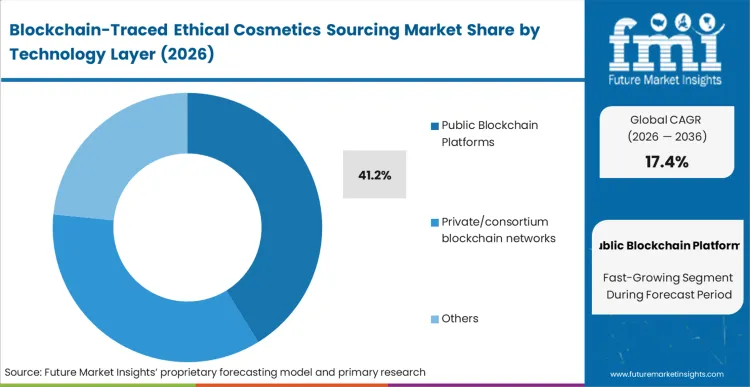
The factor driving the public blockchain platforms segment revenue share of 41.2% in 2026 is due to architectural independence from legacy corporate firewalls. According to FMI's estimates, luxury brands recognize that proprietary consortium ledgers lack the decentralized credibility required to convince skeptical buyers of ethical claims. By utilizing a public cosmetics supply chain transparency platform, procurement directors can export unalterable track and trace solutions directly to consumer smartphones without building bespoke viewing portals. This transparent verifiability ensures that once an ingredient is logged at the farm level, no intermediary can silently alter its certified status. Brands that mistakenly opt for closed networks discover that their traceability efforts are dismissed as internal marketing exercises rather than immutable proof.
- Decentralized credibility: Public ledgers eliminate single points of failure in data hosting. Compliance directors utilizing this architecture bypass accusations of corporate greenwashing by ensuring data permanence.
- Interoperable bridges: Standardized public protocols allow disparate agricultural suppliers to connect via open APIs. Brands lower the onboarding friction for rural cooperatives lacking advanced enterprise software.
- Consumer access: Open read-access enables instant provenance verification via mobile devices. End users gain immediate visibility into the exact journey of their purchased formulation.
Blockchain-Traced Ethical Cosmetics Sourcing Market Analysis by Ingredient Source Tracking
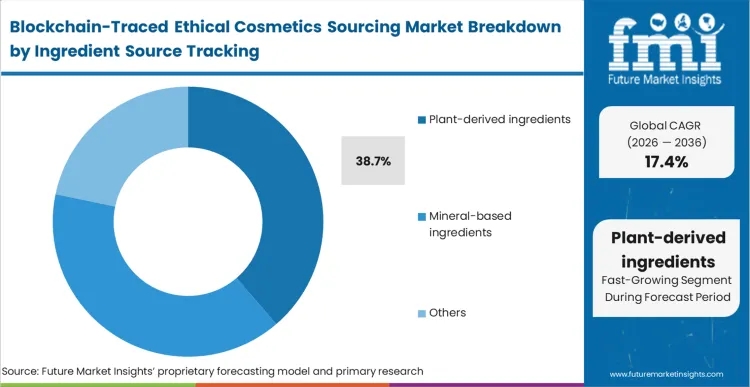
Legacy paper-based certification processes simply fail to capture the multi-stage complexity of botanical supply chains, fundamentally driving the transition toward cryptographic ledgers. Plant-derived ingredients segment is projected to secure a 38.7% share by 2026, as these raw materials represent the highest risk for undocumented dilution or substitution during processing. FMI analysts opine that formulators sourcing rare essential oils or vegan cosmetics inputs face severe brand damage if adulteration occurs downstream. By anchoring each batch to an ethical ingredient sourcing blockchain hash at the harvest site, brands lock in the origin identity for organic personal care formulations. Formulators who cling to retrospective blockchain ingredient certification cosmetics audits inevitably discover adulterated botanicals only after retail distribution, triggering catastrophic recalls.
- Harvest anchoring: Cryptographic hashes bind physical botanical yields to digital tokens at the farm gate. Procurement teams eliminate the vulnerability of mid-transit substitution.
- Dilution prevention: Smart contracts monitor volume metrics between extraction and refinement phases. Processors attempting to mix conventional oils with certified organic batches are flagged automatically.
- Yield verification: Satellite and yield data integrate with the ledger to confirm harvest realities. Brands ensure their sustainability narratives match actual agricultural output.
Blockchain-Traced Ethical Cosmetics Sourcing Market Analysis by Application
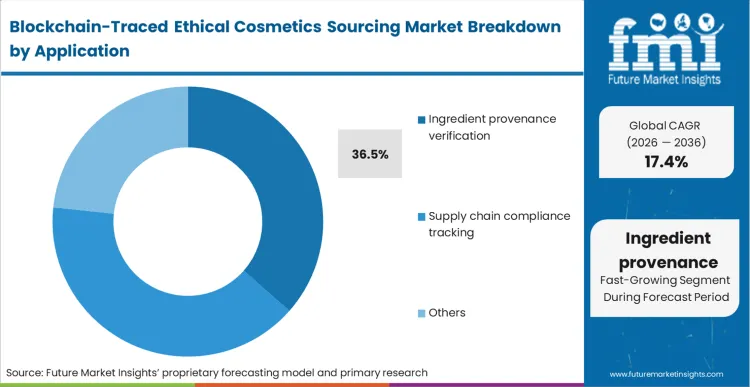
The fundamental tension in modern cosmetic supply chains pits the marketing desire for transparency against the operational reality of fragmented supplier networks. Ingredient provenance verification emerges as the dominant application, anticipating a 36.5% share in 2026, because it directly resolves this conflict. As per FMI's projection, ESG teams prioritize cosmetic ingredient provenance verification above broader tracking functions to definitively prove their sustainable claims substantiation to retail partners. This application provides a binary answer to origin questions, delivering ultimate blockchain transparency in beauty products and stripping away the ambiguity of multi-tiered broker networks. Operations managers delaying this implementation operate completely blind to their tier-2 and tier-3 sourcing realities.
- Origin validation: Digital tokens provide an unbroken chronological map from soil to shelf. Brand protection officers isolate exactly where ethical sourcing protocols break down.
- Broker bypass: Immutable ledgers expose the actual agricultural source rather than stopping at the primary distributor. Companies secure negotiating leverage by understanding their true supply base.
- Claim defense: Cryptographic proof serves as an absolute defense against regulatory greenwashing audits. Legal departments drastically reduce their compliance exposure.
Blockchain-Traced Ethical Cosmetics Sourcing Market Analysis by Deployment Model
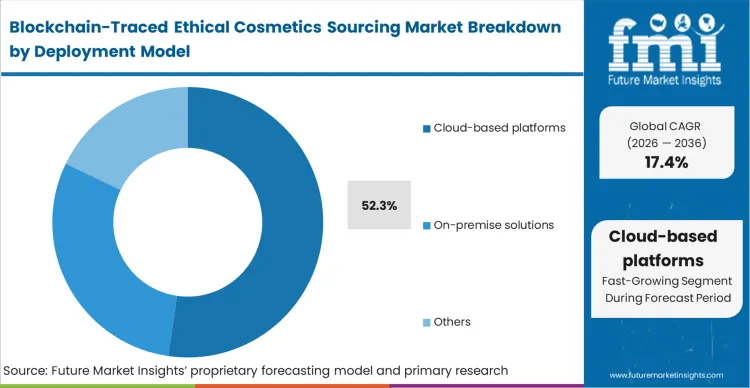
Chief information officers across the beauty sector face an immediate architectural decision: maintain localized traceability servers or migrate to distributed infrastructure. Cloud-based platforms is a dominate choice, poised to hold 52.3% share of the market in 2026. Based on FMI's assessment, cloud architecture drastically reduces the capital expenditure required to bring rural organic cosmetics suppliers onto a unified blockchain cosmetic ingredient tracking system. Instead of demanding that agricultural cooperatives install complex node hardware, brands can provide simple, browser-based access. Manufacturers attempting to force on-premise ledger solutions onto their agricultural partners simply fail to achieve the critical mass of participation required for true traceability.
- Low-friction access: Browser-based entry portals require minimal hardware investment at the extraction site. Agricultural co-ops upload yield data using standard mobile networks.
- Scalable storage: Distributed cloud environments expand automatically as transaction volumes surge. IT departments avoid the continuous hardware upgrades associated with on-premise networks.
- Ecosystem integration: Cloud APIs natively connect with existing cloud ERP systems. Supply chain directors achieve unified visibility without heavy custom coding.
Blockchain-Traced Ethical Cosmetics Sourcing Market Analysis by End User
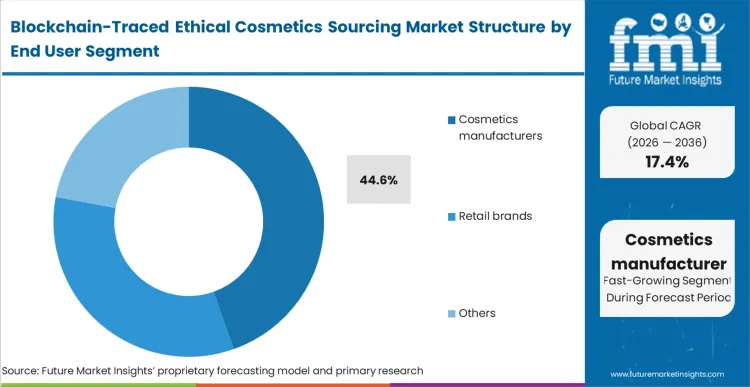
The trajectory of traceability shifts the financial burden squarely onto the entities with the most brand equity to lose. Cosmetics manufacturers lead end-user adoption with an anticipated 44.6% share in 2026. In FMI's view, these manufacturers act as the central node, compelling both their upstream suppliers and downstream retail partners to interface with their chosen blockchain technology platforms. The manufacturer absorbs the software licensing costs because they recognize that a single sourcing scandal destroys years of consumer trust. Formulation houses that rely on supplier self-reporting operate with an unacceptable level of operational risk in an increasingly scrutinized market.
- Network orchestration: Manufacturers dictate the ledger standard for their entire supplier ecosystem. Procurement teams centralize compliance data into a single, verifiable dashboard.
- Risk absorption: The central brand funds the integration architecture. Mid-sized suppliers gain access to enterprise-grade traceability without bearing the capital cost.
- Retail alignment: Immutable provenance data satisfies the stringent onboarding requirements of luxury department stores. Manufacturers secure their physical retail presence through digital transparency.
Blockchain-Traced Ethical Cosmetics Sourcing Market Drivers, Restraints, and Opportunities
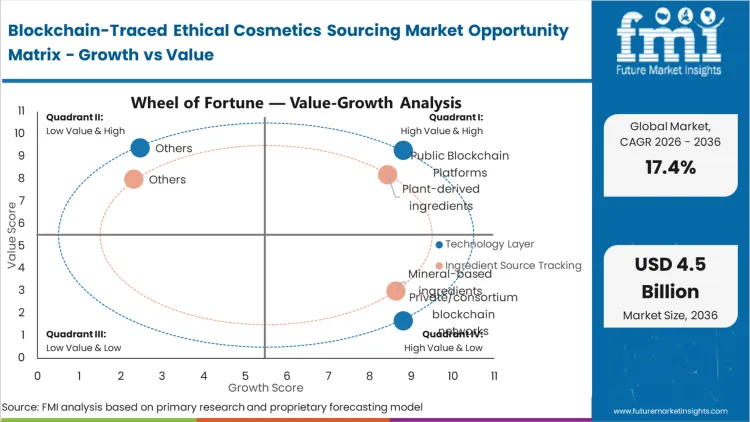
Impending extended producer responsibility mandates in major western markets compel ESG compliance directors to secure immutable proof of origin for every botanical import. This pressure forces brands to abandon fragmented, paper-based auditing in favor of blockchain ESG compliance cosmetics frameworks that map the exact supply chain journey. Brands that fail to implement continuous digital validation face immediate disqualification from premium retail shelves and severe regulatory penalties regarding unverified upcycled cosmetic ingredients.
The digital capability gap at the tier-3 and tier-4 agricultural level acts as a severe friction, slowing widespread adoption. Small-scale farmers and rural cooperatives fundamentally lack the digital infrastructure or reliable connectivity to consistently input verified ledger nodes. While brands deploy sophisticated cloud portals, the failure to physically bridge this last-mile data entry problem leaves the blockchain relying on delayed, batch-processed updates, undermining the promise of real-time traceability.
Opportunities in the Blockchain-Traced Ethical Cosmetics Sourcing Market
- Automated smart contracting: API standardization enables smart contracts to execute supplier payments automatically upon ledger verification. Financial controllers eliminate invoicing delays by tying capital release directly to cryptographic delivery confirmation.
- NFC-enabled packaging: The integration of near-field communication chips allows physical products to interface directly with the ledger. Brand managers deploying anti-counterfeit NFC packaging turn passive bottles into interactive digital portals, advancing blockchain sustainability cosmetics messaging to end consumers.
- Fractionalized ingredient trading: Immutable provenance opens the door for secure, secondary markets of certified raw materials. Procurement heads can confidently purchase excess premium botanical yields from other verified manufacturers.
Regional Analysis
Based on the regional analysis, the Blockchain-Traced Ethical Cosmetics Sourcing Market is segmented into North America, Europe, Asia Pacific, and other key territories across 40 plus countries.
.webp "Top Country Growth Comparison Blockchain Traced Ethical Cosmetics Sourcing Market Cagr (2026 2036)")
| Country | CAGR (2026 to 2036) |
|---|---|
| China | 19.4% |
| South Korea | 18.6% |
| France | 18.2% |
| United Kingdom | 17.5% |
| Germany | 17.1% |
| United States | 16.8% |
| Japan | 16.2% |
Source: Future Market Insights (FMI) analysis, based on proprietary forecasting model and primary research
Asia Pacific Blockchain-Traced Ethical Cosmetics Sourcing Market Analysis
Rampant counterfeiting concerns across the premium beauty sector heavily dictate the adoption of provenance ledgers in Asian markets. E-commerce platforms and import authorities mandate immutable validation layers to protect luxury margins from sophisticated adulteration rings. Based on FMI's estimates, this environment forces regional cosmetics manufacturers to prioritize cryptographic product tracking over broad sustainability messaging. The focus here remains intensely transactional: securing the supply chain from the port to the final digital point of sale.
- China: Rampant substitution risks within premium beauty e-commerce compel major platforms to demand unbroken cryptographic validation for luxury imports. Brand protection officers utilize these ledgers as an absolute defense against sophisticated domestic counterfeiting syndicates, accelerating blockchain cosmetic ingredient sourcing China deployments. China is projected to witness growth at a CAGR of 19.4% as brands successfully executing this digital lockdown secure preferred algorithmic placement on the country's dominant retail applications.
- South Korea: Export‑oriented formulation hubs in the country are under increasing pressure to validate the complex botanical claims embedded within blockchain‑enabled beauty supply chains. Procurement teams must deliver immutable sourcing evidence for specialized extracts, strengthening demand and trend analysis of natural cosmetics in Korea natural‑cosmetics segment, which is projected to expand at 18.6% CAGR. Key contributors to this growth include authentication of botanical inputs, export‑market compliance requirements, and competitive differentiation through digital audit trails. This elevated transparency standard positions Korean contract manufacturers ahead of regional competitors without digital audit frameworks.
- Japan: The mature personal‑care ecosystem in Japan is adopting blockchain technologies to verify traditional domestic agricultural inputs with greater precision. Operations managers emphasize deep integration with localized farming cooperatives, supporting a projected 16.2% CAGR for the sector. The outcome is a synchronized data‑exchange environment that minimizes administrative friction between rural suppliers and urban laboratories. Growth is driven by verification of heritage agricultural materials, cooperative‑linked supply‑chain integration, and efficiency gains from streamlined data exchange.
FMI's report includes extensive analysis of emerging supply chains in Southeast Asia and Oceania, highlighting momentum in the ASEAN organic cosmetics space. The reality across these adjacent territories reveals a rapid deployment of mobile-first ledger interfaces, bypassing legacy desktop ERP infrastructure entirely.
Europe Blockchain-Traced Ethical Cosmetics Sourcing Market Analysis
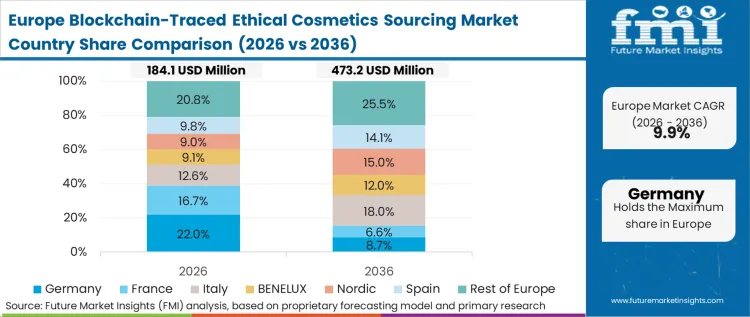
Impending digital product passport regulations and aggressive extended producer responsibility frameworks fundamentally shape the Europe trajectory. Regulatory bodies demand verifiable proof that raw materials meet stringent ecological and labor standards before entering the continent. FMI analysts opine that luxury conglomerates centered in this region utilize consortium ledgers to aggressively dictate compliance terms to their global suppliers. For European actors, the blockchain is a non-negotiable compliance tool disguised as a consumer transparency initiative.
- France: The intense concentration of luxury heritage groups in France ensures that luxury cosmetics blockchain authentication deployment occurs via powerful, top-down consortium mandates. Supply chain directors at these conglomerates force their entire global supplier base onto unified platforms like the Aura network, defining the blockchain cosmetics supply chain France ecosystem. The France market is forecast to register a CAGR of 18.2%, as these luxury groups standardize their digital demands, the rest of the European cosmetic ecosystem will be forced to align with this established architectural baseline.
- United Kingdom: Post‑Brexit procurement realignment is driving UK natural cosmetics brands to intensify audits of independent supply chains, with ethical compliance teams requiring definitive origin validation to navigate newly established import‑tariff structures. The market is projected to advance at 17.5% CAGR, supported by accelerated cloud‑based traceability adoption among mid‑sized British brands. Growth reflects three principal drivers: rigorous origin‑verification demands, tariff‑related supply‑chain restructuring, and the rapid digitalization pace of mid‑market operators.
- Germany: Strict national due‑diligence regulations expose domestic cosmetic formulators to substantial financial risk linked to undocumented labor or environmental violations within upstream supplier tiers. Legal teams increasingly rely on cryptographic ledgers to establish defensible transparency frameworks, enabling manufacturers to protect margins and secure exclusive contracts with tightly regulated European pharmacy retailers. Revenue expansion at 17.1% CAGR is shaped by compliance‑driven documentation mandates, penalty‑avoidance incentives, and competitive gains from enhanced traceability.
FMI's report includes secondary data regarding Mediterranean botanical extraction zones. Across these agricultural hubs, local processors are increasingly using ledger compliance to justify premium commodity pricing to northern European buyers.
North America Blockchain-Traced Ethical Cosmetics Sourcing Market Analysis
Capital allocation strategies heavily influence the adoption curve across North American formulation networks. Venture-backed clean beauty brands aggressively deploy blockchain tracing to justify premium retail pricing and secure distinct valuation multiples during acquisition. According to FMI's estimates, this environment treats provenance not purely as a compliance exercise, but as a direct driver of brand equity. The underlying architecture prioritizes scalable cloud integration that connects seamlessly with digital marketing ecosystems.
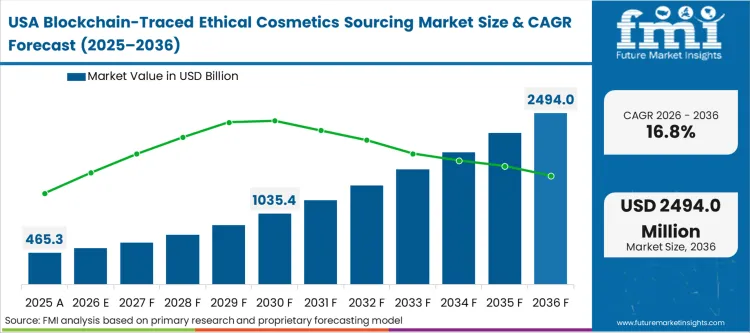
- United States: In the United States, margin‑protection imperatives are directing major personal‑care corporations toward selective API‑based traceability systems that monitor only the most valuable or reputationally sensitive active ingredients. Procurement groups emphasize safeguarding the chain of custody for high‑risk botanicals while minimizing system load associated with low‑value inputs. The sector’s anticipated 16.8% CAGR is driven by strategic focus on high‑risk ingredient oversight, cost‑efficient API integration, and targeted transparency initiatives.
FMI's report includes evaluation of Canadian raw material extraction markets. These northern supply corridors are actively testing smart contract deployments to automate cross-border compliance documentation for specialized marine derivatives.
Competitive Aligners for Market Players
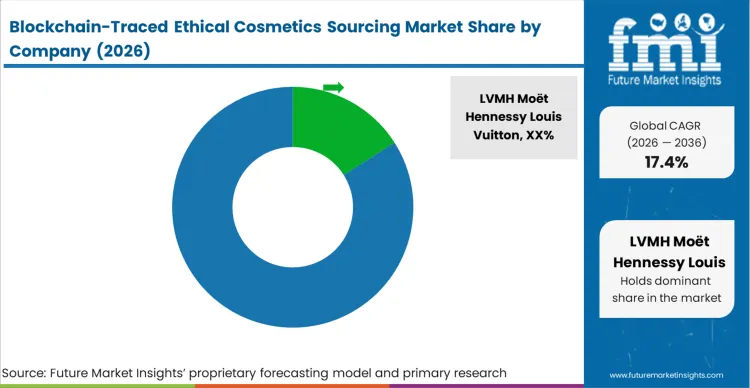
The reality of the blockchain cosmetics sector reveals deep concentration at the platform level, driven by the intense capital requirements of establishing secure, interoperable ledgers. Luxury conglomerates like LVMH have essentially orchestrated the competitive environment by establishing consortiums that dictate the standard. Buyers evaluating the best blockchain traceability platform cosmetics do not select vendors based on raw cryptographic speed; they choose based on existing network density. When a platform like Provenance or Everledger already hosts hundreds of validated agricultural suppliers, brands will default to that network rather than bearing the cost of onboarding their suppliers onto a pristine, empty ledger.
Legacy software incumbents possess a distinct architectural advantage over emerging cosmetics traceability technology providers that challengers struggle to overcome. Companies like SAP natively understand the complexities of enterprise resource planning, allowing them to embed blockchain validation directly into the existing procurement workflows that cosmetics manufacturers already use. A challenger entering this space cannot simply build a better track and trace packaging dashboard; they must build the complex middleware that translates raw agricultural data into enterprise-grade compliance formats. This integration capability separates the scalable platforms from isolated pilot projects.
Looking toward 2036, the tension centers on data ownership between the centralized brands and the decentralized agricultural suppliers. As tier-1 cosmetics manufacturers push for absolute visibility, massive farming cooperatives are resisting localized lock-in, demanding portable digital identities that they can present to multiple competing buyers. The market will see a slow fragmentation of the user interface layer, even as the underlying cryptographic protocols consolidate into a few universally accepted standards, forcing vendors to compete purely on analytical insights rather than basic traceability.
Key Players in Blockchain-Traced Ethical Cosmetics Sourcing Market
- LVMH Moët Hennessy Louis Vuitton
- IBM
- Provenance
- VeChain
- Aura Blockchain Consortium
- SAP
- Everledger
Scope of the Report
| Metric | Value |
|---|---|
| Quantitative Units | USD 0.9 billion to USD 4.2 billion, at a CAGR of 17.4% |
| Market Definition | This market provides the cryptographic software infrastructure required to authenticate the origin, ethical harvesting, and transit of cosmetic raw materials. |
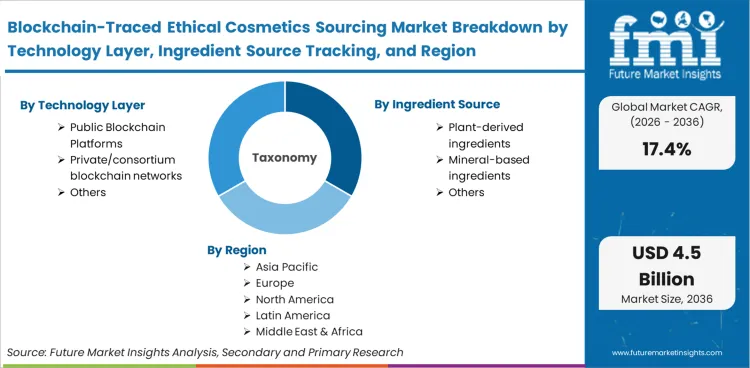
| Technology Layer Segmentation | Public blockchain platforms, Private/consortium blockchain networks, Hybrid blockchain architecture, Smart-contract verification systems |
| Ingredient Source Tracking Segmentation | Plant-derived ingredients, Mineral-based ingredients, Biotechnology-derived ingredients, Marine-derived ingredients |
| Application Segmentation | Ingredient provenance verification, Supply chain compliance tracking, Sustainability certification verification, Consumer transparency applications |
| Deployment Model Segmentation | Cloud-based platforms, On-premise solutions, API-based integration platforms |
| End User Segmentation | Cosmetics manufacturers, Ingredient suppliers, Retail brands, Third-party certification bodies |
| Regions Covered | North America, Europe, Asia Pacific |
| Countries Covered | China, South Korea, France, United Kingdom, Germany, United States, Japan, and 40 plus countries |
| Key Companies Profiled | LVMH Moët Hennessy Louis Vuitton, IBM, Provenance, VeChain, Aura Blockchain Consortium, SAP, Everledger |
| Forecast Period | 2026 to 2036 |
| Approach | Research involved extensive interviews with chief supply chain officers and ESG compliance directors. Baseline metrics anchored to annual software licensing and API integration fees. Forecasts validated against enterprise IT procurement budgets. |
Source: Future Market Insights (FMI) analysis, based on proprietary forecasting model and primary research
Blockchain-Traced Ethical Cosmetics Sourcing Market Analysis by Segments
-
Technology Layer:
- Public blockchain platforms
- Private/consortium blockchain networks
- Hybrid blockchain architecture
- Smart-contract verification systems
-
Ingredient Source Tracking:
- Plant-derived ingredients
- Mineral-based ingredients
- Biotechnology-derived ingredients
- Marine-derived ingredients
-
Application:
- Ingredient provenance verification
- Supply chain compliance tracking
- Sustainability certification verification
- Consumer transparency applications
-
Deployment Model:
- Cloud-based platforms
- On-premise solutions
- API-based integration platforms
-
End User:
- Cosmetics manufacturers
- Ingredient suppliers
- Retail brands
- Third-party certification bodies
-
Region:
- North America
- United States
- Canada
- Europe
- Germany
- United Kingdom
- France
- Italy
- Spain
- Asia Pacific
- China
- Japan
- South Korea
- Taiwan
- Singapore
- Latin America
- Brazil
- Mexico
- Argentina
- Middle East & Africa
- GCC Countries
- South Africa
- Israel
- Rest of Middle East & Africa
- North America
Bibliography
- Liu, X., & Dawod, A. Y. (2025, August). Exploring the role of blockchain technology in enhancing product quality perception and purchase behavior in cross-border e-commerce cosmetics. Journal of Business and Management Studies.
- Liu, X. (2025, October). When technology signals trust: Blockchain vs. traditional traceability labels in cosmetics supply chains. Information.
- Pise, R., Patil, S., Shinde, S., & Gavkare, S. (2024, March). Decentralizing the cosmetic supply chain with Hyperledger Fabric blockchain architecture. Proceedings of the International Conference on Blockchain and Distributed Systems Security.
- Le, M. T. H., et al. (2024, May). Fostering product quality and brand trust through blockchain-enabled traceability labels. Journal of Retailing and Consumer Services.
- Jauhola, A. (2025, December). Artificial intelligence and blockchain integration for sustainable supply chains in the cosmetics industry. Aalto University Research Publications.
This bibliography is provided for reader reference. The full FMI report contains the complete reference list with primary source documentation.
This Report Addresses
- Market intelligence to support strategic decision making across public blockchain platforms, private networks, and smart-contract verification systems.
- Market size estimation and 10-year revenue forecasts from 2026 to 2036, supported by annual software licensing revenue models within the beauty vertical.
- Growth opportunity mapping across cloud-based platforms and API-based integration models with emphasis on the standardization of API bridges between legacy ERPs.
- Segment and regional revenue forecasts covering plant-derived and mineral-based ingredients across extended producer responsibility frameworks in European markets.
- Competition strategy assessment including network density advantages, API middleware integration capabilities, and legacy ERP interoperability.
- Software development tracking including decentralized architecture, cryptographic hashing, node-level transparency, and automated smart contracting.
- Market access analysis covering digital product passport regulations, European compliance frameworks, and Chinese e-commerce validation standards.
- Market report delivery in PDF, Excel, PPT, and interactive dashboard formats for executive strategy, ESG compliance planning, and operational benchmarking use.
Frequently Asked Questions
What is the blockchain traceability market size cosmetics sector expects in 2026?
The sector reaches a valuation of USD 0.9 billion in 2026. This metric reflects the aggressive baseline spending by luxury manufacturers actively replacing paper audits with cryptographic infrastructure.
What does the blockchain cosmetics market forecast indicate for 2036?
The total opportunity scales to USD 4.2 billion by the end of the forecast. Sustained investment carries this valuation as digital product passports transition from premium marketing tools to mandatory customs requirements.
What CAGR is projected?
A compound annual growth rate of 17.4% is expected during the forecast period. This aggressive rate signals the rapid, forced migration of tier-3 agricultural suppliers onto unified ledger platforms orchestrated by central cosmetic brands.
Which technology layer segment leads?
Public blockchain platforms lead the technology layer. They provide the necessary decentralized credibility that closed, proprietary networks lack, allowing brands to export unalterable supply chain records directly to consumer smartphones without accusations of corporate greenwashing.
Which ingredient source tracking segment leads?
Plant-derived ingredients dominate the source tracking dimensions. Botanical supply chains represent the highest risk for undocumented substitution during processing, forcing procurement teams to anchor physical yields to digital hashes immediately at the farm gate.
Which deployment model segment leads?
Cloud-based platforms capture the majority of deployment share. Browser-based cloud architecture drastically reduces the hardware capital expenditure required to bring rural agricultural cooperatives onto the ledger, removing a major integration friction point.
Why beauty brands use blockchain sourcing?
Impending extended producer responsibility mandates in western markets compel ESG directors to secure immutable origin proof. Brands cannot risk the severe retail and regulatory penalties associated with undocumented or substituted raw materials, utilizing the blockchain as an absolute defense.
What is the primary restraint?
The digital capability gap at the tier-3 agricultural level severely slows seamless adoption. Small-scale farmers lack the infrastructure to input verified ledger nodes, forcing brands to rely on delayed, batch-processed updates rather than real-time tracking.
Which countries lead blockchain adoption in beauty supply chains?
China expands aggressively at a 19.4% CAGR, outpacing South Korea's 18.6%. The Chinese trajectory is entirely dictated by the immediate need to combat sophisticated counterfeiting on luxury e-commerce platforms, whereas Korean growth relies on substantiating botanical export claims.
How do digital product passports reshape the European sourcing landscape?
Pending passport regulations force European brands to prove ecological compliance before botanicals clear customs. This regulatory reality transforms the blockchain from an optional transparency exercise into a strict legal necessity for market access.
Why do luxury consortiums dominate the competitive structure?
Conglomerates like LVMH utilize consortium ledgers to dictate the digital standard for their massive supplier networks. Mid-tier brands simply adopt these established networks rather than building custom solutions because the network density of suppliers is already present.
How does smart contract automation impact formulation costs?
Standardized APIs allow smart contracts to release supplier payments the moment a batch clears cryptographic verification. This automation eliminates complex invoice reconciliation, lowering the administrative overhead for both the rural cooperative and the brand.
What role do cosmetics manufacturers play in ledger adoption?
Manufacturers absorb the primary software licensing and API integration costs. They recognize that funding the infrastructure for their upstream suppliers is significantly cheaper than surviving a catastrophic public sourcing scandal.
Why are on-premise solutions losing market share?
Forcing rural extraction facilities to install localized server architecture creates insurmountable onboarding barriers. Supply chain directors pivot to cloud portals precisely because they demand zero hardware investment from the agricultural partner.
Evaluating blockchain vs traditional supply chain tracking cosmetics, what is the core difference?
Traditional supply chain tracking relies on retrospective paper auditing and trust in intermediary brokers. Blockchain tracking anchors each physical botanical yield to an immutable digital hash at the harvest site, structurally preventing mid-transit substitution.
What operational changes occur when botanicals are added to the ledger?
Operations managers shift from auditing historical paper certificates to monitoring real-time yield and volume metrics. If extraction volumes exceed the harvest inputs recorded on the ledger, the system automatically flags the dilution.
Why are legacy ERP providers positioned strongly in this market?
Companies like SAP control the existing procurement workflows utilized by global beauty brands. They simply build blockchain middleware directly into these trusted systems, bypassing the friction of introducing entirely new dashboard interfaces.
How does tracking marine-derived ingredients differ from botanicals?
Marine sourcing requires cross-border compliance documentation mapping to international harvest quotas. Smart contracts automate these complex maritime certifications, ensuring that specialized derivatives meet unique conservation metrics.
What consequence do ingredient suppliers face if they resist ledger integration?
Suppliers refusing to utilize cryptographic validation find themselves permanently removed from the approved vendor lists of major luxury houses. This exclusion happens seamlessly during annual sourcing reviews without the option to requalify mid-season.
How do UK brands navigate post-Brexit traceability demands?
British formulators aggressively deploy cloud traceability to navigate newly established, complex import tariffs. Providing unassailable proof of origin allows these ethical compliance officers to secure critical raw materials without administrative delays.
What shift occurs in this market by 2036?
As the infrastructure matures, massive farming cooperatives will demand portable digital identities to present to multiple buyers. This shift fragments the user interface layer while consolidating the underlying cryptographic protocols into a few universal standards.
Why does FMI emphasize API integration fees in its market sizing?
The true cost of traceability is not the raw ledger space, but the middleware required to connect legacy agricultural software to enterprise dashboards. Analyzing integration fees provides a far more accurate picture of actual market deployment than simply tracking raw token generation.
Preview the report firsthand - request a free sample
Get SampleGet the brochure for pricing and purchase details.
Get PDFTable of Content
- Executive Summary
- Global Market Outlook
- Demand-side Trends
- Supply-side Trends
- Technology Roadmap Analysis
- Analysis and Recommendations
- Market Overview
- Market Coverage / Taxonomy
- Market Definition / Scope / Limitations
- Research Methodology
- Chapter Orientation
- Analytical Lens and Working Hypotheses
- Market Structure, Signals, and Trend Drivers
- Benchmarking and Cross-market Comparability
- Market Sizing, Forecasting, and Opportunity Mapping
- Research Design and Evidence Framework
- Desk Research Programme (Secondary Evidence)
- Company Annual and Sustainability Reports
- Peer-reviewed Journals and Academic Literature
- Corporate Websites, Product Literature, and Technical Notes
- Earnings Decks and Investor Briefings
- Statutory Filings and Regulatory Disclosures
- Technical White Papers and Standards Notes
- Trade Journals, Industry Magazines, and Analyst Briefs
- Conference Proceedings, Webinars, and Seminar Materials
- Government Statistics Portals and Public Data Releases
- Press Releases and Reputable Media Coverage
- Specialist Newsletters and Curated Briefings
- Sector Databases and Reference Repositories
- FMI Internal Proprietary Databases and Historical Market Datasets
- Subscription Datasets and Paid Sources
- Social Channels, Communities, and Digital Listening Inputs
- Additional Desk Sources
- Expert Input and Fieldwork (Primary Evidence)
- Primary Modes
- Qualitative Interviews and Expert Elicitation
- Quantitative Surveys and Structured Data Capture
- Blended Approach
- Why Primary Evidence is Used
- Field Techniques
- Interviews
- Surveys
- Focus Groups
- Observational and In-context Research
- Social and Community Interactions
- Stakeholder Universe Engaged
- C-suite Leaders
- Board Members
- Presidents and Vice Presidents
- R&D and Innovation Heads
- Technical Specialists
- Domain Subject-matter Experts
- Scientists
- Physicians and Other Healthcare Professionals
- Governance, Ethics, and Data Stewardship
- Research Ethics
- Data Integrity and Handling
- Primary Modes
- Tooling, Models, and Reference Databases
- Desk Research Programme (Secondary Evidence)
- Data Engineering and Model Build
- Data Acquisition and Ingestion
- Cleaning, Normalisation, and Verification
- Synthesis, Triangulation, and Analysis
- Quality Assurance and Audit Trail
- Market Background
- Market Dynamics
- Drivers
- Restraints
- Opportunity
- Trends
- Scenario Forecast
- Demand in Optimistic Scenario
- Demand in Likely Scenario
- Demand in Conservative Scenario
- Opportunity Map Analysis
- Product Life Cycle Analysis
- Supply Chain Analysis
- Investment Feasibility Matrix
- Value Chain Analysis
- PESTLE and Porter’s Analysis
- Regulatory Landscape
- Regional Parent Market Outlook
- Production and Consumption Statistics
- Import and Export Statistics
- Market Dynamics
- Global Market Analysis 2021 to 2025 and Forecast, 2026 to 2036
- Historical Market Size Value (USD Million) Analysis, 2021 to 2025
- Current and Future Market Size Value (USD Million) Projections, 2026 to 2036
- Y-o-Y Growth Trend Analysis
- Absolute $ Opportunity Analysis
- Global Market Pricing Analysis 2021 to 2025 and Forecast 2026 to 2036
- Global Market Analysis 2021 to 2025 and Forecast 2026 to 2036, By Technology Layer
- Introduction / Key Findings
- Historical Market Size Value (USD Million) Analysis By Technology Layer , 2021 to 2025
- Current and Future Market Size Value (USD Million) Analysis and Forecast By Technology Layer , 2026 to 2036
- Public Blockchain Platforms
- Private/consortium blockchain networks
- Others
- Public Blockchain Platforms
- Y-o-Y Growth Trend Analysis By Technology Layer , 2021 to 2025
- Absolute $ Opportunity Analysis By Technology Layer , 2026 to 2036
- Global Market Analysis 2021 to 2025 and Forecast 2026 to 2036, By Ingredient Source Tracking
- Introduction / Key Findings
- Historical Market Size Value (USD Million) Analysis By Ingredient Source Tracking, 2021 to 2025
- Current and Future Market Size Value (USD Million) Analysis and Forecast By Ingredient Source Tracking, 2026 to 2036
- Plant-derived ingredients
- Mineral-based ingredients
- Others
- Plant-derived ingredients
- Y-o-Y Growth Trend Analysis By Ingredient Source Tracking, 2021 to 2025
- Absolute $ Opportunity Analysis By Ingredient Source Tracking, 2026 to 2036
- Global Market Analysis 2021 to 2025 and Forecast 2026 to 2036, By Application
- Introduction / Key Findings
- Historical Market Size Value (USD Million) Analysis By Application, 2021 to 2025
- Current and Future Market Size Value (USD Million) Analysis and Forecast By Application, 2026 to 2036
- Ingredient provenance verification
- Supply chain compliance tracking
- Others
- Ingredient provenance verification
- Y-o-Y Growth Trend Analysis By Application, 2021 to 2025
- Absolute $ Opportunity Analysis By Application, 2026 to 2036
- Global Market Analysis 2021 to 2025 and Forecast 2026 to 2036, By Deployment Model
- Introduction / Key Findings
- Historical Market Size Value (USD Million) Analysis By Deployment Model, 2021 to 2025
- Current and Future Market Size Value (USD Million) Analysis and Forecast By Deployment Model, 2026 to 2036
- Cloud-based platforms
- On-premise solutions
- Others
- Cloud-based platforms
- Y-o-Y Growth Trend Analysis By Deployment Model, 2021 to 2025
- Absolute $ Opportunity Analysis By Deployment Model, 2026 to 2036
- Global Market Analysis 2021 to 2025 and Forecast 2026 to 2036, By End User
- Introduction / Key Findings
- Historical Market Size Value (USD Million) Analysis By End User, 2021 to 2025
- Current and Future Market Size Value (USD Million) Analysis and Forecast By End User, 2026 to 2036
- Cosmetics manufacturers
- Retail brands
- Others
- Cosmetics manufacturers
- Y-o-Y Growth Trend Analysis By End User, 2021 to 2025
- Absolute $ Opportunity Analysis By End User, 2026 to 2036
- Global Market Analysis 2021 to 2025 and Forecast 2026 to 2036, By Region
- Introduction
- Historical Market Size Value (USD Million) Analysis By Region, 2021 to 2025
- Current Market Size Value (USD Million) Analysis and Forecast By Region, 2026 to 2036
- North America
- Latin America
- Western Europe
- Eastern Europe
- East Asia
- South Asia and Pacific
- Middle East & Africa
- Market Attractiveness Analysis By Region
- North America Market Analysis 2021 to 2025 and Forecast 2026 to 2036, By Country
- Historical Market Size Value (USD Million) Trend Analysis By Market Taxonomy, 2021 to 2025
- Market Size Value (USD Million) Forecast By Market Taxonomy, 2026 to 2036
- By Country
- USA
- Canada
- Mexico
- By Technology Layer
- By Ingredient Source Tracking
- By Application
- By Deployment Model
- By End User
- By Country
- Market Attractiveness Analysis
- By Country
- By Technology Layer
- By Ingredient Source Tracking
- By Application
- By Deployment Model
- By End User
- Key Takeaways
- Latin America Market Analysis 2021 to 2025 and Forecast 2026 to 2036, By Country
- Historical Market Size Value (USD Million) Trend Analysis By Market Taxonomy, 2021 to 2025
- Market Size Value (USD Million) Forecast By Market Taxonomy, 2026 to 2036
- By Country
- Brazil
- Chile
- Rest of Latin America
- By Technology Layer
- By Ingredient Source Tracking
- By Application
- By Deployment Model
- By End User
- By Country
- Market Attractiveness Analysis
- By Country
- By Technology Layer
- By Ingredient Source Tracking
- By Application
- By Deployment Model
- By End User
- Key Takeaways
- Western Europe Market Analysis 2021 to 2025 and Forecast 2026 to 2036, By Country
- Historical Market Size Value (USD Million) Trend Analysis By Market Taxonomy, 2021 to 2025
- Market Size Value (USD Million) Forecast By Market Taxonomy, 2026 to 2036
- By Country
- Germany
- UK
- Italy
- Spain
- France
- Nordic
- BENELUX
- Rest of Western Europe
- By Technology Layer
- By Ingredient Source Tracking
- By Application
- By Deployment Model
- By End User
- By Country
- Market Attractiveness Analysis
- By Country
- By Technology Layer
- By Ingredient Source Tracking
- By Application
- By Deployment Model
- By End User
- Key Takeaways
- Eastern Europe Market Analysis 2021 to 2025 and Forecast 2026 to 2036, By Country
- Historical Market Size Value (USD Million) Trend Analysis By Market Taxonomy, 2021 to 2025
- Market Size Value (USD Million) Forecast By Market Taxonomy, 2026 to 2036
- By Country
- Russia
- Poland
- Hungary
- Balkan & Baltic
- Rest of Eastern Europe
- By Technology Layer
- By Ingredient Source Tracking
- By Application
- By Deployment Model
- By End User
- By Country
- Market Attractiveness Analysis
- By Country
- By Technology Layer
- By Ingredient Source Tracking
- By Application
- By Deployment Model
- By End User
- Key Takeaways
- East Asia Market Analysis 2021 to 2025 and Forecast 2026 to 2036, By Country
- Historical Market Size Value (USD Million) Trend Analysis By Market Taxonomy, 2021 to 2025
- Market Size Value (USD Million) Forecast By Market Taxonomy, 2026 to 2036
- By Country
- China
- Japan
- South Korea
- By Technology Layer
- By Ingredient Source Tracking
- By Application
- By Deployment Model
- By End User
- By Country
- Market Attractiveness Analysis
- By Country
- By Technology Layer
- By Ingredient Source Tracking
- By Application
- By Deployment Model
- By End User
- Key Takeaways
- South Asia and Pacific Market Analysis 2021 to 2025 and Forecast 2026 to 2036, By Country
- Historical Market Size Value (USD Million) Trend Analysis By Market Taxonomy, 2021 to 2025
- Market Size Value (USD Million) Forecast By Market Taxonomy, 2026 to 2036
- By Country
- India
- ASEAN
- Australia & New Zealand
- Rest of South Asia and Pacific
- By Technology Layer
- By Ingredient Source Tracking
- By Application
- By Deployment Model
- By End User
- By Country
- Market Attractiveness Analysis
- By Country
- By Technology Layer
- By Ingredient Source Tracking
- By Application
- By Deployment Model
- By End User
- Key Takeaways
- Middle East & Africa Market Analysis 2021 to 2025 and Forecast 2026 to 2036, By Country
- Historical Market Size Value (USD Million) Trend Analysis By Market Taxonomy, 2021 to 2025
- Market Size Value (USD Million) Forecast By Market Taxonomy, 2026 to 2036
- By Country
- Kingdom of Saudi Arabia
- Other GCC Countries
- Turkiye
- South Africa
- Other African Union
- Rest of Middle East & Africa
- By Technology Layer
- By Ingredient Source Tracking
- By Application
- By Deployment Model
- By End User
- By Country
- Market Attractiveness Analysis
- By Country
- By Technology Layer
- By Ingredient Source Tracking
- By Application
- By Deployment Model
- By End User
- Key Takeaways
- Key Countries Market Analysis
- USA
- Pricing Analysis
- Market Share Analysis, 2025
- By Technology Layer
- By Ingredient Source Tracking
- By Application
- By Deployment Model
- By End User
- Canada
- Pricing Analysis
- Market Share Analysis, 2025
- By Technology Layer
- By Ingredient Source Tracking
- By Application
- By Deployment Model
- By End User
- Mexico
- Pricing Analysis
- Market Share Analysis, 2025
- By Technology Layer
- By Ingredient Source Tracking
- By Application
- By Deployment Model
- By End User
- Brazil
- Pricing Analysis
- Market Share Analysis, 2025
- By Technology Layer
- By Ingredient Source Tracking
- By Application
- By Deployment Model
- By End User
- Chile
- Pricing Analysis
- Market Share Analysis, 2025
- By Technology Layer
- By Ingredient Source Tracking
- By Application
- By Deployment Model
- By End User
- Germany
- Pricing Analysis
- Market Share Analysis, 2025
- By Technology Layer
- By Ingredient Source Tracking
- By Application
- By Deployment Model
- By End User
- UK
- Pricing Analysis
- Market Share Analysis, 2025
- By Technology Layer
- By Ingredient Source Tracking
- By Application
- By Deployment Model
- By End User
- Italy
- Pricing Analysis
- Market Share Analysis, 2025
- By Technology Layer
- By Ingredient Source Tracking
- By Application
- By Deployment Model
- By End User
- Spain
- Pricing Analysis
- Market Share Analysis, 2025
- By Technology Layer
- By Ingredient Source Tracking
- By Application
- By Deployment Model
- By End User
- France
- Pricing Analysis
- Market Share Analysis, 2025
- By Technology Layer
- By Ingredient Source Tracking
- By Application
- By Deployment Model
- By End User
- India
- Pricing Analysis
- Market Share Analysis, 2025
- By Technology Layer
- By Ingredient Source Tracking
- By Application
- By Deployment Model
- By End User
- ASEAN
- Pricing Analysis
- Market Share Analysis, 2025
- By Technology Layer
- By Ingredient Source Tracking
- By Application
- By Deployment Model
- By End User
- Australia & New Zealand
- Pricing Analysis
- Market Share Analysis, 2025
- By Technology Layer
- By Ingredient Source Tracking
- By Application
- By Deployment Model
- By End User
- China
- Pricing Analysis
- Market Share Analysis, 2025
- By Technology Layer
- By Ingredient Source Tracking
- By Application
- By Deployment Model
- By End User
- Japan
- Pricing Analysis
- Market Share Analysis, 2025
- By Technology Layer
- By Ingredient Source Tracking
- By Application
- By Deployment Model
- By End User
- South Korea
- Pricing Analysis
- Market Share Analysis, 2025
- By Technology Layer
- By Ingredient Source Tracking
- By Application
- By Deployment Model
- By End User
- Russia
- Pricing Analysis
- Market Share Analysis, 2025
- By Technology Layer
- By Ingredient Source Tracking
- By Application
- By Deployment Model
- By End User
- Poland
- Pricing Analysis
- Market Share Analysis, 2025
- By Technology Layer
- By Ingredient Source Tracking
- By Application
- By Deployment Model
- By End User
- Hungary
- Pricing Analysis
- Market Share Analysis, 2025
- By Technology Layer
- By Ingredient Source Tracking
- By Application
- By Deployment Model
- By End User
- Kingdom of Saudi Arabia
- Pricing Analysis
- Market Share Analysis, 2025
- By Technology Layer
- By Ingredient Source Tracking
- By Application
- By Deployment Model
- By End User
- Turkiye
- Pricing Analysis
- Market Share Analysis, 2025
- By Technology Layer
- By Ingredient Source Tracking
- By Application
- By Deployment Model
- By End User
- South Africa
- Pricing Analysis
- Market Share Analysis, 2025
- By Technology Layer
- By Ingredient Source Tracking
- By Application
- By Deployment Model
- By End User
- USA
- Market Structure Analysis
- Competition Dashboard
- Competition Benchmarking
- Market Share Analysis of Top Players
- By Regional
- By Technology Layer
- By Ingredient Source Tracking
- By Application
- By Deployment Model
- By End User
- Competition Analysis
- Competition Deep Dive
- LVMH Moët Hennessy Louis Vuitton
- Overview
- Product Portfolio
- Profitability by Market Segments (Product/Age /Sales Channel/Region)
- Sales Footprint
- Strategy Overview
- Marketing Strategy
- Product Strategy
- Channel Strategy
- IBM
- Provenance
- VeChain
- Aura Blockchain Consortium
- SAP
- Everledger
- LVMH Moët Hennessy Louis Vuitton
- Competition Deep Dive
- Assumptions & Acronyms Used


