

- Industry Size (2026)
- USD 1.30 Bn
- Forecast (2036)
- USD 4.68 Bn
- CAGR (2026 to 2036)
- 13.6%
Sustainable Claims Substantiation Market Size, Market Forecast and Outlook By FMI
The sustainable claims substantiation market was valued at USD 1.14 billion in 2025. Industry is expected to reach USD 1.30 billion in 2026 at a b during the forecast. Demand outlook carries the market size to USD 4.68 billion through 2036 as regulatory enforcement transitions from voluntary disclosure to legally binding verification across global supply chains.
The era of self-declared environmental benefits is rapidly concluding as global regulatory bodies implement stringent anti-greenwashing frameworks. Brands operating in international markets now face a mandatory requirement to back environmental assertions with empirical data. This shift is driving a massive migration of corporate budget from creative marketing toward scientific substantiation services and environmental product declarations. Companies that fail to establish a rigorous audit trail for their recycled content claims face significant litigation risks and potential exclusion from major retail platforms.
Summary of Sustainable Claims Substantiation Market
- Sustainable Claims Substantiation Market Definition
- Sustainable Claims Substantiation encompasses specialized verification services, LCA methodologies, and software built on international standards to guarantee the accuracy and legality of environmental marketing claims.
- Demand Drivers in the Market
- The implementation of the EU Green Claims Directive forces companies to obtain third-party verification for every environmental claim before it reaches the consumer.
- Rising consumer litigation surrounding "carbon neutral" claims compels brands to invest in high-fidelity carbon footprint verification.
- Retailer mandates from platforms like Amazon and Walmart require suppliers to provide certified sustainability data to qualify for "climate pledge" or "green" badges.
- Key Segments Analyzed in the FMI Report
- Third-party Verification: 42.0% share in 2026, reflecting the requirement for independent assurance to mitigate legal and reputational risks.
- FMCG & Packaging: Expected to dominate as brands overhaul sustainable packaging labels to comply with new plastic waste management rules.
- India: 18.2% compound growth driven by the rapid alignment of textile and pharmaceutical exporters with international ESG standards.
- Analyst Opinion at FMI
- Ronak Shah, Principal Consultant for Consumer Products at FMI, suggests, “In my analysis, I have observed that the true bottleneck in corporate sustainability is not the lack of intent, but the lack of granular supply chain data. Many organizations attempting to claim carbon neutrality discover that their Tier-2 and Tier-3 data is non-existent, leading to immediate compliance failure. Verification providers who can offer integrated traceability solutions alongside their audits will dominate the market as brands look for one-stop solutions to bridge the gap between their marketing promises and their operational reality.”
- Strategic Implications / Executive Takeaways
- Sustainability leads must transition from annual reporting to real-time claim verification to avoid the rising tide of greenwashing litigation.
- Procurement directors should mandate native traceability data from all suppliers to ensure the final product meets recycled content verification standards.
- Software vendors should focus on AI-powered LCA tools that can automate the substantiation process for high-SKU environments like fashion and food retail.
- Methodology
- Primary Research: FMI conducted detailed technical interviews with ESG auditors, environmental lawyers, and supply chain managers across 40 countries to validate spend patterns.
- Desk Research: Analysts aggregated public standards documentation from ISO, Global Reporting Initiative registries, and national consumer protection agency enforcement logs.
- Market-Sizing and Forecasting: The model applies a bottom-up methodology starting with global revenue metrics for TIC firms and projecting the conversion rate from voluntary to mandatory claim verification.
- Data Validation and Update Cycle: Segment forecasts undergo cross-validation against quarterly ESG software shipment volumes and professional services growth metrics.
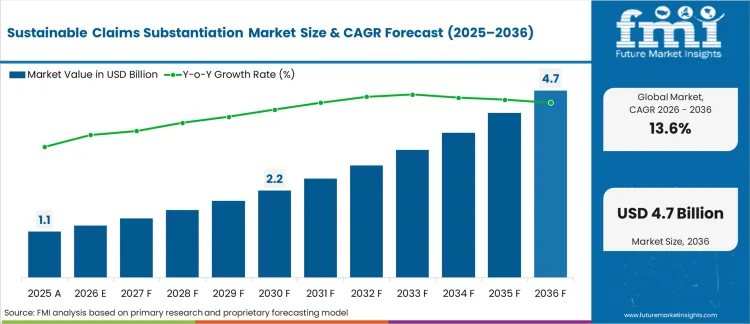
Sustainable Claims Substantiation Market Key Takeaways
| Metric | Details |
|---|---|
| Industry Size (2026) | USD 1.30 Billion |
| Industry Value (2036) | USD 4.68 Billion |
| CAGR (2026-2036) | 13.6% |
Source: FMI analysis based on primary research and proprietary forecasting model
FMI analysts observe that the projected compound expansion relies on a structural shift toward digital transparency and standardized life cycle assessment methodologies. This transition forces consumer goods companies to abandon vague "eco-friendly" labeling and commit capital to digital product passports. The underlying mechanism sustaining the 13.6% growth trajectory is the absolute necessity of consumer trust in a hyper-skeptical market. The geographic distribution of this adoption reveals distinct velocities tied to the implementation of the EU Green Claims Directive and updated FTC guidelines in North America.
As regional manufacturing hubs navigate this transition, India sets the pace with an 18.2% CAGR, followed by China at 14.6% as both nations align their export sectors with global sustainability reporting standards. Brazil advances at a 13.1% rate, supported by biodiversity protection audits. Germany registers a 12.8% expansion while the UK tracks at 12.2%, both driven by aggressive circular economy mandates. The USA expands at an 11.5% trajectory anchored by increased SEC climate disclosure requirements, while Japan maintains a steady 10.4% pace as electronics manufacturers prioritize energy efficiency verification.
Sustainable Claims Substantiation Market Definition
Sustainable Claims Substantiation represents the professional services, testing protocols, and digital infrastructure used to verify environmental and social statements made by businesses. The ecosystem includes third-party verification audits, carbon footprinting software, and supply chain traceability tools compliant with ISO 14020 series standards. A core inclusion is hardware and software supporting digital product passports for real-time claim validation. Regulatory frameworks like the Green Claims Code define the operational parameters for these precise verification profiles.
Sustainable Claims Substantiation Market Inclusions
The market scope includes third-party audit fees, LCA software subscriptions, regulatory consulting for environmental compliance, and specialized laboratory testing for biodegradability and compostability. Protocol-specific certification schemes, traceability platforms for raw materials, and associated supply chain mapping tools fall within the boundaries. Services utilizing blockchain for sustainability mechanisms for critical chain-of-custody data are fully incorporated.
Sustainable Claims Substantiation Market Exclusions
General marketing agency fees, standard financial audits without ESG components, and standalone physical waste management services are excluded. Internal corporate sustainability staff salaries, generic IT hardware, and non-environmental product testing fall outside the defined parameters. Pure carbon credit trading platforms without a direct substantiation or verification component are explicitly omitted from the valuation.
Sustainable Claims Substantiation Market Research Methodology
- Primary Research: Analysts engaged with sustainability directors, compliance officers, and third-party verification leads to map the specific decision gates triggering service procurement.
- Desk Research: The data collection phase aggregated compliance roadmaps from the European Commission, FTC Green Guide updates, and major retail vendor sustainability guidelines.
- Market-Sizing and Forecasting: The baseline value derives from a bottom-up aggregation of verification service revenues, applying region-specific regulatory curves to project the future adoption velocity.
- Data Validation and Update Cycle: Projections are rigorously tested against publicly reported ESG consulting growth rates and testing, inspection, and certification (TIC) industry financial reports.
Segmental Analysis
Sustainable Claims Substantiation Market Analysis by Service Type
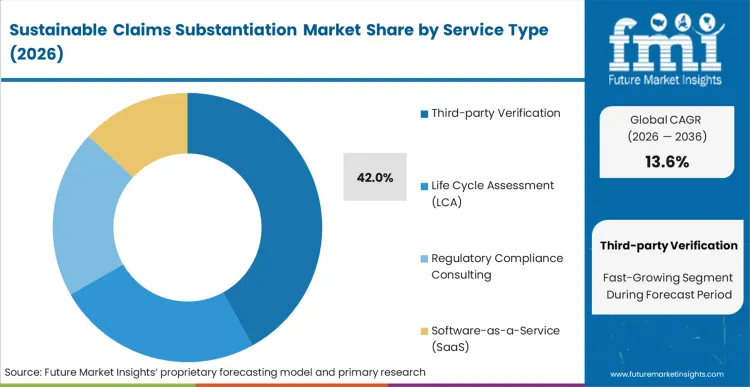
With legacy self-declaration proving inadequate for modern regulatory scrutiny, capital projects directors execute full-scale third-party verification programs. This segment commands a dominant 42.0% share in 2026, reflecting the absolute requirement for independent audits to survive legal challenges. Manufacturers deploying SaaS-based sustainability platforms directly into their ERP systems establish the foundation for automated claim substantiation. This digital integration eliminates the need for expensive, manual annual audits. According to FMI's estimates, facilities transitioning to digital product passports realize measurable reductions in compliance reporting times.
- Independent Assurance: Verification protocols demand rigorous third-party testing to guarantee statements meet anti-greenwashing laws.
- Digital Traceability: Embedded software capabilities natively handle carbon footprint data, shifting the burden away from manual data entry.
- Regulatory Shielding: Utilizing certified providers offers a "safe harbor" against consumer protection agency audits.
Sustainable Claims Substantiation Market Analysis by Claim Type
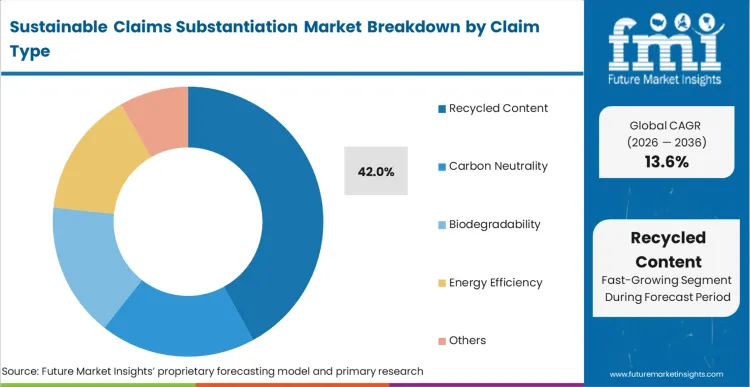
Recycled content verification emerges as the dominant claim type, expected to represent a significant portion of the market share. Modern consumer packaging environments are increasingly built around PCR plastic verification, removing the risk of fraudulent material claims. FMI analysts opine that establishing a verified chain of custody directly enables brands to charge premium prices for sustainable products. Compliance leads must validate biodegradability metrics through standardized testing to authorize on-pack labeling.
- Carbon Neutrality Proof: Critical GHG protocol verification receives guaranteed windows while standard social metrics follow.
- Material Integrity: Connecting field data directly to recycled content platforms accelerates the extraction of proof for regulators.
- Energy Efficiency Claims: Standardized energy audit models reduce the risk of misleading "low-carbon" marketing.
Sustainable Claims Substantiation Market Analysis by End-use Industry
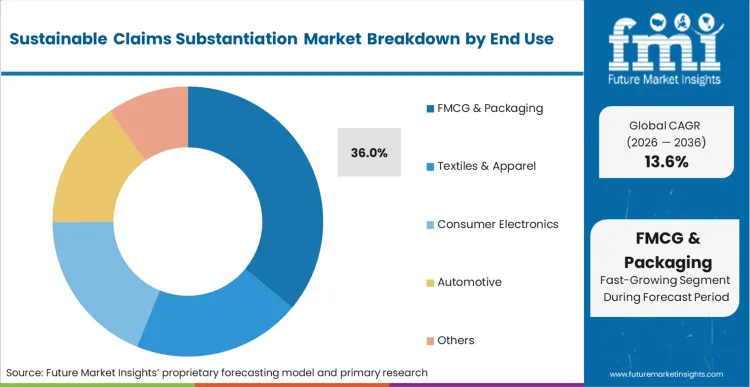
Every brand manager bidding on retail shelf space now faces strict adherence criteria for environmental claim substantiation. FMCG & Packaging accounts for a leading segment share in 2026. Marketing directors operating global portfolios reject labeling that introduces litigation risk. Incorporating certified sustainable packaging modules guarantees that recycled content commands arrive verified. As per FMI's projection, the convergence of traceability in apparel with core ESG reporting amplifies the demand for high-accuracy verification labs.
- Greenwashing Mitigation: Fixed verification schedules ensure marketing packets bypass standard legal reviews with higher confidence.
- Retailer Alignment: Dedicated sustainability data allocation permits brands to share the same verified data with multiple retail platforms.
- Consumer Loyalty: Open transparency standards empower consumers to source specialized products without worrying about false claims.
Sustainable Claims Substantiation Market Drivers, Restraints, and Opportunities
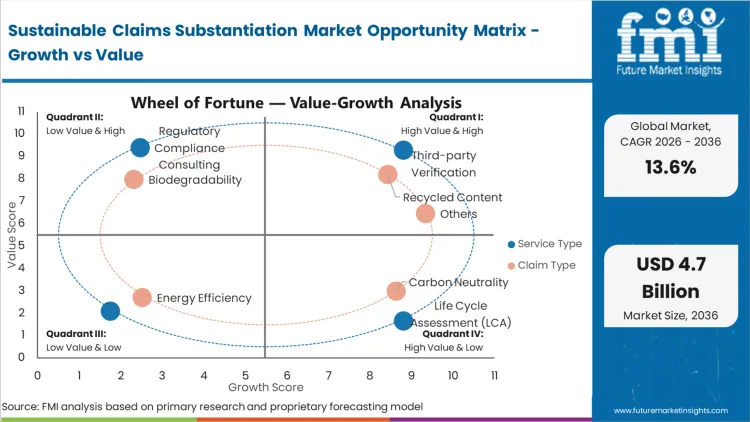
The convergence of ESG monitoring tools and consumer demand for transparency forces marketing teams to extract actionable data directly from the supply chain. This requirement renders vague slogans obsolete. Brands upgrading their sustainability communication strategies face a choice between deploying complex internal systems or hiring specialized substantiation firms. Transitioning to a verified data backbone simplifies reporting and enables direct connection to digital consumer labels.
The intricate data parameters required to optimize LCA traffic flows create steep learning curves for traditional marketing teams. Designing conflict-free environmental product declarations across multi-tier suppliers demands specialized carbon accounting expertise. To mitigate this skill gap, brands increasingly rely on automated ESG software that validates claims before public release.
Opportunities in the Sustainable Claims Substantiation Market
- Digital Product Passports: Next-generation traceability endpoints enable brands to run virtualized proof logic directly on the product label. This eliminates static PDFs and simplifies the verification experience.
- AI-Driven Verification: Upgraded AI for sustainability permits quality teams to deploy inline claim checking without impacting product launch cycles. This prevents defective marketing from reaching the store.
- Circular Economy Mapping: Companies integrating PCR material tracking require precise flow data. Deterministic verification provides the accuracy necessary to prove closed-loop recycling claims.
Regional Analysis
Based on the regional analysis, the Sustainable Claims Substantiation market is segmented into North America, Latin America, Europe, East Asia, South Asia, Oceania and Middle East & Africa across 40+ countries.
.webp "Top Country Growth Comparison Sustainable Claims Substantiation Market Cagr (2026 2036)")
| Country | CAGR (2026 to 2036) |
|---|---|
| India | 18.2% |
| China | 14.6% |
| Brazil | 13.1% |
| Germany | 12.8% |
| United Kingdom | 12.2% |
| USA | 11.5% |
| Japan | 10.4% |
Source: Future Market Insights (FMI) analysis
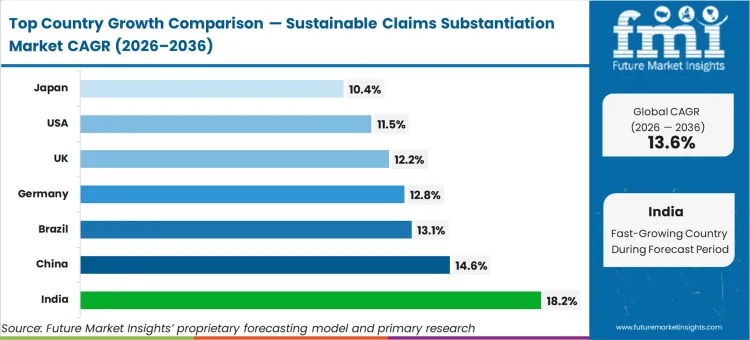
Asia Pacific Sustainable Claims Substantiation Market Analysis
Greenfield manufacturing development across Asia Pacific accelerates the adoption of certified export documentation. Capital projects directors constructing new sustainable textile facilities specify native substantiation in their initial blueprints. FMI analysts opine that this clean-slate approach eliminates the costly retrofit phase. By building traceability capabilities into the foundation, regional owners establish highly credible production environments.
- India: India's pharmaceutical and textile sectors deploy digital traceability platforms to satisfy European supply chain due diligence laws. Greenfield facility architects specify native environmental verification endpoints for all new contracts. This drives an 18.2% CAGR as exporters prioritize global market access.
- China: The shift toward sustainable electronics requires seamless exchange between IT carbon tracking and OT manufacturing. Greenfield architects bypass legacy manual reporting, specifying real-time carbon footprinting for all new procurement contracts. This drives a 14.6% CAGR as the nation targets "Green Supply Chain" status.
- Japan: The Ministry of Environment (MOE) encourages circularity reporting across the electronics and automotive sectors. Ronak Shah, Principal Consultant for Consumer Products at Future Market Insights, opines, "I observe that Japanese manufacturers are pivoting from voluntary ESG disclosures to automated precision electronics certification to maintain their edge in highly regulated European and North American export markets." This drives a 10.4% CAGR as legacy auditing is replaced by energy efficiency verification platforms.
North America Sustainable Claims Substantiation Market Analysis
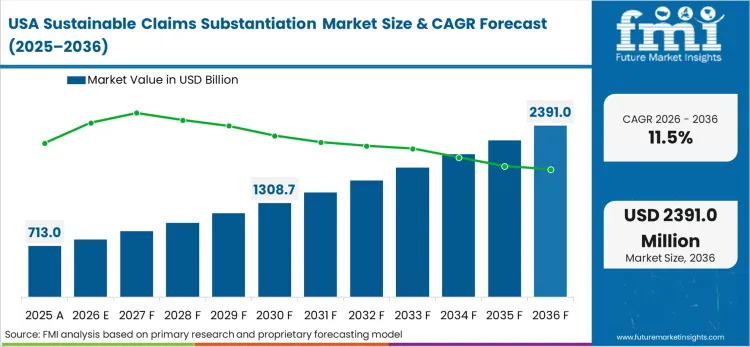
Modernization mandates across North America target the systematic eradication of "green hushing" and unverified claims. Control engineers leading ESG overhauls face strict directives from the SEC and FTC. Implementing a standardized substantiation backbone enables facilities to deploy advanced climate analytics without compromising data integrity.
- USA: The United States FMCG sector enforces strict green labeling mandates across its entire supply chain. Brands replacing aging marketing strategies must deploy converged verification architectures capable of supporting FTC compliance. Federal initiatives actively fund the replacement of vague claims with science-based targets.
Europe Sustainable Claims Substantiation Market Analysis
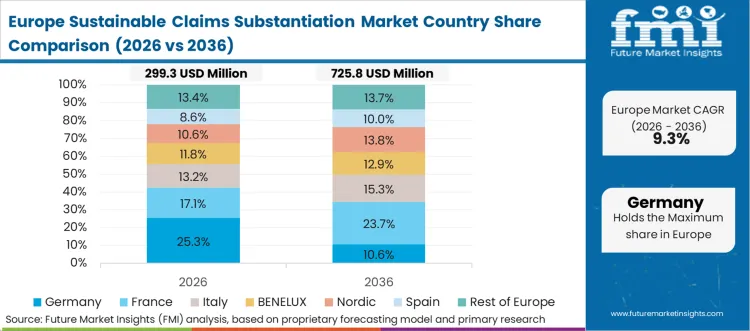
European policy actively penalizes the operation of "greenwashing" facilities. Architects redesigning legacy lines must integrate real-time energy monitoring alongside environmental claim data. This dual-purpose requirement forces the rapid adoption of traffic-shaping verification protocols.
- Germany: Germany's manufacturing supply chain dictates stringent validation for mixed-criticality ESG data. Control engineers must demonstrate flawless verification execution before connecting new products to the market. This systemic pressure drives a 12.8% annual expansion as certified substantiation hardware becomes the standard.
- United Kingdom: Enforcement of the CMA's Green Claims Code compels UK retailers to adopt green claims auditing to avoid significant greenwashing penalties. Brands in the FMCG sector are integrating environmental retail transparency tools to satisfy domestic regulatory scrutiny. This generates a 12.2% annual growth rate as companies prioritize UK sustainability consulting to validate consumer-facing declarations.
Latin America Sustainable Claims Substantiation Market Analysis
The Latin American market is undergoing a structural shift driven by international trade mandates, particularly the EU Deforestation Regulation (EUDR). Capital project directors in the agricultural sector are prioritizing agriculture ESG compliance to ensure continued access to global commodity markets.
- Brazil: As a leading global exporter of soy and beef, Brazil is accelerating the deployment of deforestation-free verification systems. Ronak Shah, Principal Consultant for Consumer Products at Future Market Insights, opines, "I believe Brazilian agribusinesses are no longer viewing substantiation as a compliance cost, but as a competitive necessity for biodiversity protection audits that unlock premium pricing in European markets." This focus drives a 13.1% CAGR as exporters integrate real-time satellite tracking with ESG reporting.
Competitive Aligners for Market Players
The introduction of standardized testing profiles under the EU Green Claims Directive is fundamentally reshaping how industrial and consumer-facing procurement teams evaluate sustainability verification services. Instead of accepting opaque, internal corporate social responsibility (CSR) reports, professional buyers now demand certified interoperable data that can be seamlessly integrated into digital product passports (DPP). This structural shift has raised the performance bar across the verification landscape, meaning that legacy vendors relying on closed, proprietary ESG ecosystems risk immediate exclusion from major retail and manufacturing tenders.
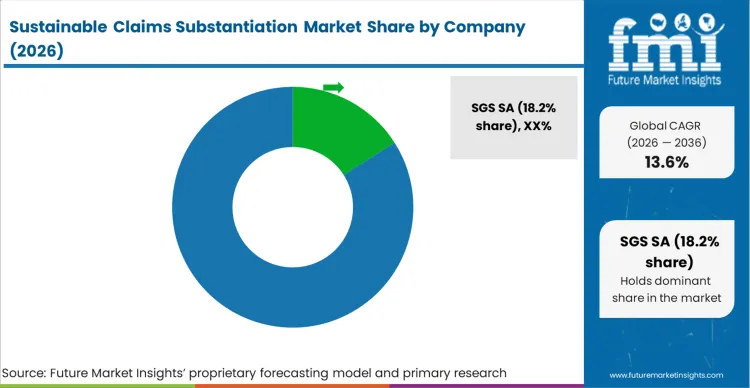
Industry leaders have already begun aggressive adaptation to this new "proof-first" reality. SGS SA, commanding a dominant 18.2% market share, has leveraged its expansive global laboratory network to set a new competitive baseline, pivoting from standard auditing to high-fidelity scientific claim substantiation. Similarly, Intertek Group plc and Bureau Veritas are aligning their portfolios with open environmental transparency frameworks, ensuring that their certifications are recognized across multiple jurisdictions. This shift pushes the entire sector to integrate native life cycle assessment capabilities directly into the certification workflow, rather than treating them as secondary add-on services.
Vendors embedding precision data synchronization directly into supply chain edge devices or ERP systems gain a significant architectural advantage. Firms such as UL Solutions and TÜV SÜD, which are increasingly incorporating safety and sustainability nexus verification, help manufacturers reduce engineering overhead during the product design phase. This "verification-at-source" approach accelerates brownfield product migrations, allowing brand leads to prioritize platforms that avoid the logistical complexity associated with manual, third-party data collection. In contrast, component manufacturers or service providers slow to adopt native deterministic verification risk losing their preferred-vendor status during early-stage shortlisting.
Furthermore, the growth of software-driven interoperability is disrupting long-established market strongholds. EcoVadis and Sphera are utilizing AI-powered ESG software to automate the substantiation process, allowing for real-time surveillance of recycled content verification instead of static annual reviews. This expanded flexibility empowers facility owners to source specialized materials from firms like Eurofins Scientific-known for its deep chemical and biodegradability testing-without worrying about data-sync failures or synchronization drift across their sustainability reports.
Key Players in Sustainable Claims Substantiation Market
- SGS SA (18.2% share)
- Intertek Group plc
- Bureau Veritas
- TÜV SÜD
- UL Solutions
- Eurofins Scientific
- EcoVadis
- Sphera
Scope of the Report
| Metric | Value |
|---|---|
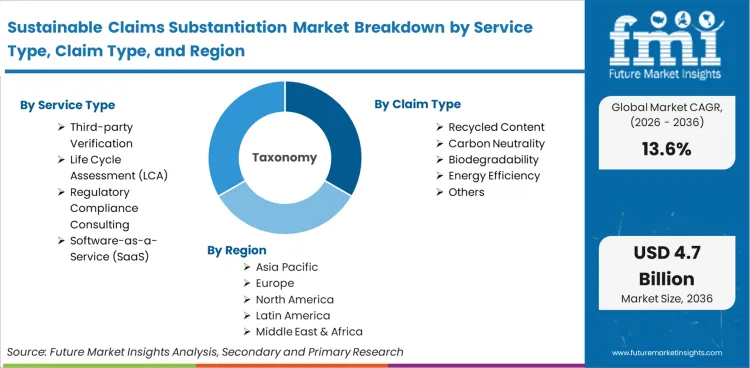
| Quantitative Units | USD 1.30 billion to USD 4.68 billion, at a CAGR of 13.6% |
| Market Definition | Sustainable Claims Substantiation encompasses specialized verification services, life cycle assessment methodologies, and software built on international standards to guarantee the accuracy and legality of environmental marketing claims. |
| Service Type Segmentation | Third-party Verification, Life Cycle Assessment (LCA), Regulatory Compliance Consulting, Software-as-a-Service (SaaS) |
| Claim Type Segmentation | Recycled Content, Carbon Neutrality, Biodegradability, Energy Efficiency, Others |
| End-use Industry Segmentation | FMCG & Packaging, Textiles & Apparel, Consumer Electronics, Automotive, Others |
| Regions Covered | North America, Latin America, Europe, East Asia, South Asia, Oceania, Middle East & Africa |
| Countries Covered | India, China, Brazil, Germany, United Kingdom, USA, Japan, and 40 plus countries |
| Key Companies Profiled | SGS SA, Intertek Group plc, Bureau Veritas, TÜV SÜD, UL Solutions, Eurofins Scientific, EcoVadis, Sphera |
| Forecast Period | 2026 to 2036 |
| Approach | The baseline value derives from a bottom-up aggregation of verification service revenues, applying region-specific regulatory curves to project future adoption velocity across the TIC and ESG software sectors. |
Sustainable Claims Substantiation Market Analysis by Segments
Service Type:
- Third-party Verification
- Life Cycle Assessment (LCA)
- Regulatory Compliance Consulting
- Software-as-a-Service (SaaS)
Claim Type:
- Recycled Content
- Carbon Neutrality
- Biodegradability
- Energy Efficiency
- Others
End-use Industry:
- FMCG & Packaging
- Textiles & Apparel
- Consumer Electronics
- Automotive
- Others
Region:
- Asia Pacific
- India
- China
- Japan
- South Korea
- Indonesia
- Australia & New Zealand
- ASEAN
- Rest of Asia Pacific
- Europe
- Germany
- Italy
- France
- United Kingdom
- Spain
- Benelux
- Nordics
- Central & Eastern Europe
- Rest of Europe
- North America
- United States
- Canada
- Mexico
- Latin America
- Brazil
- Argentina
- Chile
- Rest of Latin America
- Middle East & Africa
- Kingdom of Saudi Arabia
- United Arab Emirates
- South Africa
- Turkey
- Rest of Middle East & Africa
Bibliography
- Bureau Veritas. (2024, February 12). Navigating the anti-greenwashing landscape: Independent assurance and the role of third-party verification in FMCG. Bureau Veritas Technical Publications.
- Intertek Group plc. (2024, August 27). Sustainability verification: The transition from voluntary disclosure to legally binding empirical data. Intertek Knowledge Center.
- Official Journal of the European Union. (2024, June 28). Regulation (EU) 2024/1781 establishing a framework for the setting of ecodesign requirements for sustainable products and digital product passports.
- Securities and Exchange Board of India. (2024, April 18). Business Responsibility and Sustainability Reporting (BRSR) core: Mandates for assurance of value chain disclosures for exporters. SEBI Circulars.
- SGS SA. (2025). Scientific substantiation of environmental claims: Methodology for Life Cycle Assessment (LCA) and Carbon Footprint Verification. SGS White Paper Series.
- TÜV SÜD. (2024, October 05). Biodegradability and compostability testing: Standardized protocols for global market access in the packaging industry. TÜV SÜD Technical Reports.
- UL Solutions. (2024, November 12). The safety and sustainability nexus: Integrated verification strategies for consumer electronics. UL Technical Insights.
This bibliography is provided for reader reference. The full FMI report contains the complete reference list with primary source documentation.
This Report Addresses
- Market sizing and quantitative forecast metrics detailing the total revenue growth of sustainable verification services and scientific substantiation protocols across global supply chains through 2036.
- Segmentation analysis mapping the adoption velocity of third-party verification audits and life cycle assessment (LCA) software, while evaluating the technical shifts driving corporate transitions from voluntary disclosure to legally binding verification.
- Regional deployment intelligence comparing the rapid greenfield traceability development in Asia Pacific against the complex anti-greenwashing regulatory compliance requirements prevalent in European and North American manufacturing hubs.
- Regulatory compliance assessment analyzing how stringent frameworks like the EU Green Claims Directive and updated FTC guidelines force the adoption of unified audit trails and environmental product declarations.
- Competitive posture evaluation tracking the mandatory shift toward independent scientific substantiation and the resulting dominance of leading testing, inspection, and certification (TIC) firms in the global verification landscape.
- Capital project and strategic guidance defining the exact procurement specifications and data traceability tolerances required to support next-generation digital product passports for retail and manufacturing.
- Supply chain vulnerability analysis identifying the specific granular data bottlenecks and Tier-2/Tier-3 reporting gaps that currently extend compliance timelines and increase greenwashing litigation risks.
- Custom data delivery formats encompassing interactive dashboards, raw Excel datasets, and comprehensive PDF narrative reports designed for executive ESG strategy and operational benchmarking.
Frequently Asked Questions
How large is the Sustainable Claims Substantiation market in 2026?
The market is estimated to be valued at USD 1.30 billion in 2026 as global regulatory bodies implement stringent anti-greenwashing frameworks.
What will the market be valued at by 2036?
The market size is projected to reach USD 4.68 billion by 2036, driven by the transition from voluntary disclosure to legally binding verification.
What is the projected CAGR for the Sustainable Claims Substantiation market?
The industry is expected to expand at a compound annual growth rate (CAGR) of 13.6% between 2026 and 2036.
Which Service Type segment leads the market?
Third-party Verification is poised to lead the market with a 42.0% share in 2026, reflecting the urgent need for independent assurance to mitigate litigation risks.
Which End-use Industry is driving the most demand?
The FMCG & Packaging sector is estimated to command the market in 2026 as brands overhaul labels to comply with new plastic waste management and green labeling rules.
Which Claim Type is most significant for market growth?
Recycled content verification is a dominant driver, as modern consumer packaging environments prioritize verified chains of custody for PCR plastics.
What is the primary driver for rapid growth in this market?
The implementation of mandatory frameworks like the EU Green Claims Directive forces companies to back environmental assertions with empirical data rather than self-declared benefits.
What is the primary restraint facing the industry?
The intricate data parameters and steep learning curves associated with Life Cycle Assessment (LCA) methodologies often create technical bottlenecks for traditional marketing teams.
Which country is expected to grow the fastest?
India is projected to lead global growth with an 18.2% CAGR as exporters align their pharmaceutical and textile sectors with international ESG standards.
How does the EU Green Claims Directive impact the European market?
The directive penalizes "greenwashing" and requires architects and manufacturers to integrate real-time energy monitoring with environmental claim data.
What role does software play in sustainable claims substantiation?
Software-as-a-Service (SaaS) and AI-powered LCA tools allow for the automation of substantiation processes, reducing engineering overhead and manual data entry errors.
What is the growth outlook for the United States?
The USA market is expanding at an 11.5% trajectory, anchored by strict federal cybersecurity and SEC climate disclosure requirements for defense and FMCG supply chains.
Why is China a major player in this sector?
China is tracking a 14.6% CAGR as its electric vehicle and electronics sectors deploy highly automated production lines that require seamless sustainability data exchange.
What are Digital Product Passports (DPP)?
Digital Product Passports are digital infrastructures that provide real-time claim validation and traceability for products throughout their lifecycle.
How does Germany regulate environmental claims?
German manufacturing relies on stringent functional safety certifications and machinery directives that mandate unified diagnostic and environmental reporting layers.
What is the significance of "Scientific Substantiation Services"?
These services move corporate budgets away from creative marketing toward empirical, laboratory-tested data to prove assertions like biodegradability or carbon neutrality.
What is excluded from the Sustainable Claims Substantiation market scope?
Standard commercial enterprise Ethernet switches, pure IT security appliances, and legacy serial fieldbus hardware without Ethernet bridging are explicitly excluded.
How does FMI validate its market forecasts?
The model uses a bottom-up methodology based on global installed base metrics and cross-validates projections against publicly reported capital expenditure guidance.
What is the role of blockchain in this market?
Blockchain is utilized for sustainability mechanisms that require a critical and immutable chain-of-custody for raw material data.
How significant is the United Kingdom's market contribution?
The UK is sustaining a 12.2% CAGR as energy and utility networks implement synchronized, synchronized control topologies to balance renewable energy inputs.
What is "green hushing" in the North American context?
It refers to the practice of under-reporting sustainability efforts to avoid regulatory scrutiny, a practice that current modernization mandates aim to eradicate.
Which companies are the key players in this market?
Key participants include SGS SA, Intertek Group plc, Bureau Veritas, TÜV SÜD, UL Solutions, Eurofins Scientific, EcoVadis, and Sphera.
Preview the report firsthand - request a free sample
Get SampleGet the brochure for pricing and purchase details.
Get PDFTable of Content
- Executive Summary
- Global Market Outlook
- Demand-side Trends
- Supply-side Trends
- Technology Roadmap Analysis
- Analysis and Recommendations
- Market Overview
- Market Coverage / Taxonomy
- Market Definition / Scope / Limitations
- Research Methodology
- Chapter Orientation
- Analytical Lens and Working Hypotheses
- Market Structure, Signals, and Trend Drivers
- Benchmarking and Cross-market Comparability
- Market Sizing, Forecasting, and Opportunity Mapping
- Research Design and Evidence Framework
- Desk Research Programme (Secondary Evidence)
- Company Annual and Sustainability Reports
- Peer-reviewed Journals and Academic Literature
- Corporate Websites, Product Literature, and Technical Notes
- Earnings Decks and Investor Briefings
- Statutory Filings and Regulatory Disclosures
- Technical White Papers and Standards Notes
- Trade Journals, Industry Magazines, and Analyst Briefs
- Conference Proceedings, Webinars, and Seminar Materials
- Government Statistics Portals and Public Data Releases
- Press Releases and Reputable Media Coverage
- FMI Internal Proprietary Databases and Historical Market Datasets
- Subscription Datasets and Paid Sources
- Social Channels, Communities, and Digital Listening Inputs
- Additional Desk Sources
- Expert Input and Fieldwork (Primary Evidence)
- Primary Modes
- Qualitative Interviews and Expert Elicitation
- Quantitative Surveys and Structured Data Capture
- Blended Approach
- Why Primary Evidence is Used
- Field Techniques
- Interviews
- Surveys
- Focus Groups
- Observational and In-context Research
- Social and Community Interactions
- Stakeholder Universe Engaged
- C-suite Leaders
- Board Members
- Presidents and Vice Presidents
- R&D and Innovation Heads
- Technical Specialists
- Domain Subject-matter Experts
- Scientists
- Physicians and Other Healthcare Professionals
- Governance, Ethics, and Data Stewardship
- Research Ethics
- Data Integrity and Handling
- Primary Modes
- Tooling, Models, and Reference Databases
- Desk Research Programme (Secondary Evidence)
- Data Engineering and Model Build
- Data Acquisition and Ingestion
- Cleaning, Normalisation, and Verification
- Synthesis, Triangulation, and Analysis
- Quality Assurance and Audit Trail
- Market Background
- Market Dynamics
- Drivers
- Restraints
- Opportunity
- Trends
- Scenario Forecast
- Demand in Optimistic Scenario
- Demand in Likely Scenario
- Demand in Conservative Scenario
- Opportunity Map Analysis
- Product Life Cycle Analysis
- Supply Chain Analysis
- Investment Feasibility Matrix
- Value Chain Analysis
- PESTLE and Porter’s Analysis
- Regulatory Landscape
- Regional Parent Market Outlook
- Production and Consumption Statistics
- Import and Export Statistics
- Market Dynamics
- Global Market Analysis 2021 to 2025 and Forecast, 2026 to 2036
- Historical Market Size Value (USD Million) Analysis, 2021 to 2025
- Current and Future Market Size Value (USD Million) Projections, 2026 to 2036
- Y-o-Y Growth Trend Analysis
- Absolute $ Opportunity Analysis
- Global Market Pricing Analysis 2021 to 2025 and Forecast 2026 to 2036
- Global Market Analysis 2021 to 2025 and Forecast 2026 to 2036, By Service Type
- Introduction / Key Findings
- Historical Market Size Value (USD Million) Analysis By Service Type , 2021 to 2025
- Current and Future Market Size Value (USD Million) Analysis and Forecast By Service Type , 2026 to 2036
- Third-party Verification
- Life Cycle Assessment (LCA)
- Regulatory Compliance Consulting
- Software-as-a-Service (SaaS)
- Third-party Verification
- Y-o-Y Growth Trend Analysis By Service Type , 2021 to 2025
- Absolute $ Opportunity Analysis By Service Type , 2026 to 2036
- Global Market Analysis 2021 to 2025 and Forecast 2026 to 2036, By Claim Type
- Introduction / Key Findings
- Historical Market Size Value (USD Million) Analysis By Claim Type, 2021 to 2025
- Current and Future Market Size Value (USD Million) Analysis and Forecast By Claim Type, 2026 to 2036
- Recycled Content
- Carbon Neutrality
- Biodegradability
- Energy Efficiency
- Others
- Recycled Content
- Y-o-Y Growth Trend Analysis By Claim Type, 2021 to 2025
- Absolute $ Opportunity Analysis By Claim Type, 2026 to 2036
- Global Market Analysis 2021 to 2025 and Forecast 2026 to 2036, By End Use
- Introduction / Key Findings
- Historical Market Size Value (USD Million) Analysis By End Use, 2021 to 2025
- Current and Future Market Size Value (USD Million) Analysis and Forecast By End Use, 2026 to 2036
- FMCG & Packaging
- Textiles & Apparel
- Consumer Electronics
- Automotive
- Others
- FMCG & Packaging
- Y-o-Y Growth Trend Analysis By End Use, 2021 to 2025
- Absolute $ Opportunity Analysis By End Use, 2026 to 2036
- Global Market Analysis 2021 to 2025 and Forecast 2026 to 2036, By Region
- Introduction
- Historical Market Size Value (USD Million) Analysis By Region, 2021 to 2025
- Current Market Size Value (USD Million) Analysis and Forecast By Region, 2026 to 2036
- North America
- Latin America
- Western Europe
- Eastern Europe
- East Asia
- South Asia and Pacific
- Middle East & Africa
- Market Attractiveness Analysis By Region
- North America Market Analysis 2021 to 2025 and Forecast 2026 to 2036, By Country
- Historical Market Size Value (USD Million) Trend Analysis By Market Taxonomy, 2021 to 2025
- Market Size Value (USD Million) Forecast By Market Taxonomy, 2026 to 2036
- By Country
- USA
- Canada
- Mexico
- By Service Type
- By Claim Type
- By End Use
- By Country
- Market Attractiveness Analysis
- By Country
- By Service Type
- By Claim Type
- By End Use
- Key Takeaways
- Latin America Market Analysis 2021 to 2025 and Forecast 2026 to 2036, By Country
- Historical Market Size Value (USD Million) Trend Analysis By Market Taxonomy, 2021 to 2025
- Market Size Value (USD Million) Forecast By Market Taxonomy, 2026 to 2036
- By Country
- Brazil
- Chile
- Rest of Latin America
- By Service Type
- By Claim Type
- By End Use
- By Country
- Market Attractiveness Analysis
- By Country
- By Service Type
- By Claim Type
- By End Use
- Key Takeaways
- Western Europe Market Analysis 2021 to 2025 and Forecast 2026 to 2036, By Country
- Historical Market Size Value (USD Million) Trend Analysis By Market Taxonomy, 2021 to 2025
- Market Size Value (USD Million) Forecast By Market Taxonomy, 2026 to 2036
- By Country
- Germany
- UK
- Italy
- Spain
- France
- Nordic
- BENELUX
- Rest of Western Europe
- By Service Type
- By Claim Type
- By End Use
- By Country
- Market Attractiveness Analysis
- By Country
- By Service Type
- By Claim Type
- By End Use
- Key Takeaways
- Eastern Europe Market Analysis 2021 to 2025 and Forecast 2026 to 2036, By Country
- Historical Market Size Value (USD Million) Trend Analysis By Market Taxonomy, 2021 to 2025
- Market Size Value (USD Million) Forecast By Market Taxonomy, 2026 to 2036
- By Country
- Russia
- Poland
- Hungary
- Balkan & Baltic
- Rest of Eastern Europe
- By Service Type
- By Claim Type
- By End Use
- By Country
- Market Attractiveness Analysis
- By Country
- By Service Type
- By Claim Type
- By End Use
- Key Takeaways
- East Asia Market Analysis 2021 to 2025 and Forecast 2026 to 2036, By Country
- Historical Market Size Value (USD Million) Trend Analysis By Market Taxonomy, 2021 to 2025
- Market Size Value (USD Million) Forecast By Market Taxonomy, 2026 to 2036
- By Country
- China
- Japan
- South Korea
- By Service Type
- By Claim Type
- By End Use
- By Country
- Market Attractiveness Analysis
- By Country
- By Service Type
- By Claim Type
- By End Use
- Key Takeaways
- South Asia and Pacific Market Analysis 2021 to 2025 and Forecast 2026 to 2036, By Country
- Historical Market Size Value (USD Million) Trend Analysis By Market Taxonomy, 2021 to 2025
- Market Size Value (USD Million) Forecast By Market Taxonomy, 2026 to 2036
- By Country
- India
- ASEAN
- Australia & New Zealand
- Rest of South Asia and Pacific
- By Service Type
- By Claim Type
- By End Use
- By Country
- Market Attractiveness Analysis
- By Country
- By Service Type
- By Claim Type
- By End Use
- Key Takeaways
- Middle East & Africa Market Analysis 2021 to 2025 and Forecast 2026 to 2036, By Country
- Historical Market Size Value (USD Million) Trend Analysis By Market Taxonomy, 2021 to 2025
- Market Size Value (USD Million) Forecast By Market Taxonomy, 2026 to 2036
- By Country
- Kingdom of Saudi Arabia
- Other GCC Countries
- Turkiye
- South Africa
- Other African Union
- Rest of Middle East & Africa
- By Service Type
- By Claim Type
- By End Use
- By Country
- Market Attractiveness Analysis
- By Country
- By Service Type
- By Claim Type
- By End Use
- Key Takeaways
- Key Countries Market Analysis
- USA
- Pricing Analysis
- Market Share Analysis, 2025
- By Service Type
- By Claim Type
- By End Use
- Canada
- Pricing Analysis
- Market Share Analysis, 2025
- By Service Type
- By Claim Type
- By End Use
- Mexico
- Pricing Analysis
- Market Share Analysis, 2025
- By Service Type
- By Claim Type
- By End Use
- Brazil
- Pricing Analysis
- Market Share Analysis, 2025
- By Service Type
- By Claim Type
- By End Use
- Chile
- Pricing Analysis
- Market Share Analysis, 2025
- By Service Type
- By Claim Type
- By End Use
- Germany
- Pricing Analysis
- Market Share Analysis, 2025
- By Service Type
- By Claim Type
- By End Use
- UK
- Pricing Analysis
- Market Share Analysis, 2025
- By Service Type
- By Claim Type
- By End Use
- Italy
- Pricing Analysis
- Market Share Analysis, 2025
- By Service Type
- By Claim Type
- By End Use
- Spain
- Pricing Analysis
- Market Share Analysis, 2025
- By Service Type
- By Claim Type
- By End Use
- France
- Pricing Analysis
- Market Share Analysis, 2025
- By Service Type
- By Claim Type
- By End Use
- India
- Pricing Analysis
- Market Share Analysis, 2025
- By Service Type
- By Claim Type
- By End Use
- ASEAN
- Pricing Analysis
- Market Share Analysis, 2025
- By Service Type
- By Claim Type
- By End Use
- Australia & New Zealand
- Pricing Analysis
- Market Share Analysis, 2025
- By Service Type
- By Claim Type
- By End Use
- China
- Pricing Analysis
- Market Share Analysis, 2025
- By Service Type
- By Claim Type
- By End Use
- Japan
- Pricing Analysis
- Market Share Analysis, 2025
- By Service Type
- By Claim Type
- By End Use
- South Korea
- Pricing Analysis
- Market Share Analysis, 2025
- By Service Type
- By Claim Type
- By End Use
- Russia
- Pricing Analysis
- Market Share Analysis, 2025
- By Service Type
- By Claim Type
- By End Use
- Poland
- Pricing Analysis
- Market Share Analysis, 2025
- By Service Type
- By Claim Type
- By End Use
- Hungary
- Pricing Analysis
- Market Share Analysis, 2025
- By Service Type
- By Claim Type
- By End Use
- Kingdom of Saudi Arabia
- Pricing Analysis
- Market Share Analysis, 2025
- By Service Type
- By Claim Type
- By End Use
- Turkiye
- Pricing Analysis
- Market Share Analysis, 2025
- By Service Type
- By Claim Type
- By End Use
- South Africa
- Pricing Analysis
- Market Share Analysis, 2025
- By Service Type
- By Claim Type
- By End Use
- USA
- Market Structure Analysis
- Competition Dashboard
- Competition Benchmarking
- Market Share Analysis of Top Players
- By Regional
- By Service Type
- By Claim Type
- By End Use
- Competition Analysis
- Competition Deep Dive
- SGS SA (18.2% share)
- Overview
- Product Portfolio
- Profitability by Market Segments (Product/Age /Sales Channel/Region)
- Sales Footprint
- Strategy Overview
- Marketing Strategy
- Product Strategy
- Channel Strategy
- Intertek Group plc
- Bureau Veritas
- TÜV SÜD
- UL Solutions
- Eurofins Scientific
- EcoVadis
- Sphera
- SGS SA (18.2% share)
- Competition Deep Dive
- Assumptions & Acronyms Used


