

- Industry Size (2026)
- USD 417 Mn
- Forecast (2036)
- USD 852 Mn
- CAGR (2026 to 2036)
- 7.4%
Sustainable Anti-Foam Agents for Wastewater and Biogas Plants Market Forecast and Outlook 2026 to 2036
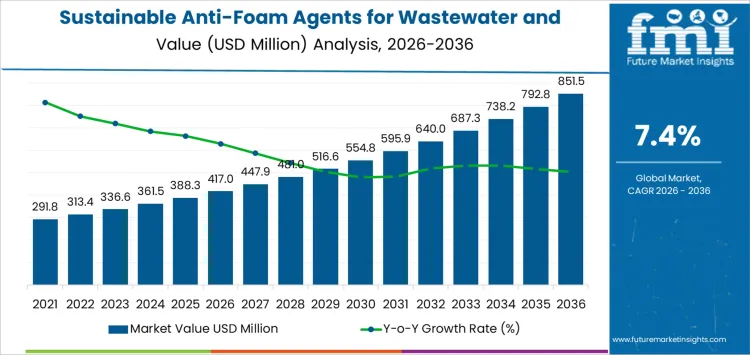
The global market for sustainable anti-foam agents for wastewater and biogas plants is projected to grow at a CAGR of 7.4% from 2026 to 2036. The market is expected to rise from USD 417 million in 2026 to USD 852 million in 2036, driven by increased adoption of eco-friendly solutions in wastewater and biogas systems. Bio-based oils & esters (plant-derived) lead the market, holding a 26% share due to their renewable, biodegradable properties, making them a popular choice for controlling foam in wastewater treatment and biogas production. Municipal wastewater treatment plants (WWTPs) dominate the application area, accounting for 34% of the market share, as these facilities focus on reducing foam to improve treatment efficiency and comply with stricter environmental regulations.
Quick Stats for Sustainable Anti-Foam Agents for Wastewater and Biogas Plants Market
- Sustainable Anti-Foam Agents for Wastewater and Biogas Plants Market Value (2026): USD 417 million
- Sustainable Anti-Foam Agents for Wastewater and Biogas Plants Market Forecast Value (2036): USD 852 million
- Sustainable Anti-Foam Agents for Wastewater and Biogas Plants Market Forecast CAGR (2026 to 2036): 7.4%
- Leading Chemistry Type in Sustainable Anti-Foam Agents for Wastewater and Biogas Plants Market: Bio-Based Oils & Esters (Plant-Derived) (26%)
- Key Growth Regions in Sustainable Anti-Foam Agents for Wastewater and Biogas Plants Market: Asia Pacific
- Top Players in Sustainable Anti-Foam Agents for Wastewater and Biogas Plants Market: Ecolab, Solenis, Kemira, Evonik, Accepta, Ashland
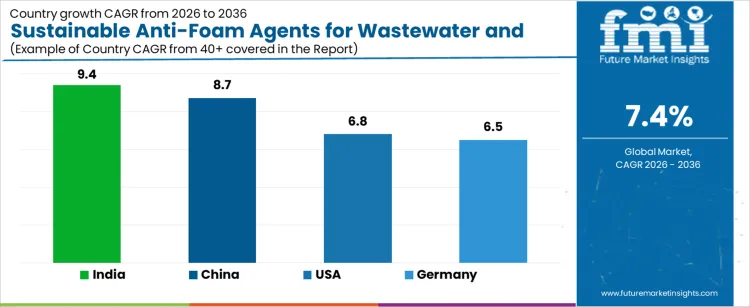
Key regions driving the market include India, which leads with the highest CAGR of 9.4%, driven by rapid industrialization, urbanization, and a focus on sustainable waste treatment. China follows closely with an 8.7% CAGR, supported by its growing infrastructure for wastewater and biogas systems. The USA and Germany show steady growth at 6.8% and 6.5%, respectively, due to increasing regulatory pressures and demand for environmentally friendly solutions in wastewater management. As the global focus on sustainability intensifies, the market for sustainable anti-foam agents in wastewater and biogas plants is poised for continued expansion, with both regional and global drivers fueling its growth.
Sustainable Anti‑Foam Agents for Wastewater and Biogas Plants Market Key Takeaways
| Metric | Value |
|---|---|
| Industry Value (2026) | USD 417 million |
| Forecast Value (2036) | USD 852 million |
| Forecast CAGR (2026 to 2036) | 7.4% |
How is the Global Sustainable Anti‑Foam Agents for Wastewater and Biogas Plants Sector Advancing?
The global sustainable anti‑foam agents for wastewater and biogas plants market is growing as operators increasingly turn to eco‑friendly solutions that improve process efficiency while minimizing environmental impact. Wastewater treatment and biogas production systems often face foam formation, which can disrupt operations, reduce treatment effectiveness, and increase maintenance costs. Sustainable anti‑foam agents are designed to control and prevent excessive foam using biodegradable, low‑toxicity formulations that reduce the potential harm associated with traditional chemical defoamers.
Adoption of sustainable anti‑foam agents is rising due to tightening environmental regulations and growing demand for greener wastewater and biogas processing technologies. These agents enhance operational stability, enabling plants to maintain consistent performance in treatment tanks, digesters, and fermenters. Innovations in anti‑foam chemistry have improved product effectiveness across diverse operational conditions while ensuring that formulations align with environmental compliance standards. This has broadened their appeal across municipal wastewater facilities, industrial treatment plants, and renewable energy producers relying on biogas systems.
The sustainable anti‑foam agents market is expected to expand as wastewater infrastructure continues to modernize and biogas production gains momentum as a renewable energy source. Operators are increasingly focused on solutions that deliver high performance without compromising environmental goals. Challenges such as balancing cost competitiveness with advanced formulation benefits and ensuring compatibility with varied plant processes may influence adoption rates. Nonetheless, as industry priorities align more closely with sustainability and operational efficiency, demand for sustainable anti‑foam agents will continue to rise globally.
What Is the Segment-Wise Analysis for the Global Sustainable Anti-Foam Agents for Wastewater and Biogas Plants Market?
The global sustainable anti-foam agents for wastewater and biogas plants market is segmented by chemistry type and application area. Bio-based oils & esters (plant-derived) lead the market with a 26% share due to their eco-friendly nature and effectiveness in controlling foam. Other significant chemistry types include silicone-free polymer dispersions, modified fatty acid defoamers, biodegradable mineral-oil alternatives, enzyme-assisted anti-foam formulations, and powder/solid sustainable anti-foam blends. In terms of application areas, municipal wastewater treatment plants (WWTPs) hold the largest share at 34%, followed by industrial wastewater plants (food & beverage, pharma, pulp & paper), biogas digester tanks, sludge handling & dewatering units, and aeration basins.
How Do Bio-Based Oils & Esters (Plant-Derived) Lead the Global Sustainable Anti-Foam Agents Market?
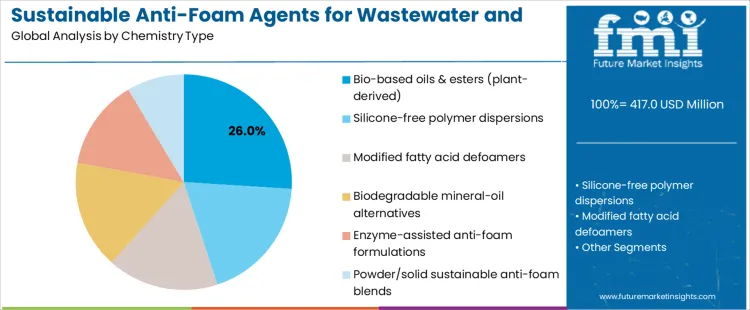
Bio-based oils & esters (plant-derived) hold a 26% share in the global sustainable anti-foam agents for wastewater and biogas plants market due to their renewable origin and effectiveness in controlling foam in wastewater and biogas processes. These agents are environmentally friendly, biodegradable, and offer a sustainable alternative to traditional petrochemical-based defoamers. As industries increasingly shift toward green and sustainable solutions, bio-based oils & esters have gained popularity for their ability to reduce environmental impact while providing effective foam control in municipal wastewater treatment plants and biogas reactors. Their performance and sustainability continue to drive their market leadership.
Why Do Municipal Wastewater Treatment Plants Hold the Largest Market Share?
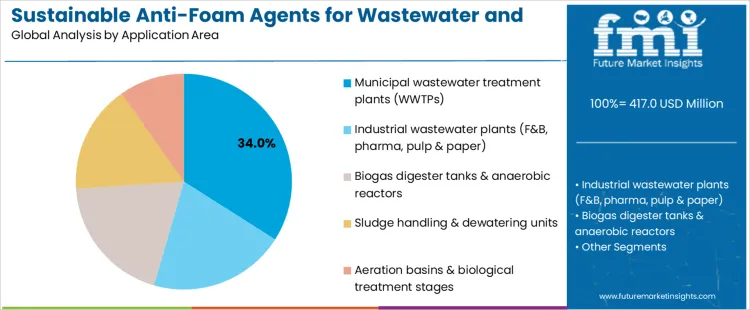
Municipal wastewater treatment plants (WWTPs) hold the largest share of 34% in the global sustainable anti-foam agents market due to their critical role in maintaining water quality by treating large volumes of wastewater. Foam formation in WWTPs can hinder treatment processes and affect plant efficiency. Sustainable anti-foam agents, such as bio-based oils & esters, are widely used to control foam without harming the environment. As environmental regulations become stricter, municipal plants are increasingly adopting green alternatives to manage foam and ensure compliance. This growing demand for eco-friendly solutions in wastewater treatment plants drives their dominant position in the market.
What Is Driving the Sustainable Anti-Foam Agents for Wastewater and Biogas Plants Market?
The sustainable anti foam agents for wastewater and biogas plants market is driven by increasing global efforts to enhance treatment efficiency while reducing environmental impact. Wastewater and anaerobic digestion processes often generate persistent foam that disrupts operations, reduces biogas yield, and increases maintenance costs. Traditional anti foam chemicals can be toxic or non biodegradable, posing risks to ecosystems and downstream discharge. Growing regulatory pressure to adopt eco friendly chemicals, alongside rising wastewater treatment capacity and biogas production, is boosting demand for sustainable, low toxicity anti foam agents that control foam effectively without compromising environmental safety.
What Factors Are Limiting Adoption of Sustainable Anti-Foam Agents in Wastewater and Biogas Plants?
Adoption of sustainable anti-foam agents is sometimes constrained by cost and performance perceptions. Eco-friendly formulations can carry higher upfront prices compared with conventional silicone or mineral oil-based anti-foams, leading some operators to favor cheaper alternatives. There can also be concerns about effectiveness in highly variable wastewater streams, where foam characteristics differ by influent composition. Limited awareness of long-term cost savings from reduced environmental compliance risk and the benefits of biodegradable agents can slow market uptake. Availability of standardized performance data and regional supply variability further challenge broader adoption.
How Are Innovations Shaping the Sustainable Anti-Foam Agents for Wastewater and Biogas Plants Market?
Innovations in sustainable anti-foam agents focus on advanced bio-based chemistries that deliver high efficacy while meeting stringent environmental standards. New formulations use biodegradable surfactants, natural polymers, and tailored emulsion technologies to suppress foam across a wide range of process conditions. Research is improving stability and long-term performance, reducing dosing frequency and chemical consumption. Integration with plant monitoring systems enables optimized dosing, minimizing waste and cost. Collaboration between chemical producers and wastewater/biogas operators is accelerating customized solutions that address specific foam challenges in diverse treatment environments.
What is the Growth Outlook for the Sustainable Anti-Foam Agents for Wastewater and Biogas Plants Market by Country?
| Country | CAGR (%) |
|---|---|
| Germany | 6.5% |
| USA | 6.8% |
| China | 8.7% |
| India | 9.4% |
The sustainable anti-foam agents for wastewater and biogas plants market is growing steadily across key regions, with India leading at a 9.4% CAGR, driven by increasing industrialization and the growing need for waste treatment solutions. China follows closely with 8.7%, supported by rapid urbanization, expanding wastewater treatment infrastructure, and biogas production. The USA shows moderate growth at 6.8%, fueled by rising demand for sustainable solutions in wastewater treatment and biogas production. Germany’s market grows at 6.5%, backed by strong environmental regulations and a commitment to eco-friendly technologies. As the demand for cleaner and more efficient waste management continues to rise, the market for sustainable anti-foam agents in these regions is expected to grow.
Why is India Leading in the Sustainable Anti-Foam Agents for Wastewater and Biogas Plants Market?
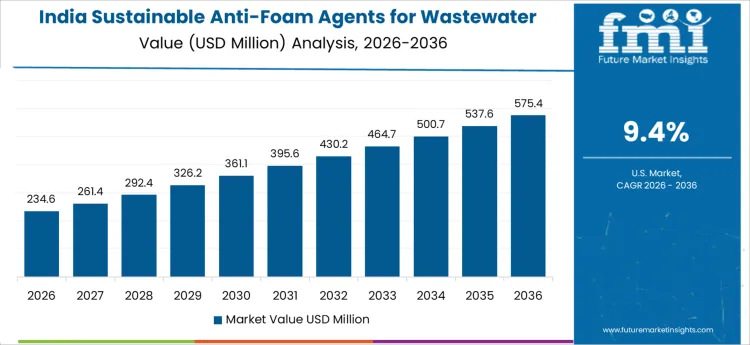
India’s sustainable anti-foam agents for wastewater and biogas plants market is growing at 9.4%, driven by the country’s rapid industrialization, urbanization, and increasing focus on environmental management. With a rapidly expanding population and industrial base, the demand for effective wastewater treatment and biogas production solutions is on the rise. As India focuses on improving its waste treatment infrastructure and increasing renewable energy generation, particularly from biogas, the need for sustainable anti-foam agents is growing. Government initiatives to improve water quality and waste management, along with growing awareness about pollution control, are accelerating the adoption of these eco-friendly agents. As India continues to invest in sustainable technologies, the market for sustainable anti-foam agents in wastewater and biogas plants is expected to see strong and continued growth.
What is Contributing to the Growth of the Sustainable Anti-Foam Agents for Wastewater and Biogas Plants Market in China?
China’s sustainable anti-foam agents for wastewater and biogas plants market is growing at 8.7%, fueled by the country’s rapid urbanization, industrial growth, and expanding wastewater treatment infrastructure. As China continues to improve its environmental regulations and enhance waste management capabilities, there is increasing demand for sustainable anti-foam agents to optimize biogas production and wastewater treatment processes. The government’s emphasis on reducing pollution and improving the efficiency of wastewater treatment systems is encouraging the adoption of eco-friendlier solutions. With the expansion of biogas plants and the increasing focus on renewable energy, China’s market for sustainable anti-foam agents is expected to continue to grow strongly, driven by both regulatory frameworks and the need for cleaner waste treatment solutions.
How is the Sustainable Anti-Foam Agents for Wastewater and Biogas Plants Market Expanding in the USA?
The USA’s sustainable anti-foam agents for wastewater and biogas plants market is growing at 6.8%, driven by the increasing demand for efficient and eco-friendly waste management solutions. With rising concerns about wastewater treatment and biogas production, industries in the USA are adopting sustainable alternatives to manage foam generation in these systems. The growing emphasis on green technologies and environmental protection, along with government regulations pushing for cleaner wastewater management, are key factors driving market growth. As biogas production becomes more important for renewable energy generation, the need for sustainable anti-foam agents continues to rise. The USA’s commitment to adopting environmentally friendly technologies in industrial processes supports the steady growth of the market for sustainable anti-foam agents.
What is Contributing to the Growth of the Sustainable Anti-Foam Agents for Wastewater and Biogas Plants Market in Germany?
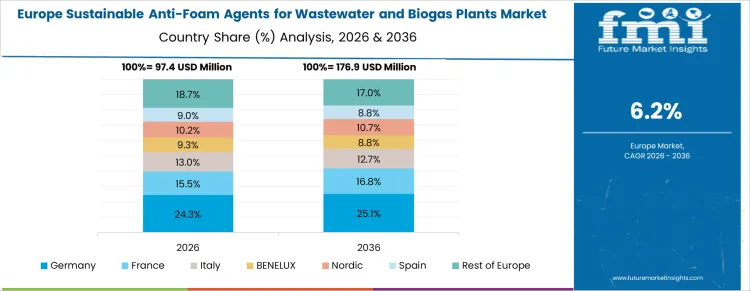
Germany’s sustainable anti-foam agents for wastewater and biogas plants market is growing at 6.5%, supported by the country’s stringent environmental regulations and commitment to cleaner industrial practices. As Germany continues to lead Europe in biogas production and wastewater treatment, there is an increasing need for effective, eco-friendly solutions to control foam in these systems. The adoption of sustainable anti-foam agents is gaining momentum as Germany focuses on reducing environmental impact across various industries. With the country’s emphasis on improving water quality and promoting renewable energy solutions, particularly biogas, the demand for these agents is expected to continue growing. Germany’s strong regulatory framework and focus on clean technologies are contributing to the steady expansion of the sustainable anti-foam agents market in the country.
How Are Companies Competing in the Sustainable Anti Foam Agents for Wastewater and Biogas Plants Market?
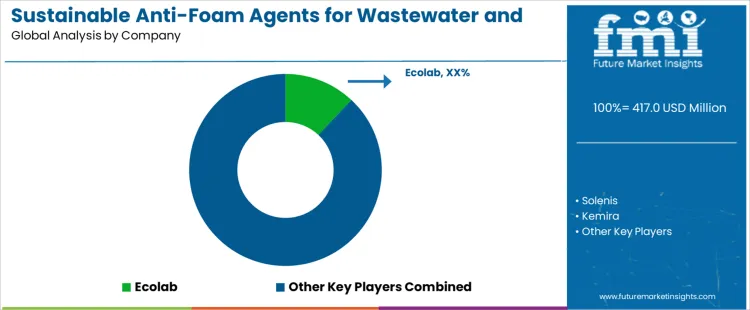
In the sustainable anti foam agents segment for wastewater and biogas plants, Ecolab, Solenis, Kemira, Evonik, Accepta, and Ashland compete with differentiated chemistries and product brochures aimed at tackling foam challenges while aligning with environmental priorities. Ecolab’s product brochures present foam control solutions for wastewater treatment that eliminate or control foam in secondary treatment zones with science based formulations designed for varied process conditions and plant sizes. These materials emphasize ease of dosing, reliable foam suppression, and support services for plant operators. Solenis positions its Antispumin™ defoamers as environmentally friendly foam control agents suited for aerobic and anaerobic processes, with catalogues detailing their use in activated sludge systems, dewatering centrates, and other critical wastewater and biogas applications.
Kemira’s brochures showcase the KemFoamX™ portfolio of eco and process friendly defoamers that cover water based, silicone based, and other chemistries tailored to municipal and industrial wastewater and related digesters. These product briefs highlight biodegradable options and broad application pH and temperature ranges. Evonik’s literature focuses on advanced defoaming additives such as hydrophobic silicas that enhance traditional antifoam formulations, aimed at reducing oil content while maintaining effective foam control and supporting reduced environmental impact. Accepta materials present technically advanced antifoams formulated to handle unwanted foam generation in wastewater and sludge dewatering. Ashland brochures feature foam control agents that include bio based options designed to improve foam collapse and suppression in process waters.
Key Players in Sustainable Anti-Foam Agents for Wastewater and Biogas Plants Market
- Ecolab
- Solenis
- Kemira
- Evonik
- Accepta
- Ashland
Scope of Report
| Items | Values |
|---|---|
| Quantitative Units (2026) | USD million |
| Application Area | Municipal wastewater treatment plants (WWTPs), Industrial wastewater plants (F&B, pharma, pulp & paper), Biogas digester tanks & anaerobic reactors, Sludge handling & dewatering units, Aeration basins & biological treatment stages |
| Chemistry Type | Bio-based oils & esters (plant-derived), Silicone-free polymer dispersions, Modified fatty acid defoamers, Biodegradable mineral-oil alternatives, Enzyme-assisted anti-foam formulations, Powder/solid sustainable anti-foam blends |
| Regions Covered | Asia Pacific, Europe, North America, Latin America, Middle East & Africa |
| Countries Covered | USA, China, Japan, South Korea, India, Australia & New Zealand, ASEAN, Germany, UK, France, Italy, Spain, Nordic, BENELUX, Brazil, Chile, Mexico, Saudi Arabia, Other GCC Countries, Turkey, South Africa, Other African Union |
| Key Companies Profiled | Ecolab, Solenis, Kemira, Evonik, Accepta, Ashland |
| Additional Attributes | Dollar sales by chemistry type, end-use application, and region; regional CAGR and growth outlook; distribution channels including municipal & industrial wastewater treatment plants, biogas reactors; innovation trends in sustainable anti-foam chemistry; competitive positioning of global vs regional suppliers. |
Sustainable Anti-Foam Agents for Wastewater and Biogas Plants Market by Segments
Chemistry Type:
- Bio-based oils & esters (plant-derived)
- Silicone-free polymer dispersions
- Modified fatty acid defoamers
- Biodegradable mineral-oil alternatives
- Enzyme-assisted anti-foam formulations
- Powder/solid sustainable anti-foam blends
Application Area:
- Municipal wastewater treatment plants (WWTPs)
- Industrial wastewater plants (F&B, pharma, pulp & paper)
- Biogas digester tanks & anaerobic reactors
- Sludge handling & dewatering units
- Aeration basins & biological treatment stages
Region:
- Asia Pacific
- China
- Japan
- South Korea
- India
- Australia & New Zealand
- ASEAN
- Rest of Asia Pacific
- Europe
- Germany
- United Kingdom
- France
- Italy
- Spain
- Nordic
- BENELUX
- Rest of Europe
- North America
- United States
- Canada
- Mexico
- Latin America
- Brazil
- Chile
- Rest of Latin America
- Middle East & Africa
- Kingdom of Saudi Arabia
- Other GCC Countries
- Turkey
- South Africa
- Other African Union
- Rest of Middle East & Africa
Bibliography
- United States Environmental Protection Agency. (2023). Technical guidance on foam control and defoamer use in municipal and industrial wastewater treatment systems. EPA Wastewater Management Publications.
- American Water Works Association. (2023). Operational practices for wastewater and sludge treatment including antifoam and defoamer additives. AWWA Standards and Technical Documents.
- Water Environment Federation. (2023). Design, operation, and optimization of wastewater and biogas treatment plants including foam control strategies. WEF Technical Manuals and Reports.
- International Organization for Standardization. (2023). Environmental water quality and performance evaluation methods for antifoam agents in treatment systems. ISO Standards Publications.
Frequently Asked Questions
How big is the sustainable anti-foam agents for wastewater and biogas plants market in 2026?
The global sustainable anti-foam agents for wastewater and biogas plants market is estimated to be valued at USD 417.0 million in 2026.
What will be the size of sustainable anti-foam agents for wastewater and biogas plants market in 2036?
The market size for the sustainable anti-foam agents for wastewater and biogas plants market is projected to reach USD 851.5 million by 2036.
How much will be the sustainable anti-foam agents for wastewater and biogas plants market growth between 2026 and 2036?
The sustainable anti-foam agents for wastewater and biogas plants market is expected to grow at a 7.4% CAGR between 2026 and 2036.
What are the key product types in the sustainable anti-foam agents for wastewater and biogas plants market?
The key product types in sustainable anti-foam agents for wastewater and biogas plants market are bio-based oils & esters (plant-derived), silicone-free polymer dispersions, modified fatty acid defoamers, biodegradable mineral-oil alternatives, enzyme-assisted anti-foam formulations and powder/solid sustainable anti-foam blends.
Which application area segment to contribute significant share in the sustainable anti-foam agents for wastewater and biogas plants market in 2026?
In terms of application area, municipal wastewater treatment plants (wwtps) segment to command 34.0% share in the sustainable anti-foam agents for wastewater and biogas plants market in 2026.
Preview the report firsthand - request a free sample
Get SampleGet the brochure for pricing and purchase details.
Get PDFTable of Content
- Executive Summary
- Global Market Outlook
- Demand-side Trends
- Supply-side Trends
- Technology Roadmap Analysis
- Analysis and Recommendations
- Market Overview
- Market Coverage / Taxonomy
- Market Definition / Scope / Limitations
- Market Background
- Market Dynamics
- Drivers
- Restraints
- Opportunity
- Trends
- Scenario Forecast
- Demand in Optimistic Scenario
- Demand in Likely Scenario
- Demand in Conservative Scenario
- Opportunity Map Analysis
- Product Life Cycle Analysis
- Supply Chain Analysis
- Investment Feasibility Matrix
- Value Chain Analysis
- PESTLE and Porter’s Analysis
- Regulatory Landscape
- Regional Parent Market Outlook
- Production and Consumption Statistics
- Import and Export Statistics
- Market Dynamics
- Global Market Analysis 2021 to 2025 and Forecast, 2026 to 2036
- Historical Market Size Value (USD Million) Analysis, 2021 to 2025
- Current and Future Market Size Value (USD Million) Projections, 2026 to 2036
- Y-o-Y Growth Trend Analysis
- Absolute $ Opportunity Analysis
- Global Market Pricing Analysis 2021 to 2025 and Forecast 2026 to 2036
- Global Market Analysis 2021 to 2025 and Forecast 2026 to 2036, By Chemistry Type
- Introduction / Key Findings
- Historical Market Size Value (USD Million) Analysis By Chemistry Type , 2021 to 2025
- Current and Future Market Size Value (USD Million) Analysis and Forecast By Chemistry Type , 2026 to 2036
- Bio-based oils & esters (plant-derived)
- Silicone-free polymer dispersions
- Modified fatty acid defoamers
- Biodegradable mineral-oil alternatives
- Enzyme-assisted anti-foam formulations
- Powder/solid sustainable anti-foam blends
- Y-o-Y Growth Trend Analysis By Chemistry Type , 2021 to 2025
- Absolute $ Opportunity Analysis By Chemistry Type , 2026 to 2036
- Global Market Analysis 2021 to 2025 and Forecast 2026 to 2036, By Application Area
- Introduction / Key Findings
- Historical Market Size Value (USD Million) Analysis By Application Area, 2021 to 2025
- Current and Future Market Size Value (USD Million) Analysis and Forecast By Application Area, 2026 to 2036
- Municipal wastewater treatment plants (WWTPs)
- Industrial wastewater plants (F&B, pharma, pulp & paper)
- Biogas digester tanks & anaerobic reactors
- Sludge handling & dewatering units
- Aeration basins & biological treatment stages
- Y-o-Y Growth Trend Analysis By Application Area, 2021 to 2025
- Absolute $ Opportunity Analysis By Application Area, 2026 to 2036
- Global Market Analysis 2021 to 2025 and Forecast 2026 to 2036, By Region
- Introduction
- Historical Market Size Value (USD Million) Analysis By Region, 2021 to 2025
- Current Market Size Value (USD Million) Analysis and Forecast By Region, 2026 to 2036
- North America
- Latin America
- Western Europe
- Eastern Europe
- East Asia
- South Asia and Pacific
- Middle East & Africa
- Market Attractiveness Analysis By Region
- North America Market Analysis 2021 to 2025 and Forecast 2026 to 2036, By Country
- Historical Market Size Value (USD Million) Trend Analysis By Market Taxonomy, 2021 to 2025
- Market Size Value (USD Million) Forecast By Market Taxonomy, 2026 to 2036
- By Country
- USA
- Canada
- Mexico
- By Chemistry Type
- By Application Area
- By Country
- Market Attractiveness Analysis
- By Country
- By Chemistry Type
- By Application Area
- Key Takeaways
- Latin America Market Analysis 2021 to 2025 and Forecast 2026 to 2036, By Country
- Historical Market Size Value (USD Million) Trend Analysis By Market Taxonomy, 2021 to 2025
- Market Size Value (USD Million) Forecast By Market Taxonomy, 2026 to 2036
- By Country
- Brazil
- Chile
- Rest of Latin America
- By Chemistry Type
- By Application Area
- By Country
- Market Attractiveness Analysis
- By Country
- By Chemistry Type
- By Application Area
- Key Takeaways
- Western Europe Market Analysis 2021 to 2025 and Forecast 2026 to 2036, By Country
- Historical Market Size Value (USD Million) Trend Analysis By Market Taxonomy, 2021 to 2025
- Market Size Value (USD Million) Forecast By Market Taxonomy, 2026 to 2036
- By Country
- Germany
- UK
- Italy
- Spain
- France
- Nordic
- BENELUX
- Rest of Western Europe
- By Chemistry Type
- By Application Area
- By Country
- Market Attractiveness Analysis
- By Country
- By Chemistry Type
- By Application Area
- Key Takeaways
- Eastern Europe Market Analysis 2021 to 2025 and Forecast 2026 to 2036, By Country
- Historical Market Size Value (USD Million) Trend Analysis By Market Taxonomy, 2021 to 2025
- Market Size Value (USD Million) Forecast By Market Taxonomy, 2026 to 2036
- By Country
- Russia
- Poland
- Hungary
- Balkan & Baltic
- Rest of Eastern Europe
- By Chemistry Type
- By Application Area
- By Country
- Market Attractiveness Analysis
- By Country
- By Chemistry Type
- By Application Area
- Key Takeaways
- East Asia Market Analysis 2021 to 2025 and Forecast 2026 to 2036, By Country
- Historical Market Size Value (USD Million) Trend Analysis By Market Taxonomy, 2021 to 2025
- Market Size Value (USD Million) Forecast By Market Taxonomy, 2026 to 2036
- By Country
- China
- Japan
- South Korea
- By Chemistry Type
- By Application Area
- By Country
- Market Attractiveness Analysis
- By Country
- By Chemistry Type
- By Application Area
- Key Takeaways
- South Asia and Pacific Market Analysis 2021 to 2025 and Forecast 2026 to 2036, By Country
- Historical Market Size Value (USD Million) Trend Analysis By Market Taxonomy, 2021 to 2025
- Market Size Value (USD Million) Forecast By Market Taxonomy, 2026 to 2036
- By Country
- India
- ASEAN
- Australia & New Zealand
- Rest of South Asia and Pacific
- By Chemistry Type
- By Application Area
- By Country
- Market Attractiveness Analysis
- By Country
- By Chemistry Type
- By Application Area
- Key Takeaways
- Middle East & Africa Market Analysis 2021 to 2025 and Forecast 2026 to 2036, By Country
- Historical Market Size Value (USD Million) Trend Analysis By Market Taxonomy, 2021 to 2025
- Market Size Value (USD Million) Forecast By Market Taxonomy, 2026 to 2036
- By Country
- Kingdom of Saudi Arabia
- Other GCC Countries
- Turkiye
- South Africa
- Other African Union
- Rest of Middle East & Africa
- By Chemistry Type
- By Application Area
- By Country
- Market Attractiveness Analysis
- By Country
- By Chemistry Type
- By Application Area
- Key Takeaways
- Key Countries Market Analysis
- USA
- Pricing Analysis
- Market Share Analysis, 2025
- By Chemistry Type
- By Application Area
- Canada
- Pricing Analysis
- Market Share Analysis, 2025
- By Chemistry Type
- By Application Area
- Mexico
- Pricing Analysis
- Market Share Analysis, 2025
- By Chemistry Type
- By Application Area
- Brazil
- Pricing Analysis
- Market Share Analysis, 2025
- By Chemistry Type
- By Application Area
- Chile
- Pricing Analysis
- Market Share Analysis, 2025
- By Chemistry Type
- By Application Area
- Germany
- Pricing Analysis
- Market Share Analysis, 2025
- By Chemistry Type
- By Application Area
- UK
- Pricing Analysis
- Market Share Analysis, 2025
- By Chemistry Type
- By Application Area
- Italy
- Pricing Analysis
- Market Share Analysis, 2025
- By Chemistry Type
- By Application Area
- Spain
- Pricing Analysis
- Market Share Analysis, 2025
- By Chemistry Type
- By Application Area
- France
- Pricing Analysis
- Market Share Analysis, 2025
- By Chemistry Type
- By Application Area
- India
- Pricing Analysis
- Market Share Analysis, 2025
- By Chemistry Type
- By Application Area
- ASEAN
- Pricing Analysis
- Market Share Analysis, 2025
- By Chemistry Type
- By Application Area
- Australia & New Zealand
- Pricing Analysis
- Market Share Analysis, 2025
- By Chemistry Type
- By Application Area
- China
- Pricing Analysis
- Market Share Analysis, 2025
- By Chemistry Type
- By Application Area
- Japan
- Pricing Analysis
- Market Share Analysis, 2025
- By Chemistry Type
- By Application Area
- South Korea
- Pricing Analysis
- Market Share Analysis, 2025
- By Chemistry Type
- By Application Area
- Russia
- Pricing Analysis
- Market Share Analysis, 2025
- By Chemistry Type
- By Application Area
- Poland
- Pricing Analysis
- Market Share Analysis, 2025
- By Chemistry Type
- By Application Area
- Hungary
- Pricing Analysis
- Market Share Analysis, 2025
- By Chemistry Type
- By Application Area
- Kingdom of Saudi Arabia
- Pricing Analysis
- Market Share Analysis, 2025
- By Chemistry Type
- By Application Area
- Turkiye
- Pricing Analysis
- Market Share Analysis, 2025
- By Chemistry Type
- By Application Area
- South Africa
- Pricing Analysis
- Market Share Analysis, 2025
- By Chemistry Type
- By Application Area
- USA
- Market Structure Analysis
- Competition Dashboard
- Competition Benchmarking
- Market Share Analysis of Top Players
- By Regional
- By Chemistry Type
- By Application Area
- Competition Analysis
- Competition Deep Dive
- Ecolab
- Overview
- Product Portfolio
- Profitability by Market Segments (Product/Age /Sales Channel/Region)
- Sales Footprint
- Strategy Overview
- Marketing Strategy
- Product Strategy
- Channel Strategy
- Solenis
- Kemira
- Evonik
- Accepta
- Ashland
- Ecolab
- Competition Deep Dive
- Assumptions & Acronyms Used
- Research Methodology


