

- Industry Size (2026)
- USD 1.2 Bn
- Forecast (2036)
- USD 4.0 Bn
- CAGR (2026 to 2036)
- 12.90%
Sustainable Last-Mile Delivery Network Design Services Market Size, Market Forecast and Outlook By FMI
The sustainable last-mile delivery network design services market was valued at USD 1.1 billion in 2025. Demand is poised to cross USD 1.2 billion in 2026 at a CAGR of 12.90% during the forecast period. Continued investment propels cumulative valuation to USD 4.0 billion through 2036 as municipal governments enforce strict curbside emissions limits that effectively outlaw legacy diesel routing logic.
Logistics directors face immediate operational friction: city planners actively penalize idle times for internal combustion vans, forcing a rapid pivot toward comprehensive last-mile decarbonization advisory. Delaying comprehensive fleet and hub architecture overhauls guarantees catastrophic margin erosion from compliance fines. One non-obvious reality complicates this transition: simply switching to electric vehicles without engaging urban logistics network design services to restructure micro-hub locations increases total cost of ownership due to localized grid charging constraints. Implementing route optimization planning requires fundamental recalculation of suburban-to-urban drop sequences.
Summary of Sustainable Last-Mile Delivery Network Design Services Market
- Sustainable Last-Mile Delivery Network Design Services Market Definition
- Strategic spatial engineering and mathematical route modeling enable zero-emission urban freight distribution. Planners purchase these advisory frameworks to transition legacy warehouse operations into decentralized, electrified micro-hub architectures.
- Demand Drivers in the Market
- Municipal zero-emission zone mandates force fleet operations directors to abandon centralized routing models.
- Escalating inner-city real estate costs compel retail supply chain heads to optimize density algorithms using sustainable urban freight consulting.
- Unpredictable grid charging constraints create pressure for transportation managers to purchase specialized route decarbonization consulting.
- Key Segments Analyzed in the FMI Report
- Network redesign is projected to capture 34.0% share in 2026, as carriers need total system overhauls rather than marginal route tweaks.
- CEP operators are expected to dominate by client type through 2036, compelled by massive package volumes requiring strict SLA adherence.
- Project advisory is poised to lead engagement models, as unique city topographies prevent copy-paste software deployments.
- Routing is anticipated to control 28.0% design focus share, as algorithms dictate vehicle range limitations.
- Dense urban is forecast to hold 39.0% delivery setting share, where curb restrictions apply maximum operational pain.
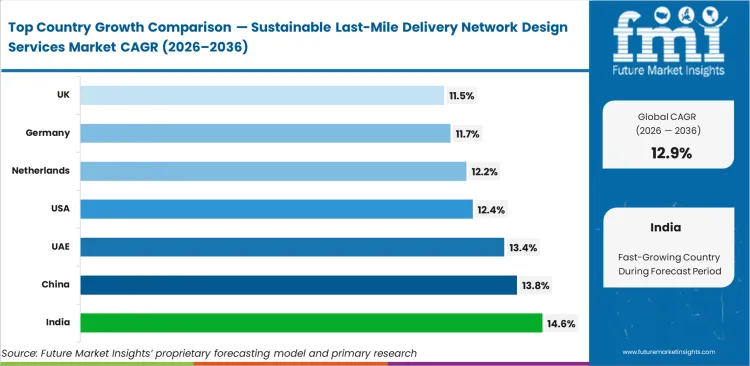
- India: 14.6% compound growth, propelled by severe urban congestion forcing immediate alternative distribution strategies.
- Analyst Opinion at FMI
- Rahul Pandita, Principal Analyst, Technology, at FMI, notes that, "Municipal planners assume mandating electric vehicles solves urban freight emissions. What city transit directors miss entirely is that swapping diesel vans for electric ones without executing a comprehensive e-commerce delivery network redesign simply creates localized grid failures and longer dwell times. We have observed that True network optimization separates package movement into distinct kinetic phases, forcing carrier procurement heads to buy spatial math advisory before they buy a single battery. Organizations focusing purely on green logistics rollout without restructuring geographic hubs face catastrophic bottlenecks within months of deployment."
- Strategic Implications / Executive Takeaways
- Carrier procurement heads must secure micro-hub real estate advisory before competitors lock up viable urban nodes.
- Municipal planning directors face critical political risk if new logistics corridors disrupt residential transit flows.
- Retail supply chain architects who ignore spatial optimization algorithms risk total margin collapse under new congestion pricing.
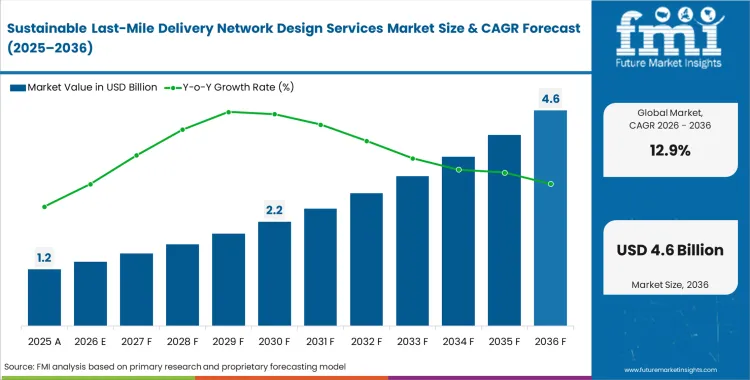
Key Takeaways
| Metric | Details |
|---|---|
| Industry Size (2026) | USD 1.2 billion |
| Industry Value (2036) | USD 4.0 billion |
| CAGR (2026 to 2036) | 12.90% |
Source: Future Market Insights (FMI) analysis, based on proprietary forecasting model and primary research
Once local authorities mandate zero-emission delivery zones, carrier procurement teams scramble to secure proximity real estate. Regulatory triggers compel supply chain architects to procure specialized delivery electrification network planning rather than generic management consulting. Operations managers who previously optimized for driver speed must now calculate load balancing against municipal power availability.
India leads at 14.6% as rapid e-commerce density collides with extreme urban congestion, making India sustainable delivery network consulting an immediate operational requirement. China tracks closely at 13.8% due to aggressive state-sponsored electrification master plans. The United Arab Emirates expands at 13.4%, driven by master-planned green districts requiring novel logistics corridors. The United States advances at 12.4% because early-stage municipal freight planning leaves massive white space for private-sector pilots, accelerating demand for sustainable last-mile delivery services in the United States. The Netherlands expands at 12.2%, supported by mature micro-hub experimentation. Germany registers 11.7% growth while the United Kingdom posts 11.5% as strict policy frameworks create steady rather than explosive redesign cycles. Underlying all geographic divergence is a fundamental split between markets forcing change via regulation versus those dependent on sheer volumetric gridlock.
Sustainable Last-Mile Delivery Network Design Services Market Definition
Architectural engineering and spatial planning algorithms required to build zero-emission urban distribution matrices define this sector. Operations managers purchase green last-mile delivery consulting to map micro-hub locations, calculate grid-constrained route topologies, and synchronize multi-modal freight handoffs. Value generation relies on solving complex geospatial math rather than executing physical package movement.
Sustainable Last-Mile Delivery Network Design Services Market Inclusions
Consulting frameworks addressing curbside management systems fall firmly within scope. Project advisory contracts focused on deploying connected logistics platforms represent core revenue streams. Geographic information system modeling for parcel locker location planning constitutes a major inclusion parameter.
Sustainable Last-Mile Delivery Network Design Services Market Exclusions
Physical construction of distribution centers sits outside analytical boundaries because structural engineering requires fundamentally different contractor ecosystems. Purchase of electric vans is excluded since vehicle procurement represents capital expenditure rather than service-based low-emission delivery network design. Basic routing software subscriptions lacking customized topological advisory fall into different tracking categories.
Sustainable Last-Mile Delivery Network Design Services Market Research Methodology
- Primary Research: Carrier network directors, municipal freight planners, and retail supply chain architects.
- Desk Research: Urban planning zoning filings, municipal zero-emission zone mandates, and real estate micro-hub permit registries.
- Market-Sizing and Forecasting: Advisory contract values disclosed in public-private partnership urban logistics grants.
- Data Validation and Update Cycle: Cross-referenced against commercial real estate absorption rates for inner-city logistics facilities.
Segmental Analysis
Sustainable Last-Mile Delivery Network Design Services Market Analysis by Service Type
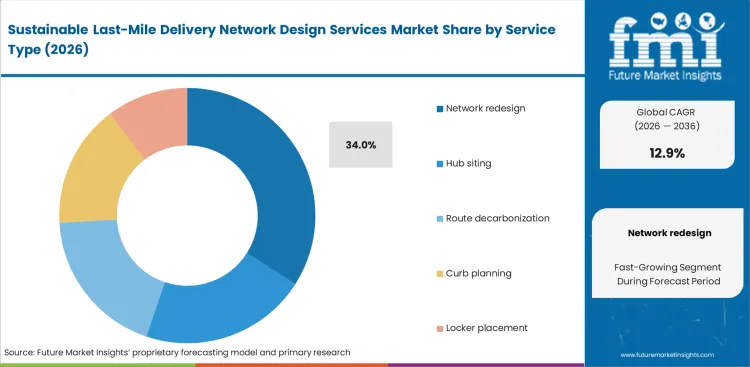
Legacy node optimization algorithms fail completely when introduced to battery drain variables and restricted municipal operating windows. Network redesign holds 34.0% share because carrier operations directors realize patching old routing logic with electric vehicle plugins causes cascading delivery failures. Complete architectural teardowns replace incremental upgrades, settling the debate of route optimization vs network redesign in favor of overhaul. Procurement managers authorize massive project advisory budgets because starting from scratch prevents compounding errors embedded in historical diesel-based models.
FMI's analysis indicates true value creation happens not in mapping roads, but in mapping power availability across specific transit corridors. What generalist consultants misunderstand is that dense urban redesigns prioritize dwell-time predictability over pure transit speed, fundamentally altering how success gets measured. Supply chain executives who attempt partial decarbonization without full network redesign inevitably face stranded assets when local power grids refuse peak-hour charging loads. Modern delivery software solutions require this underlying logic to function.
- Route fragmentation prevention: Legacy algorithms split manifests based on geography alone. Operations managers face severe SLA breaches when electric vans deplete batteries mid-route.
- Grid overload mitigation: Uncoordinated depot charging triggers utility demand penalties. Facility directors require synchronized power-draw models to maintain operational margins.
- Curbside friction resolution: Ignoring local parking restrictions generates catastrophic fine accumulation. Fleet coordinators must integrate municipal zoning rules to capture true efficiency gains.
Sustainable Last-Mile Delivery Network Design Services Market Analysis by Client Type
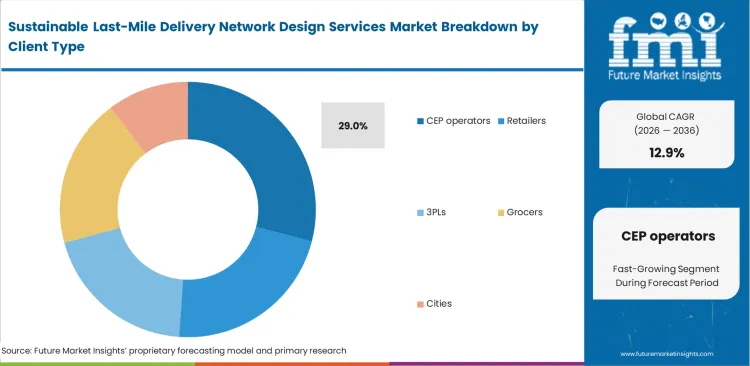
Massive volume requirements collide directly with increasingly hostile municipal traffic policies. Courier, Express, and Parcel (CEP) operators dominate this category, driven by an existential need to maintain sub-two-day promises inside regulated zero-emission zones. Fleet procurement heads engage specialized design firms to model mathematically perfect transfer points between heavy incoming freight and light outgoing cargo bikes, especially critical for quick commerce delivery network design.
According to FMI's estimates, massive logistics giants spend millions on advisory services specifically to avoid localized public relations disasters regarding congestion. Real-world implementation reveals an ironic truth: smaller regional carriers executing targeted urban courier network optimization often achieve sustainable metrics faster than Tier-1 operators because legacy giants must dismantle entrenched hub-and-spoke infrastructure before building decentralized node networks. Delaying this architectural pivot leaves global logistics directors vulnerable to aggressive agility-focused startups capturing high-margin premium delivery tiers. Advanced green delivery initiatives demand this rigorous initial modeling.
- Volume density threshold: Triggering external advisory engagements requires reaching specific package-per-square-mile metrics. Regional directors authorize spend when internal Excel models break down.
- Pilot program validation: Testing micro-hub concepts proves theoretical mathematical gains. Supply chain heads demand physical proof-of-concept before funding full regional rollouts.
- Multi-city scaling: Standardizing node architecture across varying municipal topographies guarantees long-term consulting relationships. Global vice presidents renew contracts to maintain deployment momentum.
Sustainable Last-Mile Delivery Network Design Services Market Analysis by Engagement Model
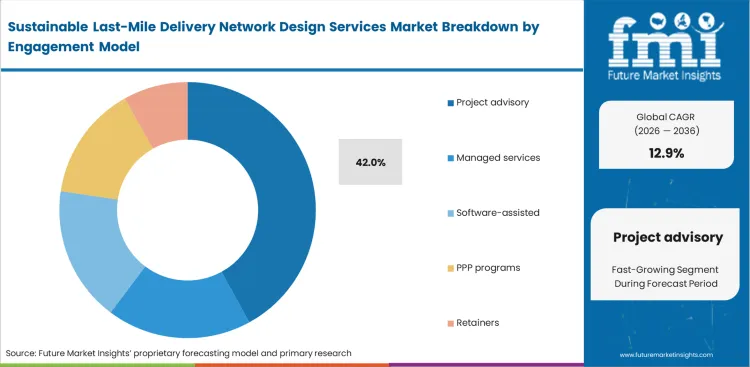
Determining whether to buy a static blueprint or rent ongoing analytical capacity represents primary friction for retail logistics planners. Project advisory commands 42.0% share as companies desperately seek initial navigational roadmaps through complex new urban regulations. Supply chain issue specific last-mile optimization RFP documents requiring bespoke, high-touch consulting engagements to map out facility transitions rather than buying off-the-shelf software. Based on FMI's assessment, these upfront consulting sprints establish physical coordinates for subsequent infrastructure deployment.
A critical measurement gap exists in standard evaluations: consultants often optimize for theoretical peak efficiency, while seasoned operations directors know whether anomalies degrade perfectly modeled networks by thirty percent on day one. Opting for cheap, generalized software-assisted planning instead of securing premium last-mile delivery consultants leaves route managers blind to hyper-local municipal zoning quirks. Complex global outsourcing moves rely entirely on this foundational intelligence.
- Capital misallocation avoidance: Siting distribution nodes incorrectly destroys years of capital expenditure. Procurement teams justify advisory fees by preventing catastrophic real estate blunders.
- Hidden transition expenses: Running parallel diesel and electric networks temporarily crushes profit margins. Finance directors rely on expert modeling to minimize overlapping operational pain.
- Lifecycle asset planning: Accurate spatial modeling extends vehicle lifespan through optimized battery cycles. Fleet managers capture total lifecycle savings that dwarf initial consulting costs.
Sustainable Last-Mile Delivery Network Design Services Market Analysis by Design Focus
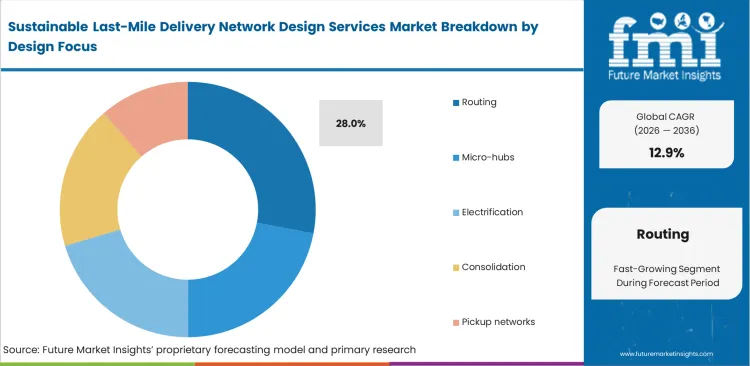
Mathematical complexity underpinning multi-stop, variable-load, battery-constrained itineraries brings high consulting value. Routing captures 28.0% share because algorithms dictate physical reality across every subsequent infrastructure decision, deeply influencing delivery density optimization services. Dispatch supervisors absolutely must possess foolproof sequencing logic before purchasing expensive electric fleets or securing micro-hub leases. FMI analysts note that solving travelling salesperson problems becomes exponentially harder when evaluating micro-hubs vs parcel lockers within zero-emission windows.
What vendor marketing brochures obscure is that perfect routing algorithms remain entirely useless if municipal curbside rules prevent actual package handoffs at calculated destinations. Planners prioritizing hardware acquisition over rigorous spatial sequencing logic inevitably deploy expensive assets that sit idle awaiting optimized dispatch instructions. Executing efficient delivery management programs demands this prior spatial resolution.
- Baseline algorithmic audit: Identifying inefficiencies inside current diesel routes highlights immediate margin leaks. Dispatch supervisors launch optimization journeys by analyzing historical failure data.
- Constraint injection modeling: Adding battery range and payload limits shatters legacy logic. Network architects simulate electric transitions virtually before committing physical capital.
- Dynamic sequence execution: Linking predictive models to real-time traffic data finalizes modernization. Operations vice presidents achieve peak profitability only after mastering this final synchronization.
Sustainable Last-Mile Delivery Network Design Services Market Analysis by Delivery Setting
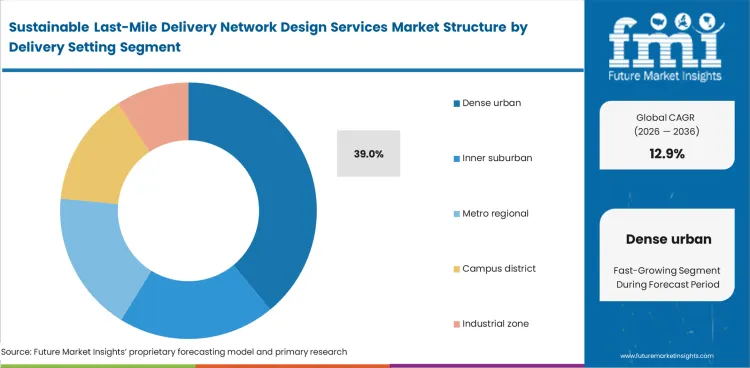
Crippling fines and extreme brand damage await logistics providers failing to adapt to inner-city realities. Dense urban settings hold 39.0% share due to overwhelming regulatory pressure combined with sheer package volume. City logistics directors face immediate mandates to execute curbside freight planning services, removing heavy commercial vehicles from pedestrian-heavy corridors. As per FMI's projection, redesigning highly congested matrices requires assessing cargo bikes vs electric vans last mile capabilities to ensure seamless synchronization at micro-hub transfer points.
A fascinating practitioner paradox defines this segment: optimizing dense urban delivery often means intentionally slowing down line-haul transit speeds to ensure perfect synchronization at these nodes. Companies attempting to force traditional suburban drop-sizes into dense urban environments suffer severe driver retention crises as operators battle impossible parking conditions. Supporting on-demand delivery grids necessitates mastering these hyper-local density rules.
- Baseline compliance parity: Meeting basic zero-emission mandates keeps operators legally viable. Regional managers secure foundational designs simply to avoid municipal bans.
- High-density friction points: Complex high-rise buildings destroy standard routing metrics. Delivery coordinators require specialized vertical-transit modeling to maintain profitability.
- Elite execution standards: Delivering perishable goods across extreme congestion demands flawless spatial math. Premium logistics directors mandate rigorous algorithmic testing before launching rapid-commerce tiers.
Sustainable Last-Mile Delivery Network Design Services Market Drivers, Restraints, and Opportunities
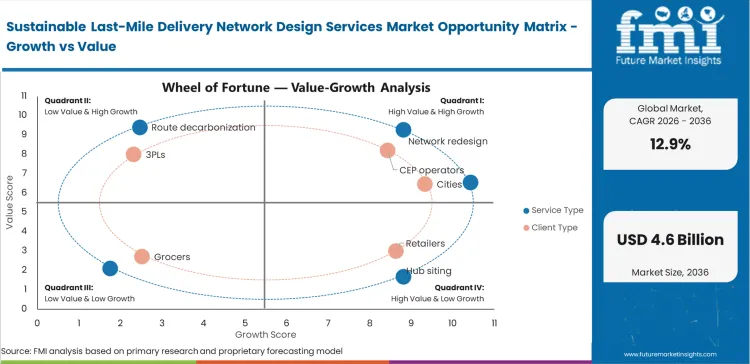
Immediate municipal threats regarding inner-city combustion engine bans force logistics vice presidents into urgent action. Delaying spatial redesign risks complete exclusion from high-revenue urban retail corridors within thirty-six months. E-commerce density has mathematically broken traditional hub-and-spoke models, causing severe margin degradation on every dispatched van. Fleet operations directors cannot simply purchase electric vehicles; they must completely reconstruct depot topologies to accommodate localized grid limits and shorter transit ranges. Severe congestion pricing initiatives globally accelerate this timeline, driving massive capital toward sustainable logistics consulting firms and transforming sustainable network design from a corporate social responsibility talking point into an existential operational requirement.
Fragmented municipal data siloes present massive friction slowing rapid advisory deployments. City planners rarely share standardized zoning, curbside mapping, or grid capacity metrics with private logistics hub siting consultancy partners. This information vacuum forces network architects into painstaking manual data collection, drastically extending project timelines and inflating consulting fees. While open-data consortiums attempt standardization, competing local government jurisdictions continue releasing incompatible digital twin formats. Real estate managers face multi-month delays simply trying to determine if desired micro-hub locations possess sufficient industrial zoning and electrical capacity.
Opportunities in the Sustainable Last-Mile Delivery Network Design Services Market
- Grid-aware scheduling models: Dispatch directors unlock massive operational savings by syncing vehicle charging with off-peak utility pricing.
- Dynamic curbside bidding: Logistics coordinators gain competitive advantage by integrating freight management systems with municipal smart-curb reservation platforms.
- Multi-tenant micro-hub sharing: Procurement heads reduce capital burden by co-designing shared neutral-host consolidation facilities alongside traditional competitors.
Regional Analysis
According to the regional assessment, the Sustainable Last‑Mile Delivery Network Design Services Market spans more than 40 countries and is categorized across five major regions: North America, Europe, Asia‑Pacific, the Middle East & Africa, and Latin America.
.webp "Top Country Growth Comparison Sustainable Last Mile Delivery Network Design Services Market Cagr (2026 2036)")
| Country | CAGR (2026 to 2036) |
|---|---|
| India | 14.6% |
| China | 13.8% |
| United Arab Emirates | 13.4% |
| United States | 12.4% |
| Netherlands | 12.2% |
| Germany | 11.7% |
| United Kingdom | 11.5% |
Source: Future Market Insights (FMI) analysis, based on proprietary forecasting model and primary research
Asia Pacific Sustainable Last-Mile Delivery Network Design Services Market Analysis
Extreme e-commerce volume colliding with hyper-dense infrastructure defines architectural planning across this territory. Logistics vice presidents abandon Western hub models, prioritizing highly localized consolidation nodes that feed vast armies of electric two-wheelers. FMI observes that government mandates act as primary accelerators, forcing entire supply chains to overhaul routing logic overnight. Spatial consultants must integrate chaotic informal traffic patterns into rigid mathematical models to generate usable dispatch algorithms. Regional directors who master this chaotic optimization capture massive first-mover advantage.
- India: Urban gridlock demands immediate alternative distribution strategies across major metropolitan zones. Operations managers realize deploying electric three-wheelers without synchronized charging topologies simply shifts the primary bottleneck from the street back to the depot. Spatial engineers must map highly informal traffic corridors into rigid dispatch algorithms to guarantee strict service level agreements for premium retail brands. Such intensive spatial restructuring propels the India Last-Mile Delivery Network Design Services segment toward a 14.6% CAGR over the 2026 to 2036 forecast period. Retail supply chain heads authorize massive advisory budgets to design micro-hub networks capable of bypassing paralyzed arterial roads entirely. Early adopters secure lucrative contracts handling premium rapid-commerce volumes by mastering these hyper-local density rules long before competitors even secure commercial real estate.
- China: The state-sponsored electrification master plans in China, rewrite municipal freight rules completely, forcing immediate compliance from carrier procurement teams. Inside this regulated environment, regional directors deploy capital toward predictive grid-load balancing rather than mere vehicle acquisition. Network architects integrate carrier systems directly with centralized city traffic control algorithms, creating formidable barriers against foreign logistics entrants. City transit authorities mandate strict spatial reporting, meaning dispatch supervisors cannot legally operate without validated network redesign blueprints. Organizations failing to procure these complex geospatial advisory frameworks face immediate lockouts from high-revenue tier-one commercial districts, destroying their omnichannel fulfillment margins. Demand for consulting expertise across the China last-mile delivery network design services industry registers a 13.8% CAGR from 2026 through 2036. Planners prioritize multi-level underground distribution centers to keep surface streets clear for pedestrian traffic. Operations executives bridging the gap between state-mandated infrastructure platforms and private carrier efficiency metrics dictate competitive survival across these hyper-regulated eastern seaboard cities.
FMI's report includes Japan, South Korea, Australia, and broader Southeast Asian markets. Rapid urbanization across ASEAN capitals necessitates bespoke advisory engagements tailored to unique topographical constraints.
Middle East and Africa Sustainable Last-Mile Delivery Network Design Services Market Analysis
Master-planned green districts built entirely from scratch present unique blank-canvas opportunities for spatial engineers. Supply chain architects bypass legacy infrastructure hurdles, embedding zero-emission logistics corridors directly into foundational blueprints. In FMI's view, this region accelerates faster than mature economies because planners face zero friction from historical diesel-era zoning laws. Project advisory teams and urban freight planning consultants design perfect multi-modal freight tunnels before physical construction begins.
- United Arab Emirates: Visionary logistics corridor investments demand precise spatial modeling long before physical concrete gets poured. Achieving flawless execution inside these specialized zones establishes a blueprint for global smart-city exports, fueling a 13.4% CAGR for the United Arab Emirates last-mile delivery network design services industry between 2026 and 2036. Operations directors deploy autonomous-ready delivery matrices inside luxury mega-developments to completely isolate freight movement from residential traffic. Procurement heads mandate rigorous algorithmic testing to ensure underground consolidation centers directly feed surface-level cargo bikes without causing intersection bottlenecks. Logistics vice presidents who master this unique zero-friction environment capture massive multi-tenant hub contracts, effectively monopolizing premium residential freight access.
Europe Sustainable Last-Mile Delivery Network Design Services Market Analysis
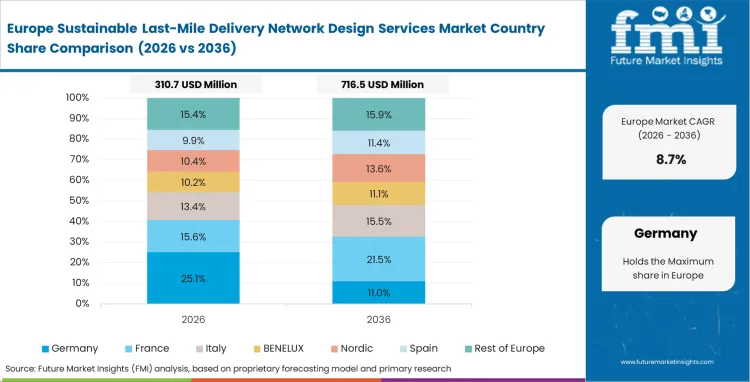
Mature municipal policy frameworks move consulting engagements from experimental pilots to strict compliance architecture. Fleet operations directors operate under severe zero-emission zone mandates that penalize slight deviations. FMI analysts note that spatial engineering here focuses intensely on integrating commercial logistics with existing public transit infrastructure. Designing shared micro-hubs becomes mandatory as historical city centers physically cannot accommodate independent carrier nodes. Utilizing advanced supply chain software coordinates these complex civic interactions.
- Netherlands: Decades of progressive urban planning provide highly structured environments for advanced node architecture, leaving zero room for ad-hoc routing decisions. Fleet operations directors must purchase high-touch project advisory to navigate complex historical city centers that physically reject standard commercial vans. This regulatory pressure pushes the Netherlands Last-Mile Delivery Network Design Services segment to a projected 12.2% CAGR spanning 2026 to 2036. Supply chain heads perfectly sync waterborne freight with electrified cargo-bike dispatch, a multi-modal mastery that drastically lowers total cost per delivery. Participants face immense pressure to execute flawless curb planning algorithms, as municipal authorities heavily penalize minor dwell-time infractions. Securing exact micro-hub coordinates determines competitive survival, forcing retail logistics planners to prioritize spatial engineering over traditional fleet expansion strategies. Consultants specializing in extremely tight volumetric tolerances command premium retainers, preventing carriers from losing access to lucrative canal-adjacent retail corridors. Advanced algorithmic models help dispatchers avoid sudden infrastructural bottlenecks entirely.
- Germany: Dispatch supervisors cannot finalize route decarbonization strategies without certified spatial consultants validating localized transformer limits. Strict policy frameworks mandate rigorous mathematical proof before fleet transitions occur, eliminating any margin for speculative deployment. Network architects navigate this highly regulated landscape by prioritizing predictive grid-load balancing across vast industrial supply chains. Operating within the Germany Last-Mile Delivery Network Design Services industry, this methodical, compliance-first approach secures an 11.7% CAGR over the 2026 to 2036 forecast window. The environment demands deep integration between municipal power capacities and proprietary carrier dispatch software. Procurement teams attempting to bypass these complete architectural teardowns immediately suffer stranded assets when localized zero-emission zones activate.
- United Kingdom: In the UK, Congestion pricing schemes permanently alter carrier profit equations, forcing immediate pivots toward decentralized consolidation. Forecasting an 11.5% CAGR between 2026 and 2036, the United Kingdom Last-Mile Delivery Network Design Services industry expands rapidly as regional directors rush to secure real estate just outside penalty zones. Capturing specific perimeter coordinates dictates competitive survival over coming decades. Fleet coordinators rely on bespoke project advisory to mathematically model the exact transition point where heavy freight must transfer to zero-emission walking couriers. Operations managers recognize generic routing software fails utterly against hyper-local London traffic regulations.
FMI's report includes France, Italy, Spain, and Nordic territories. Extreme winter weather conditions in northern zones force consultants to fundamentally alter battery-drain algorithms.
Competitive Aligners for Market Players
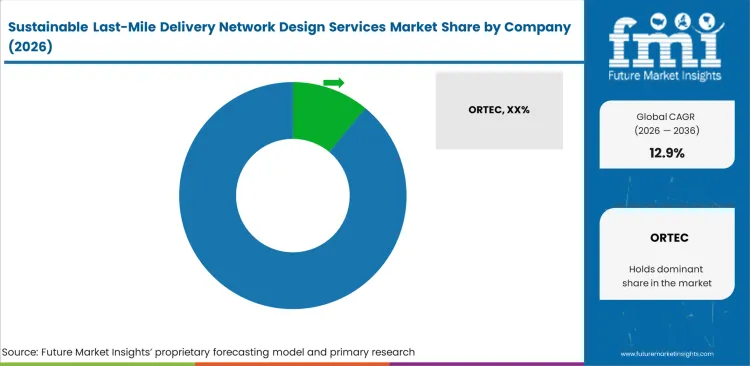
Consulting scale collides directly with hyper-local geospatial nuance inside this specific advisory tier. Global engineering giants like Arcadis and Arup battle against specialized software-born consultancies like ORTEC and PTV Logistics to provide the premier sustainable last mile delivery design services. Municipal freight planners explicitly evaluate vendor proposals based on their ability to ingest chaotic unstructured city data rather than simply presenting polished strategy frameworks. Competition relies heavily on owning proprietary algorithmic engines capable of simulating thousands of vehicle variables against highly specific neighborhood grid topologies. Pure management consultancies struggle here because high-level strategy fails immediately upon encountering localized curbside parking realities.
Incumbent software providers possess massive historical datasets mapping legacy diesel routes, giving them unparalleled baseline visibility. Ricardo and Steer leverage deep public-sector transportation relationships to access restricted municipal planning timelines long before commercial rivals, dominating micro-hub network planning services. Challengers attempting to breach this sector must build extreme hyper-local simulation capability, proving they understand specific intersection bottlenecks in targeted cities. Advanced supply chain analytics requires more than just generic math; it demands empirical validation across hundreds of real-world urban deployments.
Carrier procurement teams fiercely resist becoming dependent on proprietary mapping black boxes. Logistics vice presidents intentionally fragment advisory contracts, hiring DHL Consulting for broad network strategy while retaining niche spatial engineers for exact micro-hub siting. This conscious uncoupling prevents software lock-in and maintains operational leverage. Moving forward, competitive dominance requires blending hardware-agnostic routing algorithms with deep civic engineering relationships, forcing vendors to bridge massive gaps between private enterprise efficiency and public infrastructure constraints.
Key Players in Sustainable Last-Mile Delivery Network Design Services Market
- ORTEC
- PTV Logistics
- Arcadis
- Arup
- Ricardo
- Steer
- DHL Consulting
Scope of the Report
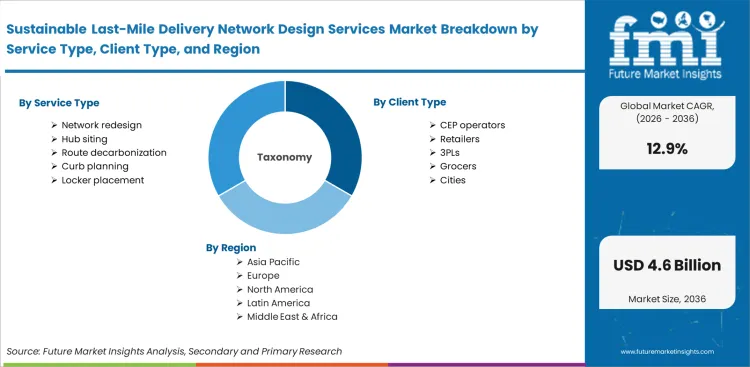
| Metric | Value |
|---|---|
| Quantitative Units | USD 1.2 billion to USD 4.0 billion, at a CAGR of 12.90% |
| Market Definition | Strategic spatial engineering and mathematical route modeling enable zero-emission urban freight distribution. Planners purchase these advisory frameworks to transition legacy warehouse operations into decentralized, electrified micro-hub architectures. |
| Segmentation | Service type, Client type, Engagement model, Design focus, Delivery setting, Region |
| Regions Covered | North America, Europe, Asia Pacific, Middle East and Africa, Latin America |
| Countries Covered | United States, Germany, United Kingdom, Netherlands, China, India, United Arab Emirates |
| Key Companies Profiled | ORTEC, PTV Logistics, Arcadis, Arup, Ricardo, Steer, DHL Consulting |
| Forecast Period | 2026 to 2036 |
| Approach | Advisory contract values disclosed in public-private partnership urban logistics grants. |
Source: Future Market Insights (FMI) analysis, based on proprietary forecasting model and primary research
Sustainable Last-Mile Delivery Network Design Services Market Analysis by Segments
Service type
- Network redesign
- Hub siting
- Route decarbonization
- Curb planning
- Locker placement
Client type
- CEP operators
- Retailers
- 3PLs
- Grocers
- Cities
Engagement model
- Project advisory
- Managed services
- Software-assisted
- PPP programs
- Retainers
Design focus
- Routing
- Micro-hubs
- Electrification
- Consolidation
- Pickup networks
Delivery setting
- Dense urban
- Inner suburban
- Metro regional
- Campus district
- Industrial zone
Region:
- North America
- United States
- Canada
- Europe
- Germany
- United Kingdom
- France
- Italy
- Spain
- Asia Pacific
- China
- Japan
- South Korea
- Taiwan
- Singapore
- Latin America
- Brazil
- Mexico
- Argentina
- Middle East & Africa
- GCC Countries
- South Africa
Bibliography
- Bonilla, M. A. M., Bouzon, M., & Peña-Montoya, C. C. (2024, June). Taxonomy of key practices for a sustainable Last-Mile logistics network in E-Retail: A comprehensive literature review. Cleaner Logistics and Supply Chain, 11, 100149.
- C40 Cities. (2024). Urban logistics for ambitious climate cities: Policy brief.
- Jaller, M., Pahwa, A., Saphores, J.-D., & Hyland, M. (2024). Benefits, challenges, and opportunities of different last-mile delivery strategies (Report No. UC-ITS-RIMI-3H). University of California Institute of Transportation Studies.
- Mantecchini, L., et al. (2025, March). Last Mile Urban Freight Distribution: A modelling framework for assessing the potential of e-cargo bikes. Logistics, 5(1), 31.
- Maxner, T., Dalla Chiara, G., & Goodchild, A. (2024). The state of sustainable urban last-mile freight planning in the United States. Journal of the American Planning Association.
- Pahwa, A., & Jaller, M. (2025, September). Assessing the sustainability of last-mile distribution strategies to manage expedited shipping with dynamic and stochastic demand. Transportation Research Part E: Logistics and Transportation Review, 201, 104273.
- Rose, W. J., et al. (2025, October). Activating the consumer: Toward more sustainable last-mile delivery. Journal of Business Logistics.
- World Economic Forum. (2024, December). Transforming urban logistics: Sustainable and efficient last-mile delivery in cities.
- Zhang, Q., et al. (2025, August). Parcel locker solutions for last mile delivery: A systematic review. Frontiers in Future Transportation, 4.
This bibliography is provided for reader reference. The full FMI report contains the complete reference list with primary source documentation.
This Report Addresses
- Route decarbonization strategies implemented by top CEP operators globally.
- Network redesign project advisory valuations mapped across major urban centers.
- Hub siting algorithm adoption rates spanning European logistics networks.
- Curb planning software integration hurdles confronting municipal municipal freight strategy directors.
- Electrification design focus changes dictate North American fleet transitions.
- Dense urban delivery setting constraints shaping modern micro-hub architecture.
- Project advisory engagement model pricing structures governing 3PL contracts.
- Spatial optimization mechanisms separating incumbent consultancies from digital startups.
Frequently Asked Questions
What are sustainable last-mile delivery network design services?
Architectural engineering and spatial planning algorithms required to build zero-emission urban distribution matrices define this sector. Operations managers purchase these capabilities to map micro-hub locations, calculate grid-constrained route topologies, and synchronize multi-modal freight handoffs.
How big is the sustainable last-mile delivery network design services market?
Revenue generated through advisory contracts reaches USD 1.2 billion initially. Operations directors authorize these baseline expenditures recognizing legacy optimization logic fails completely inside newly regulated zero-emission zones.
What drives growth in sustainable urban logistics design services?
Municipal zero-emission zone mandates force fleet operations directors to abandon centralized routing models. Extreme congestion pricing initiatives transform sustainable network design from a corporate social responsibility talking point into an existential operational requirement.
What is the ROI of redesigning a last-mile delivery network?
Accurate spatial modeling extends vehicle lifespan through optimized battery cycles. Fleet managers capture total lifecycle savings that dwarf initial consulting costs, while preventing catastrophic compliance fines associated with legacy diesel deployments.
Who offers sustainable last-mile delivery network design services?
Global engineering giants like Arcadis and Arup battle against specialized software-born consultancies like ORTEC and PTV Logistics. Niche players like Steer and DHL Consulting capture specialized segments of spatial execution.
How do micro-hubs reduce last-mile emissions?
Micro-hubs decentralize distribution, allowing heavy freight to terminate at city perimeters. Delivery coordinators utilize these transfer points to seamlessly hand off final-mile volume to zero-emission cargo bikes and walking couriers.
Why do cities need urban freight planning?
Unprecedented urban gridlock forces immediate alternative distribution strategies. Municipal planning directors require rigorous logistics corridor modeling to prevent commercial freight from completely destroying residential transit flows.
How to plan a parcel locker network?
Geographic information system modeling establishes physical coordinates based on pedestrian density and structural availability. Supply chain heads demand mathematical proof-of-concept before committing capital to long-term locker real estate leases.
How to design an EV-ready delivery network?
Executing a successful transition requires modeling grid-aware scheduling systems. Dispatch directors unlock operational viability by syncing vehicle charging algorithms with off-peak utility pricing and localized transformer capacities.
Compare micro-hubs vs parcel lockers for sustainable last-mile delivery
Micro-hubs function as active transfer nodes requiring constant staff orchestration for multi-modal handoffs. Parcel lockers serve as passive terminus points, drastically lowering operational costs but capturing far less bulk freight volume.
Explain the sustainable last-mile delivery network design services market
Consultants and spatial engineers sell mathematical certainty to logistics operators facing decarbonization mandates. True value creation happens not in mapping roads, but in mapping power availability across specific transit corridors.
Why does network redesign command dominance?
Patching old routing logic with electric vehicle plugins causes cascading delivery failures. Complete architectural teardowns replace incremental upgrades because procurement managers realize starting from scratch prevents compounding errors embedded in historical models.
What drives CEP operator engagement?
Massive package volume requirements collide directly with increasingly hostile municipal traffic policies. Courier fleets require mathematically perfect transfer points between heavy incoming freight and light outgoing cargo bikes to maintain strict SLA promises.
How do project advisory contracts retain share?
Supply chain architects require bespoke consulting engagements to map out specific facility transitions rather than buying off-the-shelf software. Upfront consulting sprints establish physical coordinates necessary for subsequent hardware deployment.
Why does routing focus lead segment shares?
Mathematical complexity underpinning multi-stop itineraries dictates physical reality across every subsequent infrastructure decision. Dispatch supervisors absolutely must possess foolproof sequencing logic before purchasing expensive electric fleets or securing micro-hub leases.
What pressure shapes dense urban settings?
City logistics directors face immediate mandates to remove heavy commercial vehicles from pedestrian-heavy corridors. Redesigning highly congested matrices requires combining cargo bikes, walking couriers, and underground consolidation centers.
Why does India present high expansion metrics?
Unprecedented urban gridlock forces immediate alternative distribution strategies. Retail supply chain heads scramble to design micro-hub networks capable of bypassing paralyzed arterial roads entirely.
How does China shape architectural adoption?
Aggressive state-sponsored electrification master plans rewrite municipal freight rules completely. Network architects integrate carrier systems directly with centralized city traffic control algorithms, creating formidable barriers against foreign logistics entrants.
What unique scenario drives United Arab Emirates?
Master-planned green districts built entirely from scratch present unique blank-canvas opportunities. Supply chain architects bypass legacy infrastructure hurdles, embedding zero-emission logistics corridors directly into foundational blueprints.
How do Netherlands policies differ fundamentally?
Decades of progressive urban planning provide highly structured environments for advanced node architecture. Supply chain heads perfectly sync waterborne freight with electrified cargo-bike dispatch, drastically lowering total cost per delivery.
What creates operational friction inside Germany?
Strict policy frameworks mandate rigorous mathematical proof before fleet transitions occur. Network architects prioritize predictive grid-load balancing across vast industrial supply chains to eliminate post-deployment technical failures.
How do United Kingdom congestion schemes function?
Aggressive pricing schemes permanently alter carrier profit equations. Regional directors rush to secure real estate just outside penalty zones because capturing specific perimeter coordinates dictates competitive survival.
What dictates United States adoption logic?
Early-stage municipal freight planning leaves massive white space for private-sector experimentation. Fleet coordinators dictate local network topologies because city governments lag behind in formalizing centralized curbside regulations.
How do retail supply chain architects measure success?
Metrics change from pure transit velocity to dwell-time predictability. Planners optimize dense urban delivery by intentionally slowing down line-haul transit speeds to ensure perfect synchronization at micro-hub transfer points.
Preview the report firsthand - request a free sample
Get SampleGet the brochure for pricing and purchase details.
Get PDFTable of Content
- Executive Summary
- Global Market Outlook
- Demand-side Trends
- Supply-side Trends
- Technology Roadmap Analysis
- Analysis and Recommendations
- Market Overview
- Market Coverage / Taxonomy
- Market Definition / Scope / Limitations
- Research Methodology
- Chapter Orientation
- Analytical Lens and Working Hypotheses
- Market Structure, Signals, and Trend Drivers
- Benchmarking and Cross-market Comparability
- Market Sizing, Forecasting, and Opportunity Mapping
- Research Design and Evidence Framework
- Desk Research Programme (Secondary Evidence)
- Company Annual and Sustainability Reports
- Peer-reviewed Journals and Academic Literature
- Corporate Websites, Product Literature, and Technical Notes
- Earnings Decks and Investor Briefings
- Statutory Filings and Regulatory Disclosures
- Technical White Papers and Standards Notes
- Trade Journals, Industry Magazines, and Analyst Briefs
- Conference Proceedings, Webinars, and Seminar Materials
- Government Statistics Portals and Public Data Releases
- Press Releases and Reputable Media Coverage
- Specialist Newsletters and Curated Briefings
- Sector Databases and Reference Repositories
- FMI Internal Proprietary Databases and Historical Market Datasets
- Subscription Datasets and Paid Sources
- Social Channels, Communities, and Digital Listening Inputs
- Additional Desk Sources
- Expert Input and Fieldwork (Primary Evidence)
- Primary Modes
- Qualitative Interviews and Expert Elicitation
- Quantitative Surveys and Structured Data Capture
- Blended Approach
- Why Primary Evidence is Used
- Field Techniques
- Interviews
- Surveys
- Focus Groups
- Observational and In-context Research
- Social and Community Interactions
- Stakeholder Universe Engaged
- C-suite Leaders
- Board Members
- Presidents and Vice Presidents
- R&D and Innovation Heads
- Technical Specialists
- Domain Subject-matter Experts
- Scientists
- Physicians and Other Healthcare Professionals
- Governance, Ethics, and Data Stewardship
- Research Ethics
- Data Integrity and Handling
- Primary Modes
- Tooling, Models, and Reference Databases
- Desk Research Programme (Secondary Evidence)
- Data Engineering and Model Build
- Data Acquisition and Ingestion
- Cleaning, Normalisation, and Verification
- Synthesis, Triangulation, and Analysis
- Quality Assurance and Audit Trail
- Market Background
- Market Dynamics
- Drivers
- Restraints
- Opportunity
- Trends
- Scenario Forecast
- Demand in Optimistic Scenario
- Demand in Likely Scenario
- Demand in Conservative Scenario
- Opportunity Map Analysis
- Product Life Cycle Analysis
- Supply Chain Analysis
- Investment Feasibility Matrix
- Value Chain Analysis
- PESTLE and Porter’s Analysis
- Regulatory Landscape
- Regional Parent Market Outlook
- Production and Consumption Statistics
- Import and Export Statistics
- Market Dynamics
- Global Market Analysis 2021 to 2025 and Forecast, 2026 to 2036
- Historical Market Size Value (USD Million) Analysis, 2021 to 2025
- Current and Future Market Size Value (USD Million) Projections, 2026 to 2036
- Y-o-Y Growth Trend Analysis
- Absolute $ Opportunity Analysis
- Global Market Pricing Analysis 2021 to 2025 and Forecast 2026 to 2036
- Global Market Analysis 2021 to 2025 and Forecast 2026 to 2036, By Service Type
- Introduction / Key Findings
- Historical Market Size Value (USD Million) Analysis By Service Type , 2021 to 2025
- Current and Future Market Size Value (USD Million) Analysis and Forecast By Service Type , 2026 to 2036
- Network redesign
- Hub siting
- Route decarbonization
- Curb planning
- Locker placement
- Network redesign
- Y-o-Y Growth Trend Analysis By Service Type , 2021 to 2025
- Absolute $ Opportunity Analysis By Service Type , 2026 to 2036
- Global Market Analysis 2021 to 2025 and Forecast 2026 to 2036, By Client Type
- Introduction / Key Findings
- Historical Market Size Value (USD Million) Analysis By Client Type, 2021 to 2025
- Current and Future Market Size Value (USD Million) Analysis and Forecast By Client Type, 2026 to 2036
- CEP operators
- Retailers
- 3PLs
- Grocers
- Cities
- CEP operators
- Y-o-Y Growth Trend Analysis By Client Type, 2021 to 2025
- Absolute $ Opportunity Analysis By Client Type, 2026 to 2036
- Global Market Analysis 2021 to 2025 and Forecast 2026 to 2036, By Engagement Model
- Introduction / Key Findings
- Historical Market Size Value (USD Million) Analysis By Engagement Model, 2021 to 2025
- Current and Future Market Size Value (USD Million) Analysis and Forecast By Engagement Model, 2026 to 2036
- Project advisory
- Managed services
- Software-assisted
- PPP programs
- Retainers
- Project advisory
- Y-o-Y Growth Trend Analysis By Engagement Model, 2021 to 2025
- Absolute $ Opportunity Analysis By Engagement Model, 2026 to 2036
- Global Market Analysis 2021 to 2025 and Forecast 2026 to 2036, By Design Focus
- Introduction / Key Findings
- Historical Market Size Value (USD Million) Analysis By Design Focus, 2021 to 2025
- Current and Future Market Size Value (USD Million) Analysis and Forecast By Design Focus, 2026 to 2036
- Routing
- Micro-hubs
- Electrification
- Consolidation
- Pickup networks
- Routing
- Y-o-Y Growth Trend Analysis By Design Focus, 2021 to 2025
- Absolute $ Opportunity Analysis By Design Focus, 2026 to 2036
- Global Market Analysis 2021 to 2025 and Forecast 2026 to 2036, By Delivery Setting
- Introduction / Key Findings
- Historical Market Size Value (USD Million) Analysis By Delivery Setting, 2021 to 2025
- Current and Future Market Size Value (USD Million) Analysis and Forecast By Delivery Setting, 2026 to 2036
- Dense urban
- Inner suburban
- Metro regional
- Campus district
- Industrial zone
- Dense urban
- Y-o-Y Growth Trend Analysis By Delivery Setting, 2021 to 2025
- Absolute $ Opportunity Analysis By Delivery Setting, 2026 to 2036
- Global Market Analysis 2021 to 2025 and Forecast 2026 to 2036, By Region
- Introduction
- Historical Market Size Value (USD Million) Analysis By Region, 2021 to 2025
- Current Market Size Value (USD Million) Analysis and Forecast By Region, 2026 to 2036
- North America
- Latin America
- Western Europe
- Eastern Europe
- East Asia
- South Asia and Pacific
- Middle East & Africa
- Market Attractiveness Analysis By Region
- North America Market Analysis 2021 to 2025 and Forecast 2026 to 2036, By Country
- Historical Market Size Value (USD Million) Trend Analysis By Market Taxonomy, 2021 to 2025
- Market Size Value (USD Million) Forecast By Market Taxonomy, 2026 to 2036
- By Country
- USA
- Canada
- Mexico
- By Service Type
- By Client Type
- By Engagement Model
- By Design Focus
- By Delivery Setting
- By Country
- Market Attractiveness Analysis
- By Country
- By Service Type
- By Client Type
- By Engagement Model
- By Design Focus
- By Delivery Setting
- Key Takeaways
- Latin America Market Analysis 2021 to 2025 and Forecast 2026 to 2036, By Country
- Historical Market Size Value (USD Million) Trend Analysis By Market Taxonomy, 2021 to 2025
- Market Size Value (USD Million) Forecast By Market Taxonomy, 2026 to 2036
- By Country
- Brazil
- Chile
- Rest of Latin America
- By Service Type
- By Client Type
- By Engagement Model
- By Design Focus
- By Delivery Setting
- By Country
- Market Attractiveness Analysis
- By Country
- By Service Type
- By Client Type
- By Engagement Model
- By Design Focus
- By Delivery Setting
- Key Takeaways
- Western Europe Market Analysis 2021 to 2025 and Forecast 2026 to 2036, By Country
- Historical Market Size Value (USD Million) Trend Analysis By Market Taxonomy, 2021 to 2025
- Market Size Value (USD Million) Forecast By Market Taxonomy, 2026 to 2036
- By Country
- Germany
- UK
- Italy
- Spain
- France
- Nordic
- BENELUX
- Rest of Western Europe
- By Service Type
- By Client Type
- By Engagement Model
- By Design Focus
- By Delivery Setting
- By Country
- Market Attractiveness Analysis
- By Country
- By Service Type
- By Client Type
- By Engagement Model
- By Design Focus
- By Delivery Setting
- Key Takeaways
- Eastern Europe Market Analysis 2021 to 2025 and Forecast 2026 to 2036, By Country
- Historical Market Size Value (USD Million) Trend Analysis By Market Taxonomy, 2021 to 2025
- Market Size Value (USD Million) Forecast By Market Taxonomy, 2026 to 2036
- By Country
- Russia
- Poland
- Hungary
- Balkan & Baltic
- Rest of Eastern Europe
- By Service Type
- By Client Type
- By Engagement Model
- By Design Focus
- By Delivery Setting
- By Country
- Market Attractiveness Analysis
- By Country
- By Service Type
- By Client Type
- By Engagement Model
- By Design Focus
- By Delivery Setting
- Key Takeaways
- East Asia Market Analysis 2021 to 2025 and Forecast 2026 to 2036, By Country
- Historical Market Size Value (USD Million) Trend Analysis By Market Taxonomy, 2021 to 2025
- Market Size Value (USD Million) Forecast By Market Taxonomy, 2026 to 2036
- By Country
- China
- Japan
- South Korea
- By Service Type
- By Client Type
- By Engagement Model
- By Design Focus
- By Delivery Setting
- By Country
- Market Attractiveness Analysis
- By Country
- By Service Type
- By Client Type
- By Engagement Model
- By Design Focus
- By Delivery Setting
- Key Takeaways
- South Asia and Pacific Market Analysis 2021 to 2025 and Forecast 2026 to 2036, By Country
- Historical Market Size Value (USD Million) Trend Analysis By Market Taxonomy, 2021 to 2025
- Market Size Value (USD Million) Forecast By Market Taxonomy, 2026 to 2036
- By Country
- India
- ASEAN
- Australia & New Zealand
- Rest of South Asia and Pacific
- By Service Type
- By Client Type
- By Engagement Model
- By Design Focus
- By Delivery Setting
- By Country
- Market Attractiveness Analysis
- By Country
- By Service Type
- By Client Type
- By Engagement Model
- By Design Focus
- By Delivery Setting
- Key Takeaways
- Middle East & Africa Market Analysis 2021 to 2025 and Forecast 2026 to 2036, By Country
- Historical Market Size Value (USD Million) Trend Analysis By Market Taxonomy, 2021 to 2025
- Market Size Value (USD Million) Forecast By Market Taxonomy, 2026 to 2036
- By Country
- Kingdom of Saudi Arabia
- Other GCC Countries
- Turkiye
- South Africa
- Other African Union
- Rest of Middle East & Africa
- By Service Type
- By Client Type
- By Engagement Model
- By Design Focus
- By Delivery Setting
- By Country
- Market Attractiveness Analysis
- By Country
- By Service Type
- By Client Type
- By Engagement Model
- By Design Focus
- By Delivery Setting
- Key Takeaways
- Key Countries Market Analysis
- USA
- Pricing Analysis
- Market Share Analysis, 2025
- By Service Type
- By Client Type
- By Engagement Model
- By Design Focus
- By Delivery Setting
- Canada
- Pricing Analysis
- Market Share Analysis, 2025
- By Service Type
- By Client Type
- By Engagement Model
- By Design Focus
- By Delivery Setting
- Mexico
- Pricing Analysis
- Market Share Analysis, 2025
- By Service Type
- By Client Type
- By Engagement Model
- By Design Focus
- By Delivery Setting
- Brazil
- Pricing Analysis
- Market Share Analysis, 2025
- By Service Type
- By Client Type
- By Engagement Model
- By Design Focus
- By Delivery Setting
- Chile
- Pricing Analysis
- Market Share Analysis, 2025
- By Service Type
- By Client Type
- By Engagement Model
- By Design Focus
- By Delivery Setting
- Germany
- Pricing Analysis
- Market Share Analysis, 2025
- By Service Type
- By Client Type
- By Engagement Model
- By Design Focus
- By Delivery Setting
- UK
- Pricing Analysis
- Market Share Analysis, 2025
- By Service Type
- By Client Type
- By Engagement Model
- By Design Focus
- By Delivery Setting
- Italy
- Pricing Analysis
- Market Share Analysis, 2025
- By Service Type
- By Client Type
- By Engagement Model
- By Design Focus
- By Delivery Setting
- Spain
- Pricing Analysis
- Market Share Analysis, 2025
- By Service Type
- By Client Type
- By Engagement Model
- By Design Focus
- By Delivery Setting
- France
- Pricing Analysis
- Market Share Analysis, 2025
- By Service Type
- By Client Type
- By Engagement Model
- By Design Focus
- By Delivery Setting
- India
- Pricing Analysis
- Market Share Analysis, 2025
- By Service Type
- By Client Type
- By Engagement Model
- By Design Focus
- By Delivery Setting
- ASEAN
- Pricing Analysis
- Market Share Analysis, 2025
- By Service Type
- By Client Type
- By Engagement Model
- By Design Focus
- By Delivery Setting
- Australia & New Zealand
- Pricing Analysis
- Market Share Analysis, 2025
- By Service Type
- By Client Type
- By Engagement Model
- By Design Focus
- By Delivery Setting
- China
- Pricing Analysis
- Market Share Analysis, 2025
- By Service Type
- By Client Type
- By Engagement Model
- By Design Focus
- By Delivery Setting
- Japan
- Pricing Analysis
- Market Share Analysis, 2025
- By Service Type
- By Client Type
- By Engagement Model
- By Design Focus
- By Delivery Setting
- South Korea
- Pricing Analysis
- Market Share Analysis, 2025
- By Service Type
- By Client Type
- By Engagement Model
- By Design Focus
- By Delivery Setting
- Russia
- Pricing Analysis
- Market Share Analysis, 2025
- By Service Type
- By Client Type
- By Engagement Model
- By Design Focus
- By Delivery Setting
- Poland
- Pricing Analysis
- Market Share Analysis, 2025
- By Service Type
- By Client Type
- By Engagement Model
- By Design Focus
- By Delivery Setting
- Hungary
- Pricing Analysis
- Market Share Analysis, 2025
- By Service Type
- By Client Type
- By Engagement Model
- By Design Focus
- By Delivery Setting
- Kingdom of Saudi Arabia
- Pricing Analysis
- Market Share Analysis, 2025
- By Service Type
- By Client Type
- By Engagement Model
- By Design Focus
- By Delivery Setting
- Turkiye
- Pricing Analysis
- Market Share Analysis, 2025
- By Service Type
- By Client Type
- By Engagement Model
- By Design Focus
- By Delivery Setting
- South Africa
- Pricing Analysis
- Market Share Analysis, 2025
- By Service Type
- By Client Type
- By Engagement Model
- By Design Focus
- By Delivery Setting
- USA
- Market Structure Analysis
- Competition Dashboard
- Competition Benchmarking
- Market Share Analysis of Top Players
- By Regional
- By Service Type
- By Client Type
- By Engagement Model
- By Design Focus
- By Delivery Setting
- Competition Analysis
- Competition Deep Dive
- ORTEC
- Overview
- Product Portfolio
- Profitability by Market Segments (Product/Age /Sales Channel/Region)
- Sales Footprint
- Strategy Overview
- Marketing Strategy
- Product Strategy
- Channel Strategy
- PTV Logistics
- Arcadis
- Arup
- Ricardo
- Steer
- DHL Consulting
- ORTEC
- Competition Deep Dive
- Assumptions & Acronyms Used


