

- Industry Size (2026)
- USD 5.8 Bn
- Forecast (2036)
- USD 17.4 Bn
- CAGR (2026 to 2036)
- 11.6%
Urban Pharma Micro-Depot and Delivery Network Size, Market Forecast and Outlook By FMI
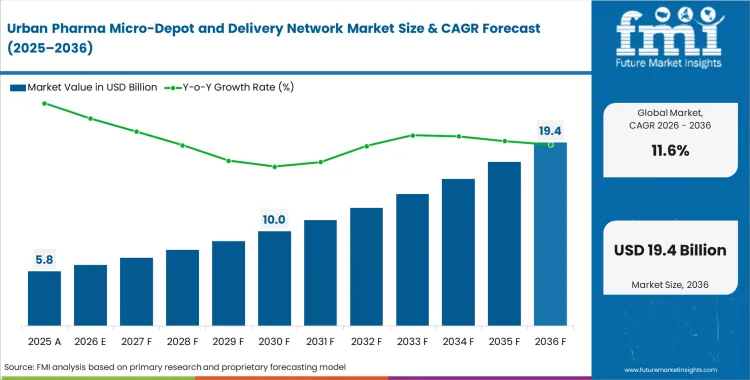
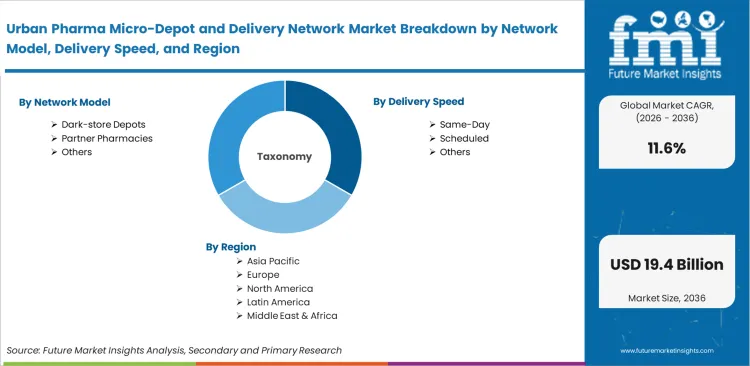
The urban pharma micro-depot delivery network market was valued at USD 5.2 billion in 2025, with sales expected to rise to USD 5.8 billion in 2026, reflecting an 11.6% CAGR through the forecast period. Revenue growth takes the market to USD 17.4 billion by 2036, as retail chains shift from large, centralized fulfillment centers to hyper-localized node networks positioned closer to end-users.
Pharmacy operations leaders experience margin pressure when acute prescriptions move through aging hub-and‑spoke systems. Dense urban corridors expose the limits of centralized dispatch, creating avoidable transit delays and higher failed‑handoff rates. Delaying investment in decentralized nodes forces e-pharmacy operators to outsource more final-mile activity, eroding unit economics on routine medication deliveries. Real estate strategy plays a bigger role in competitive performance than many assume. Access to compact, licensed spaces within commercial buildings often shapes network reach more than small improvements in routing efficiency.
Summary of Urban Pharma Micro-Depot and Delivery Network Market
- Market Snapshot
- The Urban Pharma Micro‑Depot and Delivery Network Market is valued at USD 5.2 billion in 2025 and is projected to reach USD 17.4 billion by 2036.
- The industry is expected to grow at an 11.6% CAGR from 2026 to 2036, creating USD 11.6 billion in incremental opportunity.
- The market sits at the intersection of digital pharmacy demand and regulated healthcare logistics, where fulfillment density, cold‑chain capability, and licensed dispatch controls define competitive position.
- The category operates as a compliance‑sensitive urban distribution network rather than a generic courier segment, as prescription handling, chain‑of‑custody discipline, and temperature management determine operating models.
- Demand and Growth Drivers
- Demand is rising as online pharmacy ordering expands faster than store‑only refill models, prompting operators to adopt micro‑depots that shorten delivery radii and improve service reliability.
- Same‑day service is gaining share as chronic‑care users, refill‑driven demand, and convenience‑led purchasing respond to faster fulfillment, higher adherence, and reduced order abandonment.
- Cold‑chain and controlled‑room handling are becoming more important as delivered prescription baskets increasingly include temperature‑sensitive therapies and require more structured fulfillment steps.
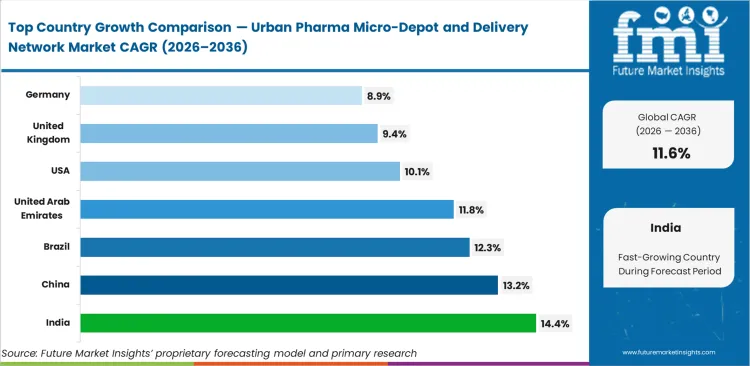
- Among key countries, India garners 14.4% of CAGR, followed by China (13.2%), Brazil (12.3%), UAE (11.8%), United States (10.1%), United Kingdom (9.4%), and Germany (8.9%).
- Growth is moderated by pharmacist licensing requirements, prescription verification, controlled‑substance protocols, and the cost of building dense urban node networks.
- Product and Segment View
- The market covers pharmacy‑linked micro‑depots, local dispatch nodes, rapid‑delivery routing, order‑orchestration software, and compliant ambient or cold‑chain transport.
- These networks serve chronic refills, acute prescriptions, OTC additions, and selected specialty therapies in dense urban catchments.
- Dark‑store depots lead the network‑model segment with 38.0% share, supported by pooled urban inventory, faster picking, and stronger route density.
- Same‑day leads the delivery‑speed segment with 44.0% share, reflecting the commercial value of rapid medication access in major cities.
- Ambient handling leads the temperature‑band segment with 57.0% share, as most delivered pharmacy volume does not require refrigerated transport.
- Chronic refills lead the order‑type segment with 41.0% share, aligned with predictable therapy cycles and stable dispatch timing.
- Retail chains lead the end‑user segment with 36.0% share, enabled by licensed inventory control, pharmacist oversight, and established urban store networks.
- Scope includes licensed prescription and OTC delivery networks tied to pharmacies, but excludes general grocery quick‑commerce, non‑pharma parcel platforms, and broad hospital line‑haul logistics.
- Geography and Competitive Outlook
- India, China, Brazil, and the UAE are the fastest‑scaling markets, while the United States remains the most commercially developed large‑market base.
- Competition is shaped by pharmacy‑platform integration, micro‑fulfillment design, local inventory placement, and app‑based dispatch systems rather than fleet size or generic courier capacity.
- Key companies include CVS Health, Walgreens Boots Alliance, Walmart, JD Health, Ping An Health, Apollo HealthCo, and DocMorris.
- The market remains moderately fragmented, with CVS Health holding the leading share due to its scale, urban presence, and established delivery operations.
Integration of clinical workflow software with inventory telemetry inside these localized nodes accelerates automation across fulfillment steps. Pharmacists pivot from manual dispensing toward clinical verification as automated dispensing cabinets align with real‑time prescribing patterns. Volume scales quickly once these systems synchronize, lifting throughput across pharmacy last-mile delivery networks.
India is projected to witness a CAGR of 14.4% in the market through 2036, supported by dense urban populations and rapid pharmacy-platform adoption. China is expected to expand at a CAGR of 13.2%, driven by strong digital-order penetration in major metropolitan areas. Brazil is likely to record 12.3% CAGR during the forecast period, while the UAE is set to post 11.8%, benefiting from compact urban corridors that support efficient health-delivery routing. The United States market is anticipated to grow at a CAGR of 10.1%, backed by mature pharmaceutical logistics capabilities. The United Kingdom is expected to register 9.4% CAGR, compared with 8.9% for Germany, reflecting differences in regulatory handling requirements and decentralized pharmacy licensing.
Segmental Analysis
Urban Pharma Micro-Depot and Delivery Network Analysis by Network Model
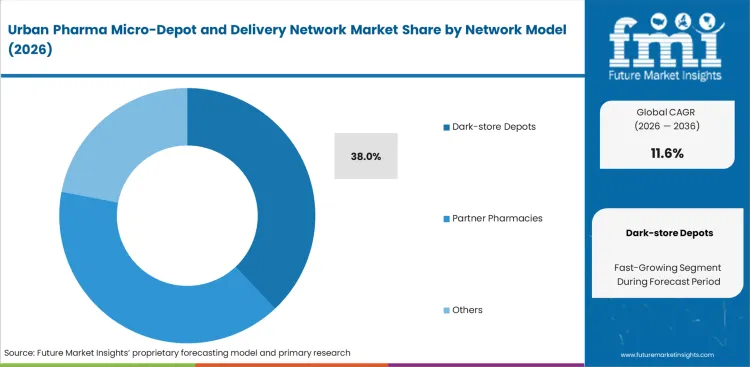
Dark-store depots hold 38.0% share in 2026, and this dominance stems directly from retail operations managers aggressively shifting volume out of high-rent storefronts to embrace the pharmacy dark store model. Stripping patient-facing retail space allows these nodes to pack automated dispensing cabinets wall-to-wall. Pharmacists working inside these closed environments process prescriptions without constant customer interruption, doubling hourly output. Integrating life science logistics software ensures accurate inventory tracking across multiple isolated nodes.
What physical footprint data alone does not show is how dark-store pharmacy vs retail pharmacy fulfillment zoning classifications bypass stringent retail pharmacy regulations, accelerating site launch timelines by months. Regional pharmacy directors who resist this transition face unsustainable cost-to-serve metrics when fulfilling digital orders from traditional storefronts, eventually ceding volume to specialized clinical drug supply networks.
- Initial footprint strategy: Real estate directors prioritize low-visibility commercial properties located near major arterial roads. Securing these specific zoning classifications prevents costly build-out delays.
- Automated density validation: Operations managers measure success through units dispensed per square foot rather than foot traffic. Maximizing robotic cabinet density validates early capital expenditure.
- Capacity expansion triggers: Network executives deploy additional nodes only when current facility courier queues cause consistent dispatch delays. Opening secondary locations prevents SLA failures.
Urban Pharma Micro-Depot and Delivery Network Analysis by Delivery Speed
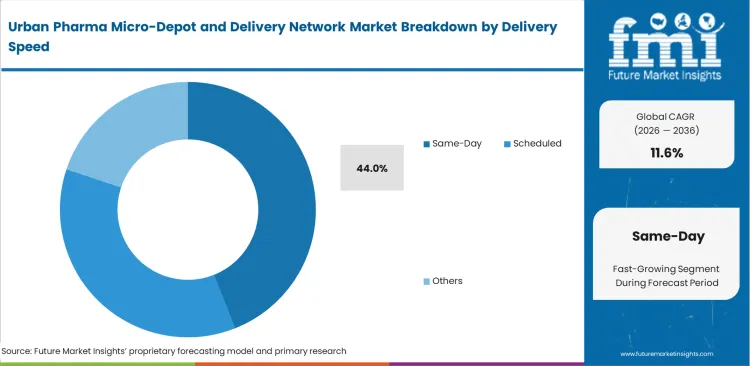
Same-day delivery is expected to account for 44.0% share in 2026, according to FMI, as payer contracts increasingly set strict adherence timelines that require rapid medication access. Clinical directors depend on this delivery model to support chronic patients who need uninterrupted therapy and timely refills. Fulfillment managers support same-day prescription delivery through scheduled courier waves rather than costly immediate-dispatch models. This structure improves service consistency and keeps operating efficiency more manageable across routine delivery volumes. It also reduces final-mile costs compared with unstable two-hour routing patterns. Proper pharmaceutical cold chain packaging integration remains essential for maintaining temperature stability across delivery windows that can extend up to eight hours.
Even so, delivery performance data often hides a broader operational issue. Same-day batching can conceal upstream inventory inefficiencies because distribution nodes often carry excess stock to avoid missing fixed dispatch cutoffs. Supply chain executives attempting to shift toward reliable two-hour fulfillment without changing inventory positioning and stock allocation strategies are likely to face margin pressure from higher expedited shipping costs.
- Batch routing efficiencies: Dispatch coordinators group geographically adjacent addresses into unified delivery runs. This consolidation eliminates redundant courier trips across identical neighborhoods.
- Expedited penalty exposure: Logistics directors incur severe margin penalties when standard batch runs fail and require dedicated emergency couriers. These hidden operational costs destroy unit profitability.
- Lifecycle margin calculation: Procurement heads analyze total delivery cost across annual prescription renewals. Same-day batching preserves maximum margin across twelve-month chronic therapy cycles.
Urban Pharma Micro-Depot and Delivery Network Analysis by Temperature Band
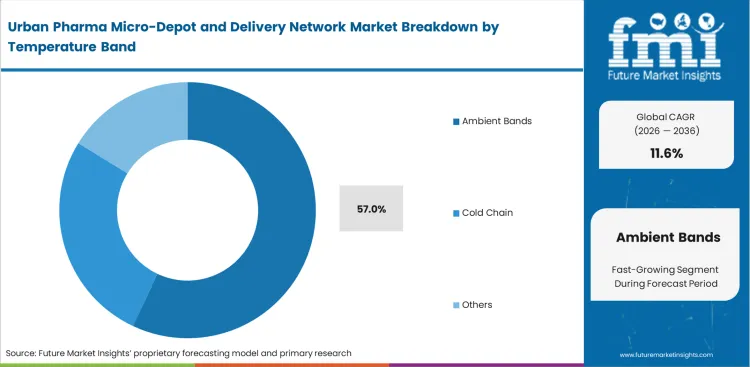
Spoilage during final-mile transit destroys entire therapeutic payloads, forcing logistics directors to heavily monitor every dispatch. Ambient bands secure 57.0% share in 2026, and this majority reflects substantial baseline volumes associated with standard oral solid-dose medications. Pharmacy technicians easily pack these orders without complex thermal buffering, streamlining outbound operations. Utilizing basic thermal packaging prevents minor temperature excursions during standard weather events.
Integrating reliable temperature monitoring systems remains critical even for non-refrigerated loads across extreme summer climates. What ambient volume dominance conceals is how urban cold-chain pharmacy delivery capability dictates competitive survival; digital pharmacies win lucrative specialty contracts solely by demonstrating flawless refrigerated transit, treating ambient volume merely as baseline revenue. Facility managers lacking validated cold-room infrastructure entirely forfeit high-margin biologic dispensing opportunities, restricting their operation to low-margin generic fulfillment.
- Excursion prevention protocols: Quality assurance officers reject any dispatched package showing thermal deviation upon delivery. Maintaining strict ambient limits prevents generic drug degradation.
- Thermal breach risks: Operations managers face complete inventory loss when air conditioning systems fail inside unmonitored transport vehicles. Residual risk remains high during peak summer traffic.
- Validation documentation requirements: Compliance directors must archive specific transit temperature logs to satisfy regulatory audits. Capturing full benefit requires unbroken data chains.
Urban Pharma Micro-Depot and Delivery Network Analysis by Order Type
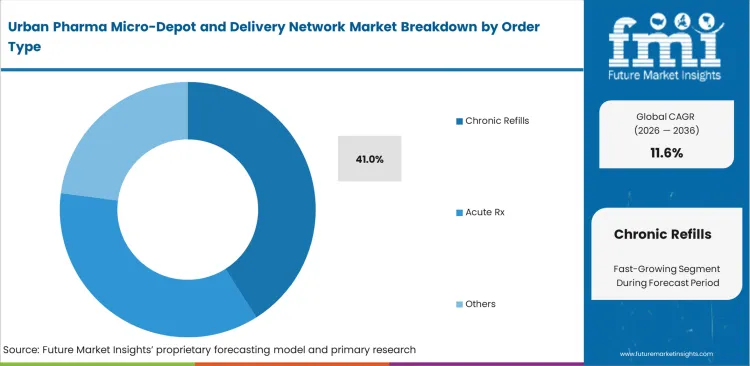
Chronic refills are expected to account for 41.0% share in 2026, according to FMI, because their recurring order pattern is easier to plan around than unpredictable acute prescriptions. Fulfillment centers can prepare these medications in advance, which helps managers organize packing and delivery schedules more efficiently. This makes daily routing more stable and reduces pressure on pharmacy distribution operations. Based on FMI's assessment, securing these recurring prescriptions provides essential baseline utilization for expensive robotic dispensing equipment, establishing robust chronic refill delivery infrastructure.
Technicians load automation hoppers with high-volume maintenance medications, letting machines handle repetitive counting tasks. Deploying specialized medical transport box solutions ensures secure chain-of-custody during neighborhood drop-offs. Prescription mix ratios do not fully show the operational risk created by chronic refill concentration. Nodes built around stable maintenance volumes can face serious disruption when acute antibiotic demand rises suddenly.
- Predictable baseload advantages: Inventory planners order generic maintenance stock months in advance. Securing predictable volume prevents costly emergency wholesale purchasing.
- Acute disruption vulnerability: Dispatch coordinators struggle when urgent prescription orders break pre-planned courier routes. Edge conditions emerge during seasonal flu outbreaks.
- Refill adherence standards: Payer relationship managers demand specific on-time delivery percentages to maintain contract status. Qualification standards require flawless execution.
Urban Pharma Micro-Depot and Delivery Network Analysis by End User
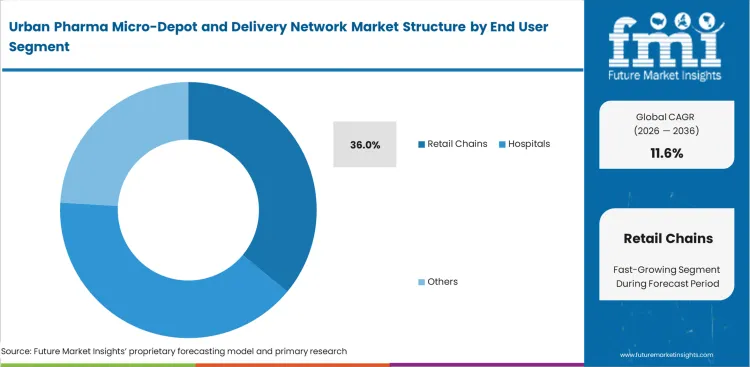
Considerable brick-and-mortar legacy infrastructure directly contradicts modern digital-first consumer expectations. Retail chains hold 36.0% share in 2026, and FMI observes that these legacy operators aggressively deploy dark-store networks to defend market position against digital native startups. Strategy officers inside traditional chains leverage existing patient data and established payer contracts to instantly populate new micro-depot nodes with guaranteed volume. Activating connected logistics software allows these corporate entities to coordinate inventory across hundreds of localized centers simultaneously. What end-user share data obscures is that retail chains frequently cannibalize their own highly profitable in-store foot traffic by pushing patients toward delivery, sacrificing lucrative front-of-store cosmetic sales for pharmacy volume retention. Corporate executives delaying this transition face complete obsolescence as aggressive digital pharmacies systematically poach younger patient demographics requiring pharmacy delivery for telehealth prescriptions.
- Digital native pioneers: Technology-first pharmacy founders launch direct-to-consumer models initially. These early adopters prove urban delivery economics function without retail storefronts.
- Retail chain defensive maneuvers: Corporate strategy directors launch competing delivery nodes to prevent patient attrition. Adopting these models changes their real estate portfolio strategy.
- Hospital system followers: Acute care pharmacy directors eventually launch decentralized nodes to manage discharge medications. Controlling readmission rates finally forces conservative hospital networks to adopt localized delivery.
Urban Pharma Micro-Depot and Delivery Network Drivers, Restraints, and Opportunities
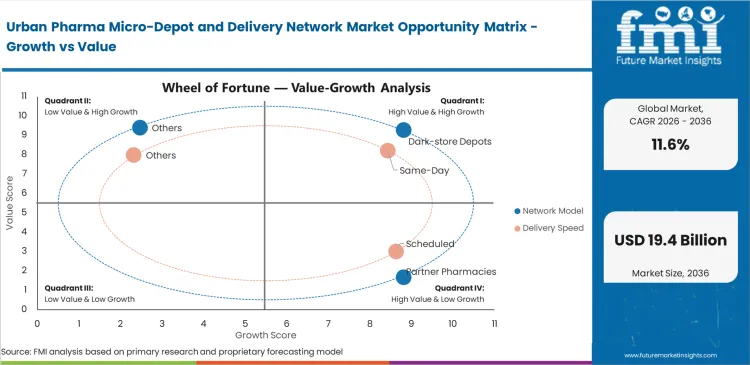
Margin collapse on standard maintenance medications forces retail operations managers to aggressively strip real estate overhead from dispensing workflows. Traditional high-street pharmacy spaces incur high leasing costs that generic drug reimbursements no longer cover. Transitioning fulfillment operations into unbranded, low-visibility commercial properties restores baseline profitability. Delaying this real estate transition guarantees operating losses, pushing pharmacy directors to rapidly sign dark-store leases across dense urban corridors. Securing on-demand delivery management solution architecture allows these hidden facilities to maintain neighborhood service levels without maintaining neighborhood storefronts, relying heavily on compliant pharmacy dispatch software.
Municipal zoning board resistance severely throttles physical node expansion across residential neighborhoods. Planners frequently classify automated dispensing centers as light industrial warehousing rather than medical clinics, effectively banning them from high-density residential corridors where they are most needed. This classification friction forces real estate directors into complex variance appeals, adding months to facility launch timelines. While temporary commercial pop-up permits offer minor relief, they fail to provide long-term certainty for heavy capital investments.
Opportunities in the Market
- Decentralized biologic staging: Supply chain directors secure significant specialty margins by placing expensive cold-chain incubators directly inside urban nodes, advancing the broader healthcare cold chain logistics market.
- Franchise network integration: Corporate development officers expand geographic reach rapidly by partnering with pharmacy and drug store franchises to utilize excess backroom space.
- Hospital discharge synchronization: Clinical integration managers capture guaranteed volume by directly linking dark-store inventory to municipal hospital discharge software, pioneering advanced hospital satellite pharmacy delivery.
Regional Analysis
The regional analysis divides the Urban Pharma Micro‑Depot and Delivery Network market into five key regions, North America, Europe, Asia Pacific, Latin America, and the Middle East & Africa, spanning more than 40 plus countries.
.webp "Top Country Growth Comparison Urban Pharma Micro Depot And Delivery Network Market Cagr (2026 2036)")
| Country | CAGR (2026 to 2036) |
|---|---|
| India | 14.4% |
| China | 13.2% |
| Brazil | 12.3% |
| United Arab Emirates | 11.8% |
| United States | 10.1% |
| United Kingdom | 9.4% |
| Germany | 8.9% |
Source: Future Market Insights (FMI) analysis, based on proprietary forecasting model and primary research
North America Urban Pharma Micro-Depot and Delivery Network Market Analysis
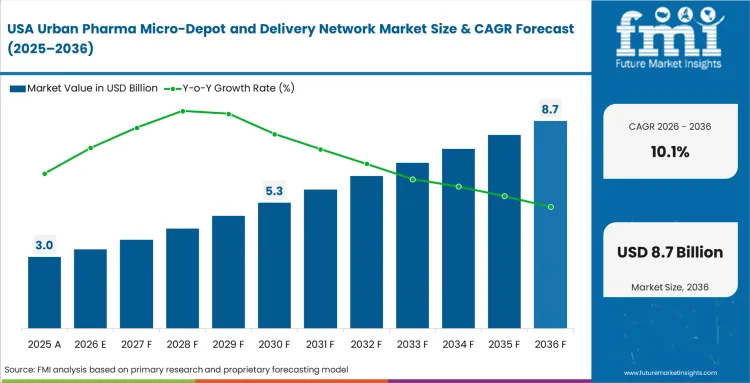
Mature pharmaceutical tracking infrastructure dictates operational cadence across North American metropolitan centers. Regional pharmacy executives leverage existing high-density courier networks to execute rapid prescription handoffs. FMI's analysis indicates that highly integrated payer networks require flawless delivery execution to maintain preferred provider status. Implementing robust radiopharmaceutical logistics protocols demonstrates advanced capability, though standard oral solids dominate actual daily volume. Regional analysis often misses the importance of municipal zoning rules. In many cities, success depends less on technical strength and more on how well companies handle local regulatory requirements.
- United States: Mature domestic distribution networks force operations managers to compete purely on route optimization rather than basic transit capability, shaping current pharmaceutical logistics trends. The urban pharma micro-depot and delivery network industry in the United States is poised to expand at a CAGR of 10.1% through 2036 as large existing infrastructure absorbs incremental volume. Perfecting final-mile routing software secures lucrative national payer contracts and solidifies market positioning.
Europe Urban Pharma Micro-Depot and Delivery Network Market Analysis
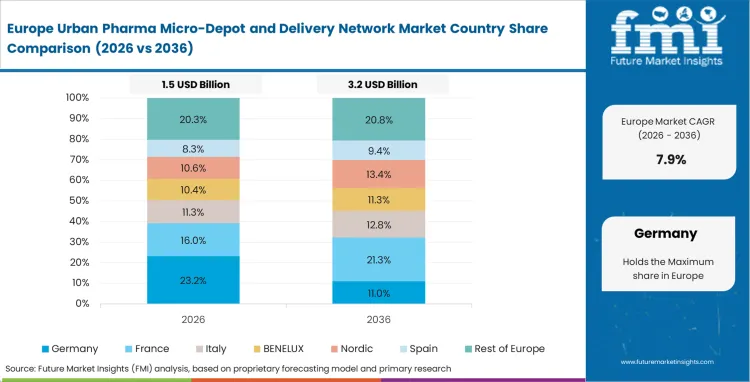
Stringent patient privacy regulations and complex cross-border licensing fundamentally shape continental fulfillment architecture. Compliance officers must navigate GDPR-compliant routing algorithms before dispatching single packages. As per FMI's assessment, tight regulatory handling prevents reckless startup expansion, favoring established entities with deep legal resources. This friction ensures high baseline quality but dramatically slows geographic scaling.
- United Kingdom: National Health Service reimbursement structures directly influence how logistics directors deploy capital across decentralized delivery nodes. Demonstrating measurable readmission reductions opens access to significant government funding pools and validates new operating models. Demand for urban pharma micro-depot and delivery network in the United Kingdom is anticipated to rise at a CAGR of 9.4% through the forecast period. Centralized health policies gradually embracing localized distribution maintain this steady trajectory.
- Germany: Germany is set to record a CAGR of 8.9% in the urban pharma micro-depot and delivery network industry during the assessment period. Strict pharmacist ownership laws complicate corporate network expansion efforts, forcing methodical facility growth behind rigid regulatory gates. Navigating these specific ownership restrictions successfully protects incumbent operator margins from aggressive foreign venture capital while ensuring compliance across local dispensing networks.
Asia Pacific Urban Pharma Micro-Depot and Delivery Network Market Analysis
High population density combined with overwhelming digital platform adoption creates perfect economic conditions for hyper-localized fulfillment. Strategy directors leverage super-app integration to capture millions of urban patients simultaneously. According to FMI's estimates, this digital-first behavior bypasses traditional retail pharmacy evolution entirely.
- India: India is projected to witness a CAGR of 14.4% in the hyperlocal pharmacy delivery segment through 2036, supported by high urban density and the fast expansion of pharmacy-platform networks across Tier-1 cities. Localized fulfillment models are gaining traction as they improve delivery speed, route efficiency, and service coverage in densely populated areas. The market is also benefiting from a gradual shift away from fragmented independent dispensing toward more organized digital pharmacy channels.
- China: Pervasive digital-order behavior across megacities fuels continuous facility expansion as domestic technology conglomerates enter healthcare distribution. Achieving hyper-density routing creates insurmountable barriers for late market entrants attempting to secure commercial real estate. Sales of urban pharma micro-depot and delivery network in China are expected to increase at a CAGR of 13.2% during the forecast period. Aggressive corporate investments ensure consistent scaling of these automated staging environments.
Latin America Urban Pharma Micro-Depot and Delivery Network Market Analysis
Concentrated population centers surrounded by difficult terrain force logistics directors to focus heavily on specific urban corridors. In FMI's view, extreme traffic congestion inside megacities makes traditional hub-and-spoke distribution mathematically impossible for urgent medical supplies.
- Brazil: The urban pharma micro-depot and delivery network sector in Brazil is expected to register a CAGR of 12.3% through 2036. High urban density inside specific commercial zones heavily favors rapid final-mile health delivery models. Aggressive private healthcare networks demand faster patient service, pushing operators to perfect specialized motorcycle courier dispatch algorithms that transform operational cost structures across major metropolitan hubs.
Middle East and Africa Urban Pharma Micro-Depot and Delivery Network Market Analysis
Extreme climate conditions mandate perfect thermal control across all final-mile operations. Facilities managers must deploy redundant cooling architecture inside every localized node. FMI analysts note that premium healthcare expectations lead to rapid adoption of advanced concierge-level medication delivery.
- United Arab Emirates: High disposable income combined with concentrated urban geography creates ideal conditions for premium delivery services leveraging hyper-modern city infrastructure. urban pharma micro-depot and delivery network adoption in the United Arab Emirates is likely to advance at a CAGR of 11.8% by 2036. Securing exclusive luxury residential contracts establishes dominant regional positioning and justifies the heavy capital expenditure required for flawless refrigerated transit.
FMI's report includes additional countries not detailed above. Municipal zoning variations consistently dictate expansion speed regardless of broader national healthcare policies.
Competitive Aligners for Market Players
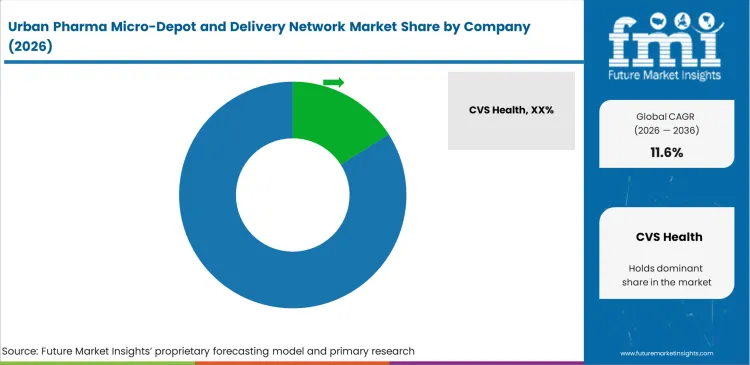
Extreme real estate scarcity distorts competitive reality, separating successful operators from failed ventures based entirely on property acquisition. Supply chain directors realize quickly that superior pharmaceutical packaging algorithms mean nothing without physical space to deploy them. CVS Health and Walgreens Boots Alliance leverage significant balance sheets to quietly absorb properly zoned commercial real estate long before announcing localized delivery intentions. This preemptive footprint capture locks out pharmacy delivery platform vendors lacking immediate capital for aggressive lease acquisitions.
Incumbents possess deep regulatory relationships and existing controlled-substance handling licenses that challengers cannot replicate quickly. Securing DEA or equivalent regional approval for decentralized narcotic storage requires years of documented compliance history. Walmart capitalizes on its existing pharmacy licensing to instantly activate localized delivery nodes without enduring lengthy regulatory probationary periods. Incorporating advanced drug delivery technology into these pre-approved sites allows incumbents to scale volume overnight alongside specialized pharma last-mile software providers.
Hospital networks and large clinic groups actively resist exclusive reliance on single fulfillment partners, intentionally splitting volume to maintain pricing leverage. Procurement officers deploy sophisticated routing software to dynamically assign discharge prescriptions across multiple competing networks based on real-time transit pricing. Apollo HealthCo and DocMorris battle for this variable volume by constantly adjusting final-mile delivery fees. Expanding complex drug delivery solutions across diverse urban geographies ultimately requires operators utilizing a same-day prescription delivery platform to accept lower margins on generic medications simply to retain access to highly profitable specialty biologic contracts, driving demand for specialized pharmacy micro-fulfillment solutions.
Key Players in Urban Pharma Micro-Depot and Delivery Network
- CVS Health
- Walgreens Boots Alliance
- Walmart
- JD Health
- Ping An Health
- Apollo HealthCo
- DocMorris
Scope of the Report
| Metric | Value |
|---|---|
| Quantitative Units | USD 5.8 billion to USD 17.4 billion, at a CAGR of 11.60% |
| Market Definition | Urban pharma micro-depot operations comprise hyper-localized inventory nodes and associated final-mile routing architectures designed exclusively for prescription medication dispensing. This ecosystem bridges centralized wholesale distribution and patient residences through high-frequency replenishment. |
| Segmentation | By network model, delivery speed, temperature band, order type, and end user |
| Regions Covered | North America, Europe, Asia Pacific, Latin America, Middle East and Africa |
| Countries Covered | India, China, Brazil, United Arab Emirates, United States, United Kingdom, Germany |
| Key Companies Profiled | CVS Health, Walgreens Boots Alliance, Walmart, JD Health, Ping An Health, Apollo HealthCo, DocMorris |
| Forecast Period | 2026 to 2036 |
| Approach | Commercial real estate leasing data for retail spaces classified for medical storage anchored baseline node capacity. |
Source: Future Market Insights (FMI) analysis, based on proprietary forecasting model and primary research
Urban Pharma Micro-Depot and Delivery Network Analysis by Segments
By network model
- Dark-store depots
- Partner pharmacies
- Hospital satellites
- Hybrid hubs
By delivery speed
- Same-day
- Two-hour
- Scheduled
- Next-day
By temperature band
- Ambient
- Cold chain
- Controlled room
By order type
- Chronic refills
- Acute Rx
- OTC add-ons
- Specialty Rx
By end user
- Retail chains
- Digital pharmacies
- Hospitals
- Clinic groups
Region:
- North America
- United States
- Canada
- Europe
- Germany
- United Kingdom
- France
- Italy
- Spain
- Asia Pacific
- China
- Japan
- South Korea
- Taiwan
- Singapore
- Latin America
- Brazil
- Mexico
- Argentina
- Middle East & Africa
- GCC Countries
- South Africa
Bibliography
- California State Board of Pharmacy. (2024, May). The Script May 2024.
- CVS Health. (2024). The Rx report: Transforming pharmacy to make healthier happen together.
- National Association of Boards of Pharmacy. (2025). 2024-2025 NABP annual report.
- Roubin, S., Holler, J., & Kedron, P. (2025). Urban-rural disparities in spatiotemporal accessibility of pharmacy care: A case study of Vermont, USA. BMC Health Services Research, 25, Article 1484.
- Sharareh, N., Tang, S., Bress, A., Mathis, W. S., Berenbrok, L. A., & Hernandez, I. (2025). Geographic access to community pharmacies based on walking, driving, and public transportation in the 10 most populated USA areas. Journal of the American Pharmacists Association.
This bibliography is provided for reader reference. The full FMI report contains the complete reference list with primary source documentation.
This Report Addresses
- Margin degradation forces accelerating dark-store depot expansion.
- Payer contracts demand strict same-day delivery adherence.
- Real estate zoning classifications dictate localized node deployment.
- Chronic refill volume anchors robotic dispensing economics.
- Retail chains cannibalize storefront foot traffic intentionally.
- Temperature excursion risks threaten high-margin biologic shipments.
- India digital-order behavior disrupts traditional retail models.
- Municipal regulatory friction slows unbranded fulfillment scaling.
Frequently Asked Questions
What is an urban pharma micro-depot?
Urban pharma micro-depots are hyper-localized inventory nodes designed exclusively for prescription medication dispensing. They bridge centralized wholesale distribution and patient residences through high-frequency replenishment. Nodes hold strictly curated formularies matching neighborhood-specific prescribing patterns rather than comprehensive catalogs.
How is this market different from e-Pharmacy?
Evaluating the e-Pharmacy market forecast reveals platform dominance, but micro-depots represent the physical infrastructure layer. While e-Pharmacies handle patient acquisition and digital consultation, micro-depots execute the actual localized physical dispensing and final-mile routing required to fulfill those digital orders.
Why are dark-store depots leading the network model?
Dark-store depots command 38.0% share currently. Operations managers prefer these unbranded commercial properties because stripping patient-facing square footage drastically lowers fixed overhead costs. This footprint strategy accelerates site launch timelines by months.
What makes same-day prescription delivery commercially viable?
Capturing 44.0% volume, same-day batching preserves maximum margin across twelve-month chronic therapy cycles. Payer contracts dictate strict adherence timelines requiring predictable courier waves, proving what runs same-day prescription delivery growth operationally.
Which countries are scaling fastest?
Advancing at 14.4%, India benefits from explosive pharmacy-platform scaling. Overwhelming urban density makes localized economics incredibly dominant across major metropolitan zones. China follows closely at 13.2% driven by pervasive digital-order behavior.
How important is cold-chain capability in urban pharmacy delivery?
Spoilage during final-mile transit destroys entire therapeutic payloads. Facility managers lacking validated cold-room infrastructure entirely forfeit high-margin biologic dispensing opportunities, restricting their operation to low-margin generic fulfillment.
Who are the main competitors in this market?
CVS Health, Walgreens Boots Alliance, Walmart, JD Health, Ping An Health, Apollo HealthCo, and DocMorris represent major operators. These incumbents possess deep regulatory relationships and existing controlled-substance handling licenses that challengers cannot replicate quickly.
What are the biggest cost drivers in pharmacy last-mile delivery?
Logistics directors incur severe margin penalties when standard batch runs fail. Requiring dedicated emergency couriers destroys unit profitability across maintenance medication prescriptions. Expedited shipping premiums create high margin compression.
How do chronic refill orders shape route density?
Chronic refills hold 41.0% share. This predictable volume allows inventory planners to order generic maintenance stock months ahead, keeping expensive robotic automation utilized efficiently and allowing dispatch coordinators to consolidate courier runs.
What does the market exclude?
Traditional retail pharmacy operations featuring public storefronts sit outside current analytical boundaries. Large regional distribution centers managed by wholesale distributors remain excluded because their operational cadence lacks final-mile patient focus.
Explain the urban pharma micro-depot business model?
Operators secure small commercial real estate footprints near dense residential zones, outfitting them entirely with automated dispensing cabinets. Revenue is generated by processing third-party or proprietary digital prescriptions through a hyper-efficient, non-public facility to lower per-unit delivery costs.
Compare pharmacy micro-depots with store-based fulfillment?
Retail pharmacies face high-street leasing costs and prioritize front-of-store consumer foot traffic. Micro-depots eliminate retail overhead, operating in unbranded commercial zones to prioritize pure dispensing volume and robotic automation density over patient visibility.
How large is the urban pharma delivery network market?
FMI assessed baseline valuation at USD 5.2 billion during 2025. Projections indicate revenue reaching USD 17.4 billion by 2036, driven by real estate acquisition strategies driving dark-store footprint growth.
Which companies lead urban pharmacy delivery networks?
Incumbent retail giants like Walmart and Walgreens Boots Alliance currently lead by leveraging significant balance sheets to absorb properly zoned commercial real estate. Digital native platforms like JD Health simultaneously scale rapidly in high-density urban corridors.
What role do pharmacy delivery platform vendors play?
These specialized technology providers supply the routing optimization algorithms and inventory telemetry required to coordinate thousands of dispatched prescriptions daily. They integrate localized cold-chain staging limits with real-time courier availability to prevent delivery failures.
What happens when dispatch coordinators fail batch routing?
Logistics directors incur severe margin penalties when standard runs fail. Requiring dedicated emergency couriers destroys unit profitability across maintenance medication prescriptions.
How do operators protect high-margin biologic shipments?
Quality assurance officers reject packages showing thermal deviation upon delivery. Integrating reliable temperature monitoring systems remains critical even for non-refrigerated loads across extreme summer climates.
What vulnerabilities plague chronic-refill focused nodes?
Nodes perfectly tuned for maintenance medications become paralyzed handling sudden spikes in acute antibiotic orders. Dispatch coordinators struggle when urgent prescription orders break pre-planned courier routes.
How do incumbents block startup competitors?
CVS Health and Walgreens Boots Alliance quietly absorb properly zoned commercial real estate. Preemptive footprint capture locks out venture-backed startups lacking immediate capital for aggressive lease acquisitions.
What role does existing pharmacy licensing play?
Walmart capitalizes on existing licensing to instantly activate localized delivery nodes. Securing DEA approval for decentralized narcotic storage requires years of documented compliance history that startups lack.
Why do hospitals split fulfillment volume?
Procurement officers deploy sophisticated routing software to dynamically assign discharge prescriptions across multiple competing networks. Splitting volume allows clinic groups to maintain pricing leverage against dominant carriers.
How do digital native pioneers influence traditional chains?
Technology-first pharmacy founders prove urban delivery economics function without retail storefronts. This forces corporate strategy directors inside traditional chains to launch competing delivery nodes.
Preview the report firsthand - request a free sample
Get SampleGet the brochure for pricing and purchase details.
Get PDFTable of Content
- Executive Summary
- Global Market Outlook
- Demand-side Trends
- Supply-side Trends
- Technology Roadmap Analysis
- Analysis and Recommendations
- Market Overview
- Market Coverage / Taxonomy
- Market Definition / Scope / Limitations
- Research Methodology
- Chapter Orientation
- Analytical Lens and Working Hypotheses
- Market Structure, Signals, and Trend Drivers
- Benchmarking and Cross-market Comparability
- Market Sizing, Forecasting, and Opportunity Mapping
- Research Design and Evidence Framework
- Desk Research Programme (Secondary Evidence)
- Company Annual and Sustainability Reports
- Peer-reviewed Journals and Academic Literature
- Corporate Websites, Product Literature, and Technical Notes
- Earnings Decks and Investor Briefings
- Statutory Filings and Regulatory Disclosures
- Technical White Papers and Standards Notes
- Trade Journals, Industry Magazines, and Analyst Briefs
- Conference Proceedings, Webinars, and Seminar Materials
- Government Statistics Portals and Public Data Releases
- Press Releases and Reputable Media Coverage
- Specialist Newsletters and Curated Briefings
- Sector Databases and Reference Repositories
- FMI Internal Proprietary Databases and Historical Market Datasets
- Subscription Datasets and Paid Sources
- Social Channels, Communities, and Digital Listening Inputs
- Additional Desk Sources
- Expert Input and Fieldwork (Primary Evidence)
- Primary Modes
- Qualitative Interviews and Expert Elicitation
- Quantitative Surveys and Structured Data Capture
- Blended Approach
- Why Primary Evidence is Used
- Field Techniques
- Interviews
- Surveys
- Focus Groups
- Observational and In-context Research
- Social and Community Interactions
- Stakeholder Universe Engaged
- C-suite Leaders
- Board Members
- Presidents and Vice Presidents
- R&D and Innovation Heads
- Technical Specialists
- Domain Subject-matter Experts
- Scientists
- Physicians and Other Healthcare Professionals
- Governance, Ethics, and Data Stewardship
- Research Ethics
- Data Integrity and Handling
- Primary Modes
- Tooling, Models, and Reference Databases
- Desk Research Programme (Secondary Evidence)
- Data Engineering and Model Build
- Data Acquisition and Ingestion
- Cleaning, Normalisation, and Verification
- Synthesis, Triangulation, and Analysis
- Quality Assurance and Audit Trail
- Market Background
- Market Dynamics
- Drivers
- Restraints
- Opportunity
- Trends
- Scenario Forecast
- Demand in Optimistic Scenario
- Demand in Likely Scenario
- Demand in Conservative Scenario
- Opportunity Map Analysis
- Product Life Cycle Analysis
- Supply Chain Analysis
- Investment Feasibility Matrix
- Value Chain Analysis
- PESTLE and Porter’s Analysis
- Regulatory Landscape
- Regional Parent Market Outlook
- Production and Consumption Statistics
- Import and Export Statistics
- Market Dynamics
- Global Market Analysis 2021 to 2025 and Forecast, 2026 to 2036
- Historical Market Size Value (USD Million) Analysis, 2021 to 2025
- Current and Future Market Size Value (USD Million) Projections, 2026 to 2036
- Y-o-Y Growth Trend Analysis
- Absolute $ Opportunity Analysis
- Global Market Pricing Analysis 2021 to 2025 and Forecast 2026 to 2036
- Global Market Analysis 2021 to 2025 and Forecast 2026 to 2036, By Network Model
- Introduction / Key Findings
- Historical Market Size Value (USD Million) Analysis By Network Model , 2021 to 2025
- Current and Future Market Size Value (USD Million) Analysis and Forecast By Network Model , 2026 to 2036
- Dark-store Depots
- Partner Pharmacies
- Others
- Dark-store Depots
- Y-o-Y Growth Trend Analysis By Network Model , 2021 to 2025
- Absolute $ Opportunity Analysis By Network Model , 2026 to 2036
- Global Market Analysis 2021 to 2025 and Forecast 2026 to 2036, By Delivery Speed
- Introduction / Key Findings
- Historical Market Size Value (USD Million) Analysis By Delivery Speed, 2021 to 2025
- Current and Future Market Size Value (USD Million) Analysis and Forecast By Delivery Speed, 2026 to 2036
- Same-Day
- Scheduled
- Others
- Same-Day
- Y-o-Y Growth Trend Analysis By Delivery Speed, 2021 to 2025
- Absolute $ Opportunity Analysis By Delivery Speed, 2026 to 2036
- Global Market Analysis 2021 to 2025 and Forecast 2026 to 2036, By Temperature Band
- Introduction / Key Findings
- Historical Market Size Value (USD Million) Analysis By Temperature Band, 2021 to 2025
- Current and Future Market Size Value (USD Million) Analysis and Forecast By Temperature Band, 2026 to 2036
- Ambient Bands
- Cold Chain
- Others
- Ambient Bands
- Y-o-Y Growth Trend Analysis By Temperature Band, 2021 to 2025
- Absolute $ Opportunity Analysis By Temperature Band, 2026 to 2036
- Global Market Analysis 2021 to 2025 and Forecast 2026 to 2036, By Order Type
- Introduction / Key Findings
- Historical Market Size Value (USD Million) Analysis By Order Type, 2021 to 2025
- Current and Future Market Size Value (USD Million) Analysis and Forecast By Order Type, 2026 to 2036
- Chronic Refills
- Acute Rx
- Others
- Chronic Refills
- Y-o-Y Growth Trend Analysis By Order Type, 2021 to 2025
- Absolute $ Opportunity Analysis By Order Type, 2026 to 2036
- Global Market Analysis 2021 to 2025 and Forecast 2026 to 2036, By End User
- Introduction / Key Findings
- Historical Market Size Value (USD Million) Analysis By End User, 2021 to 2025
- Current and Future Market Size Value (USD Million) Analysis and Forecast By End User, 2026 to 2036
- Retail Chains
- Hospitals
- Others
- Retail Chains
- Y-o-Y Growth Trend Analysis By End User, 2021 to 2025
- Absolute $ Opportunity Analysis By End User, 2026 to 2036
- Global Market Analysis 2021 to 2025 and Forecast 2026 to 2036, By Region
- Introduction
- Historical Market Size Value (USD Million) Analysis By Region, 2021 to 2025
- Current Market Size Value (USD Million) Analysis and Forecast By Region, 2026 to 2036
- North America
- Latin America
- Western Europe
- Eastern Europe
- East Asia
- South Asia and Pacific
- Middle East & Africa
- Market Attractiveness Analysis By Region
- North America Market Analysis 2021 to 2025 and Forecast 2026 to 2036, By Country
- Historical Market Size Value (USD Million) Trend Analysis By Market Taxonomy, 2021 to 2025
- Market Size Value (USD Million) Forecast By Market Taxonomy, 2026 to 2036
- By Country
- USA
- Canada
- Mexico
- By Network Model
- By Delivery Speed
- By Temperature Band
- By Order Type
- By End User
- By Country
- Market Attractiveness Analysis
- By Country
- By Network Model
- By Delivery Speed
- By Temperature Band
- By Order Type
- By End User
- Key Takeaways
- Latin America Market Analysis 2021 to 2025 and Forecast 2026 to 2036, By Country
- Historical Market Size Value (USD Million) Trend Analysis By Market Taxonomy, 2021 to 2025
- Market Size Value (USD Million) Forecast By Market Taxonomy, 2026 to 2036
- By Country
- Brazil
- Chile
- Rest of Latin America
- By Network Model
- By Delivery Speed
- By Temperature Band
- By Order Type
- By End User
- By Country
- Market Attractiveness Analysis
- By Country
- By Network Model
- By Delivery Speed
- By Temperature Band
- By Order Type
- By End User
- Key Takeaways
- Western Europe Market Analysis 2021 to 2025 and Forecast 2026 to 2036, By Country
- Historical Market Size Value (USD Million) Trend Analysis By Market Taxonomy, 2021 to 2025
- Market Size Value (USD Million) Forecast By Market Taxonomy, 2026 to 2036
- By Country
- Germany
- UK
- Italy
- Spain
- France
- Nordic
- BENELUX
- Rest of Western Europe
- By Network Model
- By Delivery Speed
- By Temperature Band
- By Order Type
- By End User
- By Country
- Market Attractiveness Analysis
- By Country
- By Network Model
- By Delivery Speed
- By Temperature Band
- By Order Type
- By End User
- Key Takeaways
- Eastern Europe Market Analysis 2021 to 2025 and Forecast 2026 to 2036, By Country
- Historical Market Size Value (USD Million) Trend Analysis By Market Taxonomy, 2021 to 2025
- Market Size Value (USD Million) Forecast By Market Taxonomy, 2026 to 2036
- By Country
- Russia
- Poland
- Hungary
- Balkan & Baltic
- Rest of Eastern Europe
- By Network Model
- By Delivery Speed
- By Temperature Band
- By Order Type
- By End User
- By Country
- Market Attractiveness Analysis
- By Country
- By Network Model
- By Delivery Speed
- By Temperature Band
- By Order Type
- By End User
- Key Takeaways
- East Asia Market Analysis 2021 to 2025 and Forecast 2026 to 2036, By Country
- Historical Market Size Value (USD Million) Trend Analysis By Market Taxonomy, 2021 to 2025
- Market Size Value (USD Million) Forecast By Market Taxonomy, 2026 to 2036
- By Country
- China
- Japan
- South Korea
- By Network Model
- By Delivery Speed
- By Temperature Band
- By Order Type
- By End User
- By Country
- Market Attractiveness Analysis
- By Country
- By Network Model
- By Delivery Speed
- By Temperature Band
- By Order Type
- By End User
- Key Takeaways
- South Asia and Pacific Market Analysis 2021 to 2025 and Forecast 2026 to 2036, By Country
- Historical Market Size Value (USD Million) Trend Analysis By Market Taxonomy, 2021 to 2025
- Market Size Value (USD Million) Forecast By Market Taxonomy, 2026 to 2036
- By Country
- India
- ASEAN
- Australia & New Zealand
- Rest of South Asia and Pacific
- By Network Model
- By Delivery Speed
- By Temperature Band
- By Order Type
- By End User
- By Country
- Market Attractiveness Analysis
- By Country
- By Network Model
- By Delivery Speed
- By Temperature Band
- By Order Type
- By End User
- Key Takeaways
- Middle East & Africa Market Analysis 2021 to 2025 and Forecast 2026 to 2036, By Country
- Historical Market Size Value (USD Million) Trend Analysis By Market Taxonomy, 2021 to 2025
- Market Size Value (USD Million) Forecast By Market Taxonomy, 2026 to 2036
- By Country
- Kingdom of Saudi Arabia
- Other GCC Countries
- Turkiye
- South Africa
- Other African Union
- Rest of Middle East & Africa
- By Network Model
- By Delivery Speed
- By Temperature Band
- By Order Type
- By End User
- By Country
- Market Attractiveness Analysis
- By Country
- By Network Model
- By Delivery Speed
- By Temperature Band
- By Order Type
- By End User
- Key Takeaways
- Key Countries Market Analysis
- USA
- Pricing Analysis
- Market Share Analysis, 2025
- By Network Model
- By Delivery Speed
- By Temperature Band
- By Order Type
- By End User
- Canada
- Pricing Analysis
- Market Share Analysis, 2025
- By Network Model
- By Delivery Speed
- By Temperature Band
- By Order Type
- By End User
- Mexico
- Pricing Analysis
- Market Share Analysis, 2025
- By Network Model
- By Delivery Speed
- By Temperature Band
- By Order Type
- By End User
- Brazil
- Pricing Analysis
- Market Share Analysis, 2025
- By Network Model
- By Delivery Speed
- By Temperature Band
- By Order Type
- By End User
- Chile
- Pricing Analysis
- Market Share Analysis, 2025
- By Network Model
- By Delivery Speed
- By Temperature Band
- By Order Type
- By End User
- Germany
- Pricing Analysis
- Market Share Analysis, 2025
- By Network Model
- By Delivery Speed
- By Temperature Band
- By Order Type
- By End User
- UK
- Pricing Analysis
- Market Share Analysis, 2025
- By Network Model
- By Delivery Speed
- By Temperature Band
- By Order Type
- By End User
- Italy
- Pricing Analysis
- Market Share Analysis, 2025
- By Network Model
- By Delivery Speed
- By Temperature Band
- By Order Type
- By End User
- Spain
- Pricing Analysis
- Market Share Analysis, 2025
- By Network Model
- By Delivery Speed
- By Temperature Band
- By Order Type
- By End User
- France
- Pricing Analysis
- Market Share Analysis, 2025
- By Network Model
- By Delivery Speed
- By Temperature Band
- By Order Type
- By End User
- India
- Pricing Analysis
- Market Share Analysis, 2025
- By Network Model
- By Delivery Speed
- By Temperature Band
- By Order Type
- By End User
- ASEAN
- Pricing Analysis
- Market Share Analysis, 2025
- By Network Model
- By Delivery Speed
- By Temperature Band
- By Order Type
- By End User
- Australia & New Zealand
- Pricing Analysis
- Market Share Analysis, 2025
- By Network Model
- By Delivery Speed
- By Temperature Band
- By Order Type
- By End User
- China
- Pricing Analysis
- Market Share Analysis, 2025
- By Network Model
- By Delivery Speed
- By Temperature Band
- By Order Type
- By End User
- Japan
- Pricing Analysis
- Market Share Analysis, 2025
- By Network Model
- By Delivery Speed
- By Temperature Band
- By Order Type
- By End User
- South Korea
- Pricing Analysis
- Market Share Analysis, 2025
- By Network Model
- By Delivery Speed
- By Temperature Band
- By Order Type
- By End User
- Russia
- Pricing Analysis
- Market Share Analysis, 2025
- By Network Model
- By Delivery Speed
- By Temperature Band
- By Order Type
- By End User
- Poland
- Pricing Analysis
- Market Share Analysis, 2025
- By Network Model
- By Delivery Speed
- By Temperature Band
- By Order Type
- By End User
- Hungary
- Pricing Analysis
- Market Share Analysis, 2025
- By Network Model
- By Delivery Speed
- By Temperature Band
- By Order Type
- By End User
- Kingdom of Saudi Arabia
- Pricing Analysis
- Market Share Analysis, 2025
- By Network Model
- By Delivery Speed
- By Temperature Band
- By Order Type
- By End User
- Turkiye
- Pricing Analysis
- Market Share Analysis, 2025
- By Network Model
- By Delivery Speed
- By Temperature Band
- By Order Type
- By End User
- South Africa
- Pricing Analysis
- Market Share Analysis, 2025
- By Network Model
- By Delivery Speed
- By Temperature Band
- By Order Type
- By End User
- USA
- Market Structure Analysis
- Competition Dashboard
- Competition Benchmarking
- Market Share Analysis of Top Players
- By Regional
- By Network Model
- By Delivery Speed
- By Temperature Band
- By Order Type
- By End User
- Competition Analysis
- Competition Deep Dive
- CVS Health
- Overview
- Product Portfolio
- Profitability by Market Segments (Product/Age /Sales Channel/Region)
- Sales Footprint
- Strategy Overview
- Marketing Strategy
- Product Strategy
- Channel Strategy
- Walgreens Boots Alliance
- Walmart
- JD Health
- Ping An Health
- Apollo HealthCo
- CVS Health
- Competition Deep Dive
- Assumptions & Acronyms Used


