

- Industry Size (2025)
- USD 23.3 Bn
- Forecast (2035)
- USD 138.2 Bn
- CAGR (2025 to 2035)
- 19.5%
On-Demand Logistics Market Size and Share Forecast Outlook 2025 to 2035
The On-Demand Logistics Market is estimated to be valued at USD 23.3 billion in 2025 and is projected to reach USD 138.2 billion by 2035, registering a compound annual growth rate (CAGR) of 19.5% over the forecast period. Technology deployment, last-mile delivery operations, labor expenses, fleet management, and digital infrastructure influence the cost structure of this market. With rapid expansion, economies of scale are expected to reduce per-unit service costs gradually, but significant capital outlays will continue to be allocated toward AI-enabled routing, warehouse automation, and digital tracking systems.
Within the value chain, platform operators serve as the central node, linking shippers, drivers, and end customers through real-time demand aggregation. Upstream activities involve investments in cloud-based logistics management systems, mobile applications, and payment gateways. Midstream processes include route optimization, load matching, and fleet allocation, where technological precision reduces operational inefficiencies. Downstream activities encompass last-mile delivery, which remains the most cost-intensive due to high labor and fuel requirements. From 2025 to 2030, the market expands from USD 23.3 billion to USD 56.7 billion, as digital platforms consolidate control over logistics networks.
By 2035, the market will surpass USD 138.2 billion, with the integration of autonomous delivery vehicles and drones reshaping value-chain economics. The shift toward automation and predictive analytics reduces delivery costs, enhances asset utilization, and increases margins. While high initial technology and operational costs characterize the early phase, value-chain efficiencies and digital innovation progressively strengthen the market’s profitability profile.
Last-mile delivery optimization involves route planning algorithms that must account for traffic patterns, delivery time windows, and vehicle capacity constraints while adapting dynamically to new orders and cancellation requests throughout operational periods. Warehouse location strategy requires balancing real estate costs against proximity to customer populations, creating investment decisions that affect delivery speed capabilities and operational expenses across different market segments. Inventory management becomes complex when on-demand services require stockpiling diverse product categories without certainty regarding demand patterns that may fluctuate based on seasonal trends, weather conditions, or competitive promotional activities.
Regulatory compliance varies significantly across municipal jurisdictions where commercial vehicle permits, parking restrictions, and business licensing requirements create operational complexity for services covering multiple cities or regions. Insurance coverage involves complex risk assessment when driver accidents, package theft, or customer property damage create liability exposures that traditional logistics insurance products may not address comprehensively. Data privacy regulations affect customer information handling and location tracking capabilities that platforms require for operational efficiency but must manage within regulatory frameworks protecting consumer privacy rights.
Quick Stats for On-Demand Logistics Market
- On-Demand Logistics Market Value (2025): USD 23.3 billion
- On-Demand Logistics Market Forecast Value (2035): USD 138.2 billion
- On-Demand Logistics Market Forecast CAGR: 19.5%
- Leading Segment in On-Demand Logistics Market in 2025: Same-day delivery (48.5%)
- Key Growth Regions in On-Demand Logistics Market: North America, Asia-Pacific, Europe
- Top Players in On-Demand Logistics Market: Bringg Delivery Technologies Ltd., Delivery Hero SE, DoorDash Inc., Grubhub Holdings Inc., Instacart, Lalamove, Postmates (Uber Technologies Inc.), Shadowfax Technologies Pvt. Ltd., Stuart Delivery Ltd., Uber Technologies Inc.
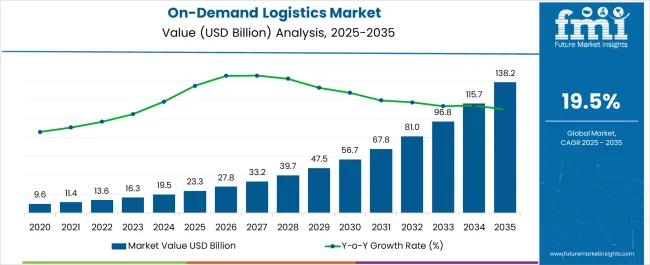
On-Demand Logistics Market Key Takeaways
| Metric | Value |
|---|---|
| On-Demand Logistics Market Estimated Value in (2025 E) | USD 23.3 billion |
| On-Demand Logistics Market Forecast Value in (2035 F) | USD 138.2 billion |
| Forecast CAGR (2025 to 2035) | 19.5% |
Why is the On-Demand Logistics Market Growing?
The on-demand logistics market is expanding rapidly due to increased consumer expectations for faster delivery, the rise of e-commerce platforms, and advancements in real-time tracking technologies. Urbanization and changing retail models have intensified the demand for flexible delivery solutions that can fulfill orders with speed and precision.
Businesses across various sectors are leveraging on-demand logistics to reduce last-mile inefficiencies and meet same-day fulfillment commitments. Growth is further supported by advancements in mobile application ecosystems and cloud based fleet management systems that enable dynamic route optimization, instant communication, and seamless integration with order processing systems.
As sustainability and convenience become primary decision drivers, the market is poised for continued adoption across retail, manufacturing, and service based industries seeking to improve delivery efficiency and customer satisfaction.
Segmental Analysis
The on-demand logistics market is segmented by service, platform, end-user, application, and geographic regions. By service, the on-demand logistics market is divided into Same-day delivery, Courier services, Warehouse and storage services, Instant delivery, and Trucking services. In terms of platform, the on-demand logistics market is classified into Mobile apps and Web-based platforms.
Based on end-user, the on-demand logistics market is segmented into B2B, B2C, and C2C. By application, the on-demand logistics market is segmented into Retail & e-commerce, Food & beverages, Healthcare & pharmaceuticals, Automotive, Manufacturing, and Others. Regionally, the on-demand logistics industry is classified into North America, Latin America, Western Europe, Eastern Europe, Balkan & Baltic Countries, Russia & Belarus, Central Asia, East Asia, South Asia & Pacific, and the Middle East & Africa.
Insights into the Same-Day Delivery Service Segment
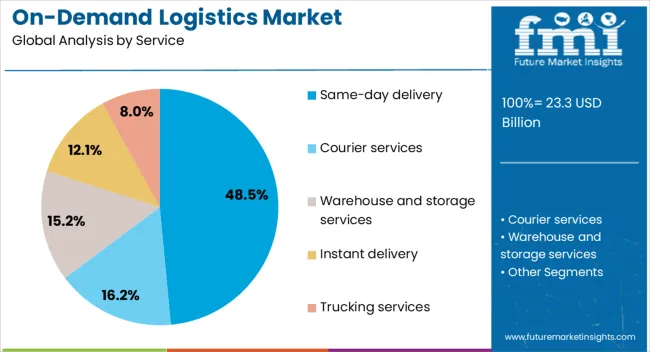
The same-day delivery segment is expected to hold 48.50% of the total market share by 2025, positioning it as the leading service category. This dominance is being driven by growing consumer demand for immediacy, particularly in urban centers where instant gratification is influencing purchase behavior.
Businesses are leveraging same-day delivery to gain a competitive advantage and enhance customer loyalty through faster fulfillment cycles. Operational improvements in dispatch systems, route planning, and delivery personnel management have also enabled providers to execute high volume deliveries with accuracy.
Additionally, sectors such as pharmaceuticals, grocery, and fashion retail are increasingly adopting same-day services to ensure product freshness and capitalize on impulse buying behaviors. These combined factors have solidified same-day delivery as the most preferred and scalable solution in the service segment.
Insights into the Mobile Apps Platform Segment
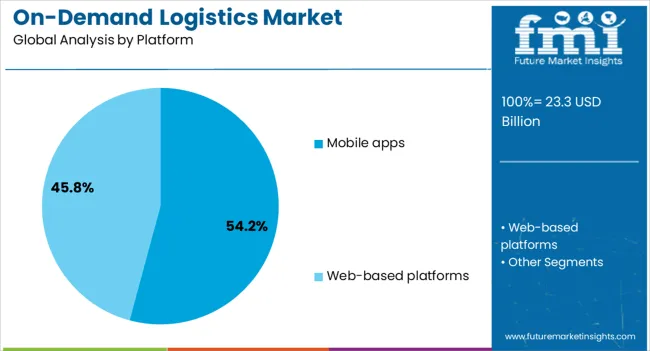
The mobile apps segment is projected to contribute 54.20% of the overall market revenue by 2025 within the platform category, making it the most dominant mode of engagement. This leadership is a result of growing smartphone penetration, consumer familiarity with app-based services, and the seamless user experience offered through intuitive interfaces.
Mobile apps provide real-time tracking, instant communication, and personalized delivery options, improving user confidence and satisfaction. Logistics providers are also using mobile platforms to manage driver assignments, delivery workflows, and customer feedback efficiently.
The ability of mobile apps to support digital payments, dynamic rerouting, and location-based offers has further enhanced their relevance in last-mile logistics. As user expectations for transparency and convenience rise, mobile apps continue to lead the platform segment due to their adaptability and end-to-end service integration.
Insights into the B2B End User Segment
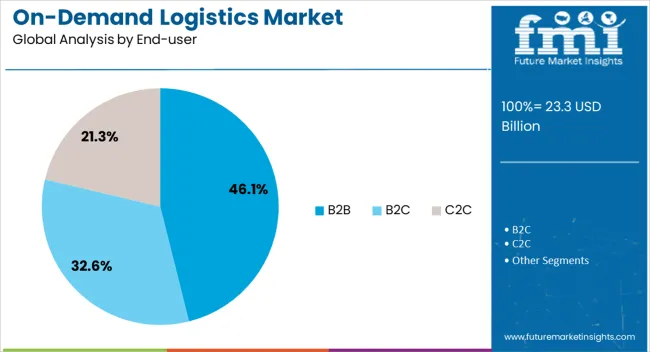
The B2B segment is forecasted to represent 46.10% of the total market share by 2025 within the end-user category, establishing it as the leading contributor. This growth is attributed to increasing intercompany shipments, replenishment requirements, and just-in-time delivery models across industrial and retail supply chains.
Businesses are adopting on-demand logistics to streamline inventory management, reduce lead times, and optimize operational costs. High volume and regular shipments between warehouses, suppliers, and distribution centers require reliable logistics solutions that offer scalability and time sensitivity.
Additionally, B2B clients benefit from customizable delivery schedules, dedicated fleet services, and integration with procurement systems, all of which are critical in maintaining supply chain continuity. This operational necessity and efficiency focus have secured B2B as the dominant segment in terms of end-user demand.
What are the Drivers, Restraints, and Key Trends of the On-Demand Logistics Market?
Digital platforms have enabled immediate connections between shippers, carriers, and consumers, facilitating faster and more efficient order fulfillment. E-commerce growth, urban last-mile delivery needs, and consumer preference for same-day or next-day services have supported expansion. Integration of AI, machine learning, and route optimization software has enhanced efficiency. Investments in digital freight platforms and multimodal logistics infrastructure have positioned this market as a vital pillar in modern supply chain operations.
Technological Advancements and Digital Platforms
Technological innovations have played a transformative role in the on-demand logistics market by strengthening connectivity, efficiency, and transparency. Digital freight platforms powered by artificial intelligence and predictive analytics have streamlined carrier matching and automated scheduling. Blockchain has been integrated for real-time tracking, tamper-proof documentation, and enhanced trust across stakeholders. IoT sensors and telematics have allowed monitoring of goods in transit, while cloud-based platforms have facilitated scalable data management. Mobile applications have enabled consumers and enterprises to access flexible delivery options instantly. These technological advancements have not only improved service efficiency but have also minimized operational costs, reduced idle fleet capacity, and improved customer satisfaction. As digital platforms continue to evolve, their impact on reshaping global logistics networks is expected to remain highly influential in the coming years.
Rising Demand from E-commerce and Retail Expansion
E-commerce expansion has been a major driver of the on-demand logistics market, as consumer demand for rapid and reliable delivery has increased significantly. Retailers have shifted toward flexible supply chain models that integrate instant delivery, warehouse automation, and omnichannel strategies. Same-day and next-day delivery expectations have placed additional pressure on logistics providers to optimize last-mile operations. Retail partnerships with on-demand logistics platforms have improved customer experiences by offering visibility and transparency in delivery status. The need for reverse logistics to handle returns has further elevated the importance of agile, technology-driven solutions. The strong connection between online retail growth and logistics innovation has resulted in significant adoption of digital logistics platforms, as businesses strive to meet evolving consumer expectations. This rising demand from e-commerce and retail has cemented the market’s role as a cornerstone of the global logistics ecosystem.
Operational Efficiency and Cost Optimization
Operational efficiency has emerged as a defining factor in the on-demand logistics market, with providers prioritizing advanced tools for route planning, fleet optimization, and resource allocation. Predictive analytics has been applied to minimize delays, reduce empty miles, and optimize fuel usage. Shared mobility models and collaborative logistics have reduced costs by maximizing vehicle utilization. Automation of dispatch systems and real-time tracking has improved accuracy in delivery scheduling and minimized service disruptions. Cost optimization has been further supported through dynamic pricing mechanisms that adjust based on demand fluctuations. By offering scalable and data-driven solutions, on-demand logistics has allowed businesses to enhance profitability while delivering convenience to end users. This focus on operational efficiency has positioned the market as an indispensable solution for enterprises seeking resilient and adaptable logistics models in rapidly evolving supply chains.
Growing Role of Last-Mile Delivery Solutions
Last-mile delivery has been recognized as a critical component of the on-demand logistics market, driven by consumer expectations for fast and reliable service. The final stage of delivery often represents the most complex and costly part of the logistics chain. On-demand logistics platforms have addressed these challenges by leveraging real-time tracking, route optimization, and gig economy delivery models. Micro-fulfillment centers and localized warehouses have been utilized to shorten delivery distances and enhance speed. Innovative solutions such as autonomous vehicles, drones, and electric delivery fleets are being tested to reduce costs and emissions in last-mile operations. The prominence of last-mile delivery in shaping customer experiences has made it one of the strongest drivers of adoption for on-demand logistics worldwide. Its growing role highlights the market’s ability to adapt rapidly to shifting consumer needs and technological advancements.
Analysis of On-Demand Logistics Market By Key Countries
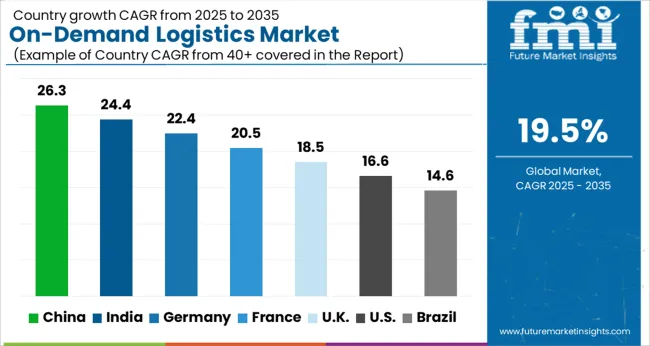
The market is projected to grow at a CAGR of 19.5% between 2025 and 2035, driven by rising e-commerce penetration, real-time delivery expectations, and digital freight platforms. China leads with a 26.3% CAGR, scaling through advanced logistics technologies and extensive last-mile networks. India follows at 24.4%, accelerating adoption with rapid e-commerce expansion and government-backed digital infrastructure. Germany, at 22.4%, transforms logistics with automation and sustainable fleet integration. The UK, growing at 18.5%, emphasizes streamlined delivery services and technology-driven optimization. The USA, at 16.6%, experiences growth through same-day delivery models and strong investment in logistics technology. This report covers 40+ countries, with the top markets highlighted here for reference.
On-Demand Logistics Market Development in China
China is anticipated to lead the market with a CAGR of 26.3% between 2025 and 2035. Rapid digitalization of logistics platforms, government backing for smart infrastructure, and strong e-commerce activity are major growth enablers. Logistics providers are deploying AI-driven route optimization, autonomous delivery vehicles, and real-time tracking systems to streamline supply chains. Strategic collaborations with e-commerce giants and investment in cold chain logistics for perishable goods are further boosting expansion.
- E-commerce in China projected to surpass USD 3.5 trillion by 2030, driving logistics demand
- Autonomous delivery pilots expected to cover 20 major cities by 2032
- Cold chain logistics investment forecast to grow by 28% annually
Expansion Path of On-Demand Logistics Market in India
India is expected to grow at a CAGR of 24.4% through 2035, driven by rapid digitization of logistics networks and increasing adoption of app-based delivery platforms. Startups and established providers are expanding their services to rural and semi-urban regions. Growing partnerships with e-commerce platforms and last-mile delivery companies are enhancing operational efficiency. Adoption of electric delivery vehicles and warehouse automation is supporting scalable, sustainable growth.
- Digital freight platforms projected to handle over 60% of urban deliveries by 2030
- Electric vehicle penetration in logistics fleets expected to reach 35% by 2032
- Rural coverage expansion anticipated to add 40% more serviceable regions
On-Demand Logistics Market Prospects in Germany
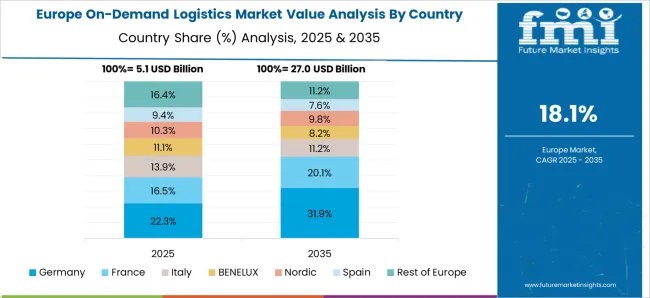
Germany is projected to expand at a CAGR of 22.4% from 2025 to 2035, supported by Industry 4.0 adoption and strong cross-border trade integration. Logistics firms are investing in AI and IoT-enabled supply chain solutions for predictive demand and efficient warehouse management. Partnerships between logistics providers and retail companies are expanding service reach. Rising focus on green logistics with electric and hybrid fleets is shaping the market trajectory.
- Germany’s logistics sector value projected to exceed USD 500 billion by 2030
- AI-enabled predictive logistics expected to reduce operational costs by up to 20%
- Hybrid and electric fleet share forecast to reach 40% by 2032
Growth Pattern of On-Demand Logistics Market in the United Kingdom
The United Kingdom is expected to achieve a CAGR of 18.5% during the forecast period, with strong contributions from e-commerce expansion and digital freight matching platforms. The shift toward same-day and next-day deliveries is creating opportunities for advanced logistics networks. Companies are investing in data-driven optimization tools and delivery automation. Urban mobility initiatives and government-LED digital infrastructure programs are further strengthening adoption.
- Same-day delivery services expected to account for 55% of e-commerce orders by 2030
- Automation in warehouses projected to increase efficiency by 25%
- Digital freight platforms expected to handle 50% of last-mile deliveries
Future Direction of On-Demand Logistics Market in the United States
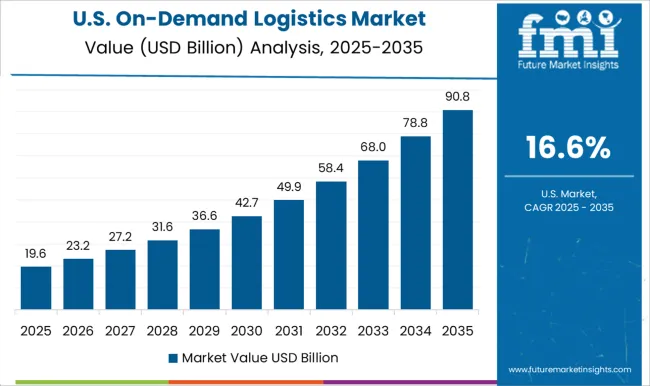
The United States is forecast to register a CAGR of 16.6% from 2025 to 2035, supported by strong e-commerce penetration and technological advancements in supply chain management. Logistics providers are focusing on real-time visibility, automated dispatching, and AI-driven demand prediction. Investments in drone delivery systems and sustainable logistics infrastructure are expanding operational scope. Consolidation among logistics startups and traditional providers is reshaping the competitive landscape.
- Drone delivery services projected to reach commercial viability in 25 states by 2031
- AI-powered logistics expected to save up to USD 50 billion annually by 2035
- Sustainable logistics infrastructure investment anticipated to grow by 30% annually
Competitive Landscape of On-Demand Logistics Market
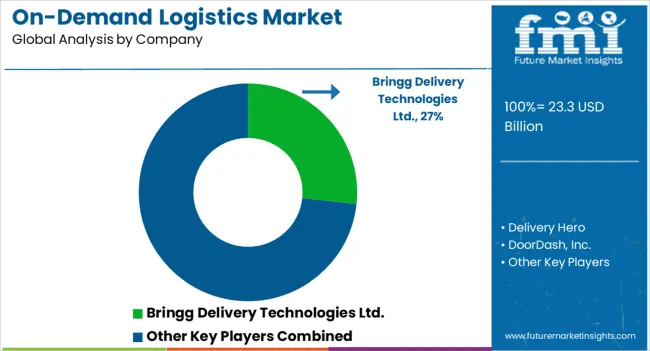
The On-Demand Logistics Market is expanding rapidly, driven by the global rise of e-commerce, quick commerce (q-commerce), and last-mile delivery services that prioritize speed, flexibility, and customer convenience. On-demand logistics platforms enable real-time fulfillment through digital connectivity, route optimization, and crowdsourced fleets, reshaping how goods move across urban and regional networks. This growth is further accelerated by advancements in AI-driven dispatch systems, predictive delivery algorithms, and integrated mobility solutions that enhance efficiency while reducing operational costs.
Industry leaders such as Uber Technologies Inc., DoorDash Inc., and Delivery Hero SE dominate the global on-demand logistics ecosystem with large-scale digital platforms that connect millions of merchants, drivers, and consumers. Uber Technologies, through its Uber Eats and Postmates brands, continues to expand its logistics infrastructure, offering real-time tracking and multi-category delivery, from food to pharmaceuticals. DoorDash has established itself as a major player in North America by diversifying into grocery and retail logistics through its DashMart model. Delivery Hero SE operates one of the world’s most extensive delivery networks across Europe, Asia, and Latin America, integrating smart logistics technologies for cross-market scalability.
Instacart and Lalamove contribute significantly to the grocery and same-day delivery segments. Instacart leverages data analytics to streamline order batching and delivery routing, while Lalamove specializes in intra-city logistics for SMEs across Asia and Latin America, offering customizable vehicle fleets for diverse cargo needs. Shadowfax Technologies Pvt. Ltd. and Stuart Delivery Ltd. are transforming the logistics landscape in emerging markets and Europe through hybrid fulfillment models that combine gig economy labor with tech-enabled supply chain orchestration. Bringg Delivery Technologies Ltd. enhances the ecosystem by providing delivery orchestration software that integrates carriers, fleets, and delivery partners into a single digital framework for optimized visibility and performance.
Grubhub Holdings Inc., now part of Just Eat Takeaway, continues to strengthen its position in North America by focusing on technology-driven route optimization and dynamic demand prediction. The Postmates division under Uber Technologies Inc. contributes to multi-modal logistics through real-time order synchronization and micro-fulfillment support.
Scope of the Report
| Item | Value |
|---|---|
| Quantitative Units | USD 23.3 Billion |
| Service | Same-day delivery, Courier services, Warehouse and storage services, Instant delivery, and Trucking services |
| Platform | Mobile apps and Web-based platforms |
| End-user | B2B, B2C, and C2C |
| Application | Retail & e-commerce, Food & beverages, Healthcare & pharmaceuticals, Automotive, Manufacturing, and Others |
| Regions Covered | North America, Europe, Asia-Pacific, Latin America, Middle East & Africa |
| Country Covered | United States, Canada, Germany, France, United Kingdom, China, Japan, India, Brazil, South Africa |
| Key Companies Profiled | Bringg Delivery Technologies Ltd., Delivery Hero SE, DoorDash Inc., Grubhub Holdings Inc., Instacart, Lalamove, Postmates (Uber Technologies Inc.), Shadowfax Technologies Pvt. Ltd., Stuart Delivery Ltd., Uber Technologies Inc. |
| Additional Attributes | Dollar sales by service model and delivery type, demand dynamics across same-day, next-day, and scheduLED deliveries, regional adoption trends in Asia-Pacific, North America, and Europe, innovation in AI-driven route optimization, autonomous vehicle integration, and real-time tracking platforms, environmental impact of reduced fuel consumption through optimized logistics operations, packaging sustainability, and last-mile emission controls, and emerging use cases in e-commerce fulfillment, B2B distribution networks, food and grocery delivery, and cross-border on-demand supply chains. |
On-Demand Logistics Market by Segments
Service:
- Same-day delivery
- Courier services
- Warehouse and storage services
- Instant delivery
- Trucking services
Platform:
- Mobile apps
- Web-based platforms
End-user:
- B2B
- B2C
- C2C
Application:
- Retail & e-commerce
- Food & beverages
- Healthcare & pharmaceuticals
- Automotive
- Manufacturing
- Others
Region:
- North America
- USA
- Canada
- Mexico
- Latin America
- Brazil
- Chile
- Rest of Latin America
- Western Europe
- Germany
- UK
- Italy
- Spain
- France
- Nordic
- BENELUX
- Rest of Western Europe
- Eastern Europe
- Russia
- Poland
- Hungary
- Balkan & Baltic
- Rest of Eastern Europe
- East Asia
- China
- Japan
- South Korea
- South Asia and Pacific
- India
- ASEAN
- Australia & New Zealand
- Rest of South Asia and Pacific
- Middle East & Africa
- Kingdom of Saudi Arabia
- Other GCC Countries
- Turkiye
- South Africa
- Other African Union
- Rest of Middle East & Africa
Frequently Asked Questions
How big is the on-demand logistics market in 2025?
The global on-demand logistics market is estimated to be valued at USD 23.3 billion in 2025.
What will be the size of on-demand logistics market in 2035?
The market size for the on-demand logistics market is projected to reach USD 138.2 billion by 2035.
How much will be the on-demand logistics market growth between 2025 and 2035?
The on-demand logistics market is expected to grow at a 19.5% CAGR between 2025 and 2035.
What are the key product types in the on-demand logistics market?
The key product types in on-demand logistics market are same-day delivery, courier services, warehouse and storage services, instant delivery and trucking services.
Which platform segment to contribute significant share in the on-demand logistics market in 2025?
In terms of platform, mobile apps segment to command 54.2% share in the on-demand logistics market in 2025.
Preview the report firsthand - request a free sample
Get SampleGet the brochure for pricing and purchase details.
Get PDFTable of Content
- Executive Summary
- Global Market Outlook
- Demand-side Trends
- Supply-side Trends
- Technology Roadmap Analysis
- Analysis and Recommendations
- Market Overview
- Market Coverage / Taxonomy
- Market Definition / Scope / Limitations
- Market Background
- Market Dynamics
- Drivers
- Restraints
- Opportunity
- Trends
- Scenario Forecast
- Demand in Optimistic Scenario
- Demand in Likely Scenario
- Demand in Conservative Scenario
- Opportunity Map Analysis
- Product Life Cycle Analysis
- Supply Chain Analysis
- Investment Feasibility Matrix
- Value Chain Analysis
- PESTLE and Porter’s Analysis
- Regulatory Landscape
- Regional Parent Market Outlook
- Production and Consumption Statistics
- Import and Export Statistics
- Market Dynamics
- Global On-Demand Logistics Market Analysis 2020-2024 and Forecast, 2025-2035
- Historical Market Size Value (USD Mn) Analysis, 2020-2024
- Current and Future Market Size Value (USD Mn) Projections, 2025-2035
- Y-o-Y Growth Trend Analysis
- Absolute $ Opportunity Analysis
- Global On-Demand Logistics Market Pricing Analysis 2020-2024 and Forecast 2025-2035
- Global On-Demand Logistics Market Analysis 2020-2024 and Forecast 2025-2035, By Service
- Introduction / Key Findings
- Historical Market Size Value (USD Mn) Analysis By Service , 2020-2024
- Current and Future Market Size Value (USD Mn) Analysis and Forecast By Service , 2025-2035
- Same-day delivery
- Courier services
- Warehouse and storage services
- Instant delivery
- Trucking services
- Y-o-Y Growth Trend Analysis By Service , 2020-2024
- Absolute $ Opportunity Analysis By Service , 2025-2035
- Global On-Demand Logistics Market Analysis 2020-2024 and Forecast 2025-2035, By Platform
- Introduction / Key Findings
- Historical Market Size Value (USD Mn) Analysis By Platform, 2020-2024
- Current and Future Market Size Value (USD Mn) Analysis and Forecast By Platform, 2025-2035
- Mobile apps
- Web-based platforms
- Y-o-Y Growth Trend Analysis By Platform, 2020-2024
- Absolute $ Opportunity Analysis By Platform, 2025-2035
- Global On-Demand Logistics Market Analysis 2020-2024 and Forecast 2025-2035, By End-user
- Introduction / Key Findings
- Historical Market Size Value (USD Mn) Analysis By End-user, 2020-2024
- Current and Future Market Size Value (USD Mn) Analysis and Forecast By End-user, 2025-2035
- B2B
- B2C
- C2C
- Y-o-Y Growth Trend Analysis By End-user, 2020-2024
- Absolute $ Opportunity Analysis By End-user, 2025-2035
- Global On-Demand Logistics Market Analysis 2020-2024 and Forecast 2025-2035, By Application
- Introduction / Key Findings
- Historical Market Size Value (USD Mn) Analysis By Application, 2020-2024
- Current and Future Market Size Value (USD Mn) Analysis and Forecast By Application, 2025-2035
- Retail & e-commerce
- Food & beverages
- Healthcare & pharmaceuticals
- Automotive
- Manufacturing
- Others
- Y-o-Y Growth Trend Analysis By Application, 2020-2024
- Absolute $ Opportunity Analysis By Application, 2025-2035
- Global On-Demand Logistics Market Analysis 2020-2024 and Forecast 2025-2035, By Region
- Introduction
- Historical Market Size Value (USD Mn) Analysis By Region, 2020-2024
- Current Market Size Value (USD Mn) Analysis and Forecast By Region, 2025-2035
- North America
- Latin America
- Western Europe
- Eastern Europe
- East Asia
- South Asia and Pacific
- Middle East & Africa
- Market Attractiveness Analysis By Region
- North America On-Demand Logistics Market Analysis 2020-2024 and Forecast 2025-2035, By Country
- Historical Market Size Value (USD Mn) Trend Analysis By Market Taxonomy, 2020-2024
- Market Size Value (USD Mn) Forecast By Market Taxonomy, 2025-2035
- By Country
- USA
- Canada
- Mexico
- By Service
- By Platform
- By End-user
- By Application
- By Country
- Market Attractiveness Analysis
- By Country
- By Service
- By Platform
- By End-user
- By Application
- Key Takeaways
- Latin America On-Demand Logistics Market Analysis 2020-2024 and Forecast 2025-2035, By Country
- Historical Market Size Value (USD Mn) Trend Analysis By Market Taxonomy, 2020-2024
- Market Size Value (USD Mn) Forecast By Market Taxonomy, 2025-2035
- By Country
- Brazil
- Chile
- Rest of Latin America
- By Service
- By Platform
- By End-user
- By Application
- By Country
- Market Attractiveness Analysis
- By Country
- By Service
- By Platform
- By End-user
- By Application
- Key Takeaways
- Western Europe On-Demand Logistics Market Analysis 2020-2024 and Forecast 2025-2035, By Country
- Historical Market Size Value (USD Mn) Trend Analysis By Market Taxonomy, 2020-2024
- Market Size Value (USD Mn) Forecast By Market Taxonomy, 2025-2035
- By Country
- Germany
- UK
- Italy
- Spain
- France
- Nordic
- BENELUX
- Rest of Western Europe
- By Service
- By Platform
- By End-user
- By Application
- By Country
- Market Attractiveness Analysis
- By Country
- By Service
- By Platform
- By End-user
- By Application
- Key Takeaways
- Eastern Europe On-Demand Logistics Market Analysis 2020-2024 and Forecast 2025-2035, By Country
- Historical Market Size Value (USD Mn) Trend Analysis By Market Taxonomy, 2020-2024
- Market Size Value (USD Mn) Forecast By Market Taxonomy, 2025-2035
- By Country
- Russia
- Poland
- Hungary
- Balkan & Baltic
- Rest of Eastern Europe
- By Service
- By Platform
- By End-user
- By Application
- By Country
- Market Attractiveness Analysis
- By Country
- By Service
- By Platform
- By End-user
- By Application
- Key Takeaways
- East Asia On-Demand Logistics Market Analysis 2020-2024 and Forecast 2025-2035, By Country
- Historical Market Size Value (USD Mn) Trend Analysis By Market Taxonomy, 2020-2024
- Market Size Value (USD Mn) Forecast By Market Taxonomy, 2025-2035
- By Country
- China
- Japan
- South Korea
- By Service
- By Platform
- By End-user
- By Application
- By Country
- Market Attractiveness Analysis
- By Country
- By Service
- By Platform
- By End-user
- By Application
- Key Takeaways
- South Asia and Pacific On-Demand Logistics Market Analysis 2020-2024 and Forecast 2025-2035, By Country
- Historical Market Size Value (USD Mn) Trend Analysis By Market Taxonomy, 2020-2024
- Market Size Value (USD Mn) Forecast By Market Taxonomy, 2025-2035
- By Country
- India
- ASEAN
- Australia & New Zealand
- Rest of South Asia and Pacific
- By Service
- By Platform
- By End-user
- By Application
- By Country
- Market Attractiveness Analysis
- By Country
- By Service
- By Platform
- By End-user
- By Application
- Key Takeaways
- Middle East & Africa On-Demand Logistics Market Analysis 2020-2024 and Forecast 2025-2035, By Country
- Historical Market Size Value (USD Mn) Trend Analysis By Market Taxonomy, 2020-2024
- Market Size Value (USD Mn) Forecast By Market Taxonomy, 2025-2035
- By Country
- Kingdom of Saudi Arabia
- Other GCC Countries
- Turkiye
- South Africa
- Other African Union
- Rest of Middle East & Africa
- By Service
- By Platform
- By End-user
- By Application
- By Country
- Market Attractiveness Analysis
- By Country
- By Service
- By Platform
- By End-user
- By Application
- Key Takeaways
- Key Countries On-Demand Logistics Market Analysis
- USA
- Pricing Analysis
- Market Share Analysis, 2024
- By Service
- By Platform
- By End-user
- By Application
- Canada
- Pricing Analysis
- Market Share Analysis, 2024
- By Service
- By Platform
- By End-user
- By Application
- Mexico
- Pricing Analysis
- Market Share Analysis, 2024
- By Service
- By Platform
- By End-user
- By Application
- Brazil
- Pricing Analysis
- Market Share Analysis, 2024
- By Service
- By Platform
- By End-user
- By Application
- Chile
- Pricing Analysis
- Market Share Analysis, 2024
- By Service
- By Platform
- By End-user
- By Application
- Germany
- Pricing Analysis
- Market Share Analysis, 2024
- By Service
- By Platform
- By End-user
- By Application
- UK
- Pricing Analysis
- Market Share Analysis, 2024
- By Service
- By Platform
- By End-user
- By Application
- Italy
- Pricing Analysis
- Market Share Analysis, 2024
- By Service
- By Platform
- By End-user
- By Application
- Spain
- Pricing Analysis
- Market Share Analysis, 2024
- By Service
- By Platform
- By End-user
- By Application
- France
- Pricing Analysis
- Market Share Analysis, 2024
- By Service
- By Platform
- By End-user
- By Application
- India
- Pricing Analysis
- Market Share Analysis, 2024
- By Service
- By Platform
- By End-user
- By Application
- ASEAN
- Pricing Analysis
- Market Share Analysis, 2024
- By Service
- By Platform
- By End-user
- By Application
- Australia & New Zealand
- Pricing Analysis
- Market Share Analysis, 2024
- By Service
- By Platform
- By End-user
- By Application
- China
- Pricing Analysis
- Market Share Analysis, 2024
- By Service
- By Platform
- By End-user
- By Application
- Japan
- Pricing Analysis
- Market Share Analysis, 2024
- By Service
- By Platform
- By End-user
- By Application
- South Korea
- Pricing Analysis
- Market Share Analysis, 2024
- By Service
- By Platform
- By End-user
- By Application
- Russia
- Pricing Analysis
- Market Share Analysis, 2024
- By Service
- By Platform
- By End-user
- By Application
- Poland
- Pricing Analysis
- Market Share Analysis, 2024
- By Service
- By Platform
- By End-user
- By Application
- Hungary
- Pricing Analysis
- Market Share Analysis, 2024
- By Service
- By Platform
- By End-user
- By Application
- Kingdom of Saudi Arabia
- Pricing Analysis
- Market Share Analysis, 2024
- By Service
- By Platform
- By End-user
- By Application
- Turkiye
- Pricing Analysis
- Market Share Analysis, 2024
- By Service
- By Platform
- By End-user
- By Application
- South Africa
- Pricing Analysis
- Market Share Analysis, 2024
- By Service
- By Platform
- By End-user
- By Application
- USA
- Market Structure Analysis
- Competition Dashboard
- Competition Benchmarking
- Market Share Analysis of Top Players
- By Regional
- By Service
- By Platform
- By End-user
- By Application
- Competition Analysis
- Competition Deep Dive
- Bringg Delivery Technologies Ltd.
- Overview
- Product Portfolio
- Profitability by Market Segments (Product/Age /Sales Channel/Region)
- Sales Footprint
- Strategy Overview
- Marketing Strategy
- Product Strategy
- Channel Strategy
- Delivery Hero
- DoorDash, Inc.
- Grubhub
- Instacart
- Lalamove
- Postmates
- Shadowfax Technologies Pvt. Ltd.
- Stuart Delivery Ltd.
- Uber Technologies Inc.
- Bringg Delivery Technologies Ltd.
- Competition Deep Dive
- Assumptions & Acronyms Used
- Research Methodology


