

- Industry Size (2026)
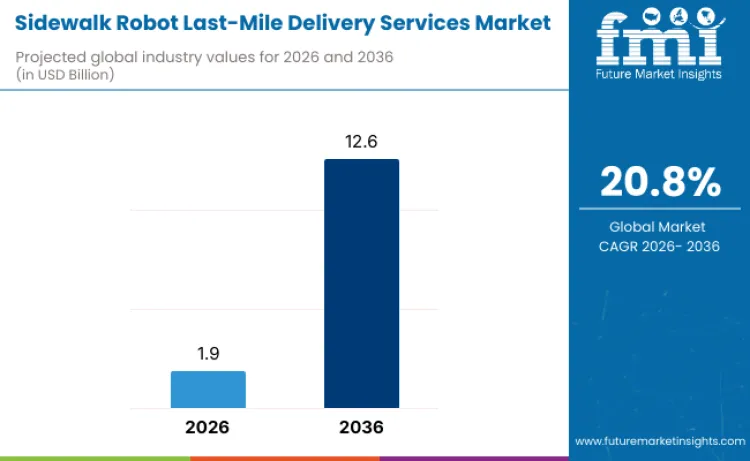
- USD 1.9 Bn
- Forecast (2036)
- USD 12.6 Bn
- CAGR (2026 to 2036)
- 20.8%
Sidewalk Robot Last-Mile Delivery Services Market Forecast and Outlook 2026 to 2036
The sidewalk robot last-mile delivery services market is valued at USD 1.9 billion in 2026 and is projected to reach USD 12.6 billion by 2036, reflecting a CAGR of 20.8%. Demand rises as retailers, foodservice platforms, and logistics providers shift toward low-cost, low-emission last-mile solutions suited for short-range urban delivery. Adoption strengthens in dense neighborhoods seeking reduced congestion and improved delivery continuity.
Autonomous delivery robots lead robot-type usage due to navigation accuracy, obstacle detection, and consistent route performance without human intervention. Units carrying up to 10 kg dominate payload demand because this range aligns with typical grocery, pharmacy, and meal-delivery orders. Connectivity with cloud routing engines, teleoperation support, and real-time fleet control improves safety and delivery precision across varied terrain.
Quick Stats for Sidewalk Robot Last-Mile Delivery Services Market
- Market Value (2026): USD 1.9 billion
- Market Forecast Value (2036): USD 12.6 billion
- Forecast CAGR (2026 to 2036): 20.8%
- Leading Robot-Type Segment in Global Demand: Autonomous Delivery Robots
- Leading Payload Segment in Global Demand: Up to 10 kg
- Key Growth Regions in Global Demand: China, India, USA, Japan
- Top Players in Global Demand: Starship Technologies, Nuro, Kiwibot, Serve Robotics, Coco Robotics
China, India, USA, and Japan emerge as core growth regions driven by rapid urbanization, expanding e-commerce ecosystems, and policy support for automated mobility pilots. Starship Technologies, Nuro, Kiwibot, Serve Robotics, and Coco Robotics shape competition through enhanced sensor suites, improved battery endurance, and scalable fleet-management platforms that support high-frequency, short-distance delivery workflows.
Sidewalk Robot Last-Mile Delivery Services Market Key Takeaways
| Metric | Value |
|---|---|
| Market Value (2026) | USD 1.9 billion |
| Market Forecast Value (2036) | USD 12.6 billion |
| Forecast CAGR (2026 to 2036) | 20.8% |
How Are the Segments Classified in the Sidewalk Robot Last-Mile Delivery Services Market?
Demand for sidewalk robot delivery services is shaped by autonomous navigation capability, labor-cost reduction goals, and requirements for low-emission last-mile operations in urban and campus environments. Buyers evaluate robot reliability, payload flexibility, and routing efficiency across food delivery, parcel distribution, and medical transport. Adoption patterns reflect advances in perception algorithms, curb-level mobility, and deployment strategies supporting dense delivery zones and controlled-site operations.
Which Robot Type Accounts for the Largest Share of Global Demand?
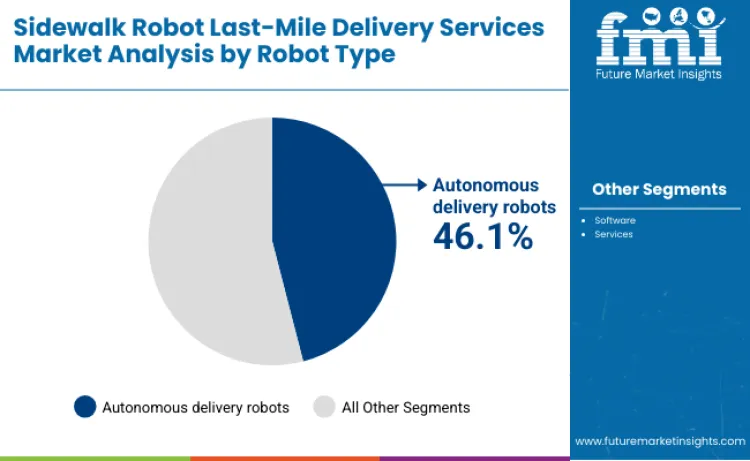
Autonomous delivery robots hold 46.1%, making them the leading robot-type segment globally. Autonomous platforms support independent navigation, continuous routing, and reduced operator intervention across sidewalks, campuses, and micro-urban zones. Semi-autonomous robots support monitored navigation in mixed-traffic areas where partial oversight improves safety. Remote-operated robots serve constrained environments requiring manual route correction or real-time operator control. Robot-type distribution reflects maturity of autonomous systems, fleet-scalability goals, and integration with on-demand delivery platforms.
Key Points:
- Autonomous robots support fully automated route execution.
- Semi-autonomous units operate with partial oversight in complex zones.
- Remote-operated robots address high-control environments.
- Distribution aligns with autonomy readiness and fleet scalability.
Which Payload Capacity Segment Represents the Largest Share of Global Demand?
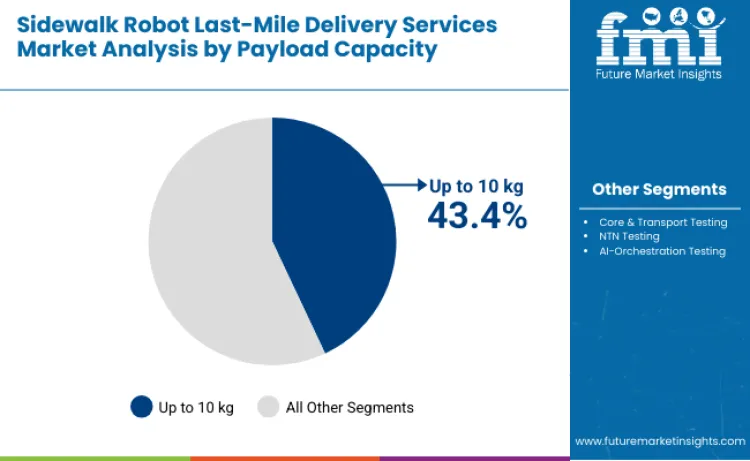
Up to 10 kg holds 43.4%, making it the largest payload-capacity segment globally. Light-payload robots support food containers, small parcels, and quick-turnaround deliveries within compact delivery radii. The 10-25 kg segment supports larger parcels, grocery bags, and multi-order consolidation tasks. Above 25 kg serves specialized applications needing heavier transport, often within campus or closed-site environments. Payload distribution reflects typical last-mile parcel weights, delivery frequency, and energy-efficiency tradeoffs in sidewalk-scale robotics.
Key Points:
- Up to 10 kg suits food and small-parcel workflows.
- Mid-range payloads support consolidated delivery tasks.
- Heavy-payload robots serve specialized or controlled-site needs.
- Segment choices reflect weight distribution across last-mile deliveries.
Which Service Application Accounts for the Largest Share of Global Demand?
Food and beverage delivery holds 45.2%, making it the leading service-application segment. High order frequency, short-distance routing, and temperature-sensitive transport drive strong adoption. Parcel and e-commerce delivery supports small-item distribution and integration with microhubs. Pharmacy and medical delivery serves time-critical transport of prescriptions and samples with strict chain-of-custody requirements. Campus and closed-site deliveries support controlled-environment logistics for universities, industrial parks, and institutions. Application distribution reflects delivery frequency, time sensitivity, and suitability for autonomous robot workflows.
Key Points:
- Food delivery dominates due to high order turnover.
- Parcel delivery aligns with e-commerce and microhub integration.
- Medical delivery supports secure, time-sensitive transport.
- Closed-site delivery benefits from predictable routing environments.
What are the Key Dynamics in the Sidewalk Robot Last-Mile Delivery Services Market?
Global demand grows as cities, retailers, and logistics operators explore automated sidewalk delivery to reduce congestion, shorten delivery windows, and manage rising e-commerce volumes. Sidewalk robots support short-range distribution in dense neighbourhoods where conventional vehicles face access limits. Operators deploy autonomous units for food, parcel, and convenience-goods delivery. Data platforms manage routing, fleet coordination, and safety monitoring. Interest rises as urban programs evaluate low emission delivery models suited to compact operating zones.
How are urban mobility needs and e-commerce workflows influencing adoption of sidewalk delivery robots?
Urban corridors experience growing parcel and meal delivery density, which strengthens interest in small autonomous units that navigate sidewalks and campus environments. Retailers and quick-commerce operators use robots for short radius fulfilment to reduce labour needs during peak periods. Robots return consistent travel times across high traffic zones that constrain van operations. Universities, hospitals, and mixed-use developments adopt robot fleets to support internal logistics. Remote operators oversee fleets using teleoperation for complex manoeuvres. Digital dispatch platforms integrate robots with inventory systems, enabling scheduled deliveries and reliable point-to-point routing. Sensors and computer-vision modules improve navigation in varied pedestrian environments.
How do regulatory constraints, capital requirements, and operational limitations affect scalability?
City regulations shape fleet deployment through speed limits, pathway rules, pilot permits, and crosswalk policies. Operators assess capital expenditure for autonomous navigation hardware, battery systems, and fleet monitoring tools. Weather conditions influence reliability, reducing utilization in regions with heavy snow or rainfall. Sidewalk clutter and variable pedestrian flow create operational challenges. Carriers balance robot deployment with labour agreements and delivery performance metrics. Charging and storage sites require proximity to service areas, affecting real estate planning. Pilot programs in several cities maintain temporary authorizations, which limits long term investment certainty for large scale robot fleets.
How is Demand for Sidewalk Robot Last-Mile Delivery Services Market Evolving Across Key Countries?
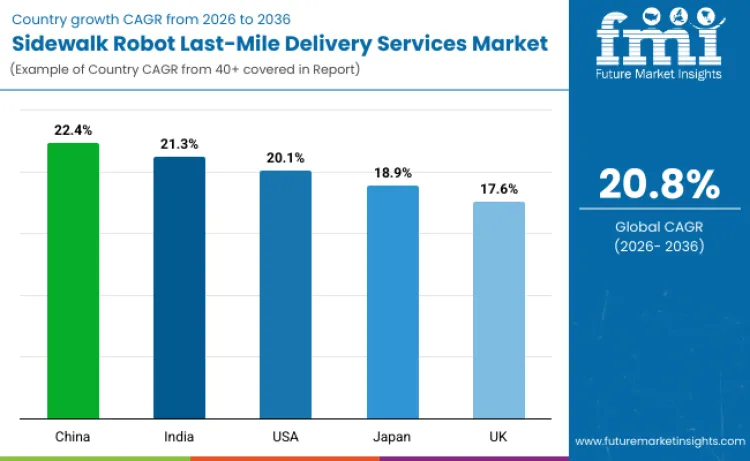
Demand for the sidewalk robot last-mile delivery services market is rising due to increased automation in urban logistics, higher delivery density, and interest in low-cost, low-emission last-mile solutions. China records a CAGR of 22.4% supported by rapid robotics deployment and high parcel volumes. India shows a 21.3% CAGR driven by dense metropolitan delivery zones and strong digital-logistics expansion. The USA posts a 20.1% CAGR supported by advanced autonomous-systems development and rising on-demand delivery activity. Japan holds an 18.9% CAGR linked with precision-driven robotics adoption. The UK records a 17.6% CAGR aligned with clean-transport objectives and structured urban-logistics planning.
| Country | CAGR (%) |
|---|---|
| China | 22.4% |
| India | 21.3% |
| USA | 20.1% |
| Japan | 18.9% |
| UK | 17.6% |
How is China driving demand for Sidewalk Robot Last-Mile Delivery Services?
China drives demand through widespread adoption of autonomous systems, strong e-commerce growth, and rapid integration of robotic logistics infrastructure. The country’s CAGR of 22.4% reflects active deployment of sidewalk delivery robots across universities, commercial districts, and dense residential zones. Logistics providers use robots to reduce labor dependency and manage high-frequency delivery cycles. Municipalities support pilot programs improving traffic flow and enabling low-emission delivery. Robotics firms introduce advanced navigation systems suited for crowded sidewalks. Strong consumer acceptance of automated delivery reinforces operational expansion across major cities.
- Strong e-commerce and automation ecosystem
- Rapid deployment of sidewalk robots in dense zones
- Municipal support for low-emission logistics
- Broad consumer acceptance of autonomous delivery
How is India driving demand for Sidewalk Robot Last-Mile Delivery Services?
India supports rising demand due to heavy metropolitan congestion, fast-growing e-commerce activity, and increased interest in automation for hyperlocal deliveries. The country’s CAGR of 21.3% reflects consistent testing and adoption of sidewalk robots across retail, food delivery, and parcel logistics. Dense last-mile networks benefit from robots that bypass traffic-related delays. Logistics platforms integrate autonomous units to reduce operational bottlenecks. Universities and technology hubs support pilot deployments to refine navigation in complex pedestrian environments. Interest in cost-effective and scalable delivery models strengthens adoption across expanding urban centers.
- Dense metropolitan delivery networks
- Strong e-commerce-driven parcel volumes
- Active pilot deployments across tech hubs
- Demand for scalable, low-cost delivery automation
How is the USA driving demand for Sidewalk Robot Last-Mile Delivery Services?
The USA drives demand through advanced robotics engineering, high on-demand delivery frequency, and strong investment in autonomous systems. The country’s CAGR of 20.1% reflects steady deployment of sidewalk robots across university campuses, residential communities, and commercial districts. Logistics firms use robots to support short-distance deliveries and reduce operational costs. Retail chains integrate autonomous delivery to improve same-day and near-instant fulfilment performance. Municipalities explore regulatory frameworks to manage sidewalk-sharing and safety protocols. Technology startups contribute continuous advancements in sensing, mapping, and fleet-management systems.
- High-frequency on-demand delivery usage
- Broad adoption of autonomous systems by logistics firms
- Retail integration supporting rapid fulfilment
- Strong robotics innovation ecosystem
How is Japan driving demand for Sidewalk Robot Last-Mile Delivery Services?
Japan drives demand due to its precision robotics industry, aging workforce, and structured urban-logistics environment. The country’s CAGR of 18.9% reflects stable deployment of sidewalk robots supporting food, parcel, and retail deliveries. Robotics firms develop compact, highly accurate navigation systems suited for narrow pedestrian pathways. Municipal authorities collaborate with logistics operators to test robots in controlled urban zones. Workforce shortages in urban retail and delivery sectors support increased reliance on autonomous systems. Retail and convenience-store networks adopt robots to support predictable, short-distance delivery operations.
- Precision-driven robotics development
- Workforce constraints encouraging automation
- Ongoing municipal-industry collaboration
- Strong usage across retail and convenience networks
How is the UK driving demand for Sidewalk Robot Last-Mile Delivery Services?
The UK drives demand through strong clean-transport policies, dense walkable city centers, and interest in reducing congestion from delivery vehicles. The country’s CAGR of 17.6% reflects steady adoption of sidewalk robots facilitating low-emission last-mile operations. Urban freight strategies encourage robotic delivery to reduce van trips in restricted zones. Retailers and parcel carriers employ autonomous units to support sustainable delivery commitments. Municipalities allow controlled pilot programs evaluating safety, routing, and pedestrian interaction patterns. Growth in automated micro-fulfilment operations reinforces the role of sidewalk robots in short-range distribution.
- Clean-transport and congestion-reduction policies
- Use of robots in restricted urban delivery zones
- Strong retailer and parcel-carrier adoption
- Pilot programs supporting structured deployment
What is the competitive landscape of demand for sidewalk robot last-mile delivery services globally?
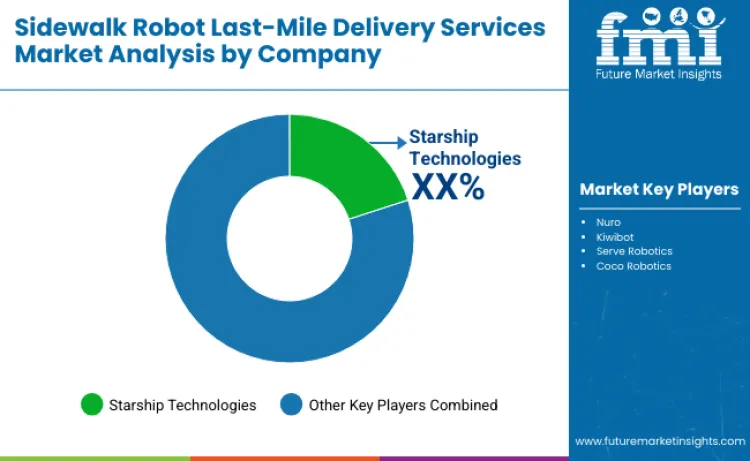
Demand for sidewalk robot last-mile delivery services grows as retailers, food platforms, and logistics providers pursue low-cost, low-emission alternatives for short-distance deliveries in dense urban areas. Requirements center on autonomous navigation reliability, curbside operational safety, obstacle detection accuracy, and secure payload compartments. Buyers evaluate fleet management software, remote supervision capability, sensor redundancy, and integration with platform ordering systems. Procurement teams emphasize regulatory compliance, mapping precision, and unit uptime supporting consistent delivery cycles. Trend in the global market reflects expanding pilot programs, supportive municipal policies, and rising interest in automated micro-fulfillment across campus, residential, and mixed-use districts.
Starship Technologies holds an estimated 31.0% share. Position strengthens through large-scale autonomous delivery deployments across universities, residential communities, and selected city zones. Nuro participates with autonomous sidewalk-adjacent units designed for heavier payloads supported by strong partnerships with retail and grocery chains. Kiwibot contributes lightweight sidewalk robots integrated with food delivery platforms operating in multiple countries. Serve Robotics maintains visibility through autonomous delivery fleets linked to major delivery apps and urban pilot programs. Coco Robotics supports demand with teleoperated and semi-autonomous delivery robots designed for short-distance transport in dense neighborhoods. Competitive positioning globally reflects navigation performance, operational scalability, regulatory alignment, and integration depth with commercial delivery ecosystems.
Key Players in the Sidewalk Robot Last-Mile Delivery Services Market
- Starship Technologies
- Nuro
- Kiwibot
- Serve Robotics
- Coco Robotics
Scope of the Report
| Items | Values |
|---|---|
| Quantitative Units | USD billion |
| Classification | Autonomous Delivery Robots, Semi-Autonomous Delivery Robots, Remote-Operated Delivery Robots |
| Payload Capacity | Up to 10 kg, 10-25 kg, Above 25 kg |
| Application (Service Application) | Food & Beverage Delivery, Parcel & E-commerce Delivery, Pharmacy & Medical Delivery, Campus / Closed-Site Deliveries |
| End-User | E-commerce Companies, Restaurants & Food Aggregators, Retailers, Healthcare Providers |
| Regions Covered | Asia Pacific, Europe, North America, Latin America, Middle East & Africa |
| Countries Covered | India, China, USA, Germany, South Korea, Japan, Italy, and 40+ countries |
| Key Companies Profiled | Starship Technologies, Nuro , Kiwibot , Serve Robotics, Coco Robotics |
| Additional Attributes | Dollar sales by robot type, payload capacity, and service application; deployment trends across dense urban and campus environments; adoption driven by growth in contactless delivery, e-commerce expansion, and labor cost optimization; integration with AI navigation, teleoperation platforms, and autonomous pedestrian-safe systems; regulatory influences on sidewalk robot permissions, safety compliance, and municipal robotics policies; competitive landscape analysis of autonomous last-mile delivery operators and technology providers. |
Sidewalk Robot Last-Mile Delivery Services Market by Segment
By Robot Type:
- Autonomous Delivery Robots
- Semi-Autonomous Delivery Robots
- Remote-Operated Delivery Robots
By Payload Capacity:
- Up to 10 kg
- 10-25 kg
- Above 25 kg
By Service Application:
- Food & Beverage Delivery
- Parcel & E-commerce Delivery
- Pharmacy & Medical Delivery
- Campus / Closed-Site Deliveries
By End-User:
- E-commerce Companies
- Restaurants & Food Aggregators
- Retailers
- Healthcare Providers
Region:
- Asia Pacific
- China
- Japan
- South Korea
- India
- Australia & New Zealand
- ASEAN
- Rest of Asia Pacific
- Europe
- Germany
- United Kingdom
- France
- Italy
- Spain
- Nordic
- BENELUX
- Rest of Europe
- North America
- United States
- Canada
- Mexico
- Latin America
- Brazil
- Chile
- Rest of Latin America
- Middle East & Africa
- Kingdom of Saudi Arabia
- Other GCC Countries
- Turkey
- South Africa
- Other African Union
- Rest of Middle East & Africa
Frequently Asked Questions
What is the size of the sidewalk robot last-mile delivery services market in 2026?
The market is valued at USD 1.9 billion in 2026, driven by adoption of compact autonomous units for short-route parcel delivery.
What will be the industry size by 2036?
Industry value will reach USD 12.6 billion by 2036 as operators scale sidewalk robot fleets in dense commercial and residential zones.
What is the CAGR for 2026 to 2036?
The sidewalk robot last-mile delivery services market expands at a 20.8% CAGR during the forecast period.
Which robot-type segment leads in 2026?
Autonomous delivery robots hold 46.1% share due to advancements in navigation systems and reduced operating costs.
Which payload-capacity segment holds the highest share?
Up to 10 kg payload systems lead with 43.4% share, reflecting suitability for food, grocery, and small parcel distribution.
Preview the report firsthand - request a free sample
Get SampleGet the brochure for pricing and purchase details.
Get PDFTable of Content
- Executive Summary
- Market Overview
- Global Market Value, 2020-2026
- Global Market Forecast, 2026-2036
- Market Dynamics
- Drivers
- Restraints
- Opportunities
- Regulatory & Standards Landscape
- Technology & Material Innovation Outlook
- Market Segmentation Analysis
- By Robot Type
- Autonomous Delivery Robots
- Semi-Autonomous Delivery Robots
- Remote-Operated Delivery Robots
- By Payload Capacity
- Up to 10 kg
- 10-25 kg
- Above 25 kg
- By Service Application
- Food & Beverage Delivery
- Parcel & E-commerce Delivery
- Pharmacy & Medical Delivery
- Campus / Closed-Site Deliveries
- By End-User
- E-commerce Companies
- Restaurants & Food Aggregators
- Retailers
- Healthcare Providers
- By Robot Type
- Regional Outlook
- Asia Pacific
- Europe
- North America
- Latin America
- Middle East & Africa
- Country-Level Outlook
- China
- India
- Japan
- United States
- Germany
- South Korea
- Italy
- Australia & New Zealand
- ASEAN
- United Kingdom
- France
- Spain
- Nordic
- BENELUX
- Mexico
- Brazil
- Chile
- Turkey
- South Africa
- Other GCC Countries
- Rest of Middle East & Africa
- Competitive Landscape
- Market Structure Overview
- Company Positioning
- Strategic Initiatives
- Key Player Profiles
- Scope of the Report
- Research Methodology
- Assumptions & Acronyms


