

- Industry Size (2026)
- USD 270.0 Mn
- Forecast (2036)
- USD 600.0 Mn
- CAGR (2026 to 2036)
- 8.3%
Robotic Ultrasonic NDT Cells for Weld and Pressure Vessel Inspection Market Size, Market Forecast and Outlook By FMI
FMI estimates the robotic ultrasonic NDT cells market for weld and pressure vessel inspection at USD 250.0 million in 2025. Industry is expected to reach USD 270.0 million in 2026 and expand at a CAGR of 8.3% between 2026 and 2036. Total valuation is projected to reach USD 600.0 million by 2036. Growth is supported by petrochemical operators replacing radiography-based inspection to avoid radiation shutdown requirements and improve operational continuity.
Fabrication facility managers face an immediate bottleneck when matching high-deposition automated welding with slow, hazardous testing. Evaluating ultrasonic weld inspection vs radiography, securing ultrasonic ndt equipment allows quality teams to evaluate thick-walled vessels parallel to adjacent fabrication activities, avoiding mandatory clearing zones that paralyze factory floors. Delaying this transition forces procurement teams within the robotic ultrasonic weld inspection sector to absorb compounding idle-time costs that rapidly destroy project margins on large pressure vessel contracts. One non-obvious reality is that heavy fabricators often prioritize robotic inspection not for superior flaw detection, but simply to accelerate critical-path timelines of final code stamping.
Summary of Robotic Ultrasonic NDT Cells for Weld and Pressure Vessel Inspection Market
- The market is estimated at USD 250.0 million in 2025.
- The market is projected to reach USD 600.0 million by 2036.
- The market is expected to grow at a CAGR of 8.3% from 2026 to 2036.
- The forecast period represents an incremental opportunity of USD 330.0 million.
- PAUT technology leads the segment with a 46.0% share.
- Crawler-based systems dominate the format segment with a 38.0% share.
- Hardware components lead the market with a 64.0% share.
- Circumferential weld inspection is the leading application with a 32.0% share.
- Oil, gas, and process industries dominate end use with a 36.0% share.
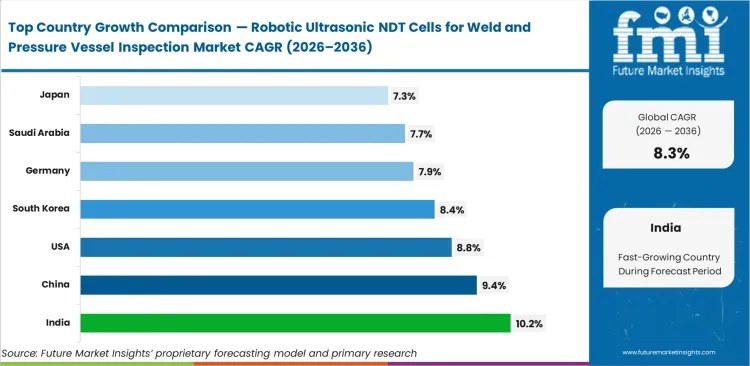
- India (10.2%), China (9.4%), and the United States (8.8%) are among the fastest-growing markets.
- Key companies in the market include Eddyfi Technologies, Evident, Waygate Technologies, Zetec, Sonatest, Invert Robotics, and ScanMaster.
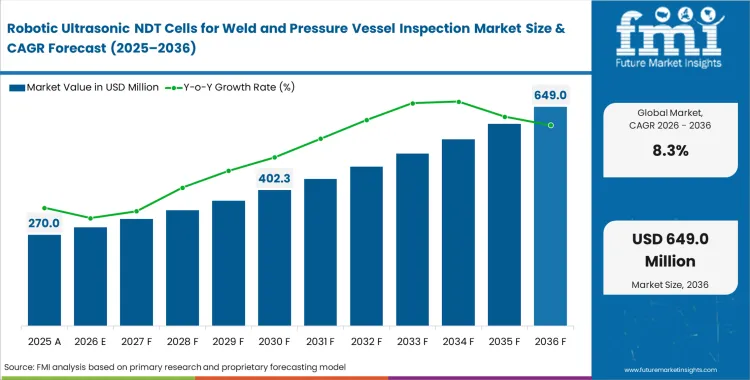
Regulatory acceptance under ASME Section VIII is accelerating adoption of automated ultrasonic inspection systems. Recognition of phased array data as a valid compliance record allows manufacturers to reduce dependence on isotope-based inspection methods. Capital investment is shifting toward automated inspection equipment as a result. Positioning inspection systems directly after welding stations improves workflow continuity and reduces process gaps across fabrication lines.
Adoption remains strongest across major industrial economies. India is expected to record a CAGR of 10.2% in the robotic ultrasonic NDT cells market for weld and pressure vessel inspection between 2026 and 2036, supported by refinery expansion and pipeline inspection requirements. China is anticipated to grow at 9.4% as nuclear power construction drives demand for automated flaw detection. The United States is forecast to expand at 8.8% due to inspection needs in aging petrochemical infrastructure. South Korea is projected to grow at 8.4% driven by shipbuilding activity. Germany is expected to register 7.9% as chemical processing facilities upgrade inspection systems. Saudi Arabia is likely to grow at 7.7% supported by oil and gas project investments, while Japan is anticipated to record 7.3% as industrial systems undergo modernization.
Segmental Analysis
Robotic Ultrasonic NDT Cells for Weld and Pressure Vessel Inspection Market Analysis by Technology
Phased Array Ultrasonic Testing (PAUT) is estimated to account for 46.0% share in 2026, as quality assurance directors leverage electronic beam steering to sweep entire joint volumes without complicated mechanical rastering. FMI's analysis indicates this capability allows metallurgical engineers executing phased array ultrasonic testing for pressure vessels to size critical defects precisely against stringent acceptance criteria. Procurement teams obsessing over raw element counts often ignore data transfer bottlenecks that severely cripple high-speed automated scanning on busy factory floors. Failing to match multi-element probes with adequate instrumentation bandwidth forces non-destructive testers to slow crawler speeds, completely negating productivity advantages of automation.
- Beam steering qualification: Quality directors validate focal laws to ensure acoustic energy hits bevel faces at optimal angles. Poor setup results in missed lack-of-fusion defects on thick-walled vessels.
- Data throughput constraints: NDT Level III engineers must throttle pulse repetition frequencies to prevent network saturation. Pushing too much data causes dropped frames, invalidating code-required continuous encoding.
- Probability of detection mapping: Integrity managers demand PAUT configurations mirroring legacy film sensitivity. Demonstrating equivalent flaw characterization is mandatory before regulatory bodies approve inspection alternatives.
Robotic Ultrasonic NDT Cells for Weld and Pressure Vessel Inspection Market Analysis by System Format
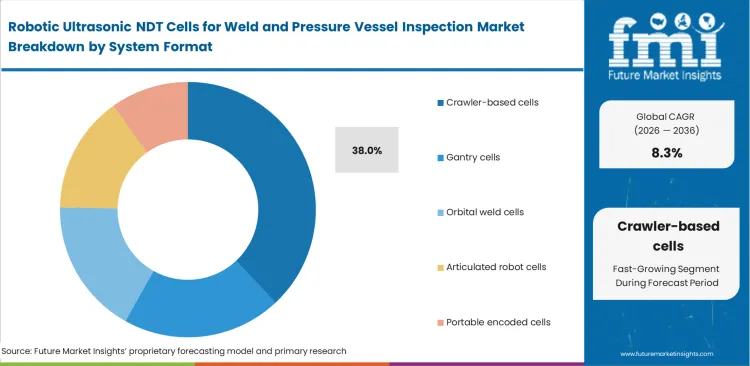
Navigating large vertical structures requires stable magnetic adhesion and accurate positional control. Crawler-based systems are expected to account for 38.0% share of the robotic ultrasonic NDT cells for weld and pressure vessel inspection segment in 2026. These systems support wall-thickness measurement on tall petrochemical columns without interrupting surrounding operations. Reliability teams use crawler-based ultrasonic systems to avoid scaffolding during inspection.
This reduces setup time and limits disruption during maintenance cycles. Cost savings from eliminating scaffolding often exceed the benefit gained from faster inspection alone. Visual inspection using drones cannot detect internal corrosion. Operators relying only on external imaging risk missing structural damage that affects pressure integrity. Contact-based ultrasonic systems remain necessary for confined space vessel inspection where internal defect validation is required.
- Adhesion payload dynamics: Robotics engineers balance heavy phased array yokes against neodymium magnet pull strength. Crawlers losing traction on damp vessel walls risk critical equipment drops.
- Umbilical cable management: Field technicians battle heavy couplant hoses and data cables dragging behind encoded scanners. Snagged umbilicals ruin positional encoding, forcing costly rescans of huge shell plates.
- Surface preparation friction: Maintenance directors must coordinate extensive abrasive blasting before crawlers can deploy. Thick epoxy coatings severely degrade ultrasonic signals, blocking effective internal corrosion mapping.
Robotic Ultrasonic NDT Cells for Weld and Pressure Vessel Inspection Market Analysis by Component
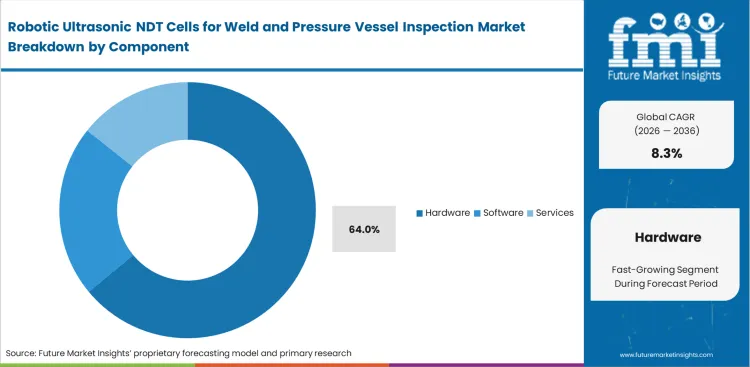
Capital expenditure profiles heavily skew toward ruggedized mechanical manipulation and complex acoustic generation. Hardware is poised to capture 64.0% share in 2026, as managers authorize major investments in multi-axis encoded scanners and high-channel-count flaw detectors. Based on FMI's assessment, NDT lab directors prioritize environmentally sealed inclusions capable of surviving abrasive shipyard conditions over theoretical laboratory specifications.
Top-tier phased array instruments are functionally commoditized across major suppliers; actual competitive advantage and highest margin sits within proprietary encoded tracking arms maintaining perfect acoustic coupling over uneven weld caps. Organizations buying cheap manipulation hardware experience constant acoustic dropouts, generating noisy data that sophisticated ndt inspection services algorithms cannot process.
- Couplant delivery failure: Field operators struggle constantly with blocked water lines interrupting acoustic transmission. Losing liquid coupling mid-scan instantly invalidates encoded compliance records.
- Encoder resolution drift: Quality engineers calibrate wheel encoders meticulously ensuring physical distance matches digital readouts. Slipping wheels’ map defects to incorrect locations, guaranteeing disastrous excavation errors during repair.
- Phased array probe degradation: Procurement teams cycle through expensive transducer wedges ground down by rough weld surfaces. Managing consumable friction costs dictates long-term profitability for inspection contractors.
Robotic Ultrasonic NDT Cells for Weld and Pressure Vessel Inspection Market Analysis by Application
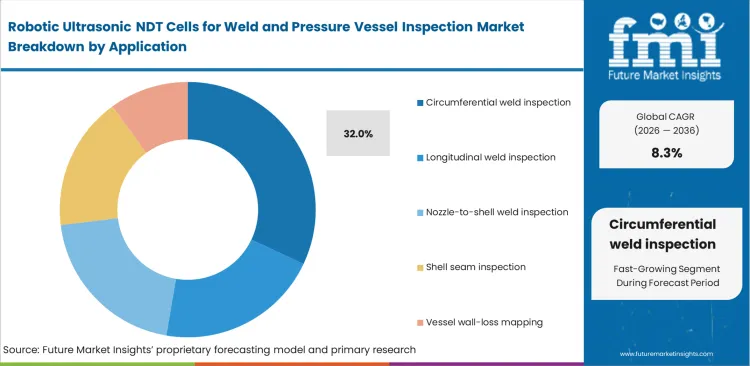
Circumferential weld inspection is projected to secure 32.0% share of the robotic ultrasonic NDT cells for weld and pressure vessel inspection segment in 2026. Welding teams use automated clamp-on bands to inspect critical piping spools during fabrication. This setup allows technicians to assess root passes while welds are still at elevated temperatures. Early-stage inspection reduces rework and prevents defects from progressing into later stages. Orbital welding systems complete joints much faster than manual GTAW processes. Inspection capacity must match this output to avoid workflow imbalance. Robotic inspection systems are deployed to maintain production continuity across high-volume fabrication lines. Delays in integrating automated inspection systems lead to spool accumulation in holding areas. Manual inspection cycles extend verification timelines and slow final dispatch.
- Hot-weld acoustic velocity: Metallurgical engineers must dynamically adjust calibration parameters on elevated temperature steel. Sound velocity shifts in hot materials distort defect sizing, risking false rejections.
- Narrow gap optimization: Quality directors configure specialized thin-profile probes fitting inside tight J-groove weld preparations. Standard transducers physically cannot access critical root geometries.
- Repair excavation mapping: NDT analysts provide precise depth coordinates to gouging operators removing identified flaws. Inaccurate spatial data forces welders to excavate high-volume trenches, destroying adjacent healthy metal.
Robotic Ultrasonic NDT Cells for Weld and Pressure Vessel Inspection Market Analysis by End Use
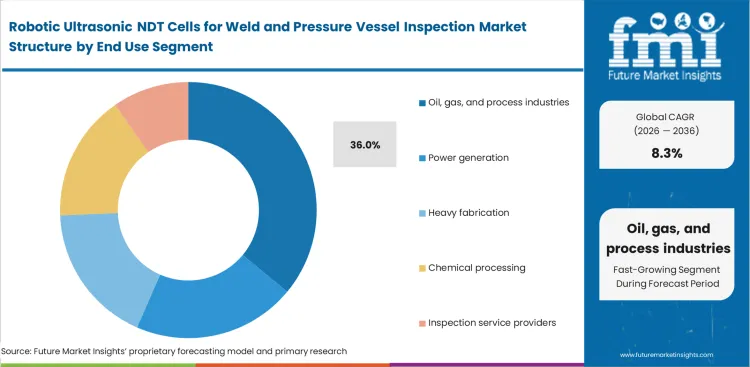
High-pressure hydrocarbon systems require strict validation of structural integrity. Oil, gas, and process industries are expected to account for 36.0% share of the robotic ultrasonic NDT cells for weld and pressure vessel inspection segment in 2026. Demand is driven by API and ASME requirements for inspection of thick-walled reactors and critical equipment. Refinery operators apply phased array ultrasonic testing aligned with ASME pressure vessel standards to validate newly fabricated units before commissioning.
This ensures compliance and reduces the risk of failure during operation. Turnaround teams use automated inspection systems to reduce shutdown duration. Faster inspection cycles help restore operations within planned timelines and limit production losses. Inspection providers without automated capabilities face exclusion from large petrochemical maintenance contracts. Manual inspection methods cannot meet the speed and consistency required in high-value shutdown projects.Top of FormBottom of Form
- Hydrogen blistering detection: Integrity managers deploy advanced PAUT setups mapping step-wise cracking inside sour gas vessels. Failing to monitor specific hydrogen-induced flaws leads to sudden severe ruptures.
- High-temperature continuous monitoring: Plant operators install permanent encoded tracks on critical piping susceptible to rapid flow-accelerated corrosion. Taking thickness measurements without shutting down active product lines preserves millions in revenue.
- Digital twin baseline generation: Reliability engineers feed baseline volumetric weld data directly into asset management software. Comparing future operational scans against initial acoustic signatures accurately predicts remaining vessel life.
Robotic Ultrasonic NDT Cells for Weld and Pressure Vessel Inspection Market Drivers, Restraints, and Opportunities
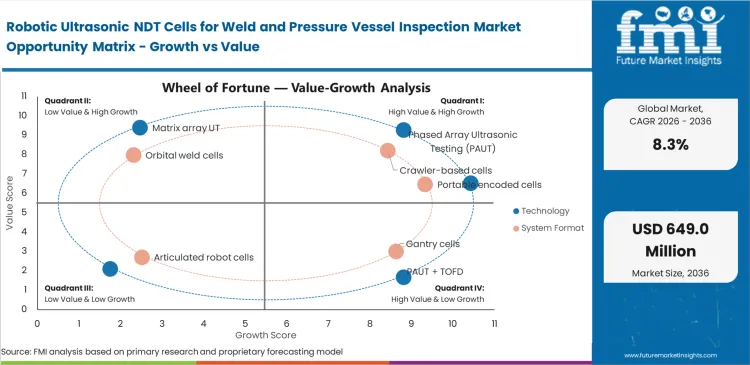
Replacing hazardous radiographic isotopes fundamentally changes heavy fabrication economics. Plant managers face severe production blockages when mandatory evacuation zones for legacy x-ray inspection force adjacent welding operations to halt. Integrating ultrasonic flaw detector automation into a remote weld inspection in pressure vessels workflow allows quality directors to execute volumetric scanning immediately alongside active fabrication lines, recovering hundreds of lost man-hours per project. Failing to eliminate radiation safety zones completely destroys schedule efficiency on vast contracts.
Strict regulatory validation cycles severely slow enterprise adoption. Code compliance requires proving equivalent probability of detection to legacy radiography, demanding months of qualification per specific weld procedure. Quality assurance managers must navigate complex performance demonstrations for independent code bodies, drafting vast technical justifications before transitioning techniques. Partial solutions involving simultaneous TOFD weld inspection for vessels and PAUT scanning improve regulatory confidence, requiring highly specialized NDT Level III engineers to sign off on specific calibration blocks.
Opportunities in the Robotic Ultrasonic NDT Cells for Weld and Pressure Vessel Inspection Market
- In-process acoustic monitoring: Welding engineers deploying high-temperature transducers immediately trailing active torches catch defects before subsequent passes bury them. Real-time adaptive feedback eliminates huge post-weld repair excavations.
- Machine learning defect recognition: Software developers training algorithms on thousands of verified PAUT scans accelerate flaw characterization. NDT directors reduce data bottleneck pressures when software automatically filters clean welds from suspicious indications.
- Drone-deployed crawler arrays: Asset managers utilizing heavy-lift drones to attach magnetic pipe inspection robots onto elevated columns bypass manual rope access entirely. Eliminating human height exposure drastically reduces facility insurance premiums.
Regional Analysis
Based on regional analysis, Robotic Ultrasonic NDT Cells for Weld and Pressure Vessel Inspection is segmented into North America, Latin America, Europe, East Asia, South Asia & Pacific, and Middle East & Africa across 40 plus countries.
.webp "Top Country Growth Comparison Robotic Ultrasonic Ndt Cells For Weld And Pressure Vessel Inspection Market Cagr (2026 2036)")
| Country | CAGR (2026 to 2036) |
|---|---|
| India | 10.2% |
| China | 9.4% |
| United States | 8.8% |
| South Korea | 8.4% |
| Germany | 7.9% |
| Saudi Arabia | 7.7% |
| Japan | 7.3% |
Source: Future Market Insights (FMI) analysis, based on proprietary forecasting model and primary research
South Asia & Pacific Robotic Ultrasonic NDT Cells for Weld and Pressure Vessel Inspection Market Analysis
Petrochemical expansion across the region is increasing fabrication volumes in heavy engineering yards. Inspection teams are adopting encoded ultrasonic systems to validate long pipeline networks under tight project timelines. A shortage of certified NDT personnel is accelerating the shift toward automated inspection cells.
- India: Refinery localization initiatives require heavy vessel manufacturers accelerating production timelines without sacrificing API compliance. Welding supervisors integrate automated industrial robotics matching high-deposition submerged arc welding stations. Demand in India is likely to rise at a CAGR of 10.2% through 2036. Securing advanced cells prevents critical bottlenecking during final vessel hydro-testing phases.
FMI's report includes Australia and ASEAN nations. Heavy mining infrastructure maintenance drives localized demand for portable encoded scanners.
East Asia Robotic Ultrasonic NDT Cells for Weld and Pressure Vessel Inspection Market Analysis
Nuclear power plant construction and large scale commercial shipbuilding operations demand absolute metallurgical integrity. Quality control directors across regional mega-yards install multi-axis gantry scanners inspecting heavy containment plates automatically. According to FMI's estimates, integrating phased array technology onto comprehensive structural weldments eliminates thousands of hours previously dedicated to radiographic film placement.
- China: Nuclear capacity expansion is increasing the need for zero-defect inspection in reactor containment vessels and other heavy forged components. Robotic ultrasonic NDT cells are gaining ground because micro-level defect detection has a direct bearing on qualification speed and commissioning schedules in these programs. During 2026 to 2036, the market in China is projected to grow at a CAGR of 9.4%. Wider adoption also reflects the value of inspection systems that can handle larger structures with greater consistency under demanding quality thresholds.
- South Korea: Cryogenic seam validation remains a critical requirement in South Korea’s LNG shipbuilding programs, where containment membrane integrity has to be verified across long weld paths under tight delivery schedules. Automated crawler arrays are being used to scan extensive structural seams more quickly and with better repeatability than manual methods can offer. Sales of robotic ultrasonic NDT cells in South Korea are expected to register 8.4% CAGR through 2036. Reliable weld verification also helps preserve buyer confidence in the country’s position within specialized maritime construction.
- Japan: Asset aging across industrial infrastructure is sustaining demand for inspection systems that can operate without forcing shutdowns in active facilities. Robotic ultrasonic NDT cells are being used in Japan to map wall thickness and corrosion across petrochemical units where continuous integrity monitoring carries clear maintenance value. Japan is estimated to record a CAGR of 7.3% in this segment between 2026 and 2036. Preference for these systems is also supported by the need to extend asset life without relying on more disruptive inspection routines.
FMI's report includes Taiwan. Precision manufacturing hubs utilize automated ultrasonic validation for high-pressure gas delivery systems.
North America Robotic Ultrasonic NDT Cells for Weld and Pressure Vessel Inspection Market Analysis
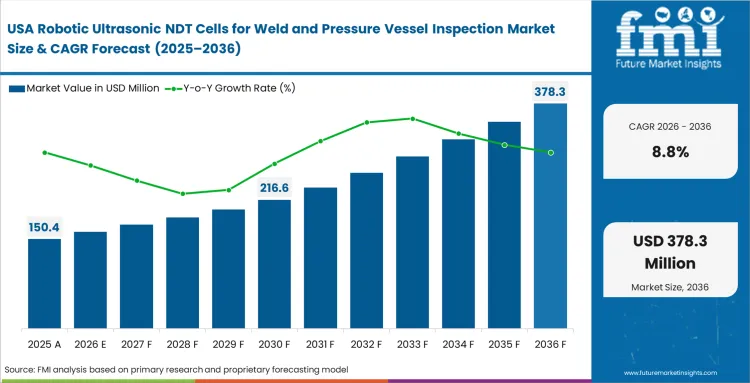
Aging energy infrastructure and strict regulatory oversight drive widespread integrity management upgrades. Plant directors across high refining complexes mandate encoded baseline scanning for newly installed high-pressure components. In FMI's view, transitioning legacy pipeline networks toward hydrogen transportation requires microscopic validation of existing weld seams preventing dangerous gas embrittlement.
- United States: Pipeline safety regulations require operators to maintain fully digitized inspection records using API-compliant ultrasonic standards. Quality teams are replacing manual spot checks with continuous automated inspection systems adapted for heavy industrial use. Demand for robotic ultrasonic NDT cells in weld and pressure vessel inspection in the United States is expected to grow at a CAGR of 8.8% from 2026 to 2036. Fabricators that cannot provide encoded digital compliance data risk exclusion from federal energy infrastructure contracts.
FMI's report includes Canada. Oil sands processing facilities require heavy-duty automated systems surviving extreme winter turnaround environments.
Europe Robotic Ultrasonic NDT Cells for Weld and Pressure Vessel Inspection Market Analysis
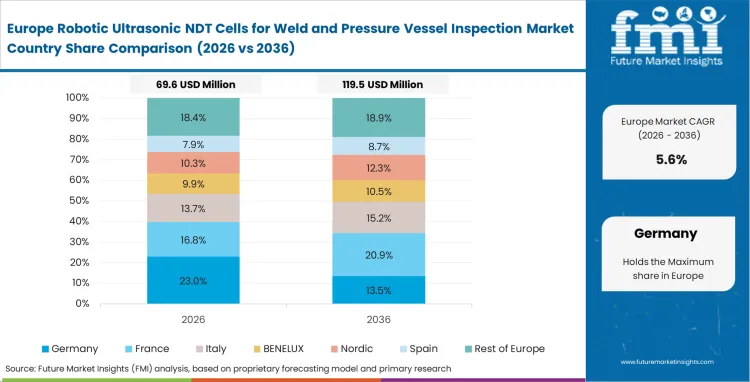
Stringent environmental containment regulations and advanced Industry 4.0 integration define regional capital expenditure. Metrology lab directors demand seamless data flow between automated NDT platforms and enterprise asset management software. FMI observes safety regulators actively pushing heavy industries away from radiographic isotopes toward environmentally benign ultrasonic alternatives.
- Germany: Chemical processing giants upgrade pipeline integrity networks utilizing advanced robotic crawlers. Integrity managers demand precise corrosion mapping algorithms predicting remaining asset life accurately. Germany is forecast to record steady growth at a CAGR of 7.9% through 2036. Connecting volumetric inspection data directly into digital twin models streamlines preventive maintenance scheduling.
FMI's report includes the United Kingdom, France, and Italy. Offshore wind fabrication requires high-volume automated gantry cells inspecting thick monopile foundation welds.
Middle East & Africa Robotic Ultrasonic NDT Cells for Weld and Pressure Vessel Inspection Market Analysis
Large oil and gas developments across the Middle East and Africa are increasing the need for inspection systems that can cover bigger project footprints without slowing construction progress. Weld validation demand rises quickly in new refinery, pipeline, and pressure vessel programs because manual inspection methods become harder to scale once project size, heat exposure, and schedule pressure all intensify. Automated ultrasonic cells are gaining stronger acceptance in this environment as project operators look for more repeatable defect detection across long weld runs and heavy fabricated sections. Equipment selection in this region is also influenced by field durability, since inspection systems often have to perform reliably in remote sites, high-temperature conditions, and extended operating cycles.
- Saudi Arabia: Pipeline and refinery construction activity is keeping inspection demand elevated across Saudi Arabia’s energy infrastructure pipeline. Robotic ultrasonic NDT cells for weld and pressure vessel inspection in Saudi Arabia are projected to expand at a CAGR of 7.7% from 2026 to 2036. Long transmission networks and large welded assemblies make automated inspection more practical where project owners need broader coverage without sacrificing weld validation quality. Ruggedized systems are also better suited to high-temperature operating conditions, which helps maintain inspection continuity and protect project timelines during large construction phases.
FMI’s report also covers the United Arab Emirates and South Africa. Offshore-linked fabrication demand in these markets is supporting localized equipment upgrades, especially where weld quality assurance and pressure boundary reliability remain central to project execution.
Competitive Aligners for Market Players
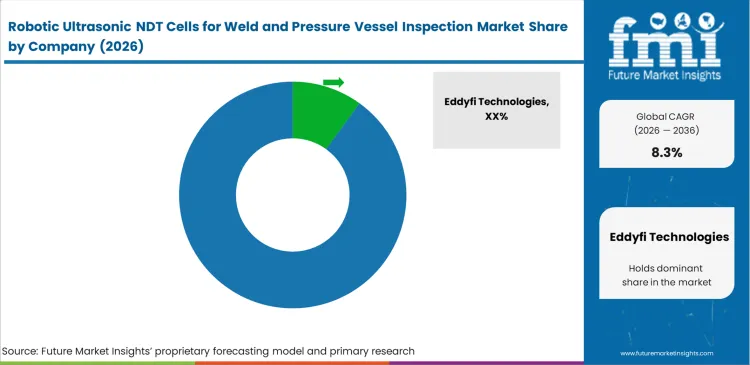
Heavy fabrication facilities prefer original equipment manufacturers that can supply both ultrasonic instruments and integrated mechanical tracking systems. Quality teams avoid building inspection cells using multiple vendors due to the risk of integration failure during critical turnaround schedules. Delays at this stage directly affect timelines and cost control. Vendors that offer stable communication between inspection modules and multi-axis robotic systems gain preference on the shop floor. Selection of robotic ultrasonic weld inspection systems now depends more on the maturity of automated defect recognition software than on hardware specifications alone.
Equipment manufacturers hold an advantage through large proprietary datasets built from validated weld inspections. These datasets support machine learning models that improve defect classification accuracy. New entrants face challenges in replicating this scale of acoustic data, which limits their ability to separate geometry-related signals from critical defects such as lack of fusion. Leading vendors strengthen their position by integrating sensor systems that maintain consistent transducer contact on uneven surfaces. This combination of mechanical design and acoustic performance remains difficult to replicate using standard flaw detectors and generic automation systems.
Inspection service contractors apply pressure by requiring open data frameworks in equipment selection. Asset owners avoid storing long-term inspection records in closed software environments that restrict access and flexibility. Contractors often separate hardware acquisition from data analysis by sourcing crawler systems independently and routing inspection data into external platforms. This approach reduces reliance on single vendors and limits control held by integrated equipment providers over long-term inspection workflows.
Key Players in Robotic Ultrasonic NDT Cells for Weld and Pressure Vessel Inspection Market
- Eddyfi Technologies
- Evident
- Waygate Technologies
- Zetec
- Sonatest
- Invert Robotics
- ScanMaster
Scope of the Report
| Metric | Value |
|---|---|
| Quantitative Units | USD 270.0 million to USD 600.0 million, at a CAGR of 8.3% |
| Market Definition | Automated electromechanical acoustic imaging platforms engineered to navigate complex metallurgical surfaces, detecting internal weld defects and mapping vessel wall degradation without hazardous radiation. |
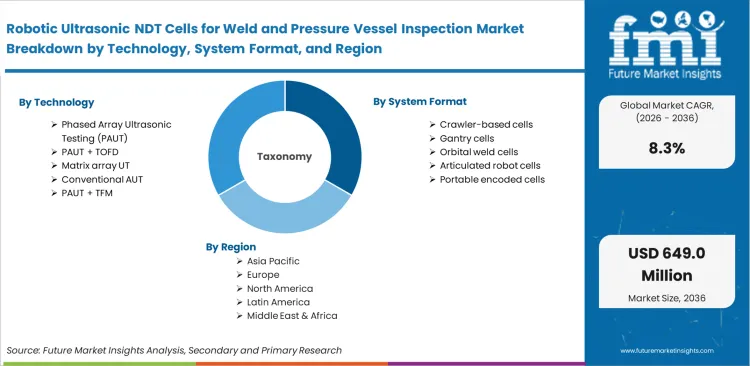
| Segmentation | Technology, System Format, Component, Application, End Use, Region |
| Regions Covered | North America, Latin America, Europe, East Asia, South Asia & Pacific, Middle East & Africa |
| Countries Covered | United States, Canada, Germany, France, United Kingdom, Italy, China, Japan, South Korea, India, Saudi Arabia, UAE, South Africa, Australia |
| Key Companies Profiled | Eddyfi Technologies, Evident, Waygate Technologies, Zetec, Sonatest, Invert Robotics, ScanMaster |
| Forecast Period | 2026 to 2036 |
| Approach | Encoded scanner unit shipments and advanced phased array instrument deployment volumes anchored baseline valuations. |
Source: Future Market Insights (FMI) analysis, based on proprietary forecasting model and primary research
Robotic Ultrasonic NDT Cells for Weld and Pressure Vessel Inspection Market Analysis by Segments
Technology
- Phased Array Ultrasonic Testing (PAUT)
- PAUT + TOFD
- Matrix array UT
- Conventional AUT
- PAUT + TFM
System Format
- Crawler-based cells
- Gantry cells
- Orbital weld cells
- Articulated robot cells
- Portable encoded cells
Component
- Hardware
- Software
- Services
Application
- Circumferential weld inspection
- Longitudinal weld inspection
- Nozzle-to-shell weld inspection
- Shell seam inspection
- Vessel wall-loss mapping
End Use
- Oil, gas, and process industries
- Power generation
- Heavy fabrication
- Chemical processing
- Inspection service providers
Region
- North America
- United States
- Canada
- Latin America
- Brazil
- Mexico
- Europe
- Germany
- France
- United Kingdom
- Italy
- Spain
- East Asia
- China
- Japan
- South Korea
- South Asia & Pacific
- India
- ASEAN
- Australia
- Middle East & Africa
- Saudi Arabia
- UAE
- South Africa
Bibliography
- Nicolson, E., & coauthors. (2024). Towards an in-process ultrasonic phased array inspection method for weld defects. Journal of Manufacturing Processes.
- Zhang, S., & coauthors. (2024). Automated weld defect segmentation from phased array ultrasonic data. NDT & E International.
- Zhong, M., Liu, Y., & coauthors. (2025). A wall-climbing robot with a mechanical arm for weld inspection of large pressure vessels. Actuators, 14(12), 607.
- Deng, B., & coauthors. (2025). Study on ultrasonic phased array inspection method of multilayer high-pressure hydrogen storage container welds. Energies, 18(20), 5419.
- Hong, M., & coauthors. (2025). Ultrasonic inspection design and application for narrow-gap welds in complex environments. NDT.net conference paper.
This bibliography is provided for reader reference. The full FMI report contains the complete reference list with primary source documentation.
This Report Addresses
- ASME Section VIII code compliance shifts driving replacement of legacy radiographic testing with encoded phased array ultrasonics.
- Elimination of million-dollar scaffolding costs deploying magnetic crawler platforms on vertical petrochemical vessels.
- Data transfer bottlenecks severely crippling high-speed automated scanning on factory floors.
- Critical-path downtime reduction achieved during petrochemical refinery turnarounds utilizing automated structural inspection.
- Supply chain decoupling strategies separating baseline mechanical hardware gaining from advanced software licensing.
- Real-time adaptive feedback enabled by in-process acoustic monitoring trailing active welding torches.
- Network saturation risks generated by throttling pulse repetition frequencies during multi-element probe operations.
- Operational bottlenecks shifting from factory floors to data rooms as automation generates vast interpretation backlogs for NDT Level III analysts.
Frequently Asked Questions
What is the expected valuation of the robotic ultrasonic NDT cells market for weld and pressure vessel inspection in 2026?
The market valuation is anticipated to reach USD 270.0 million in 2026. This baseline reflects the initial wave of heavy fabricators replacing legacy radiographic testing with automated ultrasonic systems. Procurement teams authorize these capital expenditures to eliminate radiation safety zones that paralyze adjacent factory floors.
What is the projected market value by the end of 2036?
The total valuation is projected to reach USD 600.0 million by 2036. This cumulative buildup occurs as automated inspection hardware becomes the default compliance standard across global petrochemical and nuclear construction projects. Procurement officers simply cannot scale operations relying entirely on manual hand-scanning.
At what rate is the market expected to expand?
The sector is forecast to expand at an 8.3% CAGR between 2026 and 2036. This steady growth rate indicates a compliance-led industrial hardware space where encoded repeatability matters significantly more than low upfront tool costs. Buyers select these systems based strictly on long-term data reliability and regulatory approval.
Why does Phased Array Ultrasonic Testing (PAUT) capture the largest technology share?
PAUT leads the segment with a 46.0% share because it allows quality directors to sweep entire joint volumes without complicated mechanical rastering. Metallurgical engineers use electronic beam steering to precisely size critical defects against stringent ASME acceptance criteria. This capability completely removes the need for multiple fixed-angle transducer scans.
What drives the preference for crawler-based inspection cells?
Crawler-based cells secure 38.0% of the market by solving the immediate problem of vertical asset access. Reliability teams deploy these magnetic systems to scale tall petrochemical columns without erecting expensive temporary scaffolding. Eliminating this physical setup time often yields higher cost savings than the actual inspection speed improvements.
Why does circumferential weld inspection dominate the application segment?
Circumferential weld inspection accounts for 32.0% share because it matches the high-volume output of automated orbital welding systems. Fabrication managers deploy clamp-on robotic bands to assess root passes while the steel remains at elevated temperatures. Finding defects early in the spool fabrication process prevents costly deep excavations later.
How does the shift away from radiography impact market adoption?
Replacing hazardous radiographic isotopes fundamentally changes heavy fabrication economics by eliminating mandatory factory clearing zones. Plant managers executing large pressure vessel contracts can finally run inspection activities in parallel with active welding. Removing this specific production bottleneck recovers hundreds of lost man-hours per project.
What constraints limit the deployment speed of automated ultrasonic systems?
Strict regulatory validation cycles severely slow enterprise adoption across heavy industries. Quality assurance managers must navigate complex performance demonstrations to prove that ultrasonic flaw detection equals legacy film sensitivity. Drafting these vast technical justifications requires highly specialized NDT Level III engineers, creating a severe human capital bottleneck.
Which region presents the strongest growth trajectory?
India leads regional expansion with a 10.2% CAGR through 2036, significantly outpacing mature markets. Unlike Western facilities dealing with replacement cycles, Indian heavy vessel manufacturers are integrating automated robotics directly into new refinery localization projects. This proactive adoption prevents inspection bottlenecks during critical hydro-testing phases.
Why does hardware account for the largest component share?
Hardware captures 64.0% of the segment because multi-axis encoded scanners and high-channel-count flaw detectors carry massive upfront capital costs. Lab directors prioritize environmentally sealed mechanisms capable of surviving abrasive shipyard conditions. Cheap manipulation hardware inevitably causes acoustic dropouts, generating noisy data that ruins compliance records.
How do oil and gas operators utilize these robotic cells?
The oil, gas, and process industries hold a 36.0% share to meet strict API validation requirements on thick-walled reactors. Turnaround teams deploy automated inspection systems to drastically compress planned maintenance shutdown durations. Faster inspection cycles restore active product lines quicker, preventing millions in lost production revenue.
How does demand in China differ from the United States?
Chinese market growth, projected at 9.4%, is heavily subsidized by new nuclear power construction demanding zero-defect containment vessels. Conversely, the 8.8% growth in the United States is anchored in inspecting aging petrochemical infrastructure. American operators focus on digitizing inspection records to maintain compliance on decades-old pipe networks.
What challenges arise from high-speed automated scanning?
Procurement teams obsessing over raw element counts often ignore the data transfer bottlenecks created by continuous encoding. Pushing too much acoustic data causes dropped frames, which instantly invalidates code-required compliance records. NDT engineers must carefully throttle pulse repetition frequencies to prevent network saturation on the factory floor.
What makes hot-weld acoustic inspection difficult to execute?
Metallurgical engineers must dynamically adjust calibration parameters because sound velocity shifts significantly in elevated temperature steel. Failing to account for this thermal distortion causes severe defect sizing errors and false rejections. Accurate spatial mapping is required to prevent welders from excavating huge trenches of healthy metal during repairs.
How do surface conditions affect robotic crawler deployments?
Maintenance directors must coordinate extensive abrasive blasting before magnetic crawlers can deploy effectively. Thick epoxy coatings severely degrade ultrasonic signals, blocking effective internal corrosion mapping. Managing this surface preparation friction dictates the actual operational speed of inspection contractors in the field.
How do established equipment manufacturers maintain their market position?
Leading vendors utilize massive proprietary datasets built from decades of validated weld inspections. These datasets train machine learning models that automatically filter clean welds from suspicious indications. New entrants struggle to replicate this acoustic data volume, limiting their ability to accurately classify geometry-related signals.
What is the growth projection for the German market?
Germany is forecast to record a 7.9% CAGR through 2036. Chemical processing giants in the region require precise corrosion mapping algorithms to predict remaining asset life accurately. Feeding this volumetric inspection data directly into digital twin models streamlines their preventive maintenance schedules.
How do consumable costs impact inspection profitability?
Procurement teams constantly cycle through expensive transducer wedges that are ground down by rough weld surfaces. Managing the friction between the mechanical scanner and the steel dictates long-term profitability for inspection contractors. If liquid couplant lines block mid-scan, the acoustic transmission fails and forces a complete restart of the procedure.
Why are specialized probes necessary for modern fabrication?
Standard transducers physically cannot access the critical root geometries found inside tight J-groove weld preparations. Quality directors configure thin-profile phased array probes specifically designed to fit these narrow spaces. Without these specialized tools, verifying the integrity of high-pressure root passes becomes impossible.
What is the commercial value of drone-deployed crawler arrays?
Asset managers use heavy-lift drones to attach magnetic pipe inspection robots onto elevated columns, bypassing manual rope access entirely. This eliminates human height exposure during initial setup and teardown phases. Removing personnel from high-risk vertical environments drastically reduces facility insurance premiums and safety liability.
Preview the report firsthand - request a free sample
Get SampleGet the brochure for pricing and purchase details.
Get PDFTable of Content
- Executive Summary
- Global Market Outlook
- Demand-side Trends
- Supply-side Trends
- Technology Roadmap Analysis
- Analysis and Recommendations
- Market Overview
- Market Coverage / Taxonomy
- Market Definition / Scope / Limitations
- Research Methodology
- Chapter Orientation
- Analytical Lens and Working Hypotheses
- Market Structure, Signals, and Trend Drivers
- Benchmarking and Cross-market Comparability
- Market Sizing, Forecasting, and Opportunity Mapping
- Research Design and Evidence Framework
- Desk Research Programme (Secondary Evidence)
- Company Annual and Sustainability Reports
- Peer-reviewed Journals and Academic Literature
- Corporate Websites, Product Literature, and Technical Notes
- Earnings Decks and Investor Briefings
- Statutory Filings and Regulatory Disclosures
- Technical White Papers and Standards Notes
- Trade Journals, Industry Magazines, and Analyst Briefs
- Conference Proceedings, Webinars, and Seminar Materials
- Government Statistics Portals and Public Data Releases
- Press Releases and Reputable Media Coverage
- Specialist Newsletters and Curated Briefings
- Sector Databases and Reference Repositories
- FMI Internal Proprietary Databases and Historical Market Datasets
- Subscription Datasets and Paid Sources
- Social Channels, Communities, and Digital Listening Inputs
- Additional Desk Sources
- Expert Input and Fieldwork (Primary Evidence)
- Primary Modes
- Qualitative Interviews and Expert Elicitation
- Quantitative Surveys and Structured Data Capture
- Blended Approach
- Why Primary Evidence is Used
- Field Techniques
- Interviews
- Surveys
- Focus Groups
- Observational and In-context Research
- Social and Community Interactions
- Stakeholder Universe Engaged
- C-suite Leaders
- Board Members
- Presidents and Vice Presidents
- R&D and Innovation Heads
- Technical Specialists
- Domain Subject-matter Experts
- Scientists
- Physicians and Other Healthcare Professionals
- Governance, Ethics, and Data Stewardship
- Research Ethics
- Data Integrity and Handling
- Primary Modes
- Tooling, Models, and Reference Databases
- Desk Research Programme (Secondary Evidence)
- Data Engineering and Model Build
- Data Acquisition and Ingestion
- Cleaning, Normalisation, and Verification
- Synthesis, Triangulation, and Analysis
- Quality Assurance and Audit Trail
- Market Background
- Market Dynamics
- Drivers
- Restraints
- Opportunity
- Trends
- Scenario Forecast
- Demand in Optimistic Scenario
- Demand in Likely Scenario
- Demand in Conservative Scenario
- Opportunity Map Analysis
- Product Life Cycle Analysis
- Supply Chain Analysis
- Investment Feasibility Matrix
- Value Chain Analysis
- PESTLE and Porter’s Analysis
- Regulatory Landscape
- Regional Parent Market Outlook
- Production and Consumption Statistics
- Import and Export Statistics
- Market Dynamics
- Global Market Analysis 2021 to 2025 and Forecast, 2026 to 2036
- Historical Market Size Value (USD Million) Analysis, 2021 to 2025
- Current and Future Market Size Value (USD Million) Projections, 2026 to 2036
- Y-o-Y Growth Trend Analysis
- Absolute $ Opportunity Analysis
- Global Market Pricing Analysis 2021 to 2025 and Forecast 2026 to 2036
- Global Market Analysis 2021 to 2025 and Forecast 2026 to 2036, By Technology
- Introduction / Key Findings
- Historical Market Size Value (USD Million) Analysis By Technology , 2021 to 2025
- Current and Future Market Size Value (USD Million) Analysis and Forecast By Technology , 2026 to 2036
- Phased Array Ultrasonic Testing (PAUT)
- PAUT + TOFD
- Matrix array UT
- Conventional AUT
- PAUT + TFM
- Phased Array Ultrasonic Testing (PAUT)
- Y-o-Y Growth Trend Analysis By Technology , 2021 to 2025
- Absolute $ Opportunity Analysis By Technology , 2026 to 2036
- Global Market Analysis 2021 to 2025 and Forecast 2026 to 2036, By System Format
- Introduction / Key Findings
- Historical Market Size Value (USD Million) Analysis By System Format, 2021 to 2025
- Current and Future Market Size Value (USD Million) Analysis and Forecast By System Format, 2026 to 2036
- Crawler-based cells
- Gantry cells
- Orbital weld cells
- Articulated robot cells
- Portable encoded cells
- Crawler-based cells
- Y-o-Y Growth Trend Analysis By System Format, 2021 to 2025
- Absolute $ Opportunity Analysis By System Format, 2026 to 2036
- Global Market Analysis 2021 to 2025 and Forecast 2026 to 2036, By Component
- Introduction / Key Findings
- Historical Market Size Value (USD Million) Analysis By Component, 2021 to 2025
- Current and Future Market Size Value (USD Million) Analysis and Forecast By Component, 2026 to 2036
- Hardware
- Software
- Services
- Hardware
- Y-o-Y Growth Trend Analysis By Component, 2021 to 2025
- Absolute $ Opportunity Analysis By Component, 2026 to 2036
- Global Market Analysis 2021 to 2025 and Forecast 2026 to 2036, By Application
- Introduction / Key Findings
- Historical Market Size Value (USD Million) Analysis By Application, 2021 to 2025
- Current and Future Market Size Value (USD Million) Analysis and Forecast By Application, 2026 to 2036
- Circumferential weld inspection
- Longitudinal weld inspection
- Nozzle-to-shell weld inspection
- Shell seam inspection
- Vessel wall-loss mapping
- Circumferential weld inspection
- Y-o-Y Growth Trend Analysis By Application, 2021 to 2025
- Absolute $ Opportunity Analysis By Application, 2026 to 2036
- Global Market Analysis 2021 to 2025 and Forecast 2026 to 2036, By End Use
- Introduction / Key Findings
- Historical Market Size Value (USD Million) Analysis By End Use, 2021 to 2025
- Current and Future Market Size Value (USD Million) Analysis and Forecast By End Use, 2026 to 2036
- Oil, gas, and process industries
- Power generation
- Heavy fabrication
- Chemical processing
- Inspection service providers
- Oil, gas, and process industries
- Y-o-Y Growth Trend Analysis By End Use, 2021 to 2025
- Absolute $ Opportunity Analysis By End Use, 2026 to 2036
- Global Market Analysis 2021 to 2025 and Forecast 2026 to 2036, By Region
- Introduction
- Historical Market Size Value (USD Million) Analysis By Region, 2021 to 2025
- Current Market Size Value (USD Million) Analysis and Forecast By Region, 2026 to 2036
- North America
- Latin America
- Western Europe
- Eastern Europe
- East Asia
- South Asia and Pacific
- Middle East & Africa
- Market Attractiveness Analysis By Region
- North America Market Analysis 2021 to 2025 and Forecast 2026 to 2036, By Country
- Historical Market Size Value (USD Million) Trend Analysis By Market Taxonomy, 2021 to 2025
- Market Size Value (USD Million) Forecast By Market Taxonomy, 2026 to 2036
- By Country
- USA
- Canada
- Mexico
- By Technology
- By System Format
- By Component
- By Application
- By End Use
- By Country
- Market Attractiveness Analysis
- By Country
- By Technology
- By System Format
- By Component
- By Application
- By End Use
- Key Takeaways
- Latin America Market Analysis 2021 to 2025 and Forecast 2026 to 2036, By Country
- Historical Market Size Value (USD Million) Trend Analysis By Market Taxonomy, 2021 to 2025
- Market Size Value (USD Million) Forecast By Market Taxonomy, 2026 to 2036
- By Country
- Brazil
- Chile
- Rest of Latin America
- By Technology
- By System Format
- By Component
- By Application
- By End Use
- By Country
- Market Attractiveness Analysis
- By Country
- By Technology
- By System Format
- By Component
- By Application
- By End Use
- Key Takeaways
- Western Europe Market Analysis 2021 to 2025 and Forecast 2026 to 2036, By Country
- Historical Market Size Value (USD Million) Trend Analysis By Market Taxonomy, 2021 to 2025
- Market Size Value (USD Million) Forecast By Market Taxonomy, 2026 to 2036
- By Country
- Germany
- UK
- Italy
- Spain
- France
- Nordic
- BENELUX
- Rest of Western Europe
- By Technology
- By System Format
- By Component
- By Application
- By End Use
- By Country
- Market Attractiveness Analysis
- By Country
- By Technology
- By System Format
- By Component
- By Application
- By End Use
- Key Takeaways
- Eastern Europe Market Analysis 2021 to 2025 and Forecast 2026 to 2036, By Country
- Historical Market Size Value (USD Million) Trend Analysis By Market Taxonomy, 2021 to 2025
- Market Size Value (USD Million) Forecast By Market Taxonomy, 2026 to 2036
- By Country
- Russia
- Poland
- Hungary
- Balkan & Baltic
- Rest of Eastern Europe
- By Technology
- By System Format
- By Component
- By Application
- By End Use
- By Country
- Market Attractiveness Analysis
- By Country
- By Technology
- By System Format
- By Component
- By Application
- By End Use
- Key Takeaways
- East Asia Market Analysis 2021 to 2025 and Forecast 2026 to 2036, By Country
- Historical Market Size Value (USD Million) Trend Analysis By Market Taxonomy, 2021 to 2025
- Market Size Value (USD Million) Forecast By Market Taxonomy, 2026 to 2036
- By Country
- China
- Japan
- South Korea
- By Technology
- By System Format
- By Component
- By Application
- By End Use
- By Country
- Market Attractiveness Analysis
- By Country
- By Technology
- By System Format
- By Component
- By Application
- By End Use
- Key Takeaways
- South Asia and Pacific Market Analysis 2021 to 2025 and Forecast 2026 to 2036, By Country
- Historical Market Size Value (USD Million) Trend Analysis By Market Taxonomy, 2021 to 2025
- Market Size Value (USD Million) Forecast By Market Taxonomy, 2026 to 2036
- By Country
- India
- ASEAN
- Australia & New Zealand
- Rest of South Asia and Pacific
- By Technology
- By System Format
- By Component
- By Application
- By End Use
- By Country
- Market Attractiveness Analysis
- By Country
- By Technology
- By System Format
- By Component
- By Application
- By End Use
- Key Takeaways
- Middle East & Africa Market Analysis 2021 to 2025 and Forecast 2026 to 2036, By Country
- Historical Market Size Value (USD Million) Trend Analysis By Market Taxonomy, 2021 to 2025
- Market Size Value (USD Million) Forecast By Market Taxonomy, 2026 to 2036
- By Country
- Kingdom of Saudi Arabia
- Other GCC Countries
- Turkiye
- South Africa
- Other African Union
- Rest of Middle East & Africa
- By Technology
- By System Format
- By Component
- By Application
- By End Use
- By Country
- Market Attractiveness Analysis
- By Country
- By Technology
- By System Format
- By Component
- By Application
- By End Use
- Key Takeaways
- Key Countries Market Analysis
- USA
- Pricing Analysis
- Market Share Analysis, 2025
- By Technology
- By System Format
- By Component
- By Application
- By End Use
- Canada
- Pricing Analysis
- Market Share Analysis, 2025
- By Technology
- By System Format
- By Component
- By Application
- By End Use
- Mexico
- Pricing Analysis
- Market Share Analysis, 2025
- By Technology
- By System Format
- By Component
- By Application
- By End Use
- Brazil
- Pricing Analysis
- Market Share Analysis, 2025
- By Technology
- By System Format
- By Component
- By Application
- By End Use
- Chile
- Pricing Analysis
- Market Share Analysis, 2025
- By Technology
- By System Format
- By Component
- By Application
- By End Use
- Germany
- Pricing Analysis
- Market Share Analysis, 2025
- By Technology
- By System Format
- By Component
- By Application
- By End Use
- UK
- Pricing Analysis
- Market Share Analysis, 2025
- By Technology
- By System Format
- By Component
- By Application
- By End Use
- Italy
- Pricing Analysis
- Market Share Analysis, 2025
- By Technology
- By System Format
- By Component
- By Application
- By End Use
- Spain
- Pricing Analysis
- Market Share Analysis, 2025
- By Technology
- By System Format
- By Component
- By Application
- By End Use
- France
- Pricing Analysis
- Market Share Analysis, 2025
- By Technology
- By System Format
- By Component
- By Application
- By End Use
- India
- Pricing Analysis
- Market Share Analysis, 2025
- By Technology
- By System Format
- By Component
- By Application
- By End Use
- ASEAN
- Pricing Analysis
- Market Share Analysis, 2025
- By Technology
- By System Format
- By Component
- By Application
- By End Use
- Australia & New Zealand
- Pricing Analysis
- Market Share Analysis, 2025
- By Technology
- By System Format
- By Component
- By Application
- By End Use
- China
- Pricing Analysis
- Market Share Analysis, 2025
- By Technology
- By System Format
- By Component
- By Application
- By End Use
- Japan
- Pricing Analysis
- Market Share Analysis, 2025
- By Technology
- By System Format
- By Component
- By Application
- By End Use
- South Korea
- Pricing Analysis
- Market Share Analysis, 2025
- By Technology
- By System Format
- By Component
- By Application
- By End Use
- Russia
- Pricing Analysis
- Market Share Analysis, 2025
- By Technology
- By System Format
- By Component
- By Application
- By End Use
- Poland
- Pricing Analysis
- Market Share Analysis, 2025
- By Technology
- By System Format
- By Component
- By Application
- By End Use
- Hungary
- Pricing Analysis
- Market Share Analysis, 2025
- By Technology
- By System Format
- By Component
- By Application
- By End Use
- Kingdom of Saudi Arabia
- Pricing Analysis
- Market Share Analysis, 2025
- By Technology
- By System Format
- By Component
- By Application
- By End Use
- Turkiye
- Pricing Analysis
- Market Share Analysis, 2025
- By Technology
- By System Format
- By Component
- By Application
- By End Use
- South Africa
- Pricing Analysis
- Market Share Analysis, 2025
- By Technology
- By System Format
- By Component
- By Application
- By End Use
- USA
- Market Structure Analysis
- Competition Dashboard
- Competition Benchmarking
- Market Share Analysis of Top Players
- By Regional
- By Technology
- By System Format
- By Component
- By Application
- By End Use
- Competition Analysis
- Competition Deep Dive
- Eddyfi Technologies
- Overview
- Product Portfolio
- Profitability by Market Segments (Product/Age /Sales Channel/Region)
- Sales Footprint
- Strategy Overview
- Marketing Strategy
- Product Strategy
- Channel Strategy
- Evident
- Waygate Technologies
- Zetec
- Sonatest
- Invert Robotics
- ScanMaster
- Eddyfi Technologies
- Competition Deep Dive
- Assumptions & Acronyms Used


