

- Industry Size (2026)
- USD 3600.0 Mn
- Forecast (2036)
- USD 9800.0 Mn
- CAGR (2026 to 2036)
- 10.5%
Robotic Knee Replacement Market Forecast and Outlook 2026 to 2036
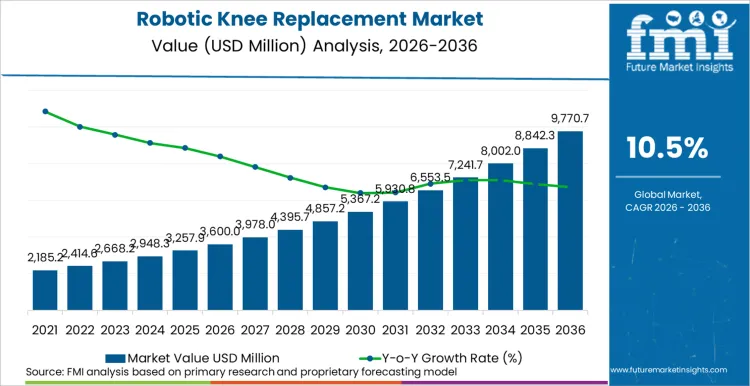
The global robotic knee replacement market to expand from USD 3,600.0 million in 2026 to USD 9,800.0 million by 2036, registering a CAGR of 10.5% over the forecast period. This growth is being supported by rising TKA volumes, steady migration toward semi-active robotic arm platforms, and broader hospital investment cycles in digitally enabled orthopaedics. According to FMI’s analysis, demand remains concentrated in total knee arthroplasty procedures, where workflow standardization and consistency benefits are most directly captured at scale.
FMI highlights ecosystem-led commercialization as the defining structural shift through 2036. Revenue is increasingly being built beyond system placement, with higher contribution from disposables and consumables, software and service contracts, and planning and analytics capabilities that reinforce utilization and outcomes reporting. Hospitals continue to anchor adoption, while ambulatory surgery centers are being pursued as care pathways shift toward lower-cost sites. Procurement is also diversifying capital purchase is being supplemented by lease or rental, pay-per-use, and managed service arrangements that reduce upfront barriers while sustaining OEM utilization economics.
"We are proud to be the first medtech company to offer two complementary robotic systems for surgeons looking to incorporate robotic assistance while performing a knee replacement, TMINI addresses surgeon demand for an ergonomic, wireless, handheld robotic system and now, in addition to ROSA, underscores our dedication to empowering surgeons with more choices to make the right decision for each patient." said Dr. Nitin Goyal, Chief Science, Technology and Innovation Officer at Zimmer Biomet.
The competitive advantage is increasingly being set by how reliably manufacturers can translate robotics into a repeatable operating model across hospitals and ambulatory settings, with collaborations and selective tie-ups being used to accelerate reach and utilization. For Instance, In June 2024, Zimmer Biomet Holdings, Inc. announced a limited distribution agreement with THINK Surgical, Inc. for the wireless, handheld TMINI Miniature Robotic System for total knee arthroplasty. FMI expects capability-led strategies that combine clinical workflow fit, scalable deployment, and partner-enabled commercialization to strengthen differentiation and sustain adoption.
Summary of Robotic Knee Replacement Market
What Is Growth Outlook for Robotic Knee Replacement Market as per Future Market Insights Projection?
Future Market Insights projects the robotic knee replacement market to expand at a CAGR of 10.5% from 2026 to 2036, increasing from USD 3,600.0 Million in 2026 to USD 9,800.0 Million by 2036. Growth is being reinforced by higher procedural volumes and by procurement frameworks that increasingly favor repeatable implant positioning, standardized workflows, and measurable intraoperative consistency across high-throughput orthopedic programs.
FMI Research Approach: Historical market size, platform installation trends, procedure volume growth, site-of-care utilization shifts, and revenue-component mix were used to model demand scenarios through 2036.
How Do FMI Analysts Perceive Robotic Knee Replacement Market to Evolve?
Future Market Insights analysts note that robotic enablement is being repositioned from optional navigation support toward execution-focused platforms that formalize planning, alignment, and data capture within routine arthroplasty workflows. Platform differentiation is being shaped by operating-room integration, portability and footprint constraints, analytics readiness, and the ability to support both total and partial knee pathways without disrupting standardized surgical throughput.
FMI Research Approach: Adoption curves were assessed across platform types and procedure mix, alongside software integration depth, utilization intensity, and procurement preferences across hospital and ambulatory settings.
Which Country Holds Largest Share in Global Robotic Knee Replacement Market?
The United States holds the largest share in the global robotic knee replacement market, supported by high knee arthroplasty volumes, early technology uptake in orthopedics, and established capital budgeting cycles that favor robotics placement within service-line expansion. Demand is also being reinforced by hospital-led program standardization and structured outcomes monitoring.
FMI Research Approach: Country-level inputs included procedure volumes, robotic system penetration, reimbursement-linked adoption dynamics, hospital procurement patterns, and orthopedic service-line investment intensity.
How Large Will Robotic Knee Replacement Market Be by 2036?
The global robotic knee replacement market is projected to reach USD 9,800.0 Million by 2036.
FMI Research Approach: Market size was calculated by modeling demand across leading platform types and dominant procedure mix, using weighted utilization and revenue-component factors.
How are Standardization and Evidence Expectations Fueling Robotic Knee Replacement Adoption?
According to Future Market Insights, rising emphasis on procedural standardization and evidence-backed technology selection is accelerating adoption of robotic platforms that support repeatable execution and audit-ready data capture. Demand is being strengthened where hospitals are formalizing alignment protocols, measuring variability, and scaling robotics across both inpatient programs and expanding outpatient arthroplasty capacity.
FMI Research Approach: Incorporated procedure standardization trends, hospital quality tracking programs, outpatient migration, and capital deployment cycles into forecasting models to refine demand estimates.
Robotic Knee Replacement Market Key Takeaways
| Metric | Details |
|---|---|
| Industry Size (2026) | USD 3,600.0 Million |
| Industry Value (2036) | USD 9,800.0 Million |
| CAGR (2026-2036) | 10.5% |
Source: Future Market Insights (FMI) analysis, based on proprietary forecasting model and primary research.
Why is the Demand for Robotic Knee Replacement Market Growing?
As per Future Market Insights, perceive demand for robotic knee replacement growing as knee arthroplasty programs are being reorganized around repeatability, throughput predictability, and measurable execution consistency. Utilization is being anchored in total knee arthroplasty, where workflow standardization and alignment repeatability are most monetizable across high-volume pathways. Preference is being observed for robotic arm (semi-active) systems, supported by their role in translating pre-operative plans into controlled intraoperative execution.
Revenue expansion is being sustained by capital systems alongside recurring pull from disposables and service contracts, while demand remains concentrated in hospitals with incremental scaling through ASCs as outpatient arthroplasty expands. Purchase behavior is being led by capital purchase, reflecting system placement cycles and long-term utilization planning. As orthopedic service lines increasingly prioritize protocol-driven outcomes monitoring, robotic platforms are being embedded into routine knee replacement workflows rather than being treated as discretionary upgrades.
How is the Robotic Knee Replacement Market Segmented?
The robotic knee replacement market is segmented by platform type, procedure, revenue component, site of care, and purchase model. By platform type, the market includes robotic arm (semi-active) systems, handheld robotic systems, navigation-assisted robotics, and active robotic platforms. Based on procedure, demand is segmented into total knee arthroplasty (TKA), unicompartmental knee arthroplasty (UKA), revision TKA, and bicompartmental procedures. By revenue component, the market comprises capital systems, disposables and consumables, software and service contracts, and pre-operative planning or analytics solutions. By End User, utilization is segmented into hospitals, ambulatory surgical centers (ASCs), and specialty orthopedic centers. Based on purchase model, adoption spans capital purchase, lease or rental, pay-per-use, and managed service arrangements.
How Do Semi-Active Robotic Arm Systems Secure Market Leadership?
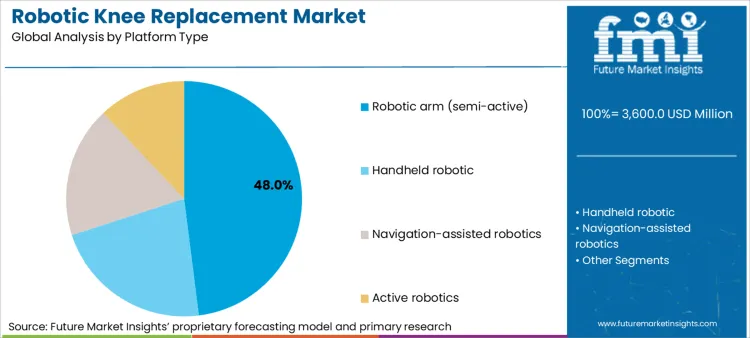
The segment of semi-active robotic arm systems is the leading segment in the robotic knee replacement surgery segment, driven by the key advantage that these systems help perform a balance between surgery and robotics in terms of cutting and precise placement under the direction of a robotic system. This segment has 48.0% of the total platform, as per estimates by Future Market Insights, as semi-active robotic arm systems have the advantage of widespread use in high-volume knee replacement surgery.
In addition to this, their dominance can be further established through a smoother infrastructure when it comes to the existing working configuration in the operating rooms together with a reduced learning curve compared to fully active systems. In a majority of the cases where a hospital considers the implementation of robotics at a wider scale, they always start with semi-active robotics systems to integrate the process further. With the wider adoption of robotic assistance in the procedures of knee arthroplasty, the semi-active robotic arms continue to be a driving force for platform-based robots.
How Does Total Knee Arthroplasty Drive Robotic System Demand?
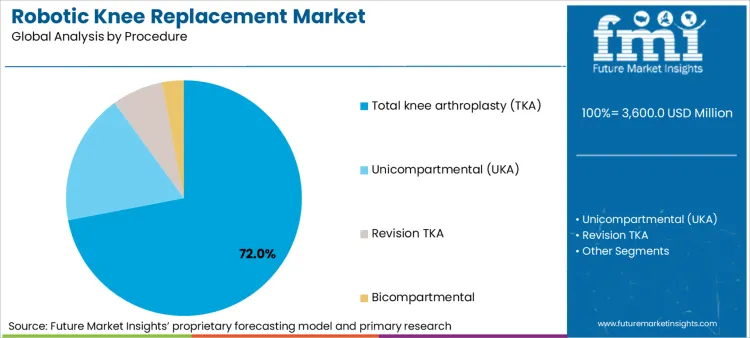
The majority share of 72.0% in overall robotic knee replacement demand is contributed by total knee arthroplasty, according to the analysis of Future Market Insights. Accordingly, TKA presents the largest volume of knee replacement procedures worldwide and holds higher technical complexity regarding alignment, soft tissue balancing, and implant positioning. In these steps, robotic assistance is increasingly employed to standardize and decrease variability among surgeons and patient anatomies.
The large procedural volume of TKA facilitates efficient use of robotic systems, enabling hospitals to amortize substantial capital investments over a large number of cases. Robotics-assisted TKA is also well matched to emerging outcome-driven care models that place increasing focus on implant longevity and revision risk reduction. Consequently, TKA remains the leading clinical anchor for robotic platform placement and utilization within orthopedic surgery.
How Are Regulatory and Quality Frameworks Influencing Robotic Surgery Adoption?
The shift towards outcome consistency, procedural traceability, and reduction of surgical complications among those involved in the provision of regulatory and quality oversight services to the orthopedic surgical community. This is a factor that is prompting more hospitals to acquire the services of a robotic device to help streamline the process of knee replacement surgery, ensuring a certain degree of surgical parameter traceability. Robotics-assisted surgical devices aid in ensuring proper alignment consistency, which is the focal point of quality benchmarking programs.
Hospitals are now linking their robotic adoption with internal governance priorities and long-term robot-related clinical performance monitoring. As accountability structures are being expanded, robotic systems are being positioned as facilitating tools rather than optional surgical enablers.
Why Is Procedure Centralization Reshaping Demand Patterns?
The centralization of complex orthopedic surgical cases to high-volume hospitals is having a significant influence on the market for robotic knee replacement systems. High-volume hospitals and specialty orthopedic centers are well suited to support the capital expenditures required for these systems while maintaining the necessary case volume to effectively utilize the systems.
As the pathway for orthopedic care continues to focus on "Centers of Excellence" models, robotic systems are playing an ever more prominent role in differentiation strategies for maximum referral potential. Thus, the trend is only continuing the focus on demand concentration within the hospital market, as opposed to a surgical approach.
How Are Commercial Models and Digital Integration Driving Market Evolution?
Innovation in commercial models is playing a growing role in robotic knee replacement adoption. While capital purchase remains dominant, alternative models such as pay-per-use and managed services are expanding access for cost-constrained facilities. These structures align capital exposure with procedure volume and reduce upfront financial barriers.
At the same time, digital integration through pre-operative planning software and analytics is enhancing system value beyond mechanical assistance. Data-enabled planning and outcome tracking are increasingly viewed as essential components of robotic platforms, shaping future differentiation and long-term market evolution.
How Will Robotic Knee Replacement Market Expansion Unfold Across Key Global Regions?
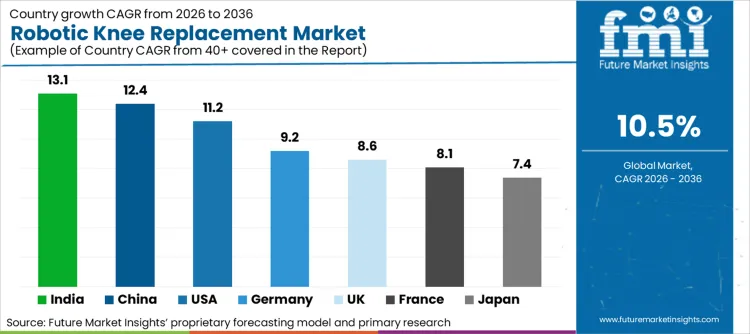
Future Market Insights identifies the United States (CAGR ~11.2%), Germany (~9.2%), the United Kingdom (~8.6%), France (~8.1%), Japan (~7.4%), China (~12.4%), and India (~13.1%) as the core demand drivers shaping robotic knee replacement adoption globally. The US excels as the leader through high procedure volumes, optimal hospital investment potential, and quicker adoption of technology in platform-based robotics for orthopedic surgery. Germany also offers stability for premium segment penetration through structured clinical pathways, disciplined surgeon approaches, and continuous procurement of precision-based systems.
In turn, the UK and France deliver sustainable growth through the phased implementation of robotics platforms in high-volume hospitals that are prioritizing outcomes improvements and cost efficiency gains. Japan is seeing its demand sustained through an increasing populace, the need for functional outcomes, and phased modernization of orthopedic surgery workflows, which have traditionally placed priority on knee and hip joint functionalities. China and India are leading growth through joint replacement volumes, along with an increasing potential for robotic capabilities by tertiary hospitals to provide differentiated approaches to orthopedic surgical care, according to FMI.
| Country | CAGR (2026-2036) |
|---|---|
| USA | 11.2% |
| Germany | 9.2% |
| UK | 8.6% |
| France | 8.1% |
| Japan | 7.4% |
| China | 12.4% |
| India | 13.1% |
Source: Future Market Insights (FMI) analysis, based on proprietary forecasting model and primary research.
Is Orthopedic Service-Line Modernization Redefining Robotic Knee Replacement Demand in the United States?
The USA robotic knee replacement procedure is growing at a rate of 11.2% CAGR, mainly driven by the modernization of orthopedic centers under service lines at high-volume centers. There is a significant hospital preference, as seen in the USA robotic knee replacement market, for reproducible alignments, along with standardization in workflows. The use of platform-based robotic systems is seen in order to eliminate intra-surgeon variety and align diversified patient groups. This trend is being supplemented as hospitals aim at increasing the pathway efficiency, patient satisfaction, and minimizing length of stay.
Does Germany’s Precision-Oriented Clinical Culture Sustain High-Value Robotic Adoption?
According to Future Market Insights, Germany’s robotic knee replacement market is projected to expand at a 9.2% CAGR, shaped by a precision-oriented clinical culture and strong preference for evidence-based surgical standardization. Adoption is being reinforced where robotic systems are being deployed to support alignment accuracy, reduce revision risk, and improve functional outcomes in selected patient cohorts. FMI analysts observe that procurement decisions are being guided by reliability, clinical validation, and integration compatibility with established implant workflows. Growth is expected to remain steady as robotics is being integrated deeper into high-specialty orthopedic centers rather than through rapid diffusion across all hospitals.
Is the United Kingdom’s Value-Based Care Focus Supporting Measured Robotic Scale-Up?
The robotic knee replacement industry in the UK will register a growth rate of 8.6%. This is because the growth is progressing on a measured scale in the facilities where the importance of results enhancement and efficiency in pathways is a priority. This is because the industry is being aided by appropriate capital allocation and clinical value assessment to ensure the services are delivered on a selective basis and not inclusive ones. This means that the industry is being driven to provide a solution for the efficiency and repetition of the healing process for the patients in the facilities where these services are being offered, as pointed out by the analyst in the research process by the organization.
How Is France’s Center-of-Excellence Model Influencing Robotic Knee Replacement Utilization?
According to Future Market Insights, France’s robotic knee replacement market is expected to expand at an 8.1% CAGR, shaped by adoption concentrated in specialized orthopedic centers where procedural standardization and outcome consistency are being emphasized. Robotics is being deployed where workflow benefits can be captured without disrupting established operating room throughput. FMI analysts observe that hospital-level decisions are being paced by investment discipline, surgeon capability build-up, and integration readiness with implant systems and planning workflows. Expansion is expected to remain steady through broader penetration in high-volume centers rather than rapid, system-wide rollout.
Does Japan’s Aging Demographic Base Sustain Stable Robotic Knee Replacement Growth?
As per FMI, Japan’s robotic knee replacement market has been predicted to grow at a 7.4% CAGR over time, dependent on factors such as age dynamics and ongoing support for interventions aimed at retaining client independence across their day-to-day lives. This has been further buttressed by use cases where robotics has been finding favor to promote precision and consistency within an aging demographic group. According to analysis from FMI, this has been pursued with significant attention to discipline and reliability within outcome quality. This continues to be supported through gradual modernization and expansion of robotic support within advanced facilities for procedures involving orthopedics.
How Is China’s Rapid Surgical Infrastructure Expansion Accelerating Robotic Adoption?
China’s robotic knee replacement market is projected to expand at a 12.4% CAGR, underpinned by rapid expansion of tertiary hospital infrastructure and rising joint replacement volumes in metropolitan centers. Robotics is being increasingly adopted to support alignment accuracy and to differentiate complex orthopedic care delivery in high-throughput environments. FMI analysts observe that growth is being reinforced by rising patient awareness and increasing preference for technology-enabled procedures in premium hospitals. Demand is expected to remain driven by procedural specialization and institutional investment rather than by volume expansion alone.
Why Is India Emerging as the Fastest-Growing Robotic Knee Replacement Market?
The Indian market is also growing the fastest, with an estimated 13.1% CAGR, driven by the increased tertiary healthcare infrastructure, the rise in osteoarthritis cases, and the high growth in elective orthopedic procedures. The use of robotics technology has been envisaged as a premium offering by private hospital chains and high-end orthopedic clinics, which provides precision to surgeons and consistency in all procedures. They point to the increased demand for this technology driven by increased patient willingness to use advanced technology for their surgical needs and the continued growth in the number of training paths for surgeons, further supporting growth through 2036.
What Strategic Moves Are Defining Competitive Landscape?
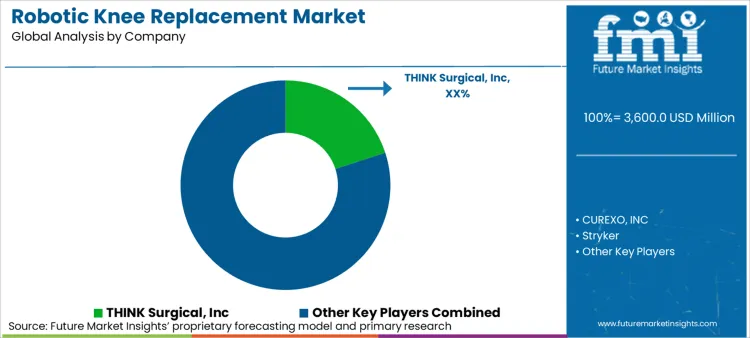
From the observations that have been made by the experts at Future Market Insights, it is clear that the robotic knee replacement market is becoming a market that is characterized by the depth of the platform, the breadth of the procedures, and the flexibility of the commercialization strategy, as opposed to differentiation on robotic devices and systems. Already, the key players in the future of the marketplace have begun to transition toward an integrated robotic solution that includes robotic arm systems, navigation systems, preoperative planning, and consumables.
Another notable strategic move within the organization is the focus on procedure-aligned platform positioning, where robotic system capabilities are maximized for Total Knee Arthroplasty (TKA), Unicompartmental (UKA), Revision TKA, and Bicompartmental procedures. Organizations like Stryker and Zimmer Biomet are using Semi-Active Robotic Arm Platform and Navigation-Assisted Robotics technology to standardize accuracy and OR efficiency for surgeons and hospitals. At the same time, revenue growth is enhanced beyond hardware systems in terms of average revenues from services through increases in disposables, services contracts, and pre-operative planning and analytics.
FMI also points to increasing differentiation through site of care and flexible purchasing model, where robotic knee systems are seen to be penetrating the ASC and specialty ortho markets, away from hospitals. Different models of purchase, leasing, renting, and services are being developed and actively employed, whereby cost of adoption appears to be lowering, thus propelling penetration in the global arena, be it developed or emerging countries, up to 2036.
Recent Developments:
- In November 2025, Zimmer Biomet has received USA FDA 510(k) clearance for ROSA® Knee with OptimiZe™, an advanced upgrade to its robotic knee platform. The system delivers highly personalized surgical planning, automated alignment options, and reduced variability, empowering surgeons with greater precision, efficiency, and confidence in robotic-assisted total knee replacement procedures.
- In October 2025, Zimmer Biomet has completed the acquisition of Monogram Technologies, strengthening its ambition to become the first orthopedic company to offer fully autonomous robotic solutions. The move expands Zimmer Biomet’s robotics ecosystem with AI-guided, CT-based semi- and fully autonomous technologies, enhancing surgeon choice, procedural precision, and long-term innovation across knee arthroplasty and beyond.
- In April 2025, THINK Surgical, Inc. announced the first global use of Maxx Orthopedics’ Freedom® Total Knee implant with the TMINI® Miniature Robotic System, performed by Dr. David V. Cashen in Florida. The milestone follows FDA 510(k) clearance and highlights seamless implant-robot integration, enabling personalized planning, precise alignment, and efficient robotic-assisted total knee arthroplasty for improved surgeon experience and patient outcomes.
- In June 2024, Johnson & Johnson MedTech announced that DePuy Synthes, The Orthopaedics Company of Johnson & Johnson, has received 510(k) FDA clearance for the clinical application of the VELYS™ Robotic-Assisted Solution in Unicompartmental Knee Arthroplasty (UKA).
- In June 2024, Corin, a leading robotics and AI innovator in orthopaedics, announced the worldwide launch of their ApolloKnee™ surgical application and Apollo™ platform for robotic-assisted total knee arthroplasty.
Key Players in Robotic Knee Replacement Market
- THINK Surgical, Inc
- CUREXO, INC
- Stryker
- Johnson & Johnson
- Corin Group
- Orthokey
- Smith & Nephew Plc
- Meril Life Sciences Private Limited
Market Definition
The robotic knee replacement market is the entire global market segment related to the development, production, as well as implementation of robotic surgical systems intended to facilitate the process of knee replacement. The market has been considered based on the total market size calculated in USD million and has been projected from the year 2026 till the year 2036.
The segments of the market consist of robotic platforms in Robotic arm (semi-active), Handheld robotic, Navigation-assisted robotics, and Active robotics. The robotic knee surgery systems serve in Total knee arthroplasty (TKA), Unicompartmental (UKA), Revision TKA, Bicompartmental, and so on. The revenue streams are through capital systems, consumables, software/service contracts, and preoperative planning/analytics. The robotic knee surgery systems are used in Hospitals, ASCs, Specialty ortho centers, and so forth. The robotic knee replacements are marketed through various Purchase Model structures.
The market excludes conventional manual knee arthroplasty surgical instrumentations, non-robotic surgical guides, non-robotic surgical navigation systems, implant revenue from sources not directly correlated to the aforementioned surgical robot systems, rehabilitation systems, or other surgical robot systems not for knee surgery.
Scope of Report
| Items | Values |
|---|---|
| Quantitative Units (2026) | USD 3,600.0 Million |
| Platform Type | Robotic Arm (semi-active), Handheld Robotic, Navigation-assisted Robotics, Active Robotics |
| Procedure | Total knee arthroplasty (TKA), Unicompartmental (UKA), Revision TKA, Bicompartmental |
| Site of Care | Hospitals, Ambulatory Surgical, Specialty Orthopedic Centers |
| Regions Covered | North America, Europe, Asia Pacific, Latin America, Middle East & Africa |
| Countries Covered | USA, Germany, UK, France, Japan, China, India, and 40+ countries |
| Key Companies Profiled | THINK Surgical, Inc, CUREXO, INC, Stryker, Johnson & Johnson, Corin Group Orthokey, Smith & Nephew Plc, Meril Life Sciences Private Limited |
| Additional Attributes | Revenue analysis by platform type and procedure, assessment of recurring versus capital revenue mix, evaluation of site-of-care expansion and purchase-model flexibility, competitive positioning based on platform breadth and clinical adoption |
Robotic Knee Replacement Market by Segments
By Platform Type
- Robotic Arm (semi-active)
- Handheld Robotic
- Navigation-assisted Robotics
- Active Robotics
By Procedure
- Total Knee Arthroplasty (TKA)
- Unicompartmental (UKA)
- Revision TKA
- Bicompartmental
By End User
- Hospitals
- Ambulatory Surgical Centers
- Specialty Orthopedic Centers
By Region
- North America
- Europe
- East Asia
- South Asia
- Latin America
- Middle East & Africa
Bibliography
- American Academy of Orthopaedic Surgeons. (2024). Clinical Practice Guidelines on Surgical Management of Knee Osteoarthritis and Arthroplasty. AAOS.
- International Society for Computer Assisted Orthopaedic Surgery. (2023). Standards and Validation Framework for Computer- and Robot-Assisted Knee Arthroplasty. CAOS-International.
- USA Food and Drug Administration. (2024). Robotic-Assisted Surgical Devices: Premarket and Postmarket Considerations. FDA.
- European Society of Sports Traumatology, Knee Surgery and Arthroscopy. (2023). Consensus on Alignment Accuracy and Functional Outcomes in Total Knee Arthroplasty. ESSKA.
- National Institute for Health and Care Excellence. (2024). Robotic and Digitally Assisted Orthopaedic Surgery: Clinical Effectiveness and Adoption Considerations. NICE.
- Marchand, R. C., et al. (2023). Accuracy, reproducibility, and early outcomes of semi-active and active robotic systems in total knee arthroplasty. Journal of Arthroplasty, 38, 2141-2152.
Frequently Asked Questions
What is the current global market size for robotic knee replacement?
The global robotic knee replacement market is valued at USD 3,600.0 million in 2026, reflecting increasing institutional adoption of robotic platforms to improve alignment accuracy and procedural consistency in knee arthroplasty.
What is the projected CAGR for the market over the next 10 years?
The market is projected to expand at a 10.5% CAGR from 2026 to 2036, supported by rising knee arthroplasty volumes, technology standardization, and expanding robotic installations across hospitals and ambulatory settings.
Which regions are experiencing the fastest expansion?
India and China are exhibiting the fastest expansion, with growth rates exceeding 12%, driven by rapid orthopedic infrastructure development, increasing procedure volumes, and accelerated adoption of navigation- and robotic-assisted surgery.
What are the primary market drivers?
Growth is being driven by demand for improved implant positioning, reduction in revision risk, surgeon preference for data-enabled workflows, and procurement models favoring capital systems integrated with software and service ecosystems.
Who are the leading manufacturers in the market?
Stryker, Zimmer Biomet, Smith+Nephew, and Johnson & Johnson (DePuy Synthes) are leading manufacturers, differentiated by installed base scale, platform maturity, and procedural breadth across total and partial knee arthroplasty.
Preview the report firsthand - request a free sample
Get SampleGet the brochure for pricing and purchase details.
Get PDFTable of Content
- Executive Summary
- Global Market Outlook
- Demand-side Trends
- Supply-side Trends
- Technology Roadmap Analysis
- Analysis and Recommendations
- Market Overview
- Market Coverage / Taxonomy
- Market Definition / Scope / Limitations
- Research Methodology
- Chapter Orientation
- Analytical Lens and Working Hypotheses
- Market Structure, Signals, and Trend Drivers
- Benchmarking and Cross-market Comparability
- Market Sizing, Forecasting, and Opportunity Mapping
- Research Design and Evidence Framework
- Desk Research Programme (Secondary Evidence)
- Company Annual and Sustainability Reports
- Peer-reviewed Journals and Academic Literature
- Corporate Websites, Product Literature, and Technical Notes
- Earnings Decks and Investor Briefings
- Statutory Filings and Regulatory Disclosures
- Technical White Papers and Standards Notes
- Trade Journals, Industry Magazines, and Analyst Briefs
- Conference Proceedings, Webinars, and Seminar Materials
- Government Statistics Portals and Public Data Releases
- Press Releases and Reputable Media Coverage
- FMI Internal Proprietary Databases and Historical Market Datasets
- Subscription Datasets and Paid Sources
- Social Channels, Communities, and Digital Listening Inputs
- Additional Desk Sources
- Expert Input and Fieldwork (Primary Evidence)
- Primary Modes
- Qualitative Interviews and Expert Elicitation
- Quantitative Surveys and Structured Data Capture
- Blended Approach
- Why Primary Evidence is Used
- Field Techniques
- Interviews
- Surveys
- Focus Groups
- Observational and In-context Research
- Social and Community Interactions
- Stakeholder Universe Engaged
- C-suite Leaders
- Board Members
- Presidents and Vice Presidents
- R&D and Innovation Heads
- Technical Specialists
- Domain Subject-matter Experts
- Scientists
- Physicians and Other Healthcare Professionals
- Governance, Ethics, and Data Stewardship
- Research Ethics
- Data Integrity and Handling
- Primary Modes
- Tooling, Models, and Reference Databases
- Desk Research Programme (Secondary Evidence)
- Data Engineering and Model Build
- Data Acquisition and Ingestion
- Cleaning, Normalisation, and Verification
- Synthesis, Triangulation, and Analysis
- Quality Assurance and Audit Trail
- Market Background
- Market Dynamics
- Drivers
- Restraints
- Opportunity
- Trends
- Scenario Forecast
- Demand in Optimistic Scenario
- Demand in Likely Scenario
- Demand in Conservative Scenario
- Opportunity Map Analysis
- Product Life Cycle Analysis
- Supply Chain Analysis
- Investment Feasibility Matrix
- Value Chain Analysis
- PESTLE and Porter’s Analysis
- Regulatory Landscape
- Regional Parent Market Outlook
- Production and Consumption Statistics
- Import and Export Statistics
- Market Dynamics
- Global Market Analysis 2021 to 2025 and Forecast, 2026 to 2036
- Historical Market Size Value (USD Million) Analysis, 2021 to 2025
- Current and Future Market Size Value (USD Million) Projections, 2026 to 2036
- Y-o-Y Growth Trend Analysis
- Absolute $ Opportunity Analysis
- Global Market Pricing Analysis 2021 to 2025 and Forecast 2026 to 2036
- Global Market Analysis 2021 to 2025 and Forecast 2026 to 2036, By Platform Type
- Introduction / Key Findings
- Historical Market Size Value (USD Million) Analysis By Platform Type , 2021 to 2025
- Current and Future Market Size Value (USD Million) Analysis and Forecast By Platform Type , 2026 to 2036
- Robotic arm (semi-active)
- Handheld robotic
- Navigation-assisted robotics
- Active robotics
- Robotic arm (semi-active)
- Y-o-Y Growth Trend Analysis By Platform Type , 2021 to 2025
- Absolute $ Opportunity Analysis By Platform Type , 2026 to 2036
- Global Market Analysis 2021 to 2025 and Forecast 2026 to 2036, By Procedure
- Introduction / Key Findings
- Historical Market Size Value (USD Million) Analysis By Procedure, 2021 to 2025
- Current and Future Market Size Value (USD Million) Analysis and Forecast By Procedure, 2026 to 2036
- Total knee arthroplasty (TKA)
- Unicompartmental (UKA)
- Revision TKA
- Bicompartmental
- Total knee arthroplasty (TKA)
- Y-o-Y Growth Trend Analysis By Procedure, 2021 to 2025
- Absolute $ Opportunity Analysis By Procedure, 2026 to 2036
- Global Market Analysis 2021 to 2025 and Forecast 2026 to 2036, By End User
- Introduction / Key Findings
- Historical Market Size Value (USD Million) Analysis By End User, 2021 to 2025
- Current and Future Market Size Value (USD Million) Analysis and Forecast By End User, 2026 to 2036
- Hospitals
- Ambulatory Surgical Centers
- Speciality Orthopedic Clinics
- Hospitals
- Y-o-Y Growth Trend Analysis By End User, 2021 to 2025
- Absolute $ Opportunity Analysis By End User, 2026 to 2036
- Global Market Analysis 2021 to 2025 and Forecast 2026 to 2036, By Region
- Introduction
- Historical Market Size Value (USD Million) Analysis By Region, 2021 to 2025
- Current Market Size Value (USD Million) Analysis and Forecast By Region, 2026 to 2036
- North America
- Latin America
- Western Europe
- Eastern Europe
- East Asia
- South Asia and Pacific
- Middle East & Africa
- Market Attractiveness Analysis By Region
- North America Market Analysis 2021 to 2025 and Forecast 2026 to 2036, By Country
- Historical Market Size Value (USD Million) Trend Analysis By Market Taxonomy, 2021 to 2025
- Market Size Value (USD Million) Forecast By Market Taxonomy, 2026 to 2036
- By Country
- USA
- Canada
- Mexico
- By Platform Type
- By Procedure
- By End User
- By Country
- Market Attractiveness Analysis
- By Country
- By Platform Type
- By Procedure
- By End User
- Key Takeaways
- Latin America Market Analysis 2021 to 2025 and Forecast 2026 to 2036, By Country
- Historical Market Size Value (USD Million) Trend Analysis By Market Taxonomy, 2021 to 2025
- Market Size Value (USD Million) Forecast By Market Taxonomy, 2026 to 2036
- By Country
- Brazil
- Chile
- Rest of Latin America
- By Platform Type
- By Procedure
- By End User
- By Country
- Market Attractiveness Analysis
- By Country
- By Platform Type
- By Procedure
- By End User
- Key Takeaways
- Western Europe Market Analysis 2021 to 2025 and Forecast 2026 to 2036, By Country
- Historical Market Size Value (USD Million) Trend Analysis By Market Taxonomy, 2021 to 2025
- Market Size Value (USD Million) Forecast By Market Taxonomy, 2026 to 2036
- By Country
- Germany
- UK
- Italy
- Spain
- France
- Nordic
- BENELUX
- Rest of Western Europe
- By Platform Type
- By Procedure
- By End User
- By Country
- Market Attractiveness Analysis
- By Country
- By Platform Type
- By Procedure
- By End User
- Key Takeaways
- Eastern Europe Market Analysis 2021 to 2025 and Forecast 2026 to 2036, By Country
- Historical Market Size Value (USD Million) Trend Analysis By Market Taxonomy, 2021 to 2025
- Market Size Value (USD Million) Forecast By Market Taxonomy, 2026 to 2036
- By Country
- Russia
- Poland
- Hungary
- Balkan & Baltic
- Rest of Eastern Europe
- By Platform Type
- By Procedure
- By End User
- By Country
- Market Attractiveness Analysis
- By Country
- By Platform Type
- By Procedure
- By End User
- Key Takeaways
- East Asia Market Analysis 2021 to 2025 and Forecast 2026 to 2036, By Country
- Historical Market Size Value (USD Million) Trend Analysis By Market Taxonomy, 2021 to 2025
- Market Size Value (USD Million) Forecast By Market Taxonomy, 2026 to 2036
- By Country
- China
- Japan
- South Korea
- By Platform Type
- By Procedure
- By End User
- By Country
- Market Attractiveness Analysis
- By Country
- By Platform Type
- By Procedure
- By End User
- Key Takeaways
- South Asia and Pacific Market Analysis 2021 to 2025 and Forecast 2026 to 2036, By Country
- Historical Market Size Value (USD Million) Trend Analysis By Market Taxonomy, 2021 to 2025
- Market Size Value (USD Million) Forecast By Market Taxonomy, 2026 to 2036
- By Country
- India
- ASEAN
- Australia & New Zealand
- Rest of South Asia and Pacific
- By Platform Type
- By Procedure
- By End User
- By Country
- Market Attractiveness Analysis
- By Country
- By Platform Type
- By Procedure
- By End User
- Key Takeaways
- Middle East & Africa Market Analysis 2021 to 2025 and Forecast 2026 to 2036, By Country
- Historical Market Size Value (USD Million) Trend Analysis By Market Taxonomy, 2021 to 2025
- Market Size Value (USD Million) Forecast By Market Taxonomy, 2026 to 2036
- By Country
- Kingdom of Saudi Arabia
- Other GCC Countries
- Turkiye
- South Africa
- Other African Union
- Rest of Middle East & Africa
- By Platform Type
- By Procedure
- By End User
- By Country
- Market Attractiveness Analysis
- By Country
- By Platform Type
- By Procedure
- By End User
- Key Takeaways
- Key Countries Market Analysis
- USA
- Pricing Analysis
- Market Share Analysis, 2025
- By Platform Type
- By Procedure
- By End User
- Canada
- Pricing Analysis
- Market Share Analysis, 2025
- By Platform Type
- By Procedure
- By End User
- Mexico
- Pricing Analysis
- Market Share Analysis, 2025
- By Platform Type
- By Procedure
- By End User
- Brazil
- Pricing Analysis
- Market Share Analysis, 2025
- By Platform Type
- By Procedure
- By End User
- Chile
- Pricing Analysis
- Market Share Analysis, 2025
- By Platform Type
- By Procedure
- By End User
- Germany
- Pricing Analysis
- Market Share Analysis, 2025
- By Platform Type
- By Procedure
- By End User
- UK
- Pricing Analysis
- Market Share Analysis, 2025
- By Platform Type
- By Procedure
- By End User
- Italy
- Pricing Analysis
- Market Share Analysis, 2025
- By Platform Type
- By Procedure
- By End User
- Spain
- Pricing Analysis
- Market Share Analysis, 2025
- By Platform Type
- By Procedure
- By End User
- France
- Pricing Analysis
- Market Share Analysis, 2025
- By Platform Type
- By Procedure
- By End User
- India
- Pricing Analysis
- Market Share Analysis, 2025
- By Platform Type
- By Procedure
- By End User
- ASEAN
- Pricing Analysis
- Market Share Analysis, 2025
- By Platform Type
- By Procedure
- By End User
- Australia & New Zealand
- Pricing Analysis
- Market Share Analysis, 2025
- By Platform Type
- By Procedure
- By End User
- China
- Pricing Analysis
- Market Share Analysis, 2025
- By Platform Type
- By Procedure
- By End User
- Japan
- Pricing Analysis
- Market Share Analysis, 2025
- By Platform Type
- By Procedure
- By End User
- South Korea
- Pricing Analysis
- Market Share Analysis, 2025
- By Platform Type
- By Procedure
- By End User
- Russia
- Pricing Analysis
- Market Share Analysis, 2025
- By Platform Type
- By Procedure
- By End User
- Poland
- Pricing Analysis
- Market Share Analysis, 2025
- By Platform Type
- By Procedure
- By End User
- Hungary
- Pricing Analysis
- Market Share Analysis, 2025
- By Platform Type
- By Procedure
- By End User
- Kingdom of Saudi Arabia
- Pricing Analysis
- Market Share Analysis, 2025
- By Platform Type
- By Procedure
- By End User
- Turkiye
- Pricing Analysis
- Market Share Analysis, 2025
- By Platform Type
- By Procedure
- By End User
- South Africa
- Pricing Analysis
- Market Share Analysis, 2025
- By Platform Type
- By Procedure
- By End User
- USA
- Market Structure Analysis
- Competition Dashboard
- Competition Benchmarking
- Market Share Analysis of Top Players
- By Regional
- By Platform Type
- By Procedure
- By End User
- Competition Analysis
- Competition Deep Dive
- THINK Surgical, Inc
- Overview
- Product Portfolio
- Profitability by Market Segments (Product/Age /Sales Channel/Region)
- Sales Footprint
- Strategy Overview
- Marketing Strategy
- Product Strategy
- Channel Strategy
- CUREXO, INC
- Stryker
- Johnson & Johnson
- Corin Group
- Orthokey
- Smith & Nephew Plc
- Meril Life Sciences Private Limited
- THINK Surgical, Inc
- Competition Deep Dive
- Assumptions & Acronyms Used


