

- Industry Size (2026)
- USD 388.1 Mn
- Forecast (2036)
- USD 617.7 Mn
- CAGR (2026 to 2036)
- 5.3%
Knee Walker Market Size, Market Forecast and Outlook By FMI
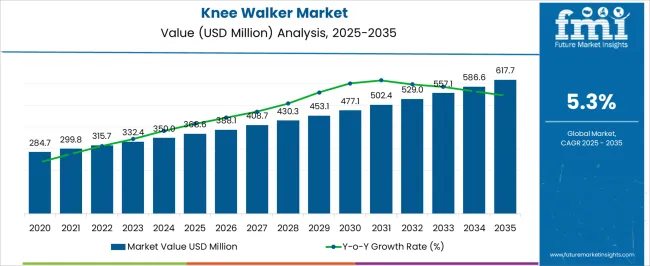
In 2025, the knee walker market was valued at USD 368.6 million. Based on Future Market Insights' analysis, demand for knee walkers is estimated to grow to USD 388.1 million in 2026 and USD 617.7 million by 2036. FMI projects a CAGR of 5.3% during the forecast period.
An absolute dollar growth of USD 229.6 million between 2026 and 2036 reflects structural shifts in post-operative and injury rehabilitation protocols rather than volume-only expansion of traditional mobility aids. Growth depends on increased adoption of knee walkers as a preferred alternative to crutches following foot, ankle, and lower leg surgeries, the expansion of outpatient surgical procedures driving home-based rehabilitation needs, and the integration of advanced features such as all-terrain wheels, folding mechanisms, and adjustable ergonomics. As per FMI, knee walker manufacturers are capturing value not from incremental unit counts alone, but from product innovation addressing specific patient requirements, superior build quality ensuring long-term durability, and strategic partnerships with healthcare providers and rehabilitation centers.
Summary of the Knee Walker Market
- Market Definition
- The market comprises wheeled mobility devices with a padded platform supporting the injured leg, enabling hands-free movement during recovery from lower limb surgeries, fractures, and injuries [1].
- Demand Drivers
- Rising global incidence of lower limb injuries requiring non-weight bearing mobility solutions.
- Increasing number of foot, ankle, and knee surgeries driving post-operative rehabilitation needs.
- Growing preference among patients for knee walkers over traditional crutches due to superior comfort, stability, and ease of use [2].
- Expanding geriatric population susceptible to falls and mobility-impairing conditions [3].
- Key Segments Analyzed
- Product Type: Premium Knee Walkers lead, accounting for 40.5% share in 2025, driven by demand for enhanced features, superior materials, and improved user experience.
- User Type: Adults represent the largest user segment, reflecting higher incidence of injuries and surgeries in this population.
- Distribution Channel: Offline channels including medical supply stores and pharmacies currently dominate, while online channels experience fastest growth.
- Geography: North America leads in market value, while Asia-Pacific drives fastest growth through healthcare infrastructure expansion.
- Analyst Opinion at FMI
- Sabyasachi Ghosh, Principal Consultant for Healthcare at Future Market Insights, opines, 'In this revamped edition of the Knee Walker Market report, value is migrating from basic mobility devices to patient-centered rehabilitation solutions. The core opportunity lies in designing knee walkers that combine clinical efficacy with user comfort, addressing the specific needs of diverse patient populations from post-surgical recovery to chronic condition management.'
- Strategic Implications/Executive Takeaways
- Invest in premium product development incorporating advanced features such as all-terrain wheels, folding mechanisms, and adjustable ergonomics.
- Develop specialized models addressing niche segments including bariatric patients, pediatric users, and individuals requiring heavy-duty support.
- Strengthen distribution partnerships with hospitals, rehabilitation centers, and home healthcare providers to capture institutional demand.
- Expand online sales capabilities while maintaining strong presence in traditional medical supply channels.
- Methodology
- Built on primary interviews with knee walker manufacturers and healthcare providers.
- Benchmarked against orthopedic procedure data and injury incidence statistics.
- Validated using medical equipment trade data and internal peer review as per FMI modeling standards.
China leads global expansion, supported by rapidly developing healthcare infrastructure, increasing number of orthopedic surgeries, and growing awareness of advanced mobility solutions among patients and healthcare professionals. India follows, driven by rising medical tourism, expanding private healthcare sector, and increasing incidence of road accidents and sports-related injuries. Germany grows on the back of its well-established healthcare system, high standards of post-operative care, and strong reimbursement framework for durable medical equipment. Brazil benefits from improving healthcare access, growing elderly population, and increasing adoption of modern rehabilitation protocols.
Mature markets such as the United States, the United Kingdom, and Japan generate comparatively slower but still steady expansion, where demand is shaped more by replacement cycles, product upgrades to premium models, and expanding applications in chronic condition management rather than new user acquisition, with competition from alternative mobility aids acting as a constraint on growth.
Knee Walker Market Definition
The knee walker market covers the global production and supply of wheeled mobility devices designed to support individuals recovering from lower leg injuries, foot surgeries, or conditions requiring non-weight bearing mobility. Also known as knee scooters or orthopedic scooters, these devices feature a padded platform where the injured leg rests while the user propels themselves with the healthy leg. They offer an alternative to traditional crutches, providing greater stability, comfort, and freedom of movement during rehabilitation periods [1].
Market Inclusions
The report includes global and regional market size estimates in value terms, with a forecast period from 2026 to 2036. It provides segmentation by Product Type, User Type, Distribution Channel, and Region. The analysis incorporates manufacturing technology trends, product innovation developments, healthcare policy impacts, and shifting patient preferences toward enhanced mobility solutions. Regional demand dynamics, country-level growth rates, and competitive positioning are also evaluated as per FMI methodology.
Market Exclusions
The scope excludes other mobility aids such as crutches, walkers, wheelchairs, and rollators not specifically designed as knee walkers. It also excludes revenue from rental services and second-hand equipment sales, focusing strictly on new device manufacturing and supply.
Research Methodology
- Primary Research: Interviews were conducted with knee walker manufacturers, orthopedic surgeons, physical therapists, medical equipment distributors, and home healthcare providers.
- Desk Research: Public company filings from Drive Medical and Nova Medical were reviewed alongside healthcare statistics from the World Health Organization, orthopedic surgery data from national health agencies, and regulatory documentation from medical device authorities.
- Market-Sizing and Forecasting: A hybrid top-down and bottom-up model was constructed, reconstructing demand from lower limb injury incidence rates, orthopedic procedure volumes, and knee walker adoption patterns across healthcare settings.
- Data Validation and Update Cycle: Outputs were subjected to variance testing against production capacity data, trade flow benchmarking, and structured internal review prior to publication.
Knee Walker Market Drivers, Restraints, and Opportunities
Future Market Insights analysis indicates the market is fundamentally tied to the global burden of lower limb injuries, orthopedic surgical volumes, and the evolution of post-operative care protocols. Its baseline scale is anchored in the clinical need for safe, effective mobility solutions during rehabilitation periods when patients must avoid weight-bearing on injured legs. As per FMI, the market's valuation is increasingly influenced by patient preference for enhanced comfort and stability, driving demand for premium products with advanced features.
FMI analysts observe a clear progression from basic knee walkers designed solely for functionality to sophisticated devices incorporating ergonomic design, lightweight materials, and user-centered features. Standard economy models face pressure where patients and healthcare providers seek improved user experience, while growth is concentrated in premium products that justify higher price points through superior comfort, durability, and maneuverability. This shift nets out as healthy value growth because product innovation and quality differentiation support margin expansion.
- Orthopedic surgery volumes: Global volumes of foot, ankle, and knee surgeries continue rising, driven by aging populations, sports participation, and medical tourism. The Australian Institute of Health and Welfare reported approximately 53,500 knee replacement procedures in Australia during 2021-2022, representing a significant patient population requiring post-operative mobility solutions [4]. Each surgical patient represents a potential knee walker user during 4-8 week rehabilitation periods.
- Patient preference shift: Clinical evidence and patient experience increasingly demonstrate advantages of knee walkers over traditional crutches. In May 2022, Harmony Home Medical Supply revealed that approximately 90% of leg-injured patients using mobility devices prefer orthopedic scooters over crutches [5]. This preference shift drives adoption as patients share positive experiences and healthcare providers recommend more comfortable alternatives.
- Aging population demographics: The United Nations World Population Prospects 2022 indicates approximately 10% of the global population is aged 65 years and above, with this percentage expected to reach 16% by 2050 [6]. Older adults face higher risks of falls, fractures, and mobility-impairing conditions, creating sustained demand for mobility aids including knee walkers. The geriatric population's preference for comfortable, stable mobility solutions aligns with premium product offerings.
- Product innovation opportunities: Manufacturers continue developing advanced features including pneumatic tires for enhanced shock absorption, all-terrain wheels enabling outdoor use, folding mechanisms for portability, and adjustable height systems accommodating diverse user physiques. These innovations differentiate premium products and command higher price points while improving user experience.
- Alternative product competition: Crutches, walkers, and wheelchairs remain widely available at lower price points, creating competition particularly in price-sensitive markets. The familiarity and lower cost of these alternatives can limit knee walker adoption despite their ergonomic advantages.
- Reimbursement limitations: Coverage policies for durable medical equipment vary significantly across regions and payers. In markets with limited or no reimbursement, the out-of-pocket cost of knee walkers can deter adoption, particularly for economy-conscious patients.
- Safety concerns: Reports of accidents and falls on uneven surfaces while using knee walkers may create hesitation among some patients and healthcare providers, potentially limiting adoption in populations with balance concerns or in environments with challenging terrain [7].
Segmental Analysis
Knee Walker Market Analysis by Product Type
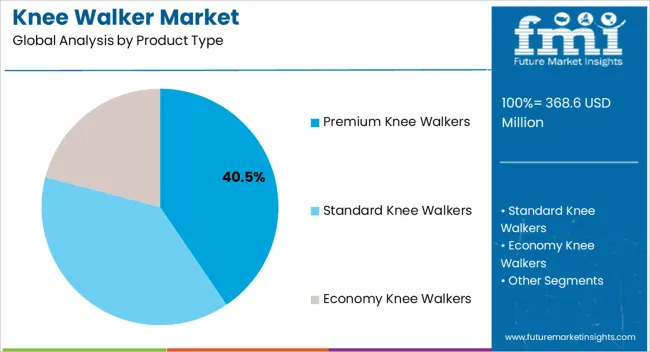
Based on FMI's knee walker market report, premium knee walkers represent the leading product type segment, projected to hold 40.5% of the market revenue share in 2025. This dominance is driven by increasing patient willingness to invest in higher-quality devices offering enhanced comfort, durability, and features. Premium models typically incorporate pneumatic tires for shock absorption, all-terrain wheels for outdoor versatility, folding mechanisms for easy transport and storage, and ergonomic padding for extended use comfort.
Standard knee walkers maintain significant market share as reliable, functional options for budget-conscious consumers and institutional purchasers. These models provide essential knee walker functionality with fewer advanced features, serving as entry-level options for patients requiring basic mobility support during rehabilitation.
Economy knee walkers, while smallest in revenue share, serve price-sensitive markets and short-term users who prioritize affordability over advanced features. These models may utilize solid rubber wheels, non-adjustable height systems, and basic frame construction.
- Premium segment growth drivers: Rising healthcare consumerism and willingness to invest in recovery experience drive premium segment growth. Patients increasingly view knee walkers as investments in recovery quality rather than purely functional medical equipment [5].
- Product differentiation strategies: Manufacturers compete through feature innovation, with premium models incorporating design elements that enhance user experience and differentiate from lower-tier offerings. All-terrain capability represents a particularly valued feature for active patients wishing to maintain outdoor mobility during recovery.
- Material advancements: Adoption of lightweight materials including aluminum alloys reduces device weight without compromising strength, enhancing portability and user convenience. Carbon fiber components in ultra-premium models offer further weight reduction at higher price points.
Knee Walker Market Analysis by User Type
Adults represent the largest user segment, reflecting higher incidence of injuries and orthopedic surgeries in this population. Work-related accidents, sports injuries, and recreational activities contribute to lower limb trauma requiring mobility assistance during recovery. The working-age adult population particularly values knee walkers' ability to maintain productivity and mobility during rehabilitation periods.
The geriatric segment represents a significant and growing user base, driven by age-related conditions including osteoarthritis, fall-related fractures, and recovery from joint replacement surgeries. Older users particularly benefit from knee walkers' stability compared to crutches, reducing fall risk during recovery. The United Nations projects substantial growth in the global population aged 65+ through 2050, expanding this user segment [6].
Pediatric users represent a smaller but specialized segment requiring devices sized appropriately for children. Pediatric knee walkers must accommodate smaller body frames while maintaining safety and stability. This segment serves children recovering from sports injuries, congenital conditions, or accidents.
- Adult segment characteristics: Adults aged 25-64 represent the core knee walker user population, balancing recovery needs with work and family responsibilities. This demographic's willingness to invest in premium products that enable continued mobility supports market value growth.
- Geriatric segment expansion: The rapidly growing elderly population creates sustained demand for mobility aids, with knee walkers offering advantages over traditional alternatives for appropriate clinical scenarios. Healthcare providers increasingly recommend knee walkers to older patients for post-operative recovery and injury rehabilitation [3].
- Pediatric specialization opportunities: Limited availability of pediatric-specific knee walkers presents opportunity for manufacturers to develop age-appropriate designs addressing children's unique needs while capturing this underserved market segment.
Knee Walker Market Analysis by Distribution Channel
Offline channels including medical supply stores, pharmacy chains, and hospital-based outlets currently dominate distribution, providing patients with opportunities for product trial, professional guidance, and immediate acquisition. Healthcare providers often direct patients to local medical equipment suppliers with whom they maintain relationships, reinforcing offline channel strength. The ability to test products before purchase and receive in-person guidance on proper use represents significant advantages of offline channels.
Online channels represent the fastest-growing distribution segment, driven by e-commerce expansion, consumer comfort with digital purchasing, and the ability to compare products across brands and price points. Direct-to-consumer websites, e-commerce platforms including Amazon, and specialized online medical equipment retailers offer convenient purchasing options with home delivery. Online channels particularly appeal to tech-savvy younger patients and those in areas with limited local medical supply options.
- Offline channel advantages: Product trial capabilities enable patients to assess comfort, adjustability, and maneuverability before purchase. Professional guidance from trained staff ensures proper device selection and fit, reducing complication risks. Immediate product availability supports patients requiring mobility solutions before scheduled surgeries or immediately following injuries [5].
- Online channel growth drivers: Wider product selection, competitive pricing, and user reviews inform purchasing decisions. Detailed product specifications and video demonstrations partially compensate for inability to physically trial devices. Home delivery eliminates transportation challenges for mobility-impaired patients.
- Omnichannel strategies: Leading manufacturers increasingly support both offline and online channels, recognizing that consumers may research online before purchasing offline or vice versa. Consistent product information across channels and strategic partnerships with both traditional retailers and e-commerce platforms optimize market reach.
Regional Analysis
The knee walker market is segmented geographically across North America, Europe, Asia-Pacific, Latin America, and Middle East & Africa. Growth dynamics differ based on healthcare infrastructure maturity, orthopedic surgery volumes, reimbursement frameworks, and consumer awareness of mobility aid options.
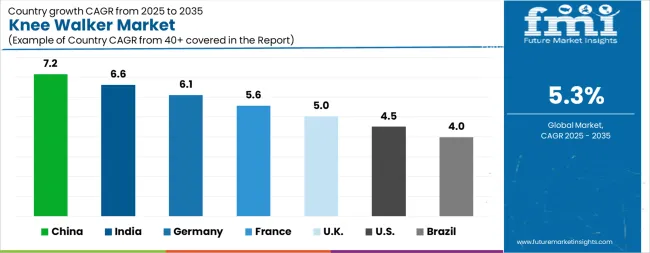
| Country | CAGR |
|---|---|
| China | 5.96% |
| India | 5.80% |
| Germany | 5.75% |
| Japan | 5.60% |
| USA | 5.50% |
| UK | 5.40% |
| Brazil | 5.30% |
Source: Future Market Insights (FMI) analysis, based on proprietary forecasting model and primary research
Asia-Pacific Market Analysis
Asia-Pacific represents the fastest-growing regional market for knee walkers, driven by rapidly developing healthcare infrastructure, increasing orthopedic surgery volumes, and growing awareness of advanced mobility solutions. China and India lead growth as they expand healthcare access and adopt modern rehabilitation protocols.
- China: Knee walker demand in China is projected to rise at 5.96% CAGR through 2036, the highest among major markets. Growth is supported by rapid healthcare infrastructure development, increasing numbers of orthopedic procedures, and growing middle-class willingness to invest in quality medical equipment. China's large population and rising injury rates from industrial accidents and road traffic create substantial addressable patient populations.
The expansion of private healthcare and medical tourism in China drives demand for premium rehabilitation equipment meeting international standards. Chinese consumers increasingly seek products offering superior comfort and features, supporting premium segment growth. Domestic manufacturers are developing competitive products while international brands expand distribution partnerships. FMI's analysis of knee walker market in Asia-Pacific consists of country-wise assessment that includes China, India, Japan, South Korea, and ASEAN nations.
- India: Knee walker demand in India is projected to rise at 5.80% CAGR through 2036. Growth is supported by expanding private healthcare sector, increasing medical tourism attracting patients from neighboring countries, and rising incidence of road accidents and sports-related injuries. India's young population and growing participation in sports and fitness activities contribute to injury volumes requiring mobility assistance.
The government's focus on healthcare infrastructure development and insurance expansion improves access to medical equipment including mobility aids. Growing awareness of knee walker benefits through digital media and healthcare provider recommendations drives adoption. Price sensitivity in the Indian market creates opportunities for both economy models and value-oriented premium products. FMI's analysis of knee walker market in Asia-Pacific consists of country-wise assessment that includes China, India, Japan, and South Korea.
- Japan: Japan represents a mature market with steady demand for knee walkers, projected at 5.60% CAGR through 2036. Japan's rapidly aging population, with one of the world's highest proportions of elderly citizens, creates sustained demand for mobility aids. The country's advanced healthcare system and high standards for medical equipment quality support premium product adoption.
Japanese consumers prioritize quality, durability, and design excellence, favoring products from established manufacturers with strong reputations. The country's culture of continuous improvement influences product development, with manufacturers refining designs based on user feedback and clinical experience. FMI's analysis of knee walker market in Asia-Pacific consists of country-wise assessment that includes China, India, Japan, and South Korea.
North America Market Analysis
North America represents the largest regional market for knee walkers, driven by advanced healthcare infrastructure, high orthopedic surgery volumes, favorable reimbursement frameworks, and strong consumer awareness of mobility aid options. The United States dominates regional demand, supported by robust private healthcare system and aging population.
- United States: Demand for knee walkers in the United States is projected to advance at 5.50% CAGR through 2036. The USA market combines high volumes of orthopedic procedures with strong consumer willingness to invest in premium rehabilitation equipment. The country's aging population, with baby boomers entering their senior years, drives sustained demand for mobility aids.
Reimbursement through Medicare and private insurers for durable medical equipment supports patient access to knee walkers when clinically appropriate. The classification of knee walkers as durable medical equipment enables coverage for eligible patients, reducing out-of-pocket costs and supporting adoption. Healthcare provider recommendations strongly influence patient choices, with physical therapists and orthopedic surgeons guiding equipment selection [5].
The USA market features intense competition among established manufacturers and private-label brands, driving continuous product innovation and feature enhancement. Consumer preferences for lightweight, portable, and feature-rich devices shape product development priorities. FMI's analysis of knee walker market in North America consists of country-wise assessment that includes the United States and Canada.
Europe Market Analysis
Europe represents a mature market characterized by well-developed healthcare systems, strong regulatory frameworks, and high standards for medical equipment quality. Germany leads Western European demand, supported by its robust healthcare infrastructure and aging population.
- Germany: Demand for knee walkers in Germany is projected to rise at 5.75% CAGR through 2036. Growth is supported by Germany's comprehensive healthcare system, which provides coverage for medically necessary durable equipment. The country's aging population and high rates of joint replacement surgeries create sustained demand for post-operative mobility solutions.
German patients and healthcare providers prioritize quality, safety, and clinical efficacy in medical equipment selection. Products must meet rigorous standards under the Medical Devices Regulation, ensuring consistent quality across the market. The country's strong engineering tradition influences expectations for product design and durability.
Reimbursement through statutory health insurance when prescribed by physicians supports patient access while maintaining quality standards. Healthcare providers play significant roles in equipment selection, with physical therapists and orthopedic surgeons guiding patient choices based on clinical experience. FMI's analysis of knee walker market in Europe consists of country-wise assessment that includes Germany, United Kingdom, France, Italy, and Spain.
Competitive Aligners for Market Players
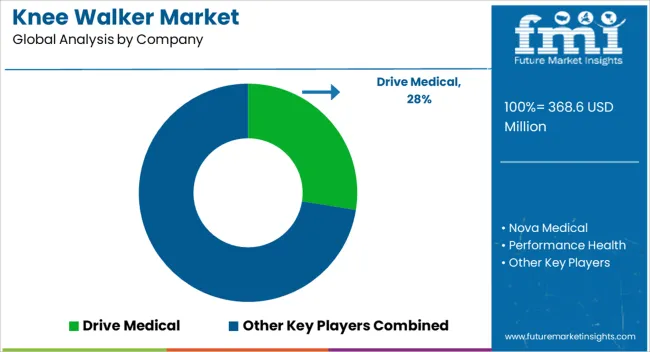
The knee walker market features competition among specialized medical equipment manufacturers and broader healthcare product companies. Key players include Drive Medical, Nova Medical, Performance Health, Vitality Medical, and Mercy Medical Equipment Company, alongside international manufacturers serving regional markets [8].
Drive Medical maintains a strong position with comprehensive product portfolios spanning multiple price points and feature levels. The company's distribution network reaches medical supply stores, pharmacy chains, and online retailers globally. Nova Medical competes through product innovation and quality positioning, with emphasis on user comfort and durability.
Performance Health leverages its broader healthcare product portfolio to cross-sell knee walkers to institutional customers including hospitals and rehabilitation centers. Vitality Medical focuses on direct-to-consumer sales through e-commerce channels, offering competitive pricing and convenient purchasing. Mercy Medical Equipment Company serves institutional customers with reliable products and strong customer support.
Competitive positioning increasingly depends on product innovation, quality consistency, and distribution reach. Manufacturers investing in ergonomic research, material science, and user-centered design build advantages in premium segments. Strategic partnerships with healthcare providers and equipment distributors secure market access.
Key Players in the Knee Walker Market
- Drive Medical
- Nova Medical
- Performance Health
- Vitality Medical
- Mercy Medical Equipment Company
Scope of Report
| Metric | Value |
|---|---|
| Quantitative Units | USD 388.1 million (2026) to USD 617.7 million (2036), at a CAGR of 5.3% |
| Market Definition | The knee walker market comprises the global manufacturing and supply of wheeled mobility devices with padded platforms supporting injured legs during recovery from lower limb surgeries, fractures, and injuries. |
| Product Type Segmentation | Premium Knee Walkers, Standard Knee Walkers, Economy Knee Walkers |
| User Type Segmentation | Adult, Child |
| Distribution Channel Segmentation | Online Channels, Offline Channels |
| Region Segmentation | North America, Europe, Asia-Pacific, Latin America, Middle East & Africa |
| Countries Covered | United States, Canada, Germany, United Kingdom, France, Italy, Spain, China, India, Japan, South Korea, Brazil and 40+ countries |
| Key Companies Profiled | Drive Medical, Nova Medical, Performance Health, Vitality Medical, Mercy Medical Equipment Company |
| Forecast Period | 2026 to 2036 |
| Approach | Hybrid top-down and bottom-up market modeling validated through primary interviews with knee walker manufacturers, orthopedic specialists, and medical equipment distributors, supported by orthopedic procedure data and injury statistics |
Knee Walker Market Analysis by Segments
Product Type:
- Premium Knee Walkers
- Standard Knee Walkers
- Economy Knee Walkers
User Type:
- Adult
- Child
Distribution Channel:
- Online Channels
- Offline Channels
Region:
- North America (United States, Canada, Mexico)
- Latin America (Brazil, Chile, Rest of Latin America)
- Western Europe (Germany, United Kingdom, Italy, Spain, France, Nordic, BENELUX, Rest of Western Europe)
- Eastern Europe (Russia, Poland, Hungary, Balkan & Baltic, Rest of Eastern Europe)
- East Asia (China, Japan, South Korea)
- South Asia and Pacific (India, ASEAN, Australia & New Zealand, Rest of South Asia and Pacific)
- Middle East & Africa (Kingdom of Saudi Arabia, Other GCC Countries, Turkiye, South Africa, Other African Union, Rest of Middle East & Africa)
Bibliography
- Cleveland Clinic. (2024). Knee Walker: What It Is and How to Use One. Cleveland Clinic Health Library.
- Harmony Home Medical Supply. (2022). Consumer Preference Survey: Mobility Devices for Leg Injuries. San Diego: Harmony Home Medical.
- United Nations Department of Economic and Social Affairs. (2022). World Population Prospects 2022: Summary of Results. New York: United Nations.
- Australian Institute of Health and Welfare. (2022). Osteoarthritis Snapshot. Canberra: AIHW.
- American Academy of Orthopaedic Surgeons. (2024). Post-Operative Mobility Guidelines Following Lower Extremity Surgery. Rosemont: AAOS.
- World Health Organization. (2024). Ageing and Health Fact Sheet. Geneva: WHO.
- USA Food and Drug Administration. (2024). MAUDE Database - Adverse Event Reports: Knee Walkers. Silver Spring: FDA.
- Drive Medical. (2025). Annual Report 2025. Port Washington: Drive Medical.
- Nova Medical Products. (2025). Company Profile and Product Catalog. Oak Brook: Nova Medical.
- Medicare.gov (2025). Durable Medical Equipment Coverage Guidelines. Baltimore: Centers for Medicare and Medicaid Services.
This Report Addresses
- Market intelligence to enable structured strategic decision-making across knee walker manufacturers, orthopedic device distributors, healthcare facility planners, and medical device investors, focusing on the shift from basic mobility aids to patient-centered rehabilitation solutions.
- Market size estimation and 10-year revenue forecasts, including validated CAGR and absolute dollar opportunity sizing.
- Growth opportunity mapping across Product Type, User Type, Distribution Channel, and regional demand pockets, with emphasis on premium product adoption and home-based rehabilitation expansion.
- Segment and regional forecasting covering the knee walker landscape, alongside demand trajectories driven by orthopedic surgery volumes, outpatient procedure expansion, and fall prevention in aging populations.
- Competition strategy assessment, including analysis of product innovation investment, quality differentiation for margin expansion, and strategic partnership dynamics with hospitals and rehabilitation centers shaping procurement decisions.
- Product and technology tracking focused on ergonomic design, lightweight materials, enhanced maneuverability features, and specialized designs catering to diverse patient needs including bariatric and pediatric populations.
- Regulatory policy analysis covering durable medical equipment reimbursement frameworks, medical device requirements, and healthcare standards influencing product specifications and market access.
- Report delivery in PDF, Excel, and presentation-ready formats to support executive planning, product development alignment, and competitive benchmarking across mature and high-growth markets.
Frequently Asked Questions
How large is the knee walker market in 2026?
Demand for knee walkers is estimated to be valued at USD 388.1 million in 2026.
What will be the market size of knee walkers by 2036?
Market size for knee walkers is projected to reach USD 617.7 million by 2036.
What is the expected demand growth for knee walkers between 2026 and 2036?
Demand for knee walkers is expected to grow at a 5.3% CAGR between 2026 and 2036.
Which product type segment is poised to lead global sales?
Premium knee walkers lead with 40.5% share in 2025, driven by patient willingness to invest in enhanced comfort, durability, and features.
Which user type segment contributes the largest revenue share?
Adults represent the largest user segment, reflecting higher incidence of injuries and orthopedic surgeries in this population.
Which distribution channel segment is the largest?
Offline channels including medical supply stores and pharmacies currently dominate, though online channels are growing rapidly.
How significant is orthopedic surgery volume in driving market growth?
Orthopedic procedures including knee replacements, ankle surgeries, and fracture repairs create substantial patient populations requiring post-operative mobility solutions, directly driving knee walker demand.
What is driving demand in China?
Rapid healthcare infrastructure development, increasing orthopedic procedures, and growing middle-class willingness to invest in quality medical equipment drive China's market growth.
What is the China growth outlook?
China is projected to expand at a 5.96% CAGR during 2026 to 2036.
What drives India's market growth?
Expanding private healthcare sector, increasing medical tourism, and rising incidence of road accidents and sports injuries support India's growth.
What is the India growth outlook?
India is projected to expand at a 5.80% CAGR during 2026 to 2036.
What characterizes the German market?
Germany's comprehensive healthcare system, aging population, and rigorous quality standards for medical equipment shape demand.
What is the Germany growth outlook?
Germany is projected to expand at a 5.75% CAGR during 2026 to 2036.
What drives the United States market?
High orthopedic surgery volumes, favorable reimbursement frameworks, and strong consumer awareness of mobility aid options shape USA demand.
What is the United States growth outlook?
The United States is projected to expand at a 5.50% CAGR during 2026 to 2036.
What is the Brazil growth outlook?
Brazil is projected to expand at a 5.30% CAGR during 2026 to 2036, supported by improving healthcare access and growing elderly population.
What are knee walkers and what are they mainly used for?
Knee walkers are wheeled mobility devices with a padded platform supporting the injured leg, enabling hands-free movement during recovery from foot, ankle, and lower leg surgeries, fractures, and injuries.
What does the knee walker market mean in this report?
It refers to the global manufacturing and supply of knee walker devices by product type, user type, distribution channel, and region, measured in value terms.
What is included in the scope of this report?
Scope includes market sizing and forecasting for 2026 to 2036, segmentation by product type, user type, distribution channel, and region, along with competitive assessment and country-wise outlook.
What is excluded from the scope of this report?
The scope excludes other mobility aids such as crutches and wheelchairs, rental services, and second-hand equipment sales.
Preview the report firsthand - request a free sample
Get SampleGet the brochure for pricing and purchase details.
Get PDFTable of Content
- Demand-side Trends
- Supply-side Trends
- Technology Roadmap Analysis
- Analysis and Recommendations
- Market Overview
- Market Coverage / Taxonomy
- Market Definition / Scope / Limitations
- Research Methodology
- Chapter Orientation
- Analytical Lens and Working Hypotheses
- Market Structure, Signals, and Trend Drivers
- Benchmarking and Cross-market Comparability
- Market Sizing, Forecasting, and Opportunity Mapping
- Research Design and Evidence Framework
- Desk Research Programme (Secondary Evidence)
- Company Annual and Sustainability Reports
- Peer-reviewed Journals and Academic Literature
- Corporate Websites, Product Literature, and Technical Notes
- Earnings Decks and Investor Briefings
- Statutory Filings and Regulatory Disclosures
- Technical White Papers and Standards Notes
- Trade Journals, Industry Magazines, and Analyst Briefs
- Conference Proceedings, Webinars, and Seminar Materials
- Government Statistics Portals and Public Data Releases
- Press Releases and Reputable Media Coverage
- Specialist Newsletters and Curated Briefings
- Sector Databases and Reference Repositories
- FMI Internal Proprietary Databases and Historical Market Datasets
- Subscription Datasets and Paid Sources
- Social Channels, Communities, and Digital Listening Inputs
- Additional Desk Sources
- Expert Input and Fieldwork (Primary Evidence)
- Primary Modes
- Qualitative Interviews and Expert Elicitation
- Quantitative Surveys and Structured Data Capture
- Blended Approach
- Why Primary Evidence is Used
- Field Techniques
- Interviews
- Surveys
- Focus Groups
- Observational and In-context Research
- Social and Community Interactions
- Stakeholder Universe Engaged
- C-suite Leaders
- Board Members
- Presidents and Vice Presidents
- R&D and Innovation Heads
- Technical Specialists
- Domain Subject-matter Experts
- Scientists
- Physicians and Other Healthcare Professionals
- Governance, Ethics, and Data Stewardship
- Research Ethics
- Data Integrity and Handling
- Primary Modes
- Tooling, Models, and Reference Databases
- Desk Research Programme (Secondary Evidence)
- Data Engineering and Model Build
- Data Acquisition and Ingestion
- Cleaning, Normalisation, and Verification
- Synthesis, Triangulation, and Analysis
- Quality Assurance and Audit Trail
- Market Background
- Market Dynamics
- Drivers
- Restraints
- Opportunity
- Trends
- Scenario Forecast
- Demand in Optimistic Scenario
- Demand in Likely Scenario
- Demand in Conservative Scenario
- Opportunity Map Analysis
- Product Life Cycle Analysis
- Supply Chain Analysis
- Investment Feasibility Matrix
- Value Chain Analysis
- PESTLE and Porter’s Analysis
- Regulatory Landscape
- Regional Parent Market Outlook
- Production and Consumption Statistics
- Import and Export Statistics
- Market Dynamics
- Global Market Analysis 2021 to 2025 and Forecast, 2026 to 2036
- Historical Market Size Value (USD Million) Analysis, 2021 to 2025
- Current and Future Market Size Value (USD Million) Projections, 2026 to 2036
- Y-o-Y Growth Trend Analysis
- Absolute $ Opportunity Analysis
- Global Market Pricing Analysis 2021 to 2025 and Forecast 2026 to 2036
- Global Market Analysis 2021 to 2025 and Forecast 2026 to 2036, By Product Type
- Introduction / Key Findings
- Historical Market Size Value (USD Million) Analysis By Product Type , 2021 to 2025
- Current and Future Market Size Value (USD Million) Analysis and Forecast By Product Type , 2026 to 2036
- Premium Knee Walkers
- Standard Knee Walkers
- Economy Knee Walkers
- Premium Knee Walkers
- Y-o-Y Growth Trend Analysis By Product Type , 2021 to 2025
- Absolute $ Opportunity Analysis By Product Type , 2026 to 2036
- Global Market Analysis 2021 to 2025 and Forecast 2026 to 2036, By Region
- Introduction
- Historical Market Size Value (USD Million) Analysis By Region, 2021 to 2025
- Current Market Size Value (USD Million) Analysis and Forecast By Region, 2026 to 2036
- North America
- Latin America
- Western Europe
- Eastern Europe
- East Asia
- South Asia and Pacific
- Middle East & Africa
- Market Attractiveness Analysis By Region
- North America Market Analysis 2021 to 2025 and Forecast 2026 to 2036, By Country
- Historical Market Size Value (USD Million) Trend Analysis By Market Taxonomy, 2021 to 2025
- Market Size Value (USD Million) Forecast By Market Taxonomy, 2026 to 2036
- By Country
- USA
- Canada
- Mexico
- By Product Type
- By Country
- Market Attractiveness Analysis
- By Country
- By Product Type
- Key Takeaways
- Latin America Market Analysis 2021 to 2025 and Forecast 2026 to 2036, By Country
- Historical Market Size Value (USD Million) Trend Analysis By Market Taxonomy, 2021 to 2025
- Market Size Value (USD Million) Forecast By Market Taxonomy, 2026 to 2036
- By Country
- Brazil
- Chile
- Rest of Latin America
- By Product Type
- By Country
- Market Attractiveness Analysis
- By Country
- By Product Type
- Key Takeaways
- Western Europe Market Analysis 2021 to 2025 and Forecast 2026 to 2036, By Country
- Historical Market Size Value (USD Million) Trend Analysis By Market Taxonomy, 2021 to 2025
- Market Size Value (USD Million) Forecast By Market Taxonomy, 2026 to 2036
- By Country
- Germany
- UK
- Italy
- Spain
- France
- Nordic
- BENELUX
- Rest of Western Europe
- By Product Type
- By Country
- Market Attractiveness Analysis
- By Country
- By Product Type
- Key Takeaways
- Eastern Europe Market Analysis 2021 to 2025 and Forecast 2026 to 2036, By Country
- Historical Market Size Value (USD Million) Trend Analysis By Market Taxonomy, 2021 to 2025
- Market Size Value (USD Million) Forecast By Market Taxonomy, 2026 to 2036
- By Country
- Russia
- Poland
- Hungary
- Balkan & Baltic
- Rest of Eastern Europe
- By Product Type
- By Country
- Market Attractiveness Analysis
- By Country
- By Product Type
- Key Takeaways
- East Asia Market Analysis 2021 to 2025 and Forecast 2026 to 2036, By Country
- Historical Market Size Value (USD Million) Trend Analysis By Market Taxonomy, 2021 to 2025
- Market Size Value (USD Million) Forecast By Market Taxonomy, 2026 to 2036
- By Country
- China
- Japan
- South Korea
- By Product Type
- By Country
- Market Attractiveness Analysis
- By Country
- By Product Type
- Key Takeaways
- South Asia and Pacific Market Analysis 2021 to 2025 and Forecast 2026 to 2036, By Country
- Historical Market Size Value (USD Million) Trend Analysis By Market Taxonomy, 2021 to 2025
- Market Size Value (USD Million) Forecast By Market Taxonomy, 2026 to 2036
- By Country
- India
- ASEAN
- Australia & New Zealand
- Rest of South Asia and Pacific
- By Product Type
- By Country
- Market Attractiveness Analysis
- By Country
- By Product Type
- Key Takeaways
- Middle East & Africa Market Analysis 2021 to 2025 and Forecast 2026 to 2036, By Country
- Historical Market Size Value (USD Million) Trend Analysis By Market Taxonomy, 2021 to 2025
- Market Size Value (USD Million) Forecast By Market Taxonomy, 2026 to 2036
- By Country
- Kingdom of Saudi Arabia
- Other GCC Countries
- Turkiye
- South Africa
- Other African Union
- Rest of Middle East & Africa
- By Product Type
- By Country
- Market Attractiveness Analysis
- By Country
- By Product Type
- Key Takeaways
- Key Countries Market Analysis
- USA
- Pricing Analysis
- Market Share Analysis, 2025
- By Product Type
- Canada
- Pricing Analysis
- Market Share Analysis, 2025
- By Product Type
- Mexico
- Pricing Analysis
- Market Share Analysis, 2025
- By Product Type
- Brazil
- Pricing Analysis
- Market Share Analysis, 2025
- By Product Type
- Chile
- Pricing Analysis
- Market Share Analysis, 2025
- By Product Type
- Germany
- Pricing Analysis
- Market Share Analysis, 2025
- By Product Type
- UK
- Pricing Analysis
- Market Share Analysis, 2025
- By Product Type
- Italy
- Pricing Analysis
- Market Share Analysis, 2025
- By Product Type
- Spain
- Pricing Analysis
- Market Share Analysis, 2025
- By Product Type
- France
- Pricing Analysis
- Market Share Analysis, 2025
- By Product Type
- India
- Pricing Analysis
- Market Share Analysis, 2025
- By Product Type
- ASEAN
- Pricing Analysis
- Market Share Analysis, 2025
- By Product Type
- Australia & New Zealand
- Pricing Analysis
- Market Share Analysis, 2025
- By Product Type
- China
- Pricing Analysis
- Market Share Analysis, 2025
- By Product Type
- Japan
- Pricing Analysis
- Market Share Analysis, 2025
- By Product Type
- South Korea
- Pricing Analysis
- Market Share Analysis, 2025
- By Product Type
- Russia
- Pricing Analysis
- Market Share Analysis, 2025
- By Product Type
- Poland
- Pricing Analysis
- Market Share Analysis, 2025
- By Product Type
- Hungary
- Pricing Analysis
- Market Share Analysis, 2025
- By Product Type
- Kingdom of Saudi Arabia
- Pricing Analysis
- Market Share Analysis, 2025
- By Product Type
- Turkiye
- Pricing Analysis
- Market Share Analysis, 2025
- By Product Type
- South Africa
- Pricing Analysis
- Market Share Analysis, 2025
- By Product Type
- USA
- Market Structure Analysis
- Competition Dashboard
- Competition Benchmarking
- Market Share Analysis of Top Players
- By Regional
- By Product Type
- Competition Analysis
- Competition Deep Dive
- Drive Medical
- Overview
- Product Portfolio
- Profitability by Market Segments (Product/Age /Sales Channel/Region)
- Sales Footprint
- Strategy Overview
- Marketing Strategy
- Product Strategy
- Channel Strategy
- Nova Medical
- Performance Health
- Vitality Medical
- Mercy Medical Equipment Company
- Drive Medical
- Competition Deep Dive
- Assumptions & Acronyms Used


