

- Industry Size (2026)
- USD 650.0 Mn
- Forecast (2036)
- USD 1685.9 Mn
- CAGR (2026 to 2036)
- 10.0%
Knee Surgical Impactor Market Size, Market Forecast and Outlook By FMI
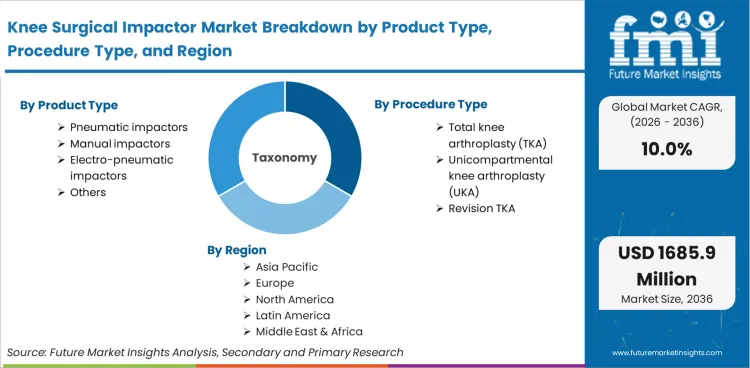
In 2026, the knee surgical impactor market is expected to be valued at USD 650.0 million. Based on Future Market Insights’ analysis, demand for knee surgical impactors is projected to grow to USD 1,685.9 million by 2036. FMI projects a CAGR of 10.0% during the forecast period.
The market is expected to experience a significant absolute dollar growth of USD 1,035.9 million during the forecast period, driven by a growing global aging population and increasing incidence of knee joint diseases. Hospitals will continue to dominate the market as the primary end user due to the high demand for TKA procedures. Technological advancements in knee surgical impactors, including the integration of electro-pneumatic impactors, are expected to enhance surgical precision and recovery times, further stimulating market growth. “When I think about what the KINCISE™ 2 System means for the future of orthopaedic care, it’s simple: it helps surgeons stay at their best, longer, This system is designed to reduce strain and support surgical precision, which means we can focus more fully on the patient in front of us. That’s the true value technology that not only improves surgical experience but helps us deliver better outcomes for every patient we treat.” said Dr. Vasilios Mathews, M.D., Texas Orthopedic Hospital. [1]
Summary of Knee Surgical Impactor Market
- Market Definition
- The Knee Surgical Impactor Market pertains to the tools and equipment used in orthopedic knee replacement surgeries, such as Total Knee Arthroplasty (TKA), Unicompartmental Knee Arthroplasty (UKA), and Revision TKA. These impactors assist in ensuring precise alignment and placement of knee implants, contributing to improved surgical outcomes.
- Demand Drivers in the Market
- The rising prevalence of knee joint disorders, particularly osteoarthritis, especially in aging populations, is driving the demand for knee replacement surgeries and surgical impactors.
- Technological innovations in surgical tools, including pneumatic and electro-pneumatic impactors, are enhancing the precision and efficiency of knee surgeries.
- Increasing healthcare access, particularly in emerging markets, and the expansion of orthopedic hospitals and surgical centers are supporting the market growth.
- Key Segments Analyzed in the FMI Report
- By Product Type: Pneumatic impactors hold the leading share at 40%, followed by manual impactors at 30%, and electro-pneumatic impactors at 20%.
- By Procedure Type: Total Knee Arthroplasty (TKA) dominates with a 60% share, followed by Unicompartmental Knee Arthroplasty (UKA) at 25%, and Revision TKA at 15%.
- Geography: The USA remains the dominant market, driven by a high number of knee replacement surgeries. China and India are forecast to show the highest growth due to improving healthcare infrastructure and rising cases of knee disorders.
- Analyst Opinion at FMI
- Sabyasachi Ghosh, Principal Consultant at Future Market Insights, opines, "The Knee Surgical Impactor Market is set to experience robust growth driven by the rising prevalence of knee disorders and the increasing number of knee surgeries globally. Pneumatic impactors are expected to remain dominant due to their high adoption in TKA, offering precision and efficiency crucial for successful surgical outcomes."
- Strategic Implications and Executive Takeaways
- Manufacturers should focus on developing advanced knee surgical impactors that integrate with robotic-assisted surgeries and precision alignment systems, ensuring higher adoption in hospitals.
- Focus on developing long-term relationships with hospitals and surgical centers that perform high volumes of knee replacements to secure consistent demand for impactors.
- Companies should target emerging markets like India and China, where access to healthcare is increasing, and knee replacement surgeries are on the rise, to capitalize on high-growth opportunities.
- Methodology
- Market sizing and segment splits were derived from primary data sources, including company disclosures and channel-level demand mapping based on procedure volumes in hospitals and surgical centers.
- End-user shares were validated by examining procedure types and aligning them with market data from key healthcare providers.
- Price sensitivity analysis was conducted by evaluating consumer and hospital responses to various types of knee surgical impactors, confirming the price elasticity of demand in different market segments.
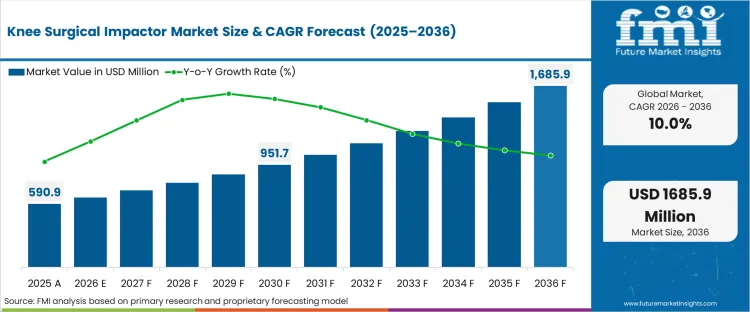
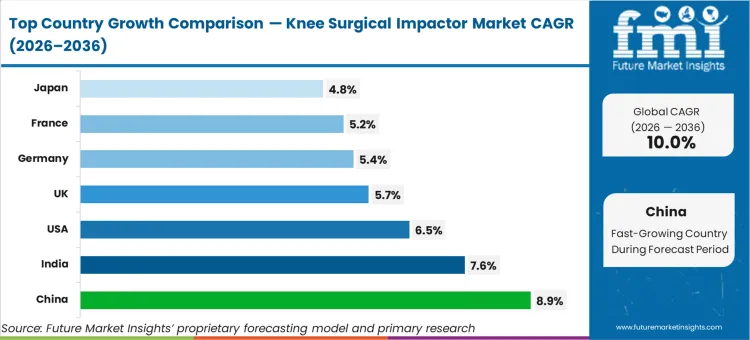
Increased adoption of knee surgical impactors is expected in emerging markets such as China (8.9% CAGR) and India (7.6% CAGR), where healthcare infrastructure development is accelerating. The USA (6.5% CAGR) remains the largest market, supported by a high volume of TKA surgeries. However, competition from manual and electro-pneumatic impactors will continue to challenge the market in more price-sensitive regions, where demand for high-end pneumatic models will be somewhat restrained.
Knee Surgical Impactor Market Definition
The knee surgical impactor market refers to the variety of surgical impactors used in knee replacement surgeries. The knee replacement surgeries include total knee arthroplasty and unicompartmental knee arthroplasty. The knee replacement impactors are used in the surgical process by applying force. The knee surgical impactors are of different types, such as pneumatic, manual, and electro-pneumatic. The knee replacement impactors are used for precise application of force during the surgical process. The knee replacement impactors are used by hospitals, ambulatory surgical centers, and specialty clinics for knee replacement surgeries.
Knee Surgical Impactor Market Inclusions
The report includes a comprehensive analysis of the knee surgical impactor market, covering global and regional market sizes, with forecasts for 2026 to 2036. It includes segmentations by product type (Pneumatic impactors, Manual impactors, Electro-pneumatic impactors, and Others), procedure type (Total knee arthroplasty (TKA), Unicompartmental knee arthroplasty (UKA), and Revision TKA), and end users (Hospitals, ASCs, and Specialty clinics). Additionally, the report provides insights into the key drivers and challenges, technological advancements, competitive landscape, and the impact of pricing pressures in different geographies.
Knee Surgical Impactor Market Exclusions
The scope excludes products related to joint implants and tools for other types of surgical procedures unrelated to knee replacement. The report does not cover non-surgical knee treatment tools or devices used for pre-operative or post-operative care. Other surgical tools that are part of the knee replacement surgery process, such as bone saws, scalpels, and surgical drapes, are not included in this analysis. Additionally, emerging, uncommercialized products or those in early development phases have been excluded from the report.
Knee Surgical Impactor Market Research Methodology
- Primary Research: For primary research, interviews were conducted with major stakeholders such as knee implant makers, orthopedic surgeons, surgical device suppliers, and healthcare providers in hospitals and ASCs. Information was obtained regarding the usage of the product and the trends observed in the market.
- Desk Research: Secondary research data was collected and studied for information regarding existing technologies and market trends in the field of knee surgery tools and equipment. Information was obtained from industry reports, medical journals, and scientific research studies.
- Market-Sizing and Forecasting: Market size and growth forecasts were obtained by using the top-down and bottom-up approaches. Information regarding the number of surgical procedures and the sales of knee surgical impactors was obtained and used for calculating the current market size. Market forecasts were obtained by using the growth in healthcare infrastructure in the regions and the trends observed in the market.
- Data Validation and Update Cycle: The data obtained was cross-checked with other sources and verified. The outputs were reviewed and updated based on the current market conditions and the latest trends observed.
Segmental Analysis
Knee Surgical Impactor Market Analysis by Product Type
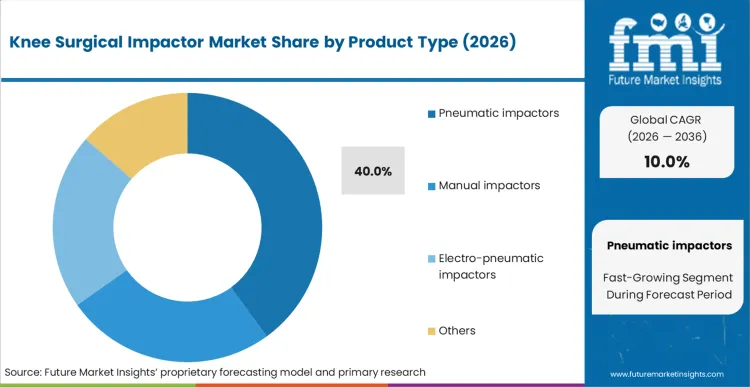
Pneumatic impactors hold the largest market share at 40% in 2026, driven by their widespread use in knee replacement surgeries, particularly in TKA procedures. Pneumatic impactors are favored for their controlled and consistent force, making them ideal for high-precision surgeries.
- Reduced Surgeon Variability and Fatigue: Automated/pneumatic impactor systems deliver consistent and controlled impaction force, significantly reducing the variability that occurs with manual mallet strikes. This consistency not only improves reproducibility of implant seating but also decreases physical strain on surgeons a major ergonomic advantage. [2]
- Broader Clinical Adoption of Powered Instruments: The evolution of power‑assisted instruments (including pneumatic/automated impactors) in orthopaedics reflects a broader clinical trend toward mechanized tools that offer consistent performance and easier operation compared with manual counterparts. [3]
- Enhanced Precision and Implant Alignment: Pneumatic impactors offer high precision in delivering consistent force, which is critical for accurately aligning knee implants during Total Knee Arthroplasty (TKA). This precision helps to reduce the risk of malalignment, contributing to better long-term patient outcomes and implant stability, reinforcing their dominance in the market.
Knee Surgical Impactor Market Analysis by Procedure Type
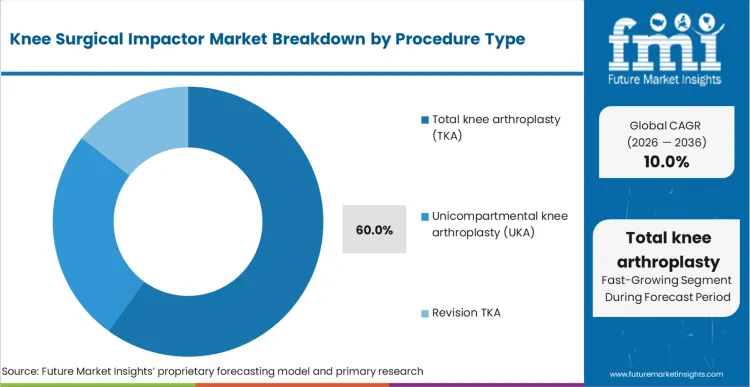
Total Knee Arthroplasty (TKA) leads the procedure type segment with a 60% market share in 2026. This is the most common knee surgery performed globally due to the high prevalence of osteoarthritis, particularly in aging populations. TKA is preferred for patients with severe joint degeneration, which drives demand for surgical tools like knee impactors.
- Growing Volume of TKA Procedures: TKA is performed in very large numbers globally and continues to increase year‑on‑year, making it one of the most common orthopedic surgeries. Data from large national datasets show that millions of primary TKA surgeries have already been performed and are projected to keep rising, reflecting strong ongoing demand for the procedure.[4]
- Cost-Effectiveness and Accessibility: TKA is one of the most cost-effective and routinely performed surgeries globally, particularly in developed countries. With a relatively predictable and standardized surgical process, TKA offers a low complication rate, making it a widely accessible option for patients with severe knee degeneration. This contributes to the consistent demand for knee impactors in surgical procedures. [5]
- Rehabilitation and Improved Mobility Post-Surgery: TKA is known for its significant improvement in post-surgical mobility, enabling patients to regain independence and return to daily activities. The rehabilitation success and long-lasting benefits of improved knee function make TKA a preferred choice for patients with advanced knee degeneration, contributing to its high and increasing demand globally. This ongoing requirement for post-surgical support further drives the need for surgical tools like knee impactors.
Knee Surgical Impactor Market Drivers, Restraints, and Opportunities
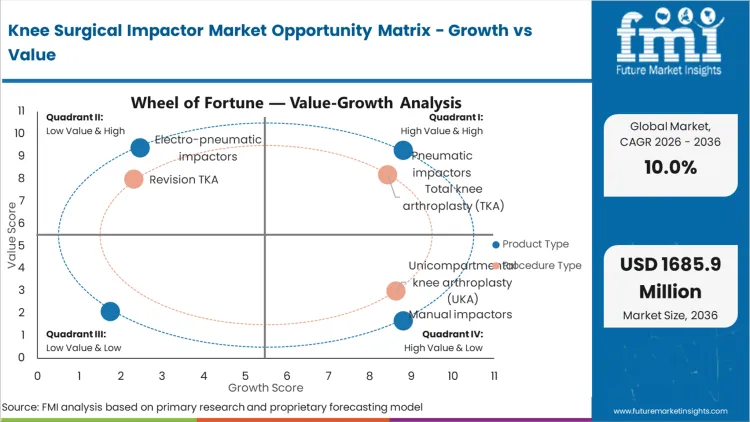
Future Market Insights analysis indicates that the Knee Surgical Impactor Market is poised for substantial growth, driven by the rising number of knee replacement surgeries globally, particularly TKA. The market is supported by advancements in surgical tools, including pneumatic and electro-pneumatic impactors, which enhance precision and improve patient outcomes.
- Rising Demand for Knee Replacements: The increasing prevalence of knee osteoarthritis and the aging global population are key drivers of growth in the knee surgical impactor market.
- Technological Advancements: The adoption of new surgical technologies, such as robotic assistance in TKA, is enhancing the demand for precise surgical impactors.
- Healthcare Access Expansion: The rising number of orthopedic hospitals and surgical centers, particularly in emerging markets like India and China, is creating significant growth opportunities for the knee surgical impactor market.
Regional Analysis
Based on the regional analysis, the Knee Surgical Impactor Market is segmented into North America, Latin America, East Asia, South Asia & Pacific, Western Europe, Eastern Europe, and Middle East & Africa across 40+ countries. Regional performance is evaluated by the adoption of knee arthroplasty procedures, hospital versus ASC adoption, and purchasing behavior related to electro-pneumatic and manual impactor tools, as per FMI. The full report also offers market attractiveness analysis based on regional trends.
.webp "Top Country Growth Comparison Knee Surgical Impactor Market Cagr (2026 2036)")
| Country | CAGR |
|---|---|
| USA | 6.5% |
| Germany | 5.4% |
| UK | 5.7% |
| France | 5.2% |
| Japan | 4.8% |
| China | 8.9% |
| India | 7.6% |
Source: Future Market Insights (FMI) analysis, based on proprietary forecasting model and primary research
North America Knee Surgical Impactor Market Analysis
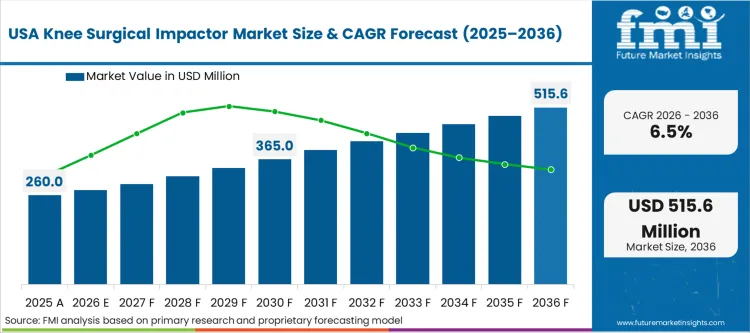
The largest market share is accounted for by the North America region, and this is attributed to the large number of total knee arthroplasty (TKA) surgeries carried out in the region. Additionally, there is an increase in the adoption of ASC. The major players in the market include Stryker, Zimmer Biomet, and Medtronic. The popularity of pneumatic and electro-pneumatic impactors is the major factor that has contributed to the growth of the market.
- USA: The growth of the market in the USA is expected to be 6.5% during the forecast period. The major factor contributing to the growth of the market is the increasing number of surgeries involving total knee arthroplasty (TKA), as pneumatic impactors are widely used in hospital settings for the procedure. Additionally, there is a steady increase in the number of surgeries carried out in ASC. This is attributed to the need for cost reduction.
FMI’s report includes a detailed analysis of the growth in the North American region, along with a country-wise assessment that includes the USA, Canada, and Mexico. Readers can also find regional trends, regulations, and market growth based on different segments and countries in the North American region.
East Asia Knee Surgical Impactor Market Analysis
The region of East Asia is seeing an increasing trend in knee arthroplasty surgeries due to the increasing investments in the healthcare sector and the growing number of aging populations, especially in China. The region is benefiting from the increasing number of hospital and ASC capacities and the increasing availability of quality surgical equipment.
- China: China has the highest growth rate of 8.9% by 2036. This is because of the increasing demand for total knee replacement surgeries and the increasing use of electro-pneumatic impactors. The major factor is the increasing number of hospital capacities; ASCs are also seeing an increasing trend because of the increasing number of outpatient knee surgeries.
- Japan: The growth of the Japanese market is expected to rise at a CAGR of 4.8% by the year 2036. One of the major growth drivers for the Japanese market is the aging population. This increases the demand for knee replacement surgeries, especially in hospitals. The use of manual impactors is expected to grow steadily. Although the use of electro-pneumatic impactors is increasing due to the improvement in efficiency.
The report by FMI offers information regarding the growth of the East Asian market. Additionally, the report offers information regarding the growth of the market based on countries such as China, Japan, and South Korea.
South Asia & Pacific Knee Surgical Impactor Market Analysis
The region of South Asia and the Pacific is also witnessing an increase in the volume of knee surgeries due to an increase in disposable income and healthcare infrastructure in countries such as India. Price sensitivity and differences in the adoption of surgical equipment are major challenges faced in less developed regions.
- India: The Indian market is expected to grow at a CAGR of 7.6% till 2036. The growth is due to an increase in orthopedic surgery and the increasing number of people in the middle class who are demanding better surgical options. The knee surgical impactor market is growing, especially for manual impactors for trauma and emergency cases.
FMI’s report includes a detailed analysis of the growth in the South Asia & Pacific region, along with a country-wise assessment that includes India, ASEAN Countries, Australia & New Zealand, and the Rest of South Asia. Readers can also find regional trends, regulations, and market growth based on different segments and countries in the South Asia & Pacific region.
Western Europe Knee Surgical Impactor Market Analysis
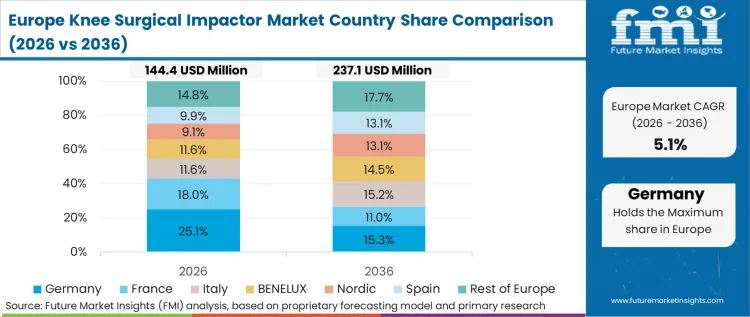
Western Europe’s growth is characterized by strong healthcare regulations, high levels of orthopedic surgical procedures, and rising demand for advanced surgical tools. Pneumatic impactors remain the most widely used tool due to their established reliability.
- Germany: Germany is projected to grow at 5.4% CAGR through 2036, driven by the volume of TKA procedures in the country’s leading hospitals. Growth is supported by the high adoption of pneumatic impactors and, to a lesser degree, electro-pneumatic tools. Demand remains concentrated in hospitals, while specialty clinics show increasing adoption for arthroplasty procedures.
- UK: The UK is expected to expand at 5.7% CAGR through 2036, as demand for TKA procedures increases alongside rising funding for outpatient surgeries in ASCs.
FMI’s analysis of knee surgical impactor market in Western Europe consists of country-wise assessment that includes Germany, UK, France, Italy, Spain, BENELUX, Nordic Countries and Rest of Western Europe. Readers can know various regulations and latest trends in the regional market.
Latin America Knee Surgical Impactor Market Analysis
Latin America shows strong demand growth driven by an increase in knee surgery volumes and hospital expansions. The market in Brazil leads due to a large volume of surgical procedures, with Stryker, Zimmer Biomet, and Medtronic increasing their market share in the region.
- Brazil: Brazil is expected to grow at 8.1% CAGR through 2036, driven by a growing demand for knee surgeries and a rising preference for advanced impactor systems. The adoption of electro-pneumatic impactors continues to rise, especially in large hospitals.
The report consists of a detailed analysis for the market in Brazil, Argentina, and Rest of Latin America. Readers can find detailed information about several factors, such as the pricing analysis and regional trends, which are impacting growth in the Latin America region.
Middle East & Africa Knee Surgical Impactor Market Analysis
The Middle East & Africa segment is growing due to a mix of high-volume trauma cases and increasing need for knee arthroplasty procedures. Stryker and Zimmer Biomet are the major companies in this segment.
- Saudi Arabia: The market in Saudi Arabia is expected to grow at a CAGR of 9.3% from 2036 onwards due to high healthcare expenditure and a rise in orthopedic procedures. Stryker and Zimmer Biomet dominate in sales in this country, especially in large hospital systems.
FMI’s analysis of the knee surgical impactor market in the Middle East & Africa consists of country-wise assessments that include Saudi Arabia, Turkey, South Africa, Other African Union nations, and the Rest of the Middle East & Africa. Readers can know various regulations and trends shaping the market growth in this region.
Competitive Aligners for Market Players
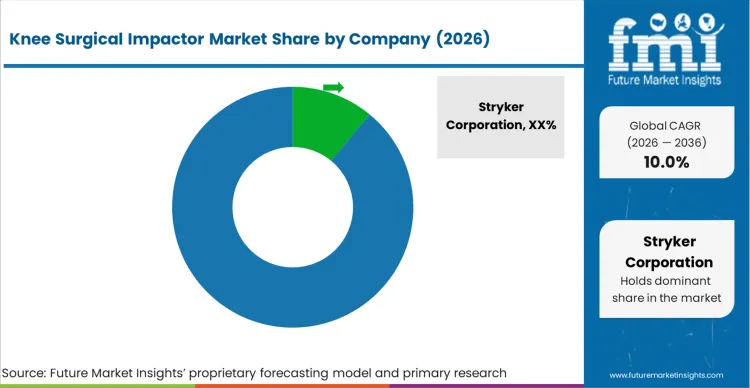
The market structure is fragmented, but effective competition is only from a handful of suppliers that can assure a certain level of performance for surgical impactors, reliability of the instruments over a period of clinical use, and service needs of hospitals and surgery centers. The competition is based on the quality of products, not on the price, as the price may vary over a period of time. The only factor for competition is the capability of providing impactors that can increase the efficiency of the procedure, reduce fatigue, and minimize the variability of results in bone preparation, as mentioned by FMI.
Structural advantage is often seen in companies with products that provide a balance of reliable and durable products, as well as extensive clinical education. The pneumatic impactors remain the leading type of products, and as a result, there is a need for a high level of consistency in the application of force and minimal maintenance. Companies that provide a variety of configurations, from electro-pneumatic impactors and manual impactors, are more likely to meet the varying needs of surgeons for different types of procedures, including total knee arthroplasty (TKA), unicompartmental knee arthroplasty (UKA), and revision TKA. Large companies also tend to provide service contracts, spare parts, and support, which helps build customer loyalty. For the smaller companies, there is a greater likelihood of being left with a narrower range of products, making it more challenging when hospitals and specialty clinics consolidate their suppliers or switch brands during contract renewal, as mentioned in the report by FMI.
The customer concentration also increases the buyer’s leverage. For instance, the largest customer segment comprises hospitals. These hospitals may address the dependency factor by requiring multiple vendors for qualification and long-term contracts with service guarantees, delivery schedules, and part replacement. ASCs are more price-sensitive and prefer standardization of fewer product types. They may prefer fewer types based on the number of procedures performed or surgeon preference. Specialty clinics are less concentrated but also require high levels of performance and accuracy. For more complex revision cases, they also require high levels of performance and accuracy. This limits the pricing power for basic surgical cases but allows for premium pricing for advanced feature sets that reduce operational risks and improve the workflow for the surgeon.
Recent Developments
The report includes full coverage of key trends from competitive benchmarking. Some of the recent developments covered in the reports:
- In June 2025, Johnson & Johnson MedTech, a global leader in orthopaedic technologies and solutions, announced the launch of the KINCISE 2 Surgical Automated System, a next-generation automated power tool engineered to improve surgical efficiency, provide control and aims to reduce physical burden on surgeons compared to manual impaction across both primary and revision hip, and revision knee replacement procedures. [1]
- In May 2025, Imperial startup raises £2.5m to take innovative joint replacements to the US. OSSTEC will use new investment to seek regulatory approval in the US, while beginning a first clinical trial in the UK. [6]
Key Players in Knee Surgical Impactor Market
- Stryker Corporation
- Zimmer Biomet Holdings, Inc.
- Medtronic plc
- Smith & Nephew plc
- Johnson & Johnson
- Arthrex, Inc.
- DePuy Synthes (Johnson & Johnson)
- Exactech, Inc.
- B. Braun Melsungen AG
- Orthofix Medical, Inc.
Scope of the report
| Metric | Value |
|---|---|
| Quantitative Units | USD 650.0 Mn (2026) to USD 1,685.9 Mn (2036), at a CAGR of 10.0% |
| Market Definition | The knee surgical impactor market includes the global production and trade of mechanical devices used in knee replacement surgeries to facilitate the placement of prosthetic components in procedures like total knee arthroplasty (TKA), unicompartmental knee arthroplasty (UKA), and revision TKA. Key devices include pneumatic, manual, and electro-pneumatic impactors designed for hospital and outpatient orthopedic settings. |
| Product Type Segmentation | Pneumatic impactors, Manual impactors, Electro-pneumatic impactors, Others |
| Procedure Type Segmentation | Total knee arthroplasty (TKA), Unicompartmental knee arthroplasty (UKA), Revision TKA |
| End User Segmentation | Hospitals, ASCs, Specialty clinics |
| Regions Covered | North America, Latin America, East Asia, South Asia & Pacific, Western Europe, Eastern Europe, and Middle East & Africa. |
| Countries Covered | United States, Canada, Mexico, Brazil, Argentina, Germany, France, United Kingdom, Italy, Spain, China, India, Japan, South Korea, Indonesia, Australia and 40+ countries |
| Key Companies Profiled | Stryker Corporation, Zimmer Biomet Holdings, Inc., Medtronic plc, Smith & Nephew plc, Johnson & Johnson, Arthrex, Inc., DePuy Synthes (Johnson & Johnson), Exactech, Inc., B. Braun Melsungen AG, Orthofix Medical, Inc. |
| Forecast Period | 2026 to 2036 |
| Approach | Hybrid top down and bottom up market modeling validated through primary interviews with orthopedic device suppliers, hospital purchasing decision-makers, and clinical specialists, supported by procedure volume and device adoption rates, as per FMI. |
Knee Surgical Impactor Market Analysis by Segments
Product Type:
- Pneumatic impactors
- Manual impactors
- Electro-pneumatic impactors
- Others
Procedure Type:
- Total knee arthroplasty (TKA)
- Unicompartmental knee arthroplasty (UKA)
- Revision TKA
End User:
- Hospitals
- ASCs
- Specialty clinics
Region:
- North America
- USA
- Canada
- Mexico
- Latin America
- Brazil
- Argentina
- Rest of Latin America
- East Asia
- China
- Japan
- South Korea
- South Asia & Pacific
- India
- ASEAN Countries
- Australia & New Zealand
- Rest of South Asia
- Western Europe
- Germany
- UK
- France
- Italy
- Spain
- BENELUX
- Nordic Countries
- Rest of Western Europe
- Eastern Europe
- Russia
- Hungary
- Poland
- Rest of Eastern Europe
- Middle East & Africa
- Saudi Arabia
- Türkiye
- South Africa
- Other African Union
- Rest of Middle East & Africa
Bibliography
- [1] Johnson & Johnson MedTech (2025). Johnson & Johnson Launches KINCISE™ 2 System, the Only Automated Surgical Impactor Approved for Knee and Hip Revision Procedures
- [2] ScienceDirect (2024). Use of an Automated Surgical Impactor Reduces Femoral Broaching Time in Direct Anterior Approach Total Hip Arthroplasty: Results From a Randomized, Multicenter Study
- [3] Opnews (2013). Power Tools in Orthopaedics - A Comprehensive Review
- [4] PubMed Central (2023). Epidemiology of primary and revision total knee arthroplasty: analysis of demographics, comorbidities and outcomes from the national inpatient sample.
- [5] PubMed (2024). Total Knee Arthroplasty Techniques
- [6] Imperial College London (2025). Imperial startup raises £2.5m to take innovative joint replacements to the US.
This bibliography is provided for reader reference and is not exhaustive. The full report contains the complete reference list and detailed citations.
Frequently Asked Questions
How large is the demand for Knee Surgical Impactors in the global market in 2026?
Demand for Knee surgical impactors in the global market is estimated to be valued at USD 650.0 Mn in 2026, as per FMI.
What will be the market size of Knee Surgical Impactors in the global market by 2036?
Market size for Knee surgical impactors is projected to reach USD 1,685.9 Mn by 2036.
What is the expected demand growth for Knee Surgical Impactors in the global market between 2026 and 2036?
Demand for Knee surgical impactors in the global market is expected to grow at a CAGR of 10.0% between 2026 and 2036.
Which product type is expected to lead the market in 2026?
Pneumatic impactors are expected to lead with 40% market share in 2026.
Which procedure type is poised to dominate the market?
Total knee arthroplasty (TKA) is expected to dominate with 60% share in 2026.
How significant is hospital end-user demand in 2026?
Hospitals are projected to account for 70% share of the end-user demand in 2026.
Preview the report firsthand - request a free sample
Get SampleGet the brochure for pricing and purchase details.
Get PDFTable of Content
- Executive Summary
- Global Market Outlook
- Demand-side Trends
- Supply-side Trends
- Technology Roadmap Analysis
- Analysis and Recommendations
- Market Overview
- Market Coverage / Taxonomy
- Market Definition / Scope / Limitations
- Research Methodology
- Chapter Orientation
- Analytical Lens and Working Hypotheses
- Market Structure, Signals, and Trend Drivers
- Benchmarking and Cross-market Comparability
- Market Sizing, Forecasting, and Opportunity Mapping
- Research Design and Evidence Framework
- Desk Research Programme (Secondary Evidence)
- Company Annual and Sustainability Reports
- Peer-reviewed Journals and Academic Literature
- Corporate Websites, Product Literature, and Technical Notes
- Earnings Decks and Investor Briefings
- Statutory Filings and Regulatory Disclosures
- Technical White Papers and Standards Notes
- Trade Journals, Industry Magazines, and Analyst Briefs
- Conference Proceedings, Webinars, and Seminar Materials
- Government Statistics Portals and Public Data Releases
- Press Releases and Reputable Media Coverage
- Specialist Newsletters and Curated Briefings
- Sector Databases and Reference Repositories
- FMI Internal Proprietary Databases and Historical Market Datasets
- Subscription Datasets and Paid Sources
- Social Channels, Communities, and Digital Listening Inputs
- Additional Desk Sources
- Expert Input and Fieldwork (Primary Evidence)
- Primary Modes
- Qualitative Interviews and Expert Elicitation
- Quantitative Surveys and Structured Data Capture
- Blended Approach
- Why Primary Evidence is Used
- Field Techniques
- Interviews
- Surveys
- Focus Groups
- Observational and In-context Research
- Social and Community Interactions
- Stakeholder Universe Engaged
- C-suite Leaders
- Board Members
- Presidents and Vice Presidents
- R&D and Innovation Heads
- Technical Specialists
- Domain Subject-matter Experts
- Scientists
- Physicians and Other Healthcare Professionals
- Governance, Ethics, and Data Stewardship
- Research Ethics
- Data Integrity and Handling
- Primary Modes
- Tooling, Models, and Reference Databases
- Desk Research Programme (Secondary Evidence)
- Data Engineering and Model Build
- Data Acquisition and Ingestion
- Cleaning, Normalisation, and Verification
- Synthesis, Triangulation, and Analysis
- Quality Assurance and Audit Trail
- Market Background
- Market Dynamics
- Drivers
- Restraints
- Opportunity
- Trends
- Scenario Forecast
- Demand in Optimistic Scenario
- Demand in Likely Scenario
- Demand in Conservative Scenario
- Opportunity Map Analysis
- Product Life Cycle Analysis
- Supply Chain Analysis
- Investment Feasibility Matrix
- Value Chain Analysis
- PESTLE and Porter’s Analysis
- Regulatory Landscape
- Regional Parent Market Outlook
- Production and Consumption Statistics
- Import and Export Statistics
- Market Dynamics
- Global Market Analysis 2021 to 2025 and Forecast, 2026 to 2036
- Historical Market Size Value (USD Million) Analysis, 2021 to 2025
- Current and Future Market Size Value (USD Million) Projections, 2026 to 2036
- Y-o-Y Growth Trend Analysis
- Absolute $ Opportunity Analysis
- Global Market Pricing Analysis 2021 to 2025 and Forecast 2026 to 2036
- Global Market Analysis 2021 to 2025 and Forecast 2026 to 2036, By Product Type
- Introduction / Key Findings
- Historical Market Size Value (USD Million) Analysis By Product Type , 2021 to 2025
- Current and Future Market Size Value (USD Million) Analysis and Forecast By Product Type , 2026 to 2036
- Pneumatic impactors
- Manual impactors
- Electro-pneumatic impactors
- Others
- Pneumatic impactors
- Y-o-Y Growth Trend Analysis By Product Type , 2021 to 2025
- Absolute $ Opportunity Analysis By Product Type , 2026 to 2036
- Global Market Analysis 2021 to 2025 and Forecast 2026 to 2036, By Procedure Type
- Introduction / Key Findings
- Historical Market Size Value (USD Million) Analysis By Procedure Type, 2021 to 2025
- Current and Future Market Size Value (USD Million) Analysis and Forecast By Procedure Type, 2026 to 2036
- Total knee arthroplasty (TKA)
- Unicompartmental knee arthroplasty (UKA)
- Revision TKA
- Total knee arthroplasty (TKA)
- Y-o-Y Growth Trend Analysis By Procedure Type, 2021 to 2025
- Absolute $ Opportunity Analysis By Procedure Type, 2026 to 2036
- Global Market Analysis 2021 to 2025 and Forecast 2026 to 2036, By Region
- Introduction
- Historical Market Size Value (USD Million) Analysis By Region, 2021 to 2025
- Current Market Size Value (USD Million) Analysis and Forecast By Region, 2026 to 2036
- North America
- Latin America
- Western Europe
- Eastern Europe
- East Asia
- South Asia and Pacific
- Middle East & Africa
- Market Attractiveness Analysis By Region
- North America Market Analysis 2021 to 2025 and Forecast 2026 to 2036, By Country
- Historical Market Size Value (USD Million) Trend Analysis By Market Taxonomy, 2021 to 2025
- Market Size Value (USD Million) Forecast By Market Taxonomy, 2026 to 2036
- By Country
- USA
- Canada
- Mexico
- By Product Type
- By Procedure Type
- By Country
- Market Attractiveness Analysis
- By Country
- By Product Type
- By Procedure Type
- Key Takeaways
- Latin America Market Analysis 2021 to 2025 and Forecast 2026 to 2036, By Country
- Historical Market Size Value (USD Million) Trend Analysis By Market Taxonomy, 2021 to 2025
- Market Size Value (USD Million) Forecast By Market Taxonomy, 2026 to 2036
- By Country
- Brazil
- Chile
- Rest of Latin America
- By Product Type
- By Procedure Type
- By Country
- Market Attractiveness Analysis
- By Country
- By Product Type
- By Procedure Type
- Key Takeaways
- Western Europe Market Analysis 2021 to 2025 and Forecast 2026 to 2036, By Country
- Historical Market Size Value (USD Million) Trend Analysis By Market Taxonomy, 2021 to 2025
- Market Size Value (USD Million) Forecast By Market Taxonomy, 2026 to 2036
- By Country
- Germany
- UK
- Italy
- Spain
- France
- Nordic
- BENELUX
- Rest of Western Europe
- By Product Type
- By Procedure Type
- By Country
- Market Attractiveness Analysis
- By Country
- By Product Type
- By Procedure Type
- Key Takeaways
- Eastern Europe Market Analysis 2021 to 2025 and Forecast 2026 to 2036, By Country
- Historical Market Size Value (USD Million) Trend Analysis By Market Taxonomy, 2021 to 2025
- Market Size Value (USD Million) Forecast By Market Taxonomy, 2026 to 2036
- By Country
- Russia
- Poland
- Hungary
- Balkan & Baltic
- Rest of Eastern Europe
- By Product Type
- By Procedure Type
- By Country
- Market Attractiveness Analysis
- By Country
- By Product Type
- By Procedure Type
- Key Takeaways
- East Asia Market Analysis 2021 to 2025 and Forecast 2026 to 2036, By Country
- Historical Market Size Value (USD Million) Trend Analysis By Market Taxonomy, 2021 to 2025
- Market Size Value (USD Million) Forecast By Market Taxonomy, 2026 to 2036
- By Country
- China
- Japan
- South Korea
- By Product Type
- By Procedure Type
- By Country
- Market Attractiveness Analysis
- By Country
- By Product Type
- By Procedure Type
- Key Takeaways
- South Asia and Pacific Market Analysis 2021 to 2025 and Forecast 2026 to 2036, By Country
- Historical Market Size Value (USD Million) Trend Analysis By Market Taxonomy, 2021 to 2025
- Market Size Value (USD Million) Forecast By Market Taxonomy, 2026 to 2036
- By Country
- India
- ASEAN
- Australia & New Zealand
- Rest of South Asia and Pacific
- By Product Type
- By Procedure Type
- By Country
- Market Attractiveness Analysis
- By Country
- By Product Type
- By Procedure Type
- Key Takeaways
- Middle East & Africa Market Analysis 2021 to 2025 and Forecast 2026 to 2036, By Country
- Historical Market Size Value (USD Million) Trend Analysis By Market Taxonomy, 2021 to 2025
- Market Size Value (USD Million) Forecast By Market Taxonomy, 2026 to 2036
- By Country
- Kingdom of Saudi Arabia
- Other GCC Countries
- Turkiye
- South Africa
- Other African Union
- Rest of Middle East & Africa
- By Product Type
- By Procedure Type
- By Country
- Market Attractiveness Analysis
- By Country
- By Product Type
- By Procedure Type
- Key Takeaways
- Key Countries Market Analysis
- USA
- Pricing Analysis
- Market Share Analysis, 2025
- By Product Type
- By Procedure Type
- Canada
- Pricing Analysis
- Market Share Analysis, 2025
- By Product Type
- By Procedure Type
- Mexico
- Pricing Analysis
- Market Share Analysis, 2025
- By Product Type
- By Procedure Type
- Brazil
- Pricing Analysis
- Market Share Analysis, 2025
- By Product Type
- By Procedure Type
- Chile
- Pricing Analysis
- Market Share Analysis, 2025
- By Product Type
- By Procedure Type
- Germany
- Pricing Analysis
- Market Share Analysis, 2025
- By Product Type
- By Procedure Type
- UK
- Pricing Analysis
- Market Share Analysis, 2025
- By Product Type
- By Procedure Type
- Italy
- Pricing Analysis
- Market Share Analysis, 2025
- By Product Type
- By Procedure Type
- Spain
- Pricing Analysis
- Market Share Analysis, 2025
- By Product Type
- By Procedure Type
- France
- Pricing Analysis
- Market Share Analysis, 2025
- By Product Type
- By Procedure Type
- India
- Pricing Analysis
- Market Share Analysis, 2025
- By Product Type
- By Procedure Type
- ASEAN
- Pricing Analysis
- Market Share Analysis, 2025
- By Product Type
- By Procedure Type
- Australia & New Zealand
- Pricing Analysis
- Market Share Analysis, 2025
- By Product Type
- By Procedure Type
- China
- Pricing Analysis
- Market Share Analysis, 2025
- By Product Type
- By Procedure Type
- Japan
- Pricing Analysis
- Market Share Analysis, 2025
- By Product Type
- By Procedure Type
- South Korea
- Pricing Analysis
- Market Share Analysis, 2025
- By Product Type
- By Procedure Type
- Russia
- Pricing Analysis
- Market Share Analysis, 2025
- By Product Type
- By Procedure Type
- Poland
- Pricing Analysis
- Market Share Analysis, 2025
- By Product Type
- By Procedure Type
- Hungary
- Pricing Analysis
- Market Share Analysis, 2025
- By Product Type
- By Procedure Type
- Kingdom of Saudi Arabia
- Pricing Analysis
- Market Share Analysis, 2025
- By Product Type
- By Procedure Type
- Turkiye
- Pricing Analysis
- Market Share Analysis, 2025
- By Product Type
- By Procedure Type
- South Africa
- Pricing Analysis
- Market Share Analysis, 2025
- By Product Type
- By Procedure Type
- USA
- Market Structure Analysis
- Competition Dashboard
- Competition Benchmarking
- Market Share Analysis of Top Players
- By Regional
- By Product Type
- By Procedure Type
- Competition Analysis
- Competition Deep Dive
- Stryker Corporation
- Overview
- Product Portfolio
- Profitability by Market Segments (Product/Age /Sales Channel/Region)
- Sales Footprint
- Strategy Overview
- Marketing Strategy
- Product Strategy
- Channel Strategy
- Zimmer Biomet Holdings, Inc.
- Medtronic plc
- Smith & Nephew plc
- Johnson & Johnson
- Arthrex, Inc.
- DePuy Synthes (Johnson & Johnson)
- Exactech, Inc.
- B. Braun Melsungen AG
- Orthofix Medical, Inc.
- Stryker Corporation
- Competition Deep Dive
- Assumptions & Acronyms Used


