

- Market Size (2026)
- USD 588.75 Mn
- Forecast (2036)
- USD 854.88 Mn
- CAGR (2026 to 2036)
- 3.8%
Surgical Generators Market Size, Market Forecast and Outlook By FMI
Summary of the Surgical Generators Market
- Demand and Growth Drivers
- Rising surgical procedure volumes across general surgery, gynecology, and orthopedics are sustaining demand for energy-based surgical platforms that improve precision and reduce operative blood loss.
- The shift toward minimally invasive and outpatient surgical procedures is increasing procurement of compact, portable generator systems suitable for ambulatory surgical center environments.
- Advancement in energy modality integration, combining monopolar, bipolar, and ultrasonic capabilities in single platforms, is driving equipment replacement cycles in hospital operating rooms.
- Product and Segment View
- Electrosurgical RF generators are expected to hold 39.2% of the product segment in 2026, supported by their versatility across cutting, coagulation, and tissue dissection functions in multiple specialties.
- Hospitals are expected to account for 52.7% of the end-user segment, reflecting the concentration of complex surgical procedures requiring advanced energy platforms.
- General surgery represents the largest application category, shaped by high procedure volumes and the broad applicability of electrosurgical energy delivery.
- Geography and Competitive Outlook
- South Korea is expected to lead growth at 3.6% CAGR, supported by advanced surgical infrastructure and high adoption of energy-based surgical techniques.
- The European Union at 3.5% reflects sustained demand shaped by operating room modernization programs and standardized procurement of energy-based surgical platforms.
- Companies that can offer bundled generator, consumable, and service contracts are positioned to capture long-term procurement relationships with hospital systems.
- Analyst Opinion
- The surgical generators market is evolving from standalone energy delivery devices toward integrated surgical platforms that combine multiple energy modalities with real-time tissue feedback and digital connectivity.
- Adoption is increasing due to the expansion of ambulatory surgical centers, which require compact, cost-effective generator systems that can support a broad range of outpatient procedures.
- Companies that can demonstrate reduced procedure times, lower complication rates, and simplified workflow through advanced generator features are likely to strengthen their position in hospital procurement evaluations over the forecast period.
- Growth reflects the ongoing replacement of legacy electrosurgical units with modern platforms offering impedance monitoring, digital displays, and compatibility with advanced energy instruments.
Key Takeaways
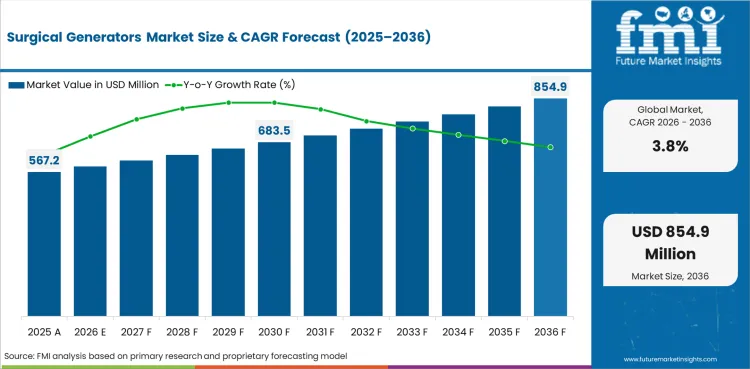
- The surgical generators market was valued at USD 567.20 million in 2025.
- By 2036, the Surgical Generators Market is expected to be worth USD 854.88 million.
- From 2026 to 2036, the market is projected to expand at a CAGR of 3.8%.
- The market is projected to create an incremental opportunity of USD 266.13 million between 2026 and 2036.
- In 2026, electrosurgical RF generators are expected to account for 39.2% of the product segment, driven by demand for versatile energy-based cutting and coagulation across multiple surgical specialties.
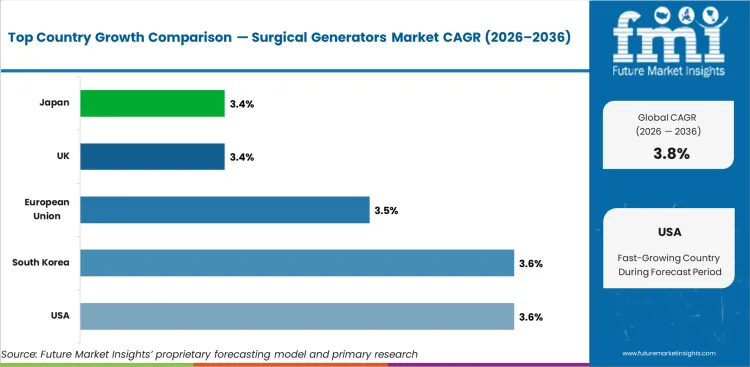
- South Korea (3.6%) and European Union (3.5%) are two of the fastest-growing markets in the world.
Surgical Generators Market Definition
The surgical generators market includes electrosurgical, electrocautery, ultrasonic, and argon plasma coagulation generator systems used to deliver controlled energy for cutting, coagulation, and tissue ablation during surgical procedures. These devices serve hospitals, ambulatory surgery centers, specialty clinics, and trauma centers across general surgery, gynecology, cardiovascular surgery, orthopedics, and urology.
Surgical Generators Market Inclusions
Market scope covers all commercially traded surgical generator products categorized by product (electrosurgical RF generators, electrocautery generators, ultrasonic generators, argon plasma coagulation generators), end user (hospitals, ambulatory surgery centers, specialty clinics, trauma centers), application (general surgery, gynecology surgery, cardiovascular surgery, orthopedic surgery, urology surgery), and deployment (standalone systems, integrated systems). Revenue coverage spans 2026 to 2036.
Surgical Generators Market Exclusions
The scope does not include laser surgical systems, radiofrequency ablation generators used exclusively for interventional cardiology or radiology, or cryosurgical systems.
Surgical Generators Market Research Methodology
- Primary Research: FMI analysts conducted interviews with hospital surgical department heads, ambulatory surgery center administrators, and OEM sales and engineering teams.
- Desk Research: Combined data from medical device regulatory filings, hospital capital equipment procurement databases, and surgical procedure volume statistics.
- Market sizing and forecasting: Bottom-up aggregation from installed base and replacement cycle data across product types, end users, and regions.
- Data validation: Cross-checked quarterly against device registration databases and manufacturer revenue disclosures.
Why is the Surgical Generators Market Growing?
- Rising global surgical volumes, driven by aging populations and increasing chronic disease burden, are sustaining demand for energy-based surgical platforms across both hospital and ambulatory settings.
- The transition from open to minimally invasive surgical approaches requires energy instruments with greater precision, and the generators that power them are being upgraded accordingly.
Surgical generator demand is shaped by the essential role these devices play in modern operating rooms. Electrosurgical RF generators remain the most widely installed product category, providing the energy platform for monopolar and bipolar cutting, coagulation, and tissue dissection across virtually all surgical specialties. Their versatility and relatively low cost of ownership make them standard equipment in hospitals of all sizes.
The ambulatory surgical center segment represents the fastest-growing end-user category. As healthcare systems shift lower-acuity procedures to outpatient settings, the demand for compact, cost-effective generators that can support a broad range of procedures is increasing. Ambulatory centers prioritize ease of use, fast setup, and compatibility with single-use energy instruments.
Technology integration is reshaping procurement decisions. Modern generators that combine multiple energy modalities in a single platform, offer real-time tissue impedance monitoring, and connect to hospital information systems are replacing older single-function units. This technology-driven replacement cycle is a key growth factor in mature markets where installed base penetration is already high.
Market Segmentation Analysis
- Electrosurgical RF generators hold 39.2% of the product segment, serving as the primary energy platform for cutting and coagulation across general surgery, gynecology, and orthopedics.
- Hospitals account for 52.7% of the end-user segment, reflecting the concentration of complex surgical procedures that require advanced multi-modality energy platforms.
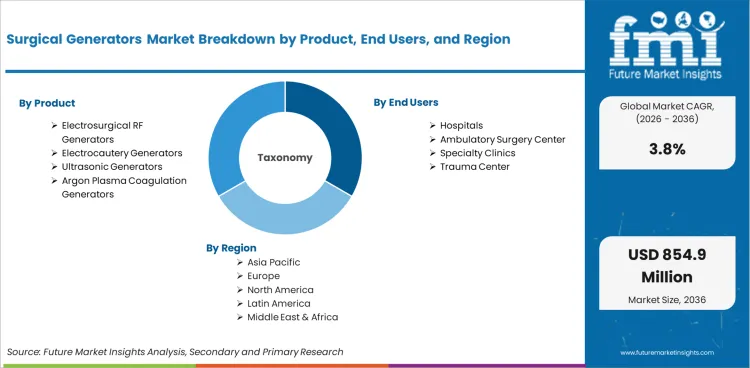
The surgical generators market is segmented by product, end user, application, and deployment. Product categories include electrosurgical RF generators, electrocautery generators, ultrasonic generators, and argon plasma coagulation generators.
Insights into the Electrosurgical RF Generators Product Segment
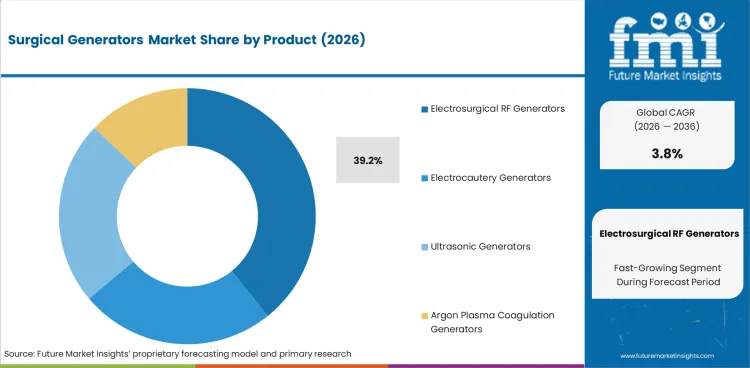
In 2026, electrosurgical RF generators are expected to account for 39.2% of the product segment. These systems deliver radiofrequency energy for monopolar and bipolar tissue effects, supporting cutting, coagulation, and desiccation functions. Their broad applicability across surgical specialties and compatibility with a wide range of instruments make them the default energy platform in most operating rooms.
Modern RF generators feature impedance monitoring, automatic power adjustment, and multiple operating modes that optimize energy delivery for different tissue types and surgical techniques. The integration of vessel sealing capabilities into RF platforms is expanding their clinical utility and reducing the need for separate energy devices.
Insights into the Hospitals End-User Segment
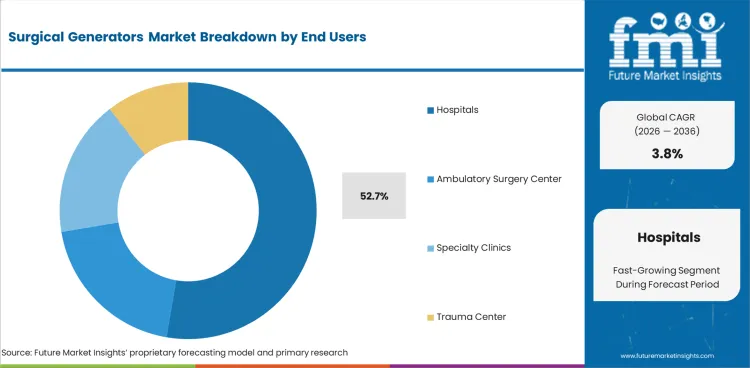
Hospitals account for 52.7% of the end-user segment in 2026. Complex surgical procedures in general surgery, cardiovascular surgery, and orthopedics require advanced generator platforms with multi-modality capabilities and high-power output. Hospital procurement is typically managed through group purchasing organizations and capital equipment budgets, with purchasing decisions influenced by clinical preference, service contracts, and instrument compatibility.
The trend toward operating room standardization, where hospitals select a single generator platform supplier for all surgical specialties, is increasing the value of each procurement decision and creating longer equipment replacement cycles.
Surgical Generators Market Drivers, Restraints, and Opportunities
- Rising surgical procedure volumes and the expansion of ambulatory surgery centers are creating sustained demand for energy-based surgical platforms.
- Capital budget constraints in hospitals and long equipment lifecycles slow replacement cycles, particularly in price-sensitive and emerging markets.
- Integration of multiple energy modalities and digital connectivity into single platforms is creating opportunities for technology-driven equipment replacement.
The surgical generators market is shaped by steady procedural demand growth, technology-driven replacement cycles, and the structural expansion of ambulatory surgical settings. While the market is mature, opportunities exist in platform modernization and geographic expansion into underserved healthcare systems.
Procedural Volume Growth
Demand is shaped by increasing surgical volumes globally, driven by aging populations, rising chronic disease burden, and expanding access to surgical care in developing healthcare systems. Each surgical procedure that uses energy-based instruments requires a functioning generator, creating a direct link between procedure volumes and equipment utilization.
Capital Budget Constraints
Adoption of new generator platforms is constrained by hospital capital equipment budgets and the long operational lifespan of existing generators. Electrosurgical generators typically remain in service for 7 to 10 years, extending replacement cycles and limiting the pace at which new technology penetrates the installed base.
Multi-Modality Platform Integration
Growth reflects the increasing demand for generator platforms that combine monopolar, bipolar, ultrasonic, and vessel sealing capabilities in a single system. These integrated platforms reduce operating room complexity, simplify training, and lower the total cost of ownership compared to maintaining multiple single-function generators.
Analysis of Surgical Generators Market By Key Countries
.webp "Top Country Growth Comparison Surgical Generators Market Cagr (2026 2036)")
| Country | CAGR |
|---|---|
| South Korea | 3.6% |
| European Union | 3.5% |
| UK | 3.4% |
| Japan | 3.4% |
- South Korea leads growth at 3.6% CAGR, supported by advanced surgical infrastructure and high adoption of minimally invasive surgical techniques.
- The European Union at 3.5% reflects sustained demand from operating room modernization programs and standardized equipment procurement.
- The UK at 3.4% and Japan at 3.4% maintain steady growth driven by NHS equipment replacement programs and Japan's aging population requiring increased surgical intervention.
The global surgical generators market is expected to grow at 3.8% CAGR from 2026 to 2036. Growth is concentrated in regions with expanding surgical infrastructure and active equipment replacement programs.
Demand Outlook for Surgical Generators Market in South Korea
South Korea is expected to grow at 3.6% through 2036, supported by its advanced hospital surgical infrastructure and high adoption of energy-based minimally invasive techniques.
- Advanced hospital infrastructure supports adoption of multi-modality generator platforms.
- High minimally invasive surgery rates drive demand for precision energy instruments.
- Medical tourism sector creates additional surgical volume supporting equipment utilization.
Future Outlook for Surgical Generators Market in the European Union
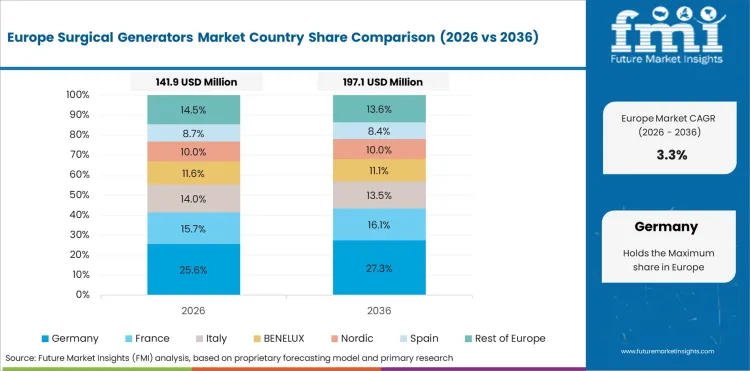
The European Union is expected to grow at 3.5% through 2036, shaped by operating room modernization programs across member states and standardized procurement through hospital purchasing groups.
- Operating room modernization programs drive periodic equipment replacement.
- Hospital purchasing group procurement standardizes platform selection across networks.
- Regulatory requirements for medical device safety ensure ongoing compliance-driven upgrades.
Opportunity Analysis of Surgical Generators Market in the United Kingdom
The UK is expected to grow at 3.4% through 2036, reflecting NHS capital equipment replacement programs and expansion of ambulatory surgical center capacity.
- NHS equipment replacement programs create structured procurement cycles.
- Ambulatory surgical center expansion drives demand for compact generator systems.
- Surgical training programs support adoption of advanced energy modality platforms.
In-depth Analysis of Surgical Generators Market in Japan
Japan is expected to grow at 3.4% through 2036, shaped by its aging population requiring increased surgical intervention and the technological sophistication of its hospital operating rooms.
- Aging population increases surgical procedure volumes across multiple specialties.
- Technologically advanced operating rooms support early adoption of integrated platforms.
- Domestic medical device manufacturers compete with established global suppliers.
Competitive Landscape and Strategic Positioning
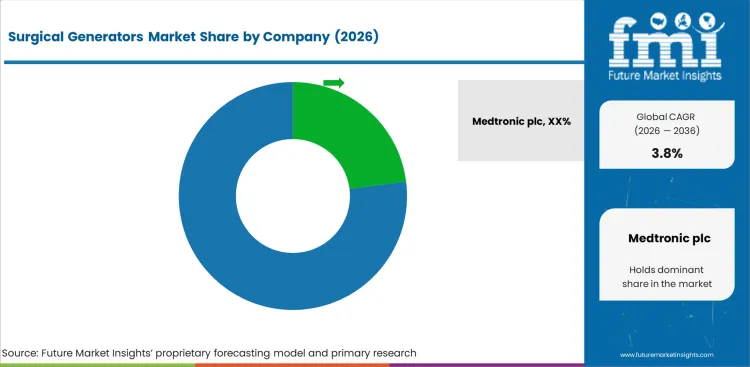
- Medtronic plc leads the market with a broad electrosurgical platform portfolio and established hospital relationships across multiple surgical specialties.
- Johnson and Johnson (Ethicon) and Olympus Corporation compete with specialized energy instruments and integrated generator systems.
- CONMED Corporation and Erbe Elektromedizin GmbH offer focused product lines targeting specific surgical applications and regional markets.
Medtronic plc holds a leading position through its broad electrosurgical generator portfolio, extensive hospital distribution network, and bundled service and consumable contracts. The company's ability to offer integrated energy solutions across surgical specialties gives it an advantage in hospital standardization decisions.
Johnson and Johnson (Ethicon) competes with its Harmonic ultrasonic platform and Enseal vessel sealing system, which integrate with Ethicon generator platforms. Olympus Corporation offers electrosurgical generators with strength in endoscopic and minimally invasive surgery applications.
CONMED Corporation targets the ambulatory surgery center market with cost-effective, compact generator systems. Erbe Elektromedizin GmbH is recognized for its argon plasma coagulation technology and electrosurgical expertise in gastroenterology and pulmonology.
Key Companies in the Surgical Generators Market
Key global companies leading the surgical generators market include:
- Medtronic plc (Ireland), Johnson and Johnson Ethicon (USA), and Olympus Corporation (Japan) are global leaders with comprehensive generator portfolios, established hospital relationships, and broad surgical specialty coverage.
- CONMED Corporation (USA), Erbe Elektromedizin GmbH (Germany), and BOWA-electronic GmbH (Germany) are regional and specialty players with focused product lines targeting specific surgical applications.
- Stryker Corporation (USA), KLS Martin Group (Germany), and Bovie Medical (USA) are expanding their energy-based surgical product portfolios through technology development and clinical partnerships.
Competitive Benchmarking: Surgical Generators Market
| Company | Product Portfolio | Hospital Access | Service Network | Geographic Reach |
|---|---|---|---|---|
| Medtronic plc | High | Strong | Strong | Global |
| J&J (Ethicon) | High | Strong | Strong | Global |
| Olympus Corporation | Medium | Strong | Moderate | Global |
| CONMED Corporation | Medium | Moderate | Moderate | N. America, Europe |
| Erbe Elektromedizin | Medium | Moderate | Moderate | Europe, Global |
| BOWA-electronic | Low | Low | Moderate | Europe |
| Stryker Corporation | Medium | Strong | Strong | Global |
| KLS Martin Group | Low | Moderate | Low | Europe |
| Bovie Medical | Low | Low | Low | N. America |
Source: Future Market Insights competitive analysis, 2026.
Key Players in the Surgical Generators Market
Major Global Players
- Medtronic plc
- Johnson and Johnson (Ethicon)
- Olympus Corporation
- CONMED Corporation
- Erbe Elektromedizin GmbH
Emerging Players/Startups
- BOWA-electronic GmbH
- Stryker Corporation
- KLS Martin Group
- Bovie Medical
Report Scope and Coverage
| Parameter | Details |
|---|---|
| Quantitative Units | USD 588.75 million to USD 854.88 million, at a CAGR of 3.8% |
| Market Definition | The surgical generators market includes energy delivery systems for electrosurgical cutting, coagulation, and tissue ablation across surgical specialties. |
| Regions Covered | North America, Latin America, Europe, East Asia, South Asia and Pacific, Middle East and Africa |
| Countries Covered | USA, UK, Germany, France, South Korea, Japan, 30 plus countries |
| Key Companies Profiled | Medtronic plc, Johnson and Johnson (Ethicon), Olympus Corporation, CONMED Corporation, Erbe Elektromedizin GmbH, BOWA-electronic GmbH, Stryker Corporation, KLS Martin Group, Bovie Medical |
| Forecast Period | 2026 to 2036 |
| Approach | Hybrid bottom-up and top-down methodology starting with verified installed base and procedure volume data. |
Market Segmentation Analysis
Surgical Generators Market Segmented by Product:
- Electrosurgical RF Generators
- Electrocautery Generators
- Ultrasonic Generators
- Argon Plasma Coagulation Generators
Surgical Generators Market Segmented by End Users:
- Hospitals
- Ambulatory Surgery Center
- Specialty Clinics
- Trauma Center
Surgical Generators Market Segmented by Application:
- General Surgery
- Gynecology Surgery
- Cardiovascular Surgery
- Orthopedic Surgery
- Urology Surgery
Surgical Generators Market Segmented by Deployment:
- Standalone Systems
- Integrated Systems
Surgical Generators Market by Region:
- North America
- USA
- Canada
- Mexico
- Latin America
- Brazil
- Chile
- Rest of Latin America
- Western Europe
- Germany
- UK
- Italy
- Spain
- France
- Nordic
- BENELUX
- Rest of Western Europe
- Eastern Europe
- Russia
- Poland
- Hungary
- Balkan & Baltic
- Rest of Eastern Europe
- East Asia
- China
- Japan
- South Korea
- South Asia and Pacific
- India
- ASEAN
- Australia & New Zealand
- Rest of South Asia and Pacific
- Middle East & Africa
- Kingdom of Saudi Arabia
- Other GCC Countries
- Turkiye
- South Africa
- Other African Union
- Rest of Middle East & Africa
Research Sources and Bibliography
- 1. World Health Organization. (2025). WHO Global Surgical Volume Estimates. WHO.
- 2. USA Food and Drug Administration. (2024). FDA Medical Device Classification: Electrosurgical Generators. FDA.
- 3. European Commission. (2024). EU Medical Device Regulation: Energy-Based Surgical Devices. EC.
- 4. Association for the Advancement of Medical Instrumentation. (2025). AAMI Electrosurgical Safety Standards. AAMI.
- 5. International Hospital Federation. (2025). IHF Global Hospital Infrastructure Report. IHF.
This bibliography is provided for reader reference.
This Report Answers
- Estimating the market size and revenue projections from 2026 to 2036.
- Segmentation by product, end user, application, and deployment.
- Regional and country-level insights across more than 30 markets.
- Technology analysis covering electrosurgical RF, electrocautery, ultrasonic, and argon plasma coagulation generators.
- Assessment of the competitive landscape.
- Identification of investment opportunities.
- Supply chain tracking.
- Delivery of data in PDF and Excel formats.
Frequently Asked Questions
What is the global market demand for Surgical Generators in 2026?
In 2026, the global surgical generators market is expected to be worth USD 588.75 million.
How big will the Surgical Generators market be in 2036?
By 2036, the surgical generators market is expected to be worth USD 854.88 million.
How much is demand expected to grow between 2026 and 2036?
Between 2026 and 2036, the surgical generators market is expected to grow at a CAGR of 3.8%.
Which product segment is likely to lead in 2026?
Electrosurgical RF generators are expected to hold 39.2% of the product segment in 2026, driven by their versatility across multiple surgical specialties.
What is driving demand in South Korea?
South Korea is expected to grow at 3.6% CAGR through 2036, supported by advanced surgical infrastructure and high adoption of minimally invasive techniques.
What is driving demand in the European Union?
The European Union is expected to grow at 3.5% CAGR through 2036, shaped by operating room modernization programs and standardized procurement.
What does this report mean by surgical generators market definition?
The surgical generators market includes energy delivery systems for electrosurgical cutting, coagulation, and tissue ablation used in hospitals, ambulatory surgery centers, and specialty clinics.
How does FMI make the Surgical Generators forecast?
Forecasting uses a hybrid bottom-up and top-down methodology, starting with verified installed base and procedure volume data.
Preview the report firsthand - request a free sample
Get SampleGet the brochure for pricing and purchase details.
Get PDFTable of Content
- Executive Summary
- Global Market Outlook
- Demand-side Trends
- Supply-side Trends
- Technology Roadmap Analysis
- Analysis and Recommendations
- Market Overview
- Market Coverage / Taxonomy
- Market Definition / Scope / Limitations
- Research Methodology
- Chapter Orientation
- Analytical Lens and Working Hypotheses
- Market Structure, Signals, and Trend Drivers
- Benchmarking and Cross-market Comparability
- Market Sizing, Forecasting, and Opportunity Mapping
- Research Design and Evidence Framework
- Desk Research Programme (Secondary Evidence)
- Company Annual and Sustainability Reports
- Peer-reviewed Journals and Academic Literature
- Corporate Websites, Product Literature, and Technical Notes
- Earnings Decks and Investor Briefings
- Statutory Filings and Regulatory Disclosures
- Technical White Papers and Standards Notes
- Trade Journals, Industry Magazines, and Analyst Briefs
- Conference Proceedings, Webinars, and Seminar Materials
- Government Statistics Portals and Public Data Releases
- Press Releases and Reputable Media Coverage
- Specialist Newsletters and Curated Briefings
- Sector Databases and Reference Repositories
- FMI Internal Proprietary Databases and Historical Market Datasets
- Subscription Datasets and Paid Sources
- Social Channels, Communities, and Digital Listening Inputs
- Additional Desk Sources
- Expert Input and Fieldwork (Primary Evidence)
- Primary Modes
- Qualitative Interviews and Expert Elicitation
- Quantitative Surveys and Structured Data Capture
- Blended Approach
- Why Primary Evidence is Used
- Field Techniques
- Interviews
- Surveys
- Focus Groups
- Observational and In-context Research
- Social and Community Interactions
- Stakeholder Universe Engaged
- C-suite Leaders
- Board Members
- Presidents and Vice Presidents
- R&D and Innovation Heads
- Technical Specialists
- Domain Subject-matter Experts
- Scientists
- Physicians and Other Healthcare Professionals
- Governance, Ethics, and Data Stewardship
- Research Ethics
- Data Integrity and Handling
- Primary Modes
- Tooling, Models, and Reference Databases
- Desk Research Programme (Secondary Evidence)
- Data Engineering and Model Build
- Data Acquisition and Ingestion
- Cleaning, Normalisation, and Verification
- Synthesis, Triangulation, and Analysis
- Quality Assurance and Audit Trail
- Market Background
- Market Dynamics
- Drivers
- Restraints
- Opportunity
- Trends
- Scenario Forecast
- Demand in Optimistic Scenario
- Demand in Likely Scenario
- Demand in Conservative Scenario
- Opportunity Map Analysis
- Product Life Cycle Analysis
- Supply Chain Analysis
- Investment Feasibility Matrix
- Value Chain Analysis
- PESTLE and Porter’s Analysis
- Regulatory Landscape
- Regional Parent Market Outlook
- Production and Consumption Statistics
- Import and Export Statistics
- Market Dynamics
- Global Market Analysis 2021 to 2025 and Forecast, 2026 to 2036
- Historical Market Size Value (USD Million) Analysis, 2021 to 2025
- Current and Future Market Size Value (USD Million) Projections, 2026 to 2036
- Y-o-Y Growth Trend Analysis
- Absolute $ Opportunity Analysis
- Global Market Pricing Analysis 2021 to 2025 and Forecast 2026 to 2036
- Global Market Analysis 2021 to 2025 and Forecast 2026 to 2036, By Product
- Introduction / Key Findings
- Historical Market Size Value (USD Million) Analysis By Product, 2021 to 2025
- Current and Future Market Size Value (USD Million) Analysis and Forecast By Product, 2026 to 2036
- Electrosurgical RF Generators
- Electrocautery Generators
- Ultrasonic Generators
- Argon Plasma Coagulation Generators
- Electrosurgical RF Generators
- Y-o-Y Growth Trend Analysis By Product, 2021 to 2025
- Absolute $ Opportunity Analysis By Product, 2026 to 2036
- Global Market Analysis 2021 to 2025 and Forecast 2026 to 2036, By End Users
- Introduction / Key Findings
- Historical Market Size Value (USD Million) Analysis By End Users, 2021 to 2025
- Current and Future Market Size Value (USD Million) Analysis and Forecast By End Users, 2026 to 2036
- Hospitals
- Ambulatory Surgery Center
- Specialty Clinics
- Trauma Center
- Hospitals
- Y-o-Y Growth Trend Analysis By End Users, 2021 to 2025
- Absolute $ Opportunity Analysis By End Users, 2026 to 2036
- Global Market Analysis 2021 to 2025 and Forecast 2026 to 2036, By Application
- Introduction / Key Findings
- Historical Market Size Value (USD Million) Analysis By Application, 2021 to 2025
- Current and Future Market Size Value (USD Million) Analysis and Forecast By Application, 2026 to 2036
- General Surgery
- Gynecology Surgery
- Cardiovascular Surgery
- Orthopedic Surgery
- Urology Surgery
- General Surgery
- Y-o-Y Growth Trend Analysis By Application, 2021 to 2025
- Absolute $ Opportunity Analysis By Application, 2026 to 2036
- Global Market Analysis 2021 to 2025 and Forecast 2026 to 2036, By Deployment
- Introduction / Key Findings
- Historical Market Size Value (USD Million) Analysis By Deployment, 2021 to 2025
- Current and Future Market Size Value (USD Million) Analysis and Forecast By Deployment, 2026 to 2036
- Standalone Systems
- Integrated Systems
- Standalone Systems
- Y-o-Y Growth Trend Analysis By Deployment, 2021 to 2025
- Absolute $ Opportunity Analysis By Deployment, 2026 to 2036
- Global Market Analysis 2021 to 2025 and Forecast 2026 to 2036, By Region
- Introduction
- Historical Market Size Value (USD Million) Analysis By Region, 2021 to 2025
- Current Market Size Value (USD Million) Analysis and Forecast By Region, 2026 to 2036
- North America
- Latin America
- Western Europe
- Eastern Europe
- East Asia
- South Asia and Pacific
- Middle East & Africa
- Market Attractiveness Analysis By Region
- North America Market Analysis 2021 to 2025 and Forecast 2026 to 2036, By Country
- Historical Market Size Value (USD Million) Trend Analysis By Market Taxonomy, 2021 to 2025
- Market Size Value (USD Million) Forecast By Market Taxonomy, 2026 to 2036
- By Country
- USA
- Canada
- Mexico
- By Product
- By End Users
- By Application
- By Deployment
- By Country
- Market Attractiveness Analysis
- By Country
- By Product
- By End Users
- By Application
- By Deployment
- Key Takeaways
- Latin America Market Analysis 2021 to 2025 and Forecast 2026 to 2036, By Country
- Historical Market Size Value (USD Million) Trend Analysis By Market Taxonomy, 2021 to 2025
- Market Size Value (USD Million) Forecast By Market Taxonomy, 2026 to 2036
- By Country
- Brazil
- Chile
- Rest of Latin America
- By Product
- By End Users
- By Application
- By Deployment
- By Country
- Market Attractiveness Analysis
- By Country
- By Product
- By End Users
- By Application
- By Deployment
- Key Takeaways
- Western Europe Market Analysis 2021 to 2025 and Forecast 2026 to 2036, By Country
- Historical Market Size Value (USD Million) Trend Analysis By Market Taxonomy, 2021 to 2025
- Market Size Value (USD Million) Forecast By Market Taxonomy, 2026 to 2036
- By Country
- Germany
- UK
- Italy
- Spain
- France
- Nordic
- BENELUX
- Rest of Western Europe
- By Product
- By End Users
- By Application
- By Deployment
- By Country
- Market Attractiveness Analysis
- By Country
- By Product
- By End Users
- By Application
- By Deployment
- Key Takeaways
- Eastern Europe Market Analysis 2021 to 2025 and Forecast 2026 to 2036, By Country
- Historical Market Size Value (USD Million) Trend Analysis By Market Taxonomy, 2021 to 2025
- Market Size Value (USD Million) Forecast By Market Taxonomy, 2026 to 2036
- By Country
- Russia
- Poland
- Hungary
- Balkan & Baltic
- Rest of Eastern Europe
- By Product
- By End Users
- By Application
- By Deployment
- By Country
- Market Attractiveness Analysis
- By Country
- By Product
- By End Users
- By Application
- By Deployment
- Key Takeaways
- East Asia Market Analysis 2021 to 2025 and Forecast 2026 to 2036, By Country
- Historical Market Size Value (USD Million) Trend Analysis By Market Taxonomy, 2021 to 2025
- Market Size Value (USD Million) Forecast By Market Taxonomy, 2026 to 2036
- By Country
- China
- Japan
- South Korea
- By Product
- By End Users
- By Application
- By Deployment
- By Country
- Market Attractiveness Analysis
- By Country
- By Product
- By End Users
- By Application
- By Deployment
- Key Takeaways
- South Asia and Pacific Market Analysis 2021 to 2025 and Forecast 2026 to 2036, By Country
- Historical Market Size Value (USD Million) Trend Analysis By Market Taxonomy, 2021 to 2025
- Market Size Value (USD Million) Forecast By Market Taxonomy, 2026 to 2036
- By Country
- India
- ASEAN
- Australia & New Zealand
- Rest of South Asia and Pacific
- By Product
- By End Users
- By Application
- By Deployment
- By Country
- Market Attractiveness Analysis
- By Country
- By Product
- By End Users
- By Application
- By Deployment
- Key Takeaways
- Middle East & Africa Market Analysis 2021 to 2025 and Forecast 2026 to 2036, By Country
- Historical Market Size Value (USD Million) Trend Analysis By Market Taxonomy, 2021 to 2025
- Market Size Value (USD Million) Forecast By Market Taxonomy, 2026 to 2036
- By Country
- Kingdom of Saudi Arabia
- Other GCC Countries
- Turkiye
- South Africa
- Other African Union
- Rest of Middle East & Africa
- By Product
- By End Users
- By Application
- By Deployment
- By Country
- Market Attractiveness Analysis
- By Country
- By Product
- By End Users
- By Application
- By Deployment
- Key Takeaways
- Key Countries Market Analysis
- USA
- Pricing Analysis
- Market Share Analysis, 2025
- By Product
- By End Users
- By Application
- By Deployment
- Canada
- Pricing Analysis
- Market Share Analysis, 2025
- By Product
- By End Users
- By Application
- By Deployment
- Mexico
- Pricing Analysis
- Market Share Analysis, 2025
- By Product
- By End Users
- By Application
- By Deployment
- Brazil
- Pricing Analysis
- Market Share Analysis, 2025
- By Product
- By End Users
- By Application
- By Deployment
- Chile
- Pricing Analysis
- Market Share Analysis, 2025
- By Product
- By End Users
- By Application
- By Deployment
- Germany
- Pricing Analysis
- Market Share Analysis, 2025
- By Product
- By End Users
- By Application
- By Deployment
- UK
- Pricing Analysis
- Market Share Analysis, 2025
- By Product
- By End Users
- By Application
- By Deployment
- Italy
- Pricing Analysis
- Market Share Analysis, 2025
- By Product
- By End Users
- By Application
- By Deployment
- Spain
- Pricing Analysis
- Market Share Analysis, 2025
- By Product
- By End Users
- By Application
- By Deployment
- France
- Pricing Analysis
- Market Share Analysis, 2025
- By Product
- By End Users
- By Application
- By Deployment
- India
- Pricing Analysis
- Market Share Analysis, 2025
- By Product
- By End Users
- By Application
- By Deployment
- ASEAN
- Pricing Analysis
- Market Share Analysis, 2025
- By Product
- By End Users
- By Application
- By Deployment
- Australia & New Zealand
- Pricing Analysis
- Market Share Analysis, 2025
- By Product
- By End Users
- By Application
- By Deployment
- China
- Pricing Analysis
- Market Share Analysis, 2025
- By Product
- By End Users
- By Application
- By Deployment
- Japan
- Pricing Analysis
- Market Share Analysis, 2025
- By Product
- By End Users
- By Application
- By Deployment
- South Korea
- Pricing Analysis
- Market Share Analysis, 2025
- By Product
- By End Users
- By Application
- By Deployment
- Russia
- Pricing Analysis
- Market Share Analysis, 2025
- By Product
- By End Users
- By Application
- By Deployment
- Poland
- Pricing Analysis
- Market Share Analysis, 2025
- By Product
- By End Users
- By Application
- By Deployment
- Hungary
- Pricing Analysis
- Market Share Analysis, 2025
- By Product
- By End Users
- By Application
- By Deployment
- Kingdom of Saudi Arabia
- Pricing Analysis
- Market Share Analysis, 2025
- By Product
- By End Users
- By Application
- By Deployment
- Turkiye
- Pricing Analysis
- Market Share Analysis, 2025
- By Product
- By End Users
- By Application
- By Deployment
- South Africa
- Pricing Analysis
- Market Share Analysis, 2025
- By Product
- By End Users
- By Application
- By Deployment
- USA
- Market Structure Analysis
- Competition Dashboard
- Competition Benchmarking
- Market Share Analysis of Top Players
- By Regional
- By Product
- By End Users
- By Application
- By Deployment
- Competition Analysis
- Competition Deep Dive
- Medtronic plc
- Overview
- Product Portfolio
- Profitability by Market Segments (Product/Age /Sales Channel/Region)
- Sales Footprint
- Strategy Overview
- Marketing Strategy
- Product Strategy
- Channel Strategy
- Johnson & Johnson (Ethicon)
- Olympus Corporation
- CONMED Corporation
- ErbeElektromedizin GmbH
- BOWA-electronic GmbH
- Stryker Corporation
- KLS Martin Group
- Bovie Medical
- Medtronic plc
- Competition Deep Dive
- Assumptions & Acronyms Used


