

- Industry Size (2026)
- USD 2.03 Bn
- Forecast (2036)
- USD 3.92 Bn
- CAGR (2026 to 2036)
- 6.8%
Surgical Sphincteroplasty Market size, market forecast and outlook by FMI
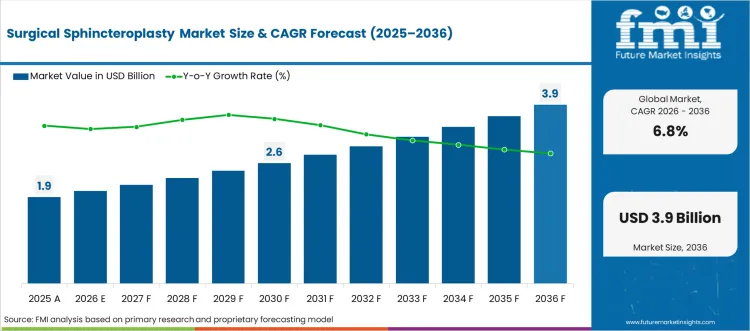
The surgical sphincteroplasty market was valued at USD 1.90 billion in 2025, projected to reach USD 2.03 billion in 2026, and is forecast to expand to USD 3.92 billion by 2036 at a 6.8% CAGR. Rising diagnosis rates of sphincter dysfunction linked to obstetric injury and age-related degeneration are expanding the treatable patient population. Gastroenterology and colorectal surgery departments are integrating sphincteroplasty into structured pelvic floor rehabilitation programs, supported by updated clinical practice guidelines that favor early surgical intervention over conservative management in moderate-to-severe cases.
Summary of Surgical Sphincteroplasty Market
- Market Snapshot
- The surgical sphincteroplasty market is valued at USD 1.90 billion in 2025 and is projected to reach USD 3.92 billion by 2036.
- The industry is expected to grow at a 6.8% CAGR from 2026 to 2036, creating an incremental opportunity of USD 1.89 billion.
- The sector functions as a procedure-driven clinical services market where diagnostic capability, surgical expertise availability, and pelvic floor care pathway integration define competitive standing.
- Demand and Growth Drivers
- Demand is expanding as improved diagnostic imaging and anorectal manometry techniques increase identification rates of treatable sphincter dysfunction.
- Clinical practice guideline updates favoring early surgical intervention for moderate-to-severe sphincter injuries are expanding the procedural addressable population.
- Growth is supported by pelvic floor care center construction in urban hospital networks that consolidate sphincteroplasty referral pathways and improve procedural throughput.
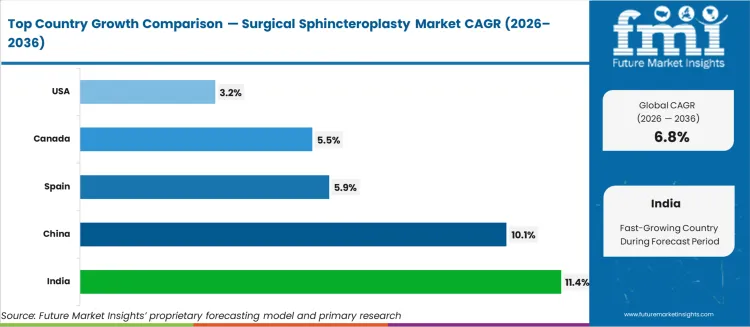
- Among key countries, India leads at 11.4% CAGR, China at 10.1%, Spain at 5.9%, Canada at 5.5%, USA at 3.2%.
- Product and Segment View
- The market encompasses surgical and non-surgical sphincteroplasty procedures performed to restore sphincter function, deployed across hospital surgical suites, ambulatory surgical centers, and specialty clinics.
- Non-surgical sphincteroplasty leads by Type with 68.7% share in 2026.
- Hospitals leads by Application in 2026.
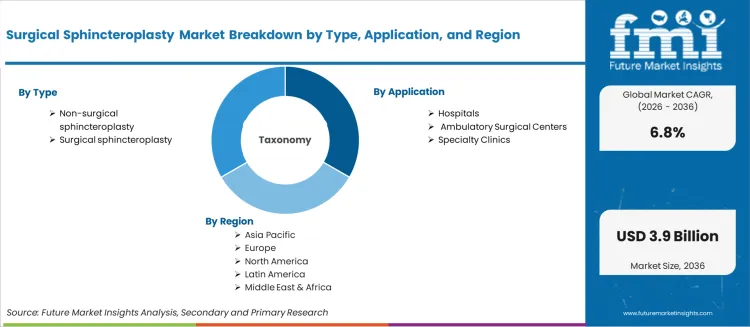
- Scope includes Type, Application segmentation with regional coverage across seven global regions.
- Geography and Competitive Outlook
- India and China are the fastest-growing markets, while North America and Europe remain mature demand bases.
- Competition is shaped by product quality, distribution reach, and regulatory compliance, with key players including Medtronic, Hill-Rom Services Inc., McKesson, B. Braun, Becton, Dickinson and Company, Novo Surgical Inc., Surgical Holdings, Pelvalon, Salix Pharmaceutical Inc., and Johnson & Johnson.
As per FMI, the surgical sphincteroplasty sector reflects a procedure-driven market where clinical adoption tracks diagnostic capability improvements rather than device technology cycles. Non-surgical sphincteroplasty approaches account for the majority of procedures as patient preference and clinical guidelines favor less invasive initial interventions. Surgical sphincteroplasty maintains a defined role in cases where non-surgical approaches fail to restore adequate sphincter function. The market is distributed across hospitals, ambulatory surgical centers, and specialty clinics, with hospital-based procedures dominating due to the complexity of surgical cases and the need for post-operative monitoring infrastructure.
Country-level growth trajectories reflect surgical specialty development and pelvic floor care infrastructure expansion. India leads at 11.4% CAGR as colorectal surgery departments in urban hospital networks expand sphincteroplasty procedure capacity. China follows at 10.1%, where hospital construction programs are adding dedicated pelvic floor surgery suites. Spain at 5.9% and Canada at 5.5% reflect established gastroenterology referral networks with steady procedural demand. USA at 3.2% maintains baseline volumes supported by high surgical specialty density and reimbursement coverage.
Surgical Sphincteroplasty Market key takeaways
| Metric | Details |
|---|---|
| Industry Size (2026) | USD 2.03 billion |
| Industry Value (2036) | USD 3.92 billion |
| CAGR (2026 to 2036) | 6.8% |
Source: Future Market Insights, 2026
Surgical Sphincteroplasty Market definition
Surgical Sphincteroplasty encompasses surgical and non-surgical procedures performed to repair or reconstruct damaged sphincter muscles, primarily addressing anal sphincter dysfunction resulting from obstetric injury, trauma, or age-related degeneration. The market covers procedural volumes and associated device utilization across hospital surgical suites, ambulatory surgical centers, and specialty pelvic floor clinics. Non-surgical approaches include biofeedback therapy and injectable bulking agents, while surgical sphincteroplasty involves direct muscle repair or reconstruction.
Surgical Sphincteroplasty Market inclusions
Market scope includes global and regional market sizes, a 2026 to 2036 forecast period, segment breakdowns by Type, Application, and regional analysis across North America, Latin America, Europe, East Asia, South Asia, Oceania, and Middle East and Africa. Pricing trend analysis and competitive positioning assessments are incorporated within the analytical framework.
Surgical Sphincteroplasty Market exclusions
The scope excludes hemorrhoidectomy, fistulotomy, and other anorectal procedures that do not involve direct sphincter muscle repair or reconstruction. Diagnostic manometry equipment and biofeedback training hardware are excluded as capital equipment categories.
Surgical Sphincteroplasty Market research methodology
- Primary Research: Analysts engaged with colorectal surgeons, pelvic floor rehabilitation specialists, and hospital procedure scheduling managers to map referral pathways and procedural volume growth drivers.
- Desk Research: Data collection aggregated clinical practice guidelines, regulatory device approval databases, hospital procedure volume registries, and medical society publications relevant to surgical instrument and consumable markets.
- Market-Sizing and Forecasting: Baseline values derive from a bottom-up aggregation of product-level revenues, applying region-specific adoption curves to project future demand velocity.
- Data Validation and Update Cycle: Projections are tested against publicly reported expenditure guidance from leading industry participants and cross-referenced with regulatory filings.
Key Industry Highlights
Increasing Adoption of Biodegradable Implants to Drive Industry Growth
The use of biodegradable implants in sphincteroplasty is propelling the surgical sphincteroplasty sector by resolving long term issues related to permanent materials. The implants provide a temporary scaffold that dissolves gradually within the body, facilitating natural tissue regeneration while reducing the risk of infection or rejection.
Biodegradable implants improve patient outcomes and satisfaction by providing appropriate support during the healing phase while eliminating the need for removal operations.
The invention offers a big step forward in sphincter restoration, attracting patients seeking safer and more dependable treatment alternatives while boosting sector growth for surgical remedies to anal incontinence.
High Cost of Modern Surgical Methods and Technology to Limit Sector Growth
A key impediment to the surgical sphincteroplasty sector is the high cost of modern surgical methods and technology. Robotic assisted surgery, 3D printing, and regenerative medicine are all innovations that greatly improve treatment results, but also come at a high cost.
The expenses can be exorbitant for many patients, particularly in areas with inadequate healthcare financing or insurance coverage. The high cost of obtaining and maintaining modern surgical equipment might be a barrier for healthcare professionals, limiting broad adoption of cutting edge sphincteroplasty procedures and ultimately inhibiting sector growth.
Growing Use of 3D Printing is an Escalating Trend in the Sector
The use of 3D printing technology in the sector is transforming patient specific therapy. 3D printing improves sphincteroplasty precision and results by allowing for the creation of personalized implants and surgical models. Surgeons can customize implants to meet the anatomy of the patient specific, resulting in improved integration and functionality.
3D printed surgical models provide extensive preoperative preparation and practice, lowering intraoperative risks and increasing accuracy. The individualized approach improves surgical success rates and patient happiness, propelling the industry ahead as more healthcare professionals embrace the cutting edge technologies.
2021 to 2025 Global Surgical Sphincteroplasty Market Outlook Compared to Demand Forecast from 2026 to 2036
Between 2021 and 2025, the global surgical sphincteroplasty sector grew steadily, owing to increased awareness and diagnosis of anal incontinence.
Advances in less invasive surgical procedures, as well as the use of robotic assisted sphincteroplasty, have greatly improved patient outcomes and recovery times. The aging global population, along with an increase in childbirth related sphincter injury, has contributed to the rising need for sphincteroplasty treatments.
Key participants engaged in research and development to improve surgical technology and create novel treatment options. Difficulties like as high pricing, limited availability to skilled surgeons, and disparities in reimbursement policies between countries have hampered the full potential of the sector.
The surgical sphincteroplasty sector is expected to grow rapidly between 2026 and 2036, owing to numerous key trends and breakthroughs.
The integration of modern technology, such as 3D printing for personalized implants and artificial intelligence driven surgical planning, is projected to transform patient specific care. The above advances are projected to minimize problems, increase success rates, and boost overall patient happiness, hence raising sector demand.
Regenerative medicine and tissue engineering are expected to play important roles in the future of sphincteroplasty. The utilization of stem cell treatments and bioengineered tissues is anticipated to attempt to successfully restore sphincter function, providing long term remedies for individuals suffering from severe anal incontinence.
The above trend toward regenerative therapies is anticipated to broaden the scope of sphincteroplasty, attracting a larger patient population.
As global healthcare systems modernize, better reimbursement policies and improved access to sophisticated surgical treatment is anticipated to drive sector expansion. Telemedicine and virtual consultations is anticipated to help improve pre and post operative treatment, making sphincteroplasty more accessible to patients in rural or underserved areas.
Market Concentration
The surgical sphincteroplasty sector is highly concentrated, with a few main firms dominating the field. In 2026, Tier 1 firms are expected to account for 57.6% of industry revenue. Tier 1 players are often key multinational enterprises with vast resources, cutting-edge technology, and a global reach.
Their leading position is due to ongoing expenditures in research and development, cutting edge surgical procedures, and strong distribution networks. Companies in the area frequently lead in innovation, providing a wide range of complex surgical treatments to meet a variety of patient demands.
Tier 2 companies, which are anticipated to account for 22.7% of the sector in 2026, are made up of smaller corporations that are competitive but lack the enormous resources of Tier 1 entities. The Tier 2 firms are often more specialized, concentrating on niche markets or certain areas of sphincteroplasty operations.
Tier 2 frequently stresses innovation and agility, introducing new items or enhancements to the sector to fill specific gaps or unmet demands. Tier 2 corporations play an important role in stimulating competition and developing innovations within the sector, despite their smaller size than Tier 1 enterprises.
The market concentration in the surgical sphincteroplasty sector exhibits a balanced dynamic, with key companies driving large scale advances and efficiency and smaller enterprises contributing to specialized improvements and competitive variety.
The above structure enables continuous growth and development, meeting a wide spectrum of patient demands while propelling the industry ahead.
Country-wise Insights
The section below covers the industry analysis for the surgical sphincteroplasty sector for different countries. Demand analysis on key countries in several regions of the globe, including North America, Asia Pacific, Europe, and others, is provided.
Canada is anticipated to remain at the forefront in North America, with a CAGR of 5.5% through 2036. In Asia Pacific, India is projected to witness a CAGR of 11.4% by 2036.
.webp "Top Country Growth Comparison Surgical Sphincteroplasty Market Cagr (2026 2036)")
| Countries | Value CAGR (2026 to 2036) |
|---|---|
| India | 11.4% |
| China | 10.1% |
| Spain | 5.9% |
| Canada | 5.5% |
| The Unite States | 3.2% |
Government Initiatives are likely to Boost Market Growth in India
India is poised to exhibit a CAGR of 11.4% throughout 2036. Supportive policies in India are considerably boosting the surgical sphincteroplasty market by encouraging better surgical procedures.
Government attempts to modernize healthcare infrastructure and provide access to high quality medical services are critical. The policies include greater financing for healthcare institutions, incentives for the use of cutting edge technologies, and advanced procedural training programs for surgeons.
The development of health insurance initiatives like Ayushman Bharat has made sphincteroplasty more economical and accessible to a larger population. The above plans encourage hospitals to use novel procedures, therefore improving patient outcomes and growing the industry.
Collaborations between the public and commercial sectors promote technical breakthroughs and ensure that cutting edge surgical choices are available even in remote locations. Supporting policies improve the quality of treatment and drive considerable growth in surgical sphincteroplasty market in India.
Patient Centered Care Fueling Demand in Spain
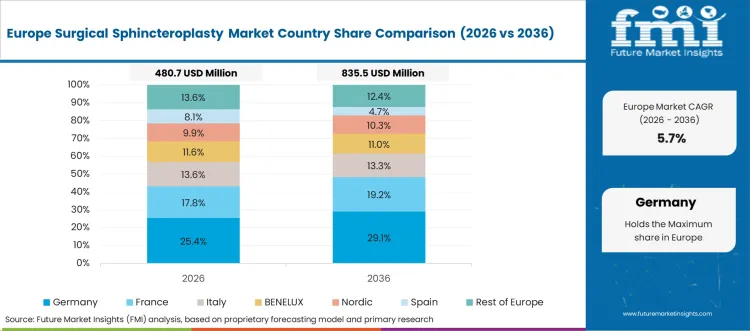
Spain is poised to exhibit a CAGR of 5.9% throughout 2036. Patient centered care is driving the surgical sphincteroplasty market in Spain. The strategy promotes individualized treatment approaches based on specific patient needs, which improves overall results and satisfaction.
The healthcare practitioners in Spain are progressively implementing patient centered techniques, which ensure that patients are actively involved in their treatment decisions.
Healthcare professionals in Spain are increasing patient trust and adherence to sphincteroplasty treatments by emphasizing extensive prior counseling and postoperative assistance. Improved communication between patients and interdisciplinary medical teams enables better management of expectations and recovery processes.
The use of new technology, such as less invasive surgical methods and specific implants, enhances individualized treatment. The advances shorten recuperation periods and increase surgical accuracy, resulting in improved success rates and patient comfort.
The emphasis on patient centered care in Spain is creating a more responsive and effective healthcare system, increasing demand and growth in the surgical sphincteroplasty industry.
Increasing Use of Surgical Robots For Sphincteroplasty Propel the Surgical Sphincteroplasty Market in the United States
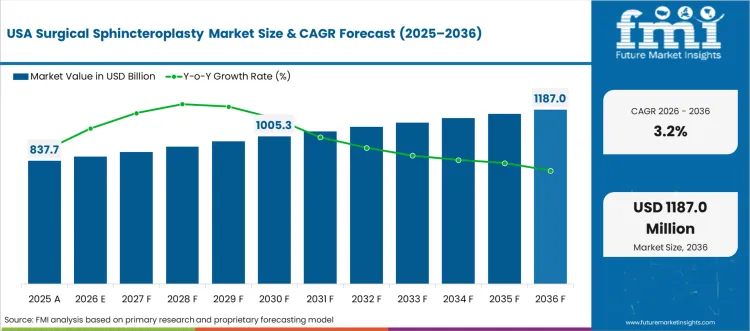
The United States is poised to exhibit a CAGR of 5.9% throughout 2036. The increased usage of surgical robots for sphincteroplasty is considerably boosting the surgical sphincteroplasty market in the United States.
Robotic assisted surgery has various advantages, including increased accuracy, less stress to surrounding tissues, and faster recovery times for patients. Surgeons can conduct difficult sphincter repairs with higher precision, resulting in better functional results and fewer post-operative problems.
In the United States, the deployment of surgical robots has been accelerated by advances in robotic technology and increasing surgeon competency with the systems. Patients benefit from less invasive treatments, which reduce discomfort and scars while speeding up healing.
As healthcare institutions engage in robotic platforms and training, robotic assisted sphincteroplasty becomes more accessible, addressing the rising need for innovative surgical methods that prioritize clinical efficacy and patient comfort.
The development highlights a significant shift toward innovation driven healthcare solutions in the treatment of anal incontinence and associated disorders.
Category-wise Insights
The section contains information about the leading segments in the industry. By type, the non surgical segment held a market share of 68.7% in 2023. The North America held a market share of 35.4% in 2023.
Non Surgical to Lead the Industry
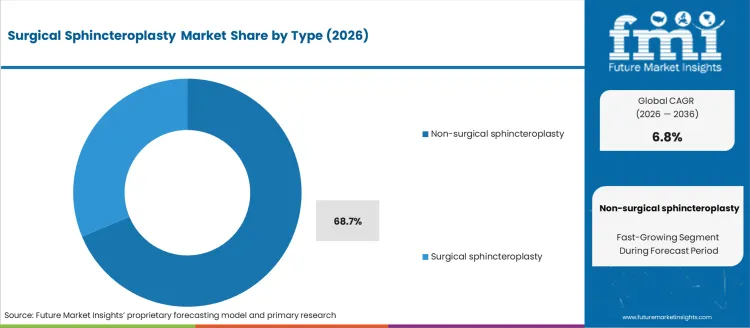
| Type | Non Surgical |
|---|---|
| Value Share (2026) | 68.7% |
The non-surgical segment accounted for 68.7% of the industry in 2026, owing to patients growing choice for non invasive therapies. Non surgical therapies, such as pelvic floor exercises, biofeedback therapy, and medication, are useful in treating mild to moderate anal incontinence without invasive procedures.
The above treatments are frequently preferred over surgical approaches because to their reduced risks, shorter recovery periods, and lower costs, appealing to a larger patient group seeking conservative yet effective options for sphincter dysfunction.
North America to Lead the Industry
| Region | North America |
|---|---|
| Value Share (2026) | 35.4% |
The North America region had a 35.4% industry share in 2026 due to a variety of factors. The growth of the segment is due to a strong healthcare infrastructure, innovative medical technology, a high incidence of anal incontinence, and advantageous reimbursement regulations.
Greater patient and healthcare provider knowledge of sphincteroplasty choices helped the area establish a strong presence. The presence of key medical device firms, as well as continuous developments in surgical procedures, boosted North America position in the surgical sphincteroplasty sector, demonstrating its leadership in adopting and improving therapies for anal sphincter dysfunction.
Competitive Landscape
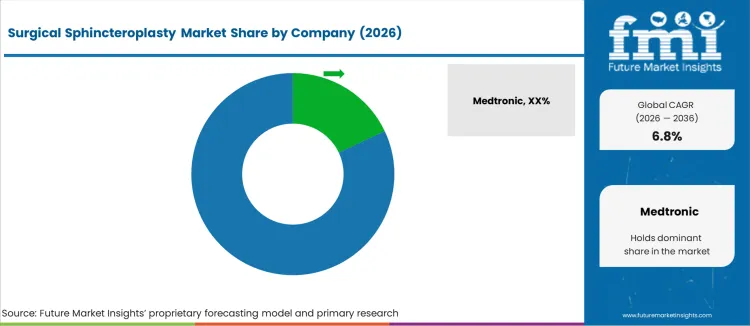
Numerous significant competitors lead the surgical sphincteroplasty sector due to their sophisticated surgical technologies and global presence. Leading corporations make significant investments in research and development to pioneer minimally invasive procedures, robotic assisted surgery, and regenerative medicine technologies.
The companies compete on product efficacy, patient results, and the capacity to provide personalized treatment alternatives. Strategic relationships with healthcare providers and a focus on growing sector reach help to sustain competitive advantage.
Emerging businesses also bring specialty technology and cost effective solutions, increasing competition and driving continual developments in sphincteroplasty treatments.
Scope of the report
| Metric | Value |
|---|---|
| Quantitative Units | USD 2.03 billion to USD 3.92 billion, at a CAGR of 6.8% |
| Market Definition | Surgical Sphincteroplasty encompasses surgical and non-surgical procedures performed to repair or reconstruct damaged sphincter muscles, primarily addressing anal sphincter dysfunction resulting from ... |
| Type Segmentation | Non-surgical sphincteroplasty, Surgical sphincteroplasty |
| Application Segmentation | Hospitals, Ambulatory Surgical Centers, Specialty Clinics |
| Regions Covered | North America, Latin America, Europe, East Asia, South Asia, Oceania, Middle East and Africa |
| Countries Covered | India, China, Spain, Canada, USA, and 40 plus countries |
| Key Companies Profiled | Medtronic, Hill-Rom Services Inc., McKesson, B. Braun, Becton, Dickinson and Company, Novo Surgical Inc., Surgical Holdings, Pelvalon, Salix Pharmaceutical Inc., and Johnson & Johnson |
| Forecast Period | 2026 to 2036 |
| Approach | Forecasting models apply a bottom-up methodology starting with global installed base metrics and projecting the conversion rate to advanced product adoption. |
Key Segments of Surgical Sphincteroplasty Industry
By Type:
By type, the industry is divided into surgical sphincteroplasty (direct apposition sphincteroplasty and overlapping sphincteroplasty), non-surgical sphincteroplasty (sacral nerve stimulation, vaginal balloon inserts and other non-surgical).
By Application:
By Application, the industry is divided into Hospitals, Ambulatory Surgical Centers (ASCs) and Specialty Clinics.
By Region:
Key countries of North America, Latin America, Western Europe, South Asia, East Asia, Eastern Europe and Middle East & Africa have been covered in the report.
Bibliography
- 1. World Health Organization. (2024). Global Health Expenditure Database. WHO.
- 2. USA Food and Drug Administration. (2024). Medical Device Databases. FDA.
- 3. European Commission. (2024). Regulation (EU) 2017/745 on Medical Devices, consolidated text. EUR-Lex.
- 4. Organisation for Economic Co-operation and Development. (2024). Health at a Glance 2024: OECD Indicators. OECD Publishing.
- 5. The World Bank. (2024). World Development Indicators: Health Systems. World Bank Group.
This bibliography is provided for reader reference. The full Future Market Insights report contains the complete reference list with primary research documentation.
Frequently Asked Questions
How large is the demand for Surgical Sphincteroplasty in the global market in 2026?
Demand for surgical sphincteroplasty in the global market is estimated to be valued at USD 2.03 billion in 2026.
What will be the market size of Surgical Sphincteroplasty in the global market by 2036?
Market size for surgical sphincteroplasty is projected to reach USD 3.92 billion by 2036.
What is the expected demand growth for Surgical Sphincteroplasty between 2026 and 2036?
Demand for surgical sphincteroplasty is expected to grow at a CAGR of 6.8% between 2026 and 2036.
Which Type is poised to lead global sales by 2026?
Non-surgical sphincteroplasty accounts for 68.7% share in 2026 as it addresses the primary demand requirements across global markets.
How significant is the role of Hospitals in driving surgical sphincteroplasty adoption in 2026?
Hospitals represents a leading share as end-user demand consolidates around established application pathways.
What is driving demand in India?
India is projected to grow at a CAGR of 11.4% during 2026 to 2036, driven by expanding infrastructure investment and regulatory modernization.
What does market forecast mean on this page?
The market forecast represents a model-based projection built on defined industry and supply chain assumptions for strategic planning purposes.
How does FMI build and validate the surgical sphincteroplasty forecast?
Forecasting models apply a bottom-up methodology starting with global installed base metrics and cross-validate projections against quarterly industry revenue volumes.
Preview the report firsthand - request a free sample
Get SampleGet the brochure for pricing and purchase details.
Get PDFTable of Content
- Executive Summary
- Global Market Outlook
- Demand-side Trends
- Supply-side Trends
- Technology Roadmap Analysis
- Analysis and Recommendations
- Market Overview
- Market Coverage / Taxonomy
- Market Definition / Scope / Limitations
- Research Methodology
- Chapter Orientation
- Analytical Lens and Working Hypotheses
- Market Structure, Signals, and Trend Drivers
- Company Annual and Sustainability Reports
- Peer-reviewed Journals and Academic Literature
- Corporate Websites, Product Literature, and Technical Notes
- Earnings Decks and Investor Briefings
- Statutory Filings and Regulatory Disclosures
- Technical White Papers and Standards Notes
- Trade Journals, Industry Magazines, and Analyst Briefs
- Conference Proceedings, Webinars, and Seminar Materials
- Government Statistics Portals and Public Data Releases
- Press Releases and Reputable Media Coverage
- Specialist Newsletters and Curated Briefings
- Sector Databases and Reference Repositories
- FMI Internal Proprietary Databases and Historical Market Datasets
- Subscription Datasets and Paid Sources
- Social Channels, Communities, and Digital Listening Inputs
- Additional Desk Sources
- Expert Input and Fieldwork (Primary Evidence)
- Primary Modes
- Qualitative Interviews and Expert Elicitation
- Quantitative Surveys and Structured Data Capture
- Blended Approach
- Why Primary Evidence is Used
- Field Techniques
- Interviews
- Surveys
- Focus Groups
- Observational and In-context Research
- Social and Community Interactions
- Stakeholder Universe Engaged
- C-suite Leaders
- Board Members
- Presidents and Vice Presidents
- R&D and Innovation Heads
- Technical Specialists
- Domain Subject-matter Experts
- Scientists
- Physicians and Other Healthcare Professionals
- Governance, Ethics, and Data Stewardship
- Research Ethics
- Data Integrity and Handling
- Primary Modes
- Tooling, Models, and Reference Databases
- Data Engineering and Model Build
- Data Acquisition and Ingestion
- Cleaning, Normalisation, and Verification
- Synthesis, Triangulation, and Analysis
- Quality Assurance and Audit Trail
- Market Background
- Market Dynamics
- Drivers
- Restraints
- Opportunity
- Trends
- Scenario Forecast
- Demand in Optimistic Scenario
- Demand in Likely Scenario
- Demand in Conservative Scenario
- Opportunity Map Analysis
- Product Life Cycle Analysis
- Supply Chain Analysis
- Investment Feasibility Matrix
- Value Chain Analysis
- PESTLE and Porter’s Analysis
- Regulatory Landscape
- Regional Parent Market Outlook
- Production and Consumption Statistics
- Import and Export Statistics
- Market Dynamics
- Global Market Analysis 2021 to 2025 and Forecast, 2026 to 2036
- Historical Market Size Value (USD Million) Analysis, 2021 to 2025
- Current and Future Market Size Value (USD Million) Projections, 2026 to 2036
- Y-o-Y Growth Trend Analysis
- Absolute $ Opportunity Analysis
- Global Market Pricing Analysis 2021 to 2025 and Forecast 2026 to 2036
- Global Market Analysis 2021 to 2025 and Forecast 2026 to 2036, By Type
- Introduction / Key Findings
- Historical Market Size Value (USD Million) Analysis By Type , 2021 to 2025
- Current and Future Market Size Value (USD Million) Analysis and Forecast By Type , 2026 to 2036
- Non-surgical sphincteroplasty
- Surgical sphincteroplasty
- Non-surgical sphincteroplasty
- Y-o-Y Growth Trend Analysis By Type , 2021 to 2025
- Absolute $ Opportunity Analysis By Type , 2026 to 2036
- Global Market Analysis 2021 to 2025 and Forecast 2026 to 2036, By Application
- Introduction / Key Findings
- Historical Market Size Value (USD Million) Analysis By Application, 2021 to 2025
- Current and Future Market Size Value (USD Million) Analysis and Forecast By Application, 2026 to 2036
- Hospitals
- Ambulatory Surgical Centers
- Specialty Clinics
- Hospitals
- Y-o-Y Growth Trend Analysis By Application, 2021 to 2025
- Absolute $ Opportunity Analysis By Application, 2026 to 2036
- Global Market Analysis 2021 to 2025 and Forecast 2026 to 2036, By Region
- Introduction
- Historical Market Size Value (USD Million) Analysis By Region, 2021 to 2025
- Current Market Size Value (USD Million) Analysis and Forecast By Region, 2026 to 2036
- North America
- Latin America
- Western Europe
- Eastern Europe
- East Asia
- South Asia and Pacific
- Middle East & Africa
- Market Attractiveness Analysis By Region
- North America Market Analysis 2021 to 2025 and Forecast 2026 to 2036, By Country
- Historical Market Size Value (USD Million) Trend Analysis By Market Taxonomy, 2021 to 2025
- Market Size Value (USD Million) Forecast By Market Taxonomy, 2026 to 2036
- By Country
- USA
- Canada
- Mexico
- By Type
- By Application
- By Country
- Market Attractiveness Analysis
- By Country
- By Type
- By Application
- Key Takeaways
- Latin America Market Analysis 2021 to 2025 and Forecast 2026 to 2036, By Country
- Historical Market Size Value (USD Million) Trend Analysis By Market Taxonomy, 2021 to 2025
- Market Size Value (USD Million) Forecast By Market Taxonomy, 2026 to 2036
- By Country
- Brazil
- Chile
- Rest of Latin America
- By Type
- By Application
- By Country
- Market Attractiveness Analysis
- By Country
- By Type
- By Application
- Key Takeaways
- Western Europe Market Analysis 2021 to 2025 and Forecast 2026 to 2036, By Country
- Historical Market Size Value (USD Million) Trend Analysis By Market Taxonomy, 2021 to 2025
- Market Size Value (USD Million) Forecast By Market Taxonomy, 2026 to 2036
- By Country
- Germany
- UK
- Italy
- Spain
- France
- Nordic
- BENELUX
- Rest of Western Europe
- By Type
- By Application
- By Country
- Market Attractiveness Analysis
- By Country
- By Type
- By Application
- Key Takeaways
- Eastern Europe Market Analysis 2021 to 2025 and Forecast 2026 to 2036, By Country
- Historical Market Size Value (USD Million) Trend Analysis By Market Taxonomy, 2021 to 2025
- Market Size Value (USD Million) Forecast By Market Taxonomy, 2026 to 2036
- By Country
- Russia
- Poland
- Hungary
- Balkan & Baltic
- Rest of Eastern Europe
- By Type
- By Application
- By Country
- Market Attractiveness Analysis
- By Country
- By Type
- By Application
- Key Takeaways
- East Asia Market Analysis 2021 to 2025 and Forecast 2026 to 2036, By Country
- Historical Market Size Value (USD Million) Trend Analysis By Market Taxonomy, 2021 to 2025
- Market Size Value (USD Million) Forecast By Market Taxonomy, 2026 to 2036
- By Country
- China
- Japan
- South Korea
- By Type
- By Application
- By Country
- Market Attractiveness Analysis
- By Country
- By Type
- By Application
- Key Takeaways
- South Asia and Pacific Market Analysis 2021 to 2025 and Forecast 2026 to 2036, By Country
- Historical Market Size Value (USD Million) Trend Analysis By Market Taxonomy, 2021 to 2025
- Market Size Value (USD Million) Forecast By Market Taxonomy, 2026 to 2036
- By Country
- India
- ASEAN
- Australia & New Zealand
- Rest of South Asia and Pacific
- By Type
- By Application
- By Country
- Market Attractiveness Analysis
- By Country
- By Type
- By Application
- Key Takeaways
- Middle East & Africa Market Analysis 2021 to 2025 and Forecast 2026 to 2036, By Country
- Historical Market Size Value (USD Million) Trend Analysis By Market Taxonomy, 2021 to 2025
- Market Size Value (USD Million) Forecast By Market Taxonomy, 2026 to 2036
- By Country
- Kingdom of Saudi Arabia
- Other GCC Countries
- Turkiye
- South Africa
- Other African Union
- Rest of Middle East & Africa
- By Type
- By Application
- By Country
- Market Attractiveness Analysis
- By Country
- By Type
- By Application
- Key Takeaways
- Key Countries Market Analysis
- USA
- Pricing Analysis
- Market Share Analysis, 2025
- By Type
- By Application
- Canada
- Pricing Analysis
- Market Share Analysis, 2025
- By Type
- By Application
- Mexico
- Pricing Analysis
- Market Share Analysis, 2025
- By Type
- By Application
- Brazil
- Pricing Analysis
- Market Share Analysis, 2025
- By Type
- By Application
- Chile
- Pricing Analysis
- Market Share Analysis, 2025
- By Type
- By Application
- Germany
- Pricing Analysis
- Market Share Analysis, 2025
- By Type
- By Application
- UK
- Pricing Analysis
- Market Share Analysis, 2025
- By Type
- By Application
- Italy
- Pricing Analysis
- Market Share Analysis, 2025
- By Type
- By Application
- Spain
- Pricing Analysis
- Market Share Analysis, 2025
- By Type
- By Application
- France
- Pricing Analysis
- Market Share Analysis, 2025
- By Type
- By Application
- India
- Pricing Analysis
- Market Share Analysis, 2025
- By Type
- By Application
- ASEAN
- Pricing Analysis
- Market Share Analysis, 2025
- By Type
- By Application
- Australia & New Zealand
- Pricing Analysis
- Market Share Analysis, 2025
- By Type
- By Application
- China
- Pricing Analysis
- Market Share Analysis, 2025
- By Type
- By Application
- Japan
- Pricing Analysis
- Market Share Analysis, 2025
- By Type
- By Application
- South Korea
- Pricing Analysis
- Market Share Analysis, 2025
- By Type
- By Application
- Russia
- Pricing Analysis
- Market Share Analysis, 2025
- By Type
- By Application
- Poland
- Pricing Analysis
- Market Share Analysis, 2025
- By Type
- By Application
- Hungary
- Pricing Analysis
- Market Share Analysis, 2025
- By Type
- By Application
- Kingdom of Saudi Arabia
- Pricing Analysis
- Market Share Analysis, 2025
- By Type
- By Application
- Turkiye
- Pricing Analysis
- Market Share Analysis, 2025
- By Type
- By Application
- South Africa
- Pricing Analysis
- Market Share Analysis, 2025
- By Type
- By Application
- USA
- Market Structure Analysis
- Competition Dashboard
- Competition Benchmarking
- Market Share Analysis of Top Players
- By Regional
- By Type
- By Application
- Competition Analysis
- Competition Deep Dive
- Medtronic
- Overview
- Product Portfolio
- Profitability by Market Segments (Product/Age /Sales Channel/Region)
- Sales Footprint
- Strategy Overview
- Marketing Strategy
- Product Strategy
- Channel Strategy
- Hill-Rom Services Inc.
- McKesson
- B. Braun
- Becton, Dickinson and Company
- Novo Surgical Inc.
- Surgical Holdings
- Pelvalon
- Salix Pharmaceutical Inc.
- Johnson & Johnson
- Medtronic
- Competition Deep Dive
- Assumptions & Acronyms Used


