

- Market Size (2026)
- USD 168.4 Bn
- Forecast (2036)
- USD 527.7 Bn
- CAGR (2026 to 2036)
- 12.1%
How big is the Healthcare Mobility Solutions Market in 2026?
USD 168.4 billion in 2026 and USD 527.7 billion by 2036 at a 12.1% CAGR.
Demand for healthcare mobility solutions is projected to expand at a 12.1% CAGR between 2026 and 2036, increasing valuation from USD 168.4 billion in 2026 to USD 527.7 billion by 2036. Health systems adopt mobility as governance connects endpoints with patient records, identity controls and staff responsibilities across care settings. WHO reported in May 2025 that 129 countries had established national digital health strategies, giving providers a policy basis for coordinated applications, security and workforce training.
Country divergence depends on the route patients and clinicians use to enter national digital services. England directs many transactions through the NHS App, whereas United States providers manage separate portals and electronic health record interfaces. NHS England Digital recorded 13.4 million distinct NHS App users during September 2025 across England. That usage scale makes mobile record and prescription access an operating channel requiring dependable identity, integration and support.
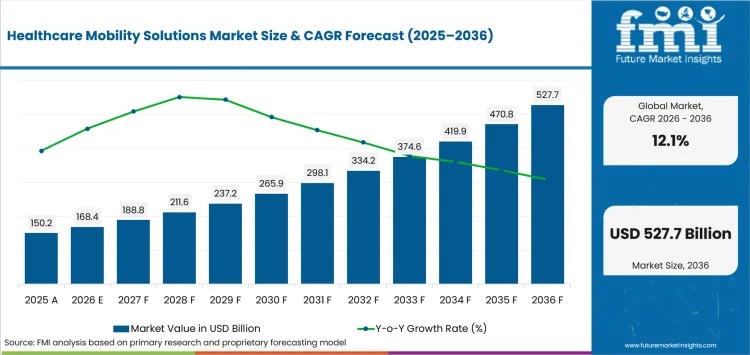
Key Takeaways of Healthcare Mobility Solutions Market
- Health systems expand mobility to preserve records, alerts and task ownership as care shifts between facilities and patients’ homes.
- Mobile devices are projected to lead the component category with 43.0% share in 2026, supported by frequent bedside documentation and communication.
- Cloud-based solutions are forecast to capture 59.0% of deployment in 2026, owing to centralized application delivery across distributed facilities.
- Healthcare providers are estimated to represent 46.0% of end-user demand in 2026, driven by concentrated clinical work across hospitals and ambulatory sites.
- Endpoint security and integration work can delay deployment as applications must fit established identity, network and clinical-system controls.
- The competitive set includes Oracle Health, Microsoft Corporation, Koninklijke Philips N.V., Zebra Technologies Corporation, AirStrip Technologies, Imprivata, Stryker Corporation and Ascom Holding AG.
Analyst Perspective
“Healthcare mobility should be judged at the handoff between a clinician, a shared device and the patient record. Platforms earn repeat contracts as offline work, alert ownership and fleet replacement remain controlled across every provider site.”
- Anurag Sharma, Principal Consultant, Future Market Insights
How is the Healthcare Mobility Solutions Market segmented?
The Healthcare Mobility Solutions Market is segmented by component, application, deployment, end user, technology and region.
Market taxonomy covers component, application, deployment, end user, technology and region across the commercial analysis. Components include mobile devices, mobile applications, enterprise mobility software and services used across healthcare organizations. Applications cover enterprise mobility, patient care management, mobile health and asset or workforce management across care settings. Deployment includes cloud-based, on-premise and hybrid models for providers, payers, patients and home healthcare, while technology covers device management and wireless communications.
How does Mobile Device use shape demand within the Component category?
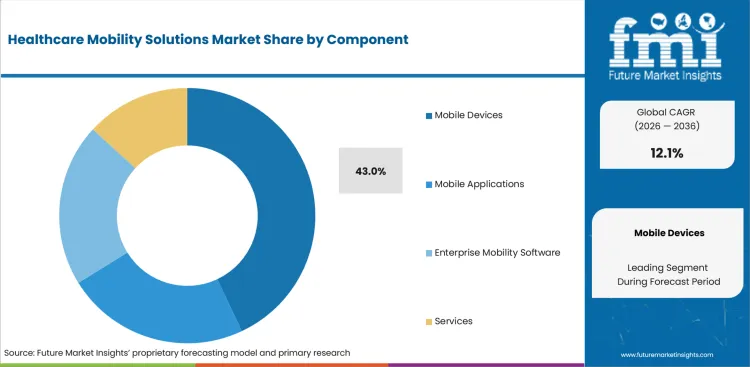
Mobile devices carry records, alerts and secure communication to the bedside as clinicians cross departments. Hospitals treat them as shared clinical mobility equipment because cleaning cycles and wireless handoffs determine whether staff can complete work without returning to fixed stations.
- Based on component, mobile devices are projected to account for 43.0% in 2026 due to frequent bedside documentation and communication.
- Healthcare IT teams coordinate mobile device management with checkout rules and battery replacement across shared fleets. Reliable return controls preserve application access during shift changes and reduce time locating charged endpoints across inpatient and ambulatory departments.
What makes Enterprise Mobility central to the Application category?
Enterprise mobility connects messages, assignments and patient context across clinical and administrative teams during each care episode. Clinical communication platforms retain alert ownership without forcing staff to reopen separate applications during complex transfers and discharge coordination.
- By application, enterprise mobility is estimated to hold 34.0% in 2026 owing to coordinated records and assignments across departments.
- Hospital teams evaluate mobile health solutions by permission rules, escalation logic and response ownership for each workflow. Monitoring alerts and staffing tasks carry different clinical responsibilities, so patient-care and workforce applications require separate configurations during routine operations and follow-up care.
How do Health systems evaluate Cloud-based deployment?
Cloud deployment centralizes daily application distribution, updates and identity policies across hospitals and ambulatory facilities. Healthcare cloud infrastructure must separate tenant access from clinical data while preserving local performance for imaging and documentation during network disruption.
- In 2026, cloud-based solutions are expected to lead deployment with 59.0% share because centralized controls serve distributed endpoint fleets.
- Controlled healthcare APIs connect cloud applications with records and payer systems across approved clinical interfaces. Hybrid designs remain necessary for workloads that require local response limits plus tested recovery, which makes network architecture and failover evidence central to platform qualification.
What supports provider demand within the end-user category?
Healthcare providers operate the largest concentration of mobile clinical work across hospitals and ambulatory facilities. Remote patient monitoring extends provider responsibility into homes as incoming data requires assigned review, escalation and documentation instead of passive collection.
- The end-user category is forecast to be led by healthcare providers at 46.0% share in 2026 due to concentrated clinical mobility.
- Telehealth and telemedicine services extend follow-up care across regions with uneven connectivity, requiring identity checks plus escalation routes and reliable offline documentation. Service contracts combine workflow configuration, regional technical support and staff training with application licensing across community care programs.
What are the drivers, restraints and opportunities in the Healthcare Mobility Solutions Market?
Interoperability requirements place authorized records inside mobile workflows, shared endpoints increase identity administration and offline synchronization extends governed care beyond facility networks.
- Driver: Interoperability requirements place authorized records inside mobile clinical tasks, prior-authorization workflows and payer operations.
- Restraint: Shared endpoints increase identity administration, inventory control and integration work across rotating clinical teams and provider sites.
- Opportunity: Offline synchronization extends governed mobile workflows into home visits and rural care routes with limited connectivity.
Interoperability rules make mobile access part of routine workflow
CMS finalized CMS-0057-F in January 2024 with most API compliance dates starting in 2027 for affected payers. The rule turns mobile access into an operating requirement because digital healthcare platforms must preserve authorization status, consent and task ownership across payer and provider workflows.
Shared endpoints increase identity and inventory work
HHS proposed stronger HIPAA Security Rule requirements in December 2024 for regulated electronic health information. Shared-device programs therefore require documented ownership, device inventories, access policies and lost-device controls for fleet expansion across departments and affiliated sites under multisite support agreements at scale.
Offline synchronization extends governed care beyond facilities
Home visits and rural services continue across unstable networks that interrupt access to central clinical systems. Application providers can earn recurring implementation and support revenue by proving that offline records synchronize securely without overwriting another clinician’s completed work across distributed community care programs.
Which country CAGRs are profiled in the Healthcare Mobility Solutions Market?
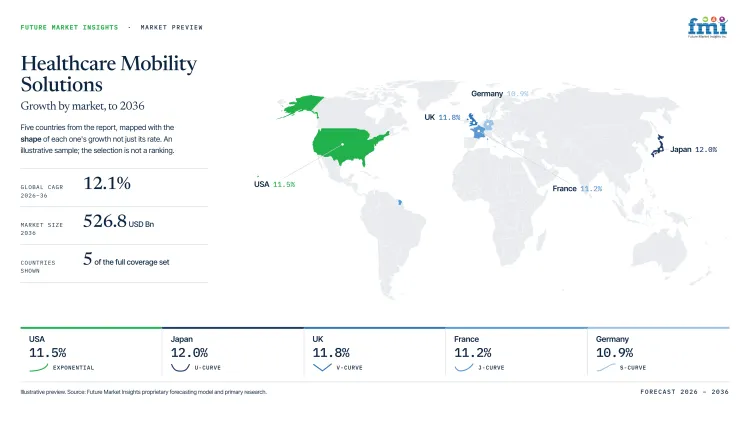
| Country | CAGR |
|---|---|
| Japan | 12.0% |
| United Kingdom | 11.8% |
| United States | 11.5% |
| France | 11.2% |
| Germany | 10.9% |
How do country-level CAGRs compare in the Healthcare Mobility Solutions Market?
The country forecasts span 1.1 percentage points from Japan to Germany. Similar rates do not establish equal current revenue given differences in patient channels, identity systems and integration routes.
- Japan’s pace reflects e-prescription integration and insurance verification, although uneven facility adoption raises implementation support requirements.
- The United Kingdom benefits from one patient channel, but clinical integration and alternatives remain necessary.
- United States growth follows broad hospital API availability, whereas proprietary electronic health record configurations preserve substantial interface testing.
- France uses a record and application route, although security reviews and patient-control requirements lengthen qualification.
- Germany combines broad electronic patient-record access with defined telematics interfaces that increase certification and site-validation work.
Comparable CAGRs can produce different market entry conditions.
The full report provides country-level CAGR analysis across North America, Latin America, Europe, East Asia, South Asia and Pacific, and the Middle East and Africa.
Country-wise Analysis
- Japan is projected to expand at a 12.0% CAGR through 2036 because healthcare mobility functions are increasingly tied to national digital health infrastructure. Electronic prescriptions, insurance verification, and medication records already move through standardized exchange channels. MHLW reported 47,681 facilities participating in the electronic prescription network in January 2025. The scale of participation supports deployment opportunities across hospitals and pharmacies. Uneven adoption between provider types still creates additional integration and support work.
- The United Kingdom is forecast to grow at an 11.8% CAGR through 2036 as patient-facing digital access becomes concentrated within a single national platform. The NHS App acts as a common entry point for appointments, prescriptions, records, and consultations. NHS England reported more than 39 million registered users in December 2025. One widely used channel simplifies deployment across large portions of the health system. Local integration quality nevertheless influences implementation timelines.
- The United States is expected to record an 11.5% CAGR during the assessment period because patient access capabilities are already embedded across much of the provider ecosystem. Mobile record access is available through hospital and health-system digital platforms nationwide. ASTP reported that approximately nine in ten hospitals enabled API-based patient access during 2024. Broad availability creates opportunities for mobility vendors to expand functionality rather than establish basic connectivity. Variation among EHR platforms continues to increase testing and validation requirements.
- France is anticipated to advance at an 11.2% CAGR through 2036 due to the expansion of nationally coordinated digital health services. Mon espace santé provides a common framework for records access and approved health applications. Assurance Maladie reported more than 2.5 million monthly users in January 2025. The platform creates a predictable route for patient engagement solutions. Security and qualification reviews can slow implementation schedules.
- Germany is estimated to post a 10.9% CAGR over the forecast period because healthcare mobility applications operate within a highly standardized digital environment. National infrastructure supports medication review and clinical document exchange across providers. Gematik reported 70 million electronic patient records and participation from more than 110,000 facilities in September 2025. Standardized interfaces simplify interoperability across care settings. Certification and deployment validation remain necessary before full rollout.
Who are the notable companies in the Healthcare Mobility Solutions Market?
Oracle Health, Microsoft Corporation, Koninklijke Philips N.V., Zebra Technologies Corporation, AirStrip Technologies, Imprivata, Stryker Corporation and Ascom Holding AG serve the Healthcare Mobility Solutions Market.
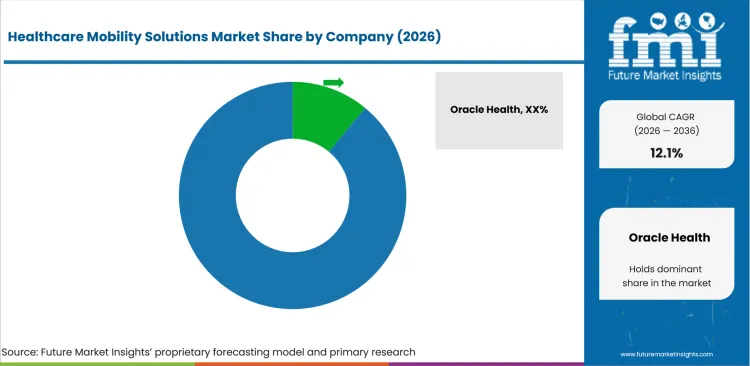
Healthcare mobility contracts rarely go to one company across multisite provider networks with established systems. Providers combine record platforms with identity and device specialists during enterprise mobility selection based on integration evidence. Entry depends on fitting existing record, network and security standards without disrupting alert ownership or clinical documentation.
- Oracle Health and Microsoft Corporation connect clinical records with cloud services and mobile documentation across provider organizations.
- Koninklijke Philips N.V. and AirStrip Technologies connect patient-monitoring information with mobile surveillance and clinical decision workflows.
- Zebra Technologies Corporation and Stryker Corporation provide frontline endpoints, whereas Imprivata and Ascom Holding AG concentrate on secure access and clinical communication across shared fleets.
Competitive Benchmarking: Healthcare Mobility Solutions Market
| Company | Clinical Workflow Mobility | Endpoint and Identity Control | Interoperability and Cloud | Geographic Reach |
|---|---|---|---|---|
| Oracle Health | High | Medium | High | Global |
| Microsoft Corporation | Medium | Medium | High | Global |
| Koninklijke Philips N.V. | Medium | Medium | Medium | Global |
| Zebra Technologies Corporation | Medium | High | Medium | Global |
| AirStrip Technologies | High | Medium | High | United States |
| Imprivata | Medium | High | High | International |
| Stryker Corporation | High | Medium | High | Global |
| Ascom Holding AG | High | Medium | High | Europe, North America and Asia-Pacific |
Scoring basis compares clinical workflow coverage, endpoint administration and multi-environment exchange across every company row. High requires broad verified coverage, Medium reflects selected capabilities and Low identifies one narrow documented route. Low never represents missing evidence, while geographic reach records operating regions without changing capability scores.
Key Developments in the Healthcare Mobility Solutions Market
- In June 2025, Oracle announced general availability of Oracle Health Community Care as a cloud-based mobile extension of its electronic health record. Clinicians can document home and field visits during limited connectivity, then synchronize updates once network access returns.
- In June 2025, AirStrip Technologies acquired Fifth Eye and added the FDA-cleared AHI System to its clinical surveillance platform. Near-real-time ECG analysis identifies hemodynamic instability, extending AirStrip’s coverage beyond visual monitoring into regulated predictive analytics for hospital teams.
- In March 2025, Microsoft introduced Dragon Copilot, a unified voice assistant for clinical documentation and workflow tasks. The solution subsequently became generally available in select healthcare markets, including the United States and Canada.
Key Players in the Healthcare Mobility Solutions Market
Clinical Information and Cloud Platforms
- Oracle Health
- Microsoft Corporation
Monitoring and Clinical Mobility Specialists
- Koninklijke Philips N.V.
- AirStrip Technologies
Frontline Communication and Access Providers
- Zebra Technologies Corporation
- Imprivata
- Stryker Corporation
- Ascom Holding AG
Healthcare Mobility Solutions Market - Report Scope
| Coverage field | Report scope |
|---|---|
| Market breakdown | By component, application, deployment, end user, technology and region. |
| Quantitative Units | USD Billion. |
| Market Definition | Mobile devices, applications, enterprise mobility software, services and related technologies that support clinical, administrative, patient and field workflows across healthcare. |
| Regions Covered | North America, Latin America, Western Europe, Eastern Europe, East Asia, South Asia and Pacific and Middle East and Africa. |
| Countries Covered | United States, Japan, Germany, United Kingdom, France and 20+ countries included in the full report. |
| Key Companies Profiled | Oracle Health, Microsoft Corporation, Koninklijke Philips N.V., Zebra Technologies Corporation, AirStrip Technologies, Imprivata, Stryker Corporation and Ascom Holding AG. |
| Forecast Period | 2026 to 2036. |
| Approach | Primary and secondary research with market triangulation. |
Healthcare Mobility Solutions Market - Research Methodology
| Method | Approach |
|---|---|
| Primary Research | FMI analysts gathered input from manufacturers, service providers, technology developers, distributors, end users, procurement teams, and subject-matter experts. Interviews examined purchasing decisions, product or service evaluation, adoption barriers, approval requirements, pricing considerations, and expectations for technical or commercial support. Respondents were also asked what evidence is required before a trial, pilot, or initial order develops into regular purchasing. |
| Desk Research | Desk research covered government statistics, regulatory publications, trade data, industry associations, technical literature, standards, company filings, product information, and official corporate announcements. Sources were reviewed for relevance, publication date, geographic coverage, and consistency with the defined market scope. Claims relating to performance, applications, approvals, capacity, investment, and commercial activity were retained only when supported by credible public evidence. |
| Market Sizing and Forecasting | The market model combined the baseline value with historical performance, segment structure, pricing and volume indicators, adoption levels, company participation, and country-level demand conditions. Forecast assumptions considered economic activity, investment trends, regulatory developments, technology adoption, purchasing cycles, supply availability, and barriers to wider market use. Segment and regional estimates were reconciled before the final market total was calculated. |
| Data Validation | Estimates were checked against multiple independent indicators, including public data, company activity, trade patterns, industry developments, and findings from primary interviews. Validation also tested whether products, services, applications, and company revenues fell within the defined market boundaries. Adjacent categories, unsupported claims, overlapping revenues, and activities without direct market relevance were excluded to reduce double counting and maintain consistency across segments and countries. |
Healthcare Mobility Solutions Market by Segments
Healthcare Mobility Solutions Market segmented by Component:
- Mobile Devices
- Smartphones
- Tablets
- Rugged Healthcare Devices
- Mobile Applications
- Clinical Applications
- Patient Engagement Applications
- Remote Monitoring Applications
- Enterprise Mobility Software
- Mobile Device Management
- Mobile Application Management
- Enterprise Mobility Management
- Services
- Implementation Services
- Managed Mobility Services
- Support & Maintenance Services
Healthcare Mobility Solutions Market segmented by Application:
- Enterprise Mobility
- Clinical Workflow Management
- Hospital Communication
- Care Coordination
- Patient Care Management
- Remote Patient Monitoring
- Chronic Disease Management
- Home Healthcare
- Mobile Health
- Telemedicine
- Mobile Electronic Health Records
- Health & Wellness Applications
- Asset & Workforce Management
- Real-time Asset Tracking
- Mobile Workforce Scheduling
- Inventory Management
Healthcare Mobility Solutions Market segmented by Deployment:
- Cloud-based Solutions
- Public Cloud
- Private Cloud
- Hybrid Cloud
- On-premise Solutions
- Hospital Data Centers
- Local Healthcare Networks
- Private Infrastructure
- Hybrid Deployment
- Multi-cloud Platforms
- Edge-enabled Healthcare
- Containerized Applications
Healthcare Mobility Solutions Market segmented by End User:
- Healthcare Providers
- Hospitals
- Physician Practices
- Ambulatory Care Centers
- Healthcare Payers
- Health Insurance Companies
- Third-party Administrators
- Government Healthcare Agencies
- Patients & Home Healthcare
- Home Care Providers
- Individual Patients
- Long-term Care Facilities
Healthcare Mobility Solutions Market segmented by Technology:
- Mobile Device Management
- Device Security
- Device Provisioning
- Remote Device Monitoring
- Enterprise Mobility Management
- Identity & Access Management
- Application Management
- Content Management
- Wireless Communication Technologies
- Wi-Fi
- Bluetooth Low Energy
- 5G Connectivity
Healthcare Mobility Solutions Market by Region:
- North America
- United States
- Canada
- Mexico
- Latin America
- Brazil
- Chile
- Rest of Latin America
- Western Europe
- Germany
- United Kingdom
- Italy
- Spain
- France
- Nordics
- Benelux
- Rest of Western Europe
- Eastern Europe
- Russia
- Poland
- Hungary
- Balkan and Baltic States
- Rest of Eastern Europe
- East Asia
- China
- Japan
- South Korea
- South Asia and Pacific
- India
- ASEAN
- Australia and New Zealand
- Rest of South Asia and Pacific
- Middle East and Africa
- Kingdom of Saudi Arabia
- Other GCC Countries
- Türkiye
- South Africa
- Other African Union Countries
- Rest of Middle East and Africa
Research Sources and Bibliography
- World Health Organization. (2025, May 23). The World Health Assembly endorses the extension of the Global Strategy on Digital Health to 2027 and approves the next phase for 2028-2033.
- NHS England Digital. (2025, October 31). NHS App Management Information - September 2025.
- Centers for Medicare & Medicaid Services. (2024, January 17). CMS Interoperability and Prior Authorization Final Rule CMS-0057-F.
- USA Department of Health and Human Services. (2024, December 27). HIPAA Security Rule Notice of Proposed Rulemaking to Strengthen Cybersecurity for Electronic Protected Health Information.
- Ministry of Health, Labour and Welfare. (2025, January 23).
- NHS England. (2025, December 24). Record numbers using NHS App to manage health.
- Office of the Assistant Secretary for Technology Policy. (2026, February). Hospital Use of APIs to Enable Data Sharing between EHRs and Third-Party Technology.
- L'Assurance Maladie. (2025, January 31). Mon espace santé a 3 ans et déjà plus de 2,5 millions d’utilisateurs tous les mois.
- gematik. (2025, September 30). ePA für alle: Aktuelle Zahlen und Daten.
- Oracle. (2025, June 17). Oracle Health Community Care Improves Care in Mobile, Home, and Rural Settings.
- Microsoft. (2025, March 3). Microsoft Dragon Copilot provides the healthcare industry’s first unified voice AI assistant that enables clinicians to streamline clinical documentation, surface information and automate tasks.
- Philips. (2025, September 4). Philips launches smart telemetry platform for cardiac monitoring that provides continuous, enterprise-wide connectivity beyond the bedside.
- Zebra Technologies. (2025, March 4). Zebra Technologies to Showcase Solutions Designed to Empower Healthcare Workers at HIMSS 2025.
- AirStrip. (2025, June 2). AirStrip Acquires Fifth Eye.
- Imprivata. (2025, April 9). Imprivata introduces new advanced analytics solution to deliver key security and operational insights into enterprise mobile device usage.
- Stryker Corporation. (2026, February 11). 2025 Form 10-K.
- Ascom. (2025, August 28). Ascom and AvaSure partner in AI-powered virtual nursing solutions for North America.
- Imprivata. (2026, February 10). Imprivata Introduces Advanced Access Management and Passwordless Authentication Capabilities to Improve User Efficiency and Strengthen Security.
- Ascom. (2025, June 18). Ascom Myco 4 becomes the world’s first 5G phone certified for Mission-Critical Services.
- Stryker. (2025, March 3). Stryker launches Sync Badge.
This bibliography is provided for reader reference and is not exhaustive. The full report contains the complete reference list and detailed citations
This Report Answers
- How large is the healthcare mobility solutions market in 2026 and what value is projected for 2036?
- Which operating conditions convert secure mobile access into routine clinical workflow demand?
- Why are mobile devices projected to account for 43.0% of component demand during 2026?
- How do enterprise mobility and cloud deployment change implementation requirements across distributed facilities?
- Why are healthcare providers estimated to represent 46.0% of end-user demand during 2026?
- Which endpoint security and integration requirements can delay wider healthcare mobility deployment?
- How do national identity channels and interoperability routes differentiate the five profiled countries?
- Which capabilities distinguish companies across clinical workflow, endpoint control and cloud interoperability?
Frequently Asked Questions
How big is the healthcare mobility solutions market in 2026?
The healthcare mobility solutions market is estimated at USD 168.4 billion in 2026 and is projected to reach USD 527.7 billion by 2036. Growth is driven by expanding mobile access to healthcare data, communication tools, and clinical applications across hospitals and home-care settings.
What is the CAGR of the healthcare mobility solutions market from 2026 to 2036?
The healthcare mobility solutions market is expected to grow at a CAGR of 12.1% between 2026 and 2036. Adoption is increasing as healthcare providers integrate mobile technologies into clinical workflows, patient management, and care coordination.
Which component is projected to account for 43.0% of the healthcare mobility solutions market?
Mobile devices are projected to account for 43.0% of the market in 2026. Their leading share reflects widespread use for bedside documentation, real-time communication, and clinical collaboration.
How much will the healthcare mobility solutions market add between 2026 and 2036?
The healthcare mobility solutions market is expected to create an incremental opportunity of USD 359.3 billion between 2026 and 2036. This growth is supported by the expansion of mobile-enabled healthcare services and managed device ecosystems.
Which companies are active in the healthcare mobility solutions market?
Key companies operating in the market include Oracle Health, Microsoft Corporation, Koninklijke Philips N.V., Zebra Technologies Corporation, AirStrip Technologies, Imprivata, Stryker Corporation, and Ascom Holding AG. These companies provide solutions spanning mobile healthcare platforms, clinical communications, and connected care technologies.
Preview the report firsthand - request a free sample
Get SampleGet the brochure for pricing and purchase details.
Get PDFTable of Content
- Key Takeaways
- Market Size and CAGR
- Top Growth Driver
- Fastest Growing Segment
- Leading Region
- Key Companies
- Emerging Opportunities
- Executive Summary
- Global Market Outlook
- Demand-side Trends
- Supply-side Trends
- Technology Roadmap Analysis
- Analysis and Recommendations
- Analyst Perspective (What is happening? Why now? What should investors know?)
- Key Questions Answered
- How large is the market?
- What is the CAGR?
- What are key trends?
- Which region dominates?
- Who are the leaders?
- Market Overview
- Market Coverage / Taxonomy
- Market Definition / Scope / Limitations
- Research Methodology
- Chapter Orientation
- Analytical Lens and Working Hypotheses
- Market Structure, Signals, and Trend Drivers
- Benchmarking and Cross-market Comparability
- Market Sizing, Forecasting, and Opportunity Mapping
- Research Design and Evidence Framework
- Desk Research Programme (Secondary Evidence)
- Expert Input and Fieldwork (Primary Evidence)
- Tooling, Models, and Reference Databases
- Data Engineering and Model Build
- Quality Assurance and Audit Trail
- Market Background
- Market Dynamics (Drivers, Restraints, Opportunity, Trends)
- Scenario Forecast (Optimistic, Likely, Conservative)
- Impact Analysis
- AI Impact
- Sustainability Impact
- Regulatory Impact
- Technology Impact
- Consumer / Buyer Analysis
- Purchase Drivers
- Adoption Barriers
- Buyer Journey
- Opportunity Map Analysis
- Product Life Cycle Analysis
- Supply Chain Analysis
- Investment Feasibility Matrix
- Value Chain Analysis
- PESTLE and Porter's Analysis
- Regulatory Landscape
- Regional Parent Market Outlook
- Production and Consumption Statistics
- Import and Export Statistics
- Global Market Analysis and Forecast, 2021 to 2036
- Historical Market Size Value (USD Billion) Analysis, 2021 to 2025
- Current and Future Market Size Value (USD Billion) Projections, 2026 to 2036
- Y-o-Y Growth Trend Analysis
- Absolute $ Opportunity Analysis
- Global Market Pricing Analysis, 2021 to 2036
- Global Market Analysis and Forecast, By Component, 2021 to 2036
- Introduction / Key Findings
- Historical Market Size Value (USD Billion) Analysis By Component, 2021 to 2025
- Current and Future Market Size Value (USD Billion) Analysis and Forecast By Component, 2026 to 2036
- Mobile Devices
- Smartphones
- Tablets
- Rugged Healthcare Devices
- Mobile Applications
- Clinical Applications
- Patient Engagement Applications
- Remote Monitoring Applications
- Enterprise Mobility Software
- Mobile Device Management
- Mobile Application Management
- Enterprise Mobility Management
- Services
- Implementation Services
- Managed Mobility Services
- Support & Maintenance Services
- Mobile Devices
- Y-o-Y Growth Trend Analysis By Component, 2021 to 2025
- Absolute $ Opportunity Analysis By Component, 2026 to 2036
- Global Market Analysis and Forecast, By Application, 2021 to 2036
- Introduction / Key Findings
- Historical Market Size Value (USD Billion) Analysis By Application, 2021 to 2025
- Current and Future Market Size Value (USD Billion) Analysis and Forecast By Application, 2026 to 2036
- Enterprise Mobility
- Clinical Workflow Management
- Hospital Communication
- Care Coordination
- Patient Care Management
- Remote Patient Monitoring
- Chronic Disease Management
- Home Healthcare
- Mobile Health
- Telemedicine
- Mobile Electronic Health Records
- Health & Wellness Applications
- Asset & Workforce Management
- Real-time Asset Tracking
- Mobile Workforce Scheduling
- Inventory Management
- Enterprise Mobility
- Y-o-Y Growth Trend Analysis By Application, 2021 to 2025
- Absolute $ Opportunity Analysis By Application, 2026 to 2036
- Global Market Analysis and Forecast, By Deployment, 2021 to 2036
- Introduction / Key Findings
- Historical Market Size Value (USD Billion) Analysis By Deployment, 2021 to 2025
- Current and Future Market Size Value (USD Billion) Analysis and Forecast By Deployment, 2026 to 2036
- Cloud-based Solutions
- Public Cloud
- Private Cloud
- Hybrid Cloud
- On-premise Solutions
- Hospital Data Centers
- Local Healthcare Networks
- Private Infrastructure
- Hybrid Deployment
- Multi-cloud Platforms
- Edge-enabled Healthcare
- Containerized Applications
- Cloud-based Solutions
- Y-o-Y Growth Trend Analysis By Deployment, 2021 to 2025
- Absolute $ Opportunity Analysis By Deployment, 2026 to 2036
- Global Market Analysis and Forecast, By End User, 2021 to 2036
- Introduction / Key Findings
- Historical Market Size Value (USD Billion) Analysis By End User, 2021 to 2025
- Current and Future Market Size Value (USD Billion) Analysis and Forecast By End User, 2026 to 2036
- Healthcare Providers
- Hospitals
- Physician Practices
- Ambulatory Care Centers
- Healthcare Payers
- Health Insurance Companies
- Third-party Administrators
- Government Healthcare Agencies
- Patients & Home Healthcare
- Home Care Providers
- Individual Patients
- Long-term Care Facilities
- Healthcare Providers
- Y-o-Y Growth Trend Analysis By End User, 2021 to 2025
- Absolute $ Opportunity Analysis By End User, 2026 to 2036
- Global Market Analysis and Forecast, By Technology, 2021 to 2036
- Introduction / Key Findings
- Historical Market Size Value (USD Billion) Analysis By Technology, 2021 to 2025
- Current and Future Market Size Value (USD Billion) Analysis and Forecast By Technology, 2026 to 2036
- Mobile Device Management
- Device Security
- Device Provisioning
- Remote Device Monitoring
- Enterprise Mobility Management
- Identity & Access Management
- Application Management
- Content Management
- Wireless Communication Technologies
- Wi-Fi
- Bluetooth Low Energy
- 5G Connectivity
- Mobile Device Management
- Y-o-Y Growth Trend Analysis By Technology, 2021 to 2025
- Absolute $ Opportunity Analysis By Technology, 2026 to 2036
- Global Market Analysis and Forecast, By Region, 2021 to 2036
- Introduction
- Historical Market Size Value (USD Billion) Analysis By Region, 2021 to 2025
- Current Market Size Value (USD Billion) Analysis and Forecast By Region, 2026 to 2036
- North America
- Latin America
- Western Europe
- Eastern Europe
- East Asia
- South Asia and Pacific
- Middle East & Africa
- Market Attractiveness Analysis By Region
- North America Market Analysis and Forecast, By Country, 2021 to 2036
- Historical Market Size Value (USD Billion) Trend Analysis By Market Taxonomy, 2021 to 2025
- Market Size Value (USD Billion) Forecast By Market Taxonomy, 2026 to 2036
- By Country
- USA
- Canada
- By Component
- By Application
- By Deployment
- By End User
- By Technology
- By Country
- Market Attractiveness Analysis
- By Country
- By Component
- By Application
- By Deployment
- By End User
- By Technology
- Key Takeaways
- Latin America Market Analysis and Forecast, By Country
- Historical Market Size Value (USD Billion) Trend Analysis By Market Taxonomy, 2021 to 2025
- Market Size Value (USD Billion) Forecast By Market Taxonomy, 2026 to 2036
- By Country
- Brazil
- Mexico
- Chile
- Rest of Latin America
- By Component
- By Application
- By Deployment
- By End User
- By Technology
- By Country
- Market Attractiveness Analysis
- By Country
- By Component
- By Application
- By Deployment
- By End User
- By Technology
- Key Takeaways
- Western Europe Market Analysis and Forecast, By Country
- Historical Market Size Value (USD Billion) Trend Analysis By Market Taxonomy, 2021 to 2025
- Market Size Value (USD Billion) Forecast By Market Taxonomy, 2026 to 2036
- By Country
- Germany
- UK
- Italy
- Spain
- France
- Nordic
- BENELUX
- Rest of Western Europe
- By Component
- By Application
- By Deployment
- By End User
- By Technology
- By Country
- Market Attractiveness Analysis
- By Country
- By Component
- By Application
- By Deployment
- By End User
- By Technology
- Key Takeaways
- Eastern Europe Market Analysis and Forecast, By Country
- Historical Market Size Value (USD Billion) Trend Analysis By Market Taxonomy, 2021 to 2025
- Market Size Value (USD Billion) Forecast By Market Taxonomy, 2026 to 2036
- By Country
- Russia
- Poland
- Hungary
- Balkan & Baltic
- Rest of Eastern Europe
- By Component
- By Application
- By Deployment
- By End User
- By Technology
- By Country
- Market Attractiveness Analysis
- By Country
- By Component
- By Application
- By Deployment
- By End User
- By Technology
- Key Takeaways
- East Asia Market Analysis and Forecast, By Country
- Historical Market Size Value (USD Billion) Trend Analysis By Market Taxonomy, 2021 to 2025
- Market Size Value (USD Billion) Forecast By Market Taxonomy, 2026 to 2036
- By Country
- China
- Japan
- South Korea
- By Component
- By Application
- By Deployment
- By End User
- By Technology
- By Country
- Market Attractiveness Analysis
- By Country
- By Component
- By Application
- By Deployment
- By End User
- By Technology
- Key Takeaways
- South Asia and Pacific Market Analysis and Forecast, By Country
- Historical Market Size Value (USD Billion) Trend Analysis By Market Taxonomy, 2021 to 2025
- Market Size Value (USD Billion) Forecast By Market Taxonomy, 2026 to 2036
- By Country
- India
- ASEAN
- Australia & New Zealand
- Rest of South Asia and Pacific
- By Component
- By Application
- By Deployment
- By End User
- By Technology
- By Country
- Market Attractiveness Analysis
- By Country
- By Component
- By Application
- By Deployment
- By End User
- By Technology
- Key Takeaways
- Middle East & Africa Market Analysis and Forecast, By Country
- Historical Market Size Value (USD Billion) Trend Analysis By Market Taxonomy, 2021 to 2025
- Market Size Value (USD Billion) Forecast By Market Taxonomy, 2026 to 2036
- By Country
- Kingdom of Saudi Arabia
- Other GCC Countries
- Türkiye
- South Africa
- Other African Union
- Rest of Middle East & Africa
- By Component
- By Application
- By Deployment
- By End User
- By Technology
- By Country
- Market Attractiveness Analysis
- By Country
- By Component
- By Application
- By Deployment
- By End User
- By Technology
- Key Takeaways
- Key Countries Market Analysis
- USA
- Pricing Analysis
- Market Share Analysis, 2025
- By Component
- By Application
- By Deployment
- By End User
- By Technology
- Canada
- Pricing Analysis
- Market Share Analysis, 2025
- By Component
- By Application
- By Deployment
- By End User
- By Technology
- Mexico
- Pricing Analysis
- Market Share Analysis, 2025
- By Component
- By Application
- By Deployment
- By End User
- By Technology
- Brazil
- Pricing Analysis
- Market Share Analysis, 2025
- By Component
- By Application
- By Deployment
- By End User
- By Technology
- Chile
- Pricing Analysis
- Market Share Analysis, 2025
- By Component
- By Application
- By Deployment
- By End User
- By Technology
- Germany
- Pricing Analysis
- Market Share Analysis, 2025
- By Component
- By Application
- By Deployment
- By End User
- By Technology
- UK
- Pricing Analysis
- Market Share Analysis, 2025
- By Component
- By Application
- By Deployment
- By End User
- By Technology
- Italy
- Pricing Analysis
- Market Share Analysis, 2025
- By Component
- By Application
- By Deployment
- By End User
- By Technology
- Spain
- Pricing Analysis
- Market Share Analysis, 2025
- By Component
- By Application
- By Deployment
- By End User
- By Technology
- France
- Pricing Analysis
- Market Share Analysis, 2025
- By Component
- By Application
- By Deployment
- By End User
- By Technology
- India
- Pricing Analysis
- Market Share Analysis, 2025
- By Component
- By Application
- By Deployment
- By End User
- By Technology
- ASEAN
- Pricing Analysis
- Market Share Analysis, 2025
- By Component
- By Application
- By Deployment
- By End User
- By Technology
- Australia & New Zealand
- Pricing Analysis
- Market Share Analysis, 2025
- By Component
- By Application
- By Deployment
- By End User
- By Technology
- China
- Pricing Analysis
- Market Share Analysis, 2025
- By Component
- By Application
- By Deployment
- By End User
- By Technology
- Japan
- Pricing Analysis
- Market Share Analysis, 2025
- By Component
- By Application
- By Deployment
- By End User
- By Technology
- South Korea
- Pricing Analysis
- Market Share Analysis, 2025
- By Component
- By Application
- By Deployment
- By End User
- By Technology
- Russia
- Pricing Analysis
- Market Share Analysis, 2025
- By Component
- By Application
- By Deployment
- By End User
- By Technology
- Poland
- Pricing Analysis
- Market Share Analysis, 2025
- By Component
- By Application
- By Deployment
- By End User
- By Technology
- Hungary
- Pricing Analysis
- Market Share Analysis, 2025
- By Component
- By Application
- By Deployment
- By End User
- By Technology
- Kingdom of Saudi Arabia
- Pricing Analysis
- Market Share Analysis, 2025
- By Component
- By Application
- By Deployment
- By End User
- By Technology
- Türkiye
- Pricing Analysis
- Market Share Analysis, 2025
- By Component
- By Application
- By Deployment
- By End User
- By Technology
- South Africa
- Pricing Analysis
- Market Share Analysis, 2025
- By Component
- By Application
- By Deployment
- By End User
- By Technology
- USA
- Market Structure Analysis
- Competition Dashboard
- Competition Benchmarking
- Market Share Analysis of Top Players
- By Regional
- By Component
- By Application
- By Deployment
- By End User
- By Technology
- Emerging Startups
- Innovation Benchmarking
- Competition Analysis
- Competition Deep Dive
- Oracle Health
- Overview
- Product Portfolio
- Profitability by Market Segments
- Sales Footprint
- Strategy Overview
- Marketing Strategy
- Product Strategy
- Channel Strategy
- Koninklijke Philips N.V.
- AT&T Inc.
- Cisco Systems, Inc.
- Microsoft Corporation
- Samsung Electronics Co., Ltd.
- Zebra Technologies Corporation
- IBM Corporation
- AirStrip Technologies
- Cerner Corporation
- Oracle Health
- Case Studies
- Success Stories
- Recent Developments
- Competition Deep Dive
- Assumptions & Acronyms Used


