

- Market Size (2026)
- USD 1.4 Bn
- Forecast (2036)
- USD 3.3 Bn
- CAGR (2026 to 2036)
- 9.0%
How big is Healthcare Visual Inspection Services Market size?
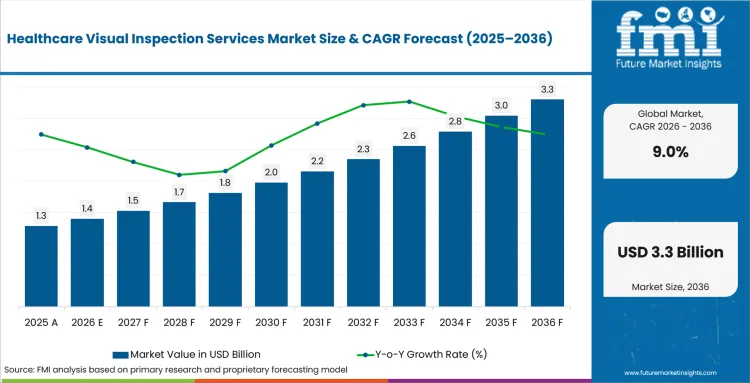
USD 1.4 billion in 2026 and USD 3.3 billion by 2036 at a 9.0% CAGR.
Demand for healthcare visual inspection services is projected to expand at 9.0% CAGR between 2026 and 2036, increasing valuation from USD 1.4 billion in 2026 to USD 3.3 billion by 2036. Pharmaceutical inspection programs evaluate injectable drugs and biologic products using manual or semi-automated methods to secure qualified release authorization. Samsung Biologics demonstrated automated visual inspection handling up to 300 vials per minute in September 2025 contrasting with manual inspection speeds of just two to three vials per minute. Such a substantial throughput gap makes automated machine inspection essential for high-volume commercial transfers where repeatable review is mandatory. Beyond injectables, container defect classification expands service scope into ophthalmic formulations and medical devices. Sterile injectable CDMO programs and remediation initiatives drive commercial orders whenever facility transfers require dedicated external inspection capacity. Service providers prove their value by delivering consistent defect detection and minimizing false-reject rates to guide manufacturing adjustments. Injectable drug programs represent the primary driver of routine demand for release testing and remediation work.
Buyers in Canada and the United States require certified inspectors and well-documented defect libraries before selecting a service provider. Purchasing teams across Japan and Germany prioritize technical-transfer discipline alongside dedicated local quality support. The European Medicines Agency released its annual report in June 2026 showing 104 human medicines having gained authorization recommendations during 2025. Such regulatory metrics reflect broad quality-review activity across new pharmaceuticals.
Key Takeaways for the Healthcare Visual Inspection Services Market
- Injectable output and particulate-control obligations drive healthcare visual inspection service demand across routine release and temporary capacity shortages.
- Direct service contracts segment is expected to garner 43.0% share of distribution channel in 2026, led by controlled acceptance criteria and direct quality-unit communication.
- Pharmaceutical companies segment is predicted to lead end user with 38.0% share in 2026, reflecting recurring release programs and established qualification procedures.
- Operator fatigue and inconsistent defect libraries restrict dependable inspection outcomes across recurring pharmaceutical batch programs.
- Competition focuses on Vetter Pharma, PCI Pharma Services, Samsung Biologics, WuXi Biologics, Sharp Sterile Manufacturing, Bushu Pharma, Recipharm, and Lonza with providers differentiating based on investigation support and service reach.
Analyst Perspective
“Inspection quality gains strategic weight on defect evidence guiding manufacturing correction and protecting batch disposition. Pharmaceutical quality teams assess inspector qualification and escalation discipline during provider selection and recurring service renewal. Long-term provider value rests on connecting inspection outcomes with corrective action and consistent release decisions.”
- Anurag Sharma, Principal Analyst for Healthcare at Future Market Insights
How is Healthcare Visual Inspection Services Market segmented?
The healthcare visual inspection services sector is segmented by inspection method, application, end user, distribution channel, service type, and region.
The healthcare visual inspection services industry is segmented by inspection method, application, end user, distribution channel, service type, and region. Inspection method coverage includes manual visual inspection and automated visual inspection serving distinct examination requirements. Semi-automated inspection and container closure inspection extend method coverage across varied product presentations. Defect detection inspection completes inspection method coverage across particulate and cosmetic defect assessment. Application coverage addresses injectable drugs and biopharmaceutical products together with vaccines. Ophthalmic products and medical devices complete application coverage across healthcare manufacturing.
End-user coverage spans pharmaceutical companies, biotechnology companies, contract development and manufacturing organizations, medical device manufacturers, and research institutes. Distribution channel coverage includes direct service contracts and contract manufacturing organizations together with quality assurance service providers. Third-party laboratory networks and digital procurement platforms complete distribution coverage across qualified service access. Service type coverage includes visual inspection services and quality control testing together with validation services. Regulatory compliance services and consulting services complete service coverage across inspection programs. Regional coverage includes North America and Europe together with East Asia. South Asia and Pacific with Latin America and Middle East and Africa complete geographic assessment.
What supports manual visual inspection within inspection method?
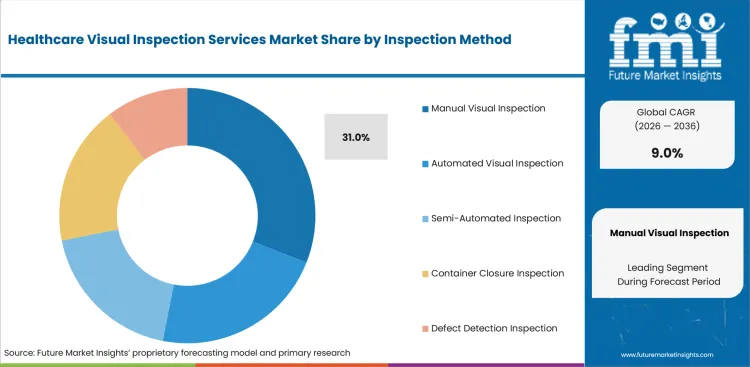
Manual visual inspection influences flexible batch sizes and difficult defect presentations requiring trained judgement across variable container formats. Product-specific judgement aids release programs through controlled lighting and representative defect samples during inspector qualification. USA Food and Drug Administration's April 2025 warning cited OSRX's absence of a commitment covering 100% visual inspection for specified sterile ophthalmic and injectable products. Agency findings identified gaps involving inspector qualification materials and defect-library control across documented release procedures.
- Manual visual inspection segment is predicted to account for 31.0% share of inspection method in 2026, aided by adaptable handling across small batches and unusual container presentations. Buyer approval rests on repeatable detection under qualified lighting with pace controls and fatigue safeguards protecting inspector consistency.
- Inspection machines support higher throughput and consistent image capture across stable presentations requiring repeatable defect classification. Product-specific validation and representative defect sets guide commercial adoption through documented handling of borderline rejects and escalation procedures.
Why does injectable drugs lead application demand?
USA Food and Drug Administration reported 46 novel drug approvals in 2025, creating added product-review work across pharmaceutical quality functions. Approval volume does not equal inspection-service revenue since only injectable presentations enter defined service demand. Qualified providers convert applicable programs through product-specific defect standards and documented batch disposition during commercial release. Injectable drugs require particle examination and fill-condition review across presentations carrying direct patient exposure risks. Container closure and cosmetic defects require separate assessment prior to release across recurring commercial batches.
- By application, injectable drugs are anticipated to represent 34.0% share in 2026 since being reflected by strict release requirements for parenteral presentations and direct patient exposure. Service teams need controlled defect classification and prompt investigation support during production interruptions affecting buyer release decisions.
- Biopharmaceutical products and vaccines require handling suited to complex formulations and temperature-sensitive container presentations during release. Ophthalmic products and medical devices add distinct cosmetic and particulate criteria across syringes and delivery systems during quality review.
What supports pharmaceutical companies across end user demand?
Pharmaceutical companies manage repeat batches and approved specifications through established quality agreements and documented inspection execution. WuXi Biologics reported 28 process performance qualification programs completed during 2025 in its March 2026 annual-results release. Qualification activity shows recurring commercial preparation without equating corporate project counts with inspection-service revenue directly.
- Based on end user, pharmaceutical companies segment is likely to garner 38.0% share in 2026 owing to recurring commercial batches and formal quality-unit oversight. Approved providers need inspection and reconciliation records linking rejected units with manufacturing causes across recurring commercial batches.
- Biotechnology companies and contract development and manufacturing organizations create project-based demand across clinical transfers and commercial scale-up. Medical device manufacturers and research institutes require narrower programs defined by container presentation and release purpose.
What keeps direct service contracts ahead within distribution channel?
Direct service contracts place acceptance criteria and scheduling under defined quality agreements assigning responsibility for deviation communication. Vetter recorded 2,231 orders during 2025 at its secondary packaging facility supporting injectable finishing and release coordination. Recorded activity illustrates administrative density surrounding injectable finishing work across direct provider relationships during release. Order volume does not represent visual inspection revenue and instead reflects coordination demands affecting direct provider relationships.
- Direct service contracts segment is estimated to capture 43.0% share in 2026, backed by direct specification control and faster deviation escalation. Contract terms define defect classes and sampling rules supporting consistent execution across repeat batches and urgent remediation assignments.
- Contract manufacturing organizations and quality assurance service providers combine inspection with manufacturing or release support across integrated programs. Third-party laboratory networks and online sourcing platforms influence narrower access routes requiring careful responsibility assignment.
What buying mechanism supports visual inspection services in service type?
Medicines and Healthcare products Regulatory Agency reported 2 injectable products involving possible glass particles in its December 2025 safety roundup. Product notices illustrate commercial consequences arising from weak particle control and incomplete inspection evidence for manufacturers. Visual inspection services combine unit examination with defect classification and reporting across qualified release assignments.
- In 2026, visual inspection services segment is projected to account for 31.0% share due to direct demand for qualified manual or automated examination. Provider value increases through dependable records supporting release decisions and deviation closure across repeat pharmaceutical assignments.
- Healthcare analytical testing services promote method qualification and defect-set performance across complex particulate investigation programs. Healthcare regulatory affairs outsourcing covers procedural repair and inspector training through revised defect standards and documented escalation procedures.
What are drivers, restraints, and opportunities in healthcare visual inspection services market?
Injectable manufacturing volume supports qualified inspection demand across routine release and temporary capacity shortage programs. Inconsistent defect control slows service conversion across buyer qualification and recurring contract renewal decisions for providers.
- Driver: Injectable manufacturers need qualified inspection capacity during routine release and technology transfer with remediation constraints adding service requirements. Release deadlines increase reliance on trained external teams during temporary internal capacity shortages.
- Restraint: Operator variability and weak defect-library governance reduce detection consistency across repeated batches for providers and buyers. Uncontrolled inspection pace and incomplete reject standards weaken comparability during recurring service assignments.
- Opportunity: Providers may combine inspection execution with trend review and particle identification to extend qualification support and manufacturing feedback. Integrated findings help quality teams trace recurring defects and direct corrective action toward manufacturing causes.
Dedicated inspection operations convert injectable output into recurring service work through repeatable release procedures and qualified personnel. Vetter reported 53.2 million injectable units inspected during 2025 at its manual visual inspection facility. Volume confirms sustained operational demand for trained personnel and controlled inspection rooms across commercial manufacturing programs. Commercial conversion remains conditional on quality agreements and retained batch performance across recurring provider relationships.
Defect recurrence exposes limits in inspection programs lacking effective supplier correction and manufacturing feedback systems. USA Food and Drug Administration's August 2025 warning reported 2 batches of ropivacaine injection exceeding visual-inspection acceptance criteria prior to recall. Reinspection did not resolve underlying packaging contamination and illustrated commercial cost from separating detection and corrective action. Providers need escalation processes connecting rejected units with material and process investigations across responsible quality functions.
Outsourced testing services create room for manual and semi-automated methods across products requiring flexible inspection qualification. Automated inspection extends service capacity across stable container presentations and repeatable commercial production programs during repeat manufacturing. Recipharm's October 2024 alliance announcement described more than 100 million units of production capacity with automated visual inspection. Integrated capacity supports product-specific qualification and smoother scale transitions across clinical and commercial manufacturing programs.
How are country CAGRs aligned in Healthcare Visual Inspection Services Market?
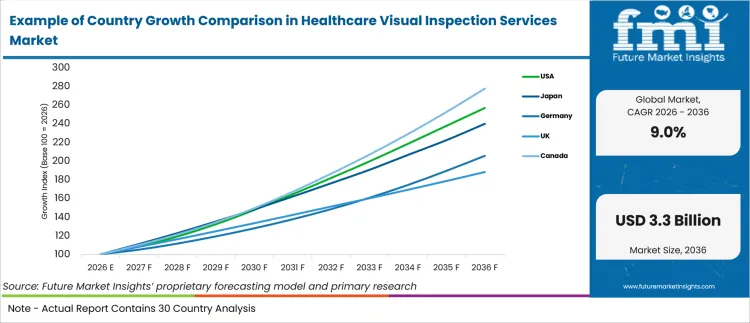
| Country or Market | CAGR |
|---|---|
| Canada | 10.7% |
| USA | 9.9% |
| Japan | 9.1% |
| Brazil | 8.3% |
| Germany | 7.5% |
| Australia | 6.9% |
| UK | 6.5% |
Source: Future Market Insights analysis, 2026.
How do country-level CAGRs compare in Healthcare Visual Inspection Services Market?
Country comparison shows a measured step-down across profiled markets reflecting different injectable production bases and validation practices. Canada occupies first position followed by United States and Japan across disclosed national growth rates for services. Brazil and Germany form a middle forecast band formed through manufacturing expansion and detailed quality review. Australia and United Kingdom complete disclosed comparison through specialist production and regulated defect-response systems for providers. National rates narrow progressively across disclosed CAGR values as outsourced service access changes entry conditions.
- Canada is anticipated to head profiled comparison led by qualification-intensive sterile manufacturing and distributed service requirements.
- The United States and Japan are expected to follow through established injectable production and formal release controls.
- Brazil and Germany are projected to form a middle band under expanding injectable programs and detailed quality review.
- Australia and United Kingdom are likely to complete disclosed comparison through specialist manufacturing and regulated defect-response systems.
- Profiled CAGRs form a gradual downward progression without sharp national separation across disclosed service markets.
Markets carrying similar CAGRs are likely to present different conditions led by provider qualification and local investigation responsibility. Full report coverage includes North America and Europe with East Asia and South Asia and Pacific. Latin America and Middle East and Africa complete geographic coverage across additional countries in full assessment.
Country-wise Analysis
- Demand for healthcare visual inspection services in Canada is anticipated to rise at 10.7% CAGR between 2026 and 2036, led by qualification-heavy sterile manufacturing and dispersed service coverage. Provincial supply arrangements increase value from documented inspector competence and consistent defect standards across recurring service agreements. Health Canada requires manual inspectors to complete visual-inspection qualification at least once each year reinforcing recurring training and qualification activity.
- PCI Pharma Services' April 2026 announcement described US automated visual-inspection infrastructure supporting more than 70 million prefilled syringe and cartridge units annually. Polymer-based prefilled syringe programs raise buyer expectations for throughput evidence and validated defect detection across outsourced services. Sales of healthcare visual inspection services in United States are projected to record 9.9% CAGR from 2026 to 2036, reflecting large sterile fill-finish operations and evidence-intensive release decisions.
- Injectable manufacturing in Japan benefits from established technical-transfer discipline and detailed release procedures across commercial programs. Adoption for healthcare visual inspection services in Japan is estimated to expand at 9.1% CAGR during 2026 to 2036, driven by high-speed filling programs requiring matched inspection performance. Bushu Pharma reports a filling speed of 8,300 vials per hour at its Misato Factory, which launched in April 2025, with added capacity increasing downstream examination and release workloads.
- Healthcare visual inspection services sector in Brazil is forecast to increase at 8.3% CAGR by 2036, guided by expanding injectable access and local distribution programs. Generic Injectable programs create separate specifications and defect sets requiring maintained release records across service teams. Eurofarma announced 2 new weekly injectable semaglutide brands for Brazil in October 2025, adding product-specific quality-control activity across national supply.
- Vetter announced a 95-acre injectable manufacturing site in Saarlouis during January 2026, with visual inspection included in planned operating scope. New fill-finish capacity increases downstream qualification and release work across German pharmaceutical supply and specialist service providers. Industry in Germany is predicted to rise at 7.5% CAGR between 2026 and 2036, backed by detailed technical review and domestic sterile manufacturing investment.
- Demand in Australia is projected to post 6.9% CAGR over 2026 to 2036, influenced by specialist sterile manufacturing and concentrated provider access. Local programs require flexible inspection support across clinical and commercial batches involving different container presentations. IDT Australia reported recommissioning a 4,000 L facility during 2025 supporting expanded domestic manufacturing activity. Recommissioned capacity adds controlled release and product-quality review requirements across clinical and commercial programs domestically.
- Medicines and Healthcare products Regulatory Agency listed 3 batches of an injection or infusion product requiring particle-related handling instructions in its January 2025 communications. Product notices reinforce demand for dependable visual examination and rapid defect escalation across UK supply. Sector in the United Kingdom is likely to expand at 6.5% CAGR through 2036, supported by formal safety communication and specialist quality-service networks.
Who are notable companies in Healthcare Visual Inspection Services Market?
Vetter Pharma, PCI Pharma Services, Samsung Biologics, WuXi Biologics, Sharp Sterile Manufacturing, Bushu Pharma, Recipharm, and Lonza are the notable companies shaping this market.
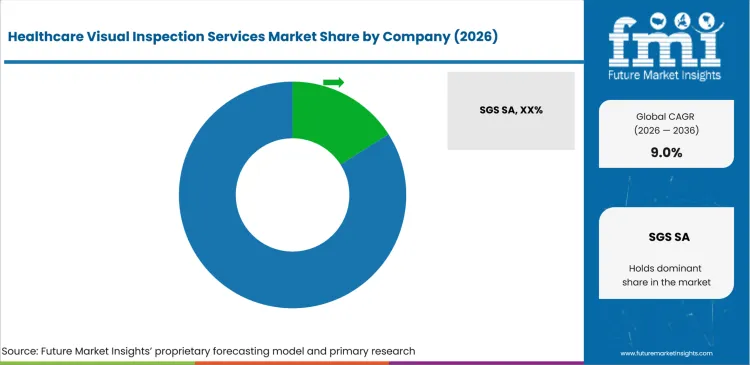
Competition in the sector centers on inspection consistency and sterile manufacturing support across pharmaceutical programs. Integrated providers combine fill-finish operations with manual or automated inspection during commercial release. Specialist companies focus on flexible batch handling across syringes and biologic products. Investigation providers connect particle identification with manufacturing correction and batch-disposition support. Buyer review covers inspector qualification, defect-library control, turnaround time, and technical assistance during implementation and renewal.
- Vetter Pharma and PCI Pharma Services compete based on integrated sterile manufacturing and visual inspection capabilities. Pharmaceutical teams assess throughput evidence and release support across recurring commercial production programs.
- Samsung Biologics and WuXi Biologics compete depending on biologics expertise connected with automated inspection and drug-product manufacturing. Customers assess technical-transfer consistency and modality coverage during provider qualification.
- Sharp Sterile Manufacturing and Bushu Pharma compete due to flexible fill-finish services across specialized container formats and smaller batch requirements. Buyer teams examine handling precision and inspection adaptability during clinical and commercial transfers.
- Recipharm competes through integrated drug-product manufacturing and inspection support across sterile pharmaceutical programs. Lonza adds particle-investigation expertise supported by analytical testing and manufacturing guidance.
Competitive Benchmarking: Healthcare Visual Inspection Services Market
| Company | Inspection Workflow | Sterile Product Depth | Investigation Support | Service Reach |
|---|---|---|---|---|
| Vetter Pharma | High | High | High | Global |
| PCI Pharma Services | High | High | Medium | Global |
| Samsung Biologics | High | High | High | Global |
| WuXi Biologics | High | High | High | Global |
| Sharp Sterile Manufacturing | Medium | High | Medium | North America |
| Bushu Pharma | Medium | High | Medium | Asia |
| Recipharm | Medium | High | High | Global |
| Lonza | High | High | High | Global |
Source: Future Market Insights competitive analysis, 2026.
Key Developments in Healthcare Visual Inspection Services Market
- In March 2025, Vetter started the third expansion phase for its Center for Visual Inspection and Logistics. Company information connected planned cold-storage additions with extra manual and automated inspection capacity for temperature-sensitive injectable products.
- In August 2025, Samsung Biologics reported expanded automated visual-inspection capability for antibody-drug conjugates and prefilled syringes. Company information connected modality coverage with qualified inspection availability across complex commercial drug-product programs.
- In February 2026, Lonza published a technical framework for visual-inspection test sets used in biologics drug-product manufacturing. The guidance covered test-set design, manufacture, certification, and lifecycle management, strengthening defect-library qualification and inspection consistency across outsourced pharmaceutical programs.
Healthcare Visual Inspection Services Market Report Scope
| Coverage field | Report scope |
|---|---|
| Market breakdown | Healthcare visual inspection services market breakdown includes inspection method, application, end user, distribution channel, service type, and region. |
| Quantitative Units | USD billion in 2026 to USD billion by 2036 at CAGR |
| Market Definition | Healthcare visual inspection services cover qualified manual and semi-automated examination across injectable drugs and biologics. Automated examination extends coverage to ophthalmic products with medical devices and packaging applications during release. Defined services include defect classification and inspector qualification across inspection validation and reconciliation requirements for buyers. Reporting and investigation support complete service coverage across recurring release programs requiring documented provider accountability. Equipment-only sales remain excluded from defined service coverage and market sizing under report scope boundaries and definitions. |
| Regions Covered | North America, Europe, East Asia, South Asia and Pacific, Latin America, and Middle East and Africa. |
| Countries Covered | Canada, USA, Japan, Brazil, Germany, Australia, UK, and additional countries covered in full regional assessment. |
| Key Companies Profiled | Vetter Pharma, PCI Pharma Services, Samsung Biologics, WuXi Biologics, Sharp Sterile Manufacturing, Bushu Pharma, Recipharm, and Lonza. |
| Forecast Period | 2026 to 2036 |
| Approach | Hybrid bottom-up and top-down methodology uses segment shares with country CAGRs for final reconciliation across categories. Provider activity and buyer qualification evidence support independent checks across service categories and national markets. |
Source: Future Market Insights analysis, 2026.
Healthcare Visual Inspection Services Market - Research Methodology
| Method | Approach |
|---|---|
| Primary Research | FMI analysts gathered input from manufacturers, service providers, technology developers, distributors, end users, procurement teams, and subject-matter experts. Interviews examined purchasing decisions, product or service evaluation, adoption barriers, approval requirements, pricing considerations, and expectations for technical or commercial support. Respondents were also asked what evidence is required before a trial, pilot, or initial order develops into regular purchasing. |
| Desk Research | Desk research covered government statistics, regulatory publications, trade data, industry associations, technical literature, standards, company filings, product information, and official corporate announcements. Sources were reviewed for relevance, publication date, geographic coverage, and consistency with the defined market scope. Claims relating to performance, applications, approvals, capacity, investment, and commercial activity were retained only when supported by credible public evidence. |
| Market Sizing and Forecasting | The market model combined the baseline value with historical performance, segment structure, pricing and volume indicators, adoption levels, company participation, and country-level demand conditions. Forecast assumptions considered economic activity, investment trends, regulatory developments, technology adoption, purchasing cycles, supply availability, and barriers to wider market use. Segment and regional estimates were reconciled before the final market total was calculated. |
| Data Validation | Estimates were checked against multiple independent indicators, including public data, company activity, trade patterns, industry developments, and findings from primary interviews. Validation also tested whether products, services, applications, and company revenues fell within the defined market boundaries. Adjacent categories, unsupported claims, overlapping revenues, and activities without direct market relevance were excluded to reduce double counting and maintain consistency across segments and countries. |
Source: Future Market Insights analysis, 2026.
Healthcare Visual Inspection Services Market by Segments
Healthcare Visual Inspection Services Market segmented by Inspection Method:
- Manual Visual Inspection
- Automated Visual Inspection
- Semi-Automated Inspection
- Container Closure Inspection
- Defect Detection Inspection
Healthcare Visual Inspection Services Market segmented by Application:
- Injectable Drugs
- Biopharmaceutical Products
- Vaccines
- Ophthalmic Products
- Medical Devices
Healthcare Visual Inspection Services Market segmented by End User:
- Pharmaceutical Companies
- Biotechnology Companies
- Contract Development and Manufacturing Organizations
- Medical Device Manufacturers
- Research Institutes
Healthcare Visual Inspection Services Market segmented by Distribution Channel:
- Direct Service Contracts
- Contract Manufacturing Organizations
- Quality Assurance Service Providers
- Third-Party Laboratory Networks
- Digital Procurement Platforms
Healthcare Visual Inspection Services Market segmented by Service Type:
- Visual Inspection Services
- Quality Control Testing
- Validation Services
- Regulatory Compliance Services
- Consulting Services
Healthcare Visual Inspection Services Market segmented by Region:
- North America
- Canada
- USA
- Europe
- Germany
- UK
- East Asia
- Japan
- South Asia and Pacific
- Australia
- Latin America
- Brazil
- Middle East and Africa
Research Sources and Bibliography
- European Medicines Agency. (2026, June 11). 2025 annual report of the European Medicines Agency.
- Samsung Biologics. (2025, September 30). From challenges to success: How Samsung Biologics drives client collaboration to accelerate time-sensitive technology transfers.
- USA Food and Drug Administration. (2025, April 23). OSRX, Inc. MARCS-CMS 701889.
- USA Food and Drug Administration. (2025). Novel drug approvals for 2025.
- WuXi Biologics. (2026, March 24). WuXi Biologics reports record 2025 annual results.
- Vetter Pharma. (2025). Secondary Packaging Ravensburg.
- Medicines and Healthcare products Regulatory Agency. (2025, December 18). MHRA Safety Roundup: December 2025.
- Vetter Pharma. (2025). Visual Inspection Ravensburg South.
- USA Food and Drug Administration. (2025, August 27). Amneal Pharmaceuticals, LLC MARCS-CMS 709894.
- Recipharm. (2024, October 1). Recipharm and Exela announce exclusive strategic alliance.
- Health Canada. (2024). Annex 1 to the Good manufacturing practices guide - Manufacture of sterile drugs: Production and specific technologies.
- PCI Pharma Services. (2026, April 27). Backed by investments exceeding $1 billion, PCI Pharma Services announces major expansion of US sterile fill-finish and drug-device delivery combination capabilities.
- Bushu Pharma. (2025, April). Misato Factory.
- Eurofarma. (2025, October 1). Novo Nordisk and Eurofarma announce strategic partnership to launch new biological injectable semaglutide brands in Brazil and expand the molecule's reach.
- Vetter Pharma. (2026, January 28). We are building a new location in Saarland.
- IDT Australia. (2025). History.
- Medicines and Healthcare products Regulatory Agency. (2025, February 26). Letters and medicine recalls sent to healthcare professionals in January 2025.
- Vetter Pharma. (2025, March 11). Vetter rolls out the Center for Visual Inspection and Logistics’ third phase of expansion.
- Samsung Biologics. (2025, August 25). Advancing drug product quality through automated visual inspection and future ready infrastructure.
- WuXi Biologics. (2024, November 13). WuXi Biologics Germany to enhance capabilities with new prefilled syringes line.
- Sharp Services. (2024, October 18). Berkshire Sterile Manufacturing, LLC rebrands to Sharp Sterile Manufacturing, LLC.
- Lonza. (2026, February 6). The critical role of robust visual inspection test sets in biologics drug product manufacturing.
This bibliography is provided for reader reference and is not exhaustive. The full report contains the complete reference list and detailed citations.
This Report Answers
- How do inspection method and application segments influence healthcare visual inspection service demand?
- What evidence guides pharmaceutical quality teams during provider qualification?
- Why do country CAGRs differ across profiled national markets?
- What provider capabilities support dependable manual and automated inspection?
- How are forecasts validated through bottom-up and top-down analysis?
- What operating evidence supports repeat inspection-service contracts?
- Why do defect libraries and inspector qualification influence provider selection?
- How does weak root-cause feedback reduce inspection-program value?
- What company capabilities improve long-term customer confidence?
- How do integrated particle-investigation services support batch disposition?
Frequently Asked Questions
How big is the Healthcare Visual Inspection Services Market in 2026?
The healthcare visual inspection services market is valued at USD 1.4 billion in 2026 and is forecast to reach USD 3.3 billion by 2036. Growth is supported by rising injectable drug production that sustains recurring demand for particulate and defect inspection across pharmaceutical release programs and technology-transfer initiatives.
What is the CAGR of the Healthcare Visual Inspection Services Market from 2026 to 2036?
The healthcare visual inspection services market grows at a CAGR of 9.0% between 2026 and 2036, driven by pharmaceutical companies requiring qualified manual and automated inspection capacity to support injectable release programs and technology transfers across established quality-controlled manufacturing environments.
Which distribution channel leads the Healthcare Visual Inspection Services Market?
Direct service contracts account for 43.0% share of the healthcare visual inspection services market by distribution channel in 2026, supported by controlled acceptance criteria and direct quality-unit communication that speeds deviation escalation across recurring commercial batch inspection assignments.
How much will the Healthcare Visual Inspection Services Market add between 2026 and 2036?
The healthcare visual inspection services market is set to add USD 1.9 billion between 2026 and 2036, growing from USD 1.4 billion to USD 3.3 billion as injectable manufacturing volume sustains demand for qualified inspection capacity across pharmaceutical release and remediation programs worldwide.
Who are the leading companies in the Healthcare Visual Inspection Services Market?
Eight companies lead the healthcare visual inspection services market, including Vetter Pharma, PCI Pharma Services, Samsung Biologics, WuXi Biologics, Sharp Sterile Manufacturing, Bushu Pharma, Recipharm, and Lonza, competing through integrated sterile manufacturing, automated inspection systems, particle-investigation expertise, and manual inspection capabilities across pharmaceutical quality and release programs.
Preview the report firsthand - request a free sample
Get SampleGet the brochure for pricing and purchase details.
Get PDFTable of Content
- Key Takeaways
- Market Size and CAGR
- Top Growth Driver
- Fastest Growing Segment
- Leading Region
- Key Companies
- Emerging Opportunities
- Executive Summary
- Global Market Outlook
- Demand-side Trends
- Supply-side Trends
- Technology Roadmap Analysis
- Analysis and Recommendations
- Analyst Perspective (What is happening? Why now? What should investors know?)
- Key Questions Answered
- How large is the market?
- What is the CAGR?
- What are key trends?
- Which region dominates?
- Who are the leaders?
- Market Overview
- Market Coverage / Taxonomy
- Market Definition / Scope / Limitations
- Research Methodology
- Chapter Orientation
- Analytical Lens and Working Hypotheses
- Market Structure, Signals, and Trend Drivers
- Benchmarking and Cross-market Comparability
- Market Sizing, Forecasting, and Opportunity Mapping
- Research Design and Evidence Framework
- Desk Research Programme (Secondary Evidence)
- Expert Input and Fieldwork (Primary Evidence)
- Tooling, Models, and Reference Databases
- Data Engineering and Model Build
- Quality Assurance and Audit Trail
- Market Background
- Market Dynamics (Drivers, Restraints, Opportunity, Trends)
- Scenario Forecast (Optimistic, Likely, Conservative)
- Impact Analysis
- AI Impact
- Sustainability Impact
- Regulatory Impact
- Technology Impact
- Consumer / Buyer Analysis
- Purchase Drivers
- Adoption Barriers
- Buyer Journey
- Opportunity Map Analysis
- Product Life Cycle Analysis
- Supply Chain Analysis
- Investment Feasibility Matrix
- Value Chain Analysis
- PESTLE and Porter's Analysis
- Regulatory Landscape
- Regional Parent Market Outlook
- Production and Consumption Statistics
- Import and Export Statistics
- Global Market Analysis and Forecast, 2021 to 2036
- Historical Market Size Value (USD Billion) Analysis, 2021 to 2025
- Current and Future Market Size Value (USD Billion) Projections, 2026 to 2036
- Y-o-Y Growth Trend Analysis
- Absolute $ Opportunity Analysis
- Global Market Pricing Analysis, 2021 to 2036
- Global Market Analysis and Forecast, By Inspection Method, 2021 to 2036
- Introduction / Key Findings
- Historical Market Size Value (USD Billion) Analysis By Inspection Method, 2021 to 2025
- Current and Future Market Size Value (USD Billion) Analysis and Forecast By Inspection Method, 2026 to 2036
- Manual Visual Inspection
- Bright Field Inspection
- Backlight Inspection
- Automated Visual Inspection
- Camera-Based Inspection
- AI-Based Inspection
- Semi-Automated Inspection
- Rotary Inspection
- Conveyor Inspection
- Container Closure Inspection
- Vial Closure Inspection
- Syringe Closure Inspection
- Defect Detection Inspection
- Cosmetic Defect Inspection
- Particulate Matter Inspection
- Manual Visual Inspection
- Y-o-Y Growth Trend Analysis By Inspection Method, 2021 to 2025
- Absolute $ Opportunity Analysis By Inspection Method, 2026 to 2036
- Global Market Analysis and Forecast, By Application, 2021 to 2036
- Introduction / Key Findings
- Historical Market Size Value (USD Billion) Analysis By Application, 2021 to 2025
- Current and Future Market Size Value (USD Billion) Analysis and Forecast By Application, 2026 to 2036
- Injectable Drugs
- Parenteral Solutions
- Lyophilized Injectables
- Biopharmaceutical Products
- Monoclonal Antibodies
- Recombinant Proteins
- Vaccines
- Viral Vaccines
- mRNA Vaccines
- Ophthalmic Products
- Eye Drops
- Ophthalmic Suspensions
- Medical Devices
- Prefilled Syringes
- Cartridge Systems
- Injectable Drugs
- Y-o-Y Growth Trend Analysis By Application, 2021 to 2025
- Absolute $ Opportunity Analysis By Application, 2026 to 2036
- Global Market Analysis and Forecast, By End User, 2021 to 2036
- Introduction / Key Findings
- Historical Market Size Value (USD Billion) Analysis By End User, 2021 to 2025
- Current and Future Market Size Value (USD Billion) Analysis and Forecast By End User, 2026 to 2036
- Pharmaceutical Companies
- Branded Pharmaceutical Companies
- Generic Pharmaceutical Companies
- Biotechnology Companies
- Large Biotechnology Firms
- Emerging Biotech Companies
- Contract Development and Manufacturing Organizations
- Full-Service CDMOs
- Specialty CDMOs
- Medical Device Manufacturers
- Drug Delivery Device Manufacturers
- Diagnostic Device Manufacturers
- Research Institutes
- Academic Research Institutes
- Government Research Centers
- Pharmaceutical Companies
- Y-o-Y Growth Trend Analysis By End User, 2021 to 2025
- Absolute $ Opportunity Analysis By End User, 2026 to 2036
- Global Market Analysis and Forecast, By Distribution Channel, 2021 to 2036
- Introduction / Key Findings
- Historical Market Size Value (USD Billion) Analysis By Distribution Channel, 2021 to 2025
- Current and Future Market Size Value (USD Billion) Analysis and Forecast By Distribution Channel, 2026 to 2036
- Direct Service Contracts
- Long-Term Service Agreements
- Project-Based Contracts
- Contract Manufacturing Organizations
- Pharma Manufacturing Partners
- Biologics Manufacturing Partners
- Quality Assurance Service Providers
- GMP Compliance Services
- Validation Services
- Third-Party Laboratory Networks
- Central Testing Laboratories
- Regional Testing Laboratories
- Digital Procurement Platforms
- B2B Procurement Portals
- E-Procurement Platforms
- Direct Service Contracts
- Y-o-Y Growth Trend Analysis By Distribution Channel, 2021 to 2025
- Absolute $ Opportunity Analysis By Distribution Channel, 2026 to 2036
- Global Market Analysis and Forecast, By Service Type, 2021 to 2036
- Introduction / Key Findings
- Historical Market Size Value (USD Billion) Analysis By Service Type, 2021 to 2025
- Current and Future Market Size Value (USD Billion) Analysis and Forecast By Service Type, 2026 to 2036
- Visual Inspection Services
- Manual Inspection Services
- Automated Inspection Services
- Quality Control Testing
- Defect Classification
- Particulate Testing
- Validation Services
- Equipment Qualification
- Process Validation
- Regulatory Compliance Services
- GMP Compliance
- Audit Support
- Consulting Services
- Inspection Process Optimization
- Training & Qualification
- Visual Inspection Services
- Y-o-Y Growth Trend Analysis By Service Type, 2021 to 2025
- Absolute $ Opportunity Analysis By Service Type, 2026 to 2036
- Global Market Analysis and Forecast, By Region, 2021 to 2036
- Introduction
- Historical Market Size Value (USD Billion) Analysis By Region, 2021 to 2025
- Current Market Size Value (USD Billion) Analysis and Forecast By Region, 2026 to 2036
- North America
- Latin America
- Western Europe
- Eastern Europe
- East Asia
- South Asia and Pacific
- Middle East & Africa
- Market Attractiveness Analysis By Region
- North America Market Analysis and Forecast, By Country, 2021 to 2036
- Historical Market Size Value (USD Billion) Trend Analysis By Market Taxonomy, 2021 to 2025
- Market Size Value (USD Billion) Forecast By Market Taxonomy, 2026 to 2036
- By Country
- USA
- Canada
- By Inspection Method
- By Application
- By End User
- By Distribution Channel
- By Service Type
- By Country
- Market Attractiveness Analysis
- By Country
- By Inspection Method
- By Application
- By End User
- By Distribution Channel
- By Service Type
- Key Takeaways
- Latin America Market Analysis and Forecast, By Country
- Historical Market Size Value (USD Billion) Trend Analysis By Market Taxonomy, 2021 to 2025
- Market Size Value (USD Billion) Forecast By Market Taxonomy, 2026 to 2036
- By Country
- Brazil
- Mexico
- Chile
- Rest of Latin America
- By Inspection Method
- By Application
- By End User
- By Distribution Channel
- By Service Type
- By Country
- Market Attractiveness Analysis
- By Country
- By Inspection Method
- By Application
- By End User
- By Distribution Channel
- By Service Type
- Key Takeaways
- Western Europe Market Analysis and Forecast, By Country
- Historical Market Size Value (USD Billion) Trend Analysis By Market Taxonomy, 2021 to 2025
- Market Size Value (USD Billion) Forecast By Market Taxonomy, 2026 to 2036
- By Country
- Germany
- UK
- Italy
- Spain
- France
- Nordic
- BENELUX
- Rest of Western Europe
- By Inspection Method
- By Application
- By End User
- By Distribution Channel
- By Service Type
- By Country
- Market Attractiveness Analysis
- By Country
- By Inspection Method
- By Application
- By End User
- By Distribution Channel
- By Service Type
- Key Takeaways
- Eastern Europe Market Analysis and Forecast, By Country
- Historical Market Size Value (USD Billion) Trend Analysis By Market Taxonomy, 2021 to 2025
- Market Size Value (USD Billion) Forecast By Market Taxonomy, 2026 to 2036
- By Country
- Russia
- Poland
- Hungary
- Balkan & Baltic
- Rest of Eastern Europe
- By Inspection Method
- By Application
- By End User
- By Distribution Channel
- By Service Type
- By Country
- Market Attractiveness Analysis
- By Country
- By Inspection Method
- By Application
- By End User
- By Distribution Channel
- By Service Type
- Key Takeaways
- East Asia Market Analysis and Forecast, By Country
- Historical Market Size Value (USD Billion) Trend Analysis By Market Taxonomy, 2021 to 2025
- Market Size Value (USD Billion) Forecast By Market Taxonomy, 2026 to 2036
- By Country
- China
- Japan
- South Korea
- By Inspection Method
- By Application
- By End User
- By Distribution Channel
- By Service Type
- By Country
- Market Attractiveness Analysis
- By Country
- By Inspection Method
- By Application
- By End User
- By Distribution Channel
- By Service Type
- Key Takeaways
- South Asia and Pacific Market Analysis and Forecast, By Country
- Historical Market Size Value (USD Billion) Trend Analysis By Market Taxonomy, 2021 to 2025
- Market Size Value (USD Billion) Forecast By Market Taxonomy, 2026 to 2036
- By Country
- India
- ASEAN
- Australia & New Zealand
- Rest of South Asia and Pacific
- By Inspection Method
- By Application
- By End User
- By Distribution Channel
- By Service Type
- By Country
- Market Attractiveness Analysis
- By Country
- By Inspection Method
- By Application
- By End User
- By Distribution Channel
- By Service Type
- Key Takeaways
- Middle East & Africa Market Analysis and Forecast, By Country
- Historical Market Size Value (USD Billion) Trend Analysis By Market Taxonomy, 2021 to 2025
- Market Size Value (USD Billion) Forecast By Market Taxonomy, 2026 to 2036
- By Country
- Kingdom of Saudi Arabia
- Other GCC Countries
- Türkiye
- South Africa
- Other African Union
- Rest of Middle East & Africa
- By Inspection Method
- By Application
- By End User
- By Distribution Channel
- By Service Type
- By Country
- Market Attractiveness Analysis
- By Country
- By Inspection Method
- By Application
- By End User
- By Distribution Channel
- By Service Type
- Key Takeaways
- Key Countries Market Analysis
- USA
- Pricing Analysis
- Market Share Analysis, 2025
- By Inspection Method
- By Application
- By End User
- By Distribution Channel
- By Service Type
- Canada
- Pricing Analysis
- Market Share Analysis, 2025
- By Inspection Method
- By Application
- By End User
- By Distribution Channel
- By Service Type
- Mexico
- Pricing Analysis
- Market Share Analysis, 2025
- By Inspection Method
- By Application
- By End User
- By Distribution Channel
- By Service Type
- Brazil
- Pricing Analysis
- Market Share Analysis, 2025
- By Inspection Method
- By Application
- By End User
- By Distribution Channel
- By Service Type
- Chile
- Pricing Analysis
- Market Share Analysis, 2025
- By Inspection Method
- By Application
- By End User
- By Distribution Channel
- By Service Type
- Germany
- Pricing Analysis
- Market Share Analysis, 2025
- By Inspection Method
- By Application
- By End User
- By Distribution Channel
- By Service Type
- UK
- Pricing Analysis
- Market Share Analysis, 2025
- By Inspection Method
- By Application
- By End User
- By Distribution Channel
- By Service Type
- Italy
- Pricing Analysis
- Market Share Analysis, 2025
- By Inspection Method
- By Application
- By End User
- By Distribution Channel
- By Service Type
- Spain
- Pricing Analysis
- Market Share Analysis, 2025
- By Inspection Method
- By Application
- By End User
- By Distribution Channel
- By Service Type
- France
- Pricing Analysis
- Market Share Analysis, 2025
- By Inspection Method
- By Application
- By End User
- By Distribution Channel
- By Service Type
- India
- Pricing Analysis
- Market Share Analysis, 2025
- By Inspection Method
- By Application
- By End User
- By Distribution Channel
- By Service Type
- ASEAN
- Pricing Analysis
- Market Share Analysis, 2025
- By Inspection Method
- By Application
- By End User
- By Distribution Channel
- By Service Type
- Australia & New Zealand
- Pricing Analysis
- Market Share Analysis, 2025
- By Inspection Method
- By Application
- By End User
- By Distribution Channel
- By Service Type
- China
- Pricing Analysis
- Market Share Analysis, 2025
- By Inspection Method
- By Application
- By End User
- By Distribution Channel
- By Service Type
- Japan
- Pricing Analysis
- Market Share Analysis, 2025
- By Inspection Method
- By Application
- By End User
- By Distribution Channel
- By Service Type
- South Korea
- Pricing Analysis
- Market Share Analysis, 2025
- By Inspection Method
- By Application
- By End User
- By Distribution Channel
- By Service Type
- Russia
- Pricing Analysis
- Market Share Analysis, 2025
- By Inspection Method
- By Application
- By End User
- By Distribution Channel
- By Service Type
- Poland
- Pricing Analysis
- Market Share Analysis, 2025
- By Inspection Method
- By Application
- By End User
- By Distribution Channel
- By Service Type
- Hungary
- Pricing Analysis
- Market Share Analysis, 2025
- By Inspection Method
- By Application
- By End User
- By Distribution Channel
- By Service Type
- Kingdom of Saudi Arabia
- Pricing Analysis
- Market Share Analysis, 2025
- By Inspection Method
- By Application
- By End User
- By Distribution Channel
- By Service Type
- Türkiye
- Pricing Analysis
- Market Share Analysis, 2025
- By Inspection Method
- By Application
- By End User
- By Distribution Channel
- By Service Type
- South Africa
- Pricing Analysis
- Market Share Analysis, 2025
- By Inspection Method
- By Application
- By End User
- By Distribution Channel
- By Service Type
- USA
- Market Structure Analysis
- Competition Dashboard
- Competition Benchmarking
- Market Share Analysis of Top Players
- By Regional
- By Inspection Method
- By Application
- By End User
- By Distribution Channel
- By Service Type
- Emerging Startups
- Innovation Benchmarking
- Competition Analysis
- Competition Deep Dive
- SGS SA
- Overview
- Product Portfolio
- Profitability by Market Segments
- Sales Footprint
- Strategy Overview
- Marketing Strategy
- Product Strategy
- Channel Strategy
- Charles River Laboratories
- WuXi AppTec
- Nelson Laboratories
- Eurofins Scientific
- Intertek Group
- Pace Analytical Services
- Boston Analytical
- Almac Group
- Recipharm
- SGS SA
- Case Studies
- Success Stories
- Recent Developments
- Competition Deep Dive
- Assumptions & Acronyms Used


