

- Market Size (2026)
- USD 27.8 Bn
- Forecast (2036)
- USD 89.5 Bn
- CAGR (2026 to 2036)
- 12.4%
How Big Is the Healthcare Cybersecurity Market in 2026?
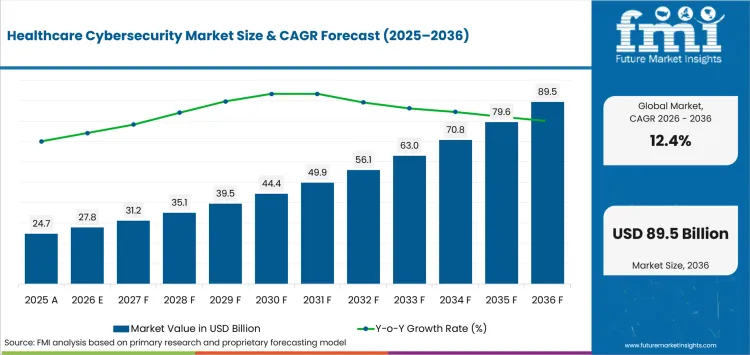
USD 27.8 billion in 2026, reaching USD 89.5 billion by 2036 at 12.4% CAGR.
Demand for healthcare cybersecurity is projected to push industry valuation from USD 27.8 billion in 2026 to USD 89.5 billion by 2036 at 12.4% CAGR. Expanding digital health ecosystems continue to increase the volume of connected patient records and networked medical devices requiring protection. HHS reported in December 2024 that large healthcare breach reports increased by 102% between 2018 and 2023, highlighting the operational and financial consequences of inadequate security controls.
National healthcare systems are responding to these risks through different governance and security management models. Japan assigns formal cybersecurity responsibilities within healthcare organizations, while Germany places greater emphasis on information-system assurance requirements embedded in hospital procurement and operating frameworks. MHLW reported in May 2026 that 86% of Japanese hospitals had appointed a security manager, although only 16% had personnel holding an information-processing qualification. The gap between governance assignment and specialist expertise increases the need for configuration management and outsourced cybersecurity support services.
Key Takeaways of Healthcare Cybersecurity Market
- Clinical dependence on shared identities and networks raises spending because failures interrupt patient care.
- Software is projected at 49.0% in 2026 owing to recurring endpoint and identity controls.
- Cloud-based security is estimated at 56.0% in 2026 as providers distribute workloads across environments.
- Network security is forecast at 31.0% in 2026 as hospitals contain threats without blocking care.
- Legacy devices and incomplete inventories slow remediation by increasing change risk across clinical systems.
- Key players in the market include Palo Alto Networks, Inc.; Cisco Systems, Inc.; Fortinet, Inc.; CrowdStrike Holdings, Inc.; Microsoft Corporation; Check Point Software Technologies Ltd.; Trend Micro Incorporated; and Sophos Ltd.
Analyst Perspective
"Healthcare cybersecurity earns value during disruptions that threaten clinical access. Providers should compare how platforms isolate compromised identities or devices without interrupting care and how clearly each supplier documents recovery."
- Anurag Sharma, Principal Consultant, Future Market Insights
How Is the Healthcare Cybersecurity Market Segmented?
The healthcare cybersecurity market is segmented by component, deployment, application, end user, security type and region.
Component includes software, services, hardware and security analytics. Deployment covers cloud-based, on-premise and hybrid security. Application covers network, endpoint and device, identity and access, and data protection. End users include providers, payers, public agencies and life sciences companies, while security types include cloud, application and infrastructure security.
What supports software demand within the component category?
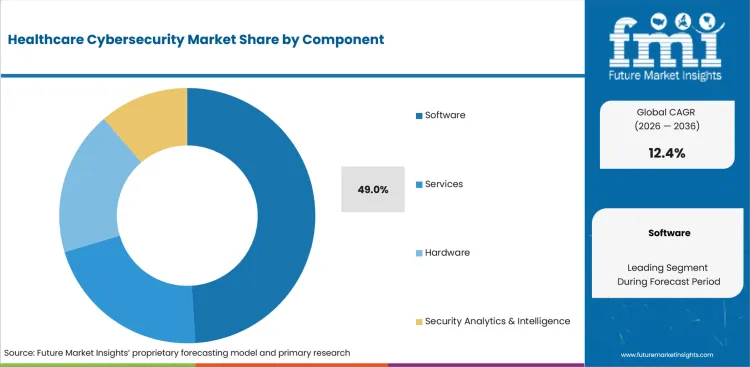
Software provides the persistent control layer for asset discovery, access enforcement and event correlation. Endpoint protection platforms remain useful as accounts, applications and device inventories change between hardware replacement cycles across sites.
- By component, software is estimated to hold 49.0% in 2026 owing to recurring licenses, policy updates and continuous telemetry.
- Healthcare security teams use software to connect endpoint activity with identity decisions and incident records. Services support configuration and response, while hardware enforces traffic controls at clinical network boundaries during routine operations and emergency containment.
How does cloud-based security shape deployment demand?
Cloud-based controls follow distributed users and workloads without requiring every care site to run the same local stack. Healthcare cloud infrastructure requires shared policy visibility across hosted applications and provider networks.
- Cloud-based security is set to lead the deployment category with 56.0% share in 2026 due to centralized policy control across distributed environments.
- Provider teams compare security service edge coverage with local access controls and clinical latency. On-premise systems protect selected data centers, while hybrid deployment connects edge workloads with shared operations without forcing every application into one environment.
What makes network security central to the application category?
Healthcare networks connect administrative systems with clinical applications and equipment that cannot tolerate uncontrolled isolation. Mapping communication paths makes medical device cyber risk visible before containment affects dependent care workflows and emergency response.
- In 2026, network security is expected to lead application demand with 31.0% share because monitoring and segmentation support safer containment.
- Hospital teams use firewall management and intrusion prevention to limit lateral movement while preserving authorized care access. Server security protects application hosts supporting records, imaging and laboratory workflows across distributed clinical networks.
Why do healthcare providers lead the end user category?
Healthcare providers directly bear the immediate operational impact when authentication, applications or connected devices become unavailable. Hospitals and clinics must protect regulated information while preserving patient access and clinical communication.
- Based on end user, healthcare providers are projected to account for 43.0% in 2026 due to direct responsibility for clinical continuity and recovery.
- Payers prioritize claims and member-data protection, while public agencies require resilient exchange and coordination. Life sciences companies add research controls, but providers manage the broadest combination of uptime and device risks across facilities.
What Are the Drivers, Restraints and Opportunities in the Healthcare Cybersecurity Market?
Clinical continuity raises demand, legacy systems increase change risk and integrated services extend specialist coverage.
- Driver: Provider networks require controls that preserve clinical access during detection, containment and recovery.
- Restraint: Legacy devices and divided ownership lengthen remediation across clinical technology and supporting infrastructure.
- Opportunity: Healthcare IT outsourcing extends specialist coverage for organizations that cannot maintain continuous security operations.
Care Continuity Demand
Cyber incidents can block scheduling and clinical data access. Providers therefore prioritize controls that isolate affected users or devices and support tested restoration for unaffected care teams.
Legacy Asset Friction
Older clinical systems have narrow maintenance windows and manufacturer-controlled settings. Security teams must map dependencies before changing access rules or network paths that support essential care.
Integrated Service Route
A shared response process connects cloud, identity and endpoint evidence under one escalation model. Managed services extend monitoring and incident support for hospitals without continuous specialist coverage.
Which Country CAGRs Are Profiled in the Healthcare Cybersecurity Market?
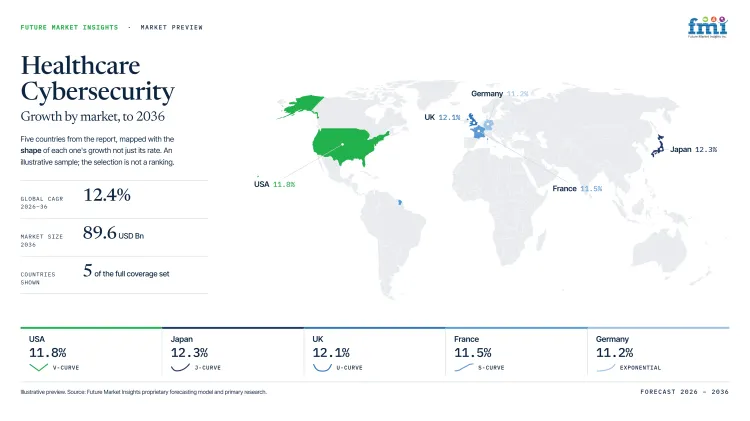
| Country | CAGR |
|---|---|
| Japan | 12.3% |
| United Kingdom | 12.1% |
| United States | 11.8% |
| France | 11.5% |
| Germany | 11.2% |
How Do Country-Level CAGRs Compare in the Healthcare Cybersecurity Market?
The country forecasts are highly concentrated across the healthcare cybersecurity market, with only 1.1 percentage points separating Japan and Germany. All five profiled countries sit below the 12.4% global CAGR, which reflects faster expansion across the remaining regions covered in the full report. The limited spread among the five suggests that growth is shaped by common challenges such as rising cyber threats, expanding healthcare digitization and stricter data protection requirements.
- Japan benefits from increasing investment in healthcare IT security and protection of connected medical systems.
- The United Kingdom supports demand through continued focus on securing NHS infrastructure and patient data networks.
- The United States reflects strong adoption driven by ransomware prevention, regulatory compliance and protection of healthcare data assets.
- France continues to expand through modernization of healthcare cybersecurity frameworks and digital health infrastructure.
- Germany maintains steady growth through increasing emphasis on cyber resilience across hospitals and healthcare providers.
Comparable CAGRs may still reflect different market conditions because regulatory requirements, healthcare IT maturity, cloud adoption and cybersecurity spending priorities vary across countries. The full report provides country-level CAGR analysis across North America, Latin America, Europe, East Asia, South Asia, Oceania and the Middle East and Africa.
Country-wise Analysis
- Japanese hospitals follow national guidance that assigns cybersecurity duties across executives, clinical teams and technology providers while older medical devices restrict maintenance flexibility across regional hospitals and rural clinics with varied local network conditions. Adoption of healthcare cybersecurity in Japan is estimated to expand at 12.3% CAGR through 2036, supported by formal accountability and stronger safety-management requirements for medical information systems during formal procurement reviews. MHLW reported in May 2026 that 86% of hospitals had appointed a security manager, while only 16% of those managers held an information-processing qualification. That gap favors suppliers able to combine configuration, training and managed monitoring without extending clinical downtime.
- United Kingdom healthcare organizations apply national assurance requirements across large trusts, contracted partners and local care networks while older applications complicate ownership across outsourced services and regional technology estates with uneven internal staffing. The United Kingdom healthcare cybersecurity outlook is anticipated to advance at 12.1% CAGR over the assessment period, reinforced by board accountability, documented recovery requirements and established national reporting during frontline procurement reviews. The Cyber Security Breaches Survey reported in April 2026 that 33% of health or social care businesses identified a breach or attack, strengthening demand for incident records and external support that fits clinical platforms.
- United States provider networks range from integrated health systems to rural hospitals with limited security staffing, while dispersed facilities require remote incident support and recovery testing across different infrastructure and service conditions. The United States healthcare cybersecurity sector is projected to record 11.8% CAGR during the assessment period, supported by regulatory enforcement and wider access to security services for resource-constrained facilities outside major urban networks. HHS reported in April 2026 that four ransomware settlements covered breaches affecting more than 427,000 individuals, reinforcing demand for risk analysis, monitoring and recovery services that fit smaller hospitals without requiring large teams.
- French healthcare institutions use national incident coordination to connect reporting with continuity planning across hospitals and medical-social organizations, while regional facilities retain different asset inventories and response capacity during serious disruptions and extended outages. Healthcare cybersecurity demand in France is forecast to rise at 11.5% CAGR over the forecast period, influenced by national reporting channels and coordinated operational support for affected institutions across regional care networks. CERT Santé reported in May 2026 that 764 incidents involved 606 structures during 2025, increasing demand for local containment and escalation support available during nights and weekends for facilities with limited specialist staffing.
- German hospitals evaluate cybersecurity dependencies within hospital information systems, while external technology providers control maintenance windows across diverse clinical estates and interconnected applications that support inpatient and outpatient care during daily operations. Germany is estimated to post 11.2% CAGR over the forecast period, shaped by assurance expectations and documented controls for architecture, logging and recovery across hospital systems and contracted technology services during supplier reviews. BSI published the SiKIS final report in February 2025 after examining hospital information-system security, reinforcing demand for suppliers that map interfaces and responsibilities before deployment so protective changes do not disrupt daily clinical availability.
Who Are the Notable Companies in the Healthcare Cybersecurity Market?
Palo Alto Networks, Inc.; Cisco Systems, Inc.; Fortinet, Inc.; CrowdStrike Holdings, Inc.; Microsoft Corporation; Check Point Software Technologies Ltd.; Trend Micro Incorporated; and Sophos Ltd. serve this market.
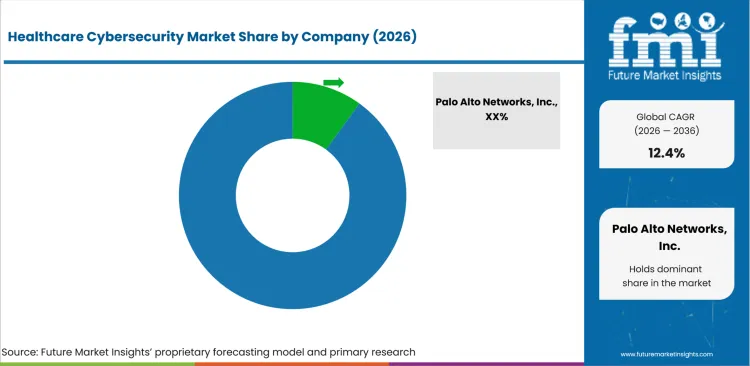
The field is fragmented across platforms, specialists and managed-security providers. Entry depends on clinical integration, older-device support and recovery evidence.
- Palo Alto Networks, Cisco and Fortinet combine network enforcement with cloud operations coverage.
- CrowdStrike, Microsoft and Trend Micro connect endpoint, identity and cloud telemetry within investigations.
- Check Point and Sophos pair integrated prevention with managed response for hospitals lacking specialist teams.
Competitive Benchmarking: Healthcare Cybersecurity Market
| Company | Network & Cloud | Endpoint & Identity | Security Operations | Geographic Reach |
|---|---|---|---|---|
| Palo Alto Networks, Inc. | High | High | High | Global |
| Cisco Systems, Inc. | High | High | High | Global |
| Fortinet, Inc. | High | High | High | Global |
| CrowdStrike Holdings, Inc. | Medium | High | High | Global |
| Microsoft Corporation | High | High | High | Global |
| Check Point Software Technologies Ltd. | High | Medium | High | Global |
| Trend Micro Incorporated | High | High | High | Global |
| Sophos Ltd. | Medium | High | High | Global |
Scoring basis: High requires three documented capabilities, Medium requires two and Low requires one. Criteria cover network and cloud, endpoint and identity, security operations and geographic reach.
Key Developments in the Healthcare Cybersecurity Market
- In March 2026, CrowdStrike extended Falcon for XIoT to medical devices with clinical-protocol and exposure workflows.
- In March 2025, Palo Alto Networks introduced guided virtual patching for medical IoT devices during delayed maintenance.
- In March 2025, Microsoft reported more than 550 rural hospitals receiving assessments, training and technology access.
Key Players in the Healthcare Cybersecurity Market
Security Platforms
- Palo Alto Networks, Inc.
- Cisco Systems, Inc.
- Fortinet, Inc.
- Check Point Software Technologies Ltd.
Endpoint and Operations Platforms
- CrowdStrike Holdings, Inc.
- Microsoft Corporation
- Trend Micro Incorporated
Managed Security Services
- Sophos Ltd.
Healthcare Cybersecurity Market - Report Scope
| Coverage field | Report scope |
|---|---|
| Market breakdown | By component, deployment, application, end user, security type and region. |
| Quantitative Units | Revenue in USD billion and CAGR in %. |
| Market Definition | Software, services, hardware and analytics protecting healthcare data, applications, devices and infrastructure. |
| Regions Covered | North America, Latin America, Europe, East Asia, South Asia and Pacific, and Middle East and Africa. |
| Countries Covered | Japan, United Kingdom, United States, France, Germany, and 20+ countries included in the full report. |
| Key Companies Profiled | Palo Alto Networks, Inc.; Cisco Systems, Inc.; Fortinet, Inc.; CrowdStrike Holdings, Inc.; Microsoft Corporation; Check Point Software Technologies Ltd.; Trend Micro Incorporated; Sophos Ltd. |
| Forecast Period | 2026 to 2036. |
| Approach | Primary and secondary research with market triangulation. |
Healthcare Cybersecurity Market - Research Methodology
| Method | Approach |
|---|---|
| Primary Research | FMI analysts gathered input from manufacturers, service providers, technology developers, distributors, end users, procurement teams, and subject-matter experts. Interviews examined purchasing decisions, product or service evaluation, adoption barriers, approval requirements, pricing considerations, and expectations for technical or commercial support. Respondents were also asked what evidence is required before a trial, pilot, or initial order develops into regular purchasing. |
| Desk Research | Desk research covered government statistics, regulatory publications, trade data, industry associations, technical literature, standards, company filings, product information, and official corporate announcements. Sources were reviewed for relevance, publication date, geographic coverage, and consistency with the defined market scope. Claims relating to performance, applications, approvals, capacity, investment, and commercial activity were retained only when supported by credible public evidence. |
| Market Sizing and Forecasting | The market model combined the baseline value with historical performance, segment structure, pricing and volume indicators, adoption levels, company participation, and country-level demand conditions. Forecast assumptions considered economic activity, investment trends, regulatory developments, technology adoption, purchasing cycles, supply availability, and barriers to wider market use. Segment and regional estimates were reconciled before the final market total was calculated. |
| Data Validation | Estimates were checked against multiple independent indicators, including public data, company activity, trade patterns, industry developments, and findings from primary interviews. Validation also tested whether products, services, applications, and company revenues fell within the defined market boundaries. Adjacent categories, unsupported claims, overlapping revenues, and activities without direct market relevance were excluded to reduce double counting and maintain consistency across segments and countries. |
Healthcare Cybersecurity Market by Segments
Healthcare Cybersecurity Market segmented by Component:
- Software
- Endpoint Security Software
- Identity & Access Management Software
- Security Information & Event Management Platforms
- Services
- Managed Security Services
- Consulting Services
- Incident Response Services
- Hardware
- Network Security Appliances
- Hardware Security Modules
- Secure Access Gateways
- Security Analytics & Intelligence
- Threat Intelligence Platforms
- Security Analytics
- Risk & Compliance Management
Healthcare Cybersecurity Market segmented by Deployment:
- Cloud-based Security
- Public Cloud Security
- Private Cloud Security
- Hybrid Cloud Security
- On-premise Security
- Data Center Security
- Local Healthcare Networks
- Enterprise Security Infrastructure
- Hybrid Deployment
- Multi-cloud Security
- Edge Security
- Container Security
Healthcare Cybersecurity Market segmented by Application:
- Network Security
- Firewall Management
- Intrusion Detection & Prevention
- Network Traffic Monitoring
- Endpoint & Device Security
- Medical Device Security
- Workstation Protection
- Mobile Device Security
- Identity & Access Management
- Multi-factor Authentication
- Privileged Access Management
- Single Sign-on
- Data Protection & Compliance
- Data Encryption
- Data Loss Prevention
- Regulatory Compliance Management
Healthcare Cybersecurity Market segmented by End User:
- Healthcare Providers
- Hospitals
- Ambulatory Care Centers
- Clinics
- Healthcare Payers
- Health Insurance Companies
- Third-party Administrators
- Public Health Agencies
- Life Sciences Companies
- Pharmaceutical Companies
- Biotechnology Companies
- Clinical Research Organizations
Healthcare Cybersecurity Market segmented by Security Type:
- Cloud Security
- Cloud Workload Protection
- Cloud Access Security Broker
- Cloud Security Posture Management
- Application Security
- Web Application Security
- API Security
- Application Vulnerability Testing
- Infrastructure Security
- Email Security
- Database Security
- Operational Technology Security
Healthcare Cybersecurity Market by Region:
- North America
- United States
- Canada
- Latin America
- Brazil
- Chile
- Mexico
- Rest of Latin America
- Western Europe
- Germany
- United Kingdom
- Italy
- Spain
- France
- Nordics
- Benelux
- Rest of Western Europe
- Eastern Europe
- Russia
- Poland
- Hungary
- Balkan and Baltic States
- Rest of Eastern Europe
- East Asia
- China
- Japan
- South Korea
- South Asia and Pacific
- India
- ASEAN
- Australia and New Zealand
- Rest of South Asia and Pacific
- Middle East and Africa
- Kingdom of Saudi Arabia
- Other GCC Countries
- Türkiye
- South Africa
- Other African Union Countries
- Rest of Middle East and Africa
Research Sources and Bibliography
- HHS. (2024, December 27). HIPAA Security Rule NPRM.
- MHLW. (2026, May 29).
- MHLW. (2026, June).
- DSIT and Home Office. (2026, April 30). Cyber security breaches survey 2025/2026.
- HHS. (2026, April 23). HHS’ Office for Civil Rights Settles Four HIPAA Security Rule Ransomware Investigations.
- CERT Santé. (2026, May 11). L’Observatoire des incidents.
- Federal Office for Information Security. (2025, February 10). SiKIS Abschlussbericht.
- CrowdStrike. (2026, March 9). Falcon for XIoT Extends Asset Protection to Healthcare Environments.
- Palo Alto Networks. (2025, March 31). Securing Healthcare Lifelines with Medical IoT Security.
- Microsoft. (2025, March 5). Enhancing cybersecurity for rural health resilience.
This bibliography is provided for reader reference and is not exhaustive. The full report contains the complete reference list and detailed citations
This Report Answers
- What is the projected value of the global Healthcare Cybersecurity market by 2036?
- Which cybersecurity risks, threats, and compliance requirements are driving healthcare organizations to increase cybersecurity spending?
- Why does the software segment hold the largest share of the Healthcare Cybersecurity market?
- How does cloud-based deployment transform cybersecurity operations, scalability, and threat management in healthcare environments?
- Why does network security account for the leading share of market demand?
- How do market growth trends, investment patterns, and adoption pathways differ across key countries?
- Which leading companies provide cybersecurity solutions and services for the healthcare sector?
- What operational, budgetary, and technical challenges limit clinical remediation and cybersecurity modernization efforts?
Frequently Asked Questions
How big is the Healthcare Cybersecurity Market in 2026?
The healthcare cybersecurity market is valued at USD 27.8 billion in 2026 and is projected to reach USD 89.5 billion by 2036. Growth is driven by the rising need to protect healthcare data, connected medical devices, and critical clinical operations.
What is the CAGR of the Healthcare Cybersecurity Market from 2026 to 2036?
The healthcare cybersecurity market is expected to grow at a CAGR of 12.4% between 2026 and 2036. Increasing cyber threats and greater investment in security infrastructure continue to support market expansion.
Which component holds 49.0% of the Healthcare Cybersecurity Market?
Software is projected to account for 49.0% of the market in 2026. Demand is driven by the need for endpoint protection, identity management, threat detection, and security monitoring solutions.
Which security type holds 34.0% of the Healthcare Cybersecurity Market?
Cloud security is expected to hold 34.0% of the market in 2026. Growing adoption of cloud-based healthcare platforms is increasing demand for secure access controls, data protection, and workload security.
Which companies are active in the Healthcare Cybersecurity Market?
Key players in the healthcare cybersecurity market include Palo Alto Networks, Cisco, Fortinet, CrowdStrike, Microsoft, Check Point, Trend Micro and Sophos across network, cloud, endpoint, identity and managed-security roles.
Preview the report firsthand - request a free sample
Get SampleGet the brochure for pricing and purchase details.
Get PDFTable of Content
- Key Takeaways
- Market Size and CAGR
- Top Growth Driver
- Fastest Growing Segment
- Leading Region
- Key Companies
- Emerging Opportunities
- Executive Summary
- Global Market Outlook
- Demand-side Trends
- Supply-side Trends
- Technology Roadmap Analysis
- Analysis and Recommendations
- Analyst Perspective (What is happening? Why now? What should investors know?)
- Key Questions Answered
- How large is the market?
- What is the CAGR?
- What are key trends?
- Which region dominates?
- Who are the leaders?
- Market Overview
- Market Coverage / Taxonomy
- Market Definition / Scope / Limitations
- Research Methodology
- Chapter Orientation
- Analytical Lens and Working Hypotheses
- Market Structure, Signals, and Trend Drivers
- Benchmarking and Cross-market Comparability
- Market Sizing, Forecasting, and Opportunity Mapping
- Research Design and Evidence Framework
- Desk Research Programme (Secondary Evidence)
- Expert Input and Fieldwork (Primary Evidence)
- Tooling, Models, and Reference Databases
- Data Engineering and Model Build
- Quality Assurance and Audit Trail
- Market Background
- Market Dynamics (Drivers, Restraints, Opportunity, Trends)
- Scenario Forecast (Optimistic, Likely, Conservative)
- Impact Analysis
- AI Impact
- Sustainability Impact
- Regulatory Impact
- Technology Impact
- Consumer / Buyer Analysis
- Purchase Drivers
- Adoption Barriers
- Buyer Journey
- Opportunity Map Analysis
- Product Life Cycle Analysis
- Supply Chain Analysis
- Investment Feasibility Matrix
- Value Chain Analysis
- PESTLE and Porter's Analysis
- Regulatory Landscape
- Regional Parent Market Outlook
- Production and Consumption Statistics
- Import and Export Statistics
- Global Market Analysis and Forecast, 2021 to 2036
- Historical Market Size Value (USD Billion) Analysis, 2021 to 2025
- Current and Future Market Size Value (USD Billion) Projections, 2026 to 2036
- Y-o-Y Growth Trend Analysis
- Absolute $ Opportunity Analysis
- Global Market Pricing Analysis, 2021 to 2036
- Global Market Analysis and Forecast, By Component, 2021 to 2036
- Introduction / Key Findings
- Historical Market Size Value (USD Billion) Analysis By Component, 2021 to 2025
- Current and Future Market Size Value (USD Billion) Analysis and Forecast By Component, 2026 to 2036
- Software
- Endpoint Security Software
- Identity & Access Management Software
- Security Information & Event Management Platforms
- Services
- Managed Security Services
- Consulting Services
- Incident Response Services
- Hardware
- Network Security Appliances
- Hardware Security Modules
- Secure Access Gateways
- Security Analytics & Intelligence
- Threat Intelligence Platforms
- Security Analytics
- Risk & Compliance Management
- Software
- Y-o-Y Growth Trend Analysis By Component, 2021 to 2025
- Absolute $ Opportunity Analysis By Component, 2026 to 2036
- Global Market Analysis and Forecast, By Deployment, 2021 to 2036
- Introduction / Key Findings
- Historical Market Size Value (USD Billion) Analysis By Deployment, 2021 to 2025
- Current and Future Market Size Value (USD Billion) Analysis and Forecast By Deployment, 2026 to 2036
- Cloud-based Security
- Public Cloud Security
- Private Cloud Security
- Hybrid Cloud Security
- On-premise Security
- Data Center Security
- Local Healthcare Networks
- Enterprise Security Infrastructure
- Hybrid Deployment
- Multi-cloud Security
- Edge Security
- Container Security
- Cloud-based Security
- Y-o-Y Growth Trend Analysis By Deployment, 2021 to 2025
- Absolute $ Opportunity Analysis By Deployment, 2026 to 2036
- Global Market Analysis and Forecast, By Application, 2021 to 2036
- Introduction / Key Findings
- Historical Market Size Value (USD Billion) Analysis By Application, 2021 to 2025
- Current and Future Market Size Value (USD Billion) Analysis and Forecast By Application, 2026 to 2036
- Network Security
- Firewall Management
- Intrusion Detection & Prevention
- Network Traffic Monitoring
- Endpoint & Device Security
- Medical Device Security
- Workstation Protection
- Mobile Device Security
- Identity & Access Management
- Multi-factor Authentication
- Privileged Access Management
- Single Sign-on
- Data Protection & Compliance
- Data Encryption
- Data Loss Prevention
- Regulatory Compliance Management
- Network Security
- Y-o-Y Growth Trend Analysis By Application, 2021 to 2025
- Absolute $ Opportunity Analysis By Application, 2026 to 2036
- Global Market Analysis and Forecast, By End User, 2021 to 2036
- Introduction / Key Findings
- Historical Market Size Value (USD Billion) Analysis By End User, 2021 to 2025
- Current and Future Market Size Value (USD Billion) Analysis and Forecast By End User, 2026 to 2036
- Healthcare Providers
- Hospitals
- Ambulatory Care Centers
- Clinics
- Healthcare Payers
- Health Insurance Companies
- Third-party Administrators
- Public Health Agencies
- Life Sciences Companies
- Pharmaceutical Companies
- Biotechnology Companies
- Clinical Research Organizations
- Healthcare Providers
- Y-o-Y Growth Trend Analysis By End User, 2021 to 2025
- Absolute $ Opportunity Analysis By End User, 2026 to 2036
- Global Market Analysis and Forecast, By Security Type, 2021 to 2036
- Introduction / Key Findings
- Historical Market Size Value (USD Billion) Analysis By Security Type, 2021 to 2025
- Current and Future Market Size Value (USD Billion) Analysis and Forecast By Security Type, 2026 to 2036
- Cloud Security
- Cloud Workload Protection
- Cloud Access Security Broker
- Cloud Security Posture Management
- Application Security
- Web Application Security
- API Security
- Application Vulnerability Testing
- Infrastructure Security
- Email Security
- Database Security
- Operational Technology Security
- Cloud Security
- Y-o-Y Growth Trend Analysis By Security Type, 2021 to 2025
- Absolute $ Opportunity Analysis By Security Type, 2026 to 2036
- Global Market Analysis and Forecast, By Region, 2021 to 2036
- Introduction
- Historical Market Size Value (USD Billion) Analysis By Region, 2021 to 2025
- Current Market Size Value (USD Billion) Analysis and Forecast By Region, 2026 to 2036
- North America
- Latin America
- Western Europe
- Eastern Europe
- East Asia
- South Asia and Pacific
- Middle East & Africa
- Market Attractiveness Analysis By Region
- North America Market Analysis and Forecast, By Country, 2021 to 2036
- Historical Market Size Value (USD Billion) Trend Analysis By Market Taxonomy, 2021 to 2025
- Market Size Value (USD Billion) Forecast By Market Taxonomy, 2026 to 2036
- By Country
- USA
- Canada
- By Component
- By Deployment
- By Application
- By End User
- By Security Type
- By Country
- Market Attractiveness Analysis
- By Country
- By Component
- By Deployment
- By Application
- By End User
- By Security Type
- Key Takeaways
- Latin America Market Analysis and Forecast, By Country
- Historical Market Size Value (USD Billion) Trend Analysis By Market Taxonomy, 2021 to 2025
- Market Size Value (USD Billion) Forecast By Market Taxonomy, 2026 to 2036
- By Country
- Brazil
- Mexico
- Chile
- Rest of Latin America
- By Component
- By Deployment
- By Application
- By End User
- By Security Type
- By Country
- Market Attractiveness Analysis
- By Country
- By Component
- By Deployment
- By Application
- By End User
- By Security Type
- Key Takeaways
- Western Europe Market Analysis and Forecast, By Country
- Historical Market Size Value (USD Billion) Trend Analysis By Market Taxonomy, 2021 to 2025
- Market Size Value (USD Billion) Forecast By Market Taxonomy, 2026 to 2036
- By Country
- Germany
- UK
- Italy
- Spain
- France
- Nordic
- BENELUX
- Rest of Western Europe
- By Component
- By Deployment
- By Application
- By End User
- By Security Type
- By Country
- Market Attractiveness Analysis
- By Country
- By Component
- By Deployment
- By Application
- By End User
- By Security Type
- Key Takeaways
- Eastern Europe Market Analysis and Forecast, By Country
- Historical Market Size Value (USD Billion) Trend Analysis By Market Taxonomy, 2021 to 2025
- Market Size Value (USD Billion) Forecast By Market Taxonomy, 2026 to 2036
- By Country
- Russia
- Poland
- Hungary
- Balkan & Baltic
- Rest of Eastern Europe
- By Component
- By Deployment
- By Application
- By End User
- By Security Type
- By Country
- Market Attractiveness Analysis
- By Country
- By Component
- By Deployment
- By Application
- By End User
- By Security Type
- Key Takeaways
- East Asia Market Analysis and Forecast, By Country
- Historical Market Size Value (USD Billion) Trend Analysis By Market Taxonomy, 2021 to 2025
- Market Size Value (USD Billion) Forecast By Market Taxonomy, 2026 to 2036
- By Country
- China
- Japan
- South Korea
- By Component
- By Deployment
- By Application
- By End User
- By Security Type
- By Country
- Market Attractiveness Analysis
- By Country
- By Component
- By Deployment
- By Application
- By End User
- By Security Type
- Key Takeaways
- South Asia and Pacific Market Analysis and Forecast, By Country
- Historical Market Size Value (USD Billion) Trend Analysis By Market Taxonomy, 2021 to 2025
- Market Size Value (USD Billion) Forecast By Market Taxonomy, 2026 to 2036
- By Country
- India
- ASEAN
- Australia & New Zealand
- Rest of South Asia and Pacific
- By Component
- By Deployment
- By Application
- By End User
- By Security Type
- By Country
- Market Attractiveness Analysis
- By Country
- By Component
- By Deployment
- By Application
- By End User
- By Security Type
- Key Takeaways
- Middle East & Africa Market Analysis and Forecast, By Country
- Historical Market Size Value (USD Billion) Trend Analysis By Market Taxonomy, 2021 to 2025
- Market Size Value (USD Billion) Forecast By Market Taxonomy, 2026 to 2036
- By Country
- Kingdom of Saudi Arabia
- Other GCC Countries
- Türkiye
- South Africa
- Other African Union
- Rest of Middle East & Africa
- By Component
- By Deployment
- By Application
- By End User
- By Security Type
- By Country
- Market Attractiveness Analysis
- By Country
- By Component
- By Deployment
- By Application
- By End User
- By Security Type
- Key Takeaways
- Key Countries Market Analysis
- USA
- Pricing Analysis
- Market Share Analysis, 2025
- By Component
- By Deployment
- By Application
- By End User
- By Security Type
- Canada
- Pricing Analysis
- Market Share Analysis, 2025
- By Component
- By Deployment
- By Application
- By End User
- By Security Type
- Mexico
- Pricing Analysis
- Market Share Analysis, 2025
- By Component
- By Deployment
- By Application
- By End User
- By Security Type
- Brazil
- Pricing Analysis
- Market Share Analysis, 2025
- By Component
- By Deployment
- By Application
- By End User
- By Security Type
- Chile
- Pricing Analysis
- Market Share Analysis, 2025
- By Component
- By Deployment
- By Application
- By End User
- By Security Type
- Germany
- Pricing Analysis
- Market Share Analysis, 2025
- By Component
- By Deployment
- By Application
- By End User
- By Security Type
- UK
- Pricing Analysis
- Market Share Analysis, 2025
- By Component
- By Deployment
- By Application
- By End User
- By Security Type
- Italy
- Pricing Analysis
- Market Share Analysis, 2025
- By Component
- By Deployment
- By Application
- By End User
- By Security Type
- Spain
- Pricing Analysis
- Market Share Analysis, 2025
- By Component
- By Deployment
- By Application
- By End User
- By Security Type
- France
- Pricing Analysis
- Market Share Analysis, 2025
- By Component
- By Deployment
- By Application
- By End User
- By Security Type
- India
- Pricing Analysis
- Market Share Analysis, 2025
- By Component
- By Deployment
- By Application
- By End User
- By Security Type
- ASEAN
- Pricing Analysis
- Market Share Analysis, 2025
- By Component
- By Deployment
- By Application
- By End User
- By Security Type
- Australia & New Zealand
- Pricing Analysis
- Market Share Analysis, 2025
- By Component
- By Deployment
- By Application
- By End User
- By Security Type
- China
- Pricing Analysis
- Market Share Analysis, 2025
- By Component
- By Deployment
- By Application
- By End User
- By Security Type
- Japan
- Pricing Analysis
- Market Share Analysis, 2025
- By Component
- By Deployment
- By Application
- By End User
- By Security Type
- South Korea
- Pricing Analysis
- Market Share Analysis, 2025
- By Component
- By Deployment
- By Application
- By End User
- By Security Type
- Russia
- Pricing Analysis
- Market Share Analysis, 2025
- By Component
- By Deployment
- By Application
- By End User
- By Security Type
- Poland
- Pricing Analysis
- Market Share Analysis, 2025
- By Component
- By Deployment
- By Application
- By End User
- By Security Type
- Hungary
- Pricing Analysis
- Market Share Analysis, 2025
- By Component
- By Deployment
- By Application
- By End User
- By Security Type
- Kingdom of Saudi Arabia
- Pricing Analysis
- Market Share Analysis, 2025
- By Component
- By Deployment
- By Application
- By End User
- By Security Type
- Türkiye
- Pricing Analysis
- Market Share Analysis, 2025
- By Component
- By Deployment
- By Application
- By End User
- By Security Type
- South Africa
- Pricing Analysis
- Market Share Analysis, 2025
- By Component
- By Deployment
- By Application
- By End User
- By Security Type
- USA
- Market Structure Analysis
- Competition Dashboard
- Competition Benchmarking
- Market Share Analysis of Top Players
- By Regional
- By Component
- By Deployment
- By Application
- By End User
- By Security Type
- Emerging Startups
- Innovation Benchmarking
- Competition Analysis
- Competition Deep Dive
- Palo Alto Networks, Inc.
- Overview
- Product Portfolio
- Profitability by Market Segments
- Sales Footprint
- Strategy Overview
- Marketing Strategy
- Product Strategy
- Channel Strategy
- Cisco Systems, Inc.
- Fortinet, Inc.
- CrowdStrike Holdings, Inc.
- Microsoft Corporation
- Check Point Software Technologies Ltd.
- Trend Micro Incorporated
- Broadcom Inc.
- IBM Corporation
- Sophos Ltd.
- Palo Alto Networks, Inc.
- Case Studies
- Success Stories
- Recent Developments
- Competition Deep Dive
- Assumptions & Acronyms Used


